“She’s just a disabled girl” They Sneered—Until the Navy SEAL’s K9 Recognized the One Who Saved Him – Part 5
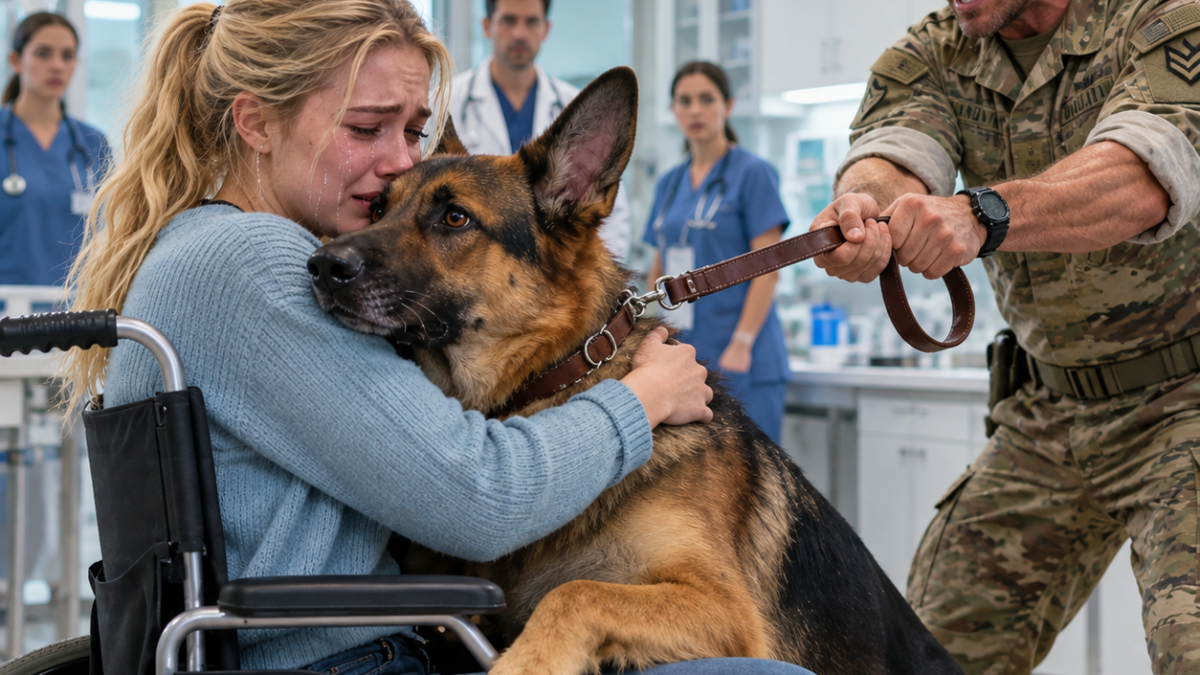
Are you staying? She stayed. H January arrived with 2 ft of snow and a cold that locked the valley in for 3 weeks and made the drive to the clinic an exercise in patience and four-wheel drive.
Gerald switched to a different van with better traction without being asked. Amelia started keeping extra gloves in her bag and a small ice scraper attached to the side of her chair for the ramp, which still got icy despite the salt because Montana and January operated on its own terms.
Rex had a winter coat. Logan had ordered it without mentioning it, and it had appeared one Tuesday morning, a quilted black vest that fit over his broad shoulders and chest, with a handle on the back for the occasions that required it.
Rex had tolerated the fitting process with stoic dignity, and then worn the coat everywhere, including on one memorable occasion into the grocery store on Main Street, when Amelia had stopped there on the way home, and Rex had apparently decided that entry was non-negotiable. Nobody at the grocery store said anything.
She suspected the coat helped.
Also, Rex’s expression, which remained professionally neutral at all times, regardless of context.
The 90-day review was completed the second week of January. Dr.
Flores had attended with Voss, and Sandra had presented the accumulated documentation, and the independent evaluation had confirmed what the session notes had been building toward for 3 months. The standing tolerance was at 4 minutes sustained. The ankle dorsif flexion was consistent and reproducible.
The proprioceptive return in the left leg had progressed to the point where Sandra had begun introducing balance board work, which was not a thing she introduced to patients who weren’t ready for it.
Flores had read Voss’s summary and looked at Amelia and said, “Doctor Holt’s assessment was incorrect.
Not his methodology was flawed or the data presents a different picture. Incorrect.
Clean and clear.”
“Yes,” Amelia said.
I want to continue at the current intensity and add the balance work formally to your protocol.
Flores had a directness similar to Voss’s, warmer in temperature but equally precise.
And I want to talk about a six-month milestone evaluation.
Not to make promises, Besson, but to establish a formal baseline for where we’re headed.
What baseline are you thinking? Amelia asked.
Assassed ambulation, Flores said. Parallel bars bracing full support.
Whether that’s a goal that’s achievable by month 13 depends on a lot of variables we can’t control, but I think it’s a goal worth having on the table.
The room was quiet. Sandra was looking at her notes. Voss was looking at her laptop.
Neither of them was looking at Amelia, which she suspected was deliberate, giving her room to have whatever reaction she was going to have without an audience for it. What she had was not a reaction she had a name for.
It wasn’t joy exactly or relief.
It was something more structural than that. Something that rearranged rather than arrived.
Like a room she’d been living in for a long time, suddenly having a window she hadn’t known was there.
“Okay,” she said.
“Let’s put it on the table.”
She told Logan that evening. They were in the parking lot after a late session, which had become a habit.
The slow decompression before Gerald arrived, the cold air and the parking lot lights, and Rex moving between them in the casual way he did when he was off duty, investigating the lot’s perimeter with the professional interest of a being who never fully clocked out.
Parallel bars, Logan said. 6 months, maybe.
A lot of variables, but they’re talking about it.
They’re talking about it.
He was quiet for a moment. The parking lot light caught the frost on the asphalt, making it bright. Rex came back from the perimeter and sat between them.
“How do you feel about that?”
Logan asked.
“Terrified,” she said immediately.
“And I don’t know the other thing.
” “Yeah, I’ve been in this chair for 18 months.
Parallel bars in 6 months.
Even if it works, that’s not the end of anything.
That’s just the next thing,” he said.
“The next thing,” she said.
and then the thing after that for a long time probably.
Yeah, he said that’s how it works.
She looked at him.
Is that how it’s working for you?
He’d had two pieces of news in the last week that he’d told her about separately with the matter-of-act delivery he gave all information.
The shoulder was at 70% ahead of the projected timeline, which the surgeon had attributed to the PT and what she suspected was also Logan’s specific relationship with physical discipline.
And the Navy had sent a letter, a formal letter, the kind that required a response, asking him to consider a training and assessment role at a facility in Virginia attached to the MWD program there.
It wasn’t the field, but it was the work.
I’m thinking about it, he said.
Virginia’s not Willow Creek.
No, he said.
It’s not.
Rex looked up at him, then at her, then back at the middle distance, where something had apparently captured his professional attention. I told them I need 60 days, Logan said. To make a decision.
60 days is spring, she said. Yes.
She looked at the ridge dark against the sky.
It’s a good opportunity.
It’s a complicated opportunity.
Those are sometimes the same thing.
He looked at her with the specific directness he’d had since the first day.
That quality of actually looking, not performing looking. Yeah, he said.
I’m figuring that out.
Rex stood up and pushed his shoulder against Amelia’s wheel, which was the gesture she’d come to understand meant enough of this.
Let’s go.
She put her hand on his back. 60 days, she said.
60 days, he said. M.
Spring came late to Willow Creek. The snow in the valley held through most of March, and the clinic parking lot was a muddy disaster for 2 weeks in April, while the frost worked its way out of the ground.
The ridge turned green from the top down, which was backwards from how she’d always thought of seasons moving.
But it was apparently the elevation doing it, the warmth hitting the high ground first and working its way toward the valley. She was at the parallel bars on a Tuesday in the second week of April.
It had taken 11 months total. One month past the six-month milestone Flores had put on the table, which Flores had noted, without apology, was still ahead of most projections for a T6 incomplete at her level of function. The bars were in a dedicated room off the main PT wing, a small room with a mirror along one wall and mats on the floor, and the specific energy of a space where effort happened.
Sandra was on her left. Flores was on her right.
Rex was at the end of the bars sitting, waiting with the particular quality of attention he brought to things he had decided were important. Logan was in the doorway.
She’d asked him not to be in the room.
She wanted fewer people, fewer variables, fewer eyes.
He’d accepted that with a single nod and taken his position in the doorway, which was technically not in the room, and she had decided not to argue the distinction.
She positioned her hands on the bars.
She’d done this in simulation.
Had practiced the grip, the angle, the weight distribution, but simulation was a different conversation than the real thing, and the real thing was telling her clearly how much it intended to require from her. Her arms were strong. Seven months of pushing her own wheels had made them strong in specific ways and the standing framework had built on that and she was as prepared for this as 11 months of preparation made a person which was not the same as ready.
Take your time, Sandra said. She pressed. The world reorganized around a new axis.
Her arms took the load first.
Both hands on the bars, elbows finding the angle, shoulders locking into the position she’d practiced.
Then her hips rising from the chair, the motion controlled and deliberate and expensive in a way that made every other thing she’d done in the last 11 months feel like a negotiation with a body that was now honoring the negotiation.
Her feet found the floor, both of them at the same time, with the weight of her on them, partial, supported, imperfect, real. She stood, not fully upright. Her posture needed the bars.
Her legs were shaking. Her right ankle was making its own decisions about how much it wanted to cooperate, and it was a somewhat inconsistent partner. She was tilted slightly left.
Sandra’s hand was at her elbow, not supporting, just present, a contact point.
But she was standing.
The mirror showed her a woman she didn’t entirely recognize.
Not because she looked different, but because the angle was, the elevation. She was used to seeing the world from a position that the world was not designed for.
That required constant navigation. That produced a specific and exhausting gap between what was and what was built for someone else.
And now she was at a different height. And the mirror showed her at a different height. And the room looked different.
And she understood in a way she hadn’t been able to understand until she was inside it how much that gap had cost.
Sandra said, “10 seconds.
Count with me.”
She counted. Rex at the end of the bars was perfectly still. Not the professional stillness of a working dog in a neutral environment.
Something else. a quality of attention so focused it was almost visible, like something in him was counting, too. 10 seconds.
She sat back down. Her arms were shaking, her legs were shaking.
She was breathing like she’d run a mile, which was an absurd physiological response to 10 seconds of standing and also completely accurate.
“Good,” Sandra said.
“Just that.”
Flores made a note.
We’ll build from here.
Amelia nodded.
She didn’t trust her voice right now, not because she was going to cry, though she was in the vicinity of it, but because what was in her chest was large enough that it needed some time before it would fit through a sentence.
Rex got up from the end of the bars and walked to her. He put his head in her lap. The full weight of it, the way he always did, not asking, not offering, just claiming the proximity that he had apparently decided somewhere between a drainage ditch and a lobby.
and 11 months of PT was where he was supposed to be. She put her hands on his ears. Logan was in the doorway.
He was not doing anything dramatic.
He was standing there with his arms at his sides and his face doing the specific thing it did when he was feeling something he didn’t have operational vocabulary for, which she had learned to read across the months as its own kind of eloquence.
60 days were up 3 weeks ago, she said. They were.
He said, “Virginia.”
I told them I needed more time. She looked at him. Logan, I know.
It’s a good opportunity.
I know that, too. He came into the room, sat on the edge of the mat. Rex turned his head to look at him, and then turned it back to Amelia.
I called them last week, asked if the position was still open. She waited.
It is, he said.
They said they’d hold it through summer.
through summer, which gives me time to see how the next phase goes.”
He said it with the careful, qualified precision of a man who had learned the hard way not to promise outcomes he couldn’t guarantee.
“Yours and mine.”
She understood what he meant by both.
“That’s not a plan,” she said.
“No,” he said.
“It’s a direction.”
Rex’s tail moved.
The program started with a phone call to Carol in May. Amelia had been thinking about it since February, not planning exactly, more like a shape slowly assembling itself from available materials.
Carol had listened to the whole idea on the phone with the quiet, focused attention she brought to things that mattered.
And when Amelia finished, there was a pause and then Carol said, “You need a space.”
“I need a space,” Amelia said.
“The old Mitchell building on fourth ground floor has been empty for 2 years.”
“I know the building.
I know the owner.
The program didn’t have an official name until June.
It operated in the first months out of a single groundfloor room in the Mitchell building with donated folding chairs and a borrowed mat and a schedule that ran Tuesday and Thursday afternoons. It was not, Amelia was careful to clarify from the beginning, a medical program. It was a peer support and resources group connecting people with disabilities navigating the rehabilitation system with information, advocacy, and each other.
The first session had seven people.
Two were former clinic patients she’d met at Bridger.
One was a man Carol knew from her quilting group whose wife had had a stroke.
Two were people who had found the flyer she’d posted at the library.
One was Sandra, who came not as a clinician, but because she wanted to, and sat in a folding chair and listened. One was Dale.
He came in with his knee brace and his paper cup of coffee and sat in the corner and said nothing for the first 40 minutes.
And then when someone in the room said they were afraid their doctor wasn’t actually listening to them, said, “You have to make them listen.
You have to say specifically what you need and then not let them change the subject.”
Amelia looked at him across the room. He shrugged.
“Learned that the hard way.”
Rex was at her side throughout.
“Not a service animal now,” Basi.
not officially, not in the working sense, but present in the way he’d been present since the beginning, positioned with the quiet authority of a being that had decided the space required monitoring, and had assumed the role without waiting to be assigned it.
She had not, she would tell people later, planned any of this. She had not planned the program, had not planned the clinic fight, had not planned for a retired military dog to walk into a PT wing and remember her from a ditch in the rain. Plans were different from directions.
Directions were different from decisions.
What she had decided somewhere in 11 months and parallel bars and 43 seconds of felt pressure against a floor was that the specific knowledge she’d accumulated about navigating systems about advocating for yourself when the system would rather you didn’t about what it cost and what it built was not knowledge
that should stop with her.
She didn’t have a theory about that.
She just had the Tuesday and Thursday sessions and the folding chairs and the donated mat and Rex at her side and the slowly growing list of people who had found their way to the ground floor of the Mitchell building because they needed to be in a room where someone understood the specific weight of what they were carrying. Logan came to the third session. He sat in the back.
He didn’t say anything.
At the end, when people were getting up and gathering their things, he caught her eye across the room and nodded once. The acknowledgement, not the question. The expression of a man who had assessed something and found it confirmed a prior judgment.
Afterward, in the parking lot, he said, “You’re good at this.”
“I don’t know what I’m doing,” she said.
“Nobody does at the start.”
He held both coffees, handed her one.
That’s not the same as not being good at it.
Rex was investigating the parking lot’s eastern boundary with professional interest.
“Virginia called again,” Logan said.
She looked at him.
I’m going to give them an answer by August, he said.
Whatever the answer is. Okay, she said.
Okay, he said. They stood in the parking lot in the early June warmth, the valley finally green, the ridge catching the last of the afternoon light, and Rex came back from the perimeter and sat between them and looked at nothing in particular.
And the three of them were quiet for a while in the way that required nothing from any of them. She thought about a rainy roadside and a drainage ditch and a small wet shape in the beam of her headlights.
She thought about a lobby and a corridor and a letter on clinic letterhead and 43 seconds of floor pushing back against her foot. She thought about parallel bars and a mirror and the world seen from a different height and about what it meant that it had taken all of those things together.
Not any one of them, all of them to arrive at this particular parking lot on this particular evening.
You didn’t get to choose the things that shaped you.
You got to choose what you did with what they made. Rex pressed his shoulder against her wheel. She put her hand on his back.
The light moved down the ridge.
To everyone watching this story from wherever you are in the world, whatever weight you’re carrying right now, whatever room you’re in that wasn’t built for you, whatever voice has told you that your timeline is too slow or your ceiling is too low, the floor pushes back.
Not always when you want it to, not always the way you expect. But if you keep showing up, if you keep pressing, it pushes back.
And sometimes the thing that remembers who you are walks back to you through a door you stopped expecting to open.
Don’t stop showing up.

