“SHE’S JUST A NURSE” — Then She Calmed the K9 That 6 HANDLERS Couldn’t Move – Part 2
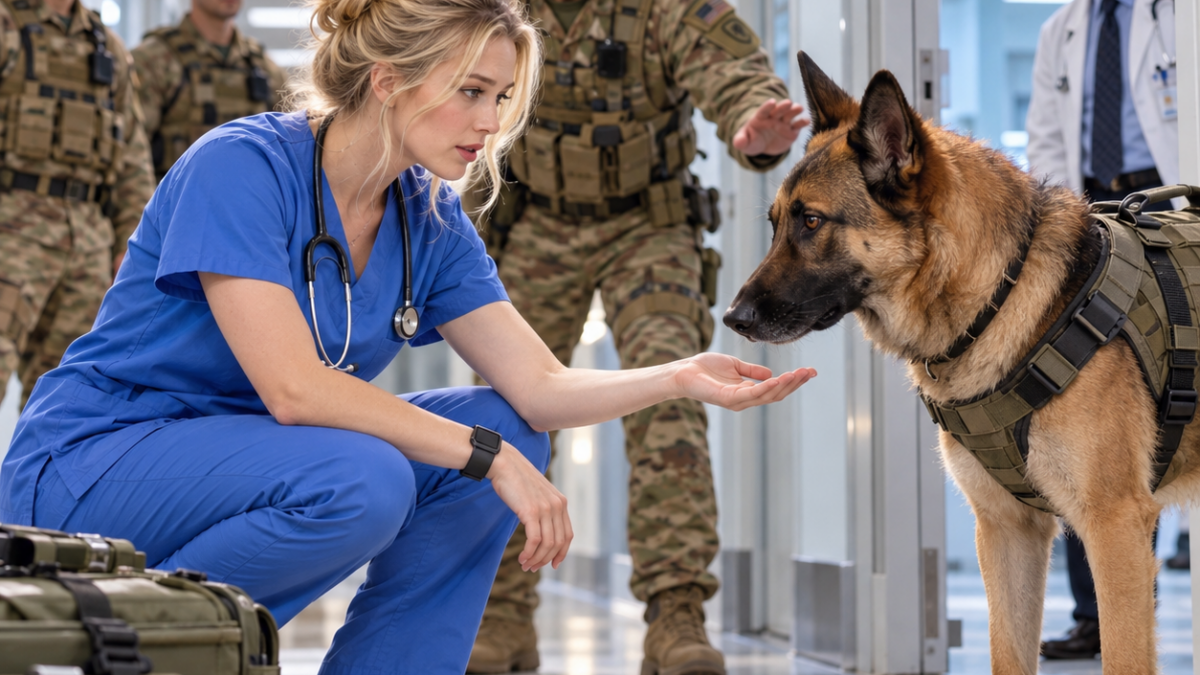
When he looked back at her, his expression had changed.
Eastfield’s federal rehabilitation contract, he said, is up for renewal in 42 days.
The K9 program is a line item in that contract, a significant one. If the program goes into external review, the line item gets flagged.
He paused. And if it gets flagged, the facility can petition to have it removed from the contract requirements, citing safety grounds.
Diana stared at him, removing the K9 line item, Vale continued, frees up approximately $2. 3 million in the annual operating allocation.
His voice was completely flat, which would then be redistributed within the facility’s budget at administrative discretion.
The room held its shape around that number, $2. 3 million.
Not Rook’s welfare, not the K9 program, not some genuine concern about safety protocols or handler authorization or nurses approaching animals without credentials.
$2. 3 million in the annual operating allocation, redistributable at administrative discretion.
Diana thought about the incident report Slade had filed in under 40 minutes. She thought about the speed with which her badge had been suspended, the personal phone call from HR rather than a facility line, the expedited federal oversight requests missed the same afternoon. She thought about the equipment transfer moved up to 6:14 in the morning before any nurse arrived, before any handler was positioned, at a time calculated to put Rook in precisely the crisis that had unfolded in that hallway.
She thought about Rook standing in that doorway, guarding something he didn’t know was also being used against him.
She stood up. Her chair scraped back on the lenolium, and the sound was very loud in the quiet room.
“What do you need from me?”
she said. Vale looked at her steadily.
“I need you to go home tonight,” he said.
I need you to document in writing everything you observed, heard, and were told from the moment you arrived at Eastfield this morning until this moment. Timestamped, specific in your own words, he paused. And I need you to be at the facility tomorrow morning at 700.
My badge, your badge will work at 700, he said. You can guarantee that? He held her gaze.
I can guarantee that what Slade did this morning constitutes a federal contract integrity violation and that the office that handles those violations responds to phone calls from Naval Special Warfare Command considerably faster than it responds to most things. Diana picked up her bag.
There’s one more thing Vale said.
She looked at him. The oversight request Slade filed this afternoon.
Vale’s expression didn’t change.
It included a supporting document, a personnel file. He paused.
Your personnel file, specifically the section documenting your suspension this morning for, and I’m quoting, unauthorized interaction with a classified military asset, representation of professional credentials, and deliberate interference with supervised federal program operations.
Diana felt something cold
move through the back of her chest. He used my suspension, she said, as the safety evidence.
He submitted it as evidence that the program lacks adequate personnel oversight. That unqualified staff were allowed unsupervised access to a military working dog.
Vale’s voice was careful.
He filed it within 20 minutes of submitting the oversight request. Diana stood very still. The thing that Slade had done crystallized in her mind with perfect clarity.
He hadn’t suspended her out of anger or administrative reflex.
He’d suspended her specifically to create a document.
A piece of paper that said an unqualified nurse had accessed a military animal without oversight. A piece of paper that submitted to the right federal office at the right time looked like exactly the kind of safety failure that justified pulling a 2.
3 million line item and calling it due diligence.
He’d used her.
He’d used the morning Rook’s crisis, the handler’s failure, her intervention, all of it as the raw material for a financial maneuver.
And she had walked directly into it, and the dog she was trying to help had been used as a prop in a budget play by a man who had looked at a Belgian Malininoa in acute grief and seen a line item. She looked at Veil.
Tomorrow at 700, she said, “Yes.”
She walked out in the parking lot. She sat in her car with both hands on the wheel for a long moment.
The heat had finally dropped.
The sky over Tucson was doing the thing it did in October evenings, going that deep, bruised orange that the desert did better than anywhere else she’d ever been.
She thought about Rook alone in that rehabilitation wing tonight.
probably Holt would check on him, maybe one of the handlers, but alone in the essential sense, without the thing he was guarding, because Veil’s people had secured it and without the person he was waiting for, because that person was never coming.
She thought about Callaway’s dog, the one named Diesel, never found out what happened to him.
She thought about Caleb Morrow, whose name she would never be able to look up, whose last minute she would never fully know, who had spent four years working beside an animal with the kind of intelligence and loyalty that most humans never managed, and whose last thought might or might not have included that animal, and who had not come home. The parking lot lights came on one by one. She turned the key in the ignition.
Her phone buzzed. unknown number different from the HR one.
She almost didn’t answer.
Then she saw the area code. She picked up. There was a brief silence on the line.
Then a voice she didn’t recognize.
Low, controlled, careful said, “Is this the nurse who was with Rook this morning?”
Diana’s hand tightened on the phone.
“Who is this?”
she said.
“Someone who needs you to understand something before tomorrow,” the voice said.
something that isn’t in the file they showed you.
The voice on the phone belonged to a man who would not give his name.
Diana sat in the parking lot of the 8th Street annex with the engine running uh and the AC on low as listen to him speak with the particular attention she’d developed in the army for sorting information by reliability.
not whether it felt true, but whether it had the specific texture of something a person actually knew versus something they were constructing. This had the texture of something he actually knew.
Marorrow didn’t just secure the case, the voice said.
He pulled it from the vehicle himself under fire. One of the other operators was down and Marorrow went back for it. A pause.
Rook went with him.
Diana didn’t say anything.
The case contained operational documentation, sigant material from a 2-year intelligence collection effort in theater. The kind of material that if it had been lost in a hostile contact scenario would have required a full operational review and potentially compromised ongoing collection assets. Another pause.
Marorrow knew exactly what he was carrying when that convoy got hit.
That’s why he went back and Rook stayed with it.
Diana said Rook stayed with it because Marorrow told him to verbally specifically the way Marorrow always gave Rook task assignments. Nobody else heard it because the contact was active and everyone else was focused on the threat. The voice was controlled, not cold controlled, which was different.
But one person saw it saw Marorrow position rook over the case and give the command before he moved to deal with the threat. Who?
Silence. Who was it?
Diana said again. Specialist Aiden Kowalsski.
Mororrow’s secondary.
The operation.
He’s at the WBAMC annex in Fort Bliss right now, recovering from injuries from the same contact.
The voice paused.
He’s been trying to get a statement into the Rook file for 8 weeks.
Every submission has been returned for procedural reasons.
Diana’s hand tightened on the phone.
What kind of procedural reasons? Wrong form. Wrong submission channel.
Statement not accompanied by the correct authorization codes from a supervising officer. A short humorless sound.
Kowalsski’s supervising officer is still in theater.
The authorization chain is complicated.
Who’s blocking it?
That the voice said carefully.
I can’t confirm.
What I can tell you is that the statement exists that it’s relevant to Rook’s legal status as a working dog completing an assigned task versus a dog in behavioral failure and that if it gets into the official record before the contract review, the entire basis for Slate’s oversight request changes.
Diana stared through the windshield at the parking lot lights. Why are you telling me this?
she said a long pause long enough that she thought for a moment he disconnected because Maros was a good operator the voice said finally and Rook was a good dog and the two of them went back into a hot zone together to finish something that mattered and right now that dog is sitting in a rehab cage in Tucson because the paperwork didn’t follow him home and I would like that to be corrected.
Another pause.
And because I’ve read your file, Captain, and you’re the person in that building most likely to understand why it matters.
The line went dead. Diana sat for a moment with the phone in her lap.
Then she pulled up Vale’s number and called it back.
He answered on the first ring. Kowalsski, she said.
Specialist Aiden Kowalsski at Fort Bliss.
You need to get his statement into Rook’s file before the contract review window closes.
A long silence. Where did you get that name? Vale said.
Someone called me.
Diana, I’m going home to write my documentation like you asked.
She said, but Kowalsski’s statement is the thing, isn’t it?
If Rook was executing a formal handler command when Mara was killed, the dog’s behavioral profile changes completely.
He’s not a rehabilitation failure.
He’s a working dog completing an assigned task in an extended time frame due to handler fatality and administrative delay.
She paused.
That’s not a dog you put down.
That’s a dog you debrief.
Vale was quiet. Can you get the statement?
She said.
I’ve been trying to get the statement, he said.
And something in his voice told her that the careful, professional control he’d maintained all day had a very specific kind of frustration underneath it that he’d been carrying for a while.
There is a chain of authorization required to pull a witness statement from an active duty personnel file and submit it to a K-9 program review that has not been cooperative.
Who’s at the top of that chain?
Someone, Vale said, who is aware that the statement changes the picture? She let that sit for a moment.
I’ll be at the facility at 700, she said.
She drove home.
She didn’t sleep much.
She sat at her kitchen table until past midnight with her laptop and a legal pad and wrote out everything she could remember, times, exact words, the sequence of events, the moment, the moment she’d arrived at Eastfield that morning to the moment you walked out of the annex building.
She was meticulous about it in the way her army training had made her meticulous about documentation because she had learned early that the version of events that got written down first with the most specificity, you know, was the version that tended to survive the review process and she wanted her version in writing before anyone else’s had time to harden.
She noted the time of every conversation.
She noted Holt’s exact words.
She noted Slaves.
She noted the specific language of the HR voicemail which she’d subdan transcribed.
She noted the timestamp on the badge suspension and the gap between that and Slade’s equipment trans transfer authorization at 6:14 that morning which she’d gotten from Vale in which she put in the document with a specific notation that the chronology should be reviewed by anyone assessing the morning’s events.
She was not a lawyer, but she’d filed enough afteraction reports in the army to know what a coherent factual record looked like and what a selective one looked like.
And she was determined that what she handed veil in the morning would be the former. At 12:47 a.
m.
, she stopped writing and made herself eat something crackers and peanut butter from the back of her cabinet cuz she hadn’t been to the grocery store.
and the the alternative was nothing and stood at her kitchen window looking at the strip of dark backyard and the concrete wall at the edge of it. She thought about Rook specifically. She thought about the moment he touched his nose to the back of her hand.
That specific contact brief, deliberate chosen, not handler trained, not command responsive. a choice the dog had made on his own terms in the middle of a situation where every human in his vicinity had been trying to take away his ability to choose anything.
She understood in a way she couldn’t have explained clinically that Rook was not a broken animal.
He was an animal in an impossible situation, loyal to a person who was gone, carrying an assignment that had never been formally closed, surrounded by people who kept trying to override what he was doing without understanding what it was. Professionally, the parallel was not lost on her. She went to bed at 1:00 in the morning and lay in the dark for a while, listening to the ambient sound of the neighborhood, a car passing every few minutes.
A dog somewhere barking at something with the specific half-hearted bark of an animal that felt it should should register a complaint, but wasn’t particularly invested in the outcome.
She was up again at 5. Eastfield Veterans Medical Center at 640 had a specific quality of light through the east-facing windows.
The pale uncommitted light of early morning before the desert sun had decided what it was doing yet. Thin and horizontal, casting long rectangles across the lenolium floors and making everything look slightly provisional.
Diana swiped her badge at the entrance. It worked. She stood in the lobby for a moment with her hand still on the card reader, feeling the small specific relief of a thing that Vale had said he could do and had done.
The third floor was quiet. Most of the night staff had handed off already, the dayshift just settling in.
That gap between the two, where the floor ran on institutional momentum, more than active attention.
Diana went to the nursing station, checked in briefly with the day charge nurse Mel 50s unflapable, who looked at Diana’s presence with the expression of someone who had heard several conflicting versions of yesterday’s events and was reserving judgment on all of them and pulled Rook’s updated care notes.
The notes said he’d been calm overnight.
Holt had checked on him at 2,200. A handler named Perez had done a second check at 300.
Rook had eaten, which was meaningful.
He’d been going off food intermittently since arrival.
He was in the rehabilitation kennel on the eastern side of the floor, which had a window that got morning light. Diana changed into fresh scrubs in the in the locker room, gathered her supply bag, and went to find Hol.
He was in the K9 supervisor’s office at the end of the corridor, which was less an office and more a repurposed storage room with a desk and a monitor.
He was on his second coffee and looked like he’d had approximately the same amount of sleep as Diana, which was to say not enough.
Reeves, he said, and then corrected himself. Whitmore. Sorry.
Which do you prefer? Reeves is fine. She sat down across from him.
Vale told you about 700. Vale told me about 700, the Kowalsski situation, and a number of other things that I am going to have to spend the next several weeks processing. Holt sat down his coffee.
He also told me what Slade did with the equipment transfer, and Holt’s jaw worked for a moment, and I should have looked more carefully at the authorization chain 2 weeks ago when they first told us the transfer was Thursday.
A change like that should have come through me.
It didn’t.
I accepted the schedule update without questioning why it had moved. He looked at the desk.
That’s on me.
Diana didn’t tell him it wasn’t.
It partly was, and he knew it, and they were both too tired for comfortable lies. What happens at 700? She asked.
Vale’s people are bringing a federal contract investigator.
Someone from the DoD oversight office. He paused.
And Slade has been asked to present himself in the administrative conference room at 700 as well, though he doesn’t know why.
Does he know Veil’s people are here?
He knows there were naval personnel in the building yesterday.
He doesn’t know the scope of what they’re looking at.
Hol finally looked up. He thinks this is still about the transfer protocol. Diana thought about that.
Slade had moved fast yesterday.
the incident report, the HR suspension, the expedited federal oversight request, all of it deployed within hours, which meant he’d had it ready.
The structure of the plan had been built before yesterday morning. The equipment transfer had been the trigger, not an improvisation.
He’s done this before, she said.
Hol frowned. What? Used an incident in the K9 program to generate a compliance concern.
Has there been anything in the past year, a handler, incidentant, an animal welfare flag, anything that gen generated an administrative review of the program? Hol went still. There was an incident in March, he said slowly.
A handler got a minor bite during a training exercise, completely within normal parameters for the work. But Slade had it written up as a facility safety concern and submitted it to the program oversight committee.
He paused. Nothing came of it.
The committee reviewed it and closed it.
But it sat in the program’s record.
Building a file, Diana said, “Building a file,” Hol repeated.
And his voice had a quality in it now that hadn’t been there before the quality of a man recalibrating something he thought he’d understood.
Diana stood up. I need to see Rook before 700.
The rehabilitation kennel smelled like kennels everywhere, disinfectant and animal, and the specific warm close air of a space with inadequate ventilation. And Rook was in the third enclosure from the door, lying on his side in the morning light with his eyes open. He heard her before he saw her, his ears lifted, rotated.
Then he raised his head. Diana approached the gate slowly and crouched outside it.
the equipment, the case, the harnesses, tomorrow’s deployment kit was gone from room 312.
Veil’s people had it.
Rook would know that in the way dogs know the presence or absence of things they’ve been attending to.
He would have registered the removal. He was still here, still in the kennel, not blocking a door, not standing guard, just lying in the light, watching her approach with the specific attention of an animal that had decided she was worth tracking.
She sat on the floor for outside the gate and didn’t say anything for a moment.
“Hey,” she said eventually.
Rook’s tail moved once.
“Low, not a greeting wag, something more careful than that.
The case is somewhere safe,” she said.
the right people have it.
She wasn’t sure why she was telling him.
It wasn’t clinical.
It wasn’t protocol.
But she’d learned in 8 years of working with operators and working dogs in some of the worst situations the military had to offer that the distinction between what an animal understood and what an animal needed to hear was sometimes smaller than the science suggested.
Rook put his head
down on his paws. His eyes stayed on her. Diana looked at him for a long moment at the old harness still strapped to his body.
It needed to come off. Had needed to come off for weeks probably, but nobody had managed to get close enough to do it without triggering a response. She looked at the worn stitching on the shoulder strap, the place where the rank patch had been removed and the Velcro backing had started to fray.
Marorrow had worn that harness for 4 years.
Or rather, Rook had worn a harness that Marorrow had fitted to him, adjusted, repaired, checked before every deployment, touched every single day they’d worked together.
That worn stitching wasn’t wear from time.
It was wear from hands. She looked at the clock on the wall, 653.
She stood up, touched two fingers briefly to the kennel gate, and walked back toward the administrative wing.
The conference room at 700 was the largest on the third floor, and it was not large enough for was what what’s in it.
Bale was at the table with two of his people. Coordinator Mills was present, standing rather than sitting, which Diana was beginning to understand was was just how Mills operated.
There was a man Diana hadn’t seen before in a dark suit, the federal contract investigator.
She assumed, compact and middle-aged with the specific look of someone who had spent a long career reading documents that other people hoped he wouldn’t read carefully.
His name was investigator Paul Driscoll and he had a briefcase and a recorder and and the kind of methodical stillness that suggested he had done this before and was not particularly susceptible to the quality of a person’s explanation.
Holt was there. Diana sat beside him. At 703 the door opened and Garrett Slade walked in.
He was dressed formally, jacket, tie, the full administrator, first presentation, and for the first 3 seconds, his face carried the expression of a man who expected to be managing this meeting. Then he saw Driscoll. Then he saw Diana.
His expression didn’t collapse.
It reorganized rapidly, a carefully, efficiently.
The way a careful man’s expression reorganizes when a situation reveals itself to be different from what he’d planned for.
He sat down. Mr.
Slade, Vale said. Thank you for coming.
Of course, his voice was smooth.
I wasn’t given much detail about the agenda.
I assume this is a follow-up to yesterday’s K9 program incident.
It is, Driscoll said.
He didn’t look up from the document he was reviewing, among other things.
Slade looked at Driscoll.
I’m sorry.
I don’t think we’ve been introduced.
Paul Driscoll, Federal Contract Integrity Review, DoD Oversight Division. Driscoll turned a page. I have some questions about the Eastfield VA federal rehabilitation contract, specifically the K9 program line item and the events of the past several weeks as they relate to that item.
Slade’s hands rested on the table.
Very still.
I’m happy to assist, he said.
I’m sure, Driscoll looked up.
Mr. Slade, can you tell me when you first identified the K9 program as a potential safety concern for this facility?
The concern developed over time through a series of incidents. Specifically, when did you first flag it internally?
A pause. March. I believe there was a handler incident that I felt warranted review.
The March incident was reviewed by the program oversight committee and closed as within normal operational parameters. Driscoll turned another page.
Did you submit any documentation to the committee suggesting the closure was inappropriate? No.
Did you raise the March incident in any subsequent internal communications before yesterday? A slightly longer pause.
I may have referenced it. I have your email correspondence for the past 11 months, Driscoll said simply.
I’ll let you know if I find a reference.
He looked back at the document. Can you tell me why you authorized the movement of classified military equipment from room 312 yesterday morning, 11 days before the scheduled transfer date.
The room temperature didn’t change, but the quality of the air in it did.
There was a scheduling conflict with room availability. Slade said we needed 312 freed up for a new patient admission. The admission record for room 312 shows no new patients scheduled for this week.
Driscoll said the room is currently occupied by two existing patients. Slade said nothing.
The authorization timestamp is 6:14 a. m.
Driscoll continued. Before normal administrative hours before you would typically be in the building. He looked up.
Where were you at 6:14 a. m.
yesterday? Mr. Slade.
I was I came in early. Signin records show your badge activated at the main entrance at 7:52 a.
m.
Diana watched Slade’s face.
It was doing something complicated and very controlled. The face of a man running multiple calculations simultaneously what they could prove, what they could only suspect where the documentation ended and the inference began.
She’d seen that face before, not often, but in specific situations on specific kinds of people who had structured their actions carefully and were now assessing which structures had held.
I may have signed the authorization remotely, Slade said.
I sometimes handle administrative approvals through the facility’s remote access system before arriving.
From what location? Driscoll said, a pause.
My home.
We’ll need your remote access logs from yesterday morning, Driscoll said in the tone of a man for whom this request was the most ordinary thing in the world.
Slade straightened slightly.
I’ll have my office coordinates.
I’ll need them today, Driscoll said.
He went back to his document. Slade sat very still. Vale looked at Diana briefly.
A look that said, this is going the way it should go. Stay with me.
She stayed with it. What happened in the next 40 minutes was not dramatic in the cinematic sense. There were no raised voices.
There was no moment of confrontation where someone slammed a hand on the table or said the thing that cracked everything open. Everything open. It was a methodical, careful, profoundly boring dismantling of a very tidy plan conducted by a man in a dark suit with a briefcase.
And what made it devastating was precisely that it was boring, that the questions Driscoll asked were specific and quiet and required equally specific answers, and that Slade’s answers kept brushing against the documentation in ways that he could feel even when the room couldn’t see it yet.
The expedited oversight request was examined. The supporting documents were examined.
The personnel file submission Diana’s suspension used as safety evidence was examined specifically and at length.
And when Driscoll read aloud the section that cited her misrepresentation of professional credentials, he looked up and asked Slade directly whether he had reviewed Nurse Reeves military service record before filing the complaint.
That information wasn’t readily available.
Slade said it’s in her hiring documentation.
Driscoll said page three army service record 8 years discharge rank captain commenation notation from the joint chief’s office 2019 he turned the page around on the table so it was facing slade did you read her file before submitting the oversight complaint a very long pause I may not have reviewed it in full you filed a federal contract safety complaint citing a staff member’s lack of qualifications Driscoll said without reviewing her
qualifications.
Slade’s attorney, who had arrived at 712 and had been largely quiet, leaned slightly toward him and said something Diana couldn’t hear.
Slade said, “I’d like to take a short break.”
“Of course,” Driscoll said and made a note.
In the hallway outside, Diana leaned against the wall and looked at the ceiling. Holt came out and stood beside her.
“You okay?”
he said.
“Yes.”
She paused.
“No, I’m angry.
That seems appropriate.
It’s not useful.
It doesn’t have to be useful.”
Holt said, “It can just be what it is for 5 minutes.”
She looked at him. He shrugged slightly uncomfortable.
“My wife says that.”
She’s usually right.
Diana almost smiled.
“He used Rook,” she said.
“That’s the part I can’t get past.
He used a dog who just lost his handler as a piece of a budget maneuver. Rook was in there guarding something that mattered, and Slade looked at that and saw an opportunity.
“People like Slade don’t see animals,” Holt said.
“They see liability and expenditure.”
“He didn’t see me either.
She pushed off the wall.
” “None of them did.”
That’s how he thought he could use my suspension because I was just a nur a nurse to him.
An administrative inconvenience. something to manage.
Well, Holt looked at the conference room door.
That’s going relatively badly for him now.
It’s not enough, Diana said.
Driscoll can pull his contract compliance. Vale can escalate the transfer protocol violation, but Rook still needs she stopped.
I need Kowalsski’s statement in the file today before the end of this review session if possible because if Driscoll closes the meeting without it, the contract review still flags the K9 program and the timeline for Rook still gets complicated.
Vale said he’s working the authorization chain.
Working isn’t the same as done.
Holt looked at her for a moment. What are you thinking?
I’m thinking there’s another channel.

