“Show Me, Then”—They Mocked the Quiet Auditor Until Her One Shot Exposed Harlan’s Lie – Part 1
“Show Me, Then”—They Mocked the Quiet Auditor Until Her One Shot Exposed Harlan’s Lie
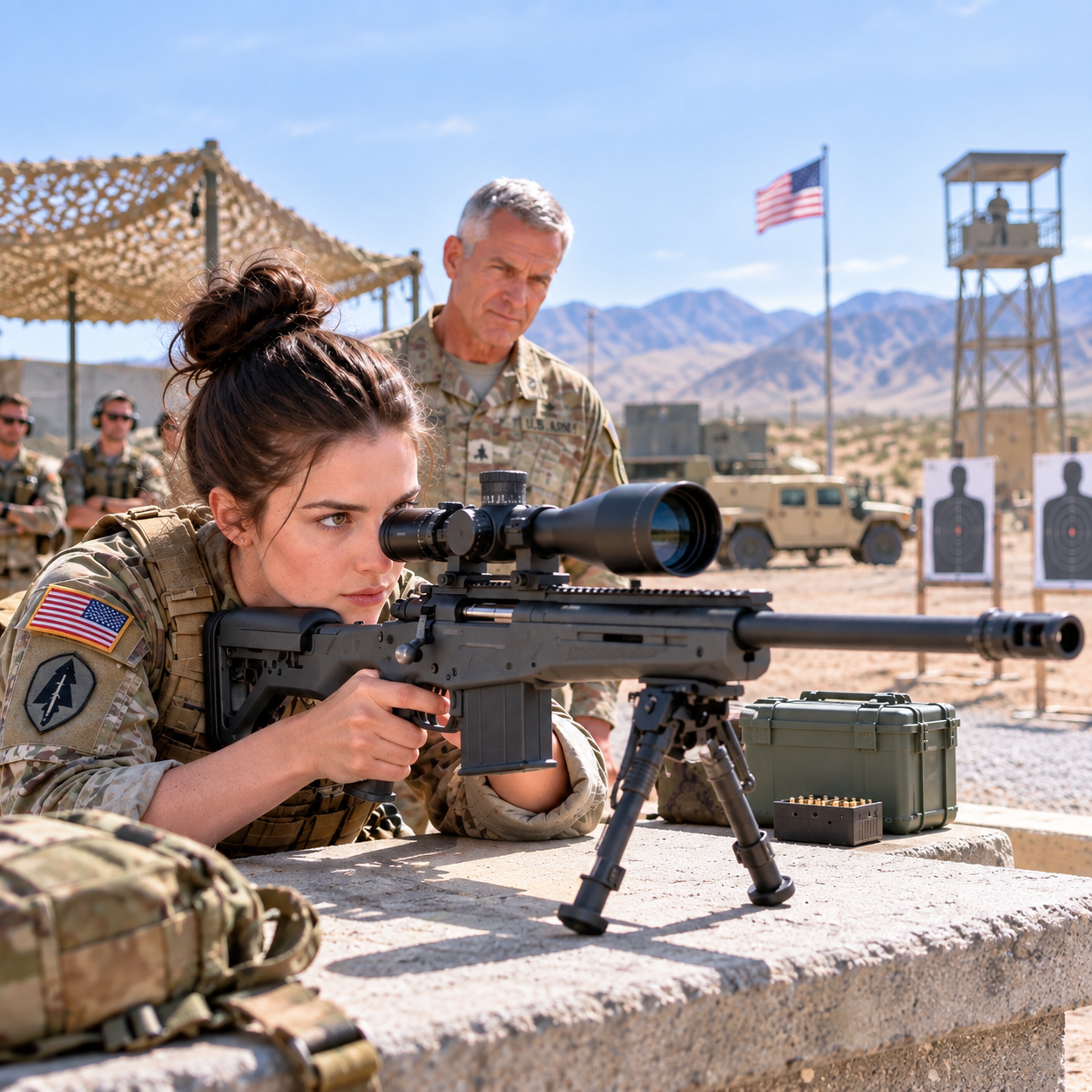
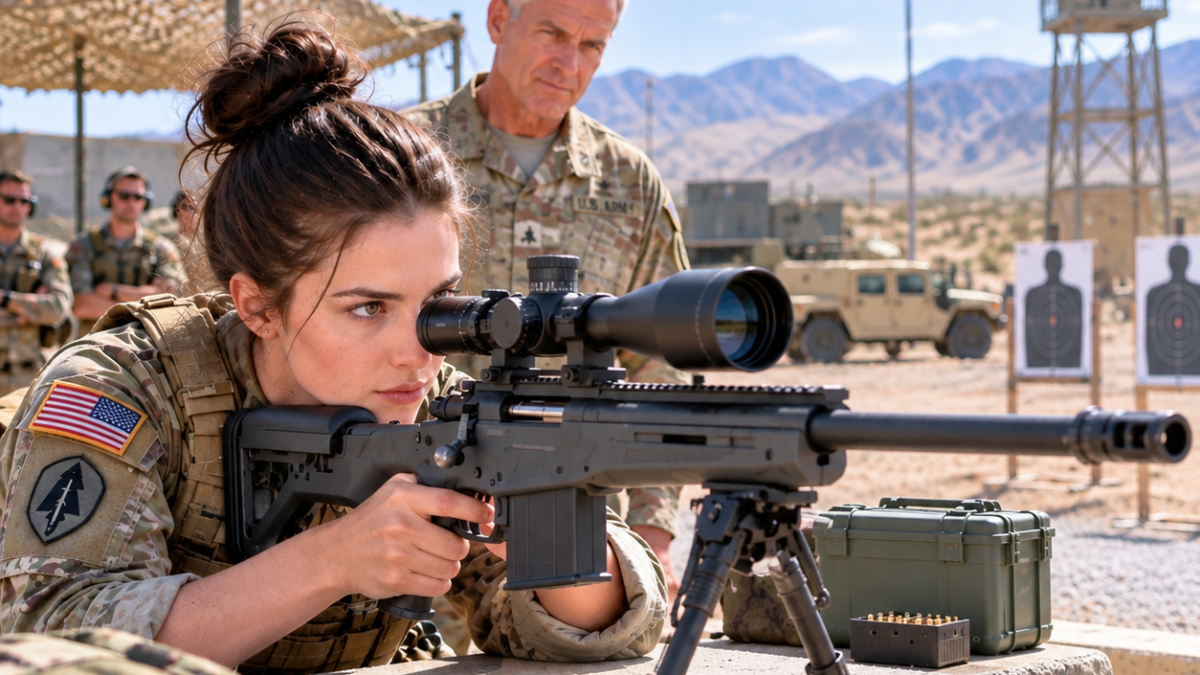
Wade Harlland shoved the rifle across the bench so hard the bipod scraped concrete.
Show me then. 20 trainees went absolutely silent.
The quiet woman from Federal Logistics, the one who’d spent 2 days counting inventory folders and saying almost nothing, picked up a precision rifle worth more than most people’s cars.
Nobody laughed yet.
That came a second later when she turned away from Harlland’s target completely and pointed down range at a small steel witness plate nobody had used in months.
One cartridge, one breath, one shot. Steel rang across the Arizona desert like a bell. And the range manager lowered her spotting scope and stopped smiling.
Because what she saw through the glass didn’t just prove Clare Mercer could shoot.
It proved Wade Harlland had lied.
Clareire Mercer arrived at Red Mesa Tactical Center on a Tuesday morning with a governmentissue laptop bag, a Manila folder thick enough to use as a weapon and absolutely no intention of touching a firearm. The facility sat 40 minutes outside Tucson on a stretch of desert that looked like the earth had given up trying. Scrub Brush, Khish Flats, a cluster of low concrete buildings baking under October sun that still felt like July.
The main range stretched north in a series of graduated firing positions 50 yards, 200, 600, 600. Beyond that, a set of steel targets that shimmered in the heat at distances most people would consider optimistic. Red Mesa had a federal training contract.
That contract was Clare’s business.
Specifically, an inventory discrepancy in small arms certification records had flagged during routine audit preparation in Phoenix.
Three-line items didn’t reconcile.
Ammunition consumption logged against training sessions didn’t match physical inventory counts.
It was the kind of thing that looked like a data entry error and occasionally turned out to be something considerably worse.
Clare’s job was to determine which.
She introduced herself at the front desk as a federal logistics compliance coordinator, showed her credentials, and asked for a workspace and access to the supply room logs. The woman at the desk late 20s, efficient, visibly curious about why anyone from Washington would personally visit over paperwork, pointed her toward a small office adjacent to the administrative building, and offered coffee twice.
Clare accepted neither. She was not there to make friends.
She was there to count things, compare numbers, and write a report that would either close the discrepancy or or escalate it to someone with subpoena authority. Either outcome was fine.
Neither required her to be interesting. What she had not planned for was Wade Harlon.
She heard him before she saw him is his voice carrying from the far end of the main building with the particular confidence of someone who had spent decades being listened to. Harlon was giving a facilities tour to two visiting contract officers, walking them through the instructor bays with the easy command of a man who understood that authority is mostly performance. He was broadshouldered somewhere in his mid-40s with closecropped silver hair and the kind of tan that came from years outdoors rather than a salon.
His instructor uniform was pressed precisely. His handshake, when he reached the administrative area and noticed Clare, lasted exactly two beats longer than it needed to. Mercer, he said, reading her credentials badge.
Federal compliance logistics audit, Clare said. Inventory reconciliation.
I’ll stay out of your way.
You’re welcome to observe training if it helps contextualize the records, he said it pleasantly.
He said it the way people offer things they don’t expect to be accepted.
I appreciate that,” Clareire said and went back to her folder.
She spent the rest of Tuesday morning in the supply room with a clipboard and a calculator. The discrepancy was real, not a data entry error. Ammunition from a specific lot number appeared in both the usage log and the current inventory count, which was arithmetically impossible.
Something had been recorded twice, or something had been replaced, or the original numbers were wrong. Each possibility had different implications.
By afternoon, she had a cleaner picture of what she was looking at and a growing list of questions she wasn’t ready to ask yet.
She ate lunch alone at a table near the far window of the facility’s small dining area.
Outside, she could see the main firing range. A training session was underway, 12 students in a line, instructors moving behind them, the flat percussion of rifle shots coming at measured intervals. standard marksmanship fundamentals.
Nothing unusual. Then the training format changed. Harlon moved the group to the long range firing position.
Clare watched through the window without particularly meaning to. A single rifle of precision bolt action on a heavy bench rest was set up at the firing line.
The students gathered behind the safety barrier.
Harland spoke to them, though Clare couldn’t hear the words through the glass.
And there was something in his posture that shifted when he addressed a crowd.
The instructor’s ease became something more theatrical.
Demonstration mode. She watched him settle behind the rifle. The distant target was posted at what the range sign indicated as 1,180 yd.
More than 2/3 of a mile under the right conditions with the right equipment. Achievable for an elite shooter. Not easy.
Not something a facility instructor did routinely. Harlon fired.
Clare’s eyes moved not to the distant target, which was too far to observe from the window anyway, but to the wind indicators posted along the range at graduated distances.
Tall fabric flags mounted on poles, their movement providing a continuous read of lateral air across the firing corridor. The flags were moving steadily left, not dramatically, not a gusting crosswind, but consistent, measurable, the kind of lateral push that at 1,180 yd compounds into significant displacement. Harlland stood up.
Even through the window, Clare could read the body language of a man acknowledging success, the slight backward movement, the hands coming off the rifle, the trainees reacting. The shot had landed. Clare looked back at the flags.
Then she looked at Harlland’s claimed firing position relative to the target angle.
She thought about the correction he would have needed to use. She closed her folder and went back to counting ammunition.
The evening briefing was informal Harlon hosting a question session for the trainee group in the classroom building while two other instructors sat along the wall. Clare had been invited to observe.
She sat in the back row with her laptop open and her attention divided. Haron was going through the demonstration shot, walking the students through his thinking wind call, elevation adjustment, the mental arithmetic of a long range firing solution.
He was good at this part, patient, organized, his explanations built logically, and the students followed him. Then one of them asked about the environmental readings. The question came from the second row, third seat from the left.
The student was young, early 20s, slight with the kind of careful intensity that comes from genuinely caring about getting something right rather than appearing to. He had been taking notes throughout, but his pen had stopped moving. The range monitor showed 8.
3 at the mid-range station, he said.
But the call you made, the windage, that’s more consistent with a reading closer to five or six.
At 8.
3, wouldn’t the displacement have been significantly wider?
Haron looked at him.
The classroom had the particular quality of quiet that happens when a student says something a teacher wasn’t expecting.
That’s Evan Torres, right?
Harlon said. Yes, sir.
You’re talking about a momentary fluctuation in the sensor reading.
You’re applying a static number to a dynamic environment.
I understand that, Evan said carefully.
I’m asking whether the momentary fluctuation was consistent with the flags at that distance during the shot or whether the sensor was reading a different layer.
It was a good question. Clareire in the back row recognized it as a good question.
The kind that a technically careful person asks, not to challenge an instructor, but because the numbers don’t reconcile, and that bothers them.
Haron recognized it differently.
I’ve been shooting at this range for 11 years.
He said, “I know what those flags are doing at 1,180 yd because I’ve fired at that distance several hundred times.
Are you suggesting you understand the wind conditions on this range better than I do? No, sir.
I’m asking about the numbers.
The numbers are in the record.
That’s why I’m asking.
There was a 3-second silence. The record reflects what happened, Harlon said.
If you’re having trouble with the ballistic math, I’d suggest working through it with your study group before tomorrow’s practical.
He turned back to the whiteboard. Evan Torres wrote something in his notebook and said nothing else.
Clare closed her laptop.
She had been watching Harlland’s face, not Evans.
And what she had seen for those 3 seconds was not irritation at a challenging student. It was something else.
A calculation happening behind the instructor’s eyes.
A rapid assessment of what had just been said and how widely it might travel. She had seen that look before. She had spent years trying to forget what it meant.
The next morning, Clare arrived at the supply room at 7:15 to find that access had been restricted, a new code on the door panel. She went to the administrative desk and was told palletly apologetically that the facility manager had updated the security protocols overnight for all non-staff spaces. A staff escort could be arranged if she needed continued access.
The restriction was technically within the facility’s authority.
It was also, Clare noted, implemented approximately 14 hours after she had begun examining ammunition lot records. She requested an escort and continued her work, writing down everything she found instead of photographing it. By 9:00, she had enough to write a preliminary report.
By 9:30, she had learned from Mara Vance, the range operations manager, who appeared with coffee Clare hadn’t asked for and a slightly conspiratorial expression that something had happened overnight.
Harland’s demonstration rifle, Mara said, keeping her voice below the ambient noise of the building.
The optic settings were changed after the weapon was returned to storage.
He’s saying someone tampered with it.
Clare set down her pen. When was it returned to storage? Log shows 6:42 p.
m. And when does he say it was tampered with?
Mara’s expression shifted slightly.
He said Evan Torres was working late in the equipment bay. Suggests Torres accessed the storage area and altered the scope to undermine confidence in the demonstration score. Does the access log support that?
A pause.
I haven’t looked at it yet this morning, Mara said.
But I’m going to Clare thanked her and said nothing else.
Harlon moved quickly. By 10:00, Evan Torres had been formally suspended from training pending an administrative review.
The announcement came through official channels, which meant it was already institution rather than allegation. Harlon addressed the remaining trainee group briefly expressing disappointment that competitive jealousy had apparently led to sabotage of a precision instrument and then resumed normal training operations as if the matter were settled. Clare found Evan sitting outside the administrative building on a concrete barrier, his notebook open on his knee, his pen not moving.
She sat down at the opposite end. He looked at her, the auditor from Washington, whom nobody had paid much attention to and clearly expected either sympathy or nothing.
You asked a good question last night, Clare said. Apparently, what made you look at the sensor readings?
He was quiet for a moment. The flags, he said finally.
I’ve been watching them all week because wind reading is something I actually want to get right.
And during the demonstration, I was watching the FAR markers specifically.
They weren’t doing what the recorded correction assumed.
He looked at his notebook.
I didn’t say anything publicly during the shot.
I just wrote it down. Asked about it last night because I thought there was something I was missing.
Was there something you were missing? He looked at her directly.
No, Claire said, “Don’t talk to anyone else about the censored data.
Don’t write anything down anywhere someone else might access it.
And don’t touch any equipment that isn’t assigned to you.
Evan stared at her. You believe me?
I believe your question was technically valid.
Clare said, “That’s not the same thing.
” She stood up and went back inside.
What she needed was the raw sensor packet, not the formatted environmental summary that went into certification records, but the underlying timestamped readings from each monitoring station. The summary was what everyone used.
The raw data was what Harlland’s version would need to survive.
Mara Vance was the one person at Red Mesa who had both access and what Clare was increasingly reading as a quiet unease about recent events. They were different.
Mara was an institution person, someone who had built her career at Red Mesa and genuinely believed in what it was supposed to do.
But institution loyalty and factual accuracy don’t always point the same direction, and Mara seemed to know it.
Clare asked her for the raw sensor files from the previous day’s demonstration.
Mara said she would need to pull them from the environmental monitoring archive and that it would take some time.
Take whatever time you need, Clare said, but please don’t mention to anyone that you’re pulling them.
Mara nodded slowly.
You’re not just here about the inventory.
I’m still here about the inventory, Clare said.
I’m also here about the inventory.
That afternoon, working in the narrow space between her official role and what she had actually uncovered, Clare interviewed three range staff members separately about the demonstration. She framed every question as ammunition, accounting, consumption records, lot tracking, equipment, assignment logs. None of them understood what she was actually mapping.
By 4:00, she had established three things. The rifle had been signed back into secured storage at 6:42 p. m.
As the log showed, the storage area’s electronic access log, which Mara quietly forwarded to CLA’s secure device that evening, showed no entry between 6:42 p.
m. and 7:15 the following morning. Evan Torres had never entered the storage area, and the only person besides the duty armorer who had accessed that room after 6 p.
m. was WDE Harland at 9:17 p. m.
logged under his master instructor credentials. Clare sat alone in the small borrowed office with this information and let it settle.
She was not surprised.
She had suspected something like this since watching Harlland’s face during Evan’s question.
But suspicion and evidence are entirely different things. And she had spent years learning the hard way that knowing something and being able to prove it in a room full of people who want to believe otherwise are separated by a distance that is not always crossable. She opened the raw sensor file Mara had sent.
The environmental readings were not what the summary report showed.
The formatted summary attached to Harlland’s certification score indicated relatively stable lateral wind averaging 5.
8 mph at the mid-range sensor station. The kind of condition that made a 1,180 yd shot demanding but credible.
The raw data told a different story. Wind at the mid-range station had shifted between 7. 1 and 9.
4 4 mph uh during the period of the demonstration with consistent readings from the FAR station reflecting a lateral component significantly stronger than the certified correction would have accounted for. Someone had replaced the raw numbers with a sanitized average. The summary files modification timestamp was 47 minutes after the demonstration ended.
Clare stared at the screen. Then she thought about what she could actually do with this.
A modified file time stamp was not proof. Environmental data could be argued technically in a 100 different directions by someone with 11 years on a given range.
The access log was more damning, but access alone didn’t establish what Harlon had done during his 917 p.
m. visit.
What she needed was something physical, and she was still thinking about the flags. Harland escalated the next morning. Word had spread the way word spreads in small professional communities through channels that have nothing to do with official announcements that the federal auditor had been asking pointed questions about equipment logs.
Harlon found her before the morning training session. He was pleasant about it. That was the most interesting thing.
I heard you’ve been asking the team about the storage room, he said, finding her in the hallway with the particular ease of a man who considers every room he enters to be his room.
I’ve been asking about equipment signout procedures, Clare said.
It’s part of the inventory audit, of course.
He looked at her with something that was dressed as collegial concern. I want to make sure you have everything you need. This situation with Torres has been difficult.
It reflects poorly on everyone.
I’d hate for an administrative audit to get complicated by a discipline matter that’s already been addressed through the appropriate channels.
I appreciate that. Clare said the demonstration score is certified.
Independent of whatever Torres did or didn’t do, the performance record stands.
He paused. Unless you have reason to think otherwise. Clare looked at him.
She had seen the access log. She had seen the raw sensor data.
She knew with a particular cold certainty of someone trained in evidence evaluation that he had modified the environmental summary after the demonstration and that Evan Torres had never touched the rifle.
She said, “I’m focused on inventory reconciliation.
Thank you for checking in.”
Harlon left. Clare went back to her office and spent 20 minutes looking at the wall.
The problem was this. Everything she had was digital.
Timestamps, access logs, sensor files, all of it could be challenged by someone with technical resources and institutional credibility. Haron had been at Red Mesa for 11 years. She was a visiting auditor nobody had heard of before Tuesday.
In a formal proceeding, his account would be given weight that hers would not.
She needed something physical, something that couldn’t be modified after the fact.
She was still thinking about the flags, about the physics of what a bullet does over 1,180 yd when the wind is not doing what the official record claimed it was doing. About the geometry of impact, about the small steel witness plate positioned at a downrange angle that nobody used anymore because it was too far off the primary line.
She was thinking about what a single carefully considered shot could establish that no sensor log or access file could. She was not going to volunteer this.
She was still hoping she wouldn’t need to.
Then Harlon brought Evan back onto the range. It was midafter afternoon.
Clare was crossing from the administrative building to the parking area when she heard Harlland’s voice carrying from the main range with the kind of projection that isn’t accidental.
If anyone here believes the conditions during yesterday’s demonstration made that shot questionable, they’re welcome to reproduce it under today’s conditions and tell me where my correction was wrong.
She stopped walking. The wind had picked up significantly since morning. The far flags were moving in hard gusts.
Nobody was going to reproduce a precision 1,180 shot in these conditions.
Harlon knew that this wasn’t a genuine challenge.
It was a performance, a way of reframing Evan’s question as ignorance and his own record as unassalable through the simple mechanism of proposing a test designed to fail.
Evan stood at the edge of the group with his suspension paperwork, presumably still processing through whatever channel Harlon had run it through. He was there, but not there. The accused returned to the scene to watch his accuser consolidate his position.
Clare walked onto the range. She had not planned to.
She was still technically a logistics auditor attending a training session as a courtesy observer. There was no formal role for her in whatever was happening on that firing line. She walked onto the range anyway.
Reproducing the shot wouldn’t tell us anything, she said.
Haron turned. 20 trainees turned. Mara Vance standing near the range management station turned.
I’m sorry, Harlon said.
Reproducing the shot in current conditions tells us about current conditions, Clare said, not about what the conditions were during the original demonstration or whether the certified firing solution matches the actual environment at that time. The silence on the range had the texture of something drawn tight. Harlon looked at her with the careful expression of a man reassessing an obstacle he had initially classified as furniture.
“You’re the auditor,” he said.
“Logistics?”
“Yes.”
“And you have a technical position on long range marksmanship.”
“I have a position on whether the test you’re proposing measures what you’re claiming it measures.”
Clare said it doesn’t.
Someone in the training group coughed. Not from illness.
Harlland’s voice stayed pleasant.
professionally pleasant. The kind of pleasant that is constructed rather than felt. If you have a better test in mind, what would tell us something useful?
Clare said, is a controlled reference shot under documented current conditions. Not at your target, at a reference point at a known distance and angle.
She looked down the range toward the unused witness plate. Something that establishes wind behavior across the range corridor under observable conditions. That gives you a physical reference for what the environment is actually doing today versus what was recorded during the demonstration.
You’re suggesting we compare today’s conditions to a certified score from yesterday.
I’m suggesting we establish what the wind is physically doing across this range right now, which creates a documented baseline.
Whether that baseline is useful to anyone depends on what the sensor data from yesterday actually says. Harlon looked at her for a long moment. Then he reached down to the rifle on the bench, the precision bolt action already set up, and slid it across the concrete toward her.
“Show me,” he said.
The laughter started at the back of the trainee group.
“Not cruel,” exactly, more the involuntary reaction of young people watching what appeared to be an administrative employee being handed a tool she clearly had no business operating.
Clare looked at the rifle. She looked at the witness plate.
She looked at the flags. She thought about what she was about to give up and whether it was worth it and whether there had ever really been a choice. She picked up the rifle.
One cartridge, she said. Harlon, still smiling, produced one from his vest pocket and set it on the bench beside her.
Clare checked the chamber, settled behind the stock with the ease of someone returning to a language they had tried to stop speaking, and began reading the flags.
Nobody on that range was laughing anymore, and Mara Vance had already moved to the spotting scope without being asked because somewhere in the last 30 seconds, something in the range manager’s professional instincts had quietly understood that what was about to happen was not going to be embarrassing for the woman behind the rifle.
The bullet found steel before most people on that range had finished deciding whether to keep laughing. The sound came back across the desert with a slight delay.
The flat clean ring of a small plate struck precisely, carrying back through heated air from a distance most of them had never attempted.
Mara Vance didn’t move from the spotting scope for four full seconds.
When she finally straightened, her expression was the kind that people wear when they have just witnessed something that rearranges their understanding of a situation they thought they had correctly read. Nobody said anything.
Harlland’s smile was still on his face, but it had stopped working.
It was a smile without the muscle memory behind it, held in place by habit rather than anything genuine. Clare set the rifle down on the bench with the same care she had used picking it up.
She did not look at the distant plate. She did not look at Haron.
She looked at Mara.
What’s the horizontal displacement from center?
Clare asked. Mara checked her notes against the scope.
Approximately 4 in left of the plate’s center line at this wind speed that’s consistent with the near flag reading.
Clare turned to the range monitoring station where the environmental display was running in real time. The far station is showing a threepoint differential from the near.
That gap that’s what creates the displacement stack at long range.
She paused.
Now compare the correction Harlland’s official score claims he used yesterday against what the actual wind readings during that demonstration would have required.
The trainees looked at each other. They looked at Haron. Harlon said the conditions today are not the conditions yesterday.
That’s my point.
Clare said the certified correction in your score is more consistent with today’s conditions than with the raw data from yesterday’s demonstration.
which raises a question about which set of numbers is accurate. It was not a dramatic speech. She had not raised her voice.
She had spoken the way someone speaks when they are describing something observable rather than arguing a position, and that restraint made it considerably worse for Haron than if she had shouted. He picked up the rifle and slung it over his shoulder with a movement that was technically routine and emotionally the equivalent of leaving a room by slamming a door.
“This session is done,” he said to the trainees, back to the classroom at 1400.
He walked off the range without looking at Clare again. Mara watched him go.
Then she looked at Clare with an expression that had passed through surprise and arrived somewhere more complicated, somewhere that involved recognition of the fact that the last 72 hours had a different shape than she’d
initially thought.
Who are you? Mara said quietly.
I’m a federal logistics coordinator, Clare said.
And I need those raw sensor files going back 14 months. She worked until nearly midnight.
The borrowed office was small enough that she could feel the walls if she stretched, and the air conditioning cycled in a pattern that stopped and started unpredictably, so the room alternated between refrigerated and merely warm. She had stopped noticing. The sensor files were open on one screen, the certification records on another, and a yellow legal pad covered in her own handwriting was propped against the wall where she could see it without turning her head.
The picture she was building was not complicated. That was the thing about evidence.
When it was real, it’s simplified rather than complicated.
The complicated part was always the human layer on top of it. The decisions people made and why they made them and what those decisions said about a person who otherwise in other in other contexts might have been someone worth respecting.
Harlland’s 1,180 score was the centerpiece.
That score had appeared in two published training articles, a federal contract renewal proposal, and the facilities marketing materials. It was the kind of shot that functioned as professional identity rather than just performance record. Lose the credibility of that shot, and something much larger than a single certification entry came down with it.
The raw sensor data showed the wind during his demonstration had been running 7. 4 to 9.
1 at the mid-range station. His certified correction assumed 5.
4. Those numbers were not reconcilable by any reasonable interpretation of realtime environmental variation. Someone had not rounded down or estimated generously.
Someone had replaced one set of numbers with a different set of numbers. The modification timestamp on the summary file 47 minutes after the shot. The access log for the monitoring station terminal.
Harlland’s instructor credentials 39 minutes after the shot.
And Evan Torres, who had watched those flags during the demonstration and understood exactly what he was seeing, had asked the question that made all of it suddenly urgent to Barry. Clare looked at the yellow pad.
What she had was strong. It was not bulletproof.
A lawyer working for Harland could raise questions about timestamp accuracy, about whether the raw sensor data represented the actual conditions at the firing point versus the monitoring stations, about whether Evan’s account of his own observation was credible, given he was a trainee with limited experience on this specific range.
What would make it bulletproof was the physical demonstration she had done that afternoon.
The witness plate, the documented environmental readings at time of shot, the measurable displacement set against Harland’s certified correction.
But that required someone to formally connect the two data sets. And that required Clare to explain how she knew exactly which reference shot to take and exactly what it would demonstrate. She set down her pen and stared at the ceiling.
The problem with being useful is that usefulness requires presence, and presence on this particular subject would require explanations. She had spent years constructing an entire alternative life to avoid. She picked the pen back up.
She wrote down two names on the legal pad. Clare Mercer, Clare Donovan.
She looked at them for a long time. Then she drew a line between them that was not a connection so much as a border and went back to the sensor files.
Evan found her in the morning.
She was crossing from the administrative building to the parking area where she’d left her rental, intending to drive to a copy shop 12 mi away that she’d confirmed would handle secure document printing.
Evan was sitting on the same concrete barrier where she’d found him the day before, as if he’d uh decided this particular stretch of outdoor furniture was his designated location for bad news.
He stood when he saw her. He was holding a phone with something pulled up on the screen.
“Someone found old competition footage,” he said.
Clare stopped walking. He turned the phone so she could see it. The video was grainy shot from the side of a competition range, the kind of footage that got uploaded to shooting sports archives in the mid 2000s and survived because nobody thought to take it down.
The shooter in the frame was younger, her hair different, her posture carrying the uncomplicated confidence of someone who had not yet learned what happened when you trusted the people around you.
The name in the caption read, “See Donovan Nationals qualifier, Mesa Verde Open.
Evan looked at her. Clare looked at the phone. She did not reach for it.
She did not deny it.
She stood in the morning sun outside a federal tactical training facility and made the rapid calculation she had been halfconsciously preparing for since the moment she’d picked up Harland’s rifle the previous afternoon.
Where did you see this? She said one of the guys in my cohort.
He said Harlon showed it to him last night.
said, “The woman who questioned his shot has her own history with manipulated wind readings.”
Evan’s voice was carefully controlled, the voice of someone who is angry but has decided not to lead with that.
He said, “You surrendered a national record because your equipment data was falsified.”
“That’s accurate,” Clare said.
He said you were involved in the falsification.
That’s not accurate.
But you left.
You didn’t fight it publicly.
No. Evan put the phone in his pocket. He was quiet for a moment.
The Desert Morning had the particular quality of silence that exists between two people who are sorting through the same information from different angles.
Why didn’t you tell me?
He said, “Because it’s not relevant.”
It’s relevant now.
Harlon is going to use it. I know.
Then why did you He stopped. Started again. You picked up that rifle in front of everyone.
You knew this was coming. Clare looked at him directly. I knew it was possible.
I calculated it was less likely than the alternative. What was the alternative?
That I didn’t pick up the rifle, and Harlland’s version of events stood unopposed.
Evan absorbed this. He had the look of someone who has just been handed a piece of information that reorganizes other pieces he already had, and the new arrangement is not simpler than the old one.
The shot you took, he said slowly, the witness plate, you knew exactly what it would prove because you’ve done that kind of ballistic reference work before.
I’ve done a great deal of longrange shooting, Clare said carefully.
The technical knowledge was there regardless of what name I was using when I acquired it.
That’s a very precise way of not answering the question.
I know he exhaled. Not quite a laugh.
So, what happens now? Harlon has your history.
He’s distributing it to everyone here, and you’re the one who just accused him of falsifying a record.
He’s going to say, “You have a personal grievance.”
He’s going to say, “You came here looking for something to pin on him.
” “He might say that, and you’re not worried about it.”
“I’m extremely worried about it,” Clare said.
“But I have better evidence than he has a narrative.”
Evan looked at her for a long moment.
“What do you need?”
he said. I need Mara to formally request a hold on the environmental monitoring archive before Harlon realizes she pulled the raw files. And I need you to write down today, timestamped, notorized, if you can arrange it exactly what you observed during the demonstration, not what you concluded, what you physically saw.
Flag behavior timing your observation position.
That’s it.
That’s not a small thing.
Clare said, “Your account is the only first person record of what the flags were doing during the actual shot.
Everything else I have is digital.
Yours is human observation.”
Evan nodded once, then the competition footage.
“What actually happened with the record?”
She had known the question was coming. She had been deciding since last night whether to answer it, and how much of the answer was hers to give. My father was my coach, she said.
He altered the wind sensor reading before one of my competition shots.
He didn’t tell me.
I found out afterward. I surrendered the record immediately. She paused.
He thought he was protecting an investment. Years of early mornings. His savings going toward competition travel.
He wanted one result that justified all of it. But you lost the record anyway.
I surrendered it.
There’s a difference.
She looked away toward the range. Then I left.
I didn’t argue publicly.
I didn’t explain.
I just disappeared and stopped being Clare Donovan. Evan was quiet.
And now Harlon’s going to tell everyone that the woman questioning his integrity had her own integrity questioned.
He said, “Yes, and the difference between your situation and his is that you actually told the truth.
That’s the part that needs to be in the evidence.”
Clare said, not in the argument. Evidence first, then the rest.
Harlon moved faster than she’d expected.
By noon, the atmosphere at Red Mesa had shifted in that particular way that happens when authority decides to consolidate rather than defend.
When a person in a position of institutional power stops pretending the challenge isn’t real and begins actively working to neutralize it.

