“Show Me, Then”—They Mocked the Quiet Auditor Until Her One Shot Exposed Harlan’s Lie – Part 3
Given the third modification event, the attempted backdating, this will be referred to the inspector general’s office rather than handled administratively.
Okafor closed the laptop. The facility director will receive formal notification tomorrow morning.
Harlland’s access to all systems will be suspended pending the referral.
Evan Torres. The suspension against Torres is inconsistent with the access log evidence.
That will be part of the formal finding. He paused.
I’ll need your supplemental statement included in the package.
You have it. Both names. Both names.
Clare confirmed. Okapor stood collected his laptop and looked at her with the careful neutrality of someone who is professionally required to be neutral and personally finds the situation somewhat more interesting than he is permitted to express the witness plate shot. He said that was a ballistic reference demonstration.
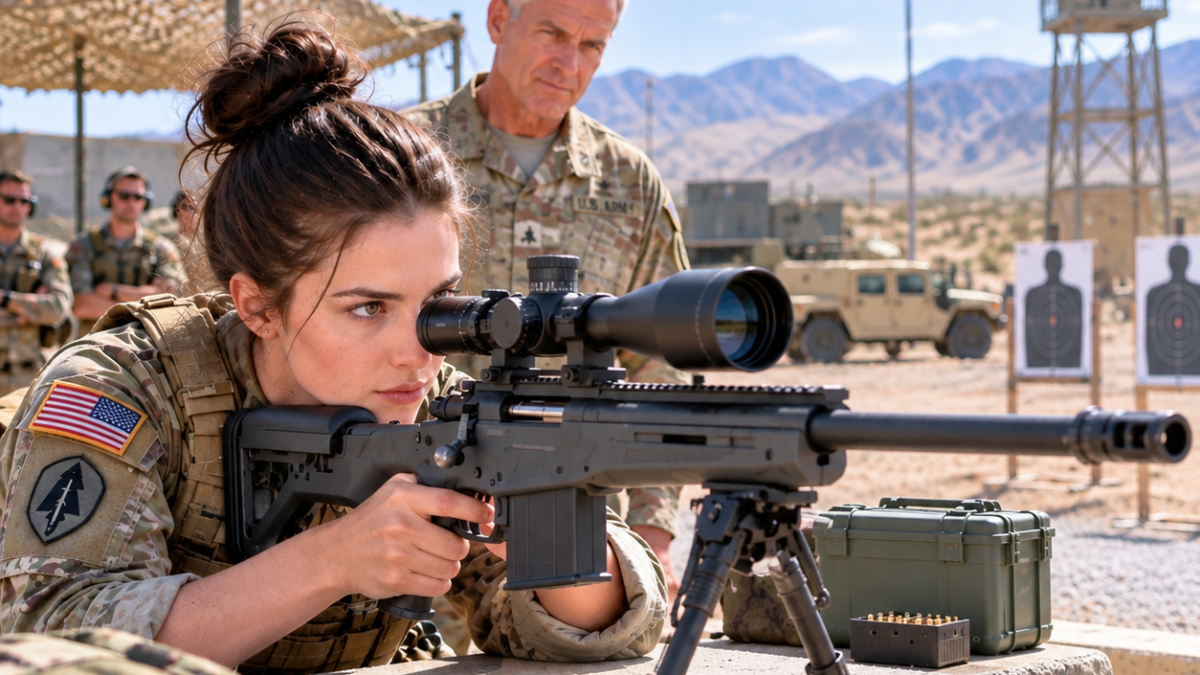
“Yes, with one cartridge, no scope adjustment period, cross- wind conditions.
The flags were readable,” Clare said.
He nodded once, as if filing this away in a category he hadn’t expected to need.
I’ll have the report drafted by midnight, he said, and left.
Clare sat alone in the office. The facility was quiet around her training hours long finished, most of the staff gone, the low ambient sounds of a building settling into desert night.
She should have felt something like relief. The forensic analysis was clean.
The chain of evidence was intact. Evan was going to be cleared by someone with the authority to make it stick. Instead, she felt the particular flatness that comes after sustained attention.
Not emptiness, but the absence of the pressure that had been filling the space for days. She picked up her phone.
Her father’s contact was still in it, unchanged from the number she had last used 6 years ago when she had called him to say she was surrendering the record and that she needed him not to contact her for a while.
She had meant a while to mean weeks or months. It had become years without anyone formally deciding that.
She put the phone face down on the desk. Not yet.
She needed to finish the thing first. She was pulling up the final section of her audit report, the inventory reconciliation, the original reason she had come, the clean findings she had planned from the beginning.
when the door opened without a knock. Not Harlon this time.
The facility director, Richard Callaway, was a man in his late 50s who had been at Red Mesa longer than Harland and who had, in Clare’s assessment during her days at the facility, essentially allowed Harland to become the public face of an institution that had once had a different identity.
He was not unintelligent. He was not, she thought, corrupt. He was the particular kind of institutional leader who manages well when institutions are functioning and discovers too late that management and oversight are not the same thing.
He sat down without asking. He did not look comfortable.
He looked like a man who has received news in the last 2 hours that has forced him to restructure his understanding of the last 11 years. Okafer briefed me.
He said, “All right, he’s filing the referral tonight.”
Yes. Callaway looked at his hands on the desk.
He had large hands, working hands, the kind that suggested a different version of his life before the administrative role.
I didn’t know, he said about the modification, about the storage room access.
I want to be clear about that. I understand. I knew Wade was protective of his record.
I knew he handled criticism badly. I thought he stopped.
I thought that was a management issue I’d address when the contract renewal was settled.
Clare said nothing. The board is going to ask me to get ahead of this.
He said before the IG referral becomes public.
They’ll want a voluntary compliance posture.
Internal investigation initiated. Harlon on administrative leave.
Torres formally reinstated. He paused.
They’ll probably also ask me to offer you something to make the supplemental statement go away.
It it’s already filed.
He said that ship has sailed.
But the framing of the public account, how this is described, whether it’s a failure of one individual or a failure of institutional oversight, that’s still being written.
Clare looked at him carefully.
He wasn’t threatening her.
He wasn’t offering a settlement the way Harlon had.
He was describing with the tired honesty of someone who has realized that transparency is now the only viable instrument. What was going to happen and what decisions remained?
The framing should be accurate, she said. Whatever that requires.
Even if accurate means the facility’s contract history goes under review.
Yes, he was quiet for a moment. Your own history is going to be part of whatever account gets written.
I know the competition record, the reason you left. People are going to ask why you were the one who found this.
People can ask whatever they want, Clare said.
What they’ll find is that a federal auditor identified an inventory discrepancy, observed an anomaly in a public demonstration, and followed the evidence where it went.
That’s one version.
It’s the version that’s accurate.
Callaway looked at her for a long moment. He was assessing something. Not her credibility, she thought, but his own red of the last 3 days and how wrong it had been.
Wade has been here a long time, he said. Not as a defense.
More like a man noting the distance between where something started and where it ended. I know, Clare said.
That’s what made it work for as long as it did.
He stood at the door. He paused, the same spot where Mara had paused the night before, though for entirely different reasons.
Torres, he said.
He’s a good shooter.
He’s an excellent observer, Clare said.
Which is rarer. Callaway nodded. Left.
Clare turned back to her screen. She was finishing the last paragraph of the inventory reconciliation.
The clean, narrow finding she had been sent here to produce, which felt almost absurd now in the context of everything layered around it when her phone lit up again. Different number this time.
local area code she didn’t recognize.
She almost let it go to voicemail, she answered. Silence on the line for a moment, then a voice she had not heard in 6 years, carrying the specific quality of someone who has been rehearsing what to say and has abandoned the rehearsals. I heard your name, her father said on a shooting sports forum.
Someone posted about a federal auditor named Clare Donovan who fired a single witness plate shot at a range in Arizona. A pause.
I didn’t know if I should call.
Clare sat very still.
I’ve been trying to figure out what to say to you for a long time.
He said, “I don’t have it right yet.
Neither do I,” Clare said.
The desert outside the window was completely dark now. The wind flags on the far range were invisible, but she knew they were still moving.
The air in this part of Arizona never fully settled at night. It just quieted.
The way certain kinds of damage quiet rather than heal.
I’m finishing something, she said.
I’ll call you when I’m done.
She ended the call. She looked at the document.
She looked at the window.
She looked at the phone in her hand and at her father’s number sitting in the recent calls list directly above a notification she hadn’t opened yet.
An email from the contracting authorities legal office flagged urgent sent 4 minutes ago. She opened it.
Read the first line. Read it again.
The independent technical review had flagged a fourth data modification event they hadn’t discussed in Okafor’s briefing.
One that predated the demonstration by 11 days. A modification to a different file entirely. Not the environmental summary.
The ammunition lot records. the ones Clare had been auditing when she first arrived. The double entry she had attributed to a clerical error.
It wasn’t a clerical error.
It was a cover for a missing lot of matchgrade ammunition that had been signed out of inventory, used without documentation, and then paperwork replaced with a duplicate entry from a previous month’s record because whoever had signed it out had needed a specific ballistic load for a specific demonstration and hadn’t
wanted anyone.
asking which cartridges had been fired at 1,180 yards. The ammunition discrepancy that had sent Clare to Red Mesa in the first place was not a separate administrative error. It was the first thing Harlon had done to protect the lie, which meant the inventory audit that had brought her here.
The routine discrepancy flag that her supervisor had sent her to resolve had been created by the same event she had spent the last 3 days unraveling. She had not stumbled into this. She had been without knowing it following a trail that started with a box of ammunition and ended somewhere considerably more deliberate than a falsified wind reading.
And if the ammunition records had been modified 11 days before the demonstration, then someone had planned this in advance, which meant the question was no longer just what Harlon had done. The question was who had known he was going to do it. Clare read the email three times.
Not because the language was unclear. The language was precise.
The finding was unambiguous, and the implication sat on the screen with the particular weight of something that has been true for a long time and has only just become visible. She read it three times because she needed the interval between readings to let the architecture of what she was looking at fully assemble in her mind.
11 days before the demonstration, someone had modified the ammunition lot records. That modification had created the inventory discrepancy that flagged in Phoenix. That flag had generated the audit request.
That audit request had sent Clare Mercer, a federal logistics coordinator with no apparent connection to precision shooting to Red Mesa Tactical Center.
If Harlon had planned the ammunition substitution in advance, he had also created the discrepancy in advance, which meant either he had deliberately manufactured the conditions for an audit, which made no logical sense, or someone else had discovered the ammunition irregularity and flagged it through channels that bypassed Red Mesa’s internal reporting structure entirely.
Someone who knew what the irregularity meant and wanted outside eyes on it before the demonstration happened. Someone who had access to the ammunition records 11 days before the demonstration.
Clare picked up her phone and called Okafor. He answered on the first ring which confirmed he was still working.
The fourth modification, she said, the ammunition records. Who else had right access to that system? A pause.
She could hear him typing. The inventory system has three credential holders with right access. Harlon, the facility director, and he stopped.
Mara Vance, Clare said. Yes.
She set the phone down without ending the call, looked at the ceiling, and recalculated the last 3 days from the beginning.
Mara, who had appeared with coffee she hadn’t asked for, and a slightly conspiratorial expression on the second morning.
Mara, who had forwarded the raw sensor files without requiring much persuasion. Mara, who had filed the formal review request at 7:03 a.
m. with her name on it, as Clare had asked.
Mara, who had the particular quality of institutional unease that Clare had read, as conscience, and which was, she now considered, possibly something more deliberate than that. She picked up the phone again.
I need to know when the fourth modification was made. Exact timestamp and I need the login credentials used. More typing.
Timestamp is 11:23 a. m. 14 days prior to the demonstration.
Credentials logged are a pause that lasted 2 seconds longer than the previous ones.
They’re logged under Harlland’s administrator account.
Clare went still.
But the access pattern is inconsistent with Harlland’s other login behavior.
Okafor continued. He consistently accesses the system between 6:00 a.
m. and 8:00 a.
m. or after 5:00 p.
m. 11:23 a. m.
on a weekday is outside his documented pattern. The session duration was also 40 seconds.
Harlland’s other sessions average between 4 and 12 minutes.
40 seconds long enough to open a file, make one change, and close it. long enough for someone who knew exactly what they were doing and needed to be done before anyone noticed the terminal was in use.
Someone used his credentials.
Clare said, “That’s the technically accurate statement.”
Yes.
Who had access to his login information that I can’t determine from the logs.
I can tell you that the terminal used was the range management station, not the main administrative terminal Harlon uses.
And that terminal’s physical location is in the range operations office.
Clare said Mara’s office.
The silence on the line had a careful quality.
I’m not drawing conclusions, Okafur said.
But the terminal location is relevant to the physical access question. Yes, Clare said. It is.
She ended the call and sat with the information for exactly as long as she could afford to, which was not long.
Mara’s light was still on.
Clare could see it from the window. The range operations office was in the secondary building and its single window faced the administrative block where Clare was sitting. A yellow rectangle in the desert dark, the kind of light that means someone is either working late or waiting for something to happen.
Clare crossed the facility courtyard and knocked. Mara opened the door almost immediately.
She looked at Clare’s face and understood something before Clare had said a word.
Not guilt exactly, more like the expression of someone who has been anticipating a specific conversation and has arrived at the moment of it feeling less prepared than they expected.
“Come in,” Mara said.
The range operations office smelled like coffee and printer toner and the dry paper smell of physical files that had been handled a great deal.
Mara’s desk had three monitors and a spotting log open to the current month and a photograph of a woman in her 70s holding a shooting medal that Clare had not previously noticed.
“Your mother?”
Clare said. Mara glanced at the photograph.
She competed until she was 69. She was genuinely excellent. A pause.
Harlon told her at an industry dinner four years ago that the women’s category in long range competition was a courtesy division.
She said it with the flat effect of someone who has processed the anger and arrived somewhere colder. She retired from competition 6 months later. Said she was tired.
She wasn’t tired.
Clare sat down across from the desk. You modified the ammunition records.
Mara did not deny it. She sat down on her side of the desk and folded her hands on the surface in front of her. And the gesture was not defensive so much as deliberate.
the posture of someone who has decided to be honest and is organizing how to do it. I discovered the ammunition substitution 7 weeks ago.
Mara said, “During a routine inventory check, Harlon had signed out a box of custom matchgrade cartridges under a training exercise code that didn’t correspond to any scheduled session.
When I traced it forward, the cartridges disappeared from inventory and then reappeared as a duplicate entry from March copy paste from an old record. You understood what it meant.
I understood he was planning to use a specific ballistic load for a demonstration without documenting it, which means the demonstration result wouldn’t be reproducible with standard issue ammunition.
Mara’s voice was controlled but not quite steady.
I’ve been watching him manage his record for 3 years.
Small things, wind disagreements where the student was right and Harland’s version ended up in the official account.
Scores that seemed higher than the conditions warranted. Nothing I could prove individually. So when you found the ammunition record, I had something concrete, but if I reported it internally, Callaway would have asked Harlon about it.
Harlon would have produced an explanation and I would have spent the next two years being reassigned to to progressively less interesting work. She looked at Clare directly.
The contracting authorities inventory flag system routes discrepancies above a certain threshold for external audit. I modified the record to push the discrepancy into that threshold.
Using Harlland’s credentials, he stores his login information in a document on the shared range management drive.
I don’t know if he forgot it was there or decided the convenience was worth the security risk.
A pause. I used it once.
40 seconds. I changed one quantity field. And then you waited to see who they sent.
Yes. Clare looked at her for a long moment.
Why didn’t you tell me this from the beginning?
Because I didn’t know who you were or what your actual mandate was.
If you were just there to reconcile numbers and leave, nothing I’d done would have mattered.
And if I told you I’d manipulated a record to trigger an audit, you’d have had to report it.
Mara looked at the photograph of her mother. I needed to see which direction you were going first.
That’s why you pulled the sensor files when I asked why you filed the formal request this morning.
You were going in the right direction. Claire sat back. She was looking at a situation that had just become considerably more complicated than it had been 20 minutes ago, and she was mapping the complications in real time.
The evidence chain was intact.
Okafor’s forensic analysis stood on its own regardless of how or why the original audit had been triggered.
Harlland’s modifications, the sensor summary, the storage room access, the three attempts to alter the archive were documented and defensible.
Evans account was notorized. The formal referral was already filed.
What Mara had done was use Harlland’s credentials without authorization to manipulate an inventory record.