Single Dad Ex-SEAL Was About to Leave—Then a Billionaire Arrived With Her Daughter – Part 6
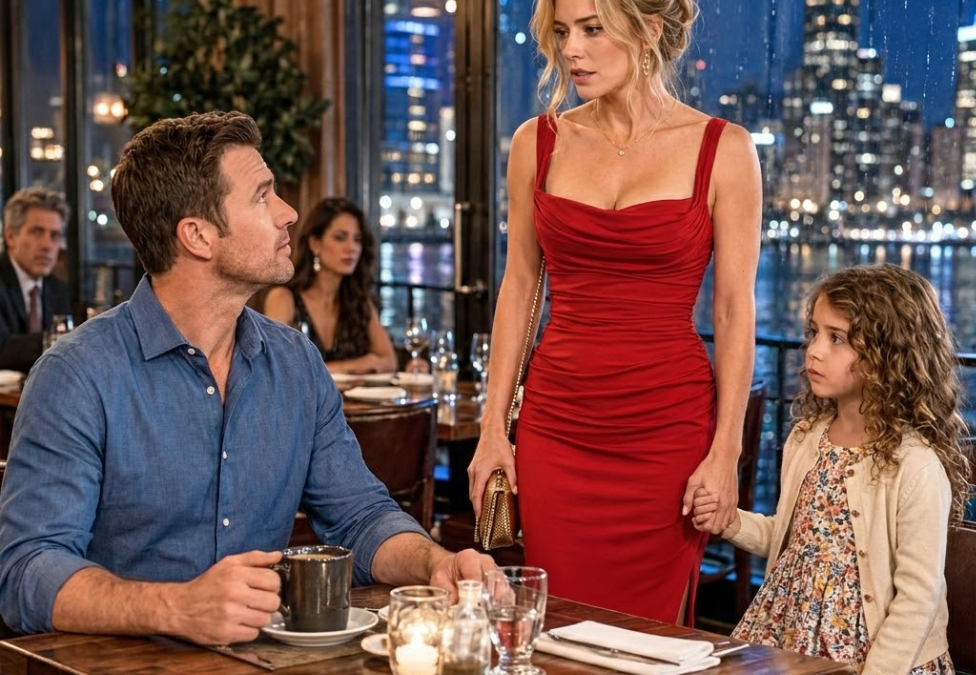
And when you disappear into your own decision-making process and surface with the results, it reinforces the aloneeness instead of she stopped again. He sat with that for a moment. Instead of being the other person in the room, he said she looked at him.
Yes. He thought about it honestly the way she deserved. I spent 11 years in a job where the decisions I made in isolation directly affected whether people came home, he said.
And then I spent 4 years making every call for Owen alone. Same as you.
I default to solo processing. I do it without thinking.
I know that’s not an excuse.
I know that, too. She looked at her tea.
I’m not asking you to be a different person.
I’m asking you to include me in the process, not just the results.
Okay, he said. She looked up. Okay.
Yeah. He turned his coffee cup in a slow circle.
You’re right.
I’ll work on it.
She seemed to be waiting for more for a qualification, a reversal, something defensive, and when none came, something in her expression shifted. Picked up her tea. That was easier than I expected, she said.
Did you want it to be harder? A little bit, honestly. A pause.
I had more points. You can make them anyway, he said. Probably valid.
She looked at him across the table in the warm and slightly cluttered kitchen of a house that was not hers, but which she knew well enough to know that the third drawer had the good scissors, and the coffee was in the cabinet above the maker, and Owen kept a book on the bottom stair, and had for months, and nobody had moved it because it felt like moving it would break something.
“You’re strange,” she said.
“Same words as the restaurant parking lot, different weight.
You’ve mentioned that,” he said.
She almost smiled.
I’m keeping a list.
Owen and Maisy’s relationship required no management and no encouragement and very little adult intervention, which was either a great gift or evidence that the two of them were operating on their own frequency that the adults weren’t fully tuned into.
Probably both. They argued constantly, not badly, not the deep cutting kind, but with the frequency and low stakes of two people who were entirely comfortable with each other and had no particular concern about the other person leaving. Maisie had opinions on nearly everything and delivered them as established fact.
Owen had the habit of constructing careful counterarguments that he believed were logical and which Maisie found hilarious which annoyed him which he found more hilarious.
She called him O which he initially said he hated and continued to say he hated for about 3 weeks after which he stopped mentioning it which meant he’d accepted it and didn’t want to admit that.
called her Maze, which she accepted immediately and without comment, which was its own form of admission. They had a shared interest in animals, specifically in animals with complicated personalities, and they kept a running argument about whether Capernacus the horse, who had by now developed a full illustrated biography across dozens of napkins and loose
pages, was a hero or an anti-hero.
Owen’s position being that the distinction mattered, and Maisy’s position being that it was a false binary.
This argument had been ongoing since December and showed no signs of resolution, which both of them seemed to find deeply satisfying.
In March, Serena came to Owen’s school science fair.
This had not been planned as a significant event. Owen had a project, a model demonstrating water pressure principles applied to marine engine cooling systems, which he had built with Damon over three weekends, and which was excellent, partly because it was genuinely clever, and partly because Owen had insisted on making all the labels himself in handwriting, that Damon privately thought was better than his own. Serena had asked if she could come, and Owen had said sure in his elaborately casual way, and Maisie had come because Maisie went most places that Owen went on weekends.
Now, the science fair was in the school gymnasium. Folding tables, trifold poster boards, the particular smell of elementary school buildings everywhere. Serena moved through it in jeans and a sweater.
No visible indication that she was anyone other than a parent at a school fair.
And Damon noticed without comment that she’d made that choice deliberately no security, nothing that would make Owen’s event about her rather than him.
Owen explained his project to three different judges and to Maisie, who asked better questions than the judges and was not shy about this assessment of the situation. He won second place, which he accepted with the specific expression of someone who believed he deserved first, but was going to be reasonable about it.
He showed Damon the ribbon. Damon told him the project was excellent.
Owen said he knew. Serena told Owen his analysis of the pressure differential was genuinely sophisticated for his grade level.
And she said it simply without the particular inflation adults sometimes put into compliments for children.
And Owen looked at her with an expression that had several things in it and said, “Thanks.
I wasn’t sure if the math was right.”
“The math was right,” Serena said.
Owen nodded once.
“Processed this.
Filed it.
” On the way out of the gym, Maisie reached up and took Owen’s hand, which she did sometimes when they were moving through crowds, and Owen let her without comment, which was the most agreement he showed toward most things.
Damon and Serena walked behind them through the parking lot.
He’s going to be someone remarkable, Serena said quietly.
He already is, Damon said.
He just doesn’t know it yet.
She looked at him sideways. Do you tell him that? Not in those words.
I’m working on it.
She was quiet for a moment. My father never told me.
I found out from other people. She said it without particular weight as a fact rather than a wound.
I spent about 15 years building things to prove it to him anyway.
And then I realized he wasn’t watching and hadn’t been for a long time.
And by then I didn’t need him to be.
She paused. But I would have liked it early on.
I’ll tell him more directly, Damon said.
She looked at him.
You don’t have to.
I know I don’t have to.
He watched Owen and Maisie navigate around a parked minivan.
But you’re right, I’ll say it more directly.
Spring came the way Chicago spring came reluctantly in Fitz with a late March snow that Owen and Maisie treated as a personal affront and Damon and Serena treated as an excuse to stay inside and cook something complicated.
The complicated thing turned out to be paella, which Serena had made before and Damon hadn’t, and which required constant attention and generated an argument between Owen and Maisie about whether the saffron smelled good or bad that lasted so long it became background noise.
They ate at
Damon’s table, all four of them, with a particular comfortable disorder of a meal that had been assembled by two people who cooked differently and had learned to work around each other in a kitchen.
The pale was uneven excellent in some bites, slightly overs salted in patches. Nobody cared. Maisie ate everything on her plate and part of Owens, which he allowed without being asked.
These were the months that built the thing neither of them had dared architect directly. Backyard evenings, when the weather finally held in April, Owen teaching Maisie to throw a baseball with the patient authority of someone who had strong opinions about form. Maisie ignoring most of the advice and throwing her own way and getting it over the plate anyway, which Owen found genuinely funny when he stopped being instructional about it.
Saturday mornings at the shop, Maisie, having claimed a specific stool as hers, bringing her drawing materials and continuing the Capernacus Chronicles while Damon worked, and Owen explained things to her without being asked. Sunday mornings, when Serena brought coffee and Damon made pancakes, first attempt usually imperfect.
Owen’s job to report the damage.
Maisy’s job to eat the damaged ones first and declare them acceptable.
Serena’s company moved through the Briggs aftermath with the specific care of an organization that had been shaken and was rebuilding its confidence.
There were investors to reassure and a board to reconstruct and the patent licensing structure to reestablish on terms that Serena controlled.
She handled it the way she handled most things systematically, without visible panic, with the occasional late night that she didn’t mention unless Damon asked directly and which she was learning to mention when he asked because that was what he’d asked her for.
She hired two new board members in April, both with independent track records, neither with connections to anything adjacent to Aldercraftoft. The Briggs legal process moved slowly through the system.
His attorneys finding every procedural inch available, core charges held, and Reyes had been right.
The documentation was deep enough that the working of edges didn’t change the foundation.
In May, Serena was named to a federal advisory panel on enterprise data security.
She told Damon about it at his kitchen table on a Tuesday evening while he was finishing the dishes, and he turned around and said, “That’s significant.”
And she said, “It’s mostly meetings.”
and he said, “You’re being modest.”
And she said, “I’m being accurate.”
And he said both. And she looked at him for a moment.
And then said, “Thank you for knowing the difference.”
He didn’t know what to do with that, so he finished the dishes.
She was watching him from the table with the expression she’d developed.
He’d noticed it appearing sometime in March that was quietly proprietary in a way she didn’t seem entirely aware of, like he was something she’d found that she intended to keep.
He’d found himself with a version of the same expression, according to his sister, who had mentioned it twice and whom he’d told to mind her own business both times.
The school family event happened on a Friday in early June. It was the kind of event that elementary schools organized with maximum ambition and mixed results, a family creative arts afternoon.
Parents encouraged to attend, children presenting work from the year.
Owen’s school and Maisy’s school were separate institutions, but Maisy’s school’s event had been scheduled first, and Serena had mentioned it, and Owen had said without particular preamble that he wanted to go, which was the clearest expression of intention he typically offered on anything.
So they went all four of them on a warm early June afternoon with the windows down on the drive over and Owen explaining to Maisie the specific criticisms he had of her school’s dismissal process which he had observed once and found inefficient and Maisie explaining that she had no interest in his opinions about her school’s dismissal process and the two of them continuing this conversation with great energy for 11 minutes while Damon and Sarissa said almost nothing in the front seats and communicated a great deal anyway in in the particular wordless
channel that people developed after enough time.
The event was in Maisy’s school’s art room and the adjacent hallway drawings and paintings on display, small sculptures on tables, and in the corner of the hallway, a collection of family drawings on large paper.
The assignment had been simple. Draw the people who make you feel safe.
Maisy’s was hanging at the end of the row.
She’d used her best crayons, the ones she kept separate from her regular drawing supplies.
The figures were recognizable by the detail she’d put into each one, the careful attention she gave to the things that mattered.