“Stay Back,” She Warned — The Former Navy SEAL Said, “I’m Trying to Help, Not Miss Dinner.” – Part 5
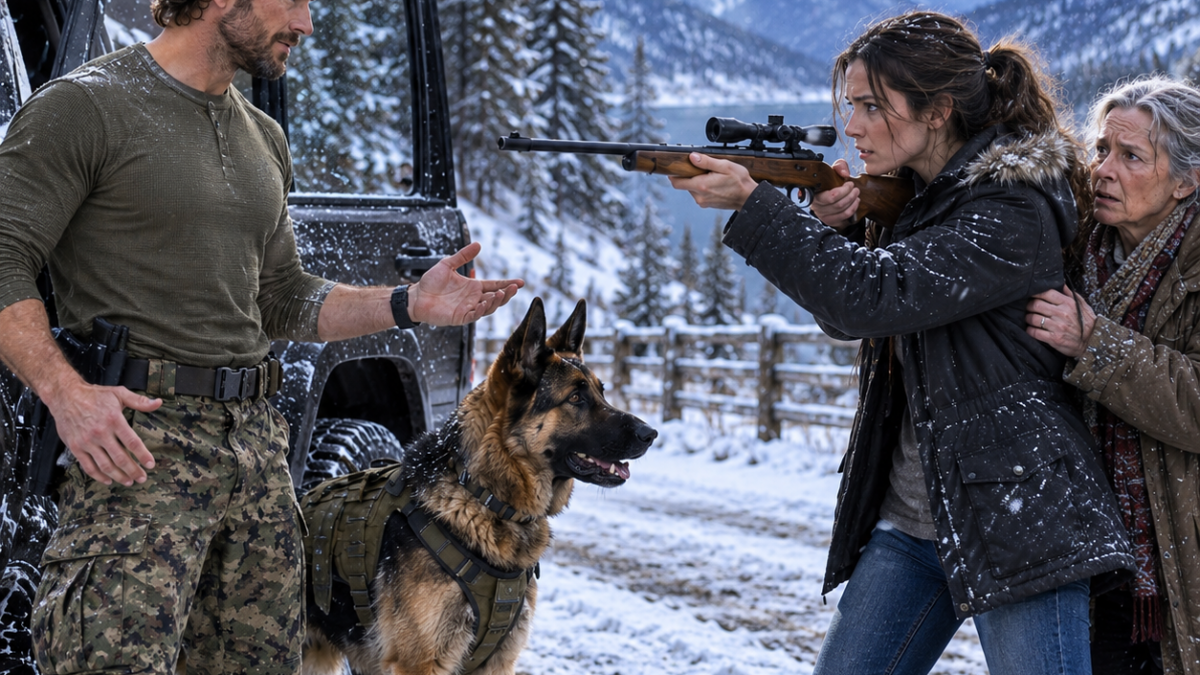
Then he said, “Dutch, done.”
One ear moved. The dog remained where he was. Mason rubbed a hand over his face.
“Seriously, done.”
Dutch finally turned. The cabin door opened again.
Helen looked from the dog to Mason. Does he always argue this much?
Mason watched Dutch climb the porch steps only when he thinks he’s right.
Helen nodded solemnly. Then you really are, partners.
By morning, the driveway looked quieter than it had the day before.
A thin layer of fresh snow had settled over the tire marks left by Dererick’s SUV and the deputy’s vehicle, softening the edges until the tracks looked older than they were.
The wind had dropped during the night. Somewhere along the roof line, melt water tapped slowly into a metal bucket Mason had set beneath a bad seam weeks earlier. Dutch slept through breakfast.
That was unusual enough for Mason to look over twice. The dog lay near the wood stove with one paw stretched toward the heat, breathing deeply. His body loose in a way it rarely was after an unsettled day.
Nothing about him looked injured or distressed. He simply seemed tired.
Mason understood that better than most. He spent the first hour outside repairing the porch railing Grant had knocked loose during the confrontation.
The damage was minor. A bracket pulled crooked and one section shifted enough to wobble under pressure. June watched him from the kitchen window for a while.
Then she returned to her laptop. There was no celebration in the cabin. No one talked about winning.
Helen made oatmeal. June reviewed the documents Rachel had sent. Mason fixed wood that had been solid the day before and was not solid now.
That felt more honest. Rachel called shortly after 10.
June took the phone near the window where the signal was strongest, expecting another careful conversation about paperwork. Instead, Rachel had news.
Granite Crest had already received her notice before Derek arrived at the cabin. The company had now suspended all communication through him after learning he continued presenting himself as though he still had authority over the Callahan property. Eric Dalton had also contacted the company.
He confirmed that Dererick had come to the cabin knowing June had ended direct negotiations. Rachel did not claim that Dererick had committed a crime. She did not promise charges, arrests, or some dramatic legal collapse.
The documents he had used were being reviewed by lawyers on both sides. That process would take time.
What had changed immediately was simpler. Granite Crest no longer trusted him to speak for the Callahan family. For Derek, that mattered.
June stood beside the window as Rachel explained the rest. The developer was still interested in the access route, but any future discussion would now begin again through June and Mercer and Hail. No deadlines from Derek would carry forward automatically.
No verbal promises he claimed Martin had made would replace the written estate documents. June looked toward the dining table. The parcel map from chapter 3 was still folded inside her folder.
What if I don’t want to talk to them right now?
Rachel paused.
Then don’t.
June smiled faintly. It was the second time someone had given her permission to stop without telling her what decision should come next.
She closed the negotiations for the winter, not permanently. Just until spring, the land would still be there.
So would the road. Granite Crest could wait or it could not.
For the first time, that was their problem, too. When June ended the call, Mason was coming in from the porch carrying the bent bracket he had replaced.
Well, Derek’s out.
Mason set the bracket on the counter. Out of what? Granite Crest suspended him from the negotiations.
He nodded. June waited for something larger. Nothing came.
That’s it.
What else do you want me to do?
I don’t know.
Seems like the people who hired him figured it out. June looked at the old bracket.
He lost the deal because he wouldn’t listen.
Mason shrugged once. He had several chances. That was close enough to judgment.
The rest could belong to consequence. Helen came in from the back room carrying a small stack of folded clothes.
When are we going home? June turned. We Helen placed the clothes on the chair.
I am. The answer came too quickly.
You’re not staying alone.
Helen looked at her daughter. Mason picked up the bracket and quietly left the room.
He had learned something. June folded her arms.
You’re still recovering.
I know. You just got over an infection.
I know and your breathing is improving.
Helen’s voice remained calm.
That made Jun<unk’s urgency sound louder than it was.
You can’t just go back there and pretend nothing happened.
I’m not pretending.
Helen sat down. Dutch lifted his head but did not get up. For several seconds, neither woman spoke.
Then Helen looked toward the window. When your father got sick, you came home.
June’s expression changed.
You needed me. Yes, I stayed because you needed me.
Yes. Helen turned back and somewhere along the way, you stopped asking whether I still did.
June said nothing. The sentence landed without cruelty. Helen continued folding one sleeve over another.
You’ve spent almost a year arranging your life around mine.
I let you.
That’s what family does sometimes.
June looked toward the hallway. Helen watched her.
I’m your mother, June.
I’m not your sentence.
The cabin stayed quiet. No one cried.
June sat across from her.
I don’t know what I’m supposed to do if I’m not worrying about you.
Helen smiled, but only a little. That sounds like your problem.
June laughed despite herself. Dutch thumped his tail once against the floor.
Later that afternoon, June found Mason behind the cabin stacking split wood beneath the leanto. She stood nearby for several minutes before speaking. Mom wants to go home.
I heard you were supposed to pretend you didn’t.
I walked outside.
That’s not the same thing.
Mason placed another log on the stack. No.
June looked at the cabin.
I think she’s right.
Mason waited.
I’ve been using her.
He stopped then. Not like that. I know.
June rubbed her hands together against the cold.
I mean, I’ve been using taking care of her as a reason not to decide anything else.
Mason nodded once. He understood that kind of arrangement. She looked at him.
If she goes home, I need somewhere for a few weeks. Maybe longer.
Just until I figure out the land and get things organized. The first answer came to Mason immediately. Stay as long as you want.
He almost said it. Instead, he leaned the splitting mall against the wall. How long do you want to stay?
June looked at him carefully. Until spring.
A pause. Then we<unkll see. Mason nodded.
Okay, that was all. It was also more than he had offered anyone in a long time. The next several weeks passed without drama.
Helen returned to her small house once the roads were clear and her clinician was satisfied with her recovery. June drove her there, stayed two nights, stocked the freezer, checked the furnace twice, then finally left after Helen threatened to change the locks if her daughter inspected one more smoke detector.
Helen called often. She usually asked about Dutch first.
Mason pretended not to notice. June continued sorting his bookkeeping, but the arrangement changed. She stopped sending invoices for him.
Instead, she left them on the table with sticky notes until Mason signed and sent them himself. This is inefficient.
He told her one evening, “This is adulthood.
I preferred the old system. The cardboard emergency, it had personality.
You can visit it on weekends.”
Mason began taking more repair jobs around the valley. a generator near Condan, a snowblower outside Celely Lake, a boat motor stored in a shed waiting for spring.
He was still living at the cabin, but he was no longer using it as an excuse not to be anywhere else. Dutch adjusted, too.
After longer days outside, he sometimes slowed at the porch steps. Nothing dramatic.
Age had simply begun negotiating with gravity. June came back from town one afternoon with a thick rubber mat and laid it across the slickest part of the porch.
Mason looked at it.
What’s that?
His retirement package. Dutch stepped onto it, tested the surface, and continued inside. Mason watched him go.
He approves. He has standards. By early spring, the valley changed by inches rather than events.
Snow pulled back first from the south-facing ground. Dark soil appeared beneath tree trunks. Water began running under crusted edges along the driveway.
The roof dripped through most afternoons. Tom arrived on a Saturday carrying a cooler and two fishing rods that were several weeks ahead of the season.
He stood in the doorway longer than necessary. Mason had repaired the porch.
The refrigerator contained yogurt. June liked, the coffee Helen had chosen, and three kinds of vegetables Mason would never have purchased voluntarily. Dutch occupied only one end of the sofa now.
Tom looked around. Then he looked at Mason.
So Mason opened the cooler. So what? Still temporary?
Mason glanced through the front window. June was outside moving two small planters away from the wall where snow melt kept dripping onto them.
He thought about the question.
I haven’t decided.
Tom nodded. Good. Mason looked over.
That’s the first honest answer you’ve given me in 2 years.
Tom walked past him toward the kitchen. Mason let the comment stand. June came in a few minutes later with cold hands and damp sleeves, complaining that someone had placed the planters directly beneath the worst gutter on the property.
Mason blamed Tom. Tom blamed Dutch. Dutch was asleep.
No one believed anyone.
A few weeks after that, June sat at the dining table correcting one of Mason’s invoices for the third time.
Mason stood at the stove. What now? You wrote the wrong address.
I know where he lives. The mail does not.
He’s 6 miles away.
Then walk it over. Mason turned.
June handed him the invoice. He took it.
Are you staying? She looked at him. He did not dress the question up.
No promise. No forever.
No speech about second chances. Just the question.
June leaned back in her chair.
You’re going to have to be more specific.
After spring, she looked at the invoice again. For how long? Mason glanced toward Dutch beneath the table.
As long as we’re both still choosing it.
June studied him for a moment. Then she pointed to the address line.
Learn to write this correctly first. Mason looked down.
That a yes? June returned to her laptop. You were a Navy Seal.
Figure it out. Under the table, Dutch let out a long, tired sigh.
Mason looked at him. helpful. Dutch did not move.
Dinner went on the stove. Outside, melt water ran steadily from the roof, and somewhere beyond the trees, the road had begun to show gravel again. Inside, no one made promises bigger than the life in front of them.
The part that stayed with me was Mason getting that address wrong on the invoice again. There was something almost comforting about it.
A man could survive years of hard training, handle danger without making a show of it, and still need somebody at a kitchen table to slide a piece of paper back across and say, “No, fix this.”
I’ve come to believe that belonging often starts there in being allowed to be useful to each other without keeping score.
June didn’t need someone to run her life.
Mason didn’t need someone to rescue him from his past.
Even Dutch for all his old training eventually needed a little traction on the porch. None of that made them weaker.
It simply made room for another person to matter. This is a fictional dramatized story, but that part feels very real to me.
We spend years learning how to carry our own weight. Then life quietly asks whether we can let someone carry one small corner of it. Maybe grace looks like that more often than we notice.

