They Called Her a “PROBLEM PASSENGER” — Until a NAVY SEAL’s K9 Exposed Her HIDDEN MISSION – Part 4
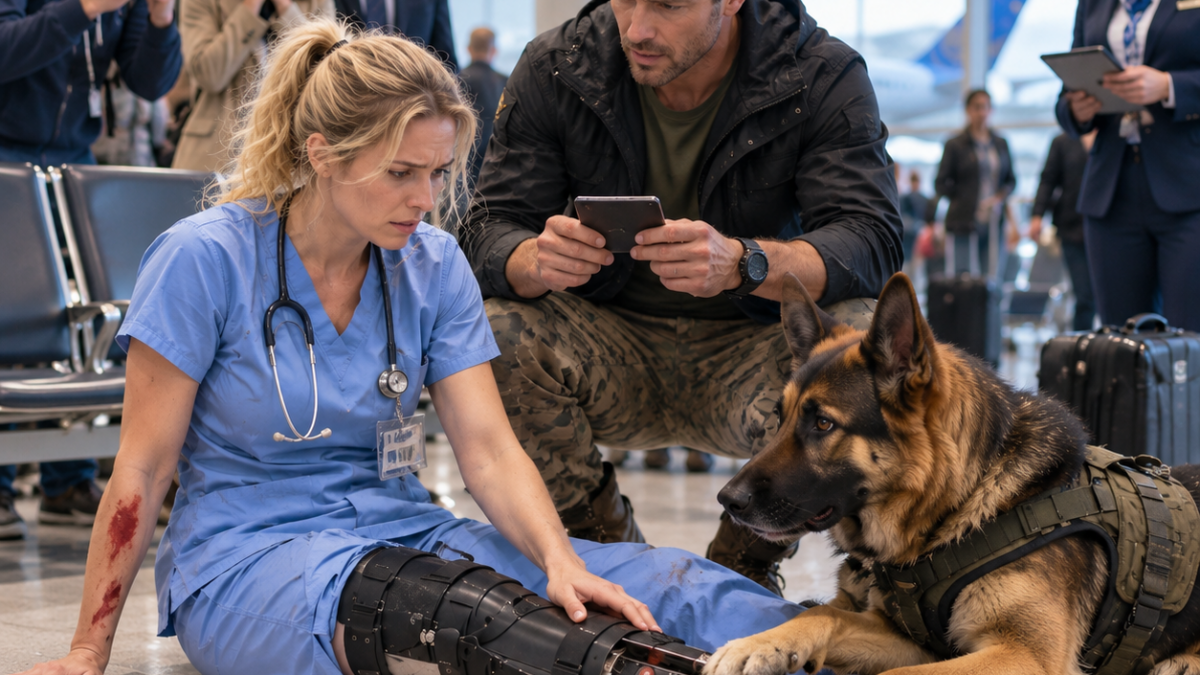
The man in the Navy jacket, whose name turned out to be Croft, a former program security consultant for Silver Meridian with no formal law enforcement background and a contractor arrangement that had given him access to VA adjacent databases, was processed by Castillia’s agents in the corridor and transported to a federal holding facility.
His colleague from the food kiosk had made it to the airport’s north parking structure before being intercepted by a local marshall who was not connected to the compromised network and who seemed from Castile’s brief account of it to have been entirely willing to help once the federal authorization was confirmed.
The medical director at the Dunore facility, a man named Harstad, who had signed off on 8 months of Adrienne’s confinement without ever appearing in any of the Silver Meridian promotional materials or public-f facing documents, attempting to
access the facility’s server remotely from a personal device at 9:41 that morning.
The attempt was logged, flagged, and used to add an obstruction count to what was already a significant charge list. Harrove received the notification on her phone and said nothing, just made a mark in her notes with the expression of someone adding a final item to a list they had been keeping for a long time.
Fenwick, the psychiatrist, had not reported to work that morning. His residential address was under observation. He had not traveled.
The hold extended to transportation, and his name had been added to the relevant watch systems within 20 minutes of the halt authorization. He was contained, even if not yet in custody. contained was enough for now.
Elena’s brace was unlocked by the technical agent Hargrove had brought, a man named Voss, which she noted with flat amusement was her own last name, who used the scanning equipment to manually override the lock joint without disturbing the transmitter housing.
The release was not elegant. It involved a specific tool applied to the side panel, three precise pressure points, and a reset sequence that took 8 minutes because the first two attempts partially cycled and stopped. When the joint finally released, the sensation of the brace returning to its normal compression was significant enough that she had to breathe through it for a moment.
The technical agent looked at her with professional concern. Pain level manageable, she said.
Don’t stop.
He finished the reset. The microprocessor cycled correctly. She stood carefully, tested the brace through its range of motion, and identified a compensation pattern in her right hip that had developed during the locked hours and would need attention.
She filed it. Then she walked to the window and looked at the tarmac and thought about Dominic. Hargrove had dispatched a contact to his address within the 12-minute window.
The contact had confirmed he was home, unharmed, bewildered, and Harrove’s word, vocal.
Elena had spoken to him briefly during a break in her statement, and the conversation had been exactly what she’d predicted.
He was fine. He was angry on her behalf about the airline, and he told her to stay and deal with it and come when she could.
He had his neighbor’s number.
He was not helpless. She had told him she knew and she would come soon. She had not told him everything else that could wait.
She was still at the window when Mason came to stand beside her.
He had been with Adrien since Adrien sat down, moving between the room’s active work and the chair where his teammate was talking to Harrove with the steady, careful pace of someone giving information that had been held under pressure for 8 months and was finally painfully being released.
He knew it would take time. Mason said that was the hardest part for him. He said designing something that depended on probability instead of planning.
He couldn’t know when.
He couldn’t know who.
He could only know that eventually the conditions would be right.
He’s an engineer, Elena said.
Explosive ordinance before the TBI. He thinks in systems.
Mason was quiet for a moment. He said he chose mobility device patients specifically because they were the population silver meridian was exploiting.
He wanted the evidence carrier to be someone the program had already failed. He thought.
Mason stopped. He thought it was the least he could do.
Make it count for someone they’d already hurt.
Elena looked at the tarmac at the aircraft moving on the far runway, ordinary and indifferent.
It’s a reasonable logic, she said.
Doesn’t make the fall less real.
No, Mason said.
It doesn’t.
I’m not saying that to make him feel worse.
I know. He knows, too.
Mason paused. He asked me to tell you.
He said he’d rather tell you himself, but wasn’t sure he had the right to ask for that.
Elena considered this. Outside the morning had moved into midm morning and the airport was at full activity now.
Passengers flowing through the terminals, gate announcements overlapping, the routine commerce of people going places. She had come here to go to her brother. She had ended up here instead.
Tell him I’ll talk to him when Harrove’s done with him, she said.
And tell him the fall is not the thing I’m holding against anyone.
What are you holding against someone? She looked at him. the boarding lane, the 40 minutes.
The way Darby looked at me when I asked for my zone, and she decided it was easier to run the clock than to solve the problem. She turned back to the window.
That part has nothing to do with Adrien and everything to do with a system that treats people as inconveniences until the inconvenience becomes someone else’s problem.
Mason was quiet. I know, he said. That complaint goes forward, too.
I know it does as I made sure of it. She paused. That was the other thing I was doing this morning.
Not just surviving a federal evidence situation. Also documenting an accessibility failure in a public transport facility.
Both things can be true. He almost smiled.
She could see it in her peripheral vision. The restraint of it.
Deliberate. The choice not to smile at something that was not quite funny enough to smile at.
The operations room behind them had shifted into a lower gear. The acute urgency of the early morning replaced by the sustained methodical work of building a case that would hold.
Hargrove was on her third call in an hour to the inspector general’s office.
Adrienne had moved from formal statement to informal debrief, sitting across from an agent who was taking notes on a legal pad, his voice gaining steadiness with each exchange. Atlas had settled at his feet in the specific way of a dog who had completed his assignment and was now simply present. At 11:17, the news broke, not through official channels, through a passenger.
The same airport that had watched Elena Voss fall on the floor of gate 14B’s boarding lane and stepped around her had also watched the aftermath.
The federal agents moving through the concourse, the operations room activity visible through the corridor windows, the man in the Navy jacket being walked out with his hands positioned in a way that was not ambiguous. A passenger in the gate 14B waiting area had filmed a portion of it on a phone. The clip was 23 seconds long and showed federal personnel escorting Croft through the concourse and it was on three platforms before noon.
The clip would have been ambient noise in the daily flood of airport incident footage, except that a journalist who covered federal contractor fraud had seen it recognized Croft from a three-year-old report on VA adjacent contracting irregularities and filed six public records requests by 12:30. Hargrove received a notification about it and said very quietly. Well, good or bad, Okaphor said.
Accelerating, she said, which is both.
The acceleration meant that Silver Meridian’s communications team, which had been operating under the assumption that the morning’s events were contained, began receiving media inquiries before the warrant packages were fully processed.
The organization’s public-f facing director, a woman named Petra Corvin, who had no apparent knowledge of the fraud operation and was in fact the person who had built the program’s legitimate rehabilitation services, received a call from a reporter at 12:44 and called the VA’s compliance office in a state of alarm at 12:49.
That call was routed to an office that was already aware of the situation and was in the process of cooperating with the federal investigation. The person who took the call informed Corin of the basic outlines of what had been uncovered.
Corin’s response, recorded and later included in the investigative record, was 17 seconds of silence, followed by a single sentence that indicated she understood the magnitude of what had been done inside an organization she had believed she was running.
She retained a lawyer and began cooperating by 2:00.
Lorraine Vth, the program administrator who had filed Adrienne’s fraudulent discharge paperwork, was located at her home address at 115 and taken into federal custody without incident.
She said nothing at the time of arrest and continued saying nothing, which was her right and which did not matter because the records Adrienne had mirrored 8 months ago contained her signature on 47 documents that described in the precise administrative language of program management the systematic diversion of
equipment from disabled veterans to a resale network. 47 documents, 47 separate occasions on which she had signed her name to something she knew was false.
The paper trail was comprehensive. Adrien had understood that paper was more durable than testimony, more durable than memory, more durable than the goodwill of institutions that might prefer a problem to disappear.
He had built his evidence in paper, mirrored it into a transmitter that had traveled 8 months through airports and medical appointments and daily life, and waited. The waiting was the part that none of it fully accounted for.
eight months in a locked ward, medicated to a level that kept him present but not functional, aware of the transmitter and the plan and the probability that it might never work, that Mason might not come through that airport on the right day, that the patient carrying the brace might never travel again. He had built a plan that
could fail on any of a dozen variables, and he had lived inside that plan for 8 months without knowing if it had worked.
Elena thought about that in the spaces between the procedural demands of the afternoon. She thought about the specific quality of that kind of waiting. Not passive, not resigned, but sustained in the way that only people with a particular kind of interior discipline can sustain it.
She had seen it in patience before. The ones who survived the unservivable things were not always the strongest.
They were often the most specific, the ones who found one thing to hold on to and held it with the precision of someone who knows that loosening their grip even slightly would cost them everything. Adrienne had held on to a Belgian Malininoa and an airport and a probability.
It had worked.
At 2:40 in the afternoon, Elena finally reached the medical team at Harlo City Medical Center’s orthopedic department, explained the morning’s events in broad terms, and arranged for an emergency assessment of her brace and her left leg’s current status.
The nurse who took the call, a woman named Tara, who had worked with Elena on the trauma floor for 3 years, was silent for a long moment after the explanation and then said, “So, you’re telling me you spent 6 hours in a locked brace, gave multiple federal statements, and your main
concern is that your hip is going to be stiff tomorrow?
My main concern is whether the brace’s microprocessor calibration was affected by the override reset.”
Elena said, “You need to come in.
I’ll come in when I can come in.
Right now, I’m still needed here.
Elena, I know my body, Tara.
I’m monitoring it.
I’ll come in today.
She did not come in today. She came in the following morning, which was technically today adjacent if you were generous with definitions.
And the assessment confirmed bruising of the iliac crest, minor soft tissue irritation in the left ankle consistent with several hours of abnormal joint loading, and a microprocessor calibration that was in fact 3% off its baseline settings and needed a manufacturer’s adjustment.
None of it was serious. None of it was nothing.
She told Dominic everything the evening of the first day, sitting in his apartment in Merit Bay with a bag of ice on her hip and his twoe postsurgical knee elevated on a pillow. Both of them injured and tired and eating takeout from the place two blocks away that did a lemongrass soup he had been recommending to her for a year.
It was not a conversation that had a natural shape. There was too much in it, too many pieces that belong to different categories of story. She told it in order, which helped.
He listened without interrupting, which was unusual for him and indicated how seriously he was taking it. When she finished, he was quiet for a moment.
Then he said, “The gate agent, Darby.”
Yes.
She’s going to say she was following protocol.
Yes.
And the accessibility desk woman, Greta, yes, she’ll say the same.
And the first agent, Ferris, at check-in. All of them will say they were following protocol, Elena said. and some of them were.
The protocol is the problem. She shifted the ice.
The complaint is filed against the airlines operational procedure as much as the individual employees.
I’m asking for a review of how mobility assistance requests are communicated between check-in, the accessibility desk, and gate staff.
The gap between those three points is where my request disappeared. That gap needs to close. Dominic looked at her for a long moment.
He had her same bone structure and her same tendency to go quiet when processing something complicated. You fell on the floor, he said, in front of people who walked around you. Yes.
And your first instinct was to document it. My first instinct was to get upright, she said.
The documentation came second. He shook his head slowly, not in disagreement, in something closer to recognition.
You’re going to do something with this, he said.
I’m already doing something with it, she said.
At 917 the following morning, Darren Quill was taken into federal custody at the golf course outside Pelum Township where he had been spending his retirement. He was escorted off the course in front of four other players and a groundskeeper, which was not by design.
The agents had simply arrived during his standing Tuesday morning round. And the image of a former federal inspector being walked to a government vehicle with a golf club still in one hand was the photograph that ended up on the front page of the Delwick County Gazette two days later under a headline that used the word fraud twice. The compromised NCIS case officer, a man named Troll, was placed on administrative suspension pending the investigation, which was the institutional language for removed from any position where he could affect the outcome of an investigation he had actively suppressed.
His attorney issued a statement suggesting his client had acted within his authority and looked forward to the opportunity to provide context.
The 14 names on Adrienne’s list began one by one, acquiring legal representation.
Silver Meridian’s operations were suspended in full.
The 212 documented cases of diverted equipment became the centerpiece of the VA’s emergency audit, which expanded within a week to cover 431 veterans whose program records showed inconsistencies.
The Shell Company in Delwick County was traced to two additional holding entities, which were traced to a resale network that had moved equipment through three states over 4 years. The scope of it was large enough to require a dedicated investigative unit which was assembled within 72 hours of the warrant package being processed. Elena was not part of that unit.
She was a witness, a complaintant, and eventually a consultant on the medical documentation aspects of the case, which required someone who could read a treatment protocol and identify where the clinical justification stopped making sense. She did that work remotely from Harlo City between shifts at the medical center in the specific gaps of a life that had not stopped simply because an extraordinary thing had happened inside it. The airline complaint was adjudicated separately through a formal accessibility review process that took 3 weeks and ultimately produced a finding that the airlines intersystem communication protocol for mobility assistance requests was inadequate and had resulted in a documented failure of duty of care toward a passenger with a
documented disability.
The finding recommended mandatory protocol revision and staff retraining. It did not name Darby or Ferris or Greta individually. It named the system.
Elena received the finding in a standard email.
She read it twice, printed it, and filed it in the same folder as her morning’s notes from the airport.
Then, on a Tuesday afternoon, 3 weeks after the day at Vaser Falls, she received a call from a number she did not recognize. She almost did not answer it.
She was between patients, standing in the corridor of the medical center’s postsurgical ward, and her phone had been ringing with unusual frequency since the story had become public enough to be findable by people who looked.
She had developed a policy of unknown number caution, but something the specific area code or the time of day or some probability her brain had assembled without consulting her made her answer. Ms.
Voss. The voice was formal, measured, belonging to someone in an institutional role.
This is the office of the VA’s under secretary for benefits.
I’m calling to inform you that a comprehensive review of veteran rehabilitation program protocols has been initiated and your formal complaint documentation has been designated as foundational evidence for that review.
A pause. The under secretary would like to speak with you personally about your experience and your recommendations.
Elena was quiet for a moment. Around her, the corridor continued its afternoon rhythms.
A monitor alarmed briefly and was silenced. A patient called for a nurse two rooms down. A cart with medication trays moved past her, pushed by a tech who nodded without breaking stride.
When? She said. This week, if possible.
Thursday. I can do Thursday. Excellent.
and Ms. Voss say on behalf of the office, I want to say that the documentation you produced under extremely difficult circumstances was I was taking notes.
Elena said, “That’s what I do.
Tell the under secretary I’ll see her Thursday.”
She hung up. She stood in the corridor for a moment longer.
The postsurgical ward was fully occupied this week. 11 patients, six of them in varying stages of mobility recovery, three of them veterans. She had three more patients to check before end of shift.
She put her phone in her pocket and started walking. The brace moved with her, calibrated and correct, the microprocessor cycling through its adjustments the way it had been designed to do.
three weeks after Vaser Falls, two days after Lorraine Vth entered a plea negotiation that the prosecutors described as significant. And on the morning when Fenwick was finally taken into custody at a rental property outside the county line where he had been quietly waiting to see how things resolved.
On that same morning, Harg Grove called Elena with the information that the VA’s emergency audit had confirmed a fifth organization operating in parallel with Silver Meridian using a different name and a different VA district, but the same shell company
structure and in one case the same secondary market broker.
The network was larger than anyone in that operations room 3 weeks ago had estimated.
And the list of names in Adrienne’s transmitter, 14 names, the ones they had believed represented the full extent of the corruption’s reach into federal systems, had not been a complete list.
Adrienne had known it wasn’t complete.
He had told Hargrove on the first day quietly while Elena was giving her statement.
He had told her there were names he couldn’t document, people he had identified by pattern and proximity, but could not connect to a paper trail.
He had told her the 14 were the foundation, not the ceiling. Hargrove had not told Elena this until now.
Why are you telling me now? Elena said.
Because one of the undocumented names, Hargrove said, is someone in the VA’s own regional oversight office.
And the under secretary’s meeting Thursday, the one you confirmed for, I confirmed it yesterday.
The person who called you to confirm it, Harg Grove said carefully, is not the under secretary’s actual administrative coordinator.
We verified the under secretary’s office did not place that call.
Elena stood in her kitchen in the early morning, coffee cooling in her hand, the brace strapped on in its correct sequence, the morning light coming through the window above the sink.
Someone called me pretending to be the under secretary’s office, she said.
Yes. To set up a meeting.
a meeting at a location they specified in a building that is not VA property. Harrove paused.
Elena, don’t go Thursday.
Elena set the coffee down. Who made the call? She said.
Hargrove was quiet for exactly 2 seconds.
We’re still identifying the number, she said.
But the name the caller used, the coordinator’s name they gave you, matches a person who retired from federal service 8 months ago.
Another pause. the same month as Darren Quill.
Elena did not go Thursday. She did something harder than not going.
She called the number back. She did it with Hard Grove on a parallel line recording and with Mason sitting at her kitchen table with his coffee untouched and his attention fully on her face.
She had told them both what she was going to do, and neither of them had tried to stop her, which she appreciated. She had explained her reasoning clearly.
The person on the other end of that call had her name, her phone number, and had already demonstrated the capability and willingness to impersonate federal officials. Disappearing from the meeting would not make that person stop. It would only make them recalibrate.
She wanted them to stop. The phone rang four times.
Then a voice, the same voice, measured and institutional, said, “Miss Voss, we were hoping to hear from you.”
“I’m calling to confirm Thursday,” Elena said.
Her voice was steady in the way she had trained it to be steady over years of delivering difficult information to patients who needed the person telling them to be calm. I have a conflict at the time you suggested.
Can we move it to 10 in the morning? A pause. Brief but present.
That should be workable. Same location.
I’ll need the address again.
I didn’t write it down properly.
Another pause. Longer this time. The calculation on the other end of the line was audible in the silence.
Not literally, but Elena could feel it. The way you feel a change in air pressure before weather arrives.
Of course, the voice said, and gave her an address in a commercial district on the east side of Harllo City. She thanked them. She hung up.
Hargrove had the address traced within 6 minutes.
The building was registered to a property management company that was a subsidiary of a holding entity that when you followed its registration chain back through three layers of corporate structure connected to the same Delwick County holding company that had moved
Silver Meridian’s diverted equipment money.
The network had a physical location and it had just told them where it was.
They think I’m coming Thursday at 10, Elena said.
They think you’re coming Thursday at 10:00.
Hardgrove confirmed. Then we have two days.
What happened in those two days was not something Elena was present for in any operational sense.
Harro’s team worked with a federal task force that had been assembling since the warrant packages were processed and the building on the east side of Harllo City became the focal point of a surveillance and entry operation that ran simultaneously with the continuing audit of Silver Meridian’s records.
Elellanena’s role was to remain available for consultation and to not approach anywhere near the address she had given Harg Grove.
She worked her shifts. She checked in on her patients. She called Dominic every evening and the conversations were increasingly normal.
His knee was responding well to the physical therapy protocol. The Lemongrass Soup Place had apparently added a new item to the menu that he felt she needed to know about.
And he had taken to sending her news articles about the Silver Meridian investigation with a single line commentary that ranged from, “Look at this.” to, “I told you these people were criminals.”
Despite never having said anything of the sort, she slept badly but slept. She ate. She strapped on the brace each morning in the sequence that was correct and let it do its job.
On Thursday morning at 9:47, federal agents entered the building on the east side of Harlo City. They found three people inside.
A former VA regional oversight officer named Callum Brig, who was the undocumented name Harrove had been tracking.

