They Called the Nurse a Liability—Then Her Secret Navy Past Exposed a Deadly Chemical Cover-Up – Part 5
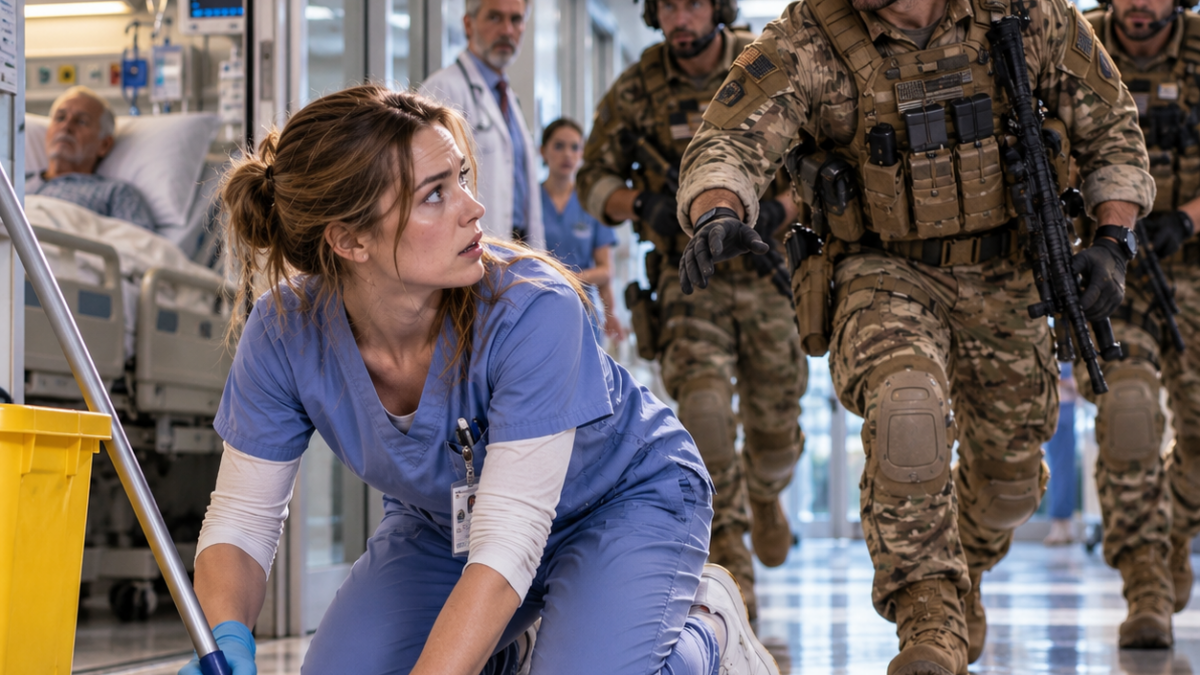
Eventually the difference between those two reasons became the most important thing I had to think about. The chair wrote something on the notepad in front of her.
Then she said, “Thank you, senior chief.”
Lena looked at her.
“Marsh,” she said.
“Lena Marsh, it’s on my badge.”
The chair’s mouth moved slightly, not quite a smile.
Something adjacent to it.
“Thank you, Miss Marsh.”
The panel panel’s preliminary findings were released 11 days after her testimony.
Lena read them on her phone in the breakroom at Harrove Valley. Between the end of a morning shift and a training session, she was scheduled to run at 2:00.
The findings were 63 pages long, and she read the summary and the conclusions and enough of the evidentiary section to confirm that the documentation she and Talbot had provided was cited correctly and completely.
Hartwell’s name appeared eight times.
The operating authorization he had signed for the original Savar contractor network appeared four times. The connection between that network and the reactivated facility. The one with the shipping manifest and the two redacted destinations was documented in the findings as an active matter under joint investigation by three national authorities.
The two redacted destinations had been identified.
She didn’t learn this from the panel findings.
She learned it from Aldrich who called her at 11:47A. Yak Sutz on the same morning and said in the characteristically compressed way he could communicated anything he considered both significant and sensitive. The shipments were intercepted both of them.
Cargo is in custody. She asked the question she needed answered.
The compound secure. She exhaled the face in the photograph.
She said, “The cargo terminal in custody as of yesterday morning.
A pause. Local jurisdiction.
It’ll take time to process, but it’s not going anywhere.”
She looked at the breakroom wall.
“Vasquez and Okafur,” she said.
Aldrich’s voice, when he answered, had a quality she had not heard in it before.
not sentimental, not performed, but genuine in the way of a man who has been carrying something for a long time and recognizes a moment that allows him to set it down. Their families were notified this morning, he said.
The corrected record, what it means, why it changed. He paused.
Both families had been told the original version that it was unavoidable. That command had no advance warning.
She said nothing.
Vasquez’s daughter is 17.
He said she’s been told her father died because of a contamination assessment failure that no one saw coming.
He stopped.
She’s going to be told something different now.
Lena pressed her palm flat against the breakroom table and held it there. Is that better? She said, and she was not entirely certain what she meant by the question better for the daughter.
Better than silence. better than the version of the truth that had existed for 3 years in an amended document that someone had altered to protect themselves.
I don’t know, Aldrich said.
I think it’s more true.
Which isn’t always the same thing as better, but it’s what we have.
She thought about a boy in slightly too large sneakers sitting on a hospital corridor floor, always asking her if his father was going to die.
She thought about how she had told him she didn’t know.
She thought about how he had said months later, “You told me the truth.”
When everyone else was giving me the other thing, “It’s what we have.”
She agreed.
At 2:00, she walked into the disaster response simulation room on the third floor of Hard Grove Valley’s education wing and found 11 people waiting for her.
Seven nurses at various stages of training, two residents, one attending doctor Ferris who had asked to observe and whom she had told he was welcome to participate and Ruth Callaway who had no official reason to be there and who had arrived 12 minutes early and was sitting in the back row with her arms folded in the expression of someone who is exactly where they intended to be. The simulation was a mass casualty chemical event.
Lena had designed it herself over 3 weeks in consultation with Voss and with two emergency medicine specialists Voss had connected her to through the network that had grown organically and without planning. From the 41 days following Caldwell, the scenario was fictional was fictional. a different compound, a different facility, different presenting symptoms.
But the structural logic was taken from what she had learned in a classified evacuation corridor 7 years ago and refined in a regional ER 41 does ago. And it was built to teach the things that standard mass casualty training did not adequately address. It was built to teach people how to think when the situation did not match any protocol they had been given.
She stood in front of the room. She looked at 11 people who had come to learn something. She noticed as she looked that her hands were trembling.
The faint familiar tremor that had been with her since she first walked into Harrove Valley that had disappeared during crisis and returned in the quiet afterward that a 12-year-old had asked her about once in a hospital corridor and that she had answered as honestly as she could. She
did not put her hands in her pockets. She did not press them flat against the table.
She let them be what they were evidence of something that had happened to her that was not finished happening. That that would probably not be finished for a long time. And that did not prevent her from doing the work she was standing in this room to do.
My name is Lena Marsh, she said.
I’ve been an ER nurse at this hospital for eight weeks.
Before that, I was a senior medical specialist in a Navy rescue unit for 11 years.
I’m going to tell you before we start what this simulation is designed to test and what it is not.
The room was quiet and attentive.
It’s not testing whether you know the protocol.
She said, “You know the protocol.
That’s baseline.
What it’s testing is what you do when the situation in front of you doesn’t match the protocol you were given.
When the data says one thing and the official clearance says another, when the person with authority over you has made a decision you believe is wrong, she let that sit for a moment and it’s testing whether you will say so clearly on record before the consequences of not saying so have already happened.
A resident in the second row, young, attentive, the kind of young that still carries the sliced uncertainty of someone who knows how much they don’t know yet, said, “What if we say it and we’re wrong?”
“Then you were wrong,” she said.
“Document it, understand why, and do better next time.”
She held the resident’s gaze.
“But in my experience, the people who are afraid of being wrong don’t speak up.
and the cost of that silence is higher than the cost of a documented error. She looked at the room. The cost of silence is something I can speak to from personal experience.
She said, “I’m not going to be dramatic about it, but I want you to know it has a price, and I paid it, and I would rather you learn the arithmetic of that now than later.
” She picked up the simulation folder.
“Let’s begin,” she said.
What followed was not smooth.
It wasn’t designed to be.
The simulation ran for 90 minutes and it broke down three times once at intake. Once during the decontamination corridor establishment and once when the secondary exposure event was introduced and two of the nurses froze for a critical 30-cond window before the resident in the second row called out the relevant observation and broke the freeze.
After each breakdown, she stopped the simulation and asked the person who had been nearest the failure point what they had seen, not what they had done, what they had seen. The answers were consistently more accurate than the responses had been. People had seen the right thing.
They had hesitated to act on it. The hesitation came from different sources. uncert uncertainty about their authority, concern about being wrong, the particular discomfort of being the person who contradicts the more senior person in the room.
She recognized every single source. After the third breakdown, she sat on the edge of the table and talked about the difference between uncertainty about capability and uncertainty about standing.
And she talked about it without making herself the example because the session was not about her. She gave them the framework. They applied it to their own versions of the situation.
The resident in the second row, his name was Parish.
She had learned during introduction stayed 20 20 minutes after the session ended to ask her a question that he’d been visibly formulating for the last half hour of the simulation.
The freeze, he said, the 30 seconds when I saw it but didn’t call it.
How do you train yourself out of that? She thought about this honestly.
You don’t train yourself out of it entirely.
She said, “You train yourself to recognize that you’re in it and then act anyway.
The freeze doesn’t mean you’re not capable.
It means you’re human and the situation has outpaced your comfort level.”
She looked at him.
“The question is whether the discomfort of speaking up is larger than your understanding of what happens if you don’t.”
He nodded slowly.
“You called it,” she said.
Eventually, within the window that mattered, she held his gaze.
Don’t spend too much energy on the 30 seconds.
Spend it on what made you call it when you did. He left.
She sat with the simulation materials for a while, making notes on the three breakdown points for the revised version. She would run in 6 weeks.
Ruth, who had not left, came and sat in the chair beside her. Ferris wants to know if he can bring his residence next month.
Ruth said, “Tell him yes.”
Voss called this morning.
She’s going to recommend this simulation to the regional emergency preparedness network as a model for chemical event nurse training.
Lena kept writing.
You don’t look surprised, Ruth said.
I’m not surprised by anything Voss does.
She said she’s very efficient.
Ruth was quiet for a moment in the way she was quiet when when she was deciding whether things she had actually come to say.
I’ve been a charge nurse for 16 years.
She said, “I’ve seen a lot of people come through this department.
Some of them were talented. Some of them were hardwork.
Some of them were both.”
She looked at Lena’s profile.
Very few of them changed anything. Lena set her pen down. You changed the decontamination corridor protocol.
Ruth said permanently.
It’s in the revised procedure manual as of two weeks ago.
Your name is on the recommendation that generated it. She paused.
You changed how Hol runs his orientation reviews.
You generated a simulation that Voss is taking regional and you are the reason Marcus Talbot’s 14-month documentation effort finally reached a jurisdiction with enough authority to act on it.
Ellis’s office did that.
Lena said.
Ellis’s office needed your testimony to do it.
Ruth said, “And your testimony required you to release a record that implicated yourself.
She held Lena’s gaze.”
I’m saying this not because I think you need to be told how significant it was.
I’m saying it because I’ve watched you downplay your own contribution in every formal and informal context for the last 6 weeks, and I find it irritating.
Lena looked at her. You told that resident not to spend too much energy on the 32nd freeze, Ruth said. The same instruction applies to the three years.
The simulation room was quiet after noon light came through the high windows and put long rectangles on the floor. Lena did not say anything for a moment. Then I spent 3 years believing that the most honest version of the night glass story required me to be primarily a cautionary tale.
She said, “Someone who saw the right thing and didn’t do it.”
I was so committed to that version that I built a life around protecting it from anyone who might complicate it by adding on the part where I did actually see the right thing. Both things were true at the same time, Ruth said.
Yes, Lena said. That was the part I found hardest. Ruth stood up.
She gathered her things with the efficiency of someone whose time is always organized around necessity. At the door, she stopped.
The next simulation, she said.
I’d like to be one of the participants, not an observer.
Lena looked up.
I’ve been running the nursing floor of this ER for 16 years, Ruth said.
And I have never once done a chemical mass casualty simulation that tested what I do when the attending rejects my assessment.
She held Lena’s gaze and I’d like to know.
You’d call it, Lena said.
I know I would, Ruth said.
I want to know what it feels like to do it in a room where that’s the expected behavior.
Where the training says that’s what you’re supposed to do.
She paused. Some of us have been right for a very long time in situations where being right was professionally inadvisable.
It would be useful to practice being right in a situation where it isn’t.
She left. Lena sat in the empty simulation room for another 10 minutes.
The day Hartwell’s suspension became a termination and formal referral for federal prosecution, Lena was on shift.
She found out from Aldrich’s text at 11:22 a.
m. between a pediatric laceration case and a patient in Bay 2 with a suspected cardiac event. The message was three words.
Hartwell formal referral. She read it. She put her phone back in her pocket.
She went to Bay 2. The announcement was public by the afternoon.
A federal contracting fraud charge that by the time the news organizations had it had expanded to include evidence tampering, obstruction of an oversight proceeding, and two counts related to the Savvar contractor network’s regulatory filings.
Puit’s office was named in the announcement as h having been placed under formal review pending the outcome of the investigation into its role in the attempt to seize operational records from Harrove Valley Medical Center.
Lena learned this not from her phone, but from a patients family member who had a news alert on their tablet in the waiting room and who mentioned it to her in passing. The headline was specific enough that it named the Caldwell event. the chemical exposure and the subsequent investigation.
The family member looked up from the tablet and said, “Were you here during the Caldwell thing?”
“I was on shift,” Lena said.
“That must have been terrifying.”
She thought about it parts of it, she said. She went back to work.
62 days after the Caldwell event, on a Thursday afternoon, with a light rain coming down outside and the particular gray green quality of late autumn light that made Clarkfield look like a city, someone had painted with the intention of being honest about it.
Lena sat in Aldrich’s car in the parking structure of a building she had not been in before and read the final official determination on the night glass incident, not the proceedings summary.
the official determination, the formal document that constituted the last words were institutionally on what had happened in that evacuation corridor and who had known what and when. Vasquez and Okafor deaths attributed to command failure in the authorization of an evacuation route through a contaminated zone following receipt of a formal contamination warning from senior specialist Marsh characterization amended from unavoidable loss in an operational environment to preventable deaths resulting from a failure to act
on field intelligence.
She read that sentence twice. Preventable.
The word cost her something to read. Not because it was wrong.
It was precisely correct, and she had known it was correct for 3 years and had carried it accordingly. It cost her because seeing it in official language meant it was real in a way that her private knowledge of it had not fully been.
It existed now in a document. It would be cited.
It would be referenced. It would live in a record that was not amendable.
And below it in the same document, the formal restoration of her operational record with the complete sequence attached, the warning, the order, the compliancence, and the field documentation that had kept 10 people alive 41 days ago, and that had indirectly ended the careers of two people who had believed they could shape institutional memory to their own benefit. Aldrich sat beside her without
speaking while she read. When she was finished, she set the document on her knee.
Is there anything else? She said that needs to come from me.
Any proceeding, any documentation, anything ongoing. Your testimony to the panel is complete. He said the contractor network investigation will take another 8 to 14 months, but your contribution to it is already in the record.
They don’t need anything further from you.
and the reactivated facility. Under joint investigation, access restricted pending the custody proceedings for the cargo intercepts.
He paused.
You won’t be asked to go anywhere near it.
She nodded. He said the offer I mentioned the civilian training role.
I know you don’t have to decide today.
I know, she said again.
I’ve already decided, he looked at her.
I’m going to stay at Harrove Valley, she said.
Clinical full-time.
Voss’s network is expanding the chemical event training program to regional hospitals, and they want a clinical lead for the simulation component.
I’ve agreed to develop it while staying on staff in the ER.
She met his eyes.
That’s my answer to your offer, and it’s also its own thing, separate from your offer.
I want to be clear about that. He almost smiled.
It was brief and genuine and surprised her slightly because she had not seen it before.
That’s a better deployment than what I was proposing, he said.
I know, she said.
That’s why I chose it.
She got out of his car. She shook his hand, which was the appropriate gesture for two people who had a specific history and a professional regard for each other and no particular road map for what their relationship was supposed to be. After the immediate business was resolved, he took her hand and held it for a moment and then let go.
She walked to her own car. She drove back to Harrove Valley. She was early for her shift and she spent the extra 12 minutes in the locker room changing into her scrubs clipping her badge to her pocket.
The badge said said what she had said stopped reading it every time she clipped it on and had not noticed exactly when that happened. She was almost to the ER floor when she heard her name. Not nurse Marsh, not Senior Chief, not Nightclass.
Lena Holt at the physician station looking up from the chart he was writing. He had been using her first name for 6 days, and it still sounded slightly unfamiliar in his mouth in the way that people who have recalibrated a habit sometimes overunciate the replacement without meaning to. incoming trauma.
He said MVA two patients Weston still on the previous case. Can you guess? She said she was already moving.
The next 3 hours were the ordinary difficulty of an emergency department on a Thursday afternoon. Not catastrophe, not the specific compressed intensity of a mass casualty event, just the sustained demanding work of people coming through the doors with bodies that had stopped stopped cooperating with them in various ways. A woman with a fractured radius, angry and frightened.
A 7-year-old with an asthma exacerbation. calm in the way that small children are sometimes terrifyingly calm when they have been frightened before and have learned that their resources are finite. An elderly man with a medication interaction that required careful management and equally careful conversation with a family who had been managing his medications for 3 years and who speak who needed the information without the implication of blame.
Lena did all of it. She did it imperfectly in the way that work done by human beings in real time is always imperfect.
She missed a notation on the elderly man’s chart and caught it 40 minutes later.
She asked Priya to repeat a handoff.
She had processed incorrectly the first time because the MVA case had taken more of her attention than she’d budgeted.
She did all of it under her own name. By the end of the shift, her feet hurt and her back achd in the specific place that indicated she had been standing in the same posture for too long without noticing.
And the documentation stack was substantial in the way it always was on days with high complexity.
She sat at the nurse’s station and wrote, “Ruth appeared beside her at some point and set a cup of coffee on the counter without comment.
was a gesture of such precise consideration that Lena drank it before she had finished deciding whether she wanted it. The ER wound down around her in the graduated way it did at shift change, the incoming nurses taking handoffs, the physicians rotating, the contained chaos reorganizing itself into a a new configuration.
She finished the last notation. She clipped her pen.
She sat for a moment at the nurse’s station with nothing in her hands, nothing in her hands, and no immediate task in front of her, which was still a condition she found slightly disorienting.
The capacity to be still when nothing was requiring motion was something she was learning the same way she was learning other things. Not quickly, not cleanly, with occasional reversals and the reliable irritation of discovering that entice to behavior change on completely different timelines.
She looked at her hands on the counter still. Both of them completely still.
The tremor was there. It was always there, somewhere below the surface of a quiet moment.
But her hands were resting flat and not moving, and the tremor was simply part of her and not a verdict. She had spent a long time believing that her handsing in ordinary situations and going shaking in ordinary situations and steady catastrophic ones meant something coherent about her character. That it was evidence of a fundamental damage, some architectural flaw in the part of her that was supposed to function in the absence of emergency.
She had spent nearly as long letting other people use the steadiness in crisis as evidence of the opposite, of some extraordinary capacity, something that set her apart, something that justified whatever she had done and whatever had been done around her. Both interpretations had required her to be less complicated than she was. She was a person who had seen the right thing and been overruled and complied anyway and spent three years managing the specific weight of that.
She was a person who had walked into a regional ER with a deliberately unimpressive regime and done the work correctly even when every institutional signal told her she was doing it wrong. sus psychologically, professionally.
She was a person who had eventually handed over a document that implicated herself because the truth of what had happened belonged to the people it had happened to and she had been holding it on their behalf without permission. She was none of those things in isolation. She was all of them simultaneously the same way most people are simultaneously the worst decision they ever made and the best response they ever gave.
and everything in the wide ordinary range between those two points. Outside, the rain had stopped.
Through the high windows above the ambulance bay entrance, she could see this ambulance in the west, the specific sky clearing, the specific luminous gray that comes after rain when the light starts to return before the clouds have fully moved on. She stood up.
She picked up her bag.
She walked past bay four, past bay 6, past the supply corridor where she had made the decision to hand Voss the drive, past the family consultation room where she had told Aldrich to use her real name, past the nurse’s station where Ruth had handed her a phone and said already flagged and the whole floor had moved.
She walked through the staff exit, down the ramp, through the amber rectangle of the streetlight. She reached her car.
She stood beside it for a moment in the cool, clean, postrain air of a Thursday evening in Clarkfield, and she looked at the hospital building behind her. The part of it she could see from the parking structure, the lit windows of the ER floor, the ambulance bay entrance with the lights on over the doors, the ordinary institutional exter exterior of a place that had been 41 days ago the site of the most consequential work she
had ever done and would be tomorrow the site of ordinary work that was not less valuable for being ordinary. That was the thing she had not understood before or had understood conceptually without believing it.
That the woman who had identified a secondary contamination pattern in a regional ER on a Tuesday afternoon was the same woman who had been overruled and humiliated and assigned to stand by a wall and observe. That neither version canceled the other.
that the value of what she had done was not located in the extremity of the circumstances, but in the fact that she had kept doing the work, kept looking, kept calling what she saw, even when the people with authority over her had made it very clear they didn’t want to hear it.
She had not survived the last 3 years because she was extraordinary. She had survived them because she had kept going imperfectly at considerable personal cost with both hands in the frame. She was not a ghost.
She was not the legend that Aldrich’s arrival had briefly threatened to make her.
She was not a cautionary tale, though the story she had participated in contained genuine cautions worth passing on. She was Lena Marsh.
She was staff at Harrove Valley Medical Center. She had a simulation to revise and a regional training program to build and a shift that started at 7:00 tomorrow morning.
And she had exactly enough time to go home and eat something real and sleep adequately. She got in her car.
She pulled on her seat belt. She started the engine. And for the first time in 3 years, not the first time she had been fine, not the first time she had been function functional or capable or doing the work correctly, but the first time she had been something quieter and more durable than any of those.
She drove home under her own name, not running from it, not carrying it as a burden, just wearing it the way people wear the names they were born into when they have finally stopped arguing with the truth of who they turned out to be. The street lights came on as the sky darkened. Clarkfield spread out around her, ordinary and specific and real.