They Fired the Quiet Nurse—Then Her “Valkyrie Six” Identity Stunned the Colonel – Part 1
They Fired the Quiet Nurse—Then Her “Valkyrie Six” Identity Stunned the Colonel
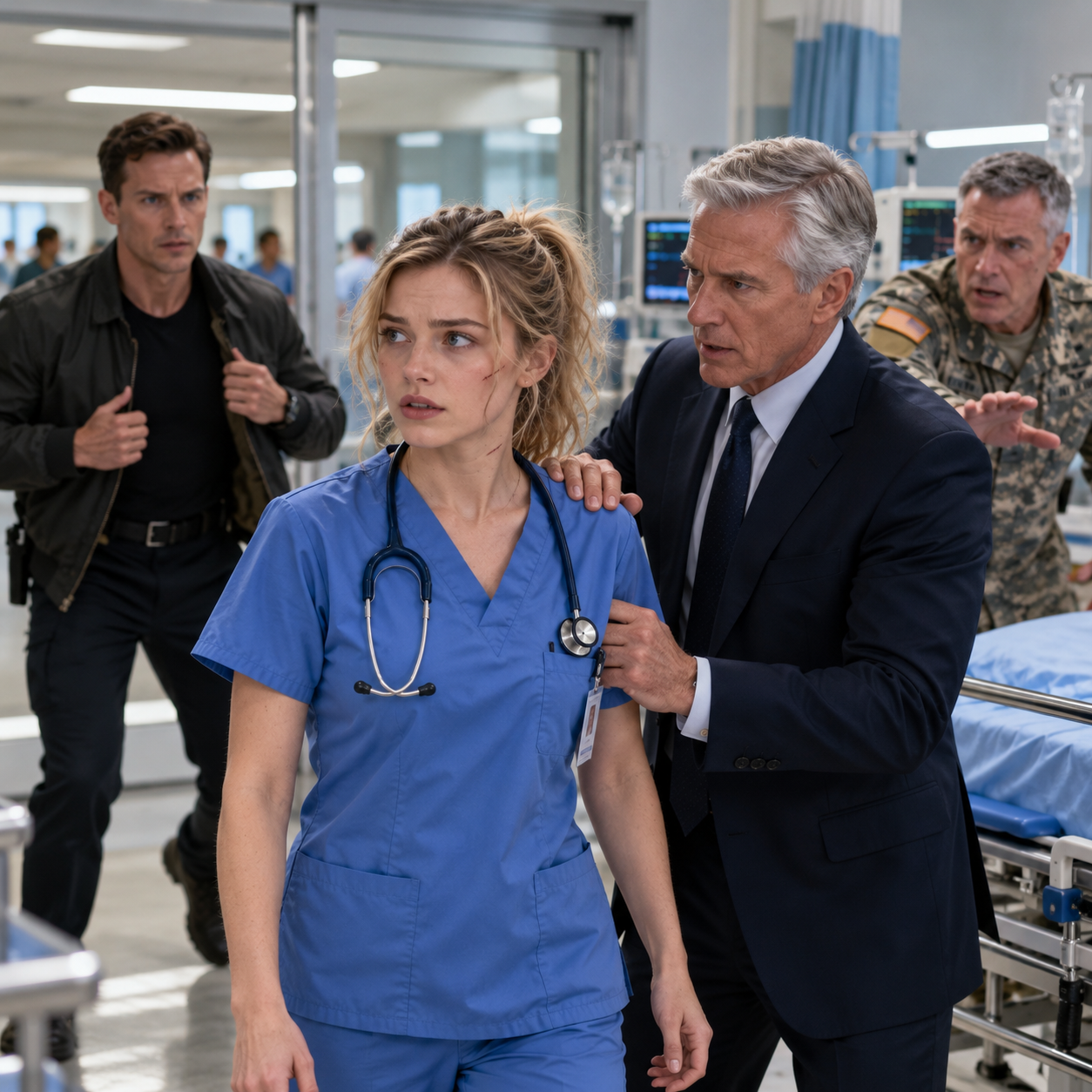
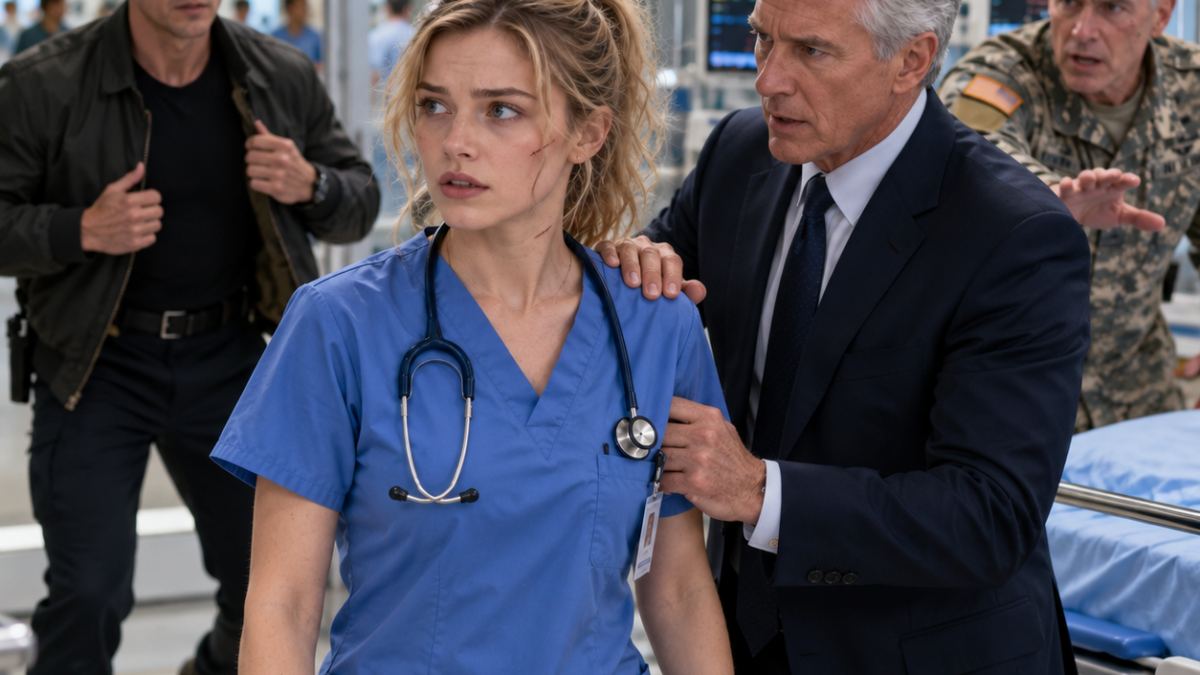
She was just a hospital nurse, quiet, forgettable, the kind of woman you pass in a hallway and never remember until the dying colonel screamed a classified call sign that had been buried for 12 years and she answered it without thinking.
1 second.
That’s all it took.
One unguarded second and 12 years of careful invisibility collapsed like a building with its foundation pulled out.
because the woman standing beside his bed wasn’t supposed to exist.
And the man in that bed had just realized he was the only reason she was still alive and the only reason someone very powerful still wanted her dead.
The first thing Colonel James Harlo noticed about her was that she never stood with her back to a door.
He’d been at Cascade Ridge Military Medical Center in Spokane, Washington for 11 days by then.
recovering from spinal fusion surgery, two vertebrae rebuilt with titanium hardware after a training accident that his orthopedic surgeon described as impressively catastrophic. James had laughed at that.
Surgeons had a way of complimenting damage. The ward was quiet most mornings. Staff rotated in andout orderlys, technicians, the occasional resident who looked young enough to still be nervous about everything.
But nurse Lydia Hartwell had been assigned to his recovery floor since day three, and she was different from the others in ways James couldn’t immediately name.
She wasn’t unfriendly.
She wasn’t cold.
She simply moved through the ward the way someone moves through a space they’ve already mapped efficiently with without waste, with a particular awareness of the room that most people don’t develop unless something has taught them to.
She checked exits.
Not obviously, not in a way that would register to someone who wasn’t looking.
But James had spent 26 years reading rooms, and he noticed. She also never startled at the alarms.
A cardiac monitor shrieking at 3:00 in the morning would send every other nurse on the floor into an accelerated walk, that specific tension walk of healthare workers managing urgency without panic. Lydia would already be moving before the alarm completed its first cycle, heading towards the source with the calm efficiency of someone who had assessed the situation before the sound even registered as an alarm, like she was operating on a different set of instincts than everyone else around her. James told himself he was being paranoid.
He’d spent too many years in operational environments, and his brain hadn’t fully accepted that he was in a hospital in Spokane and not running surveillance on something.
Postm mission pattern recognition didn’t turn off cleanly.
It just misfired at wrong targets. Then the heavy patient collapsed. It happened on a Tuesday afternoon.
a large man, former enlisted, probably pushing 280, who stood up too fast from his wheelchair and went down hard in the corridor outside James’ room.
James heard the crash and turned his head toward the open door. Two orderlys were already moving, but they were moving wrong, hesitating, calculating how to lift safely, thinking about liability. Lydia came around the corner at a controlled run.
What she did next lasted maybe 8 seconds.
She dropped to one knee, checked the man’s airway with two fingers, tilted his head with a specific angle of pressure that James recognized as a combat casualty airway maneuver, called out a sequence of instructions to the orderlys that were clipped and exact and left no room for interpretation, and had the man stabilized and recovering before the charge nurse even reached the scene.
James watched the whole thing.
that airway maneuver wasn’t in standard civilian nursing curriculum.
He knew because he’d spent three years on a medical readiness committee reviewing training protocols across military and civilian institutions.
What Lydia had just done was a field expedient technique developed for treating casualties in environments where you had no equipment and no time. It was something you learned in a combat zone.
He lay back against his pillow and stared at the ceiling for a long time after that.
“Who are you?”
he thought.
He didn’t ask her directly.
James had learned over many years that the fastest way to get someone to close off was to ask the question you actually wanted answered. You waited.
You watched.
You let people show you things they didn’t intend to show because everyone eventually did.
Over the next three days, he built a quiet inventory. She wore her hair pulled back in a way that allowed full peripheral vision.
Her stethoscope was looped short, not hanging loose the habit of someone who’d learned that loose equipment catches on things in tight spaces.
She had a scar along her left jawline, thin and old, the kind that came from something sharp rather than something blunt. Her hands were steady in a way that came from conditioning, not personality.
And twice when she was adjusting his IV line and thought he was asleep, he’d caught her scanning the corridor with an expression that had nothing to do with nursing.
It was the expression of someone waiting for something to go wrong.
James had seen that expression on operators running protective details, on intelligence people embedded in hostile environments, on soldiers who had learned the hard way that relaxing at the wrong moment had consequences that didn’t come with second chances.
He kept his observations to himself. He remained the cooperative patient, polite, undemanding, occasionally self-deprecating about the indignity of being a decorated officer who needed help standing up in the shower.
Lydia responded to his humor with a dry precision that suggested she found most things mildly absurd, which James respected.
He was almost convinced he’d invented the whole thing.
Then came the nightmare.
They happened regularly, which he disclosed to the staff because you were supposed to disclose things like that and because he’d long since stopped being embarrassed by them.
26 years of operational deployments left traces.
His particular traces manifested as vivid nonlinear replays of a convoy ambush in a classified theater that he wasn’t permitted to name even in his own medical records.
The file listed it as traumatic event, classified operational context. The nightmares called it what it actually was. It was a Tuesday night, the same Tuesday, in fact, running into early Wednesday when it happened worse than usual.
He was back in the vehicle, back in the specific quality of dust and heat that existed in that part of the world. The kind that coated your teeth and sat in your lungs and made everything taste like something already dying. The convoy had stopped.
The radio was alive with competing voices, and James was trying to cut through the noise, trying to reach his team. And the silence that followed was the specific silence of a radio that had just been jammed.
Then the first explosion. He woke shouting, not words exactly. Not at first.
The sounds that came out of him were operational, reflexive, the kind of half language that exists in the gap between sleep and consciousness. when the brain is still running the scenario.
Raven one convoys compromised. Raven one, he was sitting up, heart crashing against his ribs, sweat soaking through the hospital gown, and the room was dark except for the ambient light from the corridor.
Lydia was already there.
She’d been doing her overnight rounds.
She’d heard him through the open door.
She’d come in fast, the way she always moved, controlled, purposeful, and she was at the bedside before James had fully oriented to where he was, her hand reaching for his arm to check his pulse.
Her voice starting to say something calm and clinical. But James had grabbed her wrist reflex, not aggression, and said it again.
Raven one, hold. And Lydia Hartwell froze. He felt it happen.
Her whole body went still in a way that wasn’t the stillness of someone startled.
It was the stillness of someone who had just heard something they were not supposed to hear. The stillness of recognition.
And then before she could stop herself, before whatever internal alarm had fired could override what was already leaving her mouth, she answered. Raven 1, hold position.
Valkyrie 6 is inbound. The words landed in the dark room like a detonation.
James let go of her wrist. Neither of them moved.
He knew what Valkyrie 6 was. He knew exactly what it was.
In the same way, he knew the smell of that dust and the sound of that jammed radio because Valkyrie 6 was the call sign of the rescue unit that had pulled him out of that convoy ambush. A specialized combat rescue team operating under combat rescue detachment 9. Small unit classified deployment.
The lead officer’s call sign had been Valkyrie 6.
Captain Ranatada Doyle, combat trauma specialist, extraordinary soldier, officially killed in action 11 years ago in an unrelated operation that James had been briefed on briefly and never allowed to investigate further because his clearance at the time didn’t extend to the specific theater where it had supposedly occurred.
He had attended her memorial.
He had stood in the rain at Fort Lewis and watched the flag being folded and handed to a family that hadn’t been told the full truth about anything.
He had felt the specific guilt of someone whose life had been saved by a person who didn’t survive long enough to receive credit for saving it.
That call sign had died with her, and the woman standing beside his hospital bed had just spoken it, like she was answering a radio she’d spent 11 years waiting to hear.
“Sit down,” James said.
His voice was quiet.
He wasn’t angry.
He was in that particular state of stillness that came when a situation had just expanded beyond what he’d prepared for, and the only useful response was to stop moving and think clearly.
Lydia, if that was even her name, didn’t sit down.
But she didn’t leave either.
She stood exactly where she was, and in the dim light from the corridor, James could see that whatever careful composure she usually wore had slipped about 3 in below the surface.
She looked like someone standing at the edge of something they’d been avoiding for a very long time.
“That was a mistake,” she said.
“Yes,” James agreed.
But you made it, so let’s not waste the next 20 minutes pretending you didn’t.
She looked at him for a long moment.
You’re not going to forget you heard that.
No, and you’re not going to let it go.
I’ve been watching you for 11 days, James said calmly.
The exits, the positioning, the airway maneuver on that patient in the hall on Tuesday afternoon.
I’ve been watching you and I’ve been telling myself I was inventing things because I’ve been out of the field too long and my brain does that.
But I wasn’t inventing things, was I?
She didn’t answer.
Valkyrie 6. James said that call sign belonged to one person.
I watched her flag get folded. I read her official death report and you just answered to her call sign like it was your own name. The silence stretched.
If you tell me there’s an innocent explanation, James said, “I’ll listen, but it’s going to need to be very good.”
Lydia and he was going to keep calling her that because it was what he had moved to the window, not to look out to put her back to something solid in her face toward the door.
“Even now, even in this, there isn’t one,” she said finally.
“I know if I tell you what actually happened, you’re going to be in danger.
I’m a colonel with a fused spine in a hospital room in Spokane, James said, define danger relative to current circumstances.
She almost smiled. It was a very small and very tired smile, and it sat on her face for about 1 second before it disappeared. You need to understand something first, she said.
I spent a long time being very, very careful, and I was good at it. 11 years is a long time to be careful.
She paused.
The fact that you notice things is either very good or very bad, and I haven’t decided which yet.
Probably both, James said. Tell me.
She didn’t tell him everything that night.
What she gave him was the shape of it, the broad strokes, enough to understand why she’d built a fake identity and buried herself inside a civilian hospital in a midsized city in the Pacific Northwest.
enough to understand that the convoy ambush James had survived wasn’t an accident of bad intelligence or poor route planning.
Enough to understand that the standown order that had theoretically frozen all rescue operations in that window had been issued by someone with the authority to issue it. And enough to understand that she had ignored it.
Your team crossed a standown order to come get me. James said.
Yes. Who issued the standown?
She looked at him steadily. Someone who knew your convoy was going to be hit before your convoy knew.
James processed this.
That’s not incompetence.
That’s not bad intelligence.
No, she said it’s not.
Who?
That, she said, is the question I’ve been staying alive long enough to answer.
She wouldn’t give him the name.
Not yet. She said she needed to think, that she needed to understand what his knowing would put in motion.
That some things once started couldn’t be stopped.
and she’d spent 11 years calibrating exactly when and how and whether to start them.
James didn’t push.
He recognized the calculation she was running because he’d run similar ones the specific math of someone who had been living at the edge of operational survival and knew that a wrong move could end everything they’d built toward.
He let her go back to her rounds. He lay in the dark for the next 3 hours and did not sleep. By morning, James had made a decision.
He wasn’t proud of it exactly.
Accessing restricted personnel archives through a patient terminal with a classified override code that he technically shouldn’t have still had memorized was not strictly speaking operating within the bounds of his recovery protocol.
His surgeon would have had opinions. James declined to share the activity with his surgeon.
The biometric archive took 11 minutes to respond.
He’d used a contacts authentication string, someone he trusted, someone who owed him the kind of favor that didn’t come with paperwork.
The system was old, and the interface was graceless, and he had to sit slightly sideways to spare his spine, which made the whole thing physically unpleasant in ways that he accepted as occupational cost. Then the file opened.
He stared at it for a long time. Lydia Hartwell, RN, Washington State nursing license. Three years at a clinic in Oregon.
Nursing degree from a school in Montana. The file was complete, coherent, internally consistent in every way that a constructed identity needed to be internally consistent to survive casual examination. But James was not conducting casual examination.
He ran the cross reference. It took longer. The second system required a different authentication layer and he had to wait while it processed.
But when it resolved, the photograph that appeared beside Lydia’s file was not a different woman.
It was the same woman. Captain Ranata Doyle, Combat Rescue Detachment 9. Call sign Valkyrie 6.
Date of rank 11 years prior. Status killed in action.
The file contained her deployment history, her commendations, her training records. and her death record classified three lines.
Sparse in the way that classified deaths were sometimes sparse when the details were inconvenient. James read it twice.
Then he sat back and stared at the wall.
Ranata Doyle hadn’t died in a separate operation.
The death record referenced a security incident in the same theater, same operational window within 72 hours of James’ convoy ambush.
Someone had tried to tie up loose ends.
And the loose end in question had been the rescue team leader who disobeyed a standown and saved a colonel who wasn’t supposed to be rescued.
She’d survived it.
She’d run.
And she’d been running ever since.
He found her at the nurse’s station at 6:40 in the morning charting post shift notes.
She looked up when he approached, and the moment she read his expression, the charting stopped.
“You looked,” she said.
said. I looked.
You used a classified override. I did. She set down her pen.
James Captain Doyle. The name landed between them like something physical. He watched her absorb it.
Watched the years of careful distance collapse into something that looked for just a moment like relief.
Like the exhaustion of someone who had been pretending so long they’d forgotten what it felt like to be called by the right thing.
“We need to talk,” he said.
Not here and not later. Now I have patience.
You have 11 years of evidence that someone tried to kill you for doing your job correctly, James said quietly, leaning on the counter so he wouldn’t have to raise his voice.
Whatever happens in the next 24 hours is going to happen whether we talk about it or not.
I’d rather we talk about it.
She was quiet for a moment. Around them, the ward was waking up the soft percussion of a hospital coming to life. monitors and rolling carts and muffled conversations.
Ordinary sounds. The world continuing its ordinary business while two people stood in it holding something extraordinary. 2 hours, she said, after I finish rounds.
2 hours, James agreed. He was back in his room, sitting in the chair beside the window with his spine aching and his mind running through operational scenarios when his door opened.
He looked up.
It wasn’t Ranata.
The man who walked in was wearing the particular kind of authority that didn’t need a uniform to announce itself the composed administrative certainty of someone accustomed to being obeyed.
He was in his 60s, silver-haired, dressed in a suit that cost more than hospital administration typically paid for.
He carried a tablet and he carried something else that wasn’t visible but was very much present in the specific way that power carries itself into a room before the person holding it fully arrives.
Behind him came two other men who were definitely not hospital staff. Colonel Harlo, the man said.
His voice was smooth. Practiced.
I’m Dr.
Gerald Mast, director of clinical operations for Cascade Ridge. I understand you had a difficult night. James looked at the two men behind him.
They were positioned the way people position themselves when they’re not primarily concerned with the person in the bed.
They were positioned toward the door. I slept fine, James said.
Dr. Mast smiled in the way of someone who has decided smiling is the most efficient use of the next 30 seconds.
I’ve been made aware of some concerns regarding one of our nursing staff.
credential irregularities, a pattern of behavior that raises questions about patient safety. He paused.
We take these things very seriously.
I’m sure you do, James said.
I understand you may have had some interaction with nurse Hartwell. That was outside standard protocols.
James kept his expression neutral.
She’s been a good nurse.
I appreciate that, Mass said, but we have obligations. He set the tablet on the bedside table and stepped back, which was when Ranata appeared in the doorway. She saw mast.
She saw the two men. James watched her absorb the geometry of it in about 1 second the door, the positions, the exits, the math of how fast this had happened, and he saw her understand in that same second that this had been moving toward her for longer than this morning. Mass turned to face her.
Miss Hartwell, he said, or and he paused with the theatrical timing of someone enjoying this more than was strictly professional. Whichever name is accurate.
Ranata didn’t move.
There are some serious discrepancies in your employment file, Mast continued. Your nursing credentials cannot be verified through the state licensing board.
Your previous employment records contain inconsistencies, and we’ve received information suggesting you have accessed restricted systems you were not authorized to enter.
He picked up her badge from where it sat on the nurse’s station counter, and James had not seen him take it, which meant one of the other men had at some point, and the precision of that bothered him considerably.
Effective immediately, your employment is terminated. Security will escort you from the building.
She’s my nurse, James said.
She’s a security concern, Mass.
said pleasantly.
I’d like to register a formal objection to your objection is noted, Colonel.
Mast set the badge on the counter. Miss Hartwell, your personal items will be returned to you.
You’ll need to leave your badge and your access credentials.
Ranata looked at the badge on the counter. She looked at Mast. She looked at the two men and then she did something that James understood in his chest before he understood it.
In his mind she was completely utterly calm. Not the calm of someone who had accepted defeat.
The calm of someone who had run this scenario before, who had in some version of this moment always known it would come and had decided long ago how she was going to carry herself through it. She picked up the badge.
She set it back on the counter slowly. All right, she said.
Mass nodded. One of the men moved toward her, and in that moment, James saw it.
The two men weren’t positioning to escort her out of the building.
They were positioning between her and the exit.
Mast’s hand moved to his jacket pocket.
Not for a phone. James had been in enough rooms where the shape of a situation changed without changing its surface to know what he was looking at.
“Don’t,” James said.
His voice came out quiet and very cold, and Mass turned to look at him with the expression of a man reassessing what he was dealing with.
This doesn’t concern you, Colonel.
A decorated combat officer watching two men who are not hospital security positions themselves around a woman they’re claiming to escort for an HR violation.
James said, “This concerns me considerably.
One of the men shifted.
James’ phone was in his hand, he’d picked it up.
The moment Mast had set the tablet down, a reflex so practiced it barely registered as a choice. He had the screen open. He had a number ready.
Whatever your orders are, James said, consider the variable you haven’t accounted for.
Mast looked at the phone.
He looked at James, and for the first time since walking into the room, his composure did something it hadn’t done before.
It hesitated. Ranata was watching James with an expression.
He couldn’t read something between calculation and something older and raarer than calculation.
Something that had been waiting behind 11 years of careful nothing. The hesitation lasted about 4 seconds.
Then Mast made a decision.
“We’ll be in contact, Miss Hartwell,” he said, as if the preceding 30 seconds had not occurred.
“Don’t leave the area.
He left.”
The two men followed. The room was quiet. Ranata stayed where she was for a long moment, and James stayed where he was, and neither of them said anything until the sound of footsteps in the corridor had faded to nothing.
They weren’t here for paperwork, James said.
No, she said. How long have you known they were coming?
I didn’t know when, she said.
I knew they would. She looked at him.
There was something in her eyes that was not fear. James had seen fear.
And it didn’t look like this.
This was something more like resolution. the expression of someone who has finally run out of runway and is deciding in real time what to do with that fact.
I’ve been watching for 3 years.
Every new administrator, every system change, every access log, waiting for the shape of it to show up, she paused. I did an account for you.
What does that mean?
It means, she said carefully, that when you used that override code this morning, someone noticed and the notification went somewhere that triggered something that I hadn’t anticipated.
She looked at the door.
They weren’t expecting you to already be asking questions.
James thought about that, who was notified. Ranata looked at him for a long moment.
You need to understand something, she said.
The name I’m about to give you is going to change what you’re able to do and what you’re able to say and who you’re able to trust.
Once you know it, you can’t unknow it.
I know how this works. This is different.
Tell me anyway, she told him. The name she gave him was not the name of a hospital administrator. It was the name of a man James had shaken hands with at a Pentagon briefing 7 months ago.
A man who sat at the center of procurement oversight and military contract review. A man who had in the last four years positioned himself as one of the primary architects of defense spending reform. A man whose name James now understood had appeared in a set of procurement records seized from an ambushed convoy 11 years ago.
A man who had spent 11 years making sure nobody connected those dots.
James’s phone buzzed.
He looked down at the screen. Unknown number, one text message, three words.
She’s not safe.
And then his room door opened again. Not slowly, not with the confident authority of doctor. Masked returning, but fast with purpose.
And James looked up to find not mass men, but two people in plain clothes with military identification, see, and expressions that had the specific quality of people who had been moving fast for longer than this morning. One of them looked at Ranata.
“Captain Doyle,” he said.
She went very still.
“Ma’am, we need you to come with us right now.”
Ranata looked at James. James looked at the credentials.
He looked at the two people in the doorway. He looked at his phone, the unknown number, the three words, the specific timing of it all, and felt the shape of the situation shift under his hands like something geological, something that had been building for a very long time and had just finally started to move.
The man in the doorway said, “We have about 4 minutes before this floor isn’t safe.”
James reached for his clothes. 4 minutes was already becoming three by the time James had his feet on the floor.
His spine protested the speed of it, a deep grinding complaint from the hardware holding his vertebrae together that his surgeon would have classified as strongly inadvisable. James classified it as irrelevant and kept moving.
He’d operated through worse.
He’d operated through considerably worse in conditions that made a hospital corridor in Spokane feel like a spa.
Ranata moved faster than he did.
She’d already picked up a small bag from beneath the nurse’s station, not her personal bag, something smaller, something that had been positioned there with the specific intention of being grabbed quickly, and she had it over one shoulder before the man in the doorway finished speaking.
James noticed that the prepositioned bag.
She’d been ready to run for longer than this morning.
She’d probably been ready to run for years.
Who sent you? Ranata said to the man in the doorway, not hostile assessing. That gets explained in the vehicle.
The man said he had a compact, efficient way of moving that James recognized from long exposure to special operations personnel. Not flashy, economical.
the movement of someone who had learned to conserve everything. Right now, we need to go. I need credentials I can verify, Ranata said.
Ranata James started.
I’ve been burned before by people with credentials, she said, and the flatness in her voice made it clear this was not a point she was willing to negotiate.
Show me something I can verify in 30 seconds or I’m not moving.
The man looked at her for one beat. Then he pulled out a phone, opened a specific application, and held it up.
James caught a flash of a digital authorization code, a format he recognized from classified federal oversight channels, the kind that couldn’t be spoofed without access to infrastructure that didn’t exist outside a handful of government departments.
Ranata looked at it. She looked at the man. 30 seconds, she said, and they were moving.
The route out of the hospital was not the main exit.
The man who gave his name as Garrett offered no last name and didn’t seem particularly bothered by that asymmetry, took them through a service corridor that ran behind the laundry facility and connected to a loading dock on the building’s east side.
The woman with him, who had said nothing yet and showed no signs of planning to, moved behind James with the particular positioning of someone covering a rear approach. James kept up.
His spine was going to file a formal complaint later, and he was going to have to answer for it in a follow-up surgical appointment, but he kept up. The loading dock was empty. A gray SUV sat at the far end with its engine running.
a second man behind the wheel who didn’t look back when they got in.
Northeast, Garrett said, and the vehicle moved. Nobody spoke for the first two minutes. James used the time to assess.
Garrett in the passenger seat, woman who he was mentally calling Reyes, because her face had a particular structure that made him think of a soldier he’d served with by that name behind him.
Driver unknown. Vehicle registration would be a dead end, he suspected.
the kind of vehicle that came from a pool that didn’t appear on civilian databases.
The notification, James said finally when I accessed the archive. Where did it go?
Garrett didn’t turn around.
To someone who’d been watching that file for a long time.
How long since about 6 months after Captain Doyle disappeared. A pause. The file had a passive monitor attached to it.
Anyone who accessed it with a classified override would trigger an alert.
Most people who accessed it weren’t doing it for the right reasons.
But you decided I was. We decided the timing was interesting. Garrett said a colonel recovering from surgery.
No operational reason to be pulling those records.
Unless he just heard something he shouldn’t have heard.
James looked at Ranata. She was looking out the window. The city was passing outside in the early morning gray, ordinary streets, ordinary traffic, the ordinary business of a Thursday that had no idea it was happening around something extraordinary.
You’ve been monitoring that file, Ranata said.
Not a question. Someone has, Garrett said, above my pay grade to explain the full chain.
Who’s at the top of it?
Garrett was quiet for a moment. Someone who was at Fort Lewis 11 years ago.
Someone who knew your team personally, someone who never accepted the official account of what happened to you. Ranata turned away from the window. Her expression was complicated, something that wanted to be hope, but had spent so long being cauterized that it came out looking more like pain.
Don’t, she said quietly.
Don’t what?
Don’t give me a name that I’m going to have to recalibrate everything around.
She looked at her hands. Just tell me what you need from me. What they needed from her, it turned out, was a memory.
The SUV pulled into an industrial park on the city’s northeast edge, the kind of place that existed in every midsized American city, occupying that specific zone between manufacturing and obsolescence.
Units that had held small businesses or storage or light industrial operations, and now held whatever was convenient and inconspicuous. Unit 14 had been set up quickly, but not carelessly.
Folding tables, laptops, a printer, lighting that didn’t come from the building’s original fixtures.
Three other people were already inside. James took them in.
A woman in her 40s with the kind of precise economy of movement that suggested federal law enforcement rather than military.
a younger man whose civilian clothes fit wrong in the way that military people’s civilian clothes sometimes fit wrong, and an older man sitting at the back of the room who didn’t stand when they entered, and whose stillness was the stillness of someone accustomed to being the most important person in any given space.
The older man looked at Ranata for a long moment.
“Captain Doyle,” he said.
His voice was the voice of someone who had spent decades on the right side of a table of authority and knew what it sounded like from that position.
I’m glad you’re alive.
Ranata looked at him. I know you, she said slowly.
You met me once briefly. Fort Lewis.
You were a lieutenant. He paused.
I was the wrong rank to do anything useful at the time.
I’ve spent 11 years regretting that.
James didn’t know the man’s name and wasn’t offered it, which he accepted because he understood the architecture of this kind of operation information distributed according to necessity.
Identity protected at every layer.
He filed the man’s face and the shape of his voice in the part of his memory he’d trained for exactly this kind of storage.
What do you have? The woman in her 40s who introduced herself as Inspector Howeran, which might have been her actual name, said to Ranata.
We need specifics. We need things that can be verified independently, not just your testimony.
Testimony from someone who has spent 11 years under a false identity is going to face challenges. I know that, Ranata said.
She sat down at one of the folding tables.
The bag she’d grabbed from the nurse’s station went on the table in front of her.
She unzipped it. James watched her pull out a drive.
small, the kind that sat in a waterproof case and could survive things a regular drive couldn’t.
I kept copies, she said, encrypted different locations. This is a composite, she looked at Howeran Transmission logs from the night of the ambush.
the standown order with the issuing officer’s identifier.
Procurement records that my team’s intelligence specialist pulled from the convoys secured cargo before the secondary explosion destroyed the vehicle.
She set the drive on the table and my own afteraction account recorded within 48 hours of the attack on my team. While I was still in the field, the room was very quiet. The standown order, Garrett said carefully.
the issuing officer. Yes, that identifier traces to Yes. Ranata said Howerin picked up the drive.
We’ll need to authenticate everything on this before it has any legal standing.
I know it’s going to take time and in the meantime.
In the meantime, Ranata said, “The man who issued that order knows that James accessed my file this morning.
He knows I’ve been found, and he is going to move faster than we are if we don’t move first.
She looked around the room.
What’s the current operational status of Gerald Mast?
Garrett and Howeran exchanged a look. He made three calls in the 40 minutes between leaving the hospital and now.
Garrett said, “Two of them to numbers we’ve been tracking for different reasons.”
And the third, a pause. The third was to a number we traced to a private line registered to a defense contractor with documented connections to fraudulent procurement contracts going back 14 years. James had been listening quietly.
The contracts from the convoy records.
He said, “We believe so,” Howerin said.
“Then we’re already behind.”
James said. Mast knows the timeline.
He’s going to call up the chain and whoever is at the top of that chain is going to start cleaning.
We’re aware of that.
Are you aware that you’ve been moving toward this for 11 years and you still might not be fast enough?
The room absorbed that. Nobody contradicted it.
The next 6 hours were the kind that James had experienced before in different contexts.
The dense compressed time of an operation running against a clock that couldn’t be slowed.
Coffee appeared and disappeared. Laptops ran authentication processes. Halorin moved between the folding tables with the focused precision of a surgeon.
The older man made phone calls in a corner of the room, speaking in the clipped shortorthhand of someone accustomed to communicating across secure lines. Ranata worked with the younger man.
His name was Tate and he had the particular combination of technical fluency and military bearing that suggested a background in signals intelligence going through the contents of the drive with a thoroughess that was sometimes painful to watch.
She had to reconstruct context for each document, explain the chain of custody, trace the exact sequence of events that had placed each piece of evidence in her hands 11 years ago on a hillside outside a town whose name James still wasn’t permitted to know.
James sat at the edge of the room and let his spine recover and watched.
He was watching her mostly, watching how she moved through 11 years of contained knowledge, careful, thorough, occasionally stopping when something on the screen pulled her back into a memory she hadn’t expected to resurface.
She didn’t cry.
He hadn’t expected her to cry, but there were moments when she went very still in a way that had nothing to do with operational caution and everything to do with grief that had been running on a very long deferred payment plan.
her team.
James hadn’t asked directly and she hadn’t offered, but from the documents on the screen and the way she referenced certain names always past tense, always with a specific flatness that was the opposite of casualness, he understood that combat rescue detachment 9 had not survived intact.
The attack that had supposedly
killed Ranata had taken others, real others, people who hadn’t had the particular combination of luck and skill and sheer stubbornness that had carried her to a hospital ward in Spokane 11 years later.
At one point, Tate asked her about a specific transmission log, and she had to clarify a date.
And in doing so, she said a name, a first name only, a woman’s name, and then stopped speaking for about 4 seconds before continuing.
James didn’t ask.
Around 2 in the afternoon, Howerin set down her pen and said, “The procurement records are authenticated.
The encryption key checks out.
The metadata timestamps are consistent and cross-referencing with independent financial records we’ve had under separate investigation confirms the contractor connections.
She looked at Ranada. The transmission logs are going to take longer, but what we have is already enough to open a formal federal investigation.
Opening an investigation isn’t enough.
Ranata said it’s the foundation.
The foundation, Ranata said, is what he’s going to spend the next 48 hours dismantling if we give him the time.
She looked at the older man in the corner, who had ended his last phone call and was now watching the room with the attentive patience of someone who had learned to wait for the right moment.
“What’s the reach of your authorization?”
The older man looked at her for a moment.
“Specific enough,” he said.
“Can you freeze his access to the procurement oversight systems?”
A pause with the right request through the right channel with the evidence you’ve just provided.
Yes, but it requires a signature that isn’t mine.
Whose is it? Someone who has been waiting for exactly this evidence for a very specific reason. Ranata studied him.
You didn’t come here just because James triggered a monitor on my file.
No, the older man said, “You came here because the investigation you’ve been running from another angle just converged with mine.”
He looked at her with something that might have been admiration and might have been something older and more complicated. The procurement fraud is larger than one ambush, Captain.
It goes back further. It involves more contractors, more falsified orders, more manipulated missions.
He paused. Your evidence is the piece that connects the operational crimes to the financial crimes. Without it, we had a financial investigation with no human cost attached.
With it, with it, James said from across the room, “You have a case.”
With it, the older man said, “We have a case.
” The complication arrived at 4:17 in the afternoon in the form of Garrett’s phone going off and Garrett’s expression going very still in the way that expressions went still when the news they were receiving required immediate recalibration.
He listened for 45 seconds, said three words, ended the call. Mast filed a formal complaint with the hospital board at noon, Garrett said, claiming that nurse Hartwell accessed restricted patient files, violated biometric security protocols, and was using falsified credentials to gain access to military personnel.
He set the phone on the table.

