They Fired the Quiet Nurse—Then Her “Valkyrie Six” Identity Stunned the Colonel – Part 2
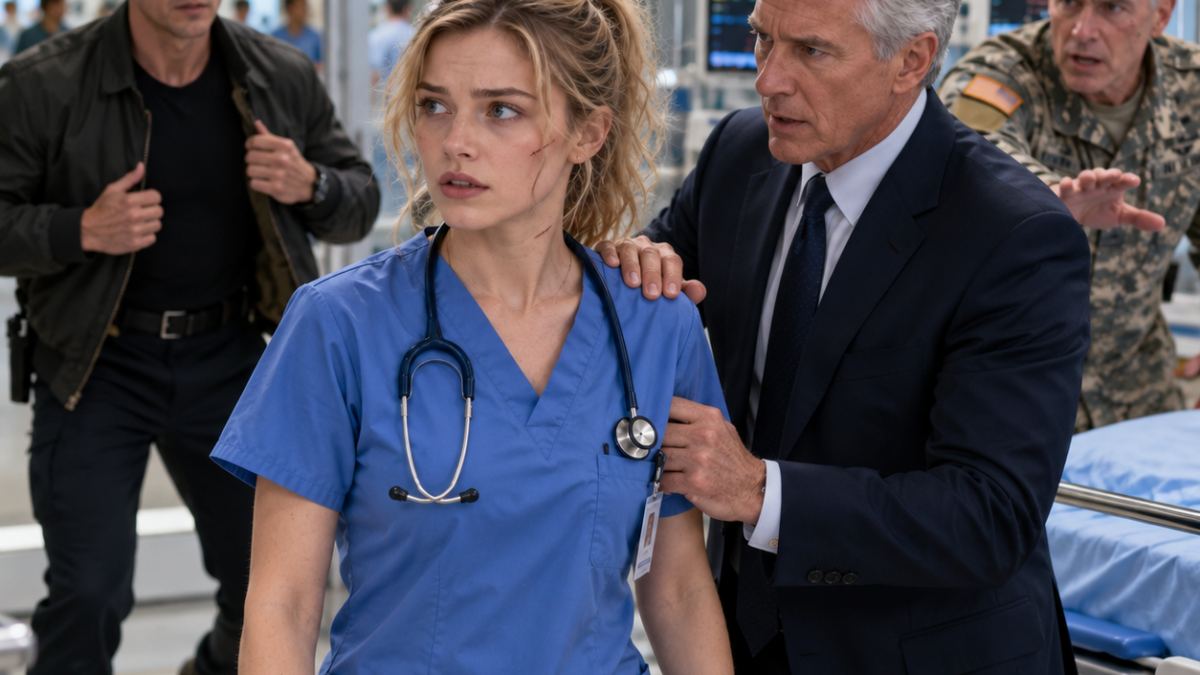
The hospital’s compliance department opened an investigation this morning.
They contacted the state nursing board.
That’s administrative.
Howerin said it doesn’t.
The state nursing board contact was logged by a system that flags certain keyword combinations. Garrett looked at Ranata.
One of those keywords was your nursing license number. That flag went to a secondary system.
He paused. That secondary system has a direct line to a federal contractor security clearance database.
The room understood what he wasn’t saying before he finished saying it.
He built a trip wire, James said, into the administrative system. Something that looks like routine compliance but triggers federal contractor flags if certain identifiers appear.
Which means, Ranata said slowly, that the formal complaint isn’t administrative.
It’s a location ping the moment your license number entered that system.
He knows exactly where to find the paper trail, Ranata said.
She wasn’t panicking.
She looked, if anything, like someone who had just confirmed a hypothesis they’d been dreading confirming.
How long before someone pulls the full employment file? If he has resources inside the licensing board, Garrett looked at his phone.
We might already be past that. The drive, Howerin said immediately. We need copies out of this location and into authenticated federal custody before.
Her own phone went off. She looked at the screen.
Whatever was on it made her stand up straighter in a way that James recognized as the physical response to information that requires immediate reassessment.
That’s not possible, she said to no one specifically.
“What?”
Garrett said. Howerin showed him the screen.
Garrett looked at it, looked at the older man.
“Do you know about this?”
The older man stood up for the first time since they had arrived. He walked to where Howerin was holding the phone. He read the screen and the expression on his face did something James had not expected.
It showed something very close.
Surprise, which on a face that had been that carefully composed was roughly equivalent to anyone else’s jaw hitting the floor.
No, the older man said, “I do not know about this.”
James was already out of his chair. Spine be damned. He crossed the room and looked at the phone.
It was a message from a federal law enforcement monitoring system, the kind that tracked court filings and warrant applications in real time for flagged cases. The message was brief, bureaucratic, the language of legal systems operating at speed. An emergency detention order had been filed, not for Ranata Doyle.
for James Harlo. The grounds were listed as interference with federal security investigation, unauthorized access to classified biometric systems, obstruction of authorized personnel security action. The filing timestamp was 2 hours ago.
James had been in this room for 6 hours. Someone had filed a detention order for him while he was in this room, which meant someone knew where he was.
“We have a problem,” Garrett said unnecessarily.
two,” Ranata said.
She was looking at her phone she’d borrowed Tate’s phone at some point.
James hadn’t noticed when, and she was looking at something on the screen with an expression he hadn’t seen on her face before.
Something that was not composure and not panic, but the very specific expression of someone whose internal architecture is being stress tested past its design parameters.
“What?”
James said. She turned the phone to face him.
It was a news alert. Local Spokane News still breaking the kind of update that appeared in those first raw minutes before journalism had time to apply context or caution. The headline was brief.
Military medical center staff member detained in federal investigation Cascade Ridge Hospital.
Below it, a photograph, not Ranata’s photograph, a photograph of the charred nurse from James’s floor, a woman named Patricia something, who had been on shift the night of the nightmare, who had been at the nurse’s station when mast arrived that morning.
A woman who had done nothing except be present in the wrong places at the wrong times.
He’s taking anyone who was in proximity, James said.
He’s sending a message, Ranata said to me that the radius of damage expands for every hour this continues.
Her voice was level. It had the levelness of something under pressure that had learned to not show the pressure. Patricia had nothing to do with any of this.
We know that he knows that too. The room was very quiet again.
Different quality of quiet than before. The quiet of people who have just understood that the rules of the situation have shifted that what had been an investigative action had just been escalated by someone willing to use uninvolved people as leverage points. Howeran was already on her phone.
Garrett was on his. Tate was pulling up something on his laptop with the focus speed of someone running out of time.
The older man walked back to his corner, made a call, spoke for 30 seconds, ended it.
“I need the drive duplicated and transmitted to four separate secure federal repositories in the next 20 minutes,” he said to the room.
“Whatever else happens in this location, the evidence leaves this location first.”
Tate was already moving and the detention order. James said being challenged. The older man said it was filed improperly.
The jurisdictional basis is wrong. Someone moved fast and cut corners.
A pause that cuts both ways. Fast filings have fast flaws.
How long to get it vacated?
Hours if we’re lucky.
Tomorrow morning if we’re not.
James looked at Ranata. She was still looking at the news alert on the borrowed phone. looking at the photograph of a charge nurse who had never done anything more complicated than show up to work on the wrong day.
He’s going to keep doing this, Ranata said quietly.
Every hour we don’t resolve this, another person gets caught in it.
She set the phone down on the table. She looked at the older man.
What do you actually have? Not procedurally, not in terms of process. What do you actually have right now that can be used?
The older man looked at her for a long moment. We have your evidence which is now being transmitted to federal repositories.
We have a financial investigation that has been building for 3 years. We have a federal judge who has been briefed in general terms and is prepared to act quickly on a properly supported application. He paused.
What we don’t have yet is the specific authorization link.
the document that places the right name on the order that changed your convoy route.
It’s on the drive, Ranata said.
The identifier on the drive traces to a position, the older man said carefully, not necessarily to the person who held that position at that specific time. His defense would be that the identifier was used without his knowledge. We need the secondary confirmation, something that places his personal knowledge and authorization beyond the reach of that defense.
Ranata was quiet.
There’s something else, she said finally.
James looked at her. Before they came for my team, she said slowly.
One of my team’s intelligence specialists intercepted a secondary transmission.
It wasn’t in the official evidence package because we thought it was corrupted.
The audio quality was poor.
The encryption was partial, but I kept a copy because she died getting it, and I didn’t know what else to do with something like that.
The room had gone very still.
“Where is it?”
Howerin said. Ranata looked at the drive on the table.
“Not on there,” she said.
“I kept it separate.
I’ve been carrying it in a different format for 11 years because I didn’t know if it was enough to matter, and I didn’t know who to give it to.”
She paused.
“It’s a voice recording.
partial, degraded, about 40 seconds of audio from a transmission that predated the ambush by 6 hours. Her voice had gone flat in the specific way it went flat when she was holding something very still inside herself.
In it, someone confirms that the convoys revised route has been set and asks for confirmation that the secondary action, that’s the word they use, secondary action, is still authorized.
And the confirmation, the older man said, comes in the same voice, Ranata said.
Same speaker issuing the order and confirming it to himself on a secondary encrypted channel that he apparently didn’t realize was being monitored.
She looked at the older man. 40 seconds partial, but voice analysis could confirm the speaker.
And if the speaker is who I believe it is, where is it? Howerin said again.
urgency now, barely contained, Ranata looked at her for a moment. I need a guarantee, she said.
Not a procedural guarantee. A human one.
I need someone in this room to tell me that if I give you the last piece of this, the thing I’ve been carrying for 11 years, the people who got caught in the radius today, the nurse from my floor, anyone else who gets pulled in before this ends, that they come out of it intact.
The room absorbed that. It was not an unreasonable thing to ask.
It was also not the kind of guarantee that anyone in a room like this was typically in a position to give because the architecture of these situations didn’t run on personal guarantees.
It ran on process and authorization and chains of legal action that moved at their own speed regardless of what individuals promised. But James understood something about what she was asking and why she was asking it. now instead of 10 minutes ago when the conversation had first opened the possibility.
She wasn’t naive.
She’d spent 11 years navigating systems that had tried to kill her.
She knew what guarantees were worth. She was asking because she needed to look someone in the eye and hear them say it, not because she believed it would make it true, but because after 11 years of carrying something alone, the act of asking mattered.
James looked at her.
I’ll make it my problem personally, he said.
Whatever it takes.
It wasn’t a formal guarantee.
It wasn’t a legal one.
It was the statement of a man who had run out of impressive things to offer and was left with only the plainest version of his word. Ranata looked at him for a long moment.
Then she reached into the inside pocket of the jacket she’d taken from the bag, the jacket she grabbed when they left the hospital, the prepositioned bag, the years of preparation, and she removed something small.
A card, not a drive, a physical
card the size of a credit card with a data contact embedded in its surface. She set it on the table. 40 seconds, she said.
His voice, his order, his authorization. She looked at Howerin.
And before you ask, yes, I’m certain of the speaker.
I’ve had 11 years to be certain.
Tate was reaching for the card.
Garrett’s phone went off again.
This time, his expression didn’t do the careful stillness thing.
This time, it did something that James had not seen it do in the 6 hours since they’d climbed into the gray SUV, and that was the expression of someone receiving news that is definitively worse than what they had been prepared to receive.
He listened for 20 seconds. His eyes moved to James.
They’re not waiting for the detention order to be processed.
He said, “What does that mean?”
James said.
“It means there are two federal marshals and a man in plain clothes currently at Cascade Ridge asking where you went.”
Garrett lowered the phone. The man in plain clothes showed credentials that the hospital administrator immediately accepted without question. A pause.
The credentials identify him as working for the same defense contractor whose name appeared in Ranata’s procurement records.
The room understood this all at once in the way that rooms understand things when the information is simple and the implication is enormous. A private defense contractor had just walked into a federal military hospital with credentials that hospital administration accepted and was asking for a recovering colonel by name.
He’s not waiting for legal process anymore, the older man said quietly.
He was already on his phone.
He’s operating outside the system he built.
James felt something move through him, not fear, something older than fear. The particular coldness that came when a situation had just crossed from dangerous to a different category entirely.
“Where’s the card?”
he said.
“Tate has it,” Howerin said.
“Get it out of this building in the next 60 seconds.
already now,” James said.
“Not in 60 seconds.”
Now Tate moved and James looked at Ranata, who was looking at the door with the expression she’d been wearing for 11 years.
The one he’d first noticed when she was doing her rounds, the expression of someone waiting for something to go wrong.
Only this time, it was different. This time, underneath the waiting was something else. something that looked, if you knew where to look, exactly like the expression of someone who has finally, after a very long time, decided to stop running.
James had learned over 26 years that the difference between a situation that could be managed and one that couldn’t wasn’t usually the size of the threat.
It was the speed. Speed compressed decision windows. Speed forced errors.
speed turned careful, layered operations into something improvised and ugly, where the margin between the right call and a catastrophic one narrowed to the width of a single second, and whoever was slower absorbed the consequence. The man in plain clothes walking into Cascade Ridge with contractor credentials was moving fast, which meant they had to move faster. Back exit, Garrett said, already on his feet.
same route we came in, but we’re not going back to the SUV.
There’s a secondary vehicle two blocks east.
The card, James said. Tate is already gone. The woman James had been calling.
Reyes said her first words since the hospital, delivered with the economy of someone who only spoke when the content justified the noise. James looked at Ranata.
She was standing with the bag over her shoulder and that expression on her face, the one he’d identified as the decision to stop running, and it was still there, clearer now, sharpened by proximity to whatever was coming through the front of this building.
“Can you run?”
she asked him. His spine had been filing complaints for the last 6 hours.
“Define run faster than a walk.”
“Yes, then let’s go.”
The two blocks east were the longest twob blocks James had covered in recent memory, and he’d covered them in combat boots through terrain that had considerably more lethal variables than an industrial park in Spokane.
The difference was that in those environments, his body had been intact, and currently his body contained titanium hardware and a surgical site that was 4 days outside of the recovery window where any of this was medically reasonable.
He didn’t stop.
The secondary vehicle was a panel van, older with commercial plates that had the specific anonymity of something chosen to disappear in traffic. A woman James had never seen was behind the wheel.
She looked at Garrett, nodded once, and they were moving before James had fully closed the door. Ranata sat beside him. She was breathing carefully controlled inhalations, the kind of respiratory regulation you learned when you needed your hands steady and your mind clear under physiological stress.
James recognized it because he’d been taught the same technique by the same branch of the military about 15 years and a world apart.
The audio card, she said, Tate has it. I know if they intercept him, Howerin is with him, Garrett said from the front. and Tate is not easy to intercept.
The van moved northeast, then curved west. The route irregular in the way that evasion routes were irregular, not random, but designed to deny anyone running surveillance from a fixed point the ability to predict the next segment.
James’ phone had been left at the industrial unit.
Garrett had told him to leave it and James had understood why if the detention order was legitimate enough to involve invol federal marshals his phone was already a tracked access but the absence of it was a particular kind of discomfort 26 years of being reachable by anyone with the right
frequency and now he was in a panel van with no communications and a spine complaining about the unpaved section of road they just crossed u credentials he said to Garrett. The man who walked into Cascade Ridge. Who does he actually work for?
Company called Vidian Strategic Services. Garrett said registered in Delaware.
Publicly they do logistics consulting for defense contracts. He paused.
What they actually do is more interesting. How much more interesting enough that three separate federal agencies have open files on them and none of those files have been shared with each other. a pause with weight behind it, which is itself interesting.
James absorbed that compartmentalization of intelligence on the same target across multiple agencies wasn’t accidental.
It was managed. Someone with cross agency visibility had been ensuring those files stayed separate, ensuring the picture they made when assembled was never assembled.
How long has Vidian been operating? Ranata said 14 years under that name.
The principles go back further under different corporate structures. 14 years.
James ran the math without meaning to. The convoy ambush had been 11 years ago. Vidian had incorporated 3 years before that.
The procurement fraud that the older man had described going back further than the ambush, the falsified contracts, the shell structures, all of it predated Ranata’s rescue team by enough time to establish that what had happened to James’ convoy wasn’t the beginning of anything.
Is it was an operational action taken to protect something already in motion. He looked at Ranata. She was looking at her hands.
She’d done the same math.
He could see it in the set of her jaw. The standown order, she said quietly.
My team wasn’t collateral.
We were a specific problem. Yes, Garrett said, because we pulled the cargo from the convoy.
Because your intelligence specialist photographed the procurement records before the secondary explosion. He paused.
Photographs we’ve been unable to locate.
They’re on the drive, Ranata said.
Encrypted within the secondary partition.
The decryption sequence requires a passphrase that I haven’t given anyone yet.
The van went quiet. Garrett turned around slowly. Captain Doyle.
I’ve been careful for 11 years, she said.
Old habits. She looked at him steadily.
When the audio card is confirmed in federal custody, and I have verbal confirmation from your chain of command that the investigation is formally opened, not in process of being opened. Formally opened.
I’ll give you the passphrase.
James watched Garrett absorb this with the expression of someone reccalibrating their assessment of a situation they thought they’d had correctly mapped.
That’s a reasonable position, James said.
Garrett looked at him.
It’s also, James said.
Exactly what I would do. The van stopped at a location.
James didn’t recognize a residential neighborhood on the city’s west side.
Unremarkable. the kind of street that existed in the periphery of every midsized American city without distinguishing itself in in any particular direction.
A house with a two-car garage. The garage opened as they pulled up and closed behind them. Inside another set of folding tables, more laptop, less equipment than the industrial unit, stripped down the backup to the backup.
James had been in enough operational environments to recognize a facility assembled for exactly this contingency. The case where the primary location was compromised and everyone fell back to the secondary that only half the people in the primary even knew about.
Howerin was already there. Tate was already there.
The audio card was on the table. Authentication in progress, Tate said without looking up. 47 minutes to complete verification through the federal acoustic analysis system.
We have 47 minutes, Garrett said. We have less than that.
Howerin said the detention order for Colonel Harlo was challenged at the jurisdictional level 40 minutes ago. The judge reviewing the challenge has requested the underlying evidence before making a ruling. She looked at James.
Standard procedure. It buys time, but it also confirms your location within the legal system, which is findable by anyone with the right access.
And the charge nurse, Ranata, said, “Patricia, Haluren’s expression did something careful.
She’s been detained for questioning, not formally arrested.
Under current parameters, they can hold her for how long? 72 hours without charge.
Ranata said nothing. She sat down at one of the folding tables and was quiet for a moment in a way that had a specific texture, not paralysis, not despair, but the particular silence of someone running their own internal operational assessment and not liking the numbers they were producing. James sat across from her.
His spine had moved past complaint into something that was going to require a conversation with his surgeon and probably an adjustment to his medication schedule. And he noted this in the way that experienced soldiers noted physical problems filed for later irrelevant to the immediate problem set.
Walk me through the night of the rescue, he said. Ranata looked at him. Not for my sake, he said.
For the gaps. There are things in those records that only you know the context for.
And if the audio card doesn’t come back clean, context is what’s going to carry the case.
He paused.
You’ve been carrying this alone for 11 years.
You don’t have to anymore.
She looked at him for a long moment. The standown came through at 2312.
She said, “We’d already been in movement for 40 minutes.
We had your position from a secondary relay, not the official channel because the official channel had gone quiet, which was itself a signal.”
She paused. I made the call to continue.
I want to be clear about that.
It wasn’t a democratic decision.
I made it. I know. James said.
I’m saying it for the record.
Whatever comes out of this, that decision was mine. She set her hands flat on the table. We reached the convoy site at 2358.
The vehicle with the secured cargo was still partially intact. Ferris, my intelligence specialist, went for the cargo while we established a perimeter. She had 11 minutes before the secondary charge detonated.
Her voice was steady in the way that voices went steady when the alternative was not speaking at all. She got the photographs and she got out. We got you out.
We were at extract by 0140. And then we were 3 hours out of the theater when the transmission came through that our extract point had been moved. She paused.
It hadn’t been moved.
We found that out later. The transmission was spoofed.
It redirected us to a secondary location that was not a friendly site. James was quiet.
We took fire at 0420. She said coordinated three positions. We were in a vehicle that was not equipped for that contact.
She stopped. Started again.
Ferris died on site. Two others, Reeves and Sodto, died in the first 2 minutes.
Corporal Banks got me out. He was the only other one who made it.
She paused. Banks died of his wounds 6 hours later in a field position I was holding alone. She looked at the table.
He was 23. The room was very quiet.
I buried the documentation because I didn’t know who to trust and I didn’t know who had the authorization to spoof our extract transmission.
She said, “I knew it went up the chain.
I didn’t know how far.”
She looked up at James until I identified the contractor connection two years later from a public procurement filing that used language identical to the operational language in the spoofed transmission.
Specific phrase construction, the kind of thing that’s a fingerprint if you know what you’re reading.
And the name attached to the contractor.
The contract had a signatory, a military signatory authorizing the contractor’s operational support role in that theater.
She paused. Same name as the standown order identifier. James sat with this 11 years.
She’d been carrying this for 11 years.
the weight of names of decisions of a corporal who was 23 years old and died in a field position that she held alone and she’d carried it into a hospital in Spokane and done overnight nursing rounds and caught falling patients with combat casualty maneuvers
and waited.
He didn’t say anything.
He didn’t offer anything that would sound like comfort cuz she wasn’t looking for comfort.
and he understood that she was looking for the thing she’d been looking for since 0420 on a night 11 years ago.
She was looking for the truth to cost something.
At the 43 minute mark, 4 minutes before Tate’s authentication process was scheduled to complete, Garrett’s phone went off.
He answered, listened for 90 seconds, and then lowered the phone with the expression of someone who has just received information that changes the geometry of everything they’ve been building toward.
The judge reviewing the jurisdictional challenge on the detention order has ruled, he said. The order is vacated. Improper basis, inadequate supporting documentation.
He looked at James.
You’re clear.
James nodded. However, Garrett continued, and the word carried the particular weight of a however that had something significant behind it.
In the process of reviewing the documentation, the judge’s clerk identified a pattern in the filing.
The jurisdictional claim referenced a federal security action that doesn’t correspond to any currently active investigation in the system.
He paused. which means someone filed a federal detention order using a fabricated security action as its basis.
That’s felony obstruction, Howerin said immediately.
And fraud on the court, Garrett said. Yes.
A pause. The judge is not pleased. Who signed the order?
The older man who had appeared at some point in the last hour.
James wasn’t sure exactly when said from the back of the room.
That Garrett said is where it gets specific. He turned the phone around. The name on the screen was not doctor Gerald Mast.
It was above Mast, several rungs above. A name that existed at the intersection of military oversight and defense procurement in the specific position that would give its holder cross agency visibility over disparate investigations. Visibility sufficient to keep three separate agency files from being compared with each other.
a name attached to a rank that James had heard spoken with deference in Pentagon corridors. Brigadier General Colin Rearden, Deputy Director, Defense Contract Oversight and Procurement Review.
James looked at the name on the screen for a long moment.
He’d met Rearen twice, once at a briefing in Arlington, once at a Washington event for wounded veterans that Reirden had attended in a ceremonial capacity.
He had the particular polish of a man who had learned to weaponize the performance of integrity, the practice concern, the precise acknowledgement of sacrifice, the language of honor worn like a tailored suit, the signatory on the
contractor authorization, James said to Ranata, the procurement record from 11 years ago. She was already looking at the name on the phone.
Yes, she said. Rearen. Yes.
The word sat in the room and the room adjusted around it. Tate looked up from his laptop.
Authentication complete. The audio card had verified.
40 seconds of degraded transmission, partial encryption, 11-year-old audio, and the Federal Acoustic Analysis System had returned a confidence rating of 91% on the voice match. The voice on the recording, Colin Rearen, Brigadier General.
11 years ago in a theater whose name remained classified, issuing and confirming an order that had preceded an ambush that had killed three soldiers and sent a fourth into 11 years of hiding.
91% that’s enough, Howerin said for the warrant application, the older man said already on his phone.
James was watching Ranata. She was looking at the laptop screen where the authentication result sat in a clean federal database format, the numbers, the confidence rating, the file reference that would attached to a federal case number within the hour.
The evidence she had been carrying for 11 years in the form of a card smaller than a credit card in the inside pocket of a jacket she’d grabbed from a prepositioned bag in a hospital she’d been hiding inside.
Her expression was not triumph. It was something quieter and more complicated than triumph.
The expression of someone standing at the end of a very long road and discovering that the end looked different from the ground than it had looked from the distance of years. Rearen is going to know the authentication happened.
She said the moment a warrant application hits the system, he’s going to know.
Yes.
Howerin said he’s still operational.
He still has access.
We’re aware.
How long between the warrant application and the authorization? Howerin looked at the older man. If the judge acts tonight, the older man said carefully, we could have authorization by morning.

