They Fired the Quiet Nurse—Then Her “Valkyrie Six” Identity Stunned the Colonel – Part 5
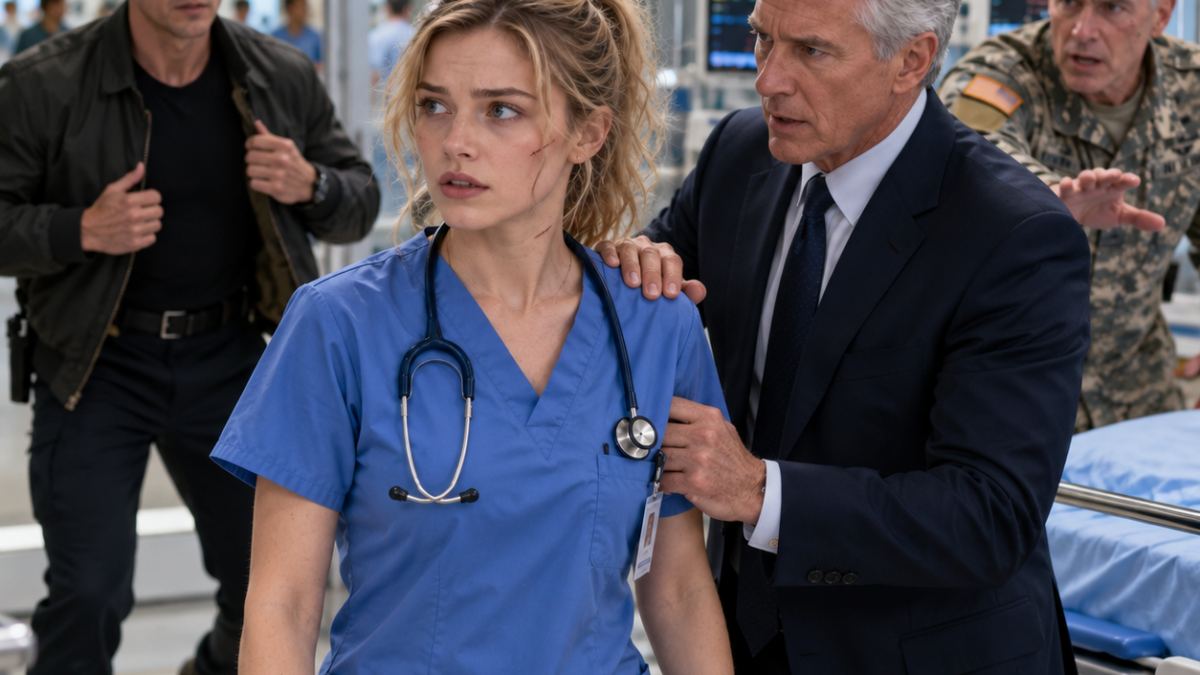
You understand what walking into that hospital means, Olen said. She had stood up from the conference table, papers in hand, the posture of a woman who had made her professional assessment and was offering it one final time.
Mast’s administrative filing is still active in their system.
The moment you badge into that building, I don’t have a badge anymore, Ranata said.
Mast took it this morning. She looked at Olsen and the warrant has been issued.
The injunction against Vidian is filed.
What exactly does Mast’s paperwork do to me at this point that matters?
Olsen looked at her for a moment. Legally, very little. Practically.
Practically.
He’s going to try to use it.
Ranata said, “I know.
Let him try.”
She looked at James.
“Are you ready?”
His spine had been providing a continuous physiological commentary on the day’s activities that he had been declining to engage with for approximately 9 hours.
He was 4 days outside a surgical recovery window, running on inadequate sleep and no food since early morning. and the hardware in his vertebrae was performing its function with the specific grudging efficiency of something that had been engineered for stability, not for this. Yes, he said.
They went in through the main entrance. Not the loading dock, not the service corridor, the front doors, the ones with the automatic sensors and the reception desk and the hospital directory board and the ordinary midday foot traffic of a working medical facility. James understood the tactical logic of it before Garrett articulated it.
The main entrance was monitored, documented, timestamped. Every camera in that lobby was a witness.
Every person at the reception desk was a witness.
Rearen had positioned himself in the administrator’s office, expecting a private conversation, and the most important thing James and Ranata could do before that conversation began was make their arrival as public as possible.
The lobby was the record. They walked in at 2:47 in the afternoon. James in front, Ranatada beside him, Garrett and Howerin behind, two federal marshals in the rear, whose presence in a hospital lobby drew exactly the kind of attention that Reirden had been hoping to avoid.
The reception staff looked up. Visitors looked up.
A man in scrubs who had been crossing the lobby stopped and looked and kept looking. Colonel Harlo, the receptionist, not the one from his floor.
Someone from the main desk recognized him with the tentative familiarity of someone who knew a face from a context that didn’t quite fit the current one.
Are you is your appointment?
I’m here to see doctor mast, James said.
And then I need to speak with whoever is currently managing the administrative hold on one of your nursing staff. The receptionist blinked.
I let me call up, please,” James said.
While she called, Garrett spoke quietly into his radio.
The Marshall team redirected to Patricia’s location, the hospital security office on the ground floor.
East Wing received confirmation and moved.
James watched the lobby with the specific quality of attention he’d spent decades developing, tracking positions, reading reading faces, identifying the person in the room who didn’t fit the room.
He found the Vidian operative in 40 seconds sitting in a lobby chair near the east-wing corridor. Civilian clothes, unremarkable, the kind of person you looked past without registering.
But his hands were wrong, positioned in a way that suggested readiness, and he was watching the east-wing corridor entrance rather than the main doors, which meant he was monitoring Patricia’s location rather than the main entrance.
He hadn’t registered James’ arrival as significant yet.
He was watching the wrong door.
James didn’t look at him directly.
Looked at Garrett and moved his eyes toward the lobby chair in a micro direction that Garrett had been trained to read. Garrett read it. The operative was contained by the time the receptionist finished her call, which was 3 minutes later in a manner that looked from across the lobby like two men helping a third man who seemed unwell.
which was a description that covered a broad range of actual situations and satisfied the lobby’s need for an explanation without requiring anyone to look more closely.
The receptionist reported that Dr. Mast was unavailable for an unscheduled meeting. James looked at the marshall behind him.
The marshall stepped forward and presented credentials in a document that changed the nature of the request from unscheduled meeting to federally compelled access which resolved doctor Mast’s availability significantly.
Gerald Mast had the specific quality of a man who had spent his career as the instrument of other people’s authority and had confused the instrument for the source.
He sat behind his desk when James and Ranata entered with the arranged composure of someone who had been expecting this visit and had spent the preceding 10 minutes constructing a posture for it, handsfolded, expression of professional concern, the language of institutional process already loading behind his eyes. He looked at Ranata. Miss Hartwell, he said, I should tell you that your presence in this facility, my name, Ranata said, is Captain Ranata Doyle.
United States Army Combat Rescue Detachment 9. She set a document on his desk.
Olsen had printed it in the conference room, the warrant application acknowledgement bearing the judicial panel’s authorization and did not sit down.
And I’d like you to look at that before you say anything else.
Mast looked at the document. James watched him read it.
Watch the composure begin to develop hairline fractures the way composure did when the architecture beneath it was already compromised and the right weight was applied to the right point. This is mast started active howerin said from behind James as of 67 minutes ago.
Mast’s hands which had been folded on the desk separated and placed themselves flat in the way of a man who needed a surface to anchor to.
I’ll need to contact legal counsel before your administrative filing from this morning.
James said the credential irregularity complaint against nurse Hartwell. Who instructed you to file it?
Mast looked at him.
I’m not in a position to discuss.
The filing was your signature. James said your name, your administrative authority as director of clinical operations. The question of who instructed you to use that authority is going to be asked by people with considerably more formal power than me and how you answer it this afternoon is going to have a material effect on how those conversations go.
He looked at Mast steadily.
I’m not your enemy, Dr.
Mast.
I’m the easier conversation.
The room was quiet. Mast looked at the document again.
Then he looked at the wall beside James’s head.
the particular displacement of eye contact that happened when a person was running calculations about how much the landscape had shifted since morning. The landscape had shifted considerably. Rearen Mast said finally.
His voice came out smaller than his administrative posture had been projecting. He contacted me 3 years ago when the monitoring protocol flagged something in a credential review. He paused.
He told me it was a national security matter. He told me there was a person in this facility who represented a security risk.
He told me what to watch for and what to do when he stopped. He told me it was authorized. And you believed him.
Ranata said mast looked at her.
In his eyes was something that might have been shame or might have been the recognition of shame which wasn’t quite the same thing but was at least adjacent to it.
He’s a general.
Mass said yes. Ranata said he is.
She said it without contempt. That surprised James, the absence of contempt in it, the flatness that was not cruelty, but a kind of exhausted clarity.
Mast had not been a villain in the architecture of this thing.
He’d been a door.
Rearen had needed doors in the right places, and Mast had been one, and the difference between a door and a weapon was a distinction that the legal system would spend considerable time evaluating, and that Ranata in this moment was not interested in adjudicating personally.
“He’s waiting,” James said to Howeran.
She nodded. Marshall team is in position.
They found Reirdan in the administrator’s conference room rather than Mast’s office, a space one room removed, marginally more neutral, the choice of a man who had calibrated even the geography of the meeting.
He was standing when they entered, which James noted as the choice of someone who wanted to maintain a height variable, and he was in uniform, which was the choice of someone who wanted the weight of rank in the room before any words
were spoken. He looked at Ranatada first. James watched that look and recognized it.
The micro assessment of a man who had spent 11 years constructing a version of this moment in his head and was now performing a rapid comparison between the version and the reality. The version had probably involved someone more diminished. Someone whose 11 years of running had left more visible marks.
What he was looking at was a woman who had spent 11 years sharpening herself against the edge of what he’d done to her and who was standing in the room he’d invited her into with the stillness of someone who had already won and was simply waiting for the paperwork to confirm it.
Captain Doyle Rearen said General Ranatus said I think if we the warrant Howerin said stepping forward she placed it on the conference table in front of him.
full document, judicial panel signatures, case number, the formal language of federal criminal proceedings that had no interest in the register of Reirdan’s voice or the weight of his rank or the 14 years of infrastructure he’d assembled to prevent exactly this document from existing.
Rearen looked at it. He looked at it for a long time.
James watched the machinery of the man process the information in the document, the charge specifications, the evidence references, the signatures of three federal judges, and watched the processing produce something he hadn’t expected to see.
Not rage, not the cold composure of a man who had contingencies, not even the performance of wrongful accusation that James had anticipated.
What crossed Reirdan’s face in the moment before he reassembled his expression into something more manageable was recognition.
Not surprise. Recognition.
He’d always known this could happen.
He’d spent 14 years building systems to prevent it.
And the systems had held until they hadn’t.
And now he was standing in a conference room at a military hospital in Spokane with a federal warrant on the table in front of him and a woman he’d tried to kill 11 years ago standing 12 ft away.
And what he felt was not shock but the exhausted recognition of a man who has been running a very long race and has finally irrevocably hit the wall.
“I want my attorney,” he said.
“Of course,” Howerin said.
The Marshall team entered. Rearen did not resist.
James had half expected something, a final maneuver, a final attempt to reframe the situation using the authority of his rank and the confidence of his position. But the warrant had done what warrants did when they were properly constructed and properly supported.
It had removed the architecture.
Without the architecture, what was left was a 61-year-old man in a uniform that no longer protected him from the weight of what he’d done.
and he seemed in that moment to understand this with a clarity that had perhaps been building for years. He walked out of the conference room between two federal marshals and the uniform and the rank and the practiced authority went with him, but they went small, diminished by the context around them. The way that all performed things diminished when the performance finally ran out of audience.
James watched him go.
He didn’t feel what he’d expected to feel, which was something clean and final.
He felt instead the complicated, uneven sensation of a thing that had been wrong for a very long time, beginning the long process of being corrected, which was not the same as being fixed, and not the same as being over, and not in any way the same as simple. He looked at Ranata.
She was watching the doorway where Reirdan had exited, and her expression was the one he’d been trying to read since the first morning he’d noticed her in the corridor the expression he’d cataloged as the decision to stop running.
Up close, it was more
complicated than a decision. It was a decade of deferred things beginning to come due simultaneously, and the weight of it was real, and she was carrying it without collapsing, which was not the same as carrying it easily. She turned and looked at James.
Patricia, she said already out, Garrett said from the doorway, his radio in hand. Marshall team had her clear 20 minutes ago.
She’s in the lobby.
Ranata moved.
Patricia Huang was 53 years old and had been a charge nurse for 19 years and had spent the last 8 hours in a hospital security office being questioned about things she had no knowledge of by people she didn’t know.
underin authorities she didn’t understand.
And when Ranata walked into the lobby, she stood up from the chair where she’d been sitting with a blanket around her shoulders and looked at Ranata with an expression that was composed of equal parts exhaustion and relief and something that was trying to be anger but didn’t quite have the energy for it.
You could have told me, Patricia said, I know, Ranata said. I have been sitting in that room for eight hours.
I know. They asked me about the corridor on Tuesday. The patient who fell.
They asked me 17 times. She stopped.
Looked at Ranata’s face.
The anger deflated into something tired and more honest. Are you okay?
Ranata looked at her for a moment.
The question, the simple human practical question, the charged nurse’s reflex of checking on the person in front of her before processing her own situation seemed to land on Ranata in a way that nothing else in the preceding 9 hours had quite managed to land.
Working on it, Ranata said, Patricia put her arms around her. It was not a dramatic gesture.
It was the gesture of a woman who had known a colleague not well, but genuinely. the way hospital staff knew each other through the specific intimacy of shared shifts and difficult patients and the ordinary human compression of a ward floor and who was responding to what she saw in front of her with the directness of a person whose profession had burned away the capacity to perform sympathy. James turned away and looked at the lobby ceiling and gave them 30 seconds.
The legal proceedings that followed were not fast.
James had known they wouldn’t be the architecture of what Reirdan had built.
14 years of shell contractors and falsified procurement records and manipulated missions and surveillance infrastructure and embedded assets in 46 military medical facilities did not disassemble in a week or a month. It took federal investigators, forensic accountants, congressional subcommittees, and a prosecutorial team that expanded three times over the first 6 months as the scope of the fraud became clear. Vidian Strategic Services was injuncted, then indicted, then dissolved.
Its principles faced charges that ranged from conspiracy to fraud to obstruction to accessory liability for the operational actions they’d supported.
The criminal cases were separate from the civil suits brought by the estates of the soldiers who had died in the secondary attack on Ranata’s team.
And those civil suits were themselves separate from the military review proceedings that examined the culture of procurement oversight that had made Rearen’s machine possible in the first place.
Gerald Mast cooperated with investigators. His cooperations was substantial and early enough to matter and his sentencing reflected that and James did not have strong feelings about the sentencing either way because Mast had not been the architect of anything.
He’d been a door and doors were common.
And the question that kept the older man and the congressional committees busy for the better part of two years was how many other doors existed in how many other facilities and how to build a system that made doors like mast harder to install. Rearen did not cooperate.
He
maintained his posture of wrongful accusation through arraignment, through discovery, through the hearings where the audio recording was entered into evidence. And his attorneys challenged the methodology. And the federal acoustic analysts responded to those challenges with the careful documented precision of people who had anticipated every objection and had answers that the court found persuasive.
91% became in the courtroom context something considerably more robust when combined with the procurement records, the transmission logs, the standown order identifier, the fraudulent detention filing, the Vidian operational logs, the testimony of five former contractors who accepted plea agreements and Mast’s full cooperation.
The verdict came 14 months after the arrest. James was not in the courtroom for it.
He’d testified in the third month and had not gone back, partly because his recovery protocol had finally reasserted itself in the form of a strongly worded conversation with his surgeon, and partly because he had made a decision somewhere in the weeks after Spokane that his role in this story had been what it had been, and he did not need to be present for every subsequent chapter to know that the story was being told correctly.
He heard about the verdict
the way most people heard about things that happened in rooms they weren’t in by phone.
A call from Howerin, brief and direct in Holleran’s characteristic mode.
Guilty on all counts.
Rearan’s face in the photographs that circulated afterward, a face that had spent decades performing the fluency of authority, now captured in the particular stillness of a man for whom that fluency had permanently stopped working.
James sat with it for a while. Then he called Ranatada.
She’d gone back to nursing.
Not at Cascade Ridge, the administrative files had been expuned, and her military record had been formally restored 4 months after the arrest, in a proceeding that was considerably less dramatic than the events preceding it. As formal proceedings tended to be, the language of official recognition being necessarily flatter than the experience being recognized.
She’d been offered positions at three different military medical facilities, and she’d turned all three down.
And she’d gone back to a hospital in Portland, a civilian one, where she worked trauma nursing with the particular competence of someone who had been trained in environments considerably less forgiving than a hospital ward.
She wasn’t hiding anymore.
That was the short version. The longer version was that she was still figuring out what came after hiding, and the process was neither linear nor comfortable, and she had said so directly in one of their conversations, and James had appreciated the directness because it was consistent with everything else about her.
When he called about the verdict, she already knew. Howerin texted me.
She said, “How are you?”
A pause. Complicated.
She said, “It’s another pause.
I thought I’d feel more finished.
Does it feel finished? Parts of it, she said. The part that needed someone to answer for it.
That part feels like something. She was quiet for a moment.
The other parts are different. The other parts were Ferris and Reeves and Sodto and Banks.
23 years old in a field position she’d held alone.
Those parts didn’t resolve with a verdict.
They didn’t resolve at all.
In the conventional sense, they became something you carried differently over time. The weight redistributing itself, becoming less like a wound and more like a scar, which was not the same as healed, but was a different relationship to the same damage.
James understood this in the way that people understood it when they’d been carrying their own version of it for a long time.
What are you doing next week? He said, working, she said.
Why, my final surgical signoff is on Thursday.
He said, “I was thinking about driving up to Portland afterward.”
“If you were inclined toward dinner,” a pause.
“Inclined toward dinner,” she repeated.
And in her voice was something he recognized as the dry, precise humor she deployed when she was actually amused, but wasn’t going to make it easy for him.
“Or not,” he said.
“No,” she said.
“Dinner is yes.”
“Thursday is fine.”
He drove up on Thursday, which was a longer drive from Boise than he’d initially calculated, and arrived 40 minutes late to the restaurant because Portland traffic had opinions about his timeline that is had failed to account for.
Renaata was already there sitting at a corner table with her back to the wall and her face toward the door, which was not something she was going to stop doing and was not something he was going to suggest she stop doing.
She looked different than she’d looked in the hospital.
Not dramatically, she’d cut her hair slightly, and she was wearing clothes that had been chosen rather than assembled for function, and the absence of the particular vigilance that had been her characteristic posture in Spokane meant that her face was more
readable than it had been, the expressions arriving and departing without the filtering layer of 11 years of practiced invisibility.
She looked tired in the ordinary way that people who worked night shifts and long weeks looked tired. She also looked like herself, which James understood was not a small thing.
You’re late, she said.
Portland traffic, he said.
I’ve been here for 40 minutes.
I’m aware.
He sat down.
I’m sorry.
You’re not entirely sorry.
You calculated wrong and traffic finished the job.
That’s accurate, James said.
She looked at him with an expression that was not quite a smile, but occupied the same general territory.
They ordered food, and the food was unremarkable in the way that food at a first dinner that wasn’t quite a first dinner sometimes was, and they talked about things that were not the case about his recovery and her new ward and
a city she’d been to once, and a book she’d read and a patient who had said something funny last Tuesday.
And the conversation was ordinary in a way that neither of them had had access to in a very long time. Not uncomplicated. Ordinary is not the same as uncomplicated.
But ordinary was its own kind of arrival.
At one point between the main course and the bill, Branata said, “The newer nurses on my ward, the young ones, she was looking at the table.
I’ve been teaching them some of the field techniques.”
She paused.
the airway maneuver, some of the casualty handling, the stuff that she stopped, the stuff I learned from people who aren’t here to teach it anymore.
James looked at her. Ferris was the one who taught me to read a procurement record, she said.
She thought every medic should know how to follow the money because the money was usually where the decisions that got people killed were made. She paused.
I can’t teach that specifically, but I can teach what I know.
The things they left in me, she looked up.
That’s something.
Yes, James said. It is. It was more than something, and she knew it.
and he suspected that the knowing had been arriving in pieces over the 14 months since Spokane arriving in the moments between shifts and the hours after difficult patients and the small ordinary accumulation of a life that was no longer being lived in the margins of someone else’s effort to erase it.
She had not been restored to what she was before. Nobody was ever restored to what they were before.
The before of a thing like this didn’t persist as a destination you could return to.
And the version of Ranatada Doyle who had walked into an ambush at 04 2011 years ago existed now only in the shape of the woman who had walked out of it. What she had been given back was not the past.
It was the right to the future. That was not a small thing either.
3 months later, the Military Review Board completed its formal assessment of Ranata’s service record.
The findings were entered into the official record on a Tuesday morning in a building in Arlington that was not dramatic and not cinematic and had the specific aesthetic of institutional bureaucracy, fluorescent lighting, a conference table, people in formal dress with folders in front of them. Ranata sat
across the table from the board.
She answered their questions in the same voice she’d used in Mast’s office and in Olsen’s conference room and on the ward floor in Portland, direct, unmbellished, accurate.
She had stopped performing anything a long time ago. And what the board received from her was the unmediated account of a soldier who had made a decision under conditions that the board spent considerable time examining and concluded informal language entered into the official record had been not only defensible but
correct.
The standown order was formally designated as unlawful. Her decision to ignore it was formally designated as consistent with her duty and with the protection of life under imminent threat.
Combat Rescue Detachment 9 was formally acknowledged in the record with a specific citation for the actions of the unit on the night of James’s rescue.
The names of Ferris Reeves, Sodto, and Banks appeared in the citation.
Ranata sat with those names in a fluorescent lit room in Arlington and did not look away from them, which was the thing she’d been doing for 11 years in the versions of this moment that existed only in her head, looking at what it had cost directly without the protection of the distance that running provided.
It cost what it cost, and it had been worth doing. Both of those things were true simultaneously. And she had learned over 11 years and 14 months and whatever came next that the ability to hold two true things at the same time without resolving them into one was not weakness.
It was the specific kind of strength that didn’t announce itself.
The kind that held position not because it wasn’t tired but because the position mattered.
Valkyrie 6 hold position inbound.
She’d held position for 11 years.
After the board adjourned, she walked out of the building into a March afternoon in Arlington that was cold and gray and entirely unremarkable in every way that a day could be unremarkable. She stood on the sidewalk for a moment, her coat buttoned against the wind, no bag prepositioned anywhere, no exits mapped in her peripheral vision. Her phone buzzed.
James, a text message, three words. How did it go? She looked at the message for a moment.
Then she typed back, “It went.”
She put the phone in her pocket. She walked down the sidewalk in the direction of the parking garage, and the wind was cold, and a woman with a stroller nodded at her as she passed, and somewhere down the block, a car alarm went off and silenced itself. And the city moved around her in the ordinary and different way that cities moved.
And she moved through it in the ordinary way of a person who was somewhere they were allowed to be under a name that was their own, carrying nothing that wasn’t theirs to carry.
Some things once broken didn’t reassemble into their original shape.
They assembled into something new, something that bore the marks of what had been done to it and was stronger at those points, not in spite of the fractures, but because of how they’d healed imperfectly, honestly, with the visible evidence of the repair.
Ranata Doyle walked down a sidewalk in Arlington, Virginia on a cold Tuesday in March, under her own name, in her own life, on her own terms. She had not been given this. She had built it from what was left.
And what was left had been enough. It had always been enough.

