“You Handle the House. Stay Out of My Way,” the Former Navy SEAL Said—Until Her Scarf Slipped – Part 5
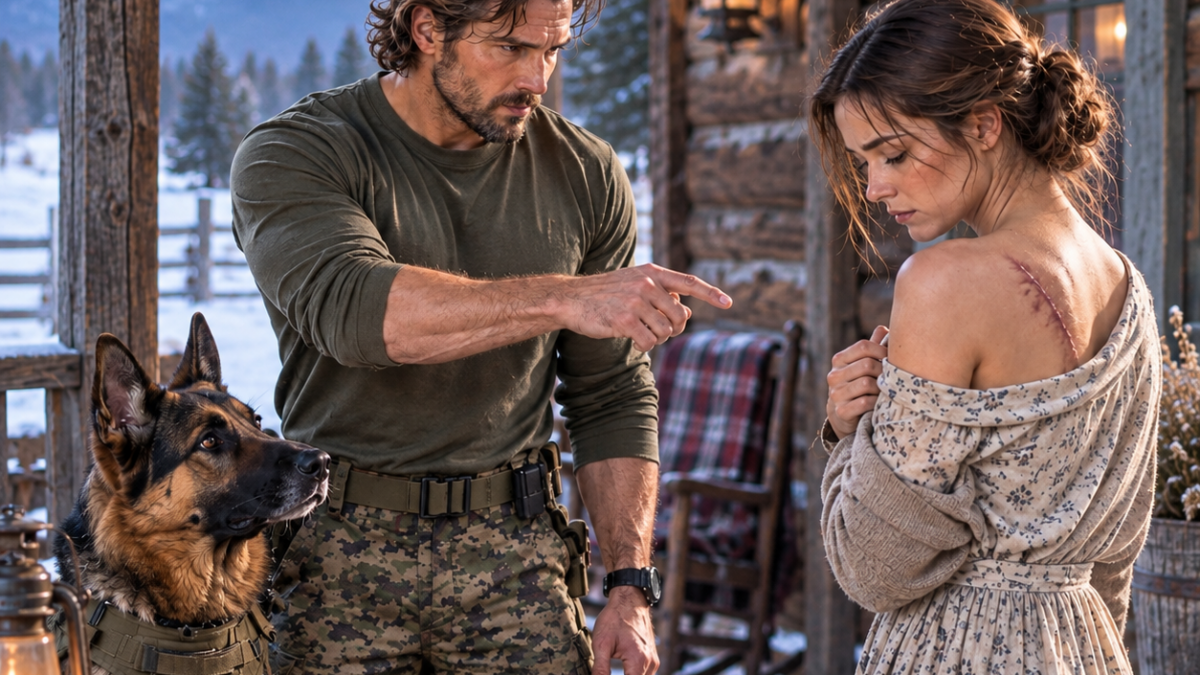
Ridge lay beside Harland’s boot.
Walt sat several feet away, staring at nothing. Ray checked the list Mara had kept, one name at a time.
Then he looked up.
That’s everybody.
The words were ordinary. Haron had heard versions of them before in places very far from Kansas.
Accountability had once meant checking names against uncertainty and knowing immediately what a missing one could cost.
For years afterward, Catherine’s absence had made every complete room feel incomplete.
in some quiet way. Now Harlon looked across the yard.
Mara, Walt, Ray, the crew, the volunteer firefighters finishing their work. Ridge at his feet, everyone present, everyone breathing, nobody needing to be found. Harlon looked back toward the dark shape of the ranch house beyond the cottonwoods.
Yeah, that was all he said. But for once, everyone being accounted for did not belong to the life he had left behind.
It belonged here. Morning showed what the dark had hidden.
The eastern pasture lay gray and black beyond the barn, with fence posts standing in places where the grass around them had burned away. A small equipment shed was gone, except for its metal frame. Smoke still lifted from a few patches farther out where the volunteer crew had worked through the night.
The house remained. So did the main barn. Inside the kitchen, the radio played quietly beside the coffee maker.
Mara had been awake less than 20 minutes when Walt came through the mudroom. The rest of the crew was beginning to gather for breakfast.
Ray stood near the counter. Haron was outside speaking with someone from the fire crew.
Nobody had settled into a chair yet. Walt stopped near the table. His clothes had been changed, but yesterday still seemed to be on him somehow.
He looked tired, older around the eyes, and less certain of where to put his hands. Mara waited.
Walt removed his hat. I was wrong.
Nobody moved. He looked at Mara rather than at the floor. I gave that article more fairness than I gave you.
That was the important part. He did not say he had only been protecting Harlon. He did not blame the man in Witchita who sent the link.
He did not explain fear as though fear made the choice reasonable. He simply owned it.
Mara held his gaze for a moment. Start there. Walt nodded.
Then he sat in his old chair. Mara placed a plate in front of him. Breakfast continued.
An apology worth anything usually changed what came after it. The words were only the beginning.
3 days later, after the last hot spots had been checked and temporary fencing had gone up along the burned section, Mara carried the metal box outside. Harlon was on the porch with Ridge asleep beneath his chair.
He noticed the box immediately. It was the same one Mara had carried into Red Willow on her first afternoon, and the same one she had moved from room to room for four years without letting anyone else handle. She placed it on the small table between them.
The latch made a soft metallic sound. Inside, there was no single piece of evidence capable of repairing everything. Mara had never believed there was.
The first item was an employee badge with one edge darkened and warped.
The photograph still showed enough of a woman’s face to recognize her.
Nina Mercer. She had worked nights at Ashdown House and had been one of the two people Mara had not been able to reach in time. Mara touched the edge of the badge but did not remove it.
Beneath it was a folded letter. Diane Alvarez had written it several months after the fire.
She had been staying at Ashdown during a temporary nursing contract and was one of the adults who came through the service corridor that night. The letter thanked Mara, but more importantly, it described the steel security bar across the service door and stated that residents had complained about it before the fire. There was a flash drive containing old workplace photographs, supply records, and copies of documents Mara had saved before leaving Witchah.
None showed the entire truth cleanly. One photograph happened to include part of the service door in the background. Another showed hardware near the frame.
useful perhaps, but not the kind of image that could carry a case by itself. At the bottom of the box lay a short piece of heat warped steel, Harlon picked it up carefully. The bracket, Mara nodded.
It had been removed during cleanup before Ashdown house was fully cleared. A maintenance worker who knew Mara had handed it to her because he believed Talbot would make the hardware disappear.
Richard Talbot had later told investigators that no such bar had existed. Mara had carried the medal ever since. Not because she knew what court might accept it.
Not because she had spent four years building a legal strategy. She had kept it because Talbot had told the world something she knew was false. And she needed one physical thing that did not depend on anybody believing her memory.
Harlon put the bracket down. He did not tell her Talbot would go to prison.
He did not promise the article would disappear. Instead, he carried a scanner from the ranch office onto the dining table.
That afternoon they copied everything, the letter, the photographs, the records, both sides of the badge. The steel piece was photographed beside a ruler, then returned to the box. The originals stayed with Mara.
Only after that did they call a lawyer in Witchah. What followed took months, which was less satisfying than stories usually made justice sound.
Diane Alvarez agreed to speak again. A former maintenance contractor confirmed he had been asked to work around the service door hardware before the fire and remembered warning that the arrangement was not appropriate for an emergency exit.
Archived photographs supported part of his account. The old investigation was reviewed.
Richard Talbot was questioned again about statements he had made after the fire and about building conditions that had not been fully documented the first time.
Paul Renshaw’s handling of early witness information was also examined, including the extent of his prior relationship with Talbot and why certain statements had received more attention than others.
Red Willow did not stop while any of that happened. That may have helped Mara more than the investigation itself.
September became October. The burned grass gave way to new green in patches after rain.
Cattle had to be moved. A water line failed behind the barn. One section of replaced fence leaned after the first hard wind and had to be set again.
Walt went back to complaining about oatmeal.
Ridge stole half of Walt’s roast beef sandwich one afternoon while Walt was underneath a tractor.
Walt came into the kitchen demanding justice. Harlon looked at the dog.
He served the government.
He’s familiar with taxes.
Walt stared at him for several seconds before deciding the ranch had become impossible. By winter, Mara no longer waited for a room to change after someone learned about Witchita.
People in town knew something had happened with the old case. Some asked questions, most did not.
At Red Willow, she had work. More than that, her work had become part of how the ranch functioned. Harlon formalized it.
Mara took responsibility for household operations, supply coordination, records that did not require an accountant, vendor scheduling, and parts of the ranch office that had previously lived in Harlland’s head or on scraps of
paper.
Her pay changed with the job. So did her authority.
If a vendor ignored something Mara had approved and tried to go around her to Haron, Harlland sent him back to Mara. That mattered.
She was not being kept at Red Willow out of gratitude. She belonged there because she had become good for the place in ways that could be measured. The rest happened more slowly.
Harlon stopped thinking of the house as somewhere he returned after work. Some afternoons he finished what could reasonably be finished and left the rest for morning. Mara began saving the last cup of coffee without asking whether he would want it.
They went into Cottonwood Falls together sometimes, first for ranch supplies and later without inventing a reason. Neither marked the moment when companionship became something else.
There was no need.
Catherine’s photograph remained in the living room.
Mara never moved it. The radio still played songs Catherine had once listened to. Eventually, Harlon could hear them without measuring how long it had been since she died.
Love did not require one life to be erased before another could begin. By January, a Witchita news outlet published a follow-up on Ashdown House.
The language was less dramatic than the original headline. Mara Ellison was no longer considered a person of interest in any review concerning the cause of the fire.
New findings instead focused on building safety violations.
Inconsistencies in Richard Talbot’s previous statements and the handling of witness information during the original inquiry.
Mara read the article at the kitchen table once, then she closed the laptop. She did not search her name afterward to see which story appeared first. Talbot eventually faced civil claims and additional legal consequences tied to the building and statements made during the renewed investigation.
Renshaw lost his position while questions about his conduct continued through the appropriate review process. Mara followed enough to know what happened. She did not make it her new life.
There were years when she had wanted Talbot to sit across from the steel bracket and admit what he had done. By the time anyone was finally asking him the questions he had avoided, Mara discovered she no longer needed to be in the room. Spring returned slowly.
The Flint Hills turned green from the creek bottoms upward until Red willow once again looked nothing like the place the fire had left behind. One morning, Mara stood at the kitchen counter making breakfast in a light summer dress.
The back of her neck was uncovered. The old scar crossed the left shoulder exactly as it always had. Her scarf was hanging over the back of a chair.
She had forgotten it there. Harlon came in from checking a heer near the south lot and poured coffee from the pot. He glanced at Mara, not at the scar.
At her coffee still alive? Barely. He took the cup anyway.
Beneath the table, Ridge had one paw resting on the end of Mara’s scarf as though he had acquired it through lawful means.
The radio played an old country song. Outside the window, wind moved through new grass.
Across the yard, the east service door of the equipment barn swung open easily when Ry carried a toolbox through it. In the ranch office, the metal box sat on an ordinary shelf. It was no longer under a bed.
The latch was not locked. No one needed to open it.
Some places enter a person’s life because rent is due, work is available, or there is nowhere better to go.
Then something changes so quietly that nobody can name the day it happened. The suitcase stays unpacked.
The coffee cup finds its place and one morning a person realizes they are no longer preparing to leave my own city lights calling out my Now mama don’t cry.
You know there’ll come a day where I come visit you at home.
And if I never stay old by crossing that county line back homeise will change but Small town will stay the same. This concrete tree got my head up in the clouds.
I got my roots back in steady parking lot.
for the ring that I want on the night and we won’t stay 14 tonight.
Those Friday feel, but the small town will stay the same.

