“You Threw Me Out Because You Thought I Didn’t Belong Here. Today, the Law Decided Who Was Truly Unfit to Serve Inside It.”
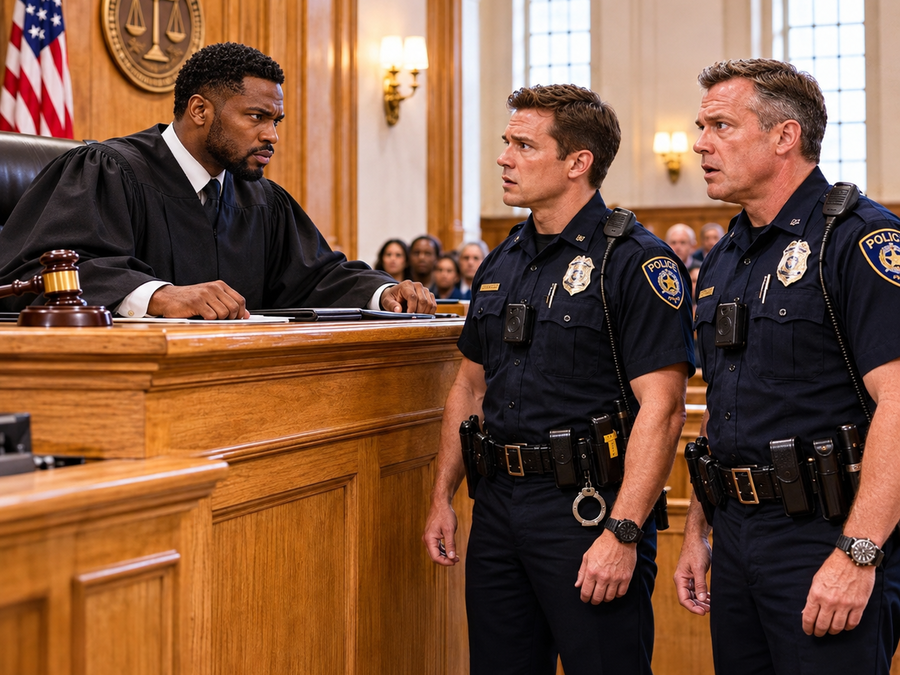
“You Threw Me Out Because You Thought I Didn’t Belong Here. Today, the Law Decided Who Was Truly Unfit to Serve Inside It.”
Move along.
You worthless nobody.
This courthouse isn’t your personal hangout.
Leave now before I arrest you. I have official business inside this courthouse, Sergeant, and you have no legal reason to threaten me.
Shut your mouth, you arrogant fool.
I’ll drag you down those stairs if you speak again.
I haven’t committed any crime.
And I’m asking you to stop treating me like some dangerous criminal.
I don’t care who you think you are.
You’re leaving this courthouse now, whether you like it or not.
Sergeant Harlan and another officer blocked Nathaniel Brooks from entering the courthouse, ordering him to leave as stunned visitors watched.
But neither cop had any idea who they had just humiliated or why seeing that same man sitting on the bench just 10 minutes later would leave them completely speechless.
The morning air felt crisp against Nathaniel Brooks’s skin as he approached the wide granite steps leading into the county courthouse.
He carried a leather document case in one hand and wore a simple dark suit.
Nothing flashy, nothing that drew attention.
After 20 years as a civil rights attorney, he’d learned that clothing could say plenty without saying anything at all.
Today, though, wasn’t about making statements.
Today was about the work itself.
He stopped at the base of the steps and glanced up at the building’s limestone facade.
The carved words above the entrance read equal justice under law.
He’d defended clients in courtrooms for two decades, arguing before judges who sometimes listened and sometimes didn’t.
Now he’d be the one listening.
Now he’d be the one making decisions that could change people’s lives.
The weight of that responsibility settled across his shoulders, heavy but right.
Nathaniel climbed the steps slowly, deliberately.
Other people moved past him, lawyers in tailored suits, clerks carrying file folders, ordinary citizens nervously clutching paperwork.
Nobody paid him much attention.
That was fine.
He didn’t need attention.
He needed to get inside and start his first day.
Hey.
The voice came from his left, sharp, commanding, the kind of voice that expected immediate obedience. Nathaniel turned.
Two white police officers stood near the courthouse entrance, both wearing dark blue uniforms with shiny badges pinned to their chests. The older one, maybe late 40s with a thick build and close-cropped hair, had his hand resting on his belt.
His nameplate read Harlan. The younger officer beside him looked nervous, shifting his weight from foot to foot.
You got business here? Harlan asked.
He wasn’t really asking.
Nathaniel kept his expression calm.
Yes, I do.
What kind of business?
Official business.
Nathaniel’s voice remained steady, polite.
He knew this game.
He’d seen it played a hundred times in different places under different circumstances.
The trick was staying calm, staying respectful, and not giving them anything they could twist into justification. Harlan stepped forward, blocking the path to the doors.
That’s not an answer.
What are you doing standing around out here?
I’m not standing around.
I’m entering the courthouse.
Doesn’t look like it to me.
Harlan glanced at the younger officer.
Cole, you see this guy standing around bothering people? Officer Cole hesitated for just a second, then nodded.
Yeah, sergeant.
I haven’t bothered anyone, Nathaniel said firmly.
I’m here on official business and I have every right to enter this building.
Harlan’s expression hardened.
You got an attitude problem.
People like you always got something to say, always think you can tell law enforcement how to do their jobs.
Nathaniel felt the familiar tightness in his chest, not fear exactly, but the cold understanding that this situation could escalate fast.
He’d spent years advising clients how to handle confrontations with police.
Stay calm, don’t argue, don’t escalate, but don’t surrender your rights either.
I’d like to speak with your supervisor, Nathaniel said quietly.
My supervisor?
Harlan laughed, but there was no humor in it.
You think you’re important enough to speak to my supervisor?
I think you’re making a mistake.
The only mistake here is you thinking you can loiter around this courthouse like you own the place.
Harlan moved closer, invading Nathaniel’s personal space.
Maybe you didn’t hear me the first time.
This building is for people with legitimate business, not for folks hanging around causing problems.
Nathaniel held his ground.
What’s your badge number, sergeant?
Harlan’s jaw tightened.
You threatening me?
I asked for your badge number.
You don’t need my badge number.
What you need is to leave before I arrest you for trespassing and disorderly conduct.
Several courthouse visitors had stopped on the steps, watching the confrontation unfold. A woman with graying hair clutched her purse tighter.
A younger man in a cheap suit glanced between Nathaniel and the officers, uncertainty written across his face.
Nobody said anything. Nobody moved to help.
Nathaniel kept his voice level.
I have the right to enter this courthouse.
If you’re going to deny me access, I need to know why and who’s making that decision.
I’m making the decision.
Harlan pointed toward the street.
You’re leaving now.
Cole shifted position, moving to stand directly in front of the courthouse doors.
He wasn’t as aggressive as Harlan, but he’d made his choice.
He was blocking the entrance.
This is your last warning, Harlan said.
His hand moved toward the handcuffs on his belt. Walk away or I remove you by force.
Nathaniel’s heart pounded, but his expression remained calm.
He’d faced intimidation before.
He’d stood in front of hostile judges, aggressive prosecutors, and witnesses who’d been coached to lie.
This wasn’t new, but it still hurt the assumption that he didn’t belong, that his presence alone constituted a threat.
You’re making a serious mistake, Nathaniel said quietly.
Harlan’s face twisted into something ugly.
The only person making mistakes here is you.
Then Harlan’s hand shot out and grabbed Nathaniel’s arm.
Harlan’s fingers dug into Nathaniel’s arm, the grip deliberately painful.
You think you can just ignore me? Release me.
Nathaniel kept his voice steady despite the pressure on his arm. You have no authority to detain me.
I got every authority.
Harlan jerked him closer.
You’re trespassing on government property.
I’m standing on the front steps of a public courthouse.
Nathaniel looked directly at him.
That’s not trespassing.
Let go of my arm.
Cole moved in from the side, his expression uncertain, but his actions decisive. He reached for the leather document case Nathaniel carried.
What’s in here?
That’s my property, Nathaniel said.
You have no right to search it.
Cole ignored him. He unzipped the case and pulled out several folders, flipping through pages without really looking at them.
Legal documents, court filings, official papers with the Georgia state seal printed at the top. He barely glanced at any of it.
Looks like a bunch of paperwork, Cole said.
Those are official court documents, Nathaniel said firmly. You need to return them.
Harlan tightened his grip again.
What you need to do is shut your mouth and do what you’re told.
I haven’t committed any offense.
Nathaniel kept his tone controlled, refusing to give Harlan the angry outburst he clearly wanted.
You’re detaining me without cause.
You’re searching my belongings without authorization and you’re denying me access to a public building.
You hear that, Cole?
Harlan’s voice dripped with mockery.
This guy thinks he can lecture us about the law. Several more people had gathered on the steps now, watching.
An older black woman frowned at the officers.
A white man in a business suit looked uncomfortable. Nobody intervened.
Nobody spoke up. They just watched.
I know the law, Nathaniel said quietly, and what you’re doing violates it.
Harlan’s face flushed red.
You calling me a liar?
I’m stating facts.
Facts?
Harlan laughed harshly.
Here’s a fact for you.
You’re trespassing, and if you keep arguing, I’m putting you in handcuffs and charging you with disorderly conduct.
For what?
Nathaniel demanded.
For standing on public property? For attempting to enter a courthouse?
What exactly am I being accused of?
You’re being accused of not listening when a police officer gives you a lawful order.
Harlan released Nathaniel’s arm but moved closer, getting in his face.
And you’re about two seconds away from spending the night in a cell.
Cole finished rifling through the documents and shoved them back into the case carelessly. Papers crumpled, folders bent.
He handed the case back to Nathaniel without meeting his eyes.
I’m not apologizing for something I haven’t done, Nathaniel said.
That was the wrong thing to say.
Harlan’s expression twisted into pure rage.
You think you’re better than me?
You think that suit makes you special?
Before Nathaniel could respond, Harlan shoved him hard. Nathaniel stumbled backward through the entrance, his feet catching on the edge of the top step.
He threw his arms out for balance, grabbing the iron railing to keep from falling completely.
The document case fell from his hand and clattered down three steps before stopping. Papers spilled across the concrete.
The watching crowd gasped. The older woman put her hand to her mouth.
The businessman looked away.
Nathaniel steadied himself, breathing carefully. Every instinct screamed at him to shout, to demand justice right here, right now.
But he wouldn’t.
Not yet.
Harlan wanted an angry black man.
He wanted justification for whatever came next. Nathaniel refused to give it to him.
He straightened slowly, adjusted his jacket, and walked down the steps to retrieve his case and the scattered papers.
You listened to me.
Harlan stood at the top of the stairs, pointing down at him.
You don’t come back to this courthouse without permission.
You up here causing problems.
And you definitely police officers how to do their jobs. You understand?
Nathaniel gathered the papers, organizing them carefully despite his shaking hands. He refused to rush, refused to show fear.
I asked if you understand, Harlan repeated.
Nathaniel looked up at both officers.
Cole still wouldn’t meet his eyes.
Harlan glared down with absolute confidence.
I understand exactly what you’ve done here, Nathaniel said quietly.
Both of you. I want you to remember that.
That a threat?
Harlan demanded.
That’s a statement of fact.
Nathaniel closed his case and stood.
Remember what you did. Remember how you treated someone trying to enter this courthouse.
Remember every word you said.
Harlan’s expression flickered just for a second with something that might have been uncertainty.
Then his arrogance returned.
Get off this property, he ordered. Now.
Nathaniel walked toward the public sidewalk, his back straight, his pace measured.
He didn’t run, didn’t hurry.
When he reached the sidewalk, he took out his phone and scrolled through his contacts. He pressed the number for chief administrator Evelyn Price.
The phone rang twice before Evelyn Price answered. Nathaniel?
Her voice was warm but concerned.
Are you outside? I expected you 20 minutes ago.
I’m on the sidewalk, Nathaniel said calmly.
Two courthouse officers just physically removed me from the entrance.
Silence.
What?
They accused me of They searched my belongings without authorization, and one of them shoved me out the door.
Stay exactly where you are.
The warmth in Evelyn’s voice vanished, replaced by something sharp and authoritative.
I’m coming down right now.
Nathaniel ended the call and slipped his phone back into his pocket.
Across the plaza, Harlan and Cole still stood near the entrance.
Harlan’s arms were crossed.
Cole shifted his weight nervously, glancing between Nathaniel and his sergeant.
Less than three minutes later, the courthouse doors opened and Evelyn Price emerged.
She was a tall, black woman in her early 50s, wearing a navy blue suit and carrying a tablet. Her hair was pulled back into a neat bun.
She moved with purpose, her heels clicking against the stone steps as she descended quickly. When she reached Nathaniel, her expression softened briefly.
Are you all right?
She asked quietly.
I’m fine, Nathaniel said.
Evelyn turned toward the entrance, her jaw tight. Sergeant Harlan?
Harlan straightened.
For the first time since the confrontation began, uncertainty crossed his face. He clearly recognized Evelyn, but he maintained his confident posture as he walked down the steps toward them.
Cole followed a few paces behind. Ms.Price, Harlan said smoothly, we were just handling a security situation.
A security situation, Evelyn repeated slowly. What security situation?
This man was loitering near the courthouse entrance, Harlan said. He refused to explain his business here.
He became argumentative when we asked him to move along.
That’s not what happened, Nathaniel said quietly.
He wouldn’t identify himself, Harlan continued, talking over him.
He acted suspiciously.
He refused lawful instructions.
We had every right to remove him from courthouse property. Evelyn looked at Nathaniel.
Is that accurate?
No, Nathaniel said. I told them I had official business inside.
I requested a supervisor. I never refused to comply with lawful instructions because they never gave me any lawful instructions.
He’s lying, Harlan said flatly.
He showed up here causing problems, and now he’s trying to make us look bad.
Sergeant Harlan, Evelyn said carefully, did you ask this man why he was here? He gave some vague answer about having business inside.
That’s what they all say when they’re up to something.
They?
Evelyn’s tone sharpened.
Who exactly is they?
Harlan’s expression tightened.
People who don’t belong here.
Cole closed his eyes briefly. Sergeant, Evelyn said coldly.
Do you know who this man is?
I don’t care who he thinks he is, Harlan replied.
He could be the governor’s cousin for all I care.
When someone refuses to cooperate with courthouse security This is Judge Nathaniel Brooks, Evelyn interrupted.
The superior court judge whose appointment I personally coordinated. The judge who is scheduled to preside over a hearing in courtroom three in approximately 15 minutes.
The color drained from Cole’s face.
Harlan stared at her, then at Nathaniel. His mouth opened, closed, opened again.
He never said, Harlan began. I told you I had official business, Nathaniel said quietly.
Multiple times.
You should have identified yourself as a judge, Harlan snapped, recovering quickly.
If you’d just shown proper identification I shouldn’t need to prove my position to enter a public courthouse, Nathaniel said.
And I certainly shouldn’t be physically assaulted for attempting to do so.
Assaulted?
Harlan’s voice rose.
That’s a serious accusation.
You shoved me through the entrance, Nathaniel said calmly. In front of multiple witnesses.
Harlan looked at Cole. Cole looked at the ground.
This is a misunderstanding, Harlan said, switching tactics.
If Judge Brooks had simply explained I explained repeatedly, Nathaniel interrupted. You chose not to listen.
Evelyn pulled out her tablet and began typing rapidly.
I’m documenting this incident immediately.
I want both officers’ badge numbers.
I want the entrance surveillance footage preserved. And I want written incident reports from both of you on my desk within the hour.
We were doing our jobs, Harlan protested. Your job is to provide security, not to harass visitors, Evelyn said sharply.
And certainly not to assault a superior court judge.
We didn’t know he was a judge, Cole said quietly.
It was the first time he’d spoken since Evelyn arrived.
You didn’t ask, Nathaniel said.
You assumed.
Harlan’s face flushed red again.
This is exactly the problem.
Judges expecting special treatment, threatening officers who are just trying to protect.
I’m not asking for special treatment, Nathaniel said firmly.
I’m asking for lawful treatment.
The same treatment every citizen deserves when they enter this courthouse. Sergeant Harlan, Evelyn said.
Judge Brooks is right.
Every person who approaches this building deserves to be treated with basic respect and professionalism.
That includes him.
Harlan’s jaw clenched.
He clearly wanted to argue further, but something in Evelyn’s expression stopped him.
I want those incident reports, Evelyn repeated, and I want confirmation that the surveillance footage has been preserved under evidence retention protocols.
Am I clear?
Crystal, Harlan muttered. Evelyn turned to Nathaniel.
Let me escort you inside. She led him toward the entrance.
The small crowd that had gathered earlier had dispersed, but a few people still lingered on the courthouse steps, watching. Evelyn held the door open, waiting for Nathaniel to enter first.
As he passed through the entrance, Nathaniel glanced back.
Harlan stood on the steps, his fists clenched at his sides, staring after him with an expression of pure fury.
Evelyn walked briskly through the main hallway, her heels clicking against the polished marble floor. Nathaniel followed a half step behind, carrying his leather document case.
The hallway stretched ahead of them, lined with dark wooden doors and framed portraits of former judges.
Morning sunlight streamed through tall windows, casting long rectangles of light across the floor.
I apologize for what happened, Evelyn said quietly.
That was completely unacceptable.
It’s not your fault, Nathaniel replied.
It happened in my courthouse, Evelyn said. That makes it my responsibility.
They passed several courthouse employees. A few nodded politely.
Others stared curiously at Nathaniel, perhaps recognizing him from the scene outside. Word traveled fast in small buildings.
How long has Harlan been working courthouse security?
Nathaniel asked.
Seven years, Evelyn said. Cole has been here about three.
Any prior complaints?
Evelyn hesitated.
Nothing formal. But something informal?
Visitors have mentioned feeling uncomfortable around Harlan, Evelyn admitted.
He can be aggressive, but until today, nobody’s filed an official complaint.
Maybe they were afraid to, Nathaniel said. Evelyn stopped walking.
She turned to face him.
I should have paid closer attention.
If I’d known You couldn’t have known, Nathaniel interrupted gently, and we’ll address it properly through the right channels.
They continued down the hallway. At the end stood courtroom three.
The heavy wooden doors were closed.
A brass nameplate beside the entrance read Superior Court. Evelyn checked her watch.
You have exactly two minutes.
I’ll be ready, Nathaniel said.
She gestured toward a side entrance.
The judge’s entrance is through there.
Good luck.
Nathaniel nodded and walked toward the private door.
Behind him, he heard Evelyn’s heels clicking rapidly back down the hallway.
She had work to do.
He took a slow breath, opened the door, and stepped into the small chamber behind the courtroom. A black robe hung on a wooden stand.
He set down his document case and pulled the robe over his suit jacket.
The fabric felt heavier than he’d expected, more real.
Through the wall, he heard muffled voices. The courtroom was filling up.
Nathaniel checked his watch. Exactly 10 minutes had passed since Harlan threw him out of the building.
He opened the door to the courtroom and stepped through. All rise, the bailiff announced immediately.
The Superior Court is now in session. The honorable judge Nathaniel Brooks presiding.
The room erupted into motion.
Chairs scraped.
Papers rustled. Every person in the courtroom stood.
Nathaniel walked calmly across the platform toward the bench.
His eyes swept the courtroom. Lawyers stood behind counsel tables, court staff occupied their designated positions, visitors filled the gallery seating, and near the public entrance, wearing courthouse security uniforms, stood Sergeant Richard Harlan and Officer Travis Cole.
Cole saw him first. His eyes widened.
PART 2
His mouth opened slightly. Then Harlan looked up.
The sergeant’s confident expression crumbled.
His face went pale.
He stared at Nathaniel with something close to horror.
Nathaniel climbed the three steps to the bench and sat down.
The leather chair was firm and straight-backed. From this height he could see everyone clearly.
Please be seated, he said.
The room sat as one. A few whispers rippled through the gallery before falling silent.
Nathaniel opened the case file in front of him. He took his time reading the first page, letting the silence stretch.
When he finally looked up, he made eye contact with Harlan. This court is convened to address an emergency administrative hearing concerning allegations of unlawful visitor exclusions and witness intimidation by courthouse security personnel.
Nathaniel said clearly, Before we proceed, I need to make a disclosure. The courtroom went completely still.
Approximately 15 minutes ago, Nathaniel continued, I was physically removed from this courthouse by two security officers who refused to allow me to enter.
Those officers are Sergeant Richard Harlan and Officer Travis Cole, both of whom are currently assigned to this courtroom. Several people in the gallery gasped.
Lawyers exchanged glances.
The court reporter’s fingers paused over her keyboard.
Harlan’s face flushed red.
I am disclosing this incident because it directly relates to the allegations under review today, Nathaniel said. Any formal complaint arising from my personal mistreatment will be handled by an independent judge.
However, the conduct I witnessed this morning raises urgent questions about evidence preservation and public access that require immediate attention. Harlan stepped forward.
Your Honor, I need to explain.
Sergeant Harlan, Nathaniel said firmly.
You will remain silent unless I formally recognize you.
Do you understand?
Harlan’s mouth snapped shut, his fists clenched at his sides.
Ms.Price, Nathaniel said, looking toward Evelyn, who had entered through the back of the courtroom.
I’m directing you to preserve all security recordings from this morning’s incident along with any related reports or communications.
This evidence must be maintained under proper chain of custody protocols. Understood, Your Honor, Evelyn said.
Nathaniel looked back at Harlan.
The sergeant stood frozen near the door, his face a mask of barely controlled rage.
And beneath that rage, Nathaniel saw something else.
Fear. Harlan had just realized the new judge sitting above him had personally witnessed the very behavior the courthouse was accused of allowing.
Nathaniel stood and gathered his case file. The initial hearing session had lasted 40 minutes.
He’d reviewed the allegations, disclosed his own confrontation, and established the basic procedural framework.
Nothing more. This court will reconvene in 48 hours, he announced.
In the interim, courthouse administration will preserve all security recordings, incident reports, visitor logs, and communications relevant to the allegations under review. Public access to courthouse proceedings will be maintained according to existing regulations.
He paused and looked directly at the attorneys representing the complaining parties.
I’m making no findings regarding individual conduct at this time.
The administrative review will be conducted by an independent authority to ensure impartiality.
Any disciplinary or legal matters arising from today’s disclosure will be handled by a different judge.
Several people in the gallery nodded.
The attorneys took notes. We are adjourned, Nathaniel said.
The bailiff called the courtroom to order as Nathaniel stood and walked back through the private entrance. He removed the robe and hung it carefully on its stand.
Through the wall, he heard chairs scraping and voices rising as the courtroom emptied. When he stepped back into the hallway, Evelyn was waiting.
Clean and proper, she said quietly. You protected the record without making it personal.
It shouldn’t be personal, Nathaniel replied.
That’s the whole point.
They walked together toward the administrative wing. Behind them, courthouse visitors streamed out of courtroom three.
Some glanced at Nathaniel with recognition. Others simply hurried past.
The security office has to produce its documentation within 24 hours, Evelyn said.
Incident reports, radio logs, surveillance access records, everything related to this morning.
Will they cooperate?
They don’t have a choice.
Your order was clear.
Nathaniel nodded. They turned a corner.
The security office was two hallways away.
Near the courtroom entrance, Harlan grabbed Cole’s arm and pulled him into a narrow alcove beside the water fountain.
His grip was tight enough to hurt. Listen carefully, Harlan said.
His voice was low and dangerous.
When they review what happened this morning, you’re going to describe Brooks as aggressive and threatening.
Cole swallowed hard.
Sergeant, he never I don’t care what you think you saw, Harlan interrupted.
He refused to follow lawful instructions.
He tried to force his way past security.
You remember it that way.
Understand? But the footage the footage shows exactly what I say it shows, Harlan snapped.
And your report will match mine.
You contradict a superior officer, Cole, and you’re done.
I’ll make sure you never work courthouse security again.
You’ll be writing parking tickets in the worst precinct in the county.
Cole looked away.
His face was pale.
He didn’t resist, Sergeant.
He just asked for a supervisor.
Harlan’s eyes narrowed.
You think he’s going to protect you?
He’s coming after all of us now.
The only way we survive this is if we stand together.
Heavy footsteps echoed down the hallway.
Both officers turned.
Captain Douglas Mercer approached quickly.
He was 56 years old, gray-haired, and walked with the rigid posture of someone who’d spent decades commanding respect through intimidation rather than competence.
His uniform was immaculate.
His expression was cold. Harlan, Mercer said curtly.
My office, now.
Yes, sir.
Harlan released Cole and followed Mercer down the hallway toward the administrative offices.
They walked past startled visitors and concerned staff members.
Mercer didn’t speak until they reached a small conference room.
He closed the door and faced Harlan.
I just received word that our new judge was physically removed from the courthouse this morning, Mercer said. Tell me exactly what happened.
Harlan straightened his shoulders.
Captain Brooks showed up acting suspicious, refused to identify himself. When we attempted to verify his business here, he became hostile and threatened us.
Threatened you how?
Said we’d regret treating him this way, tried to intimidate us with vague warnings about making mistakes.
Harlan’s voice grew more confident.
Then 10 minutes later he’s wearing a robe and disclosing the incident like we did something wrong.
He’s abusing his position, sir.
Mercer’s jaw tightened.
Did he identify himself as a judge?
Not until after we’d already escorted him outside.
And you searched his belongings?
Standard security procedure.
Mercer walked slowly around the small table. His fingers tapped against the polished wood.
This could destroy the department’s reputation, he said finally.
A new black judge claiming racial profiling by courthouse security.
The media will crucify us.
That’s exactly what he wants, Harlan said quickly.
He’s looking for a reason to discredit us before the access hearing moves forward.
If we let him control the narrative, every questionable removal we’ve ever made gets second-guessed.
Mercer stopped pacing. How many recordings did you request be preserved?
Just this morning’s entrance footage.
And your incident report? Already filed.
Cole’s matching statement will be submitted within the hour.
Mercer’s eyes went cold.
Then we challenge his credibility before anyone examines that footage. We make it clear that he provoked the confrontation and is now misusing judicial authority to retaliate.
Harlan nodded.
Relief flooded through him.
Yes, sir.
I’ll contact the county attorney’s office, Mercer continued.
They need to know we have serious concerns about this judge’s temperament and judgment.
Nathaniel and Evelyn turned the final corner toward the security office.
Ahead, the door stood partially open. Voices drifted into the hallway.
Harlan’s voice carried clearly.
We make him look dangerous before anyone sees the original footage. Nathaniel stopped mid-stride.
His hand moved toward the security office door, then paused.
Evelyn heard it too.
Her expression darkened.
Harlan’s voice continued through the gap.
We document his behavior as threatening before the footage becomes part of any investigation.
Once the county attorney sees our reports, they’ll understand what kind of man just took the bench.
Captain, Cole’s voice followed, uncertain and quiet.
He never actually I don’t care what you think happened, officer.
Your report will match mine exactly.
Nathaniel met Evelyn’s eyes briefly, then he pushed the door fully open and stepped inside.
The security office went silent immediately. Harlan stood beside a small metal desk.
His incident report spread across the surface. Cole sat on the opposite side, pen frozen above his own paperwork.
Captain Mercer leaned against the far wall, arms crossed.
Judge Brooks, Mercer said flatly, we weren’t expecting you.
Clearly, Nathaniel walked further into the room. Evelyn followed, closing the door behind them.
Harlan straightened his shoulders.
The surprise vanished from his face, replaced by calculated confidence.
We just finished our incident reports.
Everything’s properly documented.
I’d like to see them, Nathaniel said.
Harlan hesitated for only a moment, then slid the pages across the desk.
Nathaniel picked up the first report and read it carefully. The document accused him of aggressive behavior, refused lawful instructions, unauthorized entry into restricted sections, and threatened courthouse personnel.
Nathaniel picked up the page.
His eyes moved across the text carefully. Evelyn stood beside him, reading over his shoulder.
According to this, Nathaniel said after a moment, a security alarm triggered when I approached the restricted corridor near courtroom three.
That’s correct, Harlan said smoothly.
And this alarm prompted you to intercept me?
Yes. Nathaniel looked directly at Cole.
Officer Cole, do you remember when this alarm sounded?
Cole’s jaw tightened.
He glanced toward Harlan. Answer the question, officer, Evelyn said firmly.
I Cole started. His voice cracked slightly.
There was the alarm activated at approximately 8:43. Harlan interrupted sharply.
Officer Cole responded with me immediately.
I’m asking Officer Cole, Nathaniel said.
His tone remained calm but carried unmistakable authority.
Cole looked down at his hands.
Sir, I Officer Cole heard the same alarm I did, Harlan cut in again.
His face was flushed.
We both responded according to protocol.
Evelyn walked around the desk and picked up the security radio log from the equipment shelf. She flipped through the pages, her finger tracing down the timestamp columns.
Sergeant Harlan, she said slowly, there’s no alarm notation between 8:30 and 9:00.
Harlan’s confident expression faltered for just a second.
Radio dispatch must have missed the entry.
That’s not how alarm systems work, Evelyn replied.
Automated alerts generate immediate logged notifications.
There’s nothing here.
Nathaniel set the report down. Your documentation also states I attempted to access restricted sections.
Which sections specifically? The judicial corridors.
I was walking directly toward the courtroom where I was scheduled to preside, Nathaniel said.
That’s not restricted access.
That’s my workplace.
You hadn’t identified yourself as a judge, Harlan shot back.
Because you never asked my business, Nathaniel replied. You accused me of loitering before I could explain why I was here.
That’s not, Harlan started.
Officer Cole, Nathaniel said, turning toward the younger officer again.
Did I tell you I had official court business when you stopped me?
Cole’s hands trembled slightly.
You said you needed to get to courtroom three. And did you verify whether I had legitimate access before searching my belongings?
I, Cole looked desperately toward Harlan. Sergeant Harlan ordered me to, Officer Cole followed proper security procedures, Harlan interrupted loudly.
His voice carried an edge of desperation now.
We don’t owe explanations to every person who claims they belong somewhere.
Nathaniel’s expression didn’t change.
There’s a second contradiction.
Your report claims I became verbally aggressive and threatened both officers.
But Officer Cole’s preliminary statement, he gestured toward the paperwork still sitting unfinished on the desk, contains no mention of threats.
Harlan’s face darkened.
Because he hasn’t completed it yet.
Or because there were no threats, Nathaniel said quietly.
Harlan slammed his hand against the metal desk.
The impact echoed through the small office. You think wearing that robe makes you untouchable?
Down here, security answers to me.
I don’t care what title they gave you upstairs.
That’s enough, Sergeant, Evelyn said sharply.
No.
Harlan pointed at Nathaniel.
He walks in here acting like we committed some crime when we were just doing our jobs.
I’ve worked courthouse security for 16 years.
I know suspicious behavior when I see it.
What you saw, Nathaniel said, was a black man in a suit.
And you decided he didn’t belong.
The room went completely silent.
Mercer pushed away from the wall.
Judge Brooks, I think Ms.Price, Nathaniel said, ignoring the captain, please document the discrepancy between Sergeant Harlan’s alarm claim and the radio log.
Evelyn pulled out her phone and photographed both documents side by side.
I’m also requesting you contact the security director, Nathaniel continued.
This incident needs independent review before these reports become part of any official record.
Understood, Evelyn said. She stepped into the hallway and made the call immediately.
Harlan’s face turned deep red.
You can’t remove me from my post over a paperwork discrepancy.
I’m not removing you from anything, Nathaniel replied.
Your own supervisor will make that determination after reviewing the evidence.
Evelyn returned moments later. The director is pulling the entrance surveillance footage now.
Sergeant Harlan, you’re temporarily reassigned from entrance duty pending administrative review.
Harlan stared at her in disbelief.
You’re suspending me?
Not suspended, Evelyn corrected. Reassigned.
Standard procedure when documentation inconsistencies arise. This is because of him, Harlan said, gesturing toward Nathaniel.
He’s targeting me deliberately.
I’m protecting the integrity of the record, Nathaniel said calmly.
Nothing more.
You’re protecting yourself, Harlan spat.
You know that footage will show exactly what I documented. Then you have nothing to worry about, Nathaniel replied.
He turned toward the door.
Evelyn followed.
Behind them, Harlan’s voice carried down the hallway.
Removing me from entrance duty changes nothing, Brooks.
This isn’t finished, not even close.
Nathaniel kept walking.
His face remained perfectly composed, but his hands, Evelyn noticed, were clenched tight at his sides.
Nathaniel and Evelyn moved down the adjoining courthouse hallway in silence.
Their footsteps echoed against the polished tile floor. Behind them, the security office door clicked shut with a metallic snap.
Judge Brooks.
The voice came from behind, quiet, urgent.
Nathaniel turned. Cole stood several feet away, his hands clasped tightly together.
His uniform looked too large for his frame suddenly, like something borrowed from someone else. Officer Cole, Nathaniel said.
Cole glanced back toward the security office.
The hallway remained empty except for the three of them. He took a step closer.
I need to tell you something.
Cole’s voice trembled slightly.
About the report.
Evelyn moved to stand beside Nathaniel. Her expression remained neutral but watchful.
Go ahead, Nathaniel said.
Cole swallowed hard.
You didn’t threaten us, either of us.
You asked for Sergeant Harlan’s badge number and said he was making a mistake.
That’s all.
And the security alarm?
Nathaniel asked.
There wasn’t one, Cole admitted.
His face had gone pale.
Sergeant Harlan told me to include it in the documentation. He said we needed justification for the stop.
Nathaniel didn’t react.
His face remained completely still.
Why are you telling me this now? Evelyn asked.
Because the report’s wrong, Cole said.
And if it becomes part of the official record He stopped himself. I just needed to say it.
Saying it doesn’t change what happened, Nathaniel replied.
His tone wasn’t harsh, but it offered no comfort.
You searched my belongings.
You participated in removing me from the courthouse.
Honesty now doesn’t erase those actions.
Cole’s shoulders slumped.
I know.
Then what do you want from this conversation?
Nathaniel asked.
I don’t know, Cole said quietly.
Maybe I just need someone to know the truth. Nathaniel studied him carefully.
Is there something else you need to tell us? Cole hesitated.
He looked down at his hands.
When he spoke again, his voice barely rose above a whisper.
This isn’t the first time, he said.
Evelyn stepped closer.
What do you mean?
Sergeant Harlan has removed people from the courthouse before, Cole explained. Same accusations, loitering, trespassing, suspicious behavior.
But some of those people He paused.
Some of them were here to testify against local officers.
The hallway went silent.
Nathaniel’s jaw tightened almost imperceptibly.
How many times?
At least 10 that I witnessed personally, Cole said.
Maybe more before I transferred to this unit. And you documented these incidents?
Evelyn asked. Sergeant Harlan handled the paperwork, Cole replied.
He told me we were protecting courthouse security, keeping potential troublemakers from disrupting proceedings. Did you believe that?
Nathaniel asked. Cole looked up.
His eyes were red.
I wanted to. Evelyn pulled out her phone again.
I need specific dates if you remember them. Ms.Price, Nathaniel said, stopping her.
Officer Cole should provide that information to an independent investigator, not directly to us. But the access hearing already involves allegations about courthouse security practices, Nathaniel continued.
If Officer Cole’s account becomes relevant to that proceeding, it needs to go through proper channels, not through private conversations in hallways.
Cole nodded slowly. Will the investigator protect me from retaliation?
I can’t promise you protection from consequences, Nathaniel said.
That’s not how accountability works.
I meant from Captain Mercer, Cole clarified. Sergeant Harlan reports directly to him.
If this comes out, then you’ll face whatever follows, Nathaniel interrupted.
His voice remained calm but firm.
The same way anyone faces the results of their choices.
Cole’s hands were shaking now.
I could lose my job.
You could, Nathaniel agreed, or you could lose something worse by continuing to lie. The younger officer looked away.
What’s worse than losing my career?
Your ability to look at yourself honestly, Nathaniel replied.
That doesn’t come back once it’s gone.
Evelyn glanced between them.
Judge Brooks is right about the independent investigation, but I can arrange for the relevant security records to be preserved through courthouse administration.
That part doesn’t require your testimony.
Which records? Cole asked.
Entrance logs, incident reports, radio communications, Evelyn said. Anything relating to visitors removed from the courthouse over the past 18 months.
Cole nodded. Sergeant Harlan keeps backup files in the security office.
Digital copies.
Then I’ll contact the director about securing those immediately, Evelyn said.
He’ll know I talked to you, Cole said.
He already knows you hesitated during questioning, Nathaniel replied.
Protecting the evidence now won’t change that.
Cole took a deep breath. All right.
I’ll cooperate with the investigation.
Good, Nathaniel said.
The younger officer turned back towards security headquarters.
His steps were slow, uncertain. Nathaniel watched him walk away down the long corridor.
What Cole didn’t see was the figure standing in the shadowed doorway 30 feet behind him.
Sergeant Harlan had been there the entire time, and he had heard every word.
The records room sat at the far end of the courthouse’s administrative wing.
Fluorescent lights hummed overhead.
Metal shelving units lined the walls, each packed with document boxes and digital storage equipment.
Nathaniel followed Evelyn past the main counter to a secured terminal where surveillance recordings were managed. The system logs every access request, Evelyn explained.
PART 3
She typed her administrative credentials into the computer. Once footage is marked for preservation, it requires supervisor approval to change that status.
The screen displayed a list of pending preservation actions. Evelyn scrolled through the entries until she found the courthouse entrance recording from three days earlier.
Her expression changed.
What is it?
Nathaniel asked. Someone submitted a reclassification request, Evelyn said.
Her voice had gone flat. The recording was flagged to be moved from protected evidence to routine footage.
What does that mean? Nathaniel asked.
Routine footage gets automatically overwritten after 30 days, Evelyn explained. Protected evidence stays permanently unless a court orders its release or destruction.
Nathaniel leaned closer to the screen. Who requested the change?
Evelyn highlighted the submission details.
Sergeant Richard Harlan filed yesterday afternoon. After receiving preservation instructions, Nathaniel said.
Yes, Evelyn confirmed. She pulled up another window.
Here’s the original acknowledgement.
Harlan signed it electronically the same morning you were removed from the building.
The acknowledgement was clear.
It identified the recording as potential evidence in an administrative proceeding and prohibited any modification of its preservation status without written authorization from courthouse administration. Can the recording still be accessed?
Nathaniel asked. Evelyn typed several commands.
The system hasn’t completed the reclassification yet.
It requires approval from the record supervisor and she’s been out sick this week.
So the recording still exists? Yes, Evelyn said.
And I’m going to make sure it stays that way.
She created a duplicate copy of the recording and transferred it to a separate protected archive. Then she documented the attempted reclassification in the administrative log.
This creates an official record that Harlan tried to change the footage’s status after receiving preservation notice, Evelyn explained.
Even if someone approves his request, we’ll have proof of when he made it and why the change was improper.
Nathaniel studied the screen.
Can Harlan access these logs? Not anymore, Evelyn replied.
I’m restricting access to courthouse administration only.
The records room door opened behind them.
Sergeant Harlan stepped inside.
His face was flushed. His uniform looked rumpled.
What are you doing? He demanded.
Evelyn turned slowly.
Protecting evidence that’s relevant to an ongoing investigation.
That’s my investigation, Harlan said.
Those recordings document courthouse security operations.
You have no authority. I have complete authority over courthouse records preservation, Evelyn interrupted.
That’s literally my job.
Harlan pointed at Nathaniel.
He’s using his position to attack police officers who were doing their jobs and you’re helping him.
I’m following established procedures, Evelyn replied.
Her voice remained calm but cold. The same procedures you tried to bypass yesterday.
Harlan’s jaw tightened.
I didn’t bypass anything.
I submitted a routine administrative request after receiving written preservation instructions, Nathaniel said.
Harlan turned toward him.
You don’t get to question my decisions, Brooks.
I don’t care what title you have now.
Then explain the request, Nathaniel said.
He gestured toward the computer screen. You acknowledged that the recording was protected evidence.
Why did you ask to have it reclassified?
Because it doesn’t show anything relevant, Harlan said.
You were loitering near restricted areas.
We removed you. End of story.
That’s not what Officer Cole told us an hour ago, Evelyn said.
Harlan’s eyes went hard.
Cole doesn’t know what he saw.
But the recording does, Nathaniel replied.
The recording shows exactly what I said it does, Harlan insisted.
You refused instructions from courthouse security.
You became aggressive when we enforced access policies.
Nathaniel picked up the printed preservation acknowledgment from the desk beside the terminal. He held it up so Harlan could see his own signature.
This document notified you that the recording was being preserved as potential evidence, Nathaniel said.
You acknowledged receipt.
You were instructed not to modify its status without authorization.
I had authorization, Harlan said.
From whom? Evelyn asked.
Harlan hesitated.
I made an administrative judgment.
That’s not how evidence preservation works, Evelyn said.
You don’t get to decide whether protected recordings remain protected just because you don’t like what they show.
They don’t show anything I’m worried about, Harlan shot back.
But you’re making this into something it’s not.
And he’s using his new position to abuse authority and intimidate officers who won’t let him break the rules.
What rules did I break?
Nathaniel asked. You were in a restricted section, Harlan said.
The courthouse entrance? Nathaniel replied.
That’s the most public part of the building.
You refused to identify yourself, Harlan continued. You ignored lawful commands from security personnel.
Officer Cole just contradicted both of those claims, Evelyn said.
Harlan’s face went dark red.
Cole doesn’t understand what happened.
Then the recording will clarify everything, Nathaniel said.
I want you to stop this, Harlan demanded, turning back to Evelyn. Stop helping him weaponize your position against courthouse security.
I’m protecting courthouse records, Evelyn replied.
That’s not negotiable.
Harlan stepped closer. His voice dropped to something dangerous.
You’re making a mistake, both of you.
Am I?
Evelyn asked.
She gestured toward the computer screen showing his reclassification request.
Because from where I’m standing, you’re the one who tried to destroy evidence after being told it was protected.
I didn’t destroy anything, Harlan said.
Not for lack of trying, Nathaniel replied. And that attempt is now documented alongside the original recording.
Harlan turned on him.
That robe doesn’t make you untouchable, Brooks.
I can make sure everyone in this county hears what kind of man you really are.
Nathaniel’s expression didn’t change.
Evidence manipulation carries serious consequences, sergeant. You might want to remember that before making threats.
Is that what this is?
Harlan asked. You threatening me?
I’m reminding you of the law, Nathaniel said.
Harlan stared at him.
His hands had curled into fists. Evelyn stood between them.
This conversation is over. Sergeant Harlan, you need to leave.
This isn’t finished, Harlan said.
He looked at Nathaniel with pure hatred.
Not even close. He turned and walked toward the door.
His boots hit the floor hard with each step. The door slammed behind him.
Evelyn exhaled slowly.
He’s going to retaliate.
I know, Nathaniel said.
She turned back to the computer.
I’ll make sure the recording, access logs, and preservation acknowledgment are packaged together as a single evidence file.
Everything documented, everything protected.
Good, Nathaniel replied.
The records room felt smaller after Harlan’s departure.
Nathaniel stood near the desk while Evelyn pulled up older incident reports on the terminal.
If Harlan tried to erase your confrontation, she said quietly, we should check whether he’s done this before.
Nathaniel nodded. Start with the complaints mentioned in the courthouse access hearing.
Evelyn typed quickly.
The screen filled with archived files dating back 18 months.
She opened the first report.
Nathaniel read over her shoulder.
The language felt familiar.
Subject observed loitering near restricted courthouse areas, he read aloud. Subject became agitated when questioned.
Subject refused lawful security instructions. Evelyn opened another file.
The wording was nearly identical, then another and another.
The accusations repeated across different dates, different visitors, different circumstances. But the descriptions remained almost unchanged.
These are templates, Evelyn said. Her voice had gone flat.
He’s been filing the same report over and over.
Nathaniel pointed at the screen. Check the timestamps.
Evelyn pulled up the metadata. Each report had been filed within minutes of the alleged incident.
He’s not writing these after investigating, Nathaniel said.
He’s writing them during the removal.
Evelyn scrolled further. Look at the request dates.
Besides several reports, Harlan had submitted reclassification requests for the corresponding surveillance footage. All of the requests came after the visitors had been escorted from the courthouse.
He removes someone, Nathaniel said slowly, files a pre-written accusation, then tries to hide the recording.
And nobody questioned it, Evelyn replied. Her hands had started shaking.
Nobody asked why the same officer kept removing people using identical justifications.
Nathaniel leaned closer.
Cross-reference those names with scheduled testimony. Evelyn opened the courthouse calendar system.
She compared the removal dates against the hearing schedules.
Her face went pale.
These weren’t random visitors, she whispered.
Most of them were scheduled to testify in cases involving local law enforcement.
Nathaniel felt something cold settle in his chest.
Harlan wasn’t just targeting people he thought didn’t belong.
He was screening witnesses.
The door opened behind them. Travis Cole stepped inside.
He looked exhausted. His uniform was wrinkled and his badge sat crooked on his chest.
The investigator told me to bring my original notes, Cole said.
He held up a small notebook.
Everything I wrote before Harlan told me what to say.
Evelyn gestured toward an empty chair.
Sit down. Cole sat heavily.
He placed the notebook on the desk. Harlan picked people, Cole said quietly.
Not everyone, just specific ones. Based on what?
Nathaniel asked.
Whether they might say something that embarrassed the captain’s department, Cole replied.
Harlan would get calls from Mercer’s office before certain hearings.
Then he’d watch for anyone who matched the descriptions.
What descriptions?
Evelyn asked.
People coming to testify about police misconduct, Cole said.
Witnesses in civil rights cases. Anyone scheduled to appear against law enforcement.
Nathaniel’s jaw tightened.
And you helped him?
I helped him, Cole admitted.
His voice cracked.
I told myself we were just enforcing security protocols, but we weren’t.
We were intimidating witnesses. Evelyn opened another archived file.
This one contained administrative correspondence between courthouse management and Mercer’s office.
She read silently. Then she turned the screen toward Nathaniel.
The emails showed Mercer personally approving several removals.
He’d received written complaints from visitors who claimed they were illegally excluded from public proceedings.
His responses dismissed every complaint as security decisions made by trained personnel.
One email stood out.
These individuals attempted to disrupt legitimate courthouse operations. Sergeant Harlan acted appropriately to maintain public safety and order.
No further investigation is warranted.
The date matched one of the reclassification requests. Mercer knew, Nathaniel said.
He protected Harlan, Evelyn replied. Every time someone complained, he backed the removal and shut down questions.
Cole looked up.
The captain told Harlan he’d take care of any paperwork problems as long as Harlan kept removing the right people.
Nathaniel straightened.
His mind processed the implications quickly.
This wasn’t one officer’s prejudice.
It was coordinated misconduct involving police leadership and courthouse security. The evidence would dramatically affect the courthouse access case.
But Nathaniel’s personal involvement complicated everything.
I can’t handle this, he said.
Evelyn looked at him.
You’re the judge assigned to the hearing.
I was assaulted by one of the officers involved, Nathaniel replied. My credibility is already under attack.
If I rule on evidence that directly implicates my own mistreatment, Mercer will argue I’m biased, and everything gets thrown out.
So what do we do? Cole asked.
We follow the established process, Nathaniel said. He turned to Evelyn.
Package all of these records together, the incident reports, the reclassification requests, the administrative correspondence, and Officer Cole’s notes.
Submit them through the independent review system.
Not directly to you? Evelyn asked.
Not directly to me, Nathaniel confirmed.
This evidence has to stand on its own.
No questions about judicial interference. Evelyn nodded slowly.
I’ll prepare the submission immediately.
And I’ll provide my testimony to the investigator, Cole added.
Nathaniel started toward the door.
He needed distance from this room, from these files, from the weight of what they’d discovered.
He reached the doorway. Captain Douglas Mercer stood in the hallway.
He held a folder in one hand. His uniform was immaculate, his expression carefully controlled.
Judge Brooks, Mercer said.
His voice was cold and formal. I need to speak with you about a serious matter.
He opened the folder.
Nathaniel glimpsed official department letterhead.
I’m filing a formal complaint alleging that you threatened courthouse security personnel and abused your judicial authority to interfere with legitimate law enforcement operations, Mercer said.
He held out the document.
And I’m requesting that you immediately recuse yourself from any proceeding involving my officers.
Mercer stepped fully into the records room.
His polished shoes clicked against the floor.
He closed the door behind him with deliberate care. Evelyn stood beside the desk.
Cole remained frozen in his chair. Nathaniel turned to face the captain directly.
His expression remained calm, but his shoulders straightened.
Captain Mercer, Nathaniel said evenly, I wasn’t expecting you.
Clearly, Mercer replied.
He placed the folder on the nearest desk. Which is why I felt it necessary to deliver this personally.
He gestured toward the document.
You’re using your position as a judge to pursue a personal vendetta against my officers, Mercer continued.
You’ve pressured witnesses, manipulated evidence preservation procedures, and interfered with legitimate security operations.
Nathaniel didn’t reach for the complaint.
The independent judicial administrator will review any allegations you choose to file.
I’m not just filing allegations, Mercer said.
I’m demanding that you immediately withdraw from the courthouse access hearing.
Your involvement has become a conflict of interest.
My involvement was disclosed the moment I took the bench, Nathaniel replied. I arranged for independent oversight of any disciplinary matters involving my personal mistreatment.
The administrator determines whether additional reassignment is appropriate.
Mercer’s jaw tightened.
You think procedure protects you from accountability?
I think procedure exists to prevent exactly the kind of intimidation you’re attempting right now, Nathaniel answered.
Evelyn stepped forward. Captain, the evidence preservation request was issued before any dispute occurred.
Judge Brooks followed established protocol. Mercer ignored her.
He focused entirely on Nathaniel.
I have 23 years of service protecting this community, Mercer said. His voice dropped lower.
You’ve been a judge for less than 48 hours.
If you think I won’t make this public, you’re badly mistaken.
Then make it public, Nathaniel said quietly.
The truth doesn’t change depending on who’s watching.
Mercer picked up his folder.
We’ll see how confident you feel when everyone hears what really happened at that entrance.
He walked out without another word.
Cole exhaled slowly. His hands trembled against the notebook.
He’s going to destroy you, Cole whispered.
He’s going to try, Nathaniel corrected.
Two hours later, Evelyn escorted Nathaniel down a narrow hallway toward the courthouse’s largest conference room.
The administrator had scheduled an emergency review session.
Nathaniel carried nothing except the preservation acknowledgment and his original entrance documentation. Evelyn opened the conference room door.
Captain Mercer sat at the far end of a long wooden table. Sergeant Harlan occupied the chair beside him.
Both men wore their full uniforms. The independent judicial administrator, a gray-haired woman named Margaret Hollis, sat at the head of the table.
She’d served as a county administrator for 30 years before accepting the oversight role.
Judge Brooks, Hollis said, please sit.
Nathaniel took the chair directly across from Mercer and Harlan. Evelyn sat beside him.
Hollis opened a thick folder.
Captain Mercer has filed a formal complaint alleging judicial misconduct. Sergeant Harlan submitted a supporting incident report.
I’ve asked everyone present to address these allegations directly.
Mercer leaned forward.
Judge Brooks threatened my officers when they attempted to verify his business inside the courthouse.
He then used his judicial authority to manipulate evidence and pressure subordinate personnel into contradicting official reports.
Harlan nodded.
He became aggressive when we asked basic security questions. He refused to identify himself properly and demanded special treatment.
Hollis turned to Nathaniel.
How do you respond?
By asking Sergeant Harlan a single question, Nathaniel replied.
He looked directly at the officer.
If I refused to identify myself, why does your report claim I never explained my business inside the courthouse?
Harlan hesitated.
You didn’t give a clear explanation.
Your report describes a security alarm that triggered when I attempted to bypass screening procedures. Nathaniel continued.
Administrator Price has confirmed that no such alarm occurred.
Evelyn placed the radio log on the table.
The security communications contain no record of any alarm activation.
Mercer’s expression hardened.
Technical records can be misinterpreted.
Officer Cole witnessed the entire confrontation, Nathaniel said.
He turned toward where Cole should have been sitting. The chair was empty.
Hollis checked her notes. Officer Cole was instructed to attend this meeting.
The conference room door opened.
Cole entered slowly. His face was pale.
He carried his original notebook and a signed statement. Mercer stared at him.
Officer Cole, take your seat. Cole walked past Mercer without looking at him.
He sat beside Evelyn. I need to correct my previous account, Cole said quietly.
Officer Cole, Mercer warned.
Don’t say anything without consulting.
Judge Brooks never threatened us, Cole interrupted. His voice gained strength.
Sergeant Harlan initiated the physical confrontation.
He ordered me to search the judge’s belongings without cause.
And he instructed me to support a false report about security violations that never happened.
The room went silent.
Harlan’s face turned red.
That’s a lie.
It’s documented in my original notes, Cole replied.
He pushed the notebook toward Hollis. Before Sergeant Harlan told me what version to write.
Mercer stood abruptly.
Officer Cole, you will remain silent until Captain Mercer, Hollis said sharply, sit down.
Mercer remained standing.
I will not tolerate witness intimidation in my presence, Hollis continued. Her voice was firm.
Officer Cole has the right to provide truthful testimony without interference from supervisors. Mercer slowly lowered himself back into his chair.
Hollis examined Cole’s notebook carefully.
She compared it against Harlan’s official report.
The contradictions were obvious.
These accounts are materially inconsistent, Hollis said.
Harlan leaned forward.
Cole is lying to protect himself. The surveillance footage will establish exactly what occurred, Nathaniel replied.
About that, Mercer said. He reached into his briefcase and produced a small storage device.
I have video evidence proving Judge Brooks behaved aggressively toward courthouse personnel, Mercer announced.
He connected the device to the conference room’s display system.
A shortened recording began playing on the wall-mounted screen. It showed Nathaniel angrily demanding that officers release him.
His voice was raised.
His expression looked confrontational.
The recording ended abruptly. Mercer turned toward Hollis.
This is the man you’re protecting.
Hollis studied the recording carefully.
This shows Judge Brooks demanding release, but it doesn’t establish the initial confrontation.
It shows enough, Mercer replied. Judge Brooks became verbally aggressive toward officers performing lawful security duties.
Harlan pointed at the screen.
That’s exactly what happened.
He started yelling the moment we asked basic questions.
Cole’s jaw tightened.
His hands gripped the edge of the table. Nathaniel remained perfectly still.
He watched the shortened recording a second time.
Administrator Price, Nathaniel said calmly. What does the preserved original show immediately before this moment?
Evelyn opened her folder.
The complete footage documents Sergeant Harlan initiating physical contact without provocation.
It captures the insults, the illegal search, and the forcible removal.
The footage I’ve presented is authentic, Mercer interrupted.
Whatever version Administrator Price believes she preserved, this recording has already been reviewed by county leadership.
Hollis frowned.
Reviewed by whom? County commissioners, senior courthouse staff, and local media outlets, Mercer answered.
He produced a stack of printed emails.
Judge Brooks’s conduct has raised serious concerns about his temperament and professional judgment.
Nathaniel’s expression didn’t change, but Evelyn saw his hands tighten against the table.
You distributed edited footage before an investigation concluded, Evelyn demanded. I distributed evidence of judicial misconduct, Mercer corrected.
PART 4
My responsibility is protecting courthouse personnel from abuse of authority. Harlan leaned back in his chair.
His confidence had returned completely. The recording speaks for itself.
Judge Brooks lost control when officers refused to give him special treatment.
Cole turned toward Harlan.
That’s not what Officer Cole, Mercer warned sharply.
You’ve already contradicted your sworn report.
I suggest you remain silent before you compound your disciplinary situation. Cole closed his mouth.
His face flushed with anger. Hollis placed both recordings side by side in her notes.
The original surveillance footage must be authenticated and compared against Captain Mercer’s version.
The original will prove Judge Brooks initiated nothing, Evelyn stated firmly. Perhaps, Hollis replied, but until the evidence is independently verified, perception matters.
Nathaniel understood immediately what was coming.
The courthouse access hearing involves allegations against Sergeant Harlan’s security unit, Hollis continued.
She looked directly at Nathaniel.
Given the contested accounts surrounding your personal confrontation with these officers, continuing to preside over that proceeding creates an appearance of bias.
The hearing concerns broader security practices documented by multiple complainants, Evelyn protested. Judge Brooks has properly disclosed his incident and arranged for independent review of anything involving his personal mistreatment.
I appreciate Judge Brooks’s transparency, Hollis said.
However, Captain Mercer’s recording, regardless of whether it’s complete, has already shaped public perception.
Half the county believes Judge Brooks threatened courthouse personnel. The other half will suspect any ruling against Sergeant Harlan was motivated by personal animosity.
Mercer nodded slowly.
Administrator Hollis is correct.
Judge Brooks cannot fairly oversee a hearing involving officers he’s accused of misconduct.
I’ve accused them of nothing beyond what the evidence establishes, Nathaniel replied quietly.
Your accusations are the problem, Harlan said. You decided we were guilty the moment we asked you to follow security procedures.
Hollis raised her hand.
I’m temporarily reassigning the courthouse access hearing to Judge Patterson pending authentication of the original surveillance recording.
Judge Brooks retains his judicial appointment and all other assigned responsibilities.
Nathaniel remained silent.
He’d known this possibility existed from the moment Mercer played the edited footage.
This is appropriate, Mercer said. Judge Brooks should not preside over matters where his impartiality has been publicly questioned.
Harlan smiled.
Guess that robe doesn’t make you untouchable after all.
Evelyn started to respond, but Nathaniel touched her arm gently.
Administrator Hollis has made her decision, Nathaniel said.
I’ll cooperate fully with any independent review.
Hollis stood.
I’ll schedule an authentication proceeding once the technical analysis is complete.
Captain Mercer, you will not distribute any additional recordings or communications regarding this incident without my authorization.
Understood, Mercer replied, but his satisfied expression suggested he’d already accomplished exactly what he intended.
Hollis gathered her materials.
This meeting is concluded.
Harlan walked past Nathaniel’s chair.
He paused deliberately.
Told you I could make sure everyone heard what kind of man you really are, Harlan whispered.
Nathaniel didn’t respond.
The conference room emptied slowly. Mercer and Harlan left together, their voices carrying down the hallway.
Cole remained seated.
He stared at his notebook.
I tried to tell the truth, Cole said quietly. You did, Nathaniel replied.
It didn’t matter.
Not yet. Evelyn waited until everyone else had gone.
Then she closed the conference room door.
They’ve damaged your reputation before anyone sees the real footage, she said.
I know.
Half the county thinks you threatened police officers.
The hearing that could expose Harlan’s pattern has been reassigned.
I know, Nathaniel repeated. Evelyn studied his face.
What do we do?
Nathaniel stood slowly.
We ensure the preserved original recording reaches administrator Hollis immediately.
We document every communication Mercer distributed, and we let the complete evidence speak for itself.
And if Mercer keeps spreading his version, then we make certain the truth is louder.
They walked together toward the courthouse’s administrative offices.
Nathaniel’s reputation was under attack.
The hearing exposing systemic misconduct had been taken from his control, but the preserved recording remained intact.
Bring the original footage to administrator Hollis, Nathaniel said quietly. All of it.
Courtroom three stood empty when Nathaniel and Evelyn entered.
The afternoon light filtered through the high windows, casting long shadows across the judge’s bench.
Evelyn locked the door behind them.
The original footage needs immediate authentication, she said, before Mercer claims it’s been altered.
Nathaniel sat at the defense table.
Show me what we have. Evelyn opened her leather case and removed a secured digital storage device.
This contains the complete entrance surveillance recording.
The courthouse system automatically backs up all security footage to an independent server every six hours.
The preservation hold I placed prevents automatic deletion.
She connected the device to her laptop. The recording began playing on the screen.
Nathaniel watched himself approach the courthouse entrance.
The timestamp showed 8:43 a.m.Harlan appeared from inside the building. He walked directly toward Nathaniel.
His body language was aggressive from the first moment.
Look at his approach, Evelyn said.
Harlan targeted you before you reached the doors. The footage captured everything.
Harlan demanding Nathaniel explain his presence.
Nathaniel calmly identifying himself as having official business.
Harlan interrupting repeatedly.
Then came the moment Cole blocked Nathaniel’s path while Harlan grabbed his arm.
There, Nathaniel said quietly.
Harlan initiated physical contact.
The recording showed Cole taking Nathaniel’s document case.
He searched it without asking permission.
His expression was openly mocking as he examined the legal materials inside. Harlan pushed Nathaniel toward exit.
Several courthouse visitors stopped to watch.
Notice how many witnesses saw this, Evelyn noted.
At least six people observed Harlan forcing you outside.
The footage continued.
Nathaniel remained remarkably calm throughout.
He asked for a supervisor.
He requested their badge numbers.
He warned Harlan that he was making a serious mistake.
Harlan laughed. The audio quality was clear enough to capture his exact words.
I don’t care who you think you are.
You’re not important enough to tell me how to do my job.
Nathaniel’s response came next.
Ten minutes from now, Sergeant, you’re going to wish you had listened.
Then Harlan physically pushed him through the entrance.
That’s what Mercer deliberately omitted, Evelyn said.
His edited recording begins after Harlan threw you outside.
It makes your anger appear unprovoked. Nathaniel watched the timestamp.
What happens before I arrived?
Evelyn moved the recording backward. At 8:37 a.m., a different man approached the courthouse entrance.
He wore casual work clothes and carried a thin folder. Harlan intercepted him immediately.
The conversation appeared almost identical.
Harlan demanded identification. The visitor attempted to explain his presence.
Harlan refused to listen. Then Harlan physically removed him from the building.
He used the same false accusation, Nathaniel said. Loitering.
This visitor had scheduled testimony in a civil proceeding involving police conduct, Evelyn explained.
His case is part of the courthouse access complaint. Harlan removed him before he could enter the courtroom.
Nathaniel studied the footage carefully.
Two people removed within minutes, both accused of loitering, both physically forced outside.
The pattern predates your arrival, Evelyn confirmed. She opened several additional files on her laptop.
I’ve assembled the security radio logs from that morning.
They contain no alarm notifications during the time Harlan claims you triggered a security response.
Cole’s independent statement contradicts Harlan’s incident report on 11 specific factual claims.
The preservation acknowledgement shows Harlan received formal notice before he attempted to change the recording status. Nathaniel reviewed each document methodically.
This evidence establishes deliberate fabrication, he said. Yes.
And Mercer distributed edited footage, knowing it omitted Harlan’s provocation.
Correct. Nathaniel closed the files.
I cannot decide this myself. Administrator Hollis must arrange independent authentication and forward everything to appropriate authorities.
Evelyn nodded.
I’ll deliver the complete package to her office immediately.
She prepared a formal evidence transfer memorandum documenting every item.
The original surveillance recording, the security radio logs, the preservation records, the incident reports, Cole’s signed statement.
What about the courthouse’s records personnel?
Nathaniel asked.
Can they verify the footage hasn’t been altered?
The digital records coordinator maintains authentication protocols for all courthouse surveillance systems, Evelyn replied.
She can certify the recording’s chain of custody and confirm the automatic backup timestamps match the original file.
Arrange that verification before delivering everything to Administrator Hollis.
Evelyn made notes.
Once authentication is complete, she’ll have sufficient cause to examine possible criminal conduct.
She’ll need to schedule a proceeding, Nathaniel said, a public one.
Before a different judge?
Yes.
I’ll appear only as a witness regarding what I personally observed.
Evelyn gathered her materials.
I’ll contact administrator Hollis immediately.
She paused at the courtroom doors.
Harlan believes he’s won, she said.
He believes his edited recording destroyed my credibility. It damaged your reputation temporarily.
Nathaniel looked toward the judge’s bench.
The truth isn’t temporary.
Evelyn left to arrange the authentication.
Three hours later, she returned to courtroom three.
Nathaniel was reviewing case files at the defense table.
The digital records coordinator has authenticated the original footage, Evelyn announced.
Her certification confirms the recording is complete, unaltered, and properly preserved through documented chain of custody.
Nathaniel set down his papers.
Administrator Hollis examined the authenticated evidence, Evelyn continued.
She compared it directly against Mercer’s edited version.
The original establishes material omissions and deliberate misrepresentation.
When does the proceeding occur?
Tomorrow morning.
Judge Patterson will preside.
You’ll testify as the complaining witness.
Nathaniel stood slowly. Harlan and Mercer will be required to attend.
Administrator Hollis issued direct summons to both officers. The complete authenticated recording will be played in open court.
Every courthouse official, every county administrator, and any member of the public who wishes to observe will see exactly what happened. Nathaniel looked at Evelyn.
Then tomorrow, he said quietly, they face the truth.
The following morning, courtroom three filled rapidly. County officials occupied the front rows.
Courthouse staff stood along the side walls. Local reporters crowded near the entrance.
Word had spread that something significant would happen. Judge Katherine Patterson entered at exactly 9:00.
Everyone rose. Patterson was 72 years old with 45 years of judicial experience.
She had presided over corruption investigations, police misconduct cases, and evidence-tampering trials.
Her reputation for impartiality was unquestionable.
This proceeding concerns allegations of official misconduct, evidence preservation violations, and abuse of authority, Patterson announced.
The court will examine documented claims and authenticated recordings.
All parties will have the opportunity to respond.
Nathaniel sat in the witness section rather than at the bench.
Harlan occupied a chair near the defense table.
Mercer sat beside him. Cole remained several feet away, his expression tense.
Evelyn sat behind the administrative table, documents organized in careful stacks.
Patterson reviewed the preliminary materials silently.
She then looked toward Harlan.
Sergeant Harlan, you filed an incident report claiming Judge Brooks behaved aggressively and refused lawful instructions. You allege he threatened courthouse personnel.
Explain what occurred. Harlan stood confidently.
Your Honor, Judge Brooks approached the courthouse entrance without identifying himself.
He loitered in a restricted area.
When Officer Cole and I asked him to leave, he became hostile.
He refused to follow security procedures. He threatened to use his position to destroy our careers.
Several courthouse visitors shifted uncomfortably. I documented everything according to standard protocol, Harlan continued.
Judge Brooks acted inappropriately.
We responded professionally.
Captain Mercer, Patterson said, you distributed footage supporting these allegations?
Mercer stood. Yes, your honor.
The recording clearly shows Judge Brooks threatening officers after they asked him to comply with basic security requirements.
Patterson nodded.
The court will now examine the authenticated original footage obtained through proper preservation procedures.
The courtroom monitors activated.
The recording began at 8:37 a.m.A man approached the courthouse entrance carrying a thin folder.
Harlan intercepted him immediately.
The audio captured Harlan’s voice clearly.
You can’t stand around here.
This is a restricted area.
The visitor attempted to explain his scheduled testimony. Harlan interrupted him.
I don’t care what you think you’re doing.
You need to leave. The man protested.
Harlan grabbed his arm and physically pushed him through the entrance.
Several courthouse visitors gasped.
The timestamp advanced to 8:43 a.m.Nathaniel appeared on screen approaching the same entrance in his dark suit.
He carried his leather document case professionally. Harlan intercepted him within seconds.
Stop right there.
You can’t loiter around the courthouse.
Nathaniel’s voice remained calm.
I have official business inside.
I didn’t ask what business you think you have, Harlan responded.
I told you to move along.
Cole stepped forward and blocked Nathaniel’s path.
Sir, you need to leave this area immediately, Cole said.
Nathaniel attempted to walk toward the courtroom. Harlan grabbed his arm.
You’re not going anywhere until you explain what you’re doing here.
The footage showed Nathaniel pulling his arm free.
I’m asking you to contact your supervisor.
You don’t tell me who to contact, Harlan said.
His voice grew louder.
Men like you don’t belong wandering around restricted courthouse areas.
Several people in the courtroom reacted visibly.
Cole took Nathaniel’s document case without permission.
He opened it and rifled through the legal papers inside.
What’s all this?
Cole asked mockingly. Nathaniel remained remarkably composed.
Those are official documents. You have no authority to search them without cause.
Harlan stepped closer. I decide what authority I have down here.
He grabbed Nathaniel’s shoulder and shoved him toward the entrance.
Nathaniel demanded Harlan release him.
I don’t care who you think you are, Harlan said clearly.
You’re not important enough to tell me how to do my job.
Nathaniel’s response came next, measured and deliberate.
Ten minutes from now, Sergeant, you’re going to wish you had listened.
Then Harlan physically pushed him through the courthouse entrance.
The courtroom remained absolutely silent.
Patterson paused the recording.
She looked directly at Harlan. Sergeant, where is the aggressive behavior you described in your report?
Harlan’s confidence faltered.
He was refusing lawful instructions. I asked about the aggressive behavior, Patterson interrupted.
I see a man being physically removed without provocation. Mercer stood abruptly.
Your Honor, the context Captain Mercer, you will remain unless the court addresses you directly.
Mercer sat down, his face flushed. Patterson reviewed several documents.
Administrator Price has provided security radio logs from that morning. They contain no alarm notifications during the time you claimed Judge Brooks triggered a security response.
Harlan had no answer.
Patterson continued.
Officer Cole submitted an independent statement contradicting 11 specific factual claims in your incident report. Evelyn stood and approached the bench with additional files.
Your Honor, these preservation records show Sergeant Harlan attempted to change the recording status after receiving formal notice that the footage must be maintained as evidence. Patterson examined the documents carefully.
The preservation acknowledgment is dated the same afternoon as the confrontation.
Sergeant Harlan received written notice before attempting to alter the recording’s classification.
Harlan’s face went pale.
Captain Mercer, Patterson said, you distributed edited footage omitting Sergeant Harlan’s physical aggression and the prior removal of another visitor.
Explain why.
Mercer struggled to respond. Patterson activated the monitors again.
She displayed Mercer’s edited recording beside the authenticated original.
The difference was undeniable.
Mercer’s version began with Nathaniel angrily demanding release.
The original showed Harlan provoking the confrontation.
This is deliberate misrepresentation, Patterson said.
Your Honor, Mercer attempted, the edited version focused on relevant portions.
Relevant portions?
Patterson’s voice sharpened.
You omitted evidence of physical assault and prior misconduct. The courtroom remained silent.
Patterson looked toward Cole.
Officer Cole approached the witness stand.
Cole stood slowly, his hands trembling slightly.
You will testify under oath about who instructed you to support false accusations.
Cole approached the witness stand, his footsteps echoing through the silent courtroom.
His hands shook slightly as he placed them on the wooden rail.
Harlan watched him with barely concealed fury.
Mercer’s expression remained carefully neutral, but tension showed in his rigid posture.
Patterson administered the oath. Cole raised his right hand.
I do. Officer Cole, Patterson began, describe what occurred at the courthouse entrance on the morning Judge Brooks was physically removed.
Cole took a breath. Judge Brooks approached the entrance carrying a document case.
Sergeant Harlan immediately confronted him and ordered him to stop loitering.
Did Judge Brooks commit any offense? No, your honor.
Was there any legitimate security reason to confront him? Cole hesitated.
Harlan’s glare intensified.
No, your honor, Cole said finally.
Judge Brooks was walking normally.
He wasn’t behaving suspiciously.
What happened next? Sergeant Harlan ordered him to leave.
When Judge Brooks tried to explain his business, Harlan grabbed his arm.
I took Judge Brooks’s document case and searched it without cause.
Did you find anything suspicious? No, your honor.
The case contained legal documents and identification. Then what?
Sergeant Harlan physically pushed Judge Brooks through the entrance and told him not to return. Patterson made notes.
Did Judge Brooks threaten either of you?
No, your honor.
Did he become physically aggressive? No, your honor.
He remained calm throughout the confrontation. The courtroom stirred.
Several observers whispered to each other.
Officer Cole, Patterson continued, who instructed you to support the accusations in Sergeant Harlan’s incident report?
Cole’s voice dropped.
Sergeant Harlan told me to confirm his version. He said if we stuck together, nobody would question our judgment.
And after Judge Brooks’s identity became known, Captain Mercer contacted me directly.
He told me the department needed a unified account and that contradicting Sergeant Harlan would damage my career. Mercer shot to his feet.
That’s a complete distortion.
Captain Mercer, you will remain silent, Patterson commanded.
Mercer sat down heavily. Evelyn approached the bench with a thick folder.
Your honor, these administrative records document Captain Mercer’s involvement in three previous incidents where courthouse visitors were improperly removed from the building.
Patterson examined the documents carefully.
Evelyn continued.
These communications show Captain Mercer personally approved Sergeant Harlan’s request to mark the entrance recording for deletion.
The request was made after preservation notice was received. Patterson studied the correspondence.
Captain Mercer, you distributed edited footage to county officials and local reporters.
Who authorized that release? Mercer stood.
Your honor, I believe the edited version provided necessary context.
The edited version omitted evidence of physical assault.
I was protecting departmental operations from premature judgment. You were concealing misconduct.
Patterson’s voice cut through the courtroom.
These documents show you received the preservation notice before distributing manipulated evidence. Mercer had no response.
Harlan suddenly stood, his face flushed with anger.
This is ridiculous, he shouted.
We’re being destroyed over a simple misunderstanding.
Patterson looked at him coldly.
Sergeant Harlan, you will control yourself. Harlan ignored the warning.
He turned toward Nathaniel.
You’re ruining two careers because you couldn’t follow basic instructions.
You think that robe makes you better than everyone else?
Sergeant Harlan, Patterson’s voice thundered through the courtroom.
You will be removed if you speak again without permission. Harlan continued anyway.
Men like him show up demanding special treatment, and when we do our jobs, suddenly we’re the criminals.
Patterson motioned to the bailiff. Remove Sergeant Harlan if he speaks again.
The bailiff stepped forward.
Harlan finally fell silent, breathing heavily. Patterson turned toward Nathaniel.
Judge Brooks, you may respond if you wish. Nathaniel stood slowly.
He looked directly at Harlan.
You didn’t make a mistake because you failed to recognize a judge, Nathaniel said quietly.
PART 5
You made a choice because you believed the man standing in front of you had no power to hold you accountable. The courtroom remained absolutely silent.
You counted on nobody questioning your authority, Nathaniel continued.
You assumed I would simply accept being humiliated and walk away.
Harlan’s anger drained into something closer to fear.
Your mistake wasn’t treating me like an ordinary citizen, Nathaniel said.
Your mistake was believing ordinary citizens deserved to be treated that way. Patterson resumed control.
This court orders all evidence referred to the appropriate prosecuting authorities for review of potential criminal violations, including assault, evidence tampering, and official misconduct. She looked toward courthouse management officials seated in the gallery.
These matters require immediate administrative action. The courthouse security director stood.
Sergeant Harlan and Officer Cole are suspended from duty effective immediately pending disciplinary proceedings.
Harlan’s face went white.
Captain Mercer is relieved of courthouse command pending investigation into evidence manipulation and witness interference. Mercer closed his eyes briefly.
Patterson issued her final order. Independent oversight will review all courthouse security procedures.
Public access protections remain in effect.
This proceeding is concluded.
The bailiff approached Harlan.
Your badge and courthouse credentials. Harlan removed his badge slowly.
His hands trembled as he surrendered the metal shield he’d carried for decades.
The security credentials followed.
This way, sergeant.
Two security personnel flanked Harlan as they escorted him toward the courtroom exit.
His footsteps echoed through the silent room.
He passed the doorway where he’d first confronted Nathaniel.
Nathaniel watched from his seat without expression. His face showed no satisfaction, no triumph, only quiet resolve.
The doors closed behind Harlan. The courtroom remained silent.
Patterson placed both hands on the bench before her. The courtroom remained absolutely still.
Based on the complete evidence presented today, she said formally, this court finds the accusations against Judge Nathaniel Brooks lack credible support.
She looked toward the gallery where several county officials sat watching.
The unedited surveillance recording establishes that Judge Brooks remained calm during the confrontation. He did not threaten courthouse personnel.
He did not become physically aggressive.
He requested a supervisor and identified himself after being denied entry.
Patterson turned toward Mercer.
The manipulated recording distributed by Captain Mercer omitted crucial context and distorted the actual sequence of events. Mercer stared straight ahead without responding.
The accusations against Judge Brooks are dismissed, Patterson declared.
His conduct throughout this incident reflected restraint and professionalism despite significant provocation.
The judicial administrator made notes. Patterson continued addressing courthouse management.
Independent oversight of security operations is ordered. Public entry procedures must comply with established courthouse access protections.
Administrative violations documented during this proceeding will be addressed through appropriate channels. She looked directly at Mercer.
Captain Mercer, you are formally relieved of courthouse command.
You will surrender your credentials immediately.
The security director approached Mercer’s position.
Mercer stood slowly and removed his credentials without speaking. This way, captain.
Two officers flanked Mercer as he walked toward the courtroom exit.
His expression remained carefully neutral, but his shoulders sagged slightly. The doors closed behind him.
Cole remained standing at his position.
His face showed exhaustion rather than relief.
Patterson addressed him directly.
Officer Cole, your cooperation has been documented.
However, cooperation does not eliminate accountability for your initial participation in this misconduct.
I understand, your honor, Cole said quietly. You are suspended pending disciplinary proceedings.
The court notes your eventual honesty, but justice requires consequences for those who initially supported false accusations.
Cole nodded.
Yes, your honor.
He turned and walked toward the exit without looking at anyone. The bailiff closed the doors after him.
Evelyn approached the bench with additional documents.
Your honor, courthouse administration has implemented independent security oversight as ordered.
Public entry procedures have been restored under the court’s protective order.
Patterson reviewed the administrative confirmations.
These measures are approved. She turned toward the judicial administrator.
Judge Brooks’s responsibilities are formally restored.
All questions regarding his conduct have been resolved. The administrator stood.
Judge Brooks, you are cleared to resume your duties effective immediately.
Your assignment to this courthouse remains unchanged. Nathaniel stood and acknowledged the restoration with a brief nod.
Patterson addressed the remaining courtroom personnel.
This proceeding is concluded. Court is adjourned.
The bailiff called the courtroom to order as Patterson departed through the judge’s entrance.
The gallery slowly emptied.
Nathaniel gathered his materials while Evelyn waited near the counsel table.
The county has approved the independent access review, she said quietly. The oversight committee will report directly to judicial administration, not the police department.
Good.
Public entry restrictions that Harlan’s unit imposed have been removed.
People who were previously turned away can return without facing the same intimidation.
Nathaniel looked toward the empty gallery. How many were removed improperly?
Records show at least 15 incidents over the past 18 months. Several involved potential witnesses in cases against law enforcement.
Nathaniel’s expression hardened slightly.
Make sure the oversight committee reviews every documented removal. Already scheduled.
The judicial administrator approached them.
Judge Brooks, courtroom three is ready whenever you are. Nathaniel glanced at the empty bench.
I’ll need a few minutes.
Of course. The administrator left them alone.
Evelyn studied Nathaniel’s face.
Are you all right?
I’m vindicated, he said quietly.
My reputation is intact.
The officers responsible face consequences.
The courthouse’s abusive security practices are being corrected.
But justice shouldn’t require this much effort just to be treated fairly.
Evelyn nodded slowly.
No, it shouldn’t.
Nathaniel straightened his robes.
But it did, and now it’s done.
He walked toward the judge’s entrance.
Through the courtroom windows, he could see the main entrance area. Harlan was being escorted past the security checkpoint where their confrontation had begun.
The sergeant no longer wore his badge.
His shoulders slumped as uniformed personnel guided him toward the street exit.
Nathaniel watched for just a moment.
Then he turned away and entered his chambers.
Ten minutes later, the bailiff announced his return.
All rise.
The Superior Court of Georgia is now in session.
The honorable judge Nathaniel Brooks presiding.
The courtroom stood.
Nathaniel walked through the judge’s entrance, wearing his black robes.
He climbed the platform steps and took his seat on the bench. The gallery contained courthouse staff, attorneys preparing for afternoon hearings, and several citizens who had come to observe the restored proceedings.
Nathaniel looked across the courtroom.
His voice carried clearly through the silent room.
You threw me out because you thought I didn’t belong here.
Today, the law decided who was truly unfit to serve inside it. He picked up his gavel.
This court is now in session.
Bailiff, please call the first case. The first case was a motion hearing in a landlord-tenant dispute, the kind of everyday matter that clogged the lower court dockets and rarely attracted any attention.
Nathaniel listened carefully as the attorneys argued over overdue rent and a broken furnace.
His mind was focused on the law, but a part of him remained aware of the subtle shift in the courtroom’s atmosphere.
The lawyers addressed him with a new deference.
The bailiff stood a little straighter.
Even the spectators in the gallery seemed to watch him with a different kind of attention.
Word of what had happened in Judge Patterson’s proceeding had traveled fast.
By the time the lunch recess arrived, Nathaniel had handled three routine matters with the same measured efficiency. He retreated to his chambers, closed the door, and sat in the worn leather chair behind his desk.
The room was quiet.
The adrenaline of the morning had faded, leaving behind a bone-deep exhaustion that had nothing to do with the day’s work.
He thought about Harlan’s face as the bailiff removed his badge.
He thought about Mercer’s carefully neutral expression as he surrendered his credentials.
He thought about Cole, walking out of the courtroom with his shoulders slumped and his career in ruins.
None of it brought him satisfaction.
He had told the truth, and the truth had been believed. That was supposed to be enough.
But a question kept circling in his mind, persistent and uncomfortable.
How many people had stood where he stood, on the granite steps of that courthouse, and been turned away without a judge’s robe to protect them?
How many witnesses had never testified because a security officer with a grudge had decided they didn’t belong?
How many cases had been decided without crucial evidence because the people who carried that evidence were sent home with a warning and a shove? The oversight committee would review the documented removals.
The prosecutor’s office would examine the evidence for potential criminal charges.
Harlan and Mercer would face disciplinary proceedings, possibly criminal ones.
But the damage they had done was not limited to the incidents that had been recorded.
It extended into every case that had been compromised, every witness who had been silenced, every citizen who had learned that the courthouse was not a place where they could expect fair treatment.
Nathaniel opened his notebook and began writing. He listed the names of the improperly removed visitors that Evelyn had identified.
He noted the dates of their scheduled testimony and the cases they had been involved in. Some of those cases were likely still pending.
Some had probably been resolved while the witnesses were absent.
He would not preside over any of them, not directly. But he could ensure that the oversight committee reviewed each one.
He could ensure that the defendants who had been deprived of their witnesses had the opportunity to challenge their convictions if the evidence had been crucial.
This was the work that came after the victory.
The work that no one saw. The work that did not fit into a neat courtroom narrative of good versus evil.
That afternoon, Nathaniel presided over a preliminary hearing in a drug possession case.
The defendant was a young black man named Marcus Webb, barely twenty years old, represented by a public defender who looked even younger than his client.
The prosecutor, a sleek woman in a gray suit, presented her evidence with practiced efficiency.
Nathaniel listened.
He watched Marcus Webb’s hands tremble on the defense table.
He saw the fear in the young man’s eyes, the same fear he had seen in his own reflection a hundred times before he had learned to hide it.
When the hearing concluded, Nathaniel set the next court date and ordered the defendant released on his own recognizance.
The prosecutor objected. Your Honor, the defendant has a prior misdemeanor.
The defendant has no history of violence and no prior failures to appear, Nathaniel replied calmly. He is presumed innocent until proven guilty.
The prosecutor’s mouth tightened, but she did not argue further.
Marcus Webb’s shoulders sagged with relief.
His public defender shot Nathaniel a grateful look.
It was a small thing, a routine decision that thousands of judges made every day. But Nathaniel knew it was not small to Marcus Webb.
He knew it was not small to anyone who had ever stood in a courtroom and wondered whether the system would see them as a person or a problem. The afternoon passed in a blur of motions and pleas and procedural arguments.
At 4:30, Nathaniel adjourned court for the day.
He removed his robe, hung it carefully on the stand, and gathered his case files. When he stepped into the hallway, Evelyn was waiting for him.
She held a folder in her hand.
The prosecutor’s office has opened a formal investigation, she said.
They’ve assigned a special investigator to review the evidence against Harlan and Mercer.
That’s good, Nathaniel said.
The investigator wants to interview Cole.
He’s agreed to cooperate fully.
She handed him the folder.
He took it and flipped through the pages.
The investigator’s preliminary notes were thorough.
The evidence was strong.
The case against Harlan and Mercer was building steadily. What about the visitors who were removed?
Nathaniel asked. Have any of them been contacted?
The oversight committee is reaching out to each one. Some have moved away.
Some have new phone numbers.
But we’ve already located five of them.
They all want to tell their stories.
Nathaniel nodded. Good.
He closed the folder and handed it back to Evelyn.
There’s something else, she said.
Her voice was quieter now.
What is it? Nathaniel asked.
The local news stations have been calling. They want to interview you.
They want to do a story about what happened. Nathaniel considered this.
He had known this moment would come.
The media had already been fed Mercer’s edited recording.
Now the truth was out. The story would be told, one way or another.
He could choose to participate and shape the narrative, or he could remain silent and let others speak for him.
He had spent twenty years advising his clients on how to handle the press. He knew the risks of speaking publicly, and he knew the risks of staying silent.
Schedule a press conference, he said.
Tomorrow morning, before court. On the courthouse steps.
Evelyn raised her eyebrows. On the steps?
You want to do it there?
Where else? Nathaniel said.
That’s where it happened.
That’s where the truth should be told.
Word of the press conference spread quickly.
By 8:00 the next morning, a crowd had gathered on the wide granite steps of the courthouse. Reporters from three local television stations and the county newspaper stood in a tight cluster at the base of the stairs.
Curious courthouse employees and passersby had stopped to watch.
Nathaniel stood at the top of the steps, where Harlan had once stood to point him toward the street.
He wore his dark suit and carried no notes. He had thought carefully about what he wanted to say.
When the cameras were ready, he stepped forward.
My name is Nathaniel Brooks, he began.
I am a superior court judge in this county.
Yesterday, two security officers were removed from their positions and a third was suspended because of evidence that they had systematically abused their authority to keep certain citizens out of this building. He paused.
The reporters waited.
He could see the cameras, the microphones, the eager faces.
He could feel the weight of their attention. But I am not here to talk about what happened to me, he continued.
I am here to talk about what happened to the people who never got a judge’s robe to protect them.
A woman named Linda Carter was scheduled to testify in a civil case involving police misconduct last spring. She was stopped at this entrance and told she was loitering.
She was searched without cause and physically removed from the building.
She never testified. A man named David Ruiz was scheduled to appear as a witness in a criminal trial last summer.
He was accused of trespassing and ordered to leave.
He did not return, and the trial proceeded without his testimony.
Nathaniel saw the reporters writing rapidly.
He saw the camera operators adjusting their lenses. He saw the faces of the people in the crowd, watching him with a mixture of surprise and something that looked like hope.
There are at least fifteen documented cases over the past eighteen months, he said.
Fifteen people who were turned away from this courthouse because a security officer decided they didn’t belong here.
Some of them were witnesses.
Some were defendants.
All of them were citizens who had the right to enter this building and have their voices heard.
He paused again. The morning air was cool against his face.
I am grateful that the truth has been established and that the officers responsible are being held accountable.
But accountability is not the same as justice. Justice would mean that every person who was turned away has the opportunity to return and be heard.
Justice would mean that the cases that were compromised can be reviewed and corrected.
Justice would mean that the courthouse is a place where the law applies equally to everyone who walks through its doors. He looked out at the crowd.
I intend to use my position to ensure that this happens, he said. I have already asked the oversight committee to review every documented removal and to contact every person who was affected.
I will not preside over any case that was compromised by this misconduct, but I will ensure that those cases are identified and that the defendants are given the opportunity to seek relief. He stepped back from the microphone.
The reporters began shouting questions. Nathaniel held up his hand.
I will not take questions today. I have court in an hour, and my duty is to the cases before me.
He turned and walked toward the courthouse doors.
The crowd parted for him. As he passed through the entrance, he saw one of the reporters in the front row, a young woman with a notepad, and she was not writing.
She was watching him with an expression of respect. Nathaniel walked to his chambers and closed the door.
He sat down at his desk and opened the case file for the day’s first hearing.
The work of the court continued, as it always did.
But something had changed.
The courthouse felt different now.
The halls were quieter, the security officers more respectful. The shadow that Harlan had cast over the entrance had been lifted.
It was a small thing, a change in atmosphere that no official report would ever capture. But Nathaniel knew it mattered.
Over the next two weeks, the changes multiplied. The oversight committee contacted all fifteen of the documented removals.
Three of the witnesses had moved to other states. Two had died.
But ten were located and interviewed. The committee found that in seven of the cases, the removed witnesses had been scheduled to provide testimony that was material to the outcome of the case.
In four of those seven, the defendants had been convicted without the benefit of the missing testimony.
Evelyn brought the news to Nathaniel one afternoon after court.
The public defender’s office is already reviewing the convictions, she said.
They believe there are grounds for post-conviction relief in at least three cases.
That’s a start, Nathaniel said.
The prosecutor’s office has also opened a review of the cases that were affected.
They’re looking at whether any of the convictions should be voluntarily vacated.
Nathaniel nodded slowly.
It was a small measure of justice, arriving years too late.
But it was something.
What about Cole?
He asked.
Evelyn’s expression softened.
He’s been cooperating fully with the investigation.
His testimony has been crucial.
He’s not going to get his job back, but the prosecutor has indicated that his cooperation will be taken into account at his sentencing.
He’s facing misdemeanor charges for filing a false report.
Nathaniel thought about the young officer, standing in the records room with his notebook in his hand.
He thought about the fear in Cole’s eyes and the way he had looked away when Nathaniel had told him that honesty did not erase his actions.
Cole had been afraid. He had been weak.
But he had also eventually done the right thing.
That was worth something. The case against Harlan and Mercer proceeded slowly through the legal system.
PART 6
Harlan was charged with assault, evidence tampering, and official misconduct. Mercer was charged with evidence tampering, obstruction of justice, and conspiracy.
Both men maintained their innocence.
Harlan’s attorney argued that his client had merely been enforcing security procedures and that the physical contact had been accidental.
Mercer’s attorney argued that the edited recording had been a good-faith attempt to focus on the most relevant portion of the incident.
The arguments did not hold up under scrutiny. The authenticated footage was clear.
The radio logs were clear.
The preservation records were clear.
Cole’s testimony was clear.
On the third day of the trial, Harlan took the stand in his own defense. He presented himself as a dedicated public servant who had been unfairly targeted by a vindictive judge.
He claimed that he had treated everyone the same, regardless of race or status. He pointed out that he had removed white visitors as well as black ones.
But the prosecutor had done her homework.
She presented evidence that Harlan had removed seventeen visitors over the past eighteen months. Of those seventeen, thirteen were black or Latino.
Every one of the seven visitors who had been scheduled to testify against law enforcement was a person of color. When the prosecutor asked Harlan to explain this pattern, he had no answer.
The jury deliberated for two days.
When they returned, they found Harlan guilty on all counts. Mercer was convicted on the charges of evidence tampering and conspiracy.
The judge sentenced Harlan to three years in federal prison.
Mercer received two years. Cole was sentenced to probation and community service.
The verdicts were announced on a Friday afternoon. Nathaniel heard the news in his chambers.
Evelyn brought him the report.
He read it in silence.
He did not feel triumphant.
He did not feel vindicated.
He felt tired. The system had worked, but it had taken eighteen months and a national media spotlight to make it happen.
How many people had suffered during those eighteen months? How many cases had gone forward without the truth being heard?
How many citizens had given up on the courthouse because they believed the system was rigged against them?
He set the report down and looked out the window. The afternoon sun was casting long shadows across the courthouse lawn.
A few people were walking up the granite steps, carrying papers, looking for justice.
He watched them for a long moment. Then he turned back to his desk and picked up the next case file.
There was work to be done. Six months later, Nathaniel received a letter.
It was handwritten, on plain stationery, and addressed to him at the courthouse.
The return address was a church in a small town two counties away.
He opened it carefully.
Dear Judge Brooks, the letter began.
My name is Linda Carter.
You don’t know me, but I was one of the people that security officer kept out of the courthouse last year.
I was supposed to testify in a case against a police officer who had roughed up my son. I never got to tell my story.
I saw you on the news and I cried.
Not because I was sad, but because someone finally said out loud what I had been feeling all along.
We don’t belong.
That’s what that man made us feel.
Like we didn’t belong in a place that was supposed to belong to all of us.
After you spoke, some people from the courthouse contacted me.
They were kind.
They asked me what had happened and they listened.
They helped me get a new hearing for my son. He got a lawyer and they presented the evidence that I was kept away.
The judge overturned his conviction.
He’s home now.
He’s twenty-four years old and he has a job and he’s taking classes at the community college.
He’s doing good.
I wanted you to know that.
I know you couldn’t have known what would happen when you stood on those steps and told the truth.
But I wanted you to know that it mattered. It really mattered.
Thank you. Nathaniel read the letter twice.
Then he folded it carefully and placed it in the top drawer of his desk. He sat for a long moment, looking at the closed drawer.
The work was not finished.
It would never be finished.
There would always be another Linda Carter, another David Ruiz, another witness who was turned away because someone decided they didn’t belong.
But this was one. One person whose life had been changed because the truth had been told.
It was enough.
It was enough for now. Nathaniel stood up and walked to the window.
The evening sun was setting over the courthouse lawn, painting the granite steps in shades of gold. Tomorrow he would preside over another docket, hear another case, make another decision.
The work would go on.
But for a moment, he allowed himself to feel something that he had not allowed himself to feel for a long time. Gratitude.
Not for the verdict. Not for the vindication.
But for the chance to do the work he had been called to do.
The chance to stand in the gap between the powerful and the powerless, between those who wanted to be heard and those who wanted to silence them.
He had been given that chance. He had used it.
And that was enough.
The next morning, Nathaniel arrived at the courthouse early.
The air was crisp, carrying the first hint of autumn.
The wide granite steps were empty. He stood at the base and looked up at the carved words above the entrance.
Equal justice under law.
He had read those words thousands of times.
He had defended them, argued about them, built a career around them. But he had never before felt their weight so acutely.
They were not just a promise. They were a demand.
A demand that every person who walked through the doors be treated with dignity, that every voice be heard, that every citizen be seen. He climbed the steps slowly.
When he reached the top, he paused and looked back. The morning sunlight was spilling across the plaza.
A young woman in a business suit was walking toward the entrance, carrying a folder.
A man in work clothes was coming from the other direction, clutching a piece of paper.
They were strangers, but they were both approaching the same threshold. Nathaniel held the door open for them.
The woman looked at him in surprise, then smiled. Thank you, she said.
You’re welcome, Nathaniel replied.
He watched them walk through the entrance and disappear into the building. Then he followed them inside.
The bailiff was waiting for him in the hallway.
Good morning, Your Honor.
The courtroom is ready. Nathaniel nodded.
I’ll be there in a minute.
He walked to his chambers, hung up his coat, and put on his robe. The black fabric settled over his shoulders.
He checked his appearance in the mirror, adjusted the collar, and straightened the hem.
Then he walked to the courtroom. The bailiff announced his presence.
All rise.
The Superior Court of Georgia is now in session. The honorable judge Nathaniel Brooks presiding.
The courtroom stood. Nathaniel climbed the steps to the bench and took his seat.
The leather chair was firm beneath him. He looked out at the faces in the gallery, the attorneys at the tables, the court reporter with her fingers poised over the keyboard, the bailiff standing at attention.
He picked up his gavel.
This court is now in session, he said.
Bailiff, please call the first case. The bailiff read the case number.
The attorneys stood.
The first case of the day began.
Nathaniel listened to the arguments, asked questions, made notes.
The work was ordinary. The work was important.
The work would go on.
And in a small office two floors above the courtroom, in a drawer that held old files and spare pens, a handwritten letter from a woman named Linda Carter waited to be read again.
It would be read many times in the months and years to come.
Each time, it would remind Nathaniel why he had fought, why he had stood on the steps of the courthouse and spoken the truth, why he had refused to walk away.
The letter was a reminder that justice, even when it arrives late, is never too late. That the law, even when it is bent, can be mended.
That a courthouse is not just a building, but a promise. And promises, Nathaniel had learned, were worth keeping.