“Your Dad’s a Liar!”the Teacher Mocked — Until a Navy SEAL and His K9 Proved Her Wrong – Part 1
“Your Dad’s a Liar!”the Teacher Mocked — Until a Navy SEAL and His K9 Proved Her Wrong
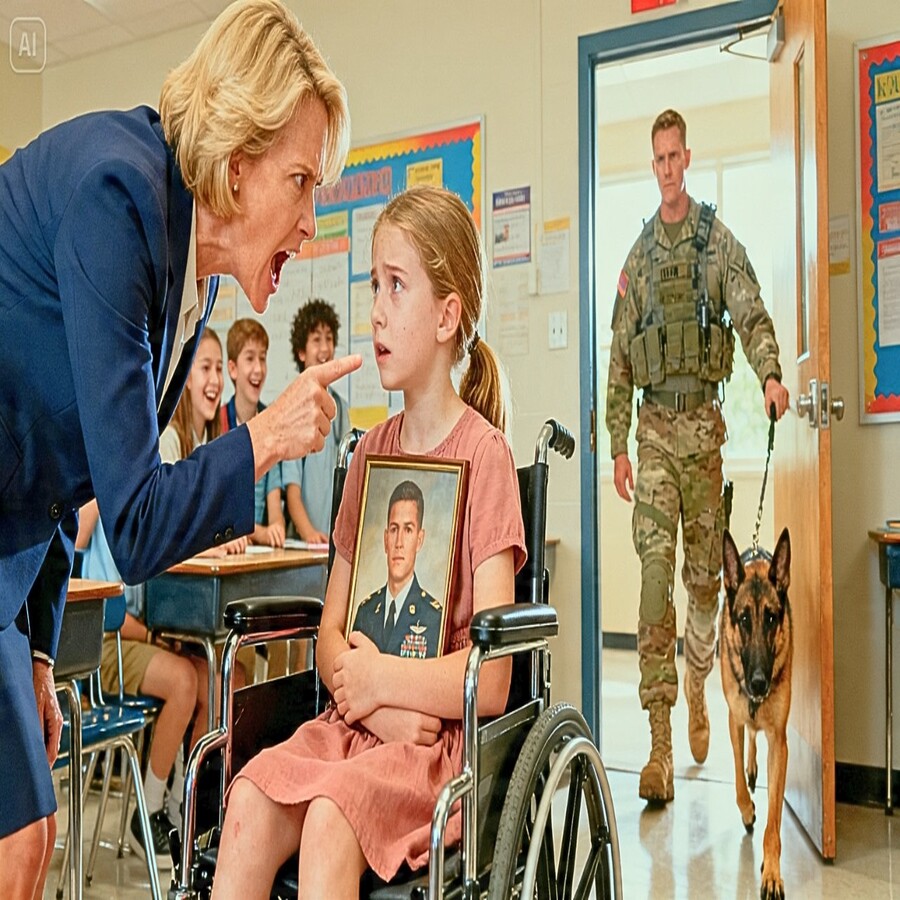
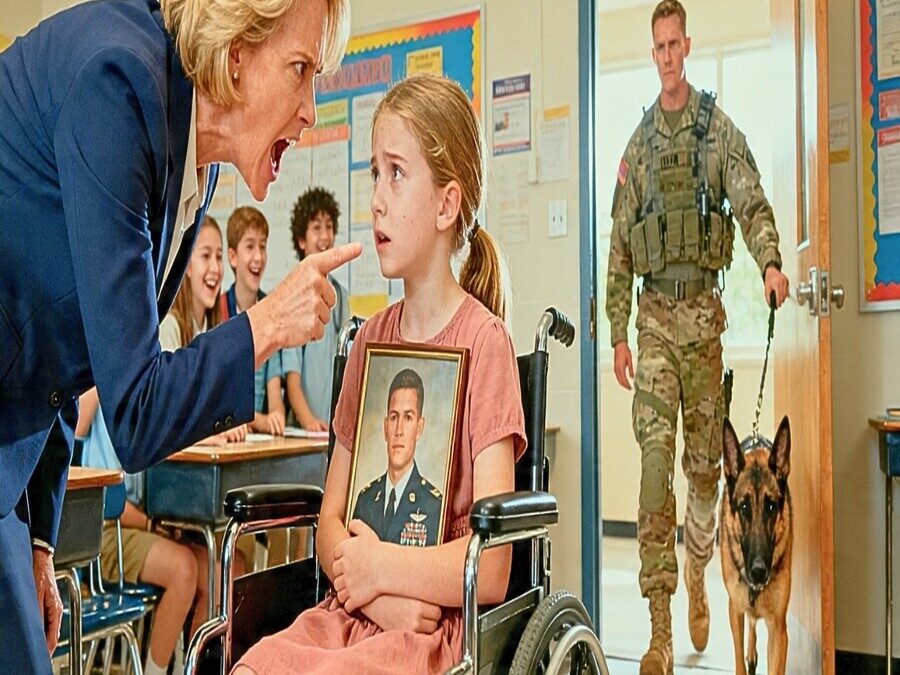
A 9-year-old girl in a wheelchair rolled to the front of her classroom to talk about her father. Her teacher picked up the project, read it once, and dropped it into the trash right in front of everyone.
She stamped it false information, and told the little girl to apologize for lying. 30 kids watched.
Nobody said a word.
What that teacher didn’t know, what nobody in that school knew, was that the man she’d just called a fraud was already pulling into the parking lot, and he had a Belgian Malininoa with him.
The rain started around 8:00 in the morning, the kind that came in sideways and soaked through jackets before anyone had time to react. Khloe Hayes noticed it against the bus window and pulled her sketchbook a little tighter to her chest.
She’d been working on the drawing since Tuesday.
4 days, three erasers, one crumpled restart.
It wasn’t perfect.
Her father’s jaw came out a little too square, and she’d given Titan ears that were maybe 20% too large, but but it was real.
That was the word she kept coming back to. Her third grade teacher, Miss Patricia Garner, had assigned the hero project two weeks ago with a single instruction written in green marker on the whiteboard.
someone you admire, someone real.”
Khloe had known immediately.
She wasn’t the kind of kid who hesitated on things like that.
The bus lurched to a stop in front of North Valley Academy, and Khloe maneuvered her wheelchair to the front with the practice deficiency of someone who had been doing it since she was four. The hydraulic ramp ground down.
She rolled out into the rain, sketchbook balanced on her lap, and didn’t bother with the hood of her jacket because it always fell over her eyes, and she needed to see where she was going.
Inside, the hallway smelled like wet sneakers and industrial cleaner. The usual chaos, third graders slamming lockers, a pair of fifth grade boys arguing about something involving a trading card, a teacher calling out about running flowed around her like water around a rock.
Khloe had learned early that the world was not built for her pace, and she had also learned early that this was the world’s problem, not hers.
Her father had told her that more than once. She stored that thought carefully, the way she stored the drawing and wheeled herself to room 114.
Miss Garner’s classroom was set up in a horseshoe, which was one of the things Chloe actually liked about it.
Every desk faced the center, which meant nobody was invisible. She found her spot along the left arm of the horseshoe and set her sketchbook face down on the desk the way the other kids were doing with their poster boards and printed photographs.
She looked around without meaning to. Marcus Webb had a framed photo of his grandfather in a navy uniform, actual medals pinned to a velvet backing.
Destiny Okafor had built something that looked like a three-dimensional display about her mother, a trauma nurse.
Even Jake Pollson, who had never, in Khloe’s experience, completed an assignment on time, had a printed booklet with a plastic cover.
Khloe looked down at her sketchbook. It was fine.
The drawing was good. She knew her story. Ms.
Garner clapped once from the front of the room, her signature call to order, and the noise level dropped in the automatic way of children who had been conditioned to respond to it.
“All right, everyone.
Hero day.”
She smiled. the smile she used for the camera during school events. Wide, bright, slightly disconnected from her eyes.
We’ve been looking forward to this.
Who wants to start? Several hands shot up.
Khloe’s was not among them.
She always waited. She wanted to watch first to understand the room before she put herself in the center of it.
Her father had taught her that, too, though he’d use different words.
Read the terrain before you commit. The first three presentations were confident and wellreceived.
Marcus talked about his grandfather with a steady voice and got actual applause. Destiny made half the class laugh with a story about her mother performing first aid on a Thanksgiving turkey.
Jake’s booklet, it turned out, was about a baseball pitcher, which explained the plastic cover because apparently that was a serious topic.
By the time Ms.
Garner’s eyes found Khloe, the room had settled into a comfortable rhythm.
Chloe, would you like to share?
It wasn’t quite a question.
Kloe squared her shoulders and wheeled herself to the front.
She held up the drawing first, the way she’d practiced in her room the night before, turning it slowly so both sides of the horseshoe could see.
Titan’s oversized ears were maybe more obvious in the classroom light than she’d intended, but her father’s face was right.
The jaw, the steadiness in the eyes, the way he held himself, that was right. This is my dad, she said.
His name is Ethan Hayes.
He’s a military K-9 handler.
That means he and his dog work together on operations, finding people who are lost or missing or in danger. His partner is a Belgian Malininoa named Titan.
She’d practiced the word Malininoa probably 40 times.
It still felt slightly strange in her mouth, but she got it clean.
They’ve been working together for 6 years.
Titan can locate a human scent trail that’s more than 72 hours old.
He can clear a building in under 4 minutes.
He’s been on search and rescue operations where they found kids who had been missing for days.
She paused. In her head, that was the moment the room was supposed to lean in. Instead, she heard a small sound from the front of the horseshoe.
Not quite a laugh, something quieter and in some ways worse. She looked up.
Miss Garner was watching her with an expression Khloe didn’t have a word for yet.
She would later when she was older, but at nine, all she knew was that it made something in her chest go cold.
“Chloe,” the teacher said with the careful, measured patience of someone choosing each word deliberately.
“That’s a very creative story.”
Chloe blinked.
It’s not a story.
It’s what my dad does.
Dogs can’t clear buildings in 4 minutes.
The teacher’s tone was gentle in a way that wasn’t gentle at all.
That’s not how any of that works.
Titan can. Dad timed it.
He showed me the “Do you have documentation, records, anything that can be verified?”
Khloe stared at her. She was nine. She had a drawing.
I could bring The assignment was to present factual information about a real hero. Miss Garner moved to her desk, picked up a red marker, and walked to the front.
Presenting fictional stories as fact isn’t just inaccurate.
It’s misleading to your classmates.
We talked about this when we discussed research methods last month, didn’t we?
The room had gone very quiet. Khloe could hear the rain.
She could also hear somewhere in the back half of the horseshoe a sound that was unmistakably a suppressed laugh.
She didn’t look to see who it was.
She was afraid of what she’d do if she saw.
The red marker came down on her sketchbook’s cover in three quick movements.
False information.
Then Miss Garner’s hand lifted the sketchbook from Khloe’s lap.
Not rough, not mean, just business-like, and dropped it into the recycling bin beside the whiteboard.
“I think we should move on,” the teacher said pleasantly.
“Marcus, would you like to share a little more about your grandfather’s service?”
Khloe sat in the front of the horseshoe while Marcus talked, and she did not cry. She was very clear on that with herself.
She would not do that here. She looked at the recycling bin.
The corner of her sketchbook was visible over the rim, the cover bent at an angle it hadn’t had before.
She thought about the sound it had made when it landed. That small flat sound.
She thought about her father’s voice on the phone two nights ago, calling from wherever he was.
The connection slightly broken the way it always was when he was in the field.
How’s the project coming?
You nervous? No, she told him.
I know what I’m talking about.
And he’d laughed low and real.
Yeah, you do. She stared at the recycling bin.
She did not cry.
The school day moved the way school days move when something bad has happened, but the world has decided to keep going anyway through math and silent reading in a lunch period where several kids avoided her table and two others asked her with the clinical curiosity of
children if she’d made the whole thing up.
No, Chloe said.
Miss Garner said, “I know what she said.”
She ate her sandwich and looked out the cafeteria window at the parking lot. The rain had softened to a drizzle.
Puddles were forming in the low spots near the drainage grate.
She’d left the sketchbook in the recycling bin because she hadn’t known what else to do with it, and because picking it up would have meant acknowledging in front of everyone that it had been put there.
She wasn’t ready for that.
By the time the final bell rang, the story had moved through the school’s nervous system with the efficiency that only elementary schools can manage.
By 3:15, there were fifth graders in the hallway who had heard that a third grader made up a story about a war hero dad and got caught. The details had mutated with each retelling.
In some versions, her father was a cartoon character she’d invented.
In others, the teacher had given her detention. None of the versions were accurate.
All of them were worse than the truth.
Khloe’s father was not there to pick her up.
He was supposed to be, but the message on her after school phone, a battered smartphone she was only allowed to use for emergency contacts.
Said he’d been held up and her aunt Karen was coming.
That was fine. That was normal. His schedule was not the kind of schedule that made promises it could keep.
She sat on the bench outside the main entrance and watched puddles.
When Aunt Karen’s car pulled up, she transferred from the wheelchair to the passenger seat in the way she did everything efficiently without ceremony and folded the chair into the back.
Aunt Karen, who was her father’s younger sister and who had a talent for reading rooms that Khloe deeply respected, looked at her for a full 3 seconds before saying anything.
“Bad day?”
“Fine,” Khloe said.
Aunt Karen drove.
After a while, she said, “Your project was today, right?”
How’d that go?
Fine. Another silence.
You want to call your dad? Chloe looked out the window at the wet streets.
He’s working.
He picks up. I know.
She paused. Not tonight.
She didn’t tell her aunt what had happened.
She was still deciding what it was exactly, whether it was the kind of thing that got told or the kind of thing that got carried until it either dissolved or hardened into something you didn’t look at anymore.
By the time they got home, she’d made a decision.
She would not tell him. He had enough to carry.
She underestimated him. She almost always did, which was strange because she also knew more than most people knew anything exactly what he was capable of. Ethan Hayes got home at 7:43, which was earlier than expected, which meant the operation had wrapped clean or been postponed.
He came in through the garage in his civilian clothes, dark jeans, a gray henley, boots that were older than some of her teachers, and he moved through the house in the quiet way he always did, the kind of quiet that wasn’t absence, but presence.
A man who’d learned to take up exactly the space he needed, and no more.
He kissed the top of her head. He made two cups of tea, strong for him, half strength, with honey for her.
and he sat down at the kitchen table across from her and did not say anything about the project for 17 minutes while they talked about other things. Whether Titan was going to need his hip checked again, a podcast her father had started listening to about historical naval strategy. A library book Kloe had almost finished.
Then he got up to refill his mug. And on the way back, he paused at the counter where she dropped her backpack.
He didn’t touch it.
He just looked at it. Chloe. Yeah.
Where’s your sketchbook?
She had been careful. She had put everything exactly where it usually went. She had been precise about it, but she had forgotten.
And she always forgot this.
And she didn’t know why she kept forgetting.
That precision is not the same as invisibility. Not to him.
I left it, she said. At school. Yeah.
He came back to the table and sat down and he looked at her with the particular quality of attention that she had spent her whole life on the receiving end of the kind that didn’t push but didn’t leave either.
“Tell me,” he said.
She didn’t want to.
She wanted to protect him from the specific indignity of it, the recycling bin, the red marker, the laughter. She was 9 years old and she was trying to protect her father, which was exactly as backward as it sounds. and she knew that even while she was doing it, but she told him she kept it short.
Facts, sequence, outcome. She had learned that from him, too. When she finished, the kitchen was very quiet.
He drank his tea. He set the mug down with the careful, steadiness of a man who was managing something.
“Miss Garner,” he said.
“Yeah, she put it in the recycling bin.”
“The recycling bin?
Yeah, in front of everyone.”
He nodded slowly. Not the nod of someone processing new information.
The nod of someone arriving at a decision they’d been approaching for a while without knowing it.
“Okay,” he said.
“Dad, I’m going to talk to the school.”
“You don’t have to.
I know I don’t have to.”
He looked at her, not angry, not heated, something quieter, and more certain than either of those things.
“Eat your dinner.
I’ll drive you in tomorrow.”
That night, lying in bed with rain still pattering against the roof, Khloe stared at the ceiling and tried to decide whether she should feel better or worse. She felt both.
What she hadn’t told him, what she wasn’t sure she had words for yet, was the way the room had looked when it happened.
The way 30 kids had gone silent, the way Marcus had looked briefly at his own poster board and then quickly away. The way the teacher had been so pleasant about it, so unhurried, as if she were doing something obvious and correct.
That was the part that had lodged in Khloe’s chest like a splinter.
Not the stamp, not the recycling bin. The certainty, Ms. Garner had been completely, absolutely certain.
And somewhere between 7:43 and now, that certainty had stopped feeling like power and had started feeling very quietly like the thing right before a mistake. Kloe closed her eyes. In the morning, her father drove her to school.
He had Titan in the back.
Titan’s nose was already working before the SUV came to a full stop.
Ethan could see it in the rear view mirror.
The dog’s nostrils flaring in that rapid shallow rhythm that meant he was cataloging the environment, filing everything away.
wet asphalt, diesel from the school bus idling near the curb, 40something children moving through a space that smelled like lunch and industrial soap, and the specific nervous sweat of a place where people spent their days being evaluated.
Titan didn’t react to any of it.
He just knew it. That was the difference between a working dog and every other animal on Earth.
They didn’t perform attention.
They simply never stopped paying it. Ethan cut the engine.
Chloe was already looking at the school entrance, her hands still in her lap, her jaw set in the particular way she had when she was bracing for something.
You don’t have to come in, she said.
I know. I mean it. I can just Chloe.
He said her name the way he said most things. Level.
No edge to it. No drama.
I’m coming in.
She looked at him for a second. Then she nodded and reached for the door handle.
He came around to her side and had the wheelchair unfolded and positioned before she’d finished transferring.
Not because she couldn’t manage it alone, say she could, and he knew it, and she knew he knew it, but because some things didn’t need to be a demonstration of independence.
They could just be a father and his daughter on a Tuesday morning.
He clipped Titan’s working lead, and the three of them moved toward the entrance.
Titan walked at Ethan’s left, not pulling, not lagging, simply matching his handler’s pace with the loose shouldered ease of a dog who understood exactly what his job was.
Several kids near the front step stopped talking.
A woman with a coffee cup and a lanyard badge froze on the top step and stared at the Malininoa with the expression people got when they encountered a large, clearly trained animal and couldn’t decide if they were supposed to be concerned.
Ethan held the door. Kloe wheeled through without looking at any of them.
The front office of North Valley Academy smelled like toner and stale coffee, and the faint floral ghost of whoever had been at the reception desk longest. A woman looked up from a computer monitor, mid-50s, reading glasses pushed up into her hair, name tag that said Beverly, and her eyes went immediately to Titan.
Sir, I’m sorry.
Animals aren’t permitted.
He’s a working military K-9.
Ethan reached into the breast pocket of his jacket and produced his ID with the same motion he’d made 10,000 times.
He’s trained, current on all certifications, and he’s leashed.
I’m here to speak with the principal regarding an incident involving my daughter yesterday.
Beverly looked at the ID, then at Titan, then at Khloe, who was positioned slightly behind her father’s left side, and watching the whole exchange with the controlled blankness of a kid who had learned to make herself small in adult conversations.
Do you have an appointment? No, I do have the morning.
A beat. Beverly picked up the phone. While she made the call, Ethan stood with his hands loose at his sides and looked around the office with the unhurried assessment of someone who had spent years being paid to notice things.
Bulletin board with the school’s mission statement and a cluster of student artwork.
Trophy case with athletic awards going back 15 years. A framed professional photo of the current principal. James Decker, according to the name plate on the door to the inner office, smiling in the way principles smiled for professional photos.
slightly too wide, positioned at a three/arter angle.
“Mr.
Decker can see you in about 20 minutes,” Beverly said.
“He has a staff meeting that’s just wrapping up.”
“That’s fine.”
He sat down in one of the chairs along the waiting area wall. Khloe rolled up beside him.
Titan settled at Ethan’s feet with his chin on his paws, ears relaxed, though his eyes tracked the door.
“You okay?”
Ethan asked quietly enough that Beverly couldn’t hear.
Why does everyone keep asking me that? Because everyone keeps being worried about you. Chloe looked at her hands.
I’m fine.
I just want it to be over.
It’ll be over soon.
Promise? He thought about that for a second.
He didn’t make promises he wasn’t certain of.
She knew that. It was one of the things she counted on. Yeah.
He said, “I promise.
” James Decker was the kind of man who had spent so long managing people that managing had become his natural register for all human interaction.
He was somewhere north of 50 with the soft authority of someone who had been in charge long enough to stop needing to prove it.
And he shook Ethan’s hand with both of his in the way of politicians and men who had taken a course on active listening.
Mr. Hayes, thank you for coming in.
Please sit down. His office was larger than it needed to be. Diplomas on the wall, a motivational poster that had probably been there since 2004, a desk that was clean in the way of someone whose assistant handled the things that would otherwise make it messy.
Ethan sat. Khloe positioned herself beside him. Titan, after a hand signal from Ethan, settled on the floor between them.
Decker looked at the dog, then at Ethan, then at Khloe with the particular softness adults deployed when they wanted to acknowledge a child without quite engaging with her. I understand we had a situation yesterday.
There was an incident. Yes.
Ethan said, “I’ve spoken briefly with Miss Garner this morning.
She described it as a a misunderstanding.
She said she was concerned about the factual accuracy of Khloe’s presentation and handled it in perhaps an overly direct way.
She stamped my daughter’s project false information and threw it in the recycling bin in front of 30 kids.
Decker’s expression went carefully neutral.
Yes, I understand that’s what Kloe described.
That’s what happened, Kloe said.
Decker looked at her. The softness shifted slightly.
Chloe, sometimes adults have to make judgment calls in the classroom. And Mr.
Decker, Ethan’s voice was still level.
It hadn’t changed register once since they’d walked in, which Khloe noticed, and which she was starting to understand was its own kind of weapon.
I’m not here to talk about classroom judgment calls.
I’d like Miss Garner to be part of this conversation.
A pause.
I can see if she’s available between classes.
I’ll wait.
Another pause. slightly longer.
Decker picked up his desk phone. Um, Patricia Garner was a woman who had clearly decided sometime in the two years since the photo on the school website had been taken that projecting confidence was more important than projecting warmth.
She came into the office carrying a coffee mug and her lesson planner, which she sat on the corner of Decker’s desk, as if establishing territory, and she sat in the chair across from Ethan with the posture of someone who had been called to a meeting they found slightly beneath them.
She looked at Titan first.
They all looked at Titan first and then at Ethan, and something moved briefly through her expression that wasn’t quite recognition, but was adjacent to it.
A recalibration. Mr.
Hayes, she said.
I’m glad we have the chance to talk.
Miss Garner, he didn’t extend his hand.
My daughter says you told her class that her presentation contained false information.
I said it contained claims that couldn’t be verified.
She’s nine.
She presented a drawing she made and facts she knew about her father’s work.
She made very specific technical claims.
Garner’s voice stayed pleasant, professional.
the tone of someone who was used to navigating parent complaints about a military working dog’s capabilities.
Dogs clearing buildings in 4 minutes, locating scent trails 72 hours old. I had no way to verify any of that and I have a responsibility to the entire class.
To do what exactly? She blinked.
It was a short flat question that didn’t leave her a lot of room to model critical thinking.
to distinguish between you distinguished between what her father does for a living and what you assumed her father does for a living.
Ethan’s voice had not changed.
This was Khloe thought the most frightening part.
He sounded exactly like he’d sounded, asking if she wanted pancakes on Saturday morning.
You made that distinction in front of her entire class without any information, without asking her a single question about what I actually do, and then you threw her work in the trash. I put it in the recycling bin.
Does the difference matter to a 9-year-old?
Garner’s mouth closed.
Decker cleared his throat. Mr. Hayes, I want you to know that we take concerns like this very seriously.
If there was a miscommunication, there wasn’t a miscommunication.
Ethan reached into his jacket and produced a small flat folder. Not thick, not theatrical, just a folder, the kind you could buy at any office supply store. He set it on the desk between himself and Decker without opening it.
I brought Khloe’s service records, my records.
K9 certifications, commendations, mission summaries. The capability parameters Kloe described are accurate.
They’re in the documentation.
Decker looked at the folder. Garner looked at the folder.
Neither of them reached for it.
I’m sure that’s all very impressive, Garner said.
And there was something in her voice now. Not quite condescension, but close enough to it that Khloe felt her fingers tighten on her armrests.
But the issue isn’t really about the specific facts.
It’s about how Khloe presented them.
She was very She paused, choosing the word carefully, emotional about it.
She wasn’t able to respond to basic questions.
She’s in third grade, which is exactly why we need to teach them early that feelings and facts are different things.
Something shifted in the room. It was subtle. a degree of temperature maybe, or the particular quality of silence that came after certain sentences.
Decker felt it. He shifted in his chair.
Titan’s ears moved, not dramatically, just a degree of rotation, tracking something in Ethan’s posture that the humans in the room hadn’t consciously registered yet.
Ms.
Garner, Ethan said, “My daughter was crying when she finished telling me what happened last night.
Children are resilient.”
She wasn’t crying because she was sad.
He paused. She was crying because she was angry.
She couldn’t figure out how to explain to me that she’d told the truth and you hadn’t believed her and there was nothing she could do about it.
Another pause.
That’s a specific kind of upset.
Takes a while to get over.
Garner’s jaw tightened almost imperceptibly.
I understand you feel your daughter was treated unfairly, she said. But I have to maintain the integrity of my classroom.
Mr. Decker. Ethan turned to the principal and opened the folder.
I’d like you to look at this.
The documents were unremarkable to look at. Decker had probably expected something more dramatic. Framed citations, military regalia, the kind of visual evidence that announced itself.
Instead, there were printed pages with federal agency letter heads, certification records, a series of afteraction summaries with sections redacted in thick black bars, and a deployment log that covered six years of K9 operations across four states and two overseas rotations. Decker read slowly.
Garner, who had not been offered the folder, but could see the pages from where she sat, read faster with the focused intensity of someone searching for an escape route that wasn’t there.
The certifications were extensive. Search and rescue, narcotics detection, explosive ordinance support, human remains detection. A specialist classification that neither Decker nor Garner would have been able to define, but which carried enough official weight that its presence changed the shape of the room.
A commendation letter from a federal agency whose name Garner did know, signed by someone whose title made Decker sit up a fraction of an inch. And in the middle of the stack, a single page that was a summary of an operation from 14 months ago.
The names were redacted. The location was redacted.
The operational detail was redacted. What remained was a timeline and an outcome.
Three children located, extracted, and returned to their families after a 78-hour disappearance. K9 handler, an animal performed without critical error. Decker set that page down and looked at Ethan.
Garner wasn’t looking at anyone.
She was looking at the desk.
“I owe your daughter an apology,” Deker said.
“It was a sentence that arrived without preamble, and it was the first thing the man had said in the last 20 minutes that didn’t feel managed.
” “That’s between you and Khloe,” Ethan said.
Decker nodded.
He looked at Garner, and something passed between them that Khloe couldn’t quite decode.
“A kind of professional accounting, rapid and uncomfortable.”
Patricia, he said, I may have been hasty, she said, and the words came out careful and flat. The words of someone calculating minimum acceptable damage.
If the information is accurate, it’s accurate, Ethan said.
Then I, she stopped, started again. I should have asked to see supporting documentation before I made a determination in front of the class. Khloe had been quiet for most of the last 40 minutes.
She had learned again from her father that in rooms where adults were having important conversations, the most powerful thing a kid could do was not give them an excuse to redirect. But something about the word determination, the clinical bloodless way Garner had said it caught in her throat.
“You didn’t ask me anything,” Khloe said.
Everyone looked at her.
“You didn’t ask me one question before you did it.”
She kept her voice even. She was working at it, but she kept it.
If you’d asked me one question, I could have told you to call my dad.
I could have told you he’d come in.
I could have given you his number. She paused.
You didn’t ask.
Garner opened her mouth. Let her finish, Ethan said. Another silence.
I drew that for 4 days, Khloe said.
I practiced saying his name right, the dog’s name, right, because I knew I’d mess it up if I didn’t.
I wanted it to be good. She looked at the principal, not the teacher.
Not yet.
She wasn’t ready for that yet.
You have all those trophies in the case outside. All those kids who did things right and got recognized for it. I just wanted to tell the truth about my dad.
That’s all I wanted to do.
The room was quiet.
Decker had the particular expression of a man who had spent years managing things and was currently confronting something he couldn’t manage.
Chloe, he said, I want to make this right. Okay, she said.
How?
He didn’t have an answer ready.
That was answer enough.
Uh they agreed or Decker agreed while Garner maintained the expression of someone enduring a necessary procedure that there would be a formal meeting later in the week with the assistant principal and the school’s parent liaison.
That Khloe’s project would be formally reinstated in the grade book.
That a letter would go home to parents acknowledging that a classroom incident had been handled incorrectly. It was not, as Ethan had predicted to himself on the drive-in, nothing. But it was also not enough.
It was the first offer, which meant it was the floor, not the ceiling. He thanked Decker and shook his hand.
He did not shake Garner’s hand.
He did not make anything out of not shaking her hand.
He simply didn’t offer it, and she didn’t extend hers, and they moved out of that moment and into the hallway as if it hadn’t happened.
Kloe was quiet until they were through the main doors and back in the morning air, which had warmed slightly from when they’d arrived.
The drizzle had stopped. Wet pavement caught the sun in flat coin-shaped patches.
“That’s it?”
she asked.
“For today.”
“What does that mean?”
He looked down at her.
“It means that’s what they were willing to give us in a 20-minute meeting, and now they have the weekend to think about what happens if it doesn’t go further.”
She processed that.
And what does happen if it doesn’t go further?
Then it goes further. She almost smiled. Almost.
Titan walked at Ethan’s left, unhurried, ears soft.
At the SUV, Ethan loaded Khloe’s chair into the back and Titan into his compartment, and then he stood at the driver’s door for a moment before getting in.
Looking at the school building with the flat, patient attention of a man doing math.
The meeting had not gone the way he’d expected.
He’d expected more resistance or more contrition or something with cleaner edges.
Instead, he’d gotten something slippery.
The institutional pivot, the minimum concession, the acknowledgement shaped like an apology that wasn’t quite won.
Garner’s last look as they’d left the office had stayed with him.
She hadn’t looked defeated.
She’d looked recalibrated, like someone who had encountered an obstacle and was already working the angles on a way around it.
He didn’t say this to Khloe.
She’d been through enough for one morning and she had school to get to and there was a version of this that resolved cleanly without anyone needing to push harder.
He got in and started the engine. That was Tuesday.
By Thursday afternoon, Garner had gone to the district office.
Ethan got the call at 4:17 from a number he didn’t recognize.
He was in the garage running a maintenance check on his gear. not a deployment prep, just the habit of someone who treated readiness as a default state.
And he answered on the second ring. Mr.
Hayes, my name is Sandra Puit.
I’m the assistant superintendent for curriculum and instruction at the district office.
I’m calling because we’ve received a concern from one of our teachers at North Valley Academy regarding an incident earlier this week.
He set down the cleaning rod for the radio unit he’d been working on and leaned against the workbench.
Go ahead, he said. A Miss Garner has raised a concern that during a meeting on Tuesday, you were, her word, intimidating.
She’s expressed worry about the appropriateness of bringing a large animal into a school environment during what was described as an already tense situation.
Ethan looked at his reflection in the darkened window above the workbench. He looked tired.
He probably was.
“She’s filing a complaint,” he said.
It wasn’t a question.
She’s raised a concern, Puit said, and the distinction was the kind that district administrators were trained to make, the verbal equivalent of soft armor.
We want to make sure everyone feels safe and heard in this process. Miss Puit, my daughter is 9 years old.
She was publicly humiliated in her classroom in front of 30 of her peers. I came in the next morning with documented proof that every claim my daughter made was accurate.
And the response is that her teacher feels intimidated. a pause. I understand this is a frustrating situation.
What’s the district’s position on what happened to my daughter?
We’re still in the process of because right now I have documentation, an incident that’s on record, and a teacher who’s trying to reframe the story before the meeting on
Friday.
He wasn’t heating up.
He was making sure the words landed in the right order.
If the district’s position is that my daughter’s teacher gets to do that without anyone addressing what she actually did, I’d like to know that now rather than Friday.
Another pause longer this time. Mr. Hayes, I assure you the district takes the well-being of all students seriously.
Good.
Then I’ll see you Friday.
He hung up. He stood in the garage for a moment with the phone in his hand, listening to the house.
Upstairs, he could hear the faint sound of Khloe’s TV.
She watched nature documentaries while she did homework, a habit she’d had since first grade that he’d never had any intention of breaking.
Titan was somewhere in the house, probably stationed outside her door the way he tended to do when he sensed that the household was operating at an elevated stress level, which Ethan had never trained him to do, and which he did anyway.
He thought about Sandra Puit’s voice.
The careful bureaucratic remove of it.
The way she’d said feels safe and heard, with the fluency of someone who’d said it so many times it had stopped meaning anything specific.
He thought about Garner’s face when she’d looked at the folder.
Not embarrassed, not guilty.
Working the angles, he went inside, washed his hands, and went upstairs to knock on Khloe’s door.
Yeah. Dinner in 20.
You want a pick? A pause. Tacos.
Tacos works. He started to head back downstairs behind the door.
Dad. Yeah. Did something happen?
He leaned against the door frame. Nothing you need to worry about tonight. But something happened.
He could lie to her. He was capable of it.
He’d done it before in the way parents did.
The comfortable lies, the small shelters. But there was a particular quality to the way she asked.
a careful steadiness that she’d had since she was very young that made him feel the dishonesty before he even opened his mouth.
“Friday’s meeting got more complicated,” he said.
“I’ll handle it.”
A longer pause.
“Okay,” she said finally.
“Tacos.”
“Tacos,” he confirmed.
He went downstairs.
He did not tell her that by Friday morning the meeting had been escalated from a parent principal conference to a formal district review, that Garner’s complaint had been formally logged, and that a district liaison named Kevin Marsh, who had the specific energy of someone whose job was to prevent things from becoming lawsuits, had called to inform Ethan that the Friday session would now include Miss Garner, Mr.
Decker, Sandra Puit, the school’s parent liaison, and a district HR representative.
He did not tell her that he had spent 2 hours that evening on the phone with his former unit’s J A contact, not for legal advice exactly, but for the kind of conversation you had when you wanted to understand which cards you were holding before you sat down at the table.
He did not tell her any of that. What he did was make tacos, and he let her put too much cheese on hers the way she always did, and Titan sat between their chairs, hoping for ground beef. And the evening was ordinary in all the ways evenings needed to be ordinary when the next day was going to ask a great deal of you.
At 8:45, after Kloe was asleep, he went back out to the garage. He opened the folder again in the yellow workbench light and went through it page by page, not looking for anything new.
He knew what was there, just making sure he knew exactly what he was walking in with. Because Sandra Puit had made one mistake on the phone.
Maybe she didn’t know it yet.
Maybe Garner didn’t either.
They’d spent 3 days trying to manage the optics of what happened to Kloe.
They’d been so focused on the optics that they hadn’t stopped to ask themselves a simple question.
Why would a man carrying that kind of documentation, federal certifications, multi- agency commendations, redacted mission files with outcomes that a public school teacher couldn’t have come close to inventing?
Why would a man like that need to exaggerate anything? He closed the folder. Friday was going to be a
long morning.
He was already looking forward to it.
He slept 4 hours, not because he couldn’t sleep more.
He’d trained himself out of needing it the way you trained yourself out of a lot of things after enough rotations.
But because his mind had been running the Friday meeting in loop since 2:00 in the morning, and somewhere around 4:30, he’d accepted that lying in the dark was less useful than getting up and being productive about it.
He made coffee. He went through the folder one more time, not because he needed to, but because repetition was how he managed uncertainty. not by eliminating it, but by making sure everything he could control was locked down so tight that the uncertainty had nowhere to attach.
He’d learned that in the field.
You controlled your equipment, your positioning, your communication. You could not control the terrain or the weather or what waited on the other side of a door. So, you stopped spending energy on those things and put it entirely into what you could fix.
The documentation was clean. The certifications were current.
The chain of recordkeeping was unbroken.
He closed the folder at 5:15 and watched the kitchen window go from black to gray to the pale, washed out blue of a morning that hadn’t committed to anything yet.
Chloe came down at 6:40 in her school clothes, her hair still damp from the shower, and looked at the coffee and the folder on the table and at him.
You didn’t sleep, she said.
I slept. She looked at the folder.
Is that what you’re bringing today?
Part of it.
She poured herself a glass of orange juice and sat across from him and didn’t ask what the other part was, which was one of the things he appreciated most about her.
She understood at 9 years old that some questions were requests for reassurance and others were requests for information, and she was good at figuring out which was worth asking.
“Am I going to school?”
she said. After the meeting. What time is the meeting?
8:30. She nodded, drank her juice, and looked out the window at the yard. The grass was still wet from earlier in the week.
Titan was outside doing his morning patrol of the perimeter. Not a trained behavior, just a thing he did, a habit the dog had developed on his own over years of living with a handler who treated readiness as a permanent condition.
Dad, Chloe said. Yeah.
What if they don’t care about the documentation about any of it?
What if they just decide they’re right and we have to live with it?
He thought about that. He could give her the reassuring answer, the one that said institutions were accountable and truth one in the end.
He didn’t do that.
Then we don’t live with it, he said.
We take it somewhere they can’t ignore it.
She looked at him like where depends on what they do this morning. She nodded slowly, the way she nodded when she was filing something away to think about later.
Titan came back in through the dog door, shook himself once, and positioned himself next to Khloe’s chair.
She put her hand on his head without looking at him, automatic, the gesture of a kid who had grown up with this animal as a fixed point in a world that moved around.
“Okay,” she said.
“Let’s go.”
The district office was a different building than North Valley Academy, a flat, modern structure about 2 mi away that had the specific aesthetic of a place designed to communicate competence without communicating anything personal. Clean lines, institutional carpeting in a color that suggested gray without quite committing to it, motivational phrases stencled on the walls in a font that had been approved by a committee.
They arrived at 8:19.
The receptionist, younger than Beverly, visibly less comfortable with the Malininoa, directed them to a conference room on the second floor where a placard on the door read, “Meeting in progress,” which was technically inaccurate since the meeting hadn’t started yet, but which was the kind of detail Ethan filed and didn’t
remark on.
The conference room was rectangular, long table down the center, windows along one wall looking out at a parking lot. It smelled like a room that was cleaned every night and used heavily every day.
Six chairs on one side of the table were occupied. Decker, who nodded at Ethan when he came in with something that wanted to be colleial, but landed closer to guilty. Garner, who was looking at her legal pad and did not look up.
A woman Ethan placed as Sandra Puit from the way she’d positioned herself at the center of the row, the authority seat.
a man in a gray suit who introduced himself as Kevin Marsh, district HR, a younger woman with a laptop who was apparently the parent liaison, though she’d never been introduced to Ethan before today, and a person from the school board’s community relations office whose name Ethan immediately forgot because she’d given it too fast.
One chair on the other side
of the table. One Ethan set the folder down, pulled the chair back, and looked at Chloe.
Can we get another chair? he asked the room.
A small hesitation, Marsh gestured to the parent leaison who stood and retrieved a chair from the stack along the wall.
Ethan positioned it so that Khloe could roll up to the table directly, which required adjusting the table’s angle slightly.
Nobody offered to help. He did it himself, one-handed, without interrupting the rhythm of settling in.
Titan went down beside Ethan’s chair.
His presence in the room had a gravitational quality, not threatening exactly, but present in a way that large, silent, purposeful things tended to be. Ethan had noticed this effect in a lot of rooms over the years, and had stopped trying to soften it. The dog was what he was.
“Thank you all for coming,” Puit said with the voice of someone who’d opened a thousand meetings.
I want to start by acknowledging that this has been a difficult week for everyone involved and our goal today is to find a path forward that Ms.
Puit Ethan said before we talk about paths forward I’d like to establish what actually happened because I think we may have different starting points a beat.
Of course, she said her voice didn’t change.
She was good.
My daughter presented a factual account of her father’s military service for a school assignment.
Her teacher publicly invalidated that account without asking a single question, marked her work as false information, discarded it in front of 30 children, and told her to apologize for lying. He paused.
That’s what happened.
Is that the district’s understanding of the incident?
Puit looked at Garner. Garner was still looking at her legal pad.
We understand there was a classroom incident involving a student presentation, Marsh said carefully. And that there are different perspectives on how it was handled.
There’s one perspective, Khloe said.
Everyone looked at her.
She had not spoken since they’d sat down.

