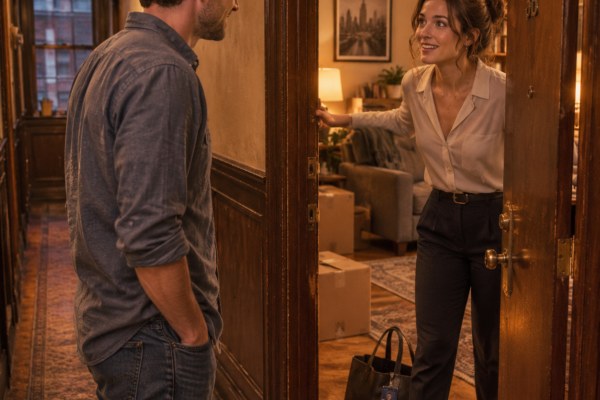
Part 3: “I need you.””I’m not your wife in this room, and I’m not your employee. I’m the actuary investigating a fraudulent claim. We’re equals in this. Or I walk.”
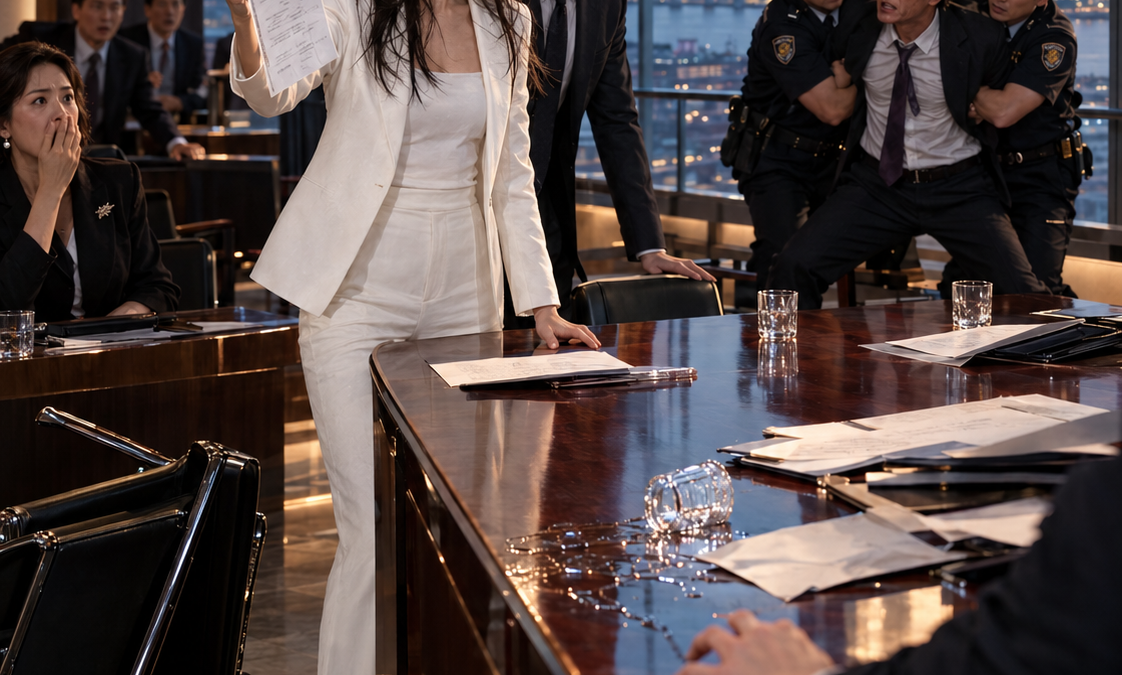
Chapter 12: The Sapphire Files
The prosecutor’s office was in a gray building near Seoul Central District Court, a place Soo-yeon had passed a hundred times without ever thinking she’d have reason to enter. She arrived at nine o’clock, alone—Tae-joon had gone ahead with his lawyers—and found him waiting in a conference room on the fourth floor, staring at a file on the table.
“You should sit down,” he said.
Soo-yeon sat.
The file was thick. Photographs. Witness statements. A transcript of a wiretap. She flipped through it slowly, her stomach tightening with every page.
“The man who died at the Sapphire,” Tae-joon said, his voice flat. “His name was Kang Min-seok. He was twenty-seven years old. He had a wife. A daughter. He was a mid-level manager at a rival shipping company.”
“I know. Your mother told me.”
“She didn’t tell you everything.” He slid a photograph across the table. “Look at the date on this.”
Soo-yeon looked. The photograph was from a security camera outside the Sapphire, dated fifteen years ago. It showed two men in the alley behind the club—one tall, one shorter, both in dark coats. The taller man was Tae-joon. The shorter man was Kang Min-seok.
But there was a third figure in the corner of the frame. A woman. Blonde. Tall. Familiar.
Soo-yeon’s breath caught.
“That’s—”
“My mother,” Tae-joon said. “She was there. She was there, Soo-yeon. She wasn’t just covering up what happened after. She was part of it.”
Soo-yeon stared at the photograph. The blonde woman was wearing a long coat and heels, her face half-turned, but the profile was unmistakable. Hye-ryun. Younger, sharper, but Hye-ryun.
“Why?” Soo-yeon asked. “Why was she there?”
“The wiretap transcript.” Tae-joon pointed to the file. “It’s from a phone call between my mother and Kang Min-seok, three days before he died. She was the one who lured him to the Sapphire. She was the one who set the whole thing up. Not my father. Her.”
Soo-yeon read the transcript. The words jumped out at her—make sure he’s there, don’t leave until it’s done, the boy will take the blame. The boy. Tae-joon. His own mother had set him up.
“She used you,” Soo-yeon said. “She used you as a weapon. As a scapegoat.”
“She used me to kill a man.” Tae-joon’s voice cracked. “I didn’t do it. I didn’t touch him. But I was there. I was the one who found him. I was the one who called my uncle. And my mother—” He pressed his hands to his face. “She stood there and watched. She watched me panic. She watched me beg Uncle Byung-ho for help. And then she used it. For fifteen years, she used it.”
Soo-yeon reached across the table and pulled his hands away from his face. “Look at me.”
He looked at her. His eyes were red, his face pale, his expression shattered.
“You were twenty-three years old,” she said. “You were young. You were scared. And your mother—the person who was supposed to protect you—used you as a pawn in her own game. That’s not your fault. None of it is your fault.”
“I should have known.”
“You couldn’t have known. She was your mother. You trusted her.”
“I should have—”
“Tae-joon.” She gripped his hands. “Listen to me. You are not responsible for what she did. You are not responsible for the lies she told. You are not responsible for any of it. Do you understand?”
He didn’t answer. He just sat there, his hands trembling in hers, his breath coming in short, uneven gasps.
“What happens now?” Soo-yeon asked.
“The prosecutors want to charge her with conspiracy to commit murder. With fraud. With obstruction of justice. They have enough evidence to put her away for life.” He pulled his hands away and stood up. “They want me to testify. They want me to go on the record and tell them everything—the Sapphire, the cover-up, the fifteen years of blackmail. They want me to destroy my own mother.”
“Will you?”
He walked to the window and stood there, his back to her, his shoulders tight. “I don’t know.”
Soo-yeon stood up and walked toward him. She stopped a few feet away.
“She threatened to have me killed,” she said quietly. “She set up a man to die and let you take the blame. She’s been manipulating you your entire life. Why are you protecting her?”
“Because she’s my mother.” He turned to face her. “Because she raised me. Because she was the only person who was ever there for me, even when she was hurting me. Because—” His voice broke. “Because I don’t know who I am without her.”
Soo-yeon reached up and touched his face. “You’re the man who caught a fraud. The man who saved his uncle. The man who fought for his company and his family and his wife. You’re the man I love. And you don’t need her to be any of those things.”
He stared at her for a long moment. Then he pulled her into his arms and held her.
“I’m sorry,” he said. “I’m sorry for everything. For the years I didn’t fight. For the silence. For letting you walk away.”
“It’s okay.”
“It’s not okay. But I’m going to make it okay. I’m going to testify. I’m going to tell the truth. And then—” He pulled back and looked at her. “And then I’m going to spend the rest of my life making it up to you.”
Chapter 13: The Testimony
The hearing was held in a packed courtroom on the third floor of the Seoul Central District Court. Reporters filled the back rows. Family members sat in the front—Min-ji, pale and silent; Byung-ho, his walking stick propped beside him; a handful of cousins and aunts who had come to witness the spectacle.
Soo-yeon sat in the second row, directly behind Tae-joon. She couldn’t touch him, couldn’t speak to him, but she could be there. Present. Witness.
Hye-ryun sat at the defendant’s table, flanked by her lawyers. She was wearing a gray suit and no makeup. Her hair was pulled back in a simple bun. She looked smaller than Soo-yeon remembered—older, frailer, the mask finally stripped away.
Tae-joon took the stand.
The prosecutor asked the questions. Tae-joon answered them. Calmly. Clearly. He described the night at the Sapphire—the fight, the death, the cover-up. He described his mother’s role—the setup, the manipulation, the fifteen years of blackmail. He described the moment he’d realized the truth, and the moment he’d decided to testify.
Hye-ryun didn’t move. She sat at the defendant’s table, her hands folded in her lap, her eyes fixed on her son. Soo-yeon watched her face—watched the flicker of emotion, the tightening of her jaw, the way her fingers curled into fists under the table.
When the prosecutor finished, Hye-ryun’s lawyer stood up.
“Mr. Seo,” he said, his voice smooth and practiced. “You’ve testified that your mother manipulated you. That she used you. That she let you believe you were responsible for a man’s death. Is that correct?”
“Yes.”
“And yet you’ve also testified that you loved her. That she was the only person who was there for you. That you don’t know who you are without her.” He paused. “Isn’t it possible that you’re exaggerating? That you’re angry at your mother for reasons unrelated to this case—her disapproval of your marriage, her interference in your life—and that you’re using this testimony to punish her?”
Tae-joon didn’t flinch. “No.”
“No?”
“My mother has interfered in my life for as long as I can remember. She’s disapproved of my choices, my marriage, my career. But that’s not why I’m here.” He leaned forward. “I’m here because she committed a crime. She lured a man to his death. She let me take the blame. And she used that guilt to control me for fifteen years. That’s not a family disagreement. That’s not a mother trying to protect her son. That’s a crime.”
The lawyer tried to recover. “Mr. Seo, surely you understand that your mother was trying to protect you—”
“She was trying to protect herself.”
The courtroom was silent. Hye-ryun’s lawyer glanced at his client. Hye-ryun sat perfectly still, her face unreadable.
“I have one more question,” the lawyer said. “You’ve testified that you’ve been estranged from your wife. That you separated nine months ago. Is that correct?”
Tae-joon’s jaw tightened. “Yes.”
“And isn’t it true that your wife—Dr. Han Soo-yeon—is the one who brought these allegations to your attention? That she’s been investigating this case, working with your uncle, gathering evidence?”
“Yes.”
“Isn’t it possible that she manipulated you? That she used this investigation to get close to you again? To manipulate your emotions, your judgment, your—”
“Objection.” The prosecutor was on her feet. “Counsel is speculating.”
“Sustained.” The judge looked at Hye-ryun’s lawyer. “Strike the question.”
But the damage was done. Soo-yeon felt the eyes of the courtroom on her—the reporters, the family members, the strangers who’d come to watch. She felt her face heat, her hands clench in her lap.
Tae-joon leaned into the microphone.
“For the record,” he said, his voice clear and steady, “my wife did not manipulate me. She saved me. She’s the only reason I’m here today, telling the truth instead of hiding from it. And if this court—if anyone—tries to use her as a weapon against me, they will fail. Because I will not allow it. Not now. Not ever.”
The courtroom erupted.
Chapter 14: The Aftermath
The verdict came three weeks later.
Hye-ryun was found guilty on all counts. Conspiracy to commit murder. Fraud. Obstruction of justice. She was sentenced to twenty years in prison—a sentence the judge called “unprecedented for a woman of her standing” but “necessary to send a message that no one is above the law.”
Joon-ho was convicted separately, in a trial that lasted only two days. He was sentenced to fifteen years. Min-ji filed for divorce the day after the verdict and moved out of the family estate, taking her two children to her mother’s house in Busan.
Byung-ho was reinstated to the board. He took his seat at the next meeting, his walking stick propped against the table, his voice hoarse but firm. He voted with Tae-joon on every measure.
And Tae-joon—Tae-joon was cleared of all wrongdoing. The prosecutors issued a statement acknowledging that he had been a victim of his mother’s manipulation, not a participant in the crime. The board voted unanimously to keep him as CEO. The stock price stabilized, then rose.
But the victory felt hollow.
Soo-yeon found Tae-joon in his office the night after the verdict, sitting in the dark, staring out at the city.
“You should be celebrating,” she said.
“I don’t feel like celebrating.”
She walked over and sat beside him on the sofa. The city sprawled below them, a blanket of lights stretching to the horizon.
“She’s my mother,” Tae-joon said. “And I put her in prison.”
“You told the truth.”
“I destroyed her.”
“She destroyed herself.” Soo-yeon took his hand. “She made choices. Terrible choices. And she’s paying the price. That’s not your fault.”
“I know.” He squeezed her hand. “But it doesn’t feel like justice. It just feels like loss.”
They sat in silence for a while. Then Soo-yeon said, “What happens now?”
“What do you mean?”
“The company is stable. Your uncle is back. Joon-ho is gone. Your mother is in prison.” She looked at him. “What happens to us?”
Tae-joon turned to face her. In the dim light of the office, his eyes were dark, unreadable.
“I want you to come home,” he said.
“Home?”
“The penthouse. Hannam-dong. Our home.” He paused. “I know it’s been months. I know you have your apartment. Your life. Your independence. But I want you to come back. Not because I need you to save me. Not because I need you to fix anything. Just because I want to be with you.”
Soo-yeon looked at him. She thought about the apartment in Mapo-gu—the small rooms, the unreliable heating, the life she’d built for herself in the nine months since she’d left. She thought about the penthouse—the sweeping views, the silent rooms, the husband who was never there.
“The penthouse isn’t a home,” she said. “It’s a museum. A monument to your family’s wealth. I can’t live there.”
“Then we’ll find somewhere else. Somewhere new. Somewhere that’s ours.”
“You’d leave the penthouse?”
“I’d leave anything for you.”
She looked at him—at the man she’d married, the man she’d left, the man she’d learned to love again—and felt something settle in her chest. A decision. A certainty.
“I’ll come back,” she said. “On one condition.”
“Name it.”
“We don’t go back to the way things were. We start over. New rules. New expectations. I’m not your wife in the traditional sense. I’m not the woman who stays home and waits for you. I’m your partner. Your equal. Or I don’t come back at all.”
Tae-joon smiled. “Equals,” he said. “I remember.”
“Good.”
He leaned forward and kissed her—soft, slow, a promise. When he pulled back, his eyes were bright.
“I love you,” he said.
“I love you too.”
Chapter 15: The New House
They found the house in Seongbuk-dong—a quiet neighborhood on the northern edge of Seoul, away from the corporate towers and the family estates. It was a modern building, all clean lines and glass, with a small garden and a view of the mountains.
Soo-yeon had seen it first, on a real estate website, late at night when she couldn’t sleep. She’d sent it to Tae-joon as a joke—imagine living here—and he’d replied within minutes: Let’s see it tomorrow.
They saw it the next day. They made an offer the day after that.
Moving in took weeks. Soo-yeon kept her apartment—she wasn’t ready to give it up, not yet—but she spent most of her time at the new house, unpacking boxes, choosing furniture, learning to live with someone again.
It wasn’t easy.
They argued about the kitchen—she wanted gas, he wanted induction. They argued about the bedroom—she wanted separate closets, he wanted shared. They argued about the garden—she wanted flowers, he wanted a vegetable patch. They argued about everything, and then they laughed about it, and then they compromised.
It was strange, Soo-yeon thought, how arguing could feel like love.
One night, after a particularly long debate about curtain colors, they sat on the floor of the living room, surrounded by paint samples and fabric swatches, and Tae-joon said, “I never thought I’d have this.”
“Have what?”
“This. A house. A life. Someone to argue with about curtains.” He smiled. “I spent so many years trying to live up to my father’s expectations. Trying to be the perfect CEO, the perfect son, the perfect heir. I never stopped to think about what I actually wanted.”
“And what do you want?”
He looked at her. “This. You. A life that’s ours. Not my family’s. Not the company’s. Ours.”
Soo-yeon leaned over and kissed him. “Then let’s build it.”
Chapter 16: The Return
Six months later, Soo-yeon returned to work.
Not at Hanjin Life—she’d resigned from that job years ago, and she had no intention of going back. Instead, she opened her own consulting firm: Han & Associates, a boutique actuarial practice specializing in fraud investigation.
The office was small—two rooms above a bakery in Jongno—but it was hers. Her name on the door. Her rules. Her future.
Tae-joon had offered to fund it. She’d refused.
“I don’t want your money,” she said. “I want your support.”
“What’s the difference?”
“The difference is I’m not your dependent. I’m your partner. And partners don’t take handouts.”
He’d smiled at that. “Equals.”
“Equals.”
The first client came through Byung-ho—a shipping company that suspected one of its executives was filing fraudulent insurance claims. The second came through a former colleague at Hanjin Life. The third came through word of mouth.
By the end of the first year, Han & Associates had five employees and a waiting list.
Soo-yeon sat in her office one afternoon, reviewing a file, when Tae-joon walked in.
“You’re supposed to knock,” she said.
“I own the building.”
“You own the bakery downstairs. You don’t own my office.”
He laughed and sat down across from her. “I have news.”
“What kind of news?”
“The board wants to expand Hanjin Life. New products. New markets. They want to launch a division focused on fraud prevention and risk assessment.” He paused. “They want you to run it.”
Soo-yeon set down her pen. “They want me to run it?”
“With full autonomy. Full control. Full budget.” He met her eyes. “It’s yours if you want it.”
She looked at him—at the man who’d once been her husband in name only, the man who’d let her walk away, the man who’d fought his way back to her—and felt something swell in her chest.
“Tell the board I’ll consider it,” she said.
“You’ll consider it?”
“I’ll consider it.” She smiled. “After I finish this file. And after dinner. And after you explain why you didn’t knock.”
He laughed. “I love you.”
“I know.”
Chapter 17: The Visit
The prison was in Uiwang, south of Seoul—a low, gray complex surrounded by fields and silence. Soo-yeon drove there on a Tuesday morning, alone, with no appointment and no warning.
She wasn’t sure why she was going. She’d told herself it was for closure, for answers, for the chance to say the things she’d never been able to say. But as she sat in the visitors’ room, waiting for Hye-ryun to appear, she realized the truth: she wanted to see if the woman who’d threatened her, manipulated her, tried to destroy her, had any remorse.
Hye-ryun walked in wearing a prison uniform—gray, shapeless, a number stitched on the pocket. Her hair was gray and short. Her face was bare. She looked at Soo-yeon across the room, and for a moment, her expression flickered—surprise, maybe, or something like it.
“I didn’t expect you,” Hye-ryun said, sitting down across the table.
“I didn’t expect to come.”
They sat in silence for a moment. The room was bare—white walls, fluorescent lights, a guard standing by the door. Not the kind of place where a chaebol matriarch would have imagined ending up.
“Why are you here?” Hye-ryun asked.
“To understand.”
“You said that before. At the house.” Hye-ryun’s lips curved—not a smile, exactly, but something close. “Did you understand?”
“I understood that you were afraid. I understood that you spent forty years fighting for a place in a family that never fully accepted you. I understood that you did terrible things because you were terrified of losing what you’d built.” Soo-yeon leaned forward. “But I still don’t understand why you threatened me. I wasn’t a threat to you. I was just your son’s wife.”
Hye-ryun was quiet for a long moment. Then she said, “You were a threat because he loved you.”
“That doesn’t make sense.”
“It makes perfect sense.” Hye-ryun folded her hands on the table. “I spent my whole life controlling my son. Not because I wanted to hurt him—because I wanted to protect him. The world is cruel, Soo-yeon. The world is full of people who will use you and discard you and destroy you if you let them. I wanted to make sure Tae-joon was strong enough to survive. I wanted to make sure he never trusted anyone more than he trusted me.”
“And then I came along.”
“And then you came along.” Hye-ryun’s voice was flat. “You were smart. Independent. You didn’t need him. You didn’t need anyone. And he loved you for it. He loved you because you were the one person in his life who didn’t want anything from him except him. And I knew—I knew—that if he had you, he wouldn’t need me anymore.”
Soo-yeon sat back. “So you tried to destroy me.”
“I tried to remove you. I thought if you were gone, he’d come back to me. He’d need me again.” Hye-ryun looked down at her hands. “I was wrong.”
“Yes. You were.”
“I know.” Hye-ryun looked up. “I’m not asking for your forgiveness. I’m not asking for anything. I just—I wanted you to know. I wanted you to understand that I didn’t do it because I hated you. I did it because I was afraid of losing him.”
Soo-yeon stood up. “You didn’t lose him because of me. You lost him because of what you did. Because of the lies. The manipulation. The crimes. He would have loved you forever if you’d just let him.”
Hye-ryun didn’t answer. She just sat there, her hands folded, her face still. And Soo-yeon walked out of the room, through the gray corridors, out into the sunlight.
She felt lighter. Not healed—she wasn’t sure she’d ever be fully healed—but lighter. She’d said what she needed to say. She’d understood what she needed to understand. And now she could let go.
Chapter 18: The Announcement
The boardroom was full.
Not just the board—the executives, the department heads, the senior managers, a handful of reporters from the business press. Tae-joon stood at the head of the table, his suit immaculate, his posture straight, his voice steady.
“Ladies and gentlemen,” he said, “I’m pleased to announce the launch of Hanjin Life’s new Risk Integrity Division. This division will focus on fraud prevention, risk assessment, and corporate accountability. It will operate with full autonomy, reporting directly to the board. And it will be led by someone who has already proven herself to be one of the finest actuaries in the country.”
He turned toward the door. Soo-yeon walked in.
She was wearing a navy suit—simple, professional, her own style—and her hair was pulled back in a low ponytail. She walked to the front of the room, nodded at the board members, and took her place beside Tae-joon.
“Dr. Han Soo-yeon,” Tae-joon said, “will serve as the division’s first director. She brings twelve years of actuarial experience, a track record of uncovering fraud, and a commitment to integrity that is, frankly, unmatched in this industry. I can think of no one better suited to lead this division. And I can think of no one I trust more.”
He stepped back and gestured for Soo-yeon to speak.
She looked at the faces in the room—the executives, the board members, the reporters. She saw skepticism, curiosity, a few smiles. She saw Hwang In-soo, the board chairman, nodding slowly. She saw Byung-ho, sitting in the corner, his walking stick propped beside him, his eyes bright.
“Thank you,” she said. “I’m honored to accept this position. But I want to be clear about what it means. This division will not be a rubber stamp. It will not be a public relations tool. It will be an independent, rigorous, and occasionally uncomfortable presence within this company. If I find fraud, I will report it. If I find wrongdoing, I will expose it. No matter who is involved. No matter how powerful they are.”
She paused. The room was silent.
“I’m not here to make friends,” she said. “I’m here to make sure that what happened to Park Byung-ho never happens again. I’m here to protect the policyholders, the employees, and the shareholders who trust this company with their money and their futures. And I will not be intimidated. Not by anyone.”
She stepped back. Tae-joon was watching her with an expression that was equal parts pride and something softer—something that made her chest ache.
“Any questions?” she asked.
The room erupted.
Chapter 19: The Vow
That night, they drove out to the Han River.
Not the crowded stretch in the city—the quiet part, north of the bridge, where the water was dark and still and the lights of Seoul glittered in the distance. Tae-joon parked the car, and they sat on the hood, looking out at the river.
“You were incredible today,” he said.
“I know.”
He laughed. “Modest.”
“I’m not modest. I’m honest.” She leaned back against the windshield. “I spent years being told to stay quiet, stay small, stay out of the way. I’m done with that.”
“Good.” He turned to face her. “I want you to know something.”
“What?”
“When I first saw you—six years ago, in the lobby of Hanjin Life—I thought you were the most beautiful woman I’d ever seen. But that’s not why I fell in love with you.”
“Why did you fall in love with me?”
“Because you didn’t care who I was. You didn’t care about my name or my money or my family. You looked at me like I was just a man. A man who might be worth knowing, or might not. And you made me want to be worth knowing.”
Soo-yeon felt tears prick her eyes. “Tae-joon—”
“I know we’ve been through hell. I know we’ve hurt each other. I know we’re still figuring out what this looks like. But I want you to know—I want you to know that I’m in this. For real. For good. Not because I need you to save me. Not because I’m afraid of being alone. Because I love you. Because you’re the best person I’ve ever known. Because I want to spend the rest of my life proving that I deserve you.”
He reached into his pocket and pulled out a small box.
Soo-yeon’s breath caught.
“I’m not asking you to marry me again,” he said. “We’re already married. The paperwork is done. But I want to ask you something else.” He opened the box. Inside was a ring—not a diamond, but a simple band of white gold, engraved on the inside with a single word: Equals.
“I want to ask you to stay,” he said. “Not because of a contract. Not because of a promise. Because you want to. Because you choose to. Because every day, you wake up and decide that this—that we—are worth fighting for.”
Soo-yeon looked at the ring. Then at him. Then at the river, the city, the stars.
“Yes,” she said.
“Yes?”
“Yes.” She laughed—a wet, happy laugh. “Yes, I’ll stay. Yes, I’ll choose you. Yes, every day.”
He slipped the ring onto her finger. Then he kissed her—soft, slow, a promise.
When they pulled apart, both of them were crying.
“I love you,” he said.
“I love you too.”
They sat there for a long time, looking out at the river, the city, the future.
Chapter 20: The Life
One year later.
The house in Seongbuk-dong had become a home. The garden was full of flowers—Soo-yeon had won that argument—and the kitchen had both gas and induction, a compromise that made them both laugh every time they used it. The walls were covered with photographs: their wedding, the first one, formal and stiff; a picture from Byung-ho’s seventieth birthday party, where he’d danced with Soo-yeon and nearly fallen over; a candid shot from a trip to Jeju, where Tae-joon had tried to learn how to fish and failed spectacularly.
The Risk Integrity Division had become one of Hanjin Group’s most respected departments. Soo-yeon had hired a team of twelve—actuaries, investigators, lawyers—and they’d uncovered three major fraud cases in the first year alone. She was invited to speak at conferences, quoted in industry publications, respected by her peers.
She’d also become something else: a mentor. Young women in the industry wrote to her, asking for advice. She answered every letter. She remembered what it was like to be told to stay quiet, stay small. She made sure no one she mentored ever felt that way.
Tae-joon had changed too.
He was still the CEO of Hanjin Group—still ruthless, still controlling, still the most powerful man in the room. But he was softer now, in ways that only Soo-yeon saw. He came home at reasonable hours. He took weekends off. He learned to cook—badly, but with enthusiasm. He learned to laugh at himself.
And he learned to trust.
Not just Soo-yeon, though that had taken time. But his uncle. His sister. His own instincts. He stopped looking over his shoulder, waiting for the next betrayal. He started living.
Min-ji came back into their lives slowly.
The divorce had been painful—Joon-ho had fought for custody, for assets, for everything he could get his hands on. But Min-ji had won. She’d kept the children, kept the house, kept her shares in the company. She’d moved back to Seoul and started a foundation for single mothers, using her share of the family money to help women who’d been through what she’d been through.
She and Soo-yeon had lunch once a month. They didn’t talk about Joon-ho. They didn’t talk about Hye-ryun. They talked about the children, about work, about the strange, complicated business of being a woman in a family that had tried to destroy them both.
“Thank you,” Min-ji said one afternoon, over coffee.
“For what?”
“For not giving up on him. On my brother.” She stirred her coffee. “He was lost without you. We all were.”
Soo-yeon reached across the table and took her hand. “He’s not lost anymore.”
“No.” Min-ji smiled. “He’s not.”
Chapter 21: The Reckoning
The final reckoning came on a rainy Tuesday in November, when Soo-yeon received a call from the prosecutor’s office.
Hye-ryun wanted to see her. One last time.
Soo-yeon went.
The prison was the same as before—gray, cold, silent. Hye-ryun looked older now, frailer, her hair fully white, her face etched with lines. She sat across the table, her hands folded, her eyes fixed on Soo-yeon.
“I’m dying,” she said.
Soo-yeon didn’t react. “I’m sorry to hear that.”
“I’m not.” Hye-ryun smiled—a thin, tired smile. “I’ve spent seventy years fighting. Fighting for my place. Fighting for my son. Fighting for control. I’m tired. I’m ready to stop.”
“Why did you want to see me?”
“Because I owe you something.” Hye-ryun reached into her pocket and pulled out a small envelope. “This is for Tae-joon. I want you to give it to him. After I’m gone.”
Soo-yeon took the envelope. “What is it?”
“The truth. The whole truth. About his father. About the Sapphire. About everything I did and why I did it.” Hye-ryun’s voice was steady. “He deserves to know. He deserves to understand. And I trust you to make sure he does.”
“Why me?”
“Because you’re the only one who’s ever been able to reach him.” Hye-ryun met her eyes. “You’re the only one who’s ever loved him enough to tell him the truth, even when it hurt. I couldn’t do that. I was too afraid. But you—you’re not afraid of anything.”
Soo-yeon looked at the envelope. Then at the woman who’d tried to destroy her.
“I’ll give it to him,” she said.
“Thank you.”
Soo-yeon stood up. She walked to the door. Then she stopped and turned back.
“I forgive you,” she said.
Hye-ryun stared at her. “What?”
“I forgive you. Not because you deserve it. Not because it makes what you did okay. But because I’m tired of carrying it. I’m tired of being angry. I’m tired of letting you live in my head.” She met Hye-ryun’s eyes. “I’m free of you. And I want you to know that.”
She walked out before Hye-ryun could respond.
Chapter 22: The Legacy
Tae-joon read the letter that night.
They sat in the living room of the house in Seongbuk-dong, the rain tapping against the windows, the fire crackling in the hearth. Soo-yeon watched his face as he read—the flicker of pain, the tightening of his jaw, the way his hands trembled.
When he finished, he set the letter down and stared at the wall.
“She was trying to protect me,” he said.
“From what?”
“From my father.” He picked up the letter again. “My father was abusive. Not physically—he never hit her, never hit me. But he was cruel. Manipulative. He made her feel small, worthless, dependent. She married him because she had no choice—her family needed the money, the connection. And she spent forty years trying to survive him.”
Soo-yeon moved closer. “The Sapphire—”
“He sent her there. He told her to lure Kang Min-seok to the club. He told her to make sure I was there. He wanted me to have blood on my hands. He wanted to control me the way he controlled her.” Tae-joon’s voice was raw. “She did it because she was afraid. Afraid of him. Afraid for me. And after he died, she kept the secret because she thought it would protect me. She thought if no one ever knew, I’d be safe.”
“But she used it against you.”
“I know. She was wrong. She was—” He stopped. Took a breath. “She was broken. She was a broken person who did terrible things. And I loved her anyway.”
Soo-yeon took his hand. “That’s okay.”
“Is it?”
“It’s human.” She looked at him. “You can love someone and still hold them accountable. You can grieve for someone and still be glad they’re gone. You can forgive someone and still carry the scars.”
He looked at her—really looked—and something in his expression softened.
“You’re the wisest person I know,” he said.
“I’m an actuary. I read numbers.”
“No.” He lifted her hand to his lips. “You read people. And you read me better than anyone ever has.”
Chapter 23: The Sunrise
Hye-ryun died three weeks later.
The funeral was small—just family, just a handful of people. Min-ji came. Byung-ho came, leaning on his walking stick. A few cousins, a few old friends. Tae-joon stood at the front of the room, his face pale, his voice steady, and delivered a eulogy that made everyone cry.
“She was complicated,” he said. “She was difficult. She was capable of terrible things. But she was also my mother. She loved me in her own way. And I loved her. I will always love her.”
After the funeral, they went home—the house in Seongbuk-dong, the house that was theirs. They sat in the garden, watching the sun set, holding hands.
“What happens now?” Soo-yeon asked.
“What do you mean?”
“Everything that’s happened. Your mother. The company. Us.” She looked at him. “What happens now?”
Tae-joon was quiet for a moment. Then he said, “We live.”
“That’s it?”
“That’s everything.” He turned to face her. “We live. We build. We love. We make mistakes and learn from them. We fight and forgive. We wake up every morning and choose each other. That’s what happens now.”
Soo-yeon smiled. “That sounds good.”
“It does.”
They sat there as the sun dipped below the mountains, the sky turning pink and gold and purple. The city lights flickered on, one by one, until Seoul was a blanket of stars below them.
“I love you,” Tae-joon said.
“I love you too.”
“Thank you.”
“For what?”
“For staying. For fighting. For believing in me when I didn’t believe in myself.” He squeezed her hand. “For being my equal.”
Soo-yeon leaned her head on his shoulder. “Always.”
Chapter 24: The Final Claim
One year later, Soo-yeon received an envelope at her office.
It was plain white, no return address. Inside was a single sheet of paper, handwritten in a shaky, familiar script.
Soo-yeon,
I’m writing this from a café in Sokcho. The fish is good here. The sea is beautiful. I’m thinking of buying a boat.
I wanted to thank you. Not for saving my life—though you did. Not for saving the company—though you did that too. But for being the person who asked questions. The person who believed me when everyone else thought I was dead.
You’re the best thing that ever happened to my nephew. And to this family.
Take care of him. And take care of yourself.
—Uncle Byung-ho
Soo-yeon smiled and tucked the letter into her desk drawer.
Then she picked up the next claim file, opened it, and started reading.