An Elite Navy Sniper Walked Into the Hospital Room and Said, Your Father Sent Me
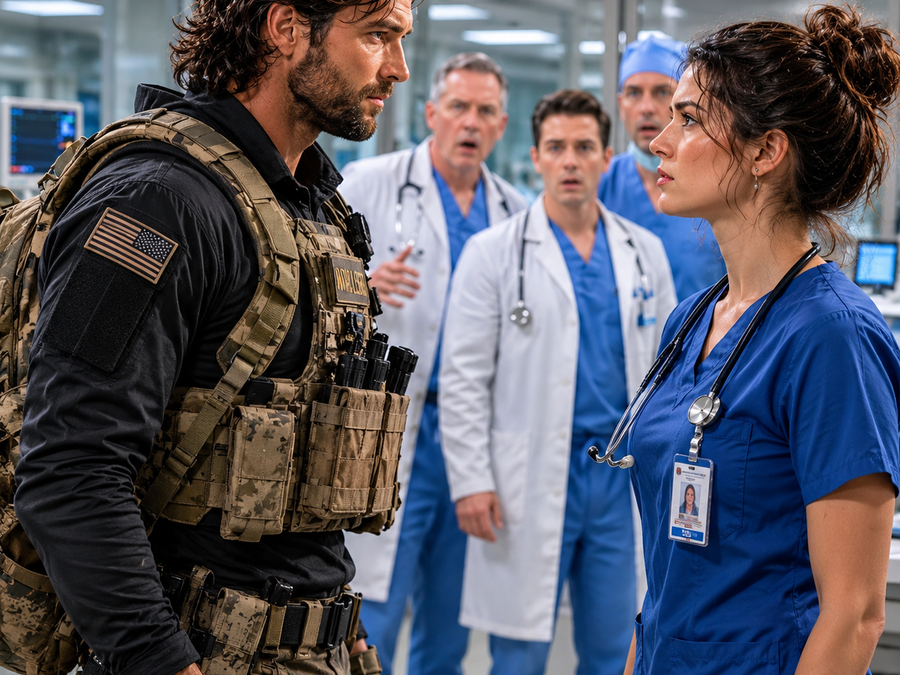
An Elite Navy Sniper Walked Into the Hospital Room and Said, Your Father Sent Me
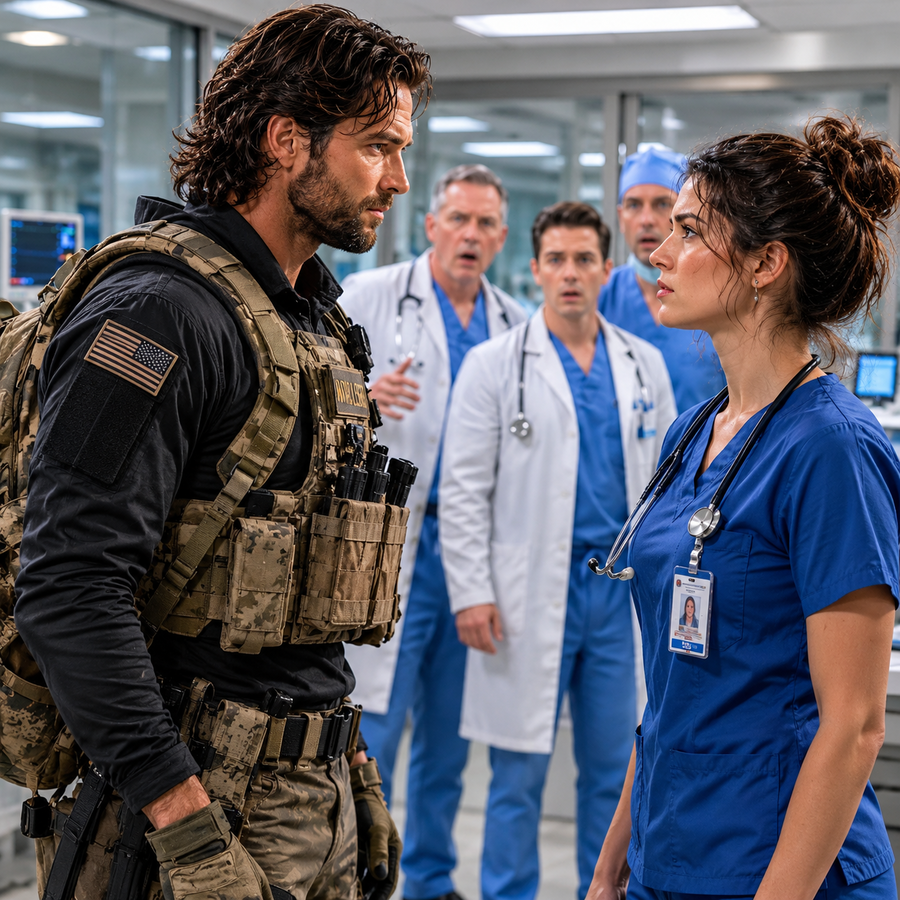
For 3 years, Clare Donovan kept her head down and let the world believe she was nobody. A quiet nurse at a forgotten veterans hospital, invisible by choice.
Then a polished stranger took the microphone at a donor gala and used her as a teaching tool, smiling as he explained to a room full of strangers what real sacrifice looked like.
Certain she had never known it. He had no idea what she had buried to survive.
None of them did until a wounded sailor stumbled through the doors that same night, bleeding out, fighting for air, and said four words that pulled the floor out from under everything she had pretended to be. Your father sent me.
What happens next isn’t about rank or medals or anything that fits on a uniform.
It’s about the price of spending your whole life making yourself small and the night a woman finally stopped.
If this story moves you, do something for me before it pulls you under.
Tap that like button so more people find their way here.
Drop a comment and tell me where in the world you’re listening from tonight because I read every single one.
And if you haven’t yet, subscribe and let me say it properly.
Welcome to Silent Badges Stories. Now, turn the lights down low.
Let’s begin.
Look at her right there. This is what humility looks like.
Clareire Donovan froze with a tray of water glasses balanced on one forearm.
The voice belonged to Gerald Maddox. He stood under the lobby chandelier of the Carter Ridge VA Medical Center, microphone in hand.
300 donors turned toward him like sunflowers chasing the light. He was pointing at her.
“Folks, you came here tonight to honor sacrifice,” Maddox said.
And it’s easy to picture sacrifice as something loud, something heroic.
Boots on the ground.
But look at this woman. Heads turned, glasses lowered.
300 faces found Clare by the catering table.
She did not move. This is sacrifice, too, Maddox went on warm and certain.
The simple kind, the quiet kind.
She will never know what these warriors knew out there.
She can’t.
None of us can. But she shows up.
She carries the trays. She does her small part.
And there is beauty in that. A few people nodded.
Someone near the front murmured, “So sweet.
” Clare looked at the floor, her shoulders curled inward, her chin dropped.
She made herself smaller, the way she had trained herself to do for 3 years now.
The lobby glittered around her, crystal and silver, catered shrimp on ice, men in tailored suits and women in long dresses.
All here to feel good about a war none of them had fought. Beyond the velvet ropes, down a dim corridor, lay the actual hospital, worn lenolum, the smell of antiseptic and old age, the men this gala claimed to honor, most of them asleep in narrow beds.
Maddox was a brand more than a man.
gray suit, capped teeth, a voice built in a recording studio. He had never served a single day.
He had built a small fortune selling speeches about courage to people who would never once test their own.
Tonight, the VA had paid him $40,000 to inspire its donors.
“I tell a story sometimes,” Maddox said, lowering his voice for effect.
“About a young soldier I met pinned down out of ammunition.
And do you know what he told me? Clare knew the story was borrowed.
She could hear it in the rhythm. A real memory does not come out that smooth.
He told me, “Sir, fear is just courage that hasn’t decided yet.”
Applause rippled through the room.
Clare’s mouth stayed flat.
She had been pinned down once in a country these people would never find on a map.
Nobody up there had said anything poetic. They had screamed for their mothers.
She had held a man’s intestines in with her hands and lied to him about the medevac until he stopped breathing.
She set that memory down where she kept the others in the dark with the lid on. A waiter passed her a fresh tray.
Clare took it without looking, her eyes already back on the room, reading it the way she could not stop reading rooms.
The donor in the blue jacket, the guard, the cold pull of air from the bay doors. Three exits, always three.
Sweetheart, Maddox called across the room.
Be a dear. Bring me a water, would you?
All this talking dries a man out. The crowd chuckled.
Clare lifted the tray.
She crossed the marble floor with her eyes down and her steps soft. A glass went down beside him without a word.
Then she turned to go.
“See that?”
Maddox said, not even looking at her.
No fuss, no ego. We could all learn something from people like her.
Applause again.
Clare walked back toward the service hallway.
Her face stayed blank.
Her hands holding the empty tray were perfectly still. That stillness was the only true thing in the room, and nobody noticed it.
She noticed everything she always had.
The exits, without trying, three of them.
The security guard by the door, overweight, gun worn too high on his hip.
The donor in the blue jacket who kept touching his ear. Probably a hearing aid.
Probably a veteran. The way the night air pushed cold through the ambulance bay every time the far doors cracked.
Old habits. They never left.
She had stopped trying to make them.
Behind her ribs, 12 years of another life sat folded and silent. 12 years she would never speak of out loud.
12 years that had left three scars on her body and a name on a black wall in another state that only she remembered.
She pushed through the staff doors into the kitchen and breathed in through the nose. Hold out slow the way her father had taught her on a dock before she could read.
Donovan, a soft voice. Marisol, the night charge nurse, leaned in.
You okay? That man out there is a snake in a nice suit.
I’m fine, Clare said.
You let him walk all over you, right in front of everybody.
It’s easier.
Marisol studied her. She had worked beside Clare for 3 years and still felt she did not know her.
You’re a strange one, Donovan.
Quietest woman I ever met. But sometimes I look at your hands and I think that woman has done things.
I clean bed pans.
Clare said Marisol didn’t buy it.
She never quite had.
One day you’re going to surprise somebody.
Clare almost smiled. I doubt that.
She set down the tray and pushed through the next doors into ward C where the noise of the gala died away to nothing.
This was where she actually worked. long-term care.
The men the war had finished using and then forgotten. Vietnam, desert storm.
Two long decades in the mountains and the sand.
Old skin, tired eyes, machines that breathed for them in the dark. Bed seven was awake.
You came back, said the old man there.
Walter Puit, 81, army medic, two tours in the jungle.
His lungs were giving out a breath at a time.
He had maybe a week left and they both knew it and neither of them lied about it.
I always come back, Clare said.
She checked his oxygen line, adjusted his pillow, smoothed the thin blanket over his chest. Her hands moved with a competence that had nothing to do with three years on a ward and everything to do with somewhere else.
They using you for a showpiece out there? Walter asked.
I can hear that fell’s voice through the wall.
talks like a man selling used cars. Something like that.
You should have poured the water on his head.
Clare laughed quietly, and for a second she looked younger. And lose my job.
Girl.
Walter’s eyes were cloudy with age, but sharp underneath, the way only a man who had watched people die could be sharp.
There is something in you. I have been around a long time.
I have seen brave men and I have seen cowards and I have seen the rare ones who are quiet because they have nothing left to prove. He took her wrist with one papery hand.
You walk like someone who learned to be still on purpose, he said.
There is a difference between humble and hiding. You are hiding, Clare.
I do not know from what. But a thing you bury does not die.
It just waits.
She went very still.
For a moment, the mask slipped just a hair.
Her spine straightened. Her gaze sharpened.
Something old and steady looked out through her green eyes, and Walter saw it. And he nodded once like a man whose suspicion had been confirmed.
Then it was gone, folded away again.
“Get some rest, Walter,” she said softly.
“You watch out tonight,” he said, and closed his eyes.
The air feels wrong. A medic learns to feel it.
Something is coming up the road. When?
What’s coming?
But the old man was already drifting, and he only shook his head against the pillow. She stood there a moment longer than she needed to.
Walter reminded her of someone, of a hundred someone, of the men she had patched up in the dark, and the ones she hadn’t reached in time.
She tucked the blanket a little higher under his chin. the way you tuck in a person you have decided to love against your better judgment.
“Good night, old man,” she said.
“Good night, soldier,” he answered, half asleep.
She went still in the doorway.
That word, she had never said it to him.
Never said it to anyone in this building. But she did not correct him.
Clare moved through the ward. Bed four needed turning.
Bed nine needed midnight meds. She did the work with her head down and her hands sure.
And she told herself, as she had told herself a thousand nights, that this was enough, that quiet was a kind of peace, that a small life was a safe one, and she had earned a safe one. She almost believed it.
At 9:14, the ambulance bay doors slammed open at the far end of the corridor.
Not the gentle wheelin of a scheduled transfer, a crash. Boots on tile.
A voice shouting for help that knew exactly how to shout.
Clipped and loud and trained. Hot patient penetrating trauma.
He is crashing. I need a doctor.
Claire’s head came up.
Carter Ridge was a long-term care VA.
It did not take active trauma.
It had no surgical team after hours. The nearest level one hospital was 40 minutes down a dark highway.
A second voice lower, gritted out through pain from the gurnie itself.
Where is she? I need the nurse.
Donovan.
Clare’s blood went to ice.
Nobody in this building knew that name to call for it like that.
Not as a summons. Not as a last hope.
She set the chart in her hand down on the counter slowly, carefully.
The way you set down something when your whole body has gone calm and clear and terribly awake.
Down the hall, the gurnie rolled into view.
Two paramedics fought to hold a big man down, his shirt soaked black, his own hand clamped hard into the crease of his hip where the blood would not stop coming.
His eyes found her across 40 ft of fluorescent light, and he stopped fighting.
The man on the gurnie was dying and he knew it and he was calm about it.
That calm told Clare everything before anyone said a single word.
Civilians panic when they bleed.
They thrash.
They beg. They grab at the people trying to save them.
This man lay still and conserved himself. three fingers jammed into the fold of his hip, holding a femoral artery shut by hand alone because he understood in his bones that letting go meant 90 seconds to black.
He was an operator.
She would have bet her life on it.
She had been one “Nurse!”
the lead paramedic yelled down the hall, “We got nobody here.
The doc went home. The gayla took your on call.
There’s no surgeon.
We are losing him.”
The gayla crowd had spilled toward the noise.
Donors in evening wear gathered at the mouth of the corridor, drawn by the drama, phones rising in pale hands.
And there, pushing to the front with a furrowed brow of practiced concern, came Gerald Maddox.
“People, please give them room,” he announced, taking charge of nothing at all.
“Let the professionals do their work.
This is what they train for.”
But there were no professionals here tonight. There was a night charge nurse going white to the lips.
Two paramedics out past the edge of what they knew. A long-term care ward built for slow deaths with no trauma surgeon for 40 mi of black road.
“And there was Clare standing very still in the middle of the corridor.
” He took a penetrating wound high inside the thigh,” the paramedic said, voice cracking as the gurnie break in front of her.
“We cannot get a tourniquet on it.
It is too high, too close to the body. Pressure is not holding.
He has lost 2 L, maybe more. His pressure is in the basement.
Clare’s eyes moved over the man on the gurnie.
Fast, methodical. A scan she had run a 100 times in places with no walls.
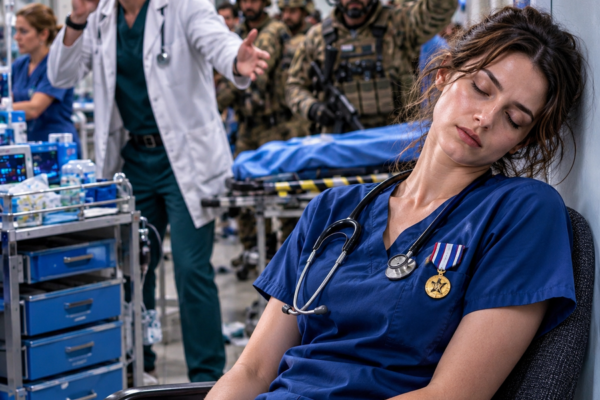
gray skin, sweat sheeting his face, lips going blue at the edges, the black soak spreading and pulsing at his right hip, pulsing, which meant artery, which meant minutes, not hours. And his breathing quick and shallow with a hitch on the left side, a small ugly tug at his collarbone with every pull of air.
Attention pneumthorax building. He had a chest wound, too.
Air was leaking into the space around his lung and could not get out.
And the pressure was climbing, and soon it would push everything in his chest sideways and squeeze his heart until it could no longer beat. She had seen it kill a man in under a minute once on a hillside, while she screamed for a needle that never came.
She had promised herself, kneeling in that dust, that it would never beat her again. Two ways to die at once, racing each other.
and Clare knew exactly what to do for both. That was the whole problem.
A regular nurse did not know how to pin a junctional hemorrhage against the pelvic bone with her fingers.
A regular nurse did not read a tension pneumothorax from across a hallway by the tug of a collarbone.
A regular nurse did not carry in the deepest muscle memory she owned, the precise location to slide a needle and save a man’s life on a cold floor with no surgeon in the building and no time to wait for one.
If she stepped forward, the quiet life was over.
All three years of it.
Every wall she had built. Gone in front of 300 witnesses and their phones.
She looked at the man’s face.
He was looking back at her, pale, fading, eyes going soft at the edges, but locked onto her with a fierce focus that refused to let go of the one thing keeping him here.
Donovan, he rasped.
Claire, it’s you.
Thank God. The lead paramedic blinked at her.
You know this guy?
It’s a common name, Clare said.
Her voice was flat, careful.
The man on the gurnie shook his head slow and certain.
Blood bubbled pink at the corner of his mouth.
Your father, he breathed. Master Chief Donovan, he sent me before he he could not finish.
A wet cough took the rest of the words and left blood on his lips.
The hallway tilted under Clare’s feet.
Her father, Thomas Donovan, the man who taught her to breathe before she could read.
The man who taught her to shoot, to swim under the dark water, to be still when everything in her screamed to run.
The man whose name she had not let herself say out loud in 3 years, because saying it broke something she could not afford to break and still keep functioning.
He sent me.
Which meant her father had known this was coming. Which meant her father somewhere out there had reached across the silence to find her one last time through a dying stranger on a gurnie before he she did not let herself finish that thought either.
Not yet. There would be time to fall apart later.
There was no time now.
For a single heartbeat the corridor fell away.
She was 11 years old on a cold dock.
Her father knelt beside her, big and patient, teaching her to slow her own pulse. Fear is just weather, Clare.
You wait it out, then you do the work.
She had done the work for 12 years after that, in rooms with no doors, in countries with no names, she was allowed to say.
And then one bad night had taken everything she loved and left her holding a folded flag.
and she had walked away from all of it and buried the woman she was under three years of carrying trays.
But the woman was not dead.
She had only been waiting.
The dying man’s grip tightened on nothing.
His hand searching the air, and Clare caught it and held it, and she felt the calluses there, the same calluses her father had carried, the mark of a life spent on a trigger and a rope and a rescue line.
This was one of her father’s men, sent by her father, bleeding out on her floor while 300 strangers filmed it on their phones.
The decision was already made. It had been made the moment he said the name.
Maddox’s voice cut in oily and loud, climbing back toward the center of attention.
“All right, this poor woman is clearly overwhelmed.
Anyone can see it,” he said, performing gentleness for the crowd.
Somebody get a real hospital on the phone. Honey, step back now.
You’re in the way of the people who do this.
He put a soft hand on Clare’s shoulder to move her aside, the way you would guide a child.
She did not move.
For the first time all night, she did not give him a single inch.
The man’s monitor screamed.
The numbers fell off a cliff.
80 over 40, then 70, then a hole opening under that.
He’s coding,” the paramedic shouted, his composure gone.
“He’s going to arrest right here in the hallway.
I’ve got nothing left.
I’ve got nothing.”
Walter’s voice drifted up from somewhere deep in Clare’s mind.
There is a difference between humble and hiding.
A thing you bury does not die. It just waits.
The old medic had felt it coming. Something is coming up the road.
He had been right.
He was always right about the air.
Three years of small. Three years of looking at the floor.
Three years of being the quiet kind of sacrifice, the simple kind, the kind that would never know what the warriors knew.
She looked down at the dying operator, at the message still burning in his fading eyes, at the blood that would not stop pooling now across the clean tile. and something inside her, folded away for so very long, quietly stood up to its full height.
Clare’s chin lifted, her shoulders rolled back and down.
The curl in her spine straightened into a hard, clean line that had been drilled into her on three continents and never truly left. The tremor in her hands was gone.
It did not fade.
It simply was not there anymore, as if it had never belonged to her at all. When she spoke again, her voice had changed completely.
It was low. It was clear.
It carried to every corner of the corridor without rising at all, the way a voice carries only when it has given orders under fire and been obeyed.
Everybody stopped talking.
The hallway went dead silent.
Maddox’s hand slid off her shoulder and hung in the air, useless.
You, she pointed at the nearest paramedic, two fingers sharp.
Your kit, 14 gauge angioath, the biggest needle you carry in my hand now. You, the second one.
Two units of saline.
Both lines wide open.
Pressure bags if you’ve got them.
Go.
Marisol. The charge nurse jumped.
trauma kit from the cart, combat gauze if this building has any regular gauze if it doesn’t, and clear this corridor of every single person wearing a tuxedo.
Now, nobody moved. They only stared at her because this was not the woman who had carried water across the lobby an hour ago.
This was someone else entirely, wearing the same oversized blue scrubs, the same quiet face.
But the eyes had changed.
The eyes were doing math now.
Fast and cold.
The kind of math that decides who lives.
“I said now,” Clare said, and the room came apart and jumped to her voice like it had been waiting its whole life to be told what to do.
The paramedic slapped the needle into her hand without thinking.
Marisol ran. Two donors in evening gowns scrambled back from the spreading blood.
And somewhere in the crowd, a phone lowered, then another. As the people who had come to clap for a speech about courage began to understand that they were watching the real thing and that it did not look like the speech at all.
It looked like a woman on her knees in blood, refusing to let a man die. Clare dropped to her knees in the spreading blood and put her bare hand into the wound.
Not on it, into it.
She drove three stiff fingers deep into the crease of the man’s hip and pressed the femoral artery flat against the hard shelf of his pelvic bone.
The only thing left in the world that would stop this bleeding now.
No tourniquet could reach here.
No clamp.
Only a hand that knew exactly where to push and exactly how hard and was willing to cause agony to buy a life.
The black flood slowed, then nearly stopped. The man arched and groaned through his teeth at the pain of it.
Good pain meant a brain still getting blood.
“Hold this exactly where I have it,” Clare told the lead paramedic, sliding his larger hands over hers and locking them into place.
“Do not lift.
Do not shift.
Do not get curious.
You are this man’s blood pressure right now.
Understand me?”
“Yes,” the paramedic whispered.
“Yes, ma’am.
” The operator’s eyes flickered toward her, dimming then catching on her face.
“Stay with me,” Clare said, and her voice softened.
“Only for him.
You came a long way to find me.
You don’t get to quit at the door.
Look at my eyes.
Breathe when I tell you.”
She turned her full attention to his chest.
Her hands ran down his ribs, reading him by feel the way she read everything, by touch and instinct and a thousand repetitions. The left side was tight and swollen.
The windpipe at the base of his throat had begun to shift, pulling away from center, away from the side that was failing.
The veins in his neck stood out like cords. The trapped air around his lung was crushing his heart one breath at a time, and the clock on it was nearly out.
“Needle,” she said, and held up her hand without looking.
Marisol slapped the 14 gauge angiocath into her palm. The big one, the right one.
Clare’s fingers walked the ribs and found the spot.
Second intercostal space, mid-clavicular line, the exact place.
She had found it in daylight and in pitch dark in the back of helicopters and flat in the mud, on men whose names were carved into a wall she could not bring herself to visit.
She uncapped the needle with her teeth.
What are you doing?
Maddox’s voice thin now and frightened.
No studio polish left in it.
You can’t.
She’s a nurse.
Somebody.
That’s a needle.
Somebody stop her before she kills him.
Clare did not look up.
She did not acknowledge that he existed. She set the needle against the skin just above the top of the third rib, angled it true, and drove it in with one smooth, controlled push.
A hiss, a long, sharp, unmistakable rush of trapped air escaping the chest. The sound filled the silent corridor.
The man’s left chest fell as the pressure released.
His next breath came deeper, then deeper still.
The blue at his lips faded slow toward gray, then toward something almost like pink.
On the monitor, the falling numbers caught, held, and began finally to climb. 70 78 85 90 over 50 and rising.
The corridor was utterly silent.
300 donors, two paramedics, one charge nurse, one $40,000 speaker. All of them frozen in place, watching a woman in oversized blue scrubs pull a man back from the edge of death with nothing but her bare hands and a needle.
Combat gauze, Clare said.
Marisol pressed it into her grip.
Clare packed the wound around the paramedic’s locked fingers fast and tight, driving the kale and treated gauze hard down against the bleeding artery.
Her thumbs sealing the pressure, her lips moving in a silent count. 3 minutes.
She had counted these exact three minutes more times than she could stand to remember, kneeling over more men than she would ever name.
“Mark the time,” she said.
“Write it on his arm if you have to.
This bleed is controlled by pressure, not closed. He needs a vascular surgeon inside the hour or he loses this leg.
Call the helicopter now. Not in 5 minutes.
Now tell them junctional hemorrhage controlled in the field.
Tension pumothorax decompressed.
Patient is stabilizing but critical.
Have vascular and thoracic standing by on the pad. The lead paramedics stared at her over their stacked hands, white-faced, decompressed in the He swallowed.
Who are you?
Nurses don’t Who are you?
Clare didn’t answer him.
The man on the gurnie was breathing on his own now. Weak, shallow, but his.
His hand crept up and found her wrist and gripped it with the very last of his strength.
He said, the operator whispered every word costing him to tell you that he was proud.
The whole time, every year, even when you wouldn’t pick up the phone, even when you went dark on all of us, he never stopped being proud of you, Clare.
Clare’s jaw tightened to stone.
Her eyes stayed dry by a force of will most people would never possess and could never understand.
Don’t talk, she said gently, her thumb still sealing the wound.
Save your heir.
You did your job. You found me.
Now rest. His name.
The man’s voice was nearly gone before he passed.
The last thing the Master Chief ever said, “It was your name.
Just your name.”
Something cracked behind Clare’s ribs, deep and silent, in the place where nobody could see it, and nobody had been allowed in for 3 years.
She had not gone to the funeral.
She had told herself it was too dangerous, that her old life would follow her there, that the people hunting the woman she used to be would be watching the grave.
All true, all also a coward’s comfort.
The truth was simpler and worse. She had not been able to stand and watch them fold the flag.
So she had let her father go into the ground without her and she had carried trays and she had pretended that was the same as surviving. He had been proud of her anyway the whole time.
Even when she went dark, she held it. 3 years of holding things had taught her exactly how.
A few more minutes would not break her.
They could not.
Helicopter is 8 minutes out, Marisol said, her phone shaking against her ear.
Carter Ridge there. They want to know who controlled the bleed in the field.
They want a name for the report.
The whole hallway waited for the answer.
Clare knelt there in a wide pool of another soldier’s blood, her hands red to the wrist, her long braid coming loose around her face gone hard and calm and ancient.
She looked nothing at all like the woman who had carried a tray of water across this same floor an hour before.
Gerald Maddox found his voice. He had built an entire career on knowing the right thing to say, and he reached for it now like a drowning man reaches for a rope.
“Well,” he said with a shaky little laugh, trying to climb back on top of the moment that had buried him.
“Lucky for this young man, we had a nurse with a little first aid training on hand.
Let’s uh let’s hear it for our wonderful staff, folks.
This is exactly the kind of dedication.
Sit down, Clare said.
She did not shout it.
She did not even turn her head to look at him, but the two words landed like a steel door slamming in an empty house, and every person in that corridor felt them, and Gerald Maddox sat back down into a folding chair he had not been standing near, and he did not say one more word.
A donor near the front stepped forward slowly.
An older man, silver-haired with a small silver pin on the lapel of his jacket.
He had been watching her the entire time, and his face had gone pale with something that was not fear and was not pity. It was recognition.
“Ma’am,” he said quietly into the silence.
“I served 22 years army.
I retired a command sergeant major. I know what I just watched happen on this floor.
Clare said nothing.
Her thumbs held the pressure.
Her eyes held the dying man’s.
That was a manual junctional control and a needle decompression of attention pumothorax. The old soldier said louder now, turning so the whole frozen room could hear him.
Done flawlessly in under 2 minutes. With no kit, no doctor, no hesitation.
I have seen that done exactly twice in my entire life.
both times by the same kind of person.
And it was never a nurse. He held her gaze and his voice dropped rough at the edges.
“My son was carried off a mountain by people who could do what you just did,” he said.
“He came home because of them.
I have spent 30 years wondering who they were.”
“I never got to say thank you.”
“So whatever you are, ma’am, whatever you were, somebody owes you a debt they will never be able to pay.
I know that much.
The room was silent.
Somewhere a woman was crying softly.
He looked at her and the question filled the corridor and 300 people leaned in to hear it. Who are you really?
Clare rose slowly to her feet, letting the paramedic take the pressure from her, talking him through the handoff with two quiet words. She wiped her bloody hands on the towel Marisol held out, and she did not curl her shoulders inward.
Her chin stayed level, her eyes stayed off the floor.
Her gaze went first to the man on the gurnie, alive and breathing because of her hands.
It moved to the silver pinned veteran who already knew the answer.
Last and longest, it settled on Gerald Maddox, sitting small and silent and gray in his folding chair.
The salesman of other people’s courage with nothing left to sell.
“My name,” she said, and her voice filled the room without effort.
“Is Clare Donovan?”
Down at the far end of the corridor, the night doors hissed open again.
“This time it was not paramedics.
Three men came through, plain dark clothes, moving fast and quiet and together, scanning the room corner to corner the way only a certain kind of person scans a room.
Not looking for the exits, looking for threats, looking for one person.
The man in front locked his eyes on Clare across the length of the bloody hallway, and he stopped walking. For a long second, nobody breathed.
Officer Donovan, he said.
Ground branch, we have been looking for you for 3 years. He took one step closer.
And we are not the only ones who finally found you tonight.
Officer Donovan.
Ground branch.
We have been looking for you for 3 years.
And we are not the only ones who finally found you tonight.
The man in front lowered his hands so she could see them. Empty.
Deliberate. Clare knew the face under the gray stubble.
Older now. Harder.
a new scar through one eyebrow, but she knew it the way you know a song from the first note. Saint, she said.
Ray Mercer almost smiled. Hello, Clare.
You look terrible. I mean that with love.
Three years collapsed into a single breath.
They had bled together once on the far side of the world in a war that never made the news.
He had carried her two miles out of a valley on a broken ankle.
She had stopped his heart from quitting on a riverbank with her bare hands and a refusal to let him go.
“You do not forget the people who keep you alive.”
“How did you find me?”
Clare said.
“I was careful.
I was a ghost.
You were the best ghost I ever saw,” Mercer said.
“We didn’t find you.
” His eyes went to the man on the gurnie.
“Briggs found you.
We followed Briggs.”
The wounded operator stirred at the sound of his own name.
Senior Chief Briggs, Navy. The finest long gun her father had ever trained, and Clare had heard the stories for years.
He came to you first, Mercer said quietly.
Before he came to us, because the Master Chief told him to right at the end. The end.
There it was again. The wall she would not climb.
My father is gone. It was not a question.
She had heard it in the way Briggs said his name, the way you only say a name when the person who owned it is dead. Two weeks ago, in his sleep, he was not in any pain, and he was not afraid.
Mercer let that sit for a moment, the way you set down something heavy. His last clear afternoon, he made Briggs promise three things.
Find Clare, put a folder in her hands, and tell her a truth he carried for 3 years and could never make himself say.
Clare’s jaw set hard.
What truth?
Mercer glanced down the corridor, both directions.
The old habit that never dies. The gala crowd had pulled back against the walls.
300 people in evening clothes gone silent, watching three strangers in dark jackets speak a language none of them could follow.
3 years ago, your team didn’t die because of a bad tip.
Mercer said, “I know that’s what they told you.
It’s a lie.
They died because someone sold the route.
A private outfit contractors.
They traded the lives of your people for a wire transfer and buried it deep. You blamed yourself for 3 years, Clare.
It was never your fault. It was a man named Cole Howerin.
The name landed like a stone dropped into still black water.
Clare’s hands went cold.
Not with fear. with something far older and far steadier than fear, something she had locked in a box three years ago and sworn never to open again.
“Halerin,” she repeated, and the word tasted like rust.
Briggs spent two years getting the proof, Mercer said.
“Account numbers, names, dates, the entire rotten machine.
He was bringing it to the only people left who could end Howerin for good.
Howerin’s crew caught up with him on the interstate tonight.
He nodded at the soaked dressing on Briggs’s hip.
Put two rounds in him at speed. He kept driving anyway.
He drove 40 mi bleeding out past three hospitals straight to this one to you.
Because a dying Master Chief told him his daughter was the only person on Earth who would finish it.
Marisol, white to the lips, stepped in close.
The helicopter’s 3 minutes out.
They want to take him to county.
No, Mercer said flatly.
They don’t.
Clare understood it before he finished the thought.
She felt the whole shape of the night turn over and show its teeth.
Because Howerin’s people are still out there, she said.
And they’re coming here for Briggs, for the folder, for every single person who saw his face come through that door.
Mercer nodded once.
Six of them, maybe eight.
Everyone a former operator. They are good, Clare.
They are very good and they do not leave witnesses because witnesses are the whole reason they exist.
That’s the job.
That’s all the job has ever been.
The corridor seemed to shrink around her. Clare looked past the men in dark jackets, down the long hall toward Ward C, toward the rooms full of old soldiers who could not stand, could not run, could not do anything but lie in their beds and trust the people around them, toward bed seven, where Walter Puit was
lying awake right now, certain that something was coming up the road.
He had been right. He was always right about the air.
That was the moment Gerald Maddox decided to take charge.
All right.
All right.
That is quite enough.
He pushed up off his folding chair, smoothing the front of his gray suit, reaching for the authority he had worn like cologne all evening.
I don’t know who you people think you are, but this is a hospital.
I am the senior representative present.
I am calling the police this instant, and everyone is going to calm down.
Sit down, sir, Mercer said almost gently.
I most certainly will not be told to sit down by some Maddox’s voice climbed toward the chandelier.
Do you people have any idea how much liability is standing in this lobby? 300 donors cameras.
We are going to handle this the correct way, the calm and professional way.
And we are not going to let some hysterical overexited the correct way gets these people killed. It was Clare who said it quietly, and the entire room turned to her.
There was no curl in her shoulders now.
She stood in the center of the corridor with another man’s blood drying brown on her hands, and when she spoke, it was the voice that had emptied the hallway an hour before.
“Mr.Maddox, listen to me very carefully because I will only say it one time.
In a few minutes, armed men are going to come through those doors.
They are extremely good at this.
The police are 20 minutes out on a fast night, and we do not have 20 minutes.
The only thing standing between 300 civilians and those men is what we decide to do in the next 90 seconds.”
Maddox stared at her like she had grown a second head.
“You, you’re a nurse.
You carry the water trays.
I was a paramilitary operations officer,” Clare said.
“Special activities center, ground branch.
I spent 12 years doing the work you sell speeches about and I buried every minute of it because doing it cost me everyone I loved. So believe me, Mr.Maddox, when I tell you that I know exactly what is about to walk through those doors.
The silence in the lobby was complete.
You could have heard a pin drop onto the marble.
Maddox’s mouth opened.
Nothing came out of it.
The salesman of Courage had finally stood face to face with the genuine article. And for the first time in his polished life, he had no script, no anecdote, no line.
Clare was already moving, already turning the lobby into a board in her mind. Marisol with me.
300 people in this room. I need them out the south doors fast and quiet.
No panic.
Into the parking structure and away from the building.
You walk in front. You do not run.
The second one person runs, you have a stampede and people die in the doorway.
Move with purpose and keep them moving. Can you do that?
Marisol’s chin trembled, then firmed.
Yes. Yes, I can.
Good.
Take Maddox with you.
Put something in his hands and give him a job. What about the ward?
Marisol’s voice cracked down the middle.
Walter, Mr.Diaz, the man in bed nine.
They can’t walk.
They can’t run.
They can’t do anything but lie there and wait.
Clare turned and looked the length of the dark hall toward Ward C. And for one heartbeat, the calm in her face cracked.
And underneath it was something that would have made Cole Howerin turn his car around. The ward stays with me, she said.
Nobody gets past me to those men. Not tonight.
Clare.
Mercer’s hand settled on her shoulder.
It’s six of us against eight, and one of mine is bleeding on a gurnie.
You sure you want your stand here in a building full of people who can’t move?
We can draw them off into open ground.
Lead them away. Clare shook her head.
They came for Briggs and the folder.
Men like Howerin will burn this whole place to get both, and they will not check the beds first.
Leading them off does nothing for the men who can’t follow.
She met his eyes steady as stone.
We hold here. We hold the ward.
That’s the mission now.
Mercer searched her face for a long moment, and then something in his hard expression eased, almost like a man setting down a weight he had carried a very long way.
“There she is,” he said softly.
I knew she was still in there somewhere.
He turned to the two men behind him, Vega Doyle. You heard the officer.
This is her ground and her plan.
We follow her lead. I have a plan.
Clare agreed.
She crouched by the gurnie and took Briggs’s cold hand in both of hers one more time.
His eyes fluttered open, found her face, and held on like she was the last solid thing in a sinking world.
“You did it,” she told him low and fierce.
“You found me.
You can stop fighting now, Senior Chief. I have the rest of it.
I’ve got the watch folder.
Briggs breathed in my vest sewn in the lining.
Don’t let them put it in the dark again.
They won’t, Clare said.
I give you my word. Now rest.
She slid her hand inside his torn vest and felt the hard edge of the thing.
A thin waterproof sleeve stitched into the lining by a man who had known he might not live long enough to hand it over himself.
She gripped it like she was gripping her father’s hand across the years.
And then far down the corridor, every light in the wing went out at once.
The whole wing dropped into sudden black.
The monitors died midbeep. The exit signs guttered down to a thin and bloody red.
Outside, a backup generator coughed once, twice, and gave up.
In the new darkness, Mercer’s voice came calm and flat.
“That’s them,” he said.
They cut the power.
They’re already here.
Darkness is a weapon. Most people never understand that.
They think the dark hides them.
It does not. The dark hides whoever stays calmst inside it, and it eats everyone else alive.
Clare Donovan was the calmst living thing in that building.
“Nobody move,” she said into the black, low and clear and even.
“Let your eyes find the dark.
Breathe slow. They killed the lights to make us panic and scatter.
We are not going to give them one inch of that. Around her, the dim red of the emergency exit signs began to bleed shape back into the world.
The gurnie, the crash cart, the long throat of the hallway running down toward ward C and the men who could not save themselves. Vega Doyle on me, Mercer murmured.
Clare, it’s your house.
Call it. Her mind had already become the thing it was forged to be years before she ever pulled on a pair of scrubs.
Cold, fast, reading the floor plan like a chessboard three moves deep.
They’ll come from two directions, she said.
The ambulance bay because that’s the way Briggs came in and they tracked his blood right to the door.
And the East Service stairwell because it’s dark, it’s quiet, and it puts them behind us with a straight run at the ward.
They’ll split their force.
Standard doctrine. Four and four.
Agreed.
Mercer said that’s how I do it.
Mercer, you take Vega and hold the bay.
It’s a true choke point.
One wide door, and they have to funnel through it one and two at a time. Two disciplined men can hold a doorway against four all night if they keep their patience and their angles.
She pointed into the dark without looking at it.
Doyle, you’re with me on the east stairwell.
That’s the one I’m worried about.
That’s the one with my patience at the end of it.
And Briggs? Doyle asked.
Briggs goes somewhere they can’t reach him.
So does the folder. Clare was already pushing the gurnie fast and silent on its good wheels deep into the black mouth of Ward C.
She rolled Briggs in and parked him between two heavy steel supply carts tucked out of any line of sight from the door.
Walter was awake.
Of course, he was awake.
The old medic’s eyes glittered like wet stones in the red light.
“Told you,” Walter whispered.
Air was all wrong.
“You did tell me.
You’re going to get tired of being right.
” Clare pressed the waterproof sleeve into his thin, papery hands and folded his fingers closed over it.
“Walter, I need one last job out of you.
Soldier to soldier.
Hold this.
Whatever you hear through that door, you do not let it go, and you do not let a single living soul touch it but me. Can you hold that line for me?
Walter’s grip tightened on the folder with a strength that startled her.
I held a perimeter in worse rain than this with worse men beside me, he said.
Go on, go do the thing you came back here to do, soldier.
I’ve got the package.
She almost came apart right there.
The clock would not let her. Heads down, she told the whole ward to every old man in every bed.
Men who had once been young men in jungles and deserts and places with no names. Stay low.
We have got you.
Nobody comes through that door tonight.
Then Clare turned to face the dark and she went to work. She did not have a rifle.
What she had was better.
A whole hospital and 12 years of knowing how to look at an ordinary room and see a hundred ways to end a fight.
A hospital is full of weapons for anyone with the eyes to read it. Moving down the east hall, she gathered her tools as she went, placing each one where her hands would find it in the black.
A fire extinguisher lifted cold and heavy off its bracket. A defibrillator charged and clipped to her hip.
A tray of long steel instruments slid into easy reach.
A full oxygen cylinder, green and heavy, wheeled into the shadow of an al cove.
Each one seeded along the route the way her father had taught her to prepare a field before a single shot was fired.
Prepare the ground, Clare. The fight is half won before the enemy ever arrives.
Doyle watched her work in silence.
He had heard the stories about Donovan’s girl, the medic who fought like a ghost.
Now he was watching them turn out to be true.
The east stairwell door eased open at the far end of the hall. Four shapes flowed through it, low and smooth, fanning out into the corridor the way only well-trained men ever move.
Night vision goggles down over their eyes, weapons up and ready, calm, quiet, confident hunters who had done exactly this in a dozen dark countries and never once come home empty.
They had never once hunted Clare Donovan on ground she owned.
She let the lead man pass the mouth of the al cove.
Then the oxygen cylinder came around in a short controlled arc.
The lead man simply folded and dropped and did not rise.
His weapons skittering off into the black. Before the second could bring his rifle around, the fire extinguisher bloomed a wall of white fog down the corridor, swallowing the light, blinding the night vision that had been their entire advantage and turning their great gift into a blank gray curtain they could not see past.
Fog! Kill the fog.
Pull the goggles.
I can’t.
One of them shouted, clawing at his own face. He never finished the sentence.
Doyle took him from the flank, fast and clean and quiet. Clare took the third with the defibrillator paddles, a charge built to restart a stopped heart used now to put a strong man on the floor without stopping his for good.
She did not want these men dead.
She wanted them down and finished.
There is a difference between the two, and only the most disciplined fighters alive ever learned to hold it. The fourth man was the smart one.
He gave ground, found a wall at his back, and swung his weapon toward the war door, toward the helpless men in the beds.
toward Walter and the folder.
Clare was faster. She had always been faster.
She came across the white fog like something the fog had made inside his reach before he could fire a single round. And she put him on the tile with three short, precise movements.
Her body remembered, even after 3 years of trying to forget them. His rifle spun away into the dark.
The man stayed down.
Four men under one minute.
Not one shot fired into that ward.
Behind her, in the red dark, the old soldiers had watched the whole thing from their beds.
Not one of them had made a sound. They had seen combat before decades ago in countries half the world away, and they knew it when it walked back into the room.
Walter Puit watched the woman move through the fog and held the folder to his chest, and thought, not for the first time, that he had been right about her from the very first night. Down at the ambulance bay, the night had turned loud.
Mercer and Vega were holding the choke point exactly the way she’d drawn it.
Two patient men in a doorway against four impatient ones, and the four were learning the oldest hard lesson in close quarters. Numbers mean nothing in a hallway.
Patience and angles mean everything.
Clare keyed the radio Mercer had pressed into her hand. East side secure.
Four down.
None dead. All restrained.
Report your status.
Mercer’s voice came back tight but steady.
Bae holding.
Three down here. But Clare, listen.
Howerin is not with them.
He’s not in the assault.
He sent his whole crew in through the doors and he stayed back.
That is not him. He always leads from the front.
Always has.
Clare’s blood went cold for the second time that night.
Howerin had not come for Briggs through the doors at all. Howerin had come for the one thing in the building worth more to him than the man who shot him.
He had come for the folder, and the folder was sitting in the hands of a dying 81-year-old man in a dark ward, guarded by no one, because she had pulled Doyle east and sent Mercer to the bay and left the only room that truly mattered, with nothing in it but old soldiers who could not rise.
“Walter!”
Clare breathed. She was already running back through the white fog.
She tore past the men she had put down, boots silent on the wet tile.
Her whole body narrowed to one straight cold line of purpose.
The ward door came up fast.
Through it low and quiet she went, and there was Cole Howalerin. He had come in through the ceiling, through the old maintenance crawl space above the ward, the one route she had not thought to seal, because nobody but a ghost would ever have known it was there.
He stood over Walter’s bed in the red light, a big calm man with a pistol in one hand and the other hand open, palm up, patient as the grave.
The folder, old man, Howerin was saying, soft and reasonable. Hand it up and you go right back to sleep.
That’s the whole deal.
Simple. Walter Puit looked up at the man with the gun.
81 years old. Two tours in the green jungle, lungs giving out one slow breath at a time.
He pulled the waterproof sleeve closer against his chest under the thin blanket over his slow and stubborn old heart.
Son, Walter said, I have been dying for 6 months now.
You are going to have to come up with something a good deal scarier than a gun. Howerin sighed, the sigh of a man at the end of his patience, and raised the pistol.
Howerin. He turned toward the sound of his own name.
Clare stood in the doorway with the fog curling in around her ankles, blood drying on her hands, her father’s terrible steadiness sitting plain in her green eyes.
And Cole Howerin for the first time in a very long and very bloody career looked afraid.
“You,” Howerin said slowly.
“Donovan’s girl.
I heard you went in the ground after that valley, quit the work, vanished off the face of the earth.”
“I did,” Clare said.
“You’re the one who put me there.”
She took one slow step into the ward.
Howerin’s pistol tracked her, but his gun hand had shifted.
The smallest tremor running through it. She saw it the way she saw everything.
He knew the stories, too. Easy now, he said.
Word is you’re a nurse these days, so let’s both be smart about this.
I take the folder.
I go back up through that ceiling, and nobody else in this room gets hurt.
Not your old men.
Not this brave old fool.
All you have to do is stand aside and let me walk. Put the weapon down, Cole.
You know I can’t do that.
Then you already know how this ends.
For a long moment, the ward held still.
The old soldiers lay frozen, breath held.
Walter’s fingers stayed locked around the folder.
Out at the bay, the gunfire had stopped, which meant Mercer had won, which meant help was seconds away, and Howerin knew it.
And the knowing made him desperate. Desperate men make mistakes.
Howerin swung the pistol off Clare and onto Walter.
The folder right now or the old man goes first and that’s on you.
That was the mistake.
Clare moved.
She crossed the room before the barrel finished its turn. And what happened in the next 3 seconds would be told and retold in that hospital for years, though no one who saw it could ever fully explain it.
Inside the gun she came, the way her father had drilled into her 10,000 times. The wrist taken and turned, the single shot punching harmlessly up into the ceiling, raining plaster over the beds.
And she did not stop.
His own weight, the bed frame, the floor, every cold law of physics learned on a dock before she could read.
All of it turned against him in one motion.
Then Cole Howerin was faced down on the lenolium of a forgotten veteran’s hospital.
his pistol spinning away, his arm locked in a hold he had no hope of breaking.
“12 years,” Clare said very quietly, leaning her weight into the lock, her voice never once rising.
“12 years I did this work for my country.
You sold my whole team for a wire transfer.
You let me believe their blood was on my hands. I carried that for 3 years, Cole.
Then finish it.”
Howerin spat against the floor.
“Go on.
You want to?
I can feel you wanting to finish it and we’re square.
Clare was silent for a long moment. The whole room waited and then she eased the pressure just slightly.
Not to set him free, to make a choice in front of witnesses.
No, she said, “That’s not who I am. That’s who you are.”
She drew his hands behind his back and bound them tight with the cord from the window blinds, the knot of someone who had done it many times.
You’re going to live, Cole.
You’re going to stand up in a courtroom under bright lights, and every name inside that folder is going to stand there beside you.
That isn’t mercy.
It’s worse.
You’re going to watch the whole rotten thing you built come apart in daylight where the world gets to see exactly what you always were.
The ward doors banged open.
Mercer came through first, then Vega, and behind them the first blue and red wash of police lights came spilling down the corridor as the cavalry finally arrived.
20 minutes too late, exactly as she had known they would be.
Mercer took one look at Howerin face down on the floor, bound and beaten and breathing, and let out one long, slow breath.
“You held the ward,” he said.
I held the ward, Clare answered.
She rose to her feet.
Her long braid had come completely undone.
Her scrubs were torn and ghost gray with extinguisher fog and dark with another man’s blood.
She did not look like a nurse anymore.
She did not look like a ghost either. What she looked like was exactly what she was.
Walter Puit held the folder up in one trembling hand. I do believe this here belongs to the United States government, he announced to the whole room with the full dignity of a man who had just won the last firefight of his long life.
Held the perimeter, lost nobody. You can put that in the report.
Clare crossed to his bed and took the folder and then his thin hand, and for the first time in 3 years, in front of every soul in the room, she let her eyes fill.
Outstanding work, soldier, she whispered. Knew you had it in you, Walter said, his voice gone soft and thready, humble and hiding.
I told you there was a difference. His fingers squeezed hers.
Don’t you go back in the ground, girl.
A thing as good as you doesn’t belong buried.
Promise an old man. I promise, she said.
And she meant it.
By the time the sun came up, the whole long night was over. Briggs was in surgery across town at County Stable.
Expected to keep his life and his leg, the round pulled from his hip and the trapped air drained from his chest.
All because a nurse on a forgotten ward had known precisely what to do.
Howerin and his men were in federal custody.
The folder had passed into the hands of serious people who would spend 2 years dismantling everything Cole Howerin had built on the bodies of better men. and Gerald Maddox stood alone in the emptied lobby in his fine gray suit, watching all of it, holding nothing.
Clare found him there as the first real light came through the tall windows.
He could not meet her eyes, the salesman of courage, who hours before had pointed at her in front of 300 strangers and called her the simple kind of sacrifice, the kind who would never know what the real warriors knew.
I owe you an apology, he said.
The words came out small, stripped of all their polish.
I had no idea who you what you No, Clare said.
You didn’t.
All those speeches.
He let out a thin laugh with nothing inside it. All those years on all those stages, and I have never once done a single thing like what I watched you do tonight.
Clare looked at him for a long moment.
She could have ended the man with one sentence, and everyone who heard about this night would have cheered her for it. She chose a different sentence.
“Then stop selling it,” she said, not cruy, almost kind.
“Go find out what it actually costs a person, and maybe one day you’ll have earned the right to talk about it.
” She left him standing alone in the light, and she did not look back, because some debts are paid in full simply by walking away whole.
Mercer was waiting for her by the doors. He wore the look she remembered.
The look that came right before an offer.
You know what comes next? He said we could use you, Clare.
The real you. I can have you reactivated before noon.
New name, new ground. You disappear back into the work and finish what started.
Your father’s daughter back in the fight.
Just say the word.
It was everything she had been three years ago. The shadows, the mission, the clean, cold purpose of being a weapon.
Clare looked down the long bright corridor toward Ward C where the morning light was coming up gold through the windows, where old soldiers were waking who would not have woken at all if she had run instead of stayed. And at last she understood the difference Walter had been trying to teach her.
“No,” Clare said.
Mercer blinked. No, I spent 3 years hiding because I believed the only way to be safe was to make myself small.
And I spent 12 years before that believing the only way to matter was to make myself a weapon.
She shook her head slowly. I had it wrong both times, Saint.
I’m not going back into the dark, and I’m not carrying water trays with my head down anymore, either.
Then what? Mercer asked.
What does Clare Donovan do now?
She looked again toward the ward and for the first time in longer than she could remember, a real smile found her face and stayed.
“This hospital is full of men who came home from the same places they sent us,” she said.
“And nobody here knows how to reach them.
Nobody speaks the language.
Nobody knows what a man’s eyes do 3 years after a thing he can never say out loud.”
She held up the two hands that had pulled a life back from the edge that night. I do.
So, I’m staying.
I’m going to build something.
Real tactical medicine, real trauma training run by someone who has stood exactly where these men are standing. Mercer nodded slow and deep.
The way one soldier salutes another without lifting a hand.
Your father would be proud of you, he said. He already was, Clare answered softly.
Somebody made sure to tell me the whole time, he said. 3 months later, the new wing opened at the Carter Ridge VA.
They had wanted to name it for a senator or a wealthy donor or anyone with money and a recognizable face.
Clare told them no.
She named it the Puit Center for an old army medic who held a perimeter on the worst night of his life and never let go of the folder, and who lived just long enough to see his name go up over the door before his tired lungs gently laid him down to rest. On the morning it opened, a young veteran came through the doors, shaking, unable to put a single word to what was wrong, certain that no living person could understand.
A nurse with a long brown braid and clear green eyes and three quiet scars sat down in the chair beside him. She did not look at the floor.
There was no curl left in her shoulders. She looked him dead in the eyes, soldier to soldier, and said the only words that have ever truly reached a person in that much pain.
I know, she said.
I’ve been there, too.
Let’s get you home.
Respect is not a title that somebody hands you.
It is not a uniform or a speech or a microphone or even a name carved on a wall.
Respect is what you do when no one expects a single thing of you on the night it costs you everything to be seen. Clare Donovan spent half her life learning the hardest truth there is.
The bravest thing a person can ever do is not to hide what they are. It is to stand up all the way up out in the open light and let the world finally see it.
The end.