“Please, Just Drive Me Home”—Exhausted Nurse Got Into the Wrong Truck With a Navy SEAL and His K9
“Please, Just Drive Me Home”—Exhausted Nurse Got Into the Wrong Truck With a Navy SEAL and His K9
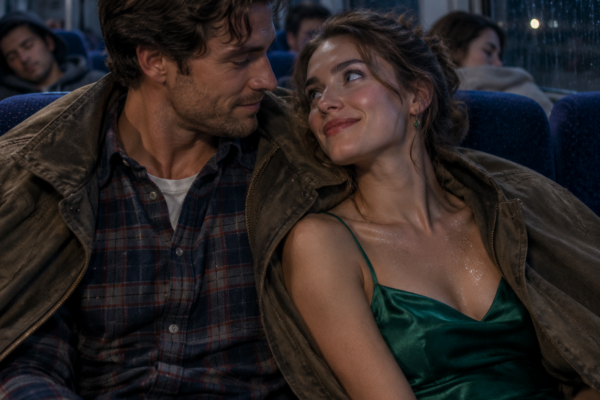
At 4:25 in the morning, after a 20-hour shift, an exhausted ER nurse climbed into the front seat of the wrong truck.
– Please, she whispered, closing her eyes. Just drive me home.
The man behind the wheel was a retired Navy SEAL whose hands would not stop shaking, and in the backseat, a German Shepherd who had not let anyone near that front seat in six years quietly rested his chin on her shoulder. She thought she had made a simple mistake—she had no idea whose seat she was sitting in, and she had no idea that the last time this man and his dog had crossed her path, they had saved her father’s life on the same day he lost everything. If you enjoy stories of loyalty, hope, and second chances, please subscribe and help us reach 1,000 subscribers; your support keeps these stories alive.
Late October frost covered the windshields in the parking lot of Western Montana Medical Center. At 4:25 in the morning, the city of Missoula was still dark, and the only lights on Broadway were the red glow of the emergency sign and the yellow headlights of a single pickup truck idling at the pickup curb. Maggie Doyle pushed through the sliding doors of the ER and stopped to breathe the cold air.
She was 30 years old, and she had been on her feet for 20 hours. In that time, she had started 11 IVs, held the hand of a man who did not survive, and been thrown up on by a toddler with the flu. Her navy scrubs were wrinkled, her long honey-blonde braid was coming apart, and her phone had died somewhere around hour 18 in the middle of ordering a ride home.
She looked at the truck at the curb—dark green, engine running, exactly where her rideshare always waited. Good enough. Maggie opened the passenger door, climbed into the front seat, pulled the door shut, and leaned her head back against the headrest.
– Please, she said, closing her eyes. Just drive me home. I’ve been on my feet for 20 hours.
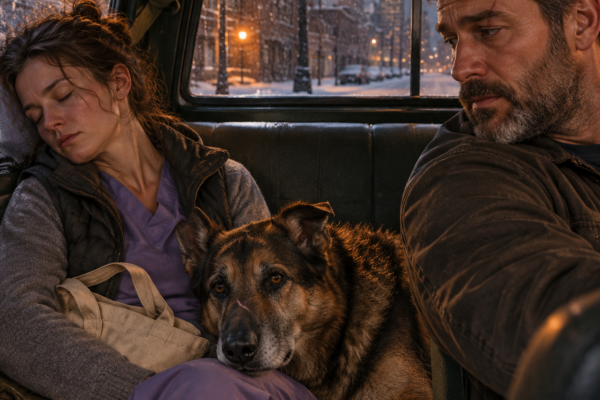
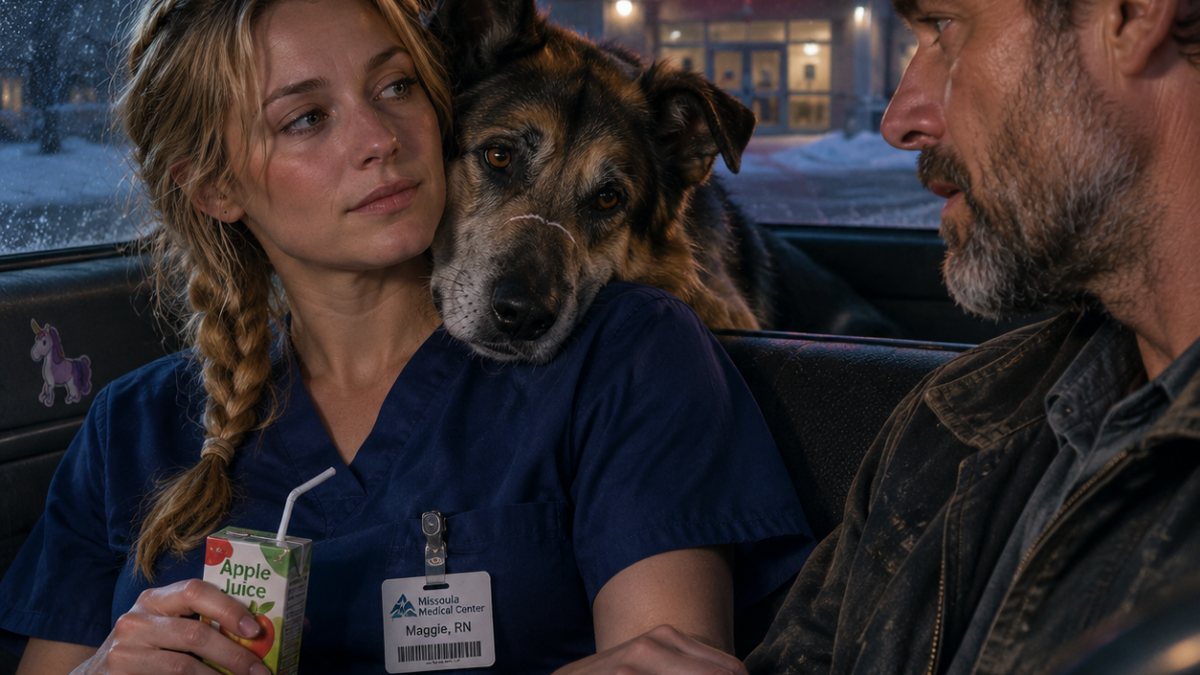
Nobody answered. Then she felt something warm and heavy settle gently on her shoulder, and she opened one eye. A German Shepherd was resting his chin on her shoulder from the backseat.
He was black and tan with gray around his muzzle, a small white scar across the bridge of his nose, and the tip of one ear folded over as if it had been bent a long time ago and never quite straightened. He was looking at her with calm amber eyes; he did not growl, he just breathed, slow and steady against her neck.
– Well, hi there, Maggie whispered.
The man behind the wheel had not moved—not when she got in, not when she spoke. He sat with both hands gripping the steering wheel, staring straight ahead through the frosted windshield, and Maggie could see in the dashboard light that his hands were shaking—not a little, a lot. She had seen hands like that a hundred times on the overnight shift, in the waiting room, on men who had been holding something in for so long that their bodies had started to give it away.
– What did you eat today? she asked.
The man turned his head slowly and looked at her for the first time. He was in his early 40s with short dark hair going gray at the temples, a neatly trimmed salt-and-pepper beard, and gray-blue eyes that looked like they had not slept in a week. There was a thin pale scar through the middle of his left eyebrow.
– Coffee, he said.
– Coffee’s not food.
Maggie reached into her bag, found the little carton of apple juice she always kept for diabetic patients, pushed the straw through the top, and held it out to him.
– Drink all of it, and you don’t drive for 15 minutes.
He stared at the juice box, then at her, and then, very slowly, he took it. Maggie took his wrist with two fingers and checked his pulse while he drank—fast, too fast—counting anyway out of habit with her eyes on the clock on the dashboard. In the backseat, the German Shepherd let out a long breath and lay down as if a job had been handed off.
– This isn’t my ride, is it? Maggie said finally.
– No.
– I’m sorry. My phone died. I just saw the truck and…
– It’s all right.
– Do you want me to get out?
He looked at the dog in the mirror, then at her.
– No, he said quietly. Nobody’s sat in that seat in six years. Not even him.
He nodded back at the dog.
– He usually won’t let anyone near it.
Maggie did not know what to say to that, so she said the only thing she could think of.
– Then he has good taste.
For the first time, the corner of the man’s mouth moved.
– Cole Brennan, he said. That’s Ranger.
– Maggie Doyle.
She glanced at the hospital doors.
– Are you waiting for somebody?
Cole was quiet for a moment.
– A friend of mine came in about three hours ago. Danny Ruiz. He’s on the county search and rescue team. A hiker went missing up in the Rattlesnake, and Danny went down a ravine after him in the dark.
He swallowed.
– They brought them both in. They told me he went into surgery. Then nobody told me anything.
– And you’ve been sitting out here for three hours?
– I don’t do well inside hospitals.
She did not ask why, because she had a feeling she knew.
– Danny Ruiz, Maggie said. Twenty-seven, broken femur, a bad cut on his scalp. Kept asking the trauma team if the hiker was okay.
Cole turned and looked at her fully.
– He came out of surgery an hour ago, she said gently. He’s stable. They’re moving him to the ICU. The hiker’s going to be fine, too. Your friend saved his life.
Cole closed his eyes, and his hands, still wrapped around the empty juice box, finally stopped shaking.
– Thank you, he said.
– I didn’t do anything.
– You got in the wrong truck.
Maggie laughed, and it came out tired and surprised.
– Okay, now you can drive. South Hills, past the high school.
The streets of Missoula were empty, and the heater hummed. Ranger rode with his head between the two front seats, his nose an inch from Maggie’s shoulder, as if he wanted to make sure she did not disappear. Somewhere around the river, Maggie fell asleep.
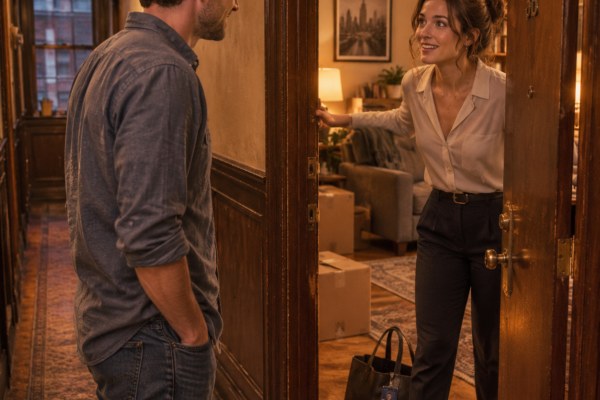
When she woke up, the truck was parked in front of her little rented duplex, the engine running so the heater would stay on. Cole was sitting quietly with his hands in his lap, watching the sky over the mountains turn from black to deep blue, and she had no idea how long he had been waiting.
– Sorry, she said, sitting up. I fell asleep in your seat.
– It’s not my seat.
There was something in the way he said it. Maggie looked at the seat she was sitting in—the leather was worn, but clean, too clean. On the inside of the passenger door near the window, there was a small faded sticker of a purple unicorn, half peeled off, as if a child had stuck it there a long time ago and nobody had ever had the heart to remove it.
– Whose seat is it? she asked softly.
Cole did not answer; he looked straight ahead.
– Don’t, Maggie said before she could stop herself. You don’t have to tell me. I’m the one who got in your truck. You don’t know me. I don’t know you.
She opened the door, and the cold rushed in.
– But keep some juice in this truck, Mr. Brennan. You’re going to need it again.
She climbed out, and Ranger whined softly from the backseat.
– Good night, Nurse Doyle, Cole said.
– It’s morning.
She closed the door and walked up the steps. When she looked back from the porch, the green truck was still there with its headlights on, waiting until she was safely inside, and in the back window she could see the shape of a German Shepherd watching her door.
Inside, her mother was already awake at the kitchen table with a cup of tea in front of her and a stack of envelopes beside it. Irena Doyle was 61 years old, small and straight-backed, with gray hair pinned up and reading glasses on a chain. She had been a school cafeteria cook for 22 years, and for the last six she had also cleaned offices downtown three nights a week.
– You’re late, she said. Who drove you?
– Wrong truck, Maggie said, dropping into the chair across from her. Long night.
Irena raised an eyebrow, but she did not push; she slid one of the envelopes across the table. Maggie knew that envelope—the hospital billing office, the monthly statement.
– The payment comes out Friday, her mother said.
– I know.
– I can take one more night shift at the bank building.
– Mom, you’re 61.
– Doyles pay their own way, Margaret.
Maggie reached across the table and squeezed her mother’s hand, and from the back bedroom they could hear the soft, steady snoring of her father.
– Yeah, Maggie said. I know.
Two days later, the ICU was short-staffed, and the charge nurse floated Maggie up to the third floor for a 12-hour shift.
– Bed seven, said Bev Martel, the charge nurse, handing her a chart. Danny Ruiz, search and rescue, femur, scalp, two cracked ribs, and the worst patient attitude on the floor. He keeps trying to get up to check on the hiker.
She lowered her voice.
– And there’s a man who hasn’t left the hallway in two days. He has a dog with him. Security keeps telling him the dog can’t come past the lobby, and the dog keeps showing up anyway.
Maggie walked down the hallway and stopped. Cole Brennan was standing outside room seven, his back against the wall, arms folded, looking like he had not changed his clothes. At his feet, lying across the doorway as if it were his job to guard it, was Ranger, who lifted his head when he saw her and moved his tail once across the floor.
– You, Maggie said. You’re standing in front of my crash cart. Move.
Cole stepped aside.
– They let you up here?
– We’re short-staffed. They’ll let anybody up here.
She looked him up and down.
– Did you eat today?
– Breakfast.
– What did you have for breakfast?
He hesitated.
– Coffee.
Maggie sighed, reached into her scrub pocket, and handed him a granola bar without a word, then went into the room. Danny Ruiz was propped up in bed with his leg in a brace, a bandage wrapped around his head, and a grin on his face that no amount of morphine could explain.
– Whoa, he said. Are you my nurse? Because if you are, I’m going to need to stay here a lot longer.
– I’m your nurse, and you’re going to stay exactly as long as your femur needs, Mr. Ruiz.
– Danny, please. Mr. Ruiz is my dad, and he’s a lot less charming.
He looked past her at the doorway.
– Is he still out there?
– He’s still out there. Two days.
Danny shook his head.
– He won’t come in. He sits on that bench like a gargoyle. He brought me a whole box of donuts and gave them to the guy at the front desk to bring up because he couldn’t make himself walk past the nurses’ station.
Maggie checked his IV and did not say anything.
– He was my chief on the teams, Danny said more quietly. I was 21, the youngest guy in the platoon, and I was terrified all the time. He never once made me feel like a kid. Then Ranger and he got blown up on the same road in Helmand, and they both got medically retired the same month. Ranger’s ear never straightened after that.
He paused.
– Cole’s never straightened, either. Not really.
When Maggie came back out an hour later, Cole had eaten the granola bar and folded the wrapper into a very small, very neat square.
– He’s doing well, she said. He asked me out twice. That means he’s doing well.
She started to walk away, then heard him clear his throat behind her.
– Maggie.
She turned.
– I’ve been standing here about 20 minutes trying to figure out how people say this, Cole said, looking at the floor, then at the dog, then finally at her. Breakfast with me when your shift ends?
– Usually I just tell people where to be.
Maggie looked at him for a long moment—at the gray in his beard, at his hands, which were steady today.
– The diner across the street, she said. 7:00 a.m., and you’re eating actual food.
The Oxford Cafe had been open on Higgins Avenue since before Maggie’s parents were born, and at 7:00 in the morning it smelled like bacon and old wood and coffee strong enough to stand a spoon in. Ranger lay under their table with his chin on Maggie’s shoe.
– How did you know? Cole asked halfway through a plate of eggs. That first night, that I hadn’t eaten.
– Your hands, Maggie said. Faces lie. Hands don’t.
He set down his fork.
– My dad says that, she added, smiling a little. He fixed buses for the city for 30 years. He said he could tell you who was hungover, who was scared, and who was about to quit just by looking at their hands on the steering wheel.
– Smart man.
– He is.
Maggie turned her coffee cup slowly.
– Six years ago he collapsed on the platform at the transit center downtown. Heart attack. In the middle of the afternoon on a Saturday with people everywhere.
She was quiet for a moment.
– Somebody posted the video online later. I’ve watched it more times than I should. Thirty-two people walked around him. I counted. Thirty-two people stepped over my father and kept walking.
Cole was very still.
– One man stopped, Maggie said. Just one. A stranger in a navy jacket. He had a dog with him. He did CPR for 11 minutes until the ambulance came. The paramedics said if he had stopped even two minutes sooner, my dad wouldn’t have made it. And then, when they loaded Dad into the ambulance, the man just walked away. Nobody got his name. We never found him.
She smiled sadly.
– Bypass surgery, three weeks in the hospital. Insurance covered part of it. My mom and I have been paying off the rest for six years. That’s why I became an ER nurse. I was working retail back then. After that day, I couldn’t stand the idea of ever being one of the 32.
She looked up at him.
– I don’t walk past, Cole. Not ever. That’s why I didn’t get out of your truck.
Cole’s voice, when it came, was very quiet.
– When did it happen?
– October 20th, Maggie said. Six years ago this week. My dad calls it his second birthday. Why?
Cole did not answer. Under the table, Ranger lifted his head and pressed it hard against Cole’s knee.
– Cole?
– Nothing, he said, picking up his fork again while his hand shook. Nothing. I’m glad your father’s okay.
Three days later, Maggie got a phone call from the hospital billing office.
– Ms. Doyle, I’m calling about your father’s account. I wanted to let you know it’s been paid in full.
Maggie sat down hard on the edge of her bed.
– I’m sorry. Paid by who?
– I’m not supposed to…
The woman paused.
– There was a name on the cashier’s check. Brennan.
That evening, Maggie walked out of the hospital and found the green truck waiting at the curb, exactly where it had been the first night. Ranger was in the backseat, and the front seat was empty. She opened the door, but did not get in.
– You paid off my father’s hospital bill.
Cole looked at her.
– It was nothing.
– It was not nothing, she said, her voice shaking. That was my father’s heart. That was six years of my mother cleaning offices at midnight. That was me picking up every double shift I could get. You don’t get to make that nothing, Cole.
She held up an envelope.
– I already called the bank. Every dime is going back to you.
He opened his mouth, and she did not let him speak.
– Next time, Maggie said, you ask me. I might even say yes.
Then she closed the door and walked to the bus stop. Cole sat in the truck for a long time after the bus pulled away, then reached up and opened the sun visor above the driver’s seat. Tucked into the visor was an old photograph, soft at the corners: a little girl with dark curls in a purple birthday crown sitting in the front seat of the same green truck, laughing so hard her eyes had closed, while in the backseat behind her a young German Shepherd with one ear folded at the tip tried to lick the frosting off her fingers.
On the back, in a woman’s handwriting, someone had written: “Lily, 6 today. October 20th.” Cole had known since the moment Maggie said the date—he knew exactly whose father he had knelt beside on that platform six years ago, why he had been 11 minutes late to his daughter’s birthday party that afternoon, and why, to make it up to her, he had said yes when she begged to ride in the front seat for the very first time. And he knew he could never tell Maggie Doyle, because the day he saved her father was the day he lost his daughter.
The next night, when Maggie came out of the ICU at the end of her shift, Cole Brennan was waiting by the elevators with Ranger sitting beside him, ears up, looking very pleased with himself for having once again gotten past the front desk. Cole cleared his throat.
– May I walk you to your bus?
Maggie stopped and looked at him; he looked like a man who had practiced that sentence in his truck for an hour.
– You may, she said.
The next evening, a bag from the Oxford Cafe arrived at the third-floor nurses’ station with a note stapled to the top in square, careful capital letters: “MAY I SEND DINNER TO YOUR FLOOR?”
– He could just send it, Bev Martel said, reading over her shoulder.
– He’s learning, Maggie said, and ate every bite.
On the third night, Maggie’s phone buzzed at 2:14 in the morning with a text from a number she had saved only the day before: “May I call you on your break?” She typed back, “You’ve got four minutes,” and her phone rang 11 seconds later.
– Then I’ll talk fast, Cole said, and Maggie laughed so loudly in the empty break room that the night janitor looked in to see what was wrong.
In room seven, Danny Ruiz watched all of this with the expression of a man who had front-row seats to the best show on television.
– He asked you? Danny said in disbelief the morning Maggie told him about the dinner. Cole Brennan asked? Do you know how long I’ve known that man? He has never asked anybody anything. He tells people where to stand, and they stand there.
– He’s getting better at it.
Danny was quiet for a moment, picking at the edge of his blanket.
– Has he told you about Lily?
Maggie set down the chart.
– No.
Danny looked toward the door as if he expected Cole to walk in, then lowered his voice.
– She’s his daughter. She’s 12 now. The seat you sat in that first night was hers.
He took a breath.
– Six years ago, on her sixth birthday, she begged him to let her ride up front, just once. “Birthday girl gets the front seat, Daddy.” He’d always said no. That day he said yes. Four blocks from home, a drunk driver ran the red light on Reserve Street and hit the passenger side.
Maggie sat down slowly in the chair by the bed.
– She lived, Danny said quickly. Broken arm, broken collarbone, surgery. She healed. But Cole didn’t. He’d only been home from Afghanistan four months. He was already having nightmares. After the accident, he decided he was the most dangerous thing in that little girl’s life. He told her mother he needed to step back until he got better. Rachel moved up to Kalispell with Lily, and Cole never decided he was better enough to go back.
– Six years, Maggie whispered.
– Six years. Every October 20th, he drives two hours to Kalispell and parks across the street from wherever she is—her school, her soccer game, her house. He sits in the truck and watches her for an hour. He’s never once gotten out.
Danny looked at her.
– The night you got in his truck, he’d just come back from Kalispell. That’s why his hands were shaking. Then he got the call about me and drove straight to the ER.
Maggie thought about the purple unicorn sticker on the passenger door, half peeled off, that nobody ever had the heart to remove. That evening, she found the green truck at the curb, opened the passenger door, and got in without being asked while Ranger put his chin on her shoulder.
– Danny told me, she said. About Lily.
Cole stared at the steering wheel for a long time.
– He had no right.
– Probably not. But I’m glad he did.
She turned in the seat to face him.
– Tell me about her.
He was quiet for so long that she thought he would not answer. Then he reached up, opened the sun visor, and handed her the photograph—the little girl in the purple birthday crown, the young German Shepherd licking frosting off her fingers.
– She kicks with her left foot, Cole said quietly. Plays forward. She ties her shoelaces twice around before she knots them, so they never come loose during a game. And she laughs with her whole body. Head back, eyes closed, like the laugh is too big for her. I could see that from across the street.
Maggie looked down at his boots, at the laces wrapped twice around before the knot.
– That’s how you tie yours, she said.
Cole looked at his boots and did not say anything, because he did not have to.
– Cole, next birthday, you get out of the truck.
– I don’t know how.
– Then I’ll sit right here, Maggie said, while you figure it out.
On Sunday, the Doyle family celebrated Walt Doyle’s second birthday—they celebrated it every year a week late, because Walt refused to have a party in the same week he nearly died. Irena made pierogi and a chocolate cake, and Walt sat at the head of the small kitchen table in his best flannel shirt, a big gray-haired man with a slow laugh and hands like baseball mitts, scarred and stained from 30 years of fixing city buses. After dinner, as she did every year, Irena brought out the old laptop and opened the video.
– Mom, Maggie said, we don’t have to watch it.
– We watch it every year, Irena said firmly. So we never forget the one who stopped.
The video was shaky and grainy, filmed by a teenager from across the transit platform, and Maggie had seen it a hundred times. Her father walking, stopping, gripping his chest, falling—and then the people, 32 of them, walking around him, glancing down, walking on. Then the man in the navy jacket running into the frame, dropping to his knees, starting compressions, and beside him, sitting perfectly still the whole time as if ordered to, a young German Shepherd.
Maggie had always watched the man; tonight, for the first time, she watched the dog. She leaned forward, touched the trackpad, and paused the video. The image was blurry, but it was enough: the black saddle across the dog’s back, a small white mark across the bridge of its nose, and the tip of its left ear folded over as if it had been bent a long time ago and never quite straightened.
– Maggie, her father said, what’s wrong, sweetheart?
She could not answer him. She was looking at the man’s left wrist in the frozen frame, at a matte black military watch—the same watch she had held two fingers beside at 4:25 in the morning while she counted the pulse of a stranger whose hands would not stop shaking.
She found Cole that night in the hospital parking lot sitting in the green truck. She did not get in; she stood at the open driver’s window with her arms folded tight across her chest.
– It was you, she said. On the platform. It was you and Ranger.
Cole closed his eyes.
– You knew, Maggie said, her voice shaking. At the diner, when I told you the date, you knew, and you sat there and ate your eggs and said you were glad my father was okay, and then you paid his bill and let me yell at you for it, and you still didn’t tell me. Why?
Cole opened his eyes, and when he spoke, his voice was barely above a whisper.
– Because I was supposed to be at Lily’s party at 2:00. I stopped for your father, and I was 11 minutes late. She was crying when I got there. She thought I’d forgotten her. So, when she asked to ride in the front seat, I said yes, just to see her smile.
He looked down at his hands.
– If I’d walked past your father like everyone else, I would have been on time. She would have been in the backseat. That drunk would have hit an empty door.
Maggie stared at him.
– I didn’t want you to carry that, Cole said. You’ve spent six years being grateful to a stranger. I didn’t want you to find out that the stranger’s daughter paid for it.
For a long moment, Maggie did not say anything. When she finally spoke, her eyes were full of tears, yet her voice was steady.
– You get to be sad, Cole. You get to be scared for her, but you don’t get to decide what I carry, and you don’t get to decide that saving my father was a sin.
She stepped back from the truck.
– I need to go home.
She walked to the bus stop without looking back, while Ranger whined in the backseat and pressed his nose against the window until the bus pulled away.
The next morning, Walt Doyle called the number on the cashier’s check, and Cole almost did not answer. When he did, a deep, slow voice came through the line.
– Son, this is Walter Doyle. I’d like you to come to my house for supper tonight. That’s not a question. Bring the dog.
Cole stood on the Doyles’ front porch at 6:00 in a clean shirt, holding a pie he had bought at the grocery store because he did not know what else to bring, with Ranger sitting beside him. Irena opened the door, looked at Cole for a long time, looked down at Ranger, and then without a word stepped forward and hugged them both. Maggie was not there; she had taken an extra shift.
Walt was sitting at the kitchen table. He did not get up—he held out both of his big, scarred hands palms up across the table.
– Give me your hands, son.
Cole hesitated, then sat down and put his hands in Walt’s. The old mechanic turned them over slowly, looking at the knuckles, the calluses, the small white scars, and the tremor that never quite went away.
– Faces lie, Walt said. Hands don’t. These are the hands that kept my heart going for 11 minutes while 32 people walked past me.
His voice cracked.
– I have thanked these hands in my prayers every night for six years. I never got to thank the man they belonged to.
Cole’s shoulders began to shake.
– My daughter told me what you told her, Walt said, about your little girl, about being late.
He tightened his grip.
– Now you listen to me, because I’m old and I’ve earned the right to say this. The man who ran that red light hurt your girl, son. Not you. You stopped for a stranger on a train platform. That’s not the man who hurt her. That’s the man she deserves to know.
Cole Brennan, who had not cried at two funerals or in a hospital bed in Germany, put his head down on the Doyles’ kitchen table and wept. Under the table, Ranger laid his head on Walt’s shoe. Irena brought the coffee and set a plate of pierogi in front of Cole and said nothing at all, because sometimes there is nothing to say.
Maggie came home a little after 10:00 to find the green truck still parked in front of the house. Through the kitchen window, she could see her father and Cole sitting across from each other at the table with two cups of coffee between them, talking quietly while Ranger slept on her mother’s feet. She stood on the dark porch for a long time watching, and when Cole finally came out, she was sitting on the top step.
– Your father, he said, is a very stubborn man.
– I know. I’m his daughter.
He sat down beside her, leaving a careful space between them, while Ranger left no space at all and lay down across both of their feet.
– I’m sorry I didn’t tell you, Cole said.
– I know.
Maggie looked at the stars over the South Hills.
– I was angry all week—at you for hiding it, at myself for thinking it was just a wrong truck. We’re both bad at this.
– We are.
– I’m not something you protect by keeping secrets, Cole. I’ve got a job, a mother, a father, and a loan with my name on it. I’m keeping all four.
She almost smiled.
– The loan you already tried to steal.
– I’ll keep asking, he said. You’ll get sick of it.
– Probably.
His phone buzzed in his pocket; he took it out, looked at the screen, and went very still.
– Who is it?
– Rachel, he said. Lily’s mother.
He almost did not answer, so Maggie reached over and pressed the green button for him. Cole put the phone to his ear, and Maggie could hear only one side of the call—a long silence, then Cole’s voice cracking.
– She did? When?
Another silence.
– Every year? Since she was eight?
He closed his eyes.
– No. No, I didn’t know that. Yes. Yes, I would. I’ll ask.
When he hung up, his hand was shaking so hard he nearly dropped the phone.
– Lily found the old photo album, he said. The one from her sixth birthday. She saw the picture of a puppy with a folded ear licking cake off her fingers. She asked Rachel where that dog went.
He swallowed.
– And Rachel says Lily has asked about the green truck across the street every birthday since she was eight years old. She’s known it was me for four years. She was waiting for me to get out.
Maggie took his hand and held it the way she had held his wrist that first morning—two fingers over the pulse.
– She wants to meet Ranger, Cole said. Saturday. And me.
He turned and looked at Maggie, saying nothing for a long moment before taking a breath.
– Will you come with me?
Maggie smiled.
– Front seat.
– It’s not even her birthday.
– Good, Maggie said. You’ve sat through enough of those.
Kalispell sat at the north end of the Flathead Valley, two hours from Missoula, with the mountains of Glacier National Park standing white against the sky. On Saturday morning, the soccer fields behind Hedges Elementary were covered in frost, and a dozen 12-year-old girls in green jerseys were warming up on the far field. Cole parked the green truck across the street in the same spot he had parked every October 20th for six years, turned off the engine, and did not move.
Maggie did not say anything; she just sat beside him in the front seat and waited the way she had promised. In the back, Ranger stood up and pressed his nose against the window, his whole body quivering, his tail beating against the seat. On the field, a girl with dark curls and a ponytail stopped in the middle of a drill and turned to look at the truck.
– That’s her, Cole whispered. Number nine.
His hands were on the steering wheel, and they were shaking. Maggie reached over and gently took one of them.
– Faces lie, she said softly. Hands don’t. You want this, Cole.
He looked down at their hands, then took a breath—the kind he used to take before a door, before a team went in—and opened the truck door. Ranger did not wait for permission; he leaped out of the backseat and ran across the street and across the frosty grass, an old dog with a gray muzzle running like he was three years old again, straight toward the girl in jersey number nine.
Lily Harper dropped to her knees on the grass, and Ranger hit her so hard she fell backward, laughing, licking her face and her hands and her fingers just like a photograph taken six years earlier.
– Ranger! Lily said. Ranger, you remember me! You remember me!
She laughed with her whole body—head back, eyes closed, like the laugh was too big for her. Then she looked up and saw the man walking slowly across the street, stopping at the edge of the field because he did not know how to come closer. Lily stood up, brushed the frost off her knees, walked over to him, and looked up at his face for a long time before looking down at his boots, at the laces wrapped twice around before the knot.
– You’re the green truck, she said.
Cole’s voice broke.
– I’m the green truck.
– You never got out.
– I know. I’m sorry, Lily. I was scared.
Lily thought about that very seriously, the way 12-year-olds think about important things.
– Mom says you saved somebody’s dad that day, she said. Before my party, she says. That’s why you were late.
She took his hand.
– I’d rather have a dad who’s late because he stopped to help somebody than a dad who’s on time because he walked past.
Cole Brennan knelt down on the frozen grass in front of his daughter, and she put her arms around his neck while Ranger pushed his way into the middle of them, and nobody on that soccer field said a word. In the green truck across the street, Maggie Doyle sat in the front seat and cried and did not bother to wipe her eyes.
Three weeks later, Lily scored two goals in the last game of the season while her father stood on the sideline with an old German Shepherd beside him and cheered so loudly that the referee asked him to calm down. Danny Ruiz sat in the bleachers on crutches explaining the rules of soccer incorrectly to Walt Doyle, and Irena had brought pierogi for the whole team. After the game, Cole walked Maggie back to the green truck while Lily rode home with her mother.
Ranger jumped into the backseat, and Cole opened the passenger door, then stopped.
– You know, he said, you could sit in the back now.
– I get carsick, Maggie said.
– I know.
He looked at the faded purple unicorn sticker on the inside of the door.
– That seat was hers. I’d like it to be yours, too. At least until she’s old enough to fight you for it.
He took a breath.
– I’m asking.
Maggie looked at him—at the gray in his beard, at his hands, which were steady.
– Yes, she said.
She climbed into the front seat, and Ranger put his chin on her shoulder the way he had at 4:25 in the morning, the night she got into the wrong truck. She leaned her head back and closed her eyes.
– Please, Maggie said, smiling. Just drive me home.
Sometimes we think the worst day of our lives is the end of the story, but God sees the whole road. He sees the stranger who stopped when 32 people walked past, he sees the father who sat in a truck for six years too afraid to open the door, and sometimes he sends a tired nurse into the wrong truck at 4:25 in the morning just to show us that our hands were never as dangerous as we believed.
If this story touched your heart, please share it with someone who has been sitting in the truck too long. Tell us in the comments where you’re watching from and whether someone ever stopped for you when everyone else walked past, and subscribe to the channel for more stories of faith, loyalty, courage, and second chances. May God bless you and your family, give you the courage to open the door you have been afraid to open, watch over every nurse on the night shift, every soldier who came home carrying more than they left with, and every child waiting for someone to get out of the car—and may you always remember that no matter how long you have waited, it is never too late to walk across the street.