Part 2: “She’ll be hurt. You know how she gets.”
PART 5 — THE SEVENTEEN
David Chen answered on the second ring.
“Master Chief Hale?”
“This is Robert.”
There was a pause. I heard him exhale.
“I’ve been trying to find you for eleven years.”
“I didn’t know anyone was looking.”
“I know. That’s what everyone says about you.”
I leaned against the railing. The water was dark now. The sun had almost disappeared.
“Where are you?” I asked.
“San Diego. I live here now. I work at a hospital. I’m a surgeon.”
“A surgeon.”
“Yes. I was a corpsman when you pulled me out. I went to medical school after I got out. I wanted to help people the way you helped me.”
I didn’t say anything.
“Master Chief, I was in that compound. I was one of the seventeen. I was twenty-three years old. I’d been in country for three weeks. I was sure I was going to die.”
I remembered the compound. I remembered the chaos. I remembered pulling bodies out of smoke and fire and not knowing which ones were alive and which ones weren’t.
“I didn’t know your name,” I said.
“I know. You didn’t ask. You just did your job.”
“I was doing what I was trained to do.”
“No. You were doing more than that. You went back three times. You could have left. You should have left. But you didn’t.”
I closed my eyes.
“I couldn’t leave.”
“I know. That’s why I want to see you. I want to thank you in person. I want you to meet my wife. My kids. I want them to know who you are.”
I didn’t know what to say.
“Master Chief?”
“I’m here.”
“Will you come? To San Diego? I’ll fly you out. I’ll pay for everything. I just—I need to do this.”
I looked at the water. The last of the light was gone.
“When?”
“Whenever you want. I’ll make it work.”
I thought about it. I thought about the men I’d saved and the men I hadn’t. I thought about the life I’d built and the life I’d hidden.
“Give me a few weeks,” I said. “I need to figure some things out first.”
“Of course. Take your time. Just—please don’t disappear again.”
“I won’t.”
I hung up and stood there for a long time.
Eleanor found me by the water.
“You’ve been out here for an hour.”
“I know.”
She stood next to me. She didn’t say anything for a while.
“Who was on the phone?”
“One of the men I saved. His name is David Chen. He’s a surgeon now.”
She looked at me.
“He wants to meet me. He wants me to meet his family.”
“That’s… that’s incredible, Robert.”
I didn’t say anything.
“Why do you look like you’ve seen a ghost?”
I turned to face her.
“Because I spent twenty years not knowing their names. I saved seventeen men and I never learned who they were. I never let myself learn.”
“Why not?”
“Because if I learned their names, I would have to think about them. And if I thought about them, I would have to think about the ones I couldn’t save.”
She reached out and took my hand.
“How many?”
“Three.”
“Three men?”
“Three men I couldn’t get to in time. Three men who died because I wasn’t fast enough or smart enough or good enough.”
She squeezed my hand.
“That wasn’t your fault.”
“You don’t know that.”
“I know you. And I know you did everything you could.”
I pulled my hand away.
“You don’t know me. That’s the problem. You’ve known me for forty years and you don’t know me.”
She didn’t say anything.
“I’m not trying to hurt you, Ellie. I’m just telling the truth. You don’t know me. The kids don’t know me. Your mother doesn’t know me. Nobody knows me.”
“Then let us know you. Let me know you. It’s not too late.”
I looked at her.
“I don’t know if I know how.”
The reception ended at seven.
I said goodbye to Tom and Marcus and Danny. Tom gave me his number and made me promise to call. Marcus hugged me again and told me he owed me his life. Danny saluted me and told me he’d see me at the next reunion.
I promised all of them I’d stay in touch.
I meant it.
Eleanor and I drove home in silence. Marcy had gone with Lorraine and Phillip. The house was empty when we got there.
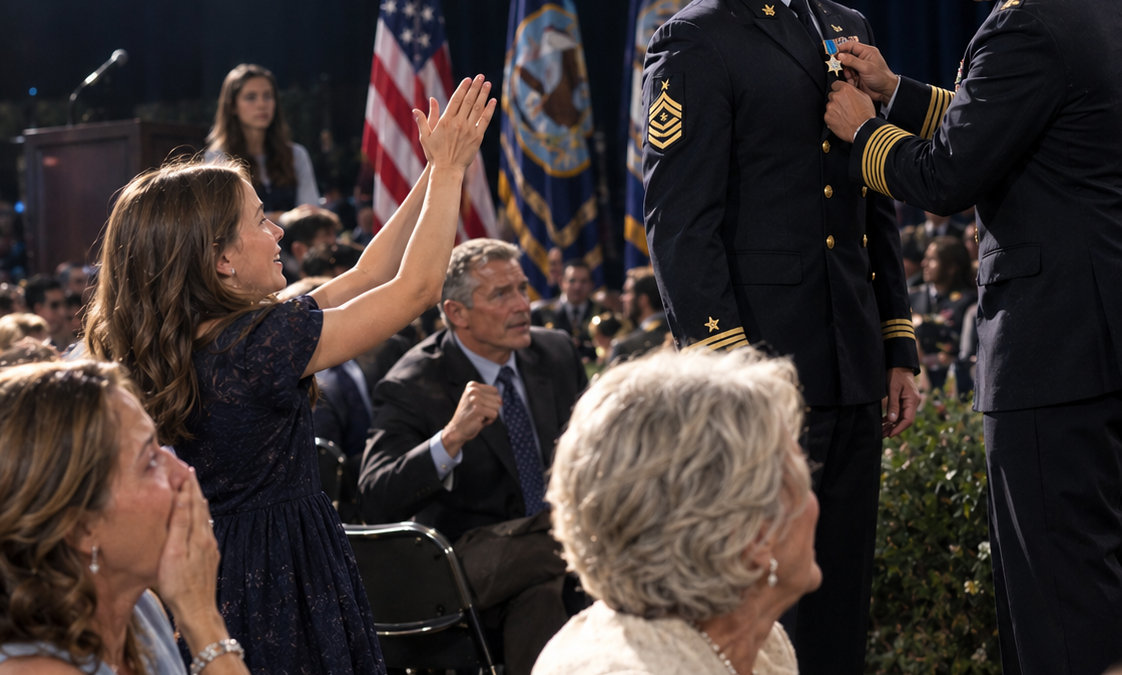
I walked into the bedroom and took off the uniform. I hung it in the closet. I put the medal in a drawer.
I sat on the edge of the bed and stared at the wall.
Eleanor came in and sat next to me.
“What are you thinking about?”
“The three men I couldn’t save.”
She didn’t say anything.
“Their names were Ramirez, Porter, and Gibbs. I didn’t know them well. They were attached to a different team. But I was the one who was supposed to get them out. And I didn’t.”
“Robert—”
“I’ve carried that for fifteen years. Every day. Every single day.”
She reached over and took my hand.
“You don’t have to carry it alone anymore.”
I looked at her.
“I don’t know how to do that.”
“Then let me teach you.”
The next morning, I woke up early.
I made coffee and sat on the back porch. The air was cool. Fall was coming.
My phone buzzed. A text from Carla.
Robert, I just wanted to say how proud I am of you. I had no idea. I’m so sorry for everything. Can we talk?
I didn’t respond.
Another text. This time from Phillip.
Robert, I owe you an apology. I’ve been a jerk for forty years. I didn’t know. I should have asked. I’m sorry.
I didn’t respond.
A third text. From Mark.
Robert, I don’t know what to say. I’ve been an idiot. You’re a hero. I’m sorry.
I didn’t respond.
I sat there and watched the sun come up.
Eleanor came out with a cup of coffee. She sat next to me.
“The family’s been texting me all morning. They want to apologize.”
“I know.”
“Are you going to talk to them?”
I thought about it.
“Maybe. Not yet.”
“That’s fair.”
She sipped her coffee.
“I talked to Mother last night. After the ceremony. She was… different.”
“Different how?”
“She was quiet. She didn’t try to make excuses. She just said she was wrong and she didn’t know how to fix it.”
I didn’t say anything.
“I think she means it.”
“I know she does. That doesn’t mean I’m ready to forgive her.”
“I know.”
We sat there in silence.
Then Eleanor said something I didn’t expect.
“I want to meet David Chen. When you go to San Diego. I want to come with you.”
I looked at her.
“Why?”
“Because I want to see that part of your life. I want to understand. And I want to be there for you.”
I thought about it.
“Okay.”
She smiled. It was a small smile. But it was real.
The next few weeks were strange.
I went back to work. I’d been working part-time at a hardware store for the past few years. It wasn’t much, but it kept me busy. The owner, a man named Frank Delaney, had been a Marine in Vietnam. He’d never asked me about my service. He’d just hired me and let me work.
The day after the ceremony, he pulled me aside.
“Robert.”
“Frank.”
“I saw the news. The ceremony. The medal.”
I didn’t say anything.
“You’re a SEAL.”
“I was.”
He looked at me for a long moment.
“I knew there was something about you. I couldn’t figure out what. But I knew.”
I didn’t say anything.
“I’m proud to know you.”
“Thanks, Frank.”
He clapped me on the shoulder.
“Get back to work.”
The story spread.
Someone from the ceremony had posted photos on social media. Someone else had written an article for a local news site. The headline was: “Local Hero: Virginia Beach SEAL Receives Navy Cross After 15 Years.”
I didn’t want the attention. But it came anyway.
People I hadn’t seen in years called me. People I’d never met sent me letters. A reporter from the Virginian-Pilot asked for an interview.
I turned them all down.
But the story kept spreading.
And the more it spread, the more I realized something.
The people who mattered weren’t the strangers. They were the ones who’d known me and never asked. The ones who’d assumed I was small. The ones who’d treated me like I didn’t matter.
They were the ones who had to live with what they’d done.
Lorraine came to the house two weeks after the ceremony.
She knocked on the door on a Saturday morning. I was in the kitchen making breakfast. Eleanor was in the garden.
I opened the door.
“Robert.”
“Lorraine.”
She was wearing a simple dress. No pearls. No jewelry. She looked older than I remembered.
“Can I come in?”
I stepped aside.
She walked into the kitchen and sat down at the table. I poured her a cup of coffee.
She held the cup with both hands.
“I’ve been doing a lot of thinking.”
“I figured.”
“I was wrong about you. I’ve been wrong about you for forty years. And I don’t know how to fix it.”
I sat down across from her.
“You can’t fix forty years, Lorraine.”
“I know.”
“But you can start.”
She looked up at me.
“How?”
I thought about it.
“By asking. By listening. By not assuming you know who I am.”
She nodded.
“I can do that.”
“Then we’ll see.”
She took a sip of coffee.
“Eleanor told me about David Chen. The man you saved. The one who wants to meet you.”
“Yeah.”
“That’s… that’s something.”
“It is.”
She set down her cup.
“I want to understand, Robert. I want to know who you are. Not the version I made up in my head. The real one.”
I looked at her.
“It’s not a happy story.”
“I know.”
“It’s not a clean story.”
“I know.”
“You might not like what you hear.”
“I know.”
I took a deep breath.
“Okay.”
She looked at me.
“Okay?”
“I’ll tell you. Not everything. But some of it. And you have to listen. Really listen. No judgment. No commentary. Just listen.”
She nodded.
“I can do that.”
I poured myself another cup of coffee.
And I started talking.
I told her about BUD/S. About the cold water and the sand and the men who quit. About the instructors who screamed in my face and the ones who taught me how to survive.
I told her about my first deployment. About the fear and the focus and the way the world narrowed to a single point.
I told her about the missions I could talk about. The ones that were declassified. The ones that had been written about in books.
I didn’t tell her about the ones I couldn’t talk about. The ones that were still classified. The ones that kept me up at night.
I told her about the men I’d served with. Tom and Marcus and Danny. The ones who were still alive. The ones who weren’t.
I told her about the compound. About the firefight. About the seventeen men I’d saved and the three I couldn’t.
When I finished, she was crying.
“I didn’t know,” she said. “I didn’t know any of that.”
“I know.”
“I’m so sorry, Robert. I’m so sorry for everything.”
I didn’t say anything.
“I know that doesn’t fix anything. I know it doesn’t make up for forty years. But I mean it. I’m sorry.”
I looked at her.
“I believe you.”
She wiped her eyes.
“Can you ever forgive me?”
I thought about it.
“I don’t know. Maybe. Someday.”
She nodded.
“That’s more than I deserve.”
Lorraine left an hour later.
Eleanor came in from the garden.
“How did it go?”
“It went.”
“That’s it?”
“She apologized. I listened. I told her I might forgive her someday.”
Eleanor nodded.
“That’s fair.”
“I know.”
She sat down next to me.
“The kids are coming over for dinner tomorrow. Marcy wants to make you a cake. She says it’s a celebration cake.”
I smiled.
“What’s she celebrating?”
“You. She says you’re a hero and heroes deserve cake.”
I laughed.
“That sounds like Marcy.”
“She’s proud of you, Robert. We all are.”
I looked at her.
“All of you?”
“All of us.”
That night, I couldn’t sleep.
I sat on the back porch and looked at the stars. The air was cool. Fall was coming.
My phone buzzed. A text from Tom Delgado.
Hey brother. Just checking in. How are you doing?
I typed back.
I’m okay. Figuring things out.
Good. That’s all any of us can do.
Yeah.
Hey Robert?
Yeah?
I’m glad you’re back. I missed you.
I stared at the message for a long time.
Then I typed back.
I missed you too.
I put the phone down and looked up at the sky.
Tomorrow, the kids would come over. Marcy would make a cake. Eleanor would be there. Lorraine would be there.
The family was trying.
It wasn’t enough. Not yet.
But it was a start.
PART 6 — THE CAKE
The kids came over on Sunday.
My son, Michael, arrived first. He was thirty-four. He worked in software in Richmond. He’d driven down for the weekend with his wife, Priya, and their two-year-old daughter, Rosa.
He walked into the kitchen and looked at me.
“Hey, Dad.”
“Hey, Mike.”
He stood there for a second. Then he hugged me. Michael hadn’t hugged me in ten years.
“I saw the video,” he said.
“What video?”
“Someone recorded the ceremony. It’s on YouTube. It’s got half a million views.”
I didn’t say anything.
“Dad, why didn’t you ever tell me?”
I looked at him. Thirty-four years old. Grown man. His own father.
“I couldn’t.”
“Couldn’t or wouldn’t?”
“Both.”
He nodded slowly.
“I get it. Sort of. I’m still processing.”
“Take your time.”
Priya came in with Rosa on her hip.
“Robert. That ceremony. I cried watching it.”
“Sorry about that.”
“Don’t be sorry. It was beautiful.”
Rosa reached for me. I took her. She was small and warm and smelled like baby shampoo.
“Papa,” she said.
“Hey, Rosie.”
She grabbed my nose. I laughed.
Marcy came in from the kitchen carrying a cake.
It was lopsided. The frosting was uneven. It said “CONGRATULATIONS DAD” in letters that got smaller as they went, because she’d run out of room on the right side.
“I made it myself,” she announced. “No help.”
I looked at it. I looked at her. Twelve years old, flour on her forehead, eyes bright.
“It’s the best cake I’ve ever seen.”
“It might taste weird. I used too much baking soda.”
“That’s fine.”
“Doesn’t matter,” Michael said. “We’re eating it anyway.”
Eleanor came in with plates. Lorraine arrived ten minutes later with a salad and a bottle of wine.
She stood in the doorway for a moment. Then she set the salad down on the table and said, “Robert, the cake looks wonderful.”
Marcy beamed.
Lorraine sat down. She didn’t say anything cutting. She didn’t make a face. She just sat.
It wasn’t much. But it was something.
Dinner was better than I expected.
Michael asked me questions. Real questions. Not polite questions. Questions he actually wanted answers to.
“What was the hardest part?”
“Not knowing.”
“Not knowing what?”
“If everyone made it home.”
He nodded.
“Did they? Most of the time?”
“Most of the time.”
Priya asked about the training. How long it took. How many made it through.
“About a hundred and fifty start BUD/S in my class. Twenty-eight graduated.”
“Twenty-eight out of a hundred and fifty.”
“Yes.”
“That’s a ninety percent failure rate.”
“Some people say eighty. Depends on the class.”
She looked at me like she was seeing me for the first time.
“You did that when you were twenty-two.”
“Yes.”
Rosa threw a piece of bread on the floor. Priya picked it up. The moment passed.
Lorraine asked one question the whole meal.
“How old were you when you first went overseas?”
“Twenty-two.”
“That young.”
“That was normal.”
She nodded and went back to her salad.
Then it happened.
We were eating cake. Marcy was watching me, waiting for my reaction to the frosting. It actually wasn’t bad. A little dry. Too much baking soda, like she said.
Lorraine set down her fork.
“Robert, I’ve been thinking.”
“Okay.”
“About the party.”
Eleanor stiffened. I saw it. She was sitting across from her mother.
“What about it?”
“I’ve been thinking that we should redo it. A proper party. Now that everyone knows.”
I put my fork down.
“Redo it.”
“Yes. At the country club. Or somewhere nicer. We could do it in October. The whole family would come.”
I looked at her.
“Lorraine.”
“Yes?”
“I don’t want another party.”
She blinked.
“But the last one was… it wasn’t right. It didn’t honor you properly.”
“The last one was exactly what it was. You didn’t know. You assumed. It’s not the party that was wrong.”
She stared at me.
“I don’t understand.”
I took a breath.
“You want to throw another party so you can feel better. So you can fix the last one. So you can point at it and say, ‘See, we did it right.'”
“That’s not—”
“It is. And I don’t want that.”
She looked down at her plate.
Eleanor said, “Mother, he’s not trying to hurt you.”
“I know.”
But Lorraine’s jaw was tight. The way it got when she was angry. Forty years of watching that jaw.
“I’m just trying to do something nice,” she said quietly.
“I know you are,” I said. “But the party isn’t the problem. The party was never the problem.”
She stood up.
“I think I should go.”
“Lorraine—”
“I’ll call you tomorrow, Eleanor.”
She picked up her purse. She walked to the door. She didn’t say goodbye.
The door closed behind her.
Marcy looked at me.
“Why is Grandma mad?”
I thought about how to answer that.
“She’s not mad at you, sweetheart.”
“I know. She’s mad at you.”
“Yeah.”
“Why?”
“Because I told her the truth. And the truth was harder than she wanted it to be.”
Marcy nodded, like that made sense. To her, it probably did.
Michael and Priya left at eight. Rosa was asleep on Priya’s shoulder.
Michael hugged me again at the door.
“Dad.”
“Yeah.”
“You okay?”
“Yeah.”
“Grandma will come around.”
I didn’t say anything.
“She’s been like that her whole life. You know that.”
“I know.”
“Call me if you need anything. I mean it.”
“Thanks, Mike.”
He left.
Eleanor did the dishes. I sat in the living room with Marcy, who was reading on the couch.
“Dad.”
“Yeah.”
“Are you sad?”
I looked at her.
“A little.”
“Because Grandma left?”
“Yeah.”
“Why do you care what she thinks?”
I thought about that one for a minute.
“Because for forty years, I wanted her to see me. And now she’s starting to. And I’m scared she’ll stop.”
Marcy set her book down.
“She won’t stop.”
“How do you know?”
“Because you’re not going to let her. You’re a SEAL. You don’t quit.”
I laughed.
“Who told you that?”
“Uncle Tom.”
“Uncle Tom?”
“He called last week. He said you were the toughest guy he ever met. He said you don’t quit anything.”
I looked at her.
“He said that?”
“He said a lot of things. He said you saved his life twice.”
I didn’t say anything.
“Dad.”
“Yeah.”
“I’m glad you don’t quit.”
I reached over and squeezed her hand.
“Me too.”
The next week, I went to San Diego.
Eleanor came with me. We flew out on a Thursday morning. The flight was five hours. I didn’t sleep.
David Chen met us at the airport.
He was in his late thirties. Korean-American. Tall. He was wearing a blue button-down and slacks. He looked like a doctor.
He saw me and stopped walking.
He stood there for a second. Then he walked over and shook my hand. He held it for a long time.
“Master Chief.”
“Robert.”
“I’ve imagined this moment for eleven years.”
“And?”
“It doesn’t feel real.”
I nodded.
“It doesn’t feel real to me either.”
He drove us to his house in La Jolla. It was a nice house. Two stories. Big windows. A view of the ocean.
His wife met us at the door. Her name was Sarah. She was a pediatrician. She had warm eyes and a firm handshake.
“Thank you,” she said. “Thank you for what you did.”
“I was doing my job.”
“No,” she said. “You weren’t.”
Their kids came running out. A boy and a girl, six and four. They were loud and happy and asked me if I was a soldier.
“Something like that,” I said.
David made dinner. We sat on the patio and ate and watched the sun go down over the water.
He told me about his life. Medical school. Residency. Meeting Sarah. The kids. He told me about his practice, his colleagues, his patients.
“I deliver babies,” he said. “That’s what I do now. I bring lives into the world. Every day.”
I didn’t say anything.
“I think about that compound sometimes. When I’m in the delivery room. When things get hard. I think about the man who came back three times. And I think: okay. If he could do that, I can do this.”
I looked at him.
“You’ve done more than I ever did.”
He shook his head.
“No. I’ve done different things. That’s all.”
We sat there in silence for a while.
Then he said something I didn’t expect.
“I looked up the other three.”
I set down my glass.
“What?”
“Ramirez. Porter. Gibbs. I looked them up.”
I didn’t say anything.
“They all have kids. Ramirez has a son in the Marines. Porter has a daughter who just graduated from college. Gibbs has two kids. Twins.”
I stared at the table.
“I found them,” he said. “Their families. I sent them letters.”
“When?”
“Five years ago.”
I looked at him.
“They wrote back. All three of them. They wanted to know who you were. They wanted to know if you were alive.”
I didn’t say anything.
“Master Chief—Robert. I still have their letters.”
He got up and went inside. He came back with a folder. Three envelopes. Handwritten.
He set them on the table in front of me.
“I didn’t open them,” he said. “They’re not mine. They’re yours.”
I looked at the envelopes.
I didn’t touch them.
“I don’t know if I can read them.”
“You don’t have to. Not tonight. But you should. Someday.”
I nodded.
I left them on the table.
That night, I couldn’t sleep.
I sat on the guest room bed and stared at the wall. Eleanor was asleep next to me.
I kept thinking about the envelopes.
Ramirez. Porter. Gibbs.
Their families.
Their kids.
I got up. I walked to the kitchen. I found the folder on the counter.
I took it back to the bedroom. I sat on the floor by the bed and opened the first envelope.
It was from Ramirez’s wife.
Dear Master Chief Hale — I don’t know if this will find you. I don’t know if you’re alive. I don’t know if you’ll want to hear from me. My name is Maria Ramirez. My husband was Sergeant Luis Ramirez. He was killed in the operation you led in Helmand Province on March 12, 2008. I want you to know that he loved his work. He loved his men. He loved this country. And he would have been proud to serve alongside you. I don’t know the details of what happened. I never will. But I know that Luis trusted his leaders. And I know he would have trusted you. I’m writing to tell you that. Not to blame you. Not to ask you questions. Just to tell you. I hope you’re well. I hope you have a family. I hope you have peace. — Maria
I set the letter down.
I opened the second one.
It was from Porter’s daughter.
Dear Master Chief Hale — My name is Emily Porter. My father was Master Sergeant Daniel Porter. He died in Afghanistan in 2008. I was nine years old. I’m twenty-four now. I’m writing because a man named David Chen contacted me and told me you saved his life. He told me you went back for my father. He told me you couldn’t get to him in time. I want you to know I don’t blame you. My father always said that in combat, you do what you can. You don’t do more. You do what you can. I think you did what you could. Thank you for trying. — Emily
I set it down.
I opened the third.
It was from Gibbs’s son.
Master Chief Hale — My name is Thomas Gibbs. My dad was Staff Sergeant Robert Gibbs. He died in Helmand in 2008. A doctor named David Chen told me you were there. He said you went back for my dad. He said you carried him a hundred yards before he died. I want to know if that’s true. I want to know if my dad died with someone holding him. That’s all I want to know. Please call me. — Tommy
I sat on the floor of a guest room in a house in La Jolla and I cried.
I hadn’t cried in fifteen years.
I didn’t stop for a long time.
Eleanor woke up.
She sat up and saw me on the floor.
“Robert?”
I didn’t say anything.
She came over and sat next to me. She picked up the letters. She read them.
She didn’t say anything either.
She just held me.
The next morning, I called Tommy Gibbs.
He answered on the second ring.
“Hello?”
“Tommy. This is Robert Hale.”
There was a long pause.
“Master Chief Hale.”
“Yes.”
“You’re alive.”
“I’m alive.”
Another pause.
“Did you hold my dad?”
I closed my eyes.
“Yes.”
“What did he say?”
I remembered. I remembered all of it. I remembered Gibbs’s face. I remembered the blood. I remembered the words he’d said to me.
“He said, ‘Tell my boy I love him.'”
Silence.
Then I heard him crying on the other end of the line.
“Thank you,” he said. “Thank you.”
“I should have called you years ago.”
“I know. But you called now.”
I didn’t know what to say.
“I’m going to come see you,” he said. “I want to meet you. I want to shake your hand.”
“I’d like that.”
He hung up.
I stood there in the kitchen and looked out at the ocean.
Eleanor came up behind me and put her hand on my back.
“You okay?”
“No.”
“That’s okay.”
I turned around and looked at her.
“I have to call Maria. And Emily.”
“I know.”
“Then I want to go home. I want to see Marcy.”
“Okay.”
I looked out at the water.
One more call. Then I could breathe.
 [Tap here for the Next Part ]