Billionaire Saw A Black Girl Return $50,000 She Found Then He Followed Her Home

Billionaire Saw A Black Girl Return $50,000 She Found Then He Followed Her Home
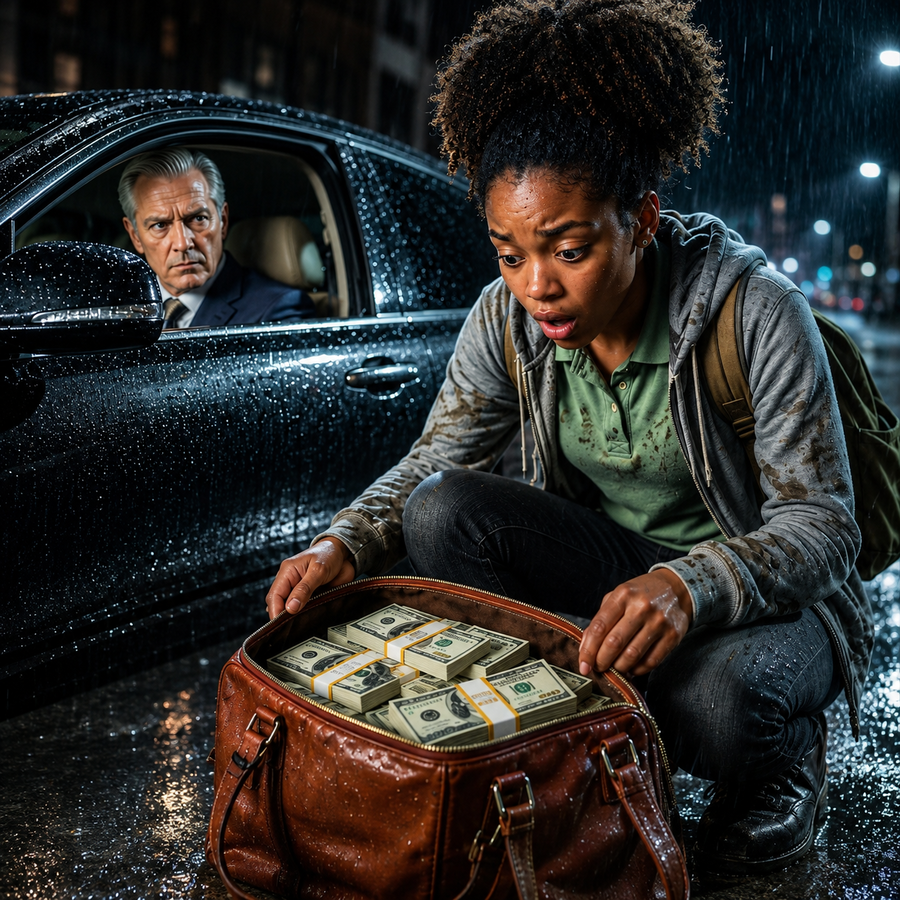
The rain had been falling since 4 in the afternoon and by the time Maya Johnson stepped out of the grocery store’s back entrance, the cold had already settled into the bones of the city.
She was 17 years old and she had the kind of tired behind her eyes that belonged to people twice her age. The kind that sleep could not fix because it did not come from exhaustion but from a life that asked too much of a person too young to carry it.
She pulled her uniform apron off and stuffed it into her bag without breaking stride. Turning up the collar of her thin jacket against the wind. The night shift ended at 9:00.
The bus home left at 9:15.
If she missed it, the next one wasn’t until 10:45 and her mother would lie awake in the dark worrying which was the one thing Maya could never afford to let happen.
The Eastside neighborhood where she lived was the kind of place that appeared in news reports only when something bad occurred there. The streets were narrow and the buildings were old.
And the people who lived there had learned to exist within the margins, to patch what broke, to stretch what was thin, to smile at neighbors they passed in hallways that smelled of mildew and cooking oil. Maya had grown up in apartment 411 of the Callaway Arms, a building whose name suggested a grander past.
The elevator had not worked in 3 years. The superintendent replaced it each season with a different excuse. By now, nobody asked anymore.
They simply climbed. Maya climbed every evening with her uniform smelling of bleach and her backpack full of textbooks and she never once let herself think about whether any of it was fair.
Her mother, Patricia Johnson, had been sick for 2 years.
The diagnosis had come on a Tuesday, read aloud in a doctor’s office that smelled of antiseptic and paper and it had rearranged their lives the way a flood rearranges a house completely with no respect for what had been there before.
Patricia had worked two jobs before the illness. Days at a laundromat, evenings cleaning office buildings downtown. Now, she worked zero.
The medications that kept her stable cost $140 a month after insurance, which was money that arrived in the apartment with considerable difficulty and departed it with great ease.
Maya’s younger brother, Darius, was 11 years old and in the sixth grade, and the other boys at his school had already begun to notice that his sneakers were the same pair he’d worn since September, and that his lunch was always a peanut butter sandwich, while theirs came from home in insulated bags.
Darius never told his mother or his sister about the comments, but Maya knew anyway because she had learned to read the particular silence a child carries when he has been made to feel small. She helped. She helped in all the ways that a 17-year-old with 15 hours of school per week and three afternoon shifts at the grocery store could help.
She helped Mrs.Caldwell on the third floor carry her shopping up when she saw her at the mailboxes. She helped by eating less than she was hungry for at dinner so that Darius could have the last of the rice. She helped by staying up until midnight with her algebra homework because she understood, with the clarity of someone who has no other options, that education was the only door that opened from the inside.
She helped, and she did not complain about it because complaining required a kind of energy she had decided to spend elsewhere. Three blocks away, in the back of a black sedan with tinted windows and a heated interior, Richard Coleman was on the phone with his attorney and not particularly interested in what the attorney was saying. Richard was 54 years old, the founder and chief executive of Coleman Technologies, a company that managed infrastructure software for 11 of the 30 largest banks in the country.
He was, by every measurable standard, a success. He was also, by most personal ones, a man in the middle of being hollowed out.
The lawsuit his attorney was describing involved a former executive vice president named Gerald Marsh, who had spent 4 years sitting at Richard’s right hand in board meetings, and another 18 months quietly siphoning client data to a competitor.
The betrayal had not
merely cost Coleman Technologies money. It had cost Richard the particular kind of trust that, once spent, does not return.
He had trusted Gerald. He had trusted his ex-wife, Claire, who had explained to him over a dinner at a restaurant they could both afford that she had married a man with ambition and found herself living with an institution. He had trusted, at various points in his life, other people whose names he now associated with legal filings and legal fees and the long low ache of having been wrong.
“We can settle by Friday,” his attorney was saying.
“It’s not ideal, but it’s clean.”
“Nothing about this is clean,” Richard said, and ended the call.
His driver, a quiet man named Franklin, navigated the sedan through the East Side on the way back from a site visit to a data center whose location had required them to pass through this part of the city. Richard had been in the back of this car for 11 years and had passed through neighborhoods like this one dozens of times and had, for most of those times, looked at them without truly seeing them.
Tonight, something made him look. Perhaps it was the rain.
Perhaps it was Gerald Marsh’s face, still vivid in his mind from the deposition that afternoon.
Perhaps it was simply the particular quality of 9:15 on a cold Wednesday, when a man who has been betrayed enough times begins to wonder whether there is a version of the world that is still capable of surprising him. He was looking out the window when he saw the girl.
She was coming around the corner of the parking lot adjacent to the grocery store, moving quickly, head down, and then she stopped. She crouched. She picked something up from near the base of a concrete post at the edge of the lot, and even from inside the car, Richard could see that it was a bag, a leather bag, medium-sized, the kind that held things of substance.
He watched her look around. He watched her open it. He watched her face in the thin orange light of the parking lot lamp, and what he saw there was not the careful blankness of someone making a decision they had already made.
It was something rarer than that, something that looked from 50 ft away through rain-slicked glass like a person being pulled in two directions at once. A young man in a green store apron came around the corner behind her. He stopped when he saw what she was holding.
He said something. Maya looked up at him, then back at the bag, then away at the street, at the sky, at something Richard could not see.
The young man spoke again, gesturing with his hands. Maya shook her head once, slowly. And the young man raised his arms in the universal gesture of someone who cannot understand the choice being made in front of him.
Then Maya closed the bag, tucked it under her arm, and began walking. Not toward the bus stop, in the other direction, toward the police station, four blocks north.
Richard sat forward.
“Franklin,” he said, “follow her.”
The bag contained $50,000 in cash, bound in rubber-banded stacks of $100 bills. Maya had counted it twice, kneeling on the damp asphalt with her fingers shaking, partly from the cold and partly from something that was not cold at all.
She had looked at the money and thought of her mother’s medication, and thought of the electric bill that was 43 days past due, and thought of Darius’s sneakers, and thought of the heating unit in the apartment that rattled and groaned and according to the landlord was not the
landlord’s responsibility to fix.
She had thought all of these things in approximately 15 seconds, which was how long it took her to go from discovery to standing. Then she had stood up.
Then she had thought of who she was and who she had decided to be. And those two things had weighed more than $50,000.
They had always weighed more. She did not fully understand why. She only knew that they did.
Marcus, her co-worker, had looked at her like she was the strangest thing he had ever encountered.
“Maya,” he said, “nobody has to know.”
“I would know,” she said.
She walked the four blocks to the East Side Precinct with the bag under her arm and the rain coming down in a fine, cold mist. And the $50,000 pressing against her ribs in a way that felt significant and final. Inside, she placed the bag on the front desk and told the officer on duty what she had found and where she had found it.
The officer, a heavy-set man named Sergeant Brooks, who had been processing paperwork for 6 hours and expected nothing remarkable from the remainder of his evening, looked at her for a long moment. Then he opened the bag.
Then he looked at her again.
“You didn’t have to bring this in,” he said.
“Yes, I did,” Maya said.
“There’s a finder’s fee if the owner doesn’t claim it within 90 days, a portion.”
“I don’t want anything,” Maya said.
She was already turning toward the door.
“Just make sure it gets back to whoever lost it.
” Sergeant Brooks watched her go.
Then he looked at the bag on his desk. Then he did something he had not done in the four years he had been stationed at the East Side Precinct.
He wrote the incident up with a note attached that read, simply, “This girl was extraordinary.”
Richard Coleman, sitting in his car half a block from the precinct entrance, had watched Maya walk in. He had watched her walk out 7 minutes later, without the bag, without anything in her hands, moving at the same brisk, purposeful pace as before. She had not looked around to see if anyone was watching.
She had not paused to feel significant. She had simply done the thing she came to do and resumed the direction of her life. Richard sat in the car for another minute after she turned the corner.
Franklin said nothing. Franklin had learned in 11 years when not to say anything.
“Take me home.”
Richard finally said.
And then, a moment later, “No.
Follow her. From a distance.
I want to see where she lives.”
He would think later about that instruction, about the precise moment when curiosity became something more purposeful, when the simple act of watching a girl return $50,000 became the first step in a much longer journey. At the time, he told himself it was just curiosity.
At the time, he was probably wrong. The Callaway Arms looked, in the rain and the dark, exactly like what it was, a building that had been promised something better and never received it.
Richard looked at the crumbling facade, at the windows where light leaked around the edges of curtains, at the front steps where someone had attempted to repair a cracked concrete riser with a piece of plywood that was now warped and soft from weather. He looked at all of this through the car window and said nothing because there was nothing adequate to say. He had passed buildings like this one his whole life.
He had simply never stopped to think about the people inside them. Not their specific gravity. Not the weight of what they carried up those stairs every evening.
Not the precise dimensions of a life lived between the cost of medication and the cost of keeping the lights on. He told Franklin to park.
He sat for another hour.
Through the window of apartment 411, he could see the glow of a single lamp and once, the silhouette of a woman moving slowly across the room, and then Maya’s profile as she stood at what must have been the kitchen counter, and then nothing.
Just the light and the rain and the long dark of the city doing what cities do. He did not know what he was looking for.
He only knew that something in him, something that had been going quiet for years, rusted shut by disappointment and litigation and the accumulated evidence of other people’s selfishness had been struck, lightly but precisely, like a tuning fork, and was humming at a frequency he had not heard in a long time.
He thought, sitting in that car, about the particular texture of his own wealth. Not the abstract number of it, not the figure on a quarterly report, but the physical reality of what it meant on an ordinary day.
It meant a heated car in a cold rain. It meant that when something in his apartment broke, a person arrived within the hour to fix it, and he never had to think about who that person was or how they had spent the rest of their day. It meant that the worst things that happened to him happened in conference rooms and courtrooms, not in kitchens or hospital waiting rooms, and that even there, he was surrounded by people whose entire professional purpose was to absorb the damage on his behalf.
He had never questioned any of this. It was simply the texture of his life.
The way cold was the texture of Maya Johnson’s.
He sat with this thought long enough that it stopped being comfortable, which was probably the first time in many years that a thought had managed to do that. The lamp in 411 went out at 10:47.
The building’s single security light, mounted above the entrance, buzzed and flickered in the rain.
Richard told Franklin to take him home. In the car, Franklin asked nothing. Richard offered nothing.
But somewhere between the Calloway Arms and the Glass Tower where he lived, something had shifted quietly, irreversibly in the architecture of what he understood himself to owe the world. He came back the next morning differently dressed.
He had sent Franklin home and taken a cab to a thrift store on Western Avenue where he purchased a canvas jacket, worn jeans, and a pair of scuffed boots. It was not a sophisticated disguise.
It was simply the clothing of someone unremarkable, someone who would not be noticed outside a grocery store in the Eastside, which was exactly what he needed. He sat on the low wall across from the store entrance for 40 minutes.
And then Maya came out on her break carrying a paper bag with her lunch. And she sat on the same bench she apparently sat on every day in the cold eating a sandwich. He approached her with his hands in his pockets and what he hoped was an expression of sufficient harmlessness.
He had not spoken to a stranger in this way without the buffer of his name, his title, his office in longer than he could clearly remember.
“Excuse me,” he said.
“I’m sorry to bother you.
Is that bench, could I sit?”
Maya looked up at him, assessed him the way people who have grown up in places like Eastside learn to assess strangers, and slid to one end.
“It’s a free bench,” she said.
He sat. They were quiet for a moment.
He was trying to figure out how to manufacture a natural conversation and was not succeeding. Maya finished half her sandwich and glanced at him sideways.
“You hungry?”
she said. He blinked.
“What?”
“You keep looking at my sandwich.
I’ve got another half.”
She held it out without waiting for his answer. And the gesture was so direct and so entirely without performance that something in his chest moved in a way he had not been prepared for.
He took the sandwich. He ate it. It was turkey and mustard on bread that had been bought from the day-old rack, and it was the best thing he had eaten in months, which said something he would have to think about later.
When he handed her back the wrapper, he said, “You didn’t have to do that.”
Maya shrugged.
“My mom always said you share what you have, even when you don’t have much.”
She paused.
“Especially then.”
The temperature dropped as they sat, and Richard noticed the jacket she was wearing. Thin canvas, no lining, the collar turned up against a wind it was not designed to resist.
Without planning it, without any strategy at all, he said, “You should have a warmer coat than that.”
Maya looked at him, and something in her eyes was not offended, but simply honest.
“I know,” she said.
“It’s on the list.”
She stood, gathered her trash, and headed back toward the entrance. She stopped and turned.
“You get cold, the store’s warm.
They don’t mind if you sit in the front corner for a while.”
Then she went inside, and Richard sat on the bench in his thrift store jacket, and felt, for the first time in a very long time, that he had been seen by someone who was not looking for anything from him. That evening, back in his office, on the 22nd floor of the Coleman Technologies building, one of his senior directors, a sharp-faced man named Victor Hale, knocked and entered without being asked.
Victor had been with the company for 9 years, and had built, over those 9 years, a careful architecture of loyalty that was, upon closer inspection, made entirely of self-interest.
“I heard you were in the East Side yesterday,” Victor said.
“And today, one of the drivers mentioned it.”
“Franklin is the only driver I use,” Richard said, without looking up.
“Regardless, people are curious.
You were seen near the precinct, and then near some apartment building, and now apparently near a grocery store. He paused.
Is there something going on I should know about?
“No.”
Richard said.
“There’s a girl.”
Victor said. It was not a question.
His sources were evidently thorough. Young, black, works at the store. He allowed a small, careful smile.
“Richard, you know how it looks.
It doesn’t look like anything.
” Richard said.
And this time he did look up.
And if I hear that you’ve said anything to anyone about this, I will consider that a significant violation of the trust I’ve extended to you.”
He held Victor’s eyes for a moment.
“You may go.”
Victor went. But the particular way he left, the controlled movement of a man storing information for later use, was something Richard should have paid more attention to.
He knew how to read people when they were in front of him. The problem was that he had spent too many years trusting the people around him to behave like people, rather than instruments.
And the lesson had not yet fully taken hold. The discovery came 3 weeks later during a routine audit of historical HR records that Richard had ordered as part of the internal cleanup following the Marsh lawsuit. A name appeared in a file from 7 years ago.
Marcus Johnson, an IT technician, middle level, terminated for alleged misappropriation of proprietary data. The termination had been swift and undocumented in the ways that mattered. No formal no legal proceedings, just a letter and a security escort, and a man who had worked for Coleman Technologies for 6 years walking out of the building with a box of his belongings on a Tuesday afternoon.
The accusation had come from a senior director who had been in charge of the IT division at the time. Richard looked at the name of the director and his stomach turned. The name was Victor Hale.
He dug deeper because Richard Coleman, whatever his failures as a husband and a human being, had never been afraid of what he might find when he started looking. What he found was this. Marcus Johnson had not stolen anything.
The data transfer logs that Victor had cited in the termination letter had been misrepresented, timestamps altered, file sizes inflated, the whole thing constructed with the kind of careful attention to detail that only becomes visible when you know what you’re looking for.
Victor had needed a scapegoat for a data breach that had in fact been his own error, and Marcus Johnson had been available, middle-level, and in possession of no particular protection. Marcus had lost his job. He had lost his reputation.
He had, according to a brief employment record that Richard found in a subsequent search, never worked in technology again. He had died 4 years later of a heart attack in a hospital at the age of 41.
Maya Johnson. Marcus Johnson.
The math was not complicated. Richard sat with this knowledge for 2 days before he did anything.
He sat with it the way you sit with something that has the potential to change the structure of your life carefully, at a distance, feeling the edges of it before you decide to pick it up. He had not known Marcus.
He had not ordered his firing. He had been, by the standards of the law and perhaps of a narrow moral accounting, uninvolved.
But he had built the company. He had hired Victor Hale. He had created the environment in which a man like Victor could do what he had done.
And Maya Johnson was making sandwiches on a day-old bread rack and going home to a sick mother in a building with broken stairs, and these two facts were related. He could not unknow this.
He was still sitting with it when Victor made his next move. The accusation appeared first as a rumor, the kind that travels through an organization via tone and implication before it arrives in formal language.
By the time it reached Richard, it had already reached the store manager at Maya’s workplace.
That a young woman named Maya Johnson had been observed taking merchandise without paying. That there was camera footage.
That an investigation was pending. There was no footage. There was no investigation.
Not a real one. There was only Victor Hale who had decided that the most efficient way to prevent whatever Richard was doing from becoming a problem was to eliminate the person at the center of it. Maya was fired by phone call on a Thursday afternoon, given 10 minutes to collect her things, and escorted out by a manager who looked as though he would rather be anywhere else.
Two days later, a letter arrived at apartment 411 of the Callaway Arms from their landlord. 60-day notice to vacate. No reason given.
Richard would later confirm that the landlord had received a call from a business contact about certain code violations that, if reported to the city, would trigger an inspection. The call had come from a number registered to a holding company that traced back through three layers of corporate structure to a subsidiary that Victor controlled.
Maya sat on the floor of her kitchen with the letter in one hand and the phone call she had just received replaying in her head. And for the first time in 2 years of carrying everything, she cried. Not quietly.
Not privately. But with the full force of everything she had been holding.
The sound of it absorbed by the thin walls.
And the sound of Darius’s footsteps stopping outside her door.
She pressed her back against the cabinet and let it come. Darius pushed the door open and sat next to her without saying anything.
And that was worse and better simultaneously.
“I did everything right.”
She said. Not to him specifically.
To the room. To whoever was keeping score.
“I did everything right.
And it’s still Why is it still” She couldn’t finish.
Darius put his head on her shoulder and she let him, and outside the rain had started again because it was that kind of season. Richard arrived at the Calloway Arms the following evening. Not in the thrift store jacket, but in his own coat, in his own car, with no disguise and no strategy except the truth.
He had spent 48 hours doing what he did when he needed to understand a problem completely, gathering information, tracing connections, documenting everything. He had also at some point during those 48 hours stopped thinking about this as a problem to be managed and started thinking about it as a debt that needed to be paid.
These were different things. The first was professional.
The second was personal. Maya opened the door and looked at him for a long moment. She recognized him or recognized something, perhaps the quality of stillness in his face, the way it differed from the careful shuffle he had performed on the bench outside the store.
She had always been better than most people at reading the difference between a person’s surface and their actual center.
“You’re not who you said you were,” she said.
It was not a question.
“No,” he said.
“I’m not.”
He told her everything in the apartment’s small living room with Patricia resting in the bedroom and Darius pretending to do homework at the kitchen table and clearly hearing every word.
He told her about seeing her at the parking lot, about the police station, about following her home. He told her about the thrift store jacket and the bench and the sandwich she had shared with a man she believed was nobody.
And he watched her face move through surprise and anger and something harder to name. And then he told her about the audit, about the file from 7 years ago, about Marcus Johnson and Victor Hale and what had been done and the particular silence that follows the arrival of a truth that has been absent for so long, it has become part of the landscape. Maya did not speak for a long time.
When she did, her voice was level, which was more frightening than if it had not been. You knew, she said.
Not then, but now you know. A pause.
And my father lost everything. Your father lost everything, Richard said.
And I cannot fix that. I can only You followed me. The anger was there now, clean and direct.
You watched my home. You let me think you were someone sitting in the cold with nowhere to go, and I gave you half my sandwich, and you were You were testing me? Yes, he said.
Because there was no version of this that did not include that admission. I was. And I am not proud of it.
You don’t get to feel sorry for us.
She stood, and her posture was not the posture of a 17-year-old girl in a difficult situation. It was the posture of someone who has been carrying things for a long time and knows precisely what she can and cannot afford to set down.
We’re not a charity case.
My father worked. He was honest.
He was better than anyone who decided to throw his name away to protect their own mistake. Her voice broke at the end of this, only slightly, and she pressed it back into place.
And now we’re going to lose the apartment.
And I lost my job. And you want to what? Write a check and feel better about it?
No, Richard said quietly. I want to fix what was broken.
If you will let me. The silence between them was long and had texture, had the weight of everything that had happened to that family, and the accumulated cost of it, and the question of whether any amount of effort from any direction could begin to address the magnitude of what had been done. Richard sat in it without flinching.
He had earned the discomfort, and he knew it.
I don’t know what letting you means, Maya finally said.
It means letting me open the file, he said.
“Officially, in court, in the public record, so that what was done to your father becomes documented fact, and his name comes out of it the way it should have been all along.
” Patricia Johnson, who had been very quiet in the doorway for the last several minutes, said, “You do that for Marcus?”
Richard turned to look at her.
“I’d do it because it’s right,” he said.
“And because it’s long overdue.”
The legal proceedings that followed moved with a particular momentum of things that have been dammed up for a long time and finally find their channel.
Richard’s attorneys filed a motion to reopen the Johnson termination case within a week of that conversation.
The altered data transfer logs were analyzed by three independent forensic experts who agreed, in language that left no interpretive room, that they had been manipulated after the fact.
Victor Hale, confronted with this finding in a conference room on the 18th floor of Coleman Technologies, remained calm for approximately 4 minutes, and then stopped being calm in a way that Richard’s lead attorney later described
as instructive.
The termination of his employment was immediate. The criminal referral to the district attorney was filed the same afternoon.
The hearing was held on a Thursday in March in a courtroom that smelled of old wood and institutional cleaning products, and Maya sat in the third row with her mother’s hand in hers and her brother on her other side and a photograph in her jacket pocket.
A photograph of her father in his work badge taken in the first year of his employment at Coleman Technologies when he had come home and showed it to Patricia and said this was the beginning of something good. She had carried the photograph since she found it in a box in the closet at age 12, not fully understanding it, keeping it the way you keep something that feels important before you know why. Richard Coleman took the stand and said what he needed to say.
He said it clearly, without the hedging language that corporate executives develop as a kind of professional reflex, without qualifications or distancing mechanisms. He said that Marcus Johnson had been wrongfully terminated. He said that the process had been corrupt.
He said that he had not known at the time and that not knowing had not protected Marcus or his family from the consequences of what was done in the company’s name and that he was sorry not in the legal sense, not as a liability management strategy, but in the plain and human sense of a person who understands that the world subtracted something from a family that it had no right to take.
The courtroom was very quiet while he spoke. Maya watched him from the third row and found, to her considerable surprise, that she believed him.
The judge’s ruling came that afternoon.
Marcus Johnson’s termination record was expunged.
The official finding of misconduct was transferred from his name to Victor Hale’s.
The civil judgment that followed awarded the Johnson family a settlement that Patricia wept over in the parking lot outside the courthouse, leaning against the car with her hand over her mouth, saying, “Marcus.
Marcus.”
Quietly. Like an address she had almost forgotten.
Maya held the photograph and did not try to stop the tears and Darius stood with his hands in his pockets and looked at his shoes and then looked at the sky and then at his sister. And something old and tight in his face loosened in a way that made him look, for the first time in a long time, like a kid.
The photograph was not a professional portrait. It was a candid shot, slightly out of focus at the edges, taken in the break room of the Coleman Technologies building on a day Maya did not know the date of.
Her father was laughing at something off to the left of the camera, a real laugh, not the kind people perform when they know they are being photographed, but the involuntary kind, the kind that arrives before you can manage it. He was wearing a blue polo shirt and his employee badge was clipped to his collar and he looked in that moment like a man who believed in the place where he worked, who believed in the future he was building there, who had not yet had that belief methodically dismantled by the calculated dishonesty of a man who needed someone to blame.
Maya had carried that photograph for 5 years without fully understanding what she was preserving. Now she understood. She was preserving the version of her father that existed before the world decided his integrity was an inconvenience.
She was keeping him whole. Richard was standing near his car on the other side of the lot watching the Johnsons without approaching and he felt at that distance the full weight of what had been taken from them and from him simultaneously.
From them, a husband and a father and 7 years of a life that should have been different.
From him, the knowledge of what had been done in his company’s name.
The knowledge that ignorance had not absolved him had simply meant that the debt accumulated unseen. He had learned in the weeks since opening the file that there were different kinds of culpability. The kind that required intent and the kind that required only the refusal to look closely enough at what your power made possible.
Victor Hale had the first kind. Richard had been living in the second kind for years and the discovery of it was not comfortable but it was honest and honesty was the only currency he had left that still meant something.
He waited because he had learned in the past months how to wait. How to be present without imposing presence which was a different skill than any he had previously needed. Maya looked up across the lot and their eyes met.
She crossed the distance between them and he did not look away. He would have been 52 this year, she said.
My dad. I know, Richard said. I looked it up.
She nodded once, with the gravity of someone acknowledging something that cannot be undone, but can at least be acknowledged.
You can’t give us back what we lost, she said.
No, but you did the next thing. She put the photograph back in her pocket. That matters.
In the months that followed, the changes at Coleman Technologies were the kind that become visible slowly, the way a landscape changes with the seasons, not all at once, not dramatically, but in the accumulation of many small decisions that point consistently in a direction. Richard restructured the HR protocols.
He implemented independent review processes for any termination at or above a certain level of seniority. He hired an ethics officer who reported directly to the board, not to him. He also established a scholarship foundation, the Marcus L.
Johnson Foundation, designed to support students from the East Side and similar neighborhoods who were pursuing degrees in technology and engineering. The first cohort of recipients was announced in June. Maya was not on the list because she had told Richard, directly and without apology, that she would apply through the normal process and be evaluated by the same standard as everyone else.
He had tried not to smile and had not entirely succeeded. She was accepted the following autumn to a university with a strong computer science program on the basis of her grades and her application essay, which a counselor later described as the most honest thing she had read in 20 years of reading application essays. In it, Maya had written about the night she found the bag and about the moment on the parking lot asphalt when she had understood that the choice she made was not really about the money at all.
It was about who she would be when the money was no longer the question, when it had been returned, and she was walking home in the rain without it, and still had to live inside her own skin for the rest of her life. She wrote that the hardest thing about integrity was not the decision itself, but the aftermath of it. The way the right choice often makes nothing easier.
The way it demands that you commit to something invisible, something that doesn’t pay the electric bill, or fix the heating unit, or keep the landlord from sending letters.
She wrote that she had chosen it anyway, and that she would choose it again. And that she was not entirely sure whether this made her admirable or simply stubborn, but that she had decided those two things might be the same.
Patricia Johnson’s health stabilized over the winter, aided by access to a specialist and a treatment plan that the settlement made possible.
She went back to work in the spring, not at the laundromat, not cleaning offices, but as a coordinator for a community health organization in the East Side that matched low-income families with medical She was, her supervisor said at the end of her first month, the best hire they had made in a decade. Maya heard this and thought of her father, and felt, alongside the grief that never quite left, something she could only call pride. Not for herself, but for the fact that her family had made it through a thing that was designed to break them, and had arrived on the other side still themselves.
Darius got new sneakers in February. He mentioned this once casually to Maya, and then did not mention it again, which was the most Darius thing he had ever done. Richard Coleman did not become a different person.
That was not how people worked, and he was old enough to know it. He became rather a more honest version of the one he already was, more willing to sit with discomfort, less certain that efficiency was the same thing as correctness, more aware of the particular blindness that comes with power, the way it allows you to look directly at a system you have built and not see its consequences for the people at its edges.
He still ran a company. He was still, by temperament, a person more comfortable with data than with conversation, but he had learned something in those months of watching and following and being wrong about what watching and following would teach him, and the learning had left a mark.
On the afternoon of Maya’s graduation from high school, a ceremony held on the football field of a school she had attended for 4 years while working three evenings a week and maintaining a grade point average that her teachers still mentioned when they talked about the students they Kamsler remembered Richard sat three rows behind the Johnson family and watched without announcing himself.
He had received an invitation left in an envelope at his building’s front desk written in Maya’s careful hand.
He had not been sure he would come. He came. Afterward, in the parking lot, where the air smelled of early summer and the families were taking photographs and the graduates still wore their gowns Maya found him standing near the edge of the crowd, which was where she had learned he preferred to be.
“You didn’t have to sit all the way back there,” she said.
“I didn’t want to intrude,” he said.
She looked at him for a moment then she said “I want to ask you something.
Not as a question about the company or the foundation or any of that.”
She paused.
“On the night I found the bag before you followed me what were you actually thinking?”
He considered it honestly which was the only way she would accept an answer.
“I was thinking that I had stopped believing that kind of person existed,” he said.
“Someone who would do that in those circumstances.”
He looked at her.
“I was thinking that maybe I had made an error in my understanding of people.
A significant one.”
Maya nodded. She was quiet for a moment looking at the crowd of families at her mother talking to another woman, at Darius attempting to look dignified in his graduation gown, and failing in a way that was entirely endearing.
“Can I tell you something?”
she said.
“Of course.”
“It wasn’t easy,” she said, “returning the money.
I want you to know that.
People think I’ve heard how they talk about it, like it was simple, like I’m some kind of” She stopped, started again.
“I stood in that parking lot, and I thought about my mother not getting her medicine.
I thought about my brother.
I thought about how $50,000 would actually feel in your hands when you’ve been eating sandwiches made with day-old bread.”
She paused.
“And I still brought it back.
But it cost something. I need people to know that. That doing the right thing sometimes costs something, and you do it anyway.
Not because it doesn’t cost anything, but because the other price, the one you pay when you look at yourself and you can’t recognize who you are anymore, that price is higher.”
Richard was quiet for a long time. The noise of the graduation crowd moved around them like water.
Finally, he said, “You’re going to do extraordinary things.
” “Maybe,” Maya said.
She almost smiled.
“Or maybe I’ll just do ordinary things with a lot of integrity.
I think that might be enough.”
She looked at him with the directness that had been there since the first moment, since the bench and the sandwich and the cold, the quality of attention that did not look through people but at them.
“I think that might actually be more than enough.”
He walked to his car across the parking lot with the late afternoon sun on the back of his neck, and the sound of the ceremony still echoing from the field.
And he thought about what she had said, and he thought about Marcus Johnson at 41 in a hospital bed, and about Victor Hale’s controlled exit from a conference room, and about Gerald Marsh’s face in the deposition, and about Claire’s voice in the restaurant, and about all the various ways a person could travel through a
life making the wrong kinds of calculations.
And then he thought about a girl on a wet parking lot in the East Side counting money she had already decided not to keep and walking four blocks in the rain to return it. He thought about that for a very long time.
There is a photograph on the wall of the Marcus L. Johnson Foundation office taken at the first scholarship reception the following January. In it Richard Coleman stands at one end of a row of eight students who represent the inaugural class of recipients.
Maya Johnson stands at the other end. She is wearing a sweater that is neither expensive nor inexpensive and her expression is the kind that belongs to a person who has arrived at a place through means she understands completely and does not need to perform gratitude about. She is simply there fully present, neither diminished by where she came from nor inflated by where she is going.
Between her and Richard the six other students are grinning in various ways the particular grin of young people who have been told that something is possible and have begun to believe it. Richard is not grinning. He is looking down the row at Maya with an expression that is not pride exactly or not only pride but something that encompasses pride and grief and relief and the particular knowledge of a man who spent many years closing himself to the world and then at 54 in the rain in the back of a car had the door opened from the outside by someone who did not know she was doing it and who had not done it for his benefit but simply because that was the kind of person she was and that was the kind of thing she did.
She had told him the last
time they spoke before the reception what she had told no one else that on the walk home from the police station that night in the rain without the $50,000 she had cried a little. Just for a block.
Not from regret, she was certain about that. Completely and permanently certain. But from the simple weight of it.
The feeling of having made a choice that was right and hard simultaneously. And of walking back into a life that had not changed because of the rightness of the choice. She had dried her face before she got to the building.
She had climbed the stairs. She had told her mother nothing. She had stood at the kitchen counter making tea.
And she had looked at her own hands and thought, “This is who I am.”
And it was enough.
“If you’d kept the money,” Richard had said, “none of this happens.
Your father’s file stays closed.
Victor stays where he is.”
“I know,” Maya said.
“But that’s not why I returned it.”
“I know,” he said.
“That’s the thing I can’t quite” He stopped.
“Most people would say you should have kept it.”
“Given everything.”
“Most people,” Maya said, “are measuring with the wrong unit.”
She picked up her bag from the chair beside her.
“If I lose my integrity, then no matter how much money I have, I’m still poor.
That’s not a figure of speech.
That’s just math.
” She said goodbye and walked out of the office and down the hall.
And Richard sat in the chair across from where she had been sitting and looked at the empty space and felt something he had not felt in years, possibly decades. The specific lightness of a man who has been wrong about the most important thing and has been given, against all reasonable expectation, the opportunity to be wrong differently, to make the error of his life into something that opens rather than closes, that gives rather than takes.
He sat with it carefully. The way you hold something you are not sure yet you deserve to hold. And he thought that this too was probably the right kind of math.
He thought about what it meant to live a life organized around the wrong measurements.
He had spent three decades measuring loyalty by how long people stayed and intelligence by how much they earned and worth by the number of buildings that bore his company’s name.
None of those measurements had protected him from Gerald Marsh or Victor Hale or the slow erosion of a marriage to a woman who deserved at minimum a husband who came home as a person rather than a set of quarterly projections. But a 17-year-old girl in a rain-soaked parking lot with nothing but the weight of her own character to guide her had made a decision in 30 seconds that had more integrity in it than most of the decisions he had made with the full resources of a legal team and a board of directors at his disposal.
This too was
worth sitting with. Outside, the city moved through its afternoon indifferent and various and full of its ordinary miracles the people passing through it choosing in the small ways that add up in the end to everything.
A girl who returned money she desperately needed. A man who followed her into the truth of what he had built.
A father’s name restored to the record.
A family changed not by luck but by the accumulated weight of choices made in parking lots and police stations and apartment kitchens and courtrooms. Choices that cost something real and were made anyway because some people have decided quietly without announcement in the unremarkable middle of an ordinary evening that this is who they are and that is enough. It has always been enough.
THE END.