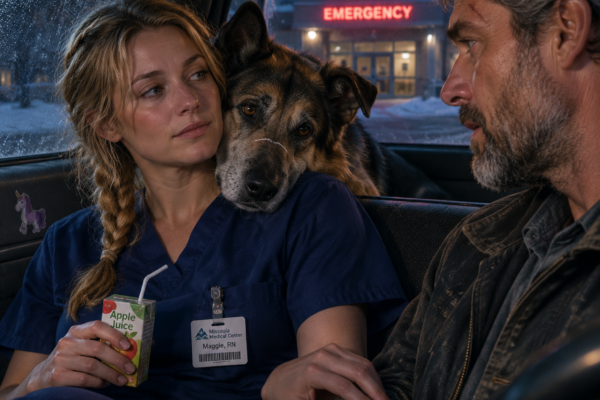
Exhausted Caregiver Fell Asleep in a Navy SEAL’s Truck—He Didn’t Wake Her. What His K9 Did Next..
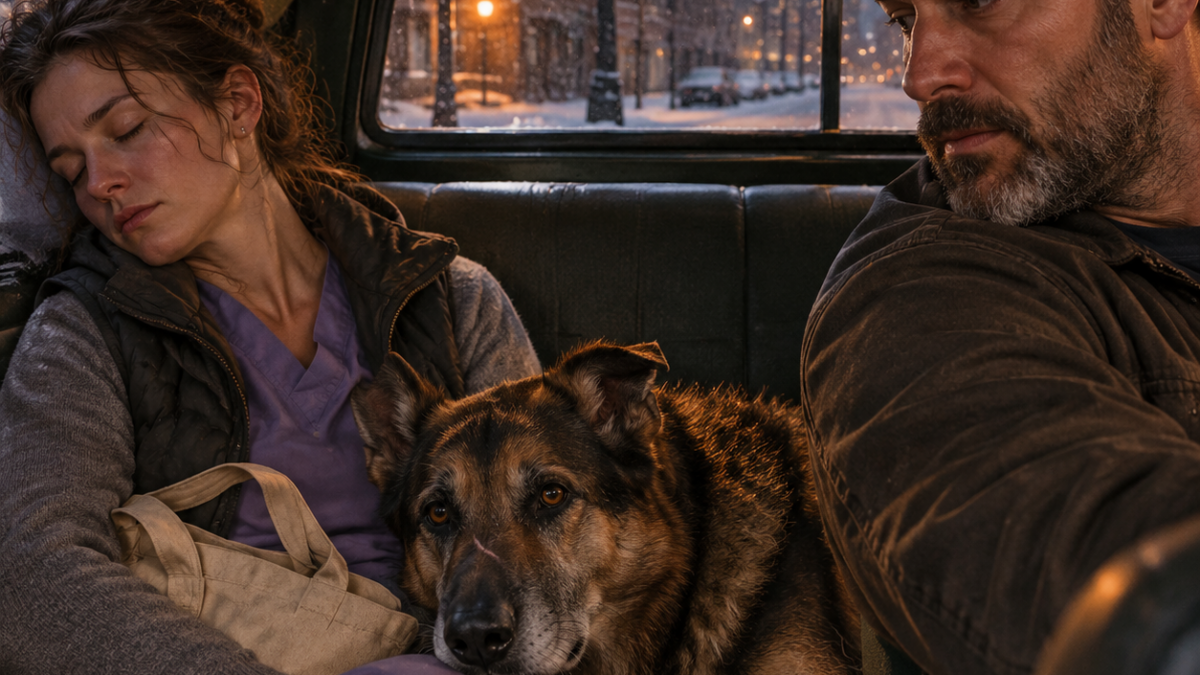
Exhausted Caregiver Fell Asleep in a Navy SEAL’s Truck—He Didn’t Wake Her. What His K9 Did Next..
At a quarter to six on a freezing February morning, after 23 hours on her feet, a young caregiver in lavender scrubs climbed into the backseat of the wrong truck, gave an address, and fell asleep before the door was even closed. The truck belonged to a retired Navy SEAL on his way to the airport to catch the flight he had been waiting two years for. He turned around to wake her, and his old German Shepherd—a war dog who had never let a stranger touch him—laid his head in her lap and growled softly at his own handler: let her sleep.
So he did. He missed his flight and drove slow circles through the snow until the sun came up. And when she finally climbed out, his dog picked up the little notebook she had dropped on the floor and carried it to him—inside, in careful handwriting, were notes about an old man, his checkers games, his soup, his pills, and the old man was the SEAL’s own father.
If you enjoy stories of loyalty, hope, and second chances, please subscribe and help us reach 1,000 subscribers; your support keeps these stories alive.
Late February snow had turned Pittsburgh into a city of gray and gold. It fell slow and steady over the three rivers, over the old steel bridges and the steep narrow streets of the South Side, catching in the orange glow of the streetlights before dawn. At a quarter to six in the morning, a dark green pickup truck sat idling at the curb outside an all-night pharmacy on Carson Street, its wipers pushing the snow aside every few seconds.
Behind the wheel, Ethan Hale checked his watch for the third time. He was 42 years old, had spent 20 years in the Navy—14 of them as a SEAL—and had come home to Pittsburgh 18 months ago when his father’s hands began to shake too much to hold a coffee cup. He had short dark brown hair going gray at the temples, a neatly trimmed salt-and-pepper beard, deep-set gray-blue eyes, a thin pale scar through the middle of his left eyebrow, and a matte black military watch on his left wrist.
The watch said 5:46, and his flight to San Diego left at 7:10. For two years he had been waiting for this—a job at Coronado training the next generation of SEALs, a chance to be useful again. His bag was in the truck bed, and his father’s prescriptions were in a white paper bag on the passenger seat, ready to drop at the house on his way to the airport so the night aide from the agency could give them to the old man at breakfast.
In the backseat, his dog yawned. Diesel was nine years old, a black-and-tan German Shepherd with a solid black saddle, a gray-flecked muzzle, a small white scar across the bridge of his nose, and the tip of his left ear folded over the way it had been ever since a blast in a dusty village on the other side of the world. He had served with Ethan for six years—he did not like strangers, tolerated Ethan’s father, and did not let anyone but Ethan touch him, ever.
Ethan was reaching for the gearshift when the back door of the truck opened and cold air rushed in. A young woman climbed into the backseat beside the dog, pulled the door shut, and dropped a canvas tote bag in her lap.
– Arlington Avenue, she mumbled. In Allentown, up the hill. Thank you so much.
Before Ethan could say a single word, her head tipped against the window and she was asleep. He turned around in his seat and stared at her. She was maybe 30, small and slender with a soft round face, light freckles across her nose, and dark brown curly hair escaping from a messy bun.
She wore lavender scrubs under an old gray cardigan, a cheap puffer vest, and white sneakers soaked through with snow, with a plastic ID badge hanging from a lanyard around her neck reading: Care First Home Health, Hannah Brooks. Her hands, folded over the tote bag, were red and chapped from too much washing. She had gotten into the wrong truck, and her ride was probably two cars back honking.
– Ma’am, Ethan said. Ma’am, I think you…
Then Diesel moved. The old dog, who had never once in nine years let a stranger lay a hand on him, stretched his long black-and-tan body across the backseat and laid his gray chin gently on the young woman’s knee, letting out a long sigh. When Ethan reached back to touch her shoulder, Diesel lifted his lip and gave a low, soft rumble deep in his chest—not a threat, a warning, the kind of sound he used to make on night patrols when he wanted the whole team to stop and stay very, very still.
Ethan pulled his hand back slowly.
– Seriously? he whispered to his dog.
Diesel did not blink; he just kept his chin on the stranger’s knee and watched Ethan with calm amber eyes. Ethan looked at the young woman again—at the dark circles under her eyes, at her wet shoes, at the badge. He knew that kind of tired; he had seen it on men coming off 72-hour operations, the kind of tired where the body simply shuts off wherever it is standing, and he had felt it himself more times than he could count.
He looked at his watch: 5:49. And from somewhere a long way back, from a time before the Navy, before anything, he heard his father’s voice: “Go around again, son.” When Ethan was a boy, his father, Walt Hale, had driven the night bus on Route 54 for 30 years, and Ethan used to do his homework in the seat right behind him under the yellow light.
Every single morning at the end of the line, there would be women in uniforms asleep in the back seats—nurses, cleaners, cooks, women coming off the night shift. Walt Hale would never wake them; he would just look in his big mirror, pull the bus around, and drive the whole route one more time, slow and smooth, so they could sleep. Go around again.
Ethan put the truck in gear, pulled away from the curb slowly—as smooth as his father ever drove a bus—and turned up the hill toward Allentown. He did not take the short way; he drove up through the steep snowy streets of the South Slopes past the little brick rowhouses with their lights coming on one by one, and along the ridge with the whole city spread out below, the rivers dark and the bridges glowing gold. He drove slow and gentle around every corner while behind him the young woman slept like someone who had not slept in a week, and the old war dog lay with his chin on her knee and did not move once.
At 6:40, Ethan’s phone buzzed—the airline, final boarding at 7:00. He looked at the phone, looked in the rearview mirror, and turned the phone face down on the seat. At 7:35, with the sun just coming up pink over the Monongahela, he pulled up in front of a narrow brick rowhouse on Arlington Avenue and turned off the engine.
The silence woke her. She sat up all at once, blinking, confused, a red crease on her cheek from the window, looking at the dog and then at Ethan as her face went white.
– No, no, no, no. This isn’t my ride.
– No, ma’am.
– What time is it?
– 7:35. You’re on Arlington.
She grabbed the tote bag to her chest like a shield.
– Okay, if this is a kidnapping, you should know I’m worth about $11 and a bus pass.
Ethan almost smiled.
– Noted.
– I don’t do this. I don’t. I just—I picked up a double. My check came up short last week, so I took an extra shift, and…
She put her hands over her face.
– I am so sorry.
– How long a double?
She looked at him between her fingers.
– 23 hours.
Ethan nodded slowly.
– Do I owe you something for the ride? she asked, starting to dig in her tote bag. I have…
– You don’t owe me anything.
– You drove me around for two hours.
– My dog wouldn’t let me wake you, Ethan said. Take it up with him.
She looked down and for the first time seemed to realize there was a large German Shepherd lying across her lap. Diesel lifted his head and looked at her, and his tail thumped once against the seat.
– Oh, she whispered. Oh, hi. Hi, sweetheart.
She put her hand on his gray head, and the old dog leaned into it and closed his eyes while Ethan watched and said nothing at all.
– Thank you, she said finally, looking up at him. For not calling the police.
– Almost wanted to, he shrugged. I didn’t.
She laughed—surprised, a tired little laugh—then opened the door, climbed out into the snow, and hurried up the icy steps of the rowhouse with her tote bag until she was gone. Ethan sat there for a moment, letting the heater run. In the backseat, Diesel stood up, stretched, put his nose down on the floor mat, and came up with something in his mouth.
He climbed carefully between the front seats and dropped it in Ethan’s lap: a small spiral notebook with a blue cardboard cover, soft and bent from being carried in a pocket for a long time.
– Diesel, Ethan said. That’s not ours.
The dog sat down and looked at him. Ethan meant to put the notebook in the glove box and give it back later, but it had fallen open, and the page on top was not about her. It was neat columns of dates and times, names, clock-in, clock-out—14 different names going back months—and beside them, small, careful notes in red pen: “meal break deducted, not taken,” “rounded down,” “short 2 1/2 hours.”
He turned the page. The next page was different, with a heading written with care like a letter: “W.H. — Ate half the soup. Won at checkers, three games to two, cheated twice. Asked about his boy again, says his boy is coming home from the Navy soon. Pills at 10, slept at 2:05.”
Ethan stopped breathing. He turned another page and another: “W.H. Wednesday,” “W.H. Thursday. Sang the whole Steelers fight song at midnight. Asked me if I’d ridden his bus. Said I looked like somebody.” At the bottom of one page, in the same careful handwriting, was an address—his father’s address.
W.H. was Walt Hale. The exhausted young woman he had just driven around Pittsburgh for two hours—the one his dog would not let him wake—was his father’s night aide, the one who had been sitting up with the old man every night for months while Ethan slept down the hall. In four months, he had never once met her; he went to bed at 9:00 like the Navy had taught him, was out the door before her shift ended, and let the agency handle everything, telling himself that was enough.
That afternoon, Hannah Brooks sat in the small back office of Care First Home Health on East Carson Street across the desk from the scheduler and tried very hard to stay awake. Trish Kowalski was in her 50s with a tight blonde perm, reading glasses on a beaded chain, and a cardigan covered in cat hair; she ran the schedule for 40 home health aides, and she ran it like a fortress.
– You look like I feel, hun, Trish said without looking up from her screen.
– I slept in a stranger’s truck this morning.
Trish glanced up.
– Was he cute?
– He was quiet, and his dog was nicer to me than most people.
Hannah slid a pay stub across the desk.
– Trish, I’m nine hours short on this check.
– Meal breaks, hun. Thirty minutes a shift. They come off automatic. Page six of the handbook.
– I didn’t take a meal break. I never take a meal break. Mr. Hale doesn’t settle down until 2:00 in the morning, and I can’t leave him alone.
– Then you should have taken one.
Trish took off her glasses.
– And while we’re talking, Kayla’s taking the Hale case starting tonight. You’ll have Mrs. Pard days.
Hannah went very still.
– That’s my case. Mr. Hale knows me. He sleeps when I’m there.
– He’ll sleep for Kayla.
– He won’t take his pills from someone he doesn’t know.
– Then he’ll learn.
Trish’s voice went flat.
– Some girls come here to work, Hannah, and some girls come here to take pictures of my sign-in sheets. Don’t think I don’t know.
She put her glasses back on.
– There’s a bus to every agency in Allegheny County, hun. Be grateful for Mrs. Pard.
That night at 9:00, Kayla showed up at the Hale house in Brookline with a phone in her hand and earbuds in her ears. By 10:00, Walt Hale had thrown the checkers board across the kitchen.
– I want the one who writes in my book! the old man shouted. The girl with the curls! Where is she?
Walt Hale was 79 years old, tall and stooped with thick white hair that stood up no matter what you did to it, big hands that shook now, and bright gray-blue eyes that were sometimes perfectly clear and sometimes very far away. He wore a red flannel shirt buttoned to the top and an old Port Authority transit cap that he would not take off even to sleep. Ethan stood in the kitchen doorway and watched his father refuse his pills for the third time, then picked up the phone and called the agency’s after-hours line.
In the voice he had once used on radio nets in places with no names, he spoke.
– This is Ethan Hale. My father’s aide is Hannah Brooks. I want her back on his case tonight.
At a quarter to eleven, the doorbell rang, and Ethan opened the front door. Hannah Brooks stood on the snowy porch in her lavender scrubs and gray cardigan with her tote bag on her shoulder, and when she saw his face, she took one step backward and almost fell down the steps.
– Evening, Ethan said.
– You! she stared at him. This is your—my father’s house?
Diesel came barreling down the hallway behind him, all 60 pounds of him, and planted himself at Hannah’s feet with his tail going so hard his whole back end wagged with it.
– You knew, Hannah said. In the truck, you knew who I was.
– Not when you got in.
Ethan held out the blue notebook.
– This fell on the floor. My dog brought it to me. It fell open. I read one page, and then I couldn’t stop.
She snatched it and held it against her chest.
– And you didn’t say anything?
– You’d apologized enough for one morning, and you’d have spent the whole ride scared for your job.
– I’m scared for it now, she said, her voice dropping. Care First has a rule, page four: no personal anything with the client’s family. A ride counts. If Trish finds out I spent two hours asleep in your truck, I’m done.
– There was no ride, Ethan said simply. Nobody hears it from me.
From the kitchen came a roar.
– Is that her? Bring the board and my pills!
Hannah’s face changed completely.
– He waited on his pills? For me? He held out?
– Two hours, Ethan said. He threw the checkers board at the other girl.
Hannah closed her eyes for a second, then squared her small shoulders and marched past him into the kitchen.
– Mr. Hale, what did we say about taking hostages?
And from the kitchen came the sound of Walt Hale laughing for the first time all night.
It went on like that for three weeks. Every night at 10:00, Hannah Brooks came up the icy steps of the little brick house in Brookline, and every night Diesel was waiting for her at the door. She played checkers with Walt at the kitchen table until midnight, let him cheat, and wrote it all down in her little blue notebook—”Ate the whole bowl of soup. Sang the Steelers fight song twice. Asked about the 54.”—and every night at a few minutes past two, when the old man was finally asleep, she came out into the dark kitchen and found Ethan Hale sitting there with two cups of coffee and Diesel lying under the table between their feet.
He had stopped going to bed at 9:00.
– You write everything down, Ethan said one night, nodding at the notebook.
– My mother did this job for 22 years, Hannah said. Night aide. She wrote everything down, too.
– Did anyone ever read it?
– No, Hannah smiled a little. She used to fall asleep on the bus every morning after her shift, ride all the way to the end of the line and back. I’d sit next to her and do my homework so she wouldn’t miss our stop. She passed when I was 19. Her heart just got tired.
Ethan was quiet for a moment.
– My father drove the night bus. Thirty years, Route 54.
Hannah looked up.
– The 54.
– Ladies in uniforms fell asleep on his bus every single night. He never woke one of them up. He’d just go around again.
Ethan turned his coffee cup slowly on the table.
– I used to do my homework in the seat right behind him.
Hannah opened her mouth, then closed it again; something flickered across her face and was gone. She turned the notebook around and pushed it across the table toward him.
– Those other pages—you read them?
– I read them.
– There are 14 of us aides. They take a meal break off every shift that nobody gets. They round every punch down to the quarter hour. Overtime gets paid like regular time. For me, it was nine hours last check. Teresa’s been losing it longer than me—she’s 61, and she’s got three grandkids she’s raising.
Hannah tapped the pages.
– Four months. I’ve been taking pictures of the sign-in sheets before Trish shreds them. In two more months, I’m filing with the state labor department.
– Why wait?
– One bad paycheck, they call it a mistake. They need to see a pattern.
– They’ll fire you.
– Then they’ll have to explain why.
Ethan looked at her for a long time, then spoke very carefully.
– Who owns Care First?
– Greg Mercer.
She saw his face and shook her head quickly.
– No. Don’t.
– One conversation.
– One conversation and Teresa’s gone by Friday, and 13 people still don’t get paid because you got angry and fixed it for me.
She leaned across the table.
– I want every hour back. Everybody’s. In writing, from the state. The slow way.
– The slow way could take a year.
– Then it takes a year. Promise me you won’t call him.
Ethan hesitated. Under the table, Diesel put his chin on Hannah’s sneaker.
– I promise, Ethan said.
– Say his name.
He almost smiled.
– I won’t call Greg Mercer.
The next night, it snowed so hard the buses stopped running, and Ethan drove Hannah home at 6:00 in the morning—and the night after that, too. By the second week, he did not ask anymore; he just had the truck warmed up in the driveway at a quarter to six with Diesel already in the backseat waiting for her.
On the last Sunday night of February, Walt Hale was having one of his clear nights. He won four games of checkers in a row without cheating once, ate a whole bowl of soup, and when Hannah leaned over to write it all down in her notebook with her curls falling over her face, the old man went suddenly quiet and stared at her for a long time.
– Linda, he said softly.
Hannah looked up, her pen stopping.
– No, Walt said, frowning and shaking his white head slowly. No, not Linda. Linda’s girl—the little one.
His shaking hand reached across the table.
– With the red mittens. You did your arithmetic in the seat across from my boy. He used to help you with your sums.
Hannah set the pen down very carefully. In the kitchen doorway, Ethan stood frozen with a coffee cup in his hand. Walt fumbled in the back pocket of his trousers, pulled out an old brown leather wallet—cracked and soft—and from behind his bus driver’s license drew out a small faded photograph, the kind that comes out of a cheap camera, laying it on the checkers board between them.
It was the inside of a city bus early in the morning, the windows gray with winter light. In the third seat back, a young woman in a white uniform slept with her head against the window, a lunch bag in her lap; in the seat beside her, a little girl of about six with dark curly hair and bright red mittens was bent over a school workbook. And across the aisle, leaning over to point at something in her workbook, was a lanky boy of about 15 with dark brown hair and a Steelers sweatshirt—Ethan.
Hannah put both hands over her mouth.
– That’s my mother, she whispered. That’s my mother, and that’s… that’s me.
For a long moment, nobody in the little kitchen said anything at all. The clock above the stove ticked, and under the table Diesel lifted his head and looked from one face to another.
– Linda Brooks, Walt Hale said slowly, as if he were reading the name off a page somewhere far back in his head. Six years she rode my bus. Every morning at 6:10 from the hospital on the North Side, third seat back by the window, and every morning she fell asleep before we crossed the bridge.
He tapped the photograph with one shaking finger.
– I never once woke her up. I’d get to the end of the line and look in my big mirror, and there she’d be, sound asleep with her lunch bag, so I’d go around again.
Hannah was crying silently now.
– She used to tell me, she whispered. She said, “Our driver is a good man, Hannah. He lets me sleep.” She said she’d have lost her job without him—she’d have missed her stop and been late to pick me up from school, and they’d have taken me away.
– And you, Walt said, smiling at her. Red mittens, doing your sums. And my boy here, 15 and too cool for anything, used to cross the aisle every single morning to help you with your takeaways.
Ethan set his coffee cup down because he did not trust his hands. He remembered—he had not thought of it in almost 30 years, yet it came back to him all at once, the way smells come back: the gray winter light on the bus windows, a little girl with a pencil and a furious frown, a tired woman asleep against the glass, and his father’s eyes in the big mirror watching all of them.
– You took my workbook away from me once, Hannah said to him, wiping her eyes with the back of her hand, half laughing. Because I kept getting seven minus four wrong. You made me count it on my mittens.
– I remember the mittens, Ethan said quietly. I don’t remember being that patient.
– You weren’t, said his father.
Walt told them he had taken the picture once on the last day Linda rode the 54 before she changed hospitals, keeping it in his wallet for 27 years behind his license because a man ought to remember the people he was proud to carry. That night, after the old man was asleep, Hannah did not come out to the kitchen for coffee; Ethan found her sitting on the floor of the hallway outside his father’s door with Diesel lying across her lap and her face buried in the dog’s thick black ruff. He sat down on the floor beside her, and neither of them said anything for a long time.
The trouble came two weeks later. Hannah’s paycheck came up short again—11 hours this time—and Teresa’s was short 14. Hannah picked up three extra shifts to cover her rent, and on Thursday night, for the first time in four months, Walt Hale woke up at 3:00 in the morning and found his night aide asleep in the chair beside his bed with her notebook open in her lap.
He did not wake her; he just pulled his old Port Authority jacket off the bedpost and laid it over her. At breakfast, however, he looked at his son across the table with his clear gray-blue eyes.
– Her check came short again, Walt said. She’s doing doubles. She was too tired to eat your soup last night. She fell asleep in my chair, Ethan. In my chair—I had to put my coat over her.
He shook his head slowly.
– Me taking care of her.
Ethan put his fork down. He knew what he had promised—he had said the man’s name out loud—yet he had spent 20 years in a world where you did not wait when someone you cared about was in trouble, where you did not take the slow way, you went in and got them out. That afternoon, Ethan Hale walked into the office of Care First Home Health on East Carson Street in his canvas work jacket with Diesel at his heel and asked to see Greg Mercer.
Greg Mercer was a soft, pink man in his 60s with a golf shirt and a big smile who knew the Hale account was one of his best, shaking Ethan’s hand twice.
– What can I do for you, Mr. Hale?
– Your scheduler is shaving hours off your aides, Ethan said. Meal breaks nobody takes, rounding down. My father’s aide did 23 hours on your schedule last month. She fell asleep in my truck.
Greg’s smile flickered.
– In your truck?
– Hannah Brooks. She’s the best one you’ve got. I want her on days at a real rate, and I want your scheduler gone, or my father’s contract goes somewhere else.
– Consider it handled, Greg Mercer said warmly. Thank you for bringing it to me personally, sir.
On the way out, Diesel stopped in the doorway, turned and looked back at Greg Mercer for a long moment, and gave one low, soft growl. Ethan should have listened to his dog. When the door closed, Trish Kowalski came out of the back office with her arms folded.
– He said she fell asleep in his truck, Greg said slowly.
– So she’s been in his truck, Trish said. And now he knows about payroll—somebody told him.
She took off her glasses.
– Greg, if she files with the state with a Navy SEAL standing behind her, we lose a lot more than the Hale account.
– He’ll pull the account.
– He’s pulling it either way. This way, it’s her fault, not payroll’s.
Trish picked up the employee handbook from the desk and opened it.
– Page four: personal relationships with client families. It’s clean.
The next morning, Hannah was called into the office before her shift, where Greg Mercer sat behind the desk with Trish standing beside him.
– Hannah, got a minute? Greg said. Ethan Hale came to see me. He says you fell asleep in his truck.
Hannah went white.
– That was before I knew whose truck it was.
– But you know now. He wants Trish fired and a raise for you.
– I asked him not to call you, Hannah whispered.
– So you two talked about payroll.
Greg slid the handbook across the desk, opened to page four.
– Personal relationship with a client’s family. Hannah, you’re suspended pending review. And the raise he asked for—I think you understand why that’s not happening.
– And the hours? Hannah’s voice shook. Mine, Teresa’s, everybody’s?
Trish smiled thinly.
– Fourteen of you whining about meal breaks, hun, and you went and got yourself a Navy SEAL.
By lunchtime, it was all over the aides’ group text: “Hannah got a man to fix her paycheck.” “Hannah sold us out for a raise.” Teresa, who had covered for Hannah a hundred times, did not text back at all.
At 10:00 that night, Hannah came up the icy steps of the house in Brookline for the last time. She did not have her tote bag, she did not come in, and she stood on the porch in the cold with her hands in her pockets, refusing to look at Diesel when Ethan opened the door.
– I’m suspended, she said.
Ethan’s face went still.
– Greg said he’d handle it.
– He did. He handled me, she said, her voice cracking. You promised me, Ethan. You said his name out loud so I would believe you.
– Dad found you asleep in his chair. You’re killing yourself.
– So you told Greg I slept in your truck?
– I told him why you were that tired.
– He heard “in my truck.” That’s all he needed.
She shook her head, and the tears came.
– And you asked for a raise for me?
– So you could stop doing doubles.
– Thirteen people got robbed right next to me, Hannah said. Thirteen. Teresa’s raising three grandkids on what they steal from her, and you bought me out of the line. You got me off the bus, Ethan—I was riding it with 13 people. You know what they think now? That I sold them for a man with a truck.
Ethan could not answer, because there was nothing to answer.
– Let me call him back, he said finally. I can undo it.
– Don’t call anyone, Hannah said. Ever again.
She turned and went down the steps into the snow. Diesel pushed past Ethan’s legs and followed her all the way to the sidewalk, whining, and she knelt down and held the old dog’s face in her hands for a long moment before standing up and walking away under the streetlights while Diesel sat in the snow and watched her go.
The next week, Ethan heard from Teresa that Hannah had quit Care First without taking a dime and found nights with another agency way out past the airport, two buses each way. And in the little brick house in Brookline, an old man in a Port Authority cap stopped eating his soup.
– The new one hums, Walt told his son on the third night. All night long, she hums. And my boy is not fine.
He looked at Ethan over his reading glasses.
– Three weeks you haven’t fixed one thing in this house. You just sit in that kitchen at 2:00 in the morning with two cups of coffee. I thought you’d want to know.
The blizzard came in the middle of March, the worst one Pittsburgh had seen in 10 years. It started at midnight and did not stop; by 4:00 in the morning, the snow was drifting knee-deep in the streets of Brookline, the plows had given up, and the Port Authority had pulled every bus off the road. At 6:20, Ethan’s phone rang—it was Teresa, whose voice he had never heard before, sounding frightened.
– Mr. Hale, I’m sorry to call you. I didn’t know who else to call. Hannah’s not home. Her shift out by the airport ended at 6:00, and she always texts me when she gets on the bus. She didn’t text. Her phone goes straight to voicemail, and the buses aren’t running.
Teresa’s voice broke.
– Mr. Hale, she falls asleep at bus stops. She told me once she fell asleep at the Clinton Avenue stop last winter and woke up with frost in her hair.
Ethan was already pulling on his boots, and he did not take the slow way—not this time. He drove out through the storm toward the airport with the headlights barely cutting through the snow along the empty highway where nothing else was moving. At the little apartment complex where her new client lived, the night manager said she had left at 6:00 on foot, headed for the bus shelter on the main road.
There were three bus shelters on the main road within two miles, all of them buried in white. Ethan stood in the snow beside the truck with the wind roaring around him, and for the first time in a very long time, he did not know what to do. Then he opened the back door of the truck.
On the seat lay an old gray cardigan—the one Hannah had left at his father’s house the night she walked away, which Ethan had kept folded on the backseat ever since, and Diesel had slept on every single morning. Ethan held the cardigan down to the old dog’s nose.
– Diesel, he said quietly. Find her.
The old war dog breathed in her scent for a long moment, then jumped down into the snow, put his gray nose to the wind, and ran. He did not go to the nearest bus shelter; he ran right past it, going a quarter mile down the empty road through drifts up to his chest, his black-and-tan coat white with snow and his folded ear flat against his head while Ethan ran behind him with a flashlight. He turned down a side street, crossed a parking lot, and stopped at a little glass bus shelter on a corner that nobody used anymore, half buried in snow, and began to bark—a deep, frantic, carrying bark, the bark he had once used to call a whole team to a wounded man.
Hannah was curled up on the bench inside in her thin puffer vest with her knees pulled up to her chest and her tote bag clutched in her arms, her curls white with frost, her lips blue, and asleep. Diesel got to her first, climbing right up onto the narrow bench to lie down across her—all 60 pounds of him pressing his warm body against her chest the way he had been trained to cover a wounded soldier in the field. By the time Ethan pushed his way into the shelter, the old dog was licking her cold face over and over, and she was starting to stir.
Ethan pulled off his heavy canvas jacket, wrapped it around her, and lifted her off the bench as if she weighed nothing.
– Ethan, she whispered, her eyes barely open. What are you… I didn’t call you.
– I know, he said. Diesel did.
He carried her through the snow to the truck with the old dog running circles around them, turned the heat up as high as it would go, and Diesel climbed into the backseat beside her and laid his head in her lap, exactly the way he had on the first morning. And Ethan Hale drove home through the blizzard very slowly, very smoothly, the way his father used to drive the 54, not taking the short way—and every time he looked in the mirror, she was asleep.
She woke up in the warm kitchen in Brookline, wrapped in a quilt with a cup of tea in front of her and Walt Hale sitting across the table in his Port Authority cap, setting up the checkers board as if nothing at all had happened.
– You’re late, the old man said. Your move!
Hannah laughed, and then she cried, and then she moved. Later, when Walt was napping in his chair, Ethan sat down across from her holding a small notebook—a cheap one from the pharmacy on Carson Street with a blue cardboard cover.
– I owe you an apology, he said. I spent 20 years fixing things. Somebody’s in trouble, you go in fast and you get them out. That’s all I knew how to do.
He turned the notebook over in his hands.
– I didn’t understand that you weren’t asking to be rescued. You were asking for someone to stand next to you while you did it yourself. The slow way.
He slid the notebook across the table to her, and she opened it to find dates in big, square, careful handwriting: “Day 4. Dad ate half the soup. I didn’t fix anything.” “Day 19. Didn’t pick up the phone once to fix something. First whole day.” “Day 22. Dad wanted the window open an inch. I gave him half. He told me I was the worst nurse he ever had.”
Hannah looked up at him with tears in her eyes.
– You started writing things down.
– A good teacher told me it was the only way anybody ever believes you, Ethan said.
She went back to Care First three weeks later—not to work, walking in through the front door with 13 other women behind her, Teresa at her side, and a tall gray-haired woman in a dark blue suit carrying a briefcase.
– Denise Carter, the woman said to Greg Mercer, holding up her badge. Pennsylvania Department of Labor and Industry, Bureau of Labor Law Compliance. I have a complaint signed by 14 of your home health aides.
Greg Mercer’s face went from pink to gray as Denise Carter laid it all out on his desk, page by page: 14 aides who signed in for eight-hour shifts and were paid for seven and a half, a meal break deducted automatically from every shift and never covered, every punch rounded down to the quarter hour, overtime paid at straight time, four months of timestamped photographs of sign-in sheets, and the rest of six months checked line by line against 14 little blue notebooks because by then every single one of the aides had started writing everything down, too.
– Trish ran payroll, Greg Mercer said quickly. I signed what she gave me.
Trish Kowalski, standing in the back office doorway, went very pale, and then after a long moment she did something nobody expected: she walked over to the desk, opened a drawer, and took out a thick folder.
– He told me to keep payroll under budget or I’d be the next one cut, she said quietly. I’ve got the emails. I kept them. I’m 58 years old and I’ve got a mortgage and I was scared.
She looked at Hannah.
– That’s not an excuse. I’m sorry, hun. I’m sorry I said what I said about you.
Hannah looked at her for a long time.
– Then help us, she said. Tell the truth.
Trish nodded and handed the folder to Denise Carter. Back wages for two years came to $61,400 owed to 14 women, plus penalties, plus a separate finding for suspending the aide who had raised the problem. Teresa got $4,200, sat down on the floor of the Care First office, and cried; when Greg Mercer offered Hannah her old job back that same afternoon—days, a real rate, whatever she wanted—Hannah simply said no thank you.
That spring, Hannah Brooks and 13 other aides started their own little home care cooperative in a rented room above a bakery on Brownsville Road. They owned it together—every hour was paid, every break was real, Teresa ran the schedule, and Trish, of all people, did the books. On the wall above the front desk, Hannah hung a framed photograph of a city bus on a gray winter morning, a young woman asleep against the window, and a little girl in red mittens, naming the cooperative Linda’s Light.
There was only one problem: the night shifts ended at 6:00 in the morning, and the buses did not start until a quarter to seven. So every morning at a quarter to six, an old white passenger van pulled up outside the bakery on Brownsville Road with its engine running and its heater on high. The driver was a retired Navy SEAL with a salt-and-pepper beard, an old black-and-tan German Shepherd rode in the back laying down beside whoever was most tired, and beside the driver, wearing his old Port Authority transit cap, sat a 79-year-old man with shaking hands who was, he told everyone, supervising.
Ethan never did go to Coronado—when the Navy called again in April with a second offer, he said thank you and no, because he had found a job he was better at. On the first warm morning in May, with the sun coming up pink over the Monongahela and the redbuds blooming along the hillsides, the old white van pulled up in front of the narrow brick rowhouse on Arlington Avenue. In the backseat, Hannah Brooks was asleep, her curly head against the window, her blue notebook in her lap, with an old dog’s gray chin resting on her knee.
Ethan turned off the engine and looked at her in the mirror for a long time. Beside him, his father leaned over and looked too, and Walt Hale smiled—the slow, happy smile of a man who had spent 30 years carrying tired people home and was finally riding in the passenger seat.
– Well, son? he said quietly.
Ethan started the engine again.
– Go around again, he said.
And the old van pulled away from the curb slow and smooth and drove the whole route one more time.
Sometimes the kindest thing we can do for someone is not to rescue them, but to let them rest and to stand beside them while they fight their own fight. And sometimes a kindness given on a city bus 30 years ago finds its way back through an old dog’s nose and a tired girl’s notebook to the very family that gave it.
If this story touched your heart, please share it with someone who works nights to take care of others, tell us in the comments where you’re watching from and about the nurse, aide, or driver who carried your family home, and subscribe to the channel for more stories of faith, loyalty, courage, and second chances. May God bless you and your family, give rest to every weary worker who keeps watch, watch over every veteran learning a new way to serve and every loyal dog who knows exactly who needs him most—and may you always have someone in your life who loves you enough to go around again.