“I Should Have Listened” — He Blamed His Ex for Never Giving Him Kids, Until Four Boys Walked Into His Wife’s Baby Shower and Exposed the Lie He Had Told for Years
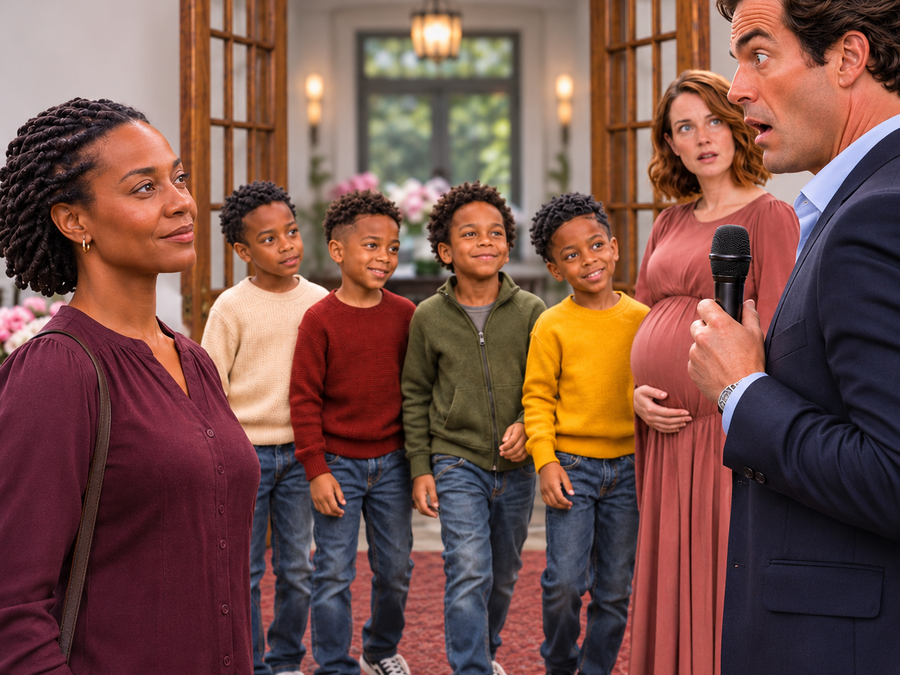
“I Should Have Listened” — He Blamed His Ex for Never Giving Him Kids, Until Four Boys Walked Into His Wife’s Baby Shower and Exposed the Lie He Had Told for Years
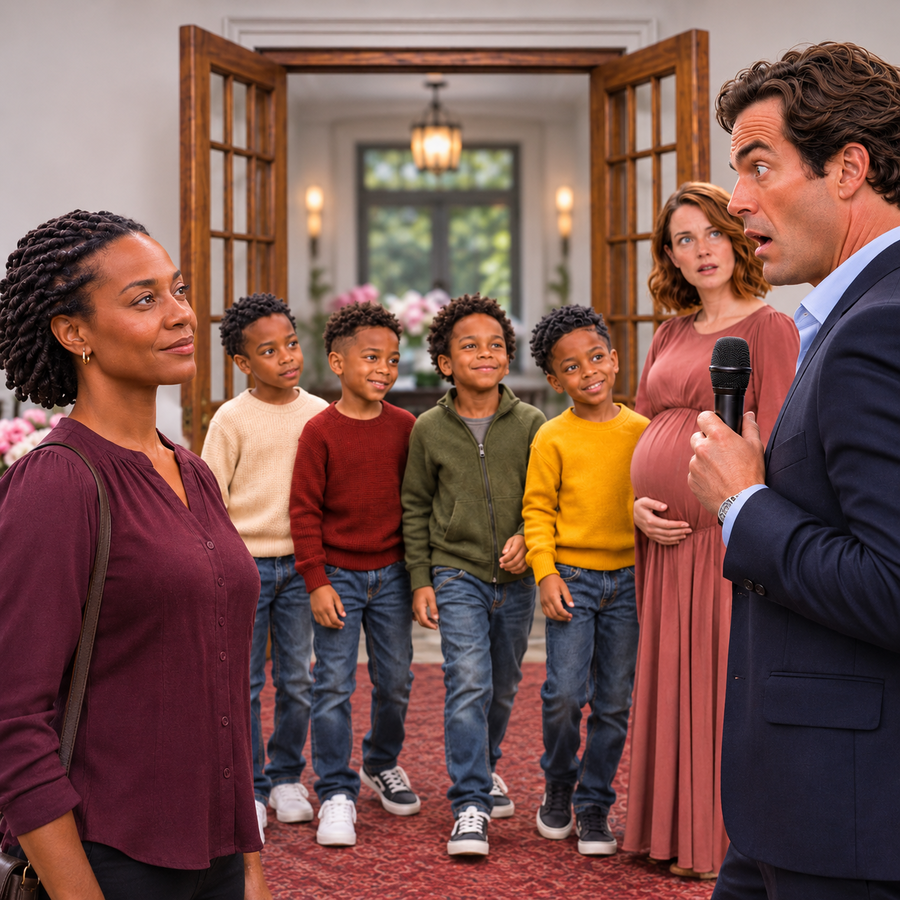
Two o’clock, Nia, right up front. I’ll say hello from the stage. I want everybody to see you there.
Ask me first.
Can I?
Two Saturdays, you’ll get to race then. Right now, it’s mostly my floor you’re sailing on.
You asked to see him outside. I heard his answer. I’ll drive. I can take them straight home if you want. Wait with them outside. If he will come out, we talk there. If he won’t, I’ll decide what to do.
All set for your toast on the dealership page like we did at the opening.
Right. Stay wide while she comes in. I’ll give you a minute for the seats.
Who’s she?
Nia. They know her. I thought I’d make a point of welcoming her.
You told me she wouldn’t come near you.
We were both angry. It’s been a long time.
Well, she can sit with me.
Come out front with me a minute.
All these people know us. Sit down. You’ve got a good view.
I need you to hear me without an audience.
Nia called her, everybody. I owe Nia a thank you. We spent a long time trying to have a family. After a while, I figured maybe it was me. Turns out I just had to marry the right woman.
You invited me to hear that.
I invited you because I thought we could all be grown-ups about being happy for somebody.
May, stay with us. Boys, come to me. You can hold on if you want.
Down. Turn it off.
Who are they?
Mine. And yours.
There are four.
I know. I’ve been there for everyone.
You could have called me.
I called the day I found out. You told me to stop trying to get you back. I tried again today.
You said the doctors told her she would never have a child. He’s the one who told people that.
Can we go now?
You don’t get to come in there, say anything like that and leave.
That’s a private lab, Thursday at four. If you want a test, I’ll meet you there. Call them directly.
Did you practice that, the whole walk in?
Yes. I knew I could get halfway through the room and let you talk me out of speaking. I’m sorry I let them hear it like that.
That was a joke, the thing I said inside.
You spent money putting a chair under it. Those for your daughter, I think.
Are those people from the party?
Somebody put a picture where people could see it. Miss May is going to put up the other blind.
Did you tell him where we go?
No. I told him to ask me if he wants to see you. He has my number. Those people don’t.
I could hear him fine out on that porch. We could have walked.
I wanted him to have to look at me when I said it.
I know. You got him to look.
Ben, you can tell me if you want to miss the race. I’ll find us some water.
Take your statement down. Then tell the people who heard it what you did.
It’s off our page. I’ve asked the photographer to pull his copy.
She asked for something else.
If I say I knew before I’ve had a test, it’s out there forever.
You already said you were kept from them. Who checked that?
I remember a call. She said she had a positive test. I just moved out. The last one at the clinic hadn’t worked. We’d both been through it. I thought she was trying to make me come home.
What did you say?
I said if she wanted to talk about the marriage, she could talk to my lawyer. Then I told him it was another fight about the divorce. He didn’t know what I’d left out.
When I told you I was pregnant, you asked if I’d eaten. You drove over with two kinds of soup because you couldn’t remember which one I liked.
I remember.
I told that story at the shower. I said that was the first time I knew what kind of father you’d be.
I wanted you to think I’d been like that all along.
I have an appointment Friday. I need you to be able to sit beside me without asking me to say you’re a good man first.
I wasn’t going to ask you to do that.
They sent me the interview questions. You put my name in the first answer.
I’m their father. All four. I read the pages twice. Then I printed them like the paper was going to say something else.
I have them.
Can I take them somewhere? Lunch?
I could get another car. They could all sit in the same row.
You’re planning their seats again. The week I had them, I picked up my phone every time one of them opened his eyes. I could have tried you again. I was angry and I didn’t want to spend another morning hoping you believe me. When they ask me about it, I’m going to tell them I made that choice.
I would have come if I’d seen them.
You could have asked. I was easy to find.
So thank you totally.
The boys are at the shop this afternoon. I’ll tell them what the report means before you come. You can stop by if they want you there. Twenty minutes. May and I will be right there.
Do I bring them anything?
Bring yourself at four.
I’m Graham. I think your mom told you a little about me. If you look right in my sphincter—
She told us you’re our father.
She’s right. And I don’t know any of you yet.
I’m the fastest one, running or talking. How come you didn’t come when we were little?
Because I didn’t ask. Your mom tried to tell me and I should have listened. You got it, buddy?
I’m Ben. If you’re going to say buddy, could you say Ben?
Ben. All right.
You only just arrived to see we’d see him. There. I used to help my dad put cars on ramps. You see it tilt. You catch it before it goes all the way.
See what she does. See what she does.
I was putting that on.
Here. I can fix that.
I said I was doing it.
Mia Calder, I have Mr. Val’s slot tomorrow. I’m picking up any statement you want us to carry.
I thought you were going to leave the questions.
These are the questions. I can take a note by hand if you prefer. Would you be willing to bring the boys tomorrow?
You gave her my shop address.
I told her where to bring the questions. I thought you’d want to see them before I went on.
You can ask me here. Leave them out of it.
Of course. I’ll wait outside if you want a minute.
I don’t want a minute. The video came from his page, and so did the story about what I kept from him. Ask him about that.
Do we have to go where the pictures are again?
No, sweetheart.
I can tell her I’m doing it by myself.
You could have told her that this morning.
Are there going to be cameras at the race?
I can stay right next to you at the club, or we can go down to the basin behind the shop, just us and May. You get to pick.
Here, can we still have a race?
If you draw the starting line.
The boys got to see you today. Leave the next visit to us. Right now I need you to fix what you said about me.
I could put something up now.
On the same page. We can run the sales straight through. I’ve told the anchor what you posted. She can leave the family out of this slot.
And if I want her to ask me about it?
She’ll ask about the shower too. I have two minutes either way. If you use them for that, there’s no live sales spot this weekend. This one’s still on your bill.
I sent that to you and my sister. That was everybody I wanted looking at it. Take it down before you go on.
I’ll send that.
You saw what I put up yesterday?
I did. Last Friday you sat beside me at my appointment. I told you I was glad you came. By the time we got to the—you were asking if you could put that in a statement. I said it to you in the car.
Use the slot for the correction. Let her ask me. No pictures or names of the boys.
People are coming in for those prices.
They still get them. Put them by the front door.
Take in three two four five. You put a correction on your page yesterday. The clip people have been passing around starts with four boys walking into your wife’s shower. Did their mother set that up?
Well, the thing is she asked me to come outside and talk. I had a chair picked out where everybody could see her. I wanted people to hear what I was going to say about her.
What was that?
That she was the reason we couldn’t have a family. I made a joke out of it. It was my camera. I put the party on our page.
If somebody wants pictures, can we go?
Whenever you want. So after the call, all those years, did you ever try to find out what happened?
No. I knew where she was. Every time somebody asked why we split up, I told the version I told at the shower. After a while, I liked how it sounded better than I wanted to know if it was true.
What happens with the boys now?
I get to wait until they’re ready. People can share what I said here. Please leave the boys’ pictures alone.
We’ll put the whole answer up.
Pin yesterday’s correction at the top of the page.
When I call next week, it might just be that I need a ride.
I can give you a ride.
I might be angry the whole way there.
I can drive anyway.
I saw you answer her. You could have put me back in that chair.
We’re at the basin behind the shop for another hour. Leave the camera in the car. We’ll ask them when you get here.
He can watch. Ready? Go. Mine goes here. You saw it get stuck in the middle last Saturday.
All right, so it’s like—
That’ll fall.
This is Lucy. You can come over if you want.
Hold descent.
The basin behind the shop was a small concrete bowl that collected rainwater and runoff from the parking lot. On dry days, it was a makeshift racetrack for the boys’ toy cars, the sloped sides forming natural ramps and curves. Graham sat on the edge of the basin with his legs dangling over the side, watching Ben and the others send their cars hurtling down the concrete slopes. May stood a few feet away, her hand resting on her pregnant belly, her expression unreadable.
Ben was the loudest, narrating every crash and near-miss as though he were calling a NASCAR race. “And here comes the blue car, taking the inside lane, oh no, he’s losing control, he’s going to hit the wall—” The car flipped and landed upside down. Ben threw his hands in the air. “Total wipeout!”
The other boys laughed. Graham laughed too, but it was a cautious laugh, the kind you make when you’re not sure if you’re allowed to join in. He had been in their lives for exactly three hours, and he still didn’t know their names beyond Ben and the youngest one, Lucy, who was actually a girl—his daughter, apparently. He had a daughter. That fact alone had been sitting in his chest like a stone since Nia had walked into the baby shower with four children in tow.
“Dad,” Ben said, and the word hit Graham like a punch to the gut. He wasn’t used to it yet. “Dad, watch this one. It’s going to go all the way to the end.”
Graham leaned forward, forcing himself to focus. “I’m watching.”
The car—a red sports car with a missing wheel—sped down the slope, hit a crack in the concrete, and launched into the air. It landed three feet away, bounced once, and came to rest against a discarded soda can. Ben whooped and ran to retrieve it.
“Did you see that? Did you see it fly?”
“I saw it,” Graham said. “That was a good launch.”
May shifted her weight, and Graham glanced up at her. She was watching the boys with a soft expression, but her eyes were tired. She had been quiet since they left the shop, since the reporter had come with her questions, since Graham had made his public correction and admitted to the world that he had lied about Nia for years.
“You okay?” he asked.
May nodded slowly. “I’m fine. Just tired. The baby’s been kicking all afternoon.”
Graham stood up and walked over to her. He placed his hand on her belly, and she covered it with her own. For a moment, they stood in silence, watching the boys play.
“I’m sorry,” he said quietly. “For all of it. For the shower. For the things I said. For not telling you about Nia and the boys before we got married.”
May looked at him. “You didn’t know about the boys. Not for sure.”
“I should have known. I should have asked. I should have—” He stopped, shaking his head. “I spent years telling myself that Nia was the reason we couldn’t have a family. I convinced myself it was her fault, that she had trapped me or lied to me or done something to make it impossible. And the whole time, the truth was that I was the one who had walked away. I was the one who hadn’t listened.”
May was quiet for a moment. Then she said, “You’re listening now.”
“It might be too late.”
“It’s not too late. Look at them.” She nodded toward the boys, who were now arguing about whose car was the fastest. “They’re here. They came. That means something.”
Graham followed her gaze. Ben was holding his car above his head like a trophy, and the youngest boy—the one who had corrected him about the word “buddy”—was tugging at Ben’s sleeve, trying to get his attention. Lucy was sitting on the edge of the basin, drawing a starting line in the concrete with a piece of chalk.
“They’re good kids,” Graham said.
“They’re your kids,” May replied. “And they’re Nia’s kids. She raised them. She did that alone.”
Graham felt a fresh wave of guilt. He thought about Nia, about the years she had spent raising four children by herself, about the phone call he had dismissed as a manipulation, about the soup he had brought her when she told him she was pregnant—the only moment of fatherhood he had allowed himself before he had walked away.
“I need to talk to her,” he said.
“Then talk to her. But not tonight. Tonight, you’re here with them. That’s what matters.”
Graham nodded. He walked back to the basin and sat down next to Lucy, who was still drawing her starting line. She looked up at him with wide eyes, and for a moment he saw Nia in her face—the same stubborn set of the jaw, the same determined expression.
“Can I help?” he asked.
Lucy handed him the chalk. “You can draw the finish line. It has to be straight.”
Graham took the chalk and drew a line across the concrete, as straight as he could manage. Lucy inspected it and nodded approvingly.
“Good,” she said. “Now we can race.”
They spent the next hour sending cars down the slope, cheering and laughing and arguing about the rules. Graham learned that Ben was the oldest and the loudest, that the quiet boy with the serious expression was named Marcus, that the youngest boy was called Eli and he hated being called “buddy,” and that Lucy was the only girl and she could out-race all of them when she wanted to. He learned that they had grown up in a small apartment with their mother, that they had never met their father, that they had asked about him sometimes and Nia had always told them the truth—that he had left before they were born, that he didn’t know about them, that he might never come back.
“She didn’t lie to us,” Ben said, when Graham asked. “She said you were a good man who made a bad choice. She said we could be angry at you if we wanted to, but we shouldn’t hate you.”
Graham felt tears prick at his eyes. “She said that?”
“Yeah.” Ben shrugged. “She said hate was too heavy to carry around. She said it would wear us out.”
Graham looked away, blinking hard. He thought about Nia, about the years she had spent defending him to his own children, about the grace she had shown him even when he had done nothing to deserve it. He thought about the baby shower, about the joke he had made, about the way he had tried to humiliate her in front of his friends and family. He thought about the reporter’s questions, about the public correction, about the long road ahead.
“Ben,” he said.
“Yeah?”
“I’m sorry. For not being there. For not knowing. For all of it.”
Ben looked at him for a long moment. Then he shrugged again. “Mom says sorry is a start. But it’s not the whole thing.”
“What’s the whole thing?”
“Showing up.” Ben picked up his car and held it out to Graham. “Here. You can race this one. It’s the fastest.”
Graham took the car. It was small and red and missing a wheel, and it was the most precious thing anyone had ever given him.
“Thanks,” he said.
They raced until the sun went down and the basin was too dark to see. May called them over to the car, and they piled in—four boys in the back seat, May in the passenger seat, Graham at the wheel. He drove them to Nia’s apartment, and when they arrived, he got out and walked them to the door.
Nia was waiting on the porch. She looked tired but calm, and she didn’t say anything when Graham handed her the boys’ empty juice boxes and the chalk they had forgotten to bring inside.
“Thank you,” she said quietly. “For bringing them home.”
“Thank you for letting me see them.”
She nodded. “Thursday at four. The lab. Don’t be late.”
“I won’t.”
She turned to go inside, then paused. “Graham.”
“Yeah?”
“Don’t make promises you can’t keep.”
“I won’t,” he said again. “I promise.”
She looked at him for a long moment, as though she were trying to decide whether to believe him. Then she nodded and went inside, closing the door behind her.
Graham stood on the porch for a long time, listening to the sounds of the boys settling in for the night—their voices, their laughter, their arguments about whose turn it was to feed the fish. He thought about the years he had spent telling himself a story about a woman who had kept him from being a father, about a marriage that had failed because of her, about a life that had been stolen from him.
None of it was true. The truth was simpler and harder and more painful: he had walked away. He had not asked. He had not listened. He had let his anger and his pride and his fear decide what kind of man he would be.
But that was then. Now, he had a chance to be different. He had four children who knew his name. He had a daughter who could out-race her brothers. He had a wife who was pregnant with a child he had not yet met. He had an ex-wife who had raised four kids alone and still found it in her heart to tell them their father was a good man who had made a bad choice.
He walked back to the car and got in. May was already asleep in the passenger seat, her hand resting on her belly. He drove home slowly, carefully, as though he were carrying something fragile.
When he got home, he sat down at the kitchen table and took out his phone. He opened the video he had posted the day of the baby shower—the one where he had joked about Nia being the reason they couldn’t have a family. He watched it three times. Then he deleted it.
He opened his page and wrote a new post. It was short and honest and it didn’t make any excuses.
“I was wrong. For years, I told a story about my ex-wife that wasn’t true. I blamed her for something that was my fault. I missed out on four children because I didn’t ask questions and I didn’t listen. I’m not asking for forgiveness. I’m just telling the truth. And I’m going to spend the rest of my life showing up for my kids. All four of them. And for their mother, who raised them alone when I should have been there.”
He posted it and put his phone down. Then he went to bed and slept for the first time in weeks.
The next morning, he woke up early and drove to the lab. He arrived twenty minutes before four o’clock and sat in his car, watching the door. At exactly four, Nia pulled into the parking lot with the boys in the back seat. They piled out, and Graham got out of his car and walked over.
“Ready?” he asked.
Ben nodded. “Ready.”
They walked into the lab together—Graham, Nia, and four boys—and they sat in the waiting room and filled out the paperwork. The technician called them back one by one, swabbing the inside of their cheeks with a small brush. Ben went first, then Marcus, then Eli, then Lucy. Then Graham.
When it was done, they sat in the waiting room again, and Nia said, “The results will be ready in a few days. We can open them together.”
“At your apartment,” Graham said. “The boys should be somewhere they feel safe.”
Nia looked at him, surprised. “Okay.”
“Thank you,” he said. “For giving me a chance.”
She nodded. “Don’t waste it.”
The results came three days later. They gathered at Nia’s apartment—Graham, May, Nia, and the four boys. Nia opened the envelope and read the letter aloud. It said what they had already known in their hearts: Graham was the father of all four children.
Ben cheered. Marcus smiled. Eli said, “I knew it.” Lucy climbed into Graham’s lap and hugged him.
And Nia sat on the couch and watched her children embrace their father, and for the first time in years, she allowed herself to hope.
The months that followed were not easy. There were fights and misunderstandings and moments when Graham wanted to give up. There were times when the boys were angry at him for missing their childhoods, and times when Nia was distant and cold. There were times when May felt left out, and times when Graham felt like he was failing everyone.
But they kept showing up. Graham went to parent-teacher conferences and soccer games and doctor’s appointments. He learned each boy’s favorite food and favorite song and favorite way to be comforted. He learned that Ben needed to talk things through, that Marcus needed quiet, that Eli needed to be taken seriously, and that Lucy needed to be hugged. He learned that Nia needed him to be consistent, to be honest, to be present.
And Nia learned to trust him again. Slowly, carefully, one small moment at a time. She learned that he was not the man who had walked away ten years ago. He was different now—softer, more patient, more willing to listen. He was not perfect. But he was trying.
The baby was born in the spring—a girl with May’s eyes and Graham’s stubborn chin. They named her Hope. And when Graham held her for the first time, he thought about the years he had spent believing he couldn’t have a family. He thought about the lie he had told himself and the world. He thought about the woman who had raised four children alone and never stopped telling them their father was a good man.
He looked at Nia, who was standing beside May’s hospital bed with the boys gathered around, and he said, “Thank you.”
She smiled. “For what?”
“For giving me another chance.”
She shook her head. “I didn’t give it to you. You earned it.”
He nodded. “I’ll keep earning it. Every day.”
And he did. He kept showing up. For the boys, for Hope, for May, for Nia. He kept telling the truth. He kept asking questions and listening to the answers. He kept being the father he had never been but had always wanted to be.
Years passed. The boys grew up. Hope grew up. They became a family—not a perfect family, not an easy family, but a real one. A family built on honesty and effort and the willingness to show up, even when it was hard.
And on the first day of every month, Graham and Nia met for coffee. They sat at a small table by the window and talked about the kids, about their lives, about the past and the future. They laughed and argued and sometimes they cried. And every time they parted, Graham said the same thing.
“Thank you for letting me be their father.”
And Nia said the same thing back.
“Thank you for showing up.”
It was enough. It was more than enough. It was everything.
THE END.