My Beautiful Coworker Asked Me to Be Her Date for One Night—Then Called Me Her Fiancé!
My Beautiful Coworker Asked Me to Be Her Date for One Night—Then Called Me Her Fiancé!
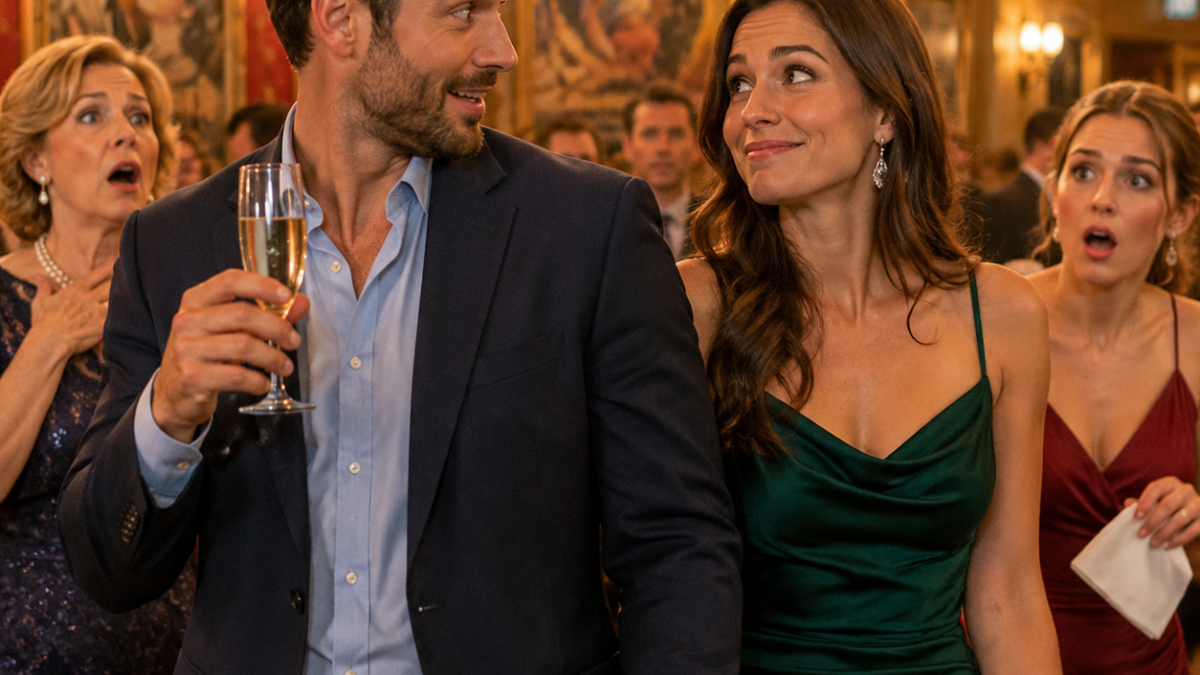
– Mom, this is Mason, Leah said, slipping her hand into mine. My fiancé.
The champagne glass halfway to my mouth stopped moving. Forty people in a restored movie theater lobby turned toward us, including the woman who had begged me just three hours earlier to be her date for one night—one night, she had been extremely specific. I looked at her beautiful, suspiciously calm face, and she looked back with the kind of smile people wear when they’re standing on a trapdoor.
Her mother gasped, her sister dropped a napkin, and a man by the ticket counter—whom I would soon learn was Leah’s ex-boyfriend—looked like he’d swallowed a lemon whole. I should have corrected the misunderstanding and said something sensible, such as, “Actually, we’ve never even been on a date.” Instead, I heard myself speak.
– Sweetheart, weren’t we saving the announcement until after dessert?
Leah squeezed my fingers hard enough to qualify as a warning, and that was how the most ridiculous weekend of my life began. If you’ve ever agreed to one harmless favor and watched it turn into something enormous, give this story a like, subscribe, and tell me: would you have played along or told the truth immediately?
My name is Mason Brooks; I was 35, single, and apparently the sort of man who could acquire a fiancée between the appetizer and the main course. I worked at North Line Studio, a small design and exhibition company in Columbus, Ohio, where we built museum displays, designed signs for historical buildings, and occasionally argued with clients who believed a 12-foot mural could be printed from a photograph the size of a postage stamp.
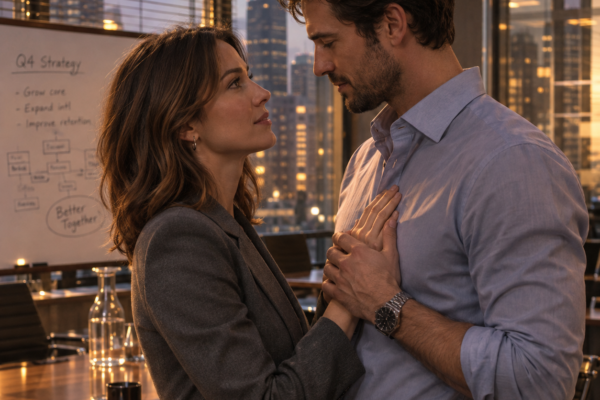
Leah Bennett worked three desks away from me—33, brilliantly organized, and blessed with the alarming ability to make a room of contractors behave by raising one eyebrow. Her dark hair usually lived in a careless knot, her coffee was always going cold, and she had a habit of tapping her pencil against her front tooth when she was trying to solve something difficult. We had been coworkers for four years, sharing late-night deadlines, spectacularly bad takeout, and one memorable road trip to a museum where she’d confidently directed us to a building that had burned down in 1987 while still maintaining that my navigation skills were the problem.
Leah was the person I wanted to tell whenever something funny happened, and I was the person she called when the office printer produced smoke instead of paper—things that mattered more than I had admitted even to myself. On Thursday afternoon she appeared beside my desk holding two coffees and looking like she was about to ask me to help bury a body.
– Before you answer, she said, this isn’t as weird as it’s going to sound.
– Excellent opening. Should I call a lawyer or a priest?
– Neither. I need a date for my parents’ anniversary celebration tomorrow night.
– And you brought caffeine because kidnapping would be difficult without it?
– Forty-five years of marriage, family, friends, the whole thing. It’s being held at the old Rialto Theater, which my parents helped restore. I’m expected to bring someone.
– Your mother’s still trying to set you up with that dentist?
– The dentist married his hygienist. Mom has moved on to a veterinarian who specializes in reptiles.
– Cold-blooded. I respect the theme.
Leah smiled, though it didn’t reach her eyes.
– My ex, Evan, is also going to be there.
I’d met Evan once at an office holiday party when he’d spent 15 minutes explaining Leah’s career to me while she was standing right beside him, and I had disliked him before dessert.
– Did you invite him? I asked.
– No, Mom did. She thinks enough time has passed for everyone to be friends.
Leah stared into her cup.
– I don’t need a fake boyfriend. I don’t want to make anyone jealous. I just want to walk into that room with someone who won’t treat my private life like a public referendum.
– So you ask someone you trust.
– I do.
The simplicity of her answer got under my ribs, and I covered it with a joke.
– What’s the dress code for a respectable bodyguard?
– Jacket, decent shoes, don’t call my father Chief, and please don’t argue with Aunt Vivian about the moon landing.
– Was she there?
– Mason.
I leaned back.
– Fine. One night. We arrive, eat cake, survive your relatives, and you bring me home before I turn into a pumpkin.
– You have no idea how grateful I am, she let out a breath.
– I’m charging two slices of cake and unlimited access to the appetizer table.
– Done.
Then she reached over my desk and straightened the collar of my shirt—an unnecessary gesture, and the reason I spent the rest of the afternoon reading the same email three times.
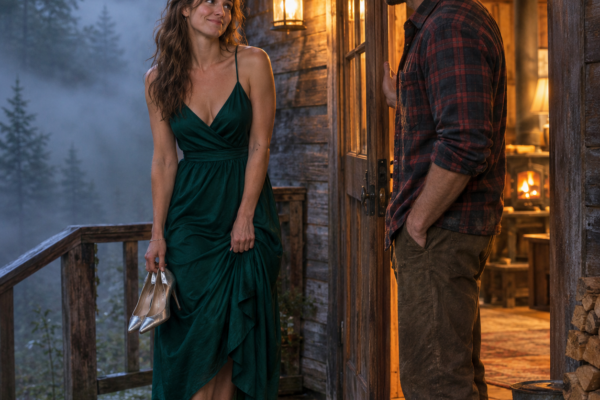
I arrived at the Rialto at 6:15 Friday evening wearing a navy jacket and carrying a small wrapped package. The theater stood between a bakery and an old hardware store on a street lined with maple trees, its marquee glowing in red letters—”Frank and Teresa: 45 Years, Still the Best Show in Town”—while warm light poured through the glass doors and someone inside played an old Frank Sinatra record. Leah was waiting beneath the marquee in a deep green dress that made me forget, briefly, how walking worked, her hair down, small silver earrings catching the light, and the expression of someone counting exits.
– You’re early, she said.
– So are my compliments. You look incredible.
She blinked, then gave me a quick smile.
– Thank you. You look unfairly competent.
– That’s the jacket. Underneath I’m three nervous raccoons operating a man.
She laughed and some tension left her shoulders. I handed her the package containing a pair of replacement brass ticket-number clips I’d found through a theater supply shop after she had complained months earlier that the restored ticket board kept slipping—a little thing, yet she’d sounded upset about it at the time.
– You remembered? she asked.
– I’m professionally obligated to care about vintage hardware.
– Of course, she said, holding the clips in her palm and looking at them longer than she needed to. Dad will love these.
– Good. I hope they distract him from my criminal record.
– You don’t have a criminal record.
– Not yet. Your Aunt Vivian hasn’t heard my moon-landing theories.
Before we went inside, Leah placed a hand against my sleeve.
– Seriously, thank you. The moment things get uncomfortable, tell me. We can leave.
– I will. And if Evan says something stupid, let me handle it.
– Absolutely. I’ll only intervene if he challenges you to single combat.
– That’s why I asked you.
The lobby was decorated with framed photographs of movies from the ’70s and ’80s, a popcorn machine repurposed for party favors, and between the old ticket booth and the velvet curtains a display tracing Frank and Teresa’s marriage from a tiny backyard ceremony through children, holidays, and the reopening of the Rialto. Leah’s father spotted us almost immediately—Frank Bennett, broad-shouldered and gray-haired, carrying himself like a retired firefighter who still knew the location of every exit. He hugged his daughter, shook my hand, and examined me with cheerful curiosity.
– So you’re Mason, he said. I’ve heard about you.
– All favorable, I hope.
– She says you once stayed until midnight to rebuild a display because a volunteer had accidentally thrown away the labels.
– I may have used stronger language than “accidentally.”
– Good, means you’re honest, Frank grinned. Come meet Teresa.
That was when I saw Evan standing beside Leah’s mother, looking polished enough to have been delivered in protective packaging. Teresa was an elegant woman with silver-streaked hair and a bright blue dress, talking animatedly until her eyes settled on our joined hands, at which point Leah stiffened and I felt her fingers begin to pull away. Evan smiled the sort of smile that leaves no warmth behind.
– Leah, he said, good to see you. Your mother mentioned you’d been busy.
– Very, she replied.
Teresa reached for her.
– Honey, I wasn’t sure you’d come. Evan was just telling me about his new house. Isn’t that exciting? And who’s this handsome young man?
I opened my mouth to introduce myself, but Leah moved half a step closer, looked straight at her mother, and spoke the sentence that changed the weekend.
– Mom, this is Mason. My fiancé.
There was a pause long enough to hear the record change. Teresa put both hands over her heart, Evan’s smile vanished, and Frank looked between us before studying my face with the unmistakable delight of a man waiting to see whether I would survive. I chose survival.
– Sweetheart, weren’t we saving the announcement until after dessert?
Leah’s nails pressed against my palm.
– Surprise, she whispered through her smile.
Teresa hugged me so fiercely that my glasses nearly fell off.
– Oh, my goodness, why didn’t you tell us?
– Because, I said, searching Leah’s expression for a rescue signal, we wanted to be sure you were sitting down.
– I’m not sitting down, Teresa cried.
– Then I’ve misunderstood our strategy.
Frank laughed, Evan walked toward the refreshment table without a word, and Leah looked as though she’d just jumped from an airplane and discovered I had brought the parachute. Within five minutes her sister Rachel appeared carrying two tiny plates of cheese and a look of magnificent disbelief.
– Fiancé? she hissed. You told me you were bringing a coworker.
– I was, Leah whispered.
Rachel looked at me.
– Did you know you were getting married?
– It’s been an educational six minutes.
She snorted, pressed a cheese plate into my hand, and said, “Welcome to the family, apparently.”
We escaped into the old projection booth 10 minutes later, looking out through the windows over rows of red seats occupied by people who apparently now had permission to discuss my future children. Leah closed the door and leaned against it.
– I’m so sorry.
– That’s an interesting first thing to say to your future husband.
– Mason. No, genuinely. I had plans this weekend—laundry, a haircut. Now I have to register for china.
She covered her face.
– I panicked.
– I noticed. Your panic has excellent vocabulary.
– Evan was standing there, and Mom was introducing him like he’d won an award for being available. I could practically hear her telling me to give him another chance. The word just came out.
I set down my untouched drink.
– Leah, you asked me to come as a date. You didn’t ask me to tell your family we’re engaged.
– I know. You have every right to be angry.
– I am a little angry.
Her eyes lifted to mine, surprised by the lack of a joke. I stepped closer while leaving space between us.
– Not because you’re embarrassed about your ex, I said. Because you took a choice away from me. I would have listened if you’d asked. You know that.
– I do, her voice softened. And I hate that I made you feel used.
I waited; one of the things I liked about Leah was that she could accept a hard truth without converting it into a courtroom defense.
– I’ll correct it, she said. Tonight with Mom and Dad first, then everyone else. I won’t make you carry this.
– Good.
She reached for the handle, and I stopped her with one question.
– Why me?
– Because you’re kind.
– Your sister seems kind. She could have dressed in a tuxedo.
– Because you don’t make everything about yourself. You make people laugh when they’re nervous. You notice things, she looked at the brass clips in my hand. And because when I tell you something matters to me, you remember.
For a moment the booth grew very quiet until a burst of applause came from downstairs followed by Frank singing badly into a microphone. Leah glanced toward the sound.
– That’s the speech before dinner. Dad’s going to tell the story about meeting Mom over a broken vending machine. He’s told it approximately a thousand times.
– Then we shouldn’t miss number 1,001.
I offered her my arm, and she didn’t take it immediately.
– Are you willing to stay until we’ve told them? she asked. You can leave right afterward. No hard feelings.
– I’ll stay. But there’s a condition.
– Anything.
– Never offer a man named Mason unlimited conditions. Some of us are petty. My condition is that you tell me the truth even when it’s awkward—especially then.
– Agreed.
– And there’s a secondary condition. If someone asks how I proposed, I get to invent the story.
Her mouth curved.
– No. Too late.
– There was a hot-air balloon and a trained penguin.
– Mason.
– The penguin cried. It was beautiful.
She laughed and took my arm—a laugh that should have been a relief, yet instead made me aware of the warmth of her hand against my sleeve and of something dangerous: if I wasn’t careful, I might forget which part of our arrangement was imaginary.
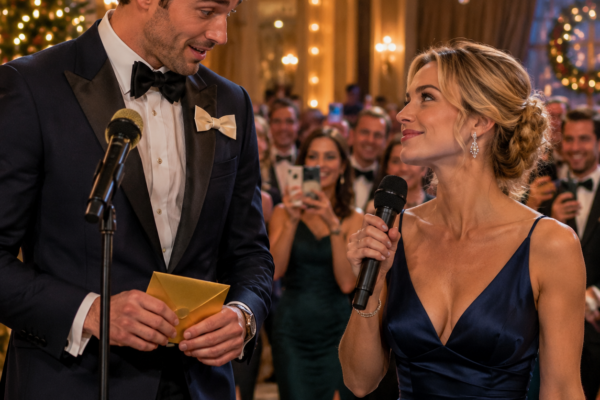
Back downstairs, Frank had begun his speech beneath the screen holding a photograph of himself and Teresa at 22 when he’d had thick brown hair and she’d worn a dress sewn by her mother.
– Everyone thinks a long marriage means finding the right person, he said. Maybe it does, but that’s only the beginning. After that comes a lot of deciding to be decent to each other when one of you is tired or stubborn or has bought yet another ridiculous lamp.
– The lamp was vintage! Teresa called from the front row. It was broken, sweetheart! Forty-five years of loving you and I still can’t get over that lamp!
The room laughed, and Frank grew quieter.
– When we reopened this theater, people congratulated us for saving a building, but Teresa saved the harder thing. She made sure it was a place people wanted to come back to.
I glanced at Leah; her eyes were glossy, and she slipped a hand into mine—this time on purpose—giving a single squeeze when Frank raised his glass to his wife that didn’t feel like a performance, which worried me much more than the lie had.
The difficulty with correcting a public announcement is that the public develops opinions faster than the people involved. By the time Frank finished his toast, Aunt Vivian had told three cousins, the bartender, and a woman who had only come to deliver flowers that Leah Bennett was getting married, and someone had produced a silver marker and written “Future Mr. and Mrs.” on the back of our place cards.
We were waiting for a moment alone with her parents when Teresa’s oldest friend, Mrs. Halloran—small, sharp-eyed, wearing a pearl necklace that probably had its own insurance policy—intercepted us.
– Tell me everything, she demanded. How long have you been together?
Leah opened her mouth, so I touched her elbow and answered before she could dig another hole.
– Long enough to know she takes the pickles off her sandwiches and puts them on mine.
Mrs. Halloran beamed.
– How romantic.
– It has saved me at least $30 in pickles.
Leah bit her lip and looked away.
– That’s technically true, she whispered.
– Exactly. We’re going to survive this with carefully selected facts.
The next question came from a cousin who wanted to see the ring, and as Leah looked down at her bare hand and the color drained from her cheeks, I spoke before she could answer.
– It’s being resized. I have remarkably strong opinions about jewelry fitting comfortably.
– Since when? Leah murmured.
– Since 30 seconds ago.
She gave me a disapproving look.
– We said no more inventions.
– You’re right. That was the last one.
It was, too; when another relative asked for wedding details, I simply told her there were none to announce, discovering that “We’re keeping that private” was a remarkably useful sentence. Dinner began beneath the old balcony, where I met Leah’s Uncle Paul—who had lost most of his hearing yet could somehow identify the exact price of any steak by looking at it—two teachers who’d worked with Teresa, a retired electrician who remembered rewiring the Rialto when every second light fixture was held together by hope, and Rachel’s husband Danny, who shook my hand and said, “My condolences. We have a family group chat.”
– Is there an exit? I asked.
– Not one I’ve found. I’ve been in it 11 years.
Leah sat close enough that her knee occasionally brushed mine under the table, quietly checking whether I was all right whenever I nodded—only to tense again when someone congratulated us, showing me the cost of her impulsive announcement as she traded one uncomfortable conversation for dozens.
After dessert, an elderly couple started dancing near the screen, Frank invited Teresa to join them, and soon the carpeted aisle was crowded with people moving slowly beneath the glow of the exit signs. Leah watched her parents turn together.
– You know, I said, your dad hasn’t taken his eyes off your mother all evening.
– He’s always been like that. When I was a teenager, I thought it was embarrassing. Then I dated a few men who couldn’t look away from their phones.
– High standards. I mostly look at my food.
She smiled faintly.
– Would you dance with me?
– Is this a contractual obligation?
– No, it’s a request.
That distinction mattered. I stood and offered my hand, and we found a place beneath a wall sconce where Leah rested her palm against my shoulder and I set a careful hand at her waist—astonished how little four years of negotiating deadlines and arguing about fonts had prepared me for dancing with her.
– You’re better at this than I expected, she said.
– My grandmother insisted every grandson learn two things: a proper waltz and how to make gravy.
– Which one stuck?
– Both. My gravy is spectacular, but it can be difficult to dance with.
She laughed and moved closer, and for three minutes we didn’t have to explain ourselves—just music, her hand in mine, and the soft sound of other couples talking—until Evan appeared at the edge of the dance floor.
– Leah, could I have a word?
She didn’t let go of me immediately.
– About what?
– Just a private conversation.
I looked at her, she gave a small nod, and I released her hand and stepped back—not far enough to pretend I couldn’t see how her expression changed as Evan led her near the ticket booth, where she folded and unfolded her arms as though consciously refusing to make herself small. After a minute she returned.
– Everything okay? I asked.
– He wanted to know why he was the last to hear I was engaged. I told him I didn’t owe him advance notice of my life.
– That’s true regardless of the accuracy of the announcement.
She made a sound halfway between a groan and a laugh.
– You aren’t going to let me forget it, are you?
– No, but I can help you make it right.
She nodded and looked toward the doors where her mother was saying goodbye to guests as soon as they were free. At 10:30, as the final guests collected their coats, Danny carried the leftover cake to the kitchen, and Rachel went hunting for the missing guest book, Leah and I found Frank and Teresa sitting in the front row surrounded by the pleasantly exhausted evidence of a successful celebration.
– Before you say anything, Teresa began, I know I got excited about your news, but I hope you understand why.
Leah stayed standing.
– Mom, we need to explain something.
Frank took one look at our faces and sat a little straighter. I would have liked to leave Leah alone with her parents to tell her own truth, yet I’d been part of the lie, so I stayed beside her.
– We aren’t engaged, Leah said. Mason came as my date. I saw Evan standing there and I panicked. I told you he was my fiancé because I didn’t want another conversation about whether I should get back together with someone I already decided wasn’t right for me.
Teresa blinked.
– But you introduced him.
– I know. It was unfair to you and unfair to him. I’m sorry.
Frank looked at me.
– And you went along with it?
– For a few minutes, I said. Then we agreed to tell you as soon as we could do it without turning your anniversary into a family announcement. I should have corrected it earlier.
A long silence followed, and the room felt different without the music as Teresa looked down at the program folded in her lap.
– I invited Evan because he asked if he could come, she said at last. He said he wanted to congratulate us and show there were no hard feelings. I thought if everyone could be in the same room, perhaps it would make things easier.
– Easier for whom? Leah asked, not sharply, but clearly.
Teresa lifted her eyes, considering the question rather than rejecting it.
– I suppose I never asked you that.
– No.
– I worried you were lonely, her mother admitted. After everything ended with Evan, you stopped bringing people around. I thought you were shutting us out.
– I stopped bringing people around because every visit became an interrogation.
Frank rested his hand over Teresa’s.
– I think we’ve all made tonight harder than it needed to be.
Leah’s eyes filled.
– I didn’t want to hurt you. I just wanted to be here for your anniversary without feeling like the one part of my life you’re disappointed in.
– Oh, honey.
Teresa stood, stopped herself before immediately embracing Leah, and asked gently if she could hug her; Leah nodded, they held each other for a long time while I looked away toward the dark screen to give them privacy, and when Teresa released her she turned to me.
– And I’m sorry we welcomed you into a marriage that didn’t exist.
– It’s all right, I said. I was mostly hoping someone would explain the health insurance.
Frank’s laugh broke the tension, and Teresa managed a smile.
– We’ll tell the family tomorrow morning, Leah said. Rachel can help me send one message. Nobody needs another dramatic announcement.
– And the pictures? Teresa asked. Vivian put a photo of you two online.
Leah closed her eyes.
– Of course she did.
– We’ll ask her to update it, I said, before rumors get any more creative.
Frank rose and shook my hand again, less formally this time.
– For what it’s worth, son, I’ve enjoyed meeting you.
– I enjoyed meeting you, too.
– I also believe the two of you would have gotten along even if nobody had said the word “fiancé.”
Leah turned pink. Outside, the street was quiet, the bakery next door had gone dark, and a light rain had begun to shine on the pavement as Leah stood under the marquee holding her wrap around her shoulders.
– I owe you a real apology, she said, not just an explanation. I took advantage of your kindness, and I know you hate being put on the spot.
– I don’t hate surprises, I replied. I hate being mistaken for someone who’ll agree to anything just because it’s easier.
– I did exactly that, she nodded.
I studied her.
– You know what makes this strange? I would have happily been your real date tonight, no story required.
Her expression changed.
– You mean that?
– Yes.
– Would you still like to be? she asked. We’ve already survived the chicken and the cake.
– Not tonight. I mean, would you go somewhere with me another time? Somewhere nobody is related to me.
– I’d like that, she said, smiling tentatively and genuinely—right before her stomach growled loudly enough to interrupt the moment.
– Was that the beginning of our love song? I asked.
– I barely ate. Do you know anywhere serving fries?
– I know a place with terrible lighting and magnificent pie.
– Then take me there. And Mason?
– Yeah?
– No more pretending.
– Not a second more.
The diner was three blocks away—a narrow place with cracked red booths and a jukebox that only played songs recorded before either of us was born—where we sat across from each other with a mountain of fries between us and, for the first time all evening, nobody congratulated us. Leah took one fry, then another.
– I should tell you something about Evan.
– You don’t owe me your romantic history.
– I know, but I want you to understand why I reacted that way.
She dipped a fry in ketchup then set it down.
– We dated almost two years. At first, he loved how close I was to my family. Then he began treating that closeness like a problem to be managed.
– What did that look like?
– He’d tell me I was ridiculous for helping Dad with the theater. He’d make little jokes about how I’d still be answering my mother’s phone calls when I was 60. Once, at a dinner with his friends, he said I couldn’t make a decision without asking three relatives and a cat.
– Was the cat qualified?
– Very, but that wasn’t the point, she smiled briefly. I kept telling him those jokes bothered me. He’d apologize, then do it again. Eventually, I realized he liked a version of me that didn’t exist. He liked me better when I wasn’t attached to anything that mattered to me.
– So you ended it?
– Yes. I didn’t want to marry someone who made me apologize for loving my family. But after we broke up, Mom kept asking what had happened. I didn’t want to turn Evan into a monster. He wasn’t. We were just wrong together, and I was tired of explaining.
– That’s a complete explanation.
– You’d think so.
She looked at me across the table.
– What about you? Four years of working together, and I know your coffee order better than your dating history.
– It’s less interesting than my coffee order.
– Try me.
I ran my thumb along the paper wrapper of a straw.
– I was with someone for five years. We were good at being a team—bills paid on time, groceries organized, family holidays scheduled. She wanted certainty about everything, and I was proud to provide it.
– What changed?
– I realized I was so busy being dependable that I’d stop telling her what I wanted. Not because she forbade it—because I assumed being easy to live with was the same as being loved.
Leah didn’t rush to reassure me, and I appreciated that.
– Did you tell her? she asked.
– Eventually. We tried, but we’d practiced the wrong relationship for too long. We parted as friends.
– And now?
– Now I’m learning that a person can be useful and still deserve to be asked what he wants.
She looked down.
– Which is exactly what I forgot tonight.
– Yes, but you remembered before the night ended.
She pushed the plate of fries toward me.
– For the record, I like you even when you’re not fixing anything.
– Bold claim. You haven’t seen me assemble a bookshelf without instructions.
– I’ve seen you at karaoke.
– Then you have witnessed courage.
We laughed, and afterward I found myself studying her face without looking away—her faint freckles beneath the diner’s fluorescent lights, the tiny crease near her left eyebrow when she concentrated—details I’d spent years knowing as facts about a coworker that suddenly felt like evidence of something I had missed. She noticed.
– What?
– Nothing.
– That’s a terrible answer.
– I was thinking I should have asked you out two years ago.
Leah went still as the jukebox clicked into another song.
– You wanted to? she asked.
– I thought about it several times. Then you were with Evan, and I decided being your friend mattered more than making things complicated.
Her cheeks warmed.
– I didn’t know. Apparently, I’m better at pretending to be your fiancée than admitting I like you.
– That makes two of us.
I held her gaze.
– Two of us?
She took a slow breath.
– Let’s say I didn’t pick your name out of a hat yesterday.
I smiled.
– I suspected. Nobody brings my favorite coffee unless they’re planning a crime or a romance.
– Which do you think this is?
– I’d like to find out on a date neither of us has to apologize for.
When I paid the bill, she insisted on leaving the tip, and when we stepped outside the rain had stopped; I walked her to her car without hurrying to say good night, wanting to kiss her, yet holding back because she’d spent the evening having her choices made by other people and I wanted the next step to feel unmistakably hers. She touched my sleeve.
– Saturday afternoon, coffee? That’s a date.
– Just coffee. Terrifying. I might have to learn your middle name.
– Margaret.
– Really?
– No. See you tomorrow, Mason.
She drove away laughing, and I stood there feeling lighter than I had in years until my phone buzzed with a message from Rachel: “I have officially informed the family that tonight’s engagement announcement was a misunderstanding. Aunt Vivian says she has questions. I recommend avoiding her until Tuesday.” Below it was a screenshot of a social media post already shared more than 50 times—a photograph of Leah and me dancing under the theater lights with the caption, “Some love stories are worth waiting for. Congratulations to our beautiful Leah and her fiancé!”—showing that while the lie had been corrected inside the family, outside it the story was only beginning.
Saturday morning, I woke to six texts from people at North Line and a voicemail from my mother, who lived two hours away, rarely used social media, and had somehow learned of my engagement before learning I’d bought a new washing machine. I called her while making breakfast.
– Should I congratulate you? she asked. Or ask why your aunt knows more than I do?
– Neither. There was a misunderstanding. Leah and I aren’t engaged.
– Is Leah the woman from your office who makes those beautiful exhibition sketches?
– Yes.
– The one you mentioned at least once every time we talk?
I turned down the burner.
– I don’t mention her every time.
– Last Sunday you said she was considering a new pencil sharpener. I have grandchildren, Mason. I’m not desperate for stationery updates.
– Mother.
She laughed.
– All right, no engagement. But are you interested in this woman?
I looked toward the window where pale sunlight caught the kitchen table.
– Yes. More than I knew.
– Then start there. Don’t let everybody else’s excitement write the rest of the story.
That was good advice, and almost identical to what Frank had said about marriage. At 11:00 Leah texted to ask if we could meet at a coffee shop near the theater instead of downtown because her parents were hosting a small Saturday open house for neighbors who hadn’t attended the party and she promised to drop off photo displays she’d designed—adding in capital letters, “THIS IS STILL A DATE. NO FREE LABOR REQUIRED.”
I laughed aloud, and when I arrived she was sitting at an outdoor table wearing jeans, a cream sweater, and sunglasses pushed onto her head with two cappuccinos between us—no fancy dress, no audience, no man from her past, just Leah looking more nervous than she’d looked in the theater.
– Hi, she said.
– Hi, Margaret.
– That’s not my middle name.
– I know. I’ve chosen to respect your privacy by never asking again.
We smiled at each other like teenagers pretending not to know they were on a date, and then Leah became serious.
– I talked to Aunt Vivian. She corrected the caption. Rachel sent a message to the family. Mom called a few people personally. There will probably be confusion for a while, but I’m not asking you to clean it up.
– Thank you.
– I also emailed our supervisor. Since the photos already made it around North Line, I thought it was better to say there was no engagement. I didn’t say anything about what might be happening between us. That’s ours.
I set down my cup; that small decision meant more than a dramatic speech would have because she hadn’t asked me to step in and had handled the problem herself.
– Then here’s my status report, I said. My mother knows the truth. She’s curious about you, but fortunately, she’s not as fast as Aunt Vivian.
– She sounds nice.
– She has an excellent record of embarrassing me.
– Good. I want to compare notes someday.
– Someday.
The word landed between us, light but promising. We spent an hour talking about things we’d somehow missed in four years of daily contact—why Leah loved old movie houses, why I always ordered a second cup of coffee even when I didn’t want it, and the tiny garden she wanted to plant behind her apartment. She told me her father had taken her to Saturday matinees when money was tight, buying one bag of popcorn and dividing it into two paper cups so she’d think they were getting separate treats without her realizing until she was grown that he never ate any himself.
– That’s why I help with the Rialto, she said. Not because I can’t say no to my parents, because some of my best memories happened in a place they cared about.
– Does he know you remember the popcorn?
– No.
– You should tell him.
She smiled into her cup.
– Maybe today.
When we walked to the theater, I saw her designs displayed along the lobby wall—beautiful panels about the neighborhood, handwritten recollections from local residents, and photographs of families returning to the Rialto over decades—creating a room that invited people to remember their own lives and making me proud in a way I hadn’t expected. Frank was standing beside the ticket board when we arrived, struggling to keep the number eight in place until Leah took the brass clips from her bag.
– Look what Mason brought you.
Frank examined them, then his face split into a grin.
– These are the exact ones. I haven’t been able to find them anywhere.
– Trade secret, I said. I have a very glamorous search history.
He installed the clips carefully, and the eight stayed up.
– You made this old place look like it has a hundred good stories left, Frank said, looking at Leah and then at the exhibit panels. I don’t say often enough how proud I am of what you do.
Leah’s eyes filled.
– Dad, you don’t have to—
– I know, but I’m saying it.
She hugged him, and I moved toward the auditorium to give them a moment until Leah joined me beneath the balcony a minute later.
– You didn’t have to come inside, she said.
– I wanted to see your work.
– You’ve seen my work every day for four years.
– Not like this. Here, it means something different.
She looked across the room at her photographs.
– I used to think he’d be disappointed that I didn’t become a teacher like Mom or a firefighter like him.
– He looked pretty delighted with the brass clips, too.
– Are you jealous of two pieces of metal?
– I’m trying to be mature about it.
She laughed and moved closer, close enough that I could smell her perfume beneath the familiar scent of coffee.
– I had a good time today, she said.
– Me too. Mason, may I ask you something?
– Please. I prefer questions to surprise engagements.
She brushed her fingertips against mine.
– If I wanted to kiss you, would that be too complicated?
I took her hand.
– Not if you actually want to.
– I do.
– Then you should know I want to kiss you, too.
She rose onto her toes and kissed me—not for Evan or her mother or a room full of people waiting to be impressed, just a brief, warm, slightly nervous kiss that left us both smiling when we stepped apart.
– Four years, she whispered.
– Terrible scheduling, I agreed.
For a few seconds I thought everything would be simple from then on: the lie had been corrected, our first real date had ended with a kiss, and we were two adults who knew how to talk to each other. Leah answered that unasked question by stepping back with a worried expression.
– I don’t want you to think the kiss fixes what I did yesterday, she said. Or that because everyone saw that photograph, we have to turn this into something serious. We don’t. And I’m nervous about work. I like my job. I don’t want either of us to become office entertainment.
– I don’t either.
I took both her hands.
– But can I tell you what I do want?
– Please.
– I want dinner on Tuesday, if you’re free. I want to hear about the garden you haven’t planted. I want to take you to that terrible miniature golf place you claim you hate. And if we decide later that this doesn’t work, I want us to be honest enough to say it, not quietly turn into strangers at adjacent desks.
She looked at me for a long moment.
– That sounds surprisingly reasonable.
– I occasionally shock myself.
– I want those things too, she said. Especially miniature golf. You’re going to lose.
– That’s a cruel thing to say to your former fiancé.
She laughed, then shook her head.
– Never again.
– Never again what?
– Using a label instead of having the conversation.
We agreed to tell our supervisor that we were beginning to date and to keep our working decisions transparent; on Monday, when a colleague offered unsolicited congratulations on my supposed engagement, I corrected him without turning Leah into the punchline, and she did the same when teased about her secret husband—neither hiding the other, neither owing the office the rest of our story.
Tuesday dinner became a Saturday hike, and the Saturday hike became a tradition of making breakfast together on Sundays, exposing two important facts: Leah hated measuring ingredients, and my grandmother had been right about teaching me to make gravy. There were awkward moments—once she asked me to repair a stubborn kitchen cabinet and I nearly agreed before remembering I actually wanted to spend the afternoon reading, so I told her, and she handed me a screwdriver, fixed the loose hinge herself, and sat beside me with her own book—which might have been the moment I fell in love with her, when I realized I no longer needed to be useful every minute to feel wanted.
We argued, too, about whether it was reasonable to own 15 decorative pillows, about my tendency to make jokes when a conversation scared me, and about her habit of taking responsibility for everyone’s feelings, yet we learned to stop and ask what the other person meant before assuming the worst—less dramatic than pretending to be engaged, and far better.
Eight months after that disastrous anniversary party, Leah and I went back to the Rialto for a Sunday afternoon screening where Frank had saved two seats near the aisle, Teresa hugged us both, and Aunt Vivian made a heroic effort not to mention weddings while families, older couples, and returning neighbors filled the theater because of Leah’s exhibits. Before the lights went down, I asked Leah to walk with me into the lobby.
– You’re acting suspicious, she raised an eyebrow.
– I brought a gift.
– Is it a pencil sharpener?
– Better.
I led her to the original ticket booth where, behind the glass, the number board displayed eight and two—the numbers of our seats—held in place by the brass clips. I took a small velvet box from my pocket, and Leah looked at it, then at me, stopping her smile in surprise.
– We’ve talked about this, I said—about our future, about what matters, about the things we’ll refuse to pretend. So this isn’t a surprise about what I want. It’s just a question I want to ask properly.
I knelt as the faint sound of opening credits came from inside the auditorium.
– Leah Bennett, I love your brilliant mind, your terrible navigation, and the way you make people feel that their stories matter. I love that you ask instead of assume, and that you’ve helped me learn to do the same. Will you marry me for real this time?
She laughed through tears.
– Yes, Mason, for real.
I stood and slipped the ring onto her finger—it fit, having made sure of that—and when she kissed me the world became wonderfully quiet for a moment until Frank appeared around the corner holding two paper cups of popcorn, glanced at us and the ring, grinned, and handed one cup to each of us.
– Are they coming? Teresa called from the auditorium. The movie’s starting.
– I’ll let you two tell her, Frank leaned toward us.
Leah took my hand.
– Ready, fiancé?
I looked at the ring, the old ticket board, and the woman who had once introduced me with a word she wasn’t ready to mean.
– This time, I said, I absolutely am.
And when we walked into the theater, we didn’t need to invent a story—we had one of our own. If this story made you smile, give it a like and subscribe for more romances about ordinary people finding extraordinary love, and tell me in the comments: when does a pretend relationship become real? For me, it starts the moment both people are free to choose it.