“If You Pull This Off, I’ll Tear Up My Medical Degree,” the Chief Surgeon Mocked — Then She Did
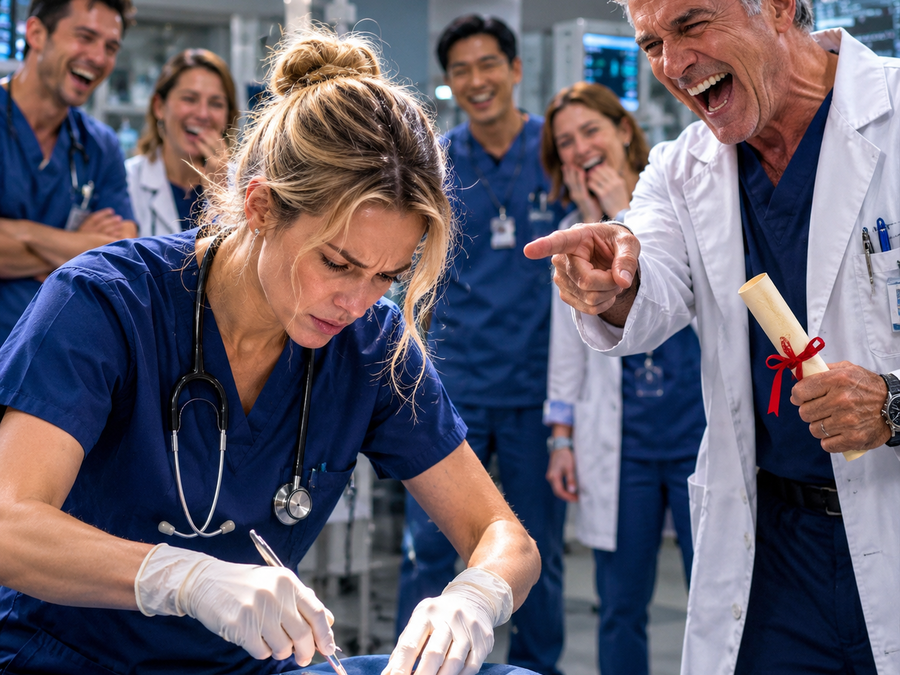
“If You Pull This Off, I’ll Tear Up My Medical Degree,” the Chief Surgeon Mocked — Then She Did
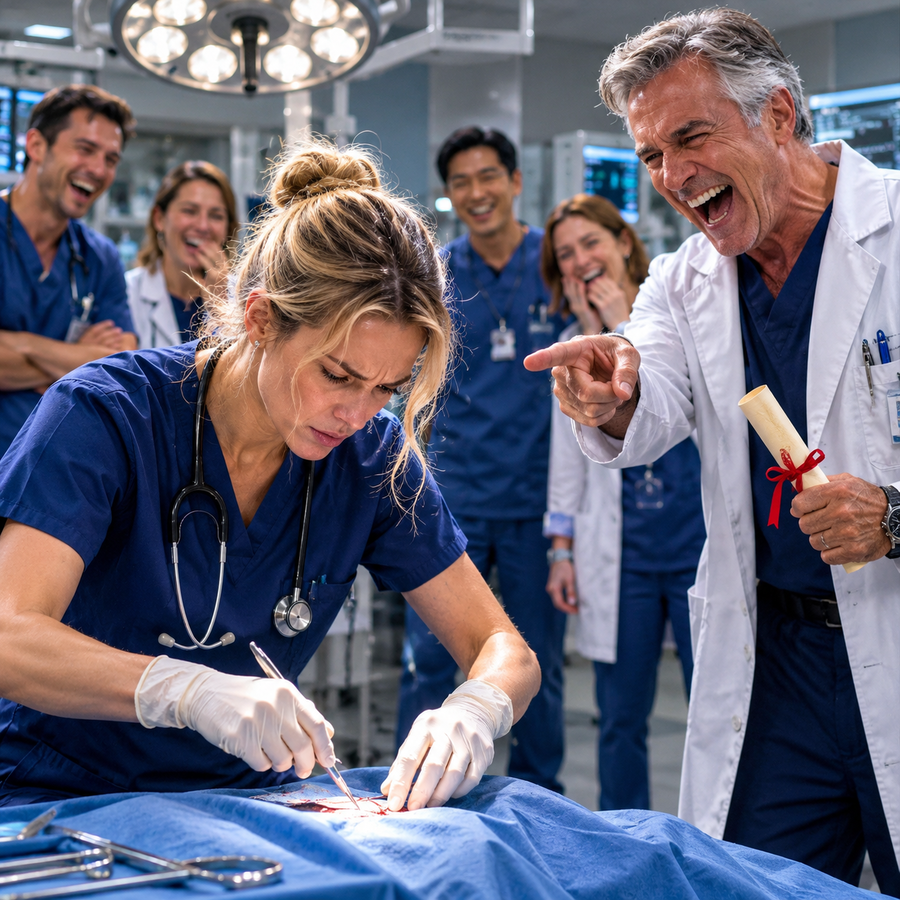
She keeps her eyes down and her badge turned inward.
One more quiet nurse nobody bothers to remember at Gracefield Emergency Pavilion in Baltimore. The chief surgeon mocks her in front of the whole department, promising to tear up his own medical degree if she ever proves him wrong.
Then a Navy Seal collapses on her trauma bay floor, and she recognizes the coin around his neck before she recognizes his face.
Her trembling hands go still.
An old promise made in a place that officially never existed pulls her back into a life she buried six years ago. While she fights to bring him back, she is also quietly teaching every viewer watching how to recognize a stopped heart and what to do in the first 60 seconds that actually save a life.
The hospital administration would rather bury what her hands reveal than explain it. And the seals who carried their brother through the doors are starting to realize the small, quiet nurse in front of them was never who they thought she was.
If this story pulled you in, hit like, subscribe to Silent Badges Stories, and drop a comment telling us the exact moment you knew she was not just the nurse. Because what happens next changes everything.
Delaney Shaw arrived at Gracefield Emergency Pavilion the way she arrived everywhere, quiet, early, and unnoticed.
She kept her badge turned inward on her scrubs and her eyes on the tile.
The scrubs were bright vivid blue, a size too large.
The sleeves rolled twice at the wrist to keep them out of her way. Her hair was pulled back in a low knot.
Dirty blonde with streaks of light brown and a thin scar above her left eyebrow caught the fluorescent light for half a second before she looked down again.
Baltimore in late autumn smelled like rain and diesel through the ambulance bay doors.
Delaney liked that smell. It reminded her of nothing anyone here would ever guess.
Inside, the nurse’s station buzzed with the particular energy of a Monday morning shift change.
Charts stacked, coffee cooling, a resident laughing too loudly at his own joke near the supply closet.
Delaney moved through it like water around stones, careful, silent, taking up as little space as a 5’4 frame could take up in a building built for people twice her presence.
She had learned that trick a long time ago. Make yourself small enough and no one asks where the rest of you went.
Dr.Carter Voss noticed her anyway.
He always did. He was the kind of chief surgeon who wore his white coat like a crown, sleeves pressed, name embroidered in gold thread.
A medical degree framed behind glass in his office where every visitor could admire it before admiring him. He had trained at institutions he mentioned in the first 3 minutes of any conversation.
He collected admiration the way other men collected watches, and he had decided from her very first week at Gracefield that Delaney Shaw was beneath his notice in every way except one.
She made an excellent target. Nurse Shaw, his voice carried across the station, pitched for an audience.
Still moving like you are trying not to be seen.
Some of us actually want to be noticed for our competence. A few of the younger staff laughed.
The reflexive kind.
the kind that comes from wanting to stay on the good side of a man who signs off on your evaluations.
Delaney did not look up from the chart in her hands.
“Morning, Dr.Voss,” she said, and kept walking.
“That is the problem with you,” he called after her, enjoying himself now, warming to it the way he always did when he had an audience and a target who would not fight back.
“No fire, no presence.
I have seen mannequins with more confidence.”
Someone snorted. Delaney felt the heat climb her neck.
the old familiar burn of being laughed at in a room full of people who did not know her, who could not know her, who saw a small, quiet woman in oversized scrubs and decided that was the whole story. She had been called worse things by better men.
She kept walking. It had been like this for 4 months.
Voss found something new nearly every shift.
her height, her quiet voice, the way her hands sometimes trembled slightly when he stood too close and stared too long, a tremor she hated and could not always control, though it had nothing to do with fear of him and everything to do with things she never spoke of. He mistook the tremor for weakness.
He built an entire performance around it.
Delaney had endured commanding officers who screamed louder than Voss ever could in places where the wrong word could cost a life instead of a paycheck. a chief surgeon with a framed degree and a taste for public mockery was, in the grand accounting of her life, a minor storm.
She let it pass over her the way she had learned to let everything pass over her without argument, without expression, filing the insult away in a place where it could not touch anything that mattered. What she could not always control was the tremor itself.
It had started two years after she came home. a small betrayal of nerves that no specialist had ever fully explained.
Worse under fluorescent light, worse when someone stood too close and stared too long, worse on days when sleep had not come easily. She hid it in the pockets of her scrubs, behind clipboards and charts, anywhere it could pass unnoticed.
She had gotten very good at hiding it, and very good at hating that she needed to.
The other nurses at Gracefield were not cruel, most of them, but cruelty by an audience of silence is still cruelty. Nobody defended her.
Nobody asked why a hospital administrator like Margarite Doyle allowed a chief surgeon to humiliate staff in front of patients and families. Delaney did not ask either.
She had bigger reasons to stay invisible than her own comfort.
She finished her morning rounds in the general ward, checked vitals on an elderly man recovering from a hip replacement, adjusted a drip for a teenager with appendicitis, spoke softly to a frightened mother whose toddler had a fever spiking past 103. In these small rooms, away from Voss and his audience, Delaney Shaw was steady, careful, good at her job in a way that never showed itself where it might be noticed.
The elderly man asked her as she checked his dressing, whether she had ever served. It was an odd question, unprompted, and she froze for half a beat before answering that she had not, not in the way he meant.
He studied her a moment longer than she liked. The way old soldiers sometimes recognize something in a stranger that younger eyes miss entirely, then let it go and thanked her for her gentle hands.
She left his room faster than necessary.
She had wanted it that way.
For 4 months, she had built a life around not being noticed.
It had worked. It stopped working at 11:42 that morning.
The ambulance bay door slammed open with the particular violence that meant something had gone very wrong very fast. Delaney heard the change in the room before she saw it.
The shift in air pressure.
The sudden silence that always precedes chaos in an emergency department.
The held breath before the scream. Multiple trauma.
Gunshot and blast injury. Priority one.
The paramedic was shouting before the gurnie cleared the doors.
Male mid-30s.
Military ID. Unresponsive on scene.
We lost pulse twice in transit.
Delaney’s whole body went still for exactly 1 second.
Military ID.
She had trained herself for years not to react to those two words.
She had built walls, routines, an entire quiet life specifically so that words like that would slide past her like rain off a window.
But something in her chest recognized the rhythm of the gurnie wheels.
The specific cadence of a combat medic’s shouted vitals before her mind caught up to why.
Then she saw his face and the walls did not just crack.
They came down all at once, silent and total.
the way a building falls when the foundation gives rather than the roof. It was Mason.
She had not seen him in six years.
He had aged the way men who spend a decade in bad places age, faster than the calendar allows.
A beard now where there had not been one. New lines around eyes that used to laugh easily and now were shut, unresponsive.
His chest rising in shallow, wrong, dangerous rhythms.
Blood soaked through a hastily applied field dressing on his side.
His lips were going the color of old bruises.
Delane’s hand went without her permission to the small chain around her neck, hidden under her scrub top, where a challenge coin hung against her sternum.
Mason’s coin.
He had pressed it into her palm outside a medevac helicopter 6 years ago in a place she had sworn never to name again, and told her that as long as she carried it, she was never really alone.
And neither was he. She had carried it every day since.
She had never expected to see the man who gave it to her rolled through a Baltimore emergency department on a gurnie with a security detail of four Navy Seals jogging alongside.
Faces said in the particular blank fury of men watching a brother die in front of them and unable to fix it with force.
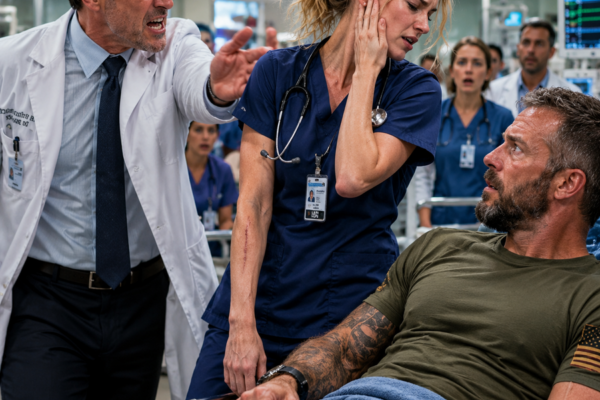
Dr.Cartervos arrived at the trauma bay at the same moment, already barking orders, already performing for the small crowd that gathers whenever a gurnie comes in loud.
He glanced at the monitor, at the erratic rhythm, at the pale gray creeping across Mason’s face, and made a decision Delaney would replay in her mind for the rest of her life.
“Get the crash cart.
We are losing him!”
Voss snapped, and then, catching sight of Delaney standing frozen at the edge of the bay, her hand still pressed to her chest where the coin hid beneath fabric, he could not resist one more performance.
“Sh, do not just stand there looking useless.
Or better yet, stay useless and stay out of my way.
” One of the seals, a broad-shouldered man with graying temples and a scar cutting through one eyebrow, stepped forward with the coiled tension of someone who has spent his whole career solving problems with his hands and is being told to wait.
His name tape reads.
His eyes swept the room once fast, professional, and landed on Delaney for exactly 1 second longer than anyone else in the bay. though she did not notice because her whole world had narrowed down to the failing rhythm on the monitor and the man she owed her life to lying still under fluorescent light.
The monitor’s alarm changed pitch flatlined.
The room erupted into motion and Dr.Voss, sweat beating at his hairline despite the crash card in his hands, turned toward Delaney one final time, furious now, frightened beneath the fury though he would never admit it, and said the words that would follow him for the rest of his career.
If you think you know something I do not, Nurse Shaw, then step up and prove it. Because if you pull this off, if a scrub tech with shaking hands does what I could not, I will tear up my own medical degree right here on this floor.
The room went silent, except for the flatline tone.
Delaney Shaw looked at Mason’s still face.
She looked at the coin-shaped weight beneath her scrub top.
She looked at Voss, and for the first time in 4 months, she did not look down. Her hands, which had trembled through four months of small humiliations, went perfectly, terribly still.
“Then get out of my way,” she said, and her voice did not sound like the quiet nurse anyone in that room had met before.
It sounded like command. What was happening inside Mason in that moment was the most dangerous thing a heart can do.
It was not simply beating too slowly or too fast.
It had stopped pumping blood altogether, even though the muscle itself might still be twitching with disorganized electrical noise, a chaotic quiver called ventricular fibrillation, no blood reaching the brain, no blood reaching the heart muscle itself.
Every second that passed without intervention meant brain cells beginning to die, and the chance of bringing him back falling with each moment lost. This is why the first response to a collapse like this is never to wait and see.
It is to act immediately.
If someone is unresponsive and not breathing normally, the first move is calling for emergency help and starting chest compressions right away without waiting for a perfect diagnosis.
Hands are placed in the center of the chest, one on top of the other, and the rescuer pushes hard and fast, allowing the chest to fully recoil between each compression, keeping a steady rhythm close to the tempo of a familiar song, fast enough to matter, deep enough to move blood through a body that cannot move it on its own.
An automated external defibrillator, an AED, does not require medical training to use.
It is built to talk a rescuer through every step out loud, reading the heart’s electrical pattern and delivering a shock only if the rhythm is one a shock can actually fix, like the chaotic quiver Mason’s heart had fallen into.
Compressions and a well-timed shock together are what give a stopped heart the chance to remember how to beat on its own again.
Delaney’s hands found the rhythm before her mind finished the thought because muscle memory built in far worse places than a Baltimore trauma bay does not forget.
Even after years of trying to forget everything else.
Delaney was on the gurnie rail before Voss could finish his sentence.
Her palms locked, her elbows straight, her whole small frame driving down into Mason’s chest with a force that made a nearby resident actually step backward.
One and two and three and four. the count running silent in her head in a cadence that belonged to a version of her nobody in this room had ever met.
Charged to 200, she said without looking up, without asking permission, in a voice pitched to carry exactly as far as it needed to and not one inch further.
The trauma nurse beside her hesitated, glancing toward Voss for direction the way hospital staff are trained to do.
Voss opened his mouth, likely to object, likely to reassert the authority he had spent four months building on Delane’s silence, and found that the words simply would not come.
He was watching something he did not have a name for.
Clear, Delaney said, and stepped back exactly long enough for the shock to fire and was back on Mason’s chest half a second after the current cleared.
Compressions resuming without a wasted breath.
Knox moved to the foot of the bed.
The other three seals, a lean, dark-haired man with a scar through his eyebrow whose name tape read Graves. A younger operator called Diesel who kept flexing his hands like he wanted something to hit and finding nothing.
And a fourth who simply stood with his arms crossed and his jaw locked, watching Delaney with an expression that was slowly sliding from grief towards something closer to disbelief. Second round, Delaney called.
Epie is in.
Somebody get me a rhythm check in 30. She was not asking the room for permission anymore.
She was running it. Dr.Voss found his voice at last, sharp and defensive, the particular tone of a man who feels control leaving his hands and cannot bear it.
Nurse Shaw, this is not your call to make.
I am the attending physician on this trauma, and I will not have a scrub nurse dictating protocol in my emergency department. Your protocol had him dead 90 seconds ago, Delaney said.
Not unkindly, not cruy, simply stating a fact the way she would state a blood pressure reading. Rhythm check.
The monitor’s waveform stuttered, jumped, found something almost like order.
Sinus rhythm, the trauma nurse said, her voice climbing with something between relief and astonishment. We have a pulse.
Weak, but it is there. The room exhaled as one organism.
Knox’s hand came down on the gurnie rail, knuckles white, his jaw working like a man fighting something enormous behind his teeth.
Delaney did not stop.
She checked Mason’s airway, adjusted the angle of his head, called for a second line, watched his oxygen saturation climb one point at a time on the monitor like a held breath finally being released.
It was only when the immediate crisis eased, when Mason’s blood pressure stabilized enough for the trauma team to begin prepping him for surgery to address the internal bleeding from the blast fragment lodged near his liver, that Delaney allowed herself to look up and find every set of eyes in the trauma bay locked on her.
Nobody
said anything for a long moment.
Then Knock spoke, quiet, careful, a man choosing his words the way he might choose a foothold on unstable ground. Those are not the hands of a scrub nurse.
Delaney’s fingers, still faintly trembling now that the adrenaline was draining out of her system, curled instinctively toward her scrub top, toward the shape of the coin hidden beneath it.
“I have been doing this a long time,” she said, which was true, and also nothing close to the whole truth.
“I have watched combat medics work a chest like that,” Knox said, not backing down, his eyes narrowing slightly, cataloging something.
“Not nurses, combat medics.
There is a difference in the hands, in the eyes. You had it in your eyes the second his heart stopped.
Knocks. The name came out of her before she could stop it.
Low, almost a whisper, and something in the way she said it, familiar and worn, smooth like a stone carried in a pocket for years, made his whole body go still.
“You know my name,” he said slowly.
“I do not believe we have met, ma’am.”
“You have not,” Delaney said.
“But I know Mason.
I have known him a long time. Dr.Voss, who had been standing frozen at the edge of the bay since the rhythm check, since the moment his authority evaporated in front of an audience he had spent months cultivating for his own benefit, finally found something to say, though his voice had lost most of its usual polish.
How, he managed, how does a scrub tech from general surgery know advanced cardiac life support protocol better than I do? How does she know a Navy Seal by his call sign?
The word landed in the room like a dropped tray.
call sign.
Voss had not meant to say it, had not fully processed what he was seeing until the word left his mouth.
But once it was out, every seal in the bay went utterly, dangerously still, and their attention shifted entirely away from the man in the white coat and onto the small woman in oversized blue scrubs, standing at the foot of their
brother’s gurnie with a coin-shaped weight, visible now at the open collar of her shirt.
Diesel was the one who broke the silence.
His voice rough with something between disbelief and dawning recognition. That coin.
Mason has been carrying one just like it for 6 years.
Says he owes his life to someone who is not supposed to exist on paper anymore. Delaney closed her eyes for exactly one second.
When she opened them, the tremor in her hands was gone, and something older and steadier had taken its place.
“He does not owe me anything,” she said quietly.
I owe him everything. The trauma bay curtain rustled.
Margarite Doyle, chief hospital administrator, silver-haired and sharpeyed, dressed in the kind of tailored suit that signaled she rarely set foot on a clinical floor unless something had gone badly enough to threaten the hospital’s reputation, stepped through it with the particular
expression of a woman who had already heard secondhand that a scrub nurse had just run a code in front of four armed military witnesses and a chief surgeon who had publicly humiliated her an hour before.
Nurse Shaw, Doyle said, her voice pleasant in the way that expensive things are pleasant right up until they are not.
My office now.
Delaney glanced once more at Mason, at the slow, steady climb of his vitals, at the color returning to lips that had gone the color of old bruises less than 10 minutes earlier. She glanced at Knox, whose eyes had not left her since the word call sign had entered the room.
After he is stable, she said, and it was not a question.
Doyle’s pleasant expression flickered just slightly, just enough for someone trained to read faces for a living to catch it and file it away.
Graves stepped closer to Delaney while the trauma team wheeled Mason toward the elevator that would take him up to surgery.
He was the quiet one of the group, the kind of quiet that comes from a man who has spent years learning to say more with silence than most people manage with a full sentence.
He studied her face for a long moment, the scar above her eyebrow, the set of her jaw, the way her stance had shifted without her noticing from the apologetic curve she wore around the rest of the hospital into something square and grounded and entirely unbothered by the four large armed men now surrounding her.
You served, he said.
It was not a question either. Delaney did not answer directly.
Mason is stable enough for surgery.
That is what matters right now. That is not an answer.
I know, Delaney said, and something almost like a smile touched the corner of her mouth, tired and real. It is the only one I have got for you today.
Diesel had gone quiet, too, staring at the coin still visible at her collar, doing math in his head that clearly was not adding up the way he wanted it to.
6 years, he said slowly.
Mason talks about someone from 6 years back, like they hung the moon and then got erased from every record that mattered. said the paperwork was scrubbed so clean it was like she never existed.
People get scrubbed from paperwork for a lot of reasons. Delaney said not all of them interesting.
Ma’am, no said and his voice had shifted.
The challenge gone out of it replaced by something careful and almost reverent. The tone of a man recalibrating everything he thought he understood about the last 15 minutes.
With respect, I have led men into worse rooms than this one.
I know what fear looks like on a face, and I know what training looks like.
And what you just did in there was not adrenaline luck. That was muscle memory built somewhere I do not have clearance to ask about.
Then do not ask, Delaney said gently, because there was no anger left in her for him. Only a bone deep tiredness that came from holding a wall up for 4 months and feeling the first stone finally shift loose.
She turned to follow the gurnie toward the elevator, needing to see with her own eyes that Mason made it to the surgical floor, needing one more minute before Margarite Doyle’s office swallowed whatever was left of the quiet life she had built in this city.
Behind her, she heard Dr.Voss finally speaking again, his voice lower now, stripped of its usual performance, directed at no one in particular.
I told her I would tear up my degree, he said almost to himself, staring at the empty space where the code cart had been at the tile still smeared faintly with the aftermath of a save he had not made. I did not think she would actually do it.
After Doyle agreed in a tone that promised the conversation was far from over and turned on her heel, already reaching for her phone before she cleared the curtain.
Already, though Delaney could not have known it yet, dialing a number she had hoped never to use again. A number connected to a decision Gracefield Emergency Pavilion had made 18 months earlier that a small, quiet nurse with steady hands was about to accidentally drag into the light.
Margarite Doyle’s office sat on the top floor of the administrative wing, glasswalled, overlooking a parking structure, and beyond it, a sliver of harbor visible on clear days.
Today, it was gray, low clouds pressing down over the water. And Delaney stood in front of the wide desk, feeling smaller than she had in years, not because of Doyle, but because of what the office represented, the machinery of an institution that valued its own image above almost everything else.
Sit down, Nurse Shaw,” Doyle said, not unkindly, though the pleasantness had thinned into something more business-like now that the Trauma Bay audience had dispersed.
Delaney remained standing. Old habits, Doyle studied her for a long moment, the way a woman studies a puzzle piece that suddenly does not fit the picture she thought she was building.
I have been chief administrator at Gracefield for 11 years. In that time, I have seen exactly one other person run a code the way you ran that one today.
He was our former chief of emergency medicine.
He left under circumstances I am not at liberty to discuss. I am not looking for trouble, Delaney said.
I am looking to keep my job and keep Mason alive.
That is the whole list.
Unfortunately, Doyle said folding her hands on the desk.
The list is not that short anymore.
Four Navy Seals just watched a general surgery scrub nurse run advanced cardiac life support better than my chief of trauma surgery.
And one of them said the word call sign loudly enough for half the department to hear.
Do you understand what that means for this hospital’s liability posture?
Nurse Shaw, do you understand what it means if the wrong person asks the right question about your credentials?
Delane’s jaw tightened.
My credentials are real.
I earned my nursing license the hard way after.
After what?
Doyle asked.
And for the first time, there was something almost gentle in her voice, almost curious.
the tone of a woman who had spent 11 years learning to read the things people did not say out loud. Delaney did not answer.
The silence stretched and Doyle reading it correctly as a closed door changed her approach.
I am not your enemy, Doyle said. But I need you to understand something about this hospital, something I would not normally share with junior nursing staff, but which your afternoon has made relevant.
18 months ago, this facility cut its cardiac response training budget by 60%.
Fewer refresher courses, fewer simulation drills, fewer hands trained to do exactly what you did today without hesitation. The board called it a costefficiency measure.
I called it a mistake at the time, and I was overruled.
Delaney’s stomach turned cold.
How many people has that costefficiency measure cost?
Doyle’s expression did not change, but something behind her eyes flickered.
the specific weight of a number she had been carrying alone for a year and a half.
More than the board would like acknowledged in a lawsuit, fewer than the worst version of the story.
I have been trying to reverse the cut for 18 months and getting nowhere because reversing it means admitting it should never have happened.
So today, Delaney said slowly, understanding, arriving in pieces. A scrub nurse walks in and does in 90 seconds what your underfunded undertrained staff could not do in front of a room full of witnesses who will absolutely talk about it.
That is either a problem for you or it is the exact leverage you have been looking for.
Something that might almost have been respect crossed Margarite Doyle’s face.
You are sharper than four months of pretending to be invisible would suggest nurse Shaw. I have had practice at both things.
Doyle leaned back in her chair. Here is my honest position.
I could use what happened today as evidence to the board that our cardiac response training is dangerously inadequate.
using you as living proof, in which case your background becomes a matter of public record, whether you want it to be or not, or I could quietly bury this afternoon, protect the hospital’s liability exposure, transfer you to a night shift in a wing where nobody important will ever see you work again, and hope Dr.Voss’s ego does not force the issue by talking about it in every operating room in the city for the next month.
Voss will absolutely talk about it, Delaney said. He already believes I embarrassed him on purpose.
Yes, Doyle said dryly.
I am aware of Dr.Voss’s tendency towards self- mythology.
That is a separate problem and one I am considerably more equipped to manage than the first one. A knock interrupted them.
Knock stood in the doorway out of his tactical gear now. Dressed in civilian clothes that did nothing to soften the way he carried himself.
Still coiled, still watchful, though the fury had drained out of his shoulders since the surgical team had confirmed Mason made it through the initial repair and was stable in recovery.
Apologies for the interruption, he said, not sounding particularly apologetic. I need 5 minutes with nurse Shaw.
Doyle glanced between them, weighing something, then rose from her desk with the air of a woman who had decided this conversation could survive an interruption. Take 10.
My office will still be here, and so apparently will the mess your friend’s arrival has stirred up.
She left them alone, the door clicking shut behind her.
Knox did not sit either.
He stood near the window looking out at the gray harbor, hands in his pockets. And for a long moment, neither of them said anything.
“Mason is asking for you,” he said finally.
First thing he asked when he came out of anesthesia enough to talk, before he asked about his own condition, before he asked about the rest of us, he asked if the woman with the coin was real or if he had dreamed her.
Something in Delane’s chest cracked open, small and sharp.
Tell him I am real.
I will, but I would like an answer first if you are willing to give one.
Knox turned from the window. 6 years ago, something happened to Mason that he has never fully explained to any of us, not even Graves.
And Graves has known him longer than anyone alive.
All Mason ever says is that a corman saved his life in a situation that officially did not happen. in a location that officially was not where we were and that the corman disappeared from every roster and every record within a month, like she had never existed at all.
He has been trying to find you for 6 years.
He was not supposed to look, Delaney said quietly. I asked him not to.
He looked anyway. Every deployment, every hospital database he could quietly access.
Every list of decorated corman who vanished from service without explanation. He never found you because whoever scrubbed your file did a thorough job.
Knox’s eyes were steady on hers now.
Careful. Weighing something.
I am not asking for classified information.
Ma’am, I have my own clearance history and I know when a door is locked for good reason.
I am asking as the man responsible for bringing him home in one piece. Whether the woman standing in front of me today is someone Mason can trust with what is left of his recovery or whether I need to be worried about anything else this hospital does not know.
Delaney met his gaze without flinching, without the small downward tilt of her head that had become reflex over four months of Dr.Voss’s audience.
You can trust me with his recovery, that is not a question.
As for what this hospital does not know, she paused, weighing 18 months of Margarite Doyle’s quiet, unpaid guilt against the coin resting warm against her sternum.
I think this hospital is about to find out more than it wants to, whether I say anything or not. Knox studied her for one more long moment, then nodded once.
The nod of a man closing a case file, not because the case was solved, but because he had decided to trust his instincts over his questions.
“Havoc would have liked you,” he said unexpectedly, quietly.
And something crossed his face that Delaney recognized instantly. The specific weight of a name spoken about someone no longer alive to hear it.
“Who is Havoc?”
she asked gently, though some instinct told her she already understood the shape of the answer.
My old team leader lost him 8 years ago before Mason joined the unit in an op that also officially did not happen.
Knox’s jaw worked.
He used to say, “The most dangerous person in any room is the one everyone assumes is harmless.
He would have clocked you in about 4 seconds instead of the 15 minutes it took the rest of us.”
Delaney felt the old ache of shared grief settle over her, familiar as the coin against her chest.
The particular kinship of people who have buried names they are not allowed to say out loud in most rooms.
I am sorry for your loss.
8 years is a long time to carry it, Nox said. And something in the careful, deliberate way he said it made Delaney look up sharply, catching the smallest flicker of something in his eyes that was not grief alone.
something closer to the way a man looks at someone he has just realized he does not want to stop looking at quickly suppressed professionally buried but not quite fast enough.
The moment stretched half a second too long before either of them looked away. I should get back to Mason, Delaney said.
I will walk you down, Knox said.
And neither of them mentioned that the walk to the surgical recovery floor did not require an escort. and both of them let the excuse stand anyway because some truths are easier to carry quietly than to say out loud on the first day they are noticed.
Neither of them saw Margarite Doyle standing just outside the door, phone pressed to her ear, speaking in the low, careful tone of someone choosing every word for an audience that could end her career if she chose the wrong one. I understand the training budget records are sealed, she was saying.
I am telling you they will not stay sealed if this becomes a wrongful death claim tied to a preventable code.
I need to know how many other incidents in the last 18 months looked like today’s.
And I need to know before nurse Shaw’s name reaches legal because right now she is the only reason this hospital is not explaining a body to a family of four Navy Seals instead of a recovery.
By the following morning, word of what had happened in the trauma bay had traveled through Gracefield Emergency Pavilion, the way important gossip always travels through a hospital, faster than any official memo, twisted slightly more at every retelling.
By the time Delaney clocked
in for her shift, she had already heard three separate versions of herself. A former Army Ranger, a disgraced military doctor stripped of her license, a witness in a federal case who had been hiding in Baltimore under an assumed identity.
None of them were true. All of them were closer to something true than anyone in that hospital had any right to guess.
Dr.Voss found her at the supply closet before she had even finished her first coffee. He looked different than he had the day before.
Less polished, dark circles beneath his eyes, suggesting a sleepless night spent replaying his own humiliation on a loop. Delaney braced for another round of public mockery.
But what came instead was quieter, more dangerous. The voice of a man who had spent the night building a case rather than an insult.
I spoke with the medical board’s regional liaison last night, Voss said, keeping his voice low, controlled, clearly rehearsed.
I raised concerns about a scrub nurse practicing significantly outside her scope of lensure. Running advanced cardiac life support protocols as a credentialed responsibility, nurse Shaw.
Not something you simply decide to do because you feel like it. I am ACLS certified, Delaney said evenly.
Same as every RN on this floor.
Certified to assist, Voss said.
not to direct a code, not to overrule an attending physician’s treatment plan in front of witnesses.
His eyes flick toward the ceiling camera in the hallway, the specific gesture of a man performing for a recording rather than a person. I want to be reasonable about this.
I do not enjoy conflict, but you put this hospital in an extraordinarily difficult position yesterday, and I have a professional obligation to report irregularities in patient care, regardless of outcome.
Regardless of outcome, Delaney repeated. Mason is alive because of the outcome.
Mason is alive because a code was eventually run correctly.
Voss said, a thin edge of desperation creeping into his careful tone. Now, the sound of a man trying to rewrite a story that four seals and an entire trauma bay had already watched happen in real time.
Whether that credit belongs to a licensed nurse acting within her scope or to someone whose credentials this hospital has not actually verified beyond a background check remains an open question, one I intend to see answered. Delaney studied him for a long moment, and something in her expression must have shifted because Voss took an involuntary half step back.
The same instinct that makes even confident men flinch from something they cannot fully name. Ask your question, she said quietly.
File your report.
But before you do, you might want to ask administrator Doyle what her cardiac response training budget looked like 18 months ago and how many codes in this department did not end the way yesterday’s did.
I think you will find the credentials question is not the one that keeps you employed here.
Boss’s face went through several colors before settling on something close to gray.
He did not respond. He turned and walked away down the corridor.
his gate less certain than it had been in the four months Delaney had known him, and for the first time since she had started at Gracefield, she watched him retreat rather than perform.
She did not enjoy it as much as she expected to. Old habits from a different life, reminded her that a cornered animal, even an arrogant one, could still be dangerous, and Voss had just learned that his usual weapons no longer worked on her.
The morning settled into something like routine, though nothing about Gracefield felt routine anymore. Delaney checked on Mason during her break, finding him awake, groggy, tubes still threading from his arm, but alert enough to recognize her the moment she stepped through the recovery room door.
“Ghost,” he said, his voice raw from the ventilator tube that had recently come out, and something in Delane’s chest folded in on itself at the sound of the name nobody had used in 6 years.
“Do not call me that here,” she said gently, closing the door behind her, though there was no real anger in it.
Sorry.
Mason’s grin was weak but real.
Force of habit. You look exactly the same.
You know, I spent 6 years imagining you would look different, older, tired, something.
You look exactly like the last day I saw you standing outside that helicopter telling me to shut up and hold pressure on my own arm. You were bleeding out and complaining about the coffee at the fob.
Delaney said, “Somebody had to tell you to shut up.”
Mason laughed, then winced, then laughed again. Anyway, careful this time.
One hand pressed against the bandaging over his ribs. I looked for you.
Every deployment, every database I could get eyes on without raising flags I was not supposed to raise.
Knox thinks I am obsessed. Graves thinks I made you up entirely.
Some kind of combat fever dream.
I asked you not to look.
I know.
Mason’s eyes, more serious now, found hers and held them.
I looked anyway because you saved my life in a place that officially never happened and then you vanished so completely it was like the universe agreed to pretend you never existed either. I needed to know you were real.
I needed to know I did not imagine the whole thing. Delaney sat carefully on the edge of the visitor chair, the coin at her collar shifting free of her scrub top, catching the light for a moment before she tucked it back beneath the fabric, an old reflex that felt suddenly uselessly pointless given everything that had already unraveled in the last 24 hours.
“I left the service the way I did for reasons I still cannot talk about,” she said quietly.
Not because I do not trust you, because some doors once you close them are not yours to open again, even for someone you would take a bullet for twice. You already took one for me, Mason said.
I remember that part clearly enough. Different bullet, different day.
Not relevant right now.
Delaney’s mouth curved despite herself, and for a moment, the weight in the room lifted enough to let something almost like the old easiness between them return.
the specific comfortable shorthand of people who had once trusted each other with their lives and never fully lost the habit.
The moment did not last. A soft knock interrupted them, and Knock stepped into the room, still moving with the careful economy of a man scanning every exit before he commits to entering a space.
His eyes taking in Mason’s improving color, then settling on Delaney with an expression she was still learning to read.
“Sorry to interrupt,” he said, not sounding especially sorry.
But there is a situation downstairs that involves you. What kind of situation?
A man from an outside firm is at the records desk claiming federal authority to access Mason’s chart and yesterday’s code documentation, citing an ongoing insurance compliance review.
Says he needs the raw telemetry data pulled from the crash cart and the security footage from the trauma bay effective immediately before the hospital’s own legal team has had a chance to review it.
Knox’s jaw was tight.
Something about the way he is pushing feels wrong. Graves has eyes on him from a distance.
He does not carry himself like Federal.
He carries himself like someone paid to make a problem disappear quietly before anyone official ever hears about it.
Delaney was already on her feet.
The tired stillness of a moment ago replaced instantly by something sharper, more focused.
The version of her that four months of Baltimore quiet had never fully erased. Describe him, she said.
mid-40s gray suit, government-l looking badge that flashed too fast for the desk clerk to actually read the print on it.
Talking in a hurry, like he wants this done before the shift change brings more people onto the floor who might ask questions, Nox’s eyes narrowed, he specifically asked whether the nurse who ran yesterday’s code was on shift today, used your name.
The room went very still.
That footage, Delaney said slowly, thinking it through in real time, is the only physical evidence connecting yesterday’s near miss directly to the training budget cuts Margarite Doyle told me about.
If that footage disappears along with the telemetry data, there is no proof this hospital’s cost cutting measure almost killed Mason.
There is just a scrub nurse who overstepped her authority.
Exactly the story Dr.Voss is already trying to write.
Then we do not let it disappear,” Mason said from the bed, struggling to sit up despite the fresh surgical repair in his side until Knox’s firm hand on his shoulder pushed him back down without much effort at all.
“You are not doing anything except healing,” Knox said, then looked back at Delaney.
“But she might be able to do something.”
“Ma’am, this is your hospital, your floor, your knowledge of how this building actually moves.
What do you need from us?”
Delaney felt something settle into place inside her. A familiar shape she had spent 6 years trying to forget the feel of the specific quiet certainty of a plan assembling itself faster than conscious thought.
Could keep pace with it. I need diesel at the records room second entrance.
The one through the old radiology corridor that nobody remembers still connects before that man realizes it exists.
She said I need Graves to keep visual on him without engaging because if he really is here to make evidence disappear quietly.
The moment he feels cornered, he will either bolt or destroy what he came for on the spot.
And either way, we lose the proof Doyle needs.
And I need you to walk with me to that records desk right now.
Not as backup, but as a witness. Because four Navy Seals standing in a hallway is the fastest way I know to make a nervous fixer decide today is not worth his paycheck.
Knox studied her for exactly one second, the same measuring look he had given her in the trauma bay less than a day earlier. And this time, there was no hesitation in it at all.
Yes, ma’am, he said, and it did not sound like an obligation.
It sounded like something closer to relief, the particular relief of a man who has spent his whole career following people worth following, and had just found one more.
The records desk sat at the intersection of two corridors on the third floor.
A low counter manned by a single overwhelmed clerk who looked profoundly relieved when Delania Knox rounded the corner because the man in the gray suit had clearly been leaning on her with increasing impatience for several minutes. He was exactly as Knox had described him, mid-40s, gray suit slightly too expensive for a government auditor, a badge holder that he flipped open and closed too quickly for anyone to actually read what it said.
He had the particular smooth urgency of a man used to getting his way through pressure rather than authority.
The kind of person who counted on hospital staff being too busy and too intimidated to slow down and ask the second question that would unravel the first answer. I need that footage pulled now.
He was saying to the clerk, compliance reviews do not wait for shift changes. And I have already explained that delays here create liability exposure for everyone in this building, yourself included.
Can I help you with something?”
Delaney asked, stepping up to the counter with the calm, unhurried voice she used on frightened family members in the trauma bay. The voice that made chaos feel smaller just by being spoken into it.
The man’s eyes flicked to her, then to Knock, standing a half step behind her shoulder, then to Graves, who had drifted into view at the far end of the corridor with the studied casualness of a man who wanted to be seen exactly enough to be a deterrent and not one inch more.
This does not concern hospital nursing staff, the man said, reccalibrating his tone slightly. Less impatient now, more careful.
I am here on a compliance matter related to yesterday’s incident.
Insurance review protocol. Which insurance carrier?
Delaney asked.
A half-second hesitation, barely visible, but visible.
That information is confidential pending the review.
Interesting, Delaney said.
Because Gracefield’s malpractice carrier is Meridian Sentinel Group, and I happen to know their compliance reviewers travel in pairs and always coordinate directly through hospital risk management before ever approaching clinical staff or records.
Administrator Doyle has not mentioned any review to me, and given that I was the nurse present for yesterday’s incident, I would expect to have heard something by now.”
The man’s smile thinned.
Ma’am, I would strongly recommend you step back and allow me to complete a routine documentation request without complicating a process you are not read into.
I am the nurse whose name is on that documentation,” Delaney said, her voice not rising, not sharpening, simply becoming more solid.
The waist stone becomes more visible as fog clears around it.
Which means anything you pull from that footage or that telemetry file involves my clinical record and my license, which means I have every right to ask who you actually work for before a single file leaves this building. The clerk behind the desk, sensing the shift in the room, quietly slid her hand away from the keyboard she had been about to type on.
The man’s eyes moved once more, cataloging the seals positioned at both ends of the corridor.
now doing rapid math on a situation that had clearly not been part of whatever briefing sent him here. His hand drifted almost imperceptibly toward the inside pocket of his jacket, and Knox moved half a step forward at the same instant.
Not aggressive, not threatening, simply present, the specific stillness of a man who has spent years learning to read the exact moment before someone makes a decision they cannot take back.
“I would think carefully about what is in that pocket,” Knox said quietly.
before you reach for it in a hospital corridor full of witnesses and cameras that unlike the ones you are trying to erase are still recording right now.
The man’s hand stopped moving.
For a long moment, nobody spoke.
The hallway holding its breath the way trauma bays hold their breath in the second before a monitor either finds a rhythm or does not. Then from the far end of the corridor, a new voice cut through the silence, sharp, authoritative, unmistakably furious.
“What?”
Margarite Doyle said, closing the distance at a pace that made her heels strike the tile like small gunshots. Is happening at my records desk.
The man in the gray suit turned toward her, visibly recalculating his options and finding fewer of them by the second.
Administrator Doyle, I am glad you are here.
I represent a firm retained to conduct an independent compliance review of yesterday’s cardiac event, and your staff has been remarkably uncooperative.
I did not retain any independent firm, Doyle said flatly.
I made exactly one phone call last night to our malpractice carrier’s internal risk assessment team requesting a full audit of our cardiac response training records going back 18 months.
I did not authorize anyone to remove footage or telemetry data from this building.
And I certainly did not authorize a man who cannot produce a readable badge to intimidate my records clerk into handing over evidence in an active malpractice exposure situation.
There has been a miscommunication, the man said, his tone shifting fully into retreat now, the smooth confidence of a few minutes earlier draining away with each word Doyle spoke. I will confirm my authorization and return through proper channels.
You will leave this building, Doyle said.
and I will be contacting the actual carrier this afternoon to determine exactly who sent you because I have a strong suspicion it was not Meridian Sentinel Group at all but someone considerably more interested in making sure this incident never reaches a courtroom or a headline.
The man did not argue further.
He gathered whatever composure remained to him nodded once to no one in particular and walked briskly toward the elevator, graves peeling off the wall to follow at a discrete distance, ensuring the departure was as complete as it appeared. Doyle exhaled slowly once the elevator doors closed, some of the sharp authority in her posture softening into something more tired, more human.
That, she said, turning to Delaney, who confirmed something I suspected but hoped I was wrong about.
Someone above my position on this hospital’s ownership chain already knows about the training budget cut, already knows it nearly killed a patient yesterday, and is moving faster to bury the evidence than I am moving to fix the underlying problem.
Then we move faster than they do. Delaney said.
Doyle studied her for a long moment, something calculating and for the first time since they had met, genuinely warm crossing her face at once.
You keep saying we, Nurse Shaw, as though a scrub nurse with a mysterious past and forearmmed military escorts is now personally invested in this hospital’s institutional accountability.
I am invested in the next patient who codes in that trauma bay, having a full team trained to bring them back without needing a scrub nurse to break protocol first, Delaney said.
Whatever else happens to me because of yesterday, that part does not stop mattering just because it is inconvenient for someone’s liability exposure.
Doyle’s mouth curved into something that was almost, though not quite, a smile.
Dr.Voss filed his complaint against you this morning for what it is worth.
Practicing outside scope, insubordination, endangering a patient through unauthorized protocol deviation. I received it an hour ago.
Delaney felt the floor shift slightly under the words.
The old familiar drop of consequence finally arriving after a lifetime of learning to expect it.
And and I am shredding it.
Doyle said, “The moment I finished drafting the incident report that will accompany it to the board, the one detailing exactly how a training budget cut I opposed 18 months ago left this department unprepared for a cardiac arrest that a scrub nurse with unspecified military medical background had to correct in real time, saving the patients life and incidentally saving this hospital from what would have been
a catastrophic and entirely preventable wrongful death claim.
Dr.Vos’s complaint is going to read very differently once the board sees it sitting next to that context.
Something loosened in Delane’s chest.
Not relief exactly, not yet.
But the first crack of daylight through a door she had expected to stay shut.
There is still the matter, Doyle continued more carefully now, of what the seals standing in my hallway already know, and what Dr.Voss already said out loud in front of witnesses about call signs and background checks.
I cannot put that particular fire back out.
I can only decide how this hospital responds to it once it catches. I know, Delaney said quietly.
I have known since yesterday afternoon that the version of my life where nobody asks questions is probably over.
Knox, who had remained silent through most of the exchange, spoke then, his voice low, deliberate, carrying none of the earlier tactical edge, something gentler underneath it instead.
For what it is worth, he said, “Whatever you decide to tell people, and whatever you decide not to, the men standing in this hallway already decided something themselves last night, sitting outside Mason’s recovery room.
We decided that whoever you were before you walked into that trauma bay.
The person who ran that code and then walked straight into a records desk standoff to protect the evidence, without hesitation, without asking anyone’s permission, is exactly the kind of person we would follow into anything.
That is not something we say lightly. Delaney looked at him for a long moment, the coin warm against her sternum.
The weight of 6 years of careful invisibility finally irreversibly beginning to lift.
That is a dangerous thing to say to someone who spent 4 months convincing an entire hospital she did not exist, she said quietly.
Maybe, Nox said, and something in his eyes, steady and unhurried, made the word land differently than it should have. Or maybe it is exactly the thing someone needs to hear after 4 months of being told the opposite.
The hospital board meeting convened 4 days later in a conference room on the top floor that Delaney had never once set foot inside during her four months at Gracefield.
She wore her own clothes instead of scrubs for the first time since starting the job.
A plain navy blazer she had bought years ago for exactly this kind of unwanted occasion. and she stood at the head of a long table with Margarite Doyle beside her, feeling the particular exposed stillness of someone who has spent 6 years perfecting the art of not being looked at, finally standing in a room built entirely around looking.
Dr.Vos sat near the far end of the table, his usual polish dimmed considerably since the day the gray suited man had walked out of the records corridor empty-handed.
The board’s internal investigation, moving with unusual speed once Doyle’s incident report reached them alongside the training budget records, had confirmed within 72 hours that Gracefield’s parent healthcare network had authorized the cardiac response training cuts 18 months earlier over Doyle’s documented objections and had subsequently pressured a private
risk consulting firm, the same firm that employed the man from the records desk, to quietly manage any incidents that risked exposing the decision before the next public earnings call.
The board has reviewed the full incident report.
The chairwoman said an older woman with steel gray hair and the flat unhurried voice of someone who had survived decades of hospital politics without losing her spine.
Including nurse Shaw’s clinical performance during the cardiac event, Dr.Voss’s formal complaint, and the subsequent attempt by an outside firm to remove evidence from hospital records without authorization.
We have some questions.
Delaney answered what she could. Delaney confirmed her nursing license was legitimate, earned after her return from service, the specifics of which she declined to detail beyond acknowledging a background in advanced field medicine that predated her civilian career.
She did not offer her call sign.
The coin stayed hidden beneath her blazer collar unexplained, though several board members eyes had drifted toward the faint outline of the chain at her throat more than once during the questioning.
It was Knox, seated near the back of the room at Doyle’s invitation, who finally spoke the words Delaney had spent 6 years avoiding.
“With respect,” he said, rising when the chairwoman acknowledged him, his voice carrying the flat authority of a man used to briefing rooms considerably more hostile than this one.
I do not believe this board needs Nurse Shaw’s classified service record to make its decision today.
What this board needs to understand is that four members of an active naval special warfare unit watched her save a teammate’s life in 90 seconds using training that this hospital’s own budget cuts had stripped from its staff 18 months earlier.
Whoever she was before
she put on those scrubs, what she is now is the reason one of my men is alive to see his little sister’s wedding next spring instead of a folded flag.
I would think very carefully before this board treats that as a liability rather than the asset it obviously is.
Silence settled over the room, thick and considering.
Dr.Voss, who had said almost nothing since the meeting began, finally spoke, his voice smaller than Delaney had ever heard it, stripped entirely of its usual performance for an audience that no longer found him impressive.
“I would like to withdraw my complaint,” he said.
“And I would like the record to reflect that nurse Shaw’s intervention was appropriate, necessary, and almost certainly the reason Mason survived long enough for a proper surgical team to intervene.
I was wrong.
I was more concerned with my own authority in that room than with the patient in front of me.
And I have had four days to sit with exactly how ugly that looks from the outside. It was not the dramatic collapse Delaney might once have imagined for a man who had spent 4 months humiliating her in front of an audience.
It was quieter than that, more human. A man finally looking at his own reflection without the framed degree between him and the truth of it.
I said something to you that day,” Voss continued, meeting her eyes directly for the first time since the meeting started about tearing up my medical degree.
I meant it as mockery. I did not expect to spend the following week actually considering whether I had earned the right to keep it, given how I treated the people around me while wearing it.
I am not going to tear it up, but I am going to spend considerably more time deserving it than I have lately.”
The chairwoman allowed a long pause before speaking again. The board will reinstate full funding for cardiac response training effective immediately with quarterly simulation drills mandatory for all clinical staff.
We will also be commissioning an independent audit of every decision made by the risk consulting firm involved in this incident and reviewing our contract with them accordingly.
She turned to Delaney and nurse Shaw. The board would like to formally offer you a newly created position, director of emergency response training, reporting directly to administrator Doyle, designing and running the very program that should have existed 18 months ago.
The salary will reflect the responsibility. The scope of the role is within reason yours to define.
Delaney felt the offer land somewhere deep and unexpected.
A door opening in a wall she had built specifically to keep doors from opening.
I would want it structured so that it teaches beyond this hospital, she said slowly, thinking it through as she spoke.
Community response training, basic bystander CPR and hemorrhage control for people who will never set foot in a hospital uniform, but might be the only person standing next to someone who collapses on a sidewalk or a soccer field.
The hospital does not just owe its own staff better training.
It owes the city something, too, since the city trusts it to know what it is doing. The chairwoman studied her for a long moment, something like genuine respect settling into her expression.
Draft a proposal. The board will fund it.
The meeting adjourned not long after.
Board members filing out in twos and threes. Dr.Voss lingering at the doorway long enough to extend his hand to Delaney.
An old-fashioned gesture that felt for the first time since she had met him entirely without performance behind it.
I owe you an apology considerably larger than a handshake, he said quietly. I do not expect it to fix 4 months.
I do intend to earn something better than what I have given you so far. Start with the next scared new nurse who walks onto your floor, Delaney said, shaking his hand once, brief and business-like.
That would fix more than an apology to me ever could. Boss nodded, something almost like humility settling over features that had spent months arranged in condescension, and left the room without another word.
That evening, Delaney found Mason sitting up in a wheelchair on the recovery floor’s small outdoor terrace, watching the last of the daylight burn orange over the Baltimore skyline, knock seated beside him with two cups of vending machine coffee that had clearly gone cold an hour earlier, and neither man seemed to mind.
“Director of emergency response training,” Mason said, grinning as she stepped through the door.
That has a nice ring to it, considerably better than Corman, who does not officially exist.
“I am retiring that title,” Delaney said, settling into the empty chair beside him.
The evening air cool and salt tinged with harbor wind, or at least the part of it that requires vanishing every time someone gets close to the truth.
“I am tired of disappearing, Mason.
I have been tired of it for longer than I let myself admit.”
“Good,” Mason said simply.
Because I have spent 6 years wondering if I imagined the person who saved my life. I would rather spend the next six knowing she is real and gets to keep existing where people can actually thank her.
Knox said nothing for a while watching the light fade over the water.
And when he finally spoke, his voice carried none of the tactical steadiness from the records corridor.
Something raw underneath it instead. Havoc used to say the hardest part of this job was not the danger.
He said it was learning to let people matter to you again after you had spent years training yourself not to because caring about someone made you slower, made you hesitate at exactly the wrong moment.
He never fully figured out how to do it himself. Died before he got the chance to try.
And you?
Delaney asked quietly.
Knox turned to look at her directly. The last orange light catching the gray at his temples.
The scar through his eyebrow. The specific unguarded expression of a man who had spent a career learning to read danger in a room and had just decided deliberately to stop reading this particular moment as anything but what it actually was.
I think I am done training myself not to.
He said, “I have known you 4 days and somehow it feels like considerably longer than that, which either means I am losing my tactical instincts entirely, or it means something I have not let myself want in a long time is sitting on this terrace right now, drinking bad coffee, watching the sun go down.
” Delaney felt the old tremor return to her hands for one brief moment.
Not fear this time.
Not the old exhausted reflex of a body remembering things it wanted to forget, but something closer to the specific vulnerable ache of letting a wall come down on purpose deliberately after years of building it brick by brick. I am not the easiest person to know.
She said, “There are parts of me that stay locked even now.
Parts of my file that will never be unsealed for anyone. Not even someone who just stood in front of a hospital board and told the truth about me when he did not have to.
I did not tell them the truth because I needed you unlocked.
No said, I told them because what I have seen in 4 days does not need the locked parts to be worth following. The parts you have already shown me are more than most people show in years.
Mason, watching the exchange with the particular satisfied amusement of a man who has just witnessed something he intends to bring up at every future opportunity for the rest of his life, cleared his throat loudly enough to break the moment without quite ruining it.
For the record, he said, “Ghost saved my life once already.
Seems only fair someone finally gets to save hers back a little, even if it is just by refusing to let her disappear again.”
Delaney laughed, real and unguarded, a sound that surprised her with how easily it came, and reached across the small gap between the chairs to press her hand briefly against Knox’s.
Not a promise, not yet, but something honest and unhurried and entirely her own choice for the first time in longer than she could remember. The following months brought changes to Gracefield that rippled well beyond its own walls.
The emergency response training program Delaney designed ran its first community CPR and hemorrhage control class in a church basement three blocks from the hospital. 22 ordinary people learning to recognize a stopped heart and act in the first 60 seconds that actually matter.
None of them soldiers, none of them medical professionals. All of them leaving that evening with hands that knew what to do the next time it counted.
Dr.Voss, true to his word, spent considerably more time on the clinical floor and considerably less time in front of his framed degree, and the newer nurses at Gracefield stopped flinching when he walked past their stations.
Margarite Doyle secured full independent oversight of the hospital’s risk consulting contracts, and the training budget her predecessor’s decision had gutted 18 months earlier was restored with interest.
Quarterly drills becoming as routine as shift changes. Mason recovered fully, returned to his unit on like duty within 4 months, and made a habit of finding excuses to pass through Baltimore whenever his schedule allowed, usually with Knox, usually staying just long enough to sit on that same terrace and watch the harbor light fade orange over
the water.
Delaney Shaw stopped hiding her badge inward on her scrubs.
The coin stayed with her, worn beneath her collar most days, and the tremor in her hands had quieted to something she barely noticed anymore. Steady now in a way that had nothing to do with muscle memory and everything to do with finally standing in a life she no longer needed to disappear from.
For years, she had believed that hiding weakness was the only way to survive what she carried. Standing now in a hospital corridor she had once tried so hard to move through unseen.
She understood that had never been true. She had been hiding command, waiting patiently for a room that finally deserved to see it.
The end. The heartstoppping event at the center of this story is called cardiac arrest.
And it is one of the few true medical emergencies where a bystander with no formal training can be the difference between life and death long before any ambulance arrives.
When someone collapses and is not breathing normally, the first and most important step is calling emergency services immediately and beginning chest compressions right away, pushing hard and fast in the center of the chest without waiting for certainty about what caused the collapse.
An automated external defibrillator found in most public buildings, gyms, and workplaces is designed to guide a rescuer through every step out loud and will only deliver a shock if the heart’s rhythm is one that a shock can actually help.
Together, fast compressions and early defibrillation give a stopped heart its best chance of remembering how to beat again.
You do not need a medical degree to save a life in that moment.
You only need to be willing to act.