She Flirted With a Teddy Bear on Black Friday—Then the Man Inside Revealed His Face!
She Flirted With a Teddy Bear on Black Friday—Then the Man Inside Revealed His Face!
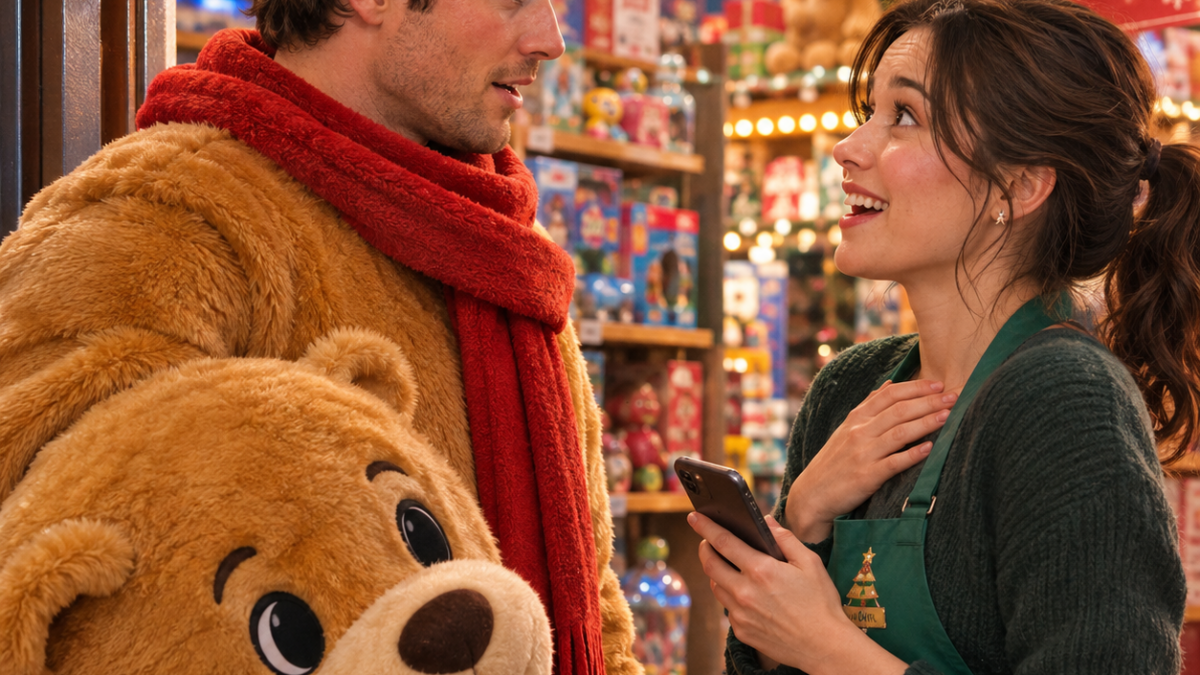
By 6:00 on Black Friday, I’d been hugged by 73 children, punched in the stomach by one enthusiastic toddler, and proposed to by a woman who thought I was a six-foot teddy bear. I was ready to take off the enormous furry head and retire from show business forever. Then a young woman in a green store apron stopped me beside the stockroom.
– Hey, Mr. Bear, could you take your head off? I want one picture with the guy who’s been making everybody laugh.
I lifted the head, blinking into the fluorescent lights, and her smile disappeared.
– Wait, you’re the man who changed my tire last Saturday.
I stared at her—the woman from the grocery store parking lot, the woman whose number I’d forgotten to ask for. Behind her, my friend Brandon started laughing.
– So that’s why you’ve been bringing the bear water all day.
She turned bright red, and I did too, yet finding each other again was only the beginning—neither of us knew what would happen when the costumes came off. If you’ve ever wished for a second chance with someone you met by accident, please like this story, subscribe, and tell me in the comments: would you have recognized your mystery stranger beneath a bear costume?
My name is Austin Hale; I was 30, lived in Dallas, Texas, and made my living as a freelance graphic designer. I designed logos, storefront displays, menus, posters, and the occasional wedding invitation for couples who disagreed passionately about the proper shade of beige, liking my work, my small apartment above a dry cleaner, and—until that November—my ability to make other people look memorable while remaining almost completely forgettable myself.
To be clear, I wasn’t a professional bear. The bear was named Benny, belonging to Wonder and Whim, a bright, slightly chaotic toy store inside a Dallas shopping center, with golden fur, a red scarf, a smile the size of a dinner plate, and a head so large that passing through ordinary doorways required strategic planning. I had designed his holiday advertising graphics two years earlier for the store’s manager, Brandon Cole, an old college friend—so when Brandon’s scheduled mascot called in sick the night before Black Friday, he telephoned me at 9:47.
– Can you dance? he asked.
– Not in a way that should be witnessed by the public.
– Perfect. Our bear can’t talk anyway.
I said no, he offered overtime pay, and I said probably not—until he reminded me that a commercial client had delayed my final payment on a large project and that I’d spent the previous week complaining about replacing my dying computer.
– I told him it was rude to weaponize accurate information.
– Come on, he said. You drew Benny. Think of this as visiting your son.
– My son needs a smaller skull.
– Seven o’clock in the morning. I’ll buy breakfast.
That was how I ended up inside a hot furry costume while the rest of Dallas hunted for half-price headphones. At first I treated the job like community service for my terrible career decisions—waving, bowing, and posing for photographs while learning that children under four either loved Benny completely or regarded him as a threat to civilization. One little boy hugged my leg for three consecutive minutes, and a girl in glittery sneakers informed me bears did not wear shoes and demanded an explanation until I pointed at the shoes, pointed at the tile floor, and performed a dramatic pantomime of burning my paws, which she accepted as sound scientific reasoning.
Around 10:00, I noticed the woman with the water bottle. She worked at Wonder and Whim, moving constantly between the register, the gift-wrap table, and a stuffed-animal display near the entrance with dark hair tied in a loose ponytail, quick hands, and a laugh that carried over the music. When a young customer dropped a box of building blocks, she knelt to help gather them; when an elderly man couldn’t find the doll on his granddaughter’s wish list, she walked him through three shelves without rushing him; and when I pretended to trip over an invisible banana peel, she laughed so hard she had to lean against a display rack before handing me a water bottle through the gap near the costume’s neck a few minutes later.
– Benny, hydrate, she ordered. I refuse to explain to my manager that we cooked a bear.
I gave her a solemn thumbs-up.
– Good. Also, your dancing is terrible.
I put a paw over my heart.
– That’s not a complaint, she said. It’s the best thing I’ve seen all morning.
There was something familiar about her voice, yet inside that head everything sounded as though it traveled through a pillow, and seeing the name Kira on her apron didn’t connect her with the woman I’d met the previous Saturday—partly because the store was loud, and partly because I’d spent a week convincing myself that the parking-lot encounter was a small, finished chapter of my life.
That chapter had begun with a flat tire outside a grocery store where I’d stopped for coffee beans and printer paper after visiting a client. Crossing the lot, I spotted a woman standing beside a blue sedan staring at the rear passenger tire with the expression of somebody trying to negotiate with a very uncooperative vegetable.
– Are you okay? I asked from a few steps away.
– Depends, she replied. Can you convince a tire that it still has dreams?
– I can try, I laughed, but I don’t think it’ll respond to motivational speaking.
Introducing herself as Kira with her phone in hand ready to call roadside assistance, she explained she had a spare in the trunk yet wasn’t sure she could change it safely. When she accepted my offer to help, we worked together under a parking-lot light—me finding the jacking point in her owner’s manual and loosening the lug nuts before lifting the car, while she operated the jack and held a cheerful little yellow flashlight.
– Is this your usual Saturday-night entertainment? she asked.
– Sometimes I go to concerts. Sometimes I rescue stranded sedans. I’m very unpredictable.
– Do the sedans send thank-you notes?
– Rarely. Their handwriting is awful.
She laughed, and wanting to make her laugh again should have warned me I was in danger. While we worked, she told me she worked in retail, liked old bookstores, and had a younger sister who treated every inconvenience as an opportunity for unsolicited commentary, while I told her I designed things and that my own sister still called me the kid who labeled every drawer in our childhood home; noticing a scrape on my knuckle, she insisted I wear a smiling cartoon dinosaur bandage from her glove compartment.
– Very intimidating, I said. Now no one will mess with you.
With the spare secure and the car back on the ground, I reminded her to follow the temporary tire’s speed and distance limits and visit a tire shop the next morning, handing back the flashlight—or thinking I did, until I later discovered it in my coat pocket. We stood beside her car for an awkward, strangely comfortable moment.
– Well, she said, thank you, Austin. You did half the work.
– Then thank you for supervising my extremely glamorous evening.
I wanted to ask for her number and even opened my mouth, yet having just helped her out of a jam, I worried turning a favor into a romantic invitation might make the favor feel like a transaction—so I simply said, “Drive safe, Kira.” She hesitated, smiled, and drove away, leaving me realizing as her taillights vanished that I could have said, “I’d like to see you again, but it’s completely fine if you don’t”—and for seven days I kept the little yellow flashlight on my desk as a reminder that hesitation could be almost as inconvenient as a flat tire.
By 5:30 on Black Friday, Wonder and Whim looked as though a small hurricane had developed an interest in educational toys, every checkout lane packed and the plush-animal section destroyed repeatedly while my shirt grew damp beneath the costume and Benny’s head smelled like warm foam and personal regret. Brandon appeared near the stockroom door holding a clipboard.
– You survived.
– Barely. A little girl asked whether I was married to the Easter Bunny.
– What did you tell her?
– I gave her two thumbs-up. So apparently we’re married now.
He glanced over my shoulder.
– Speaking of devoted admirers, Kira’s been checking on you all day.
– She’s checking that I haven’t died in your costume.
– That’s how all the great love stories start.
I tried to swat him with one enormous paw, missed, and knocked a cardboard sign against the wall before Brandon laughed and went off to handle a customer complaint about a remote-control dinosaur. Turning toward the changing room, I paused when Kira hurried over with her phone in hand—noticing up close her tiny silver star earrings, her green apron crooked from a tough shift, and the way she tucked a loose strand of hair behind one ear as she smiled up at the bear.
– Wait, I need a picture, she said. You’ve been the unofficial hero of Black Friday.
I raised both paws for the camera.
– Not another picture with the mascot—one with the actual person.
– Take the head off?
Glancing toward the changing room and deciding a few seconds wouldn’t matter, I lifted it off, shaking my hair out of my eyes as cool air hit my face—and watched her smile freeze as I saw the same dark eyes and crooked little smile without a cold parking lot or car jack between us.
– Kira?
– Austin? we spoke at the exact same time.
– Wait, she said. You’re the guy who helped me change my tire last week.
– And you’re the woman who threatened to give my mechanical skills a one-star review.
– I said four stars. You got one off for bad jokes.
Brandon appeared behind us with a roll of receipt paper and the grin of a man who had just received an unexpected Christmas bonus.
– Oh, he said. Oh, this is excellent.
Kira covered her face with her phone.
– So that’s why you kept hanging around the bear, Brandon said. I knew the hydration schedule was suspicious.
– I work here, she protested. I was being responsible.
– Of course—you always personally deliver five water bottles to the seasonal mascot.
– Six, I corrected.
– You’re not helping, Kira looked at me.
– I’ve been told that before.
Laughing and glancing at the giant bear head in my hands, she admitted she had spent an entire week hoping to run into me again while I was right there dressed as a bear.
– You spent a week hoping?
– Maybe, she tilted her head.
– That’s a pretty important maybe.
– Then quit making me do all the talking, tire guy.
For once understanding an invitation while it was still available, I set Benny’s head on a safe shelf.
– Kira, would you let me take you to dinner tonight?
– Without the bear costume?
– Preferably.
– And without a flat tire?
– I’ll inspect all four wheels before we leave.
Pretending to consider the offer, she agreed with one condition: I could not wear the bear suit to the restaurant because she refused to explain to a hostess why her date had paws. Brandon applauded once, announced romance accomplished, and sent me to return the costume while Kira clocked out—earning a pointed paw warning never to tell this story at my wedding, which only made him laugh harder.
Twenty minutes later, after a shower in the employee gym, an embarrassing battle with static electricity, and a final check that my ears were human again, I met Kira outside the shopping center in jeans, ankle boots, and a cream sweater, looking relaxed in a way that showed how much energy she’d spent caring for people all day.
– You clean up well, she said.
– So do you. I was worried the apron was permanently attached.
– It nearly was, she said, holding up her phone. Before anything else—numbers.
Exchanging phones on the sidewalk like two people who had finally learned from experience, she saved herself in mine as “Four-star tire rescue customer” and me in hers as “Benny (off duty).” We chose a small diner 10 minutes from the mall with blue vinyl booths, excellent fries, and a waitress named Marcy who called everyone “honey” regardless of objections, where Kira ordered a cheeseburger and I ordered chicken-fried steak amid the blessedly quiet clatter of dishes.
She told me she was 26 and had worked at Wonder and Whim for nearly three years—not merely as a sales associate, but training new hires, planning displays, and developing a December community giving event beyond ordinary sales promotions because she believed a good toy could turn an ordinary afternoon into a childhood memory.
– What about you? she asked. Full-time bear? Seasonal bear? Bear with a side hustle?
– Graphic designer. The bear is a consulting arrangement—a professional service in exchange for money and breakfast.
She laughed as I explained brand identities, signage, illustration, and clients who wanted logos shifted three pixels left until everyone lost the will to live—a process she compared to retail, except I could mute people on video calls.
– You made people happy today, she said softly. Every time someone looked exhausted, you did something ridiculous and they smiled.
– That’s a generous way to describe falling into a plastic tree.
– You fell on purpose?
– Mostly.
Reaching across the table to straighten the paper napkin I’d twisted into a knot, she let her fingers brush mine without pulling away.
– I’m glad I asked you to take off the head, she said.
– I’m glad you did, too.
Later, over two slices of pecan pie, she admitted she had thought I was going to ask for her number in the parking lot, and when she asked why I hadn’t, I gave her the truth instead of a joke: I hadn’t wanted her to think I helped because I wanted something.
– That’s kind, Kira considered, but you could have asked what I wanted.
– You’re right, I nodded.
– I would have said yes, by the way.
The diner suddenly went very quiet.
– Good to know, I said, leaning forward. Next time, don’t make me wait for a holiday and a giant costume. Would you like a second date?
– Look at you, learning already, she grinned.
Our second date was two days later at a used bookstore in Oak Cliff—chosen by Kira because while anyone can fake good taste in a restaurant, books make people confess who they really are. Arriving 10 minutes early with fresh batteries in her cleaned yellow flashlight, I held it up when she walked in, making her burst out laughing before she explained her father had given it to her with her first car and a roadside kit so she would always know how to find her way out of trouble.
Tucking the flashlight carefully into her purse, she reached for my hand as naturally as if we’d been together for months. We spent nearly two hours among crooked shelves and paperback stacks, where she showed me vintage illustrated children’s books and told me how decorating a classroom reading corner with paper stars and borrowed lamps at 14 had drawn a shy boy out of his shell—teaching her that changing how a room feels welcomes people before a single word is spoken.
Stopping at a shelf of illustrated fairy tales, she pulled down a book showing a small bear in a red scarf beneath a tree, teasing that I would never escape Benny after Brandon told her I had designed his logo, stickers, and holiday posters. Closing the book, she confided her hopes for the December giving event: a Saturday evening where families could choose books and toys to donate through a local nonprofit, opening with a quieter sensory-friendly hour featuring low music, softened lights, and a designated calm space before welcoming everyone for crafts and gift wrapping.
– Brandon agreed to a pilot, she said, but I still have to show the regional office that it’s manageable. They’ll want a staffing plan, a budget, and a reason for keeping the store open after regular hours.
– What are you worried about?
– That they’ll decide it’s “cute” instead of useful, she said, sharpness touching the word. It’s what people say when they like my ideas but don’t want to take them seriously—I’m the cheerful girl at the register, so half the room looks surprised when I talk about traffic flow, accessibility, or budgets.
Recognizing the sting of not being taken seriously behind humor, I encouraged her to show them the concrete work—proving she had thought through every way the evening could go sideways rather than relying on a speech about caring.
– That’s actually useful advice, Mr. Bear, she smiled slowly.
– I contain multitudes.
At checkout she bought the fairy tale while I picked up a battered typography book—insisting nothing got the heart racing like kerning—before we sat on a sunlit sidewalk bench with paper cups of coffee. I shared how a neighborhood cultural center had praised my six-week exhibition pitch months earlier only to hire a larger agency with suspiciously similar ideas, leaving me choosing safer sign and menu jobs rather than risking rejection on personal work.
– When people laugh at Benny, I admitted, I don’t have to wonder what they think about Austin.
– I liked Benny, Kira said after a quiet moment, but I’d have asked the man in the costume to dinner even if he’d been a terrible dancer.
– You didn’t know that man was the tire guy?
– Exactly. I already liked both versions.
Leaning her shoulder against mine, she told me she wasn’t asking me to become someone else, only hoping I’d let myself be seen—and beside a bookstore window full of holiday paper stars, I asked first and kissed her for the first time, earning a solemn “Five stars” not for the kiss, but for asking.
On Monday, Brandon called with a small approved marketing budget to hire me for directional signs and donation tags, and I insisted on submitting a regular contractor estimate while keeping Kira firmly as event lead so our dating never blurred her ownership of the project. Over the next week we traded sketches and jokes—learning about her nursing-student sister Nora, who thought I needed a medical alert bracelet warning of bad jokes under stress, and my sister’s infamous calendar of my worst childhood haircuts.
When Kira visited my apartment on Wednesday to review display mockups, she paused at my stack of unframed personal illustrations of everyday streets, storefronts, and bus stops, asking why they weren’t on my website and pointing out that a drawing of a mother lifting a child toward a bakery window made her feel as if she’d been there. Without pushing or promising fame, her quiet interest gave me the nerve to apply for a winter illustration showcase at a local arts market—my first original submission in over a year.
The first real complication arrived the next afternoon when Kira called while I was balancing a ruler across my keyboard.
– I have good news, she said, laughing once nervously, and I’m a little terrified to say it out loud. I applied for a visual merchandising development program with our company in September—a six-month assignment in Houston. They called today. I got it.
Standing up so fast my ruler clattered to the floor, I told her how incredible and well-deserved it was, even as the realization that Houston was four hours away starting the second week of January left my apartment feeling suddenly empty. After hanging up, I fought through three reactions in rapid succession: calculating mileage, assuming we were too new to survive a move, and feeling ashamed of writing an ending to a story neither of us had finished telling.
Bringing takeout noodles to the cozy, plant-and-candle-filled two-bedroom apartment she shared with Nora that evening, I survived Nora’s greeting—”The bear has arrived”—and her warning that breaking Kira’s heart would mean telling everyone I wore fake fur professionally. Alone at the small kitchen table, Kira showed me the offer letter explaining her six months of merchandising training, store layouts, and travel across Southeast Texas.
– I’d be stupid to turn it down just because I met someone, she said, looking directly at me.
– I agree.
– Good, she said, setting down her fork. But I also don’t want to act like meeting you meant nothing. Then what are you thinking?
Admitting Houston was far and January uncertain, I stumbled into trying to sound reasonable instead of vulnerable—suggesting we keep things casual until she left with no big expectations so neither of us got hurt. Kira went completely still.
– Is that what you want? she asked.
– I want you to take the job.
– That wasn’t my question. I’m not asking you to tie me to anything. I’m asking whether you want to keep seeing me.
– Of course.
– Then why are you telling me how little this should mean? I’m trying to make it easier, you said—for who?
Setting her plate aside to clear the space between us, she reminded me she could accept the offer and like me at the same time without needing me to protect her from feeling something—pointing out gently that I was so considerate I sometimes decided what other people needed without asking them. Remembering the grocery store parking lot, I apologized, and she told me plainly what she wanted: to take the Houston job, keep getting to know each other, and hear when I was scared instead of watching me pretend I wasn’t invested.
She accepted the offer the next morning, and though our conversations stayed steady over the next few days, they carried a careful distance until Saturday morning’s planning meeting with Brandon and assistant supervisor Tasha. Walking in with a schedule, floor map, and numbers-packed notebook, Kira fielded every logistical concern—moving truck deliveries earlier, scheduling nonprofit volunteers after the sensory-friendly quiet hour, capping first-session registration so families got the calm experience promised—before I presented clear directional signage mockups and stepped back so she could lead the room to Brandon’s full approval.
Outside the meeting room, she thanked me for not speaking for her, and when I fumbled a compliment by calling her map the sexiest spreadsheet I’d ever seen, she laughed lightly and reminded me I was allowed to mean things without making them funny.
On Sunday evening, I submitted my illustrations to the winter showcase—spending an hour writing three honest sentences about capturing places where strangers briefly become part of each other’s lives—and called Kira immediately.
– I was scared when you said Houston, not because I think you should stay, I told her over the phone. I was scared because I really like you, and for the first time in a long time, I want something I can’t make certain. I shouldn’t have tried to turn us into a casual arrangement before asking what you wanted. I’m sorry.
– That’s how I feel too, she replied softly, agreeing to meet tomorrow after work with no speeches or pre-made plans.
On Monday at our first-date diner, after Marcy asked if I was still employed by the Bear Union, I put my phone face down and reached across the table—telling Kira I didn’t need a promise about next summer, only to date her now and put real effort into calls and visits when she moved, with an honest agreement to speak up if it ever stopped working rather than pretending or deciding for each other. Smiling in relief, she agreed—and promoted my mechanic rating slightly for improved communication.
The following Saturday’s giving event was a triumph: Brandon wore a reindeer tie, Tasha coordinated volunteers, my mounted directional arrows guided families smoothly, and a noise-sensitive boy spent 20 peaceful minutes arranging wooden animals in Kira’s softened calm corner before his grateful mother stopped to thank her. Watching Kira speak simply and sincerely to the volunteers without a script after meeting their donation target, I applauded until my hands hurt.
After cleanup, Brandon offered me Benny’s costume bag for one last holiday photo, and I shook my head—choosing to stand beneath the paper stars as myself rather than behind a furry mask. After Tasha snapped a photo of just the two of us with Kira’s hand slipped into mine, I finally asked the question I knew I wanted to ask.
– Kira, would you be my girlfriend?
– Yes, she smiled, warm and certain. And for the record, I was wondering how many more giant teddy bears I’d have to stand beside before you asked.
Promising to retire from mascot work permanently because she liked seeing my face, I kissed her gently without hiding behind a single joke.
January arrived fast, and while helping load boxes into Kira’s car, I checked her tires and tucked a new roadside kit beside her father’s yellow flashlight—earning a laugh and a promise to see each other the very next weekend. Days later, the Winter Arts Market accepted three of my illustrations, Kira shouted so loudly on the phone I had to hold it away from my ear, and we celebrated both wins in Houston with tacos and a walk through the park—proving distance worked one honest choice at a time.
I still keep the photo from that December giving event on my desk—Kira laughing beside me beneath glowing paper stars, no giant ears or furry head hiding my face—not as proof I “won” her, yet as proof we both had the courage to ask for what we wanted, listen to the answer, and let ourselves be truly seen. Helping someone is a gift rather than a bargain, and when you’re finished helping, there’s nothing wrong with asking whether they’d like to see you again.
If this story made you smile, please like and subscribe, and tell me in the comments: have you ever been given an unexpected second chance at love? Sometimes the most important part of finding the right person is having the courage to let them see the real you.