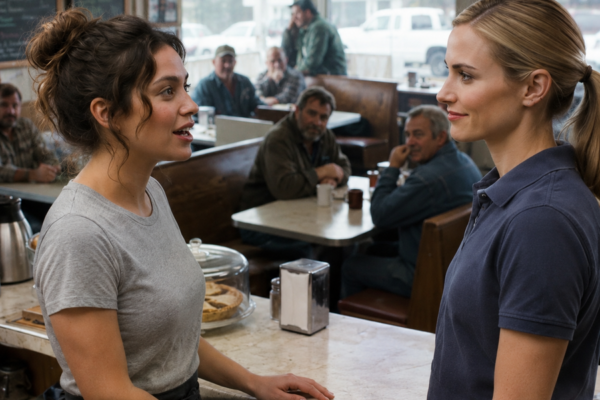
“You Planted That, and Someday Everyone in This Room Is Going to Know It.” An Undercover Billionaire Orders Lunch at His Own Diner—Then Notices the Bruise on the Waitress’s Face.

“You Planted That, and Someday Everyone in This Room Is Going to Know It.” An Undercover Billionaire Orders Lunch at His Own Diner—Then Notices the Bruise on the Waitress’s Face.
“Turn around, please.”
The handcuffs clicked shut around her wrists. The whole diner went silent.
Forks stopped halfway to mouths. Nobody moved.
Eight hundred dollars, folded neat, pulled straight out of her own bag. The deputy held it up so every single person could see.
“I didn’t touch that money,” she said.
Her voice did not shake.
That was the strange part. He leaned close so only she could hear him.
She leaned closer still.
“You planted that,” she whispered.
“And someday everyone in this room is going to know it.”
Six days.
That was all she had. Six days against a badge this whole county trusted without question.
What that deputy did not know was simple: a camera nobody remembered had been running in that storage room two nights before he ever thought to worry about it, and a quiet old man in a flannel shirt had been watching him for weeks.
There is a kind of town that still exists in America. You will not find it on a highway sign.
You find it by accident or by choice. Millbrook, Ohio, is one of those towns, population just under nine thousand.
One stoplight downtown—people still call it the New Light.
It has stood there since 1994.
A hardware store that closes for lunch.
A diner on Main Street called Cassidy’s.
It has carried that name for almost sixty years. A church on every third corner, it seems.
A high school football field that fills up every Friday in the fall.
The kind of town where a stranger’s car gets noticed by noon.
A barbershop where the same three men argue about the same three things.
A library that still stamps due dates by hand.
A war memorial in the square, flowers changed out every spring without anyone being asked.
Millbrook is proud of itself, the quiet way small towns often are.
Not loud pride.
Not the kind that needs an audience.
Just the steady, everyday pride of people who show up for each other.
Mostly.
“Mostly” is doing a lot of work in that sentence.
People in Millbrook believe they know each other.
They believe if something were wrong, they would see it. This is a story about how wrong that belief can be.
It is about a young woman who walked among them for seven months.
She carried something none of them noticed—not because they did not care, but because she had learned the hard way how to hide it. Maybe you know a town like this one.
Maybe you grew up in one. Maybe you raised your children in one.
Maybe you still drive past a diner just like it.
If you do, you already know something. You know the quietest people often carry the loudest storms.
And you know something else, too. Sometimes it takes a stranger to see what everyone else learned to ignore.
This is that kind of story.
Before the end, three people would collide: a young waitress, a corrupt lawman, and a billionaire. None of them saw it coming.
And by the time it was over, an entire town would remember that quiet strength is still the strongest kind there is.
The morning light came in low and gold through Cassidy’s front windows.
Even the scuffed linoleum floor looked golden in it.
By 6:15, the smell of coffee filled the place.
Bacon sizzled on the griddle.
Butter melted into pancake batter. A radio played something old, turned down low.
Josephine Hale had been awake since five. She went by Josie now.
Had for seven months. She moved through the diner with efficiency—coffee cups refilled before they went half empty, orders remembered without a notepad, a warm smile at every table, careful enough to never invite questions.
She wore long sleeves even in July. If anyone noticed, they assumed she simply ran cold.
That morning, she stood at the small mirror in the back hallway. She dabbed concealer along her left cheekbone just below the eye.
Her hand was steady. She had gotten good at this.
A bruise three days old, fading from purple into dull yellow-green. Three nights ago, a man had stepped out of the shadows behind her building.
He had gripped her jaw, tilting her face up just to prove a point.
The bruise bloomed along her cheekbone by morning, small and easy enough to cover if you knew how. She had not screamed.
She had learned a long time ago that screaming rarely helped.
She had simply memorized every word he said, then gone inside and locked the door three times instead of once. He always used to say that after: harder than I meant to.
She had stopped believing that excuse a long time before she ever left him. She studied her reflection like a soldier checking a uniform.
Not vanity—necessity. Good enough, she thought.
Then she pinned her name tag onto her apron, straight the way her father taught her. Straight collar, straight shoulders, straight spine.
Josie, the tag said, small block letters over her heart. She touched it once before walking out onto the floor.
On her right wrist, hidden under her sleeve, sat a thin silver bracelet.
It had belonged to her father.
Inside the band, in tiny letters, it read: Stand tall, Josie.
Dad. He had been gone six years now.
A heart attack, sudden, on an ordinary Thursday. No warning at all.
Some mornings she still reached for the phone to call him.
Then she remembered.
By seven, the diner was full.
Truck drivers sat at the counter. A table of retired men met there every morning, same as always.
A young mother nursed a coffee, stealing five quiet minutes before her day began. Martha Jenkins ran the front of the house.
She had run it for eleven years, since the diner changed hands. She was sixty-eight, built solid, reading glasses living on a chain around her neck.
Her voice could carry across the room without ever sounding unkind.
She had buried a husband decades ago and raised two children on a waitress’s wages long before holding a manager’s key.
She did not talk about those years much. She simply ran her diner the way she wished someone had run things for her: fair, steady, with no patience for cruelty dressed up as anything else.
She liked Josie, had liked her since the first interview.
“You’re a hard worker,” Martha had told her back in January.
“Don’t say much about yourself.
That’s fine by me.
Around here, we judge people by how they treat the customers.”
Josie had almost cried right there in the booth.
Tanya Briggs worked the other side of the floor. Twenty-four years old, always laughing about something, always five minutes late, somehow never late for anything that mattered.
She and Josie had become something like friends, the careful kind of friendship built slowly, one small trust at a time. Some mornings they split a cinnamon roll before the doors opened.
Some evenings Tanya talked through her nursing textbook chapters out loud just to hear them make sense. Josie always listened, even after a ten-hour shift.
Tanya was saving for community college one class at a time.
She wanted to be a nurse someday. She needed this job more than she let on, and she worried quietly about anything that might put it at risk.
It made her kind. Later, it would also make her afraid.
Nobody could blame her for that yet. Nobody had asked anything hard of her.
In the kitchen, Hank Doyle flipped eggs with easy hands. He had cooked breakfast in that exact spot for almost twenty years.
Divorced, behind on a few bills—more than he let on.
Good with a spatula, better with a joke.
Lately, something in him seemed a little quieter than usual, if you knew to look for it.
He liked Josie, too, in his own way. She never complained when an order came out slow.
She never made him feel small in front of customers.
He had started looking out for her without really thinking about it, saving her the good tips when he could steer a table her way, walking her to her car on the nights she closed alone.
He had a daughter about Josie’s age, living two states away.
They did not talk much anymore.
He never explained why.
Maybe that was part of why he watched out for Josie.
Some men fill an old ache by taking care of somebody new. Hank never would have put it in those words, but it was true all the same.
He kept a photo of his daughter taped inside the kitchen cabinet where only he could see it. Some mornings before the rush started, he looked at it a moment too long.
He would have called himself a good man that spring. He did not yet know how badly that would be tested.
Nobody was looking for trouble yet.
This was still the easy part of the story.
By 7:15, the corner table by the window had already filled. Same four chairs reserved by nothing but habit, decade after decade.
Frank Delaney sat closest to the glass the way he always had.
Seventy-four years old, retired now for almost a decade. Most people in Millbrook still called him Judge.
He had not worn a robe in years, but he had spent thirty-one years on the county bench.
That kind of career never quite leaves a man. He still read people the way he used to read case files—carefully, patiently, looking for the detail that did not add up.
Beside him sat Walter Higgins, known to everyone as Pops, eighty-two years old, a retired mechanic.
He had fixed half the trucks in the county at one point or another. His hands were still thick and scarred from a lifetime of wrenches.
“Morning, Josie,” Pops said as she filled his coffee unasked.
“You sleep all right?”
“Slept fine, Pops,” she said.
“You sneaking extra sugar again?”
“Doctor doesn’t need to know everything,” he said, winking.
Frank chuckled beside him without looking up from his newspaper. These two men had grown fond of the new waitress.
She never rushed them. She remembered Frank liked his eggs plain and his opinions strong.
She remembered Pops liked to talk about the weather far too long.
Frank, in particular, had a habit of watching more than he spoke.
Weeks earlier, he had noticed something: her smile never quite reached certain moments.
She sometimes glanced toward the front door a half-second too long.
Thirty-one years on the bench teaches a man to notice things. He notices when someone is watching the exits.
He had not said anything yet, but like Martha, he had started paying attention. At 7:40, the bell over the front door rang.
Everything in Josie’s morning shifted.
She felt it before she turned around—a pressure change in the air, the kind some people feel before a storm, before a single cloud shows. Derek Cole walked in wearing his deputy uniform, badge catching the light, sunglasses pushed up on his head.
He looked like a man with all the time in the world. He was handsome in the way that made people trust him fast: square jaw, easy smile, the kind of confidence built by a lifetime of being believed.
He scanned the diner like a man checking a room he already owned.
Then he found her.
Her stomach turned.
This was the same face, the same badge from three nights ago behind her building. Seeing him now in daylight, in front of witnesses, felt worse than the parking lot.
“Well, look who it is,” he said, loud enough for two tables to hear, friendly enough that nobody would think twice.
“Millbrook’s newest waitress.”
Josie kept her hands steady on the coffee pot.
“Morning,” she said.
“Table or counter?”
“Counter’s fine.”
He slid onto a stool close to her path.
“Been meaning to stop in.
Heard the coffee here was decent.”
“It’s the same coffee as everywhere else,” she said, pouring for the man beside him.
“People just like the mugs.”
A few regulars chuckled.
Derek smiled along with them.
His eyes did not smile. He reached out, casual as anything, and flicked her silver bracelet.
“Still wearing this old thing,” he said, voice low now, just for her.
“Didn’t figure you for sentimental.”
Josie did not pull her arm away. Pulling away would have told him something.
She finished pouring the coffee and looked at him directly.
“You’ve still got time to turn this car around, Derek,” she said quietly.
“I mean that as a kindness, not a threat.”
For half a second, something flickered behind his eyes—surprise, maybe, or something closer to warning.
Then the smile came back, easy as ever.
“Just being neighborly,” he said.
“Small town.
We’re going to see a lot of each other.”
He ordered eggs, ate them slowly, tipped exactly the minimum.
He left without another word to her.
He looked back once through the window on his way to the cruiser. Josie felt that look land on the back of her neck.
Martha noticed the whole exchange from across the room.
She said nothing yet. She simply filed it away the way people do when something feels off.
At the corner table, Frank had noticed too. He had not looked up from his paper once during the whole exchange.
That was exactly how Frank listened best.
“New deputy,” Pops muttered, low enough for just Frank to hear.
“Boyd’s nephew, they’re saying.
Transferred in from over near Columbus.”
“That so?”
Frank said, turning a page he was not really reading.
“Girl didn’t much care for him,” Pops added.
“You clock that?”
Frank folded his paper and set it beside his plate.
“I clocked it,” he said quietly.
“Question is whether anybody else will.”
There is a kind of strength that does not look like strength at all. It looks like patience.
It looks like a woman finishing her shift after being humiliated in front of strangers because she has bills to pay, a life to rebuild, because she has decided this man does not get to take that too.
Josie had learned the hard way that reacting was often the point. Reacting gave people like Derek a story, an excuse.
So she had trained herself, slowly and painfully, not to give him one.
It did not mean she was not afraid. It meant she had decided fear did not get to drive.
The lunch rush at Cassidy’s started around 11:30.
It did not let up until nearly 1:30.
Farmers came in, office workers from the county building, the same handful of retirees who ate every meal there.
My wife’s cooking retired before I did, one of them liked to say.
Josie moved through it with practiced calm, weaving between tables, calling orders back to Hank, refilling waters before anyone had to ask. At a corner table near the window sat Opal Reed, seventy-one years old, a widow.
She came in three times a week, always alone, always the same tuna melt and a cup of tea.
She thanked Josie so sincerely for every small thing it sometimes caught in Josie’s chest.
Today, a man at the next table grew loud.
Not a regular, just passing through.
His order was late and Hank was behind for the rush.
He decided to blame Opal, sitting quietly nearby.
He claimed she had been served out of turn.
“This is ridiculous,” he snapped, loud enough for half the diner to hear.
“She’s been sitting there twenty minutes doing nothing, and I’m still waiting.”
Opal shrank back in her seat, the way people do when confrontation makes them feel smaller. Josie was there within seconds.
She did not raise her voice.
She did not over-apologize the way a nervous new hire might.
She simply stepped between the man and Opal’s table, calm as still water.
“Sir, I hear you, and I understand you’re frustrated,” she said evenly.
“Your order came in after hers.
That’s not favoritism.
That’s the ticket order.
I’ll go check on it myself right now.”
“I don’t need you explaining tickets to me,” the man said.
“I need my food.”
“You’ll have it in four minutes,” Josie said.
“And there’s no need to raise your voice at another guest.
That’s not something we do here.”
Something in her tone made him pause.
Not aggressive, not pleading, just unmistakably certain.
He muttered under his breath and looked away.
Josie turned to Opal.
She crouched to eye level.
Her voice went completely soft.
“You’re all right,” she said.
“He’s not upset with you.
Can I bring you a fresh cup of tea on the house?”
Opal’s eyes filled just slightly.
“You didn’t have to do that, dear.”
“Yes, I did,” Josie said simply, and went to check the ticket.
She came back a few minutes later, tea in hand.
She sat for just a moment across from Opal—not technically allowed during a rush, but she did it anyway.
“He’s just having a bad day,” Josie said gently.
“It’s got nothing to do with you.
Some people carry their anger around and it spills on whoever’s closest.”
Opal wrapped both hands around the warm cup.
“You always know just what to say.”
“I’ve had practice,” Josie said.
Something in the way she said it made Opal look closer.
The older woman did not press.
“My husband used to say that too,” Opal said instead.
“That the loudest people are usually the most afraid of something.
He was a good judge of character, my Harold.”
“He sounds like he was a wise man.”
“He was,” Opal said wistfully.
“I miss him something terrible some mornings.”
“I’m glad you come in,” Josie said.
“This town needs more people like you in it.”
Opal reached out and squeezed her hand. Josie let her, just for a moment, before checking her other tables.
Near the back, in the booth by the old jukebox, sat a man alone.
The jukebox had not worked properly in years.
The man watched everything over the top of a menu he had not opened.
He was somewhere past sixty, wearing a faded flannel shirt and jeans worn for actual work, not for style.
A ball cap sat low on his head, the logo long worn away.
His truck outside had a dent in the tailgate.
It looked exactly like a hundred other trucks parked on Main Street. Nothing about him suggested he was worth more than the whole town combined.
That was the point. Richard Grant had built his career on one belief: you cannot understand a business from a boardroom.
You have to sit in the booth.
You have to watch the floor.
You have to see what happens when nobody knows you are watching. He had done this dozens of times in dozens of restaurants across a dozen states, ever since Grant Hospitality Group grew large enough that people started managing what he heard.
PART 2
He had started the company at twenty-three with one diner and a loan he almost did not get. Thirty-eight years later, his name sat on buildings in cities he could barely track.
He still remembered the exact interest rate on that first loan. Some numbers stay with a man long after they stop mattering.
Money had never been the part that interested him most. He liked knowing what was really happening on the floor.
He liked knowing whether a manager respected their staff or whether the smiles only came out for a corporate visit.
You could not learn that from a spreadsheet. He had a saying he repeated to every new regional manager he hired: Numbers tell you what happened.
People tell you why. If you only ever read the numbers, you will always be a year too late.
Some of his executives found it old-fashioned. He did not mind.
Old-fashioned had built the company. Old-fashioned still ran it.
You had to sit in the booth.
Cassidy’s Diner had come under his company three years earlier, part of a modest chain acquisition.
Nobody outside the industry noticed. He had kept the name.
He had insisted on keeping the name. Few people at headquarters knew why that mattered to him so much.
He watched Josie handle the loud customer without losing her composure.
He watched her check on Opal a second time, unprompted, just to make sure she was truly all right.
He had seen a thousand employees in his life—good ones, great ones, even. This was something else.
When she reached his table, he had his menu ready.
He barely glanced at it.
“Afternoon,” she said, pen ready.
“Know what you want, or you need a minute?”
“Burger,” he said.
“Medium.
Black coffee, no room.”
“Good choice,” she said.
Something in her voice—tired, but genuinely kind—made him look up properly.
That was when he saw it. The concealer had held through most of the morning, but the window light was unforgiving.
Sweat from the lunch rush had begun to wear it thin. Along her left cheekbone, just below her eye, a faint shadow showed through.
Yellow and green.
Not fresh. Days old, healing, unmistakable to a man who knew what he was looking at.
He had seen that color before, on someone he loved very much, a long time ago.
He had never forgotten it. His expression did not change.
He had learned long ago not to let his face give things away.
Not in negotiations.
Not in moments like this, either.
“Coffee first?”
he said, keeping his voice light.
“Coming right up.”
She turned toward the kitchen. Rick Grant sat very still, watching her go.
His mind was somewhere far away from burgers and black coffee.
When she brought his coffee, he thanked her.
As she set it down, he noticed something else.
Her sleeve, just slightly too long for the summer heat, shifted as she reached.
She adjusted it back into place almost automatically—a small, habitual motion, the kind a person does so many times it stops being a decision.
“Been working here long?”
he asked, keeping his tone easy, the tone of any curious customer making small talk.
“About seven months,” she said.
“You new to town, or just passing through?”
“Bit of both,” he said.
“Used to come through here years back.
Diner looks about the same.”
“People tell me that a lot,” she said with a small smile.
“I think that’s the whole point of a place like this.”
She moved on before he could say anything more.
He sat there a long while after his food arrived, eating slowly, watching.
Watching her walk an elderly man through two pie choices twice, never a hint of impatience.
Watching her remember, unasked, exactly how the trucker two seats down liked his eggs. Watching most of all how she carried herself—careful, contained, like someone holding something heavy very steadily and trying not to let anyone see.
When he finished, he left cash on the table, nearly three times the bill.
Tucked beneath the mug where only she would find it, he left a folded note in plain black handwriting: Are you all right?
You don’t have to answer.
Just wanted to ask.
Josie found it twenty minutes later while clearing the table.
She read it twice.
Her first instinct—the old instinct—was to crumple it and throw it away.
Months of learning not to trust kindness from strangers had built that instinct in her. Instead, she folded it carefully and slipped it into her apron pocket.
She did not know why.
She only knew it had felt different from the usual sympathy.
It had not felt like pity. It had felt like someone had actually seen her.
She thought about the man in the flannel shirt longer than she meant to. Something about his eyes had felt familiar, though she was certain they had never met.
Not familiar like a face she recognized—familiar like a kind of attention she used to know back when she was still Josephine, still working long hours at a law office, back when she still believed the world mostly ran on fairness if you waited long enough. She did not believe that anymore.
Not entirely. But some small, stubborn part of her still wanted to.
That evening, Josie drove her ten-year-old sedan back to her apartment: two rooms above the old post office on Elm Street, a kitchenette, a mattress on a frame she had bought secondhand.
It was not much, but it was hers.
Nobody could walk in without her permission.
Some nights, that fact alone was enough to let her breathe. She made a simple dinner—rice, a bit of chicken, whatever vegetables had not gone soft.
She ate at the small table by the window and watched the porch lights come on one by one across town.
After dinner, she opened the closet and pulled down a shoe box.
Inside sat the fragments of a different life: a half-finished paralegal certificate—she had been six credits from completing it—a photograph of her father in his old police captain’s uniform, looking younger there than she was now, and a worn leather notebook filled with her own cramped handwriting.
She sat on the edge of the bed and opened her laptop. A folder sat on the desktop, labeled with a name that meant nothing to anyone but her.
Inside it, organized by date, sat screenshots, old messages she had never deleted, only hidden. Photos taken quietly in bathroom mirrors on the worst nights, timestamped and dated.
A short list of names—people who had seen things, even if they never said anything.
She had started this file the year before she left, back when she still believed, foolishly, that enough proof would make someone step in.
Nobody had.
There had been a version of her once that believed strongly in systems, in evidence and process and the slow machinery of the law.
She believed that machinery, fed the right proof, would eventually produce something like justice.
She still believed that, somewhere underneath everything. She had simply learned something harder: believing in a system and being protected by it are two different things.
Most people have to protect themselves in the space between. So she had learned to fix things herself, one quiet decision at a time.
The decision to leave. The decision to change her name back to the one her mother gave her.
The decision to keep this folder anyway, even now, even after seven months in Millbrook.
Some habits, once survival teaches them to you, do not simply go away. She thought about all the small kindnesses Millbrook had given her.
She thought about Martha’s steady trust, Tanya’s easy laughter, Pops and his extra sugar, Opal’s hand warm around hers, thanking her for something so small.
She had come here broken in more ways than she let herself admit.
This town, without ever knowing the whole story, had started stitching something back together. She was not whole yet.
She was not sure she ever would be, not completely. But she was standing, and most days now, that felt like enough.
She closed the laptop. She touched the silver bracelet on her wrist.
“Still standing, Dad,” she whispered, the way she sometimes did.
Then she turned off the light.
Derek came back to the diner two days later. This time, he did not sit at the counter.
He chose a booth near the register, close enough to watch her whole shift.
He ordered slowly, deliberately, making her come back again and again. Around the middle of her shift, she passed with a full coffee pot.
He moved.
His leg shifted at exactly the wrong moment. The pot tipped.
Hot coffee splashed across her hand and wrist. She did not cry out.
Years of practice had taught her not to give anyone that satisfaction.
She simply set the pot down, grabbed a towel, and wrapped her hand.
“Whoops,” Derek said, not moving to help.
“My bad.
Guess I should watch where I put my feet.”
His voice was pitched for the room—casual, apologetic-sounding. His eyes, when they met hers, held something entirely different.
A warning. A reminder.
I know where you are now.
Martha came hurrying over, examining Josie’s hand.
She told Tanya to grab the burn kit from behind the register.
In all the commotion, nobody noticed Derek leaning close as Josie stood.
His voice dropped low, just for her.
“You look good running your own little life out here,” he murmured.
“Be a shame if it got complicated.”
“Is that a threat, Deputy Cole?”
she asked quietly.
Her hand was still wrapped in the towel. Her voice was remarkably steady.
“It’s a fact,” he said, standing, straightening his uniform shirt.
“Facts aren’t threats.
They’re just true.”
He dropped a five-dollar bill on the table, more than his coffee cost, and walked out whistling something under his breath.
Martha watched him go, brow furrowed.
She had worked in this diner a long time.
She knew the difference between an accident and something else entirely, even if she could not yet name what that something else was.
“You all right, honey?”
she asked, gently turning Josie’s hand over to check the burn.
“I’m fine,” Josie said.
“It’s not bad.”
“That’s not what I asked.”
Josie looked up at her for just a moment.
Something honest crossed her face. Then the calm returned.
“I will be,” she said.
“I promise.”
Martha did not push further.
But that night, closing up alone, she stood a little longer by the front window.
She watched Josie’s car pull away down Main Street.
She thought about the way a person flinches when flinching gets punished. She did not know the whole story yet, but she had started, without quite realizing it, to pay attention.
Those old years of her own came back to her the way they sometimes did. She had seen that particular look in her own mirror once, a long time ago.
She locked the front door.
She flipped the sign to Closed.
She made a quiet decision of her own: starting tomorrow, she would keep a closer eye on Deputy Cole.
She thought about calling someone, though she was not sure who.
A deputy’s word still carried weight in this county.
Badge or not, an accusation without proof was just a rumor, and rumors could cost a woman her job.
So instead, she decided to watch, and to wait, and to remember.
She did not know yet how right she was to worry. Two tables away, Rick Grant had watched the whole scene.
This time he had not bothered to hide behind a menu.
He had come back to Cassidy’s three times that week already, more than his usual visits to any single location.
He told himself it was because the numbers looked promising, because the staff seemed solid, because it was good practice to check in personally.
He knew underneath all of that it was not really about the numbers.
He watched the deputy lean in close.
He watched Josie’s spine straighten instead of curl inward the way so many people’s did.
He watched her answer him with a steadiness that raised the hair on his neck. That was not the reaction of a frightened new hire.
That was the reaction of someone who had faced worse and survived it—someone choosing, deliberately, not to run.
He thought of his sister then. He always thought of his sister in moments like this.
He remembered the version of her that laughed loud enough to fill a room before things changed, before she started wearing long sleeves in the summer, too, before everyone around her—including him—told themselves it was not their business to ask. He had been twenty-six years old when she died.
Young and successful, completely, uselessly powerless to help her.
He had promised himself at her funeral one thing: he would never again watch it happen to someone else without asking, Are you all right? It was such a small thing to offer.
He knew that a folded note under a coffee mug did not undo decades of silence—his own silence included—but it was a start.
He caught Josie’s eye across the diner as she finished bandaging her hand.
He offered a small nod. Nothing more.
She returned it, faintly puzzled, unsure what to make of the quiet regular who kept showing up, who kept somehow seeming to actually see her.
Tuesday brought the moment that changed how Rick Grant looked at Josie Hale entirely.
It started with a man at the counter, three stools from where Rick sat. He grew louder with every passing minute.
He had been drinking before he arrived; that much was obvious.
The smell of it hung around him like a fog. He ordered a beer with his lunch, then another.
Martha, at the register, quietly told the counter to cut him off after the second.
His mood turned ugly fast.
“You can’t do that,” he snapped, loud enough that conversation faded across the diner.
“I’m a paying customer.
I know my rights.”
“Sir, I hear you,” Josie said, stepping in smoothly, the same calm voice she had used with Opal’s table days before.
“But we’re not able to serve you a third drink.
That’s our policy.”
“Your policy?”
the man sneered.
“You know what happens if something happens to me on the way home?
You know who’s liable?
I’ll sue this whole diner into the ground.”
Around the room, a few older regulars exchanged uneasy glances.
Nobody quite knew what to say to a threat like that.
Martha at the register had gone slightly pale; she was already calculating what a lawsuit might do to a small diner’s insurance.
Josie did not flinch.
“Actually, sir, that’s exactly why we can’t serve you,” she said.
Her voice was calm, almost gentle, but perfectly clear.
“Under Ohio’s dram shop law, we can’t serve you once you’re visibly intoxicated.
If something happened afterward, this place could be held responsible.
Cutting you off right now isn’t us being difficult.
It’s us following the law.
Honestly, it’s us looking out for you, too.”
The diner went quiet. The man blinked at her.
He clearly had not expected a waitress in an apron to speak with that precision. At the counter, Pops let out a low whistle.
He turned to Frank, who had lowered his newspaper entirely.
“You hear that?”
Pops said quietly.
“Girl just quoted case law like she does it for a living.”
Frank did not answer right away. He watched Josie move to her next table, filing the moment away the same way he used to file away a witness who answered too precisely.
“Some people,” he finally said, folding his paper, “have a whole other life folded up small enough to carry in an apron pocket.”
“You some kind of lawyer or something?”
the man muttered, some fight draining from his voice.
“No,” Josie said simply.
“Just someone who reads more than she probably should.”
She offered him a coffee on the house, gently, no trace of superiority in her tone.
After a long moment, some of the tension eased from the man’s shoulders.
He grumbled, “Fine, whatever,” and took the coffee.
The moment passed without further incident. Martha exhaled, visibly relieved.
She shot Josie a look of genuine gratitude from across the room. Before Josie could move on, Frank caught her eye and waved her over.
“Sit a second,” he said, nodding to the empty chair beside Pops.
“Just for a minute.
Martha won’t mind.”
Josie hesitated, then sat, glancing toward the kitchen out of habit.
“That was a fine thing you did just now,” Frank said.
“Both with him and with Opal Reed last week.
I noticed that, too.”
“Just doing my job,” Josie said.
“No,” Frank said gently.
“Your job is carrying plates.
What you did was something else.”
Josie did not answer right away.
“I sat on the bench in this county thirty-one years,” Frank went on.
“You learn to tell the difference between someone reciting a rule and someone who understands why it exists.
You’re the second one.
Whatever brought you here, Millbrook’s lucky to have you.”
Something in Josie’s chest loosened just slightly at those words.
“Thank you,” she said quietly.
“That means more than you know.”
“I imagine it does,” Frank said, and did not push any further.
He simply patted the table once, a small gesture, then let her get back to work.
It was a small thing, but small things in a town like this one had a way of mattering later. It was the man in the corner booth, however, who sat longest in the silence.
He turned the moment over carefully in his mind. Dram shop liability was not something most people knew existed, let alone could recite correctly under pressure without missing a beat.
That was not the vocabulary of someone who read a little. That was the vocabulary of someone who had been trained.
Rick Grant had built a career reading people, understanding at a glance who was exactly what they appeared to be and who was carrying something far larger beneath the surface. He had learned to trust that instinct.
It had rarely failed him.
It was not failing him now. He watched Josie clear the counter, wipe it down, and move to her next table as if nothing unusual had happened at all.
Whoever this young woman truly was, he thought, she had not wandered into Millbrook by accident. There was a story here, a real one.
Whatever it was, it had left marks on her, both visible and hidden.
It had also somehow made her formidable in ways she worked hard to hide.
He thought again of his sister, of the folded note under the coffee mug, of the promise he made at a funeral thirty-five years ago. He left a tip that afternoon that made Tanya gasp out loud.
He said nothing else to Josie directly.
He only nodded to her once more on his way out the door—the same small, steady nod as before.
PART 3
That night, he sat in the modest rented house he used on quiet visits.
He made a call he had not planned to make. Diane Kessler had worked for Rick almost twenty years—first as outside counsel, later as something closer to a trusted partner.
She had helped him quietly settle disputes, quietly fix mistakes over the years. She had helped him quietly investigate exactly two situations like this one before, both times at his own insistent request.
She knew better than almost anyone what usually sat underneath a call like this.
“Diane,” he said when she answered, “I need you to look into something for me.
Quietly.
A woman named Josie Hale works at the Millbrook location. Whatever you find, I want it handled carefully.
She’s already been through something.”
“Rick,” Diane said slowly, “is this a business matter or a personal one?”
He looked out the dark window toward Main Street, toward the diner that still carried his sister’s name on its sign.
Cassidy had been her name—Cassidy Grant, before she married.
The diner had carried that name for almost sixty years, long before he ever bought it. Pure coincidence.
When his company first looked at acquiring the place, nobody at headquarters understood why he cared so much about keeping it.
Nobody in Millbrook knew the real reason either; he preferred it that way.
Three years ago, when the deal came across his desk, he had made one condition: The name does not change.
Not while I’m alive.
“I honestly don’t know yet,” he admitted.
“But something tells me it’s about to become both.”
There is an old saying, the kind grandparents pass down without ever explaining it: Still waters run deep. People say it about lakes, about rivers, about anyone calmer on the surface than the current running beneath them.
Josie Hale had become, over the last year, the deepest kind of still water—calm on the surface by necessity, by training, by sheer will.
The alternative, the version that let the current show, had once nearly cost her everything.
But water, no matter how calm, cannot stay hidden forever. Somewhere in Millbrook, a deputy sheriff believed he had found an easy target, someone who would fold the moment real pressure came.
And in that same town, a billionaire in a flannel shirt had begun to wonder. He suspected something else entirely.
Neither man yet understood the full truth. But the truth, like most truths worth knowing, was already moving beneath the surface, waiting for its moment to rise.
That moment was closer than any of them realized.
Every small town keeps its secrets in the same place—not in the courthouse, not in the church basement, but in the quiet space behind people’s eyes, where they store the things they choose not to say.
Josie Hale had been carrying one of those secrets for over a year now.
She had learned to fold it small, to tuck it away during daylight hours, to only let it out at night alone when nobody could see her face change. But secrets, like water under a locked door, have a way of finding the cracks.
And in Millbrook that spring, the cracks were starting to show.
Four years ago, Josephine Hale had a different life entirely.
She worked at a law firm downtown in a city three hours from Millbrook—Whitmore and Associates.
Nine floors up, a corner office view.
The kind of job people worked years to earn. She was twenty-four years old, six credits from finishing her paralegal certification.
Her supervisors talked about law school like it was only a matter of time. She met Derek Cole at a charity fundraiser her firm sponsored.
He was a patrol officer then, not yet a deputy, still climbing—handsome, charming, the kind of man who remembered small details about people he barely knew. He remembered her coffee order after one conversation.
He remembered her mother’s name after she mentioned it exactly once.
She thought at the time that this meant he was thoughtful. It took her almost a year to understand what it actually meant: it meant he paid close attention to people he intended to control.
The first year was good, genuinely good in the ways that mattered to her. Then he proposed on a Tuesday.
No fanfare, just the two of them alone on her apartment balcony.
She said yes before he even finished asking. The second year, small things started to shift.
He did not like her working late.
He did not like her lunches with old college friends. He did not like when she made plans without checking with him first.
Each time he had a reason, a good one, it always seemed in the moment.
He was worried about her. He missed her.
He just wanted more time together.
She started canceling plans to avoid the conversation that would follow if she did not.
Her friends called less. She told herself that was normal.
People got busy. Life moved on.
The isolation did not arrive all at once.
It arrived one small excuse at a time.
By the third year, the fights had turned into something else entirely. The first time he grabbed her arm hard enough to leave a mark, he cried.
He said he had never done anything like that before.
He promised it would never happen again. She believed him.
She wanted to believe him.
It happened again four months later, and again after that. Each time the apology came faster.
Each time it meant a little less.
She stopped telling her mother the truth about the bruises.
She started wearing long sleeves even in summer, long before Millbrook ever taught her to.
She told herself she was managing it, that she understood him better than anyone else could. She told herself a lot of things that last year that were not true.
Looking back now, she could see the pattern clearly. It was almost textbook, the way she later learned in her paralegal readings: isolate first, control the money next, make the world outside feel more dangerous than home.
She had lived inside that pattern for three years without a name for it.
There were other things, too—smaller things, easy to miss one at a time. The way he checked her phone while she showered.
The way he timed her drive home down to the minute.
The way a five-minute delay turned into an hour of questions. Her coworkers at the firm noticed she laughed less.
Nobody asked why.
People rarely do when the answer might be complicated. Looking back, she wished someone had asked anyway.
Naming it later was the first step toward finally leaving it. The night she left, it was raining hard enough that the wipers barely kept up.
Derek had come home late, agitated about something at work. The argument that followed was worse than the ones before it.
She did not talk about the details of that night, not even now.
What she would say, when she said anything at all, was this: somewhere around midnight, alone in her bathroom with the door locked, she made a decision that had been building for three years.
She packed one bag while he slept off the anger in the other room.
She took her clothes, her laptop, the shoe box from the closet shelf, and her father’s silver bracelet—the one she almost never wore around Derek.
He had once called it cheap and old-fashioned.
He had asked why she still kept it.
She kept it anyway. She always kept it anyway.
She left before sunrise. She drove for three hours without stopping.
She changed her last name back to Hale, her mother’s maiden name, the moment the paperwork allowed it.
She told almost no one where she had gone. Almost no one, she would learn later, was not quite no one at all.
In the present, on a warm Thursday afternoon, Josie sat alone in her apartment, staring at her laptop screen.
She had spent the last two hours doing something she rarely allowed herself: searching.
Careful searches, one at a time, clearing her history after each one. Derek Cole.
Millbrook County Sheriff’s Department.
Deputy transfer records.
What she found confirmed something she had suspected since his first morning at Cassidy’s.
Derek’s transfer to Millbrook County had not come through a normal request process.
It had come through a direct request from Sheriff Walt Boyd, his mother’s brother, filed less than three weeks after something else happened: a mutual friend from her old life had posted a photograph online, a photograph taken at a farmers market on Main Street, location tagging turned on the way most people never think to check.
Josie remembered that day—an old college friend, someone she had not seen in years, someone who did not know the full story, someone who meant no harm at all. A simple photo.
A simple tag: Millbrook, Ohio.
It had taken Derek less than a month to find her after that. She sat back from the screen, her hands trembling.
This was not a coincidence. It had never been a coincidence.
He had not stumbled into her new life by accident. He had hunted for it, and when he found it, he had moved his whole career to be near it.
She thought about the badge on his chest, about the authority it gave him in this county. And she thought, with a coldness that surprised her, about the effort behind it all—how much planning it must have taken to make all of this look so casual.
He wanted her to believe this was simply small-town luck.
It was not luck.
It was a plan carried out patiently over months.
That frightened her more than anything he had said to her face so far.
Because a man who plans that carefully does not stop just because he gets embarrassed. He simply changes his method.
Rick Grant came back to Cassidy’s Diner the following Monday morning.
By now, his visits had become expected. Martha had started saving him the same corner booth without being asked.
“Morning, Rick,” she said, sliding a coffee cup toward his spot.
“Same as always?”
“Same as always,” he said, settling into the booth.
“You’re too good to me, Martha.”
“Somebody has to keep an eye on the regulars,” she said, and moved on.
He watched Josie work the floor from across the room, the same careful attention he had brought every visit since that first afternoon. She looked tired today, more tired than usual.
When she reached his table, her hands were not quite as steady as normal.
“Morning,” he asked, keeping his tone light.
“Rough couple of days,” she admitted before catching herself.
“Sorry, you didn’t ask for that.”
“I did, actually,” he said.
“I asked how your morning was.
You can tell me the truth.”
She studied him for a long moment. There was something about this man that made her want to trust him, even though every instinct she had built told her not to trust anyone that easily.
“It’s nothing I can’t handle,” she said finally.
“Just an old problem following me around.”
“The deputy,” Rick said.
Not a question.
Josie’s eyes flicked up to his, surprised.
“I notice things,” he said simply.
“It’s sort of my whole job.”
“What is your job, exactly?”
she asked.
“You never did say.”
“I will,” he said.
“Soon, I promise you.”
She did not push further, but the answer sat strangely with her the rest of the day. It turned over in her mind between orders.
There was something about the way he said soon. It sounded less like small talk and more like a promise he intended to keep.
He left his usual tip that afternoon and one more folded note under the mug.
This time it said something different: You’re not alone in this, whether you believe that yet or not.
Josie read it twice, then folded it into her apron right beside the first one.
She was starting to build a small, strange collection—proof, in a way, that not everyone in her life left her worse than before.
That same evening, a sheriff’s cruiser sat parked outside Josie’s building for nearly twenty minutes.
She noticed it eventually from her window upstairs. Derek did not get out.
He simply sat there, engine idling, watching the building. Eventually, he drove away, but not before leaving something wedged into the door handle: a small bouquet of flowers, the cheap kind sold at the gas station on Route 9.
Tucked into the plastic wrapping was a folded note in familiar handwriting: Just checking on an old friend.
Hope Millbrook’s treating you well.
See you around, Josie.
She stood in the hallway a long time, staring at the flowers.
Then she threw them in the trash bin outside.
Her phone rang twenty minutes later—an unfamiliar county number. She almost did not answer.
Something made her pick up anyway.
“Miss Hale,” a gravelly voice said.
“This is Sheriff Boyd.
Got a minute?”
Her stomach tightened immediately.
“I do,” she said carefully.
“Wanted to reach out personal, one-on-one,” Boyd said, friendly enough on the surface.
“My nephew’s had a rough couple years—losing his mother, changing departments, all of that.”
“I’m sorry to hear that,” Josie said, keeping her voice neutral.
“He’s a good deputy,” Boyd continued.
“Damn good one.
County’s lucky to have him.”
“I’m sure he is,” Josie said.
“Just wanted to say, whatever history you two have,” Boyd went on, his tone shifting, “I’d hate to see anything complicate his fresh start here.
He’s finally getting settled.”
Josie closed her eyes.
“Is there something specific you’re asking me, Sheriff?”
“Just asking you to be reasonable,” Boyd said.
“Small town like this, things get complicated fast if people aren’t reasonable with each other.”
She did not answer right away.
“I hear you, Sheriff,” she finally said, careful and even.
“Have a good night.”
She hung up before he could say anything else.
She sat on the edge of her bed for a long time afterward, staring at nothing, her hands still shaking slightly.
This was the first time anyone had said it out loud, even in that careful, coded way. The department itself was already choosing sides, and it was not choosing hers.
The next morning at the diner, Tanya noticed something was wrong before Josie spoke.
They were folding napkins together during the slow stretch before the doors opened.
“You’re quiet today,” Tanya said, not looking up from the stack in her hands.
“Quieter than usual, I mean.”
“Just tired,” Josie said.
Tanya set down her napkins and studied her friend for a moment.
“You know you can talk to me, right?”
she said.
“Whatever it is.”
Josie hesitated.
She was not used to being offered that, not really meaning it.
“It’s complicated,” she finally said.
“More complicated than I could explain over napkins.”
“Okay,” Tanya said simply.
She did not push the way some people would have.
“But for what it’s worth,” she added, “I’ve got your back.
Whatever it turns out to be.”
Josie felt something tighten in her throat, unexpected and sudden.
“Thank you,” she managed.
“That actually means a lot right now.”
“That’s what friends are for,” Tanya said, going back to her napkins.
“Even the kind who show up five minutes late and never actually explain why.”
Josie laughed, quiet but real—the first real laugh she had managed in two days.
It was a small moment.
It did not fix anything, but it reminded her of something she badly needed reminding of: she was not entirely alone in this town.
Not anymore.
She found the address online, careful to search from a public library computer instead of her own.
Legal Aid of Southeastern Ohio occupied the second floor of an old bank building, above a shoe repair shop that had clearly seen better decades.
The waiting room held three other people.
None of them made eye contact with anyone else. All of them carried the same careful, guarded posture Josie recognized in her own reflection.
A tired but kind-faced attorney named Rebecca Sloan called her back after a while.
“What can I help you with today?”
Rebecca asked, settling behind a cluttered desk. Josie took a breath.
This was the first time she had said any of it aloud.
“I need to know how a protective order works,” she said.
“Against someone who’s also a law enforcement officer.”
Rebecca’s expression shifted—professional, but immediately more focused.
“Okay,” she said gently.
“Tell me what’s going on.”
Josie told her the basics: the history, the transfer, the flowers left at her door, the call from Sheriff Boyd. Rebecca listened without interrupting, taking careful notes.
“Here’s the honest truth,” Rebecca said when Josie finished.
“The process itself doesn’t care what his job is.
The law is the law.”
“But,” Josie said, hearing the word coming before Rebecca said it.
“But enforcement can get complicated,” Rebecca admitted, “when the respondent works within the very department that has to respond.
It happens more than people realize.
It’s not impossible.
It’s just harder.”
“What would it actually protect me from?”
Josie asked.
“Practically speaking.”
Rebecca leaned forward slightly.
“A civil protection order can require him to stay a certain distance away,” she said.
“It can bar contact entirely—calls, texts, showing up at your home or work.
Violating it becomes its own separate criminal charge, badge or no badge.”
“And if he violates it anyway?”
“Then it goes on record every single time,” Rebecca said.
“That record matters.
Courts take a pattern more seriously than a single incident.”
Josie absorbed that, filing it away carefully, the way she filed most things now.
“I have documentation,” Josie said quietly.
“I’ve had it for a while now.”
Rebecca looked up, genuinely surprised.
“How long is a while?”
“Almost a year,” Josie said.
“Before I even left him.”
Something in Rebecca’s expression softened further.
“That’s rare,” she said.
“Most people don’t think to do that until it’s too late.”
“I used to work in a law office,” Josie said.
“I understood even then that someday I might need proof nobody could argue with.”
Rebecca nodded slowly, writing something down.
“Bring everything you have next time.
Dates, timestamps, any messages, any witnesses.
We’ll build this properly, one piece at a time.”
“How long does something like this usually take?”
Josie asked.
“Depends on the county,” Rebecca said honestly.
“Could be weeks.
Could take longer if it gets contested hard, especially with his connections.”
Josie nodded slowly, absorbing that.
“I’m not going anywhere,” she said.
“I’ve waited this long already.”
Rebecca studied her for a moment, something like admiration crossing her face.
“You know,” she said, “most people who walk through that door look like they’re drowning.
You don’t look like that.”
“I feel like that most days,” Josie admitted.
“I’ve just had practice hiding it.”
Josie left with the first real, practical plan she had held in a year. It did not make her less afraid, but it gave the fear somewhere useful to go.
PART 4
Back in Millbrook, trouble was already brewing somewhere Josie had never thought to look. Hank Doyle had not slept well in almost two weeks.
It started with a phone call he never should have answered.
Derek had approached him outside the diner one evening, casual as anything, offering to buy him a beer at the tavern down the street. Hank, behind on his truck payment and two months behind on child support, said yes.
He said yes before thinking it through.
“Just need a little help,” Derek had said over the second round.
“Nothing crazy.
Just want to know Josie’s schedule ahead of time.
When she’s working, when she’s closing alone.”
“Why do you need that?”
Hank had asked, some instinct telling him to be careful.
“We used to be close,” Derek said, waving a hand like it was nothing.
“Just want to catch up with her proper, not ambush her at work.”
It had sounded almost reasonable that first night.
Two beers already in him, three hundred dollars cash on the table. Hank had taken the money.
He told himself it was harmless—a schedule.
Everybody at the diner knew everybody’s schedule anyway.
The second time Derek asked, it was less friendly, less optional-feeling.
“Just need to know if she’s closing Thursday,” Derek had said.
No beer this time. No pretense of friendship.
“You’ll get your money.”
Hank had given him the information again.
He told himself again it was harmless. But watching Derek corner Josie by the coffee pot, something in Hank went cold.
Watching the coffee spill across her hand sealed it.
This was not a man trying to catch up with an old friend.
This was something else—something Hank had been quietly helping along, three hundred dollars at a time. He had not slept properly since.
He thought about his own daughter, two states away, the one he rarely spoke to.
He wondered what she would think of her father right now if she knew. That thought sat heavier on him than any of the money ever had.
Josie found out on a Wednesday afternoon during a slow stretch between lunch and dinner. She had gone looking for Hank in the small break room behind the kitchen to ask if he could cover her shift the following weekend.
She found him sitting alone at the small table, his head in his hands, an open envelope in front of him with cash still inside.
“Hank,” she said carefully.
“You all right?”
He looked up at her. Something in his face made her stomach drop before he said a word.
“I need to tell you something,” he said, his voice cracking.
“And I need you to know I’m sorry before I even say it.”
Josie sat down slowly across from him.
“What did you do, Hank?”
He told her everything: the first beer, the three hundred dollars, the schedule information handed over twice, maybe three times now. Josie sat very still through the whole confession, her face carefully blank the way she had trained herself to stay.
“How long?”
she asked quietly when he finished.
“How long has he known my schedule?”
“About six weeks,” Hank admitted.
“I’m so sorry, Josie.
I didn’t understand what I was actually doing.
Not until I saw him corner you.”
“You knew,” she said, her voice still quiet, but sharper now.
“Some part of you knew, or you wouldn’t have taken the money in secret.”
Hank did not argue with that. He could not.
“I’m going to tell Martha,” he said instead.
“I’m going to tell her everything.
I’ll take whatever happens.”
Josie sat with that for a long moment. Part of her wanted to be furious at him, and some part of her was.
But a larger part of her recognized something in Hank’s face: the particular shame of a person who made a mistake out of fear, only now understanding the size of what they had done.
“Tell Martha,” she finally said.
“But Hank, I need you to do one more thing first.”
“Anything,” he said.
“Write down every time he asked you,” she said.
“And every time you told him something.
Dates. What you told him.
What he paid you. All of it.
As exact as you can.”
Hank blinked at her, surprised by how steady, how precise her request had come out.
“You’re not just angry,” he said slowly.
“You’re building something.”
“I’ve been building something for a long time,” Josie said.
“I just didn’t expect I’d need a piece of it from you.”
He nodded, wiped his face, and got up to find a pen.
Whatever came next, he decided, he would not make the same mistake twice.
Later that same afternoon, Opal Reed came in for her usual tea and tuna melt.
She noticed right away that Josie’s smile did not quite reach her eyes.
“Rough day, dear?”
Opal asked as Josie set down her tea.
“You could say that,” Josie admitted, more honestly than she meant to.
Opal patted the seat across from her, an invitation Josie had learned not to refuse.
“Sit a minute,” Opal said.
“The other tables can wait for one old woman’s kindness.”
Josie sat, just for a moment, the weight of the day settling into her shoulders.
“My Harold used to say something,” Opal said, “about storms and houses.”
“What did he say?”
“A house doesn’t need to be stormproof,” Opal said.
“Just storm-ready.
Doesn’t mean nothing can shake it.
Means it’s built to still be standing after.”
Josie turned that over in her mind, surprised by how much it settled her.
“That’s a good way to put it,” she said quietly.
“He was a good man for putting things simply,” Opal said, smiling at the memory.
She reached across the table and squeezed Josie’s hand the same way she had before.
“Whatever storm you’re weathering, dear, you strike me as storm-ready.”
Josie did not know what to say to that.
She simply squeezed back.
It was such a small exchange—a few sentences over a cooling cup of tea—but it stayed with her the rest of the shift, quiet and steady, like a hand on her shoulder she could not quite see.
Frank Delaney had noticed a great deal over the past several weeks. He had said very little about any of it.
That Thursday evening, he was leaving the diner after a rare dinner visit, having come to catch up with an old friend passing through town. He happened to glance out toward the parking lot.
What he saw made him stop cold in the doorway.
Derek Cole stood beside Josie’s car, blocking her path to the driver’s door.
His body language was casual on the surface, unmistakably, deliberately threatening underneath. Frank could not hear the words from that distance.
He did not need to.
He watched Josie’s shoulders square the same way he had seen them square during the confrontation weeks earlier.
He watched Derek lean in close, say something short, then step back and let her pass with a smile that did not reach his eyes. Frank stood in the shadow of the doorway.
He waited until Josie’s car pulled safely out of the lot.
Then he did something he had not done in years. He pulled a small notebook from his jacket pocket—the same kind he once kept on the bench for private notes during long trials.
He wrote down the date, the time, and a careful, precise description of exactly what he had witnessed.
He did not yet know what he would do with it.
But thirty-one years on the bench had taught him one unshakable lesson: small details, the ones that seemed to matter least, often matter the most later. He closed the notebook and slipped it back into his jacket.
He walked home slowly under a sky just beginning to darken. The next morning, over coffee before the diner opened, he told Pops what he saw.
Pops set down his mug, all the usual humor gone from his face.
“You sure about what you saw?”
Pops asked.
“I sat on the bench thirty-one years,” Frank said.
“I know what a threat looks like dressed up as a conversation.”
Pops was quiet a long moment, staring into his coffee.
“What are you going to do about it?”
he finally asked.
“Keep watching,” Frank said.
“Keep writing it down.
And wait for the right moment.”
“That deputy’s got his uncle’s badge behind him,” Pops said.
“That’s a lot to go up against.”
“It is,” Frank agreed.
“Which is exactly why we do this carefully, and we do it right.”
Pops nodded slowly, something settling into his expression—the look of a man deciding to pay closer attention himself, starting now.
“Count me in, then,” he said.
“Whatever careful looks like.”
Frank allowed himself a small, grim smile.
“I was hoping you’d say that.”
Rick Grant heard about the parking lot incident from Martha two days later over a cup of coffee he had barely touched.
She had heard it secondhand from Frank, who had mentioned it carefully, like a man still deciding what to do about it.
“I don’t like it, Rick,” Martha said, her voice low despite the empty booth.
“I don’t like any of this.
That deputy’s been circling her for weeks now.”
“I’ve noticed,” Rick said quietly.
“You’ve noticed a lot,” Martha said, “for a man who just eats burgers and coffee.”
She studied him with the same sharp attention she gave everything in her diner.
Rick allowed himself a small, tired smile.
“Martha,” he said, “there’s something I should probably tell you.”
Before he could continue, the bell over the front door rang. Derek Cole walked in, not on duty this time—plain clothes, a confident swagger to his step.
He scanned the room until he found Josie at the far end of the counter.
Rick watched the change come over her instantly: the straightening, the careful, controlled stillness.
He had seen enough.
He stood from the booth, unhurried, and walked directly toward Derek.
He got there before the younger man even reached the counter.
“Help you find a seat?”
Rick asked, his voice calm, his body positioned squarely between Derek and Josie’s line of sight.
Derek looked him over, clearly annoyed by the interruption.
“I’m fine,” Derek said.
“Just here to see an old friend.”
“Funny,” Rick said.
“She doesn’t look like she agrees with that description.”
The diner had gone quiet around them, the way rooms do when something is about to happen.
“You want to mind your own business, old man?”
Derek said, his voice dropping.
“This is my business,” Rick said simply.
“Every inch of it.
I own this diner.”
For the first time since arriving in Millbrook, Rick let that sentence land fully.
Martha’s mouth fell open slightly.
Josie, from across the counter, went very still. Derek blinked, momentarily thrown, before recovering with a scoff.
“Sure you do,” he said.
“Nice truck outside, too, I bet.”
“You’re welcome to check the deed,” Rick said evenly.
“Or take my word for it and leave quietly, the way a reasonable man would.”
The two men stood there a long moment. The whole diner watched, waiting to see which way it would break.
Finally, Derek forced a laugh, shook his head, and turned toward the door.
“This isn’t over,” he muttered, more to himself than to Rick, but loud enough that Josie heard it too.
The bell rang again as he left, and the diner exhaled all at once. Martha turned to Rick slowly, her expression somewhere between shock and relief.
“You own Cassidy’s?”
she said, not quite a question.
“This whole time?”
“For three years now,” he said.
“I should have told you sooner.
I’m sorry, Martha.”
“Why didn’t you?”
she asked, though her voice held more curiosity than hurt.
“Because I needed to see how this place really ran,” he said.
“Not the version people show a man in a suit.”
Martha considered that a moment, then nodded slowly.
“Well,” she said, “you saw plenty today.”
Across the diner, Josie stood behind the counter, still absorbing what had just happened. The quiet man in the flannel shirt, the one who left folded notes under his mug, the owner of the whole company—standing between her and Derek like it was nothing.
She walked over slowly once the room had settled back into its usual rhythm.
“You could have told me,” she said quietly.
“That first day.
Any day since.”
“I could have,” Rick agreed.
“I chose not to.
I hope you understand why.”
“I think I do,” she said.
“You wanted to see who I really was.”
“Something like that,” he admitted.
“Though I suspect I learned a great deal more than I expected to.”
Josie studied him a moment, something shifting behind her old expression.
“Thank you,” she said finally.
“For today.
For the notes.
For not looking away.”
“You don’t have to thank me,” Rick said.
“This is what decent people are supposed to do.
I just happened to also own the diner.”
That earned a small, tired laugh from her—the first one he had seen all day.
“Well,” she said, “decent people who own diners are apparently in short supply.”
“I’m working on that,” he said, and for the first time his smile reached his eyes.
That night, Rick sat in his rented house with the lights low. A glass of water sat untouched on the table beside him.
He called Diane for the second time in two weeks.
“You told them,” Diane said before he even finished the details.
“Didn’t you?”
“Half of them,” he admitted.
“The half that mattered right now.”
“Rick,” Diane said carefully, “you know I support what you’re doing, but you need to think about how far this goes.
This isn’t a labor dispute.
This is a law enforcement officer.”
“I know exactly what it is,” Rick said.
There was a long pause on the line.
“Tell me about her again,” Diane said finally, her voice softening.
“The waitress.”
Rick was quiet a moment before answering.
“She reminds me of Cassidy,” he said.
“Not in looks—in the way she holds herself.
Like she’s decided she’s not allowed to fall apart in front of anyone.”
Diane knew the name.
She was one of the only people who did.
“Rick,” she said gently, “this isn’t going to undo what happened to your sister.”
“I know that,” he said, his voice rough.
“I’ve known that for thirty-five years.
But maybe I can undo it for somebody else.
Just this once.”
Diane was quiet for a long moment.
“All right,” she finally said.
“Tell me what you need.”
“I need everything legal we can build,” Rick said.
“Quietly, carefully, and fast.
This is escalating faster than I like.”
“I’ll pull together a team,” Diane said.
“Discreet.
The best people I have.”
“Thank you,” Rick said.
“Rick,” Diane added before he could hang up.
“For what it’s worth, Cassidy would be glad you finally did this for somebody.”
Rick did not trust his voice enough to answer that.
He simply thanked her again, quietly, and ended the call.
He sat alone a long while after, looking at an old photograph on his phone: his sister, younger than Josie was now, laughing at something out of frame. He had not looked at that photo in months.
Tonight, somehow, it felt like exactly the right thing to do.
Two towns over, in a dimly lit sheriff’s office, Derek sat across from his uncle.
His jaw was still tight from the humiliation at the diner.
“She’s making a fool of me,” Derek said.
“In front of the whole town, Uncle Walt.”
“Calm down,” Boyd said, leaning back in his chair.
“Getting worked up isn’t going to fix anything.”
“That old man says he owns the place now,” Derek said.
“You believe that?”
Boyd frowned, genuinely surprised by that detail.
“Owns it?
How?”
“Says he bought it,” Derek said.
“Some kind of company.
I don’t know.
Doesn’t matter.
What matters is she’s still walking around like nothing happened.”
Boyd studied his nephew for a long moment, the way a man studies a problem he has quietly been managing for weeks.
“You need to let this go, Derek,” Boyd said.
“Whatever history you two have, it’s not worth the risk to your career—or mine, by extension.”
“I can’t just let it go,” Derek snapped.
“She’s got no idea what I gave up to find her.”
Boyd’s expression shifted, something colder settling behind his eyes.
“Then we handle it the smart way,” he said slowly.
“Not the loud way.
The smart way.”
“What does that mean?”
Derek asked. Boyd leaned forward, lowering his voice even though the office door was closed.
“It means people believe deputies over waitresses,” Boyd said.
“If something goes missing around that diner and turns up in the wrong hands, people believe the deputy—not the waitress.”
Derek’s expression shifted slowly from anger into something far more calculating.
“You’d help me do that?”
“I’d help you protect this family’s name,” Boyd said.
“There’s a difference, and I’d thank you to remember it.”
Neither man said anything else for a long moment.
Outside the window, the late afternoon light was already fading over Millbrook, the whole town going about its evening, unaware of exactly what was being decided in that quiet office. Derek thought about the diner, the register, the cash drawer he had often seen.
An idea was already forming, sharper and colder than anything he had planned before. He did not share it with his uncle yet.
There would be time for that later. There is a particular kind of danger that does not announce itself.
It does not raise its voice.
It does not slam doors or make threats loud enough for everyone to hear.
It plans quietly in back offices and borrowed authority.
It counts on a simple fact: most people trust a badge before they trust a stranger’s word against it.
Josie did not yet know what was being planned in that office that evening. She only knew, in the way people know things without proof, that something had shifted.
Derek had been humiliated in public, in front of people who mattered in this town.
Men like that, she had learned over three long years, did not simply walk away. They found another way to win—quietly if they had to, dishonestly if that was what it took.
She thought about the folder on her laptop, about Rebecca Sloan’s careful notes, about Hank’s shaky confession and the list he had promised to write.
Piece by piece, without any of them fully realizing it yet, something was being built: a case, a record, a wall of small, stubborn truths, each one collected quietly by someone who had decided this was worth standing up for.
Somewhere in this town, a billionaire had declared himself on her side. Somewhere else, a deputy and his uncle had just declared war.
Neither side yet knew the full shape of what was coming.
The quiet part of this story was almost over.
PART 5
What came next would not be quiet at all. There is a moment in every quiet fight that turns loud, whether anyone wants it to or not.
For Josie Hale, that moment came on a Tuesday morning in the middle of the breakfast rush, a coffee pot still warm in her hand.
She did not see it coming—not the exact shape of it—but she had felt something building for weeks now, the way you feel a storm coming even under clear skies. Martha found the register short just after eight that morning.
Eight hundred dollars gone from the lock box kept in the back office overnight.
She checked it twice, her stomach sinking with each recount.
“That can’t be right,” she muttered, pulling the drawer out entirely.
She checked every corner.
It was right.
The money was simply not there.
She called the non-emergency line at the sheriff’s department the way any small business owner would.
She did not expect who would answer the call.
Derek Cole arrived within twenty minutes, his cruiser parked crooked out front, his expression carefully arranged into something like professional concern.
“Heard you had some trouble,” he said, stepping inside, badge catching the morning light.
“Someone got into the lock box,” Martha said.
“Eight hundred dollars, near as I can tell.”
“Let’s see what we can find,” Derek said, already moving toward the back office.
Josie watched from across the diner. Something cold settled low in her stomach.
She could not have said why—not exactly, not yet—but some instinct sharpened by three years of learning to read this man spoke clearly: this was not simply bad luck. It took Derek less than fifteen minutes to find what he was looking for.
He walked back out to the main floor, holding a small evidence bag between two fingers.
Inside it: folded bills, eight hundred dollars in the same denominations reported missing.
“Found this in a bag hanging by the coat rack,” he said, loud enough for the whole diner to hear.
Josie’s stomach dropped entirely.
“That’s my bag,” she said before she could stop herself.
Derek turned to her slowly, his expression a careful mask of regret.
“Josie,” he said, his voice gentle in a way that made her skin crawl, “I’m going to need you to step outside with me.”
“I didn’t touch that money,” she said, steady despite the panic in her chest.
“I didn’t take anything.”
“I hear you,” Derek said.
“But I found it in your bag in front of witnesses.
You understand I have to follow procedure here.”
The diner had gone completely silent.
Every customer froze mid-bite, watching the scene unfold. Martha stepped forward, her face pale with confusion.
“Derek, there’s got to be some mistake,” she said.
“Josie wouldn’t do this.”
“I hope you’re right, Martha,” Derek said, not looking at her.
“But the evidence says otherwise right now.”
He reached for the handcuffs at his belt.
Josie closed her eyes for one brief moment.
She steadied herself the way she had learned to years ago in far worse moments.
When she opened them again, her voice was calm—almost too calm.
“You planted that,” she said, quiet enough that only he could hear.
“And someday everyone in this room is going to know it.”
Derek’s jaw tightened just slightly before the mask slid back into place.
“Turn around, please,” he said, louder now for the benefit of the room.
The click of the handcuffs was the loudest sound Josie had ever heard. Opal Reed, seated near the window, dropped her fork with a small, sharp clatter.
She half-rose from her seat, one hand pressed to her chest.
Martha gently steadied her.
“There’s been a mistake,” Opal said, her voice trembling but clear.
“There has to be.”
Nobody answered her. Nobody quite knew what to say.
Josie caught Opal’s eye for one brief moment as Derek led her toward the door.
She managed the smallest of nods—an attempt at reassurance she did not entirely feel herself. Then the door swung shut behind her, and the diner sat in stunned, heavy silence.
Tanya watched the whole thing from behind the counter, her hands frozen mid-motion around a coffee cup. She had been in the back storage room the night before, restocking napkins for the morning shift.
She remembered with sudden, sickening clarity headlights sweeping across the alley window sometime after closing.
She had assumed it was nothing—a car turning around, someone lost.
Now, watching Josie being led out in handcuffs, she was no longer sure. Her hands trembled as she set down the coffee cup.
She wanted to say something.
She opened her mouth to say something, but the words would not come.
Not with a badge standing eight feet away.
Not in front of a room full of frightened customers.
She watched the cruiser pull away from the curb, Josie’s face turned toward the window, unreadable.
Tanya stood there long after it disappeared down Main Street, her heart pounding, her mind racing through everything she had witnessed and everything she was still too afraid to say. By that afternoon, Josie had been processed, questioned, and released on modest bail.
A public defender named Carl Voss arranged it—a tired-looking man in his fifties who handled more cases than any person reasonably could.
“They’re charging you with petty theft,” Carl explained in the hallway outside the courtroom.
“Given the amount and no prior record, this shouldn’t be a major case.”
“I didn’t take that money,” Josie said.
“Someone planted it.”
Carl studied her for a moment with the particular weariness of a man who had heard every version of that sentence before.
“I believe you,” he said, surprising her slightly.
“For what it’s worth.
But belief doesn’t win cases.
Evidence does.”
“What happens next?”
Josie asked.
“Preliminary hearing,” Carl said.
“Monday morning, nine sharp, in front of Judge Foss.”
“That’s six days from now,” Josie said, doing the math instantly.
“Six days,” Carl confirmed.
“If we can’t show reasonable doubt by then, my honest advice is a plea deal.
Reduced charge, probation likely, given the amount involved.”
“I’m not pleading guilty to something I didn’t do,” Josie said, sharper than she intended.
“I understand,” Carl said gently.
“I’m just being honest about how these things usually go—especially against testimony from law enforcement.”
Josie left the courthouse with a date circled in her mind like a countdown clock. Six days.
Six days to prove what she already knew to be true against a man wearing a badge most of the county still trusted without question.
That evening, in a quiet booth two towns over, Derek sat across from his uncle.
“It went exactly like we planned,” Derek said, some of his earlier tension finally easing.
“Don’t get comfortable yet,” Boyd warned.
“Six days is a long time in a small county.”
“She’s got no lawyer worth worrying about,” Derek said.
“Some overworked public defender juggling forty cases.”
“That old man who bought the diner worries me more,” Boyd said.
“Money finds ways.”
“Money can’t undo footage that doesn’t exist,” Derek said with a small, confident smile.
“See that it stays that way,” Boyd said.
“I’ve stuck my neck out further than I like already.”
Derek nodded, satisfied, unaware of exactly how wrong he already was about that footage. Some mistakes take days to surface.
This one had already been quietly recording its own answer two nights before he ever thought to worry about it. Martha called Rick that same evening, her voice tight with worry over the phone.
“They arrested her,” Martha said, barely waiting for a greeting.
“Rick, they took her out of my diner in handcuffs.”
“I heard,” Rick said grimly.
“Diane called me an hour ago.
She’s already looking into it.”
“Rick, I know this girl,” Martha said.
“I don’t care what that badge says.
She did not steal from me.”
“I don’t think she did either,” Rick said.
“But knowing something and proving it are two very different problems.”
He drove to Josie’s apartment that evening, no longer bothering with the disguise of a casual visit.
She answered the door looking exhausted, her eyes red-rimmed but dry.
“You didn’t have to come,” she said.
“I know,” Rick said.
“I wanted to anyway.”
She let him in. They sat at her small kitchen table, the shoe box from the closet already open between them, its contents spread across the surface like evidence at a very different crime scene.
“Tell me what you have,” Rick said.
“Everything.
Even the parts that feel too small to matter.”
Josie took a breath and began.
She laid it all out for him, piece by piece: screenshots of old messages from her time with Derek, timestamped and dated; the early signs of control, once mistaken for something sweet, twisted now into something else; photographs taken in bathroom mirrors on the worst nights of that final year, each one dated in the metadata, each one a quiet, terrible record; a short list of names, people from her old life who had seen bruises or heard arguments through apartment walls, even if none of them had ever said anything; medical records from an emergency room visit she had made once, quietly, where she had told the intake nurse she had fallen downstairs and the nurse’s careful notes suggested she had not fully believed that.
“This is good,” Rick said, studying the collection with focused attention.
“This establishes a pattern.
But none of it directly touches what happened yesterday morning.”
Josie sat back, thinking hard.
Then something occurred to her—something she had almost forgotten entirely.
“There’s an old security camera,” she said slowly.
“In the storage room by the back door.”
Rick looked up sharply.
“The one Martha mentioned once?
I thought that thing stopped working years back.”
“It stopped recording to a live feed,” Josie said.
“But Hank told me once, when I first started, that the hard drive still runs.
Nobody ever bothered replacing it.
It just loops and overwrites eventually, but not for a while.”
Rick was already pulling out his phone.
“If that camera caught anything from the night before the theft,” he said, “we need to know right now, before that footage gets overwritten.”
Diane Kessler arrived in Millbrook the following morning.
Two technicians and a portable hard drive analysis kit came with her. Martha thought it looked like something out of a spy movie.
They worked in the back storage room for nearly three hours, carefully extracting the old camera’s internal drive without damaging whatever footage might remain.
Josie waited outside the diner, pacing the sidewalk, unable to sit still. Finally, Diane emerged, her expression carefully unreadable—the way someone looks when they have learned not to celebrate too early.
“We got something,” she said.
“I want to be careful with how I say this.
It’s grainy, low resolution, but it’s something.”
She showed them on a laptop screen right there on the sidewalk. Timestamped footage from two nights before the theft.
The storage room lit only by a single bare bulb.
A figure entering through the back door using what appeared to be a key, moving directly to the shelf where the lock box sat overnight.
The figure paused near the shelf for exactly eleven seconds.
The face was not fully clear—not clear enough for certainty on its own—but the uniform was unmistakable. The build, the walk, the particular way the figure adjusted their belt afterward.
All of it matched a man Josie had watched cross that diner many times now.
“It’s not enough on its own,” Diane said carefully.
“A good defense attorney could argue about identification.
But combined with everything else, it’s a very serious piece of the puzzle.”
Josie stared at the frozen frame on the screen for a long moment. Something complicated rose in her chest—not quite relief, not yet, but something close to it, for the first time in days.
She called Rebecca Sloan that evening, the attorney from the legal aid office.
“I heard what happened,” Rebecca said immediately.
“I’ve been following it.
How can I help?”
“I think I might actually have a real case now,” Josie said.
“Not just a protective order.
Something bigger.”
Rebecca was quiet a moment, considering.
“Send me everything you have.
I’ll cross-reference it against what you already filed with us.”
“You don’t have to do that,” Josie said.
“This isn’t really your department anymore.”
“Josie,” Rebecca said firmly, “I told you once that most people who walk through my door look like they’re drowning.
You didn’t.
I meant that.
I’m not stepping back now.”
Josie felt something steady in her chest at those words—an unexpected ally showing up exactly when she needed one most.
By the end of that night, three separate people quietly worked toward the same goal: a billionaire, a legal aid attorney, and a retired judge nobody yet knew was involved. Justice, it turned out, rarely arrived through one grand gesture.
More often, it arrived exactly like this: a handful of ordinary people refusing, each in their own way, to simply look away.
That same afternoon, Frank Delaney showed up at Diane’s temporary office behind the diner, a manila folder tucked under his arm.
“I understand you’re building a case,” he said without much preamble.
“I’d like to contribute, if you’ll have me.”
Diane studied him for a moment.
“And you are?”
“Frank Delaney,” he said.
“Retired judge.
Thirty-one years on the county bench, two counties over.
I’ve been keeping notes.”
He opened the folder.
Careful, precise entries, each one dated and timed, describing specific incidents he had personally witnessed involving Derek Cole and Josie Hale: the parking lot confrontation, the coffee spill, two separate instances of Derek approaching her outside of any professional context. Diane read through them carefully.
Her expression shifted from polite interest to genuine focus.
“This is exceptionally well documented,” she said.
“You wrote these like courtroom testimony.”
“Old habits,” Frank said.
“Thirty-one years teaches a man how to write something that holds up.”
“Would you be willing to testify to this personally?”
Diane asked.
“I’ve been waiting for someone to ask me that,” Frank said simply.
Hank came forward the next day, unprompted.
He carried a handwritten timeline that filled nearly three full pages—every date Derek had approached him, every piece of information he had provided, every dollar he had accepted in exchange.
“I want to testify, too,” he told Diane.
His voice was steady despite the shame written plainly across his face.
“Whatever happens to me because of it, I want to do this right.”
“You understand this could expose you to consequences of your own,” Diane said carefully.
“Accepting payment for that information wasn’t legal either.”
“I understand,” Hank said.
“I’m not looking to avoid that.
I’m looking to fix what I helped break.”
Diane nodded slowly, something like respect crossing her expression.
“That’s a braver stance than most people manage,” she said.
“We’ll make sure the court understands the difference between what you did and what he did with it.”
That night, Hank did something he had not done in over a year.
He picked up his phone and called his daughter two states away. She answered on the fourth ring, surprised to hear from him.
“I did something I’m not proud of,” he told her, his voice rough.
“But I’m trying to fix it.
I wanted you to know that.”
There was a long pause on the line.
“That’s more than you usually tell me, Dad,” she finally said, her tone softening.
They talked for almost an hour that night, longer than they had in years.
It did not fix everything between them, but it was a start—the same quiet kind that mattered most in Millbrook. Sometimes doing the right thing costs you something.
Sometimes, unexpectedly, it gives something back, too. Tanya came forward last, and it was the hardest for her by far.
She sat across from Diane two days before the hearing, her hands twisted tightly in her lap.
“I saw headlights,” she said quietly.
“The night before the money went missing.
In the alley behind the storage room.”
“Can you describe what you saw?”
Diane asked gently.
Tanya told her everything: the timing, the direction the lights had come from, the way they had lingered near the back door before moving on.
“Sheriff Boyd called me,” she admitted, her voice dropping further.
“After the arrest.
He said I should be careful what I said if I wanted to keep working in this county.”
Diane’s expression sharpened considerably at that.
“That’s witness intimidation,” she said.
“Directly from a sitting sheriff.
That’s not a small thing.”
“I was scared,” Tanya said.
“I’m still scared.
But I keep thinking about Josie sitting in that cell.
I can’t just stay quiet anymore.”
“You don’t have to be brave and fearless,” Diane told her.
“You just have to tell the truth.”
Tanya nodded, wiping her eyes.
For the first time in days, she felt something like the weight lifting slightly. Monday morning arrived cold and clear, the kind of early autumn morning that made the whole town look freshly washed.
The county courthouse sat two blocks off Main Street, a modest brick building that had served this community for nearly a century. By 8:45, the small gallery in Courtroom Two was fuller than anyone recalled.
Martha sat in the front row, Pops beside her. Frank sat on his other side in a suit unworn since his retirement ceremony.
Hank sat further back alone, his hands folded tightly in his lap.
Tanya sat beside Diane’s legal team, still visibly nervous, but present—determined not to look away this time.
Rick sat quietly near the back, deliberately unremarkable, though several people in the room had already begun to recognize who he was.
Josie sat beside Carl Voss at the defense table.
Her silver bracelet showed beneath her sleeve in public for the first time in months.
Across the room, Derek sat beside the county prosecutor, his uniform pressed, his expression carefully composed. Sheriff Boyd sat directly behind him, arms crossed, radiating the confidence of a man who had never once imagined losing.
Judge Elaine Foss entered the courtroom precisely at nine o’clock, her expression neutral and professional.
“We’re here for a preliminary hearing,” she said, settling into her seat.
“Let’s proceed.”
The prosecutor presented the state’s case first, methodical and brief: cash found in the defendant’s personal bag, Deputy Cole’s sworn statement regarding the discovery, the missing funds reported by the diner’s manager that same morning.
On paper, laid out that plainly, it sounded almost simple. Then Carl Voss rose for the defense.
“Your Honor,” he began, “the defense would like to submit evidence—evidence that calls the state’s timeline into serious question.”
He submitted the security footage first.
The courtroom watched in near-total silence as the grainy image played on screen: a figure entering the storage room two nights before the alleged theft, moving directly to the lock box, pausing exactly eleven seconds.
“The state will note,” the prosecutor interjected, “that the individual’s face is not clearly identifiable.”
“Agreed,” Carl said.
PART 6
“Which is why the defense would like to call witnesses—witnesses who can help establish who was in that storage room, and why.”
Frank Delaney took the stand first.
He testified calmly, precisely.
He walked the court through each entry in his notebook, each date, each incident he had personally witnessed.
The prosecutor tried twice to shake his account under cross-examination.
Both times, Frank’s answers remained exactly as precise and unshaken as his notes.
“I sat on this bench myself for thirty-one years,” Frank said at one point, his voice calm but unmistakably firm.
“I know the difference between a witness who is guessing and one who is certain.
I am certain.”
Hank testified next.
His voice cracked slightly as he described the payments and the schedule information, and the moment he finally understood what he had actually been part of.
“I’m not proud of what I did,” he said.
“But I’m telling the truth about it now because she deserves that much from me.”
The prosecutor pressed him hard, trying to paint his testimony as an attempt to escape his own culpability.
“I’m not trying to escape anything,” Hank said steadily.
“I already told the court I broke the law, too.
I’m just done letting him get away with worse.”
Tanya followed, her voice shaking at first, growing steadier with each sentence. She described the headlights, the timing, and finally the phone call from Sheriff Boyd himself.
“He told me to be careful what I said,” Tanya testified, “if I wanted to keep working in this county.”
A murmur moved through the gallery at that.
Judge Foss’s expression, neutral until this point, sharpened visibly.
“Sheriff Boyd made that call personally?”
she asked.
“Yes, Your Honor,” Tanya said.
“I still have it on my phone.
He left part of it as a voicemail before I picked up.”
The courtroom went utterly silent. What happened next, nobody in that courtroom fully expected—including Josie herself.
Diane Kessler rose, requesting permission to introduce one final piece of evidence, obtained through the defense team’s own independent investigation over the past several days: personnel records, legally obtained through public information requests from the Franklin County Sheriff’s Department, where Derek Cole had previously served before his transfer.
A formal complaint filed three years earlier by a former colleague, alleging a pattern of behavior toward a young woman who had once dated Derek Cole. The former colleague, according to the record, had described nearly identical warning signs: constant check-ins, controlling behavior around her schedule, an incident involving a bruise she refused to explain.
The complaint had been quietly closed within two weeks without formal investigation. Internal records described only a conversation with a family contact within command staff.
Diane let that detail sit in the room for a long moment before continuing.
“Your Honor,” she said, “the defense believes that family contact was Sheriff Walter Boyd.
At that time, he held a liaison position between Franklin County and several neighboring departments, including this one.”
Sheriff Boyd’s face had gone pale.
His arms unfolded slowly from across his chest.
“Objection,” the prosecutor said, though his voice carried noticeably less conviction now.
“Relevance, Your Honor.”
“Overruled,” Judge Foss said, her voice cutting cleanly through the tension in the room.
“I would very much like to understand the relevance myself.”
The room held its breath.
This was not simply about eight hundred dollars anymore. Everyone in that courtroom understood that now, all at once.
This was about a pattern, a cover-up, a family that had learned how to make a serious problem quietly disappear.
In the gallery, Martha reached over and gripped Pops’s hand tightly.
Frank sat perfectly still, his eyes fixed on Boyd—the look of a man watching a suspicion finally confirmed. Even Carl Voss, seated beside Josie, allowed himself the smallest flicker of surprise.
He had built his defense around reasonable doubt; he had not expected Diane’s team to hand him something this much larger.
Behind the prosecution table, the county prosecutor leaned toward his assistant. He murmured something too quiet for the gallery to hear.
Whatever it was, his posture shifted afterward, some of the earlier confidence draining visibly from his shoulders.
This case, everyone in that room now understood, had stopped being about eight hundred dollars.
Josie was called to the stand last. She walked forward steadily.
Her silver bracelet caught the courtroom’s fluorescent light.
Her father’s words echoed somewhere quiet inside her chest: Stand tall, Josie.
She answered every question calmly, precisely.
The training of her old paralegal life surfaced in every careful, measured response. When the prosecutor called her documentation suspiciously thorough for an innocent victim, she answered fast.
“I documented everything because I understood even years ago that I might need proof nobody could argue with,” she said.
“I was right.”
When he asked why she never reported Derek formally, her answer silenced the room entirely.
“Because I was afraid of exactly what is happening right now,” she said.
“A badge protecting itself at the expense of the truth.
I’m relieved to see that fear was not entirely justified today.”
The prosecutor tried one final angle, his voice edged with frustration.
“Isn’t it convenient,” he said, “that you happen to have such thorough records of everything?”
“It’s not convenient,” Josie said evenly.
“It’s exhausting.
I would have much preferred not needing any of it.”
A few quiet murmurs of agreement moved through the gallery at that.
“No further questions,” the prosecutor said, sitting with far less confidence than he had started.
Judge Foss made no comment, but something in her expression watching Josie had shifted into something very close to respect. The hearing recessed for forty minutes while Judge Foss reviewed everything presented.
When court reconvened, the room was nearly silent, waiting.
“This court finds the state’s evidence insufficient to proceed,” Judge Foss said, her voice final.
“The charge against Miss Hale is dismissed.”
A collective breath moved through the gallery.
“Furthermore,” Judge Foss continued, “given the substantial evidence presented today regarding witness intimidation, evidence tampering, and a documented pattern of misconduct, this court is referring this matter directly to the county prosecutor’s office for a full independent investigation into Deputy Cole and Sheriff Boyd’s conduct.”
Derek’s face had gone rigid, all his earlier composure finally cracking open.
Two uniformed officers—not from Millbrook County—stepped forward from the back of the courtroom.
They had been quietly present since the hearing began: state investigators called in days earlier by Diane’s legal team, working alongside the prosecutor’s office once the pattern of misconduct became undeniable.
“Deputy Cole,” one of them said, “we need you to come with us.”
Derek did not resist.
His eyes found Josie’s for one final moment before he was led from the courtroom.
Something unreadable passed across his face.
Sheriff Boyd sat frozen at the table a moment longer.
Then he rose slowly, his career, his family’s careful reputation, unraveling in real time.
He was escorted out separately, suspended from duty pending the outcome of the investigation, his badge surrendered at the door.
Outside the courthouse, the crisp autumn air felt different than it had an hour before. Martha reached her first, wrapping her in a fierce, unhesitating hug.
“I knew it,” Martha said, her voice thick with emotion.
“I knew it wasn’t you.”
Frank shook her hand formally, then, after a moment, pulled her into an unexpected embrace of his own.
“Thirty-one years on the bench,” he said, “and that’s one of the finest examples of quiet courage I’ve ever witnessed.”
Hank approached last, hesitant, unsure of his welcome.
“I’m sorry,” he said again.
“For everything.”
Josie studied him a long moment, then reached out and squeezed his shoulder.
“You told the truth when it counted,” she said.
“That matters more than the mistake that came before it.”
Tanya hugged her tight enough to lift her slightly off the ground, both of them laughing through unexpected tears. Rick stood back slightly, watching the scene with quiet satisfaction.
Josie finally turned to him.
“Thank you,” she said simply.
“For seeing me before anyone else bothered to.”
“You did the hard part,” Rick said.
“I just made sure the right people were listening.”
Two weeks later, Cassidy’s Diner reopened for a Saturday morning shift like any other—except that it was not like any other at all.
The moment Josie walked through the front door, the entire diner rose to its feet.
Regulars, strangers, people who had only heard the story through the town’s fast-moving grapevine—all of them standing, applauding, some openly crying.
Opal Reed stood closest to the door, tears streaming freely down her face.
“Welcome home, dear,” she said, taking both of Josie’s hands in her own.
Josie’s own eyes filled as she made her way slowly through the room, greeted at every table by people who had decided this was worth standing up for.
Pops caught her arm as she passed his usual seat.
“Knew it the first week you started,” he said gruffly, blinking suspiciously fast.
“Told Frank so myself.”
“You did not,” Frank said dryly from the seat beside him.
“Details,” Pops said, waving a hand, and Josie laughed—a real laugh, bright and unguarded.
Tanya hugged her from behind, nearly knocking the coffee pot from her hand.
“I’m never letting a badge scare me quiet again,” Tanya said fiercely.
“Not after this.”
“You didn’t stay quiet,” Josie reminded her gently.
“Not when it mattered.
That’s what counts.”
Hank stood near the kitchen doorway, uncertain until Josie waved him over. He came slowly, a dish towel still in his hands, bracing for something.
“You’re still on the schedule,” Josie told him.
“Unless you’d rather not be.”
“I’d rather be,” Hank said quickly.
“If you’ll have me.”
“I already told you,” Josie said.
“You told the truth when it counted.”
She reached out, squeezed his shoulder once more, and something in his posture finally eased. Martha met her at the counter, holding out a small box.
Inside sat a fresh name tag—Josie in the same small block letters as before—pinned to a clean apron.
“Figured you’d want to do the honors yourself,” Martha said, smiling.
Josie pinned it on with steady hands, straight, the way her father had taught her.
She touched it once, the way she always did. Something settled fully into place for the first time in over a year.
Rick found her during a quiet lull that afternoon, two cups of coffee in hand.
“I have something to ask you,” he said, sliding into the booth across from her.
“After everything else this month, nothing can surprise me,” Josie said, smiling faintly.
“Grant Hospitality Group needs someone to lead a new regional training initiative,” Rick said.
“Teaching managers across our diners how to actually take care of their people, not just the customers.”
Josie blinked, caught genuinely off guard.
“You want me to do that?”
“I can’t think of anyone better qualified,” Rick said.
“You understand this business from the floor up.
You understand what it looks like when someone needs help and can’t ask.”
“I’m just a waitress,” Josie said quietly, old habits of self-doubt surfacing despite everything.
“You were never just anything,” Rick said.
“You were someone carrying a great deal more than anyone around you understood.
That’s not a small thing.
That’s exactly the kind of person this company needs.”
Josie sat with that for a long moment. She felt the shape of an entirely new future settling around her.
“I’d like that,” she finally said.
“I’d like that very much.”
“There’s one condition,” Rick added, a small smile forming.
Josie raised an eyebrow, wary but curious.
“What’s that?”
“You keep working a shift here once a month,” he said.
“Wherever your travels take you.”
“Why is that?”
she asked.
“Because the day I stop sitting in booths,” Rick said, “I stop understanding this business.”
“And you don’t want that to happen to me either,” Josie said, understanding.
“I don’t,” Rick said simply.
“Some lessons are too easy to lose once the view changes.”
Josie thought about that a long moment, turning her coffee cup slowly in her hands.
“Deal,” she said finally.
“One shift a month.
Same apron, same name tag.”
“Same name tag,” Rick agreed.
“I wouldn’t dream of asking you to change it.”
They sat together a while longer in comfortable quiet—two people who had each decided that watching from a distance was no longer enough. That evening after her shift, Josie stood outside as the sun dropped over Main Street, painting the whole town gold.
She touched the silver bracelet on her wrist, the way she had for years now.
Stand tall, Josie.
Dad. She thought about how far she had traveled to reach this exact, ordinary sidewalk: a law office three hours away, a rainy night and one packed bag, a town she had never planned to call home.
She thought about Martha’s steady trust, Frank’s careful notebook, Pops and his extra sugar, Tanya’s fierce, frightened courage, Hank’s hard-earned redemption, Opal’s gentle wisdom about storms and houses built to withstand them.
She thought about a quiet man in a flannel shirt who had noticed a bruise nobody else had bothered to see, and had chosen in that moment to ask a simple question instead of looking away: Are you all right? She was, she realized, for the first time in longer than she could clearly remember.
She truly was. Not because the danger was entirely behind her.
Not because every wound had fully healed. But because she had finally learned the truest lesson her father ever taught her, the one written small inside a bracelet carried through every dark night for three years: standing tall was never about being unbreakable.
It was about refusing to stay down, one quiet decision at a time, for as long as it took. Somewhere behind her through the window, Martha flipped the Closed sign, calling it a night.
Somewhere down Main Street, Frank and Pops walked home together, still deep in conversation about something that had made them both laugh.
And somewhere in Millbrook, a town that thought it knew everyone’s story had just learned something new: sometimes the quietest person in the room is carrying the fiercest storm, and sometimes, if a town pays attention and asks the right questions, that person turns out strong enough to weather it—strong enough even to help the whole town weather it with her.
Kindness is never wasted, even when it takes a long time to matter. A folded note under a coffee mug, a cup of tea offered free, a notebook kept quietly for weeks just in case it was ever needed—none of those things on their own looked like much.
Together, they were enough to bring the truth into the light. Millbrook did not forget that lesson quickly.
Still, a preliminary hearing is not the end of a story.
It is only the moment the door swings open.
By November, the leaves along Main Street had turned the color of rust and fallen into the gutters, and the independent investigation Judge Foss had ordered was no longer a rumor whispered over coffee at Cassidy’s.
It was front-page news in the county paper every Thursday.
A special prosecutor from the Ohio Attorney General’s office had been assigned to the case—a sharp, unsmiling woman named Evelyn Marsh who had no relatives in Millbrook County and no interest in protecting anyone’s family name.
Within three weeks, she had subpoenaed ten years of personnel files from both Millbrook and Franklin counties. Within five, a grand jury handed down indictments.
Derek Cole was charged with felony tampering with evidence, official misconduct, false swearing, and stalking.
Sheriff Walter Boyd was charged with obstruction of justice, witness intimidation, and conspiracy to tamper with evidence.
Both men were released on bond pending trial, stripped of their badges, their firearms, and the quiet immunity they had spent years assuming was permanent.
For Josie, those weeks between the indictment and the trial were stranger than the six days before her own hearing. The immediate panic was gone, replaced by a slower, heavier kind of waiting.
She had already started her new role with Grant Hospitality Group, driving her same ten-year-old sedan—she had refused Rick’s offer of a company car—to diners in neighboring counties.
She sat in booths, drank bad coffee, listened to line cooks and dishwashers and night-shift waitresses who had never once been asked what they needed to do their jobs well. She was good at it.
Better than she had expected to be. People talked to her because she did not walk in with a clipboard and a corporate smile.
She walked in wearing a cardigan and sensible shoes, helped bus a table if the rush got thick, and asked questions that sounded like she actually wanted the answers. In a diner forty miles east of Millbrook, near the Pennsylvania border, she met a nineteen-year-old busboy who flinched every time the shift manager raised his voice.
Josie did not make a scene. She sat down with the manager afterward, calm as still water, and walked him through the turnover numbers for his store—three times the regional average—before explaining, gently and unmistakably, that fear was not a management strategy.
Two weeks later, when she checked back in, the manager had enrolled in the leadership workshop she had designed, and the busboy was being trained on the register.
Every fourth Saturday, true to her deal with Rick, she drove back to Millbrook, tied on her apron, pinned Josie straight over her heart, and worked the breakfast rush at Cassidy’s.
It was on one of those Saturdays in early December that the other shoe dropped. She was wiping down the counter between orders when the bell over the front door rang.
She did not look up right away—she was pouring coffee for Pops—until she felt the room go quiet in that familiar, sudden way. Standing just inside the doorway was a woman in her late fifties, wearing a heavy wool coat and clutching a leather handbag with both hands.
She looked like she had been crying in her car for twenty minutes before finding the nerve to come inside.
Martha stepped out from behind the register.
“Can I help you, ma’am?”
The woman’s eyes bypassed Martha and landed squarely on Josie.
“Are you Josie Hale?”
she asked. Her voice was thin, strained.
Josie set the coffee pot down.
“I am.”
“I’m Clara Boyd,” the woman said.
“Walt’s wife.
Derek’s aunt.”
At the corner table, Frank lowered his newspaper.
Pops stopped stirring his coffee.
Hank, peering through the kitchen pass-through, went completely still.
“I’m not here to cause trouble,” Clara said quickly, her gaze darting nervously around the room.
“Please.
I just—could I talk to you for five minutes?
Outside, if you’d rather.”
Martha stepped forward, her hand resting lightly on Josie’s arm.
“You don’t have to talk to her, honey,” Martha said quietly.
“Not here.
Not anywhere.”
Josie looked at Clara Boyd.
She saw the way the woman held her shoulders—drawn slightly inward, bracing for impact.
She saw the exhaustion around her eyes, the careful, practiced way she kept her voice low so she wouldn’t draw attention.
Josie recognized that posture.
PART 7
She had worn it herself for three years.
“It’s okay, Martha,” Josie said softly.
“Give me five minutes.”
She untied her apron, draped it over the back of a stool, and walked with Clara out onto the cold sidewalk.
They stopped beside the brick wall next to the diner, out of the wind.
Clara took a shaky breath, pulling a tissue from her coat pocket.
“Walt doesn’t know I’m here,” she said.
“He’d be furious if he knew.
His lawyer told us not to have any contact with you.”
“Then you probably shouldn’t be here, Mrs.Boyd,” Josie said evenly, not unkindly.
“I don’t want you getting into trouble.”
“I’m already in trouble,” Clara said, a bitter little laugh escaping her.
“I’ve been in trouble for thirty years.
I just never called it that.”
She looked up at Josie, her eyes bright with unshed tears.
“I’m not here to ask you to drop anything.
I’m not here to defend Walt, or Derek.
I just…
I needed to tell you that I’m sorry.”
Josie blinked, caught off guard.
“You didn’t do anything to me.”
“I did,” Clara whispered.
“Three years ago, when that complaint came out of Franklin County, Walt took the phone call in the kitchen.
I heard him.
I heard him tell the captain over there that Derek was just a passionate kid going through a rough patch, that the girl was exaggerating.
I knew it wasn’t true.
I’d seen the way Derek talked to his own mother when he didn’t get his way.
I’d seen the way Walt talked to me when the doors were closed.”
She pressed the tissue to her mouth, her shoulders trembling.
“I didn’t say anything.
I told myself it wasn’t my place.
I told myself Walt knew what he was doing.
And then you ended up in handcuffs in the middle of Main Street because I kept my mouth shut.”
The cold December air hung between them.
Josie looked at this woman—someone she had expected to hate, or at least to fear—and felt only a deep, familiar ache.
“Mrs.Boyd,” Josie said gently, “you are not responsible for what your husband and your nephew chose to do.”
“Maybe not,” Clara said, wiping her cheeks.
“But I’m responsible for what I do now.”
She reached into her handbag and pulled out a small, worn address book, flipping it open to a page near the back. She tore the page out and held it toward Josie.
“Walt kept a second phone in his study.
A prepaid one.
He used it for things he didn’t want on the county bill.
That’s the number.
He threw the phone away the night after your hearing, but the records—the prosecutor can pull those, can’t they?”
Josie stared at the slip of paper.
“If you give this to the special prosecutor, Mrs.Boyd, your husband will know where it came from.”
Clara nodded, her chin lifting just an inch.
“I know,” she said.
“I packed a bag this morning.
I’m staying with my sister in Akron.”
For a long moment, neither of them spoke. Then Josie reached out and took the paper.
Her fingers brushed Clara’s, cold as ice.
“Do you have somewhere safe to go after Akron?”
Josie asked quietly.
“Do you have someone to talk to?”
Clara looked at her, surprised by the question, and then a small, fragile smile broke through her tears.
“I think I’m going to figure that out,” she said.
“You did, didn’t you?”
“One day at a time,” Josie said.
Clara nodded once, pulled her coat tighter around herself, and walked back toward her car.
Josie watched her drive away down Main Street, then folded the slip of paper carefully and went back inside to call Diane Kessler.
That phone number changed everything.
When Evelyn Marsh subpoenaed the carrier records for Walter Boyd’s prepaid phone, the timeline of the conspiracy laid itself out in black and white: seventeen calls between Boyd and Derek in the forty-eight hours before the money vanished from Cassidy’s lock box; three calls to a locksmith in the next county who had cut a duplicate back-door key using an old impression; and two calls to a local bail bondsman made before Martha had even discovered the cash was missing, joking about how long a waitress could sit in a holding cell before she broke.
By January, Walter Boyd’s defense attorney stopped talking about a trial and started talking about a plea.
Boyd pleaded guilty to obstruction of justice and witness intimidation in exchange for a reduced sentence: eighteen months in a state correctional facility, permanent revocation of his peace officer certification, and forfeiture of his county pension.
He did not look at anyone in the gallery when he entered his plea.
Clara was not there to watch. Derek Cole, however, refused to plead.
“He thinks he can charm a jury,” Diane told Josie over coffee at Cassidy’s two weeks before the trial date.
“Men like him always do.
They’ve spent their whole lives getting away with things because they look the part.
He genuinely believes that if he puts on a suit and tells twelve people you’re a bitter ex-girlfriend out for revenge, they’ll buy it.”
“Let him try,” Josie said calmly.
She had finished her final six credits for her paralegal certificate two weeks earlier, taking the last two exams online late at night in hotel rooms between diner visits.
The framed certificate sat on the small table in her Elm Street apartment, right next to her father’s photograph.
She did not intend to go back to a law firm—she loved the work she was doing for Rick too much for that—but finishing it had mattered.
It was a loose end she had refused to leave untied.
The trial of State of Ohio v. Derek Cole lasted four days in late February.
It was held in the same brick courthouse two blocks off Main Street, though the courtroom was larger this time, and the gallery was packed from wall to wall. Reporters from Columbus sat in the back row.
Martha closed Cassidy’s for the first time in eleven years on the day Josie testified, hanging a handwritten sign on the door: Closed for Jury Duty of the Heart.
Open Tomorrow at 6. Hank was there, sitting beside a young woman in her mid-twenties with his same dark eyes and a cautious, hopeful smile.
His daughter, Rachel, had driven six hours from Indiana the night before. When Hank took the stand and admitted, in front of a packed courtroom and his own child, to taking three hundred dollars from Derek Cole to betray a coworker, his voice did not crack the way it had in October.
It was steady. Clear.
When he stepped down and walked back to his seat, Rachel reached out and took his hand. Tanya testified without shaking once.
She had started her first two nursing classes at the community college in January, funded in part by a new tuition-assistance grant Grant Hospitality Group had rolled out across all its diners—a program Josie had helped draft.
Frank Delaney testified with the quiet authority of a man who had spent half his life weighing the truth, and Pops sat in the front row nodding along so vigorously the bailiff had to gently remind him to keep still. When Derek took the stand in his own defense on the third day, he wore a navy suit instead of a uniform.
He looked smaller without the badge.
He spoke softly, trying to summon the easy charm that had worked on so many people for so many years.
He claimed he had only entered the storage room to check on an unlocked door during a routine patrol.
He claimed the eight hundred dollars had been a misunderstanding, that Josie had been unstable since their breakup, that she had orchestrated the whole thing to ruin his career. Evelyn Marsh did not raise her voice during cross-examination.
She simply played the voicemail Walter Boyd had left on Tanya’s phone.
She put the locksmith’s receipt on the overhead screen.
She read aloud the text messages from Josie’s carefully preserved folder—messages Derek had sent three years ago, threatening to make sure nobody ever believed her if she left.
With every exhibit, the easy smile faded a little more from Derek’s face, until there was nothing left behind it at all.
The jury deliberated for less than two hours.
When the foreperson read the verdict—Guilty on all four counts—there was no cheering in the courtroom. Just a long, quiet exhale, as if the whole town had been holding its breath since October and could finally let it go.
Judge Foss sentenced Derek Cole to four years in state prison, followed by three years of post-release control, and issued a permanent, statewide civil protection order barring him from ever contacting Josie Hale again.
As the deputies led Derek out of the courtroom for the last time, he did not look back at Josie.
And for the first time in four years, Josie did not feel the need to watch him go.
That spring, Millbrook elected a new sheriff—a quiet, twenty-year veteran of the state highway patrol who had grown up two towns over and promised, in a speech at the VFW hall, that the badge belonged to the county, not to any one family.
In May, on a warm Saturday afternoon after her monthly shift at Cassidy’s, Rick Grant asked Josie if she had an hour to spare before she drove back to her apartment.
They drove out past the edge of town in his dented pickup truck, down a narrow two-lane road lined with flowering dogwoods, until they reached a small, well-kept cemetery on a hill overlooking the valley. Rick parked by the iron gate and walked with her up a gravel path, stopping in front of a simple gray headstone.
Cassidy Grant Miller. 1961–1987.
Beloved Sister. Fresh white lilies sat in a vase beside the stone.
“I come out here twice a year,” Rick said quietly, hands tucked into the pockets of his flannel shirt.
“Her birthday, and the day she died.
Usually I don’t have much to say.”
Josie stood beside him, looking at the dates carved into the granite.
Twenty-six years old. Younger than Josie was now.
“She was the loud one,” Rick said, a faint, sad smile touching his mouth.
“She used to tease me about being too serious.
When I bought my first diner, she came in on opening night and waitressed for free because two of my hires didn’t show up.
She dropped three plates and made the whole room laugh about it.”
He was quiet for a long moment, looking out over the green hills.
“When she married him, I thought she was happy.
I was busy building the company.
I didn’t notice when she stopped calling as much.
I didn’t notice when she started making excuses not to come to Thanksgiving.
By the time I finally asked what was wrong, it was too late.”
Josie reached out and gently touched his arm.
“You didn’t look away this time, Rick,” she said softly.
“You saw me.
And you stayed.”
Rick looked down at the stone, his eyes shining slightly in the afternoon sun.
“I told Diane back in October that helping you wouldn’t undo what happened to Cassidy,” he said.
“And it didn’t.
Nothing ever will.
But standing here today, for the first time in thirty-five years, I don’t feel like I failed her.”
They stood there together in the quiet breeze for a few minutes more, two people who understood the exact weight of what it meant to survive, and what it meant to finally stop carrying the past alone.
When they drove back into Millbrook, the late afternoon sun was slanting low across Main Street, turning the windows of Cassidy’s Diner to gold.
Inside, the dinner rush was just starting to build.
Martha was behind the register, her reading glasses resting on her nose, laughing at something Pops had just said.
Frank was in his usual corner booth, a fresh notebook tucked into his jacket pocket—empty now, though he still liked having it there.
Opal Reed sat by the window with her tuna melt and her tea, chatting with Rachel Doyle, who had moved to Ohio a month earlier to take a job in the next town over so she could be closer to her father.
In the kitchen, Hank was flipping burgers and whistling off-key. Josie stepped inside, the bell over the door chiming its familiar, bright welcome.
She did not glance at the exits. She did not check the windows.
She simply smiled, walked behind the counter, and poured herself a cup of coffee. She touched the silver bracelet on her wrist—no longer hidden under a long sleeve, catching the warm light of the diner.
Stand tall, Josie.
Dad. She was standing tall.
And for the first time in a long, long time, she was home.