“You Just Made a Mistake”—She Said It Quietly to the Bully Who Slapped Her, and Three Days Later, the Entire University Would Understand Exactly What She Meant.
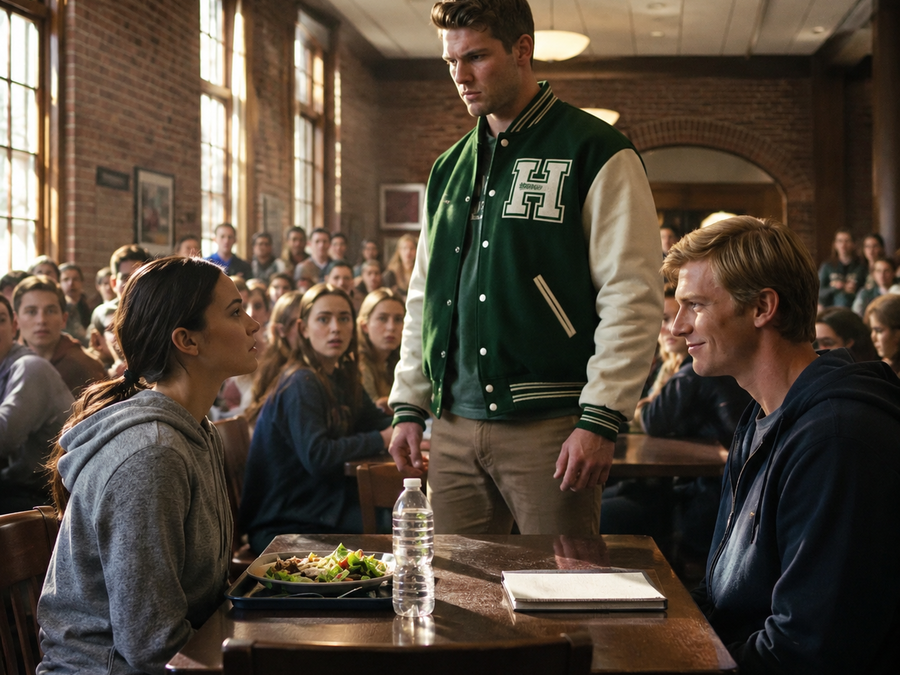
“You Just Made a Mistake”—She Said It Quietly to the Bully Who Slapped Her, and Three Days Later, the Entire University Would Understand Exactly What She Meant.
Move.
Now.
I said move. You just made a mistake.
Nobody knew who she really was.
Nobody knew what she had spent her entire life training to do. In three days, everything in that room was going to change.
This is the story they never saw coming.
There is a kind of quiet that follows a person like a shadow. Not the peaceful kind.
Not the kind you find on a Sunday morning with coffee and no plans and nowhere to be. This is the quiet of someone who has decided, very deliberately, to disappear.
Ren Calloway carried that kind of quiet with her everywhere she went.
She had been carrying it for three years now and she had gotten good at it. Good enough that most people looked right past her.
Good enough that she could walk into a room full of strangers and leave without a single person being able to describe her afterward. That was not an accident.
She walked into Harwick University on a Tuesday in September with a backpack that was too heavy and a campus map she had already memorized. She did not stop to take photos of the fountain.
She did not look up at the old brick buildings with the wide eyes of someone seeing them for the first time.
She had done her research.
She had studied the campus layout, the building numbers, the fastest routes between the engineering complex and the library.
She knew exactly where she was going.
That was the thing about Ren that most people missed at first glance. She always knew exactly where she was going.
She had just learned over time to make it look like she was simply passing through.
She was 22 years old, five foot four, brown hair pulled back in a plain elastic band, no product, no effort.
She wore a gray hoodie, jeans, and sneakers that had seen better days.
No jewelry except a small watch with a rubber band.
No statement, anything.
Just a girl who looked like she wanted to get from one place to another without being noticed. For a while, that is exactly what happened.
She found her apartment off campus on Birch Street, small, clean, one window that looked out onto a parking lot and a slice of sky.
She unpacked in two hours, arranged her books by subject, set up her desk, and made herself a cup of instant coffee before bed.
She sat at the desk and drank it slowly and listened to the sounds of the street below.
A car passing, someone’s music from two floors up, the particular night quiet of a city that was not fully asleep.
On the shelf above her desk, she placed one thing, a small velvet pouch, dark blue, pulled shut with a drawstring. She did not open it.
She just set it there, in the corner, where she could see it without looking directly at it. Like a compass you carry not because you are lost, but because you want to remember which way is north.
Then she turned off the light and went to sleep. Harwick University sat in the middle of Dayton, Ohio, the kind of mid-sized college town that felt energized in September and quiet by February, when the cold came down from the lake and the students stopped walking slowly between buildings.
The campus had that comfortable worn-in quality of a school that had been around long enough to stop trying to impress people.
Red brick, old oak trees with roots that had buckled the sidewalks in places, a student union that smelled like burnt coffee and ambition, and the ghost of a thousand group projects.
Ren liked it immediately. She was studying mechanical engineering, third year.
She had transferred from a smaller school in western Pennsylvania, the kind of place where everyone knew your name and your business and your mother’s maiden name and what you had done in ninth grade that one time.
She had chosen Harwick specifically because nobody knew her here. Nobody knew what she had done.
Nobody knew who she had been.
She wanted to start clean.
She wanted to just be a student, to sit in the classroom and raise her hand when she had a question and eat lunch by herself if she felt like it without any of the weight that came with being known.
That was the plan. The first morning of classes she got lost.
Not badly lost. She had the map.
She knew the building.
But the engineering complex at Harwick had been renovated over the summer and the main entrance had moved about forty feet to the left and the new signage had not yet been installed properly.
So she went around the building once, found the side entrance, took the wrong staircase, and arrived at Professor Eleanor Marsh’s materials mechanics class exactly three minutes after it was supposed to begin.
She pushed open the door quietly. The lecture hall held about sixty students arranged in tiered rows that rose toward the back.
Every head turned when the door opened because every head always turns when a door opens late. It is one of those small unkind reflexes that classrooms produce.
Ren did not look at the heads. She scanned the room for an open seat.
There was one. Second row, left side on the aisle.
She moved to it quickly and sat down, settling her backpack by her feet, pulling out her notebook and her pen, uncapping it, writing the date at the top of the first clean page.
She was already forming the opening of a thought when she noticed the backpack on the floor beside the chair. She noticed the lacrosse jacket draped over the back of it.
She had sat in someone else’s seat.
That’s my seat.
The voice came from the aisle. Not loud the way someone surprised is loud.
Loud the way someone who wants the room to register their inconvenience is loud. Calculated.
Pointed. Ren looked up.
He was tall. Six foot two.
Maybe taller in the way that some people stand, like they are always trying to remind you of it. Wide in the shoulders.
The kind of wide that comes from years of athletics. And the certainty that the world would make room for it.
Dark hair. A jaw that looked like it had never had a difficult Tuesday.
And the particular expression of someone who had organized his entire personality around the fact that people rarely told him no.
She did not know his name yet. She would learn it soon enough.
I’m sorry, Ren said.
Her voice was level. Polite.
I didn’t see your things.
I can move. She was already beginning to stand.
No kidding you can move, he said. A few people nearby laughed.
The low uncertain laugh of people who are not sure if something is funny, but have decided it is safer to be on the side that laughs.
Ren stood. She picked up her notebook and her pen.
She looked around the room for another available seat. There was one in the far back corner.
Behind a structural pillar. The kind of seat where you spend the entire semester looking at a column of concrete and taking notes based on what you can hear rather than what you can see.
There’s a seat in the back, the young man said.
He pointed as though she could not locate it herself.
As though she needed to be shown.
Thank you, Ren said.
She walked to the back.
She sat behind the pillar.
She opened her notebook to the page with the date written on it and she continued writing. She did not write down what she was feeling.
That was not the kind of thing she wrote down. At the front of the room, the door opened again and Professor Eleanor Marsh walked in.
Marsh was 67 years old.
She had silver hair cut short and practical.
Reading glasses on a chain around her neck. The posture of someone who had been standing at the front of rooms for a very long time and had stopped thinking about how she looked doing it.
She set her briefcase on the desk with a decisive thud, looked out at the room and said simply, Good.
You’re all here.
Her eyes moved briefly to the back corner, to Ren behind the pillar. Then she began the lecture.
Ren took notes, good notes, the kind you take when you are genuinely paying attention and also, beneath that, processing something else entirely. The kind of notes where the handwriting stays neat even when your thoughts are not.
She did not look at the young man in the second row. She did not need to.
She had already noted exactly where he was sitting. The angle of his shoulders, the way he leaned back in the chair with the specific ease of someone who had never been asked to make himself smaller.
She had met this kind before.
She had known this type since she was fifteen years old standing on a mat in a gym in Pittsburgh, learning for the first time that the loudest person in any room is very rarely the most dangerous one.
By noon, the cafeteria was loud in the warm institutional way of dining halls everywhere.
Harwick’s main dining space was officially named Founders Hall, which was a significant name for a room that smelled primarily of steam trays and dish soap.
Round tables, plastic chairs, a wall of windows along the south side that looked out onto the quad where students cut across the grass in groups of two and three. Ren got a bowl of tomato soup and a piece of cornbread and found a table near the windows.
Not the most central table.
Not a hidden one, either.
Just a table with a decent view, good light, and enough distance from the nearest cluster of people that she could think. She had been there about ten minutes when she heard him.
You could always hear Derek Stole before you saw him. He moved through space like someone who had never been required to take up less of it.
His voice carried across the dining hall before he had made it through the door. Loud and comfortable.
The voice of someone who had grown up in rooms where his presence was assumed to be welcome.
He came in with two others. One was shorter and stockier, with a crew cut and a Harwick Athletics shirt stretched tight across his shoulders.
The other was leaner, with the easy, practiced laugh of someone who had learned early that laughing along with the right person opened more doors than thinking carefully about what was said. She would learn their names later.
For now, they were simply the people who walked with him. They got their food and scanned the room.
Derek looked at Ren’s table.
She noticed.
She kept eating.
He said something to the shorter one.
The shorter one grinned. They walked over.
Derek pulled out the chair across from Ren and sat down in it without asking.
The other two took the remaining chairs, arranging themselves with the casual ease of people who did this often and had never been turned away.
Ren looked up from her soup.
You’re in the wrong place again, Derek said.
I don’t think so, Ren said.
I was here first. We always sit at the window tables.
He said it the way you state a fact about the weather.
Settled. Not open to discussion.
There are four other window tables, Ren said.
This one is closest to the door.
I noticed.
Something shifted in his expression. Not quite surprised.
More like a small adjustment. People usually responded to him one of two ways.
They either moved immediately, eager to avoid friction, or they tried to joke their way out, laughing it off, making it easy for everyone. What they did not usually do was look at him calmly and point out that there were four other window tables.
Look, said the shorter one, leaning in with a grin that had no warmth behind it at all.
She’s telling you no, Derek.
He directed this at Derek, but kept his eyes on Ren, watching for the reaction. Like she runs the place.
Ren picked up her spoon and ate another bite of soup.
Where are you from?
Derek asked. His tone had shifted slightly, lighter on the surface, harder underneath, the way ice looks the same as solid ground until you are already on it.
Pennsylvania, Ren said.
Pennsylvania. He said it with a faint inflection of someone identifying a lesser product.
What part? Western part.
The small town part.
He glanced at his two companions.
That explains a lot. The lean one laughed on cue.
Ren set her spoon down. She looked at Derek with the specific unhurried attention of someone who has spent years learning to read a situation before responding to it.
She looked at the set of his jaw and the angle of his posture and the way his eyes kept flicking to the people at the tables around them, checking the audience, making sure the room was watching. She had learned to recognize that.
The performance underneath the provocation, the way some people did not actually want what they were asking for.
What they wanted was the reaction. The flinch, the retreat, the confirmation that they had the power to produce those things on demand.
Is there something you actually need from me? she asked.
The question was simple, genuine. It landed in the middle of the performance like a stone dropped in a pond.
Derek blinked.
Because if not, Ren continued, her voice still even, I’d like to finish my lunch.
For a moment, no one at the table said anything.
Then something moved through Derek’s expression, something that was not quite anger and not quite embarrassment and had the quality of both.
The feeling of a person who has run a familiar play and found that the other side has not followed the expected script.
He stood up. He was tall, standing over a table.
He used it.
He looked down at her and there was a decision happening behind his eyes, something fast and not entirely thought through. And then he leaned down and he slapped her open-handed across the left cheek, hard enough that the sound of it traveled.
The dining hall went silent, not gradually. All at once, the way a fire goes out when you cover it.
Sixty or seventy people and every single one of them stopped at the same moment. Forks paused, conversations cut off, chairs did not move.
It was the particular silence that descends when something happens that is so clearly wrong that everyone in the room understands it in the same instant without discussion, without needing to be told.
Ren’s head had moved with the impact.
She sat without moving for a moment.
Her left hand rested flat on the table. Her right hand was wrapped loosely around the handle of her spoon.
Her breathing did not change.
Four seconds passed.
She turned her head back. She looked at Derek Stole.
Her eyes were completely, entirely calm. Not the stunned calm of someone who does not yet understand what has happened.
This was something different and it was visible to everyone in the room who was paying attention, which was everyone.
This was the calm of something very deep and very still.
The kind of calm that exists not because nothing is happening, but because something has already been decided somewhere below the surface where decisions like that get made. She said four words.
Her voice did not rise.
It did not tremble. It was low and clear, and in that absolute silence, every person in that dining hall heard it without straining.
You just made a mistake.
Derek stared at her.
The shorter one looked at the lean one.
Derek laughed.
It was not a comfortable sound. It was the laugh of someone filling a silence because they do not know what else to put in it.
The laugh of someone who has just done something they cannot undo and has decided that volume is the answer.
Yeah, okay, he said.
He reached over and pulled his jacket from the back of her chair.
He straightened up. Enjoy your lunch.
He walked away.
The shorter one followed without looking back. The lean one lingered half a second looking at Ren with something on his face that was not quite guilt and not quite curiosity and did not have a clean name, and then he followed, too.
The noise of the dining hall came back, not all at once, slowly, like water finding its level again. First a whisper, then two voices, then the general hum resuming.
People looked at each other.
People looked at Ren. People looked away.
Ren picked up her spoon.
She finished her soup.
Her hand was perfectly steady, not because she felt nothing, but because she had spent years learning the difference between what you feel and what you show, and because she understood with the clarity of someone who had trained for exactly this kind of moment without knowing it that the most important thing she could do right now was stay exactly where she was. Two tables away, Seth Drummond sat with his lunch untouched in front of him.
He was 21 years old, a second-year engineering student with dark-rimmed glasses and a face that processed things slowly and thoroughly, the kind of face that caught up to events a few seconds after they happened and then held on to them longer than most. He had watched the entire thing from the moment Derek had sat down.
He had not moved.
He had not said a word. He had been holding his fork in the air from before the slap.
He set it down now.
He looked at Ren. She did not look back at him, but there was something in the way she was sitting.
The precise straightness of her back. The unhurried way she reached for her glass of water.
The fact that she was still here, still at this table, still eating, as though the most important statement she could make right now was simply to finish what she had started.
Seth reached into his pocket.
He looked at his phone. He thought about it for a moment.
Then he put the phone back.
He picked up his fork and started eating, but he kept his eyes on the door through which Derek Stole had walked, and he kept thinking about those four words, and about the way they had been said. Not angry, not shaking, not the desperate volume of someone who had been cornered and was trying to sound bigger than they felt.
PART 2
Just a fact stated quietly to be heard by exactly one person. You just made a mistake.
Seth ate his lunch and thought about that for a long time.
Across campus, in a small office in the East Wing of the Athletics Building, Coach Raymond Tusk was eating a sandwich and working on a crossword puzzle.
He was 70 years old, three years retired, and Harwick still gave him an office and a parking permit because he had given the school 31 years of his life and a regional judo championship, and that bought you certain courtesies. He liked the office.
He liked the crossword puzzles.
He liked the way they required you to approach a word from the side, to come at it indirectly until the right angle appeared. It was not unlike coaching, not unlike a lot of things if you thought about it the right way.
He was considering seventeen across when his phone buzzed on the desk beside him. A text from one of the student athletic trainers who still checked in with him occasionally.
It read, Something strange just happened in Founders Hall.
Derek Stole slapped a girl and she didn’t react at all.
Just sat there and kept eating. Nobody did anything.
Tusk read it twice.
He set the phone face down on the desk. He picked up his tea and held it and looked out the window at the strip of afternoon sky visible between the buildings.
He thought about that for a while.
Specifically, he thought about the phrase she didn’t react at all.
In his experience, that phrase meant one of two things. It meant someone was in shock.
Or it meant something else entirely.
He put on his jacket and went for a walk.
The sports complex sat on the east side of campus, set back from the academic buildings by a long sweep of lawn that caught the September afternoon light in a way that had always seemed slightly too beautiful for Ohio. On one side of the main gym was the practice field for the lacrosse team.
On the other was a smaller paved area surrounded by old chain-link fencing. A space that had been used decades ago for combat sports training.
Before the program was cut and the mats were rolled up and nobody thought about it much anymore. Tusk came around the corner of the building at 4:15 in the afternoon.
He stopped.
A young woman was in the paved space. She was not stretching.
She was not jogging. She was doing none of the things that students did when they wandered into open spaces to exercise.
She was training.
Properly.
Fully.
Tusk had coached judo for 31 years. He had trained collegiate athletes and national level competitors and three students who had gone on to compete on international platforms.
He had spent more hours watching technique, good and bad and everything between, than he could accurately calculate.
He had the kind of eye that does not turn off when you retire, the same way a surgeon’s hands do not forget their training when they stop operating.
He watched her for a full minute without moving or making a sound.
She was performing a kata, a formal judo sequence executed solo. Each movement connected to the next with the precision of something that had been practiced so many thousands of times that it had passed beyond conscious thought and become something more like breathing.
Her weight transitions were clean. Her foot placement was exact.
The control in her wrists and forearms told him she had been doing this since she was very young, young enough that it had shaped the way her body moved even when she was standing still.
But it was not only the technical quality that had stopped him on the path.
It was the quality of her attention.
She was completely inside the movement.
There was no performance in it. No awareness of being watched.
She was not training for an audience of any kind. She was training the way you train when the practice itself is the only language that makes sense to you in a given moment, when the body knows things the mind has not yet caught up to.
In 31 years of coaching, Tusk had seen that quality in perhaps a dozen athletes. She completed the sequence, stood still for a moment, hands at her sides, breathing controlled and quiet.
Then she turned and saw him.
She did not startle.
She did not look embarrassed or caught.
She looked at him with the direct attention of someone who has been half expecting this particular moment. Tusk walked forward slowly.
He stopped about ten feet away.
They looked at each other across the late afternoon light, this old coach and this young woman, and something passed between them that did not require words to establish.
You know who I am, he said. Coach Tusk, she said.
You coached judo here from 1990 to 2021.
Retired three years ago. You still keep an office in the East Wing.
He nodded once. And you have been training for a long time.
Since I was eight. He looked at her hands.
He looked at the specific way her weight was distributed, the quality of readiness in her stillness that people without serious training always mistook for tension, not understanding that it was actually its opposite. National program?
he said.
She understood what he was asking. Yes, collegiate level.
I competed until I was nineteen.
He let a breath out slowly, not surprise, confirmation.
What year were you at Nationals?
2021. Seattle.
He was quiet for a moment. He had watched that championship.
He remembered the final match.
He remembered the call that had gone the other way at the end.
I watched that final, he said.
I know. You wrote about it in the Judo Coaches Newsletter.
He looked at her steadily.
The judges got it wrong. Maybe, she said.
Or maybe I let it get too close. He kept looking at her.
She did not look away, and she did not fill the silence with anything unnecessary, and that told him as much as everything else had.
Why are you here? he asked.
Why does no one on this campus know who you are? She was quiet for a moment.
When she answered, her voice was measured, but underneath it there was something genuine, something she had decided carefully that she was willing to say out loud. Because I wanted to find out if I could be a person without being an athlete first, she said.
I wanted to know what it felt like when people saw me before they knew what I could do, whether they would treat me the same way. Tusk nodded slowly.
It was the nod of someone who understood something that had taken a long time to come to. And how has that been going?
he asked. A pause.
Today was difficult, she said. He looked at her left cheek.
The redness there had mostly faded, but not entirely.
He had spent enough years around athletic injuries and the aftereffects of physical contact to recognize what he was looking at. Derek Stole, he said.
She did not confirm or deny. She did not need to.
He has done this before, Tusk said.
His voice was level, but there was something underneath it.
Something that had been there for a long time and had not found the right place to land. Not always this directly, but the pattern has been there for four years and every time the institution has found a way to make it quiet.
I know, Ren said.
He looked at her. You know.
I read the student newspaper archives before I transferred here. His name comes up in the letters section.
Always vague. Always framed as misunderstanding.
Always resolved without anything on record.
He studied her face for a long moment. You transferred here knowing he was a student here.
She did not answer that question directly.
She picked up the small towel she had set on the fence post and wiped her hands with it. Folding it carefully before setting it back down.
I transferred here because Harwick has one of the better mechanical engineering programs in the state, she said. And because I was tired of being somewhere small where everyone already knew my whole story.
She looked at him directly.
But I don’t walk into any room without first understanding what is in it.
He held her gaze for another moment.
Then he said quietly, What do you need? Right now, she said.
I need to know if you still have access to the university’s historical disciplinary records.
The ones from before the new record system was introduced six years ago.
Tusk was quiet.
And I need someone who understands this institution, she continued. And who has been watching long enough to know where the problems actually are.
He looked at her for a long time.
Come by my office tomorrow morning, he said.
Eight o’clock.
She nodded.
He walked back the way he had come. He did not look back, but if he had, he would have seen her watching him go with a particular expression of someone who has just confirmed something they already suspected and is now doing the quiet arithmetic of what comes next.
That evening, Seth Drummond found her in the library.
The Harwick Library stayed open until ten o’clock on weekdays, and Ren had already located the quietest corner on the third floor, northwest side, where the light was good and almost no one came after seven in the evening.
She was reading a thermodynamics textbook when she heard the chair across from her scrape back.
She looked up.
Seth sat down. He had his backpack on one shoulder and a granola bar in his hand and the expression of someone who had thought carefully about whether to do this and had decided to do it anyway.
I was in the cafeteria today, he said.
I know, Ren said. Two tables to my left.
He blinked.
You noticed me?
I notice most things.
He set the granola bar on the table.
He looked at her for a moment with the particular expression of someone trying to find the right way into something. I have a video, he said.
Not of the slap.
I didn’t get that part, but right after, when he walked away and you just kept sitting there, I had my phone out and I kept recording without fully deciding to, and I have about ninety seconds of you at the table, completely steady while everyone around you is looking at each other and not doing anything.
He held out his phone. She took it and watched.
It was exactly what he had described.
Ninety-three seconds of Ren Calloway finishing a bowl of soup in a room that had gone very quiet, surrounded by people who were watching her and whispering into each other and doing nothing while she reached for her glass of water and set her spoon down with the unhurried precision of someone who had decided that the most important thing she could do right now was exactly this. She handed the phone back.
Don’t post it, she said.
I wasn’t going to, he said quickly.
I just felt like someone should have it.
That it should exist somewhere. That it happened and someone should have seen it and not looked away.
She looked at him for a moment. He was earnest in the specific undefended way of someone who had not yet learned to wear armor over it.
Genuinely earnest. The kind that you did not see often in people his age because most of them had discovered by now that sincerity without irony was a vulnerability.
What’s your name?
she asked. Seth.
Seth Drummond.
Second year engineering.
Why didn’t you say something?
she asked. In the cafeteria.
He looked at the table between them then back at her.
I’ve been thinking about that since it happened, he said.
I keep telling myself I was scared but I’m not sure that is exactly right.
I think I was waiting.
Like I thought someone else was going to step in and I could follow their lead and then nobody did and then it was over and there was nothing to follow. He held her gaze.
I’m sorry.
Ren considered him for a moment. What you did has a name, she said.
It is a well-documented psychological phenomenon.
When more than one person witnesses something that requires a response the likelihood of any single person responding goes down with every additional witness because everyone assumes that someone else will handle it. The responsibility gets distributed until nobody feels like they are personally the one who needs to act.
That doesn’t make it okay, Seth said.
No, she agreed.
It doesn’t.
But understanding why we do something is the beginning of deciding whether we will do it the same way again.
He looked at her carefully.
How are you so calm about all of this?
She was quiet for a moment. Outside the library window, the campus had gone dark and the lamp posts had come on casting small orange circles on the paths below.
I’m not as calm as I look, she said.
It was a small thing to say. Simple, but something in the way she said it made Seth understand that it was also true in a way she did not often allow herself to be out loud.
What are you going to do?
he asked.
She pulled her textbook back toward her. Tonight I am going to finish this chapter, she said.
And then I am going to think carefully about what I know and what I still need to find out. And then I am going to sleep.
And tomorrow?
Tomorrow I have an eight o’clock meeting and then class.
And whatever comes after that, I’ll deal with it when it comes.
Seth looked at her for another moment.
Then he nodded once and reached into his backpack and pulled out his own notebook.
He did not leave. He opened the notebook and started working.
After a while, the only sounds in that corner of the library were the quiet turning of pages and the distant hum of the building’s heating system and the occasional footsteps somewhere on the floor below.
Two engineering students working late in a quiet library, which was the most ordinary thing in the world. Ren finished her chapter and started the next one.
Later, after Seth had packed up and said good night and the library had emptied to almost nothing, Ren sat alone at the table by the dark window.
She reached into her backpack and took out the velvet pouch.
She had carried it all day without opening it. She opened it now.
Inside was a metal silver, about the size of a silver dollar, heavier than it looked.
On one face, the emblem of the United States Judo Federation. On the other, engraved in small, clean letters, U.
S.
National Collegiate Judo Championship 2021, second place.
She held it in her palm and looked at it.
She thought about her father, his gym in Pittsburgh, the smell of the mats on a Saturday morning, that specific combination of rubber and effort, and the kind of discipline that gets into your bones when you start young enough.
She thought about the way he had taught her, not by talking about winning, but by talking about control, about the distance between an impulse and a decision, about how the space you leave between those two things is where your character actually lives.
He used to tell her, The technique is the easy part. Knowing when to use it is the whole lesson.
She had spent three years trying to understand what that meant when you were not on a mat, when the situation was not a competition with rules and referees and a clear beginning and end, when the person across from you was not an opponent who had agreed to the same terms. She turned the medal over in her hand.
She thought about Derek Stole, the calculation behind his eyes in that moment before he slapped her, the way he had looked at the room first, checking the audience. It was not impulsive, what he did.
It was performed.
It was the action of someone who had done something like it before and had learned that he could, that the room would let him, that the institution would find a way to manage it quietly, and that the person on the receiving end would do what people in that position usually did.
She thought about the students who had come before her.
Three of them, based on what she had pieced together from the archives.
Three students who had tried to report what had happened to them and had gone quiet afterward. She thought about what it costs a person to go quiet when they have tried to speak, the specific weight of that, the way it follows you.
She closed her hand around the metal. She thought about Nadine Fuller in the student affairs office that afternoon, who had looked at Ren with the expression of someone who genuinely wanted to help and was also genuinely afraid of what helping might cost her.
Fuller was not a bad person.
She was a person inside a system that had taught her, repeatedly, what the consequences of acting were. She thought about Coach Tusk standing at the edge of the training space watching her with 31 years of understanding in his eyes.
She thought about Seth Drummond saying, quietly, I think I was waiting for someone else to go first. She opened her hand and looked at the metal again.
Then she put it back in the pouch, pulled the drawstring closed, and set it on the table in front of her.
She took out a clean sheet of paper and she wrote two columns.
The first column, what she knew for certain. The second column, what she needed to find out.
The first column was short, but each item in it was solid, the kind of solid that does not move when you push on it.
The second column was longer, but nothing in it was impossible.
It was simply a matter of patience, of understanding the situation clearly before acting on it, of waiting for the right moment rather than the nearest one.
She had learned that on a mat in Pittsburgh. She had learned it in the specific way you learn things when you are eight years old and your body is still figuring out what it can do.
PART 3
And a patient man is teaching you that the difference between a good fighter and a great one is not strength or speed or even technique. It is timing, and timing comes from stillness, from being willing to wait inside the discomfort of not yet, to hold your position and read the situation and not move until the moment is genuinely right.
She folded the paper and put it in her pocket.
She packed up her bag. She walked home through the night campus past the old oak trees and the brick buildings and the fountain that caught the lamplight and turned it gold.
The air had that particular September quality of warmth that knows it is temporary, holding on for one more week before it lets the cold in.
She let herself into her apartment. She made tea.
She sat at her desk and looked at the velvet pouch on the shelf and thought about her father’s gym and the smell of the mats and the thing he had said to her that morning she left for college the first time.
You are going to meet people who look at your size and think they understand what you are.
Let them think it. The truth will introduce itself when it needs to.
She sipped her tea.
She thought about the four words she had said in that cafeteria.
She had meant them not as a performance, not as a threat designed to be overheard. She had meant them the way her father had always taught her to mean the things she said, which was fully and with the intention of following through.
You just made a mistake.
Not a threat, a fact, a quiet commitment made mostly to herself that this was not going to be the kind of thing that disappeared into institutional silence, not again, not to her and not to the three who had come before her whose names she did not yet know but intended to learn. She finished her tea.
She rinsed the cup.
She turned off the desk lamp and lay down in the dark.
The parking lot outside threw a stripe of orange light across the ceiling through the gap in the curtains.
She lay there and thought about what her father had taught her about the most dangerous moment in any match. It was not the moment of confrontation.
It was not the throw or the hold or the point of contact. It was the moment just before, when everything was still and nothing had happened yet and all the possible futures were still possible.
That was the moment that required the most from you. The most patience, the most clarity, the most honest reading of what was actually in front of you.
She was in that moment now. She let herself be in it, and underneath the surface of the quiet, in the place where she kept the things that she was most certain of, something had already begun its patient, inevitable movement toward what needed to happen next.
The next morning came in gray and cool, the way Ohio mornings do in September, when the season has made up its mind. Ren was up at 5:30.
She made coffee, drank it standing at the kitchen window, watching the parking lot fill slowly with light. She reviewed the two columns she had written the night before.
She added three items to the second column. Then she folded the paper, put it in her jacket pocket, and went to train.
She was back, showered, and walking across campus by 7:45.
Coach Tusk’s office was at the end of a corridor that smelled like old rubber and institutional cleaner.
The particular smell of a building that had housed physical effort for decades. The door was open.
He was already there, sitting behind a desk that held a cup of tea, a legal pad, and a file folder that he had placed within the center of the desk with the deliberateness of someone who had decided to do something and was committing to it.
He looked up when she appeared in the doorway. Close the door, he said.
She did. She sat in the chair across from him.
He looked at her for a moment, then he said, Before we talk about anything else, I want to say something, and I want you to hear it.
She waited. What happened yesterday in that dining hall was wrong, he said.
Not complicated.
Not a misunderstanding.
Wrong. And I have watched this institution manage things that were wrong for long enough that I no longer have patience for the way it manages them.
So, whatever you are thinking about doing, I want you to know that I am not going to tell you to be careful about how you proceed.
I am going to help you proceed correctly.
There is a difference. Ren looked at him.
Okay, she said.
He opened the file folder. I pulled what I could from the records I still have access to, he said.
Three previous complaints involving Derek Stole. One in his first year, one in his second, one in his third.
All three were filed through the student affairs office.
All three were closed at the internal review stage with a finding of insufficient evidence. He paused.
In each case, the complainant withdrew before the formal hearing. They withdrew or they were persuaded to withdraw, Ren said.
Tusk looked at her. That is the question worth asking.
He turned the folder toward her. She read through it steadily, the way she read technical documents, absorbing the structure and noting the gaps.
There were three thin files, each one a few pages of official language that said a great deal by saying very little. Dates, procedural notations, the phrase matter resolved through internal mediation appearing in all three in identical wording, as though copied from a template.
She looked up. Who signed the closure documents?
Tusk tapped the bottom of the third page.
Associate Provost for Student Athletics. A name she recognized from the university website.
The person who managed the relationship between the academic institution and its athletic programs.
The person whose office sat between the university’s reputation and its funding.
The Stole family made a substantial donation to the new athletics facility, Tusk said.
Two years ago, the building was named after them last spring.
Ren set the folder down. What was the donation amount?
she asked. Publicly reported as 1.
4 million.
She was quiet for a moment.
That is not a reason to protect someone from consequences, she said. No, Tusk said, it is not, but it is a reason that institutions sometimes try to.
She nodded slowly. She was not surprised.
She had understood from the newspaper archives that there was a structure here, a set of relationships and dependencies that had been allowed to calcify over time into something that looked from the inside like the natural order of things. The problem with structures like that was not that the people inside them were all bad.
Most of them were not.
The problem was that the structure itself rewarded certain behaviors and punished others.
And over time people learned, without ever quite deciding to, to behave accordingly.
That was worth understanding, not because it excused anything, but because understanding the structure was the first step to knowing where it could be challenged. I have a meeting with Nadine Fuller this afternoon, Ren said.
Tusk nodded.
She is a good person in a difficult position.
I know.
I am not going to make her position more difficult than it needs to be.
She paused.
But I am going to ask her some specific questions.
What do you need from me?
She looked at him directly.
I need to know if you still have contact with any of the three previous complainants.
He was quiet for a moment. One of them, he said.
She graduated two years ago. She is in Columbus now.
We stayed in touch.
Would she be willing to talk?
He considered it.
I don’t know.
I can ask.
That is all I am asking. She stood up.
One more thing, Tusk said.
She stopped.
Derek Stole is going to find out you filed a report.
It may already be happening.
When he does, he is not going to leave it alone. He looked at her steadily.
I want to make sure you understand what that means practically. I understand it practically, she said.
He held her gaze for a moment longer, then he nodded. She left.
The corridor smelled like rubber and cleaner and old effort. She walked back out into the gray morning and went to class.
The afternoon meeting with Nadine Fuller was in Fuller’s office on the second floor of the student affairs building, a room that smelled like printer toner and had a bowl of hard candy on the desk that Ren suspected had been there since the previous academic year.
Fuller was 64 years old with reading glasses pushed up on her head and the expression of someone who had been doing a difficult job for a long time and had recently started questioning whether the difficulty was inherent to the job or specific to this institution. She had short silver hair and a cardigan the color of a stormy sky and hands that moved when she talked, which they did as soon as Ren sat down.
I want to be straightforward with you, Fuller said. And I want you to know that what I say in this room is said with genuine concern for your well-being and not as a representative of any institutional position.
I appreciate that, Ren said. I received your formal report this morning.
I also received a phone call this morning from the office of the associate provost for student athletics. She let that sentence sit between them for a moment.
The call expressed concern that the timing of your report, coming the day after an alleged incident, might reflect an escalating conflict between two students rather than a straightforward conduct violation.
Ren listened without changing her expression.
They used the word alleged, Fuller continued, in reference to something that happened in front of approximately seventy people. I noticed that, Ren said.
Fuller looked at her.
You’re very calm.
I have been told that.
Are you actually calm or are you very well trained to appear calm?
Ren considered the question. Both, she said, depending on the moment.
Fuller sat back slightly. She studied Ren for a moment with the particular attention of someone who has spent decades evaluating people and has gotten reasonably good at it.
I want to help you, she said. I need you to understand that wanting to help you and being able to help you are two different things inside this institution.
I have seen what happens to complaints against this specific student.
I have watched three of them get managed into silence.
And I am telling you this not to discourage you, but because I think you deserve to know what you are walking into. I know what I am walking into, Ren said.
What I need to know is what you need from me to make this proceed correctly. Fuller looked at her for a long moment.
Evidence that cannot be easily dismissed, she said quietly. Witnesses who will not withdraw.
And ideally something that makes the cost of managing this into silence greater than the cost of addressing it properly. Okay, Ren said.
That is a significant ask.
I know.
I have until Friday’s hearing.
She paused.
Can you keep the hearing on schedule regardless of any pressure to delay or restructure it?
Fuller straightened slightly.
What was the straightening of someone who has been reminded of something they believed before the institution taught them to be careful about it. That, she said, I can do.
Ren thanked her and left.
She was crossing the quad toward the engineering building when she felt the shift. It was not loud.
It was not dramatic.
It was the particular change in the air that happens when someone behind you has decided to close the distance and something in the part of your nervous system that has been trained to read exactly that kind of information registers it before your conscious mind catches up. She did not speed up.
She did not turn around.
She adjusted her path slightly, moving toward the more populated area near the student union, and she kept walking.
They caught up with her near the side entrance to the engineering complex. It was Briggs who reached her first.
He came around in front of her, not touching her, just placing himself in her path with his chest forward and his chin tilted up in the way of someone who has been told he is large enough to solve problems this way.
Colt came up on her left side, not as close, the positioning of someone who wants to be present without being the primary thing.
Derek was behind her.
She turned slowly so she could see all three of them. She stopped.
She stood with her feet shoulder-width apart and her hands loose at her sides, her backpack on both shoulders, completely still. Derek looked at her with the expression of someone who has made a decision and is now committed to it.
He had the particular quality of someone who has recalibrated since yesterday and arrived at a plan that involves a different kind of pressure.
I heard you filed a report, he said. Yes, she said.
That was stupid.
I don’t think so, she said.
He looked at her for a moment. The same recalibration as yesterday, the same brief flutter of something that was not quite discomfort and not quite respect and lived in the space between.
You’re new here, he said.
You don’t understand how things work.
I’m learning, she said.
Briggs stepped slightly closer, not touching, just reducing the space.
You should think about what you’re doing, Derek said.
You should think about who you’re doing it to and what happens to people who try to make problems for certain kinds of people in certain kinds of places.
Ren looked at him steadily. That sounds like it might be a threat, she said.
It’s advice, Derek said.
From someone who has been here longer than you have.
She held his gaze for a moment.
Then she looked at Briggs, who was close enough now that she could see the texture of his Harwick Athletics shirt. She looked at him with the same calm reading quality, the assessment of someone who is very clearly cataloging exactly what they are working with.
Briggs shifted his weight.
He reached out and pushed her.
It was not a massive shove. It was the kind of push that is designed to destabilize, to make a person stumble, to establish physically what has been attempted verbally.
The kind of push that relies on the assumption that the person being pushed will respond with the instinctive, uncoordinated scramble of someone caught off guard.
Ren did not scramble. What happened instead was this.
As Briggs’s hands made contact with her shoulder, Ren’s body rotated, not away, into it and to the side, a movement so compact and precise that Briggs’s push, instead of connecting solidly, slid along her turning shoulder and found no resistance.
In the same motion, her right hand came up and found his wrist, and she stepped inside his reach. And then she executed an osoto-gari with the efficiency of someone who has done this specific technique several thousand times, which she had.
Briggs went down, not violently, not brutally, with the clean, controlled inevitability of a technique applied correctly to a situation that had presented itself.
He hit the ground on his back, and the sound of it was sharp in the open air of the afternoon, and he lay there for a moment, looking up at the sky with the expression of someone who has just had their understanding of a situation revised very rapidly. He was not hurt.
She had made sure of that in the execution, the angle of the fall, the controlled release that cushioned the impact enough to leave him undignified but uninjured.
He was, however, completely unable to stand up for approximately ten seconds. Ren took a step back.
She looked at Derek. She looked at Colt, who had not moved and did not appear to be planning to.
She adjusted the strap of her backpack on her right shoulder.
I’m going to class now, she said.
She walked to the entrance of the engineering building.
She pushed the door open and went inside.
Behind her, she heard Derek saying something to Briggs.
She did not stop to hear what it was.
She went to class. She took notes.
Her handwriting was perfectly even.
Seth was already in their corner of the library when she arrived at seven that evening.
He had two cups of coffee from the library cafe on the ground floor, and he slid one across the table when she sat down. She looked at it, then at him.
I figured you’d need it, he said.
Thank you.
She opened her notebook.
She noticed him watching her with the particular expression he got when he was deciding whether to say something. What?
she said.
I heard about what happened outside the engineering building this afternoon.
She looked up.
How? Three people saw it.
One of them is in my mechanics study group. He paused.
She said it was the most technically perfect thing she has ever seen in her life, and she grew up watching Olympic judo with her grandfather. Ren was quiet for a moment.
Was anyone filming?
she asked. Seth reached into his jacket pocket and put his phone on the table between them, screen face down.
She looked at the phone, then she looked at him. The angle is from across the courtyard, he said.
You can see clearly that Briggs initiates contact. You can see clearly what you do after.
He paused.
You can also hear Derek’s voice.
Not every word, but enough.
Seth, I wasn’t there, he said quickly.
My study group member filmed it on her phone because she had it out and it happened in front of her and she didn’t think about it.
She just recorded.
She sent it to me because she knew I was in the library with you last night.
He looked at her steadily.
I know I should have asked before accepting it, but I’m not sorry I have it.
She looked at him for a long moment.
This earnest, careful, genuinely decent person who had been learning one event at a time over the last two days the difference between watching something happen and being part of what happened.
She thought about what he had said the night before about waiting for someone else to go first.
I need to show it to someone, she said.
I know. That is why I brought it.
PART 4
She took her phone out and he airdropped it to her. She watched it twice.
He was right about the angle. She was right about what it showed.
She sent it to a folder she had created that morning and labeled simply as evidence. She looked up at him.
I need to ask you something, she said. Okay.
If this goes to the full disciplinary hearing on Friday, there is a chance you will be asked to provide a witness account of what happened in the cafeteria yesterday. Not just the video, but a direct account of what you saw.
Seth was quiet.
I know I didn’t do anything yesterday, he said.
That is not what I am asking. I am asking if you will do something now.
He looked at the table, then back at her.
The processing look, slow and thorough.
The look she had come to understand was what genuine consideration looked like on his face.
Yes, he said.
I’ll do it.
She nodded.
They worked in silence for a while.
The library’s quiet settled around them like something habitual.
After about forty minutes, Ren’s phone rang.
She looked at the screen.
Tusk.
She stepped away from the table and answered it.
I talked to her, Tusk said. Her name is Deanna Marsh, no relation to the professor.
She graduated two years ago.
She is in Columbus doing civil engineering, and she listened to what I said, and she was quiet for a long time. What did she say?
She said she withdrew her complaint because two days before the formal hearing, her academic scholarship was placed under review for unrelated reasons that were never clearly explained to her. And that when she inquired about the review, she was told it would likely be resolved quickly if the situation at the hearing level could be managed without institutional disruption.
Ren closed her eyes for a moment.
She understood what that meant. Tusk continued.
She was a first-generation college student. She needed that scholarship to stay enrolled.
She made a decision she has thought about every day since. Is she willing to put that account on record?
Tusk paused.
She said she needs to think about it overnight. That is fair.
She also said something else.
He paused again, and in the pause she could hear something in his voice that she had not heard before, a weight to it. She said she is glad someone is still trying.
Ren stood in the corridor outside the library’s north stairwell and said nothing for a moment.
Call you in the morning, she said.
She went back to the table.
Seth looked at her face when she sat down. Good news or bad news?
he asked.
Both, she said.
At the same time, which is usually how it works.
He nodded. She opened her notebook and added an item to the second column.
She was still writing when her phone buzzed with a text, unknown number, no name.
It said, Withdraw your report and this stops.
Don’t and it won’t.
She read it.
She took a photo of the screen with her second phone, the old one she kept charged for the kind of situation where you needed a record of something that might be deleted. Then she added the photo to the evidence folder.
Then she set her phone down and went back to her notes.
Seth was watching her.
What was that?
he asked.
Someone who thinks this is the kind of thing that stops, she said. She kept writing.
The following morning, Ren arrived at Professor Marsh’s classroom five minutes early and took a seat in the front row, not behind the pillar.
The front row, where the sightlines were clear and the light was good, and there was no structural obstacle between her and the board.
When Marsh walked in, she noted this without comment.
She set her briefcase down and arranged her notes. Students filtered in.
The room filled. Marsh began the lecture.
Forty minutes in, she assigned a group problem and moved among the tables.
When she reached the front row, she paused beside Ren’s desk.
She looked at Ren’s notes.
They were thorough, more thorough than the lecture required, with additional annotations in the margins that indicated independent reading.
The habit of someone who comes to class having already done the work and uses the lecture to deepen, rather than establish.
You’re the student who was placed in the back corner on Tuesday, Marsh said, quietly, for Ren’s ears alone.
Yes, Ren said.
How is your view from the front? Much better, Ren said.
Marsh looked at her for a moment over the top of her reading glasses.
It was the look of someone who has been teaching long enough to read a situation in a small number of details. Come by my office at five, she said.
It was not a question.
Yes, Ren said.
Marsh’s office was on the third floor of the engineering building, a room with floor-to-ceiling bookshelves and a window that looked out over the section of campus where the old gymnasium had been before it was demolished to make way for the Stole Athletics Center.
Marsh had a framed photograph of the old gymnasium on the wall behind her desk. Ren noticed it when she walked in.
She suspected it had been placed there deliberately.
Marsh poured two cups of tea without asking whether Ren wanted one and set one in front of her.
You’re being talked about, Marsh said.
She sat across the desk, both hands around her own cup.
Among the faculty, I mean.
Not loudly, but I hear things.
What are they saying?
Ren asked.
That a transfer student has filed a misconduct complaint against Derek Stole and that the situation is being watched carefully by the athletic department. She paused.
And that the student in question has an unusual quality of stillness about her that several people have independently remarked upon.
Ren wrapped her hands around her tea. I have been a professor at this institution for 31 years, Marsh said.
I have watched Derek Stole move through four years of undergraduate education in a way that has left damage in its wake that this institution has consistently declined to address.
I have written three letters to student affairs.
I have attended two faculty senate meetings at which the pattern of certain complaint resolutions was raised.
I have been told each time that procedures were followed.
She looked at Ren directly.
I am tired of procedures being followed.
She said, I am interested in the right thing being done.
Ren looked back at her. I am going to ask you something directly, Marsh said.
And I would like you to answer directly because I think you are someone who can. Go ahead, Ren said.
Do you have what you need to make this work?
Not to file a complaint. That has been done before and it has not worked.
Do you have what you need to make this actually work?
Ren thought about the video from the cafeteria, the video from the courtyard, the threatening text with its timestamp and unknown number, Tusk’s contact in Columbus, Fuller’s commitment to keep the hearing on schedule, Seth’s account.
She thought about what was still missing. Almost, she said.
There are two things I still need. What are they?
Ren set down her tea. I need the three previous complaint files in their original form, she said.
Not the summaries in the current system. The originals before they were closed.
If those files exist anywhere outside the managed record. Marsh was very still for a moment.
Then she stood up.
She went to the bookshelf on the far left wall, the one that held not books, but a series of labeled binders organized by year.
She ran her finger along them.
She pulled out one from six years ago and one from seven years ago. She set them on the desk in front of Ren.
I was on the faculty conduct review committee for twelve years, she said.
When a complaint is filed, committee members receive copies of the supporting documents for review. I kept mine.
I keep everything.
She paused.
When the digital records were migrated to the new system four years ago, certain documents were not transferred. I noticed this at the time.
I made additional copies.
Ren looked at the binders.
That is one thing, Marsh said. What is the second?
Ren looked up at her.
Deanna Marsh, she said.
No relation. Columbus.
Civil engineering.
Something moved across the professor’s face.
Not surprise exactly. The expression of someone who has just discovered that two separate things they have been carrying alone have found each other.
You know her, Ren said. She was one of my students, Marsh said quietly.
She was one of the best students I have taught in 31 years.
She withdrew her complaint in her second year.
I have thought about her frequently since. Coach Tusk has been in contact with her, Ren said.
She may be willing to provide a formal statement about the circumstances under which she withdrew.
Marsh sat back down.
She was quiet for a moment. The office was very still.
Outside the window, the Stole Athletics Center caught the last of the late afternoon light and held it in its glass facade. What do you need me to do?
Marsh said. Ren told her.
That evening Ren walked home through the campus as the last of the day’s light left the sky.
The oak trees were dark shapes against the early dark.
The lamp posts came on one by one as she passed them.
A few other students moved along the paths in pairs talking, not looking at her.
She was thinking about Deanna Marsh and Columbus and the decision she was weighing overnight. She was thinking about what it costs to come back to something you have tried to put down.
The weight of reopening something that you have spent two years learning to carry without it pulling at you every day. She knew that cost personally, not in the same way, but she knew what it was to close a door on something that mattered and to build a whole new life in the space on the other side of that door.
She knew what it asked of a person to walk back toward it.
She could not make that decision for Deanna.
She could not make it easier or lighter or less costly than it was.
What she could do was make sure that if Deanna came back, she did not come back alone.
She let herself into her apartment.
She put the kettle on. She took the velvet pouch out of her backpack and set it on the desk.
She sat down and opened the evidence folder on her laptop and went through everything in it methodically, the way she would approach a technical problem, looking for gaps, looking for assumptions she had made that needed to be verified, looking for the places where the structure she was building could be made stronger.
She worked for two hours. She found three things that needed to be checked and added them to the second column.
She found that the first column was now longer than the second.
She closed the laptop.
She looked at the velvet pouch.
She thought about her father’s gym.
About the Saturday mornings she had spent on those mats at ages eight and nine and ten, learning the beginning of a language that had taken her years to become fluent in.
Learning that the strongest position was not the one that used the most force.
It was the one with the most information, the most patience, the most honest reading of what was actually in front of you.
She picked up her phone and opened the messages. She typed a text to Tusk.
I have the original complaint files.
Professor Marsh had them. Friday is still possible.
She sent it. She made her tea.
She sat at the window and drank it slowly, watching the parking lot below where the orange street light made everything look like a scene from another time. Like something that had already happened and was being remembered.
Three days until the hearing.
She had the video. She had the text.
She had the files.
She had Seth and she had Marsh and she had Tusk and she had Fuller’s commitment to hold the process on the timeline it was supposed to follow.
And she might have Deanna.
What she did not have yet was the thing that would make all the other pieces mean something more than a complaint about a single incident on a single afternoon. She did not yet have the pattern made visible in a way that could not be dismissed.
The three files in the binders were a start, but files were documents and documents could be argued about.
What she needed was a person. Someone who had stood where she was standing inside this system and who had made a decision under pressure and lived with it.
And who was now choosing for the first time in two years to tell the truth about what that decision had cost them. She set her cup down, her phone lit up, a text from Tusk.
She called me twenty minutes ago.
She says yes.
Ren read the message.
She held the phone in both hands and sat very still in the orange-lit dark of her small apartment and did not say anything to anyone because there was no one there to say anything to.
But something in her chest shifted quietly in the way that things shift when something you have been carrying becomes, for the first time, possible to put down. She typed back, Tell her thank you.
Tell her she is not alone in this. She set the phone on the desk beside the velvet pouch.
Outside the parking lot was empty.
The lamp posts held their small circles of light against the dark. She did not sleep for a while.
She sat at her desk and thought about the two columns and about the people who had agreed, one by one, to do something that asked something real of them.
Marsh with her 31 years and her binders and her photograph of a gymnasium that no longer existed. Tusk with his retirement and his crosswords and his memory of a final match called the wrong way.
Seth with his careful honesty about the moment he had waited too long.
Fuller with her commitment to hold a process that was already under pressure. And Deanna in Columbus who had spent two years rebuilding herself after a door was closed on her and who was now at the cost of something real deciding to open it.
Ren thought about what her father had told her on a Saturday morning in Pittsburgh when she was twelve years old and had just lost a match she should have won and could not yet understand how. He had not told her she had been unlucky.
He had not told her the judges were wrong or that her opponent had been better or that she should have done something differently. He had sat beside her on the edge of the mat and waited until she was ready to listen and then he had said, You did not lose because you were weaker.
You lost because you waited too long to commit. There comes a point where you have read the situation completely.
Where you know what needs to happen.
And at that point waiting is no longer patience.
It is fear wearing the mask of patience.
Learn to know the difference.
She had thought about those words many times since.
She had spent a long time learning what they meant outside the context of a competition.
She thought she was beginning to understand. She had read this situation.
She had read it as clearly as she was able.
She had the pieces. She had the people.
She had three days.
She knew what needed to happen.
Thursday was not over yet, but Friday was coming and she was done waiting.
Thursday came in clear and cold.
The kind of morning that arrives with a particular sharpness to it. The way autumn mornings do when the warmth has finally stepped back and the air has decided to be honest about what season it actually is.
The sky over Dayton was a pale precise blue.
The oak trees on Harwick’s campus held their last red leaves against it like something they were not quite ready to give up.
Ren was on the training ground at 5:15.
She ran through her kata twice. Slowly.
The way you run through something when you are not practicing the movements, but practicing the state of mind that produces them. Steady.
Present. Not looking ahead to what was coming.
Just here.
In this paved space with the chain-link fence and the morning light and the sound of the campus beginning to wake up around her.
When she finished, she stood still for a moment. She thought about what her father used to say on the morning of a competition.
He would make breakfast and they would eat together without talking much. And when she stood up to go, he would say simply, Do what you know how to do.
Not win, not be great, not prove anything to anyone.
Do what you know how to do.
She picked up her towel and walked back to her apartment.
By eight, she was sitting at Tusk’s office door.
He opened it before she knocked.
He had two cups of tea ready and the legal pad from earlier in the week with additional notes in his careful, small handwriting.
He had spent part of the night on the phone, she could tell. The lines around his eyes were deeper than they had been two days ago, and he had the focused quality of someone who had passed through tiredness and come out the other side of it into something clearer.
Deanna is taking the train from Columbus this morning, he said. She will be on campus by noon.
Ren nodded.
She wants to meet you before the hearing, he said. She asked me to tell you that.
Of course.
He looked at her.
How are you?
It was a direct question, not the kind people ask to fill space. She gave it a direct answer.
I am ready, she said.
He nodded once. Then he slid a sheet of paper across the desk.
I wrote out the timeline of the three complaints.
Dates, file numbers, the names of the officials who signed the closure documents. It is in a format the committee can use directly.
He paused. Professor Marsh called me last night.
She is bringing the binders. I know.
We spoke at nine. And Fuller confirmed the hearing is at two.
She said the associate provost’s office called her yesterday afternoon requesting a postponement.
She denied the request.
Ren paused.
PART 5
She used the word denied, not declined.
Denied.
Something moved across Tusk’s face.
Quiet satisfaction. The kind that comes not from victory, but from watching someone remember who they are.
Good, he said. They went through the materials together for an hour, methodically, the way you prepare for something important, not by rehearsing speeches or imagining outcomes, but by knowing your facts so completely that you do not have to search for them when you need them.
When the facts are part of you, you do not hesitate. Hesitation is what happens when you are not sure what is true.
She knew what was true.
She left Tusk’s office at 9:15 and went to her morning classes.
She sat in the front row of both of them.
She took careful notes. She ate lunch in the dining hall at a window table, alone, and finished everything on her tray.
At 12:30, she was waiting on a bench outside the main entrance to campus when a woman walked through the gate pulling a small rolling bag. She was in her mid-twenties with dark hair and a composed face and the particular way of moving that belongs to people who have learned to carry something heavy without showing it in their stride.
Deanna Marsh stopped when she saw Ren. They looked at each other for a moment.
You’re Ren, Deanna said.
Yes, thank you for coming.
Deanna looked at her steadily.
Coach Tusk says you’re different from the others who tried.
I don’t know if that’s true, Ren said.
He thinks it is.
Deanna sat down on the bench. She set her rolling bag beside her and looked out at the campus she had not walked through in two years.
Something moved across her face that was too layered to name cleanly, memory and something sharper beneath it. Can I ask you something?
Deanna said.
Yes. When it happened to you, in the cafeteria, what did you feel?
Ren considered the question. She gave it the same honesty she would want given to her.
I felt the thing that comes before anger, she said.
The thing that arrives first before you have named it, a kind of very clear seeing, like everything gets precise. She paused.
And underneath that, something quieter, the knowledge that this was not going to be the end of the conversation.
Deanna was quiet for a moment. When it happened to me, she said, I felt that, too.
The clear seeing. And then I made the mistake of thinking that feeling was enough.
That if I felt it clearly enough, the institution would see it, too.
She stopped.
It doesn’t work that way.
No, Ren agreed.
Feeling it clearly is just the beginning. The rest is work.
Deanna looked at her. What did you build?
she said. In three days.
What do you actually have? Ren told her, carefully, specifically, without dramatizing any of it.
The video from the cafeteria, the video from the courtyard, the threatening text with its timestamp, the original complaint files from Marsh’s binders, Fuller’s commitment, Tusk’s documentation of the timeline, Seth’s witness account.
Deanna listened without interrupting. When Ren finished, Deanna was quiet for a moment.
That is more than I had, she said.
You didn’t have two years of watching what happened to you as a blueprint, Ren said.
I did.
You are part of why this is possible. Deanna looked out at the oak trees.
A leaf came loose from the nearest one and turned slowly in the still air before settling on the path.
What do you need from me? she said.
A statement about what happened to your scholarship during the two days before your scheduled hearing.
What was said to you?
By whom?
The exact language, as closely as you can recall it.
I remember it exactly, Deanna said. There was no hesitation in her voice.
The way you remember things that have cost you something. And I need you to be willing to say it in that room this afternoon, Ren said, in front of the committee, on the record.
A pause.
Not the pause of someone deciding, the pause of someone who has already decided and is taking one full breath before walking through the door.
Yes, Deanna said.
They sat together on the bench for another few minutes, not talking much, just being there in the particular solidarity of two people who had been in the same place at different times and were now for the first time in it at the same moment. Then Ren stood up.
I’ll show you where the committee room is, she said.
They walked together through the campus, past the oak trees and the fountain and the brick buildings. And the afternoon light was very clear and very cold and made everything look sharper than usual, like the world had been defined in a higher resolution.
At 1:45, the corridor outside the student conduct committee room was not empty.
That was the first thing Ren noticed when she arrived.
She had expected to walk into a procedural space, institutional, contained.
The formal machinery of a university doing its official business in the particular way universities do official business, which is carefully and without unnecessary witnesses. Instead, there were people in the corridor.
Seth was there with his notebook and his dark-rimmed glasses and his expression of someone who had made a decision and was fully committed to it. Professor Marsh was there with the two binders under her arm and her reading glasses on their chain and the posture of 31 years of standing at the front of rooms.
Coach Tusk stood beside her, straight-backed, with the quiet authority of someone who has nothing left to prove and therefore nothing to perform.
Nadine Fuller stood near the committee room door.
When she saw Ren, she nodded, a small precise nod, the nod of someone who has done what they said they would do. And there were others.
Ren did not know all of them. Three women she had not met before stood together near the water fountain at the end of the corridor.
One of them caught Ren’s eye and held it for a moment.
There was a recognition in it that was not personal. It was the recognition of a shared experience, the way people sometimes look at each other across a room when they understand without needing to say it that they have been in the same place.
Tusk came to stand beside her. Word got around, he said quietly.
Fuller mentioned to two faculty members that the hearing was proceeding. Marsh mentioned it to three others.
People came. Ren looked at the corridor, at Deanna, who had stopped when she saw the people there, and was looking at them with something on her face that Ren did not have a word for and did not try to name.
They are not all here to testify, Tusk said. Most of them are just here to be present, to make it visible that this is happening and that people know.
He paused. Sometimes that is what the institution needs to understand, that it is being watched.
Ren looked at the committee room door.
Let’s go in, she said.
The committee room held a long table at the front where five faculty and administrative members of the student conduct committee were seated.
Behind a smaller table to one side sat a representative from the Dean of Students office.
There was a respondent’s table where Derek Stole sat with two people beside him, one of whom had the polished prepared look of someone who had been formally briefed, and the other of whom was a man in his fifties wearing a suit that had not been bought for a university disciplinary hearing, but for a different kind of room entirely.
Ren noted him. She noted the suit and the posture and the way he sat slightly forward with his hands on the table in the manner of someone accustomed to this kind of proceeding.
She noted that he was not a university official. She made a mental note to establish on the record who he was.
She sat at the complainant’s table with Deanna beside her.
Seth sat in the witness chairs along the side wall.
Professor Marsh sat directly behind Ren with the binders on her lap.
Coach Tusk sat beside Marsh. Fuller stood near the door, not seated, in her capacity as the administrator managing the proceeding.
The committee chair was a woman named Dr.Voss, a political science professor whom Ren had looked up the previous day.
Sixty years old, seventeen years at Harwick. A record of three published papers on institutional accountability in higher education.
Ren had read all three of them on Wednesday night.
Dr.Voss called the room to order.
She reviewed the procedural rules, standard language. Ren listened and noted the things that would matter.
She looked at Derek when Voss was speaking.
He was doing the thing he always did, reading the room, assessing the audience. He had looked at the people in the corridor when he walked in.
And she had seen the brief calculation in his eyes, the acknowledgment that this was larger than he had expected, followed by the particular kind of confidence that belongs to people who have been through institutional processes before and come out of them unchanged.
He was not worried. He had been here before.
The structure had protected him before. He had not yet understood that the structure was different today.
The man in the suit leaned close to Derek and said something. Derek nodded.
Dr.Voss concluded the procedural overview.
Mr.Stole, she said, as the respondent, you will have the opportunity to present your account and call witnesses. I want to note for the record that the committee is aware that a request was made yesterday afternoon to postpone this hearing, and that request was denied by the student affairs office.
This proceeding is moving forward on its scheduled timeline.
She looked at both tables.
We’ll begin with the complainant’s statement.
Ren stood. She spoke clearly and without notes.
She described Tuesday in the cafeteria, the exchange, the escalation, the slap. She described it the way you describe something you have decided to tell the truth about, without embellishment and without minimizing, which is the most precise language there is.
She described the threatening text she had received Wednesday evening and stated that she had documented it with a timestamp and was prepared to submit it to the committee.
She sat down. Dr.Voss looked at Derek.
Mr.Stole, your response. Derek stood.
He was polished.
That was the only word for it. He had been prepared well.
He expressed concern for the complainant’s apparent distress.
He used that word, apparent, twice in the first paragraph.
He described the cafeteria incident as a misunderstanding that had escalated beyond what either party had intended.
He characterized Ren’s statement to him, the four words she had said after the slap, as a threat directed at him.
He expressed surprise that a complaint had been filed when, to his understanding, the situation had been difficult for everyone involved and could have been resolved without formal proceedings.
He sat down.
The man in the suit nodded once.
Dr.Voss looked at her notes.
The committee would like to review the submitted evidence at this point.
She looked at the committee’s administrator.
Please display the first video file.
The cafeteria video played on the screen at the front of the room.
Ninety-three seconds of Ren finishing a bowl of soup in a dining hall that had gone very quiet. Seventy people visible in the background, all of them still, all of them having registered the same thing at the same moment.
The footage did not capture the slap itself, but what it captured was its aftermath, undeniably, in the behavior of every person in that room. The room was quiet while it played.
Dr.Voss looked at Derek. Mr.Stole, the committee notes that this footage shows a dining hall of approximately seventy students responding in a manner consistent with witnessing a significant incident.
Is it your account that this response was provoked by a misunderstanding?
Derek’s jaw moved slightly.
The situation was confusing for everyone.
Confusing?
Dr.Voss repeated.
Her voice carried no particular inflection. She made a note.
We’ll move to the second video.
The courtyard footage played.
It was forty-one seconds. You could see Briggs approach and make contact.
You could see the specific sequence of Ren’s response.
You could see, clearly, that she had not initiated anything.
That her technique had been precise and controlled. And that Briggs had been left uninjured on the ground for approximately ten seconds before he stood up.
You could see Derek standing behind this. You could also hear, at the edge of the audio range, a voice that the committee would have no difficulty attributing.
The words were not all clear, but the word withdraw was clear, and the word stop was clear, and the tone was clear in the way that some tones are across any quality of audio recording. The man in the suit leaned toward Derek and said something under his breath.
Dr.Voss looked up from the screen.
The committee will take a five-minute recess to review the audio documentation from the text message submitted by the complainant.
During the recess, Derek leaned back in his chair and looked at the ceiling for a moment.
Then he looked at the man in the suit.
Whatever passed between them was not visible from where Ren was sitting.
But she noted that the man in the suit’s expression had changed.
The prepared quality had given way to something more calculating, something reassessing. She noted that, too.
Dr.Voss called the room back to order. The committee would like to call Mr.Seth Drummond, she said.
Seth stood up from the witness chair and moved to the witness table. He sat down with his notebook in front of him, though he did not open it.
Dr.Voss asked him to describe what he had witnessed in the cafeteria on Tuesday. Seth described it.
He was precise and unhurried and completely specific. He described the table, the approach, the escalation.
He described the slap and its sound and the response of the room. He described the four words Ren had said and the exact tone in which they were said, which he characterized as quiet and clear and not threatening.
One of the committee members asked him, Mr.Drummond, you did not intervene at the time.
Why are you here now? Seth looked at the committee member directly.
Because I understand now that waiting for someone else to go first is not a neutral act, he said. It is a choice, and I made the wrong one on Tuesday.
I am trying to make a different one today.
The committee member made a note.
Seth returned to the witness chairs. Dr.Voss looked at her agenda.
The committee will now hear from Professor Eleanor Marsh. Marsh came forward with the binders and set them on the witness table.
She did not sit. She stood because she had been standing at the front of rooms for 31 years, and it was the position from which she communicated most effectively.
She described the binders. She explained what they contained, why they existed, and how they had come to be in her possession.
She explained the migration of digital records four years ago and the documents that had not been carried forward in that process.
She explained the closure language that appeared identically across three separate complaint files, which she noted was statistically improbable unless the language had been templated and applied rather than arrived at independently.
Then she described the signing official.
She said the name clearly, associate provost for student athletics.
The man in the suit sat very still. Dr.Voss looked at the binders.
The committee will enter these documents into the formal record. She paused.
Professor Marsh, in your professional judgment, having reviewed these documents, what do they indicate? Marsh looked at the committee without hesitation.
They indicate a pattern, she said. Not an isolated incident.
A pattern of complaint management that has consistently produced the same outcome regardless of the specifics of the complaint, which suggests that the outcome was determined before the process was completed.
She paused. In my field, when an experiment consistently produces the same result regardless of the variables, you do not conclude that the experiment is working correctly.
You look at the methodology.
She returned to her seat.
Dr.Voss made a note.
She looked at the agenda, then she looked at Ren.
You indicated there is an additional witness.
Ren said, Yes.
Deanna Marsh, no relation to Professor Marsh, former Harwick student, graduated two years ago. Dr.Voss looked at the door.
Fuller opened it. Deanna walked in.
She sat at the witness table and folded her hands in front of her.
She had the composed quality of someone who has decided to do something they are afraid of and has moved through the fear to the other side of it, where everything is simply clear.
Dr.Voss said, Ms.Marsh, please describe your experience as a Harwick student as it relates to the matter before this committee. Deanna spoke.
She spoke for seven minutes without stopping. She described the incident in her second year.
She described filing the complaint.
She described the scheduled hearing and the forty-eight hours before it, during which her academic scholarship had been placed under unexplained review.
She described the conversation she had been asked to have had with an academic administrator during those forty-eight hours, during which the phrase institutional disruption had been used in proximity to the phrase scholarship review. Not as a direct connection, but as a proximity that anyone in her position would understand.
She described making the decision to withdraw.
She described what that decision had cost her. Not in dramatic language, in plain language, which is more expensive.
I withdrew because I was a first-generation college student and I needed the money to stay in school, she said. And I was twenty years old and I was alone in it and I did not understand yet that alone does not have to be permanent.
She paused. I have thought about that decision every day since.
Not because I blame myself for it.
I understand why I made it.
I think about it because I wonder how many other people made the same decision in the same circumstances and never found out that someone eventually came back to try again.
She looked at Ren. Ren looked back at her.
The room was very quiet. One of the committee members, a woman at the far end of the table who had not spoken yet, took off her glasses and set them on the table in front of her.
The gesture of someone who has heard enough to not need to take notes anymore. Dr.Voss said, Thank you, Ms.Marsh.
Deanna returned to her seat beside Ren.
Dr.Voss looked at Derek.
PART 6
He had the particular quality of someone who has been watching the structure they depended on reveal itself piece by piece as something different from what they believed it to be.
The confidence was still there because it was habitual enough to not fully switch off, but beneath it something had shifted.
The man in the suit was no longer leaning forward.
He was sitting back. That was a visible change.
Mr.Stole, Dr.Voss said, the committee has several questions. The questions took twenty minutes.
They were precise questions about specific dates and specific interactions and specific conversations. They were the questions you ask when you already have a significant number of the answers and you are establishing what someone is willing to acknowledge and what they will choose to deny on the record.
Derek answered some of them. He declined to answer others on the advice of the man in the suit, which was his right.
Each declined answer was noted.
Dr.Voss finally set down her pen.
She looked at Derek with the expression of someone who has been doing this work for a long time and has learned to say difficult things without either softening or hardening them beyond what the truth requires.
Mr.Stole, she said, I want to ask you one direct question and I want to ask it for the record.
Did you strike the complainant in the university dining hall on Tuesday? The room was completely still.
The man in the suit leaned close to Derek.
Derek looked at the table for a moment, then he looked up.
It was not intended the way it’s being characterized, he said.
Dr.Voss made a note.
That is not a denial, she said.
Another note.
She looked at the committee members.
Something passed along the table between them.
Not words. The particular kind of communication that happens between people who have been working together long enough to not need words for certain things.
The committee will recess to deliberate, Dr.Voss said.
We will reconvene in forty-five minutes.
The room began to move.
Derek and the man in the suit left quickly into a side corridor. Ren watched them go.
She noted the posture of the man in the suit, which had changed significantly from when he had arrived.
She noted that Derek did not look back. Ren stood up slowly.
Deanna was standing beside her. You did that very well, Ren said.
Deanna looked at her for a moment.
Something in her face was different than it had been this morning on the bench outside the campus entrance.
Not lighter, exactly.
More settled. The quality of someone who has put something down after carrying it for a long time and is noticing, with some surprise, that their hands are free.
I should have done it two years ago, Deanna said. You did it when you could, Ren said.
That is what matters.
They walked out into the corridor together.
People who had been there before were still there. Marsh was talking quietly with Tusk.
Seth was standing with his notebook, looking at the floor in the way he did when he was processing something slowly and thoroughly.
Fuller stood near the window at the end of the corridor, looking out at the campus.
And when Ren came through the door, she turned and looked at her with an expression that was not quite relief and not quite pride and had something of both in it.
The forty-five minutes passed. People talked quietly.
Someone brought coffee from the student union.
Tusk and Marsh sat on a bench with the binders between them and spoke in low voices. Seth came and stood near Ren without saying much, which was, she had learned, his way of being present.
When the committee room door opened again, everyone straightened.
They filed back in.
Dr.Voss waited until the room had settled.
Then she read the findings. She read them precisely and without preamble.
The committee found that Derek Stole had engaged in conduct constituting physical assault on a fellow student in violation of the university’s student conduct code, sections 4.
2 and 4.
7.
The committee found that a pattern of complaint management in previous related cases warranted referral to the provost’s office for independent review of the procedures by which those cases had been closed.
The committee found that the conduct warranted suspension from Harwick University for one academic year, effective immediately, and revocation of the Harwick athletics scholarship that funded his enrollment.
The committee further found that the evidence submitted regarding communication involving a scholarship review and the timing of a previous complaint withdrawal warranted referral to the university’s general counsel for assessment of whether additional actions were appropriate.
Dr.Voss sat down her paper.
The room was quiet. Derek sat without moving for a moment.
Then he stood. The man in the suit touched his arm and said something.
Derek pulled his arm away slightly. He looked at the committee table.
He looked at the binders that were still sitting there in evidence, labeled by year.
He looked at Ren.
She looked back at him. His expression was not the expression of someone who has been defeated.
It was the expression of someone who has just understood for the first time that the world contains a kind of accounting they did not previously believe was real.
That things do not disappear just because you have the resources to manage them into silence.
That silence, managed or not, is not permanent. He left.
The man in the suit followed him without looking at anyone. The room remained very quiet for a moment after the door closed.
Then Dr.Voss looked up from her papers and said, Thank you all for the care you brought to this proceeding.
She gathered her files.
The committee members began to stand.
The room began to move around Ren in the particular way that rooms move after something significant has concluded.
People picking up their things, turning to each other, exhaling. Ren stayed seated for a moment.
She sat at the complainant’s table with her hands folded in front of her, and she looked at the room and at the people in it and at the windows where the afternoon light, very clear and cold, was coming in at the low angle of late October.
The angle that finds the dust in the air and makes it visible. She thought about the cafeteria on Tuesday.
The sound of the slap in the quiet.
The specific weight of that silence. All those people who had registered the same wrong thing at the same moment and found in that moment that they did not know what to do with it.
She thought about Deanna on the train from Columbus this morning with her small rolling bag and her two years of carrying something she had not been able to put down.
She thought about Seth saying, I think I was waiting for someone else to go first.
She thought about Marsh with her binders and her photograph of a demolished gymnasium. She thought about Tusk at the edge of the training ground watching her perform a kata in the late afternoon light and saying simply, Come by my office at eight.
She thought about Fuller denying a postponement request and choosing the word denied deliberately.
She thought about her father’s gym on a Saturday morning.
The smell of the mats. The patient, consistent work of learning something so completely that it became not what you did, but what you were.
Deanna touched her arm lightly. Hey, she said.
Ren looked at her.
It’s done, Deanna said.
Ren nodded. They walked out of the committee room together.
In the corridor, Professor Marsh put a hand briefly on Ren’s shoulder.
No words. Tusk looked at her and nodded.
The same single nod as the first day, but different in what it contained.
Seth was already at the end of the corridor holding the door open. And when she walked through it, he said, Are you hungry?
Because I think I’ve been anxious for three days and I need to eat something.
She looked at him.
Yes, she said.
I am.
They walked out onto the campus in the late afternoon light, five of them, into the October air that was sharp and clean and carried the smell of leaves and distant cold.
The oak trees were almost bare now. The sky above the campus was the particular blue of late afternoon in autumn, deep and clear.
Deanna walked beside Ren.
After a moment, she said, I thought it would feel bigger when it was over. Ren thought about that.
I think it will, she said. Not right now.
Right now, it just feels like it’s over.
The bigger feeling comes later, when you have had time to understand what actually happened.
Deanna was quiet for a moment.
What did actually happen? she said.
Ren looked at the campus around her, at the brick buildings and the lamp posts coming on one by one in the early dark, and the students moving between them, unaware of what had just concluded in a committee room on the fourth floor of the Student Affairs Building.
A few people decided not to wait, she said, for someone else to go first.
They walked to the Student Union.
They sat at a table by the windows, the five of them, and ordered food and ate it while the campus darkened outside and the lamp posts made their small circles of gold on the paths.
They talked and did not talk, and Seth explained something about his mechanics homework to Deanna that made her laugh with the sudden, unguarded laugh of someone who had not laughed without reservation in a while, and Professor Marsh told a story about a student from 1998 that had nothing to do with any of this and was simply funny, and Tusk drank his tea and was mostly quiet, but had the quality of someone who was exactly where he wanted to be.
After a while, Ren excused herself and stepped outside for a few minutes. She stood on the steps of the student union in the cold October air.
She reached into her jacket pocket and took out the velvet pouch. She held it in her palm, the familiar weight of it, and looked at it in the light from the door behind her.
She thought about Tuesday morning, walking onto this campus with her backpack and her map and her careful, deliberate invisibility.
The plan to be unknown. The plan to simply be a student, undefined by what she could do or had done.
She thought about what her father had said.
Let them think it. The truth will introduce itself when it needs to.
She turned the pouch over in her hand. The truth had introduced itself.
Not the way she had imagined when she was eighteen and winning and certain that what she had would always be enough.
In a messier way, a slower way, a way that required more people and more days and more willingness to stay in the difficulty than any competition she had ever entered. But it had.
She put the pouch back in her pocket.
She stood there a moment longer in the cold, looking out at the campus, at the oak trees and the paths and the lamp posts and the students moving between them. Then she went back inside.
She sat down at the table.
She picked up where the conversation had been and let it continue. Later, walking home alone through the dark campus, she thought about what her father would say if she called him tonight.
She had not called him yet.
She would call him when she was home and had made tea and was sitting at her desk in the quiet of her small apartment.
He would listen.
He would ask a few questions, the right questions.
And when she had told him everything, he would be quiet for a moment, the way he always was when he was thinking about what actually mattered in what she had told him. And then he would say something true and simple.
She did not know yet what it would be, but she knew the quality of it. She had been hearing that quality her whole life on Saturday mornings in a gym that smelled like rubber and effort in the particular patient voice of a man who had spent his life teaching people not how to fight, but how to understand what was worth fighting for.
She walked past the fountain, which caught the lamplight and held it in its moving water, golden and shifting. She walked under the last of the oak trees.
She let herself into her apartment on Birch Street.
She put the kettle on.
She took the velvet pouch from her pocket and set it on the desk in its corner where the light caught it.
She sat down. She looked at it for a moment.
Then she picked up her phone and called her father.
It rang twice. He answered.
Hi, sweetheart, he said.
His voice was the same as it always was, steady, present, not surprised to hear from her because he was never surprised to hear from her. He had a quality of permanent availability that she had taken for granted when she was young and had come to understand over time was one of the rarest things a person can offer another.
Hi, Dad, she said. How are you?
She looked at the velvet pouch on the desk at the slant of light across it.
I had a long week, she said.
Tell me, he said, and she did. She told him everything.
She told him about the cafeteria, the slap, the four words she had said and the silence that had followed. She told him about Seth and his phone and his careful, undefended honesty.
She told him about Coach Tusk at the edge of the training ground, and the way he had watched her kata without speaking until she was finished.
She told him about Professor Marsh and the binders and the photograph of the gymnasium that no longer existed.
She told him about Nadine Fuller and the word denied.
She told him about Deanna on the bench outside the campus entrance, and the two years she had spent carrying something she could not put down, and the moment she had decided to put it down anyway. Her father listened without interrupting.
She could hear him breathing on the other end of the line, steady and patient, the way he had always been. When she finished, he was quiet for a long moment.
She waited.
She had learned to wait through his silences. They were never empty.
They were the place where he did his thinking, the place where he turned a thing over and looked at it from all its sides before he said anything about it. You did what you know how to do, he said at last.
Not what I would have done, not what someone else might have done. What you know how to do.
She closed her eyes.
Something in her chest that had been tight for three days loosened its grip.
The technique is the easy part, she said.
Knowing when to use it is the whole lesson. That is what you taught me.
That is what I tried to do. I know, he said.
I could hear it in everything you told me.
He paused.
You did not use your hands, Ren. Not in the way that would have been easiest.
You used your patience and your clarity and the people who chose to stand with you.
That is a harder technique. It takes longer to learn.
And it is worth more than any throw I ever taught you.
She felt the tears come then, not the way they came when she was a child, not the sudden flooding of a small hurt, but slow and quiet and steady, the way they come when something you have been holding alone is finally understood by someone who matters. She let them come.
She did not wipe them away.
She sat at her desk in the orange-lit dark of her small apartment and let her father’s words settle into her.
I am proud of you, he said. Not because you won.
Because you did not let it become about winning. You let it become about what was right.
That is the whole thing, Ren. That is the whole thing.
She nodded, even though he could not see her. She had learned that from him, too, the willingness to nod into a phone, to let the small physical gestures of understanding cross the distance between two people.
Thank you, Dad, she said. Her voice was steady again.
I should let you sleep.
It is late there. It is not so late, he said.
And I am not so old that I cannot stay up for a phone call from my daughter. She laughed, a small wet laugh, and he laughed with her, and for a moment the distance between Dayton and Pittsburgh was not a distance at all.
Call me when the bigger feeling comes, he said. When you understand what actually happened.
I will, she said.
I love you, Dad.
I love you too, sweetheart, he said. Good night.
Good night.
She set the phone down on the desk.
She sat for a while in the quiet, listening to the sounds of the street below, the car passing, someone’s music from two floors up, the particular night quiet of a city that was not fully asleep.
Then she stood up and made herself a cup of tea.
She carried it to the window and stood looking out at the parking lot and the stripe of orange light and the slice of sky above it.
She thought about the four words she had said in the cafeteria on Tuesday.
You just made a mistake. She had meant them as a fact, a quiet commitment made mostly to herself.
She had not known, when she said them, what shape the following three days would take. She had not known about Seth and his ninety-three seconds of video.
She had not known about Deanna on the train from Columbus.
She had not known that an old coach with a crossword puzzle and a memory of a final match called the wrong way would become one of the steadiest presences in the most consequential week of her life. She had not known any of it.
But she had known, with the clarity her father had spent years teaching her to trust, that she was not going to let the mistake disappear into silence.
That was what the four words had meant. That was what they had always meant.
The next morning, Ren woke at 5:30 out of habit. She lay in bed for a moment, listening to the quiet of the apartment, the early light coming gray through the gap in the curtains.
PART 7
For the first time in three days, there was nothing on her list that could not wait.
She got up anyway. She made coffee.
She drank it standing at the kitchen window, watching the parking lot fill slowly with light. Then she put on her shoes and walked to the training ground.
The morning was cold, colder than the day before, the first real cold of the season. The sky was the pale, precise blue that comes before the sun has fully cleared the buildings.
The chain-link fence was beaded with frost. She stood in the paved space and breathed the cold air in slowly, and then she began her kata.
She moved through the sequence the way she had moved through it a thousand times before, each movement connected to the next, her weight transitions clean, her foot placement exact.
But something was different this morning.
She felt it in the first minute and did not stop to name it.
She let it be there, underneath the movement, the way her father had taught her to let things be there.
It was not the tight, coiled readiness of the past three days.
It was something looser.
Something that had room in it.
When she finished the sequence, she stood still for a moment, hands at her sides, breathing controlled and quiet. The sun had cleared the buildings now, and the frost on the chain-link fence was beginning to melt, catching the light in small bright drops.
She heard footsteps on the path behind her and did not turn. She had known the sound of those footsteps for years, even though she had never heard them on this particular path before.
She turned.
Her father stood at the edge of the paved space, in his old canvas jacket, his white hair bright in the morning sun.
He had a duffel bag over one shoulder and the particular patient stillness of a man who had been standing there for some time, watching her train, waiting until she was finished.
Dad, she said.
Her voice caught. He smiled.
The smile he had given her on a thousand Saturday mornings in a gym in Pittsburgh. You did not think I would miss it, did you?
he said. Miss what?
The bigger feeling, he said. You did not think I would let you have it alone.
She walked to him and he set down the duffel bag and opened his arms and she stepped into them and he held her the way he had held her when she was eight years old and had lost a match she should have won.
He held her without saying anything for a long moment. The sun was warm on her back.
The frost was melting on the fence.
Somewhere across the campus, a door opened and closed, and the day began its ordinary movement. You drove all night, she said into his shoulder.
I did not drive, he said. I took the first flight.
There is such a thing as an airport, Ren. She laughed.
She stepped back and looked at him. He looked the same as he always did.
Steady, present. The quality of permanent availability that she had taken for granted when she was young and had come to understand over time was one of the rarest things a person can offer another.
How did you know?
she asked. You called me, he said.
And I listened to your voice. And I knew that when the bigger feeling came, you might need someone to be there when it arrived.
She looked at him.
He looked at her.
Then he picked up his duffel bag and nodded toward the path.
Come on, he said. Show me this campus.
Show me where it happened.
Show me the people who stood with you. She did.
She walked him across the quad, past the fountain that caught the morning light, past the oak trees with their last red leaves, past the brick buildings and the old gymnasium site and the new Stole Athletics Center with the name that would soon be coming down.
She showed him the dining hall where it had happened and the courtyard where Briggs had gone down and the library corner where Seth had brought her coffee and the corridor outside the committee room where people had gathered to be present.
She told him the stories that went with each place, and he listened, and he asked his few right questions, and he nodded his slow, considering nods. They ended at the training ground, where she had left her towel on the fence post.
He stood in the paved space and looked around at the chain-link fence and the old concrete and the morning light.
He nodded once, slowly. Good space, he said.
It has been good to me, she said.
He looked at her. And the medal?
She reached into her pocket and took out the velvet pouch.
She opened it and poured the medal into her palm and held it out to him.
He looked at it for a long moment, the emblem on one face, the engraved letters on the other, U.
S. National Collegiate Judo Championship 2021, Second Place.
He did not say what the judges had done. He did not say what he had written in the newsletter.
He looked at the medal, and then he looked at his daughter, and he said, You know what this is worth?
She waited.
It is worth exactly what you did with it, he said.
Not more, not less.
You carried it for three years and it reminded you who you were.
And then you set it down and you became someone who did not need it to remind you. That is what it is worth.
She closed her hand around the metal. She put it back in the pouch and pulled the drawstring closed.
She did not put the pouch back in her pocket. She set it on the fence post beside her towel, in the morning sun, where the light caught the dark blue velvet.
She looked at it for a moment.
Then she turned back to her father.
Are you hungry? she asked.
Because I think I have been holding my breath for three days, and I need to eat something.
He laughed, the low warm laugh she had known her whole life. I am always hungry, he said.
That is the other thing I taught you. They walked back across the campus together, father and daughter, into the ordinary morning.
The frost had melted.
The lamp posts had gone dark. The students were moving between the buildings, carrying their backpacks and their coffee cups, unaware of the small blue pouch on the fence post at the edge of the old training ground, and the medal inside it, and the three years it had taken to put it down.
Ren did not look back. She did not need to.
The technique was the easy part.
Knowing when to use it was the whole lesson. She had used it.
She had done what she knew how to do. And now, walking beside her father into the morning, she was learning the last part, the part he had never been able to teach her in the gym, because it was not a technique at all.
It was simply the willingness to let the moment be over when it was over.
To let the bigger feeling come when it came.
To walk forward into the ordinary day, carrying nothing that she did not need to carry, and knowing, with the quiet certainty that had been her companion since she was eight years old, exactly where she was going.