“I Don’t Look for Trouble, But I Don’t Run From It Either.” A Spoiled Bully Spits on a Quiet Diner Waitress—Unaware She Spent Ten Years as a Navy SEAL Commander Who Once Saved His Own Father’s Life.
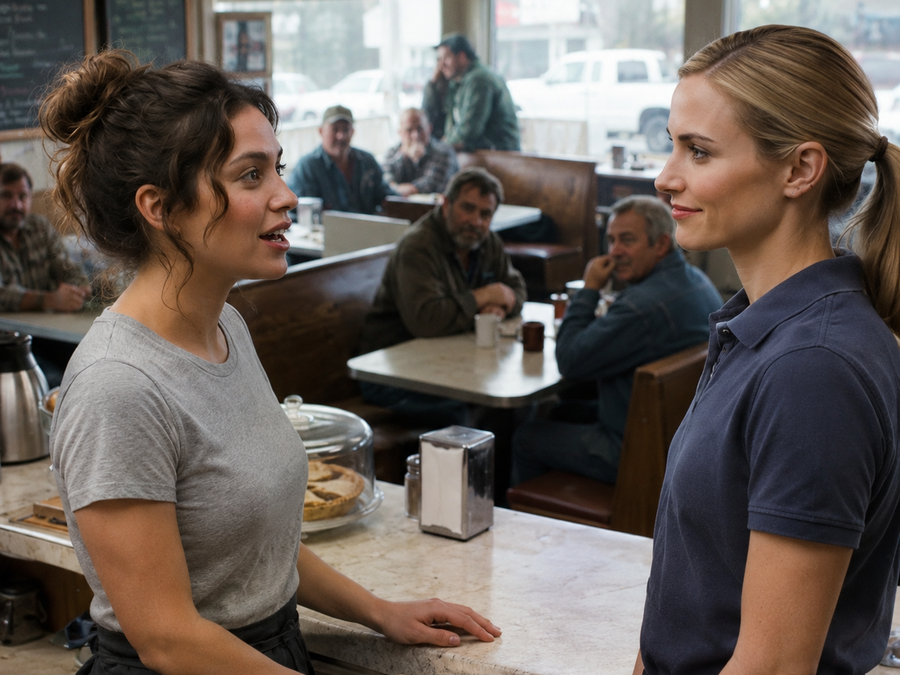
“I Don’t Look for Trouble, But I Don’t Run From It Either.” A Spoiled Bully Spits on a Quiet Diner Waitress—Unaware She Spent Ten Years as a Navy SEAL Commander Who Once Saved His Own Father’s Life.
“You threatening me?”
The whole diner had gone dead silent.
A twenty-four-year-old kid stood there, water glass in hand, grinning at his friends.
In front of forty people, he had just spit into the tray a waitress was carrying under her arm.
She didn’t cry.
She didn’t shout.
She set the tray down, wiped it clean with a rag, and looked him straight in the eye.
“I don’t look for trouble,” she said.
“But I don’t run from it either when it comes looking for me.”
Nobody in that town knew who she was.
They didn’t know why she never sat with her back to the door.
They didn’t know why her hands moved so fast.
They had no idea that for ten years, this quiet waitress in a small Ohio diner had been a United States Navy SEAL commander.
And they were about to find out.
There is a kind of silence that people mistake for weakness.
You have seen it before.
Maybe you have lived it.
A person gets talked down to, gets laughed at, gets pushed a little too far, and instead of shouting back, they just go quiet.
Most folks read that silence as surrender.
But sometimes that silence is something else entirely.
Sometimes it is a person who has already survived worse things than a room full of laughing strangers.
Sometimes it is a person who learned a long time ago that the loudest voice in the room is rarely the strongest one. This is a story about a woman like that.
Her name was Kate Sullivan. For three weeks, the town of Mill Haven, Ohio, knew her only as the new waitress at a diner called the Rusty Spoon.
They didn’t know where she came from.
They didn’t know why her hands moved so fast or why she never sat with her back to the door.
They had no idea that ten years of her life had been spent doing things most people only see in movies. They were about to find out.
But before they did, they were going to make a mistake—the kind of mistake a lot of people make when they judge someone by how quiet they are, instead of asking why.
Mill Haven wasn’t the kind of town that made the news.
It had one high school, one Baptist church older than most of its members, and one diner that had been serving the same coffee since 1974. The Rusty Spoon sat on Route 9, right where the road bent past the old grain silo.
Its sign had lost the letter U a long time ago. Nobody ever fixed it.
Folks just learned to read around the gap. Inside, the booths were red vinyl, cracked at the corners.
The coffee was strong. The pie was better.
And every morning at exactly 6:15, the bell over the door rang for the first regular of the day. That regular was Walt Higgins, seventy-four years old, retired, a widower for six years now.
Walt came in every single morning, rain or shine, and sat at the same corner booth, the one with a clear view of the door.
Old habits, he liked to say, didn’t leave a man easy.
He always ordered the same thing: two eggs over easy, wheat toast, black coffee, no sugar.
And for three weeks now, he had noticed something about the new waitress.
She always brought his coffee before he asked for a refill.
She always set his fork on the left because she’d noticed somehow, without him saying a word, that he was left-handed.
And she always stood with her back to the wall.
Never to the door. Never with her back exposed to the room.
Walt hadn’t said anything about it.
Not yet, but he noticed. Men who had served noticed things like that in other people—sometimes in women too, though it surprised him a little every time.
Kate Sullivan had come to Mill Haven the way a lot of people come to small towns: quietly, without much explanation.
She’d answered a help-wanted ad taped to the diner’s front window.
Dorothy Fenwick, the owner, had hired her on the spot.
“You got steady hands,” Dorothy had said, watching Kate carry four plates up one arm without a wobble.
“That’s rare these days.”
Kate just smiled and said, “Thank you, ma’am.”
She didn’t mention that steady hands were the least of what she carried with her.
She was thirty-four years old.
Blonde hair always pulled back tight, a quiet voice that never rose no matter what was happening around her. She rented a small room above the hardware store two blocks from the diner.
She kept it clean, kept it simple: a bed, a dresser, one chair by the window, and a wooden box tucked at the very back of the closet that she had not opened in longer than she wanted to admit. Most days, Kate arrived at the diner forty minutes before her shift started.
She’d sit in her car in the parking lot, engine off, and just watch the road for a while, watch who came, who went.
It wasn’t nerves.
It wasn’t fear.
It was a habit built over ten years in places far from Ohio.
A habit of knowing your surroundings before your surroundings knew you.
Some habits stay with a person long after the reason for them is gone.
Walt wasn’t the only one carrying a few of those.
Dorothy Fenwick was sixty-eight years old, and she had run the Rusty Spoon for thirty-one of those years. Her husband had built the counter with his own two hands back when gas was fifty cents a gallon and the mill down the road still employed half the town.
He’d passed eight years ago—heart attack right there in the kitchen, spatula still in his hand.
Dorothy kept the diner going because it was the only piece of him she had left.
She was a small woman with silver hair she wore in a braid and reading glasses that hung from a beaded chain around her neck.
She didn’t talk much about her own troubles.
She was the sort who asked everyone else how they were doing and never quite answered when they asked her back.
But lately there were troubles, and they were getting hard to hide. The bank note on the diner had come due for renewal, and the man holding that note was named Randall Grant.
Randall owned the biggest bank in three counties and half the land Mill Haven sat on besides. He was polite.
Always polite. That was the thing about men like Randall.
They never raised their voice either.
They didn’t need to.
Their voice was already written into the fine print of every loan in town.
Dorothy hadn’t told Kate about any of this.
She hadn’t told Maria, the other waitress, either.
She just smiled through her shifts, same as always, and hoped a solution would show up before the deadline did.
She had thirty days.
Thirty days before the note came due and Randall Grant decided whether Dorothy Fenwick kept her diner or lost it. The other waitress at the Rusty Spoon was named Maria Delaney.
Maria was thirty-one, married to a man who worked at the auto parts plant two towns over, and mother to a grown stepson who’d moved out west for work.
She’d waited tables at the diner for nine years now, long enough to know every regular by name, and long enough to know exactly which customers tipped well and which ones didn’t.
She liked Kate from the very first shift they worked together.
Not because Kate talked much—she didn’t—but because Kate noticed things.
She noticed when Maria’s feet were hurting before Maria said a word about it and quietly took two extra tables off her hands.
She noticed when the coffee maker was running low before the light even blinked.
“You’re a good one to work next to,” Maria told her that first week.
“Most people you got to ask twice for help.
You just show up.”
Kate had just smiled and said she liked being useful.
It was true as far as it went.
It just wasn’t the whole truth.
Being useful was the only thing Kate really trusted about herself anymore.
It was simple.
It didn’t ask questions about the past.
It just asked quietly, every single day, Can you help the person in front of you right now with what’s in your hands?
Most days, the answer was yes.
Let’s go back to the morning that changed everything.
It was a Tuesday. Ohio Tuesdays in October look a certain way: gray sky, the kind that threatens rain and never quite delivers it; wet leaves stuck to the sidewalk outside the diner window.
The place was maybe half full that morning.
A few farmers finishing up before the day’s work.
A long-haul trucker passing through, hunched over his coffee like it was the only thing keeping him upright. Walt in his corner booth, working on his second cup.
Kate moved through her section with the same steady rhythm she always kept.
Refill here, plate there.
A kind word for the trucker who looked like he hadn’t slept properly in two days.
Then the bell over the door rang hard, like it had been shoved rather than opened, and Tyler Grant walked in.
Tyler was twenty-four, Randall Grant’s only son.
He had his father’s jawline and none of his father’s patience.
He’d played football at the local college for two years before a knee injury ended that dream, and ever since, he seemed to be looking for something to prove.
He walked into the Rusty Spoon that morning with three of his friends, still wearing their game-day jerseys from the night before, still riding the high of a win against the next county over.
They were loud. Not dangerous loud, just careless loud—loud in a way that only comes from young men who have never once been told no and made it stick.
They slid into the big booth by the window, the one meant for six, and immediately started rearranging the table like they owned it.
“Hey, sweetheart,” Tyler called out, not even looking up from his phone.
“We need four coffees and whatever the special is.”
Kate walked over, order pad in hand.
“Morning,” she said, even voice, polite.
“Four coffees coming up.
Special today is the biscuits and gravy.”
“Didn’t ask what it was,” Tyler said.
“Asked for it.”
His friends laughed.
Not because it was funny, but because Tyler had said it, and Tyler was used to being laughed for, no matter what came out of his mouth.
Kate didn’t flinch.
She wrote it down and walked to the counter.
Dorothy caught her eye from behind the register, and Kate gave her the smallest shake of the head.
It’s fine.
I’ve got it.
Dorothy nodded back, but her shoulders stayed tight. She knew exactly whose son had just walked through her door.
The coffee came out first. Kate set the four mugs down carefully, one at a time.
No spills, no clatter.
Tyler waited until she set his mug down, then reached over and nudged it just slightly so a little coffee sloshed over the rim and onto the table.
“Careful,” he said, grinning at his friends.
“Don’t want you burning anybody.
Might be above your pay grade.”
More laughter. Kate reached for a rag, wiped the spill without a word, and turned back toward the counter.
“Hey,” Tyler said, louder this time.
“I wasn’t done talking to you.”
Kate turned back around.
She looked at him, steady, unbothered.
“What can I get you, sir?”
“Sir,” Tyler repeated the word like it tasted funny in his mouth.
“That’s cute.
You new around here?
Nobody around here talks like that.”
“I’m new,” Kate said simply.
“No name tag either.
What’s your name, new girl?”
“Kate.”
“Kate what?”
“Just Kate,” she said.
And there was nothing rude in how she said it—just a quiet line drawn plain and simple.
Tyler’s grin faded just a touch, replaced by something colder.
He didn’t like being told no.
Even a small no wrapped in politeness still landed like a no.
“Whatever,” he muttered.
“Get us the biscuits.
All four.”
Kate nodded and walked away.
At his corner booth, Walt Higgins had gone very still, watching over the rim of his coffee cup.
He’d seen young men like Tyler before, plenty of them over seventy-four years of living.
What he was watching for now wasn’t Tyler.
It was Kate.
The way she’d turned, the way her weight had shifted onto the balls of her feet just for a second before she answered him, the way her eyes had flicked quick as a blink toward the exits before settling back on Tyler’s face.
That wasn’t a nervous habit.
Walt knew nervous habits.
He’d watched plenty of young waitresses get rattled by rude customers over the years.
This was something else: a readiness, the kind a person carries after learning the hard way that trouble rarely announces itself before it arrives. The biscuits and gravy came out twelve minutes later.
Kate set the plates down in front of each of the four young men, careful and quick, the way she always worked. Tyler picked up his fork, poked at the gravy, and made a face.
“This is cold,” he announced, loud enough for half the diner to hear.
It wasn’t cold.
Steam was still rising off the plate, but that didn’t matter.
“I’m sorry to hear that,” Kate said.
“I can have the kitchen remake it.”
“Don’t want it remade.
I want a refund.”
“I’ll get Dorothy for you.”
“I don’t want Dorothy.
I want you to admit you brought me cold food.”
Kate looked at him for a moment.
Just a moment—long enough that one of Tyler’s friends shifted uncomfortably in his seat, sensing something in the air that he couldn’t quite name.
“The food isn’t cold,” Kate said, even voice.
No anger in it, just fact.
“But I’m happy to bring you something else.”
Tyler’s face went red.
Maybe it was the two beers he’d already had at ten o’clock in the morning, tucked into a coffee mug from his truck.
Maybe it was the knee that still ached when it rained, reminding him every single day of the football career he never got to finish. Maybe it was just that he was twenty-four years old and had never once been told no by someone with less money than him, and it made something ugly rise up in his chest.
Whatever it was, Tyler Grant stood up out of the booth, picked up his fork, and flicked a piece of biscuit across the table at Kate’s apron.
His friends laughed, though two of them laughed a little less than the others.
“Oops,” Tyler said.
“Guess you should have brought it hot.”
Kate didn’t move.
Didn’t wipe at the crumbs stuck to her apron.
She just looked at him.
“Anything else I can get you?”
The calm in her voice seemed to make Tyler angrier, not less angry, like her steadiness was somehow an insult all its own.
He picked up his water glass, and in front of the whole diner—in front of Walt Higgins in his corner booth, in front of Dorothy standing frozen behind the register, in front of the trucker who’d stopped chewing mid-bite—Tyler Grant spit into the empty tray Kate was carrying under her arm.
The room went dead silent. Even his own friends stopped laughing.
For three whole seconds, nobody in the Rusty Spoon moved.
Here’s the thing about moments like that one.
They only last a few seconds, but they tell you everything you need to know about the people inside them.
They tell you who has power and who’s been taught to fear it.
They tell you who stays silent because they’re scared and who stays silent because they’ve already decided how the story ends.
Dorothy’s hand had gone to her mouth.
Maria, coming out of the kitchen with a tray of pancakes, froze in the doorway.
Walt Higgins set his coffee cup down without a sound and watched.
Kate stood there for a moment, tray under her arm, Tyler’s spit sitting in it, his three friends staring at their own hands like the floor had suddenly become very interesting.
She didn’t cry.
She didn’t shout.
She set the tray down on the counter, slow and deliberate, wiped it clean with a rag, and looked at Tyler Grant.
“I don’t look for trouble,” Kate said.
Her voice was quiet, but it carried clear across the whole diner.
“But I don’t run from it either when it comes looking for me.”
Tyler blinked.
Whatever reaction he had expected, that wasn’t it.
“You threatening me?”
he said, trying to laugh it off, though the laugh came out thin.
“No,” Kate said.
“I’m telling you the truth.
There’s a difference.”
She turned and walked back to the counter, picked up her order pad, and moved on to the next table like nothing had happened at all.
Tyler stood there a second longer, looking foolish in a way he clearly wasn’t used to feeling, then sat back down, muttering something about crazy waitresses under his breath.
His friends didn’t laugh this time.
One of them, a quiet kid named Dale who’d known Tyler since middle school, looked over at his empty coffee mug like he wished he was anywhere else.
For the rest of that morning, the diner buzzed with a nervous energy nobody quite named out loud.
Dorothy came over to Kate at the first free moment, wringing a dish towel in her hands.
“Honey, I am so sorry,” she said.
“You didn’t deserve that.
Nobody deserves that.”
“I’m all right, Dorothy,” Kate said.
“I should have said something.
I should have told him to leave.”
Kate reached out and touched Dorothy’s arm gently.
“You’ve got thirty days hanging over your head right now,” Kate said quietly.
“You don’t need me making it thirty-one.”
Dorothy’s eyes went wide for half a second.
She hadn’t told anyone about the bank, not even Maria.
“How did you—”
“I hear things,” Kate said simply, and went back to clearing table six.
Dorothy stood there a moment, watching her go, wondering exactly what sort of woman she had hired. Outside in the parking lot, Dale Whitmore sat behind the wheel of his truck for a good five minutes before he started the engine.
Dale had known Tyler Grant since the third grade. They had grown up two streets apart, played pee-wee football together, gone to homecoming dances together with girls who were now married to other men.
He’d laughed along with Tyler plenty of times over the years.
It was just what you did when Tyler got going. Easier to laugh than to be the one he turned on next.
PART 2
But something about this morning sat wrong in his stomach, heavier than the biscuits and gravy he hadn’t finished eating.
He kept seeing it: the way that waitress had just stood there, tray in hand, and looked at Tyler like he was a kid throwing a tantrum instead of a grown man in a diner.
He kept hearing her voice.
I don’t look for trouble, but I don’t run from it either.
Dale’s own father had said something close to that to him once, a long time ago, back when Dale was maybe twelve and scared of a bigger kid at school.
He hadn’t thought about that conversation in years.
He didn’t say anything to Tyler about it.
Didn’t bring it up when Tyler laughed the whole thing off in the truck, calling Kate a crazy chick who needed to lighten up.
But Dale drove home a different way that morning, taking the long route past the church, thinking about the sort of man he wanted to be when he was thirty, or forty, or seventy-four years old, like that quiet man in the corner booth who never seemed to need anybody’s laughter to feel like he mattered.
It wasn’t much—just a truck driving the long way home and a young man sitting quietly with a feeling he didn’t have words for yet.
But sometimes that is exactly how a change in a person starts. Not with a speech, not with an apology, just a small, uncomfortable feeling that refuses to go away, sitting in the passenger seat where the laughter used to be.
Maria caught up with Kate in the kitchen during the lull before lunch.
“You okay?”
Maria asked, low so the cooks wouldn’t hear.
“I’m fine.”
“He spit in your tray, Kate.
In front of everybody.
And you just wiped it off and kept working?”
Kate shrugged, stacking clean mugs onto a tray.
“What was I supposed to do?
Throw a plate at him?
Lose my job over a boy who’s mad his knee doesn’t work anymore?”
Maria studied her for a second.
“You’re different,” she said, not unkindly.
“Most people, somebody does that to them, they either fall apart or they blow up.
You didn’t do either.”
Kate looked at her, and for just a moment something old and tired moved behind her eyes.
“I learned a long time ago,” Kate said, “that the people who fall apart in public are usually the ones who never had anyone teach them how to hold still.”
“And you had someone teach you that?”
“I had a lot of people teach me that,” Kate said.
“Some of them aren’t around anymore to be thanked for it.”
She picked up the tray of mugs and walked back out to the floor before Maria could ask what that meant.
Maria stood there a moment, arms crossed, watching the swinging door settle back into place.
She’d worked plenty of shifts beside plenty of people in nine years.
She thought she’d gotten good at reading them, at knowing who was hiding what and how much.
Kate Sullivan, she was starting to realize, might take a good deal longer to read than most.
That evening, driving home, Maria found herself telling her husband about it over dinner, turning the words over slowly, still trying to make sense of them.
“She just wiped it off,” Maria said, “like it didn’t cost her anything at all.
I don’t know if that’s the strongest thing I’ve ever seen or the saddest.”
Her husband, a practical man who didn’t much care for mysteries, shrugged and said, “Maybe it was both.”
Maria thought about that answer for the rest of the night.
Maybe it was both. Maybe a person could be strong enough to hold their composure in front of a room full of strangers and still be carrying something heavy enough to bend a weaker person clean in half.
She didn’t know Kate’s story yet.
Nobody in Mill Haven did.
But she found herself hoping, driving home under that same gray October sky, that whatever Kate Sullivan had survived to become this calm, this steady, hadn’t cost her everything on the way.
Around noon, an elderly woman named Ruth Callaway came in alone, like she did most Tuesdays, and sat at her usual two-top by the window. Ruth was eighty-one.
Her husband had passed the winter before, and everyone in Mill Haven had watched her shrink a little smaller every month since, the way people sometimes do when the person they built their whole life around is suddenly gone.
She ordered the same thing every time: a cup of tomato soup and a grilled cheese cut in triangles, the way her husband used to cut it for her.
Kate had learned that detail during her first week from Dorothy, and never once needed to be told it again.
“Triangles today, Mrs.Callaway?”
Kate asked, setting down her water glass.
Ruth’s eyes softened.
“You remembered?”
“Of course I did.”
“Most young people don’t have the patience for old women who order the same thing every week.”
Kate crouched down slightly so she was eye level with Ruth instead of standing over her.
“I don’t think it’s about patience, ma’am,” Kate said.
“I think some things are worth keeping the same even after everything else changes.
Especially after everything else changes.”
Ruth looked at her for a long moment, like she was seeing something she hadn’t expected to find in a diner on a Tuesday.
“You lost someone, too,” Ruth said.
It wasn’t really a question.
Kate didn’t answer right away.
“A long time ago,” she finally said.
“Does it get easier?”
“No, ma’am,” Kate said honestly.
“But you get stronger around it.
Eventually, it stops feeling like it’s going to break you every single day.
It just becomes something you carry, like a stone in your pocket.
Heavy, but yours.”
Ruth reached out and patted Kate’s hand, the way you’d comfort someone half your age who had somehow, impossibly, understood something it took most people eighty years to learn.
“Bring me my soup, sweetheart,” Ruth said, her voice a little thick.
“And thank you.”
Kate walked back toward the kitchen, and if her eyes were a little brighter than usual, nobody at the counter was rude enough to mention it.
That was the thing about Kate Sullivan that Mill Haven hadn’t figured out yet.
She wasn’t just quiet because she was hiding something.
She was quiet because she had learned the hard way that real comfort rarely comes from a lot of words.
It comes from showing up, from remembering the triangles, from sitting with somebody’s grief instead of rushing past it.
It was a small thing, cutting a sandwich a certain way, but small things done with real attention could be the whole difference between a person feeling invisible and a person feeling seen.
Walt Higgins stayed at the diner longer than usual that day.
He watched Kate work through the lunch rush.
Watched her navigate around Tyler’s table without a flicker of tension in her shoulders.
Watched her make an elderly couple at table four laugh out loud with nothing more than an easy joke about the weather.
He watched all of it, and the more he watched, the more certain he became of something he couldn’t quite name yet.
Around one o’clock in the afternoon, when the lunch rush thinned out and Kate came by with the coffee pot, Walt finally spoke up.
“You catch a falling stack of plates like that in the service, or somewhere else?”
he asked.
Kate’s hand paused just barely above his cup.
“Sir?”
“Earlier, before that boy came in, you caught four plates sliding off a tray with one hand without even looking at them.
Most people, they’d have dropped the whole lot.
You didn’t even blink.”
Kate poured his coffee, slow and even.
“Lucky reflexes, I guess,” she said.
Walt studied her face for a long moment.
Seventy-four years of reading people had taught him a thing or two about which answers were true and which were just polite.
“I served two tours myself,” Walt said quietly.
“Long time ago now.
You get so you can spot certain things in people. The way they stand with their back to a wall.
The way they scan a room before they sit down in it.”
Kate’s expression didn’t change, but something behind her eyes went very still.
“That’s a generous thing to notice about a person, Mr.Higgins,” she said.
“Most folks don’t notice things like that anymore.”
“Most folks don’t have a reason to,” Walt said.
“I think you might.”
Kate held his gaze for a moment.
There was no fear in it, but there was something else: a careful weighing, the look of a person deciding how much truth a moment could hold.
“Enjoy your coffee, sir,” she finally said, and walked away.
Walt watched her go, and for the first time in a long while, he found himself genuinely curious about another human being.
He didn’t push it further.
Whatever this woman was carrying, he sensed it wasn’t his place to pry it open with questions in the middle of a diner.
But he made a decision right there in that corner booth to keep his eyes open. Some things, once noticed, refused to be unnoticed again.
That evening, after her shift ended, Kate walked the two blocks back to her room above the hardware store. The October air had turned properly cold, the kind that gets into your knuckles and stays there.
She let herself in, locked the door—same as she always did, twice—and stood for a long moment with her back against it.
Somewhere out in Mill Haven, Tyler Grant was probably telling the story of his morning to anyone who’d listen, twisting it into something where he came out looking clever instead of cruel.
Somewhere else, Dorothy Fenwick was probably lying awake doing math in her head that never quite added up to enough.
And here, in this small room with its one chair by the window, Kate Sullivan sat down on the edge of her bed and let out a breath she felt like she’d been holding all day.
She hadn’t been afraid of Tyler Grant.
Not for one second.
What she’d felt standing there with his spit in her tray wasn’t fear.
It was memory.
It was the flash of every time in her old life when someone with more power than sense had tried to make her feel small and failed—because she had already survived things that made a spoiled kid’s cruelty look like a summer breeze passing through.
She got up, crossed the room, and opened the closet door.
At the very back, behind a row of plain work shirts, sat a wooden box.
Plain pine, no carvings, the kind you might keep old letters in.
She hadn’t opened it in almost two years.
She carried it to the bed and sat down, running her thumb along the edge of the lid for a long moment before she finally lifted it.
Inside was a dive watch, its strap worn soft with use, the glass face scratched, but still ticking, keeping perfect time even now.
Beneath the watch was a folded photograph, edges gone soft from handling, of a group of people in uniform, squinting into bright sunlight somewhere that wasn’t Ohio.
And beneath the photograph, wrapped in a plain handkerchief, was something small and heavy that she didn’t take out: a medal, one she had never worn, one she had, in fact, refused to accept all those years ago, though the Navy had tried three times to make her take it.
She sat there for a long while, the box open on her lap, the watch ticking softly in her palm.
She thought about the young man who used to wear that watch before her, and about the promise she’d made to herself the day she finally took it off his wrist and put it on her own.
A promise to live a plain, quiet life, to stop being someone people needed to save them and just be someone who served coffee and left the past exactly where it belonged.
Some days that promise was easy to keep.
Today, with a stranger’s spit still faintly staining the memory of her tray, it had been harder.
She closed the box, set it back in the closet, and told herself the same thing she told herself most nights: Tomorrow will be quieter.
She had no idea, sitting there in that small, cold room, just how wrong she was about to be.
Two days later, Randall Grant walked into the Rusty Spoon at nine in the morning, wearing a gray suit that cost more than most of the diner’s monthly earnings.
He sat down across from Dorothy Fenwick in her small back office, closing the door gently behind him.
“Dorothy,” he said in the warm, easy voice he used on everyone—the voice that had convinced half the town to sign papers they didn’t fully understand.
“I’ve been thinking about you.
About this place.”
“That’s kind of you, Randall,” Dorothy said carefully.
“I know things have been tight.
Everybody knows it.
Foot traffic’s down since the highway bypass went in.
I’m not blind to it.”
“We’re managing.”
Randall folded his hands on the small desk between them.
“Dorothy, I like you.
I always have.
Your husband and I did business for twenty years, God rest him.
That’s why I wanted to come to you myself instead of sending a letter.”
Dorothy felt her stomach tighten.
“A letter about what?”
“The note on this building comes due in thirty days,” Randall said gently.
“Now, I could renew it.
I could also call it if the bank’s numbers say I have to.
I’d rather not do that to you.”
“What are you saying, Randall?”
“I’m saying,” Randall said, leaning forward slightly, “that I’d be willing to buy this place from you.
Fair price.
More than fair, given the market. You could retire with dignity, Dorothy.
No more worrying about payroll.
No more worrying about the roof or the walk-in cooler that keeps acting up.”
“This diner was my husband’s whole life,” Dorothy said quietly.
“It’s the only thing of his I’ve got left.”
“I understand that.
I do.”
Randall’s voice stayed soft, patient, the voice of a man who had never once needed to raise it to get what he wanted.
“But sentiment doesn’t pay a bank note, Dorothy.
And I’d hate to see this place end up in foreclosure, sold at auction for pennies, when I could offer you something respectable right now.”
Dorothy sat very still, her hands folded tight in her lap.
“I need some time to think,” she said.
“Of course.
Take all the time you need.”
Randall stood, buttoning his suit jacket.
“You’ve got thirty days.
I’d just hate for that clock to run out while you’re still thinking.”
He left with the same easy smile he’d walked in with, the bell over the door ringing softly behind him.
Dorothy sat alone in her office for a long time after that, staring at a calendar on the wall where she had, in pencil, circled a date thirty days out. Out on the floor, Kate had been refilling napkin dispensers near the office door when Randall walked out.
She hadn’t meant to hear anything, but the office walls at the Rusty Spoon were thin, built in an era when nobody expected to need much privacy.
She’d caught enough: thirty days, a note coming due, a buyer circling like he already owned the place.
She’d seen men like Randall Grant before, in other places, wearing other suits, offering other people fair prices for things that were never really for sale.
Men who used patience the way other men used force.
Men who understood that if you waited long enough and squeezed just gently enough, most people would hand you what you wanted and thank you for the opportunity. Kate finished the napkin dispensers and moved on without a word.
But something in her had shifted, quiet and small, the way a compass needle shifts when it finds true north.
She had come to Mill Haven to disappear, to live small and plain and unremarkable, and let an old life stay buried where she’d buried it.
She hadn’t planned on caring about an old woman’s diner, or a bully with a bad knee and a worse temper, or a banker whose smile never quite reached his eyes, but she found, standing there with a fresh stack of napkins in her hands, that she cared anyway.
That was the trouble with people who had once sworn an oath to protect things.
Some part of that oath never really leaves you, no matter how many miles or years you put between yourself and the person who swore it. That afternoon, Walt Higgins came in for his usual second visit, a habit he had only started in the last three weeks, ever since a certain new waitress had started working the floor.
He watched Kate move through her shift, quiet as ever, steady as ever, and he thought about the faint tan line he’d glimpsed once on her wrist, quickly covered by her sleeve, shaped like something that used to sit there every day for years.
He thought about the way she’d looked at Tyler Grant two days ago—not with fear, but with something closer to patience.
The sort of patience a person only carries when they know deep down that they could end a fight in about four seconds flat, but have decided for reasons of their own not to.
He didn’t say anything to her that day.
He just left his usual tip, a little more generous than usual, and told her to take care of herself.
“You too, Mr.Higgins,” Kate said, and meant it.
Walt walked home that evening under a gray Ohio sky, past the old grain silo, past the church, past the bank with Randall Grant’s name carved into its cornerstone.
And he found himself thinking, for the first time in longer than he could remember, that something was about to happen in this town—something bigger than a rude young man and a spilled cup of coffee.
He didn’t know what it was yet, but seventy-four years in this town had taught him to trust a feeling like that.
Some people carry storms without ever raising their voice, and every storm, sooner or later, finds its reason to break.
The rest of that week passed the way most weeks in Mill Haven passed: slow, familiar, easy to overlook.
Tyler Grant didn’t come back into the diner right away.
Word had gotten around town about what happened, twisted into three or four different versions, depending on who was telling it. In one version, Kate had threatened to call the police on him.
In another, she’d nearly gotten herself fired for talking back to Randall Grant’s boy.
PART 3
In a third version, told mostly by old men at the barbershop, she’d stood there and taken it without so much as blinking, and that quiet had rattled Tyler worse than any shouting match could have.
That third version happened to be the true one.
But in a small town, the truth rarely travels as fast as the story people would rather believe.
Dorothy didn’t sleep well that week.
Kate could tell by the way she moved a little slower behind the register, by the extra cups of coffee she poured for herself and never quite finished.
On Thursday evening, after closing, Kate found her sitting alone at the counter, the calendar from her office open in front of her, that pencil circle around the thirtieth day staring back at her like a verdict.
“You should go on home, Dorothy,” Kate said gently, wiping down the counter beside her.
“In a minute.”
Dorothy didn’t look up.
“You ever run a business, Kate?”
“No, ma’am.”
“It’s a strange thing.
You pour your whole life into a place.
Every wall, every chair, every dollar you ever earned, and then one day some man in a suit tells you it was never really yours to keep, just yours to borrow until the bank decided otherwise.”
Kate set down her rag and leaned against the counter facing her.
“For what it’s worth,” Kate said, “I don’t think this place is just walls and chairs to anybody who’s ever sat in it.”
Dorothy looked up at her then, eyes tired but sharp.
“What do you mean?”
“I mean Ruth Callaway comes here every Tuesday because somebody remembers how her husband used to cut her sandwich.
I mean Walt Higgins has sat in that same booth every morning for who knows how many years because it’s the one place in town that never changes on him.
I mean this diner isn’t just a building with a loan on it, Dorothy.
It’s the only room in Mill Haven where old grief gets to sit quietly at a table and be fed something warm.”
Dorothy’s eyes filled, and she didn’t bother hiding it.
“That’s a kind thing to say.”
“It’s not kindness,” Kate said.
“It’s just true.
Randall Grant sees a bank note.
Everybody else in this town sees the only place they’ve got left where somebody remembers their name and their order and the small details that make a person feel like they still matter.”
“You talk like somebody who’s had to hold a place like that together before,” Dorothy said quietly.
Kate didn’t answer right away.
She picked her rag back up, folded it neatly, set it by the sink.
“I’ve held a lot of things together before,” she finally said.
“People mostly.
A diner might actually be easier.”
Dorothy managed a small, tired laugh at that, the first real laugh she’d had all week.
“Go on home, Kate,” she said.
“Thank you for staying late.”
“Anytime.”
Kate walked out into the cold evening air, the bell over the door ringing softly behind her, same as it did for everyone who came and went from that place.
She took the long way home that night, past the church, past the darkened windows of the barbershop, the streetlights buzzing faintly overhead.
She thought about Ruth Callaway’s stone in her pocket, about Dorothy’s calendar and the pencil circle growing darker with every passing day, about a young man named Tyler Grant who had never once in his life been told no in a way that stuck.
She thought, too, about the wooden box back in her closet and the promise sealed inside it.
She didn’t know yet how much that thirty-day countdown was about to collide with her own carefully buried past.
She didn’t know that a wooden box in the back of her closet and a banker’s fine-print handshake deal were about to end up tangled together in ways nobody in Mill Haven could have predicted.
She only knew, walking home under a sky gone the color of an old bruise, that something in her had woken back up—something that had been sleeping since the day she’d taken off a dead man’s watch and promised herself a plain, quiet life.
Some promises are easy to keep, right up until the moment the world asks you to break them for somebody who needs you more. The days after that Tuesday morning passed with a strange sort of quiet.
Tyler didn’t come back to the diner right away.
But quiet in a small town rarely means peace. It usually just means people are talking somewhere else.
And in Mill Haven, they were. At the barbershop on Cedar Street, old men traded versions of the story while Earl the barber trimmed their hair the same way he had for thirty years.
At the church potluck that Sunday, a few of the younger wives whispered about the new waitress who’d stood up to Randall Grant’s boy without raising her voice.
And at the Grant house, out past the county line in a home with more square footage than half the town combined, Randall sat across the dinner table from his son and listened to a very different version of events.
“She humiliated me,” Tyler said, cutting into his steak harder than necessary.
“In front of the guys.
In front of half the diner.”
“You told me she spit food on you,” Randall said evenly.
“Not the other way around.”
“That’s not the point, Dad.
The point is she talked back like she owns the place, like some no-name waitress gets to lecture me.”
Randall studied his son for a long moment.
He loved that boy more than anything else on this earth, but he wasn’t blind to what twenty-four years of comfort had built inside him.
Still, blood was blood.
“You embarrassed yourself, Tyler,” Randall said, not unkindly.
“But if it bothers you that much, there are quieter ways to handle it than causing a scene in a diner.”
Tyler looked up.
“What’s that supposed to mean?”
Randall set down his fork.
“It means that diner is going to belong to me in about a month, one way or another.
Dorothy’s in over her head.
She’s got no path to renew that note, and everybody with a set of eyes can see her business dropping every quarter since the highway went in.
So,” Randall said, “there’s no need for you to lose sleep over some waitress.
In thirty days, none of this will matter.
You won’t have to see her again unless you want to.”
Tyler chewed on that for a moment, something calculating moving behind his eyes.
“Unless the diner starts losing customers faster,” he said slowly.
“Unless people stop wanting to eat there at all.”
Randall didn’t answer right away.
He didn’t say yes, exactly.
But he didn’t say no either.
And in a house like the Grant house, silence from a father often worked better than permission ever could.
The countdown Dorothy Fenwick carried in her chest ticked forward the same way it did for anyone waiting on bad news.
Thirty days, then twenty-six, then twenty-three.
She kept the calendar in her office, the pencil circle around the deadline growing darker every time she traced over it, a nervous habit she couldn’t seem to break.
She hadn’t found a way out yet.
She had called two other banks in the county, hoping for a way to refinance, but small-town banks talk to each other more than people like to admit. And word travels fast when a man like Randall Grant has an interest in how a conversation goes.
Kate noticed the toll it was taking.
She noticed everything about Dorothy lately, the same way she used to notice everything about the people she once commanded—the small signs that told you someone was running low on whatever kept them standing upright. Dorothy was sleeping less, eating less, smiling the same amount, but it cost her more to do it now.
There was a night about a week into the countdown when Kate stayed behind after close and found Dorothy standing at the walk-in cooler, staring at nothing in particular, a clipboard hanging loose in one hand.
“You all right?”
Kate asked.
“Just doing inventory,” Dorothy said, though the clipboard was blank.
“Dorothy.”
Dorothy set the clipboard down on a shelf and pressed both hands flat against the cold metal door of the cooler like she needed something solid to hold onto.
“Thirty-one years,” she said quietly.
“I’ve never once missed a payment on this place.
Not one in thirty-one years.
And now some man in a suit gets to decide whether all of that mattered.”
“It mattered,” Kate said.
“It still does.”
“Tell that to the bank ledger.”
Kate didn’t have an answer for that—not one that would fix anything overnight.
So she just stood there with her, quiet, letting the silence be a kind of company instead of trying to talk her way out of it.
After a while, Dorothy let out a long breath and managed a small, tired smile.
“Listen to me,” she said, “complaining to my own waitress like she’s got nothing better to worry about.”
“I don’t mind,” Kate said.
“Everybody needs somebody to stand next to a cooler with sometimes.”
Dorothy huffed out something close to a laugh, the first one in days.
Kate didn’t say much about any of it out loud.
She just started coming in fifteen minutes earlier to help with prep before opening and staying fifteen minutes later to help close—small things, the sort of things a person does when they can’t fix the big problem, but refuse to let somebody carry it alone.
Around the second week of the countdown, something shifted at the diner. Not all at once, just a little at a time.
A handful of regulars stopped coming in on Tuesdays and Thursdays, the days Tyler and his friends used to show up after their intramural games. At first, Dorothy thought it was coincidence.
Then Maria mentioned overhearing two younger women at the register whispering about something they’d seen online.
“You seen the reviews?”
Maria asked Kate quietly during a slow stretch on a Wednesday afternoon.
“What reviews?”
Maria pulled out her phone and showed her. Someone using the name Tyler G.
had posted a review of the Rusty Spoon on the town’s community page: one star, complaining about slow service, rude staff, and food that came out cold.
It wasn’t true.
Anyone who ate there regularly knew it wasn’t true.
But three of Tyler’s friends had liked the post, and a few more comments had piled on underneath it from accounts that didn’t look like they belonged to real customers at all.
Dorothy read it standing at the counter, her face going pale.
“This isn’t fair,” she said quietly.
“We’ve never once served this boy cold food.”
“No,” Kate said.
“But fair was never really the plan.”
Dorothy looked at her, startled by the certainty in her voice.
“What do you mean?”
Kate didn’t answer right away.
She was thinking about Randall Grant’s easy smile, the sort men wear when they’ve already decided how a negotiation is going to end, long before the other person realizes there’s a negotiation happening at all.
“I mean,” Kate finally said, “sometimes the fastest way to buy something cheap is to make sure nobody else wants it first.”
Dorothy sat down slowly on the stool behind the register, one hand pressed to her chest.
“You think Randall’s behind this?”
“I think Randall doesn’t have to be behind anything,” Kate said.
“He just has to raise a son who does his dirty work for him and never ask too many questions about how.”
The following Tuesday brought the diner’s regular lunch crowd: the trucker route drivers who stopped through every week, a table of retired schoolteachers who met every month to play cards afterward, and Walt Higgins—same corner booth, same order, same watchful eyes.
It also brought George Petrakis, seventy-nine years old, a widower like Walt, who came in most Tuesdays for a bowl of chicken soup and to complain good-naturedly about his grandchildren never calling enough.
George was mid-sentence, telling Walt about his granddaughter’s new job, when he suddenly stopped talking, made a strange choking sound, and grabbed at his own throat.
For a second, nobody in the diner understood what was happening.
Then his face started to turn red, then a darker shade, and his chair scraped back hard as he tried to stand, both hands clutched at his neck.
“George!”
Walt was on his feet immediately, but seventy-four-year-old knees don’t move the way they used to, and by the time he’d rounded the booth, George had already sunk halfway to the floor.
“Somebody call 911!”
Maria shouted from across the room, already fumbling for her phone.
But an ambulance out here on the edge of the county could take twelve minutes—fifteen on a bad day.
George didn’t have fifteen minutes.
He barely had one.
Kate was already moving before anyone else fully understood what they were looking at. She crossed the diner floor in four long strides, got behind George, and wrapped her arms around his midsection from behind, fist against his abdomen just below the ribs.
“I’ve got you,” she said, voice calm, steady—the same voice she’d used with Tyler Grant, the same voice that didn’t rise no matter what was happening around her.
“Try to relax your shoulders for me.”
She pulled inward and upward in one sharp, controlled motion.
Nothing.
She adjusted her grip half an inch and tried again.
A piece of chicken half the size of a quarter shot out of George’s mouth and skidded across the linoleum floor.
George gasped a huge, ragged breath, then another, color flooding back into his face as Kate eased him gently down into a nearby chair.
“There you go,” Kate said softly, crouching in front of him now, checking his eyes, checking his breathing.
“Nice and slow.
In through your nose.”
George stared at her, wide-eyed, chest heaving.
“You just…
you just saved my life.”
“You’re all right, George,” Kate said.
“Just breathe.”
The whole diner had gone silent, every fork frozen halfway to every mouth, every eye locked on the woman crouched in the middle of the floor with a trembling old man.
It had taken maybe eleven seconds, start to finish—eleven seconds that most people in that room would remember for years. For a moment, nobody moved.
Then the room seemed to exhale all at once, a low murmur breaking out across the tables.
Someone at the counter said, “Oh my Lord,” under their breath.
A young mother two booths down pulled her daughter’s face gently into her shoulder without quite knowing why she felt the need to.
Dorothy came hurrying over from the register, a dish towel still clutched in one hand, her own face nearly as pale as George’s had been a minute before.
“George, honey, are you all right?
Do you need me to call your daughter?”
“I’m fine, Dorothy,” George said, his voice shaky but steadying with every breath.
“I’m fine.
This young lady just about performed a miracle.”
“Wasn’t a miracle,” Kate said, still crouched beside him, checking the color returning to his fingertips.
“Just the Heimlich.
Anybody can learn it.”
“Not like that,” George said.
“Not that fast.”
Maria arrived a moment later with a glass of water, hands trembling slightly as she set it down in front of George.
“The ambulance is on its way,” she said.
“I called as soon as it started.”
“Good,” Kate said.
“Have him sit here till they arrive.
Loosen his collar a little. Keep him talking.
Keep him calm.”
She said it simply, the way a person gives directions to somewhere they’ve walked a thousand times.
No hesitation, no second-guessing. Maria did exactly as she was told, without stopping to wonder why a waitress seemed to know precisely how to manage a medical scene better than most people would after a full semester of training.
That question would come later.
For now, the whole diner was simply grateful the old man sitting in the booth was breathing easy again, a little embarrassed, already trying to wave off the attention the way proud old men often do right after nearly dying in front of a room full of neighbors.
Walt Higgins stood frozen by the booth, one hand still braced on the table, watching Kate check George’s pulse at his wrist with two fingers, counting silently, her lips moving just slightly as she kept time.
He had seen medics work before, real ones, men and women trained to move fast when a second mattered more than anything else in the world.
What he’d just watched wasn’t luck.
It wasn’t a lifeguard course from high school or a first-aid class taken once and half forgotten.
It was muscle memory, the sort that only comes from doing something so many times under real pressure that your hands know what to do before your mind finishes deciding.
“You’ve done that before,” Walt said quietly, once George was settled and sipping water, insisting he was fine and didn’t need the ambulance Maria had already called anyway.
Kate straightened up, wiping her hands on her apron.
“Everybody should know the Heimlich, Mr.Higgins,” she said.
“It’s not complicated.”
“That wasn’t complicated,” Walt agreed.
“But it also wasn’t the first time you’ve had somebody’s life in your hands.
I’ve seen plenty of people panic in an emergency.
I’ve seen a few keep their head.
You didn’t just keep your head, Kate.
You looked like you were somewhere else for a second.
Somewhere you’d been before.”
Kate met his eyes, and for just a moment, something honest passed between them. Unspoken.
Understood.
“Some places leave marks on you,” she said quietly.
“Even after you leave them behind.”
Walt nodded slowly, like a man confirming something he’d already suspected for weeks.
He didn’t push further.
He never did.
But he sat back down in his booth that day, and for the first time he found himself wondering not just what Kate Sullivan had done in her life before Mill Haven, but what she might have lost along the way to learn it.
The ambulance arrived nine minutes later, checked George over, and cleared him to stay put with instructions to see his doctor that week.
Word of what happened moved through Mill Haven faster than any of Tyler’s fake reviews ever could.
By the next morning, half the town had heard some version of the story: the new waitress at the Rusty Spoon saved old George Petrakis’s life.
Just about killed her getting that chicken out, some folks said, though Kate herself would have told you it was closer to eleven seconds and a technique anybody could learn with a weekend course. But there was a difference between what happened and what Mill Haven wanted the story to mean.
To them, it meant something simple and good.
Their new waitress wasn’t just quiet and polite.
She was capable.
She was somebody a small town likes to claim as its own.
PART 4
For three days, business at the Rusty Spoon picked up in a way it hadn’t in months.
People came in just to meet Kate, to shake her hand, to tell George’s story back to him while he sat in his usual booth, a little more animated than usual, clearly enjoying his brief spell of local fame.
Dorothy watched all of it with something like hope creeping back into her tired eyes.
“Maybe this is it,” she told Kate quietly one evening after close.
“Maybe this is what turns things around before the thirty days run out.”
Kate wanted to believe that too, but ten years of experience had taught her something about good moments in bad situations. Sometimes they were the beginning of a turnaround, and sometimes they were just the calm before somebody who felt threatened decided to hit back harder.
Ruth Callaway came in for her usual Tuesday soup and grilled cheese three days after the George Petrakis incident and found half the diner still talking about it.
“I heard you saved his life,” Ruth said to Kate, settling into her usual two-top by the window.
“Right here on this floor.”
“He’s doing fine now,” Kate said, setting down the water glass.
“Triangles today?”
“Don’t change the subject on me, young lady,” Ruth said, though there was warmth in it.
“I want to hear it from you.
What was that like, having somebody’s whole life in your hands like that?”
Kate paused for a moment, order pad still in hand.
“Heavy,” she finally said.
“Even when it only lasts eleven seconds.
Especially then, maybe.”
Ruth studied her for a long moment, the same way she had that first week, like she was reading something written in a language only she remembered.
“You’ve done that before,” Ruth said quietly.
“More than once, I’d guess.”
“More than once,” Kate agreed.
“And nobody thanks you enough for it, I bet.
Not really.
Not the way it deserves.”
Kate looked at her, something shifting behind her eyes.
“No,” she said.
“Not usually.”
Ruth reached out and patted her hand, the same gesture from weeks before.
“Well, I’m thanking you now,” Ruth said.
“For George, and for whatever else you carried before you ever set foot in Mill Haven.
Whatever it was, it clearly cost you something.
Don’t let anybody in this town make you feel small for it.”
Kate didn’t answer right away.
She simply nodded and went to put in Ruth’s order, feeling, for reasons she couldn’t quite explain to herself, a little more like a whole person than she had in a very long time.
Small towns could be cruel, the way Tyler Grant had proven once already.
But they could also hold you gently if you let them, the way Ruth Callaway just had, without asking for a single detail in return. Kate carried that feeling with her through the rest of the lunch rush, light as it was—the way a person carries the memory of good weather into a week that later turns cold.
She would think of it again more than once in the days that followed, when good weather was in short supply.
The following Thursday afternoon, something happened that would change everything about how Mill Haven saw its new waitress.
It started small: a dropped tray, a moment nobody expected.
Kate was carrying a full tray of drinks to a booth near the window when one of Tyler’s friends, a heavyset young man named Cole Ambrose, still nursing a grudge from the diner incident weeks earlier, stuck his foot out as she passed.
It wasn’t hard to see coming if you knew what to look for.
Kate had spent ten years learning to see things coming.
She shifted her weight at the exact right moment, kept the tray level with one hand, and used her free hand to catch herself lightly against the booth’s edge instead of falling.
Not a single glass tipped over.
Cole, embarrassed at how badly his little prank had failed, reached out and shoved her shoulder hard, trying to finish what his foot had started.
What happened next took less than a second and a half.
Kate’s body reacted before her mind fully caught up—ten years of training answering a threat faster than conscious thought ever could.
She pivoted, caught Cole’s wrist as it came toward her, redirected his own momentum against him, and had him bent slightly forward over the booth, arm locked at an angle that hurt enough to make her point without breaking anything.
She held it for exactly one second. Then she let go, stepped back, and set the tray down on the table, still perfectly level.
Not a drop spilled.
“You all right?”
she asked Cole, voice even, like nothing unusual had just happened at all.
Cole straightened up, red-faced, rubbing his wrist, muttering something about crazy waitresses under his breath—the same insult Tyler had used weeks before, like it was the only insult either of them owned. The whole exchange had taken maybe three seconds.
But a young woman sitting two booths over, filming a video for her friend’s birthday, had caught the entire thing on her phone, angled just right to see the whole motion clearly.
By that evening, the video was everywhere in Mill Haven.
By the next morning, it had made its way into three neighboring counties.
The video itself wasn’t dramatic to look at, not by movie standards.
No punches thrown, no shouting—just a waitress moving with a speed and precision that didn’t belong in a small-town diner.
But something about it captured people’s attention anyway.
Maybe it was the contrast: a quiet, polite woman in an apron moving like that for exactly one second before calmly setting down a tray of drinks like nothing had happened.
The video got shared with a caption that read: Anyone know this waitress?
She just took down a guy in one second flat and didn’t even blink.
Comments poured in fast.
That’s not a normal reflex, one person wrote.
That’s training.
My cousin’s a cop.
He moves like that.
Another comment read: Look how calm she stayed.
That’s not adrenaline.
That’s discipline.
A third comment, from an account with a small blue verification checkmark—a self-described veteran advocacy page with several thousand followers—simply wrote: We know that stance.
We’ve seen it before.
Somebody should ask her where she served. The comment got over a thousand likes within a day.
Walt Higgins watched the video seven times in a row on his grandson’s old tablet, the one his daughter had shown him how to use for video calls.
Each time, he paused it at the same frame: the moment Kate’s weight shifted, her hips rotating, her free hand rising in a motion so controlled it looked almost gentle right before it locked Cole’s wrist at precisely the angle needed to stop him without hurting him more than necessary.
That kind of restraint, Walt thought, was almost harder to teach than the technique itself. Any fool with enough training could hurt somebody.
It took real discipline to have that much power in your hands and use exactly enough of it, and not one ounce more.
He’d seen men trained like that before—men who came home from serving somewhere far away, carrying a stillness in them that outsiders sometimes mistook for coldness, when really it was the opposite.
It was the deepest sort of control there was. He thought about Kate crouched in front of George Petrakis, counting his pulse with two fingers, voice steady as a metronome.
He thought about her standing across from Tyler Grant, saying, I don’t look for trouble, but I don’t run from it either, like she was reciting words she’d earned the hard way.
Walt closed the video and set the tablet down on his kitchen table.
“Who are you, Kate Sullivan?”
he said quietly to an empty room.
He had a feeling, sitting there alone that evening, that Mill Haven was about to find out.
Randall Grant saw the video, too, forwarded to him by three different people within the same hour, each message carrying some version of the same nervous question: Did you see this?
Isn’t that the waitress who works for Dorothy?
He watched it once, then again, slower the second time, his finger hovering over the pause button at the exact moment Kate’s hand locked around Cole’s wrist.
Something about the motion tugged at a memory buried deep, deep down somewhere Randall Grant didn’t like to visit anymore.
A memory of another moment, another set of hands moving with that same terrible calm a long time ago in circumstances he had spent years trying very hard to forget. He remembered heat—real heat, the kind that presses down on you like a hand.
He remembered the particular quality of fear that comes from being somewhere very far from home in a situation that had gone badly wrong through no real fault of his own, just bad timing and worse luck. He remembered a voice, steady and unhurried, telling him to move now and not asking twice.
He remembered hands, sure hands, gripping his arm and pulling him somewhere safer while the world around them seemed to be falling apart.
He had never seen that person’s face clearly.
It had been dark and fast, and he had been too frightened at the time to memorize much beyond the sound of that voice.
He shook his head, told himself it was nothing—a trick of the light, a coincidence dressed up by a tired mind that had been under too much stress lately with the diner deal and the quarterly bank numbers.
He set his phone down and poured himself a drink and didn’t think about it again.
Not yet.
But somewhere in the back of his mind, a door that had been closed for a very long time had creaked open just a crack, letting in a sliver of light he wasn’t ready to look at directly.
It was easier, he told himself, to keep that door shut, easier to focus on bank notes and quarterly numbers and a diner he intended to own within the month.
Some men build their whole lives around doors they refuse to open.
Randall Grant had been doing exactly that for longer than he cared to admit. Tyler, for his part, watched the video with a very different reaction.
Watching his friend Cole get handled that easily in public, on camera, for the whole county to see didn’t humble him the way it should have.
It humiliated him further by association—and humiliation in Tyler Grant rarely turned inward.
It almost always turned outward, looking for somewhere else to land.
“She assaulted him,” Tyler said, watching the video for the fourth time on his phone, sitting in his truck outside the sports bar.
“That’s assault.
She could go to jail for that.”
“Man, he shoved her first,” Dale said tiredly, though he’d learned by now that reasoning with Tyler rarely worked once he’d decided how a story was going to go.
“Doesn’t matter.
She used some kind of combat move on him.
That’s excessive force.
That’s not normal waitress behavior.”
“It’s not normal waitress behavior because she’s clearly not just a waitress,” Dale said.
“Man, did you even watch the comments?
People think she’s ex-military or something.”
Tyler went quiet for a moment, staring at the frozen frame of Kate’s calm face on his phone screen.
Something ugly and small started turning over in his mind. Not admiration, not even curiosity—just a plan.
If people were starting to see Kate Sullivan as some sort of hidden hero, then the fastest way to take that away from her was to make people believe she was dangerous instead.
Dangerous people didn’t get sympathy.
Dangerous people got arrested.
But something had cracked, quiet and small, at that table.
Two nights later, Dale sat alone in his truck outside his parents’ house, phone in hand, staring at a text thread with Tyler that he hadn’t answered yet.
Tyler wanted him in on something.
He hadn’t said what, exactly, just that it would take care of the waitress problem once and for all, and that Dale needed to decide whose side he was really on.
Dale thought about his father, a quiet man who’d worked the same factory line for thirty years and never once raised his voice at another human being that Dale could remember.
He thought about what his father would say, watching his son help destroy an innocent woman’s life over a bruised ego and a spilled cup of coffee.
He typed out a reply three different ways: Count me out.
I don’t want any part of this.
Whatever you’re planning, leave me out of it.
He deleted all three and, in the end, sent nothing at all.
Silence, he told himself, wasn’t the same as agreement.
But sitting there in his truck, engine off, hands cold on the wheel, some part of him already knew that silence, when someone needed you to speak, could do just as much damage as the cruelty itself.
He would think about that truck and that unsent text for a very long time after everything in Mill Haven finally came to light.
It took Tyler four days to put his plan into motion. Four days of careful whispering to the right people.
Four days of building a story with just enough believable detail to hold together under a first glance.
He didn’t do it alone.
Cole, still nursing wounded pride from the video, was more than willing to help.
So was a third friend named Brett, who had never much liked being the third wheel to Dale’s growing conscience and welcomed a chance to prove his loyalty a different way.
The three of them met at Tyler’s place two nights running, going over the story until it sat right, the way a person practices a lie enough times that it starts to feel almost like a memory instead.
“We say she came at you,” Tyler told Cole, pacing his kitchen.
“Not the other way around.
She’s been on edge since the video.
Everybody knows it.
We just say she snapped.”
“What if the cops ask about my face?”
Cole said.
“I don’t have a mark on me.”
“We’ll figure that out,” Tyler said.
“My sister’s got makeup that does bruises for Halloween.
Looks real enough in bad lighting.”
Brett, sitting at the counter, didn’t say much.
He mostly nodded along, the way a person nods when they’ve already decided to go along with something and don’t want to think too hard about why.
None of them called Dale.
Tyler hadn’t forgotten his hesitation the week before, and some part of him understood, without wanting to admit it out loud, that Dale might not go along with this one.
The plan was simple, and cruel in its simplicity.
Cole would claim that after her shift ended one evening in the diner’s back parking lot, Kate had confronted him again, unprovoked this time, and struck him hard enough to leave a mark and knock him to the ground.
Brett would claim he witnessed the whole thing from his truck parked two spots away—close enough to see clearly, too far to have been able to step in and stop it in time.
It wasn’t hard to fake a bruise: a little makeup borrowed from Cole’s younger sister’s bathroom drawer, a story rehearsed three times in Tyler’s truck until every detail lined up clean.
They chose a Friday evening right after Kate’s shift ended, when the parking lot behind the diner was mostly empty, streetlights doing more to create shadows than to banish them.
By the time Kate walked out that back door, tired after a long shift, keys in hand, already thinking about the quiet walk home past the hardware store, Cole and Brett were waiting.
She never saw the confrontation coming the way they’d planned it because there wasn’t really a confrontation at all—just a young man stumbling backward theatrically as she passed, clutching his face, shouting loud enough for the whole block to hear.
“She hit me!
Somebody call the cops!
She just hit me!”
Kate froze for exactly one second, understanding immediately, with the clear, cold clarity of someone who had walked into ambushes before, that she had just been set up.
“I never touched you,” she said, voice steady, though her mind was already working fast, cataloging every detail: the angle of the parking lot lights, the position of the security camera bolted above the diner’s back door—the one Dorothy had installed two years ago after a break-in, the one Tyler and his friends had apparently forgotten was there or never known was there at all.
“You did!
Everybody saw it!”
Cole shouted, playing his part with more enthusiasm than skill.
Brett climbed out of his truck right on cue, already talking loudly on his phone, narrating a version of events that hadn’t actually happened for whoever was listening on the other end.
Within minutes, exactly as planned, a patrol car rolled into the lot, lights flashing red and blue against the brick wall of the Rusty Spoon. Sheriff Ray Dobson had held his position in the county for almost eleven years now.
And in that time, he had built a comfortable friendship with Randall Grant—the sort built on golf games and campaign contributions, and a shared understanding of how a small town’s power really worked, quietly beneath the surface of everyday politeness.
Ray Dobson wasn’t a cruel man, not by nature.
He had a wife he loved, two grown daughters he was proud of, and a genuine belief somewhere underneath all the golf games and campaign favors that he was a fair man doing a difficult job.
But eleven years of small-town policing had taught him something that wasn’t in any training manual: in a place like Mill Haven, fairness and convenience had a way of quietly agreeing with each other more often than they probably should have.
Randall Grant had backed his last two campaigns.
Randall Grant’s bank held the mortgage on Ray’s own house.
And Randall Grant had a way of asking for things that never sounded like asking at all.
So when Ray Dobson pulled into that parking lot and saw Cole Ambrose clutching his face and shouting, and a woman standing calmly a few feet away who happened to work for a diner Randall Grant badly wanted to own, some small, unspoken part of him had already started leaning in a direction before he’d gathered a single fact.
He arrived at the scene, took one look at Cole’s tearful, theatrical story, glanced briefly at Brett’s corroborating account, and didn’t spend nearly enough time asking Kate for her side before deciding how the next hour of his evening was going to go.
“Ma’am, I’m going to need you to come down to the station with me,” Dobson said, his tone polite but firm—the tone of a man who had already made up his mind.
“Just to sort this out properly.”
PART 5
Dorothy came running out from inside, having heard the commotion, Maria right behind her, both women’s faces pale with confusion and worry.
“Ray, this is ridiculous,” Dorothy said.
“Kate would never hurt anyone.
You know that.”
“I don’t know anything yet, Dorothy,” Dobson said.
“That’s why we’re going to sort it out.
Standard procedure.”
Kate didn’t argue, didn’t raise her voice, didn’t do anything that might even for a second look like the aggression Cole and Brett were accusing her of.
She simply looked at Dobson, steady and unhurried, and said, “There’s a security camera above that door.
It’s been there two years.
I’d suggest you pull the footage before you decide anything.”
Sheriff Dobson hesitated just slightly, a flicker of uncertainty crossing his face before he covered it back up.
“We’ll look into all of it,” he said.
“Right now, I need you to come with me.”
Kate nodded once and walked toward the patrol car without another word, her expression giving away nothing at all—not fear, not anger, not even surprise.
Dorothy grabbed Maria’s arm hard enough to leave a mark, watching the car door close on Kate.
“This is my fault,” Dorothy said, voice shaking.
“If I hadn’t hired her, if that boy hadn’t ever set foot in my diner—”
“Dorothy, stop it,” Maria said, though her own voice wasn’t much steadier.
“This isn’t on you.
This is on Tyler Grant and whoever put him up to it.”
“You think somebody put him up to it?”
Maria looked at her, something hard and certain settling into her expression for the first time in longer than she could remember.
“I think a boy doesn’t wake up one morning and decide to fake an assault charge against a waitress all on his own,” Maria said.
“I think somebody taught him that people with money get to write the story and everybody else just has to live inside it.”
Dorothy didn’t answer.
She just watched the patrol car’s taillights shrink into the distance, feeling the weight of thirty days—now down to something closer to sixteen—pressing harder against her chest than it ever had before.
Maria drove her home that night, both of them mostly quiet in the car, the radio off, neither one in the mood for noise.
“You should try to sleep,” Maria said, pulling up outside Dorothy’s small house at the edge of town.
“I doubt I will,” Dorothy said.
“Not until I know she’s all right.”
“She will be.
That camera doesn’t lie, Dorothy.
Whatever happened out there, it’ll show the truth.”
“I hope you’re right.”
“I know I’m right,” Maria said with more conviction than she actually felt, because sometimes that’s what you offer a frightened friend, whether or not you’re entirely sure of it yourself.
Dorothy sat in her kitchen a long while after Maria left, a cup of tea going cold in front of her, staring at the calendar she’d carried in from the diner without quite meaning to.
Sixteen days.
A young woman sitting in a jail cell over lies dressed up as truth.
A whole life’s work hanging by threads that felt thinner every single morning.
She thought about the day she’d hired Kate—steady hands and a quiet voice—and wondered, not for the first time, what exactly she had let into her life, and whether it was going to cost this town more than any of them understood yet.
Walt Higgins, standing on the sidewalk across the street, having come out for his evening walk right at the moment everything unfolded, watched the patrol car pull away with Kate Sullivan in the back seat.
He stood there a long moment after the taillights disappeared around the corner, an old, familiar anger rising slowly in his chest—the kind he hadn’t felt in years.
He thought about the eleven seconds it had taken her to save George Petrakis’s life.
He thought about the calm in her voice the day Tyler Grant spit in her tray.
He thought about the way she’d looked him dead in the eye and asked him not to push further, and how he’d respected that because some things aren’t yours to pry open before a person is ready.
He decided right there on that sidewalk that his patience for staying quiet had just run out.
Whatever Kate Sullivan had done or hadn’t done in that parking lot tonight, he intended to make sure the truth got a fair hearing in this town, even if he had to knock on every door in Mill Haven himself to get it.
He walked home slowly, already thinking through exactly what he was going to say and to whom first thing in the morning.
He would start with Earl at the barbershop, then the pastor, then anyone else in this town who still remembered what it meant to stand up for somebody who’d once, without being asked, stood up for a stranger choking on a piece of chicken in the middle of a Tuesday lunch rush.
Because Walt Higgins might have been seventy-four years old, but he still remembered how to fight for somebody who couldn’t fight for themselves in that particular moment.
And he had a strong suspicion that the woman sitting in the back of that patrol car was about to remind an entire town exactly what real strength looked like. Some storms take their time building.
This one, Walt thought, watching his own breath fog in the cold night air, was just about ready to break.
The Mill Haven County Sheriff’s Station wasn’t much to look at: one low brick building, four cells in the back that mostly held nothing but empty air, and a front desk manned most nights by a deputy named Pruitt, who’d rather have been home watching television.
Kate sat in a small interview room, hands folded on the table in front of her, back straight, the same posture she’d carried through every uncomfortable moment of the last three weeks.
Sheriff Dobson sat across from her, a legal pad in front of him, mostly blank.
“Walk me through what happened,” he said.
“Cole Ambrose stumbled backward and started shouting that I hit him,” Kate said.
“I never touched him.
There’s a camera above the diner’s back door.
It’s been there two years.
Pull the footage and you’ll see exactly what happened and what didn’t.”
“His friend says he saw it.”
“His friend was standing by his truck on his phone before anything even happened,” Kate said.
“You can check the timestamp on that call he made.
It’ll tell you more than his story will.”
Dobson tapped his pen against the legal pad, a slow, uneasy rhythm.
He didn’t want to pull that footage.
Some part of him—the part that had spent eleven years learning to read a room the way Randall Grant needed it read—already suspected what it might show.
But Dorothy Fenwick was sitting in his lobby right now, refusing to leave, having gotten Maria to drive her straight back over from her house the moment she couldn’t sit still anymore.
And Walt Higgins had called him twice in the last twenty minutes, voice sharper than Dobson had ever heard it, insisting he check that camera before this went one step further. Out in the small lobby, Dorothy sat rigid on a hard plastic chair, her purse clutched in her lap like a life preserver.
Maria sat beside her, unwilling to let her sit alone with worry eating through her the way it clearly was.
“She didn’t do this,” Dorothy kept saying to nobody in particular, to the deputy at the front desk who had stopped answering after the third repetition.
“I know that girl.
She didn’t do this.”
“I believe you, Dorothy,” Maria said gently, though she’d said it three times already, too.
They sat there together in that uncomfortable lobby for the better part of an hour, watching the clock on the wall tick past nine, then nine-thirty, the fluorescent light overhead humming faintly the way old fluorescent lights do.
Inside the interview room, there was something in the way Kate Sullivan sat across from Dobson—unshaken, entirely without the panic most innocent people show when they’re wrongly accused, and entirely without the nervous defensiveness most guilty people show either.
She just sat there like a woman who had been in far worse rooms than this one and had learned a long time ago that the truth eventually finds its own way to stand up whether or not anybody helps it along.
“Fine,” Dobson said, finally standing up.
“I’ll pull the footage.”
It took Deputy Pruitt eleven minutes to locate the right file on the diner’s security system, a modest black box Dorothy had installed after a break-in two years back—the same system Tyler and his friends had clearly forgotten still existed.
The footage showed everything in clear, unforgiving detail: Kate walking out the back door, keys in hand, tired posture, nothing threatening about her at all; Cole stepping into her path, not the other way around; Cole stumbling backward on his own, clutching his own face before Kate had so much as raised a hand; Brett climbing out of his truck exactly on cue, phone already pressed to his ear. Dobson watched it twice in complete silence, his jaw tightening with every second.
“Well,” he finally said, rubbing a hand across his face.
“Looks like we’ve got a different situation here than what got reported.”
“Looks that way,” Kate said evenly.
No satisfaction in her voice.
No anger either—just fact laid plain on the table, the way she’d said most things since the day she walked into Mill Haven.
Dobson sat there a long moment, staring at the frozen frame of Cole’s fake stumble, feeling something uncomfortable settle low in his stomach.
He thought about the campaign donations.
He thought about the mortgage on his own house, sitting quietly in a filing cabinet at Randall Grant’s bank.
He thought about eleven years of small favors that had never once felt like corruption at the time, just the ordinary give-and-take of small-town life.
He thought about how close he’d come tonight to letting a good man’s convenience decide an innocent woman’s fate.
“I owe you an apology, ma’am,” Dobson said quietly.
“That’s not something I say often in this job, but I owe you one tonight.”
Kate studied him for a moment, and something in her expression softened just slightly.
“Apology accepted, Sheriff,” she said.
“Just make sure Cole and Brett understand what filing a false police report actually costs a person.”
“They will,” Dobson said.
“I promise you that.”
While Deputy Pruitt ran Kate’s information through the standard system—a formality now, given the footage—something unusual happened.
Standard background checks in a case like this were routine: name, date of birth, basic record search.
But Kate Sullivan’s file didn’t come back the way most files did.
It came back flagged.
Pruitt frowned at his screen, then called Dobson over.
“Sir, I’ve never seen this before,” Pruitt said.
“System’s asking me to route any inquiry about this individual directly to a federal liaison number.
Says it’s a matter of national security protocol.”
Dobson leaned over the screen, reading it twice.
“What in the world?”
he muttered.
The flag included a case reference number, a set of initials that meant nothing to either man in that room, and a single line of text that made Dobson’s stomach drop even further than it already had: Subject: Former US Navy Special Warfare Community.
Rank Attained: Commander.
Ten years active service, honorable discharge.
Any law enforcement inquiry regarding this individual should be directed to liaison office before further action is taken. Dobson looked up at Kate, sitting quietly across the room, hands still folded, expression unreadable.
“Ma’am,” he said slowly.
“Is there something about your background you’d like to tell me?”
Kate was quiet for a long moment.
Then, for the first time since she’d walked into Mill Haven three weeks ago, she let out a small, tired breath—the sound of a person setting down something heavy they’d been carrying for a very long time.
“I served ten years in the Navy,” she said.
“Special operations.
I was a commander for the last three of those years before I left the service.”
Dobson sat down slowly across from her.
“That explains a few things,” he said.
“The reflexes.
The Heimlich.
The way you look at every room like you’re already planning three ways out of it.”
“Old habits,” Kate said quietly.
“They don’t leave even when you want them to.”
“Why keep it a secret?
Living here, working at a diner—nobody would have thought less of you for it.
Might have thought a whole lot more, honestly.”
Kate looked down at her folded hands for a long moment.
“Because when people find out what you did,” she said, “they stop seeing you.
They start seeing what you represent instead.
A hero, a soldier, a symbol of something bigger than yourself.”
She looked back up at him, and something old and painful moved behind her eyes.
“I didn’t come to Mill Haven to be a symbol, Sheriff,” she said.
“I came here to be a person again.
Just a person pouring coffee, remembering how folks like their sandwiches cut.
That’s all I wanted.”
Dobson didn’t say anything for a moment, letting that settle in the quiet room.
“Well,” he finally said, “I think that ship might have sailed tonight, Commander Sullivan.”
Word moves fast in a small town.
It moves faster still when a sheriff’s deputy, still shaken by what he’d just witnessed, mentions it to his wife over a late dinner, who mentions it to her sister, who happens to work at the diner two shifts a week herself.
By six the next morning, half of Mill Haven had heard some version of the truth.
By eight, Walt Higgins had heard the full and accurate version, delivered personally by Sheriff Dobson himself, who stopped by the diner before his shift specifically to make things right with the man who’d called him twice the night before, voice sharp with an old soldier’s fury.
Walt sat in his corner booth, coffee going cold, listening to Dobson explain what the background check had revealed.
When Dobson finished, Walt sat quietly for a long moment, and then, to his own surprise, felt his eyes go wet.
“Ten years,” Walt said softly.
“Special operations.
Commander rank.
And she’s been standing behind that counter refilling my coffee for three weeks, and I never once thought to just ask her straight out what she needed.”
“None of us did,” Dobson admitted.
“That’s the trouble with people like her,” Walt said.
“They serve you the same way they served their country—quiet, without asking for a single thing back.
And the rest of us just let them, because it’s easier than wondering what it cost them.”
He sat there a while longer after Dobson left, thinking about the eleven seconds it took her to save George’s life, thinking about the calm in her voice the day Tyler Grant spit in her tray, thinking about a dive watch he’d once glimpsed on her wrist, quickly hidden away again beneath her sleeve.
He understood now, in a way he hadn’t quite let himself understand before, exactly what that watch probably meant.
Dorothy heard the news from Maria, who’d heard it from her husband, who’d heard it from a cousin who worked dispatch at the sheriff’s office.
She sat down hard on the stool behind the diner’s register when Maria told her, one hand pressed flat against her chest.
“Ten years,” Dorothy said quietly.
“A commander.
Dear Lord.”
“You didn’t know?”
Maria asked.
Dorothy was quiet for a long moment, and something complicated passed across her face—something Maria couldn’t quite read.
“I knew some of it,” Dorothy finally said.
“Not all of it, not the details.
Just enough to understand she needed a quiet place to land, and I wasn’t about to be the one who made that harder for her.”
“Wait,” Maria said slowly.
“You knew who she was this whole time?”
Dorothy nodded, eyes distant.
“I’ll tell you the whole story,” she said.
“But not yet.
There’s more that needs to happen first.”
Two days later, on a gray Wednesday afternoon that looked much like every other gray Wednesday afternoon in Mill Haven, a black government sedan pulled off Route 9 and parked in front of the Rusty Spoon.
A man stepped out, silver-haired, somewhere north of seventy, dressed in a plain dark suit that carried itself with a formality Mill Haven didn’t see very often.
He moved with the unhurried confidence of a man who had spent his whole career in rooms where his word carried real weight.
He stood outside the diner for a long moment, reading the faded sign above the door—the one missing its letter U—before he finally pushed it open.
The bell rang, same as it always did. Kate was behind the counter refilling the sugar dispensers when she looked up and saw him.
For a long moment, she didn’t move at all.
“Rear Admiral Marsh Whitfield,” she said quietly, setting down the sugar dispenser with careful, deliberate slowness.
The whole diner had gone quiet, the way it seemed to whenever something important was about to happen in that particular room.
“Commander Sullivan,” Whitfield said, his voice warm but formal, carrying easily across the small space.
“It’s been a long time.”
“Two years,” Kate said.
“Two years,” he agreed.
“Longer than I would have liked.”
Dorothy came out from the back office, drawn by the sudden silence, and stopped short at the sight of a man who clearly did not belong to Mill Haven’s usual crowd of truckers and farmers and retired schoolteachers.
Walt Higgins, sitting in his corner booth, set down his coffee cup very slowly, watching the scene unfold with the sharp attention of a man who understood exactly what sort of moment he was witnessing.
Whitfield took a seat at the counter, and Kate, after a long moment, came around to sit beside him, the two of them looking like old colleagues meeting after too much time apart—which, in every way that mattered, they were.
“I heard about the trouble you had here,” Whitfield said.
“News like that travels faster than it used to, even for someone trying to stay off the grid the way you have.”
“It’s handled,” Kate said.
“I also heard about the old man you saved,” Whitfield said.
“The Heimlich.
Eleven seconds, they tell me.”
Kate almost smiled at that.
“You’ve been checking up on me, Admiral.”
“I’ve been checking up on you for two years, Kate,” Whitfield said, his voice gentler now.
“Not to interfere.
Just to know you were all right.
It’s the least I could do, given everything.”
Kate’s expression tightened slightly.
“I’m all right,” she said.
“I’ve built a quiet life.
I don’t need looking after.”
“I know that,” Whitfield said.
“That’s not why I drove three states to sit in this diner today.”
He reached into his jacket and pulled out a small dark blue case, worn slightly at the corners, and set it gently on the counter between them.
PART 6
Kate stared at it, and something in her face went very still.
“You kept it,” she said quietly.
“I’ve kept it for two years,” Whitfield said, “hoping one day you’d let me finish what we started back then.”
Dorothy stepped closer, close enough to hear, though she didn’t dare interrupt.
Whitfield glanced up, seeming to notice for the first time that a small audience had gathered: Dorothy near the register, Walt in his booth, Maria frozen halfway through wiping down table six.
“Perhaps it’s time this happened properly,” Whitfield said, standing up from his stool.
“In front of people who clearly think a great deal of you, Commander.”
Kate shook her head slightly.
“Admiral, I don’t need a ceremony in a diner.”
“No,” Whitfield agreed.
“But I think Mill Haven might need to understand exactly who has been serving them coffee for the last three weeks.
And I think you might need, after two years, to finally let somebody say this to your face instead of leaving it in a box in a closet.”
He opened the case.
Inside sat a medal, its ribbon a deep, solemn blue, the metal beneath it catching the diner’s fluorescent light in a way that made the whole room go very quiet.
“Kate Sullivan served this country for ten years,” Whitfield said, his voice carrying now, meant for the room as much as for her.
“Three of those years as a commanding officer, leading operations most of you will never read about in any newspaper, because the nature of that work means it rarely makes headlines at all.”
He paused, looking directly at Kate.
“Two years ago, during a rescue operation that went about as wrong as an operation can go, Commander Sullivan made a decision that saved the lives of every single person under her command that night—every single one except for one man, someone she had served alongside for six years.”
The diner was silent except for the low hum of the refrigerator case behind the counter.
“She has carried that loss every day since,” Whitfield continued.
“Carried it so heavily that when this medal was offered to her in recognition of the lives she saved that night, she refused to accept it.
Told me—and I remember her words exactly—that a medal for saving some felt like an insult to the one she couldn’t.”
Kate’s eyes had gone bright, her jaw tight, but she didn’t look away.
“I told her then, and I’m telling her now,” Whitfield said, “that grief and honor aren’t opposites.
You can carry both.
You’re allowed to carry both.”
He held the case out toward her.
“This belongs to you, Kate.
It always has.
I’m not here to make you wear it if you’re not ready.
But I am here to make sure you know, once and for all, that what you did that night mattered.
That the people you saved are alive today because you made an impossible choice under impossible circumstances, and you made the right one.”
Kate stared at the medal for a long moment, her hands trembling slightly at her sides.
“I let him die, Admiral,” she said quietly, the words coming out smaller than anything Mill Haven had ever heard from her.
“I made the call.
I chose the many over the one.
I know it was the right call.
I’ve told myself that ten thousand times.
It still doesn’t feel like enough some nights.”
“It wasn’t a choice anybody should ever have to make,” Whitfield said gently.
“But you made it.
And because you did, four other families got their loved ones home.
That’s not nothing, Kate.
That’s not something to hide from behind an apron and a coffee pot for the rest of your life.”
Dorothy, standing nearby, felt tears sliding freely down her own face now, one hand pressed hard against her mouth. Walt Higgins had risen slowly from his booth, standing now, quiet and straight-backed—the posture of a man paying silent respect the only way he knew how.
Kate reached out finally and took the case from Whitfield’s hands.
She didn’t put the medal on.
Not yet. But she held it, both hands wrapped around the small blue box, and let herself, for the first time in two years, cry in front of other people.
Nobody in that diner said a word.
Nobody rushed her.
They simply let her have the moment, the way good people do when they finally understand what somebody else has been quietly carrying all along.
It took Kate a few minutes to steady herself. When she finally looked up, she found the whole diner watching her with something that had shifted permanently from curiosity into something much closer to reverence.
“I’m sorry,” she said, wiping her eyes with the back of her hand.
“I didn’t mean to make a scene.”
“Honey,” Dorothy said, voice thick, “you’ve never once made a scene in your life.
This town’s just finally seeing what was standing in front of us the whole time.”
Whitfield placed a hand briefly on Kate’s shoulder.
“Take whatever time you need with all this,” he said.
“The Navy isn’t asking anything of you.
I just couldn’t let another year pass without finishing what I started.”
“Thank you, Admiral,” Kate said quietly.
“For not giving up on me.”
“Never was going to,” Whitfield said simply.
He turned to leave, then paused at the door, looking back at the small diner, the worn booths, the faded sign missing its letter U.
“For what it’s worth,” he said, “I understand why you chose a place like this.
Quiet, simple, full of people who need someone paying attention to their small troubles.
That’s not so different from the work you used to do, Commander.
Just a smaller battlefield now.”
He left, the bell ringing softly behind him, and the black sedan pulled away down Route 9, leaving Mill Haven to sit with everything it had just learned.
News of what happened in the diner that afternoon spread through the county faster than any fake review Tyler Grant had ever posted.
By the next morning, it wasn’t a rumor anymore, twisted through three or four tellings the way rumors usually were in Mill Haven.
It was simply the truth, witnessed firsthand by enough people that nobody could argue with it.
Randall Grant heard it over breakfast, delivered by his own housekeeper, who’d heard it from her sister, who’d been standing in line at the diner counter when it happened.
He set down his coffee cup very slowly, his hand not quite steady.
Special operations.
Ten years.
A rescue that went wrong. A friend lost.
Something cold moved through his chest—a memory he had spent years keeping locked behind a door he refused to open. He thought about heat pressing down like a hand.
He thought about a voice, steady and unhurried, telling him to move now.
He thought about sure hands pulling him toward safety while the world fell apart around them.
He had never seen that person’s face clearly.
It had been dark and fast, and he had been too frightened at the time to memorize much beyond the sound of that voice and the particular calm certainty in it—a voice he had heard again weeks ago, standing in a diner, telling his own son, I don’t look for trouble, but I don’t run from it either.
Randall sat very still at his kitchen table for a long time that morning, the coffee going cold in front of him, a door in his mind creaking open at last, wider than it had in years.
He did not yet know for certain that Kate Sullivan was the same person who had once pulled him to safety in circumstances he had never spoken of to another living soul.
He didn’t yet have proof—just a feeling, sharp and undeniable, the kind a man gets when a truth he’s avoided for years finally catches up to him at his own breakfast table.
But he intended to find out.
And if it was true, he understood with a growing sense of shame exactly what that would mean about the family he had spent years building on the foundation of somebody else’s unspoken sacrifice.
Tyler heard the news the same morning from three different friends texting him at once, none of them quite able to believe what they were telling him.
He sat in his truck outside his father’s bank, phone in hand, reading messages that made his stomach turn over slowly.
She’s a Navy commander, man.
10 years special ops.
They gave her a medal at the diner.
Whole town saw it.
Dude, we messed with an actual war hero. This is bad.
Tyler stared at his phone for a long time, feeling something shift inside him that he didn’t have words for yet.
It wasn’t quite shame, not fully, but it was close enough to make his hands feel unsteady on the wheel.
He thought about spitting in her tray.
He thought about Cole’s fake bruise and Brett’s rehearsed lie and the whole plan he had built out of nothing but wounded pride and a bad knee that would never let him forget the life he thought he was owed.
He thought about the woman who had stood there, calm as anything, and told him the truth plainly without ever once raising her voice.
For the first time since that Tuesday morning weeks ago, Tyler Grant felt something other than anger. He felt small.
The consequences, when they came, came clean and swift, the way consequences rarely do in places where money usually buys a way around them.
Sheriff Dobson, determined to make things right after his own failure that night, filed formal charges against Cole and Brett for the false police report—charges that would follow both young men for years, a lesson neither of them would forget easily. Tyler faced his own reckoning, not from the law this time, since no charge quite fit what he had actually done, but from something arguably harder to sit with.
His own father, standing in the kitchen two mornings later, looked him dead in the eye and told him plainly that he was ashamed of him.
“You mocked a woman who gave more to this country in ten years than you’ve given to anyone in your whole life,” Randall said, his voice low and unfamiliar even to himself.
“I don’t know yet exactly what she means to this family, but I know enough to be disgusted by how you treated her.”
Tyler didn’t argue.
For maybe the first time in his life, he didn’t have anything clever to say back.
Randall arranged quietly, without fanfare, for Tyler to spend the next several months doing supervised community service at the Rusty Spoon itself—bussing tables, washing dishes, learning under Dorothy’s patient, watchful eye exactly what it meant to serve other people instead of expecting to be served.
Randall told him the rest of it, too, eventually sitting him down one evening and explaining plainly that the woman his son had mocked in front of a full diner was the same woman who had once pulled him out of a burning situation on the other side of the world and lost a friend doing it.
Tyler didn’t say much when he heard it.
He just sat there a long time, staring at his own hands, understanding for the first time how small his own troubles had been next to what he’d been mocking.
Kate hadn’t asked for this arrangement, but when Dorothy told her about it, she simply nodded.
“Might be good for him,” Kate said.
“Nobody learns humility from a lecture.
They learn it from doing the work.”
Dale Whitmore showed up at the diner the same week, unprompted, and asked Dorothy if he could volunteer some hours, too.
No pay necessary—just a chance to make right what he’d stayed silent about for too long.
Dorothy said yes without hesitation.
The first evening Dale worked a shift, he found himself standing near Kate at the sink, both of them washing dishes side by side in comfortable quiet.
“I never sent that text,” Dale finally said, not looking up from the plate in his hands.
“The night Tyler was planning the parking lot thing.
I typed it out three times, telling him I wanted no part of it.
Never sent it.”
Kate glanced over at him.
“Why not?”
“I don’t know,” Dale admitted.
“Guess I told myself staying quiet wasn’t the same as agreeing.
Took me a while to understand that isn’t really true.”
Kate dried her hands on a towel, considering him for a moment.
“You’re here now,” she said.
“Doing the dishes nobody wants to do for a woman you barely know because your conscience wouldn’t leave you alone.
That counts for something, Dale.
Maybe not everything, but something.”
Dale nodded slowly, something in his shoulders easing just slightly, like a weight he’d been carrying for weeks had finally shifted to a place he could manage.
Some cracks, once they start to spread, let something better grow through them.
Dorothy finally told Kate the rest of the story on a quiet evening a week later, after closing, the two of them sitting together at the counter over cups of decaf.
“You asked me once how I knew to hire you so quickly,” Dorothy said.
“Truth is, I didn’t hire a stranger off the street that day, Kate.
I recognized your name the moment you wrote it on that application.”
Kate looked at her, surprised.
“Your mother and I grew up two houses apart,” Dorothy said.
“Best friends all through school.
I was there the day you were born.
I held you before your own father did, if you can believe that.”
Kate’s eyes filled slowly.
“I lost track of your family after your mother passed,” Dorothy continued.
“Life does that sometimes.
Pulls people apart even when nobody means for it to happen.
But I never forgot her, or the little girl she used to tell me was going to do something important with her life someday.”
“You knew this whole time,” Kate said softly.
“And you never said anything.”
“You didn’t come here looking to be somebody’s long-lost family reunion,” Dorothy said.
“You came here looking for quiet.
I figured the least I could do for my oldest friend’s daughter was give you exactly that, and let you decide in your own time whether you wanted the rest of the story.”
Kate reached across the counter and took Dorothy’s hand.
“Thank you,” she said.
“For not making me explain myself before I was ready.”
“That’s what family does, sweetheart,” Dorothy said, squeezing her hand back.
“Even the sort you find later in life in a diner over cold coffee.”
Randall Grant came into the Rusty Spoon himself the following Monday morning—a rare enough sight on its own—and asked quietly if he could speak with Kate in private.
They sat together in Dorothy’s small office, door closed, the two of them alone for the first time.
“I need to ask you something,” Randall said, “and I need you to be honest with me, even if the answer is difficult.”
“All right.”
“Two years ago.
A rescue operation.
Something that went wrong overseas.”
He paused, hands folded tightly in his lap.
“Was I there?
Was I one of the people you pulled out that night?”
Kate studied him for a long moment, something complicated moving across her face.
“Yes,” she finally said.
“You were part of a civilian contracting team caught in a situation none of you should have been in.
My unit got the call to extract everyone.
We got four of you out safely.”
“And the fifth person,” Randall said quietly.
“The one you lost?”
“His name was Petty Officer Danny Mercer,” Kate said.
“He was twenty-six years old.
He had a daughter back home he hadn’t seen in eight months.
He went back in for a piece of equipment that could have identified all of you—all of your families—if it had fallen into the wrong hands.
I made the call to pull everyone else out before he made it back to the extraction point.”
She paused, her fingers moving briefly to the watch on her wrist.
“This was his,” she said quietly.
“I’ve worn it every day since.
Some people carry a folded flag.
I carry his watch instead.
Felt closer somehow, to keep something that still ticked.”
Randall sat in silence for a long moment, his composed banker’s face finally completely breaking apart.
“I have spent two years telling myself that night was just bad luck,” he said, voice thick.
“That whatever happened over there wasn’t really my business to dwell on once I got home safe.
I never let myself ask what it might have cost the person who saved me.”
“It cost me plenty,” Kate said honestly.
“But that wasn’t your burden to carry, Randall.
It was mine.”
“I let my own son treat you like nothing,” Randall said, shaking his head slowly.
“The woman who once carried my life out of a burning situation with her own two hands, and I let my boy spit in your tray like you were less than dirt.”
“You didn’t know,” Kate said.
“I should have looked harder,” Randall said.
“I should have wondered the moment I saw that video why some part of me recognized how you moved.”
He was quiet for a long moment, gathering himself.
“I’m calling off the note on this diner,” he finally said.
“Effective today.
Dorothy keeps this place free and clear of any debt to my bank.
It’s the smallest thing I can do, and it isn’t nearly enough, but it’s what I can offer.”
Kate shook her head slightly.
“You don’t owe me anything, Randall.”
“I owe you everything,” Randall said simply.
“And I intend to spend a good deal of the rest of my life trying to be a man worthy of what you did for me that night.”
The changes that followed came slow and steady, the way real change in a person usually does.
Randall didn’t just cancel Dorothy’s note.
He quietly forgave a handful of other struggling small businesses around Mill Haven, too—decisions his board of directors grumbled about, but ultimately allowed, given how the story had begun circulating through the county, painting the Grant name in a very different light than it had carried before.
Tyler kept coming to the diner month after month, learning to bus tables properly, learning to say please and thank you to people he’d once looked straight through.
It wasn’t a fast transformation.
Old habits, good or bad, rarely change overnight.
But there came a Tuesday almost two months after everything happened when Tyler carried a tray of coffee out to old Ruth Callaway’s table without being asked, set it down gently, and asked her, unprompted, how she was holding up since her husband passed.
Ruth looked up at him, surprised, and something in her face softened.
“Better than I was,” she said.
“Thank you for asking, young man.”
PART 7
It was a small thing, but small things done with real attention could be the whole difference between a person feeling invisible and a person feeling seen.
Kate, watching from behind the counter, allowed herself a small, quiet smile.
On a bright Saturday morning, six weeks after Whitfield’s visit, Mill Haven held a small gathering at the town square.
Nothing official, nothing organized by any government office—just neighbors deciding on their own that Kate Sullivan deserved a proper thank-you for everything she had given this town, both before and after they knew her real story. Walt Higgins stood at the front of the small crowd, dressed sharper than anyone had seen him in years, and cleared his throat to speak.
“I’ve lived in this town my whole life,” Walt said.
“Seventy-four years.
I’ve seen this square used for a lot of things.
Fourth of July parades, Christmas tree lightings, a funeral or two that hurt worse than words can say.”
He looked over at Kate, standing quietly near the front, Dorothy on one side of her, Maria on the other.
“But I don’t think I’ve ever seen it used for something quite like this,” Walt continued.
“A chance to say thank you to somebody who never once asked for thanks.
Somebody who spent ten years serving people she’d never met, then came here and kept right on serving, one cup of coffee at a time, without ever telling us what it cost her to learn how.”
He turned toward Kate fully now.
“Commander Sullivan,” he said, using the title deliberately, watching her flinch slightly at the formality of it.
“This town owes you an apology for how slow we were to see you.
And it owes you a thank-you for everything you gave us anyway, even before we deserved it.”
A few people clapped right away.
Most just nodded, quiet and solemn—the sort of respect that doesn’t need noise to mean something.
George Petrakis stepped forward next, leaning on his cane, his voice a little unsteady, but clear enough for the whole square to hear.
“I don’t have a fancy speech in me,” George said.
“I’m just an old man who choked on a piece of chicken and got a second chance at life because this woman didn’t hesitate for one single second.
I’ve got grandchildren I get to keep calling me on Sundays because of her.
That’s not a small thing.
That’s everything.”
Ruth Callaway spoke after him, her voice softer, steadier than it had been in months.
“She remembered how my husband used to cut my sandwich,” Ruth said simply.
“Some of you might think that’s a small thing to mention today next to everything else she’s done.
I don’t think it’s small at all.
I think it means she pays attention to people the rest of the world stopped noticing a long time ago.
That’s its own kind of courage.”
Dorothy spoke last, her voice thick with emotions she no longer bothered hiding.
“She’s family,” Dorothy said simply.
“Not because of blood, though that part turned out to be true, too, in its own way.
She’s family because she showed up every single day for people who had nothing to offer her back except a kind word and a warm plate of food.
I don’t know what else you call that except exactly what it is.”
The whole square broke into applause then, warm and unhurried, the kind that doesn’t need to be loud to mean everything it says.
Kate stood there, hand resting lightly against her wrist, against the dive watch she now wore openly, no longer hidden beneath a sleeve, no longer a secret she felt she had to carry alone. That evening, after the crowd had dispersed and the square had emptied back into ordinary Saturday quiet, Kate walked back to the diner alone—the same two blocks she walked every evening, past the hardware store, past the old grain silo, the October chill of six weeks ago finally softening into something closer to a mild winter.
She let herself in with her key, the diner dark and closed for the night, and sat for a while at the counter alone, running her thumb over the small blue medal case she now kept in her apron pocket, close to her instead of buried in a box at the back of a closet. She thought about Danny Mercer—twenty-six years old, a daughter waiting for him back home who never got the chance to grow up knowing her father.
She thought about the promise she’d made herself two years ago to live small and quiet and unremarkable, and how thoroughly Mill Haven had ended up breaking that promise for her in the gentlest way imaginable.
She thought about Ruth Callaway’s grilled cheese cut in careful triangles, about George Petrakis alive and laughing again in his usual booth, about Walt Higgins standing at attention in front of a whole town honoring a stranger who had simply refilled his coffee without being asked.
She understood something now, sitting alone in that quiet diner, that she hadn’t fully understood the day she arrived in Mill Haven three months ago.
You could carry grief and still choose to be useful.
You could carry loss and still choose to serve.
And sometimes the smallest, quietest acts—a remembered order, a steady hand in an emergency, a patient silence in the face of cruelty—mattered every bit as much as anything she had ever done in ten years of official service.
Mill Haven hadn’t just learned who Kate Sullivan really was.
Kate Sullivan had learned, in this small town on the edge of an Ohio county nobody outside it had ever heard of, that dignity doesn’t require an audience, that real strength very often looks like patience, and that sometimes the bravest thing a person can do after surviving something unbearable is simply choose, every single morning, to keep showing up for the people in front of them.
The bell above the door stayed quiet that night.
The diner settled into its familiar dark stillness.
But somewhere out on Route 9, past the grain silo, past the church, a whole town slept a little easier knowing exactly what sort of woman had been quietly watching over them all along. And somewhere in a small blue case, kept close now instead of hidden away, a medal finally rested where it had always belonged—not as a trophy, but as a reminder that the quietest people in the room are very often the ones who have already given everything they had, and chosen, against every reasonable expectation, to keep giving.
Some weeks later, on an ordinary Tuesday morning that looked much like the one that started all of this, Walt Higgins walked into the Rusty Spoon at exactly 6:15, same as always.
He slid into his corner booth, the one with a clear view of the door, and found his coffee already waiting for him, poured just the way he liked it.
Kate came by a moment later, set his fork down on the left, and gave him the same quiet smile she gave him every morning.
“Morning, Mr.Higgins.”
“Morning, Commander,” Walt said, and meant every part of the title.
Outside the window, Mill Haven went on being Mill Haven.
Farmers headed out to their fields.
The bank opened its doors under new instructions from a man who had finally learned what his own comfort had cost other people.
Somewhere across town, Tyler Grant was already at the diner’s back door, tying on an apron, learning slowly what it meant to serve instead of expect.
And behind the counter of a small diner on Route 9, a woman who had once commanded soldiers into darkness poured coffee into chipped mugs, remembered every regular’s order without being asked, and went on quietly proving, one small kindness at a time, that the strongest people in any room are very often the ones nobody thought to notice first.
Yet winter in Ohio has a way of reminding people that peace is never permanent—it is only borrowed, and sooner or later the weather comes to collect.
By the middle of January, the mild stretch that had carried Mill Haven through Christmas broke all at once. It started on a Thursday afternoon as a thin, freezing rain that coated Route 9 in a sheet of glass before the county salt trucks could even get their plows down.
By sunset, the rain had turned to heavy, wet snow driven sideways by a wind that howled off the flat farmland like something alive.
Power lines groaned under the weight of the ice.
Around seven o’clock, the lights inside the Rusty Spoon flickered twice, held for a stubborn second, and then went out completely.
The sudden dark was followed by a strange, heavy quiet—the refrigerator cases dying down, the hum of the exhaust hood fading out, leaving only the whistle of the wind against the plate-glass windows. Dorothy, who had been wiping down the pie case, let out a long sigh.
“Well,” she said into the gloom.
“That’s the grid.
When the substation out by the river goes, we’re dark till morning at the earliest.”
Kate was already moving, not fumbling, not hurrying. She reached under the counter where she had, two weeks earlier, quietly stashed two battery-powered lanterns and a box of heavy utility candles.
She clicked one lantern on, casting a warm, steady glow across the red vinyl booths.
“You keep emergency gear under my register?”
Dorothy asked, half-amused, half-relieved.
“Old habits,” Kate said, handing the second lantern to Tyler, who had been stacking clean mugs in the dish pit when the lights died.
“Check the gas pilot on the flat-top, Tyler.
If the line’s still live, we can keep water boiling.”
Tyler nodded, taking the lantern without a word of complaint.
Over the past two months, the spoiled kid who had once flicked a biscuit at Kate’s apron had grown quieter, leaner around the edges, his hands rough from dish soap and hot water.
He disappeared into the kitchen and called back a moment later: “Pilot’s good!
Gas is still running.”
“Good,” Kate said.
She walked to the front window and peered out into the whiteout.
Visibility on Route 9 was down to maybe thirty feet.
The old grain silo across the road had vanished entirely into the storm.
“Dorothy, how many folks in town live alone on electric heat?”
Dorothy’s smile faded.
She set her dish towel down slowly.
“Too many,” she said.
“Ruth Callaway’s house still has those old baseboard heaters.
George Petrakis, too.
And the Miller twins over on Oak Street—they’re both pushing eighty-five.”
Kate didn’t hesitate.
She reached for her heavy coat from the hook by the back door.
“The diner’s got gas stoves, a full walk-in that won’t spoil in this cold, and forty seats.
If we open the doors as a warming station, we can keep them through the night.”
“In this storm?”
Maria asked, stepping out of the back with her own coat already half on.
“Kate, the roads are solid ice.
My husband just texted me from the plant—he’s staying there overnight because the sheriff closed the highway.”
“I’ve walked in worse,” Kate said, zipping her jacket to her chin.
“You’re not walking alone,” Tyler said, stepping out of the kitchen, already pulling his heavy Carhartt coat over his apron.
“My dad’s got a four-wheel-drive Ford with snow chains in the bed.
I drove it in today because the forecast looked bad.
If we’re going after Mrs.Callaway and George, we’re taking the truck.”
Kate looked at him for a long moment.
In the soft yellow light of the lantern, Tyler Grant didn’t look like a boy trying to prove something anymore.
He looked like a man who had finally found something worth proving.
“All right,” Kate said.
“Grab a couple of blankets from the linen closet.
Maria, can you call Sheriff Dobson and let him know the Rusty Spoon is open as a warming center?
If he’s got stranded drivers on Route 9, send them here.”
“Already dialing,” Maria said, her phone glowing against her cheek.
The next three hours were the kind of quiet, exhausting work that never makes the evening news.
Tyler drove slow and steady, chains biting into the ice, while Kate navigated from the passenger seat, scanning the whiteout with the calm, methodical focus she had once used in places far darker than Ohio.
They found Ruth Callaway sitting in her living room wrapped in three quilts, her breath fogging the air, too proud to call anyone for help because she didn’t want to be a bother.
“I’m perfectly fine,” Ruth insisted, her teeth chattering slightly as Kate knelt to help her into her boots.
“You’re coming for soup, Mrs.Callaway,” Kate said gently.
“And grilled cheese.
Cut in triangles.
The stove’s already hot.”
Ruth looked at Kate, then past her at Tyler, who was carefully locking up her back porch and checking that her faucets were left dripping so the pipes wouldn’t freeze.
Something warm flickered in the old woman’s eyes.
“Well,” Ruth said softly.
“I suppose I shouldn’t let good soup go to waste.”
They made four trips in all. George Petrakis, the Miller twins, an elderly couple from Cedar Street whose furnace had given out, and a young family of four from Michigan whose minivan had slid into a ditch half a mile south of the grain silo.
Sheriff Dobson brought in two more stranded truckers around ten o’clock, his uniform dusted with snow, his cheeks raw from the wind.
By midnight, the Rusty Spoon was full—not with paying customers, just neighbors and strangers huddled together in the warm glow of battery lanterns and the heat rolling out of the kitchen.
Dorothy and Maria ladled out pots of chicken noodle soup and brewed endless thermoses of coffee on the gas burners.
Walt Higgins, who had walked over from his house three blocks away with a thermos of his own and a flashlight tucked under his arm, sat with the Michigan family’s two young boys, teaching them how to fold paper airplanes out of old paper placemats to keep them from being scared of the wind howling against the glass.
Dale Whitmore arrived around eleven on foot, carrying two extra propane heaters from his father’s garage, his eyebrows crusted with frost.
He set them up near the front door without being asked, then went straight to the dish pit to spell Tyler, who had been hauling firewood and clearing the front steps every twenty minutes so nobody would slip. Around one in the morning, when the storm was at its worst and the wind rattled the faded sign outside, Tyler found Kate standing just inside the back vestibule, looking out through the small square window at the snow.
She was holding a mug of black coffee, her thumb resting lightly against the scratched face of the dive watch on her wrist.
“You haven’t sat down since six,” Tyler said quietly, leaning against the doorframe.
“Neither have you,” Kate replied, not turning around.
Tyler looked down at his boots, melted snow pooling around the soles.
“I never actually said it,” he said after a long silence.
“Not properly.”
Kate turned then, looking at him evenly.
“Said what?”
“I’m sorry,” Tyler said.
His voice didn’t waver, didn’t hide behind a joke or a shrug.
“Not because my dad made me work here.
Not because of who you are, or what you did for him.
I’m sorry because you were just a person doing your job, and I treated you like dirt because I was angry at my own life.
You didn’t deserve that.
Nobody does.”
Kate studied him for a moment.
The boy who had stood in front of forty people and spit in her tray felt a very long way off now.
“Thank you, Tyler,” she said simply.
“You did good tonight.
Ruth would’ve been in real trouble by morning if you hadn’t had those chains.”
“Anybody would’ve done it,” Tyler muttered, looking a little embarrassed.
“No,” Kate said.
“Not anybody.
Most people stay inside when the lights go out and hope somebody else handles it.
You didn’t.”
She clinked her coffee mug lightly against his—a small, quiet gesture—and walked back out onto the floor to check on the Miller twins. Tyler stood in the vestibule a moment longer, feeling something settle inside his chest that felt, for the first time in years, like self-respect.
The storm broke just before dawn, leaving Mill Haven buried under fourteen inches of clean, blinding snow.
Power came back on around nine in the morning with a collective cheer from the booths, the refrigerator cases humming back to life one by one.
People began to trickle home as the county plows finally cleared Route 9, hugging Dorothy, shaking Walt’s hand, thanking Kate until she looked faintly uncomfortable and retreated behind the counter to wipe down a spotless stretch of Formica.
It was two days later, on a crisp, sunlit Saturday when the snow was still piled high along the curbs, that the letter arrived.
It came in a plain white envelope addressed simply to Commander Kate Sullivan, c/o The Rusty Spoon, Mill Haven, Ohio. The return address was a street in Virginia Beach that Kate knew by heart, even though she had never once driven down it.
Her hands went very still as Dorothy handed it to her across the counter.
“You okay, honey?”
Dorothy asked softly, noticing the way the color drained slightly from Kate’s face.
“Yeah,” Kate said, though her voice was barely above a whisper.
“I just…
I need five minutes.”
She took the envelope into Dorothy’s small back office, closed the door, and sat down in the worn swivel chair.
She stared at the handwriting on the front for a long time—neat, slanted cursive. Sarah Mercer.
Danny’s wife.
For two years, Kate had written at least a dozen letters to Sarah Mercer and burned every single one of them in a metal sink.
What do you say to a woman whose husband didn’t come home because you gave the order to lift off?
I’m sorry felt too small.
He was a hero felt like something written on a greeting card. So she had said nothing at all, and carried his watch instead, convinced that silence was the only mercy she had left to offer.
Finally, she slid her finger under the seal and pulled out a single sheet of lined stationery.
Kate,
Admiral Whitfield called me last month.
He didn’t give me your address—he’s too good a soldier to break your confidence—but he told me you were finally somewhere safe, and that you’d finally taken the medal.
I found the diner myself.
Small towns in Ohio aren’t as hard to find as you think, especially when the local paper writes a story about a waitress who saved an old man’s life.
I’m not writing to make you feel guilty.
I know you’ve been doing plenty of that on your own for two years.
I’m writing because Lily turns ten next month.
PART 8
She asks about her dad every day. She remembers his laugh, and the way he used to cheat at Uno, and how he smelled like salt water when he came home from deployment.
But she doesn’t know what he was like when he was doing the job he loved.
She doesn’t know the people who stood next to him.
I don’t blame you, Kate.
Danny told me a hundred times before he left that if anything ever went wrong, he trusted you with his life, and he trusted you to make the hard call so the rest of the team made it home. He knew what he was doing when he went back for that gear.
You didn’t leave him behind.
You honored what he went back to protect.
If you’re ever ready, there’s a spare room here, and a ten-year-old girl who would really like to hear a story or two about her dad from the person who knew him best.
No pressure. Take your time.
Just know that you don’t have to carry him all by yourself anymore.
—Sarah
Kate sat in that small office for a long time, the letter resting on her knees, tears falling quietly onto the lined paper.
Not the sharp, choking grief she had carried for two years, the kind that felt like a knife twisted between her ribs every time she closed her eyes. Something softer.
Something that felt, impossibly, like air entering a room that had been sealed shut for far too long.
She thought about Danny’s watch ticking against her wrist.
You don’t have to carry him all by yourself anymore.
When she finally opened the office door, Dorothy was waiting just outside, pretending to organize a stack of menus.
She took one look at Kate’s red eyes and didn’t ask a single question.
She just held out a fresh mug of hot tea.
“Dorothy,” Kate said, her voice steady again, though a little rough around the edges.
“Would you mind if I took a long weekend next month?
Just four days.
I need to drive down to Virginia.”
Dorothy smiled, a warm, knowing look that reached all the way to her eyes.
“Take a week, sweetheart.
Maria and I can hold the fort.
And Tyler’s practically running the dish pit by himself now anyway.”
“Four days is plenty,” Kate said.
“I’ve got a ten-year-old girl’s birthday to get to.”
She made the drive in late February, taking the winding highways through West Virginia and down to the coast, the wooden box from her closet sitting on the passenger seat beside her. Inside it was the faded photograph of her team squinting into the sun, and the small blue medal case.
On her wrist was Danny’s watch—for the last time.
When she pulled up to the modest blue house in Virginia Beach, her heart was hammering against her ribs harder than it ever had before a night jump. A woman with dark hair and tired, kind eyes opened the front door before Kate even reached the porch.
Behind her, peeking around the doorframe, was a girl with Danny’s exact crooked smile and a gap where one of her front teeth had recently fallen out.
“You must be Kate,” Sarah said softly, stepping out onto the porch.
“I am,” Kate said.
She swallowed hard, holding out the wooden box.
“I brought something that belongs to Lily.”
They sat at Sarah’s kitchen table for four hours.
Kate drank three cups of coffee and ate a slice of lopsided chocolate cake that Lily had frosted herself.
She told Lily about the time Danny had tried to cook pancakes on a camp stove in the middle of a training exercise and set off the smoke alarm in the barracks. She told her about how he always kept a picture of Lily taped inside his helmet, and how he used to brag to the whole unit that his daughter was going to be smarter than all of them combined.
Lily listened with her chin propped in her hands, her eyes shining. When Kate finally unclasped the dive watch from her own wrist and set it gently on the table in front of her, the little girl gasped.
“It’s still ticking,” Lily whispered, touching the scratched glass with one careful finger.
“It’s a good watch,” Kate said, her voice thick.
“Just like your dad.
I was just keeping it safe for you until you were ready for it.”
Sarah reached across the table and covered Kate’s hand with her own, squeezing tightly.
Neither of them needed to say anything else.
The stone Kate had been carrying in her pocket for two years didn’t vanish—she knew it never would—but for the first time, it no longer felt like it was going to drag her under.
Kate drove back into Mill Haven on a Sunday afternoon, the sun low and golden over the bare fields along Route 9.
As she rounded the bend past the old grain silo, she slowed the car and stared up at the Rusty Spoon. Something was different.
Standing on two tall aluminum ladders in front of the diner were Tyler Grant and Dale Whitmore, both of them bundled in flannel jackets, argyle breath puffing in the cold air.
Below them, holding the base of Tyler’s ladder and shouting entirely unnecessary instructions, was Walt Higgins.
And bolted fresh and bright onto the faded sign above the front door—painted to match the old lettering as closely as humanly possible—was a brand-new letter U.
THE RUSTY SPOON.
Kate parked her car, stepped out into the crisp February air, and walked over, hands tucked into her coat pockets.
“Look who’s back,” Walt called out, grinning as he spotted her.
“Just in time to inspect the workmanship, Commander.”
Tyler looked down from the ladder, a screwdriver gripped between his teeth. He pulled it out and wiped his forehead with the back of his sleeve.
“My dad paid for the sheet metal,” he said, a little sheepish.
“Dale and I cut it and painted it in his garage.
Thought it was about time somebody fixed it.”
“Looks good,” Kate said, smiling up at the sign.
“Really good.”
The front door swung open, and Dorothy stepped out onto the porch, wiping her hands on her apron, Maria right behind her.
“Welcome home, honey,” Dorothy said, her voice warm.
“How was Virginia?”
Kate looked at the diner—the cracked red booths visible through the window, the freshly fixed sign overhead, the people standing out in the cold just to greet her.
She thought of the quiet life she had come here looking for, and the much fuller, louder, braver life she had accidentally found instead.
“It was good, Dorothy,” Kate said, stepping up onto the porch and pulling her apron from her bag.
“It was really good.
Now, who needs coffee?”
The bell over the door rang bright and clear as she pushed it open, and for the first time in longer than she could remember, Kate Sullivan didn’t check the exits before she walked inside.
She already knew she was home.