“You’re Nobody in a T-Shirt in My Town.” Two Corrupt Cops Bragged About Their Illegal Arrests at a Small-Town Diner—Unaware the Quiet Man Waiting on a Peach Pie Was an FBI Agent Recording Every Word.
“You’re Nobody in a T-Shirt in My Town.” Two Corrupt Cops Bragged About Their Illegal Arrests at a Small-Town Diner—Unaware the Quiet Man Waiting on a Peach Pie Was an FBI Agent Recording Every Word.
“Another easy arrest.
That kid didn’t even see it coming.
His car’s already sitting on Hatcher’s lot.
Two hundred bucks a tow, and Hatcher never asked a single question.
Best side job in the whole county.
What are you staring at? Real police are talking here.
Turn around and mind your own business.”
“I’m just waiting on a pie, Sergeant.
You were talking pretty loud.”
“You’re nobody in a T-shirt in my town.
One more look and you’ll be my next easy arrest.”
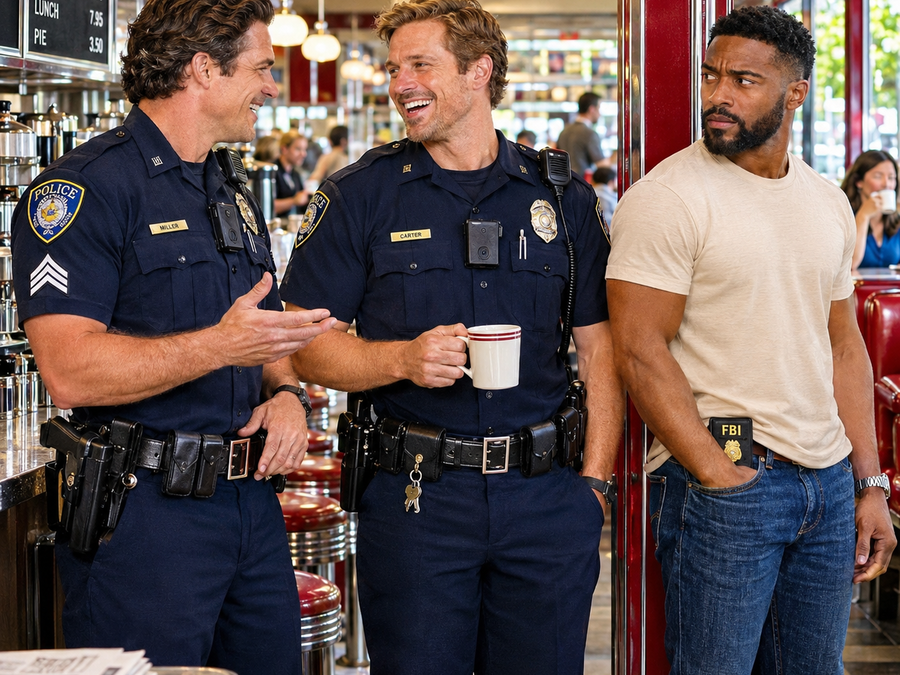
Sergeant Wade Miller and Officer Brett Davis bragged about their arrests over coffee at Dot’s Diner, sure that nobody who mattered was listening.
They never noticed the badge clipped to the quiet man’s pocket, or that every word they said was already being recorded.
Isaiah Grant had driven four hours from Atlanta for one peach pie.
It was eight o’clock on a Saturday morning, and Dot’s Diner smelled the way it always had: coffee, bacon, butter on the grill.
He stood at the long silver counter in a plain cream T-shirt and blue jeans, waiting while Dot Hale boxed up the pie he had ordered two weeks ago.
His mother, Ruth, was turning seventy today.
She had eaten Dot’s peach pie on every birthday since before Isaiah was born.
He was not about to break that streak.
“Two more minutes, honey,” Dot called from the kitchen window.
“Crust is still cooling.”
“Take your time, Miss Dot.”
He leaned on the counter.
Above the pie case, a small black camera blinked a red light.
That was new. Everything else looked the same: the stools, the old menu board, the photos of the high school football team on the wall.
The bell over the door jingled.
Two police officers walked in.
Navy uniforms, badges shining, big black belts heavy with gear. The older one had wavy brown hair and three stripes on his sleeve.
His name tag said Miller.
The younger one had a name tag that said Davis. Neither of them sat down.
They walked straight to the counter and stood right next to Isaiah like he was part of the furniture.
“Dot, two coffees,” Miller called out.
“And make mine hot this time.”
Davis picked up a white mug from the stack and held it out.
He was already grinning. Miller slapped the counter and laughed out loud.
“Another easy arrest.”
Davis laughed with him.
“Man, did you see his face?”
“See it?
I’ll be seeing it in my sleep.
Best laugh I had all week.”
Miller shook his head.
“That Wallace kid didn’t even see it coming.
Just driving home from work with his little lunch box on the seat.”
Isaiah kept his eyes on the pie case, but he was listening now. Every word.
“Weaving,” Davis said, doing air quotes with one hand.
“He was weaving.”
“He was breathing is what he was doing,” Miller snorted.
“I said weaving.
Who’s the judge going to believe?
Me or some kid from Pecan Street?”
“And the body cams?”
“Off.
Same as always.
Funny how those things just quit working.”
Miller grinned.
“I wrote him up for resisting.
He asked me why he was being stopped.
That’s resisting right there—asking questions.”
Davis laughed so hard he had to set the mug down.
“And his car?”
“On Hatcher’s lot before the paperwork was even dry.
Two hundred a tow, Brett.
Two hundred dollars every single car.
Hatcher never asks one question.
Best side job in the whole county.
Payday’s Friday,” Miller said.
“Hatcher pays at Dot’s.
Same as always.”
Behind the kitchen window, Dot had stopped moving. She stood with the pie box in her hands, very still.
Isaiah slid his phone out of his back pocket. He did not hurry.
He held it low against his leg and touched the screen twice. The voice memo app opened.
He pressed the red button.
A tiny timer began counting. Zero seconds.
One.
Two. He set the phone face up on the counter beside his elbow, as if he were just waiting on a text.
“How many is that this month?”
Davis asked.
“Nine.
Ten if you count the girl with the expired tag.”
Miller took the coffee Dot finally set down and blew on it.
“Kid’s going to lose his job.
Watch.
Can’t get to work without a car.
Can’t get his car without nineteen hundred dollars.
Can’t get nineteen hundred dollars without a job.”
“That’s a circle,” Davis said.
“That’s a business.”
Miller laughed again.
“And the best part?
We can do anything we want in this town.
Our word against theirs, every single time.”
“No one will ever know,” Davis said.
Miller lifted his cup.
“No one will ever know.”
They touched cups like it was a toast. Isaiah looked down at the pie case.
In the curved glass, he could see the two officers behind him, both of them red-faced from laughing.
He could also see his own face: calm, still, listening. He had spent eleven years with the FBI, nine of them on the Public Corruption Squad in Atlanta.
He had sat in rooms with crooked judges, crooked contractors, and crooked city councilmen. He had heard men brag before, but never in his hometown.
Never at Dot’s counter.
Never about a kid from Pecan Street—the street his mother lived on.
The timer on his phone read one minute and forty seconds.
In the glass of the pie case, Miller’s eyes moved.
They slid from the coffee cup to the reflection.
And they stopped on Isaiah. Miller was not laughing anymore.
He was staring right at him.
“What are you staring at?”
Miller’s voice cut through the diner like a whistle.
The cook stopped scraping the grill.
A woman in a booth set her fork down.
Isaiah turned his head slowly.
“Morning, Sergeant.”
“I asked you a question.”
Miller stepped closer. He was not a tall man, but he took up space like one.
“What are you staring at?”
“The pie case,” Isaiah said.
“I’m waiting on a pie.”
“You’re waiting on a pie?”
Miller looked him up and down—the T-shirt, the jeans, the work boots. He smirked.
“You don’t look like you can afford a pie.”
Davis chuckled behind his mug.
“Real police are talking here,” Miller said.
“Grown men doing grown men’s work, and you’re over here with your ears flapping, listening in on things that are none of your business.”
“I’m standing at a public counter, Sergeant.
You were talking pretty loud.”
Miller’s face went a shade darker.
“Did you just tell me what I was doing?”
“I just said you were loud.”
“People like you,” Miller said slowly, so the whole diner could hear, “don’t get to tell me anything.
You understand?
You’re nobody.
You’re some nobody in a T-shirt who thinks he can stand in my diner and eavesdrop on my conversation.”
“It’s Miss Dot’s diner,” Isaiah said.
Somebody in a booth let out a short, nervous laugh.
They stopped fast.
Miller reached over and flicked Isaiah’s coffee cup with two fingers.
It tipped.
Brown coffee ran across the silver counter and dripped onto Isaiah’s jeans.
“Oops,” Miller said.
Davis laughed out loud.
Isaiah did not move. He did not look at the coffee.
He looked at Miller.
“ID,” Miller said.
“Now.”
“Am I being detained, Sergeant?”
“Oh, listen to him.
Am I being detained?”
Miller turned to Davis.
“He’s been watching YouTube.”
“Must be a lawyer,” Davis said.
“He ain’t a lawyer.
Look at him.”
Miller turned back.
“Here’s what’s happening.
You’re loitering in a place of business.
You’re bothering officers of the law.
That’s disorderly conduct in Millbrook.
You can hand me your ID, or you can ride in my backseat and your car can go to the same place that Wallace kid’s car went.
Your choice.”
Davis moved away from the counter and stood in front of the door, arms crossed, mug still in his hand, grinning. The diner had gone dead quiet.
A man in a feed store cap looked down at his eggs. A young mother pulled her little boy closer in the booth.
Nobody said a word. Nobody got up.
Dot stood in the kitchen doorway, pie box in her hands, her mouth pressed into a thin line.
“I haven’t done anything wrong,” Isaiah said.
His voice was even, polite—the same voice he used in interview rooms.
“I came in for a pie.
I’m going to pay for it and leave.”
“You’re going to do what I tell you,” Miller said.
“That’s what you’re going to do.”
That was when Miller’s eyes dropped to the counter, to the phone.
The screen was glowing.
The red dot was blinking.
The little timer was still counting. Three minutes, twelve seconds.
Three minutes, thirteen.
Miller’s whole face changed.
The grin went away.
His jaw went tight.
“You recording me?”
Isaiah said nothing.
“You recording a police officer in my town?”
Miller’s voice dropped low, cold.
“That’s a crime, pal.
Interfering with an officer.
Obstruction.”
“It’s not a crime to record in a public place, Sergeant.
You know that.”
“What I know is that phone is evidence now.”
Miller held out his hand, palm up, right in front of Isaiah’s chest.
“Give me that phone.”
Isaiah looked at the hand.
“Give me that phone,” Miller said again.
“Now.”
Isaiah did not pick up the phone.
He did not reach for it.
He did not slide it away.
He left it right where it was, blinking on the wet counter, and he slowly stood up straight.
“I’m going to move my right hand,” he said, slowly.
“I’m not reaching for anything dangerous.”
Miller’s hand dropped to his belt.
“Don’t you move.”
“I’m going to move it slowly,” Isaiah said again, and he did.
He reached down to the front pocket of his jeans and turned the leather case clipped there so it faced them.
A gold badge caught the light. Under it, in hard blue letters, were three letters every cop in America knew.
FBI.
“Special Agent Isaiah Grant,” he said.
“Federal Bureau of Investigation.
The phone stays with me.”
Nobody in the diner breathed.
Davis’s mug shook in his hand.
A splash of coffee spilled over the side and hit the floor.
Miller stared at the badge.
For a long second, he did not say anything at all. His face went white, then red, then white again.
Then something hard came back into his eyes.
“Well, well,” he said quietly.
“A fed.”
“That’s right.”
“A fed in a T-shirt buying pie.”
Miller let out a short laugh with no fun in it.
“You’re off duty, Agent.
You’re on vacation.
You don’t have one ounce of power in this town.
Not one.”
“I didn’t say I did.”
“This is my town.”
Miller leaned in until Isaiah could smell the coffee on his breath.
“This is Mayor Hatcher’s town.
You go back to Atlanta and eat your pie, and you forget whatever you think you heard—because you didn’t hear anything.
Two officers telling jokes.
That’s all.”
“Then you’ve got nothing to worry about,” Isaiah said.
Miller held his gaze for three more seconds. Then he stepped back.
“Come on, Brett.”
“But our coffee—”
“Come on.”
Davis set his mug down so hard it cracked against the counter.
The two officers walked out.
The bell over the door rang behind them.
Through the front window, Isaiah watched them cross the lot to their cruiser.
Slowly, the diner started breathing again.
A fork clinked. Somebody coughed.
The young mother let go of her son.
Isaiah picked up his phone.
He stopped the recording: four minutes and fifty-one seconds.
He pressed save, then watched the little cloud icon spin until it said Uploaded.
Dot came out of the kitchen. She set the pie box on the counter in front of him and wiped up the spilled coffee with a rag.
Her hands were not steady.
“On the house,” she said.
“No, ma’am.
I’ll pay.”
“On the house, Isaiah Grant.”
She looked at him.
She had known him since he was six years old and sneaking sugar packets.
“I didn’t know you were FBI.”
“Mama doesn’t brag on it.”
“She brags on everything else.”
Dot almost smiled.
Then the smile went away. She leaned closer and lowered her voice.
“You aren’t the first one they did that to.
You know that, right?
You’re just the first one who didn’t go quiet.”
“How many?”
Dot glanced at the door.
“Too many to count, honey.
Too many.”
Isaiah looked up at the little camera over the pie case.
Its red light was still blinking.
“Miss Dot,” he said, “does that thing record sound?”
Dot followed his eyes.
She didn’t answer, but she didn’t say no.
Outside in the parking lot, Wade Miller sat behind the wheel of his cruiser. He did not start the engine.
He pulled out his cell phone and dialed a number he knew by heart. It rang twice.
“Roy,” Miller said.
“It’s me.
We got a problem.”
Ruth Grant opened her front door before Isaiah even got up the porch steps.
“Is that what I think it is?”
“Peach,” Isaiah said.
“From Dot’s.
Happy birthday, Mama.”
She pulled him into a hug that nearly crushed the pie.
She was small and quick, with silver hair cut short and reading glasses on a beaded chain around her neck.
She had been the librarian at Millbrook Elementary for thirty-four years.
Half the town still called her Miss Ruth.
“Seventy years old,” she said, “and my baby boy drove all the way down here for a pie.”
“Not just a pie.”
He held up a small box.
“Got you something else.”
She opened it at the kitchen table.
Inside was a small black camera with a suction-cup mount.
“What on earth is this?”
“A dash cam for your car.
It records the road front and back—sound, too.”
“Isaiah, I drive to church and the Piggly Wiggly.”
“Humor me.”
So she humored him.
After lunch, he sat in the driver’s seat of her old silver Buick and stuck the camera to the windshield.
He ran the cord under the dash, set it to save everything to the cloud, and showed her the little green light.
“Green means it’s watching,” he said.
“Watching what?”
He didn’t answer right away.
Ruth was never fooled by silence. She sat down in the passenger seat and folded her hands.
“Tell me,” she said.
So he told her—about the counter, about Miller and Davis, about the Wallace kid.
Ruth’s face went still.
“Andre,” she said.
“That’s Andre, Bernice’s grandson, right next door.”
Isaiah turned to look at the little yellow house next door.
The driveway was empty.
“They took him two weeks ago,” Ruth said, “on his way home from the warehouse.
Bernice was sick about it.
They said he fought them.
Andre has never fought anybody in his life. He drives a forklift and goes to choir practice on Wednesdays.
And they took his car, and he couldn’t get to work, and they let him go last week.”
“Fired?”
She shook her head.
“He sits in that kitchen all day now.
Won’t talk to anybody.”
Isaiah sat with that for a long moment. Then he stepped out onto the driveway and called his supervisor in Atlanta.
His boss picked up on the fourth ring.
Isaiah told him everything—the recording, the tow money, the mayor’s name.
The line was quiet for a moment.
“Isaiah,” his supervisor said, “listen to me.
What you have is a recording you made on your day off in your hometown of two guys running their mouths.
That’s a start.
It’s not a case.”
“They said it out loud.
Two hundred a tow.”
“And their lawyer will say it was a joke.
You know that.”
A sigh.
“If you want this to go anywhere, bring me a victim who will talk on the record.
Bring me paper that backs it up.
Until then, you are on leave and you are visiting your mother.
Do not play hero in your hometown.
Do you hear me?”
“I hear you.”
“I mean it, Isaiah.”
“I hear you.”
He hung up and went back inside.
They ate the peach pie.
Ruth’s friends from church called all afternoon to sing to her over the phone.
For a few hours, it almost felt like a normal birthday. But that night, when Isaiah went to pull the porch curtains, he stopped.
Across the street, under the big oak tree, a Millbrook police cruiser sat parked against the curb.
Its lights were off. Its engine was off.
Through the windshield, in the glow of a phone screen, Isaiah could see the face of the man behind the wheel.
Wade Miller was looking right at his mother’s house.
The next morning, Ruth drove herself to church.
She insisted.
She had driven herself to Greater Mount Zion Baptist every Sunday for forty years, and she was not about to be chauffeured on her birthday weekend. Isaiah would come along after he showered.
She would save him a seat.
She made it six blocks.
The blue lights came on behind her at the corner of Church and Main, right in front of the old hardware store.
Ruth pulled over, put the car in park, and set both hands on the wheel, just like Isaiah had taught her years ago.
Wade Miller walked up to her window slowly. He took his time.
He leaned down and smiled.
“Morning, Grandma.”
“Good morning, Officer.
Is there a problem?”
“Sure is.
You rolled right through that stop sign back there.
Didn’t even slow down.”
“I came to a complete stop, Officer.
I always do.”
“Not today you didn’t.”
He tapped his ticket book against the door.
“License, registration, insurance.”
Ruth handed them over.
Her hands were steady, but her heart was pounding.
Across the street, people in their Sunday clothes were stopping on the church steps to watch. Miller took his sweet time reading her license.
“Grant,” he said.
“Ruth Grant.”
He looked up.
“You’ve got a son, don’t you, Ruth?
Tall fellow, likes pie.”
Ruth said nothing.
“Thinks he’s real important,” Miller went on.
“Flashed his little badge at me yesterday.
Well, let me tell you something, Grandma.
That badge doesn’t mean anything here.
Your boy can’t save you in this town.
Nobody can.
You understand me?”
“I understand you’re threatening me, Officer.”
“I’m educating you.”
He started writing.
“Rolling stop—that’s a ticket.
Failure to obey a traffic control device—that’s another ticket.
And with an attitude like yours, I’ve got half a mind to have this car towed to Hatcher’s lot right now.
See how you like walking to church.”
Ruth slowly reached for her phone and pressed one button. Isaiah answered on the first ring.
“Mama?”
“I’m at Church and Main,” she said calmly.
“Sergeant Miller has pulled me over.”
Isaiah was there in four minutes.
PART 2
He parked behind the cruiser and walked up with his hands in plain view, still in his church shirt, tie loose around his neck.
“Morning, Sergeant.”
Miller straightened up.
“Well, look who’s here.
Agent Pie.”
“What’s the stop for?”
“Your mama ran a stop sign, then she mouthed off.”
Isaiah looked through the windshield of the Buick.
The little dash cam was mounted right where he’d put it.
The green light was glowing.
“Sergeant,” he said, loud enough for the church steps to hear, “that camera on her windshield has been recording since she left the house.
Front road and the inside of the car.
Sound, too.
It uploaded to the cloud about thirty seconds after she stopped.”
He paused.
“It shows a full stop at that sign, and it heard every word you just said to her.”
Miller turned and looked at the camera. The green light stared back at him.
On the church steps, someone said, “Mm-hmm,” loud and clear.
For a long moment, Miller didn’t move.
Then he ripped the page out of his ticket book, tore it in half, and tore it in half again.
He dropped the pieces through Ruth’s open window into her lap.
“Warning,” he said.
“Drive careful, Grandma.”
He walked back to his cruiser.
As he opened the door, he looked over the roof at Isaiah.
“Enjoy church,” he said.
“Pray for that Wallace kid.
He’s going to need it.”
The cruiser pulled away.
It didn’t turn toward the station.
It turned left toward Pecan Street—toward Andre’s house.
Isaiah followed the cruiser as far as Pecan Street. By the time he and Ruth pulled into her driveway, the cruiser was gone.
But it had stopped.
Bernice Wallace was standing on her front porch next door in her housecoat, one hand pressed to her chest.
“He just sat there,” Bernice called over.
“Sat right out front with his window down, staring at my house.
Didn’t say a word.
Then he drove off laughing.”
Ruth crossed the grass and put her arms around her old friend.
“Bernice, honey, is Andre home?”
“Where else would he be?”
They skipped church.
It was the first Sunday Ruth had missed in nine years.
Andre Wallace sat at his grandmother’s kitchen table with his hands wrapped around a glass of sweet tea.
He wasn’t drinking.
He was twenty-four, tall and thin, still wearing a gray warehouse T-shirt with his name stitched on the chest.
He looked up when Isaiah came in, and then he looked right back down.
“Miss Ruth says you’re FBI,” he said.
“I am.”
“Then you’re just another badge.”
Andre’s voice was flat.
“No offense.”
“None taken.”
Isaiah pulled out a chair and sat down across from him.
“I’m not here as a badge.
I’m here because I was standing at Dot’s counter yesterday when two officers talked about you.”
Andre’s jaw tightened.
“What did they say?”
“I’ll get to that.
First I want to hear it from you—all of it.
Take your time.”
For a long while, Andre didn’t say anything.
His grandmother put a hand on his shoulder. Ruth sat down beside him.
Then the words started coming.
“I was driving home from my shift.
Eleven at night.
I’d worked a double.
I wasn’t speeding.
I wasn’t doing nothing.
Blue lights come on behind me on Route 9, right past the Dollar General.”
He swallowed.
“Miller walks up.
Davis is behind him.
Miller says I’m weaving.
I said, ‘Sir, I’m not weaving.
I’m just tired.
I just got off work.’
He says, ‘So you admit you’re impaired?’
I said, ‘No, I said I’m tired.’
He says, ‘Get out of the car.’
”
“Did you get out?”
“Yes, sir.
Hands up.
I know how it goes.
My grandma raised me right.”
Andre’s voice cracked.
“He made me put my hands on the hood.
I asked him why I was being stopped.
That’s all I said—Why am I being stopped?
And he says, ‘That’s resisting.’
And Davis laughed.
And they cuffed me.”
“Were their body cameras on?”
“I saw Miller reach up and push the button on his chest right before he walked up.
I thought he was turning it on.”
Andre shook his head.
“He was turning it off.”
“What happened to your car?”
“Hatcher’s tow truck was there before they even put me in the backseat, like they called it before they stopped me.”
He let out a short, bitter laugh.
“Nineteen hundred dollars to get it back.
Tow fee, storage fee, paperwork fee.
Every day it sits there, it’s forty dollars more.
I don’t have nineteen hundred dollars.
I couldn’t get to work.
They fired me after three days.”
“Did you file a complaint?”
Andre’s face shut like a door.
“Miller came by the house the day after they let me out,” he said quietly.
“Stood right where you’re sitting.
Told me if I made any complaints, my charges would get worse. Said it real calm.
Said, Resisting is a misdemeanor, son. Obstruction is a felony.
You want to go to prison over a traffic stop?”
Andre pushed his tea away.
“So no, I didn’t file nothing, and I’m not going to.
I’m sorry, Mr.Grant.
I know you mean well, but you go back to Atlanta tomorrow.
I still have to live here.”
The kitchen was silent. Bernice wiped her eyes.
Isaiah took out his phone.
He set it on the table between them.
“Andre,” he said, “I want you to hear something.
Then you can tell me no, and I’ll respect it.”
He pressed play.
Miller’s voice filled the little kitchen, loud, laughing.
Another easy arrest.
That Wallace kid didn’t even see it coming.
Just driving home from work with his lunch box on the seat. Andre went very still.
He was breathing is what he was doing.
I said weaving.
Who’s the judge going to believe?
Davis laughing.
Kid’s going to lose his job.
Watch.
That’s a business.
No one will ever know. Isaiah stopped the recording.
Andre stared at the phone for a long time. His eyes were wet.
His hands were shaking.
“They were laughing,” he said.
“They were laughing at me.
At my lunch box.”
“Yes.”
“And everybody at Dot’s heard it?”
“Everybody.”
Andre wiped his face with the back of his hand. When he looked up, something in his eyes was different.
Something had come back.
“What do I have to do?”
“Write it down.
Everything you just told me.
Every time, every word you remember.
Sign it and date it.”
“And then what?”
“Then we make sure somebody besides me hears that recording.”
Andre pulled a notebook out of the kitchen drawer. He started writing.
He wrote for an hour and twenty minutes, and when he was done, he had filled nine pages.
When Isaiah and Ruth walked back across the grass, the afternoon mail had come.
Bernice’s mailbox was open.
A white envelope sat inside, stamped with the seal of the Millbrook Police Department.
Bernice opened it on the porch.
She read it once. Then she sat down hard on the top step.
“Andre,” she called through the screen door, her voice breaking.
“Baby, they changed your charge.”
Andre came out and took the letter.
He read it out loud, very slowly.
“Charge amended.
Resisting arrest upgraded to felony obstruction of an officer.
Hearing moved to Thursday, 9:00 a.m.” He looked up at Isaiah.
“He said it would get worse,” Andre whispered.
“He said it would get worse.”
Dot’s Diner opened at six every morning.
Dot Hale got there at five. At 5:15 on Monday, Isaiah knocked on the back door.
Dot opened it in her apron with a spatula in her hand.
She looked at him for a long moment.
Then she stepped aside.
“Figured you’d come,” she said.
“Coffee’s on.”
The diner was dark except for the light over the grill. Dot poured two cups and set one in front of him on the counter—the same counter.
The coffee stain from Saturday was gone.
“The camera,” Isaiah said.
Dot sighed.
She looked up at the little black box above the pie case.
“My insurance company made me put it in last spring,” she said, “after somebody broke the front window.
It records everything at the counter. Picture and sound.
Saves it on a box in my office for ninety days.
Then it records over itself.”
“Ninety days.”
“Ninety days.”
She sipped her coffee.
“Saturday’s on there.
All of it.”
“Miss Dot, I need a copy.”
She didn’t answer.
She looked around the empty diner instead—at the red stools, at the photos of the football team on the wall, at the old menu board her husband had painted the year they opened.
“You know who owns this building, Isaiah?”
“Tell me.”
“Roy Hatcher.”
She said the name like it tasted bad.
“Mayor Roy Hatcher.
He bought the whole block eight years ago. My lease comes up for renewal every year, and every year he could just say no.
Thirty years I’ve been in this spot.
My husband died in this spot—back in that kitchen, flipping hash browns.
And Roy Hatcher could throw me out on the sidewalk with one letter.”
“I know it’s a lot to ask.”
“It is a lot to ask.”
She set the cup down.
“Thirty years I fed those boys.
Wade Miller sat on that stool right there when he was fourteen and couldn’t pay for his own milkshake.
I paid for it.
Brett Davis cried in that back booth the night his daddy left.
I sat with him till midnight.”
Her voice was shaking now—not from fear, from anger.
“And now they stand at my counter and laugh about locking up a boy from Pecan Street like it’s a joke, like it’s nothing.”
She stood up, walked into her little office behind the kitchen, and came back two minutes later. She set a small blue flash drive on the counter.
“Saturday,” she said.
“The whole thing.
Picture and sound.”
Isaiah picked it up carefully.
“Thank you.”
“I’m not done.”
Dot sat back down.
“There’s something else on that box.
You heard Wade say it.
Payday’s Friday.
Hatcher pays at Dot’s.”
“I heard it.”
“He wasn’t joking.
Every Friday morning, eight o’clock, Roy Hatcher walks in that door.
Wade and Brett are already standing at the counter.
Roy orders a coffee, black, and he slides a white envelope across the counter under his newspaper. Wade puts it in his jacket.
Every Friday for as long as I can remember.”
“And the camera has seen it?”
“The camera has seen twelve Fridays.”
She looked him in the eye.
“I checked last night.
I couldn’t sleep.”
Isaiah sat back on the stool. Twelve Fridays.
Twelve envelopes on video, with sound.
“Miss Dot,” he said quietly, “you know what this means if you give me that?”
“It means I lose my diner.”
She pushed a second flash drive toward him, a red one.
“Take it before I change my mind.”
He took it.
At noon, the diner was packed for the Monday lunch rush.
Isaiah was in a back booth with Ruth, eating a club sandwich he couldn’t taste, when the bell over the door jingled.
The whole room got quieter.
Roy Hatcher walked in.
He was sixty, tall and heavy-shouldered in a tan suit and a white cowboy hat.
He smiled at everybody. He shook hands with the man in the feed store cap.
He patted a little boy on the head. Then he walked up to the counter where Dot was ringing up a ticket.
“Dot, darling,” he said, loud and warm.
“How’s my favorite tenant?”
“Busy, Roy.”
“Won’t take but a second.”
He reached into his jacket and pulled out a long white envelope.
He laid it on the counter right in front of her.
“Thirty days’ notice.
I’ve decided not to renew.
Going to put a nice new tow company office in here.
Better use of the space.”
The diner went dead silent.
Dot stared at the envelope.
Her face had gone pale.
Roy Hatcher turned around slowly. His eyes swept across the room until they found the back booth.
They found Isaiah.
He tipped his white hat.
“Y’all enjoy your lunch,” he said, and he walked out.
Millbrook Town Hall was a small brick building with a flagpole and a clock that had been stuck at ten after four for as long as Isaiah could remember.
He walked in at two o’clock that Monday afternoon with a pen and a stack of forms he had printed at the library.
“I’d like to file some public records requests,” he told the clerk at the front window.
She was a young woman with a nervous smile.
“As a private citizen, under the Georgia Open Records Act.”
“What records, sir?”
“Every tow ordered by the Millbrook Police Department in the last eighteen months, every arrest report that came with those tows, the town’s towing contract, and who signed it.”
The clerk’s smile went away.
“That’s a lot of records, sir.”
“I’ve got time.”
Under Georgia law, the town had three business days to respond, but the clerk came back in forty minutes with a thick folder—because, she said quietly, most of it was already on the town’s own website if you knew where to look.
Nobody ever looked. Isaiah sat in his truck in the parking lot and read every page.
The towing contract was first: exclusive, no bidding. Every vehicle towed by the Millbrook Police Department went to one company only—Hatcher Towing and Impound.
The contract had been renewed four times. Every time, it was signed by the mayor, Roy Hatcher.
Mayor Hatcher had signed a deal as mayor giving all the town’s tow business to Roy Hatcher, the tow company owner.
Then Isaiah went through the tow logs. He made marks with his pen.
He counted twice to be sure.
In eighteen months, the Millbrook police had made two hundred twelve arrests that ended with a car towed to Hatcher’s lot.
One hundred ninety of those arrests had Sergeant Wade Miller or Officer Brett Davis listed as the arresting officer.
And of those charges, more than eighty percent had later been dropped quietly—after the car fees had been paid, or after the cars that couldn’t be paid for had been sold at Hatcher’s monthly auction.
Two hundred dollars a tow.
Isaiah did the math on the back of the folder: thirty-eight thousand dollars in envelopes across Dot’s counter.
And that was only what the cops got.
Hatcher kept the tow fees, the storage fees, and the auction money.
He walked back inside to ask the clerk one more question. He never got to.
Roy Hatcher was standing in the hallway, waiting for him. Up close, he smelled of aftershave and cigars.
He was smiling.
“Agent Grant,” he said, holding out his hand.
“Roy Hatcher, mayor of this fine town.”
Isaiah didn’t take the hand.
“Mr.Mayor.”
Hatcher let the hand drop.
The smile didn’t move.
“I hear you’ve been reading,” he said.
“Lots of reading.
Library, records office.
Very civic-minded of you.”
“Public records are public.”
“Sure they are.
Sure they are.”
Hatcher stepped closer.
“Let me give you some free advice, son.
You’re a tourist here.
You came down for your mama’s birthday, and that’s sweet.
That’s real sweet.
But tourists ought to see the sights and go home, not dig around in things they don’t understand.”
“I understand them fine,” Isaiah said.
“And I’m not a tourist, Mr.Mayor.
I was born three streets from here.
I learned to ride a bike in the parking lot of your tow yard back when it was a Piggly Wiggly.”
For the first time, Hatcher’s smile slipped, just a little.
“Then you ought to know how things work in Millbrook,” Hatcher said softly.
“Better than anybody.”
He turned and walked away down the hall, boots clicking on the tile. Isaiah was halfway back to his truck when his phone rang.
It was his supervisor in Atlanta—on a Monday afternoon when Isaiah was supposed to be on leave.
He answered.
“Isaiah,” his supervisor’s voice was tight.
“What did I tell you?”
“Sir?”
“I just got off the phone with the Special Agent in Charge, who just got off the phone with a congressman’s office, who just got off the phone with the mayor of Millbrook, Georgia.”
A long breath.
“The mayor’s office has filed a formal complaint.
It says that on Saturday, an off-duty FBI agent flashed his badge to threaten local police officers in a diner, harassed an elderly business owner, and has been going around town using his federal position to push a personal grudge.”
Isaiah closed his eyes.
“That’s not what happened.”
“I believe you.
It doesn’t matter what I believe.
There’s going to be an inquiry.”
His supervisor’s voice softened just slightly.
“You need to stand down right now, today.
Don’t talk to those officers.
Don’t talk to that mayor.
Don’t go near that diner.
You hear me?”
Isaiah looked across the parking lot.
A Millbrook police cruiser sat at the edge of the lot with its engine running.
Wade Miller lifted two fingers off the steering wheel and waved.
On Tuesday morning, it became official.
The email came at 7:40.
Special Agent Isaiah Grant was placed on administrative leave pending an internal inquiry.
He was ordered to report to the Atlanta field office on Friday at 10:00 a.m.to turn in his badge and his government phone until the inquiry was finished.
He read it twice, sitting on the edge of his childhood bed under a faded poster of Hank Aaron.
Ruth stood in the doorway with a cup of coffee.
“Well?”
“They’re taking my badge on Friday.”
Ruth set the coffee down on the dresser.
She didn’t say anything for a minute.
Then she sat beside him on the bed, the way she used to when he was nine and had lost a ball game.
“Are you wrong?”
she asked.
“No, ma’am.”
“Then you don’t act like somebody who’s wrong.”
He almost smiled.
“Yes, ma’am.”
He was ordered not to go near the diner.
He didn’t—but the diner came to him.
At eleven that morning, Isaiah and Ruth were picking up her prescription at the drugstore on Main Street.
When they walked out, Miller and Davis were leaning on the hood of their cruiser right outside the door, both holding coffees from Dot’s.
“Well, look at this,” Miller said loudly.
People on the sidewalk slowed down to watch.
“If it isn’t Agent Pie.
Or is it just Mr.Pie now?”
Davis laughed.
“Heard some news this morning,” Miller went on.
“Heard somebody’s in trouble with his bosses up in Atlanta.
Heard somebody’s turning in his little badge on Friday.”
Isaiah kept walking.
Ruth held his arm.
“Your badge don’t mean nothing now, Grant,” Miller called after them.
“Didn’t mean nothing before, neither.
You came into my town thinking you were somebody.
Now look at you.
Just another nobody walking his mama to the drugstore.”
“Hey, Grant!”
Davis called.
“Tell that Wallace kid we said hi.
See him Thursday.”
They both laughed. The sound followed Isaiah all the way to the truck.
PART 3
Ruth got in, closed the door, and looked straight ahead. Her lips were pressed tight.
“Mama—”
“I taught Brett Davis to read,” she said quietly.
“Second grade.
He couldn’t sound out the word because.
I stayed after school with him for six weeks.”
That night, Isaiah sat at Bernice’s kitchen table with Andre.
He did not bring his badge. He did not bring his government phone.
He brought his own laptop.
“I’m not allowed to work this case,” he told Andre.
“I’ve been ordered to stand down, so I’m not going to work it.
I’m not here as an agent.
I’m here as a neighbor.
Understand?”
Andre nodded slowly.
“But you,” Isaiah said, “are a citizen of the United States.
And any citizen of the United States can file a civil rights complaint directly with the FBI and the Department of Justice online.
Nobody in Millbrook has to approve it.
Not the police, not the mayor, nobody.”
He turned the laptop around. The page on the screen had a federal seal at the top.
“You fill it out,” Isaiah said.
“In your own words.
I’ll just sit here.”
Andre typed for an hour. He typed what happened on Route 9.
He typed about the body camera button.
He typed about the tow truck that was there too fast, the nineteen hundred dollars, the job he lost, the visit to his grandmother’s kitchen, the letter that said felony.
At the bottom, there was a button that said Attach Files. Andre looked at Isaiah.
“Can I attach the recording?”
“It’s your complaint,” Isaiah said.
“You can attach anything that’s true.”
Andre attached the voice memo.
He attached a copy of Dot’s Saturday video.
He attached his nine handwritten pages, photographed one by one.
Then he pressed Submit. The screen thought for a second.
Then it showed a green check mark and a long number.
“Your complaint has been received,” Andre read out loud.
“Case reference number…”
He read all fourteen digits slowly.
Then he wrote the number on a sticky note and pressed it to the refrigerator, right next to a photo of himself in his high school graduation gown.
“Now what?”
he asked.
“Now it’s in the system.
It’s real.
Nobody can make it disappear.”
Andre nodded. For the first time since Isaiah had met him, he almost looked hopeful.
Then his phone buzzed. He looked at it, and the hope drained out of his face.
He turned the screen around so Isaiah could see. It was a text from an unknown number.
It had a link to the Hatcher Towing and Impound website.
The page was titled Saturday Vehicle Auction.
Lot number seven was a blue 2014 Honda Civic—Andre’s car.
Millbrook Municipal Court met in a room on the second floor of Town Hall, under the clock that didn’t work.
At nine o’clock on Thursday morning, every seat was full.
Word had gotten around; it always did in a town of six thousand people. Folks from Greater Mount Zion were there in their work clothes.
The man in the feed store cap was there.
The young mother from the diner was there with her little boy. Dot Hale was there in the front row in a navy dress, with her purse in her lap and her chin up.
Isaiah sat in the third row, with Ruth on one side and Bernice on the other. He was not there as an agent.
He was there as a neighbor. He kept his hands folded and his mouth shut.
Andre sat at the defense table in a borrowed suit that was too big in the shoulders. Beside him sat his public defender, a young woman with a stack of folders and a laptop.
On the other side of the room, Sergeant Wade Miller sat in full uniform.
Officer Brett Davis sat behind him. When Miller saw Isaiah in the third row, he smiled and winked.
The judge came in. Everybody stood.
Everybody sat.
The town’s lawyer called Miller first.
Miller walked to the witness chair like he had done it a hundred times, because he had.
“On the night in question,” he said in a calm, official voice, “I observed the defendant’s vehicle weaving across the center line on Route 9.
I initiated a stop.
The defendant was hostile from the beginning. He refused my commands.
When I attempted to place him in handcuffs for my safety, he pulled away and struck my arm.”
A murmur went through the room.
“He struck you?”
the town’s lawyer asked.
“Yes, sir.
He’s a big young man.
I was in fear for my safety and the safety of my partner.”
“And your body camera?”
“Unfortunately, it malfunctioned that night.
Technical problem.
It happens.”
“Thank you, Sergeant.
No further questions.”
The public defender stood up.
She didn’t look nervous at all.
“Sergeant Miller, you’ve testified that my client attacked you, that he was hostile, that you were in fear.”
“That’s right.”
“And you’ve testified that this arrest was serious—a felony.”
“Very serious.”
“Then you were not laughing about it?”
Miller blinked.
“Excuse me?”
“Two days after you arrested Andre Wallace, were you laughing about it at Dot’s Diner on Main Street?”
“Objection,” the town’s lawyer said, half rising.
“Relevance.”
“Goes to the officer’s credibility, Your Honor.
I have video.”
The judge looked at her over his glasses for a long moment.
“I’ll allow it, briefly.”
The public defender turned her laptop around to face the room.
She pressed a key.
On the screen was the counter at Dot’s Diner, seen from above the pie case.
There was Miller in uniform, coffee in hand.
There was Davis with his white mug. And off to one side, in a cream T-shirt, was a man waiting for a pie.
Miller’s voice filled the courtroom.
Another easy arrest. The room went silent.
That Wallace kid didn’t even see it coming.
Just driving home from work with his little lunch box on the seat.
He was breathing is what he was doing.
I said weaving.
Who’s the judge going to believe?
Me or some kid from Pecan Street? On the screen, Davis laughed so hard he had to set his mug down.
Off, same as always.
Funny how those things just quit working.
I wrote him up for resisting.
He asked me why he was being stopped.
That’s resisting right there—asking questions.
The public defender pressed the key again.
The screen froze on Miller’s grinning face.
Nobody in the room moved.
The judge took his glasses off.
He looked at the frozen screen. He looked at Miller in the witness chair.
Miller’s face had gone the color of the paper on the judge’s desk.
“Sergeant,” the judge said very quietly, “is that you on that video?”
Miller opened his mouth. Nothing came out.
“I’ll take that as a yes.”
The judge put his glasses back on. He picked up his pen.
“The charges against Andre Wallace are dismissed—all of them, with prejudice, which means they can’t ever be filed again.”
He looked at the town’s lawyer.
“And the court orders Mr.Wallace’s vehicle released to him today, with no tow fee, no storage fee, and no paperwork fee.
Today.
Do we understand each other?”
“Yes, Your Honor.”
The judge banged his gavel once. The room exploded.
Bernice burst into tears. The people from Mount Zion stood up and clapped.
Dot Hale put her hand over her mouth. Andre sat at the defense table staring straight ahead, his shoulders shaking while his public defender rubbed his back.
Ruth squeezed Isaiah’s hand so hard it hurt.
“We won,” she whispered.
“Baby, we won.”
Isaiah squeezed back. But his eyes were on Miller.
Miller was walking out of the courtroom.
He didn’t run.
He didn’t hurry.
He walked straight out the side door with Davis behind him, and he did not look back once.
Outside on the steps of Town Hall, Andre came through the doors into the sunlight.
He walked straight to Ruth and threw his arms around her.
Then Bernice.
Then, after a moment, Isaiah.
“Thank you,” Andre said into his shoulder.
“Thank you, Mr.Grant.
Thank you.”
People were cheering.
Somebody was taking pictures.
For one bright minute, it felt like the whole town was on their side.
Isaiah looked across the street.
Miller’s cruiser was parked at the curb, its engine running.
Miller sat behind the wheel, watching them through the windshield.
He was not angry. He was not upset.
He was calm. He picked up his radio and said something into it.
Then he pulled away from the curb. It took less than six hours for the town to take everything back.
At three o’clock that Thursday afternoon, Dot Hale called Isaiah.
Her voice was shaking so hard he could barely understand her.
“They came for the camera box,” she said.
“Wade and Brett and two officers I never saw before.
They had a paper—a warrant, signed by the town magistrate, Roy’s golf partner.
It says my camera was illegally recording law enforcement communications. They took the whole box out of my office, Isaiah, unplugged it, and carried it out the front door in front of my lunch crowd.
Ninety days of everything.”
“Are you all right, Miss Dot?”
“No, I’m not all right.”
She took a breath.
“But they don’t know about the flash drives.
They don’t know I gave you a copy.
Wade didn’t ask, and I didn’t tell him.”
“Keep it that way.”
At 4:30, Andre called from the gate of Hatcher Towing and Impound.
He had gone there with the judge’s order in his hand, the way the judge had told him to.
“They say it’s gone,” he said.
His voice was hollow.
“The man at the window said my car was sold this afternoon.
Cash buyer. Before the paperwork from the court got here.
He said that’s just bad timing.
He said the town will mail me a check for whatever’s left after fees.”
Andre let out a sound that was half a laugh and half a sob.
“He said what’s left after fees is eleven dollars.”
At 6:15, the sun was going down over Pecan Street, and a Millbrook police cruiser pulled up in front of Bernice Wallace’s yellow house.
Wade Miller got out. Brett Davis got out behind him.
Miller walked up to the front porch and knocked on the door with his flashlight, hard, like he owned it.
Ruth was in her own front yard next door, watering her tomato plants.
She set down the hose. She took out her phone.
She held it up and pressed record.
Andre opened the door.
“Evening, Andre,” Miller said, loud enough for the whole street to hear.
“Just came by to tell you personally how sorry I am about your car.
Real shame.
Bad timing.
Hope you like walking.”
“Get off my grandmother’s porch,” Andre said quietly.
“Or what?
You going to call your friend the fed?”
Miller laughed.
“He’s turning in his badge tomorrow.
He can’t help you.
He can’t help anybody.
He couldn’t even help himself.”
“Sergeant Miller!”
Ruth’s voice carried across the yard.
“I am recording you.
You are on private property.
That young man asked you to leave.”
Miller turned around slowly.
He looked at her.
He looked at the phone in her hand, and he smiled. He walked across the grass toward her.
“Ma’am, put down the phone.”
“I will not.
I have every right to record a police officer on a public street.”
“You are interfering with an official police investigation.
Put down the phone.”
“There is no investigation.
You came here to gloat.”
“That’s obstruction,” Miller said.
Brett Davis hesitated for one second. Just one.
He looked at Ruth—his second-grade teacher—standing in her yard in her gardening gloves. Then he looked at Miller.
And he walked over and took the phone out of her hand.
“Ruth Grant,” Miller said, pulling out his handcuffs, “you’re under arrest for obstruction of an officer.
Turn around and put your hands behind your back.”
Bernice screamed from the porch.
Andre came running down the steps, and Miller pointed at him without looking.
“One more step, son, and you’re going with her.”
Andre stopped. His fists were clenched.
Tears were running down his face.
Isaiah came out of his mother’s front door at a run.
He had heard the voices from the kitchen.
He stopped at the edge of the porch. His mother stood in the yard in her flowered house dress, seventy years and five days old, with her hands cuffed behind her back.
“Mama!”
“I’m all right, baby.”
Ruth’s voice was steady.
Her chin was up.
“I’m all right.
Don’t you do anything foolish.
You hear me?
Not one thing.”
Every part of Isaiah wanted to cross that lawn, but he had no badge. He had no authority.
He had orders to stand down. And he knew exactly what Miller wanted.
Miller wanted him to step off the porch. Miller wanted him to put one hand on him.
Then it would be two Grants in handcuffs. So Isaiah stood still.
It was the hardest thing he had ever done.
Miller walked Ruth to the cruiser and put her in the backseat.
He closed the door gently, almost politely.
Then he looked up at Isaiah on the porch.
“Something wrong, Agent?”
he called.
“Oh, wait.
Not agent.
Not anymore.”
The cruiser drove away.
Ruth’s face was in the back window, looking at her son.
Isaiah drove to the Millbrook jail behind them. He waited at the front desk for an hour.
Nobody would tell him anything.
Finally, at eight o’clock, Miller came out from the back, signing a clipboard.
He walked up to the desk. He leaned on it.
He smiled.
“Another easy arrest, Agent,” he said.
At one o’clock in the morning, Isaiah sat in his truck in the jail parking lot.
The engine was off. The windows were down.
He could hear crickets and, far away, a train. His mother was inside that building, sleeping on a metal bench—if she was sleeping at all.
The judge’s ruling had lasted six hours.
Andre’s car was gone.
Dot’s camera box was gone.
His mother’s phone was gone.
His badge would be gone by ten a.m.Every win had been taken back. Miller had played the town like a piano, and Isaiah had stood on the porch and watched him do it.
For a long time, he just sat there. Then he did what he had been trained to do for eleven years.
He stopped feeling.
He started counting.
He took out a pen and the back of the records folder from Town Hall, and he made a list.
One: the voice memo.
Saturday morning at Dot’s counter.
Four minutes and fifty-one seconds.
He opened his phone and checked.
It was still there, saved to the cloud the moment he stopped it. Miller had never touched it.
Two: Dot’s flash drives.
He reached into the glove box—the blue one, Saturday at the counter, and the red one: twelve Fridays, twelve envelopes, Hatcher’s hand, Miller’s jacket.
Miller had seized the camera box, but he had seized it four days too late.
Three: his mother’s dash cam.
He sat up straight.
Ruth’s silver Buick had been sitting in her driveway all evening, nose pointed toward the street, toward Bernice’s house.
He had set the camera to keep watching when the car was parked.
Green means it’s watching.
He opened the dash cam app with shaking fingers.
He scrolled back to 6:15 p.m.There it was: Bernice’s yellow house, the cruiser pulling up, Miller knocking with his flashlight.
Hope you like walking.
Ruth’s voice from the yard: I am recording you.
Miller crossing the grass, Davis taking the phone out of her hand, the handcuffs, and Miller’s voice, perfectly clear: Something wrong, Agent?
Oh, wait—not agent, not anymore.
He scrolled further back.
Sunday morning, Church and Main: Your boy can’t save you in this town.
It was all there.
Every word.
Four: Andre’s complaint.
A fourteen-digit number on a sticky note on Bernice’s refrigerator, filed by a private citizen—not by Isaiah, not by a federal agent on leave with a grudge, by the victim himself.
Isaiah looked at the list for a long time.
Then he waited.
There was nothing else to do. At 6:02 in the morning, as the sky was turning gray, his phone rang.
It was his supervisor.
“Isaiah, where are you?”
“In a jail parking lot in Millbrook.
They arrested my mother last night.”
There was a short silence on the line.
“I know,” his supervisor said.
“We know.
That’s why I’m calling.”
He took a breath.
“Listen to me carefully.
On Tuesday night, a civil rights complaint came into the system from a man named Andre Wallace. It had a recording attached and a video from a diner.
It landed on the desk of the Civil Rights Unit, and the Civil Rights Unit walked it straight over to the inquiry team that was looking at you.”
Isaiah closed his eyes.
“The mayor’s complaint said you threatened two officers in a diner.
The video from that diner shows two officers threatening you. It shows you standing still with your hands in plain view.
It shows you identifying yourself only after one of them demanded your phone.”
His supervisor’s voice softened.
“The inquiry is closed, Isaiah.
You’re cleared.
You don’t need to come in and turn in anything today.”
“And the case?”
“The case is open.
As of last night—public corruption and civil rights together.
The US Attorney signed off at midnight.”
A pause.
“But you’re not leading it.
You’re the witness.
You understand?
You’re the one who was standing at that counter.
A team is already on the road from Atlanta.
They’ll be in Millbrook by seven.”
“What about my mother?”
“The Special Agent in Charge called the Millbrook police chief at five a.m.at home, woke him up, explained a few things.
Your mother is being released right now.
All charges dropped.
The chief apologized several times.”
Isaiah looked up. The front door of the jail was opening.
Ruth Grant walked out into the gray morning light.
Her flowered dress was wrinkled.
Her silver hair was flat on one side.
She was walking slowly, but her chin was up.
He was out of the truck before he knew it. He held her in the parking lot for a long time.
She patted his back the way she had when he was small.
“I told you not to do anything foolish,” she said into his shoulder.
“I didn’t, Mama.”
“Good boy.”
She pulled back and looked at his face.
“Now—what day is it?”
Isaiah looked at his phone.
“6:15 a.m.Friday,” he said.
Ruth’s eyes narrowed.
She was a librarian.
She never forgot anything she heard.
“Payday,” she said.
At 7:30, Isaiah and Ruth drove down Main Street. The sun was coming up.
The lights were already on inside Dot’s Diner.
Dot was standing at the front window.
When she saw the truck, she unlocked the front door. She flipped the sign from Closed to Open.
Then she looked at Isaiah through the glass and said three words he could read on her lips: Same as always.
PART 4
By eight o’clock, Dot’s Diner looked exactly like it did every Friday morning.
The grill was hot.
The coffee was fresh.
The radio behind the counter was playing gospel low. Every booth was full.
The man and woman in the second booth looked like a couple on their way to a church conference. The two men at the window table looked like they sold farm equipment.
The young woman alone at the end of the counter reading a paperback looked like a nurse coming off the night shift.
All five of them were federal agents. They had driven down from Atlanta in the dark.
Up above the pie case, where Dot’s old camera had been, there was a new one—smaller, better.
It had been installed at 6:40 that morning by a quiet agent in a ball cap, with Dot holding the ladder and the owner’s written permission signed on the counter.
Isaiah sat in the back booth with his mother.
A plate of eggs sat in front of each of them, untouched.
Isaiah had a newspaper open.
Ruth had her reading glasses on.
At 7:55, the bell over the door jingled. Wade Miller and Brett Davis walked in laughing.
They didn’t look at the booths.
They never did. They walked straight to the counter and stood in their usual spot, side by side.
“Dot,” Miller called.
“Two coffees, hot.”
Dot set two cups in front of them without a word.
Davis picked up his white mug.
At eight o’clock exactly, the bell jingled again.
Mayor Roy Hatcher walked in—white cowboy hat, tan suit.
He shook a hand by the door.
He tipped his hat to a lady in a booth. Then he walked to the counter and stood beside Miller, just like always.
“Coffee, Dot.
Black.”
Dot poured it.
Her hand did not shake.
Not one drop. Hatcher opened his newspaper and laid it on the counter.
Under the newspaper, a long white envelope slid across the silver countertop.
It stopped in front of Miller’s hand.
Miller picked it up and tucked it into his jacket, smooth as anything. He had done it a hundred times.
“Little extra this week,” Hatcher said quietly, sipping his coffee.
“For the inconvenience.”
“Appreciate that, Roy.”
“That Wallace kid’s car sold for thirty-one hundred cash.
Fella from Macon drove it off the lot before the judge’s paper even hit my fax machine.”
Hatcher chuckled.
“Bad timing.”
Davis laughed into his mug.
“Bad timing.”
Miller leaned back against the counter, grinning. He looked like a man who had won.
“You know what time it is?”
he said.
Davis checked his watch.
“8:03.”
“In two hours,” Miller said, “Agent Pie walks into the FBI building in Atlanta and hands over his little badge.
And by lunchtime, he’s a nobody.
A nobody with a mama who just spent the night in my jail.”
“Old lady didn’t even cry,” Davis said.
“Didn’t have to.
Her boy did all the crying for her.”
Miller laughed.
“Stood on that porch like a statue.
Didn’t move a muscle.
You know why? Because he knows.
He knows how this town works now.
Everybody does.”
“Smart man in the end,” Hatcher said.
“Smart nobody.”
Miller picked up Davis’s white mug and raised it like a trophy—right under the new camera above the pie case, right in front of Dot, right in front of a whole diner full of people.
“Another easy arrest.”
In the back booth, Isaiah folded his newspaper. He set it down on the table.
He took off his reading glasses—the ones he didn’t really need.
He reached into his jacket and took out a leather case. He opened it and clipped it to his belt, right where everyone could see it.
A gold badge.
Three blue letters.
Ruth looked up at him.
She didn’t say a word.
She just nodded once. Isaiah stood up.
He walked down the center aisle of Dot’s Diner.
His boots made a slow, steady sound on the old tile floor.
People in the booths stopped talking, one table at a time. The radio was still playing gospel; somebody turned it off.
By the time he reached the counter, the only sound in the whole diner was the hiss of the grill. Miller was still holding the mug up.
He turned his head. He saw Isaiah.
He saw the badge. His arm came down slowly.
“Another easy arrest,” Isaiah said quietly.
“Let’s make one.”
For a second, Miller just stared. Then he laughed.
It came out too loud and too fast.
“You’re kidding me.
You’re kidding me, right?”
He looked around the diner like he wanted somebody to laugh with him.
Nobody did.
“You don’t have that badge anymore, Grant.
You’re on leave.
You’re nobody here.
You got no power in this town, none.
I’ll have you in a cell next to your mama by lunch.”
“He’s not here to arrest anybody, Sergeant.”
The voice came from the end of the counter. The young woman with the paperback had stood up.
She had a badge on her belt, too. She was the team leader.
So did the couple in the second booth, and the two men at the window table—all at once, all standing.
“He’s our witness,” the young woman said.
“FBI, Atlanta.
Wade Miller, Brett Davis, Roy Hatcher—you are under arrest for conspiracy to violate civil rights under color of law, extortion, and bribery.
Put your hands on the counter.”
Hatcher’s coffee cup slipped out of his hand.
It shattered on the floor.
“Now hold on,” Hatcher said, his voice rising.
“Hold on now.
I’m the mayor of this town.
You can’t just walk into—”
“Hands on the counter, Mr.Mayor.”
“I’ll have your jobs!
I know people in Washington!
I know a congressman!”
“We know,” the team leader said.
“He called us last Monday.
We have the notes from that call, too.
Hands on the counter.”
Hatcher put his hands on the counter.
Miller didn’t.
He stood there with his face turning purple, staring at Isaiah.
“This is a setup,” he said.
“This is entrapment.
That’s my envelope.
That’s private business.
You can’t prove a thing.”
The team leader pointed up at the pie case.
Miller looked up.
The little red light was blinking.
“We can prove twelve Fridays before this one,” she said.
“And this one makes thirteen.”
The two agents from the window table stepped up beside Miller. One of them reached into his jacket and pulled out the white envelope with two gloved fingers.
He dropped it into a clear plastic evidence bag and sealed it. Then they turned Miller around and cuffed his hands behind his back.
The click was loud in the silent diner. Brett Davis set the white mug down on the counter very gently.
His hands were shaking.
“Miss Ruth,” he said.
His voice cracked.
He was looking past Isaiah to the back booth.
“Miss Ruth, I’m sorry.
I’m so sorry.
It was Wade. It was always Wade.
I didn’t want to.
He said if I didn’t—”
“Shut up, Brett!”
Miller shouted.
“Shut your mouth!”
“I’ll tell you everything,” Davis said to the team leader.
His words were tumbling out now.
“Every car, every envelope—I kept a list in my locker.
Every single one.
I’ll tell you everything.
I want to talk to a lawyer, and then I want to tell you everything.”
“Brett, you’ll get your chance,” the team leader said, and the couple from the second booth cuffed him.
They walked the three men out in a line: Hatcher first, his white hat left behind on the counter; then Davis, crying; then Miller. As Miller passed the pie case, he stopped.
He turned his head and looked at Isaiah, standing at the counter with his badge on his belt.
“You were nobody,” Miller said.
His voice was low and full of hate.
“You were just some nobody buying a pie.”
“I was,” Isaiah said.
“I was just standing here.
You did all the talking.”
The agents pushed Miller forward. He walked out the front door.
The bell jingled over his head one last time. Above the pie case, the little red light kept blinking.
The rest happened fast. By Monday, a federal grand jury in Atlanta had charged Wade Miller, Brett Davis, and Roy Hatcher with conspiracy, extortion, bribery, and violating the civil rights of the people they arrested.
The list from Davis’s locker had one hundred ninety names on it.
Every one matched a tow on Hatcher’s books.
On Tuesday, Roy Hatcher resigned as mayor in a one-line letter. That same afternoon, the town council voted six to nothing to cancel the Hatcher towing contract.
By the end of the month, Wade Miller and Brett Davis had been fired from the Millbrook Police Department.
Their state police certifications were taken away for good.
Davis pleaded guilty in October and agreed to testify against the other two. Faced with thirteen Fridays of video, Miller and Hatcher pleaded guilty in December.
Miller was sentenced to eleven years in federal prison.
Hatcher got nine and had to pay back every dollar.
Every one of the two hundred twelve tow arrests was reviewed by a federal prosecutor. One hundred seventy-eight were thrown out.
Every family got their fees back.
Hatcher’s tow yard was seized by the government, and its money was used to pay them.
Ruth Grant’s arrest was erased from every record in the state of Georgia.
The Millbrook police chief came to her front porch in person, hat in his hand, to apologize.
She made him wait while she finished watering her tomatoes.
Andre Wallace’s blue Honda Civic was found at a used car lot in Macon.
Federal agents drove it back to Pecan Street themselves and parked it in Bernice’s driveway with a bow on the hood.
The town of Millbrook paid Andre one hundred eighty thousand dollars to settle his lawsuit.
The warehouse gave him his job back with back pay. Six months later, he was a shift supervisor.
And Dot Hale’s diner was saved.
When the government seized Hatcher’s property, the whole block on Main Street went up for sale.
Thirty-one people from Greater Mount Zion, the feed store, and the high school booster club pooled their money and bought Dot’s building outright.
They handed her the deed at the counter.
Rent, they told her, was one peach pie a year.
One year later, on a Saturday morning at eight o’clock, Isaiah Grant stood at the long silver counter of Dot’s Diner, waiting for a pie.
He was in a cream T-shirt and blue jeans. His badge was clipped at his pocket, where it always was.
“Two more minutes, honey,” Dot called from the kitchen window.
“Crust is still cooling.”
“Take your time, Miss Dot.”
The bell over the door jingled.
Isaiah turned his head. A young Millbrook police officer walked in—new uniform, new badge, body camera on his chest with a small green light glowing.
He nodded politely to Dot.
He nodded to Isaiah. He ordered a coffee and paid for it.
Then he sat down at the counter and drank it quietly, like a regular person.
Dot set a white box on the counter in front of Isaiah.
“Peach pie.
Seventy-one candles’ worth.
On the house,” she said.
“No, ma’am.”
“Isaiah Grant, I own this building now.
I’ll give away whatever pie I want.”
He laughed and took the box.
That afternoon, the whole street came to Ruth’s seventy-first birthday party.
Bernice brought potato salad.
Andre parked his blue Civic in the driveway and carried in folding chairs. Half of Greater Mount Zion sang Happy Birthday in the backyard, loud enough to hear on Main Street.
When the candles were out, Ruth stood up and tapped her glass with a fork.
“I just want to say,” she said, “that last year two men stood at Dot’s counter and laughed about how nobody would ever know.”
The yard went quiet.
Ruth looked at her son.
“Somebody was listening.”
The yard broke into applause, warm and loud, the kind of sound that didn’t hurry to fade.
People raised paper cups of sweet tea.
Dot Hale wiped the corner of her eye with a napkin.
Andre clapped so hard he nearly dropped his plate of peach pie.
Isaiah smiled and raised his cup to his mother, feeling for the first time in a long year that the weight had finally come off Millbrook’s shoulders.
He thought the story was finished.
He should have known better.
In eleven years with the Public Corruption Squad, Isaiah had learned one hard truth about small-town graft: when you pull a weed out of the ground and the dirt comes up clean, you’d better check how deep the roots went before you walk away.
The first sign came an hour later, when the sun was dropping low behind the pecan trees and most of the church folks had packed up their Tupperware and headed home.
Isaiah was folding metal chairs by the back porch when Andre walked over, carrying two empty pitchers.
He didn’t set them down right away.
He glanced toward the driveway, where Ruth and Bernice were talking with Dot, and lowered his voice.
“Mr.Grant,” Andre said, “can I ask you something?
Just as a neighbor.”
“Always, Andre.”
“Those two hundred twelve tow arrests the feds reviewed.
They threw out one hundred seventy-eight of them.”
“That’s right,” Isaiah said, leaning a chair against the porch rail.
“The other thirty-four had separate warrants or valid DUI tests attached—at least according to the municipal court dockets.”
Andre shook his head slowly.
“One of those thirty-four is my cousin, Marcus Bell.
He drives a delivery van for the lumber yard. Wade stopped him fourteen months ago on Route 9, same stretch as me, same two-hundred-dollar tow.
Only Marcus didn’t have a video.
And when the federal prosecutor asked Millbrook Municipal Court for Marcus’s file, Magistrate Harold Finch sent back a stamped sheet saying the case was closed by guilty plea and the original docket was sealed.”
Isaiah went still.
“Harold Finch.
Roy Hatcher’s golf partner.”
“Same man,” Andre said quietly.
“The one who signed that bogus warrant to take Miss Dot’s camera box.
Everybody thought he’d resign after Roy went to prison.
He didn’t.
He’s still sitting up there on the second floor of Town Hall, signing off on fines every Tuesday and Thursday.”
“Did Marcus plead guilty?”
“He didn’t even get a hearing,” Andre said.
“Finch told him in the hallway that if he paid a nine-hundred-dollar ‘court administrative fee’ in cash right then, he wouldn’t put a misdemeanor on his record.
Marcus paid it so he wouldn’t lose his commercial license.
Never got a receipt with a case number—just a yellow carbon slip.”
Isaiah stood very quiet for a long moment.
The evening crickets were starting up in the hedges.
“Nine hundred dollars,” he repeated softly.
“Cash.
In the hallway.”
“And he ain’t the only one,” Andre said.
“Since I got my settlement, folks around Pecan Street started talking to me.
At least a dozen people paid those same ‘administrative fees’ over the last three years.
Cash or money order, right to Finch’s office.
And here’s the kicker, Mr.Grant—none of those people show up on the town’s revenue ledger.
Clara Jenkins down at Town Hall told my auntie the town budget is short forty thousand dollars this year, and nobody on the council can figure out why.”
Isaiah looked out toward Main Street, where the top of the old Town Hall clock tower was visible above the oaks.
The hands were still stuck at ten after four.
“Tell Marcus to hold onto that yellow carbon slip,” Isaiah said evenly.
“Don’t talk about it at work.
Don’t post about it online.”
“You going to look into it?”
“I’m going to church with my mother tomorrow,” Isaiah said, “and on Monday morning I’m going to talk to some people in Atlanta.”
Sunday morning at Greater Mount Zion Baptist was bright and full of music.
Ruth wore a pale yellow dress and sat straight in the third pew, singing every verse of Great Is Thy Faithfulness without opening her hymnal. Halfway through the sermon, Isaiah noticed two unfamiliar faces sitting quietly in the back row near the doors.
One was the young Millbrook officer he had seen at Dot’s Diner the morning before, wearing a neat charcoal suit instead of his uniform.
Beside him sat a lean woman in her late forties with sharp dark eyes and silver-streaked hair pulled back tight. After the benediction, as the congregation spilled out onto the sunny steps, the woman waited near the oak tree by the curb until Isaiah walked out with Ruth.
“Agent Grant?”
she said, extending a firm hand.
“Linda Morales.
I took over as Millbrook’s police chief in February.”
“Chief Morales,” Isaiah said, shaking her hand.
“Glad to meet you.
This is my mother, Ruth.”
“Miss Ruth, it’s an honor,” Morales said warmly.
“Your name came up in my very first briefing when I moved up from Savannah.
And this is Officer Devon Brooks.”
The young officer from Dot’s stepped forward and shook Isaiah’s hand.
“Good to meet you properly, sir.”
“You’ve got a good crew starting up, Chief,” Isaiah said.
“Saw Officer Brooks at Dot’s yesterday.
Paid for his coffee and kept his camera green.”
“That’s the new baseline,” Morales said.
Her smile faded slightly, replaced by the tired, steady look of a cop who had walked into a mess and was trying to scrub it clean with a toothbrush.
“Agent Grant, do you have five minutes?
Just down by the sidewalk.”
Ruth patted Isaiah’s arm.
“I’m going to talk to Sister Bernice about Tuesday’s choir rehearsal.
Take your time, baby.”
Isaiah walked a few paces down the brick path with Chief Morales.
Brooks stayed back by the curb, giving them space.
“I’m not going to waste your time,” Morales said, folding her arms.
“When the town council brought me in after the old chief retired, they told me to clean house.
I fired two more officers who used to run with Miller. I instituted mandatory body-cam audits every Friday.
We’re rebuilding trust block by block.”
She paused, looking down Main Street toward Town Hall.
“Except every time I try to audit the department’s old municipal court citations—the ones that never went to state court—I hit a brick wall.”
“Magistrate Harold Finch,” Isaiah said.
Morales blinked, then let out a short breath.
“Word travels fast.”
“It’s a small town.”
“Finch is sitting on three years of municipal court cash-bond ledgers,” Morales said, keeping her voice low.
“He claims they’re protected judicial records and refuses to turn them over to my department or the town council.
Two weeks ago, the town clerk—Clara Jenkins—tried to run a reconciliation report comparing our old arrest logs against the town’s bank deposits.
Finch had the interim mayor suspend her for five days for ‘unauthorized access to court files.’
”
“Did he?”
Isaiah asked quietly.
“She comes back to work tomorrow morning,” Morales said.
“And yesterday afternoon, Finch’s brother-in-law—who happens to be the county code inspector—walked into Dot’s Diner and handed Miss Dot a citation for an ‘unpermitted grease trap and non-compliant parking lot.’
PART 5
Eighteen thousand dollars in repairs due in thirty days, or he pulls her occupancy permit.”
Isaiah’s jaw tightened.
“Dot didn’t say a word about that at my mother’s party.”
“She didn’t want to ruin Miss Ruth’s birthday,” Morales said.
“She told me this morning before church.
Agent Grant, I don’t have jurisdiction over a municipal magistrate, and the district attorney in the next county plays golf at the same club Finch does.
If I push this locally, it dies in a drawer—and Clara Jenkins loses her job, and Dot loses her diner anyway.”
Isaiah looked down the quiet street.
Sunlight glinted off the windows of the feed store and the hardware store.
A year ago, Wade Miller had looked him in the eye and told him he had no power in this town. He had been wrong then.
Harold Finch was making the exact same mistake now.
“Chief,” Isaiah said calmly, “I’m driving back to Atlanta tonight.
Tomorrow morning, I’m going to walk into the Public Corruption Squad and put a memo on the table.
Keep Officer Brooks on his regular patrol.
Tell Clara Jenkins not to shred anything, and tell her not to argue with Finch tomorrow.
Just do her job.”
“And Miss Dot?”
“Tell Miss Dot not to pay a dime until she hears from me.”
Morales studied him for a second, then nodded once.
“Understood, Agent.”
Monday morning in Atlanta smelled like wet pavement and strong breakroom coffee. Isaiah arrived at the Peachtree Street field office at 7:30 a.m.and went straight to the sixth floor.
Special Agent Rachel Kim—the same young woman who had sat at the end of Dot’s counter reading a paperback a year ago—was already at her desk, two monitors glowing with spreadsheets.
“Morning, Grant,” she said without looking up.
“Happy birthday to your mom.”
“She says thank you, and she wants to know when you’re coming back down for a full breakfast.”
Rachel smiled, finally glancing up.
“Tell her soon.
You’ve got that look on your face, Isaiah.
The one that means my afternoon is about to get ruined.”
“Pull up the asset forfeiture file on Roy Hatcher,” Isaiah said, pulling a chair up beside her desk.
“Specifically the bank records from his towing company and his personal LLCs.
Did we ever trace the outbound wire transfers that didn’t go to Miller or Davis?”
Rachel frowned slightly, tapping her keyboard.
“Hatcher pleaded guilty before trial, so once we recovered the restitution funds for the towing victims, the financial team closed the primary ledger.
Hold on—I still have the raw bank subpoenas in the archive.”
She opened a dense PDF of monthly statements from First Southern Bank.
Isaiah leaned in, scanning the columns with the practiced eye of nine years on the squad.
Rent. Fuel.
Truck leases. Payroll.
Then, on the fifteenth of every month for thirty-four straight months, a neat, recurring check made out to Piedmont Municipal Consulting, LLC. Sometimes four thousand dollars.
Sometimes six thousand five hundred.
“Look at the memo line,” Isaiah murmured.
Rachel zoomed in. Docket reconciliation.
“A towing company doesn’t pay for docket reconciliation,” Rachel said, her voice dropping into pure investigator focus.
“Who owns Piedmont Municipal Consulting?”
She ran the corporate registry through the Bureau’s financial database.
Two minutes later, a name appeared on the screen—a registered agent in Savannah, tied to a post office box. Rachel dug one layer deeper into the beneficial ownership filings and tax ID links.
“Well, I’ll be damned,” she breathed.
“The sole signatory on the Piedmont account is Harold E.
Finch. Municipal Magistrate, Millbrook, Georgia.
And look at the deposit side—it’s not just Hatcher’s checks.
There are cash deposits every Friday afternoon at the Macon branch of First Southern. Eight hundred, twelve hundred, two thousand dollars.
Over three years, it totals nearly two hundred forty thousand dollars.”
“Cash administrative fees,” Isaiah said quietly.
“Collected in the hallway outside his courtroom from people who didn’t want a bogus arrest on their record.
And when Miller and Hatcher went down, Finch realized he had to keep the lid on the remaining thirty-four files—because those thirty-four files were the ones where he personally took cash to ‘close’ the cases.”
Rachel sat back in her chair, tapping her pen against her chin.
“Wait a second.
If Finch signed the warrant to seize Dot Hale’s camera box last year—”
“He didn’t sign it just as a favor to Roy Hatcher,” Isaiah finished.
“He signed it because he was terrified the camera had caught him talking to Roy, or because he knew a federal investigation into Hatcher’s lot would eventually follow the money right up to his own bench.
That’s obstruction of justice, honest services fraud, extortion under color of official right, and conspiracy.”
“And now he’s using a county building inspector to squeeze Dot Hale out of her diner,” Rachel said, her eyes sharpening.
“Let’s go see Vance.”
Supervisory Special Agent Thomas Vance listened for ten minutes without interrupting.
When Isaiah finished laying out the Piedmont Consulting transfers, Marcus Bell’s yellow carbon slip, Clara Jenkins’s suspension, and the sudden eighteen-thousand-dollar citation on Dot’s Diner, Vance leaned back in his leather chair and rubbed his temples.
“Last year,” Vance said slowly, “you were a witness.
You had to sit on the bench and watch Rachel’s team run the arrest.”
“Yes, sir.”
“Miller and Hatcher are in federal prison.
Their cases are closed.
There is no conflict on a separate public corruption investigation into Magistrate Harold Finch—provided Rachel is co-case agent and every warrant goes through the U. S.
Attorney’s office cleanly.”
Vance looked at Isaiah squarely.
“You sure you can keep your head cool in your hometown, Grant?”
“I kept it cool when they put my mother in handcuffs on her own front lawn,” Isaiah said evenly.
“I can handle a crooked magistrate.”
Vance nodded once.
“Get the Assistant U.
S.
Attorney on the phone.
I want bank subpoenas on Piedmont Consulting and the county code inspector’s phone records by noon.
You and Rachel head down to Millbrook Wednesday morning—official capacity, Bureau vehicle, no freelancing.”
“Yes, sir.”
By Tuesday evening, the pieces were clicking together faster than Harold Finch could possibly have imagined. The U.
S.
Attorney’s office didn’t hesitate; a sitting judge taking cash kickbacks from an already-convicted mayor’s towing scheme and falsifying court dockets was a federal prosecutor’s dream case.
Subpoenas hit First Southern Bank at 1:00 p.m., and by 4:30, the forensic accountant had matched twenty-seven separate cash deposits to the exact dates of Millbrook Municipal Court hearings where defendants had been ordered to pay “administrative resolution fees.”
Even better, the toll records for County Building Inspector Darrell Coker showed a fourteen-minute phone call with Harold Finch at 9:12 a.m.on Friday—two hours before Coker walked into Dot’s Diner and slapped an eighteen-thousand-dollar code violation on her counter.
Wednesday morning, Isaiah and Rachel Kim pulled into Millbrook in a dark gray Bureau sedan.
They didn’t park on Main Street.
They pulled straight into Ruth Grant’s driveway on Pecan Street, where three people were already waiting around the kitchen table: Marcus Bell, clutching his faded yellow carbon receipt; Dot Hale, wearing her apron under a cardigan; and Clara Jenkins, the young clerk from Town Hall, holding a thick blue binder against her chest like a shield.
Ruth poured coffee for everyone, set a fresh plate of cinnamon rolls in the center of the table, and looked at Rachel Kim with a bright, welcoming smile.
“You must be the young lady with the paperback,” Ruth said.
Rachel laughed, shaking Ruth’s hand.
“Guilty, Miss Ruth.
Good to finally meet you without handcuffs on the counter.”
“Sit down, honey.
Eat before you start interrogating my neighbors.”
For the next two hours, Isaiah and Rachel took formal, sworn statements—clean, thorough, by the book.
Marcus Bell handed over the yellow carbon slip for nine hundred dollars, signed with Harold Finch’s looping initials and stamped Paid in Full — No Further Action.
Then Clara Jenkins opened her blue binder.
“I’m not a detective,” Clara said, her voice steadier than Isaiah remembered from Town Hall a year ago.
“I’m a bookkeeper.
When Mr.Finch suspended me two weeks ago for asking why the municipal court deposits didn’t match the arrest logs, I went back and printed the backup receipts I’d saved to the state auditor’s upload folder six months ago—before he revoked my login to the court software.”
She slid three sheets across the table.
“Every month, the state requires the clerk to report total municipal fines collected.
For three years, Mr.Finch gave me a summary sheet by hand and told me to enter his numbers into the town ledger.
He never let me see the individual cash receipts. Except last October, when he was out sick with pneumonia for a week, a woman came to the window to pay a six-hundred-dollar fee in cash.
I logged it into the regular town system.
When Mr.Finch came back, he made me void the entry and hand him the envelope so he could ‘process it through the magistrate’s discretionary fund.’
”
“There is no magistrate’s discretionary fund in Georgia,” Rachel said, taking rapid notes.
“I know that now,” Clara said, lifting her chin.
“I looked up the state statute the night he suspended me.”
Dot Hale set her coffee cup down gently.
“And Darrell Coker came back by my diner yesterday afternoon,” she said.
“Told me if I couldn’t come up with eighteen thousand dollars to repave the lot and replace the grease trap, he knew a buyer—Roy Hatcher’s nephew, Curtis—who’d be happy to take the building off our hands for half what the church folks paid for it.”
“He said that out loud?”
Isaiah asked.
“Right in front of the counter,” Dot said.
A faint, fierce smile touched her lips.
“Under the new camera.”
Rachel Kim looked at Isaiah and shook her head in genuine admiration.
“Miss Dot, you ought to be on our payroll.”
“I’m too old to carry a badge, honey.
I just like keeping my kitchen clean.”
“When is your zoning hearing?”
Isaiah asked.
“Tomorrow night,” Dot said.
“Six o’clock.
Second floor of Town Hall.
Harold Finch is presiding as the municipal hearing officer, since the town council still hasn’t appointed a replacement.”
Isaiah looked at Rachel.
Rachel looked back at him. Neither of them needed to say a word.
“We’ll call the AUSA from the car,” Rachel said, closing her notebook.
“With Clara’s voided ledger entry, Marcus’s carbon receipt, the bank transfers from Hatcher’s account, and Dot’s video of Darrell Coker trying to extort her building?
We’ll have a federal grand jury indictment and arrest warrants signed by noon tomorrow.”
“Miss Clara,” Isaiah said gently, “can you go into work tomorrow morning like nothing happened?”
“Yes, sir,” Clara said, no trace of her old nervousness left.
“I’ve been acting normal around that man for three years.
One more day won’t kill me.”
“And Miss Dot,” Isaiah added, “you show up to that hearing at six o’clock sharp.
Bring the deed to your diner.”
“I’ll bring a pie, too,” Dot said.
“In case anybody gets hungry.”
Thursday evening arrived warm and clear, with a soft Georgia breeze moving through the oaks around Millbrook Town Hall.
Just like a year ago, the second-floor hearing room was packed—not just with Dot’s regulars and folks from Greater Mount Zion, but with shopkeepers from Main Street, farmers from the county line, and Chief Linda Morales sitting near the back door beside Officer Devon Brooks.
At the front of the room, behind the raised wooden bench, sat Magistrate Harold Finch.
He was sixty-four, round-shouldered in a crisp navy blazer and a silk tie, peering down over gold-rimmed bifocals with the bored, unbothered expression of a man who had never once been told no in his own courtroom.
Beside him at the administrative table sat Darrell Coker, the county building inspector, tapping a red violation folder against his knee.
Dot Hale sat at the front table alone, wearing her navy dress, her purse in her lap and the framed deed to her building tucked neatly inside a manila envelope. At 6:02 p.m., Finch tapped his gavel once.
“Let’s get through this quickly,” he announced.
“Matter of the Town of Millbrook versus Dorothy Hale, doing business as Dot’s Diner.
Inspector Coker, please state your findings for the record.”
Coker stood, clearing his throat.
“Thank you, Your Honor.
During an inspection conducted last Friday, I identified significant municipal code deficiencies regarding the grease interceptor and exterior parking drainage. Estimated remediation cost is eighteen thousand four hundred dollars.
Under Section Twelve of the municipal ordinance, failure to post bond or begin work within thirty days requires immediate suspension of the occupancy permit.”
A low, angry murmur rippled through the benches.
“Order,” Finch said sharply, banging his gavel.
“This is an administrative hearing, not a town picnic.
Miss Hale, do you have proof of a bonded contractor ready to begin work?”
Dot stood up slowly. Her voice was clear and steady.
“Harold Finch, my grease trap passed state health inspection three weeks ago.
I have the certificate right here.
And that parking lot hasn’t flooded since 1998.
You and Darrell know good and well this isn’t about drainage.”
Finch’s face tightened.
“Miss Hale, I will not tolerate accusations against county officials in my courtroom.
You may have had some luck last year when your friends from Atlanta came down here to make a spectacle, but this town still has rules.
If you cannot comply with the code, I am prepared to enter an immediate compliance lien against your property tonight.”
“He can’t do that!”
somebody shouted from the third row. It was the man in the feed store cap.
“One more outburst and I will clear this room!”
Finch snapped, leaning forward over the bench.
He pointed a finger toward the back, where Clara Jenkins was sitting at the clerk’s desk taking minutes.
“Clara, enter the compliance order into the municipal record.
Effective immediately.”
Clara Jenkins didn’t type.
She looked up from her keyboard, met Harold Finch’s eyes, and set her hands flat on the desk.
“No, sir,” she said quietly.
The room went dead silent. Finch stared at her, his face flushing dark red.
“Excuse me?”
“I’m not entering a fraudulent order into the town record,” Clara said, her voice rising just enough to carry to the back wall.
“Just like I’m not voiding any more cash receipts for your discretionary fund.”
Finch rose halfway out of his chair.
“You’re fired!
Pack your desk and get out of my building!
Chief Morales, remove this woman from the—”
He stopped.
The double oak doors at the back of the courtroom swung open smoothly.
Chief Morales didn’t move toward Clara.
Instead, she stepped aside to let six people walk down the center aisle.
Isaiah Grant walked in front, wearing a dark navy suit and a crisp white shirt, his gold FBI badge clipped clearly to his belt. Beside him walked Special Agent Rachel Kim, holding a thick blue federal warrant folder.
Behind them came four federal agents from the Atlanta Public Corruption Squad.
Nobody in the room breathed. Harold Finch stared at Isaiah as they approached the wooden rail separating the gallery from the bench.
Slowly, the flush drained out of the magistrate’s face.
“What is the meaning of this?”
Finch demanded, though his voice cracked on the last word.
“This is an active municipal proceeding!
You have no right to interrupt—”
“Actually, Judge, we do,” Rachel Kim said calmly, stepping through the wooden gate.
“Special Agent Rachel Kim, FBI.
This is Special Agent Isaiah Grant. We have a federal arrest warrant issued out of the Northern District of Georgia for Harold E.
Finch on charges of extortion under color of official right, honest services wire fraud, money laundering, and obstruction of justice.”
She turned slightly toward the administrative table, where Darrell Coker had gone the color of chalk.
“And we have a second federal warrant for Darrell Coker for conspiracy to commit extortion.”
“This is absurd!”
Finch stammered, gripping the edge of the bench.
“I am a judicial officer of the State of Georgia!
You can’t arrest me in my own courtroom!
I know the District Attorney—I know Congressman Sterling!”
“We spoke to the state judicial qualifications commission this morning,” Isaiah said evenly, stepping up to the side of the bench.
“They suspended your authority an hour ago.
As for Piedmont Municipal Consulting and the two hundred forty thousand dollars in cash deposits at the Macon branch of First Southern Bank—you can explain that to a federal judge in Atlanta.”
Finch’s mouth opened, then shut.
All the bluster, all the thirty years of small-town untouchability, seemed to collapse inside his navy blazer all at once.
“Stand up and put your hands behind your back, Mr.Finch,” Isaiah said quietly.
Behind him, two agents stepped forward and placed handcuffs on Darrell Coker, who didn’t say a single word, his eyes fixed on the floor.
Another agent stepped behind the wooden bench and gently turned Harold Finch around. The double click of the steel cuffs echoed clearly across the silent room.
As the agents led Finch down the steps of the bench, he paused for a half-second beside Dot Hale’s table.
Dot didn’t gloat.
She didn’t shout.
She just looked up at him calmly, her hands folded over the deed to her diner.
“You forgot something, Harold,” Dot said softly.
“You forgot that people in this town remember.”
Finch looked away. The agents guided him and Coker down the center aisle and out through the double oak doors.
For three full seconds after the doors swung shut, nobody spoke. Then Chief Linda Morales walked to the front of the room, picked up the red violation folder Coker had left on the table, and dropped it neatly into the trash bin beside the desk.
The courtroom erupted.
People stood up cheering, clapping, hugging each other across the wooden benches. Ruth Grant sat in the second row beside Bernice and Andre, beaming with quiet pride.
Clara Jenkins let out a long, shaky breath and laughed through sudden tears as Dot Hale walked over and wrapped her in a tight hug. Isaiah stood by the wooden gate, watching the town he grew up in finally breathe clean air.
Rachel Kim stepped up beside him, tucking her warrant copy back into her folder.
“Nice work, Grant,” she said softly.
“Think we finally got all the roots?”
Isaiah looked up at the round glass clock mounted above the courtroom doors.
“Getting close,” he said.
“Getting real close.”
The federal prosecution of Harold Finch and Darrell Coker moved swiftly.
Faced with the bank records from Piedmont Municipal Consulting, Clara’s state-auditor backups, Marcus Bell’s yellow carbon receipt, and Dot’s counter video of Coker’s extortion threat, Coker pleaded guilty within six weeks in exchange for testifying against Finch.
Finch held out until autumn, then pleaded guilty on the morning jury selection was set to begin.
He was sentenced to seven years in federal prison, permanently disbarred from holding public office, and ordered to pay full restitution of every dollar taken through his hallway “administrative fees.”
Every one of the remaining thirty-four tow cases was reopened by a special state prosecutor.
PART 6
Thirty-one of them—including Marcus Bell’s—were vacated and expunged, and the families received full reimbursement from Finch’s seized accounts.
Back in Millbrook, the town didn’t just exhale; it rebuilt.
The town council appointed Clara Jenkins as permanent Town Clerk, with a raise and a brand-new accounting system audited openly every quarter.
Chief Linda Morales hired two more young officers from the state academy, and for the first time in twenty years, the Millbrook Police Department had a waiting list of applicants who actually wanted to serve the people who lived there. In November, Millbrook held its first honest municipal election in over a decade.
A retired high school principal won the mayor’s race by a landslide.
And on the town council, taking the seat for District Three—which covered Pecan Street and Main—was twenty-five-year-old Andre Wallace, who had run on a simple, three-word promise printed on yard signs all over town: Everyone gets heard. As for Isaiah Grant, the year had changed something in him, too.
He still loved the Bureau.
He still believed in the work.
But driving four hours south every time he wanted to check on his mother’s tomatoes—or sit at Dot’s counter for a cup of coffee—had started feeling like too much highway between him and the people who mattered most.
When a supervisory slot opened up at the FBI’s Macon Resident Agency—forty-five minutes up Route 9 from Millbrook—Isaiah put his name in.
Thomas Vance didn’t even blink before signing the transfer recommendation.
“Middle Georgia needs somebody who knows how small towns work,” Vance had told him on his last day in Atlanta.
“Just try not to arrest any more mayors on your day off.”
On a crisp Saturday morning in early October, two weeks after moving his boxes into a quiet brick house on the edge of Macon, Isaiah pulled his truck into the freshly striped parking lot of Dot’s Diner.
The sun was just clearing the roof of the feed store across Main Street.
Up on the brick tower of Town Hall, the old clock—repaired that summer by Andre’s cousin Marcus and two retirees from the hardware store—chimed eight o’clock, clear and true.
Isaiah stepped inside.
The bell over the door jingled. The diner smelled the way it always had: coffee, bacon, butter on the grill.
He was wearing a plain cream T-shirt and blue jeans, his gold badge clipped quietly at his pocket. Every stool along the silver counter was full of regulars—farmers, a couple of warehouse workers coming off the night shift, Officer Devon Brooks sipping a black coffee he had already laid three dollars on the counter for, and Clara Jenkins reading the morning paper before heading over to the library.
“Morning, Agent Grant,” Brooks said, lifting his mug in a polite nod.
“Morning, Officer,” Isaiah replied.
Dot Hale appeared at the kitchen window, wiping flour off her hands on her apron, a broad smile lighting up her face.
“Well, look who’s practically a local again,” she called out.
“Two more minutes, honey.
Crust is still cooling.”
“Take your time, Miss Dot,” Isaiah said, leaning his elbows on the clean silver counter.
He looked down at the curved glass of the pie case. In the reflection, he could see the whole diner behind him—people laughing, talking easy, nobody glancing over their shoulder, nobody lowering their voice when a uniform walked through the door.
Outside on the sidewalk, Ruth Grant pulled up in her silver Buick, the little green light of her dash cam still glowing softly on the windshield, and stepped out carrying a basket of late-season tomatoes from her yard. Beside her, Bernice and Andre waved through the front window.
Dot slid a warm white bakery box across the counter and poured Isaiah a fresh cup of coffee, setting it down right beside his elbow without spilling a drop.
“Feels different in here, doesn’t it?”
Dot asked quietly, leaning on the counter.
Isaiah took a sip of the hot coffee, looked out at his mother walking toward the door, and smiled.
“Feels like home, Miss Dot.
Just the way it’s supposed to.”