“When They Call You Names, Make Your Stance Stronger.” A Homeless Veteran Laughed At Behind a Karate Dojo Steps Onto the Mat—And Shatters Every Record and Assumption in the Room.
“When They Call You Names, Make Your Stance Stronger.” A Homeless Veteran Laughed At Behind a Karate Dojo Steps Onto the Mat—And Shatters Every Record and Assumption in the Room.
Among the polished floors and disciplined ranks of Harland’s Dojo, they barely noticed him—a shadow behind the dumpster, a ghost at the window.
Elliot Ray collected cans while they collected trophies. His calloused hands, once holding championship medals, now clutched discarded aluminum.
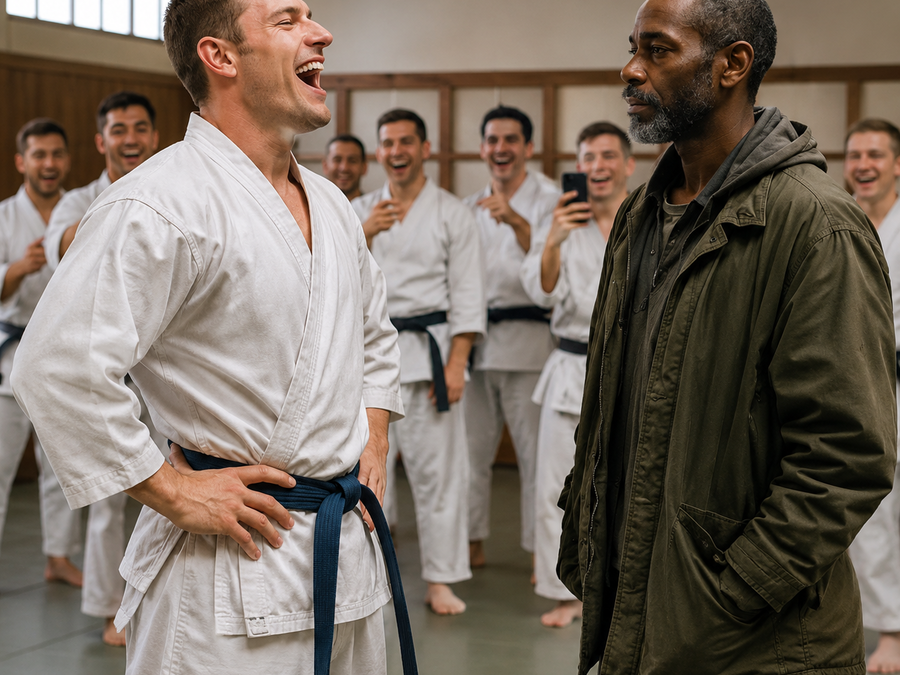
The students laughed, calling him “Sensei Bum,” never suspecting that beneath his worn jacket beat the heart of a master who’d forgotten more about martial arts than they’d ever learn.
When Harland finally invited him inside, no one expected the homeless man to step onto the mat and shatter not just their record, but every assumption they’d made about human worth.
The afternoon sun cast long shadows across the polished wooden floor of Harland’s Dojo, where twenty children moved in synchronized patterns.
Their white uniforms, crisp and bright under fluorescent lights, contrasted against the deep blue mats beneath their bare feet.
Parents lined the perimeter of the room, some scrolling through phones, others watching with proud smiles as their children practiced basic forms.
“Keep your back straight, Michael.
Emma, eyes forward,” called Mr.Harland, a broad-shouldered man in his fifties with salt-and-pepper hair and laugh lines that deepened when he smiled.
He walked between the rows of students, adjusting a stance here, demonstrating a movement there. His voice carried authority without harshness—the voice of someone who had spent decades teaching discipline through respect rather than fear.
Near the back of the viewing area, Sarah Miller leaned toward another mother and whispered behind her hand.
“Did you see him again today?
That homeless man.”
The other woman, Jennifer Adams, nodded with a concerned frown.
“Third time this week.
Just sleeping back there behind the dumpsters.
Tom says we should call the police, but Mr.Harland hasn’t seemed worried.”
“I heard he watches the classes sometimes,” Sarah continued, her voice dropping even lower.
“Just stands outside by the window.
Gives me the creeps.”
“Mom, did you see my kick?”
Eight-year-old Leo bounded over to his mother, Jennifer, his round face flushed with exertion and pride.
“It was amazing, sweetie.”
Jennifer smiled, momentarily forgetting the conversation.
“Now go finish your class.”
As Leo ran back to join the other students, Jennifer’s eyes drifted toward the side window.
For just a moment, she caught sight of a dark figure standing in the shadows, watching. Behind the dojo, Elliot Ray carefully folded the threadbare blanket that had served as his bed for the past three nights.
At forty-eight, his face showed the weathering of someone who had spent too many nights outdoors, but his eyes remained clear and observant.
His beard, though untrimmed, was clean, and despite his worn clothing, there was something in his posture that suggested dignity—shoulders straight, head held high. He methodically placed the blanket into his backpack alongside his few possessions: a dog-eared paperback, a water bottle, a small first-aid kit, and a faded photograph protected in plastic.
The distant sound of children’s voices counting in unison drifted from the dojo’s open back door.
One, two, three, four. Elliot paused, listening.
A small, almost imperceptible smile touched his lips before disappearing. He zipped his backpack and began gathering aluminum cans from around the dumpster, placing them carefully in a separate plastic bag.
Each movement was deliberate, economical—nothing wasted. The back door of the dojo opened suddenly, and Elliot straightened, ready to apologize or leave quickly if needed.
A young boy stepped out: Leo, the same one who’d been practicing his front kicks minutes earlier.
“Hi,” Leo said, curiosity written across his freckled face.
“Are you collecting those?”
Elliot nodded once.
“Yes.
Recycling.”
“Oh.”
Leo seemed surprised by the man’s voice—soft-spoken, articulate, with no trace of aggression.
“My mom says you sleep out here sometimes.”
“Sometimes,” Elliot acknowledged, no defensiveness in his tone.
“It’s quiet here.”
Leo glanced back at the door, then pulled a slightly squashed sandwich from his pocket.
“This is my extra lunch sandwich.
Mom always packs two, but I’m full already.”
He held it out, and Elliot hesitated, studying the boy’s face for signs of mockery or fear.
Finding none, he carefully accepted the offering.
“Thank you,” he said, bowing slightly from the waist in a gesture that seemed oddly formal.
“That’s very kind.”
Leo’s face lit up at the unexpected response.
He started to say something else when a sharp voice cut through the air.
“Leo!
Get back inside now.”
A tall teenager with a blue belt stood in the doorway, his arms crossed over his chest.
Travis Wilson, seventeen and the dojo’s most competitive student, glared at Elliot with undisguised disdain.
“Coming, Travis,” Leo called back, then whispered to Elliot, “Sorry,” before hurrying inside.
Travis lingered in the doorway.
“You need to stop hanging around here, man.
You’re freaking people out.”
Elliot said nothing, just continued gathering cans.
“What, you think you’re learning karate by staring through the window?
Hey, everybody!”
Travis called back into the dojo.
“Sensei Bum thinks he’s going to be a black belt!”
Laughter echoed from inside, and Travis smirked before shutting the door with unnecessary force.
Elliot remained still for a long moment, his expression unreadable.
Then he picked up his bags and moved toward the side of the building.
Inside, the advanced class had begun. Teenage students sparred in pairs while Mr.Harland observed, occasionally offering corrections.
Through the side window, Elliot watched a young girl practicing a kata—a choreographed sequence of movements. Her brow furrowed in concentration as she struggled with a particular turn.
Her foot placement was slightly off, causing her to lose balance at the pivot point. Without thinking, Elliot shifted his own stance, mirroring what she should be doing.
When she failed again, he shook his head slightly. The girl glanced up, noticing him through the window.
Instead of turning away, Elliot pantomimed the correction: weight on the back foot, front foot turned outward before the pivot. After a moment of hesitation, she tried it his way.
Perfect execution. Her face broke into a surprised smile, and she gave him a small wave before returning to practice.
What Elliot didn’t notice was Mr.Harland standing quietly in the corner, watching the entire exchange with thoughtful eyes.
Later, as twilight settled over the parking lot, Elliot sat on the curb behind the building, eating Leo’s sandwich and reading his paperback by the security light.
The door opened and he tensed, expecting Travis, or perhaps an angry parent. Instead, Mr.Harland stood there, two bottles of water in hand.
“Mind if I join you?”
he asked, his voice neutral.
Elliot shook his head, closing his book—Sun Tzu’s The Art of War.
Mr.Harland sat down on the curb, leaving a respectful distance between them, and offered one of the waters.
“I’m James Harland.
This is my dojo.”
“Elliot,” he replied, accepting the water with a nod of thanks.
“I apologize for loitering.
I’ll move on if it’s causing problems.”
Harland studied him, noting the careful articulation, the straight posture even while sitting on concrete.
“That was good advice you gave Caitlyn about her pivot.”
Elliot looked down.
“Force of habit.
I didn’t mean to interfere.”
“You’ve trained before.”
It wasn’t a question.
A long silence stretched between them.
Finally, Elliot sighed.
“A long time ago.”
Harland nodded, not pushing further.
“You’re welcome to watch from inside rather than through the window.
Might be more comfortable.”
Surprise flickered across Elliot’s face before he controlled it.
“That’s generous, but I don’t think everyone would be comfortable with that arrangement.”
“Probably not,” Harland agreed candidly.
“Their loss.”
He stood, brushing off his pants.
“The offer stands.
And Elliot—that spot behind the building, no one will bother you there.
At least it’s out of the rain.”
As Harland walked away, Elliot stared after him, a complex emotion crossing his weathered features—something between gratitude and weariness, as if kindness had become unfamiliar territory.
Over the next week, whispers about “the dojo stalker” spread through classes and parent circles.
Elliot continued his routine: collecting cans, reading in the parking lot, occasionally watching classes from a distance. Some days he disappeared entirely, only to return the following evening.
“Did you hear about the homeless guy?”
Michael asked during a water break, huddled with several other students.
“My dad says he might be dangerous.”
“He’s not dangerous,” Leo defended.
“He’s just quiet.”
“Then why does he hide and watch us?”
another student challenged.
“It’s weird.”
Travis, who had been listening nearby, snorted.
“Because he’s a creep.
Or maybe he thinks he’s learning secret ninja moves.”
He adopted an exaggerated stance, swaying drunkenly.
“Master of Trash-Fu!”
The children laughed—all except Leo, who looked uncomfortable. Unknown to them, Mr.Harland had been within earshot.
His eyes narrowed slightly, but he said nothing, deep in thought.
That evening, as Elliot sat reading on his usual curb spot, Caitlyn—the girl he’d helped with her kata—approached hesitantly, her mother waiting anxiously by their car.
“Thank you for helping me with my form,” she said quickly.
“I got it right at testing today.”
Before Elliot could respond, she thrust a small paper bag toward him and hurried back to her mother. Inside, he found an apple, a granola bar, and a handwritten note: Thank you, Sensei.
The word made something shift behind his eyes—a memory, perhaps, or a long-buried emotion. From the dojo doorway, Mr.Harland watched the exchange, the beginnings of an idea forming in his mind.
“Dude, check out what I posted.”
Travis laughed, showing his phone to a group of friends at the dojo entrance. On screen was a video of Elliot from afar, gathering cans and watching through the window, with the caption: Master of Trash-Fu: The Dojo Stalker.
Comments were already piling up, some laughing, others questioning whether it was right to mock someone down on their luck.
“That’s messed up, Travis,” said Miguel, one of the older students.
“Take it down.”
“Why?
It’s hilarious.
The guy’s been creeping around for weeks,” Travis defended.
“If he doesn’t want attention, he should go somewhere else.”
The argument was cut short as Mr.Harland called them inside for warm-ups.
Travis shoved his phone in his pocket, not noticing Leo watching from nearby with a troubled expression. Later that afternoon, Elliot returned to his spot behind the dojo.
The video had made its rounds, and several passing students pointed and whispered.
If he noticed, he gave no indication, sitting on the curb with the same quiet dignity, a newspaper spread across his lap.
Mr.Harland emerged from the back door, a bottle of water in one hand and a flyer in the other. He placed both beside Elliot.
“Open Mat Day tomorrow,” he said, tapping the flyer.
“Anyone can come in and practice.
No formal classes.”
Elliot glanced at the paper without touching it.
“I appreciate the thought, Mr.Harland.”
“Ever feel like showing them what you know?”
Harland asked casually, though his eyes were sharp.
A flicker of something—amusement, perhaps—crossed Elliot’s face.
“I doubt they’re interested in what I know.”
“You might be surprised.”
Harland straightened up.
“The offer stands.
Sometimes the best teaching comes from unexpected places.”
As Harland walked away, Elliot picked up the flyer, studying it thoughtfully before folding it neatly and tucking it into his book. Open Mat Day arrived with a larger crowd than usual.
Word had spread about the “dojo stalker,” and curiosity had drawn extra spectators.
Parents chatted in small groups while students practiced freely across the mat—some working on katas, others sparring lightly, the youngest ones simply tumbling and playing. Mr.Harland supervised it all with a watchful eye, occasionally offering guidance where needed.
His gaze frequently drifted to the door, as if expecting someone. Travis, showing off with high spinning kicks for a group of admirers, noticed Elliot quietly entering the dojo.
The homeless man stood just inside the doorway, still wearing his worn jeans and faded jacket, looking uncomfortable but determined.
A hush fell over the nearest students as they noticed him, the whispers quickly spreading throughout the room.
“Well, look who it is,” Travis called out loudly, walking toward Elliot with an exaggerated bow.
“The great master has decided to join us.”
Snickers rippled through the crowd.
Some parents shifted uneasily; others looked annoyed at the intrusion.
“You’ve been watching long enough,” Travis continued, playing to his audience.
“Come on, show us something.
Try something.”
Elliot remained still, his expression neutral.
“I’m just here to observe.
Mr.Harland invited me.”
“Did he now?”
Travis looked around for approval from his peers.
“Well, since you’re our guest, maybe you could demonstrate your incredible trash-can technique.”
More laughter, louder this time.
A few parents joined in, one father audibly muttering, “Why is that guy even in here?”
Elliot’s jaw tightened almost imperceptibly, but he made no move to leave or engage.
His eyes found Mr.Harland’s across the room, a silent question passing between them.
Before Harland could intervene, Leo pushed through the crowd, standing between Travis and Elliot.
“Stop it!”
the small boy demanded, his voice cracking slightly.
“He’s not hurting anybody.
He helped Caitlyn with her kata!”
“Oh, we’ve got a defender,” Travis laughed, ruffling Leo’s hair dismissively.
“Relax, kid.
We’re just having fun.”
“It’s not fun.
It’s mean,” Leo insisted, his small hands balled into fists at his sides.
The room grew uncomfortably quiet.
Mr.Harland finally stepped forward, his presence immediately commanding attention.
“That’s enough, Travis,” he said firmly, then turned to Elliot with a gentler expression.
“Actually, I was hoping you might demonstrate something for us today.
Just a kata.
No sparring.”
Murmurs swept through the room. Travis looked stunned, then smug, clearly expecting embarrassment to follow.
Elliot hesitated, scanning the faces around him: skeptical parents, curious children, mocking teenagers. Finally, his eyes settled on Leo, who looked up at him with complete faith.
“Just one,” Elliot agreed quietly.
He moved toward the center of the mat, removing his worn shoes and placing them neatly at the edge. In his socked feet, he stood silently for a moment, eyes closed, gathering himself.
A few snickers broke the silence, quickly hushed as Elliot began to move.
The transformation was immediate and stunning. His body, which had seemed ordinary moments before, suddenly displayed extraordinary control.
Each movement flowed with precision—blocks, strikes, turns executed with a grace that spoke of decades of practice. His worn clothing no longer seemed relevant as the form took shape: a complex kata that even the most advanced students recognized as far beyond their current abilities.
Silence fell over the dojo.
Every eye was fixed on Elliot as he moved through the final sequence, his breathing controlled, his focus absolute.
The kata concluded with a powerful strike that seemed to vibrate the air itself, followed by perfect stillness.
For several heartbeats, no one moved or spoke. Then a single person began to clap—Leo, his face shining with vindication.
Others joined, tentatively at first, then with genuine appreciation.
“That was Gojushiho,” Mr.Harland said into the silence that followed, naming one of the most advanced katas in karate.
“Fifty-four steps.
Few masters perform it that well.”
Parents began whispering urgently to one another.
Who is this guy? Did you see that?
I’ve never seen anything like it.
Travis stood slack-jawed, his earlier mockery forgotten.
When he finally recovered, his competitive nature surfaced.
“That was pretty good,” he admitted reluctantly.
“But kata is just choreography.
How about some light sparring?
You know, to show the kids some practical application.”
The challenge hung in the air.
Mr.Harland opened his mouth to intervene, but Elliot spoke first.
“Thank you for allowing me to share,” he said simply, bowing deeply to the room, then specifically to Travis.
Without another word, he walked back to his shoes, slipped them on, and headed for the door.
“Wait, you’re leaving?”
Travis called after him, a mix of relief and disappointment in his voice.
“What, afraid to spar?”
Elliot paused at the doorway, looking back with the first real smile anyone had seen on his face—small, but genuine.
“A good martial artist knows when to engage and when to walk away,” he said quietly.
“Another day, perhaps.”
With that, he was gone, leaving the dojo buzzing with speculation and Travis standing alone on the mat, his challenge unanswered, yet somehow still defeated.
The next morning, Mr.Harland arrived early at the dojo to find Elliot sitting on the front steps waiting.
“I appreciate what you did yesterday,” Elliot said without preamble.
“But I shouldn’t have come.
It’s caused more disruption than help.”
Harland unlocked the door, considering his words carefully.
“I disagree.
Those kids—and their parents—needed their assumptions challenged.
So did I.”
He pushed the door open and gestured for Elliot to follow him inside.
After a moment’s hesitation, Elliot did.
“Elliot M.
Ray,” Harland said once they were alone in his office.
“National karate champion, 2003, 2004, and 2005.
Former Marine.
Disappeared from the competition circuit in 2006.”
Elliot’s face remained impassive, but something flickered in his eyes.
“You’ve been researching me.”
“Of course I have.
A man with your talent shows up behind my dojo—I’d be a fool not to look into it.”
Harland leaned against his desk.
“What I can’t figure out is how a national champion ends up homeless.”
“Life doesn’t always bow to your plans,” Elliot replied, the practiced evenness of his tone suggesting he’d explained this many times before, or perhaps had stopped explaining it altogether.
“I won’t press you for details,” Harland said, “but I would like to make you an offer.
Help instruct my beginner classes.
In exchange, you get meals and a clean place to sleep in the back room.
It has a shower, a small fridge—not luxury, but—”
“Why?”
Elliot interrupted, genuine confusion breaking through his careful composure.
“You don’t know me.
And your clients—they won’t all approve.”
Harland smiled slightly.
“Because that kata yesterday wasn’t just technically perfect.
It had soul.
That’s rare.”
He paused.
“As for my clients, let me worry about them.
Some will complain.
Others will understand what an opportunity this is.”
Elliot looked away, conflict evident on his face.
“I haven’t taught in a very long time.”
“Like riding a bike,” Harland replied.
“Just without the falling-off part, hopefully.”
A reluctant smile tugged at Elliot’s mouth.
“I’ll consider it.”
Before Harland could respond, the front door chimed as someone entered the reception area.
They heard Leo’s voice, bright with excitement.
“Mom, can I show you the move Elliot did yesterday?
Please?”
Elliot and Harland exchanged a look.
“Think about it,” Harland said quietly.
“But don’t think too long.
That boy out there already believes in you.
Others will follow.”
As they walked out to greet Leo and his mother, neither man noticed Travis’s father watching through the front window, his expression dark with disapproval as he took out his phone and began typing a message to other parents.
The whispers that had started yesterday were about to become much louder. By afternoon, word had spread through the parent community.
Opinions were sharply divided—some excited about a former champion possibly teaching their children, others uncomfortable with Harland’s decision to invite a homeless man into their carefully cultivated space.
PART 2
Travis stood in his kitchen listening to his father on the phone.
“I’m telling you, Dave, it’s completely inappropriate.
I don’t care if he was a champion twenty years ago.
The man’s been living behind dumpsters.
Who knows what issues he has?
And Harland just brings him in without consulting any of us.”
Travis thought about the kata he’d witnessed—the undeniable skill, the intensity of focus.
Despite himself, he was impressed and troubled.
The man he’d mocked so easily had turned out to be something entirely different from what he’d assumed.
His father hung up, looking satisfied.
“Well, that’s that.
Dave is contacting the local paper.
If Harland wants to make this a public matter, so will we.”
“Dad,” Travis began hesitantly.
“Maybe we should—”
“Travis, trust me,” his father cut him off.
“People like that need help, sure, but not around children—not teaching our kids.
There are proper channels for that sort of thing.”
Travis nodded, but doubt lingered. He picked up his phone, thumb hovering over the delete button on his Master of Trash-Fu post.
After a moment’s hesitation, he put the phone down without taking action, the mocking image still visible on his screen.
The early morning light filtered through the blinds of Mr.Harland’s office as he sat hunched over his computer, coffee cooling beside him.
The search results on his screen painted a picture of a life in fragments: newspaper clippings, tournament results, military commendations.
Elliot M.
Ray—three consecutive national karate championships in the early 2000s, distinguished service in the Marines, featured in Martial Arts Today as one of America’s most promising competitors.
And then, nothing.
After 2006, Elliot Ray simply vanished from public record.
Harland leaned back, rubbing his tired eyes.
The man sleeping on the training mat in his back room—the same man who had been gathering cans behind his dumpster for weeks—was more than just a fallen champion. There was a deeper story here.
The office door creaked open, startling him from his thoughts.
He closed the browser quickly, like a man caught prying into someone’s diary.
Elliot stood in the doorway, his borrowed clothes—a plain gray T-shirt and black sweatpants from Harland’s lost-and-found—hanging loosely on his frame.
Despite the simple attire, there was something changed about him. Perhaps it was the clean-shaven face or the shower-damp hair, but he looked ten years younger than the man who had performed that stunning kata.
“Morning,” Harland said, gesturing to the coffee maker.
“Help yourself.”
Elliot nodded in thanks, pouring a cup. His movements were economical, precise—the same efficiency Harland had noticed in his kata.
“Sleep okay?”
Harland asked.
“Better than I have in months,” Elliot admitted, his voice still carrying that unexpected gentleness that contrasted with his weathered appearance.
“Thank you.”
Harland waved away the gratitude.
“I’ve been looking into your background,” he said directly, seeing no point in deception.
“You were exceptional.
Why did you stop?
You could have run a dojo of your own.”
Something closed off in Elliot’s expression—not anger, but a practiced protection, like a door being quietly shut.
“Life doesn’t always bow to your plans,” he repeated from their earlier conversation, the phrase sounding more like a personal mantra than a casual observation.
Harland waited, letting silence do the work of encouragement.
Elliot sighed, looking down into his coffee.
“My wife, Amara—she got sick in 2006.
Cancer.
We had insurance, but…”
He shook his head.
“Anyone who’s been through it knows insurance only covers so much.
Experimental treatments, specialty care, medications not on the approved list.
It adds up.”
The words came slowly at first, then with increasing momentum, as if a dam had broken after years of pressure.
“I was competing, teaching, working security on the side, sleeping maybe three hours a night.
It still wasn’t enough.”
Elliot’s gaze drifted to the window.
“We sold everything.
The car, the house, my tournament medals.
Borrowed from everyone we knew.
After she died, I just couldn’t go back to the circuit.
Couldn’t face those people with their concerns about tournament standings when my whole world had collapsed.”
Harland nodded, understanding filling the spaces between Elliot’s words.
“The debt followed you like a shadow.”
Elliot confirmed it with a quiet nod.
“I worked construction, security, whatever I could find.
Then the economy crashed, and I…”
He straightened his shoulders slightly.
“Excuses don’t change reality.
I ended up where I ended up.”
“And now?”
Harland asked. Elliot met his eyes directly.
“Now I’m here.”
“For how long?”
“I don’t know.”
“Stay,” Harland said simply.
“Help me teach.
Not just the beginners—all of them.
They could learn from you.”
“Your clients might have something to say about that,” Elliot pointed out.
As if on cue, the front door chimed.
Jennifer Adams, Leo’s mother, walked in, her expression determined.
“Mr.Harland, I need to talk to you about—” She stopped short at the sight of Elliot, recognition and surprise crossing her face.
“Mrs.Adams,” Harland greeted her.
“You know Mr.Ray.
He’s going to be helping out around the dojo.”
Jennifer hesitated, then extended her hand.
“Leo hasn’t stopped talking about your demonstration.
He says you’re the best he’s ever seen.”
Elliot shook her hand, a flicker of surprise in his eyes at the gesture.
“He’s a good kid.
Respectful.
That speaks well of his parents.”
“Some of the other parents aren’t as…”
Jennifer paused, searching for the right word.
“Open-minded.
There’s a petition going around, and someone contacted the Herald.”
Harland sighed.
“I expected as much.”
“I should go,” Elliot said quietly.
“No,” Jennifer said with unexpected firmness.
“No, you shouldn’t.
Leo’s gained more confidence in the past week than in months of classes.
He told me how you helped him with his stance when no one was looking, how you never made him feel stupid for asking questions.”
She turned to Harland.
“I’ll talk to the other parents.
Some will listen.”
Harland smiled gratefully.
“And the others?”
Jennifer shrugged.
“They’ll come around when their kids start improving under Mr.Ray’s instruction.”
After she left, Elliot and Harland stood in thoughtful silence.
“Looks like you’ve got at least one supporter,” Harland finally said.
“One is more than I had a week ago,” Elliot replied, the ghost of a smile touching his lips.
The next afternoon, a sleek silver sedan pulled into the dojo parking lot. A young woman in a pressed blazer emerged, notebook in hand, her eyes sharp with the hunger of a journalist sensing a story.
Megan Taylor, twenty-six, had been with the Herald for just under a year—long enough to know that human-interest stories were her ticket to bigger assignments. And this one had all the elements: a fallen champion, controversy, redemption.
If it played out right, it could be her first feature. Inside, she found Harland leading a class of teenagers through drills.
Off to the side, a man she immediately recognized as Elliot Ray from her research was quietly demonstrating a technique to Leo.
“Keep your weight centered,” he was saying, gently adjusting the boy’s stance.
“Power comes from balance, not just strength.”
Megan watched, noting the natural authority in Elliot’s manner—not imposed, but earned.
The contrast between his worn appearance and fluid movements was striking.
After class, Harland introduced them.
“Elliot, this is Megan Taylor from the Herald.
She’d like to interview you.”
Weariness immediately replaced the calm focus in Elliot’s eyes.
“I’m not interested in being a story, Ms.Taylor.”
“People are already talking,” she countered.
“Wouldn’t you rather they heard the truth from you than speculation from others?”
Elliot considered this, then nodded once.
“No photographs.”
They sat in Harland’s office, the door left partially open.
Megan positioned her recorder between them.
“Let’s start with the obvious question,” she began.
“How does a national champion end up homeless?”
“The same way anyone does,” Elliot replied evenly.
“One loss at a time.”
He shared the outline of his story—the competitions, his wife’s illness, the crushing debt—without self-pity or dramatization.
Facts stated plainly, as if reading a weather report.
“Do you want people to feel sorry for you?”
Megan asked bluntly.
Elliot’s response was immediate and firm.
“No.
Pity is useless to everyone involved.”
“Then what do you want?”
The question seemed to catch him off guard.
He was silent for a long moment.
“Dignity,” he finally said.
“The same thing everyone wants.”
Megan’s expression softened slightly.
“Some parents are concerned about your situation.
They worry about having their children taught by someone who’s been living on the streets.”
“Their concern is natural,” Elliot acknowledged.
“I would worry too in their position.
All I can offer is my knowledge, and my word that I would never bring harm to any student.”
“And what would you say to those who think you’re exploiting this situation, using Mr.Harland’s generosity?”
A flicker of something—perhaps anger, quickly controlled—crossed Elliot’s face.
“I’d say judgment comes easily to those who’ve never had to ask for help.”
Megan nodded, writing that down word for word.
“One last question, Mr.Ray.
What do you hope to achieve here?”
Elliot looked through the partially open door, where Leo was still practicing the move he’d been taught earlier.
“Second chances are rare,” he said quietly.
“I’m just trying not to waste mine.”
As Megan’s article took shape at the Herald office, life at the dojo settled into a new rhythm.
Elliot began teaching fundamentals to the beginner classes, his patient instruction drawing positive feedback from most students and parents. But not all.
“I don’t understand how you can allow this,” Mark Wilson, Travis’s father, confronted Harland after a class.
“The man was living behind your dumpster, for God’s sake.”
“And now he’s not,” Harland replied calmly.
“He’s a certified instructor with more tournament experience than anyone in this county.”
“That was twenty years ago.
Who knows what’s happened since then?”
Mark lowered his voice, though his anger remained evident.
“My son says he disappeared for three days last week.
Where did he go? What was he doing?
Have you even run a background check?”
Across the dojo, Travis watched the argument with discomfort.
Since Elliot’s demonstration, he’d found himself oddly conflicted.
The skills Elliot displayed were undeniable—exactly the kind of mastery Travis aspired to.
Yet admitting this meant acknowledging how wrong he’d been in his mockery.
Meanwhile, Leo had attached himself to Elliot like a shadow, absorbing every correction, every instruction with remarkable dedication. Other younger students had begun to follow his example, forming a small but devoted group.
After hours, when the dojo emptied, Elliot would train alone, moving through advanced katas with an intensity that spoke of more than practice. It was almost like meditation, a way of processing emotions too complex for words.
One evening, Harland stayed late, watching from the doorway as Elliot executed a particularly challenging sequence.
“You’re holding back when you teach,” Harland observed.
“Why?”
Elliot completed the form before answering.
“They’re not ready for more.”
“Some are.
Travis, for instance.”
A complicated expression crossed Elliot’s face.
“Travis has talent and anger.
A dangerous combination.”
Harland nodded in agreement.
“He’s trying to figure you out.
They all are.”
He paused.
“Did you know we have a board-breaking record here?
Eight stacked pine boards.
No one’s touched it in twelve years.”
Elliot raised an eyebrow.
“Your point?”
“Sometimes people need something tangible—something they can see and hear.
Breaking boards isn’t about strength.
It’s about focus, commitment, following through.”
Harland smiled slightly.
“Just something to think about.”
As Harland turned to leave, Elliot called after him.
“Whose record is it?
The eight boards.”
“Mine,” Harland replied.
“From when this place first opened and I had something to prove.”
Elliot nodded thoughtfully, turning back to his training with renewed concentration.
The Herald article appeared the following Sunday, featuring Elliot’s story under the headline: From Champion to Homeless: A Master’s Return to the Mat.
Megan had written it with surprising sensitivity, focusing on Elliot’s journey without sensationalism.
She described his teaching style, the respect he showed each student, and included quotes from Leo and Jennifer about the positive impact he’d had.
The article didn’t shy away from controversy—Mark Wilson’s concerns were presented alongside Harland’s defense—but the overall tone suggested a community finding its way toward acceptance.
That morning, Elliot sat on the dojo steps, reading the article with mixed emotions.
The story was fair, more than he’d expected.
But seeing his life laid out in black and white brought a strange vulnerability.
“Is it weird?”
Leo asked, plopping down beside him.
“Seeing yourself in the newspaper?”
Elliot folded the paper carefully.
“A little.”
“My mom says you’re famous now,” Leo continued, swinging his legs.
“She says more people will come to learn from you.”
“Maybe,” Elliot allowed.
“Can you teach me to break boards?”
Leo asked suddenly.
“Like Mr.Harland’s record?”
Elliot studied the boy thoughtfully.
“Breaking isn’t about strength, Leo.
It’s about focus.
Seeing through the obstacle, not at it.”
“Like when I’m scared of something?”
A genuine smile spread across Elliot’s face, a rare sight that transformed his features.
“Exactly like that.”
Leo beamed at the approval.
“Will you try to break Mr.Harland’s record someday?”
The question hung in the air as other students began arriving for morning classes.
Elliot rose, offering Leo a hand up.
“Some records exist to inspire, not to be broken,” he said cryptically.
But later, when the dojo was empty, Elliot examined the breaking stands and boards stored in the equipment room, his expression thoughtful. The article changed everything.
Within a week, class sizes had doubled.
Parents from across town brought their children to see the “homeless karate master”—some out of genuine interest, others from morbid curiosity.
Elliot weathered the attention with quiet dignity, focusing on teaching rather than the whispers that followed him.
Harland expanded the class schedule to accommodate the influx, with Elliot handling most beginner and intermediate sessions.
One afternoon, as Elliot demonstrated a defensive technique to a crowded class, he noticed a camera phone pointed at him from the viewing area. A quick series of emotions crossed his face—discomfort, resignation, then determination—as he continued the lesson without acknowledging the intrusion.
Later, Harland found him in the back room, staring at his phone with a troubled expression.
“Everything okay?”
Harland asked.
Wordlessly, Elliot turned the phone toward him.
On screen was a social media post—a video of Elliot teaching, already with thousands of views and comments ranging from supportive to cruelly mocking.
“It’ll pass,” Harland reassured him.
“People will find something else to talk about.”
But they didn’t.
More videos appeared.
Local TV stations called requesting interviews.
A sports channel producer left a message about a potential documentary.
Through it all, Elliot maintained his routine: teaching, training, helping around the dojo. He declined all interview requests and avoided cameras when possible.
The back room became his sanctuary—sparse, but private. One evening, as he organized equipment after classes, Travis entered the dojo alone.
The two had maintained a careful distance since Elliot’s demonstration, with Travis attending Harland’s advanced classes rather than Elliot’s.
“Need something?”
Elliot asked, not pausing in his work. Travis shifted uncomfortably.
“My dad’s organizing some of the parents against you being here.”
Elliot nodded, unsurprised.
“I know.”
“He says you got kicked out of competition—that you were violent.”
Travis hesitated.
“Is that true?”
Elliot set down the training pads he’d been stacking.
“No.”
“Then why’d you disappear?
You were at the top.”
“Sometimes life gives you different priorities.”
Elliot studied Travis thoughtfully.
“Your reverse punch has power, but you drop your guard when you execute it.”
The abrupt change of subject caught Travis off balance.
“What?”
“Tomorrow, 6:00 a.m., before regular classes.
I’ll show you how to fix it.”
Elliot returned to his task, effectively ending the conversation. Travis stood there a moment longer, confusion evident on his face, before leaving without another word.
The next morning, to Elliot’s mild surprise, Travis showed up at exactly six.
They worked for an hour on form and technique, with Elliot offering corrections without commentary or judgment.
By the end, Travis’s punches were sharper, his guard more consistent.
“Why are you helping me?”
Travis asked finally, wiping sweat from his face.
“I was a jerk to you.”
“You were,” Elliot agreed without heat.
“But your potential is more important than your past mistakes.
True for all of us.”
Before Travis could respond, the door opened and his father walked in, stopping short at the sight of them training together.
“Travis, what are you doing here?”
Mark demanded.
“Training, Dad.
Mr.Ray was showing me how to improve my reverse punch.”
Mark’s expression darkened.
“Get your things.
We’re leaving.”
“But—”
“Now, Travis.”
The tension in the room was palpable as Travis gathered his gear. He glanced apologetically at Elliot before following his father out.
Through the window, Elliot could see them arguing in the parking lot, Mark gesturing angrily, Travis defensive. The encounter left a bitter taste—one Elliot recognized all too well.
Later that day, Harland called a staff meeting, which with just the two of them meant coffee in his office.
“I’ve had an idea,” Harland began.
“A fundraiser—Dojo Challenge Day.
Open to the public. Demonstrations, competitions.
The proceeds would go to the Westside Shelter.”
Elliot raised an eyebrow.
“The shelter where I stayed sometimes.”
“Exactly.
It’s good PR for the dojo, helps a worthy cause, and—”
“Legitimizes my presence here,” Elliot finished.
Harland didn’t deny it.
“The community needs to see you as more than a curiosity or a charity case.
This puts the focus on what you can contribute.”
Elliot considered it, turning the paper with Harland’s notes toward him.
“Board-breaking exhibition?”
“People love it.
Very visual.”
Harland hesitated.
“I was thinking maybe you’d consider attempting the record.”
“Your record?”
“It’s just a number.”
Harland shrugged.
“Records exist to be broken.”
Before Elliot could respond, Leo burst into the office, excitement radiating from him.
“Mr.Ray!
My mom says I can join the demonstration team if you think I’m ready!”
The interruption shifted the mood immediately.
Elliot smiled at the boy’s enthusiasm.
“We’ll need to work on your form,” he said, rising from his chair.
“Let’s see what you’ve got.”
As they moved to the training floor, Harland watched thoughtfully. The fundraiser idea had taken root, and he began making calls that afternoon.
Local businesses agreed to sponsor.
The Herald promised coverage. Even the mayor expressed interest in attending.
What no one anticipated was how quickly things would unravel. Three days before the fundraiser, Travis approached Elliot after class, his expression troubled.
“My dad found some old videos of you,” he said without preamble.
“From a tournament in 2005.
He’s showing them to the other parents.”
Elliot’s face revealed nothing.
“What videos?”
“You fighting some guy.
It got really intense.
You…”
Travis hesitated.
“You broke his arm.”
A long silence stretched between them.
“Tournament fighting has consequences,” Elliot finally said.
“Injuries happen.”
“He’s saying you did it on purpose—that you got disqualified.”
Elliot closed his eyes briefly.
“The match was reviewed by officials.
I was cleared of intentional misconduct, but yes, I was disqualified from that event.”
“Why didn’t you tell anyone?”
“Because it doesn’t matter anymore,” Elliot replied, a rare edge entering his voice.
“It was twenty years ago.”
PART 3
But it did matter, as became evident the next day when parents began pulling their children from classes. The whispers had turned to open concern.
Someone had edited the old tournament footage, showing only the moment of injury on a loop without context. Mark Wilson had organized his campaign well.
By evening, half the students had canceled their attendance at the fundraiser.
Local businesses began withdrawing their sponsorship.
The final blow came when Harland found graffiti spray-painted across the dojo door: Bums don’t belong here.
Elliot stood silently as Harland photographed the vandalism for the police report.
His face was impassive, but something had changed in his posture—a subtle withdrawal, as if he were already preparing to leave.
“This doesn’t change anything,” Harland insisted, though his voice lacked conviction.
“We’ll still hold the fundraiser.
People will see the truth.”
Elliot shook his head slowly.
“I’ve brought trouble to your door—literally.”
He gestured to the graffiti.
“You’ve been good to me, James.
Better than anyone has in years.
I won’t repay that by damaging what you’ve built.”
“So you’re just going to leave?
Let them win?”
Harland demanded, frustration evident.
“Sometimes walking away takes more strength than staying to fight,” Elliot replied quietly.
That night, storm clouds gathered over the city, matching the mood inside the dojo.
Elliot packed his few belongings into his backpack, leaving the borrowed clothes neatly folded on the cot.
On top, he placed a handwritten note for Harland. As rain began to fall, he slipped out the back door into the darkness, the weight of failure familiar on his shoulders.
Morning brought no relief from the storm.
Harland arrived early, already knowing what he would find: the back room empty, the note on the cot simple and direct.
Thank you for believing in me.
Some debts can’t be repaid, but I’ll try.
The students deserve better than controversy.
—E.
Harland crumpled the note in his fist, anger and disappointment warring in his expression. Outside, volunteers were setting up for the fundraiser despite the rain, their enthusiasm dampened but not extinguished.
Leo arrived with Jennifer, immediately searching for Elliot.
“Where’s Mr.Ray?”
he asked, his small face creased with worry.
“He promised to help me with my demonstration.”
Harland knelt to the boy’s level.
“Elliot had to leave for a while, Leo.
I’m not sure when he’ll be back.”
“But he has to come,” Leo insisted, tears welling in his eyes.
“He promised!
And he’s supposed to break the boards!”
Jennifer placed a gentle hand on her son’s shoulder.
“Leo, sometimes people have to leave even when they don’t want to.”
“He’ll come back,” Leo said with absolute certainty.
“He wouldn’t leave without saying goodbye.”
As the day progressed, the rain intensified.
Attendance was sparse.
The local news crew arrived, but their interest had shifted from a feel-good story to controversy. Mark Wilson gave an interview outside, speaking of community standards and proper role models.
Inside, Harland went through the motions, leading demonstrations with the students who had remained loyal.
The board-breaking exhibition was postponed, then canceled as equipment was damaged by rain leaking through the roof. By evening, it was clear the fundraiser had failed.
Volunteers began packing up early, expressions grim.
“He’s not coming, is he?”
Leo asked as the last guest departed, his earlier confidence fading.
Harland looked out at the rain-swept parking lot.
“I don’t think so, buddy.”
“It’s not fair,” Leo said, his voice small.
“He was good.
He helped everyone.”
“Life isn’t always fair,” Harland replied, the words tasting bitter.
“Sometimes the people who deserve a second chance don’t get one.”
As they turned to go inside, headlights swept across the lot. A taxi pulled up and a figure emerged—Elliot, soaked from the brief walk, a determined set to his shoulders.
Leo broke into a run.
“Mr.Ray!
You came back!”
Elliot caught the boy in a one-armed hug, his expression softening.
“I made a promise.”
Harland approached more slowly, questioning without words.
“I came for the boy,” Elliot explained simply.
“And for myself.”
He looked past Harland to the nearly empty dojo, the abandoned fundraiser setup, and nodded once, accepting the situation without comment.
“We still have the boards,” Harland said after a moment.
“If you’re interested.”
A small smile touched Elliot’s lips.
“Let’s give them something to remember.”
As they walked inside together, the rain began to ease, clouds parting to reveal the first stars of evening—small points of light in the darkness, persistent and unwavering. The morning after the failed fundraiser dawned clear and bright, as if nature itself had decided to grant a fresh start.
Inside the dojo, Harland and a small group of volunteers worked quickly to salvage what they could of the event. Tables were wiped dry, equipment checked for water damage, and a makeshift schedule hastily drawn up.
“You really think people will come back?”
Jennifer asked as she helped Leo arrange chairs in front of the demonstration area.
Harland glanced toward the back room, where Elliot was changing into a clean gi he’d provided.
“They will.
Trust me.”
The doubt in Jennifer’s eyes was clear, but she nodded, turning back to her task with renewed determination.
In the back room, Elliot stood before a small mirror, adjusting the white uniform that felt both foreign and familiar against his skin.
It had been years since he’d worn a proper gi, the fabric crisp and weighted with memory and meaning.
He ran his fingers along the worn black belt Harland had lent him, tracing the frayed edges that spoke of years of dedication. A soft knock interrupted his thoughts.
“People are starting to arrive,” Harland said, leaning against the doorframe.
“More than I expected.”
Elliot nodded, tightening the belt with practiced motions.
“Thank you for this,” he said quietly.
“Whatever happens today—thank you.”
Harland studied him for a moment.
“You ready to break some boards?”
A small smile touched Elliot’s lips.
“Let’s not get ahead of ourselves.”
As they walked toward the main floor, the sounds of voices grew louder—curious, excited, skeptical.
Word had spread overnight about Elliot’s return, drawing an unexpected crowd despite the previous day’s disaster.
Stepping into the training area, Elliot was momentarily taken aback by the number of people: parents, students, community members, even a few faces he recognized from his nights at the shelter. Near the back, a local news crew set up cameras while Megan from the Herald scribbled notes in the front row.
“There he is,” someone whispered loudly.
“The homeless karate guy.”
Leo broke away from his mother and ran to Elliot’s side.
“I told them you’d come back,” he said proudly.
“Nobody believed me, but I knew.”
Elliot placed a gentle hand on the boy’s shoulder, drawing strength from his unwavering faith.
At precisely ten o’clock, Harland stepped to the center of the mat and raised his hands for quiet.
The murmurs gradually faded as all eyes turned to him.
“Thank you all for coming to our rescheduled Dojo Challenge Day,” he began, his voice carrying easily through the room.
“As many of you know, yesterday didn’t go quite as planned.”
This drew a few sympathetic chuckles.
“But sometimes life’s greatest lessons come from our biggest challenges.”
Harland gestured toward Elliot, who stood tall and composed despite the scrutiny.
“I’d like to introduce—or reintroduce—someone special.
Many of you know him as the man from the newspaper article or the viral videos.
Some of you have already benefited from his instruction.”
He paused, meeting several gazes directly.
“But I want you to know him as I do.
Not as a homeless man, though circumstances brought him there for a time—but as a veteran who served this country with honor, as a national champion whose skill remains undiminished by hardship, and as a teacher life sent us when we weren’t ready to listen.”
A murmur ran through the crowd, some nodding in approval, others shifting uncomfortably.
“Today, Elliot Ray will demonstrate what decades of dedication to martial arts looks like—not for glory or attention, but to remind us all that human worth isn’t determined by an address or a bank account.”
With that, Harland stepped back, and Elliot moved to the center of the mat. He bowed deeply—first to Harland as the dojo master, then to the audience, and finally to the space itself, honoring the tradition of the art.
The room fell silent as Elliot began a complex kata, different from the one he’d performed during his first visit.
Where that had been a display of technical perfection, this was something more intimate.
Each movement flowed with a liquid grace that made it appear both effortless and impossible, telling a story of struggle, perseverance, and hard-won peace. When the final movement concluded, there was a heartbeat of silence before applause erupted—hesitant at first, then growing in confidence.
As the clapping subsided, a voice cut through from the back of the room.
“That’s all very pretty,” Travis said, stepping forward onto the mat.
“But kata is just choreography, right?”
He looked directly at Elliot.
“You said real martial arts is about application.”
Harland moved to intervene, but Elliot raised a hand to stop him.
“You’re right,” he agreed, surprising Travis.
“Would you like to demonstrate with me?”
Travis nodded, a complex mix of emotions crossing his face: determination, nervousness, and something like respect.
“Light contact only,” Harland cautioned as Travis took position opposite Elliot.
What followed wasn’t the confrontation many expected.
Instead, it became an impromptu lesson, with Elliot calling out techniques and Travis executing them—Elliot blocking, redirecting, occasionally demonstrating counters at reduced speed and power.
It was collaborative rather than competitive, highlighting both Travis’s skill and Elliot’s control.
After several minutes, they paused, and Travis, breathing hard but energized, turned to the audience.
“Mr.Ray has been helping me refine my techniques,” he announced, surprising his fellow students.
“There’s not a person in this room who couldn’t learn something from him—even those of us who thought we knew it all.”
The last part was delivered with a rueful smile that drew appreciative laughter. As Travis rejoined the audience, Elliot caught sight of Mark Wilson standing near the door, his expression unreadable.
The demonstrations continued—younger students showing forms they’d practiced with Elliot, Jennifer leading a self-defense workshop for parents.
Throughout it all, Elliot moved between groups, offering quiet guidance and encouragement. By early afternoon, the energy in the dojo had transformed.
Skepticism had given way to curiosity, and in many cases, genuine admiration. Donation boxes for the shelter filled steadily as people browsed silent-auction items and signed up for special workshops.
It was during a brief lull in activities that someone from the crowd called out, “What about the board-breaking record?
Is that still happening?”
All eyes turned to Harland, who looked at Elliot questioningly.
“The record stands at eight boards,” Harland explained to the audience.
“Set by myself twelve years ago.
It’s a test of focus and power—pine boards, one inch thick, stacked together.”
A murmur of interest spread through the room.
“Well?”
the same voice pressed.
“Is he going to try it?”
Elliot stepped forward, his expression calm.
“If it will help raise funds for the shelter—yes.”
The announcement sent a ripple of excitement through the crowd. People who had been preparing to leave found seats again.
The news crew repositioned their cameras.
Even Mark Wilson moved closer, curiosity overcoming his previous disdain. As Harland and Travis set up the breaking stand, Leo approached Elliot with a bottle of water.
“Are you nervous?”
the boy asked. Elliot took a sip before answering.
“Respect the challenge, but don’t fear it.
That’s the balance.”
Leo nodded solemnly.
“Like when I was afraid to try the flying kick, and you said the ground would still be there either way.”
A genuine smile warmed Elliot’s face.
“Exactly like that.”
When the time came, Harland placed eight boards in the stand, then looked at Elliot.
“This is the record.
Want to warm up with fewer first?”
Elliot shook his head.
“No.
But I’d like to try nine.”
A hush fell over the room.
Harland raised his eyebrows, then added another board to the stack. Nine one-inch pine boards—a feat very few could accomplish.
As Elliot positioned himself before the target, the room grew so quiet that the sound of the air conditioning seemed intrusive. He closed his eyes, centering himself.
Those watching saw not the homeless man from behind the dumpster, but a martial artist in his element—focused, composed, present.
With deliberate movements, Elliot raised his right arm, preparing for a downward elbow strike, one of the most powerful breaking techniques.
He drew a deep breath, held it, and then—
“Wait,” he said suddenly, opening his eyes.
“One more.”
Murmurs of surprise rippled through the audience as Harland, after a moment’s hesitation, added a tenth board.
“Ten boards,” Harland announced, his voice betraying a mix of concern and awe.
“No one has ever attempted this many in this dojo.”
Elliot resumed his stance, closed his eyes once more, and breathed deeply. In that moment of perfect stillness, it seemed as if the entire room breathed with him, a collective holding of breath in anticipation.
When the strike came, it was almost too fast to follow—a blur of controlled power, his elbow driving down through the center of the stack with an explosive kiai shout that seemed to come from his very core.
CRACK! The sound was like a gunshot in the quiet room.
For a split second, nothing seemed to happen. And then all ten boards separated cleanly, falling away from the stand in perfect halves.
The room erupted.
People jumped to their feet, applauding and cheering.
Leo’s excited voice could be heard above the din: “He did it!
He broke them all!”
Elliot straightened, breathing hard but composed, and bowed to the audience.
As he did, his eyes met Mark Wilson’s across the room.
The man gave a single, almost imperceptible nod before turning away—not acceptance, perhaps, but acknowledgment.
Harland clapped a hand on Elliot’s shoulder, grinning broadly.
“I think we just raised a lot of money for that shelter,” he said.
As cameras flashed and people pressed forward with congratulations, Elliot felt something he hadn’t experienced in years: a sense of belonging.
Hard-won and fragile, but real.
The room’s explosion of energy following Elliot’s board break seemed to reverberate beyond the dojo walls.
Children rushed forward, wide-eyed with excitement.
Parents clapped enthusiastically, some even standing on chairs to capture the moment on their phones.
Leo jumped up and down, tugging at his mother’s hand and pointing.
“Did you see?
Ten boards!
Ten!”
Reporters surged toward Elliot, microphones extended, questions overlapping.
How does it feel to break the record? Was this a comeback moment for you?
What message do you have for people who doubted you?
Harland stepped in, creating a buffer between Elliot and the press.
“Let’s give Mr.Ray some space.
There’ll be time for questions later.”
As the initial chaos subsided, people formed a more orderly line to congratulate Elliot. Among them was Sarah Miller, one of the mothers who had been most vocal about her concerns.
“I owe you an apology,” she said quietly, extending her hand.
“I judged without knowing.
My son Michael has talked about nothing but your classes for weeks.”
Elliot shook her hand, his expression warm but reserved.
“No apology needed.
Caution around your children is never wrong.”
More parents approached with similar sentiments—some openly apologetic, others offering gift cards, business cards with job leads, or simply heartfelt thanks for what he had taught their children. An older man in a suit made his way through the crowd.
“Mr.Ray, Tom Bradley, First National Bank.
I’d like to discuss opening an account for you.
We have programs for veterans reestablishing credit.”
Before Elliot could respond, another voice chimed in.
“And I’m Lisa Jameson from Veteran Housing Alliance.
We should talk when you have a moment.”
The offers continued—temporary housing, job interviews, donations to the shelter in his name.
Elliot accepted each with quiet dignity, neither dismissing the help nor appearing overwhelmed by it.
From across the room, Travis watched the scene unfold, a complicated mix of emotions playing across his face.
He started forward, hesitated, then continued with determined steps until he stood before Elliot.
“Can I talk to you?”
he asked.
“Privately?”
Elliot nodded, and they moved to a quieter corner while Harland continued managing the crowd.
“I was wrong about you,” Travis said without preamble.
“And I’m sorry for how I acted.
The video I posted—all of it.”
“Apology accepted,” Elliot replied simply.
Travis shifted uncomfortably.
“My dad…
he still has issues with all this, but I wanted you to know I deleted that video and I told people the truth about who you really are.”
Elliot studied the young man thoughtfully.
“That took courage.”
“Not compared to what you did.”
Travis hesitated.
“There’s an event at the shelter next weekend.
Some of us are going to volunteer.
Would you—would you come?
Maybe show us some techniques we could teach the kids there?”
A look of genuine surprise crossed Elliot’s face, followed by a smile that reached his eyes.
“I’d be honored.”
Meanwhile, Megan from the Herald was typing furiously on her tablet, her exclusive coverage of the event already taking shape.
“This is going viral by tonight,” she told Jennifer.
“ESPN picked up clips from our livestream.
Someone from a sports channel is flying in tomorrow for an interview.”
Jennifer watched Elliot across the room, now surrounded by children asking him to sign their belts.
“Will all this attention be good for him?”
Megan followed her gaze.
“Fame is tricky, but I think he can handle it.
There’s something solid about him, like he knows exactly who he is, even when the world tried to tell him otherwise.”
By Monday morning, Elliot had become a local celebrity. Clips of the board break had indeed gone viral, garnering millions of views across multiple platforms.
A sports channel had requested an exclusive interview, and three martial arts magazines had reached out for feature stories. City Hall called Harland personally: the mayor wanted to visit the dojo later that week to present a community service award and discuss a potential partnership for at-risk youth programs.
“It’s crazy out there,” Harland said, closing the blinds against the small group of reporters who had gathered in the parking lot.
“How are you holding up?”
Elliot sat cross-legged on the mat, as composed as ever despite the whirlwind around him.
“I’ve seen both extremes now—being invisible and being too visible.
Neither defines me.”
Harland nodded appreciatively.
“The mayor’s visit is good publicity for the dojo, but say the word and I’ll cancel.”
“No need,” Elliot assured him.
“This isn’t just about me anymore.”
In the days that followed, Elliot maintained his teaching schedule while navigating the newfound attention.
With quiet grace, he agreed to a single television interview, during which he spoke not of his own accomplishments, but of the shelter’s needs and the importance of second chances.
When asked about his journey from homelessness to viral fame, he redirected: “The real story isn’t about breaking boards or overcoming obstacles.
PART 4
It’s about a community that ultimately chose to see a person, not a circumstance.”
The mayor’s visit brought another wave of attention.
Standing before a forest of microphones, Mayor Wilson—no relation to Mark—praised Harland for his inclusive vision and Elliot for redefining what it means to fight, not just physically, but against prejudice and misfortune.
As cameras flashed, Elliot found himself thinking of darker days: a particular night three years ago when he’d been denied entry to a shelter during a snowstorm, forced to sleep on a subway bench while security guards periodically woke him to move along.
The contrast between then and now was so stark it seemed almost unreal. After the official proceedings, Harland found Elliot sitting alone in the office, looking at something in his hands: a worn photograph of a beautiful woman with a bright smile, her arm around a younger, happier version of himself.
“Amara?”
Harland asked gently.
Elliot nodded, carefully returning the photo to his wallet.
“She would have handled all this attention better than me.
She loved people.
Could talk to anyone.”
Harland sat across from him.
“I have a proposition for you.
The publicity has been good for business.
We need another full-time instructor, and the back room isn’t a permanent solution.”
“Are you offering me a job?”
“A partnership eventually, but yes—starting with a position.
Salary, benefits, the works.”
Harland slid a folder across the desk.
“Jennifer helped set up a community fund.
Enough for first and last month’s rent on an apartment, plus some basics.”
Elliot stared at the folder, momentarily overwhelmed.
“I can’t accept charity.”
“It’s not charity.
It’s an investment in a future we believe in.”
Harland leaned forward.
“But there’s a condition.”
“What’s that?”
“The shelter program you mentioned to Travis.
I want to make it official.
Free weekly classes for residents.
You’d lead it, with dojo students assisting.”
Harland smiled.
“Help others like yourself.”
Elliot was quiet for a long moment.
“I’d need to start small.
Focus on discipline and self-control first, practical techniques later.”
“So that’s a yes?”
Elliot extended his hand.
“It’s a yes.”
The following weekend, Elliot led the first martial arts class at Westside Shelter.
Travis and three other advanced students assisted as fifteen shelter residents—men, women, and a few teenagers—gathered in the community room, its furniture pushed aside to create a makeshift training area.
“This isn’t about fighting,” Elliot began, looking each participant in the eye.
“It’s about finding center when everything around you feels chaotic.
It’s about discipline when life seems to have none.”
Among the participants was a young man with angry eyes who reminded Elliot of himself years ago—defensive, distrustful, expecting disappointment.
“What’s your name?”
Elliot asked him during a basic stance exercise.
“James,” the young man muttered, barely participating.
“Your stance is too narrow, James.
You’ll be off balance if anyone pushes you.”
James glared.
“What’s the point of this?
Karate doesn’t get you a job or a place to stay.”
Elliot adjusted the young man’s feet gently but firmly.
“No, it doesn’t.
But it might give you the discipline to keep a job once you find one.
The patience to deal with people who look at you the way you’re looking at me right now.”
James held the stance reluctantly.
“When they call you names,” Elliot continued quietly, “make your stance stronger.
When they doubt you, prove them wrong with action, not words.”
He stepped back, assessing James’s posture.
“Better.
Now hold it for thirty seconds.”
By the end of the session, James was asking when the next class would be held.
Outside the shelter, Travis waited as Elliot locked up the community room.
“That went well,” he said.
“Even that angry kid seemed to come around.”
“Everyone needs something to believe in,” Elliot replied.
“Sometimes it’s easier to start with believing in yourself.”
They walked toward Harland’s car, where Leo was waiting excitedly to tell Elliot about his progress on a new kata.
The sky was turning golden with sunset, casting long shadows across the parking lot.
“Mr.Ray!”
Leo called, waving.
“I’ve been practicing all day!”
“Show me,” Elliot encouraged, his expression softening.
As Leo launched into an enthusiastic, if imperfect, demonstration, Elliot watched with the same focused attention he gave all his students—present, patient, seeing potential rather than flaws. Later that evening, back at the dojo, Harland found Elliot reviewing plans for the shelter program expansion.
The local YMCA had offered space for larger classes.
A sporting goods chain had donated equipment.
Two other dojos in neighboring towns had reached out about starting similar initiatives.
“It’s spreading,” Harland observed, gesturing to the proposals.
“Like ripples in a pond.”
Elliot nodded, a quiet satisfaction in his eyes.
“The kids at today’s shelter class named themselves ‘Sensei Ray’s Respect Team,'” Harland laughed.
“Got a nice ring to it.
Speaking of which…”
He handed Elliot a small box.
Inside was a new black belt with Sensei Ray embroidered in gold thread.
“The students pitched in,” Harland explained.
“They wanted you to have something that was yours, not borrowed.”
Elliot ran his fingers over the stitching, visibly moved.
“Thank you for everything.”
“Don’t thank me yet,” Harland warned with a smile.
“Leo’s mother is organizing a community dinner next week to officially welcome you to the neighborhood.
You’ll have to make a speech.”
Elliot groaned softly.
“I’m better with demonstrations than words.”
“Some demonstrations speak louder than any speech could,” Harland replied.
“You’ve already given this community the message it needed to hear.”
As night fell over the dojo, lights still burned in the office, where Elliot began drafting a curriculum for both his regular classes and the shelter program. On his desk sat a framed photo of his late wife beside a newspaper clipping about the board-breaking record—past and present side by side, not as separate chapters, but as parts of a continuous story.
Outside, a light rain began to fall. But unlike so many nights before, Elliot Ray had a roof over his head, purpose in his hands, and the knowledge that tomorrow people would be waiting for him—not with judgment, but with respect.
Three months after breaking the board record, Elliot Ray’s life had transformed in ways he could scarcely have imagined.
The small apartment near the dojo, paid for initially by the community fund, was now maintained by his steady income as the dojo’s associate instructor.
Simple furniture filled the once-empty rooms: a used couch, a dining table with four chairs, bookshelves gradually accumulating volumes on martial arts philosophy and teaching methods. On the wall of his living room hung three framed items—the newspaper article about his board break, his new black belt certificate signed by Harland, and a photograph of his late wife, Amara.
Past and present in careful balance.
His morning routine had become predictable: wake at five, meditate for thirty minutes, train alone at the dojo before classes began at nine. The stability felt almost surreal after years of uncertainty, each day a surprise of where he might sleep or what he might eat.
But with stability came a new kind of pressure.
“Good morning, Mr.Ray,” called the barista at the coffee shop where he stopped each morning.
“Saw you on that morning show yesterday.
You were great.”
Elliot nodded politely, accepting his regular order—black coffee, no sugar.
The television appearance had been arranged by a producer who’d seen the viral board-breaking video.
What was supposed to be a five-minute human-interest segment had expanded to fifteen minutes when viewers started calling in with questions.
“The network wants to do a follow-up,” Harland informed him later that day, holding up his phone to show an email.
“They’re talking about a regular segment—Wisdom from the Mat or something like that.”
Elliot’s expression remained neutral, but Harland knew him well enough now to notice the slight tension in his shoulders.
“I’ll turn them down,” Harland offered.
“Say we’re too busy with classes.”
“No,” Elliot said after a moment.
“The publicity helps the shelter program.
We’ve doubled participation since last month.”
It wasn’t just television.
Martial arts equipment companies had sent free gear for the shelter classes.
A publisher had reached out about a possible book deal.
Three different clothing brands wanted him to endorse their athletic wear. The attention was a double-edged sword.
While it brought resources and recognition to causes Elliot cared about, it also meant constant scrutiny—people watching, recording, analyzing his every move and word.
That evening, Elliot was scheduled to speak at a community center fundraiser. The room was packed beyond capacity, faces turned expectantly toward the podium as he was introduced.
“…
and we’re honored to have with us tonight a man who has inspired so many with his journey from homelessness to becoming a community leader.
Please welcome Elliot Ray.”
Applause washed over him as he approached the microphone.
The lights seemed suddenly too bright, the crowd too large, too close. He gripped the edges of the podium, centering himself as he would before a kata.
“Thank you for—” he began, but was cut off by a photographer’s flash directly in his face.
The bright light triggered something unexpected: a rush of memory not of cameras, but of explosions, heat, sand, shouting—his squadron under fire in a foreign desert years ago.
The room seemed to tilt sideways.
Sweat beaded on his forehead as the walls appeared to close in.
The faces before him blurred, becoming unrecognizable. Without finishing his sentence, Elliot stepped back from the podium.
“I apologize,” he managed to say, his voice tight.
“Excuse me.”
He walked off the stage with as much dignity as he could muster, straight through a side door and into the cool night air.
Behind him, confused murmurs spread through the audience.
Harland found him ten minutes later, sitting on a bench in the parking lot, his breathing slowly returning to normal.
“PTSD?”
Harland asked quietly, sitting beside him.
Elliot nodded once.
“Hasn’t happened in a while.”
“You never mentioned your service experiences.”
“Some things are harder to talk about than others.”
Elliot looked up at the stars.
“The crowds, the attention—it’s getting to be too much.
I’m not built for this, James.”
“For what?
Success?”
Elliot shook his head.
“For becoming someone I can’t live up to again.”
He met Harland’s concerned gaze.
“Before Amara got sick, I had everything—trophies, sponsorships, recognition.
When it all fell apart, the crash was devastating.”
“You’re afraid of losing it all a second time,” Harland observed.
“I’m afraid of believing I’m only worth something when people are watching and applauding.”
Elliot’s honesty was raw, unfiltered.
“When I was homeless, at least I knew who I was without all the external validation.”
Harland considered this.
“So what do you want to do?”
“Focus on teaching.
The regular classes, the shelter program.
That’s where I can make a difference without becoming a spectacle.”
Elliot gestured toward the community center.
“Let someone else give the speeches.”
The next morning, Elliot arrived at the dojo to find Leo waiting outside, bouncing on the balls of his feet with excitement.
“Mr.Ray, did you see my mom’s post?
I did the whole kata without any mistakes!”
Elliot smiled, the tension from the previous night easing slightly.
“Let’s see it again inside.”
As Leo demonstrated, Elliot noticed something remarkable. The boy was now teaching the younger students the same way Elliot had taught him, repeating the exact phrases: Start with balance, not speed.
Feel the movement before you make it.
Respect your opponent even when they’re imaginary.
It was like watching a small mirror of himself, reflecting not just techniques, but philosophy.
The realization was both humbling and profoundly satisfying. Later that afternoon, Elliot declined a radio interview request and instead spent three hours at the shelter, working one-on-one with James, the angry young man from his first class.
The transformation in James over three months had been subtle but significant—his stance more confident, his eyes clearer, his responses less defensive.
“Got that job at the warehouse,” James mentioned casually during a water break.
“Started Monday.”
Elliot nodded, hiding his pleasure behind a matter-of-fact response.
“Good.
How’s the schedule with our training?”
“Working evenings, so I can make morning classes.”
James hesitated.
“They said if I stick with it three months, they’ll train me for equipment operation.
Better pay.”
“You’ll stick with it,” Elliot said with quiet certainty.
James studied him for a moment.
“How do you know?”
“Because now you have something to lose.”
Elliot adjusted James’s arm position slightly.
“Again, from the beginning.”
As they resumed training, Elliot felt a centering calm that had eluded him during the previous night’s public event.
This was where he belonged—on the mat, teaching, connecting one-on-one. The rest was noise.
The calm proved short-lived.
The following week, a rival dojo owner named Scott Henderson published a scathing blog post questioning Elliot’s credentials and motives.
Is the “Homeless Karate Master” Exploiting His Past for Fame?
the headline blared.
The article suggested Elliot’s story was exaggerated for publicity, citing the tournament disqualification as evidence of a violent temperament and questioning whether someone who had failed in his own career should be teaching children.
The post spread quickly through local martial arts circles, eventually reaching mainstream news sites looking for a controversy angle.
Anonymous commenters piled on, some claiming to have insider information about Elliot’s past.
Harland was furious.
“This is defamation.
We could sue.”
“No,” Elliot said firmly.
“Engaging gives it credibility.
Let it go.”
But the damage was spreading.
Parents who had been supportive began asking uncomfortable questions.
A few students didn’t show up for class.
A reporter ambushed Elliot outside his apartment building one morning.
“Mr.Ray, are you doing this for attention?
Is your homelessness story even true?”
Elliot didn’t respond—just walked calmly to his car and drove away.
But the question lingered, poisonous in its simplicity.
Was he becoming exactly what he feared, someone defined by external validation? That evening, he skipped his usual routine and drove directly to the shelter after classes.
There, away from cameras and expectations, he worked with a group of teenagers on basic self-defense. One boy, particularly frustrated with a technique, lashed out verbally.
“This is stupid!
When is this ever going to help me in real life?”
Instead of correcting him, Elliot sat down on the mat, inviting the teen to join him.
“You know what people called me for years?”
he asked quietly.
“‘Hey, you.’
‘Move along.’
‘Get out.’
Sometimes worse.
When they give you a name like that long enough, you start to believe it.”
The boy’s anger faded into reluctant interest.
“When they call you names,” Elliot continued, “make your stance stronger.
That’s not just about karate.
It’s about standing your ground when the world tries to define you by its lowest expectations.”
The words resonated beyond the immediate audience; several shelter residents who had been pretending not to listen moved closer.
“You don’t need a reason to have dignity,” Elliot told them.
“You don’t need permission to respect yourself.
And you definitely don’t need to prove your worth to people who have already decided not to see it.”
As he drove home that night, Elliot felt a clarity that had been missing for weeks.
The controversy, the attention, the praise, the criticism—none of it defined him. What mattered was the work itself, done with integrity, whether anyone was watching or not.
The next morning, he was surprised to find Travis waiting outside his apartment along with several other students from the advanced class.
“We saw the blog post,” Travis said without preamble.
“It’s garbage.”
“We know who you really are,” added Miguel, another senior student.
“And we’re not letting this stand.”
Before Elliot could respond, Travis explained their plan: a “Walk with Sensei Ray” event scheduled for the following Saturday.
Students, parents, and shelter residents would march together from the dojo to City Hall, showing community solidarity.
“You don’t have to speak or anything,” Travis assured him.
“Just walk with us.”
Elliot was momentarily speechless, moved by their initiative.
“This isn’t necessary,” he finally managed.
“Yes, it is,” Travis insisted.
“Not for you—for us.
You taught us that respect isn’t just something you talk about.
It’s something you demonstrate.
So that’s what we’re doing.”
The walk took place as planned, drawing over two hundred participants—far more than anyone expected.
Shelter residents walked alongside dojo students, parents alongside city officials. No speeches were given, no demands made.
It was simply a visible statement of support, more powerful in its silence than any verbal defense could have been.
Scott Henderson’s blog post quietly disappeared the following day.
Two weeks later, a documentary filmmaker named Rachel Chen approached Harland about creating a short film about Elliot’s journey.
Unlike previous media requests, her focus wasn’t on the viral board break or the “homeless-to-hero” narrative, but on the deeper themes of dignity, resilience, and community.
“I want to show the real story,” she explained to Elliot when they finally met.
“Not just what happened, but what it means—for you, and for the people whose lives you’ve touched.”
After careful consideration, Elliot agreed to limited participation. The resulting thirty-minute film, titled Still Standing, focused primarily on the shelter program and the transformative power of martial arts as a path to self-respect.
Elliot’s personal story served as context rather than spectacle.
When it aired nationally on a documentary channel, the response was overwhelming—not with social media sensation, but with quiet, meaningful impact.
Shelter programs across the country reached out about implementing similar martial arts initiatives.
Veterans’ organizations offered partnerships.
Former competitors from Elliot’s tournament days reconnected, expressing admiration for his new path.
One email in particular caught Elliot’s attention—from Marcus Coleman, his former training partner and closest friend from his championship days.
They had lost touch after Amara’s death, when Elliot had withdrawn from everyone associated with his past life.
Saw the documentary, Marcus wrote.
You never stopped being the best of us, E. Not because of what you can do on the mat, but because of who you are off it.
If you’re open to it, I’d like to visit sometime.
It’s been too long.
The message brought unexpected tears to Elliot’s eyes—a connection to his past that felt healing rather than painful.
He replied immediately with an invitation. That night, Elliot sat at his small dining table, laptop open before him.
After weeks of consideration, he had finally agreed to write a guidebook—not a memoir or an instruction manual, but a philosophy of resilience drawn from both martial arts and his life experiences.
He titled the document Still Standing: Lessons from the Mat and the Streets.
His fingers hovered over the keyboard for a long moment before he began to type: True strength isn’t measured by what you can break.
It’s measured by what you can survive, and what you choose to build from the pieces.
One year to the day after Elliot had performed his first kata in Harland’s Dojo, the training floor was packed with students.
PART 5
The once-struggling neighborhood martial arts school now had a waiting list for new enrollments and had expanded its schedule to accommodate growing demand. Elliot stood at the front of the class, his black belt now bearing golden embroidery that identified him as Sensei Ray.
The students before him represented a cross-section of the community: children from affluent families training alongside scholarship recipients from the shelter program, teenagers who had once mocked him now listening attentively to his instruction.
“Martial arts isn’t about defeating others,” he was saying.
“It’s about mastering yourself.
Your true opponent is always internal—doubt, fear, anger, complacency.”
His teaching style had evolved over the months—still patient and precise, but now infused with the quiet confidence of someone who had found his purpose.
The transformation went beyond physical appearance, though that too was remarkable.
Gone was the gaunt, weathered man who had collected cans behind the dumpster. In his place stood a respected teacher, his face relaxed, his eyes clear and focused.
After class, as students filed out, Leo approached with a carefully wrapped package.
“This is from all of us,” he said, his voice cracking slightly with the awkwardness of early adolescence.
No longer the small boy who had offered a sandwich to a stranger, Leo had grown several inches and recently earned his green belt. Elliot unwrapped the gift to find a framed photograph of the entire class arranged in neat rows, with himself and Harland in the center.
Beneath the image, a simple inscription read: The man who showed us what strength looks like.
“Thank you,” Elliot said, genuinely touched.
“This means more than you know.”
Leo beamed.
“We’re having cake in the breakroom.
Mom made it.
Chocolate with strawberries—your favorite.”
As the celebration continued, Elliot slipped away briefly to the small office he now shared with Harland.
On his desk sat a letter that had arrived that morning from Amara’s former oncologist, acknowledging Elliot’s final payment on the medical debt that had once seemed insurmountable.
He took out the worn photograph of Amara that he always carried, gently touching her face through the protective plastic.
“We made it,” he said softly.
A knock at the door interrupted the private moment.
Harland entered, carrying a small plaque.
“This came from the contractor.
Ready whenever you are.”
Elliot nodded, carefully returning Amara’s photo to his wallet.
Together, they walked to the main entrance, where the installation team waited.
The new plaque was simple but elegant, designed to be mounted beside the dojo door.
It read: Strength is not what you break—it’s what you survive.
—Sensei Ray.
As the workers began the installation, a group of unfamiliar faces entered the dojo: five children ranging from eight to fifteen, accompanied by an older woman.
“Can I help you?”
Harland asked.
“We’re from Westside Shelter,” the woman explained.
“These kids just arrived in our program yesterday.
They heard about the classes and begged to meet the guy who broke all the boards.”
Elliot stepped forward, bowing slightly to the children.
“Welcome to Harland’s Dojo.
I’m Sensei Ray.”
The youngest girl, no more than eight, with bright eyes and tightly braided hair, looked up at him with undisguised admiration.
“Can you teach us to break boards, too?”
Elliot exchanged a glance with Harland, who nodded encouragingly.
“How about we start with proper stance?”
Elliot suggested, leading them to the mat.
“Everything begins with a strong foundation.”
To everyone’s surprise, Leo stepped forward.
“I can show them the warm-up exercises, Sensei.
If that’s okay.”
Elliot nodded, feeling a surge of pride as he watched Leo begin guiding the newcomers through basic stretches.
The boy demonstrated each movement carefully, his instructions clear and patient—a mirror of Elliot’s own teaching style.
“He’s becoming quite the instructor,” Harland observed quietly.
“He has good instincts,” Elliot agreed.
“Sees the person, not just the student.”
As Leo continued the warm-up, Elliot noticed the group had attracted an audience.
Travis and several other advanced students had returned, ostensibly to help with the new shelter kids, but their attention was focused on a demonstration being set up in the corner. A young girl—Caitlyn, now twelve, the same student Elliot had once helped with her kata through the window—was preparing for a board-breaking attempt.
Nine boards were stacked in the holder.
“Nine?”
Elliot asked, moving closer.
“She’s been practicing for months,” Travis explained.
“She wants to match your record.”
“That’s ten boards,” Harland corrected.
Travis shook his head.
“She says nine is enough.
That it’s not about the number.”
Elliot watched as Caitlyn prepared herself, going through the same centering ritual he had taught—eyes closed, breathing steady, focus inward. Her technique was different from his; where he had used an elbow strike, she positioned herself for a straight punch, her small fist perfectly aligned.
The room fell silent as she opened her eyes, fixed her gaze on the center of the stack, and struck with unexpected speed and precision.
CRACK!
For a heartbeat, nothing happened.
Then all nine boards split cleanly, falling away from the stand.
The room exploded with cheers. Elliot clapped the loudest, his face alight with genuine pride.
Caitlyn turned to him, seeking his approval.
“Perfect form,” he told her, bowing deeply in respect.
“Better than mine.”
Her face broke into a radiant smile.
“I had a good teacher.”
The celebration continued as word spread throughout the dojo.
Parents who had arrived early for the next class joined in the applause.
Even Mark Wilson, who had gradually come to a grudging acceptance of Elliot’s role, nodded in acknowledgment from the doorway.
Later, as the excitement settled and preparations began for the next class, Elliot found a quiet moment with Harland.
“Remember when you said records exist to be broken?”
he asked. Harland smiled.
“Some do.
Others exist to inspire what comes next.”
“Nine boards,” Elliot mused.
“She could have done ten.
We both know it.”
“But she understood the real lesson,” Harland replied.
“It was never about the number.”
Elliot nodded, watching as Caitlyn showed her technique to the shelter children, their eyes wide with possibility.
“The real record isn’t counted in boards or trophies.”
“No,” Harland agreed.
“It’s counted in lives changed.
Including yours.”
As evening fell, Elliot walked through the quiet dojo after the last class, turning off lights and checking that equipment was properly stored.
The routine had become a meditation of sorts, a daily ritual that marked the transition from teacher back to student—always learning, always growing. His phone buzzed with a message from Marcus, confirming his visit the following weekend.
Another buzz followed: a photo from James at the shelter, proudly displaying his official forklift operator certification. Outside, the spring air was mild as Elliot locked the dojo door.
His apartment was only a ten-minute walk away, a journey he had come to enjoy regardless of weather.
The neighborhood had become familiar territory—shopkeepers nodding in recognition, neighbors offering greetings, his presence no longer a curiosity but simply part of the community fabric.
As he walked, Elliot’s thoughts drifted to the documentary filmmaker’s question during their final interview: After everything you’ve experienced, what would you tell someone who feels like they’ve lost everything?
His answer then seemed even more true now: They laughed when I asked for one chance.
But life—life only needs one break to open back up.
Reaching his apartment building, Elliot paused to look back at the path he’d traveled—not just the physical distance from the dojo, but the much longer journey from despair to purpose.
The weight of his backpack was comforting against his shoulders, no longer containing all his worldly possessions, but carrying the day’s lesson plans, student evaluations, and a draft of his upcoming book.
He was no longer homeless. He was home.
With that thought, Elliot Ray climbed the steps to his apartment, head high, moving forward into the life he had rebuilt—one stance, one lesson, one day at a time.
The following Saturday morning, Elliot stood by the front window of Harland’s Dojo with two mugs of black coffee, watching a dusty blue pickup truck pull into the parking lot.
It had been nearly nineteen years since he had last seen Marcus Coleman in person. Back then, they had both been in their late twenties, lean and restless, spending six hours a day on the mats in Chicago preparing for the national circuit.
The truck door opened, and a man stepped out—broader through the shoulders now, gray threading through his close-cropped beard, moving with the slight stiffness of old knee injuries that never completely forget their history. Marcus paused in the lot, looking up at the freshly painted sign above the entrance, and then his eyes caught the brass plaque mounted beside the door.
He read it, smiled to himself, and walked toward the glass. Elliot pushed the door open before Marcus could reach the handle.
For two seconds, neither of them spoke.
They simply looked at each other, measuring the distance between the men they had been and the men they had become.
“You always did hate being late,” Marcus said, his voice a deep, familiar rumble.
“You’re four minutes early,” Elliot replied, holding out one of the mugs.
“Still trying to throw off my timing.”
Marcus laughed, took the mug, and pulled Elliot into a brief, hard one-armed embrace that smelled faintly of cedar and highway miles.
“Good to see you, E.”
“Good to see you, Marc.”
They walked inside together.
The dojo was quiet—Saturday open mat didn’t start for another two hours—and the morning sun slanted through the high windows, illuminating dust motes drifting lazily over the blue mats.
Marcus walked slowly around the perimeter, taking in the clean wooden floors, the neatly racked training pads, the framed class photograph near the reception desk.
“Harland built a good place here,” Marcus said, taking a sip of his coffee.
“He did,” Elliot agreed.
“And he kept it standing when most people would have folded.”
“You look good, man.
Really good.”
Marcus turned to face him, the teasing lightness fading into something quieter.
“I looked for you, you know.
After Amara passed.
Went by the old apartment twice.
Called every number I had.”
“I know,” Elliot said softly.
“I wasn’t ready to be found.”
Marcus nodded slowly, accepting the answer without pushing.
That had always been the best thing about him—he knew when to press in a match and when to give a man room to breathe.
“Brought you something,” Marcus said, reaching into his jacket pocket and pulling out a small, worn velvet pouch.
“Found it cleaning out my gym’s storage room last year.
Figured it belonged back with you.”
Elliot opened the pouch and poured the contents into his palm. It was a small brass lapel pin—the emblem of the 2004 National Karate Championships, slightly tarnished around the edges.
Elliot had given it to Marcus as a joke after winning his second title, telling him to hold onto it until he won one of his own.
“I sold all the medals,” Elliot murmured, his thumb tracing the worn engraving.
“Didn’t think anything from those years was left.”
“Some things stick around whether you plan on it or not,” Marcus said.
He glanced toward the center of the mat, a gleam of old mischief returning to his eyes.
“You still got a spare gi in my size, or are you too famous to spar with an old man?”
Elliot smiled.
“Locker room’s on the left.
Don’t complain when your knees start talking back.”
For the next hour, they moved across the mat together—not at full tournament speed, not trying to prove anything, just two old friends speaking a language they had learned in their youth and never truly forgotten.
Marcus was heavier now, his style more grounded, relying on timing and economy rather than the explosive footwork he’d used in his twenties.
Elliot matched him easily, feeling the familiar rhythm return to his breathing, the quiet joy of working with someone who didn’t need corrections or explanations.
When Harland walked through the front door at half past eight, he stopped just inside the threshold and watched them for a full two minutes before making his presence known.
“Well,” Harland called out, setting his briefcase down by the counter.
“Now I understand why you always make it look so easy, Elliot.
You had a decent sparring partner.”
Elliot bowed to Marcus, then stepped off the mat to make the introductions.
“James, this is Marcus Coleman.
Marc, James Harland.”
The two men shook hands warmly.
“I’ve heard a lot about you, Mr.Harland,” Marcus said.
“Thank you for looking out for my friend.”
“He’s done more for this place than I ever did for him,” Harland replied, though Elliot noticed something in Harland’s movement as he walked back toward his office—a slight hesitation on his left side, a brief hand pressed against his lower back before he straightened up and covered it with a smile.
Elliot frowned slightly, filing the observation away. Harland had been moving slower for the past few weeks, sitting down more often during the evening classes, leaving the heavier demonstrations to Elliot and Travis.
When Elliot had asked about it two Thursdays earlier, Harland had brushed it off as “fifty-eight catching up with fifty-five.”
After open mat ended around noon, the three of them sat in Harland’s office over takeout sandwiches from the deli down the street.
Marcus talked about the small gym he ran outside Indianapolis, the kids he coached, and the state of the regional tournament circuit.
“Actually,” Marcus said, setting his napkin down, “there’s another reason I drove out here besides checking up on you.
The Midwest Invitational is in six weeks—over in Columbus.
It’s the biggest open tournament in the region.
Youth divisions, teen divisions, adult kata, the works.”
He looked at Harland, then at Elliot.
“I’ve been watching your kids all morning—that teenager, Travis, and the girl who broke the nine boards.
Caitlyn. And the little guy with the green belt.
They’re sharp, E.
Sharper than half the kids I see on the circuit.”
“We’ve never entered the Invitational,” Harland said, leaning back in his chair.
“Entry fees alone are steep, and travel adds up.
Most of our families don’t have the budget for a weekend hotel stay, especially the shelter kids.”
“That’s the thing,” Marcus said.
“The tournament committee set up a community outreach grant this year.
Covers registration and lodging for scholarship programs.
I happen to sit on the advisory board.”
He smiled faintly.
“And they’d love to have Harland’s Dojo on the roster.”
Elliot went very still.
The Midwest Invitational. He knew that arena.
He had fought in it three times between 2003 and 2005.
It was the exact venue where he had won his second national qualifier—and the exact venue where, one year later, a spinning back kick had gone wrong and shattered an opponent’s forearm, ending his tournament career in a swirl of whistles, medical staff, and whispered accusations that Mark Wilson had dug up twenty years later.
“I don’t know, Marc,” Elliot said evenly.
“Our focus here isn’t trophies.
The kids are learning discipline. Bringing them into a tournament environment—it changes the energy.
Makes them think about winning instead of growing.”
“Only if their teacher lets it,” Marcus countered gently.
“You know as well as I do, E, competition isn’t the enemy.
It’s a mirror.
Shows a student who they are when the pressure’s real and the crowd is loud.”
He paused, meeting Elliot’s eyes squarely.
“And maybe it wouldn’t hurt for you to walk back into that arena on your own terms.”
The room was quiet for a moment. Harland looked between the two men, understanding immediately that there was more beneath the surface than travel budgets.
“Let me talk to the students and parents,” Harland said softly.
“No pressure.
If they want to go, we go.
If not, we stay home.”
Elliot didn’t argue, though the old, familiar tightness had already settled between his shoulder blades.
He didn’t have to wait long to hear what the students wanted.
Word spread through the dojo by Monday afternoon like dry brush catching a spark.
Travis was the first to corner Elliot after the evening session, his eyes bright with an intensity that had matured considerably over the past year.
“Sensei, is it true?
The Midwest Invitational?”
Travis asked, wiping his face with a towel.
“I graduate in June.
This is my last shot at the junior division before I head to state college.”
“You’ve been working hard, Travis,” Elliot said carefully.
“Why do you want to go?”
Travis paused, actually thinking about the question instead of blurting out the first answer that came to mind—a habit Elliot had spent a year drilling into him.
“Because last year, I wanted to win so people would look at me,” Travis said honestly.
“Now I want to see if what I’ve been practicing actually holds up when I’m nervous.
When nobody in the room knows my name.”
Elliot studied him for a long moment, then gave a single nod.
“Fair answer.”
Caitlyn wanted to enter the youth kata division.
Leo wanted to enter beginner forms, beaming with the unshakeable confidence of a nine-year-old who had never met a challenge he didn’t think he could talk his way through.
Even James—now nineteen, working full-time at the warehouse and living in a studio apartment three blocks from the shelter—stopped by the dojo on Wednesday evening after his shift, still wearing his work boots.
“Heard you’re taking a team to Columbus,” James said, leaning against the reception counter.
“Just a few of the kids,” Elliot replied.
“Youth and junior divisions.”
“They got an adult novice division?”
James asked, looking down at his scuffed boots.
“For folks who’ve only been training a year?”
Elliot raised an eyebrow.
“You want to compete, James?”
“Don’t care if I lose in the first round,” James said, shrugging, though his jaw was set.
“Just want to step onto a mat where nobody knows I used to sleep on a cot at Westside.
Want to see if my stance holds.”
Something warm and solid shifted in Elliot’s chest.
“Practice starts at six tomorrow morning,” Elliot said.
“Don’t be late.”
A rare grin broke across James’s face.
“Yes, Sensei.”
The final push came on Friday afternoon, in a way Elliot hadn’t expected.
He arrived early to prep the mats and found Harland sitting at his desk with the door half closed, staring at an envelope from St.Jude’s Medical Center.
Harland looked up quickly when Elliot knocked, sliding the envelope under a stack of flyers—not fast enough.
“James,” Elliot said quietly, stepping into the office and closing the door behind him.
“What’s going on?”
Harland sighed, the practiced cheerfulness dropping away all at once.
He leaned back in his chair, suddenly looking every day of his fifty-eight years.
“It’s my hip, Elliot.
Degenerative arthritis. Bone on bone.
Doctor’s been telling me for two years I need a full replacement, and I’ve been putting it off because I couldn’t afford to close the dojo for three months of recovery.”
“You should have told me,” Elliot said, sitting down across from him.
“I’m telling you now,” Harland said with a tired smile.
PART 6
“I scheduled the surgery for the Monday after the Invitational.
Which means for the next three months, you’re running this place.
And honestly, Elliot—even after I’m back on my feet, I’m not going to be able to teach six classes a day anymore.”
He reached into his desk drawer and pulled out a crisp manila folder, sliding it across the blotter.
“I had my lawyer draw up the partnership papers.
Fifty-fifty co-ownership. No buy-in—your sweat equity over the past year already paid for it twice over.
You keep the shelter program running, you lead the instruction, and I handle the books and the beginner classes when I’m healed.”
Elliot stared at the folder.
A year ago, he had been folding a threadbare blanket behind the dumpster outside this very building, wondering if the rain would hold off until morning.
Now, a man was handing him half of his life’s work.
“James, I can’t—”
“Don’t start with the charity speech again,” Harland interrupted firmly.
“You saved this dojo, Elliot.
Before you walked through that door, I was six months away from selling the lease to Scott Henderson and retiring to a condo in Florida. You brought the soul back into these walls.
Sign the papers when you’re ready.
Just do me one favor before I go under the knife.”
“Name it.”
“Take those kids to Columbus,” Harland said softly.
“I’ll be there in the bleachers cheering until my voice gives out.
Show them how to walk into a big room without shrinking.”
Elliot looked down at his hands—scarred, calloused, steady.
He thought about the bright lights of the community center, the flash of the camera that had sent him walking off a stage months ago. He thought about the arena in Columbus, the roar of spectators, the ghost of the man he had been in 2005.
“All right,” Elliot said quietly.
“We’ll go.”
The next six weeks were the hardest and most focused the dojo had ever seen. Elliot trained the small team—Travis, Caitlyn, Leo, James, and two other scholarship students from the shelter—with a quiet, relentless precision.
He didn’t drill them on flashy kicks or point-scoring tricks.
He drilled them on breathing.
On recovery after a mistake.
On how to bow to an opponent who didn’t bow back with respect.
One evening, two weeks before the tournament, Mark Wilson walked into the dojo twenty minutes before the end of Travis’s session.
Instead of waiting in his car in the parking lot as he had done for months, he took a seat on the wooden bench near the viewing area and watched silently. Elliot noticed him immediately, but kept his focus on the floor.
Travis was working through a difficult defensive sequence against James, getting caught twice by James’s longer reach.
On the third try, Travis grew frustrated, lunging forward with his guard wide open.
“Stop,” Elliot called out calmly.
“Travis, what just happened?”
“I rushed it,” Travis muttered, eyes on the mat.
“Why?”
“Because I didn’t want to get tagged three times in a row.”
“And what did rushing get you?”
“Tagged worse,” Travis admitted, letting out a breath.
“Resetting my stance.”
“Good.
Breathe before you move.
Your ego wants to win the exchange; your training wants to survive it.
Listen to your training.”
They went again.
This time, Travis held his ground, absorbed the pressure, pivoted cleanly, and countered with textbook control.
After class ended, while the students were packing their gear bags, Mark Wilson didn’t leave right away.
He walked slowly over to the edge of the mat where Elliot was wiping down the scoreboards.
“Mr.Ray,” Mark said.
His voice was stiff, carrying the weight of a man who didn’t apologize easily.
“Mr.Wilson,” Elliot replied evenly, setting down the cloth.
Mark cleared his throat, glancing over at Travis, who was laughing with James near the water fountain.
“He’s different,” Mark said quietly.
“At home, I mean.
He doesn’t slam doors anymore.
Helps his mother without being asked.
Talks about going into physical therapy at college.”
“He’s doing the work himself,” Elliot said.
“I just point at the mirror.”
Mark looked down at his shoes for a beat, then met Elliot’s eyes.
“What I did last year—digging up that tournament tape, calling the paper, trying to run you out of here.
It was wrong.
I let fear and pride make me look at the worst five seconds of a man’s life and call it the whole story.”
Elliot studied him for a long moment.
He remembered the graffiti on the front door, the rain-soaked night he had packed his backpack and walked away.
He also remembered the quiet nod Mark had given him the day the ten boards broke.
“You were trying to protect your son,” Elliot said without bitterness.
“You just aimed in the wrong direction.
You’re welcome to ride up to Columbus with the parents’ caravan next Saturday, if you’d like to watch him compete.”
Something loosened in Mark’s shoulders.
“I’d like that,” he said.
He extended his hand.
Elliot shook it, firm and brief, and another old wound closed cleanly without leaving a scar. The morning of the Midwest Invitational arrived crisp and bright.
Inside the massive convention hall in Columbus, six tournament rings were laid out in neat rows beneath towering fluorescent banners.
The air smelled of floor wax, liniment, and coffee, humming with the overlapping chatter of three hundred competitors, coaches, and families.
The moment Elliot stepped through the double doors in his dark tracksuit with the Harland’s Dojo emblem stitched over the heart, the noise hit him like a physical wave.
The whistles from the center rings. The sharp kiai shouts echoing off the high steel rafters.
The bright glare of the overhead arena lights.
His chest tightened instinctively.
For a brief, disorienting second, the crowd noise blurred together, and he felt the old adrenaline spike—the same surge that had hit him on the stage at the community center.
Beside him, Harland didn’t say a word.
He simply leaned slightly on his cane and placed a steady hand on Elliot’s shoulder.
On his other side, Leo looked up, his small face pale with nerves as he stared at the huge hall.
“Sensei?”
Leo whispered, gripping the hem of his gi.
“There’s a lot of people.”
The boy’s voice pulled Elliot instantly back into the present.
The noise settled back into ordinary sound.
The lights were just lights. Elliot knelt down so he was eye level with Leo.
“Remember what we practiced?”
“Feet shoulder-width,” Leo recited softly.
“Breathe in for four, out for four.
Look through the room, not at it.”
“That’s it,” Elliot said, straightening the boy’s green belt.
“You’ve got your whole dojo right behind you.
You’re not out there alone.”
Leo took a deep, visible breath and nodded, some of the color returning to his cheeks.
Across the hall, near Ring Three, Elliot spotted a familiar banner: Henderson’s Elite Martial Arts.
Scott Henderson—the rival dojo owner who had written the smear blog post months earlier—was standing near the ring edge, barking sharp instructions at two of his teenage competitors. When Henderson glanced up and saw Elliot leading his small team across the floor, his expression soured instantly, though he quickly looked away and pretended to study his clipboard.
Marcus Coleman jogged over from the officials’ table, wearing a crisp black referee’s blazer, a broad grin on his face.
“Welcome back to the big room, E,” he said, shaking Harland’s hand and fist-bumping Leo.
“Your divisions start at ten.
Ring Two for youth kata, Ring Four for adult novice, Ring Five for junior sparring.”
The morning moved in a blur of focused intensity. Leo went first in Ring Two.
He stumbled slightly on the third turn of his form—a tiny hitch in his footwork that would have made him panic six months earlier.
Instead, he paused for half a beat, found his balance, and finished the remaining sequence with crisp, unmistakable determination.
He didn’t place in the top three, finishing fifth out of eighteen, but when he walked off the mat, his head was high.
“I messed up the turn,” Leo told Elliot, panting slightly.
“But I didn’t stop.”
“That’s a win in my book,” Elliot said, clapping his shoulder while Jennifer beamed from the bleachers behind them.
Caitlyn stepped into Ring Two twenty minutes later.
She moved through her kata with the quiet, unhurried authority Elliot had seen in her since the day she first waved at him through the dojo window. There was no wasted motion, no theatrical shouting—just clean, grounded power.
When the judges raised their scorecards, she took second place overall, earning a silver medal that she immediately tried to hand to Elliot before he gently folded her fingers back around the ribbon.
“That’s yours,” he told her.
“You earned every ounce of it.”
In Ring Four, James faced a towering opponent from a Cleveland gym in the adult novice sparring division.
James fought smart, keeping his guard tight, absorbing two heavy body kicks without losing his composure.
He lost the match by two points in the final ten seconds—a close, hard-fought bout—and when the referee raised the other man’s hand, James bowed deeply, shook his opponent’s hand with genuine respect, and walked off the mat grinning from ear to ear.
“Did you see that block in the second minute, Sensei?”
James asked, eyes shining.
“He didn’t even move me!”
“Your stance held,” Elliot said, smiling.
“Didn’t budge an inch.”
By early afternoon, only Travis remained. He had fought his way through three preliminary rounds in the junior division, his improved reverse punch and disciplined guard carrying him all the way to the finals in Ring Five.
His opponent was a sharp, aggressive eighteen-year-old named Kyle—Scott Henderson’s top student, wearing a black-trimmed uniform with Henderson’s Elite stitched across the back.
As the two boys stepped onto the mat, the crowd around Ring Five thickened. Harland leaned heavily on his cane near the barrier, Mark Wilson standing right beside him, both men watching with tense silence.
From the opposite corner, Henderson leaned in close to his student.
“Keep pressuring him,” Henderson hissed loud enough to carry.
“He’s got a temper—make him sloppy.
Don’t let a bunch of charity cases take our trophy.”
Elliot caught Travis’s eye from the coaching chair.
He didn’t shout strategy.
He simply tapped his own chest twice—breathe, stay centered—and nodded once. The match was fierce.
Kyle came out fast, throwing rapid combinations designed to overwhelm. He scored the first point with a clean side kick to the ribs.
Travis didn’t flinch.
He reset, kept his hands up, and waited.
When Kyle lunged in again, overcommitting on a high roundhouse, Travis stepped inside the angle, parried cleanly, and landed a textbook reverse punch to the chest protector. Point!
Tied one to one.
With twenty seconds left, Kyle grew frustrated, throwing a wild, heavy hook that grazed Travis’s cheek—borderline excessive contact.
The crowd gasped.
A year ago, Travis would have exploded, swinging back in blind anger.
Instead, he stepped back, let the referee issue the warning to Kyle, and simply stared across the mat with calm, steady eyes.
When the referee called Begin, Kyle rushed in one last time.
Travis pivoted on his front foot—the exact weight shift Elliot had taught Caitlyn through a window over a year ago—let Kyle’s momentum carry him past, and scored the decisive counter-point as the buzzer sounded.
The Harland’s Dojo section erupted.
Mark Wilson jumped to his feet, shouting louder than anyone in the bleachers, his face flushed with pride.
Travis bowed deeply to Kyle, helped him pick up his dropped mouthpiece, and then jogged straight to Elliot’s corner, pulling his teacher into a breathless hug.
“I didn’t lose my head, Sensei,” Travis said, grinning.
“I stayed in my stance.”
“You fought like a martial artist,” Elliot replied, his voice thick with pride.
As the crowd around Ring Five began to disperse for the awards presentation, Elliot walked over to the water station near the edge of the hall to refill the team’s bottles.
When he turned around, a man in his late forties was standing ten feet away, wearing a plain navy polo with a tournament referee’s lanyard around his neck.
His left forearm bore a faint, pale surgical scar running just beneath his rolled sleeve. Elliot froze.
He knew that face. Twenty years had softened the jawline and put silver at the temples, but Elliot had seen that face in his nightmares for a decade.
Devon Brooks.
The opponent from the 2005 finals.
For a long moment, neither man moved.
The noise of the convention hall seemed to recede into a distant hum. Slowly, Devon walked forward, stopping a few feet away.
There was no anger in his eyes—only a quiet, measured curiosity.
“Elliot Ray,” Devon said softly.
“I heard you were back on the mat.
Saw the documentary last month.”
Elliot swallowed hard, his throat dry.
“Devon.
I…”
He searched for the words he had never had the chance to say in 2005, when the officials had escorted him out of the arena and Amara’s diagnosis had swallowed the rest of his life a few months later.
“I’m sorry.
About your arm.
About how that match ended.
I never meant to hurt you.”
Devon looked down at the faint scar on his forearm, then back up at Elliot, and let out a quiet, genuine laugh.
“Man, I dropped my block into your kick.
I told the review board it was my own damn fault the morning after surgery.
They only disqualified you because of the technicality on the contact rule.”
Elliot blinked, caught completely off guard.
“You told them that?”
“Course I did,” Devon said, shaking his head.
“I tried to call you a month later to tell you not to sweat it, grab a beer, maybe rematch when the cast came off.
Your number was disconnected.
Nobody knew where you went.”
He studied Elliot’s face, his expression softening.
“I didn’t know about your wife until I saw the film.
I’m sorry, Elliot.
Truly.”
A weight Elliot hadn’t realized he was still carrying—twenty years of quiet, unspoken guilt sitting right beneath his ribs—finally cracked open and fell away.
“Thank you, Devon,” Elliot said, his voice steady again.
“For telling me that.”
“That kid you just coached in Ring Five,” Devon said, nodding toward where Travis was accepting his first-place trophy from Marcus, surrounded by Leo, Caitlyn, James, and a grinning Mark Wilson.
“He’s got your footwork.
And better composure than either of us had at seventeen.”
Elliot looked over at his students, then back at Devon.
“He’s a good kid.
They all are.”
Devon extended his right hand.
“Good to have you back, champ.”
Elliot shook it firmly.
“Good to be back.”
Two months later, on a warm Saturday evening in June, the small independent bookstore on Main Street was packed to the walls.
Folding chairs had been set up between the shelves of history and biography, and a hand-lettered sign in the front window read: Book Launch & Signing — Still Standing: Lessons from the Mat and the Streets, by Sensei Elliot Ray.
Harland sat in the front row, his cane resting across his lap—six weeks out from his hip surgery and already stubbornly insisting he didn’t need the walker anymore.
Beside him sat Jennifer and Leo, Caitlyn and her parents, Travis and Mark Wilson, James in a crisp button-down shirt, and Megan Taylor from the Herald, who had written the foreword for the book. Even Sarah Miller was two rows back, holding three copies to give to her nephews.
In the back corner, leaning against a bookshelf with his arms crossed and a quiet smile on his face, stood Marcus Coleman. Elliot stood at the small wooden podium at the front of the room.
There were no blinding television lights tonight. No aggressive photographers ambushing him on a sidewalk.
Just warm yellow lamps, the smell of old paper and coffee, and a room full of neighbors who knew exactly who he was—not a viral headline, not a charity case, not a ghost behind a dumpster, just a man who showed up every day and did the work. He looked down at the open copy of his book resting on the podium.
On the dedication page, printed in simple, clean type, were six words: For Amara.
And for the second chances. He took a slow breath, planted his feet shoulder-width apart, and looked out at the room.
“People still ask me about the ten boards,” Elliot began, his voice calm, clear, and entirely unhurried.
“They ask how much force it takes, or what goes through your mind right before you strike.
And the truth is, breaking wood is the easiest thing I’ve ever done.
Anyone can learn to break something if you practice long enough.”
The room was completely quiet, listening.
“The hard part,” Elliot continued, his eyes moving from Leo to James to Harland in the front row, “is learning how to hold yourself together when life is the one doing the striking.
It’s learning how to accept a sandwich from a kid when your pride tells you to refuse.
It’s learning how to walk back through a door when you’re convinced you don’t belong on the other side of it.
And it’s realizing that no matter how far you fall, your stance is always still there, waiting for you to step back into it.”
He closed the book gently.
“Everything I wrote in these pages, I learned twice—once on the mat, and once from the people sitting in this room.
So thank you.
For seeing me before I was ready to be seen.”
The applause that followed wasn’t the roar of a stadium or the frantic noise of a viral crowd.
It was warm, steady, and unhurried—the sound of a community that had grown stronger together.
Later that night, after the last book was signed and the last cup of coffee was poured, Elliot walked the ten minutes back to the dojo to lock up a few chairs they’d borrowed for the event.
The street was quiet under a clear June sky. Before unlocking the front door, he paused by the side of the building, walking back toward the narrow alley behind the dumpster where his story in this town had begun more than a year ago.
The concrete curb where he used to sit and read The Art of War under the security light was empty now, swept clean. A small potted shrub sat near the back door—planted by Leo and his mother that spring.
Elliot stood there for a moment, hands in his pockets, feeling the cool evening breeze against his face.
He didn’t feel shame looking at that curb anymore.
He didn’t feel regret.
That curb was where he had survived long enough to reach the door.
He turned, walked back around to the front of the building, and looked up at the newly hung sign illuminated by the soft glow of the porch light: Harland & Ray Martial Arts.
Below it, mounted beside the glass door, the brass plaque caught the streetlight.
Strength is not what you break—it’s what you survive.
Elliot smiled, slid his key into the lock, and stepped inside.
Tomorrow was Sunday—an early morning class at Westside Shelter, followed by open mat at ten, followed by dinner at Harland’s house.
There were students waiting, foundations to build, and a whole life still ahead to live. And for the first time in twenty years, Elliot Ray knew his stance was solid enough to carry every bit of it.