Everyone Voided a Black Woman at Charity Gala — Until Billionaire Host Revealed Who She Really Was
Everyone Voided a Black Woman at Charity Gala — Until Billionaire Host Revealed Who She Really Was
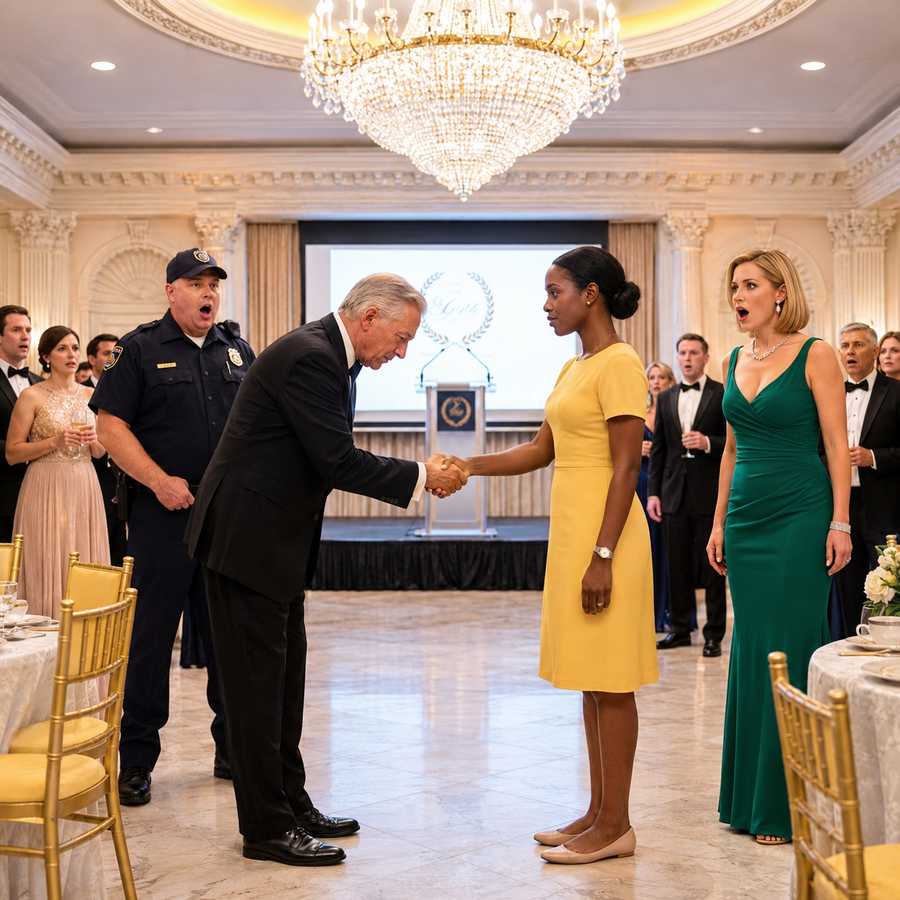
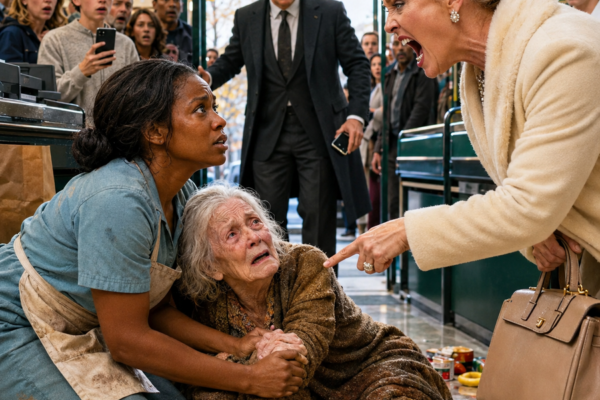
This place isn’t for you, you poor Victoria Ashford’s lip curled.
I’m just looking for my seat.
This isn’t a welfare line.
Trash. Look at you.
Filthy, stinking. You make me sick.
Get out.
Andrea’s hands trembled.
Oh my god, she’s still here.
Oh, doesn’t she have any shame?
The whispers spread like fire. Chairs scraped. Guests stood and walked away.
One by one, then in groups. A woman pinched her nose. A man shielded his wife.
Security. Drag this trash out.
I can’t take it anymore.
300 people voided her. Not one looked at Andrea Collins. Not one said a word.
But the billionaire host was already walking toward the microphone. and what he was about to reveal would change everything.
Two hours before Victoria Ashford’s words echoed across that ballroom, Andrea Collins stood in front of her bathroom mirror.
She smoothed the front of her yellow dress, plain cotton, no label, no jewelry, just a thin gold chain her mother had given her before she passed. She looked at herself and took a breath.
Tonight was the annual gala for Hope Beyond Borders, the largest charitable organization in the city. 300 of the wealthiest donors in the state had been invited.
Black Tai, $10,000 a plate. Champagne Towers, string quartets, and speeches about changing the world. Andrea had received her invitation 6 weeks ago, a cream colored envelope with gold embossing.
She had read it three times before she believed it was real.
She didn’t own a gown.
She didn’t own heels that cost more than her grocery bill.
But she had the invitation, and she had every right to be there. The Grand Lynen Hotel sat on the corner of Fifth and Park, a limestone giant wrapped in ivy and old money.
Black SUVs lined the curb. Ballets and white gloves opened doors for women in diamonds and men in custom suits. Andrea arrived by bus.
She stepped off at the corner, clutched tucked under her arm, and walked toward the entrance. The doorman saw her coming from 30 ft away. His smile disappeared before she reached the steps.
“Ma’am, can I help you?
I’m here for the gala.
” He looked at her dress, then her shoes, then the bus pulling away behind her.
The service entrance is around the back.
I’m not service.
I’m a guest.
She held out the invitation. He took it, turned it over twice, then handed it back without a word.
He didn’t open the door.
She opened it herself. The ballroom hit her like a wall of light.
Crystal chandeliers hung from 40ft ceilings. White linen draped every table. At the center of the room, a champagne tower rose 5 m high.
Thousands of glasses stacked in a perfect pyramid, catching light from every angle. Waiters in black vests moved between tables carrying silver trays. The air smelled like perfume and money.
Andrea stepped inside and the room noticed. Not the way a room notices someone important, the way a room notices something wrong.
A woman at the nearest table glanced up from her wine.
Her eyes moved from Andrea’s face to her dress to her shoes.
She leaned toward her husband and whispered. He looked, then looked away.
Andrea walked toward the seating chart near the entrance. A couple standing beside it saw her coming and stepped back. Not far, just enough.
The kind of distance that says everything without a word. She found her name, table 14, near the back by the service corridor.
She walked through the ballroom. Every step was a small negotiation.
A group of women shifted to let her pass, then closed ranks behind her like water filling a hole. A man pulled his chair in as she walked by. Another turned his back mid-con conversation.
No one said hello. No one nodded. No one made eye contact.
At table 14, four guests were already seated. When Andrea pulled out her chair, the man across from her stood up, grabbed his wine glass and moved to another table without a word. His wife followed.
Then the couple beside them. Andrea sat alone at a table for eight. A waiter passed with champagne.
She raised her hand. He walked past. She raised it again for the next one.
He didn’t even look.
Across the ballroom, Victoria Ashford held court at the center table.
wife of real estate billionaire Richard Ashford, chair of the gala’s organizing committee.
She wore a floorlength emerald gown and a diamond necklace that caught light every time she turned her head. People orbited her like satellites, laughing at her jokes, refilling her glass, touching her arm when they agreed. Victoria had noticed Andrea the moment she walked in.
She had watched the yellow dress move through her ballroom like a stain on white marble. She had watched the tables empty. The waiters ignore, the whispers spread, and she had smiled.
Now she set down her champagne, said something to the woman beside her, and began walking toward table 14. Andrea saw her coming.
She straightened her back, folded her hands on the table. She had no idea what was about to happen. Victoria Ashford stopped 3 ft from table 14.
She didn’t sit.
She stood over Andrea the way a person stands over something they’ve found on the bottom of their shoe.
Excuse me.
Victoria’s voice carried across three tables.
She wanted people to hear.
I think you’re confused.
Andrea looked up.
I’m sorry.
This table, this room, this event. Victoria gestured at the ballroom with her champagne glass. None of this is for you.
I was invited. My name is on the your name. Victoria laughed.
Not a real laugh.
The kind that’s designed to make someone feel small.
Sweetheart, I organized this gayla. I approved every name on that list, and I can promise you yours was not on it.
It was table 14. Andrea Collins.
Victoria tilted her head.
Studied Andrea the way someone studies a stain they’re deciding whether to scrub or throw away.
Andrea Collins,” she repeated slowly, tasting every syllable like something sour.
“And what exactly do you do, Andrea Collins?
What could you possibly contribute to a room full of people who actually matter?”
The tables around them had gone quiet, forks down, conversations paused, heads turning slowly, the way people turn when they smell smoke. Andrea kept her voice steady.
I received an invitation.
I’m here because I was asked to be.
Asked. Victoria took a step closer.
By whom? Because I know every person in this room.
I handpicked them. And I did not pick you.
She looked Andrea up and down slowly, deliberately, making sure the people watching could follow her eyes. That dress, is that cotton?
You wore cotton to a $10,000 gayla. Victoria pressed her fingers to her lips, suppressing a smile. Oh, honey, did you think this was a church picnic?
Laughter quiet at first, then louder from the table behind Andrea. From the couple near the window, from a group of women standing by the bar who had stopped their conversation to watch.
Andrea’s jaw tightened, but she didn’t stand.
She didn’t raise her voice.
I have my invitation right here. She reached into her clutch and pulled out the cream colored card, gold embossing, the same card every guest in the room had received.
Victoria looked at it.
Then she reached out, plucked it from Andrea’s fingers, and held it up to the light.
Anyone can print one of these. She turned to the nearest table.
Can’t they?
A color printer. 5 minutes. A child could do it.
Heads nodded. Not all of them, but enough. Victoria tore the invitation in half, then in half again.
She let the pieces flutter to the floor like confetti. There, problem solved. Andrea stared at the torn paper on the ground.
Her mother’s gold chain pressed against her collarbone.
She could feel her heartbeat in her throat. The reaction rippled outward like a stone dropped in still water.
A man at the next table raised his glass toward Victoria, a toast. His wife clapped twice soft and slow like applause at a tennis match. At the bar, a group of three women exchanged looks and nodded, approving, justified.
A teenage boy in a borrowed suit pulled out his phone and started filming, grinning.
His mother didn’t stop him.
The message was unanimous. Victoria had spoken for the room, and the room agreed.
A waiter knelt near Andrea’s feet and began sweeping the torn paper into a dustpan quickly, quietly like he was cleaning up something embarrassing.
He didn’t look at Andrea.
He looked at Victoria, checking if he was doing the right thing. Victoria gave him a small nod.
The waiter swept faster.
“That was my invitation,” Andrea said quietly.
“You just destroyed my proof that I belong here.
You don’t need proof, sweetie.
Everyone in this room already knows you don’t belong here.
Look around. Andrea looked.
Victoria was right about one thing. Every face in the ballroom was turned toward her now. But not one of them showed sympathy.
Not one showed concern. They watched the way people watch a car accident.
Fascinated, entertained, glad it wasn’t them.
A woman two tables over leaned into her husband’s shoulder.
Can you believe she’s still sitting there?
She whispered loudly enough that Andrea heard every word.
“Just ignore her,” the husband replied.
“Victoria will handle it.”
Another woman, younger in a red sequin gown, raised her phone and began filming.
She didn’t hide it.
She held it up like Andrea was a spectacle, a show, content for her followers.
“This is going on my story,” the woman said to her friend.
“You can’t make this stuff up.”
Her friend laughed. Caption it. Wrong address.
Wrong dress. Andrea felt the heat rise up her neck. Her fingers curled around the edge of the table.
She focused on breathing. In. Out.
In. Out. She would not cry.
Not here. Not in front of them.
Victoria watched her with the patient satisfaction of someone who knows they’ve already won.
Still here. Victoria tapped her nails against her champagne glass. I admire the stubbornness.
I really do. Most people in your position would have had the dignity to leave by now.
My position?
Don’t play dumb.
You know exactly what I mean. Andrea looked at her, held her gaze. Say it.
Victoria smiled.
I don’t need to say it, sweetheart.
This room says it for me. She snapped her fingers at a passing waiter.
Get me the hotel manager now. The waiter nodded and disappeared.
Two minutes later, a man in a dark suit appeared. His name tag read Gerald Witmore, general manager. He was already sweating before he reached the table.
Mrs.Ashford, how can I? This woman. Victoria pointed at Andrea without looking at her.
She’s not on the guest list.
She somehow got past your door, man, which we’ll discuss later, and she’s been sitting here making my guests uncomfortable.
I need her removed. Gerald looked at Andrea, then at his tablet.
He scrolled through the guest list twice.
“Ma’am, I do see an Andrea Collins on the confirmed list.”
Table 14.
Victoria’s smile didn’t move, but her eyes went cold.
Gerald? She said his name the way someone says a warning.
“The Ashford Foundation books this ballroom four times a year.
We spend $600,000 annually at this hotel.
Are you telling me you’re going to take her word over mine?
Gerald looked at the 300 faces watching him.
He looked at Victoria’s diamond necklace.
He looked at Andrea’s yellow cotton dress.
He put the tablet down. I apologize, Mrs.Ashford. There must have been an error in our system.
He turned to Andrea.
Ma’am, I’m going to have to ask you to step outside while we verify your invitation.
You just verified it. Andrea said. You said my name is on the list.
There may have been a database error. These things happen.
If you could just She’s not leaving because of a database error.
She’s leaving because that woman told you to make her leave.
Gerald said nothing. He took a small step back. His hands clasped behind him.
He stared at a point on the floor somewhere between Andrea’s shoes and his own.
Victoria turned to Andrea one final time. Her voice dropped low enough for intimacy, loud enough for the nearest five tables. Let me make this simple for you.
You are not wanted here. Not by me. Not by anyone in this room.
You walked in wearing a $30 dress to a place where people write checks with more zeros than your annual salary.
You don’t belong at this table.
You don’t belong in this building.
And if you had any self-respect, you would have figured that out the moment you walked through that door. And every single person in this room looked the other way.
She straightened up, smiled, took a sip of champagne.
“Now, are you going to walk out or do I need to have someone carry you?”
Andrea didn’t move.
Her hands were flat on the table. Her fingertips were white from pressing down.
The gold chain on her neck felt warm against her skin. She thought about her mother.
She thought about the three buses she had taken to get here tonight.
I’m not leaving, she said.
Victoria stared at her for three full seconds. Then she set her glass on the table, pulled out her phone, and made a call.
Greg, it’s Victoria.
I need your team at table 14. We have a situation. She hung up, looked at Andrea.
You should have walked out when I gave you the chance. Around them, the ballroom had become a theater. Every table faced their direction.
Phones were out. Some recording, some texting.
Not one person stood up.
Not one voice said, “Stop.”
300 witnesses, zero objections. Andrea Collins sat at table 14 alone, surrounded by people who had decided she was nothing.
And the worst part hadn’t even started yet.
Greg Lawson arrived in under a minute. Head of security, 62, black suit, earpiece.
Two guards flanked him, both built like linebackers.
They moved through the ballroom with the kind of efficiency that comes from practice, the kind of removal they’d done before.
Greg stopped at table 14 and looked at Andrea, then at Victoria. Mrs.Ashford, what seems to be the problem?
Victoria didn’t look at Greg.
She kept her eyes on Andrea. This woman has been asked to leave multiple times.
She’s refused.
I need her escorted out now. Greg turned to Andrea.
Ma’am, I’m going to need you to come with us.
I was invited, Andrea said. My name is on the guest list.
The hotel manager confirmed it. Greg glanced at Gerald Witmore, who was standing 6 feet away with his tablet pressed flat against his chest like a shield. Gerald.
Gerald opened his mouth, closed it, looked at Victoria, then at the floor. There appears to have been a system error, Gerald said.
We’re still verifying.
There’s nothing to verify, Andrea said.
He already told me my name was on the list. He said it right here in front of everyone. Gerald said nothing.
Greg exhaled through his nose.
He’d been given a job.
The politics weren’t his concern.
He reached down and placed his hand on Andrea’s arm.
Ma’am, let’s do this the easy way.
Andrea pulled her arm back.
Don’t touch me, ma’am.
I said don’t touch me.
I have a right to be here. Greg paused.
He looked at Victoria, who raised one eyebrow, the kind of look that says, “Why is she still sitting there?”
Greg nodded at his two guards. They stepped forward, one on each side.
They took Andrea’s arms, not gently, not violently, but with the practice grip of men who expected resistance and had already decided it wouldn’t matter.
Andrea stood, not because she wanted to, because they lifted her.
“Let go of me!”
her voice cracked.
“I’m not doing anything wrong.”
The ballroom watched. 300 faces.
Some looked away.
Most didn’t.
A few raised their phones higher to get a better angle. The guards walked Andrea toward the exit. Her shoes scraped against the marble floor.
Her clutch was still on the ground at table 14 where Victoria had thrown it. No one picked it up.
They passed table after table. Andrea looked at the faces as she went.
She searched for one pair of eyes, one person who might stand up, one mouth that might say stop. At table six, an older woman met her gaze for half a second.
Something flickered behind her eyes. Discomfort, maybe guilt. Then her husband touched her arm and she looked down at her plate.
At table nine, a young man in his 20s watched with his jaw tight. His hand moved toward the edge of the table like he was about to push his chair back, about to stand.
His date whispered something. He pulled his hand back and folded his arms.
A child no older than eight tugged at her father’s sleeve.
Daddy, why are they taking that lady away? The father shushed her and turned her chair to face the other direction.
That was the closest anyone came to objecting.
A child’s question that was silenced before it could finish.
Every other face turned away as she passed, like dominoes falling in reverse. Victoria followed five steps behind, champagne glass still in hand, heels clicking on the marble like a metronome. I told you, Victoria said loud enough for the room.
I gave you every chance. You could have walked out with whatever dignity you had left. But you people never know when to quit, do you?
Andrea’s eyes burned.
She blinked hard. She would not give them that.
The route to the exit passed directly by the Champagne Tower, 5 m tall, thousands of crystal glasses stacked in a perfect pyramid. It had taken a team of four men 3 hours to build it that afternoon.
Every glass was filled. The liquid caught the chandeliers and scattered light across the ballroom like a constellation. Victoria was close now.
Close enough for Andrea to smell her perfume. Close enough to hear the ice shift in her glass. It happened fast.
Victoria reached out with her free hand and shoved Andrea hard between the shoulder blades. Andrea stumbled forward.
Her ankle turned on the marble. Her arms went out, but there was nothing to grab. Nothing except crystal and air.
She hit the tower. The sound came first. Not a crash, a cascade like a waterfall made of glass.
The first row of glasses tipped into the second, the second into the third, then the fourth, then everything. Thousands of champagne glasses collapsed inward like a building folding in on itself.
Crystals shattered against crystal. Champagne erupted in every direction.
Golden liquid spraying across white tablecloths, across the marble floor, across Andrea’s yellow dress.
Shards of glass exploded outward in a radius of 15 ft. Guests at the nearest tables screamed and jumped back. Chairs toppled.
Plates slid off tables. The sound lasted 4 seconds.
Four seconds of continuous breaking, a high, sharp, unrelenting symphony of destruction that silenced every other sound in the room. Then it stopped. And in the center of it all, Andrea Collins lay on the floor.
Glass was everywhere, in her hair, on her arms, under her palms. A shard had cut a line across her left hand, thin and deep. Blood ran down her fingers and dripped onto the white marble, mixing with champagne and shattered crystal into something that looked like abstract art.
Her yellow dress was soaked, torn at the hem where she’d fallen, stained dark in patches where champagne and blood had mixed together.
She didn’t move for 5 seconds.
The ballroom was dead silent. 300 people holding their breath.
Not out of concern, out of shock, out of the sudden realization that something had crossed a line, but not a single person willing to say so. Andrea pressed her hands against the floor to push herself up.
Glass bit into her palms. She winced. Blood smeared against the marble.
She pushed through it, got to her knees, then to her feet. She stood in the wreckage, champagne dripping from her hair, glass crunching under her shoes, blood running down both hands now, falling in slow drops onto the floor. She looked at Victoria.
Victoria stood exactly where she had been, untouched. Not a drop of champagne on her emerald gown. Her face showed no surprise, no regret, no concern.
She smiled.
“See,” Victoria said.
She didn’t whisper.
She projected. She wanted every person in that room to hear.
She destroys everything she touches. The ballroom was still silent, but it was a different kind of silence now.
The kind that follows a car crash. The kind where people look at each other and wait for someone else to react first.
No one reacted.
A man at table three turned to his wife and said quietly, “We should go.”
They didn’t.
A woman near the back pressed her hand to her mouth.
She didn’t stand.
A waiter holding a silver tray stood frozen near the kitchen entrance. He stared at Andrea at the blood at the glass at the ruined dress, and he did nothing. Phones were still recording, dozens of them.
The red lights glowed like tiny eyes in the dim ballroom light. Andrea stood in the middle of the destruction.
Her hands trembled. Her dress clung to her body.
Blood and champagne pulled at her feet. She wiped her face with the back of her wrist, took a breath, straightened her back.
She didn’t say a word.
Victoria turned to the crowd. Well, is someone going to clean this up?
She’s made quite the mess of our evening.
Scattered nervous laughter.
The kind people use when they know something is wrong, but can’t figure out how to say it.
Greg Lawson and his guard stood 10 ft away.
They hadn’t moved since the tower fell.
Greg was staring at Victoria. Something in his face had changed. The professional mask cracking just enough to show what was underneath, but he said nothing.
Did nothing. Gerald Whitmore had retreated to the far wall. He was typing on his phone with both thumbs.
His face was gray. Andrea reached down and picked a piece of glass from her palm.
Placed it carefully on the nearest table. Then another piece. Then another.
Methodical, quiet, like she was cleaning up after someone else’s mistake.
The gold chain from her mother still hung around her neck.
It was the only thing that hadn’t been touched.
300 people in that ballroom, 300 pairs of eyes, and not a single one of them saw a human being standing in front of them. They saw a stain, an inconvenience, a mess to be cleaned up. They had no idea who she was.
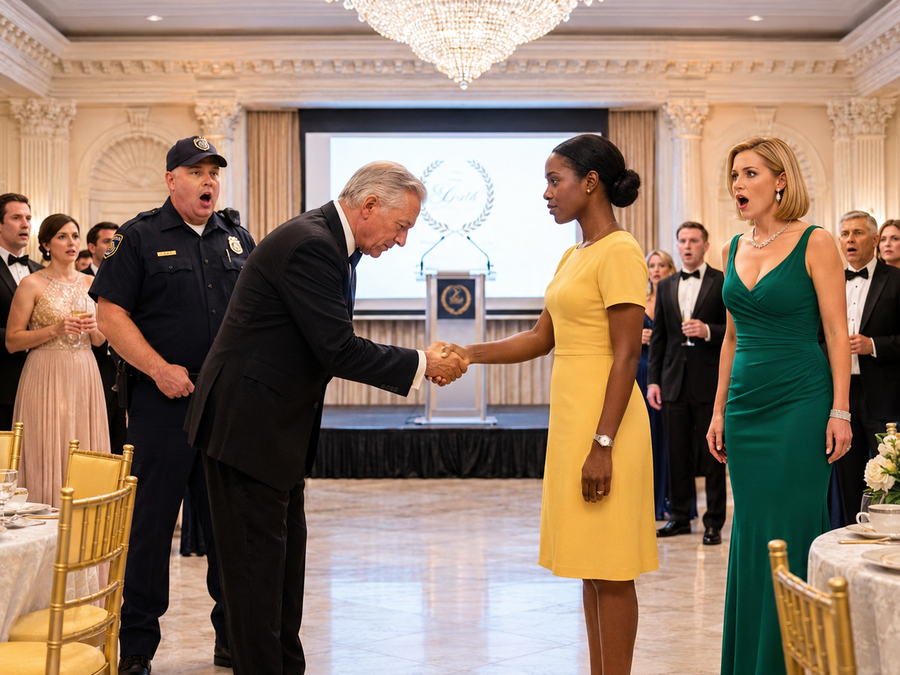
A microphone clicked on. The sound cut through the ballroom like a blade.
Every head turned toward the stage. Elliot Weston stood behind the podium.
71 years old, silver hair, charcoal suit, the kind of man who didn’t need to raise his voice to silence a room because every person in it owed him something.
He was the host, the billionaire, the reason this gala existed. And he had watched the entire thing.
“Good evening,” he said.
His voice was calm, too calm, the kind of calm that makes the air feel heavy.
He didn’t smile.
He didn’t greet the crowd the way he had at every gala before this one.
He stood at the podium and looked at Victoria Ashford the way a judge looks at a defendant.
I had a speech prepared tonight,” Elliot said.
“About generosity, about the power of giving, about what it means to show up for people who have less than you.”
He paused.
“I’m not going to give that speech.”
The ballroom was silent, the kind of silent that hurts.
“Instead, I want to talk about the woman standing in the middle of that broken glass.”
Every eye in the room shifted to Andrea. She stood where she had been soaked, bleeding, surrounded by wreckage.
She looked at Elliot.
She didn’t understand.
Most of you don’t know her, Elliot continued.
And that’s by design, because she asked me personally not to use her name tonight.
She didn’t want attention.
She didn’t want recognition.
She wanted to sit in this room, listen to the speeches, and go home. He pressed a button on the podium. The enormous screen behind him flickered to life.
A photograph appeared. Andrea Collins, but not in a yellow cotton dress. In a white lab coat, standing in front of a molecular diagram at MIT.
Beside her, a caption, “Dr.Andrea Collins, Nobel laurate in chemistry 2021.”
The room didn’t move, but something shifted.
A woman at table 3, covered her mouth with both hands.
The man who had toasted Victoria’s invitation tearing set his glass down slowly as if it had suddenly become too heavy to hold.
At the bar, the three women who had nodded their approval minutes ago were no longer nodding. One of them was staring at the floor.
Elliot pressed the button again. A second image. Andrea shaking hands with the Secretary General of the United Nations.
A murmur moved through the ballroom. A third image. Andrea at a podium accepting a humanitarian award.
The murmur became a hush. A fourth Andrea standing in a refugee camp in South Sudan surrounded by children, her hands full of medical supplies.
Someone at the back of the room whispered, “Oh God, Dr.Andrea Collins,” Elliot said, his voice carrying through the silence, “is the founder of Hope Beyond Borders.”
The words landed like a bomb. Hope Beyond Borders. The organization this gala was raising money for.
The organization whose name was printed on every invitation, on every banner, on the giant screen behind Elliot’s head.
She created it, Elliot said, 11 years ago from nothing. She built the infrastructure. She recruited the doctors.
She negotiated with governments on three continents. And when the funding ran out twice, she sold her own property to keep it alive.
Victoria Ashford’s champagne glass was no longer in her hand.
It was on the floor.
She hadn’t dropped it.
Her fingers had simply stopped working.
But that’s not all, Elliot said.
He looked directly at Victoria now. For the past four years, Hope Beyond Borders has received an anonymous donation.
Every year, the same amount, $50 million. He let the number breathe.
50 million every year for 4 years.
That’s $200 million, more than every person in this room has contributed combined.
He paused. The anonymous donor is Dr.Andrea Collins. The screen changed one final time.
A document, a foundation transfer record, $200 million. Donor Andrea Collins.
The signature was unmistakable. Elliot stepped out from behind the podium.
He walked down the three steps from the stage across the ballroom floor through the scattered glass and pulled champagne and stopped directly in front of Andrea. He took off his jacket, placed it over her shoulders.
“The woman you just pushed into broken glass,” he said, turning to face the room, “is the reason every single one of you is standing in this building tonight.
She funded the charity. She built the programs.
She paid for the research that saved lives in 14 countries. And she asked for nothing in return. Not even a seat at her own table.
He turned to Victoria. You tore up her invitation. You called security on her.
You pushed her into a 5 m tower of glass. And you stood there and watched her bleed.
Victoria’s face had gone white.
Not pale. White, the color of paper, the color of something that has had all the life drained out of it.
her mouth opened. Nothing came out. Richard Ashford, sitting at the center table, had pushed his chair back.
He was staring at his wife with an expression Andrea had never seen on another person’s face.
The exact moment someone realizes that the person they love has just destroyed everything.
The phones that had been recording Andrea’s humiliation were now pointed at Victoria.
Every single one. The room had flipped completely, irreversibly, like a coin spinning in the air that finally lands on the side no one expected.
Andrea stood in Elliot’s jacket, blood still on her hands, champagne still in her hair.
She looked at Victoria.
She didn’t say a word.
She didn’t need to.
Victoria moved first. She crossed the ballroom floor in four quick steps, heels cracking against the marble. She stopped in front of Andrea, hands clasped together like a woman in prayer.
“Andrea, Dr.Collins, I had no idea.
If I had known who you were, I never would have would have what?”
Andrea said quietly.
“Torn invitation, called security, pushed me into a wall of glass,” Victoria swallowed.
“It was a misunderstanding.
I was trying to protect the integrity of the event.”
I thought. You thought what?
Elliot cut in from behind Andrea.
His voice hadn’t risen once all evening.
It didn’t need to.
That a black woman in a cotton dress couldn’t possibly belong in your ballroom.
Victoria’s mouth opened and closed.
She looked around the room for an ally, a nod, a sympathetic face. She found nothing.
300 people stared back at her the way she had stared at Andrea 30 minutes ago. Elliot, please.
Victoria’s voice cracked.
You know me.
You know the work I’ve done for this foundation.
I’ve chaired this gala for 6 years and tonight is your last.
Elliot stepped aside. Andrea. As of this moment, Victoria Ashford is permanently removed from the board of hope beyond borders.
She is banned from every event, every fundraiser, and every function connected to this organization. Effective immediately.
Victoria’s legs buckled slightly.
She grabbed the edge of the nearest table. A woman sitting there pulled her chair away.
“You can’t do that,” Victoria whispered.
“My family has donated.
Your family has donated $400,000 over 6 years,” Elliot said.
The woman you pushed into Broken Glass has donated $200 million. You are not in the same conversation.
The number echoed through the ballroom. 400,000 versus 200 million. The math was devastating.
Andrea turned to Elliot. Her voice was steady, but her hands were still shaking.
I’d like to make an announcement.
Elliot stepped aside and gestured toward the podium microphone. Andrea shook her head.
She didn’t need a podium.
She spoke from where she stood in the middle of the wreckage. Blood drying on her palms, champagne stains darkening her yellow dress.
I came here tonight because I believe in this organization. I built it because I believe that people deserve help regardless of what they look like or what they wear.
She paused. But what happened in this room tonight, what every single one of you allowed to happen, tells me something I should have known a long time ago. She looked across the ballroom, table by table, face by face.
I am withdrawing my funding. All of it effective tonight.
$200 million gone.
The sound that followed wasn’t a gasp.
It was closer to a collapse. The kind of exhale a room makes when the floor drops out from under it. Board members at the front table went pale.
The event coordinator near the stage grabbed the back of a chair. A man in the second row dropped his phone.
Every program this organization runs, the medical clinics, the refugee housing, the water projects, those are funded by my donations. Without them, this gala raised enough tonight to keep the lights on for about 3 months.
She let that settle. Maybe next year you should be more careful about who you push into the glass.
At the center table, Richard Ashford stood up.
He didn’t look at Victoria.
He buttoned his jacket, walked to the exit, and left without a word.
His chair sat empty beside his wife’s untouched dessert plate.
Victoria watched him go. She called his name once.
He didn’t turn around.
Elliot turned to Greg Lawson, who was still standing near the wreckage with his two guards.
Greg, you’re done tonight and permanently.
You removed a confirmed guest because a donor told you to.
You didn’t verify.
You didn’t question.
You followed an order you knew was wrong. Elliot looked at the two guards.
You two as well. Clear out.
Greg’s jaw tightened.
He unclipped his earpiece, set it on the nearest table, and walked toward the service exit. His guards followed. None of them looked back.
Gerald Witmore, the hotel manager, had already disappeared. His tablet sat abandoned on a side table near the kitchen entrance.
Outside the Grand Lynen Hotel, the first video was already live. 43 seconds of Victoria Ashford shoving a woman in the yellow dress into a champagne tower.
It had been posted by the woman in the red sequin gown.
The one who had said, “Wrong address, wrong dress.”
The caption read, “I don’t even know what to say.
” Within the hour, it had 14,000 shares.
By midnight, it would have millions. By 6:00 in the morning, the video had been viewed 12 million times. The original post, 43 seconds of Victoria Ashford pushing Andrea Collins into a 5 m champagne tower, had been uploaded at 10:47 p.m.by a guest named Brooke Kensington.
The woman in the red sequin gown, the one who had laughed and said, “Wrong address, wrong dress.”
She wasn’t laughing anymore.
Her caption had been deleted and replaced three times.
The final version read, “I was there.
I didn’t help.
I’m sorry.”
It didn’t matter.
The internet had already saved the original. By sunrise, #Justice for Andrea was trending in 14 countries. The video had been clipped, reposted, stitched, and analyzed on every platform.
News outlets picked it up before breakfast.
CNN ran it with the headline, “Nobel laurate humiliated at her own charity gayla.”
The BBC followed an hour later, “Then the New York Times, then everyone.
” Clareire Dennis broke the real story.
Clare was a journalist for The Atlantic. She had been at the gala not as a guest, but as a reporter covering the event for a feature on philanthropic culture. She had watched everything from the back of the ballroom.
She had taken notes. She had recorded audio on her phone.
Her article went live at 8:00 a.m.4,200 words titled The Charity Queen and the Woman She Tried to erase. It was devastating.
Clare had done what no one at the gala had bothered to do.
She had looked into Victoria Ashford’s history, and what she found turned a single incident into a pattern.
Three former household employees, all women of color, had filed complaints against Victoria over the past decade. One described being forced to use a separate entrance.
Another said Victoria had referred to her as the help in front of dinner guests. A third, a Haitian nanny named Clawudette, described being fired after Victoria found out she had eaten lunch at the family dining table while the Ashfords were out of town.
None of the complaints had gone anywhere.
The Asheford family’s legal team had settled each one quietly.
Non-disclosure agreements, five figure payments, silence. Clare printed all of it. She also found records showing that Victoria had personally blocked three scholarship applications to Hope Beyond Borders, all from applicants of color during her time as board chair.
She had flagged them as not aligned with organizational values. The applications had been approved by every other board member.
The article included a quote from Elliot Weston. I should have seen this sooner. I should have acted sooner.
That failure is mine. By noon, the fallout was structural.
Ashford Properties.
Richard’s real estate empire lost three major contracts before lunch.
A commercial development deal in Midtown worth $80 million was pulled by the city council after two members cited the video. A luxury hotel chain cancelled a joint venture. A pension fund that held a significant stake in Asheford Properties announced a review of its investment.
Richard released a statement at 1 p.m.two paragraphs carefully worded.
He expressed deep regret for his wife’s actions, stated that they did not reflect his values or the values of his company and announced that he and Victoria were taking time apart to reflect.
He did not say the word divorce.
He didn’t need to.
Everyone understood.
Victoria’s attorney released a separate statement calling the incident an unfortunate misunderstanding and suggesting that the video lacked context.
The internet responded with a second video shot from a different angle, showing Victoria’s hand making contact with Andrea’s back.
The push was deliberate. There was no misunderstanding.
Andrea’s legal team filed a civil suit at 2 p.m.Assault and battery, intentional infliction of emotional distress.
The filing included photographs of Andrea’s injuries, lacerations on both hands, bruising on her knees and forearms, a 3-in cut on her left palm that had required 11 stitches.
The photographs went viral within an hour.
Victoria’s personal social media became a graveyard.
Every post she had ever made about charity, about giving back, about lifting others up, the internet found them all. Screenshots flooded Twitter.
Sidebyside comparisons.
Victoria’s Instagram caption reading, “True generosity comes from the heart.
” Next to a still frame of her pushing Andrea into glass.
The hypocrisy was surgical, inescapable. Her follower count dropped by 90,000 in a single afternoon. That evening, the remaining board of Hope Beyond Borders held an emergency session.
The vote was unanimous. Victoria Ashford was permanently removed from all positions.
Her name was stripped from the organization’s donor wall.
Her photograph was taken down from the annual report. The board also issued a public apology to Andrea Collins. They acknowledged that the organization had failed to protect its founder and largest donor.
They committed to an independent review of all decisions made during Victoria’s tenure as chair.
3 days later, Andrea received a call she hadn’t expected.
The National Forum on Race and Equity, a summit held annually in Washington, DC, invited her to deliver the keynote address. The topic, Institutional Racism in elite philanthropic spaces.
Andrea said yes. The speech was broadcast live. Andrea stood at the podium in a navy blue suit, the first formal outfit she had bought since the gayla.
She spoke for 22 minutes.
She talked about the yellow dress, about the bus, about the doorman who wouldn’t open the door, about the waiter who wouldn’t pour her champagne, about the invitation that was torn up in front of 300 people who did nothing.
She talked about what it feels like to stand in a room full of people who have decided you are invisible.
I didn’t go to that gayla to prove anything.
She said, I went because I believed in the work. I went because I thought the people in that room shared that belief. I was wrong about the people.
I was not wrong about the work. The speech was viewed 48 million times in 5 days.
Victoria Ashford did not watch it. She had deleted her social media accounts 3 days after the gayla. Her attorney had advised her to avoid all public statements until the civil case was resolved.
But the case wasn’t going away and the evidence wasn’t shrinking.
Greg Lawson, the fired security chief, had given a sworn statement confirming that Victoria had personally ordered Andrea’s removal despite being told she was on the guest list.
Gerald Whitmore, the hotel manager, had provided documentation showing that Victoria had threatened to pull the Asheford Foundation’s business unless Andrea was removed.
The walls were closing in, and Victoria Ashford, the woman who had told Andrea Collins she didn’t belong, was about to find out what it feels like when the whole world decides you don’t belong either.
The civil case settled 8 months later. Victoria Ashford agreed to pay Andrea Collins $2. 8 $8 million in damages, but money was the smallest part of it.
The settlement included a clause that Victoria’s attorney had fought against for weeks and lost 500 hours of community service, not at a country club, not at a museum board, at a homeless shelter on the south side of the city, serving meals to the same kind of people she had spent her entire life looking past.
The judge had been specific. 500 hours supervised, documented, no substitutes, no donations in lie of service. Victoria showed up on day one in sunglasses and a baseball cap trying not to be recognized.
She was recognized immediately. A volunteer took a photo.
It was on Twitter within the hour. She kept coming back.
She didn’t have a choice.
Richard Ashford filed for divorce two months after the settlement. The proceedings were private, but the financial disclosures were not. Asheford Properties had lost an estimated $140 million in contracts and partnerships since the gayla.
The pension fund had divested. Two board members had resigned.
The company that had taken Richard a lifetime to build was bleeding, and his wife’s 43 seconds of cruelty were the wound that wouldn’t close.
The Grand Lynen Hotel fired Gerald Whitmore quietly. No press release, no statement.
He was replaced by a woman named Denise Callaway, who implemented a new policy on her first day. No guest would ever be removed from an event without verification from a minimum of two independent sources. The doorman who had directed Andrea to the service entrance was reassigned to a different property.
Brooke Kensington, the woman in the red sequined gown, wrote a public essay on her Instagram six weeks after the gala. It was long. It was uncomfortable.
It was honest. I watched a woman get humiliated in front of me. And my first instinct was to film it, not to help, to film it.
And then I made a joke about her dress. I have to live with that.
I don’t get to erase that by posting an apology.
The essay was shared 200,000 times. Andrea Collins did not read it. She was busy.
Three months after the gala, Andrea launched a new foundation. She called it Open Door.
No gallas, no champagne towers, no $10,000 plates. The organization operated out of a converted warehouse in Brooklyn. It funded education, medical research, and housing for underserved communities.
The same work Hope Beyond Borders had been doing, but without the velvet rope. Open Door raised $60 million in its first year. Not from billionaires in ballrooms, from ordinary people, teachers, nurses, students, small donations, $5, $20, 50, hundreds of thousands of them.
Andrea still wore the gold chain her mother had given her. She still took the bus to work most mornings.
She still owned the yellow dress, washed, mended, hanging in the back of her closet. She never wore it again, but she never threw it away.
Some things you keep, not because they’re beautiful, because they remind you of what you survived.
One year after the gala, a reporter asked Andrea if she had any message for Victoria Ashford. Andrea thought about it for a long time.
I hope she learned something, Andrea said.
not about me, about herself, about what she’s capable of when she thinks no one important is watching.
She paused. But the truth is everyone is important.
That’s the part she missed.
That’s the part a lot of people in that room missed.
She looked at the camera.
You don’t get to decide who belongs.
Not in a room, not in a country, not in the world.
The moment you think you have that right, that’s the moment you’ve already lost everything that makes you worth being in the room yourself.
The interview ended.
Andrea stood up, shook the reporter’s hand, and walked out into the afternoon sun.
She had a meeting at Open Door in an hour. New partnerships, new programs, new lives to change.
The woman in the yellow dress had built something no one could tear down. Not with words.
THE END.