Bride Humiliated Her Groom’s Black Mother at the Wedding — Minutes Later, Three Rolls Royces Arrived
Bride Humiliated Her Groom’s Black Mother at the Wedding — Minutes Later, Three Rolls Royces Arrived
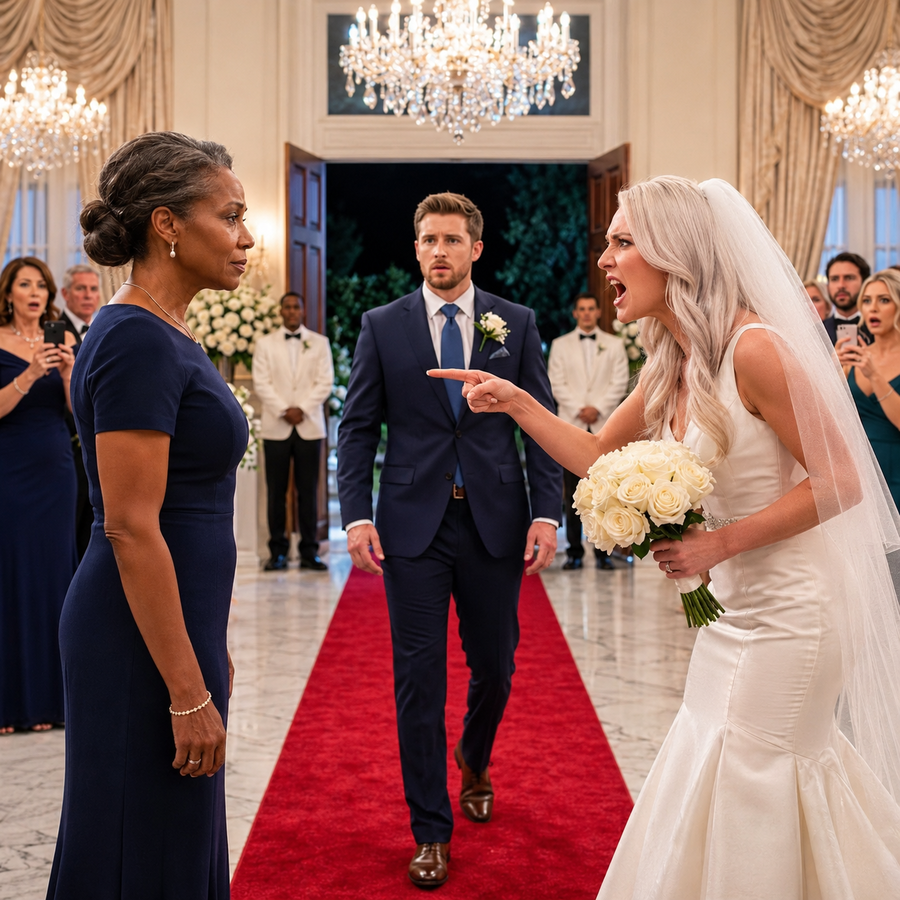
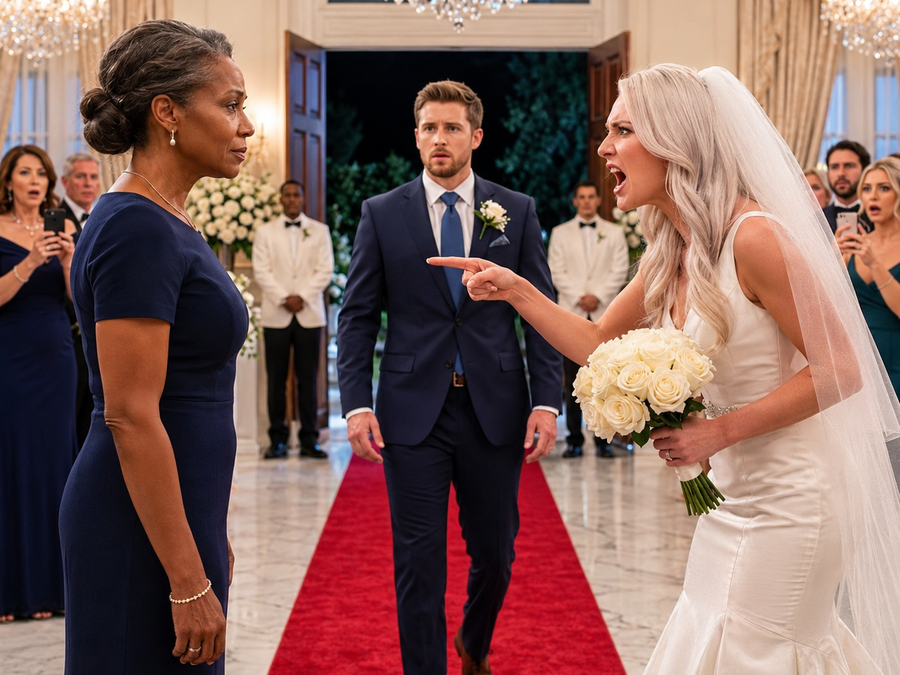
Get that black monster out of here or cancel the wedding.
Vanessa, she’s my mother.
Your mother is black, Elliot. You never told me that. Why would that matter?
Vanessa’s face flushed red.
Those disgusting, filthy people make me sick. The black woman standing 3 ft away heard every word.
Monica’s chest tightened.
Each sentence landed like a slap across her face. I brought you a gift.
This is mother’s token of love.
Don’t touch me.
Disgusting. Vanessa shoved her hand away. The bracelet skidded under a chair.
Who do you think you are, you lowly, poor woman? Your stench makes me nauseous.
300 guests, dead silence.
Monica’s knees locked, her throat burned.
She didn’t cry.
None of them knew who that black mother really was. Monica Turner had never been the kind of woman who needed people to know her name. She ran Turner Capital Holdings from a glass tower in downtown Atlanta.
A $2. 3 billion investment empire built over 22 years. 3,800 employees across four countries.
Fortune 500 clients who waited weeks for a meeting with her. But at home, she was just Monica. She cooked Sunday dinners in a kitchen she refused to renovate.
She drove a 10-year-old sedan because it still ran fine. She wore clothes she liked, not labels other people recognized.
And when her neighbors asked what she did for work, she smiled and said, “I help people with their money.
” Her husband Harold was the same way.
A white man from a small town in Vermont, he had met Monica at a conference 26 years ago. He was an engineering director, quiet, steady, the kind of man who fixed things around the house before anyone noticed they were broken.
People who saw them together sometimes raised an eyebrow. Harold never cared. Monica never explained.
Their son Elliot looked like Harold. Light skin, blue eyes, sandy brown hair.
Strangers never guessed his mother was black. Elliot never corrected them.
Not out of shame, he adored his mother, but the subject simply never came up the way people expected it to. Elliot had left for college at 18, then graduate school in Boston, then a junior analyst position at a finance firm in New York.
He called every Sunday, sent flowers on Mother’s Day, flew home for Christmas when he could.
But the visits got shorter, the calls got quicker. Monica understood.
Her boy was building his life. Then came the phone call that changed everything. It was a Tuesday evening.
Monica was reviewing quarterly reports in her study. Harold was reading in the living room.
The phone rang, and Elliot’s voice came through fast, nervous, excited.
Mom, I need to tell you something. What is it? Vanessa is pregnant.
We’re getting married.
Monica set her pen down.
She hadn’t even met this girl.
Elliot had mentioned her a few times, Vanessa Brooks, daughter of Richard Brooks, old money Connecticut family. But there had been no visit, no introduction, no video call, nothing. How far along is she?
Three months. We want to do it soon, next month. Harold walked in.
Monica put the call on speaker. They asked the obvious questions. Is she good to you?
Are you sure about this? Have you thought it through?
Elliot answered yes to everything.
We want you both there, of course, but I know you’re busy.
If you can’t make it, I understand.”
Monica looked at Harold. Harold looked at Monica.
“We’ll be there,” she said.
They wired Elliot $80,000 for the wedding.
They didn’t ask questions about the venue or the flowers or the guest list.
They trusted their son. They assumed they would meet Vanessa and her family at the wedding.
There would be time for introductions, for warmth, for the families to blend.
What Monica didn’t know was that Elliot had never shown Vanessa a photo of his parents.
He had never mentioned his mother’s race.
He had never talked about Turner Capital or his mother’s career.
To Vanessa, Elliot was just a promising young analyst from a comfortable family. She saw his white skin and assumed the rest. The Brooks family operated on assumptions.
Richard Brooks ran a mid-size investment firm, Brooks and Associates. Catherine Brooks chaired two charity boards and hosted galas where the guest list was curated by last name and net worth. They had raised Vanessa to marry well, look perfect, and never let anyone beneath her circle get too close.
When Vanessa told her parents about Elliot, Catherine asked three questions.
“What does his father do?
Where did he go to school?
What neighborhood did he grow up in?”
No one asked about his mother. The wedding was set for the first Saturday of June, a five-star hotel ballroom in Hartford.
300 guests, white orchids, champagne towers, a 12-piece string ensemble. Every detail curated by Catherine Brooks herself. Monica packed a navy blue dress she had bought for the occasion.
Simple, elegant, not designer.
She folded the velvet box with her grandmother’s gold bracelet.
Three generations of Turner women had worn it on their wedding day. She and Harold boarded a 6-hour flight to Connecticut.
Neither of them had any idea what was waiting. The hotel lobby smelled like fresh lilies and polished wood.
Monica smoothed her navy dress as she and Harold walked through the double doors toward the ballroom. She carried the velvet box in her left hand.
Harold held her right.
“You look beautiful.”
He said. She squeezed his hand.
“I just want to meet her, finally.”
The ballroom was everything Katherine Brooks had designed it to be. Crystal chandeliers hung from a ceiling draped in white silk.
Round tables with gold rim plates stretched across the floor. A 12-piece string ensemble played Pachelbel in the corner.
White orchids spilled from every surface. Monica scanned the room for Elliot.
She spotted him near the head table, adjusting his tie, laughing with a groomsman. He looked handsome. He looked happy.
Her heart swelled.
“Elliot.”
She called softly. He turned. His face lit up.
He crossed the room in five long strides and wrapped his arms around her.
“Mom, Dad, you made it.”
“Of course we made it.
” Harold said, clapping his son on the back.
“Where’s Vanessa?”
Monica asked.
“I’ve been dying to meet her.”
Elliot’s smile flickered.
Just for a second. Just enough for Monica to notice.
“She’s in the bridal suite.
She’ll be out soon.
Come, let me show you your seats.”
He led them toward the head table, the family table front and center. Monica set the velvet box beside her plate. Harold pulled out her chair.
She sat down and looked around the room. Every detail was polished perfect, expensive.
She thought of the bracelet inside the box. Three generations of Turner women had worn it.
It wasn’t expensive, but it was priceless.
Then the bridal suite door opened. Vanessa Brooks stepped out in a fitted white gown, her blonde hair pinned beneath a cathedral veil.
Catherine walked beside her, chin high, scanning the room like a general surveying a battlefield. Richard Brooks followed two steps behind, hands clasped behind his back.
Vanessa’s eyes found Elliot first.
She smiled. Then her gaze drifted to the woman sitting next to him. She stopped walking.
Catherine nearly collided with her. Vanessa, what? Who is that?
Vanessa’s voice was low, controlled, but her face had already changed.
The softness was gone. Something harder had taken its place.
“That’s my mom,” Elliot said.
He stood up.
“Vanessa, this is Monica.
Mom, this is She’s black.
The words came out flat, not a question, a verdict. The string ensemble kept playing, the guests kept chatting, but at the head table, time had stopped.
Catherine’s hand closed around Vanessa’s elbow.
She pulled her daughter back two steps and leaned in. Her whisper was sharp enough to cut glass.
“Did you know about this?”
“No, he never said a word.”
Catherine turned to look at Monica again. Her nostrils flared. She straightened her pearl necklace with one hand as if touching something clean could undo what she was seeing.
“This is unacceptable,” Catherine said.
“Your father will handle it.”
Richard Brooks walked over. He looked at Monica the way a man looks at a stain on an expensive suit, something to be dealt with quietly, quickly, and without drawing attention.
“Elliot,” Richard said.
His voice was calm, but his eyes were cold.
“A word.
Elliot followed Richard to the corner near the bar. Richard stood with his back to the room, so no guest could read his lips. He spoke with his hands low, palms down, the gesture of a man giving orders.
Listen to me carefully. My daughter is not going to walk down the aisle in front of 300 people with that woman sitting in the front row.
That woman is my mother.
I don’t care who she is.
She was not part of the plan. Catherine has spent eight months on this wedding. Every detail, every guest, every photograph.
Your mother doesn’t fit.
Doesn’t fit?
She’s my mother.
Richard leaned closer. His cologne was thick. His voice dropped to something barely above a breath.
If you make a scene right now, I pull every dollar. The apartment in New York, the car, the job I got you at Hargrove Financial, all of it.
Gone. Do you understand me? Elliot looked at the floor, his fists clenched at his sides.
He said nothing. Good.
Now, go sit down and let Catherine handle the seating. When Elliot came back, his face was different, older, tired.
He didn’t look at Monica.
Vanessa pulled him aside near the gift table.
She didn’t go far.
Monica could hear every word. You lied to me. I never lied about anything.
You let me believe your family was normal. My family is normal.
Your mother is black, Elliot.
You don’t think that was worth mentioning.
You don’t think my parents deserve to know.
Elliot stared at her. Deserve to know what exactly?
Vanessa’s lip curled.
Don’t play dumb.
This changes things. It changes nothing.
It changes everything. Look at her.
Look at what she’s wearing.
My mother spent eight months planning this wedding. Every detail, every guest. And now this.
Monica sat perfectly still. Her hands rested on the table.
The velvet box was 3 in from her fingertips. She could feel Harold beside her rigid, his jaw working silently. She pressed her foot against his under the table.
Not yet. Catherine returned to the head table. She did not sit down.
She stood behind Monica’s chair and spoke to the wedding planner, a young woman with a clipboard and an earpiece.
There’s been a seating change.
Mrs.Turner will be moved to table 14. The wedding planner blinked. Table 14 is by the service corridor, Mrs.Brooks.
I’m aware.
But that’s the family table.
The groom’s parents are supposed to I said table 14.
The wedding planner looked at Monica. Monica looked at Catherine.
Catherine didn’t blink.
Monica stood up. She picked up the velvet box.
She didn’t argue.
She didn’t raise her voice.
It’s fine, she said to the wedding planner.
Show me where it is. Harold grabbed her arm. Monica, no.
We’re not moving.
Harold, it’s our son’s wedding day.
I’m not going to be the reason it falls apart.
She walked to table 14. It was tucked behind a partition next to the kitchen entrance.
The chairs were mismatched. The centerpiece was smaller. The tablecloth had a crease down the middle.
A waiter pushed through the kitchen door and nearly hit Monica with a tray of dirty glasses.
He didn’t apologize.
The smell of dish soap and leftover food drifted out every time that door swung open. Harold followed her.
He pulled out her chair again. He sat next to her.
He didn’t say a word, but his hands were shaking.
From across the room, Monica could see the head table. Catherine was already seated. Richard was pouring wine.
Vanessa had returned, smiling now, greeting guests, posing for photos, as if nothing had happened, as if Monica didn’t exist.
Elliot came to table 14. He crouched beside his mother.
Mom, I’m sorry.
I didn’t know she would It’s okay, baby.
It’s not okay.
Elliot, go back to your bride. This is your day. He stood there for a long moment.
His eyes were red. Then he walked back to the head table. Monica watched him sit down next to Vanessa.
Vanessa leaned over and kissed his cheek.
She didn’t look toward table 14 once.
A bridesmaid passed by Monica’s table carrying a tray of champagne flutes.
She paused, looked at Monica’s dress, then leaned in with a polite smile.
Excuse me, are you with the catering staff? The kitchen entrance is right behind you.
Monica’s stomach dropped.
She held the bridesmaid’s gaze for three full seconds before answering.
I’m the groom’s mother.
The bridesmaid’s smile vanished.
Her cheeks turned pink. She turned and walked away without another word, her heels clicking fast across the marble.
At the next table, two of Catherine’s friends were talking.
They weren’t whispering.
They didn’t need to.
Can you believe it?
She’s actually sitting here.
I heard the mother is some kind of, well, you know.
Poor Catherine, on her daughter’s wedding day.
Poor Vanessa, you mean. Imagine finding out like this.
I feel sick just looking at that table. One of them pulled out her phone and tilted the camera toward table 14.
She wasn’t subtle about it.
The flash went off. Then another guest did the same.
A third held her phone at an angle recording. Within minutes, five different phones were pointed at Monica from different corners of the room.
Nobody asked permission. Nobody thought they needed to.
To them, Monica wasn’t a person.
She was a spectacle. Monica heard all of it, saw all of it.
She folded her hands in her lap and stared at the centerpiece. The orchid was wilting. One petal had already fallen onto the tablecloth.
She reached out and pressed it flat with her thumb. It was soft. It was dying.
It had been beautiful once. Harold leaned close.
His voice was barely a whisper.
“Say the word and we leave.”
Monica shook her head.
“Not yet.”
She didn’t know what she was waiting for, but something in her, something deeper than pride, deeper than pain, told her to stay.
The worst part hadn’t happened yet.
The ceremony began 20 minutes later.
Monica watched from table 14 as Vanessa walked down the aisle on Richard’s arm.
The string ensemble played Canon in D. Guests stood and turned. Cameras flashed.
Catherine dabbed her eyes with a monogrammed handkerchief. Elliot stood at the altar. He looked nervous.
He looked young. When Vanessa reached him, he took her hand and glanced toward the back of the room, toward table 14. Monica gave him a small nod.
He swallowed hard and turned back to his bride. The vows were traditional, short, rehearsed.
Vanessa’s voice was steady and bright, like she was performing for a stage.
Elliot’s voice cracked twice.
When they kissed, the ballroom erupted in applause. Monica clapped, too.
Harold didn’t.
The reception began immediately after. Waiters moved through the room with silver trays.
Wine flowed. Laughter rose.
The DJ transitioned from classical to soft jazz. Everything was smooth.
Everything was choreographed. Monica decided this was the moment. She picked up the velvet box and walked toward the head table.
Harold reached for her arm, but she shook her head.
“I need to do this.”
She whispered. She approached the head table slowly. Every step felt heavier than the last.
She could feel eyes on her. Conversations paused at the tables she passed.
Forks stopped mid-air.
Someone whispered, “What is she doing?”
Monica stopped in front of Vanessa. She held out the velvet box.
“Vanessa, I know we haven’t had a chance to talk, but I wanted to give you this.
It belonged to my grandmother.
Every Turner bride has worn it.”
Vanessa didn’t take the box.
She looked at it like it was something she might catch a disease from.
Catherine reached across the table and plucked the box from Monica’s hands.
She opened it, held up the gold bracelet, and turned it over under the chandelier light.
“What is this?”
Catherine’s voice carried across three tables.
“Is this from a pawn shop?”
Laughter. Not from everyone, but from enough people.
Enough to fill Monica’s ears.
Enough to make her hands drop to her sides.
“It’s a family heirloom.”
Monica said. Her voice was steady, but her chin trembled.
“My grandmother wore it on her wedding day.
My mother wore it on hers. I wore it on mine.
I hoped “You hoped what?”
Catherine set the bracelet down on the table like she was putting down a piece of trash.
“That my daughter would wear this with this gown at this wedding.”
More laughter. Louder this time. A woman at the next table covered her mouth, but her shoulders were shaking.
A man in a gray suit nudged his wife and pointed. Monica reached for the bracelet.
Catherine slid it further away.
“Leave it,” Catherine said.
“Someone will throw it out later.”
Monica’s breath caught.
She stood there for 3 full seconds. The room felt enormous.
The chandelier above her buzzed faintly, and the light caught the gold bracelet sitting on that white tablecloth like something discarded, something worthless. She picked up the bracelet herself. She placed it back in the velvet box.
She walked back to table 14. She sat down.
She put the box in her lap. She pressed both palms flat on the table to stop them from shaking.
Harold’s face was white, not from fear, from rage.
“We need to leave,” he said.
“No.”
“Monica.”
“I said no.
” The toast began 30 minutes later.
The best man went first, a childhood friend of Elliot’s.
He told a story about college. Everyone laughed.
Then a bridesmaid took the microphone.
She praised Vanessa’s beauty, her taste, her impeccable standards.
She glanced toward table 14 when she said it. A few guests noticed.
A few more pretended not to. Then Catherine Brooks stood up.
She held her champagne glass high. Her smile was wide and practiced.
“I want to thank everyone for being here tonight.
This is a celebration of love, of family, and of legacy.
The Brooks family has always believed in standards, in excellence, in preserving what matters.”
She paused. Her eyes swept the room.
They passed over table 14 without stopping.
“When Vanessa told us about Elliot, we were thrilled.
A young man from a good background, educated, well-spoken, the kind of man we always hoped our daughter would find. Another pause, a sip of champagne, and I know, I just know that their children will be beautiful.
They’ll have the right genes.
She smiled at the room. Some guests laughed politely, others shifted in their seats, a few exchanged glances, but no one said a word.
No one stood up. No one walked out. Monica stared at her plate.
Harold’s hand found hers under the table.
His grip was so tight her knuckles turned white. The right genes.
The words sat in Monica’s chest like a stone.
She thought of her grandmother. She thought of her mother. She thought of every woman who had worn that bracelet and built something out of nothing.
And she thought none of them would have been welcome in this room, either. Then Vanessa stood up.
She took the microphone from Katherine with a smile. She looked radiant, confident, every inch the bride her mother had raised her to be.
Thank you, Mom, and thank you all for being here. This is the happiest day of my life.
She looked around the room, table by table, face by face, building the moment. I want to thank every person who made this day special. My father, who has given me everything.
My mother, who taught me what it means to be a Brooks. My bridesmaids, who have been my rock. She listed seven names.
She thanked the wedding planner. She thanked the florist.
She thanked the chef. She thanked the hotel manager by first name.
She did not mention Monica. She did not mention Harold.
She did not acknowledge table 14. It was as if they had been erased from the story entirely. And most of all, Vanessa continued, I want to thank my husband.
Elliot, you are everything I dreamed of. I promise to build a family we can both be proud of.
She raised her glass. The room raised theirs.
To love, to legacy, to the future. 300 glasses clinked.
The room cheered.
Monica didn’t lift her glass.
It sat untouched in front of her. The condensation had pooled at the base, soaking into the tablecloth.
Elliot caught Monica’s eye from across the room.
He mouthed something.
She couldn’t read it.
Maybe I’m sorry.
Maybe I love you. Maybe nothing at all. Vanessa sat down.
She leaned into Elliot and kissed his temple. Then she leaned toward her mother and whispered something. Catherine nodded.
Catherine whispered something to Richard. Richard pulled out his phone and typed quickly.
Two minutes later, the wedding planner appeared at table 14. She looked uncomfortable.
Her clipboard was gone. She was holding a white envelope.
“Mrs.Turner, I’ve been asked to give you this.”
Monica took the envelope. She opened it. Inside were 10 crisp $100 bills and a folded note.
She unfolded the note. The handwriting was neat, careful, feminine.
“Thank you for coming.
Please use this for your travel expenses.
It would be best if you left before the dancing begins.”
V. Monica read it twice.
The paper was thick, expensive. Vanessa had probably picked it from the same stationery set she used for thank you cards.
The same elegant script, the same careful attention to detail.
As if dismissing your husband’s mother was just another item on the wedding checklist.
She folded it again. She placed it back in the envelope. Harold saw her face.
“What does it say?”
She handed it to him. She watched his eyes move across the words. She watched the color drain from his face, then flood back red.
He stood up so fast his chair scraped across the marble floor. The sound cut through the jazz like a gunshot.
“Harold,” Monica said, “sit down.”
“No.
I’m done watching this.
Harold, please. He stood there breathing hard.
His fists were at his sides. Every muscle in his neck was taut.
His eyes were locked on the head table, where Vanessa was feeding Elliot a piece of cake, laughing for the photographer. Monica reached up and took his hand. She pulled gently.
He sat, but he didn’t let go of her hand, and he didn’t stop staring at that table.
Monica placed the envelope on the table.
She didn’t take the money.
She didn’t keep the note.
She smoothed her navy dress. She straightened her back. Then she reached into her purse and pulled out her phone.
She typed one message, three words. She hit send. Across town, a driver in a black suit read the message on his phone.
He adjusted his mirror. He turned the key in the ignition of a black Rolls-Royce.
Behind him, two more engines rumbled to life. Monica put her phone away. She folded her hands in her lap.
She looked across the ballroom at Vanessa Brooks, who was laughing, dancing, glowing under the chandelier light.
“Not yet,” Monica whispered, “but soon.”
The sound came first. Three engines, low, heavy, unmistakable.
The kind of sound that made people stop talking and look toward the windows. A guest near the entrance tilted his champagne glass toward the driveway.
“Are those Rolls-Royces?”
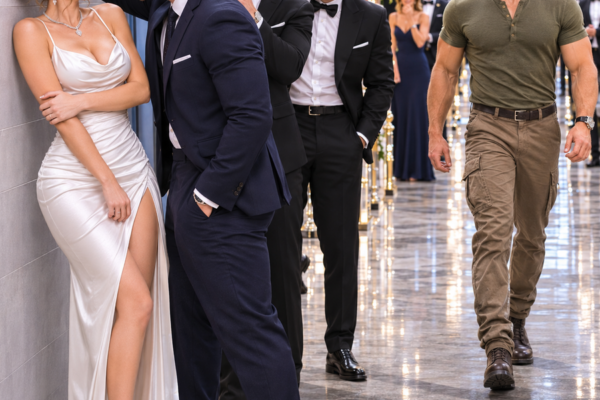
Three black Rolls-Royce Phantoms pulled up to the hotel entrance in a tight line. Their headlights cut through the early evening light. The doors opened in sequence, left, center, right, and six people stepped out.
Three men in tailored black suits, two women in sharp gray blazers, and one man carrying a leather briefcase with gold initials stamped on the clasp, TCH. They walked through the lobby without hesitation.
The hotel staff stepped aside. The concierge held the door. They moved like people who had done this a hundred times before.
The ballroom doors opened. Every head turned.
The man with a briefcase walked straight to table 14. He stopped in front of Monica.
He didn’t bow.
He didn’t smile.
He simply said, “Mrs.Turner, we received your message.
Everything is prepared.”
The ballroom went silent. Not the polite silence of a toast, the deep, airless silence of a room that knows something has shifted.
Vanessa’s hand froze on Elliot’s arm.
Catherine set her glass down slowly. Richard Brooks turned in his chair.
Monica stood up. She smoothed her navy dress one last time.
She looked at the man with the briefcase.
“Thank you, Gerald.
Please introduce yourself to the room.”
Gerald turned to face the ballroom.
He didn’t need a microphone.
His voice was trained for boardrooms, not wedding receptions, but it carried just the same.
“Good evening.
My name is Gerald Hayes. I am the chief legal counsel for Turner Capital Holdings.
” He paused.
The name hung in the air.
“For those unfamiliar, Turner Capital Holdings is a privately held investment firm based in Atlanta, Georgia.
We manage assets across four countries. Our current portfolio valuation stands at $2.
3 billion.”
A murmur rippled through the room. Guests looked at each other. Phones appeared.
Someone Googled the name.
Someone else whispered, “Turner Capital.
That’s real.”
Gerald continued.
“The founder and chairwoman of Turner Capital Holdings is the woman you have been sitting beside, table 14 this evening.”
He turned to Monica. Mrs.Monica Turner.
The room didn’t gasp.
It was worse than that. The room went completely, totally still. 300 people stopped breathing at the same time.
Catherine’s face drained of color.
Her pearl necklace suddenly looked cheap. Her champagne glass sat untouched, the bubbles dying.
Richard Brooks didn’t move, but his eyes did.
They moved fast from Gerald to the briefcase, to the gold initials, to Monica. And then, something happened to his face.
Recognition. Not of Monica, of the name. Turner Capital Holdings.
He knew that name. He knew it because 60% of Brooks and Associates investment portfolio was managed through a fund that Turner Capital controlled. He knew it because every quarter his firm received a performance report with that logo in the top right corner.
He knew it because 3 months ago, he had personally requested a meeting with the chairwoman of Turner Capital, and had been told she was unavailable.
She had been unavailable because she was planning her son’s wedding.
Richard stood up.
His chair didn’t scrape.
He rose slowly like a man standing in a courtroom to hear a verdict.
“Monica,” he said.
His voice was different now, smaller.
“I I didn’t realize.”
Monica looked at him.
She didn’t blink.
“No, you didn’t.”
The two women in gray blazers stepped forward. One opened a tablet.
The other handed Gerald a folder.
“This is Diana Cole, chief financial officer of Turner Capital Holdings,” Gerald said.
“And this is Reese Whitfield, director of client relations.”
Diana nodded at the room.
Reese didn’t.
She was looking at Richard Brooks the way an auditor looks at a ledger that doesn’t add up.
Vanessa stood frozen at the head table. Her bouquet was gone.
Her hands were gripping the edge of the table. Her knuckles were white.
“Elliot,” she whispered, “you knew about this.”
Elliot looked at his mother, then at his wife, then at the floor.
“I told you she was my mother,” he said quietly.
“You didn’t ask what she did.”
Monica walked to the center of the ballroom.
She didn’t rush.
She didn’t raise her voice.
She stood where the bride had stood 10 minutes ago under the same chandelier in the same light.
“I came here today as a mother,” she said, “not as a chairwoman, not as a billionaire.
I came to meet my son’s bride.
I came to give her my grandmother’s bracelet.
I came to welcome her into my family.”
She paused. The silence was absolute.
“Instead, I was moved to a table by the kitchen.
I was mistaken for the catering staff.
My family heirloom was called a pawn shop trinket, and I was handed an envelope full of cash and told to leave before the dancing.”
She held up the envelope. The white paper caught the chandelier light.
“This envelope, $1,000 to make me disappear.”
She set it on the nearest table.
“I don’t need your money, Vanessa.
I never did.”
The room erupted. Not in applause, in whispers, in gasps, in the sound of 300 people realizing they had watched a billionaire get humiliated for 2 hours and done nothing. Richard Brooks was the first to move.
He crossed the ballroom in six steps. His face had the look of a man who just heard the fire alarm go off in his own house.
He reached for Monica’s hand.
She pulled it back.
“Monica, please.
There has been a terrible misunderstanding.”
“There was no misunderstanding, Richard.
Your family understood exactly what it was doing.
We didn’t know.
If we had known who you were, if you had known who I was, you would have treated me differently.
That’s the problem.
Richard opened his mouth. Nothing came out.
He stood there with his hand still extended, reaching for something that wasn’t coming back.
Catherine rushed over next. Her heels clicked across the floor in rapid, uneven steps. Her composure was gone.
Her hands were shaking.
Mrs.Turner, I The bracelet, I didn’t mean You called it a pawn shop trinket, Catherine, in front of 300 people.
I was joking. It was a joke.
My grandmother’s bracelet is not a joke.
Catherine’s mouth trembled.
She looked at Richard. Richard looked at the floor. Monica turned to Gerald.
Her voice was calm, measured. The voice of a woman who had made billion-dollar decisions before breakfast.
Gerald, please proceed. Gerald opened his briefcase. He pulled out a folder and placed it on the nearest table.
Effective immediately, Turner Capital Holdings is initiating a full withdrawal of all investment funds and managed assets associated with Brooks and Associates. This includes the primary equity fund, the real estate trust, and the offshore development portfolio. Diana Cole stepped forward with her tablet.
Total exposure, $342 million. Once the withdrawal is processed, Brooks and Associates will fall below minimum capital requirements for six of its 12 active funds.
Richard’s knees buckled.
He grabbed the back of a chair to steady himself.
You can’t do this, he whispered.
It’s already done, Gerald said.
The paperwork was prepared this afternoon. This afternoon?
Richard’s voice cracked.
You planned this. Monica shook her head.
No. Harold called Gerald when your daughter moved me to table 14.
I hoped it wouldn’t come to this.
Your family made sure it did. Richard sank into the chair. His hands covered his face.
Catherine stood behind him, her fingers gripping his shoulders, her pearl necklace rising and falling with each shallow breath. The room buzzed.
Guests pulled out phones. Some were recording, others were texting.
The words Turner Capital and 300 million bounced from table to table like a ball no one could catch. Then Gerald opened a second folder.
Mrs.Turner, there is one additional matter. Monica nodded. Go ahead.
Gerald turned to face Elliot. His expression softened, but only slightly.
Mr.Turner, as part of standard due diligence, Turner Capital’s legal team conducted a background review on your fiance prior to the wedding.
This is routine for any family member entering the Turner household. Elliot stood up.
What are you talking about? Gerald pulled out a sealed document. He broke the seal and held it open.
Medical records obtained with legal authorization indicate that the pregnancy timeline does not align with your relationship. DNA adjacent hormone markers from the prenatal screening suggest the biological father is not you. The ballroom went silent again.
Deeper this time, colder. Elliot turned to Vanessa. What is he talking about?
Vanessa’s face was white.
Her lips moved, but no sound came out. We also recovered text messages, Gerald continued, between Ms.Brooks and a Mr.Kyle Henderson spanning 7 months.
The messages confirm an ongoing relationship and reference the pregnancy explicitly.
One message dated 6 weeks before the engagement reads, he doesn’t know.
He’s too nice to question it.
This is our way out. Elliot stared at Vanessa. She stared back.
Tears streamed down her face. Elliot, please. I can explain.
Explain what? His voice was quiet, broken. That you used me.
I love you. You lied to me about everything. He pulled the wedding ring off his finger.
He held it for a moment. Then he set it on the table next to the white envelope full of cash.
The wedding is off. Vanessa collapsed into her chair. Catherine rushed to her side.
Richard didn’t move.
He was still sitting in that chair, his head in his hands, trying to calculate how many months his company had left. Monica watched it all.
She didn’t smile.
She didn’t gloat.
She felt no joy in what had just happened, only the heavy, necessary weight of truth. She picked up the velvet box from table 14.
She held it close. The bracelet was safe. Her son would be, too.
The first video hit the internet before Monica’s Rolls-Royce left the parking lot.
A guest at table nine had been recording since Catherine’s toast.
The footage caught everything. The right jeans comment.
Vanessa’s speech that erased Monica from existence.
The envelope. The arrival of the three Rolls-Royces.
Gerald’s announcement.
And Monica standing in the center of that ballroom holding a thousand dollars she never needed.
The caption read, “Bride humiliates groom’s black mother at wedding.
Turns out she’s a billionaire.”
Within two hours, the video had a hundred thousand views. By midnight, it had crossed two million.
By morning, it was on every major platform, every news outlet, every group chat in America. The comments were relentless.
She called her grandmother’s bracelet a pawn shop trinket.
I’m physically sick.
300 people watched and nobody said a word. Nobody.
The bride tried to pay her off with a thousand dollars. The woman is worth 2.
3 billion. #justiceformonica started trending at 3:00 in the morning. By sunrise, it was the number one hashtag in the country.
The media moved fast. CNN ran a segment titled Wedding Day Racism when wealth meets prejudice.
A reporter stood outside the hotel where the wedding had taken place. The hotel released a statement distancing itself from the Brooks family and announcing a review of its event policies.
The New York Times published an opinion piece, The Bracelet, The Envelope, and The Lie We Tell Ourselves About Progress. It was shared 400,000 times in 48 hours.
A civil rights organization issued a public statement condemning the Brooks family’s behavior and calling for accountability.
And then, the business fallout began. Brooks and Associates had spent 40 years building a reputation.
Richard Brooks had cultivated relationships with high net worth clients, institutional investors, and corporate pension funds. He had built his firm on trust, discretion, and the promise of old money stability.
All of it collapsed in 72 hours. The first client to pull out was a pension fund managing retirement savings for 12,000 public school teachers. Their board issued a one-line statement.
We do not associate with individuals or firms that engage in racial discrimination. Three more clients followed that day. Then five, then 11.
By the end of the week, Brooks and Associates had lost over 600 million dollars in managed assets. Not just the 342 million from Turner Capital.
The rest came from clients who saw the video, read the headlines, and decided they didn’t want their money managed by a family that handed a black woman a thousand dollars and told her to disappear.
Richard Brooks was called into an emergency board meeting on Wednesday. The meeting lasted 40 minutes.
He walked out without his title. The board had asked for his resignation effective immediately. His name would remain on the building for now, but he was no longer welcome inside it.
Catherine’s world crumbled differently.
Quieter. More personal.
The two charity boards she chaired held emergency sessions. Both voted to remove her.
The annual gala she had hosted for nine consecutive years sent a letter thanking her for her service and informing her that her involvement was no longer aligned with the organization’s values.
Her friends, the same women who had laughed at Monica’s bracelet, stopped returning her calls.
One by one, the invitations dried up. The lunches disappeared.
The group chat went silent.
Catherine Brooks, who had spent her entire adult life curating her social standing, found herself standing in an empty living room with a phone that didn’t ring.
Vanessa’s fall was the loudest.
The text messages between Vanessa and Kyle Henderson were leaked, not by Monica’s team, but by a guest who had overheard Gerald’s reading and tipped off a journalist.
The messages confirmed everything.
Vanessa had known the baby wasn’t Elliot’s.
She had targeted him deliberately. A kind, trusting man from what she assumed was a comfortable family.
A man too decent to ask hard questions.
The internet didn’t forget that.
She faked a pregnancy to trap a good man and then tried to throw his mother out of her own son’s wedding.
This woman is the definition of karma coming to collect.
Vanessa Brooks is what happens when you think you’re untouchable.
Vanessa deleted her social media accounts within 48 hours.
It didn’t help.
Screenshots lived forever.
Her name became a punchline, a cautionary tale, a hashtag that wouldn’t die.
Kyle Henderson released a public statement denying involvement. No one believed him. His employer, a mid-size marketing firm in Stamford, put him on administrative leave pending an internal review.
And through all of it, Monica said nothing. No interviews, no press conferences, no social media posts.
Turner Capital’s PR team released a single statement.
Mrs.Turner is spending time with her family. She has no further comment on private matters. That silence spoke louder than anything she could have said.
Elliot flew home to Atlanta 3 days after the wedding that never was.
He showed up at the front door of the house he’d grown up in.
His suitcase was in one hand. His eyes were red. He looked like a man who had been carrying something heavy for a very long time and had finally set it down.
Monica opened the door.
She didn’t ask questions.
She didn’t say, “I told you so.”
She wrapped her arms around her son and held him the way she had when he was small enough to carry.
I’m sorry, Mom.
You have nothing to be sorry for. I should have said something at the wedding. I should have stood up.
You’re standing up now.
That’s what matters.
Harold appeared behind her.
He put his hand on Elliot’s shoulder.
He squeezed once. That was enough. That night, Harold cooked dinner for the first time in years.
Roast chicken, green beans, cornbread from his mother-in-law’s recipe.
The three of them sat at the kitchen table, the same table where Elliot had done his homework as a child, and ate without saying much. Monica looked at her son across the table.
He was tired. He was hurt, but he was home. She reached across and placed the velvet box next to his plate.
“This belongs in our family,” she said.
“It always has.
It always will.”
Elliot opened the box. The gold bracelet caught the kitchen light.
He ran his thumb across the clasp.
“The right woman will wear this someday,” he said.
Monica smiled.
It was the first real smile she’d had in days.
“Yes,” she said.
“She will.”
One year later, the Turner house smelled like lavender and fresh-cut roses. The backyard had been transformed, not by a wedding planner, not by a team of designers, by family.
Harold had built the wooden arch himself, sanded, stained, and assembled over three weekends. Monica had strung the lights.
Elliot had mowed the lawn twice because his mother said the lines weren’t straight enough the first time.
32 guests sat in white folding chairs on the grass. No ballroom, no chandelier, no 300-person guest list curated by last name and net worth.
Just the people who mattered. Elliot stood under the arch in a navy suit.
His hands were steady this time. His eyes were clear.
He looked like a man who knew exactly where he was supposed to be. The back door opened.
Sophie Reed stepped out in a simple white dress. No cathedral veil, no train, just a woman walking toward the man she loved carrying a small bouquet of wildflowers she had picked that morning from the garden. She was white, blonde hair, green eyes, a kindergarten teacher from a small town in Georgia.
She had met Elliot at a coffee shop 6 months after the wedding that never was. He had spilled his drink on her lesson plans. She had laughed.
He had offered to buy her a new set. She had said yes to the lesson plans and eventually to everything else.
Sophie had met Monica on their third date. Elliot had brought her home for Sunday dinner.
Monica had cooked her signature pot roast. Sophie had eaten two plates, asked for the recipe, and spent the rest of the evening looking through old family photo albums with Monica on the couch.
When they left that night, Elliot asked Sophie what she thought of his mother.
Sophie looked at him like the question didn’t make sense.
“She’s wonderful.
Why wouldn’t she be?”
That was the moment Elliot knew. Now Sophie walked down the grass aisle toward him.
Monica sat in the front row. The front row, not table 14.
Harold sat beside her. His hand was on her knee.
He was already crying. The ceremony was short.
The vows were not rehearsed. Elliot spoke from a folded piece of paper he had written that morning. His voice cracked twice.
Sophie spoke from memory.
Her voice didn’t crack once.
When the officiant asked if anyone objected, 32 people laughed. Elliot laughed the hardest.
After the ceremony, Sophie walked over to Monica. She sat down next to her, took her hand, and said nothing for a long moment. Then she reached into the pocket of her dress and pulled out the velvet box.
“Elliot told me about this,” Sophie said, “about your grandmother, about what it means.”
She opened the box. The gold bracelet caught the late afternoon sun. She held it out to Monica.
“Will you put it on me?”
Monica’s hands trembled.
Not from pain this time. Not from humiliation.
From something she hadn’t felt in a long time.
Joy. Pure, unearned, uncomplicated joy.
She clasped the bracelet around Sophie’s wrist.
The gold looked warm against her skin. Sophie held up her wrist and turned it slowly in the light.
“It’s beautiful,” Sophie whispered.
“It is now,” Monica said.
Harold took a photo. Monica and Sophie side by side, the bracelet between them.
He would frame it later and hang it in the hallway next to every other Turner family portrait. It would be the only one where Monica was smiling with her whole face.
That evening, the 32 guests ate Harold’s roast chicken and Monica’s peach cobbler in the backyard.
The string lights flickered, the crickets sang. Sophie danced with Elliot on the grass in bare feet. Monica watched from her chair, the velvet box empty in her purse, the bracelet finally where it belonged.
No Rolls-Royces, no legal teams, no envelopes full of cash, just a family that had been broken and put itself back together.
A year ago, a bride had looked at Monica Turner and saw someone who didn’t belong.
Someone to be erased. Someone whose love could be bought off with 10 $100 bills. She was wrong.
About all of it. Because the value of a person was never in what they owned.
THE END.