I Saw Her Throw Away the Ring She’d Bought Herself… Then She Asked Me to Help Find It
I Saw Her Throw Away the Ring She’d Bought Herself… Then She Asked Me to Help Find It
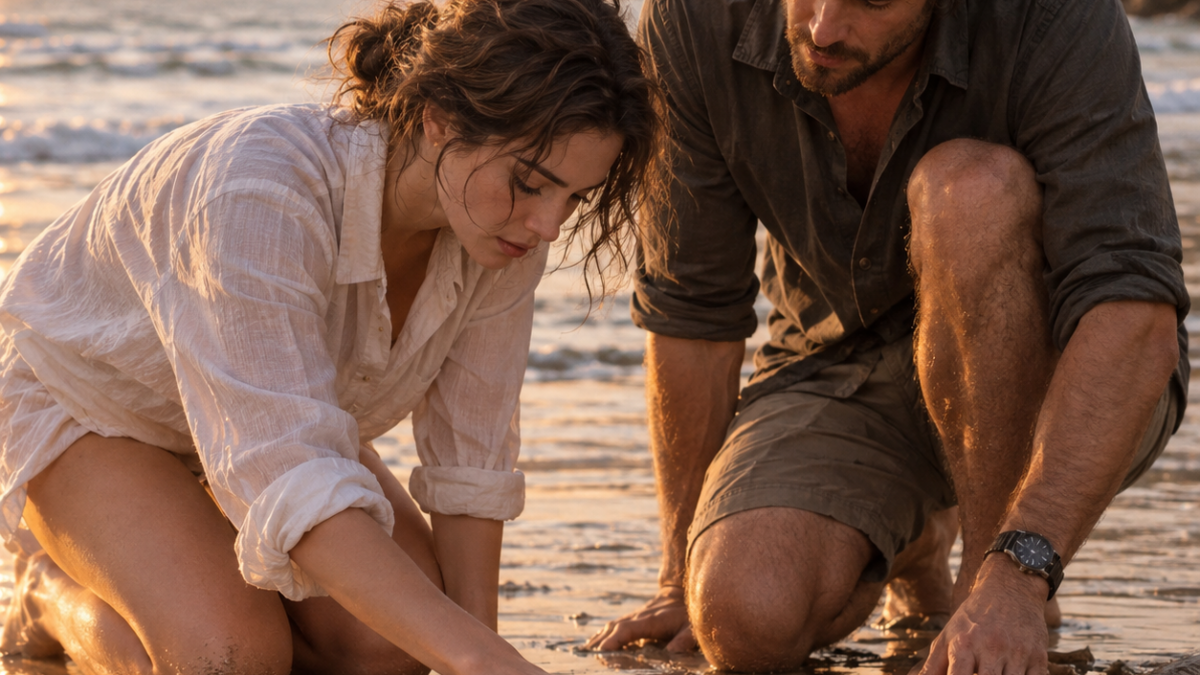
The ring caught a flash of late afternoon sunlight before it disappeared into the sand. A woman in a white linen shirt had pulled it from her finger, taken three determined steps toward the water, and thrown it as if she wanted the Pacific Ocean to make a decision for her. It landed short of the waves, close enough that I heard metal strike wet sand.
She marched toward the beach access path, shoulders squared. I kept walking. Whatever had happened wasn’t my business.
I had almost reached the next lifeguard marker when I heard quick footsteps coming back across the sand. The woman was searching on her knees, dragging her fingertips through the place where she’d thrown the ring.
The incoming water reached her ankles as she scanned the ground with an expression that made my chest tighten. When she caught me looking, she gave me a tired, rather defiant smile.
– “You saw that, didn’t you?” she asked.
I admitted I had.
– “Then you probably know what an idiot I am.”
I looked at the retreating water.
– “I know you have terrible aim if you were trying to hit the ocean.”
She laughed once despite herself, then glanced down as another wave spread over her footprints.
– “Would you help me find it, please? I really need it back.”
Something in her voice had shifted from embarrassment to genuine urgency. I set my shoes on the dry sand and knelt beside her. We divided the area into narrow strips, using a washed-up piece of driftwood to mark the approximate place where she’d stood.
As a sound system technician, I’d spent plenty of time searching for misplaced cables. She searched the higher sand while I worked closer to the water, turning my face away whenever a wave threw grit at me. After a few minutes, she said her name was Brooke Ellison.
I told her mine was Leo Warren, and she repeated it as if making sure she had the name of someone she might owe an enormous apology. She was 30, with dark hair escaping a loose clip and striking brown eyes.
I was 33, grateful I’d worn shorts. I asked whether the ring had been a gift, mostly to understand how carefully we should search.
– “From me,” she said. “To me.”
It was a slim gold band with a small blue stone. She’d bought it after finishing her bachelor’s degree, a goal she had pursued in evening classes while working full-time at a medical equipment company. For years, she’d spent weekends on papers and dragged herself to class after work.
The little ring was the first thing she’d purchased simply because she’d earned something. I said that sounded like a good reason to wear it. The problem, she admitted, was that somebody in her family hadn’t thought so.
Her older brother had called that afternoon about a small graduation celebration she was hosting the next evening. When she mentioned the ring, he’d said casually enough to be more painful that finishing college at 30 wasn’t exactly breaking a record.
She spent the next hour remembering every time she’d felt behind her peers. By the time she reached the beach, she was angry at him, angry at herself for caring, and absurdly angry at the ring for reminding her.
– “I threw away the one thing I bought to say I did it,” she said. “How’s that for a well-educated decision?”
I dug through a patch of sand where a tiny shell had caught the light. I once drove halfway to Los Angeles with a ladder strapped to the roof and left the soundboard I actually needed in San Diego.
– “A degree doesn’t make anybody immune to dramatic mistakes,” I told her. “It just gives you nicer vocabulary for them.”
Her laugh came back fuller this time. She asked whether I’d ever done something difficult that nobody else seemed particularly impressed by. The question surprised me, because I told her about training for my first half marathon two years earlier.
I’d been a terrible runner. I could fix a feedback squeal blindfolded but couldn’t jog a mile without gasping.
I trained before work for months, crossed the finish line in tears I pretended were sweat, and tucked the medal into a kitchen drawer because I didn’t know how to bring it up in conversation. Brooke stopped searching long enough to study me.
– “So, you ran 13 miles and then hid the evidence?” she asked.
– “13.1?” I said, offended on principle.
She smiled.
– “I’m glad you kept it, Leo.”
I found myself wanting to spend an evening with her. Larger waves erased more of the search area. We moved toward the dry edge in short passes.
I nearly missed it because the stone was turned downward, and what showed through the sand looked like a tiny curved line made by a shell. I pressed my fingers beneath it, lifted, and felt the clean weight of gold against my palm.
– “Brooke,” I said, and she was beside me so quickly that our shoulders collided.
I opened my hand. Her face went completely still before she reached for the ring.
She didn’t put it on right away. She held it between her fingers, turning it until the blue stone caught the light.
– “I was ready to cancel tomorrow,” she said. “Not because of my brother. Because I thought maybe everybody else would secretly agree with him.”
I brushed the sand from my knees.
– “You shouldn’t let one guy who wasn’t there for any of the work decide whether the party happens.”
She looked at me for a moment.
– “You’re right. But I think I knew that before you said it.”
Brooke slipped the ring back onto her right hand. Then she asked if I had plans the following evening. She stepped closer as she asked, and my pulse surprised me.
I said I could probably rearrange the glamorous Saturday I’d planned, which involved laundry and an argument with a refrigerator that made suspicious noises. She told me she’d reserved the back room of a small neighborhood restaurant for a handful of friends and was going to celebrate finishing her degree after all.
– “You should come,” she said. “Not as payment for finding the ring. I’d like to talk to you when we’re not crawling around in sand.”
Her smile was hard to look away from.
– “I’d like that,” I said.
She gave me the address and her number, holding my gaze. On my walk home, I realized I was looking forward to her party for a reason that had very little to do with graduation. On Saturday morning, Brooke sent me a message with the restaurant address and an instruction not to wear anything that still contained sand.
She added that if I changed my mind about coming, she wouldn’t be offended. I wondered how much of the previous afternoon she wanted me to remember. I wrote back that my cleanest shirt had been inspected and approved.
Then I checked my closet and discovered the shirt in question was less impressive than I’d remembered. I spent ten minutes choosing between identical button-downs. On the way out, I found the half marathon medal in my kitchen drawer beneath a spare charger.
I put it back without quite knowing why I’d taken it out. The restaurant sat on a quiet side street in North Park, with warm light spilling across a narrow courtyard and the comfortable noise of people who knew one another well. Brooke had booked a table for eight.
She stood near the entrance talking to two friends, wearing a deep green dress with her hair down, and the difference between the woman I’d seen kneeling in the sand and the one looking up to smile at me was startling. She walked straight over, touched my forearm in greeting, and said she was relieved I’d shown up.
– “I was worried you might have looked at the invitation and realized your beach rescue services don’t include social events,” she said.
I told her there was a reasonable service charge for Saturdays, payable in dessert. Her eyes traveled briefly over my shirt before returning to my face. I liked the way she looked at me.
Her friends knew her from college, a former apartment, and her job coordinating customer services for a medical equipment company. They teased her about studying flashcards in the grocery line and about the truly awful coffee she considered adequate fuel. Brooke gave as good as she got.
She joked about wearing mismatched shoes to an exam. I watched her move around the table, checking that everybody had food, remembering how one friend took her drink, and letting herself be teased without pretending she hadn’t worked hard.
Nobody in that room appeared to be measuring her achievement against a timeline. When someone asked how I knew her, Brooke answered before I could.
– “We met when I made a spectacular decision involving a beach,” she said. “He was very patient about it.”
She didn’t offer the rest of the story, and I appreciated that. After dinner, Brooke stood to make a brief toast.
She held her glass in both hands and laughed when her voice caught. She thanked her friends for sending notes when she missed gatherings, for saving seats at celebrations she couldn’t attend, and for pretending not to notice when she called them from the library at closing time.
– “I kept telling myself I would celebrate when I finally finished,” she said. “Then I got here and almost talked myself out of it.”
She looked at the little blue stone on her right hand.
– “I’m glad I didn’t.”
The table raised its glasses. She didn’t mention her brother, the beach, or me. She didn’t have to.
The moment belonged to her long before I’d arrived, and I felt a ridiculous surge of attraction watching her claim it back. Later, as the group drifted toward the courtyard for photographs, Brooke found me examining a framed advertisement from the restaurant’s former life as a corner grocery. She asked whether I was enjoying myself or simply being admirable about a stranger’s graduation.
I said I’d been having a good time and that one of her friends had just instructed me never to play board games against her. Brooke groaned and explained that she was competitive only when winning was reasonably possible.
– “So always,” I said.
She took the glass from my hand and set it on a nearby ledge, apparently to demonstrate that she could be decisive in matters other than a lost ring.
– “I invited you because I wanted you here,” she said, her voice lower. “Now stop checking on me.”
The frankness caught me off guard. I admitted I’d wondered what my role was, and she looked almost offended on my behalf.
– “Your role is man who made me laugh when I had absolutely no intention of laughing.”
She said it was a promising beginning. We stayed outside while her friends took pictures under a strand of lights. Brooke asked about the half marathon, including what mile had nearly defeated me, and I was absurdly pleased she remembered.
I told her the hardest part had been the first month, before there was any evidence I would improve. She said studying had felt much the same. Then the conversation took a turn neither of us seemed to expect.
We argued pleasantly about whether learning something as an adult made it sweeter or simply more annoying. She claimed I had an unfair advantage in any debate that involved being patient with equipment. I pointed out that she’d spent years handling customers who called to complain about machines they hadn’t plugged in.
She laughed, then rested her hand lightly against my elbow while she spoke. It was an easy gesture, but my attention followed it more closely than any conversation happening around us. I helped stack the few remaining plates after the others left.
Not because anyone had asked, but because Brooke was still thanking the server, and I couldn’t think of a reason to stand around waiting. When we reached the sidewalk, she turned to face me beneath a small pool of streetlight. She told me she’d enjoyed the evening more than she’d expected.
I said I had too. We stood there caught in a promising silence.
I wanted to kiss her. I also knew she’d spent the whole evening being someone’s graduate, someone else’s friend in the center of a room, and I didn’t want our first real romantic move to arrive because she was swept up in the celebration.
– “I’d like to take you out,” I said. “Just you and me. No guest list.”
Brooke’s smile changed.
– “I was hoping you’d say that,” she replied.
She offered Tuesday after work, and when I suggested we do something she’d never have planned for herself, she leaned closer and said she was willing to be surprised. She touched the ring once while I walked her to her car, but by then I was paying much more attention to her face than her hand. By Tuesday, I could tell the beach story without sounding entirely ridiculous.
I hadn’t told anyone about the way Brooke said my name. She texted once during the workday to ask whether my surprise involved helmets, because she wasn’t spending another evening on her knees looking for expensive objects. I assured her nothing would be thrown, buried, or retrieved.
I had chosen a little neighborhood restaurant with a courtyard where a three-piece band played on Tuesday evenings, a place I liked precisely because I didn’t know anybody who worked there. At work, I often heard music has problems waiting to happen. At that courtyard, I could sit down, eat good food, and let somebody else worry about the microphones.
Brooke was waiting outside when I arrived. She wore a fitted dark blue dress beneath a light jacket, with simple gold earrings and sandals that made her look taller than I remembered. The little blue stone rested against her right hand when she brushed hair from her cheek.
I noticed it, but I noticed the way her face brightened when she saw me more. She looked me over appreciatively.
– “No sand,” she said. “Excellent progress.”
I said I’d checked every pocket. She asked whether I was nervous. I told her I’d been unusually interested in what my reflection looked like for a man who owned exactly one decent jacket.
She laughed, and something in my shoulders loosened. A server led us to a courtyard table where Brooke looked delighted by the surprise. We ordered two dishes to share and argued about whether that counted as efficiency or indecision.
Brooke admitted she was terrible at ordering something she hadn’t tried because she always imagined the better option sitting on someone else’s plate. I told her I had a rule that the second person at the table had to choose the dessert, which let me feel decisive while transferring all the risk.
– “You’re very good at protecting your image,” she said.
– “I’m better at protecting the people who have to eat my choices,” I replied.
She tilted her head in a way that suggested she liked the answer more than she wanted to show. The band began a slow song, and the lights over the courtyard came on. The music carried us into a silence I liked as much as her laughter.
Brooke asked what my favorite part of my job was, and I surprised myself by answering honestly. I liked that most people never noticed the person making a room sound right. When everybody could hear the singer, nobody noticed the machinery.
But I hated spending all my evenings behind a mixing board, watching other people enjoy things I was supposed to make possible. She wanted to know what I did about that. I said I had started protecting one night a week for myself, even when it meant turning down extra work.
– “That sounds harder than a half marathon,” she said.
She understood the impulse to protect time for yourself. I asked what she wanted to do with her new freedom now that evening classes were finished. She leaned back, considered the question, and said she hoped to get very good at making plans that didn’t look impressive on paper.
Her answer led us into stories neither of us had offered at the beach. She told me she’d once signed up for a pottery class and produced an ashtray despite never having smoked. I admitted I’d bought a secondhand keyboard during a year when I thought learning an instrument would make me less critical of musicians.
My neighbors had objected. Brooke requested a performance. I declined on humanitarian grounds.
She laughed so hard she had to put down her glass. Under the table, her knee touched mine. Neither of us moved away, and suddenly I barely heard the music.
When I reached for the water, her fingers brushed the back of my hand and stayed there just long enough to make the choice unmistakable. I turned my palm up, and she fitted her fingertips into it with a small smile that made the whole courtyard seem farther away. After dinner, we walked toward a bookstore that was still open, drawn by its front window crowded with old science fiction covers.
Brooke accused me of having a secret collection, and I admitted I had one shelf of books with covers so dramatic that nobody could possibly guess the plots. She made me choose the worst. I picked an old paperback featuring a spaceship shaped like an appliance, then defended it with excessive conviction.
She bought it before I could stop her, announcing that she needed to understand what kind of man took a woman to dinner and immediately revealed this taste in literature. She said she’d decide whether my taste was respectable after reading it. It was an ordinary purchase, but I liked the idea that she was going home with something that had nothing to do with her ring, her degree, or the afternoon I’d helped her.
We lingered beneath the bookstore awning when it began to mist, though neither of us seemed particularly bothered by a little water. Brooke stood close enough that I could see the tiny flecks of lighter brown in her eyes. She asked whether I’d enjoyed surprising her.
I said I’d enjoyed discovering that she was funny when she wasn’t trying to be. She narrowed her eyes, then told me she’d been making an enormous effort all evening.
I reached toward her and waited until she stepped into my hand at her waist. The permission in that small movement felt more intimate than anything I’d rehearsed in my head.
– “Can I kiss you?” I asked.
– “I was beginning to think your entire job description involved asking me questions I already know the answer to,” she said.
Then she kissed me before I could respond. Her mouth was warm, her hand rested against my neck, and for several seconds there was no graduation, no obligation, and no clever thing I needed to say. She drew me into a second kiss, slower this time, with one hand holding the edge of my jacket.
I felt her smile just before she pulled back and had to remind myself we were standing on a public sidewalk. The mist had dampened her hair, but she looked entirely unbothered by the weather.
When we stepped apart, her smile made me forget my joke. She brushed her thumb across my jaw, then looked down at the paperback tucked into her bag.
– “I want to see you again,” she said. “Not for a tour. Not because you were nice to me on the beach. I think we’d have fun, even if nothing interesting happened.”
I told her I was starting to suspect that an evening with her would rarely meet that condition. She asked me to keep Friday open, but warned me that she couldn’t promise anything more exciting than a takeout meal after a long day at work. I said that sounded like an excellent test of our compatibility.
She took my hand on the way to her car. I’d kissed Brooke, and she had kissed me back. The harder question was what we’d choose when there wasn’t anything beautiful or unusual happening around us.
Friday left us both exhausted. I’d dealt with an unreasonable event coordinator. Brooke had untangled a shipment problem for an irate customer.
We had agreed on takeout at her apartment with no expectations beyond comfortable clothes and permission to be tired. When she opened the door, she was barefoot in jeans and a soft black top, her hair gathered loosely behind her neck. She kissed me before she’d finished saying hello.
That made a strong argument for continuing to see her, even if the food turned out terrible. I followed her inside, carrying paper bags that smelled of ginger and sesame, and tried not to grin like a teenager while she cleared two textbooks from the couch. Her bright, crowded apartment suited her.
A stack of coursework leaned against one wall. A half-finished jigsaw puzzle occupied the small dining table, and a plant near the window looked as though it had survived several difficult conversations. Brooke caught me examining it and said the plant had been with her through three semesters and deserved a diploma of its own.
On the coffee table sat the ridiculous science fiction paperback she’d bought on Tuesday. She had already read half of it. Worse, she was prepared to argue that the supposedly implausible villain had a perfectly sensible motivation.
We ate on the couch and conducted a mock trial of his crimes. She accused me of judging a book by its cover while claiming to be broad-minded, and I countered that I had bought the book precisely because of its cover. She pointed out that she’d actually bought it.
– “For research,” she added with suspicious innocence.
Somewhere between dinner and dessert, her phone lit up with a message from her brother. She turned it face down without reading the rest. I noticed the little shift in her posture and asked whether she was all right.
She told me he had congratulated her on the party photograph earlier in the week, then added a remark about how she could finally stop talking about school. She was annoyed that she’d nearly let the comment spoil the photo for her. I found myself reaching for solutions before she had finished explaining.
I suggested she tell him exactly how many hours she’d worked, or perhaps stop answering when he made those comments. Brooke was quiet. Then she put down her fork and said gently but unmistakably:
– “Leo, I know what I could say to him. I didn’t ask you to win an argument for me.”
I felt my ears warm. I hadn’t meant to make her evening worse, but I had tried to turn a feeling into a task. I apologized for barging ahead of her and asked whether she wanted to tell me more.
She said she was tired of giving the comment free room in her head and mostly wanted to sit beside somebody who didn’t need an explanation for why finishing her degree mattered. I could do that. We cleared the cartons, and she curled against me through a nature documentary about a small bird.
After a while, she tucked her hand under mine. The ring pressed briefly against my palm, cool and familiar, before she shifted to a more comfortable position. I didn’t mention it.
There was relief in not making every part of her life into a symbol I had to decipher. When the program ended, she looked at me and thanked me for staying rather than making an elaborate speech. I told her she was welcome, and for once, I resisted adding anything clever.
She asked whether I ever let somebody celebrate me or whether I kept hiding good things in drawers. I asked whether this was about the half marathon medal, and she gave me an expression that made lying impossible. I admitted I’d kept the medal because I was proud of it, but putting it on display had felt like asking visitors to applaud.
Brooke said she’d probably put hers on the wall if she ever finished a race longer than the distance from her couch to the refrigerator. Then she surprised me by asking what crossing the finish line had felt like.
I told her about the taste of oranges at the last water station and the strange sound of thousands of shoes tapping the pavement. She listened without turning it into advice.
– “That sounds like a good memory to keep,” she said when I finished.
It was a small kindness, and I understood why she’d asked me not to fix the things she brought into the room. We spent the following week discovering how differently our schedules worked. My event calls occasionally came early and ran late.
Brooke had an office schedule and a firm dislike of texting when she was trying to finish something difficult. Neither of us needed constant attention. She would send a picture of the paperback beside a coffee cup, then disappear for hours.
I would tell her about a meal I’d ruined or a piece of equipment that had survived a particularly foolish mistake. We didn’t stage every exchange as flirtation, although sometimes a single sentence from her could undo my concentration for the rest of an afternoon. Once, after I’d said I was working through Saturday evening, she wrote that she hoped my microphones knew how lucky they were to get so much attention.
I told her I’d be happy to introduce her to the competition, but that the microphones had never kissed me under a bookstore awning. Our comfortable routine made one unanswered question harder to ignore. We had kissed and spent evenings touching, laughing, and making room for each other in busy weeks, but neither of us had said what we were doing beyond enjoying it.
At first, I’d been afraid she liked me because I’d happened to help on a terrible day. Now, I could see she liked plenty of things about me, including a few she had no good reason to admire. Yet I still wondered whether the version of us that belonged in her everyday life was something she truly wanted or something she hadn’t needed to name.
I knew I was beginning to want more than occasional evenings. I didn’t want to wait until she guessed that. Before I could find the right words, Brooke asked if I would keep Sunday afternoon free.
She told me she had made a plan for once, one that involved something I liked, and she sounded almost mischievous about refusing to tell me what it was. Brooke refused to tell me where we were going until I arrived at her apartment on Sunday afternoon.
She stood in the doorway wearing a fitted rust-colored jumpsuit, her hair loose over one shoulder, and announced that she was in charge of transportation. I told her this arrangement sounded suspiciously like an attempt to reenact the beach without any risk of losing jewelry.
– “Nothing of value will be thrown,” she promised, then slid past me and took my hand as we walked to her car.
She knew where to park and was grinning too broadly for a routine lunch reservation. We headed toward Hillcrest and stopped outside a small independent theater with faded movie posters in its windows. A sign advertised a double feature of terrible old science fiction films.
I laughed immediately after reading the titles. She’d searched for movies like the paperback from our first date and found the theater screening. She worried my terrible taste had been a joke.
I told her I had never worked that hard on a joke in my life. Inside, she handed me a paper bag with the sort of candy I had confessed to stealing from my sister’s Halloween stash when we were kids. I’d mentioned that candy once.
Her remembering got to me more than the tickets. She also brought the battered paperback, its pages flagged with small yellow notes marking the scenes she thought were funniest. She showed me one especially absurd passage before the lights dimmed, and we both struggled not to laugh loud enough to draw attention.
The fact that she had finished reading it felt like a private compliment. On the way to our seats, she glanced over her shoulder and said:
– “If the movie is awful, you have to tell me. I don’t want you politely praising space garbage because I planned the afternoon.”
I assured her honesty was essential to the scientific method. The films were even worse than she’d hoped. One featured a cardboard spacecraft that changed size.
Another had a villain dressed like a curtain. I laughed until my cheeks hurt. Brooke supplied quiet commentary that was better written than the dialogue on screen.
But when a surprisingly lovely piece of music drifted over one scene, I found myself listening closely. She noticed. Afterwards, she asked what I’d heard, and I explained that the composer had somehow made a moment of quiet feel larger than the whole movie.
Brooke didn’t pretend to hear every technical detail. She just said she’d liked that moment, too, and asked me to play it for her again if we could find the soundtrack. She was curious without pretending expertise, and held my hand through the second film.
She’d noticed something I loved and wanted to share it. Outside the theater, Brooke admitted that she’d nearly talked herself out of the plan.
– “I thought it might look as if I was trying too hard,” she said.
People from the screening drifted past. I said her terrible special effects and excellent company had made my Sunday. She looked relieved, but then her expression grew serious.
She said she had spent years thinking that inviting somebody to celebrate her meant asking them to approve of her life. Lately, she was trying to do things simply because they mattered to her. That included the ring, the graduation dinner, and today with me.
– “I didn’t arrange this to say thank you again,” she told me. “I arranged it because I wanted to see what you look like when you’re having the kind of fun nobody can fake.”
I took her hand and kissed the back of it.
– “Apparently, I look like a 12-year-old boy,” I said.
– “A very attractive one,” she answered.
I asked if she wanted to come back to my place for something to eat. She seemed pleased I hadn’t planned anything elaborate. My apartment overlooked the next building’s thoroughly unromantic roof.
She found my other terrible science fiction paperbacks and looked triumphantly vindicated. I made grilled cheese sandwiches because that was what I had in the refrigerator and because neither of us was hungry enough for another restaurant. Brooke sat on the counter, then slipped down and stood behind me.
Her arms settled around my waist, her cheek against my shoulder. When I turned, she smiled up at me and brushed a loose strand of hair from her face. I kissed her slowly, and she drew me closer, the warmth of her body making it difficult to remember what I was cooking.
The sandwiches survived only because I eventually reached past her to turn off the heat. We ate at my kitchen table, laughing about the nearly burned bread. Brooke spotted the medal when I opened a drawer for a spare napkin.
She didn’t reach for it or make a speech. She simply glanced at the ribbon and asked whether I’d ever thought of putting it somewhere I could see it. I looked at the faded blue cloth in my hand and felt unexpectedly exposed.
I told her I had been proud of finishing that race, but had always been uncomfortable treating my own achievements as announcements. She knew how easy it was to make yourself small. Then she picked up her plate and carried it to the sink, leaving me free to decide what to do with the medal.
I set it on the bookshelf near the window. It was a modest change, but I liked the fact that she’d noticed without asking me to become somebody louder. When we moved to the couch, Brooke sat close, her leg resting against mine, and took my hand without needing to ask whether I wanted it.
I asked her to look at me because I didn’t want to tuck what I felt into another joke. I told her I liked spending time with her, that I wanted to know the unremarkable version of her as well as the woman who could laugh at an old monster movie, and that I’d like us to be dating for real. I asked because I’d begun making plans that included her without even realizing it.
Brooke studied me with that direct, steady gaze I’d first noticed under the restaurant lights. She said she’d been doing the same.
– “I want to be your girlfriend, Leo,” she said. “Not because you found anything for me, because I keep wanting to tell you things and I keep wanting to hear what you think.”
The word girlfriend made me forget my rehearsed response. I told her yes, although that wasn’t quite the right answer to a statement. She laughed, leaned across me, and kissed me with a certainty that made any remaining question feel wonderfully unnecessary.
Her hand slid into the hair at the back of my head. Mine rested against the curve of her waist as we moved closer on the couch. She shifted sideways into my lap, her arm settling comfortably around my shoulders.
The kisses were unhurried, and I liked the small sounds of her laughing when I brushed my mouth against the corner of hers. I held her close without trying to hurry us toward anything beyond what we both wanted. We traded softer kisses as the city darkened outside.
When she eventually rested her forehead against mine, she asked whether there was anything about me she hadn’t learned yet. I admitted I couldn’t fold fitted sheets and cried at certain movies. She smiled and said we had time to discover them.
Later, when I walked her downstairs, she paused on the landing, held my face between her hands, and kissed me once more. She left smiling. I stood in the stairwell smiling, not because I’d solved something for her, but because we’d both chosen what happened next.
Being Brooke’s boyfriend didn’t change our work schedules. We still had long days and occasional late events. The difference was in the small decisions between those hours.
When I passed a bakery she liked, I sometimes stopped for the little almond cookies she pretended not to care about. When she knew I had a late event, she’d leave a message that made me laugh on the drive home with no expectation I’d answer before morning. Some evenings we stayed in with crosswords.
Other nights we dressed up and went out. Sometimes she called just to tell me a joke she knew I would appreciate, then hung up before I could accuse her of wasting my entire afternoon. Sometimes I showed up with dinner because I knew she had a deadline, and we ate it side by side without needing to make a story out of it.
The comfortable moments began to matter as much as the kisses. One Wednesday, she came over carrying groceries and announced that she was making dinner, provided I promised not to offer helpful commentary. I put on music and helped only when asked.
In a pale yellow blouse, she danced whenever a song pleased her. Halfway through chopping vegetables, she caught me looking at her and lifted an eyebrow. I said I liked her in my apartment.
She set down the knife, walked over, and kissed me until I forgot the name of the song. Later, she chose the record we played while we ate, and I told her it was a questionable selection. She informed me that having a boyfriend with opinions was inconvenient, but apparently worth the trouble.
We stayed up talking about childhood vacations, her bare feet resting in my lap. A week or two after the movie date, Brooke invited me to meet two of her friends for coffee. I recognized them from the graduation dinner.
One of them noticed the ring when Brooke reached across the table for a napkin. She admired the blue stone and asked whether it was new. Brooke looked down, smiled, and said she’d bought it for herself after earning her bachelor’s degree.
She described the shop where she’d found it. She didn’t apologize for her age or the time it had taken. I did.
When somebody asked how we’d met, Brooke laughed and said she had been caught behaving with less dignity than she preferred. I told them she was exaggerating the degree of dignity she’d lost. Her hand found mine under the table.
Walking back to her car, I asked whether it felt strange to tell that story now. Brooke considered the question.
The beach still embarrassed her, but she didn’t regret it. The degree had been hers before anybody commented on it, and the ring still meant what she’d chosen it to mean.
– “I shouldn’t have thrown it,” she admitted. “But I don’t have to keep explaining myself because I did.”
I liked the distinction. We stopped at a crosswalk, and she looked up at me with a small smile that suggested she had another thought.
– “Besides,” she said, “the guy who helped me find it turned out to be pretty interesting.”
I asked whether that meant my performance review was going well. She said the results were promising, but she intended to keep evaluating. She took my hand as we crossed, smiling at my mock concern.
At my apartment, the half marathon medal stayed on the shelf where I’d put it the evening we’d become a couple. Seeing it reminded me how hard I’d trained. Brooke didn’t point it out or ask whether I was proud often enough.
Once she brought over a small photograph from her graduation dinner and asked if there was somewhere she could leave it, then laughed when I offered an absurdly prominent spot beside the medal. We put the picture on a lower shelf next to the battered science fiction paperback, where it looked comfortable among my other odd possessions. She’d become part of a place I’d once kept to myself.
The first night she left a sweater on the back of my chair. I moved it carefully out of the way, rather than asking whether she intended to take it home. We returned to La Jolla Shores one late Sunday afternoon, not for an anniversary and not because either of us needed a grand gesture.
Brooke suggested a walk. I chose dinner afterward. We left our shoes in the car and walked along the damp sand.
Brooke told me she had signed up for a pottery class again, entirely for fun, and I promised not to ask whether she intended to make another ashtray. She said she might make me one just to teach me a lesson. She was wearing a simple white cotton dress, her hair loose in the breeze.
When she caught me watching her, she took a step toward me and asked whether the beach still seemed dangerous. I said my position depended on whether she was carrying any jewelry she planned to throw. She held up her right hand, the blue stone catching the afternoon sun, and informed me that the ring was staying exactly where it belonged.
I told her I’d already retired from professional treasure hunting anyway. She laughed and leaned into me as we walked. Farther down the beach, we passed the spot where I’d first heard the ring fall.
The water had erased every trace of our search. Brooke stood for a moment studying the place, then asked if I thought we’d have talked if she’d simply walked past me that day. I considered it.
– “Probably not,” I told her, although I would have noticed her.
She turned toward me with a smile that grew unmistakably pleased.
– “Would you have said hello?” she asked.
I admitted I might have needed a better opening than my usual talent for spotting things on the ground. She stepped closer, rested her hand against my chest, and said she thought I would have managed. I kissed her briefly at first, then again when she drew me nearer.
When we pulled apart, she slipped her fingers through mine and started us toward dinner without asking me to lead. We’d chosen where to go together. I still remembered that afternoon as the day I found a ring in the sand, because that was the strange visible thing that happened.
The part I valued most came afterward, when Brooke kept showing up as herself and letting me do the same. Her ring belonged to her achievement, and it always would. What we had together belonged to every ordinary choice we kept making after the tide had gone.