My Boss’s Daughter Became My Intern… Day One She Asked, “Are You the One Dad Warned Me About?”
My Boss’s Daughter Became My Intern… Day One She Asked, “Are You the One Dad Warned Me About?”
I was walking the new intern past the paper backdrops, pointing out the tape marks that showed where the light stands could not move, when she stopped beside the rolling light cart and looked straight at me.
– “Benjamin, before I put my bag down anywhere,” she said, “are you the one Dad warned me about?”
She asked it the way a person asks whether a dog bites, curious more than worried, and it took me a moment to understand that I was supposed to be the dog. My lanyard said Benjamin Duval, Studio Lead, and I was 30.
Sabrina Ki was 23, a week out of her visual communications degree, and until that Monday morning, I had known her only as the daughter in the stories her father told in staff meetings. I told her the warning was probably accurate and asked which version she had heard.
– “He said you’d send my work back exactly like anyone else’s,” she said, “and that I wasn’t allowed to complain to him about it.”
– “That part is true,” I said. “He told me the same thing on Friday, so I assume he enjoyed saying it to both of us.”
She tilted her head and studied me for a second as though checking the label against the contents.
– “Everyone upstairs said you’d be terrifying. But so far, you’re only a little terrifying,” she said.
I told her I saved the rest for people who shot an entire sleeping bag without showing the zipper. She laughed out loud, a sound that carried across the studio and made Marisol, our retoucher, look up from her monitor. Then she dropped her bag on the bench and asked whether that had really happened.
I said it had happened once with 112 frames and that I still remembered the missing zipper better than the intern. By 9:30, she was holding the new rain jacket for the summer sale and telling me she wanted to shoot it differently. Every jacket on the company site hung flat and gray under strobes, she said, and not one of them looked as if it had ever been outside.
She wanted to hang it from a stand by the big north window and let the daylight do the work. I asked for her reason, because “it would look cool” was not something I could put on a shot list, and I watched her decide against the easy answer. She said the strobes flatten the seams and that window light would show the taping and the fabric grain, which was what a person actually checked before buying a jacket.
She never said her father would like it, and she never asked me to trust her. It was a reason about the shot instead of a reason about her. So I gave her until after lunch for a test set, with the sale catalog due Wednesday, and handed her a written note that told her to keep it natural and leave room for copy.
She came back at 1:15 with 40 frames, and half of them were good enough to annoy me. The fabric looked like fabric. The seams showed, and the jacket seemed to be waiting for weather.
But the whole set had a faint green cast from the fire door on the far wall because she had skipped the gray card on the cart, and she had left the copy space on the left when the website banner needed it tall and on the right. Mara drifted over with Dev and Kayla, the two other interns rotating through the studio that summer, the way people do when a new person’s first work is on the screen. I knew that whatever I said next would be repeated in the break room by 3:00.
I told Sabrina the crop was my fault because my note said to leave room for copy without saying which side or what ratio, and she had made a sensible guess from what I gave her. The color was hers. I said so because the card was sitting right there on the cart, and I wanted both problems fixed by five.
Her face went pink, and she lifted her chin and asked whether I was going to make it sound nicer than it was. I told her it wasn’t nicer than it was. She looked at me for a long moment, and I had the impression she was waiting for the catch, an apology that would quietly lower the bar, and was surprised not to find one.
Denise Sackerman came through a little after two with a clipboard, as she did with every new group, to explain the program to Sabrina before the afternoon got away from us. Denise ran creative operations and said the internship lasted 10 weeks with a final review she would sign herself against the same rubric for every intern, built from the weekly notes the studio lead wrote, which meant nobody on the fourth floor would have a hand in it. She added that the company sometimes offered a four-week paid extension to someone whose workload and progress supported one, and she said it in the voice of a person describing a parking policy.
Sabrina thanked her but said she wasn’t planning to stay because she wanted to use the summer to build a portfolio she could carry to jobs outside this building. Denise said plenty of people said that in June. And Sabrina said she knew and that she would like it on the record anyway.
She said it without glancing at the ceiling, even though her father’s office sat two floors above us. And I noticed that I had noticed.
She reshot the set with the gray card at 4:00, and the new frames came up clean and tall, with the copy space on the right and the jacket looking like it belonged to someone who had been caught in the rain and did not mind. I told her they passed, and she asked if that was all, and I said that on a Monday:
– “passed” was the best word I owned.
She grinned and started to answer, and then Kayla called across the floor about a stuck light stand, and I realized I had been standing at her bench much longer than the frames required. At 5:15, while the others packed up, I told Sabrina what I had planned for her next two weeks, which was a desk beside Marisol, tagging and sorting the archive. Quiet work that needed almost none of my supervision.
I had been calling it a considerate choice since lunch. She listened to all of it with her bag strap in her hand. And then she asked whether it was quieter or just farther from me, and I said, before I could improve the answer, that it was both.
– “Dev and Kayla are on the floor tomorrow,” she said. “And I’m guessing nobody is offering them a desk by the archive. If you think I’m not good enough to be out here, say so and I’ll deal with it. But don’t give me less because of whose daughter I am, because then I’m paying for it twice.”
She did not raise her voice or wait for me to be impressed. And what I felt was the particular discomfort of hearing my own caution described correctly. I had told myself that staying away from her was a form of fairness, and she had just shown me it was a charge I was billing to her account.
– “9:00 on the floor with the group,” I said. “Same shot list as everyone else.”
She nodded once, said good night to Marisol by name, and went out through the glass door with her bag swinging against her hip. After the studio emptied, I stood at the whiteboard and wrote her name under the 9:00 shoot in the same block letters I used for everyone, and I capped the marker more slowly than a marker deserved. She had needed one day to find the exact spot where I had been keeping my distance, and I did not know yet whether I could teach her tomorrow without hiding there again.
On Tuesday morning, I did what the whiteboard said. Sabrina worked the floor with Dev and Kayla, shooting tent flats and running a lantern setup, and she got the same shot list, the same two-minute review after each setup, and the same rejections as everyone else. Her second tent frame came back with a lantern glowing so hard that the fabric burned out around it, and I sent it back the way I would have sent back Dev’s.
She asked why, and I told her the stitching had disappeared, which was the first thing a buyer checked. She walked away without arguing and returned 20 minutes later with the lantern turned down two stops and a white card propped on a milk crate to lift the shadows. I asked why the card sat on the left, and she gave me an answer about the window and the seam line that was better than the one I had in my head.
I never told her good job. I asked a second question about the milk crate and listened to the answer for longer than the frame deserved, and I suspect she counted that as the better compliment. The next two weeks stacked up in a way I have trouble separating now.
The rain jacket made the catalog on Wednesday, shot by the north window with the fabric grain showing, and Marisol retouched it so lightly that she said she felt like she had done nothing. Sabrina learned fast that the studio lead on the floor was brisk and a little formal, while the man closing up after the group left was somebody else. She would ask one more question exactly when I believed a review was over, and I developed a dry answer for each.
When she asked whether I ever liked anything on the first pass, I said once, a thermos, until we discovered the label was upside down. It took her a beat to understand she had been teased, and then she laughed so hard that she had to set down the card she was holding. By the third week, I noticed I was saving the end-of-day review for the quiet part of the afternoon so there would be room for the extra question.
I still locked the studio at 5:30 every day because I had decided that a boundary which bends at the first good reason was only a preference. On the Thursday of the third week, we ended up on the loading dock with the door propped open, drinking coffee from the machine upstairs that nobody defends. Dev and Kayla had gone to lunch together, and Sabrina turned her cup in her hands and said she knew her father had gotten her the internship.
She said it plainly, the way she said most things, and she added that she had no interest in pretending otherwise with me. What bothered her was what happened next, because people heard her last name and stopped looking at the frames as though her work were a note from the fourth floor. I said that I looked at frames since it was the only thing I was qualified to do, and that hers had a habit of making me work harder than I planned.
She gave me a long look over the rim of the cup, trying to decide whether I had said something kind or something dry, and I let her work it out. I realized that I would have been content to stand on that dock for the rest of the afternoon. The picture surfaced the next day.
It was the Friday of week three, and we were leaving together at 5:30 because her bus and my parking lot used the same side door. I had a canvas tote over my shoulder with the portfolio sleeve in it, and when I shifted the strap, a single print slid out and landed face up on the concrete floor. Sabrina got to it first.
It showed a woman in a folding lawn chair outside a dry cleaner, her shoes off and her head tipped back against the brick, taken in the thin light of an ordinary Tuesday. Sabrina did not ask what lens I had used, which is the question people usually ask. She asked why the woman’s chair faced the wall instead of the street, and I said I thought she had picked the one spot where nobody would ask her anything.
– “So it’s a picture of her choosing,” Sabrina said.
And the way she said it made me realize I had never put it that cleanly myself. I told her about the series since there was no way to make the print go back into the bag unseen. For two summers, I had been photographing the small places people make for themselves in the city.
The folding chairs outside hardware stores, the bus stop steps, a milk crate by a loading dock that someone had clearly claimed. I had nearly 30 pictures and never finished because every Friday I could find a catalog that needed me more.
– “That’s an excuse with a shot list,” she said, and I told her it was a very good shot list.
Then, because she was still holding the print and there was no one else in the hall, I admitted that I had registered for a community exhibition at a neighborhood arts hall and that it opened on the Saturday right after her final week. I had paid the fee in March.
I had nine prints to choose and no title. And I was telling her because she asked, not because I was inviting her, and I said so in those words.
– “Understood,” she said, and her mouth went crooked as though she might argue with that and had decided to save it.
Then she told me the woman in the folding chair looked like a girl from her campus who napped in the library stairwell. And I said that I now owed the stairwell girl a release form. And she was laughing again.
It was a real laugh, the kind that bounces around a hallway. And I was laughing too, helpless over a remark that had nothing to do with exposure or crop. When the elevator opened and Richard Ki stepped out with his jacket over his arm, whatever my face had been doing a second earlier stopped.
I heard my own voice go level and professional as I said good evening and asked whether he needed the Monday catalog proofs, and I felt it shift as plainly as a gear. But Sabrina was in the middle of a sentence about the stairwell, and I did not cut her off, so I turned my head and let her finish it. Richard looked from her to me with the polite attention of a man who had heard laughter from the elevator and was waiting to be told the joke.
I said it was a release form joke, nothing worth repeating, and he said the proofs could wait until Monday and that he would see us both then. He pressed the button for the lot instead of the stairs and left us standing in the hall. And Sabrina handed me the print without looking at it.
– “You changed your voice,” she said quietly enough that it was not an accusation.
I said I’d had a lot of practice with that voice, and she nodded, and I saw her file the shift away next to everything else she had learned about me that month. I could no longer pretend that the way we talked when no one else was in the room counted as harmless. She walked beside me to the side door and stopped with her hand on the push bar.
– “Can I see the rest?” she asked. “Not tonight and not as a favor. On a lunch break at a table where Marisol can walk by and judge us both.”
I told her Monday at noon at the table in the break area, and that I would bring the prints I trusted least. Somewhere between the hallway and the parking lot, I recognized that I had just agreed to a meeting with a perfectly sensible location and a time limit, and that I could not explain it to myself as a way of teaching her anything. On Monday at noon, the break area was nearly empty, apart from Marisol heating soup at the microwave and a vending machine that hummed like it disapproved of everyone.
I had spread seven prints along the long table by the window at 11:40, the ones I trusted least, and then moved two of them to the back because they were better than I wanted to admit. Sabrina arrived exactly on time with a plastic container of leftover pasta, a fork stuck through the lid, and a sweatshirt tied around her waist.
She did not sit down. She walked the length of the table slowly, like someone studying a lineup, and stopped at a boy asleep on a bus stop bench with his skateboard under his head.
– “These are the ones you trust least?” she asked.
I told her they were the ones closest to finished, and that “closest to finished” was the part that frightened me. She asked what I called them in my head since I had admitted on Friday that I had no title. And I said the folder on my hard drive was named “Misc Nolm 2,” which she said was the saddest thing she had heard all week.
She sat across from me and ate while she looked, and I found myself saying more than I had planned to. For two years, I had told myself the series was waiting on a free month, when the truth was that I kept choosing catalog work because a catalog never asked me to stand beside a picture and say it was mine. I had been busy on purpose, I told her, and it was the least interesting kind of cowardice there is.
Sabrina set her fork down and did not tell me I was being too hard on myself. She said she was doing a version of the same thing, building a portfolio to take out of her father’s building while still working inside it. In the spring, she had sent 11 applications and gotten two form rejections and nine silences.
And when her father offered to make a call, she had said yes so fast that she still disliked the sound of it. She said part of her wanted to find out whether she could stand without the net before she let go of it.
– “If I jump, and it turns out I can’t,” she said, “I’ll have jumped off the one thing that was already holding.”
She said it without self-pity, as a problem with measurements, and I realized that nobody at work had been allowed to see that side of her, and I had not either until that minute. Marisol carried her soup past us and took a long, innocent look at the prints on the way. When she had gone, Sabrina slid one toward the middle of the table.
A man on an upturned milk crate outside a hardware store with his lunch balanced on his knee. We both leaned over it to look at the corner where his shadow met the curb, and the table was narrower than I had remembered. Her hair smelled like studio coffee and something citrus, and her hand lay flat on the table an inch from mine while she explained that the shadow should have been the subject.
She was right, and I missed the second half of her sentence. I looked up to say something about the exposure and found that she was not looking at the print at all. The clock over the vending machine ticked loud enough to count, and anyone could have walked in at any second, which I think was the only reason I could still think.
I knew exactly what I wanted to do, and I knew it with the same clarity I would have used to name a missing zipper. So I straightened up, picked the next print off the stack, and took half a step back from the table. And I did it before either of us had touched the other.
She saw it. She did not look insulted, and she did not look embarrassed.
She looked like a person recording a result. And then she asked me in an ordinary voice whether I wanted to get coffee with her on Saturday.
– “Not here,” she said. “Somewhere with bad chairs and no catalog.”
I heard myself say that I couldn’t. It was true, but it was also the entire answer, and it came out in the flat tone I used for the lighting schedule. She waited for the second sentence, the one that would tell her which kind of “couldn’t” it was, and I had nothing ready.
Because she kept waiting, I added that the lantern setup started at 1:00, and we should start gathering things. She said:
– “Okay.”
And she collected the prints in the order I had laid them out, squaring the edges, which was worse than if she had argued. Tuesday through Thursday, I did everything correctly. She had the same shot list as Dev and Kayla and the same two-minute reviews.
And on Wednesday, I gave her the lead on the tent flats because it was her turn and I would have given it to anyone. She did it well, with a clean frame on the second try. But she answered each question with exactly the answer it asked for, and she stopped adding the extra one at the end.
She also stopped eating at the break table, and I would see her at her bench at lunch with her headphones in. On Wednesday, Marisol said without looking up from her monitor that the studio felt like a house where two people had stopped speaking at dinner. At 5:30, Sabrina was out the door with the others.
And on Thursday, Dev asked me quietly whether I had said something to her. I told him no, which was almost true, and he gave me the look of a 22-year-old who suspected otherwise. What I had done was fix the wrong half of the problem.
I had kept the job fair, but I had left her alone with a closeness I had invited and a stop I had not explained, and she had no way to tell which of those I meant. It was the same mistake I had made with the archive desk. I had decided what she could carry without asking her, and this time I had made her carry the question as well.
By Thursday night, I was going through the prints at my kitchen table and noticing how often I picked the one she had stood in front of longest. On Friday afternoon, the studio emptied the way it always did, with Kayla’s lights going out first and Dev’s keys jingling down the hall.
I was locking the cabinet with the cables when I saw Sabrina waiting by the glass door with her bag already on her shoulder. She had not left with the others, and she had not come over to ask about her review.
– “Can I ask you something and get a real answer?” she said.
I told her she could ask whatever she wanted, and she crossed her arms loosely, looking more steady than annoyed.
– “When you said you couldn’t on Monday, was it because you don’t want to go anywhere with me, or because I’m your intern?”
I put the keys down on the bench because I did not trust myself to hold them. The easy answer was the policy, and it was even a good policy. I assigned her work.
I wrote her weekly reviews, and her father signed my raises. But she had not asked about the policy. If I handed it to her again, she would take it, say thank you, and spend the next six weeks wondering what she had been refused.
I told her that was a fair question and that she was owed an answer to it, not to the rules. I said I wanted to give it to her plainly right now, and that I wanted her to be able to hear it without feeling she owed me anything back for it. Sabrina studied me for a few seconds.
– “Then go ahead,” she said, and she did not move from the door.
I told her I had wanted to say yes before she finished asking. I said that first because the rest of the answer made no sense without it, and I did not want her to hear the rest as a polite way of saying no. Then I gave her the other half.
I assigned her shots. I wrote what was wrong with her frames, and Denise read what I wrote. So if we had coffee on Saturday and she had a rough Monday, she would have to wonder whether my notes came from the work or from the coffee.
She would be right to wonder, and I could not give her any way to check. I said my answer in the break area had been a lighting schedule instead of an answer, and that was my fault because I had stepped back from the table and left her to guess what the step meant. It had nothing to do with not wanting to be near her.
I was sorry for how coldly I had said it, I told her. But I was not sorry for the limit, and I would not pretend to be just to make the next minute easier. Sabrina listened with her arms still loosely crossed, and when I finished, she let out a breath that was half a laugh.
– “I figured if I was the one who asked, it would cancel out,” she said. “My invitation, my risk, so it wouldn’t count against you.”
I said it didn’t work that way because she could ask all she liked and I would still be the one holding the pen. She asked whether her father was the reason, and I said he was part of it since he signed my raises, but he was not the person I was trying to be fair to. She was.
– “I don’t love that,” she said. “But I’d rather hear it than keep guessing.”
Then she uncrossed her arms and told me what she would not do, which was wait in a drawer. If I told her to hold on until week 10 and we would see, she would spend six weeks as a reminder on my calendar, and she was not going to be the thing I saved for the end of summer.
– “If we get to the end and both of us still want to walk out of that building and see each other, we can decide it standing there with nothing promised in advance.”
I had been about to ask her for exactly the promise she had just refused. And her rule was the better one. On Monday morning, I walked into Denise’s office with a folder holding every written note I had given Sabrina in four weeks, each one dated.
I told Denise I had a personal interest in Sabrina Ki and should not be the person deciding how her internship was judged. I said nothing had happened that needed a form and that the notes were exactly as I had written them, no softer and no harsher, so she could read them against the rubric herself. Denise capped her pen and asked only whether Sabrina knew I was there, and I said she would by lunch.
The final review had always been hers to sign, she said, and from now on she would write it herself from the folder. She would take the extension decision as well, which had also been hers all along, and she would log it as a reassignment of review authority and leave it at that. She did not congratulate me or tell me what to do next.
She did point out that I would still set Sabrina’s shot lists and run the floor, so nothing had been unlocked, and I said I hadn’t expected it to be. I told Sabrina at her bench before lunch, in the same words, while Dev fought with a tripod across the room. She said I hadn’t needed to do that for her, and I said I hadn’t, that I did it so the notes could stay hers.
After that, I took away the parts that were only for me. There were no more prints at the break table, no more reviews saved for the quiet hour, and no extra question left hanging so she could ask the next one. I kept everything that belonged to the job.
She still had the floor, the same shot list as Dev and Kayla, and the same two minutes of honest review after every setup, with the reason behind every rejection. In week five, her sleeping bag set came back from me with two rejections and one yes, the same ratio Dev got that afternoon, and she fixed it by Thursday without a single extra question. The zipper showed this time, and I told her only which frames to keep.
Sabrina stopped lingering after 5:30 and walked out with the others, and I locked the studio and did not invent a reason to keep her at the bench. Marisol said the place sounded like a studio again, which I understood was not a compliment.
That same week, I started to tell Sabrina about the boy on the bus stop bench, how I had waited 40 minutes for the skateboard to settle under his head, and I got as far as the 40 minutes before I stopped. She waited a polite second, said:
– “Okay,” and went back to her frames.
She noticed something anyway, and it was not what I handed her. In week six, her bus line was rerouted for road work, and I mentioned the detour before she brought it up because she had told me her route once, two weeks earlier, over a plastic container of pasta.
I offered no ride and made no point of it, and I gave it to her as information, the way I would have told Dev the loading dock was blocked. She looked at me a moment longer than the information required.
– “You remember everything I say,” she said.
And I said I remembered the route, and she almost smiled and went to catch her bus. By then, I knew the rule was working and that it cost us both something every afternoon. On Friday of week six, a little after 3:00, Denise called Sabrina into her office, and she came back with an index card.
She waited until Dev and Kayla had gone, and she told me what was on it because she wanted me to know, not because she was asking me anything. Denise had said her workload in progress supported a four-week paid extension, and the answer was due Friday morning of week 10 at 9:00, her last day. Richard had brought up the program’s extension at Sunday dinner, too, before any offer existed, and asked her to take it seriously if one came.
– “It’s the first time he’s asked me for something that didn’t sound like a warning,” she said.
She could not wave it off as a favor because her loans were real and so was the rent. And she had sent another dozen applications since June and had one interview and no offer.
– “And before you wonder, no, the answer isn’t you,” she said. “If I stay, it’s about rent. If I go, it isn’t about you either.”
I wanted to tell her to stay, and I wanted just as badly to tell her to go, and I knew either sentence would put my hand on the scale.
– “I can’t help you with this one,” I said. “I’d like to, and that’s the reason I can’t.”
– “I wasn’t asking,” she said without any heat.
And she tucked the card into the front pocket of her bag beside her bus pass. Four more weeks inside the building was a safe answer with a paycheck attached, and September with nothing booked and nothing promised by me was the other. She said good night to Marisol by name and left at 5:30, and I locked the studio without knowing which one she would pick.
On Monday of week seven, Sabrina did the sensible thing, which was keep working while she made the decision slowly. She shot the fall sleeping bag lineup with Dev and Kayla, kept her applications on a spreadsheet taped inside her bench drawer, and never once asked me what I thought. Her single interview had ended that week with a polite email saying the studio had gone another way.
And in week eight, a smaller shop asked her for a portfolio test and then went quiet. Nobody called with a perfect job to make the choice tidy, and she did not seem to expect one. I kept my own rule, which was harder than it sounds.
When she glanced at the clock with the index card sticking out of her bag pocket, I handed her a reflector and said nothing about the extension. I offered no number for what four more weeks would cover and no promise about September, because any sentence I could say about either one would have been a thumb on the scale. Richard found the seam on Tuesday of week seven.
The extension paperwork reached his desk for a signature, and it listed Denise as Sabrina’s only reviewer, with my name gone from the line where it always sat. So at 10:30, he sent me a message asking if I had a minute. His office on the fourth floor had a view of the parking structure and a framed trail map of the Laurel Highlands.
He did not ask me to sit, and I did not. He asked why Denise was handling his daughter’s review, and I saw that I could give him a cleaner answer than the truth. Something about workload or the rubric, and he would probably accept it.
I also saw that Sabrina would be the one paying for that answer later. Because I have a personal interest in her. I said I told Denise two weeks ago and gave her every note I’d written, unchanged.
Nothing has happened that needs a form, and nothing has been promised. Sabrina didn’t ask me to step back.
I did it so nobody could ever say her review came from me. Richard looked at the trail map for a while before he looked at me.
– “I’d have preferred that you were dull about it,” he said, and it did not sound like a joke.
He said he had never doubted my work, which was why he had put me in charge of the studio, and that this was part of what bothered him. I was 30 and had a seat in this building that would still be standing next year, he said, while his daughter would be gone in four weeks with no seat at all. He did not want her pulled toward a man whose position was safer than hers.
Then he said the harder part, which was that he was no longer sure he could read my notes the same way, and he would not insult me by pretending he could. He never mentioned my job, and I noticed how carefully he stepped around it. I told him I was not asking for his approval.
I was telling him because he should hear it from me and not from a rumor in the break room, and if my notes to her ever looked different from the ones Dev and Kayla got, Denise had the folder and he should ask her to read it. He said that was not the same as being convinced. And I said I knew.
He picked up his pen, and I could tell on the way out that the easy trust he used to give me was gone and might not come back. I told Sabrina that afternoon at her bench before anyone else could, and I gave her the whole scope of it and nothing beyond it. He had asked, I had answered truthfully, and he disagreed and had not changed his mind.
I did not describe it as a rescue because it was not one. I had done it to stay honest, and she had paid none of the bill. She listened with her chin on her fist, and when I finished, she said I had not asked her before I told him.
I said that was right and that I should have. And she said not to speak for her with her father again because she would do her own talking. She did that at Sunday dinner and told me on Monday in the hallway outside the studio in the same voice she used for a shot list.
She had said the extension was a decision about rent and about where to aim that she was weighing like any other offer, and that if he believed anyone was waiting on a promise from her, he was mistaken because she had made none. She did not ask me to defend her, and I found it was one more thing I admired about her. The cost showed up in small places during weeks eight and nine.
Richard stopped by the studio twice, both times to look at Denise’s printed schedule, and his hello to me was courteous and a degree cooler than before. He signed my equipment request, but he read it first in front of me with a pen in his hand. I had expected that and found I could stand it.
What I could not stand as easily was the Thursday of week nine when the second strobe tripped the breaker and the studio went black. Sabrina and I reached for the same extension cord in the dark, and her hand landed over mine for about two seconds. Neither of us moved, and Kayla’s phone flashlight swung across the floor and caught us holding a cable like two people trying to look innocent.
I let go first and said the breaker box was in the back. Sabrina said she knew where the breaker box was in a tone that had nothing to do with breakers. On Thursday of week 10, the second-to-last day, I was matting the final nine prints at the cutting table while the group went to lunch.
I had chosen them on Sunday, the dry cleaner woman and the man on the milk crate and the bus stop boy among them. I had stopped asking whether they were finished and started asking whether I could live with them on a wall. Sabrina came over from her bench with a coffee and stopped at the far end of the table.
It was a long table, and I had measured it in my head earlier, which says something about me. She looked at the prints without touching them, and she took her time.
– “You got to the end of the list,” she said.
I said nine had turned out to be enough once I admitted nobody else was going to pick for me. She asked whether the exhibition was open to people from outside or only to friends and family.
– “Anyone,” I said. “Saturday 4 to 8 at the neighborhood arts hall, and the doors are free.”
I took a flyer from the stack by the door and set it on the table between us and not on her side. She read the hours, folded the flyer in half and then in half again, and slid it into the bag pocket where the index card already sat.
– “Thanks for the information,” she said.
– “That’s all it is,” I said.
– “I know,” she said, and she went back to her bench without telling me whether she would come.
Richard did not come down that day, which I took for the good and the bad it was. At 5:30, the studio emptied in its usual order, with Kayla’s lights going out first and Dev’s keys jingling down the hall. Sabrina’s answer to Denise was due at 9:00 the next morning, and her answer about Saturday, if she had one, was due to no one.
I stood at the whiteboard where I had first written her name in block letters, wiped Thursday off, and began the list for her last day. Her name went up again in the same letters as everyone else’s. She had walked out with an offer and a flyer in one pocket, and each of them needed a separate yes or no, and neither was mine to open for her.
At 10 to 9 on Friday morning, Sabrina walked down the hall to Denise’s office with nothing in her hands. I made myself stay on the floor and finished the last tent setup with Dev and Kayla. She was gone for 20 minutes, and when she came back, she sat at her bench, plugged in her headphones, and took them out again.
I was aware of every one of those motions from 40 feet away. She waited until Dev and Kayla left for lunch before she crossed the studio and stopped on the far side of the cutting table where the matted prints were stacked.
– “I told Denise no,” she said. “I wanted you to hear it from me and not from the hallway.”
I asked if she was sure, and she said she was sure and also a little sick, and that both could be true at once. She told me the rest in the same even voice she used for shot lists. She had a spreadsheet, a portfolio test that still had not come back, and about two months of rent if she ate like a student.
– “I’m not doing this for you, so don’t stand there looking noble about it,” she said. “If I’d stayed, it would have been for the money, and if I leave, it’s because I told Denise in June that I wanted to carry this summer out of the building. I’d like to be a person who does what she said on the record.”
I kept my face as neutral as I could, which she told me later was not very, and I said the only thing I was allowed to say, which was that I understood. She nodded once and picked up the top print from the stack without asking. She set it back down exactly square and went to lunch, and she had left me nothing to carry out of that conversation.
I decided that was a kind of generosity. Denise came through at 4:00 with her clipboard and her parking-policy voice. She said she would finish Sabrina’s review at her own desk against the same rubric she used for everyone, and that the written copy would reach Sabrina by email on Monday.
She did not ask me for a closing comment, and I did not offer one, since every note I had written was already in her folder with a date on it. I also did not offer to be a reference. A letter from me would have been a favor with a ribbon on it, and the point of the last six weeks was that nothing from me should come with a ribbon.
Denise thanked the three interns in a single sentence, wished them luck, and moved on to the fourth floor. At 5:30, the studio emptied in its usual order. Marisol hugged Sabrina hard enough to rattle her lanyard.
Dev shook her hand like a man closing a deal, and Kayla made her promise to send a link when her website went up. Sabrina stopped in front of me last with her bag on her shoulder and her badge already handed in at the front desk.
– “Thanks, Benjamin,” she said. “Same shot list the whole way. I mean that.”
– “Same shot list,” I said.
And she held my eyes a second longer than a handshake needed. And she did not say Saturday. I did not ask.
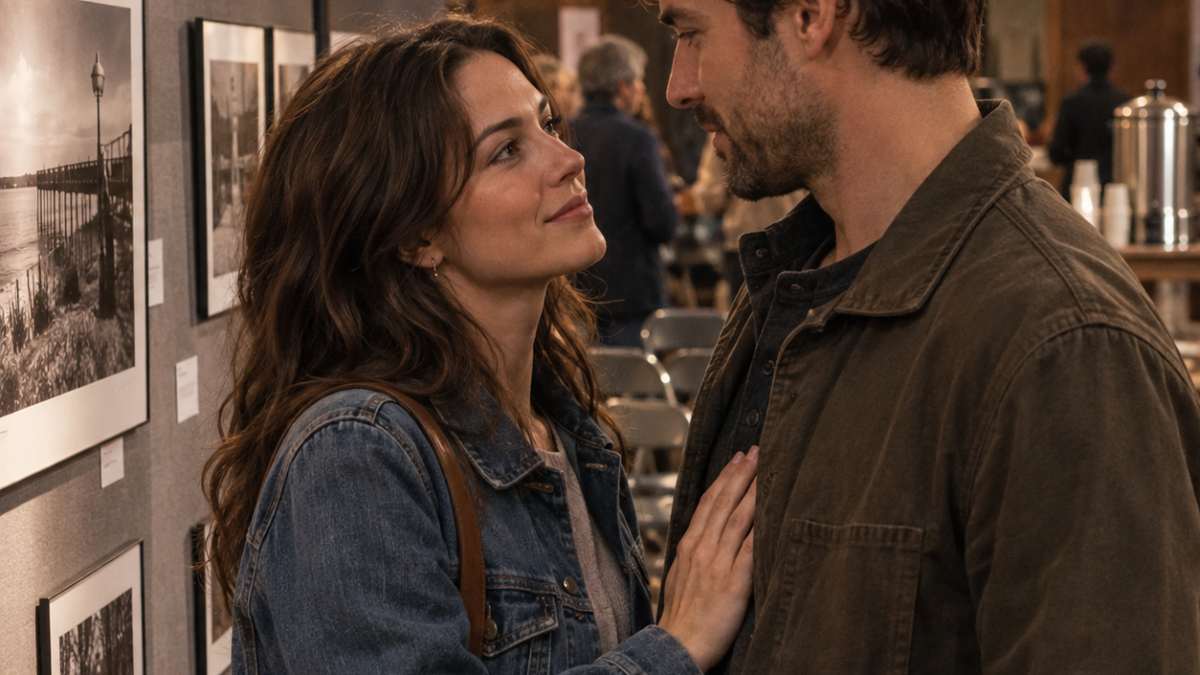
She went out through the glass door, and I locked up, wiped her name off the whiteboard for the last time, and capped the marker like an ordinary marker. The neighborhood arts hall was a converted union building with a good wooden floor, rows of folding chairs, and a coffee urn that a volunteer defended with her whole body. My nine prints hung on a freestanding partition near the back with a card beside them that I had finished at midnight on Friday.
I had called the series “Small Claims” because everyone in the pictures had staked a little ground that nobody else was using. By 5:30 or so, people had come through, Mara among them with her husband and a strong opinion about the milk crate. I had learned that standing beside my own pictures was survivable, mostly.
I was explaining the dry cleaner photograph to a man in a Steelers cap when Sabrina walked in alone in a denim jacket with her hair down and her hands in her pockets. She did not look around for me. She started at the left end of the partition and walked the line slowly, the way she had walked the break table, and I watched her pass the boy on the bus stop bench and the man on the milk crate.
She stopped at the woman in the folding chair and stayed there long enough that the man in the cap asked whether I knew her. I said I did and left him in the middle of his question. No shot list, no review, and no rule stood between us anymore.
And the only thing left to find out was whether she wanted me to cross the room. My legs had decided before the rest of me caught up.
– “Small Claims,” she said without turning around.
– “It took me until midnight,” I said. “It’s good. It’s dry, but it’s good.”
Then she looked at me, and I said it the way I had practiced in the truck and abandoned because practice made it sound like a form. I told her I would like to take her to dinner tonight or whichever night she chose as a date. It was not a review or a reward for the summer, and she did not owe me one word about the pictures to earn it.
I told her that her father still disliked this, that I had not asked his permission, and that I was not going to pretend that part was solved. A family with a stroller rolled past behind us before she answered.
– “I didn’t come to prove him wrong,” she said. “I’d feel ridiculous winning an argument with a man who isn’t even in the room. I came because I wanted to see you in the pictures on a day when nobody had a stake in it. So, yes, tonight. And I picked the place somewhere with bad chairs and no catalog. I think I asked you that once.”
– “You did,” I said, and I answered like a lighting schedule.
I asked if I could kiss her, and she said yes before I finished the question and closed the gap herself in front of the milk crate man with one hand flat against my jacket. Somewhere behind us, Mara coughed on purpose. When we parted, Sabrina kept her hand where it was for another second and then turned back to the dry cleaner print, the first picture of mine she had ever seen when it slid out of my tote onto the concrete.
– “What do you want to shoot next?” she asked.
Nobody had put that question to me in two years without a deadline attached. And I told her I did not know. For two years, the answer had been “after the catalog,” and not knowing felt better than I had expected.
– “Then I have a request,” she said. “The next time you go out with the camera on your own time, I’d like to watch. I won’t carry anything or hold a reflector or review a single frame. I’ll just stand somewhere.”
I said she would not be in the picture and would not carry a thing.
– “Bring your own coffee,” I said.
She laughed loud enough that the man in the Steelers cap turned around, and she said she would bring her own opinion, too. I told her that was the only thing I had ever wanted her to.