Single Dad And CEO Were Stranded On Desert Island — She Said ‘If We Can’t Go Back, Must I Marry You’
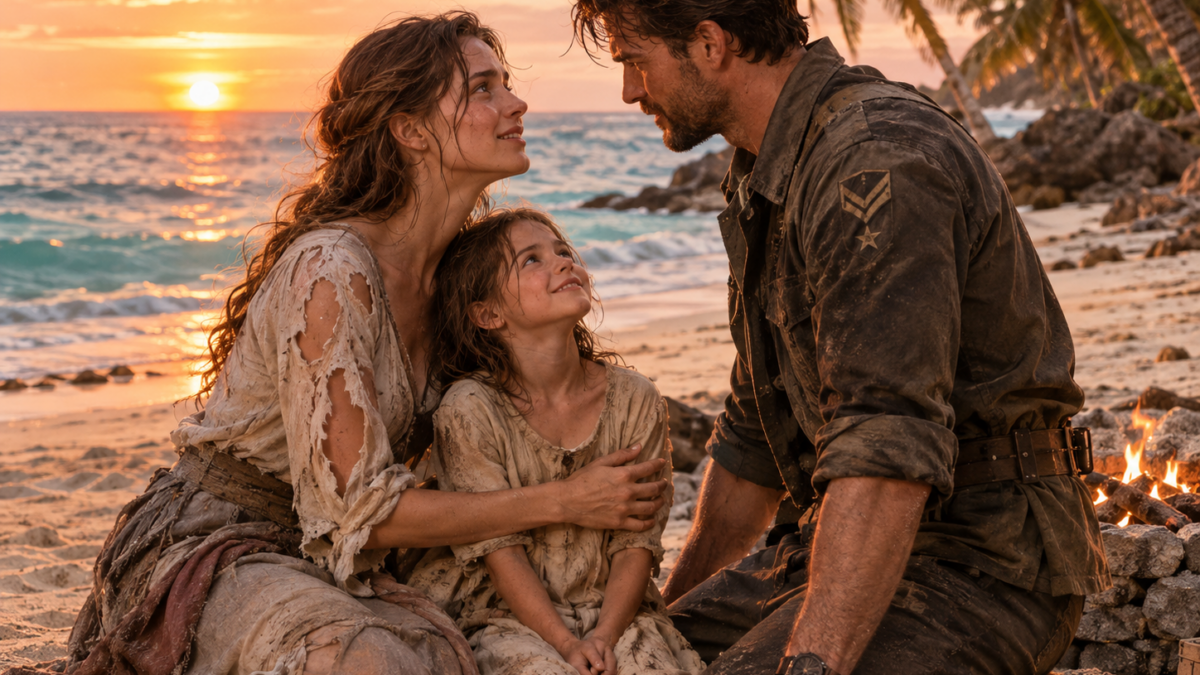
Single Dad And CEO Were Stranded On Desert Island — She Said ‘If We Can’t Go Back, Must I Marry You’
Here is the edited English version, with spelling and punctuation corrected, timespans removed, dialogue on separate lines, and paragraphs kept to 2–3 sentences each. A single image-generation prompt is at the end.
The storm clouds gathered like an omen, swallowing the aircraft whole as thunder cracked through the cabin. The engines screamed their protest, metal groaning against nature’s fury while passengers gripped their armrests with white knuckles. Among them, a woman in designer clothes fought to maintain composure, her perfectly manicured nails digging into leather as fear etched itself across her face.
Nearby, a man with weathered hands and military bearing shielded the elderly passenger beside him. His eyes stayed cold and calculating even as chaos erupted. The plane plummeted toward the dark waters below, and then there was nothing but blackness and the roar of the ocean claiming its prize.
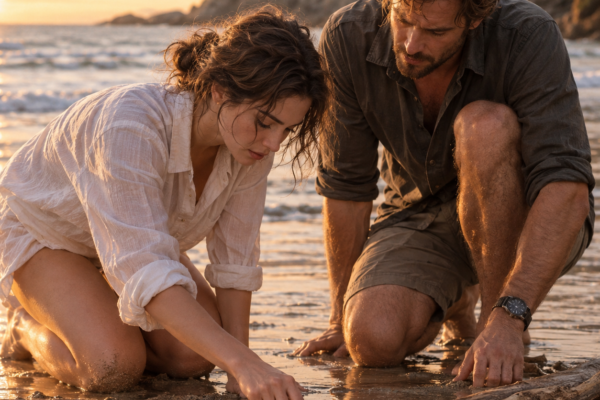
She woke to sand in her mouth and waves lapping at her feet. The CEO’s designer suit was torn, her blonde hair matted with salt and seaweed. Beside her, the man stirred, coughing up seawater as consciousness returned.
They were alone on an endless stretch of beach. Wreckage lay scattered like broken promises along the shore. She trembled, voice barely a whisper against the vast emptiness:
– “If we can’t go back, must I marry you?”
The question hung between them, absurd yet somehow prophetic, as if fate itself had already written their story in the sand.
Marcus Hayes had spent 35 years learning how to survive. His body bore the map of that education: scars from Afghanistan, calloused hands from construction work, shoulders broad enough to carry the weight of single fatherhood. The sun had baked his skin to bronze during countless hours on job sites, trying to make ends meet for his seven-year-old daughter, Emma.
She was everything now. Had been since cancer took Sarah three years ago. The grief had aged him, carved lines around eyes that had seen too much death. But it had also sharpened his purpose.
Every sunrise was for Emma. Every exhausted evening was another day closer to giving her the life she deserved.
Victoria Sterling inhabited a different universe entirely. At 30, she commanded boardrooms with the same precision her mother had once commanded charity galas. Her blue eyes could freeze negotiations or close million-dollar deals, depending on what the quarterly reports demanded.
The Sterling fortune had groomed her from birth: private schools, a Yale MBA, a corner office before she turned 28. Love had been a luxury she couldn’t afford, especially after James had chosen her rival’s bed and her father’s biggest competitor as his new employer. Trust became a liability. Vulnerability, a weakness she’d surgically removed from her emotional portfolio.
They were oil and water, war and commerce, calluses and manicures. He knew how to read wind patterns and track animals. She could read market trends and track insider trading. His hands had held dying soldiers. Hers had held nothing heavier than platinum credit cards.
Yet here they stood on this nameless shore, stripped of everything that had defined them, equal in their mortality. The island didn’t care about her net worth or his Purple Heart. It only cared that they were soft, fragile humans who needed water within three days or they’d die.
Victoria’s first instinct was denial wrapped in authority. She pulled out her waterlogged phone, shaking it as if corporate determination could resurrect dead circuits.
– “The Coast Guard will find us,” she declared, her voice still carrying boardroom authority despite her chattering teeth. “My company has resources. They’ll have helicopters searching within hours.”
Marcus didn’t respond immediately. Instead, he walked the beach’s edge, reading signs. She couldn’t see the height of the tide line, the direction of debris scatter, the complete absence of human footprints beyond their own. His trained eyes cataloged resources: bamboo clusters, coconut palms, a freshwater stream trickling from the jungle’s edge.
Finally, he turned back to where she stood, still clutching her useless phone like a talisman.
– “We need shelter before nightfall,” he said simply. “Fire, water, food. In that order.”
Her laugh was bitter, edged with hysteria.
– “I’m sure someone will spot us before we need to play Robinson Crusoe.”
– “Maybe,” he conceded, already gathering driftwood. “But hypothermia doesn’t wait for rescue schedules.”
The first clash came when she tried to assert control, falling back on the only power structure she understood.
– “I’ve managed crisis situations before. I’ve overseen—”
– “You’ve overseen nothing like this.” His interruption was quiet but final. “Out here, there’s no delegation, no assistance, no board to convince. There’s just work and survival.”
She wanted to argue, to remind him that she’d negotiated with Fortune 500 CEOs, that she’d rebuilt her company’s Asian division from scratch. But the words died as she watched him strip bark with his bare hands, creating tinder with practiced efficiency. Her designer heels sank into sand with every step, and when she stumbled, the sharp coral sliced through Italian leather and into her heel.
The blood was bright against the white sand, real in a way her world never was. Marcus knelt beside her without hesitation, tearing strips from his shirt to bind the wound. His hands were gentle despite their roughness. And for the first time since the crash, she felt something other than fear or anger. It might have been gratitude. It might have been something else.
– “Thank you,” she managed, the words foreign on her tongue.
He just nodded and went back to building their shelter, leaving her to wonder when she’d last thanked anyone for anything that couldn’t be invoiced.
By the third day, Victoria had learned that nature didn’t negotiate. The sun rose and set on its own schedule, indifferent to her internal clock, still set to New York time. Marcus had constructed a lean-to from bamboo and palm fronds, engineering it with the same precision she’d once applied to spreadsheets.
She watched him work, noting how he used vines as rope, how he angled the roof to shed rain, how he positioned the shelter to block wind but catch morning light. Her contribution that first day had been gathering firewood, though she’d needed three attempts to understand the difference between dry and merely dead wood.
Her hands, soft from years of lotions and professional manicures, blistered within hours. She hid them at first, ashamed of her weakness, but Marcus noticed anyway. He showed her how to wrap them in torn fabric, how to grip with her palms instead of her fingers.
The fire was their first shared victory. Marcus had fashioned a bow drill from bamboo and vine, but his hands shook from exhaustion after hours of trying. Without thinking, Victoria took over the steady pressure while he controlled the speed, and together they coaxed smoke, then ember, then finally flame from the friction.
When the kindling caught, she actually laughed. Not the polished laugh of cocktail parties, but something raw and genuine.
– “I haven’t felt this accomplished since my first hostile takeover,” she admitted, then caught herself, embarrassed by the comparison.
But Marcus smiled, a rare expression that transformed his weathered face.
– “Fire’s more useful than paperwork out here.”
Their first meal was fish he’d speared in the shallows, cooked over their hard-won fire. It was barely edible, charred outside and raw inside, but she ate every bite. Hunger, she discovered, was the best seasoning she’d never wanted to taste.
That night, the storm hit without warning. One moment the stars were clear; the next, rain hammered their shelter like bullets. The palm-frond roof held for exactly ten minutes before water poured through.
Lightning turned the beach into a strobing nightmare. Victoria found herself pressed against Marcus’s back, shaking not from cold but from primal fear.
– “We’re okay,” he murmured, his voice steady despite the chaos. “I’ve weathered worse.”
She wanted to ask where, how, but thunder swallowed her questions. Instead, she focused on his breathing, using its rhythm to calm her racing heart. Dawn found them soaked but alive, and she realized she’d slept. Actually slept, feeling safer in this stranger’s presence than she’d felt in her penthouse with its state-of-the-art security system.
Trust, it turned out, wasn’t about contracts or background checks. Sometimes it was just about someone staying steady while your world fell apart.
The fourth night brought unexpected honesty. They sat feeding small sticks to their fire, the ocean providing nature’s white noise. Victoria had spent the day failing to weave a basket, her fingers refusing to cooperate with Marcus’s patient instructions. Frustration had nearly brought her to tears, not because of the basket, but because failure wasn’t something she’d allowed herself in years.
– “Why are you so calm about all this?” she finally asked, gesturing at their primitive camp, their isolation, their uncertain future.
Marcus stared into the flames for a long moment. When he spoke, his voice carried the weight of memories he usually kept buried.
– “Afghanistan, 2009. Our convoy hit an IED outside Kandahar. Three days in hostile territory with two wounded, waiting for extraction that almost didn’t come.”
He paused, adding another stick to the fire.
– “After that, everything else is just an inconvenience.”
She absorbed this, trying to reconcile the quiet man beside her with that level of violence and survival.
– “How do you not let it break you?”
– “It did break me.” The admission was quiet but unflinching. “Coming home to Emma, my daughter—that’s what put me back together. Different shape maybe, but functional.”
The mention of his daughter shifted something in his expression, softening the harsh lines. Victoria recognized the look. She’d seen it in mirrors when she thought about the life she’d never have time for.
– “Tell me about her,” she said, surprising herself with genuine curiosity.
His smile was immediate and transformative.
– “Seven years old, going on 40. Reads everything she can get her hands on. Wants to be a marine biologist or a princess or both, depending on the day.”
His voice caught slightly.
– “Her mom died three years ago. Breast cancer. Emma doesn’t remember much, which is both a blessing and a curse.”
Victoria felt the words pull something from deep in her chest.
– “I’m sorry.”
– “Me too.” He turned to look at her directly. “What about you? What breaks someone who seems unbreakable?”
She almost deflected, almost retreated behind corporate speak and careful distances. But the firelight and isolation made honesty feel less dangerous.
– “I’ve never had anyone really see me. Not my parents, who saw an heir. Not James, who saw a stepping stone. Even I don’t see me anymore. Just the role I play.”
– “I see you,” Marcus said simply.
The words hung between them, weighty with possibility. Victoria felt exposed, vulnerable in a way that had nothing to do with their primitive circumstances. She’d been naked in boardrooms full of hostile investors and felt less seen than she did right now in torn designer clothes with dirty hair and broken nails.
– “That terrifies me,” she admitted.
– “Good,” he replied. “Terror keeps you honest.”
They sat in companionable silence after that, watching sparks rise toward stars that seemed impossibly bright without light pollution. For the first time in her adult life, Victoria wasn’t planning the next quarter, the next acquisition, the next defensive strategy. She was just present, existing in the space between one breath and the next, between one heartbeat and its echo.
Tomorrow would bring new challenges: food to find, water to collect, the endless work of survival. But tonight, she was learning that sometimes the most valuable thing you could possess was someone who saw through all your armor to the frightened, hopeful human underneath.
The storm arrived on their tenth day like an angry god. Marcus had seen it building in the cloud formations, the way the birds fell silent, how the air pressure made his old injuries ache. He tried to reinforce their shelter, but bamboo and hope were poor defenses against nature’s fury.
It hit at midnight. Winds that could have been hurricane force for all they knew. Their shelter exploded in the first gust, sending palm fronds whipping through the air like blades. Victoria screamed. He heard it even over the wind as debris struck her leg, opening a gash that immediately ran red.
Marcus half carried, half dragged her to a cluster of rocks he’d noted days earlier, a small cave barely large enough for two. They pressed inside as rain turned the beach into a river, as waves climbed higher than seemed possible, reaching for them with foaming fingers.
By morning, their camp was gone. Everything—the fire pit, their collected food, the rain catches he’d built—was scattered or destroyed. Victoria’s leg was worse than he’d thought. The cut was deep and already showing signs of infection in the tropical heat. She was burning with fever by noon, slipping in and out of consciousness, calling for people who weren’t there.
– “James, don’t. The contract isn’t—” she mumbled, then clearer: “Mom, I’m trying to be perfect. I’m trying.”
Marcus felt helplessness creeping in, that familiar enemy from battlefield traumas. But this wasn’t Afghanistan. And he wasn’t going to lose another person. He’d grown to—what? Care for? The word felt inadequate for the fierce protectiveness surging through him.
He’d seen plants the locals in Afghanistan used for wounds, and he’d noticed similar species here. It was a risk, but doing nothing was certain death. He left her in the shade with their last fresh water and plunged into the jungle he’d been avoiding, machete-less and desperate.
Three hours of searching, cutting his hands on vines, tearing through undergrowth. Finally, he found what looked right: broad leaves with the same distinctive smell, bark that peeled in medicinal strips. He crushed them together with stones, making a primitive poultice that might save her or might do nothing at all.
She was worse when he returned, skin on fire, lips cracked despite the water he’d left. He cleaned the wound with seawater—she screamed and fought him weakly—then applied the poultice, binding it with strips from what remained of his shirt.
Then came the waiting. He held her through the night as she shivered and burned in cycles, whispering promises he wasn’t sure he could keep.
– “Stay with me, Victoria. Emma needs to meet you. You need to tell her about board meetings and hostile takeovers. Make it sound like fairy tales. Stay with me.”
Dawn brought broken fever and clear eyes. She looked at him with such naked gratitude that it physically hurt, like staring directly into the sun.
– “You saved me,” she whispered, voice raw.
– “We saved each other,” he corrected. Because it was true in more ways than she knew.
Recovery was slow, intimate in ways that transcended physical proximity. He had to help her walk, bathe—tasks that stripped away any remaining pretense between them. She learned his body’s language, how his jaw tightened before tropical squalls, how his hands went still when he was thinking of Emma.
He learned hers. How she hummed Chopin when anxious. How she still tried to check a wrist where no watch remained.
Three weeks in, she successfully speared her first fish. The triumph on her face was so pure, so utterly disconnected from her corporate victories, that he kissed her without thinking, just pressed his salt-chapped lips to hers in celebration of this small perfect moment.
She froze, then kissed him back with an intensity that suggested she’d been waiting for this permission to be human, to want something that couldn’t be quantified in quarterly reports. When they pulled apart, she laughed, bright and startled.
– “If we weren’t stranded, HR would have opinions about this.”
– “Good thing HR doesn’t have jurisdiction here,” he replied, tucking sandy hair behind her ear with fingers that had built shelter, made fire, saved her life.
She caught his hand, examining the calluses and scars like they were precious texts.
– “These hands have done more real things than mine ever have.”
– “Your hands are learning,” he pointed out. “Look at them now.”
She did, seeing the cuts and calluses, the broken nails and sun damage. Hands that had worked, truly worked, for the first time.
– “I don’t recognize them.”
– “I do,” Marcus said quietly. “They’re the hands of someone who survives.”
That night, she taught him about leveraged buyouts while they cleaned fish, making it sound like warrior strategy. He taught her about reading stars for navigation, about finding true north when everything else was lost. They were teaching each other languages they’d never needed before: his of earth and endurance, hers of ambition and achievement.
The irony wasn’t lost on her that she’d traveled the world for corporate retreats meant to build trust and teamwork, spending thousands on exercises and facilitators. Yet here, with nothing but need and time, she’d learned more about partnership than any consultant could have taught.
– “I was so angry at first,” she admitted one evening, watching the sunset paint the ocean gold. “Angry at the crash, at being helpless, at you for being so capable when I wasn’t.”
And now she considered, really considered.
– “Now I’m grateful. Not for the crash, but for what it’s shown me. I was successful, but not alive. Profitable, but not present.”
Marcus understood. War had taught him similar lessons about what mattered when everything else was stripped away. But he’d had Emma to come home to, a reason to keep choosing life. Victoria had been slowly drowning in success, and it had taken a literal disaster to teach her to swim.
The night everything changed started with Marcus deciding they needed a better water source. The small stream was getting brackish, too close to the ocean, and the spring he’d spotted up the cliff face promised cleaner, more reliable fresh water. Victoria wanted to come, insisted on it, but he’d seen how she still favored her injured leg.
– “I’ll be back before dark,” he promised, kissing her forehead in a gesture that had become routine, precious in its simplicity.
The cliff was higher than it looked, the rocks more brittle. Halfway up, reaching for the next handhold, the ledge crumbled. He fell only ten feet, but his ankle caught in a crevice, twisting until he heard—felt—the snap. The pain was immediate and nauseating, his vision going white at the edges.
He was stuck. Truly stuck. Leg wedged at an angle that sent fire through his nervous system with every attempt to move. The sun tracked across the sky as he tried everything—using his belt for leverage, chipping at rocks with his bare hands—but nothing worked.
Then he heard her voice carried on the wind.
– “Marcus! Marcus, where are you?”
– “Here,” he shouted, voice hoarse.
– “The cliff? But don’t—”
She was already climbing. He could hear the scrabble of rocks. When her face appeared above him, dirt-streaked and determined, his first feeling was relief, immediately followed by terror.
– “You can’t. Your leg isn’t healed enough.”
– “Shut up,” she said firmly, already assessing the situation with the same focus she’d once applied to hostile takeovers. “Tell me what to do.”
Together, they worked the problem. She found a strong branch for leverage. Used the vines he’d taught her to braid for rope. When she had to put her full weight against his trapped leg to free it, the pain nearly made him black out. But her voice kept him conscious—a steady stream of encouragement and surprisingly creative profanity.
When he was finally free, she half carried him down, both of them slipping and sliding, leaving skin on rocks. On the beach, they collapsed, breathing hard, bodies trembling with adrenaline and exhaustion. His ankle was certainly broken, already swelling purple-black.
– “You could have died climbing up there,” he said, still processing that she’d risked everything for him.
– “You would have died if I hadn’t,” she replied simply.
The pragmatic truth of it, delivered in her boardroom voice, made him laugh despite the pain. Then she was kissing him, fierce and desperate, tasting of fear and relief and something deeper than gratitude.
– “I love you,” she said against his mouth, the words torn from some deep place. “I know it’s insane. I know we’re just trauma bonding or whatever psychological term applies. But I love you, and I almost lost you, and I need you to know.”
He pulled her closer with his good arm—this brilliant, broken, beautiful woman who’d learned to make fire and spearfish and climb cliffs for him.
– “I love you, too. Have since you tried to use your phone as a hammer that third day.”
She laughed, cried into his shoulder, and they stayed there as the sun set. Two damaged people who’d found wholeness in the last place anyone would think to look for it.
– “If we die here,” she said eventually.
– “At least we lived first.”
– “We’re not dying here,” he promised, though his ankle throbbed a counter-argument.
– “Emma needs to meet the woman who’s going to teach her about hostile takeovers, and I need to meet the girl who’s going to teach me about sea creatures,” Victoria added.
The future suddenly seemed possible again, even probable, even necessary.
They built the signal fire at dawn, using every piece of dry wood they’d collected, adding green palm fronds for smoke. Victoria had become expert at maintaining flames, coaxing them higher, while Marcus, immobilized by his broken ankle, directed the construction of a reflective backing from salvaged metal.
The fishing vessel appeared on the horizon at noon, a dark speck that might have been anything. Victoria fed the fire frantically, adding more green fuel until the smoke column rose black and thick into the clear sky. She screamed herself hoarse, waved a makeshift flag of Marcus’s torn shirt, ran back and forth on the beach like someone possessed.
The boat changed course. Marcus watched her collapse in the sand, sobbing with relief, and thought he’d never seen anything more beautiful than her tears. They’d survived 43 days—he’d kept count with notches on bamboo—and now the world was coming back to claim them.
The fishermen were Colombian, working international waters, and spoke little English. But rescue needed no translation. They wrapped them in blankets that felt impossibly soft, gave them water that tasted wrong after weeks of filtered rainwater and coconut milk.
The journey to civilization took 18 hours, during which Victoria didn’t let go of Marcus’s hand once, as if afraid he might disappear if she loosened her grip.
The hospital in Panama City was a shock of white walls and machines, of forms to fill out and calls to make. Victoria’s assistant cried on the phone, told her the whole company had been searching, that her memorial service was scheduled for next week. Marcus called his sister, who’d been raising Emma, and had to hang up when his daughter’s voice asking “Daddy?” made him sob too hard to speak.
Then came the reckoning. Their rescue made international news: CEO and single father survive six weeks on deserted island. Photographers waited outside the hospital, wanting pictures of the romance everyone insisted on seeing. But when the discharge papers came, when real life beckoned with its obligations and social strata, they stood in the hospital lobby like strangers again.
– “I have a car coming,” Victoria said, voice carefully neutral. “Back to New York.”
– “Emma’s in Boston,” Marcus replied, equally careful. “My sister’s place.”
They were oil and water again. Different worlds, different lives. The island had been a parenthesis, a pause in their real stories.
– “This is insane,” Victoria finally said. But she was smiling through tears. “We have nothing in common except almost dying.”
– “We have everything in common that matters,” Marcus countered, reaching for her hand.
She took it, held it, studied their interlaced fingers—his dark and scarred, hers pale and healing.
– “Your daughter will hate me. I don’t know anything about children.”
– “You’ll learn. You learned to spearfish.”
– “Your world will bore me.”
– “My world will ground you.”
– “We’ll fail.”
– “We might,” he agreed. “But we survived a plane crash and six weeks on an island. I like our odds.”
She kissed him then, in the middle of the hospital lobby, in front of the photographers and nurses and God and everyone. It tasted like possibility.
They went their separate ways that afternoon, but with plans to meet in one week. Seven days to return to their lives and see if what they’d found was real or just island fever. Seven days to decide if love forged in extremity could survive normality.
New York consumed Victoria immediately. The board wanted briefings. The media wanted statements. And her apartment felt like a museum of someone she used to be. Designer clothes that seemed absurd now. Shoes worth more than Marcus probably made in a month. A bed so soft it felt like drowning.
She sat in her first board meeting three days after rescue, watching executives argue about market share and fourth-quarter projections. Harold Steinberg was proposing another aggressive acquisition, the kind that would gut 200 jobs but boost stock prices. Six weeks ago, she would have led the charge.
– “Victoria, Harold prompted, your thoughts on the Chen Industries takeover.”
She looked at their expectant faces, these soft people who’d never been hungry, never been afraid, never built anything with their actual hands.
– “I think we should explore partnership instead of acquisition. Keep their workforce, their corporate culture. Build something together instead of consuming it.”
The room went silent. Harold’s face darkened.
– “That’s not the Sterling Industries way.”
– “Maybe it should be,” she replied calmly.
After the meeting, her phone buzzed with texts from Marcus. Photos of Emma holding a sign that said “Welcome home, Daddy” in crayon. A video of them at the aquarium, Emma explaining to Marcus why octopi were the smartest creatures in the ocean. Another text: She wants to know when she can meet the lady who helped Daddy come home.
Victoria cried in her office, her corner office with its view of Manhattan, its testament to everything she’d achieved and everything that suddenly felt hollow.
Boston was simpler. Marcus returned to his two-bedroom apartment, to his construction job that his boss had held for him, to Emma who wouldn’t let go of his leg for the first full day. His sister Maria had questions about the island, about survival, about the CEO whose picture was all over the news next to his.
– “She’s not your type,” Maria said carefully, watching him help Emma with homework.
– “I don’t have a type anymore,” he replied. “I have Victoria.”
Emma looked up from her math worksheet.
– “Is she pretty?”
– “Very.”
– “Is she nice?”
– “She’s learning to be.”
– “Does she like fish?”
Marcus laughed, remembering Victoria’s first successful spear.
– “She’s complicated about fish.”
Emma considered this seriously.
– “I want to meet her.”
Three days into their week apart, Victoria called at midnight.
– “I can’t sleep in this bed. It’s too soft. I put a blanket on the floor, but it’s not the same.”
– “I know,” he said. Because he did.
– “Emma asked why I was checking the wind patterns this morning. The board thinks I’ve lost my mind. I suggested we reduce executive bonuses to increase worker safety protocols.”
– “Maria thinks you’re going to break my heart.”
– “I might,” Victoria admitted. “Not on purpose, but I don’t know how to do this normal relationship thing.”
– “Neither do I,” Marcus reminded her. “Sarah and I were high school sweethearts. I’ve never dated as an adult, especially not as a single father.”
– “We’re a disaster waiting to happen.”
– “Probably.”
They stayed on the phone, not talking, just breathing together across 300 miles. Finally, Victoria spoke.
– “I bought a ring.”
Marcus sat up.
– “What?”
– “Not for you. For me. Made from salvaged aluminum from the plane. A reminder that I’m different now. That I want to stay different. But when I look at it, all I think about is you.”
– “Come to Boston,” he said suddenly. “Tomorrow. Meet Emma. See my actual life.”
– “It’s Tuesday. I have meetings.”
She stopped, laughed.
– “Who cares about meetings? Yes. Yes, I’ll come.”
Victoria stood outside Marcus’s apartment building, holding an octopus plushy, and questioning every decision that had brought her here. The building was old, working-class, with graffiti on the brick and a door that needed three tries to open. His apartment was on the third floor, no elevator.
Emma answered the door—seven years old, with Marcus’s dark eyes and a serious expression. She studied Victoria for a long moment, then announced:
– “You’re wearing the wrong shoes for Boston.”
Victoria looked down at her designer flats.
– “What shoes should I be wearing?”
– “Sneakers or boots. Something for walking. Daddy says you learn to walk on an island, but Boston has different rules.”
– “Emma,” Marcus appeared behind his daughter. “Let her in first.”
The apartment was small, clean, filled with Emma’s artwork and photos of a woman who must have been Sarah. Victoria felt like an intruder, too polished, too much. But then Emma took her hand, pulled her to the kitchen table covered in science books.
– “Daddy says you lived on an island. Did you see any cephalopods?”
– “I—what?”
– “Octopi, squids, cuttlefish. Cephalopods.”
– “Oh. Yes, actually. Small octopi in the tide pools.”
Emma’s eyes widened.
– “Really? What color? How many arms? Did you know they can change not just color, but texture?”
For the next hour, Emma interrogated her about marine life, correcting her terminology, sharing facts with the intensity of someone three times her age. Marcus made dinner—simple spaghetti—and Victoria realized this was his real life. Small apartment, bright daughter, making ends meet.
– “I don’t fit here,” she said quietly while Emma was in the bathroom.
– “You don’t fit yet,” Marcus corrected. “Neither did I on your island.”
After dinner, Emma fell asleep against Victoria’s shoulder while watching a documentary about coral reefs. Marcus carried her to bed, and Victoria watched from the doorway as he tucked her in, kissed her forehead, whispered something that made the little girl smile in her sleep.
– “She likes you,” he said, finding Victoria on his small balcony later.
– “She likes that I’ve seen octopi.”
– “Same thing.”
He pulled her close, and she realized he smelled different here. Less salt, more city, but still fundamentally Marcus.
– “This is who I am, Victoria. This apartment, this life, this daughter who needs stability and routine, and someone who won’t leave.”
– “I know,” she said, though the weight of it terrified her.
– “I need you to see who I am, too. The real version, not the island version.”
So he came to New York the next day, bringing Emma, who’d insisted on missing school for this adventure. Victoria’s penthouse made them both go quiet—the space, the view, the casual wealth in every surface.
– “This is bigger than our whole building,” Emma whispered.
Victoria knelt to Emma’s level.
– “But your home has something mine doesn’t.”
– “What? Life? Your drawings? Your books? Your dad’s coffee mug collection? This place is just expensive emptiness.”
Emma considered this.
– “You could get some drawings. I make good ones.”
The boardroom was harder. Victoria had to attend one crucial meeting, and Marcus witnessed her in full CEO mode: sharp, decisive, wielding power like a blade. She demolished Harold’s proposals with precision, restructured a failing division in real time, reminded everyone why she was the youngest CEO in the company’s history.
Afterward, in the elevator, Marcus was quiet.
– “Too much?” Victoria asked, vulnerable despite her victory.
– “No,” he said slowly. “Just seeing all of you. It’s like watching you spear that first fish, except the fish are corporations.”
Emma, who’d been coloring in the corner during the meeting, looked up.
– “Was it boring? It looked boring.”
– “Incredibly boring,” Victoria agreed, and Marcus laughed.
They spent the afternoon at the Museum of Natural History, Emma dragging them through the ocean exhibits, Victoria buying her every book she glanced at until Marcus intervened. They looked like a family, he realized, catching their reflection. Mismatched, complicated, but somehow fitting.
That night, after Emma was asleep in Victoria’s guest room—her first time in a bed that cost more than Marcus made in three months—they stood on the terrace, city lights spread below.
– “I’ll sell the penthouse,” Victoria said suddenly. “Move to Boston. I can run the company remotely or find something else.”
Marcus turned her to face him.
– “You don’t give up who you are. We find a middle ground.”
– “Where’s the middle ground between this and that?”
– “We’ll build it,” he said simply. “Like we built that shelter. Piece by piece.”
Victoria traced the scar on his hand from those first days.
– “You really think we can make this work? CEO and construction worker, penthouse and three-story walk-up, boardrooms and bulldozers.”
– “I think we already did the impossible,” Marcus replied. “We survived. Everything else is just details.”
Six months later, Victoria stood in her redesigned office—the same corner space, but now with Emma’s drawings framed alongside corporate awards, a photo from the island next to her MBA diploma. She’d restructured Sterling Industries, implementing what the business journals called “radical humanistic capitalism,” though she just called it common sense, learned the hard way.
Marcus had started his own construction company with a loan she’d co-signed, building sustainable housing that he joked was disaster-resistant. Island-tested.
Emma spent weekends with them in the Brooklyn brownstone they’d bought together. Not penthouse, not walk-up, but something in between.
– “There’s a documentary crew,” her assistant informed her. “They want to film your story. The island survival, the romance, the corporate transformation.”
Victoria considered, then shook her head.
– “Tell them no. Some stories aren’t meant for cameras.”
That evening, they met at Emma’s school science fair. She’d built a model ecosystem of a tropical island, complete with tide pools and sustainable shelter design.
– “My dad lived here,” she explained to the judges. “And my future mom helped him survive.”
– “Future mom.” Victoria felt the words like a physical touch. She found Marcus in the crowd, held up her left hand where the salvaged aluminum ring had been joined by something more traditional, something that meant promises beyond survival. He smiled, that rare full smile that had first appeared by firelight, and mouthed, “If we can’t go back—”
– “—must I marry you?” she mouthed back.
Emma won first place. They celebrated with pizza, the three of them laughing over Emma’s detailed explanation of cephalopod intelligence, Marcus teasing Victoria about her continued inability to weave baskets, Victoria threatening to make them all attend a board meeting as punishment.
Later, walking the Brooklyn streets with Emma between them, each holding one of her hands, Victoria thought about the question she’d asked on that first morning—desperate, delirious, accidentally prophetic. If we can’t go back, must I marry you?
The answer, it turned out, was both simpler and more complex than survival. The answer was choosing to build something new from the wreckage of what was. The answer was Emma’s hand in hers, Marcus’s smile in the streetlight, the promise of ordinary mornings and extraordinary love.
They returned to the island one year later. The three of them, a chartered boat, proper supplies. Emma bouncing with excitement to see where her father had lived, where Victoria had changed, where their family had truly begun.
The shelter was gone, of course, reclaimed by wind and growth. But the fire pit remained, stones they’d placed in a circle now worn smooth by weather. Emma ran the beach collecting shells, pointing out tide pools, lecturing them about ecosystems with seven-year-old authority.
– “This is where you asked the question,” Marcus said, standing at the spot where they’d first woken.
– “If we can’t go back—” Victoria began.
– “—must I marry you?” he finished.
– “And the answer was yes,” she said. “Though it took us a while to figure that out.”
Marcus pulled out a small box and knelt in the sand where he’d once knelt to bandage her wounds.
– “So I’m asking officially now, with Emma as witness, with the island as testament. Victoria Sterling, will you marry me? Not because we can’t go back, but because we choose to go forward.”
Emma squealed, jumped up and down, shouted, “Say yes!” with all the subtlety of childhood.
Victoria looked at this man who’d taught her to make fire, to spearfish, to trust another human with her very survival. She thought of their messy, complicated, beautiful life: board meetings and construction sites, penthouse views and school science fairs, designer suits and work boots.
– “Yes,” she said, laughing and crying simultaneously.
– “Though I should warn you, I still can’t weave baskets.”
– “And I still can’t read spreadsheets,” Marcus replied, sliding the ring onto her finger. Not salvaged aluminum this time, but something that sparkled with promise.
Emma performed the ceremony right there, using the power invested in her by the ocean and a script she’d apparently prepared. They exchanged vows that mentioned quarterly reports and tide patterns, hostile takeovers and hurricane shelters, promising to love each other in both boardrooms and on beaches.
As the sun set, painting the sky in shades of hope, they sat by their old fire pit, Emma between them, and watched the stars emerge. The same stars that had witnessed their struggle, their survival, their surrender to something bigger than themselves.
– “Tell me the story again,” Emma demanded, though she knew it by heart. “About the plane and the island and falling in love.”
So they told it together, interrupting each other, arguing about details, laughing at memories that had once been desperate. How a CEO learned to gut fish. How a construction worker learned to navigate corporate politics. How two people from different worlds discovered that love was its own form of survival.
The boat would return for them tomorrow, would carry them back to their complicated, imperfect, wonderful life. But tonight, they were just a family on a beach under stars that didn’t care about net worth or social status, telling stories by firelight, holding hands across the space where worlds collided and love was born.
If we can’t go back, Victoria thought, watching her daughter—she was her daughter now, in all ways that mattered—draw patterns in the sand while Marcus added driftwood to their commemorative fire, we can only go forward together, building something new from whatever wreckage we find.
Creating shelter in the most unlikely places. Discovering that sometimes the best adventures begin with a crash. And the most profound love stories start with a question asked in delirium that turns out to be the best thing ever said.
The island held them one more night—this family forged in extremity, tempered by ordinary life, stronger for having been broken and rebuilt. Tomorrow would bring reality again: meetings and homework, deadlines and dance recitals, all the beautiful mundane chaos of a life actually lived.
But tonight, they were timeless, eternal, complete. A CEO who’d learned to survive, a soldier who’d learned to trust, a child who’d gained a mother, and an island that had given them everything by taking everything away first.
The fire crackled its ancient song. The waves whispered their eternal promise. And somewhere in the vast Pacific night, their story became legend—not because it was perfect, but because it was true. Love found in the last place anyone would look, built from nothing but need and trust and the wild hope that some things once survived together create bonds that no amount of civilization can break.
If we can’t go back, must I marry you?
Yes. Always, inevitably, impossibly. Perfectly. Yes.