I Cut My Hand at Midnight. My Best Friend’s Older Sister Stitched It: “Look at Me, Not the Needle.”
I Cut My Hand at Midnight. My Best Friend’s Older Sister Stitched It: “Look at Me, Not the Needle.”
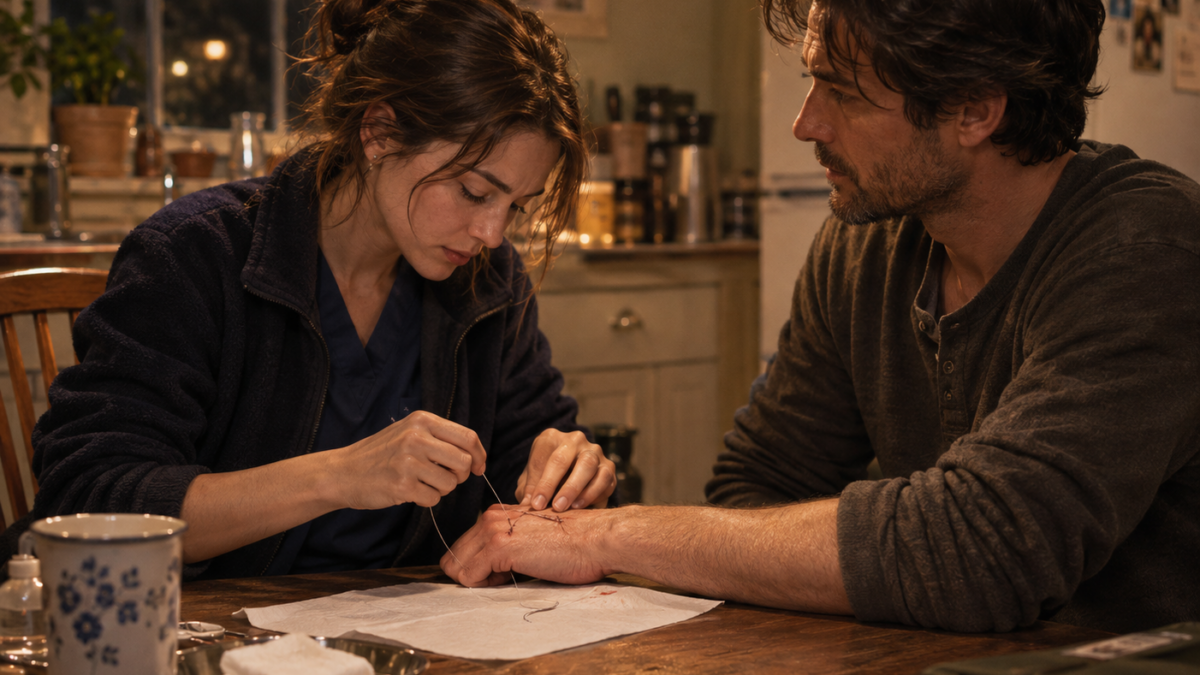
I had turned my whole head toward the dark window over the sink, as if the reflection of my own kitchen were suddenly fascinating, when Colleen Tierney set a small curved needle on a square of sterile paper and tapped the table twice beside my wrist.
– “Darren,” she said, and waited until I made a vague sound in reply. “Look at me, not the needle.”
So I did. I turned back and looked straight at her across the secondhand table I’d bought off a guy in Norwood, under the one overhead light that makes everybody look like they need a nap. And for once, I didn’t make a joke. That was apparently the part she hadn’t planned for.
She held my eyes for about two seconds, and then her gaze dropped to my palm faster than the job required.
– “Okay,” she said in the flat voice of someone reading instructions off a box. “Good, keep doing that.”
From the living room, I could hear her brother Kevin opening and closing my cabinets, which was his way of pretending he wasn’t listening. Forty minutes earlier, a little after midnight, I had been sawing at a cold brick of leftover lasagna with a knife that deserved better treatment. The blade slid off the edge of the pan and went straight across the heel of my left hand.
Kevin had stayed late after the Bengals game, and he took one look at the dish towel turning red and reached for his keys to drive me to the ER. I told him I’d tape it shut and go to bed. I’m not proud of that. I have had a problem with needles since a flu shot in the third grade, and I once passed out at a company blood drive in front of the entire sales floor.
Kevin argued for about a minute, then gave up on me and called his sister, who had just come off a shift at the emergency department and was still in her car. Colleen walked in wearing navy scrubs under a fleece jacket, carrying a kit, and she didn’t treat the situation as funny or tragic.
She had me make a fist, spread my fingers, press my thumb to each fingertip, and tell her where she was touching with my eyes closed. Then she told me it was a clean cut through the skin, not deep into anything that mattered, and that if it had been, she’d have driven me to the hospital herself, and I could fight her about it in the parking lot.
She also said that refusing the ER wasn’t toughness on my part, just luck, and that I shouldn’t confuse the two. The numbing shot was the worst of it, and I got through it by doing exactly what she’d told me to. I watched her face instead of my hand.
I had known Colleen since I was 15 and she was 17. Back when she drove Kevin and me to the movies in her mother’s minivan and called me the shadow because I was always one step behind her brother. I had seen her at birthdays and Thanksgivings and one memorable Fourth of July since then, but always across a crowded yard, always with Kevin standing somewhere between us.
I had never had a reason to look at her for this long. She has a small crease between her eyebrows when she concentrates and a faint freckle near her jaw that I had somehow never noticed. She also talks steadily while she works about nothing at all, like the weather in Dayton and the vending machine at her hospital that eats dollar bills.
Halfway through the third stitch, she stopped with a needle held perfectly still, glanced up at me, and said,
– “You’re allowed to blink, you know.”
I blinked. She huffed out something close to a laugh, looked back down, and finished the stitch without the slightest wobble.
There were five stitches in the end, and a dressing so neat it looked like it came out of a package. Then she sat back and laid out the rules the way I imagine she lays them out for strangers. She wanted somebody to look at it in person within a couple of days at an urgent care or my own doctor. And she wanted it checked again around day 10 to decide about the stitches.
She said a kitchen table was not a substitute for follow-up, and that she’d only done this because the cut was simple and she’d seen it with her own eyes. I said fine. I’d go to the urgent care on Montgomery tomorrow after work.
I think she expected me to bargain, because she waited a moment with her pen hovering over the instructions she’d written out. I told her I wasn’t going to pretend I was brave about needles when she had just watched me stare at her for 20 minutes to avoid one. She looked at me a beat longer than necessary and then wrote the date at the top of the page.
Kevin came in, inspected the bandage, and declared that I would live, which was generous of him considering he’d spent the whole procedure in the other room. He had to be at work by 7. He clapped me on the shoulder on his way out, told his sister to text him when she got home, and told me not to faint on her.
Then the front door shut behind him, and the house got very quiet. Colleen started gathering wrappers into a plastic bag and wiping down the table with a sanitizing cloth, and I sat there with my hand propped on a folded towel and realized I didn’t want to ask her one more question about my palm. So I asked what she’d been doing before her brother called.
She paused with the cloth in her hand, like she’d been asked something slightly out of order. Then she said she had been planning to go home, eat cereal standing up, and watch The Thing for maybe the fifteenth time, the 1982 one, which Kevin always called the dog puppet movie.
I told her I’d seen it twice and that I hated the ending.
She stopped wiping.
She asked me very calmly what exactly I hated about it, and I told her. Two men sit in the snow sharing a bottle. Nobody knows which one is human, and then the movie just leaves them there to freeze. I said it felt like the filmmakers had walked out before finishing the job.
She said that was the whole point, that the not knowing was the most honest thing in the film. I said honesty would be telling me who the monster was. She pointed the cloth at me and said I was exactly the kind of person who reads the last page of a book first. And I admitted that I had done that with at least two books.
Then she laughed. It wasn’t the tired, polite laugh she’d used with Kevin. It came out of her suddenly, and she put the back of her wrist against her mouth like she was a little more embarrassed by it. It occurred to me that this was the first conversation we’d had in 13 years that didn’t start with her brother’s name.
When the table was clean and her bag was packed, she asked whether it would be all right if she stopped by tomorrow evening for a quick first look. She said she passed through my neighborhood on her way home, but she phrased it as a question and she waited for my answer.
I said yes, tomorrow worked. I wanted to keep the argument about the movie going, but I let it sit because it felt like something I’d rather finish when I wasn’t sitting there bandaged at 1:00 in the morning.
She went down the hall and opened the front door, and the cold October air came in around her. Then she stopped with her hand on the knob and turned around.
– “Do you actually hate that ending?” she asked. “Or were you just arguing with me?”
I could have made it a joke, and an hour earlier I probably would have. Instead, I told her I actually hated it. That I like knowing where I stand when something’s over. And I said it the same way I’d answered her questions about my fingers.
She studied me from the doorway for a second, said, “Huh,” and pulled the door shut behind her. I stood in the hall listening to her car start and wondered whether tomorrow she would come to look at my hand or to finish what we’d started without Kevin there to start it for us.
She texted at 7:40 the next evening to ask whether it was still a good time. And by then, I had already done the thing I’d promised. I left the dealership a little early, drove to the urgent care on Montgomery, and sat under a television playing a cooking show with the sound off until a physician assistant called my name.
She unwrapped Colleen’s work, looked at it for about a minute, and said whoever closed it knew what they were doing. Then she typed something into a computer and handed me a printed card with a return date 10 days from the cut, when they’d decide about taking the stitches out.
I was home before 7 with the card on my refrigerator under a magnet shaped like a pierogi, which felt like the most responsible thing I had done all year.
When Colleen knocked, she had her kit over her shoulder and her hair still flattened on one side from a scrub cap. She asked how it felt before she asked to see it, and I told her it throbbed when I forgot and used it to open the fridge.
She sat me back at the same table and took the dressing down herself, and this time she talked me through it instead of talking about the weather in Dayton. She showed me how to clean around the stitches without scrubbing them and how to lay the new pad so the tape didn’t pull across the cut. She told me what normal looked like and what didn’t, like redness that kept spreading, heat, anything that smelled wrong, or numbness in my fingers.
I asked her to go back over two parts because I hadn’t followed them the first time. One was whether keeping it dry meant I couldn’t shower, which earned me a look and a demonstration with a plastic bag and a rubber band. The other was how much redness counted as a little, and she drew a line in the air about the width of a pencil from the edge of the cut.
I made her show me again. She seemed faintly surprised that I wasn’t nodding along to save face, and she slowed down without making a point of it.
When she was finished, I took the card off the refrigerator and set it on the table in front of her. I told her I’d been seen, I had the follow-up booked, and now that she’d shown me how, I could handle the dressing on my own. I wasn’t saying it to get rid of her, and I watched her decide that before she answered.
She turned the card over, read the date, and slid it back to me.
– “Then you don’t need me here every night,” she said. “Medically, I mean, you really don’t.”
She said it the way she’d told me refusing the ER was luck, plainly without softening it. And I appreciated that more than I could have explained at the time. It took away the excuse neither of us had quite admitted we might use.
She packed up, told me to text her a picture if anything looked off, and left before 9. Only after her tail lights were gone did I realize we hadn’t said one word about the movie.
Two nights later, she texted again around the end of her shift, asking whether I wanted her to swing by for a quick look. I wrote back with my right thumb, slowly, that the hand was handled and I had the photos to prove it, but the argument about The Thing was still wide open. Then I put the phone face down on the counter because I didn’t feel like watching three dots appear and disappear.
It buzzed about a minute later with a single line saying she’d be there in 20.
She showed up in jeans and a sweatshirt from some half marathon, and she didn’t have the kit with her. She didn’t ask to see my hand either. She glanced at it once when I opened the door, the way you’d glance at a car you used to own. And then she walked past me into the kitchen like she’d been there more than twice.
I hadn’t cleaned up for her or planned anything to say thank you. And I think that was the right call. It was a Thursday, and on Thursdays I make grilled cheese and watch whatever hockey is on. So that’s what I was doing. I offered her a sandwich and she said yes before I finished asking.
She was in a mood and she didn’t hide it. A man had argued with her for 20 minutes about whether he needed a tetanus shot, and her parking garage had charged her for a full day because the gate arm was broken. She also informed me that cheddar on grilled cheese was a mistake and that American was the only correct answer, which was a hill I would not have expected a woman with her education to die on.
Somewhere in there, she started on the blood test scene in the movie, and she did all the parts, hot wire included. Then she laughed at herself so hard she had to put her sandwich down. And it was the same sudden laugh from the first night.
At one point, she came over to the stove while I was flipping the second sandwich left-handed with my right, and she reached past me and turned the burner down. She said I was going to scorch it and that the butter should go in the pan instead of on the bread. I turned the burner back up. I told her I liked it a shade from burnt and that I’d been making this sandwich since I was 12.
I wasn’t irritated, and I said it the same way I’d tell a customer that his warranty didn’t cover curb damage. She looked at me, then at the pan, and I could see her consider saying something about my hand in the hot skillet. She didn’t. She held up both palms and backed away to the table.
– “That one wasn’t medical,” she said. “That was just me being bossy.”
I told her I knew the difference, and she smiled at her plate like she wasn’t sure whether to be annoyed or pleased that I did.
By 10, she had argued the ending again. I had refused to give an inch, and neither of us remembered the same details about the dog. She swore the dog runs off into the snow before the station burns. And I swore it doesn’t.
That was when it occurred to me that we’d been fighting for three nights over a movie we were both quoting from memory. When she stood up and went for her keys, I said the obvious thing out loud. I suggested that next time we just watch it, start to finish, and settle the dog once and for all. I meant my couch, a night we picked ahead of time, and no bandage to explain why she was there.
She stopped with her keys halfway into her pocket. She didn’t say no, and she didn’t say yes either. She said she’d look at her schedule, and her voice was careful enough that I understood exactly what I’d done. A quick look at my hand could happen on the way home from anywhere. A movie night with me had to be something she chose to drive over for, and she was standing in my kitchen deciding whether she wanted to be someone who did that.
She answered the next afternoon while I was on the service drive, explaining to a man that his warranty didn’t cover a tree branch. Her text said Saturday 7 to 11, because she had a 7 a.m. shift on Sunday and wanted to be asleep by midnight. I liked that she had given the night edges instead of leaving it loose.
I wrote back that 7 to 11 worked and that I’d find the movie. I didn’t say anything about my hand being in good shape, as if a clean dressing earned me a visit. The cut was healing the way the printed card said it should, and that was between me and the urgent care on Montgomery.
On Saturday, I bought the movie for $4 on my TV, moved a laundry basket off the couch, and set out a bowl of pretzels. I didn’t do more than that. She had told me she was choosing this, and dressing it up felt like trying to influence the choice after she’d already made it.
She came at 5 after 7 in the half marathon sweatshirt with a bag of the cheap orange circus peanuts nobody has bought on purpose since 1985. She said they were tradition, and I said they tasted like scented candles, and she said nobody had asked me. Then she took the end of the couch closest to the lamp and pulled her feet up under her, and I pressed play.
The opening hadn’t finished before the dog question was settled. A helicopter chases a husky across the snow with a man leaning out shooting at it. And Colleen sat forward and said, “Oh no.” She had folded the first scene into the last one in her memory. So the dog running off into the snow was real, just at the wrong end of the film.
I didn’t gloat much. I said “the beginning” twice, and she threw a circus peanut at my chest without looking away from the screen.
We disagreed through most of the movie, and that turned out to be the best part. She thought MacReady was the only person on that station with any sense. I thought he was a man who made every decision with a flamethrower in his hand and got lucky about which ones were right. She argued that luck was half of what keeps people alive. And I reminded her that she told me luck wasn’t the same as toughness.
She narrowed her eyes at me for using her own line. During the blood test, she went completely quiet, knees pulled up, mouthing a few of the words, and I watched her more than the screen. I liked how fiercely she took a side. I still thought she was wrong about MacReady, and I said so when the scene ended. She said that was fine, because being wrong about MacReady was a personal flaw she was prepared to forgive me.
When the two men were sitting in the snow at the end, sharing that bottle while the camp burned, she turned and looked at me instead of the screen. I told her I still hated it, and she said she knew, she could see it on my face. I turned the TV off rather than letting the credits run.
The room went dim except for the lamp, and for a while we just talked. The conversation drifted the way it does, from the movie to the video store on Glenway that used to rent it, and from there to the basement where Kevin and I watched most of the horror movies of our teenage years.
That was when Colleen started laughing to herself. She asked if I remembered Kevin’s 17th birthday. I did. She described it anyway, in detail, with her hands. I had announced to six of Kevin’s friends that I could backflip off the garage roof onto the trampoline, and I’d landed in her mother’s hydrangeas instead.
– “You were 16,” she said. “You had frosted tips.”
I told her the frosted tips were a phase and the hydrangeas came back the next spring. I wasn’t embarrassed, and I think she’d expected me to be. It was a fair story and I had been exactly that kid.
But I pointed out that she’d been home from Ohio State that one weekend and gone again by Sunday night. After that, she had seen me at holidays across a yard for 20 minutes at a time, usually holding a paper plate. I said she had a very complete file on me up to about age 16 and almost nothing after it.
She stopped smiling, not unhappily, and looked down at her hands. Then she asked the thing I think she’d been carrying since the first night.
– “Is this you liking me?” she said. “Or is this you liking that Kevin’s big sister finally looked at you like you were an adult?”
It was a fair question, so I didn’t answer it fast. I told her that at 16, I had wanted Kevin’s whole crowd to take me seriously, and she had been part of that crowd, the oldest and the hardest to impress. That was the honest truth about the hydrangeas.
But I told her I wasn’t going to pretend I’d been carrying a torch for her for 12 years, because I hadn’t. Most of those years, I hadn’t thought about her at all, except to wonder whether she’d be at Thanksgiving.
What I had now was newer than that, and smaller and more specific. I said she was the first person who had watched me get scared of a needle and hadn’t made it a joke and also hadn’t let me be stubborn about it. She told me the ER thing was luck and she’d been right.
Then I added that it didn’t mean she was right about everything, because she was wrong about MacReady, wrong about the ending, and badly wrong about American cheese.
She laughed, but it was a short one, and she didn’t fire back the way she had all night. She looked at me for a long moment from her end of the couch, and I let her. I’d learned at that kitchen table that I didn’t have to fill every silence she left open.
She didn’t say she believed me, and she didn’t say she didn’t. She said, “Okay.” The same flat way she’d said it the first night, but this time it didn’t sound like instructions off a box.
She didn’t reach for my hand to check the dressing, though I saw her eyes go to it once and come back. It was 10:15 and she had 45 minutes left of the time she’d picked, and she used all of them. We talked about her sister-in-law’s terrible sourdough and the car I was saving for. We argued about whether a hot dog is a sandwich, which she treated with the same gravity as MacReady.
Neither of us called it a date, and neither of us leaned across the couch to answer the question she’d asked by doing something easier than answering it.
At 11 exactly, she stood, found her keys, and stopped by the kitchen to throw the circus peanut bag away. She stood there looking at my table under that overhead light for a second, like she was seeing herself sitting at it with a needle in her hand.
Then she turned around and said the next one should be at her place. Tuesday after her shift, if I wanted. She said it quickly and practically, the way she says things when she’s already decided she might regret them.
I said Tuesday was good. She tore a corner off the pizza menu on my fridge and wrote her address on it, even though I could have found it, and she handed it to me on her way out. For three nights, she had walked into my kitchen and found my light switch on her first try. On Tuesday, I would be the one standing in her hallway, feeling along the wall for hers.
Her apartment was the top floor of an old brick house in North Side, up a staircase that leans slightly to the left. When she opened the door on Tuesday, she was still in her scrubs.
She had texted at 6:00 to push the time from 7 to 8 because the shift had run long, and then again at 7:40 to say she was home. Sort of. I understood the “sort of” as soon as I saw her.
Her hair was down and still damp at the ends. She was holding a mug of coffee at 8:00 at night, and a basket of clean laundry sat on the armchair where she made no move to hide it. She didn’t apologize for any of it, and I liked her more for that. She took my jacket and dropped it right on top of the laundry.
I found her light switch myself on the second try, exactly where a normal person would put one. I asked how the day had gone, and she said long, and then said she didn’t want to talk about it. I let it go.
A week earlier, I might have kept asking, the way you poke at a sore tooth, because getting her to tell me something hard would have felt like proof that we were close. But she wasn’t asking me to fix her evening, and I wasn’t there to take over the job she’d done at my kitchen table.
She had picked a ’90s thriller she swore was underrated, and we got about 40 minutes into it. Then she paused it in the middle of a car chase, looked at the screen, and announced that she had been completely wrong about this movie. She said it was boring, that she’d remembered it being much better, and that she was starving. She said all of it without a trace of embarrassment, the way you’d report the weather.
I told her I knew a place, and I didn’t ask her to choose, because for once I had a strong opinion and she was clearly out of them.
I drove us to the Skyline in Clifton, the one I’ve been going to since I got my license. I ordered a four-way with onions without looking at the menu. Colleen looked at the menu for a long time and then told the waitress and me that she was a Gold Star person and that she hated onions on anything.
She ordered two plain cheese coneys and told me she’d eat them but wouldn’t pretend she liked them better. A month ago, I would have heard that as a small verdict on me and maybe offered to go somewhere else. Instead, I told her that was fine, that I’d take her to Gold Star sometime and complain the whole way through. She said she’d hold me to that.
Then she stole my oyster crackers, which she apparently didn’t hate, and ate them one at a time while she told me about the summer she lived on nothing but cereal and parking tickets. She didn’t ask about my hand once that night, and I didn’t bring it up. The dressing was clean. I’d changed it that morning, and it was nobody’s business at that table.
When I dropped her back on her street, she sat in my passenger seat for a minute with her seat belt still on. She said I’d given her a better night than the shift deserved, and then she got out before I could decide what to say back. I watched her go up those leaning stairs and turn on the light in the front window. I didn’t drive away until it came on.
Kevin and I have had wings on Wednesdays at a bar in Oakley since we were old enough to get in. Neither of us has ever called it a tradition because that would ruin it. I told him on Sunday I’d be there, and I was, sitting in our usual booth with my bandaged hand around a glass of beer.
He waited until the second basket came out, which told me he’d been thinking about it on the drive over. He said he had called his sister the night before about their mom’s birthday, and she’d told him she was out eating chili with me. On Saturday, when he texted her, she was at my place, he said he was pretty sure Thursday was the same.
– “Your hand looks fine, man,” he said. “So why is my sister suddenly free every night? She hasn’t had a free weeknight since 2019.”
There was an easy answer sitting right there, and I could feel how easy it was. I could have said she was keeping an eye on the stitches. He’d have believed it, because she was the one who’d closed them and he knew how she was about loose ends.
But it wasn’t true, and it would have put the whole thing on her job, as if she’d been coming over because she couldn’t help herself professionally. So I told him it wasn’t the hand. I said she hadn’t looked at it since last Tuesday, and that I’d been asking her to come over and she’d been coming.
Kevin sat down a wing and wiped his fingers on a napkin slowly, one finger at a time. He wasn’t angry. He looked like a guy recalculating a route. Then he said,
– “Okay, just so you know, I’m not doing the thing where I carry messages between you two. If you’re trying something, try it without me standing in the middle of it.”
I said that was fair and I meant it. I didn’t ask whether he was all right with it, because it wasn’t his to approve and asking would have been a way of making him responsible for it. I also didn’t promise him anything, like that I’d be careful with her or that this was going somewhere. I didn’t know where it was going, and that answer belonged to Colleen as much as to me.
He nodded, ate the rest of the basket, and complained about the Bengals offensive line for 20 minutes as if nothing had happened. When we split the check, he said the one thing I think had actually been bothering him. He said that if this went sideways, he still wanted his Wednesdays. I told him he’d have them either way.
I called Colleen from the parking lot instead of going home first. I didn’t want her hearing about that conversation from her brother, in his words.
A day later, she picked up on the fourth ring, sounding like she was folding something. I told her what Kevin had asked, what I’d answered, and what he’d said about not being in the middle. She went quiet for long enough that I checked whether the call had dropped.
Then she asked, “You told him it wasn’t the hand?”
I said it wasn’t. And she said she knew that. She said she’d been telling him she was “at Darren’s” all week, like it was an address and not a decision. She said that was cowardly of her and that she hadn’t noticed she was doing it until just now.
– “I’ll talk to him myself,” she said.
Before your appointment on Thursday, she said she didn’t want to be the kind of sister her brother found out about secondhand from his best friend in a booth over a basket of wings. Her voice had the quick, practical edge it gets when she’s decided something she’d rather not discuss.
I asked what she was going to tell him. She said she’d figure it out. Then she said good night and hung up.
And I sat in my car under the bar’s neon sign with the engine off. She knew exactly who she was going to talk to, and she had even picked the day. She hadn’t said a word about what she’d call the last nine nights when she did. And somewhere between North Side and Oakley, I’d realized I wanted to hear it before Kevin did.
She didn’t wait for Thursday. About 40 minutes after she hung up on me, I was standing at my sink rinsing a glass when somebody knocked, and it was the first time in nine nights that she hadn’t texted to ask first.
Colleen was on my porch in a long parka over flannel pajama pants, with her car keys in one hand and nothing else. There was no kit on her shoulder and no bag of dressings, and she didn’t glance at my hand.
She said she’d driven straight to Kevin’s place in Pleasant Ridge and caught him in the parking lot before he went inside. They had sat in his car for 10 minutes with the heater running. She told him she had been coming to my house because she wanted to see me, not because my hand needed her, and that she should have said so the first time he asked where she was.
Kevin had said okay. Then he’d asked her to please stop texting him that she was “at Darren’s,” like I was a pharmacy. That was all she gave me, and I didn’t ask for more, because it was their conversation and not mine.
She came into the kitchen but she didn’t sit at the table. She leaned against the counter by the stove instead, with her parka still zipped, and apologized for not texting first. She said she was out of practice at this part.
I should have just asked the question I’d been carrying since the parking lot, but some old habit got there first. I asked her, grinning, whether “wanted to see me” meant the way a nurse wants to see a patient, or whether it meant something with less paperwork.
She started to answer the joke, too. She said something dry about bedside manner, and I watched her take the exit I’d built for both of us, and I didn’t like it. So I stopped her in the middle of it. I said that was a bad way to ask, and I wanted to try again.
– “I want to take you on a date,” I said. “Not here and not on your way home from anything. A real one.”
Then I stopped talking, and I didn’t add a single word to make it smaller.
She set her keys down on the counter, which I took as a good sign, though it turned out to be only half of one. She told me she liked me, and that she’d noticed it the first night, halfway through the third stitch, when I wouldn’t stop looking at her. It had annoyed her, she said, because she was holding a needle at the time, and that is not a moment when she allows herself to notice anything.
But then she said there was something she needed to be straight about before she answered me. My appointment tomorrow belonged to the urgent care on Montgomery. She wasn’t going to come with me or look at the cut beforehand or take the stitches out at my table to save me a copay.
She said she had watched people let looking after someone quietly become the whole relationship. And she wasn’t going to do that to herself or to me. She didn’t want any part of this to be something she could later tell herself had happened because of a hand.
I told her that was fine and I meant it. I’d already planned on Montgomery, and the card was still on my fridge under the pierogi magnet where it had been all week. She looked over at it as if checking my story, and I let her.
There was a moment right then when something else would have been very easy. We were standing about three feet apart in my kitchen at a quarter to 11, and she had just told me she liked me. I didn’t move, and I didn’t ask her to prove anything with a kiss.
But I did tell her one thing back. I said I didn’t want any more nights described as her passing through the neighborhood. If she came over, I wanted it to be because she wanted to, and I wanted that said out loud to me, to Kevin, and to anybody else who asked.
She said that was fair. Then she admitted that Kenwood wasn’t on the way from her hospital to North Side at all, and that she had checked it on a map the second night. She didn’t promise me anything big, and I didn’t need her to.
She said she didn’t know what this was going to turn into. She also said she wasn’t going to pretend to know just so I’d sleep better, and I respected that more than a nicer answer.
Then she took out her phone and scrolled through her schedule with her thumb, frowning at it the way she’d frowned at my palm. She picked Saturday, two days after my appointment, and she said it was a date in exactly those words, without any hedging around them. She also said she was choosing the place. I told her that seemed fair since I’d picked the Skyline. She said she wasn’t taking me anywhere I could order without opening the menu.
At 20 to 11, she zipped her parka to her chin and went to the door. She didn’t stop and turn around this time the way she had on the first night. She just said good night like a woman walking out with a plan, and I stood in the hallway feeling oddly proud of both of us.
The next two days were ordinary, and that turned out to matter. We texted the way normal people text about nothing much. She sent me a picture of her hospital’s vending machine with a handwritten sign taped to it that read, “It knows what you did.” And I sent her a photo of a customer’s minivan with a kayak strapped to the roof upside down. I didn’t send her a single picture of my hand, and she didn’t ask for one.
Thursday night she worked late, and Friday she told me plainly that she was keeping the evening for herself. She said she was going to take a bath, read half a paperback, and see nobody, including me. A month earlier, I might have wondered what that meant about me. Instead, I spent my Friday paying bills, moving another $200 into the car fund, and doing my laundry, and I didn’t check my phone more than a normal amount. It felt good to have a life of my own to go back to while I waited.
Around 9:00 on Friday night, my phone buzzed with an address on Hamilton Avenue, a bar a few blocks from her apartment that I’d driven past for years without ever going inside. Underneath it, she’d written that it had a kitchen, a booth by the back window she liked, and the best fried pickles in the city.
Then a second message came in. She said not to pick her up, and that she wasn’t going to pick me up either. We’d each get there on our own at 7, the way two people do when neither of them is coming off a shift to check on the other.
I read it twice in my laundry room with a towel over my shoulder. For nine nights, every time we’d seen each other, one of us had been showing up at the other’s door with a reason already in hand. I wrote back that I’d be there at 7, and that I’d be the one in her booth pretending I knew what to order, and I left the phone on the dryer while I folded the rest of my shirts.
She had given me a place, a time, and the word for it. What she hadn’t given me was any idea what Colleen Tierney was like when she walked into a room where nobody needed her for anything.
On Thursday after work, I drove to the urgent care on Montgomery by myself with the printed card from my refrigerator folded in my jacket pocket. It was a different physician assistant this time, a young guy with a cartoon taco pinned to his lanyard, and the same cooking show was playing on the same silent television.
He looked at the cut, said it had healed exactly the way it was supposed to, and took the stitches out while I stared at a water stain on the ceiling tile. Nobody told me where to look, and I managed fine, which I mentioned only because two weeks earlier I wouldn’t have bet on it.
He told me to keep it covered a couple more days and go easy on lifting anything heavy. I walked out with a thin pink line across the heel of my hand and no reason left to see anybody about it. I texted Colleen one sentence saying I’d been signed off. She wrote back “good” and nothing else. Which was exactly the right amount.
On Saturday, I got to the bar on Hamilton Avenue at 10 minutes to 7:00. It was dim and narrow, with a long wooden bar, a chalkboard of beers I’d never heard of, and a booth by the back window with a crack in the vinyl seat. I sat in it as promised and opened the menu so I’d look like I knew what I was doing.
Colleen walked in at two minutes past 7. She wasn’t in scrubs or the half marathon sweatshirt. She wore a dark green sweater with her hair pulled back and small silver earrings I’d never seen. The bartender called her by name before she reached the booth, and she stopped to ask a man at the end of the bar how his dog’s surgery had gone.
I realized she’d been coming here for years. She hadn’t picked a place I’d find easy. She’d picked her place and brought me into it.
She slid in across from me, took the menu out of my hands, and informed me I was not allowed to order the burger. She didn’t glance at my hand, and I didn’t set it on the table like a report card.
We disagreed within five minutes, which was a relief to both of us. She ordered the fried pickles as spears, and I said chips were better because you got more crunch per pickle. She called chips “pickle confetti” and said people who ordered them were afraid of commitment. I told her that was a lot of psychology to hang on a side dish.
She ordered for herself and then for the table a flatbread with something on it I couldn’t pronounce, and I let her, because she’d earned the menu and I wanted to see what she actually liked.
Halfway through the pickles, she started a story the way she starts a lot of them.
– “So, when Kevin moved into that first apartment,” she said, and I could see her settling into the version of us where her brother sits in the middle and we both talk about him.
I didn’t dodge it, and I didn’t pretend it wasn’t a good story. I told her I’d heard that one from Kevin’s side, and it was mostly about a couch.
– “I want yours,” I said. “What were you doing that year?”
She looked at me for a second like I’d changed lanes without signaling. Then she told me she’d been in nursing school at night and working days at a pharmacy. And for nine months, she had played bass in a cover band called Second Opinion. They played exactly four bars in Covington and broke up over whether to learn a Journey song. She said she had not been good, but she had been very loud.
I asked what she’d wanted to be before nursing, and she said a marine biologist, until she found out how much of it was spreadsheets. She asked what I was saving for, really, and I told her it was a 1987 Buick Grand National, black, and that I’d been looking at the same listing for a year like it might change its mind. She said that was the least practical thing she’d ever heard me say, and she liked it.
For two hours, neither of us mentioned needles, dressings, or the word Kevin. I learned more about her in that booth than in 13 years of Thanksgivings, and every bit of it came from asking.
It was after 10 when we walked out onto Hamilton. The air had turned cold, and the street was quiet except for a bus sighing at the corner. Her apartment was three blocks one way, and my car was half a block the other. We stopped on the sidewalk under the bar’s sign, where the evening would naturally split in two.
On the first night, she’d told me where to look, and I had looked at her because she told me to. I wasn’t waiting for instructions. Now, I stepped closer, close enough to see the cold in her cheeks, and I said,
– “I want to kiss you.”
I didn’t make it a joke, and I didn’t phrase it as a question she had to rescue me from. She looked at me the way she had across that table, but nothing in her hands needed to stay steady this time.
– “Then stop announcing it,” she said.
She took hold of the front of my jacket and closed the last of the distance herself. And I kissed her. She kissed me back like she’d been making up her mind about it all night and had made it up some time ago.
When we came apart, she found my left hand without looking for it, and her thumb ran once across the pink line on my palm. She didn’t inspect it. She just held on.
She was the one who brought up the next time before we’d even started walking. She said she still owed me Gold Star so I could complain the whole way through, and she offered Wednesday.
I told her no. Wednesday was wings with Kevin, and I’d promised him he’d keep his Wednesdays no matter what happened.
A month earlier, I might have worried that saying no would cost me something. She didn’t treat it like a verdict. She just nodded and said she’d never come between a man and a basket of wings.
She offered Monday, and I said I had a late appointment at the dealership until 7. I asked about Tuesday, and she checked her phone and said Tuesday was a 12-hour shift and she’d be useless. We settled on Thursday after her shift, because it was the first night we both actually wanted rather than just had open. She said she’d text me the time.
Then she asked me to walk her home, and she was careful to add that it wasn’t because she needed it. I walked her the three blocks to the brick house with the leaning staircase. She kissed me again at the bottom step, quicker this time, as if it were already something she was allowed to do.
Then she went up, and the light came on in the front window. She came to the glass and lifted one hand, and I lifted mine back, the left one.
When I got to my car, my phone buzzed with a single line. It said, “Thursday 7, Gold Star on Glenway,” and that I was not allowed to say a word about onions.
I sat behind the wheel and read it twice. I’ve always hated stories that leave you out in the snow without telling you where you stand. For once, I knew exactly where I stood.
I’d known Colleen Tierney since I was 15, and I had filed her under “Kevin’s sister” for so long, I never noticed the file was nearly empty. Everything worth knowing about her, I had to learn by asking across a table with nobody needing anything from either of us.