My First Crush Asked Me to Walk Her Home Again After Our Hometown Reunion
My First Crush Asked Me to Walk Her Home Again After Our Hometown Reunion
By the time the reunion started winding down, I had already made two trips to the coat rack for a jacket I wasn’t wearing. Both trips had taken me past Marin Halverson. The first time, she was laughing with three people from our graduating class. The second time, she caught me looking and raised an eyebrow over her paper cup.
I was considering a third trip, which would have required pretending to lose an entire arm, when she crossed the room herself.
– “Ronan Whitam,” she said. “Are you about to leave without saying goodbye?”
I told her I was looking for the exit.
She pointed toward the double doors behind me.
– “That’s been there all night.”
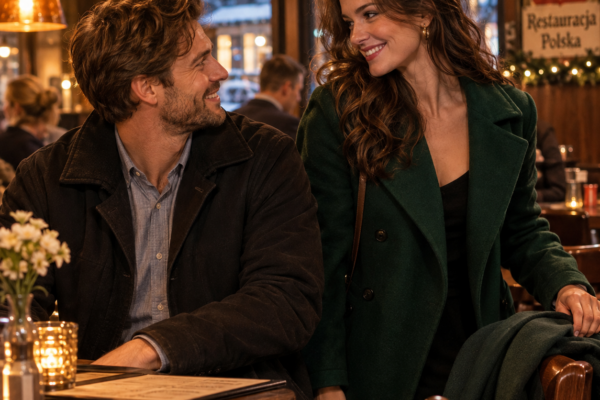
Her smile hadn’t changed much in 10 years. The rest of her had, in ways I wasn’t equipped to inventory while she stood three feet away. She wore a dark green dress and flat shoes, and her hair fell in loose waves around a face I recognized before I quite believed it was hers.
– “I was going to find you,” I said. Eventually.
She looked at the empty coat rack.
– “Your search pattern could use some work.”
We’d spoken once near the buffet, long enough for me to learn she was a physical therapist in Pittsburgh, and for her to hear I worked as an electrician here in Ridgeford. She joked about the terrible depot lighting. I’d been too distracted by her grin to explain the fixtures were older than we were.
In high school, I’d been good at making her laugh, then terrible at deciding what came afterward. I wasn’t planning to repeat that second part at 28.
Outside, the November air felt colder than it had through the windows. The town had converted the depot into an event space years ago, and somebody had hung little strings of lights along the brick wall. A dozen former classmates were organizing rides, comparing babysitter schedules, and promising to get together before another decade passed.
Marin stopped beside me while I looked for my truck.
– “Can I ask you something strange?” she said.
– “You’re starting with a generous advantage,” I told her. “You knew me in high school.”
She slipped her hands into her coat pockets.
– “Would you walk me home?”
I looked up the street, then back at her.
– “Your parents’ place?”
She nodded.
– “The old way, if you remember it.”
There were several perfectly sensible things I could have said, including that it was late and that she probably hadn’t planned on walking in thin shoes. Instead, I said,
– “You know your house was never on my way home, right?”
Marin’s smile returned slowly.
– “I was wondering when you’d admit that.”
The first block was easy. We passed the diner where the reunion committee had once planned to hold the event, then crossed in front of the hardware store with its familiar crooked awning. Marin remembered the original owner, who used to give every kid a peppermint whether they bought anything or not. I remembered the owner telling me to stop testing his display doorbells. We had different accounts of why I did that.
When the conversation turned to our classmates, I learned she genuinely enjoyed seeing people again, although she had spent an unreasonable amount of time assuring one woman that no, physical therapy did not mean she could diagnose a shoulder injury from across a ballroom. I admitted that somebody had asked whether electricians still used ladders.
– “What did you say?” she asked.
– “Only on special occasions. Mostly we levitate.”
Her laugh carried down the quiet street, and I had the peculiar sensation of being 18 and 28 at the same time.
We reached the corner of Bir and Mercer, where she’d always insisted we turn left after school. The direct route continued straight, past the elementary school, and saved at least seven minutes. Left took us by a flower shop and a row of red brick houses with little front gardens. The shop was gone, replaced by a place that sold expensive coffee and called itself a studio.
Marin stood beneath its new sign and frowned.
– “That used to smell like wet dirt and roses,” she said.
– “Now it smells like rent,” I answered.
She gave me a sideways look.
– “You got meaner.”
– “No, I got invoices.”
We stood for a moment, watching our reflections in the dark glass. The familiar route hadn’t been waiting for us unchanged, which I found more reassuring than disappointing. It meant we could walk through the town as we were, not as two people trying to squeeze into old winter coats.
Marin chose the left turn. I followed, and she glanced back as though checking whether I would argue.
– “Still the quickest way,” she said.
– “Absolutely. If the objective is seeing every street in Pennsylvania before midnight.”
She bumped my sleeve with the back of her hand. The contact was brief, but it took me a second to pay attention to her next sentence. She was talking about leaving Ridgeford for college, then finding work in Pittsburgh, about how she’d expected the city to overwhelm her and had instead grown to love walking around it.
I told her I’d spent two years working outside the county before deciding I liked having people I knew close enough to complain about me in person. That drew a question about whether I ever regretted coming back.
– “Sometimes when it snows,” I said. “Not often enough to leave.”
She didn’t give me a polite response. She considered it, nodded, and asked what I liked about my work. It was the first question all evening that didn’t sound as though it came from a reunion name tag.
The closer we got to her family’s street, the less either of us seemed interested in the weather, the reunion, or the practical merits of asphalt. She asked whether I still saw people from school. I named a few, then admitted that most of the classmates I had talked to that night were people I hadn’t thought about in years.
– “And me?” she asked.
It was a fair question, delivered without a smile. I could have told her I’d remembered her whenever I drove along our old route, but that wasn’t true. Most days I was thinking about bills, a job, dinner, or why my truck made a noise it definitely shouldn’t. What was true mattered more.
– “Not every day,” I said. “But sometimes something happens, and I think you’d have found it funny. Then I realize I haven’t known where to send the joke for 10 years.”
She looked down at the sidewalk for a few steps.
– “I like that answer,” she said. “It sounds like yours.”
Her parents’ porch light was on when we reached the house. The steps had been repainted. The mailbox was new, and the small tree beside the driveway had grown taller than the roof. I stopped at the foot of the path, giving her room to decide whether the night was over.
Marin turned to face me, her cheeks pink from the cold.
– “I didn’t know if you’d remember the way,” she said.
– “I remember more than is useful.”
– “Do you remember the stop sign at the end of this block?”
I glanced over my shoulder.
– “Sure.”
She looked almost embarrassed for the first time all night.
– “You used to get there after dropping me off, turn around, and check whether I made it inside.”
I blinked.
– “You could see that from the upstairs window.”
– “My room faced the street.”
I’d thought those looks back were the kind of private stupidity no one ever noticed.
– “You never mentioned it,” I said.
– “Neither did you.”
For a second, we just stood there. Two adults caught by the sight of their younger selves being a little less invisible than they’d believed. Marin rubbed her hands together, and I realized I didn’t want the conversation to end at the porch. I also didn’t want to trap her there while the cold did my persuading for me.
– “Are you free tomorrow morning?” I asked. “I’d like to take you to breakfast. Somewhere that isn’t a memory from high school.”
She looked at me for a long enough moment that I could hear a car turning onto the next block.
– “I am,” she said. “And I’m glad you asked that instead of making me invent another shortcut.”
We agreed on 9:30. At the front door, she turned, lifted a hand, and waited until I started walking before she went inside. I reached the stop sign, looked back out of habit, and saw her standing at the upstairs window. This time, when she waved, I knew exactly who it was for.
I arrived at her parents’ place at 9:27 the next morning, which was early enough to feel eager and late enough that I could claim I was being normal about it. I changed shirts twice. The first one looked as though I were heading to a job site, and the second made me look like someone trying to sell an expensive vacuum cleaner. I settled on a dark sweater and jeans.
Marin opened the door before I reached the bell. She wore faded jeans, a cream-colored jacket, and her hair pulled loosely away from her face. Without the green dress and the noise of the reunion, she looked more familiar and considerably more dangerous to my concentration.
– “You’re early,” she said.
– “I calculated the shortest route.”
She walked past me toward the truck.
– “That’s unfortunate. I was hoping you’d learned something overnight.”
I held the passenger door open, and she glanced at my hand on the handle.
– “You know I can open doors.”
– “I know. I’m showing off my range of skills.”
I took her to a little place on Willow Street called June’s Table. It had opened four years earlier in a storefront that used to sell fishing gear, and the owners still hadn’t managed to remove a faded outline of a trout from the brick outside. Marin stopped to examine it before we went in.
– “You brought me somewhere with a fish ghost,” she said.
– “I thought it was a step up from the diner where we bought fries after football games.”
– “I liked those fries. They came with enough grease to keep a tractor running.”
Inside, the breakfast rush was thinning. We found a table near the front window, and she ordered eggs and toast while I made the mistake of asking whether the cinnamon pancakes were good. The server gave me a look suggesting that declining them would be a character flaw. Marin watched the exchange with open amusement.
– “You still let people talk you into things?” she asked.
– “Only when cinnamon is involved.”
She stole the first bite when the plate arrived, so I had to admit the server had been right.
A reunion makes it easy to talk in bullet points. You mention the city where you live, the job you do, whether you survived your 20s with any dignity, and the conversation moves on. Over breakfast, Marin stopped giving me the condensed version.
She told me about the narrow apartment she rented in Pittsburgh and the neighbor who watered the shared hallway plants according to a mysterious schedule. She talked about the friends who had become her Saturday night trivia team and how she’d learned the hard way that knowing anatomy did not make her useful during the geography round.
I told her about my small rental house near the edge of Ridgeford, the cupboard door I kept promising myself I’d repair, and the fact that I had been invited to three weddings in one summer because I apparently looked reliable in photographs.
– “You do,” she said, studying me. “Reliable. Like the person who’d hold everybody’s coats while they climbed onto a table.”
– “I would not encourage climbing onto tables.”
– “Exactly. You’d find a safer table.”
It surprised me how little we needed to talk about school to keep things moving. When I mentioned that I liked coming home to a quiet place after spending a day around loud equipment and louder opinions, she didn’t call me boring. She asked whether I ever felt the town was too small.
I said it could be, especially when strangers knew why my truck had been at the mechanic before I did. But I liked being somewhere my decisions had consequences beyond the next shift.
Marin turned her coffee cup in her hands.
– “I thought leaving was the only way I’d figure out who I was,” she said. “For me, it probably was.”
I asked if she’d found out enough to be annoyed by herself fairly often. She gave me a quick smile, then told me she liked Pittsburgh because no one expected her to be the person she’d been at 18.
I understood that more than she might have guessed. In Ridgeford, I’d had to prove by repetition that I wasn’t still the kid who climbed the school roof on a dare.
The conversation changed when she asked how much I’d really known about her senior year.
– “I knew you hated chemistry,” I said. “You liked lemon candy, except when you pretended you didn’t. You were good at arguing with teachers, and your favorite route home added seven minutes.”
She leaned back.
– “Seven?”
– “On a good day. Nine if you wanted to look at the flower shop.”
– “I can’t believe you timed it.”
– “I didn’t time it. I had somewhere to be after I left you.”
Her eyes narrowed.
– “And yet you kept going the long way.”
I took a bite of pancake to buy a few seconds.
– “Yes, Marin. I understood that your shortcut wasn’t a shortcut.”
She stared at me, then laughed so suddenly the woman at the next table turned around.
– “I thought I was being subtle.”
– “You once told me we had to turn left because the sun was better on that side of the street.”
– “It was—it was raining.”
She covered her face with one hand.
– “I can’t believe you let me keep saying it.”
I liked seeing her caught off guard, not because I’d scored a point, but because she stopped managing the conversation for a moment. When she lowered her hand, she wasn’t smiling quite as broadly.
– “You could have said something,” she told me.
– “I could have,” I agreed.
The old version of me would have followed that with a confession carefully disguised as a joke. Instead, I asked,
– “Would you have wanted me to?”
She thought about it while the server refilled our coffee.
– “Some days, yes. Other days, I would have been terrified that you had.”
Her answer was neither romantic enough to settle anything nor casual enough to ignore. That was one of the things I was starting to like about her. She could be playful without lying about where the playfulness stopped.
– “We were pretty young,” I said.
– “We were,” she answered. “I’m glad we’re not anymore.”
After breakfast, we stepped onto the sidewalk and found that the temperature had climbed just enough to make a walk pleasant. Marin glanced toward the old school, then deliberately turned away from it.
– “What do you do here on a Sunday when you’re not babysitting reunion guests?” she asked.
I told her there was a riverfront path that had opened after she moved away, with benches, a small market when the weather cooperated, and a view of the old mill buildings across the water. She wanted to know if it was crowded.
– “Not usually. It’s mostly people who like being outdoors but also want a parking lot close by.”
She smiled, then looked at the time. She had lunch plans with her parents, but no plans for the afternoon. I didn’t have to pretend I was indifferent.
– “I’d like to see it,” she said, “with you, if that part wasn’t obvious.”
I told her I could pick her up at 2.
She nodded and said she’d be ready, then paused beside the truck without opening the door.
– “You know what was strange about last night?” she asked.
I shook my head.
– “I was nervous about seeing you more than I was about anyone else.”
The admission hung between us in the sharp November sunlight. I wanted to ask how long she’d thought about me, whether she’d looked for my name on the reunion list, whether there had been other chances when she almost got in touch. Those questions all belonged to a version of the story we’d already spent 10 years not telling. I chose the one that mattered now.
– “Are you nervous about this afternoon?”
Marin looked at me, and her smile turned smaller, more private.
– “A little.”
– “Good,” I said. “I’d hate to be the only one.”
She put a hand on the open passenger door and laughed.
– “You’re a lot less subtle than you used to be, Ronan.”
I told her that had been a deliberate improvement.
When I dropped her off, she touched my forearm to stop me before I could say goodbye.
– “You choose where we go at 2,” she said. “No old roots. I want to see where you would take me now.”
It was a simple request, and it gave the afternoon a weight no photograph from the reunion could have supplied.
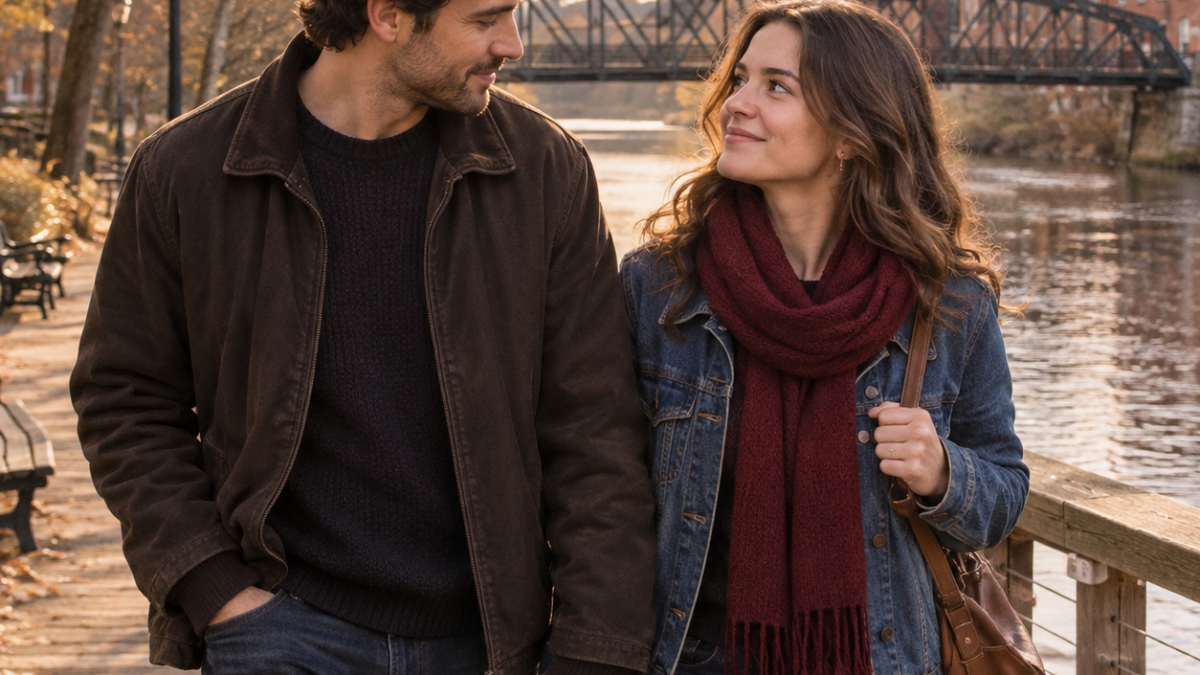
At 2:00, the sky was bright enough that the river looked silver beyond the rooftops. Marin appeared on the porch with a dark red scarf looped around her neck and a look that told me she’d spent a little time deciding what to wear. I recognized the look because I’d had the same trouble with my own jacket.
On the drive to the riverfront, she asked whether I was taking her somewhere I used to go with girls in high school.
– “There weren’t a lot of those places,” I said.
– “There weren’t a lot of girls?”
– “There were plenty of girls. I had a scheduling problem.”
She looked at me, waiting.
– “I kept walking one particular girl home,” I said.
Marin turned toward the window. She didn’t hide her smile nearly as well as she thought she did.
We parked beside the old grain warehouse, now a cluster of small businesses, and she stepped out to survey the new boardwalk.
– “Okay,” she said. “You win. I wouldn’t have found this by myself.”
The path curved along the river where the town had cleared out decades of weeds and rusted fencing. On one side stood renovated buildings with broad windows. On the other, the water ran fast beneath a steel footbridge. A handful of people were browsing a weekend stall selling apples and warm cider.
We bought two cups because the air carried a sharper edge near the river. Marin took a sip, frowned, and asked why mine tasted better. I handed it over. She tried both again and announced that I’d somehow been given the better cup.
– “They poured them from the same container,” I said.
– “That’s what makes it suspicious.”
She returned mine after drinking considerably more than a test sip. It was a small, ordinary piece of behavior, but I caught myself enjoying the fact that she was comfortable enough to be difficult with me. The girl I’d known had always been easy to make laugh. The woman beside me had opinions, and she expected me to survive them.
We crossed the footbridge and stopped to watch the water breaking around a concrete support. Marin told me about getting lost on her first week in Pittsburgh, when she’d spent 20 minutes circling the same block because she refused to ask for directions.
I said that sounded familiar.
She pointed out that I was the man who had spent his final year of high school pretending he had a reason to walk several blocks out of his way.
– “Fair,” I admitted.
She asked whether I still did that kind of thing.
– “Not usually. These days I ask where someone wants to go.”
And if they don’t know, I thought for a moment, I give them a choice and see what happens.
She leaned her elbows against the railing.
– “You make everything sound simple.”
– “I don’t think it’s simple. I just don’t want to spend another decade wondering what I should have asked.”
She looked out at the river, and I wished I’d said it a little less carefully. Sometimes being direct meant letting a sentence arrive with the rough edges still attached.
When we walked on, the conversation wandered away from us for a while. Marin told me she’d started joining her friends for weekend hikes after years of insisting she hated hills. I admitted that I enjoyed cooking but had once mistaken coriander for cumin and made a pot of chili that nobody wanted to discuss afterward. She laughed so hard she had to stop walking.
I liked the way she laughed now without looking around to see who might be watching.
We passed a mural painted on the old retaining wall, a bright scatter of birds and windows. She studied it and said she liked the colors but couldn’t tell what the artist wanted it to mean. I told her maybe the artist had just wanted people to look.
– “You have an answer for everything,” she said.
– “Incorrect answers count.”
– “That’s becoming clear.”
She nudged me with her shoulder, and this time neither of us moved immediately apart.
Near the end of the path, we found a bench facing the water. We sat for a few minutes watching a man guide a small dog away from the muddy edge. Marin unwrapped her scarf, then wrapped it again.
– “Can I tell you something without you making a joke?” she asked.
– “I can try.”
– “I was glad you stayed in Ridgeford.”
I turned toward her. She corrected herself before I could respond.
– “Not because I think you should have waited for me. That came out wrong. I mean, when I saw your name on the reunion list, I was glad there’d be someone here who might remember me before I knew what I wanted to do with my life.”
She looked embarrassed by the explanation. I could have made it easier by assuring her I felt exactly the same way. But that wasn’t quite true. I’d been glad because I wanted to see her. The person she’d become was making the old reason seem small.
– “You don’t have to turn that into something neat,” I said. “I know what you mean.”
She let the scarf fall into her lap. She asked what I’d been like during the years we hadn’t spoken, and I tried to answer without giving her a list of achievements. I’d made mistakes, rented an apartment I couldn’t afford, learned to say no when work took more than it gave, and eventually moved home.
She told me about a friendship that had survived several years of living in different cities because both people kept doing the unglamorous work of showing up. When she finished, she made a face.
– “That sounds like something I say to patients about their exercises.”
– “Only if you hand me a resistance band,” she grinned.
– “I have some in the car.”
The teasing carried us for a while, but I kept thinking about the way she’d spoken of the friend. She wasn’t afraid of distance in principle. She was careful about promises that made good conversation and disappeared when someone had to keep them.
At the far end of the boardwalk, the path narrowed where construction fencing blocked a section near the mill. We had to turn back. Marin stood in front of the sign and read the temporary route instructions with exaggerated seriousness.
– “We’re being sent the long way,” she announced.
– “At last, an official endorsement of your methods.”
She stepped closer as we turned, and her hand brushed mine. This time, she didn’t pull it away. I took her fingers gently, giving her every chance to decide whether she wanted that. Her hand closed around mine. Neither of us commented on it.
We walked past the mural again, and I noticed how easily our pace matched when we weren’t trying to pretend the contact was accidental. It would have been nice if that settled everything, but I was old enough to know that a pleasant walk and a shared hand didn’t answer questions about where two people lived or what happened on Monday morning.
By the steps leading back toward the parking lot, Marin slowed. She stood facing me with her scarf loose around her shoulders and a faint crease between her eyebrows.
– “I don’t know if this is a terrible idea,” she said.
– “What is?”
She looked at our joined hands, enjoying this as much as I am.
I could feel the old temptation to protect myself with a joke. Instead, I said,
– “I like you, Marin. Not because you used to sit next to me in history class. I like being with you now.”
She studied my face, and I let her.
– “I like you, too,” she said almost irritably, as if I’d made an argument she was annoyed to agree with.
I smiled.
– “That sounded painful a little.”
– “You’re enjoying it quite a bit.”
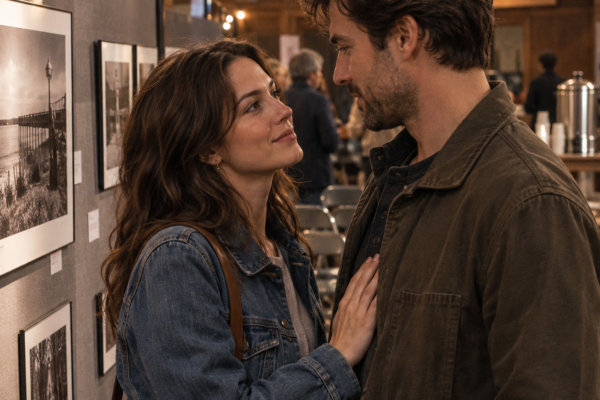
She stepped nearer. I touched her cheek slowly enough that she could move away. She didn’t. When I kissed her, she caught the front of my jacket and drew me closer. The kiss was warm and unhurried, and when we broke apart, she was smiling in a way I’d never seen at 18.
I wanted another kiss. She wanted one, too, judging by the way she stayed close, but her eyes flicked toward the parking lot before she spoke.
– “I’m leaving tomorrow,” she said.
– “I know.”
– “I don’t want to say something dramatic because we’ve had a really good day.”
– “Then don’t.”
She gave me a skeptical look.
– “You make that sound simple again.”
– “It’s not simple. I just don’t need a dramatic answer today.”
We stood there until the cold finally became impossible to ignore.
On the drive back, she rested her hand over mine for a moment when I stopped at a red light, then withdrew it before the light changed. She had plans with her parents that evening. I had known about them since breakfast, and I wasn’t going to act surprised that she intended to keep them.
When we reached her driveway, she asked whether we could talk before she headed back to Pittsburgh. I said yes without trying to turn the answer into a promise.
As she walked up to the porch, I realized the dangerous part wasn’t wondering whether she’d ever kiss me. I knew now that she wanted to. The question was what we’d be willing to do about it once she was gone.
I drove home with the windows cracked even though it was cold. The truck smelled faintly of apple cider, and I kept replaying the moment on the boardwalk when Marin’s hand had found mine.
I was pleased with myself for about five minutes, which was how long it took to realize I hadn’t asked what time she planned to leave Monday. That was the kind of practical detail that mattered a lot more than a clever line delivered on a riverfront.
I considered turning around, then kept driving. She had told me she was having dinner with her parents, and I didn’t intend to show up on their porch, acting as though my afternoon had made me the center of her weekend.
At home, I put away the jacket she’d gripped when she kissed me and stood in the kitchen wondering what to make for dinner. The answer turned out to be toast and a piece of cheese eaten over the sink. It wasn’t a good meal, but it prevented me from giving the day the kind of solemn ceremony it hadn’t asked for.
I spent part of the evening cleaning up the house, which had needed attention before Marin came back to town and would still need it if I never saw her again. The cabinet door I’d mentioned at breakfast had been hanging crooked for months. I tightened the hinge, closed it, and opened it twice to enjoy the result.
Then I started laughing, because it was exactly the sort of task I might have used as an excuse not to think about a woman. I wasn’t frightened of talking to Marin. I was wondering what I could reasonably offer somebody who had built a life in a city two and a half hours away.
I’d lived outside Ridgeford before. I knew how easy it was to make plans while standing face to face and how quickly they could thin out when one person was tired on a Friday night and the other had an early start Saturday. I didn’t want to promise my way past that problem. I wanted to know whether it was one we both wanted to try solving.
Marin called a little after 8. We’d exchanged numbers at breakfast, and I recognized hers before the screen had finished lighting up. She said she’d survived dinner and helped her mother clean the kitchen. I told her about the cabinet hinge.
– “That’s an incredibly romantic evening,” she said.
– “You should see how smoothly it closes.”
She laughed, then asked if we could meet somewhere in the morning before she drove home. I said I knew a bakery near the highway, open early enough that she wouldn’t lose half the day on the road.
– “Good,” she said. “I have to be back by lunch.”
There was a brief silence, the kind that had never lasted long between us in high school because one of us would rush to fill it. This time I let it stay. She asked if I’d been thinking about the afternoon.
– “Yes,” I told her. “The cider wasn’t nearly as good as you claimed.”
– “I did not call to discuss cider.”
– “Then yes, I’ve been thinking about you.”
She breathed out quietly.
– “I’ve been thinking about you, too.”
I could hear a door close somewhere on her end and imagined her moving into a room where she could talk without everyone listening.
– “I’m worried that we’re good at this because we’re here,” she said. “At home, I have plans most weekends. I work late sometimes. I don’t sit around waiting for a pretty afternoon.”
I told her I didn’t either.
– “I know. That’s part of what I like about you,” she said. “But we haven’t had to do anything difficult yet.”
I started to say I’d drive to Pittsburgh, then stopped myself. I could have said it easily. In the moment, I might even have meant it as an unconditional promise. Instead, I asked what worried her about the idea.
She told me she’d dated people who loved the first few dates but didn’t care much about the ordinary parts after that. I didn’t need to ask for a history of those relationships. She wasn’t requesting that I defend myself against men I’d never met. She was telling me what mattered to her.
– “I can make a trip,” I said. “I wouldn’t suggest one if I couldn’t, but I don’t want you making space for me just because I happen to be in town for your reunion.”
She was quiet.
– “It’s our reunion,” she corrected.
– “I know. You understand what I mean.”
– “I do. I just don’t know what happens when the nice weekend is over.”
Her voice was steadier than I’d expected. I leaned against the kitchen counter and looked at the cupboard I’d finally fixed.
– “Neither do I,” I said. “Maybe we don’t have to decide that before you’ve even gotten home.”
She made a small sound of agreement.
– “That’s what I was trying to say.”
Then, after a pause:
– “You were about to tell me you could drive here, weren’t you?”
I admitted it.
– “Ronan, don’t spend the whole conversation figuring out how to make things easy for me.”
That stung more than it should have.
– “I wasn’t,” I said too quickly.
She didn’t argue, and I knew she’d heard the defensiveness anyway.
I took a moment before speaking again.
– “Okay. I was trying to solve the distance before you’d said you wanted me to. But I also meant what I said yesterday. I’m interested in you, and I can be practical without pretending this is nothing.”
Marin didn’t rush to reassure me. I was glad later that she didn’t. Instead, she told me something small and unflattering about herself. When a choice seemed important, she sometimes tried to gather so much information that she ended up making no choice at all.
– “I thought I’d grown out of it,” she said. “Apparently, I just got better at describing it.”
I laughed, partly because the confession sounded exactly like the woman who had once invented weather-related reasons to add nine minutes to her walk home.
– “We’ll get coffee tomorrow,” I said. “I’ll listen. You listen. And if there’s something we both want, we can say it without signing a 10-year agreement.”
– “I’d prefer a shorter agreement,” she said. “Maybe one involving breakfast.”
We settled on 8:45 at the bakery. She had already checked the driving time, which made me smile. I had too.
Before we hung up, she asked whether the kiss had surprised me.
– “Not as much as the fact that you were thinking the same thing,” I said.
– “I wasn’t thinking,” she answered. “That was probably why it happened.”
I let the joke pass without trying to improve it. She said good night first, and I put my phone on the counter, then went outside to take the trash to the curb.
The air was clear, and a few porch lights glowed along the street. At 18, I’d imagined that knowing whether Marin liked me would settle every question worth asking. Now I knew she did, and the questions were both more interesting and more inconvenient.
I pulled out a chair, wrote 8:45 on a scrap of paper, and stuck it to the refrigerator. She was going home in the morning. I could either try to make that departure mean something dramatic, or I could show up when we’d agreed and find out whether we had the nerve to make one ordinary, real plan.
Monday morning was gray and bright at the same time, the kind of November day that made the storefront windows look silver. I got to Bell Street Bakery early and bought a coffee I barely tasted. The woman behind the counter was arranging fresh rolls while a radio played softly above the refrigerator.
I had driven past the bakery dozens of times without noticing the little table tucked beside the front window. Now I watched that table as though it were reserved for a meeting that might change the direction of my life. That was an embarrassingly large thought to have before 9 in the morning. So I took another drink of coffee and reminded myself that Marin was coming to talk, not to accept an award.
When her car pulled up outside, I stood before I’d decided to stand. She spotted me through the glass, smiled, and lifted one finger to say she’d be there in a second.
She came in wearing a blue jacket and carrying a canvas bag she said contained everything she’d forgotten to pack the night before. Her hair was tied back, and she looked a little tired. I liked that she hadn’t hidden it. She came straight to me and kissed my cheek, which was less dramatic than what had happened on the boardwalk and somehow made me happier.
– “Your choice of breakfast place is becoming suspicious,” she said, looking at the display case. “Are you testing every bakery in town?”
I told her this was the only one near the highway that made decent coffee.
She tasted mine, considered it, and ordered tea.
– “That good, huh?” I asked.
– “I said nothing.”
She chose a roll, paid for it before I could offer, and joined me at the table. Through the window, we could see her car loaded for the drive. The sight made the morning feel less like an extension of Sunday and more like the beginning of something that would either survive ordinary life or end here.
We spoke about the weather, her parents, and how the reunion committee had managed to run out of name tags while still possessing enough plastic forks for 300 people. She told me she’d enjoyed the weekend more than she’d expected. I said I had too, although I had spent most of the reunion trying to decide whether she wanted to talk to me.
Marin set down her cup.
– “I did,” she said. “I know that now. I was looking for you before you came over.”
She glanced out the window, then back at me.
– “I was looking for you when I arrived. I kept finding other people first.”
She said it without embarrassment, and the simple truth settled something I’d carried from Saturday night. I asked whether that was why she’d suggested the walk.
– “Partly. I remembered how easy it was to talk to you when nobody else was around.”
She pressed the edge of the paper napkin flat with one thumb.
– “I also wanted to see whether it would still feel easy.”
I considered telling her that it had been easy from the first block, but the truth was more complicated. The easy part was joking about old shops and bad shortcuts. The part that had stayed with me was the moment she asked if I’d thought of her over the years, and I couldn’t pretend I had been a devoted secret admirer waiting for a reunion.
– “It wasn’t completely easy,” I said.
– “No,” she answered, looking relieved. “It wasn’t.”
We were quiet for a moment, watching the owner carry a tray to the counter. Then Marin leaned forward.
– “I liked you when we were 18. Not every minute. And not in the way people talk about their one true love. I liked walking with you. I liked knowing you’d be there after school. I thought there would be time to figure out what that meant.”
I nodded.
– “I thought the same thing. And when graduation happened, I didn’t know how to turn a walk into an actual invitation.”
She smiled.
– “You just did. It took 10 years, but you did.”
I reached across the table and turned her hand palm up. She threaded her fingers between mine without looking down.
– “I don’t want another 10 years of almost asking,” I said. “But I also don’t want to be a guy who says he’ll drive to Pittsburgh because he’s standing across from you, then starts acting put out when the trip takes effort.”
Marin held my gaze.
– “Neither do I.”
I thought of what she’d said the night before about not wanting me to make everything easy for her. The temptation was still there. I wanted to tell her that whatever she asked for would be fine, that I could fit myself into the gaps in her schedule and never complain. That wasn’t an offer I could keep indefinitely, and it wasn’t what she had asked for.
– “Here’s what I can actually do,” I said. “I have Saturday free. I can leave after breakfast and be in Pittsburgh around 1:00. I’d like to take you on a date there, where you live, if that’s something you want.”
She didn’t answer immediately. I watched her take out her phone, check the calendar, and frown at something on the screen. At 18, a pause like that would have convinced me I’d said the wrong thing. At 28, I waited.
– “Friday is trivia night,” she said. “Sunday, I’m helping a friend finish moving. Saturday after 1 is clear.”
She looked up.
– “I want to, but I want to pick the place.”
– “Gladly.”
– “You won’t complain about driving that far for lunch.”
– “I might complain about traffic. That’s a separate issue.”
She laughed.
– “That’s fair.”
Then she opened a map and showed me a little cafe a few streets from her apartment. I didn’t know the neighborhood. I didn’t pretend to. She explained where parking was usually available and said we could walk afterward if the weather held. I told her that sounded better than anything I would have invented from a distance.
The plan wasn’t grand. That made it more solid. I could picture leaving my house, making the drive, and arriving where she’d asked me to be.
Marin folded the napkin she’d been flattening and tucked it beneath her cup.
– “I need to say one more thing,” she told me. “I can’t promise I’m going to be good at this. I like my life. Sometimes I work too much. Sometimes I say yes to things and resent having no free time.”
– “I’ve noticed you can be stubborn,” I said.
– “You’ve noticed?”
– “There’s a documented history of you claiming the longest possible route was shorter.”
She shook her head, smiling, and I went on before she could distract us both.
– “I like my life, too. I’m not asking either of us to trade it in. I just want to see what happens when we make room for each other on purpose.”
She considered that, then squeezed my hand.
– “Okay,” she said.
No sweeping declaration followed. She didn’t suddenly become someone who believed distance was simple. I didn’t become someone who expected every weekend to belong to me. We’d made one plan, and we both knew exactly what it involved.
Her car was still waiting outside when we finally got up. I carried our cups to the bin while she adjusted the strap on her canvas bag. At the door, she stopped and looked back at the table, now empty except for the folded napkin.
– “I’m glad I asked you to walk me home,” she said.
– “So am I.”
– “I was going to ask you even if you didn’t come over to say goodbye.”
I grinned.
– “That explains why you crossed the room like you had a mission.”
– “I did have a mission. You were making it difficult by circling the coat rack.”
We stepped into the cold together, and beside her car, she kissed me again. It wasn’t a goodbye meant to convince us that something enormous had happened. It was a goodbye that made the next meeting feel possible.
I stood by the curb while she pulled out, then walked toward my truck when she turned onto the road. I didn’t follow her toward the highway. I had a reason to go to Pittsburgh on Saturday, and for once, the right thing to do was let her drive away.
The following Saturday, I left Ridgeford a little after 10:00 with a full tank of gas and a piece of paper bearing the address Marin had sent me. I had the same address on my phone, but the paper made me feel more prepared, and I wasn’t interested in discussing that particular habit with anyone.
The highway gave me plenty of time to think. I didn’t spend it imagining a future that hadn’t happened. Mostly, I wondered whether she’d prefer the cafe she’d chosen, or whether she knew I was the sort of person who would have happily eaten lunch at a gas station if it meant spending time with her.
I stopped once for coffee and arrived in Pittsburgh just before 1:00. The first parking space I found required a maneuver that would have embarrassed a driving instructor. I had to pull out and try again.
When I finally climbed onto the sidewalk, Marin was waiting outside the cafe in a denim jacket and a dark sweater, watching me with the sort of smile that meant she’d seen the whole thing.
– “You’re going to mention the parking,” I said before she could speak.
– “Not immediately,” she answered. “I’m trying to be welcoming.”
She stepped into my arms, and the kiss she gave me was brief but unmistakably pleased. I hadn’t realized how much difference there would be between hearing her voice during the week and seeing her in person again. We’d exchanged a few messages and spoken Wednesday evening after work, but neither had substituted for the sight of her standing right in front of me.
Inside the cafe, she greeted the woman at the counter and asked for the table near the window if it was free. It was. She knew what the soup tasted like and which bread came warm from the kitchen. The place belonged to her ordinary Saturday, and she’d invited me into it. I found that more attractive than any elaborate plan she could have arranged for my visit.
Over lunch, I learned that Marin had exaggerated the strength of her trivia team. They had finished second to last on Friday because someone had confidently identified a photograph of a camel as a llama. She had identified it as a camel, which she felt ought to count for more than it did.
I told her about a customer who had asked me to diagnose a problem by listening to a sound recording made from inside a cupboard. She laughed, then asked whether I had actually solved it.
– “I told him I’d need to look at the cupboard,” I said.
– “A sensible answer.”
– “I’m almost disappointed.”
When the woman from the counter passed our table, Marin introduced me simply as Ronan, who was visiting from Ridgeford. I liked the ordinary way she said it. She wasn’t turning me into a story about her first crush, and she wasn’t hiding why I was there. I was a person who’d driven to have lunch with her. That was enough for the moment.
After we ate, she took me through the streets near her apartment. The neighborhood was busy with people carrying grocery bags, dogs pulling at leashes, and bicycles chained outside narrow storefronts. She pointed out the little bookstore where she spent too much money and the bakery where she bought bread when she couldn’t be bothered to cook. She showed me the corner where she’d slipped on ice during her first winter in the city.
– “I fell directly in front of six people,” she said.
– “Did they help?”
– “Eventually. First, they all made the face you make when you see something terrible but don’t want to laugh.”
I told her I would have helped immediately.
– “You would have told me I should have taken a different route,” she said.
– “Also true.”
She wasn’t delivering a tour for a visitor anymore. She was showing me the places that formed the shape of her days, and she was paying attention to which ones made me laugh, which ones made me curious, and where I wanted to linger.
At a crossing, she caught my hand and led me toward a narrow street that sloped away from the main road.
– “My map said our destination was in the other direction.”
– “We’re going the long way,” I observed.
Marin glanced over her shoulder.
– “I know. There’s a perfectly good shortcut back there.”
– “There is. I suppose I shouldn’t ask for an explanation.”
She stopped and turned toward me. A little breeze lifted a strand of hair across her cheek.
– “No, you should. I want to show you something.”
I followed her down the slope to a small overlook between two buildings where the river and the rooftops spread out below. It wasn’t a famous landmark. There was a bench with chipped paint and a trash can somebody had decorated with a sticker of a grinning frog.
– “I come here when I’ve had a long week,” she said. “Sometimes I sit for 10 minutes. Sometimes I just stand here and remember the city is bigger than whatever bothered me that day.”
I looked across the water, then at her.
– “Thanks for showing me.”
She squeezed my hand.
– “I wasn’t sure you’d like it.”
– “I like that it’s yours.”
We stayed there while the wind moved through the bare branches of a tree below us. Marin leaned against my shoulder, and I put an arm around her. There was no old school nearby, no reunion crowd, no familiar porch waiting at the end of the street. The place didn’t remind me of anything we’d done 10 years ago. I was glad.
She tipped her face up and kissed me, and I felt her smile against my mouth before she stepped back.
– “I’m glad you came,” she said.
– “I was going to,” I answered.
She gave me a look.
– “I know. That’s one of the nice things.”
On the walk back, she told me she had to be up early Sunday to help her friend move. I said I should get on the road before dark. Neither of us treated those ordinary obligations like evidence that the afternoon had failed.
Instead, we talked about whether she wanted to come to Ridgeford in two weeks, and I told her about a place outside town she’d never seen. She said she’d check her schedule and let me know that evening. I believed her.
When we reached my truck, I opened the passenger door out of habit, then realized she wasn’t getting in. Marin began laughing before I could close it.
– “You are spectacularly committed to walking me home,” she said.
– “Apparently, I can do it even from the wrong side of a car.”
I shut the door and took her hand again. We stood beside the curb for another minute, unwilling to rush the goodbye but with no need to make it tragic.
– “Text me when you’re back,” she said.
– “I will.”
She kissed me once, gave my hand a final squeeze, and turned toward her street. I watched until she reached the corner. This time, she looked back first. I waved, and she waved back without slowing down.
I drove home with the directions still on my phone and a plan to call her when I got in. I’d spent 10 years remembering a girl who made every walk longer than it needed to be. Now I knew a woman who did the same thing on purpose, and I was already looking forward to wherever she might take me.