Former Navy SEAL Heard Two Women Laugh at a Single Mom—Then He Quietly Stepped In
The laughter reached the front door before Ruth Calder did. She had already put the copper-colored thread back on the shelf, counted the bills in her purse twice, and decided the feed mattered more—all she wanted now was to leave Harland Supply with enough dignity to make it across the parking lot.
– If a woman cannot afford one spool of thread, Lorraine Pike spoke loudly enough for every customer to hear, perhaps she should stop pretending she can afford a farm.
Beth Larkin covered a smile with one gloved hand.
– Some people hold on because they like being admired for suffering, she remarked.
Ruth stopped with her fingers around the door handle. She was 58 years old; she had buried a husband, delivered lambs in freezing rain, repaired a roof with a fractured wrist, and learned to sleep in a bed that had become too large—yet those two women had found the one wound she still did not know how to hide: not poverty, pity.
Near the work boots, a tall man in a faded field coat slowly set down the box he had been holding, with an aging Belgian Malinois sporting a gray muzzle and watchful amber eyes standing at his left knee. Former Navy SEAL Luke Hale had heard every word, yet he did not tell Lorraine to be ashamed, raise his voice, or ask Ruth to wait—he simply walked to the counter after the door closed behind her.
– Put the thread back in the bag, he told the clerk, pointing to a roll of heavy navy canvas and a stack of brass fasteners. Add 40 yards of that, all the insulated lining you have, and the rest of those buckles.
Lorraine gave him a curious smile.
– That is an expensive order.
– Only if the wrong person does the work, Luke said, looking at her for the first time while the dog beside him never moved—and Lorraine’s smile disappeared.
Luke Hale lifted the first roll onto his shoulder and left. Before the week was over, two survey crews would enter Ruth’s farm without permission; before the month was over, a banker would learn that a widow’s silence was not consent; and before winter ended, the women who had laughed at Ruth Calder would understand that the spool she could not buy had never been the measure of what she was worth.
That morning had begun like most winter mornings in Cedar Ridge, Idaho, with Ruth awake since 5:00 thawing a trough and repairing a torn gate cover. Calder Farm had once supported her and Henry comfortably as they raised sheep, cut hay, and ran a canvas and tack shop from a converted milkhouse—never wealthy, yet the bills were paid and the freezer stayed full.
Then Henry died from an aneurysm while repairing a pump three winters earlier—there in the morning and gone before supper. Grief did not pay bills or thaw pipes, so Ruth learned that mourning on a farm came in 10-minute portions between necessary jobs, selling six acres, reducing the flock, and catching up on partial bank payments after hay season—unaware that people had begun speaking about Calder Farm as if it already belonged to someone else.
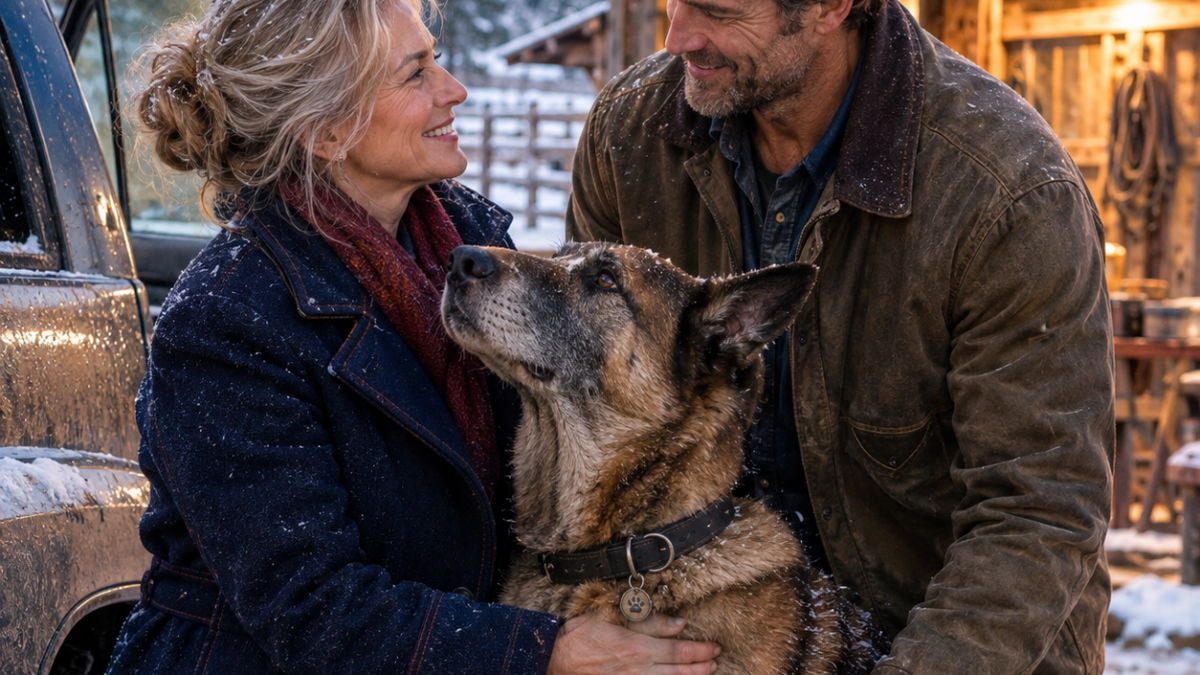
Lorraine knew because her husband, Wade Pike, managed agricultural loans at Pioneer Valley Bank and had mentioned a distressed parcel near Miller Creek over dinner; in a town like Cedar Ridge, half a fact could become a complete story before morning. Outside, Luke’s dog Atlas waited on the passenger side until Luke gave a quiet command, climbing in carefully—at 11 years old, Atlas still moved with the focus of the military working dog he had once been, though cold mornings slowed his rear legs, so Luke rested a hand under his chest for the final step without either of them treating the help as an event.
Luke drove to the county search-and-rescue barn where he had volunteered since leaving the Navy six years earlier; the dog handlers needed new protective vests and gear bags that the county budget would not replace until summer, and volunteer coordinator Mara Jennings approved the canvas and asked who would sew it.
– Ruth Calder, Luke answered.
– Does she know?
– Not yet.
– You must have been irritated, Mara smiled.
– I was paying attention, Luke said, glancing at Atlas waiting in the truck.
Two days later, Luke returned with a purchase order, a deposit check, and the navy canvas beneath a tarp—making the job real with 12 handler vests and six equipment bags at Ruth’s normal commercial rates, half paid in advance. Coming out of the milkhouse before Luke shut off the engine, Ruth—her dark hair threaded with silver and pulled into a loose knot, wearing the same patched brown coat from the store—looked from Luke to the canvas.
– You bought half of Harland’s sewing department, she said.
– Not quite half.
– Was this before or after you heard Lorraine Pike?
Luke did not insult her by pretending he misunderstood.
– After.
Ruth’s shoulders stiffened.
– I do not take charity.
– Good. The rescue team does not give it, Luke replied, handing her the purchase order.
Ruth read every line while the wind pulled at the corner of the paper, and Luke waited while Atlas sat beside the truck studying the sheep behind the nearest fence without leaning toward them.
– Twelve vests in four weeks is possible, Ruth said. The gear bags will take longer.
– Write the date you can meet.
– My rate may be higher than you expect.
– Write the rate the work costs.
Looking up to test his face for the soft expression people used when they believed kindness gave them ownership, she found none.
– And if I say no?
– I load the material and ask someone less qualified.
That nearly made her smile—nearly—as Ruth opened the workshop door.
– Bring it inside. The dog can come if he leaves the sheep alone.
– Atlas leaves almost everything alone until given a reason not to.
– That sounds more reliable than most men I know.
The workshop was warm, narrow, and perfectly ordered, with spools of thread arranged by color on shelves Henry had built, patterns hanging from wooden pegs, and a heavy industrial machine on the center table. Near the back door hung an old green coat with worn cuffs and the name “Henry” embroidered above one pocket, which Luke noticed and looked away from before Ruth had to explain.
Atlas made one slow pass around the room—sniffing the machine leg, the heater, and a stack of wool blankets—before lowering himself onto the only clear piece of pattern paper on the floor.
– Highly trained, Ruth stared at him. Extensively.
– Move him, Luke pointed beside the heater, and Atlas looked at the warm spot, looked at Luke, and remained where he was for the first time that morning, making Ruth laugh.
They spent 40 minutes refining the vest design—Ruth adding a breakaway tab so a handler could release the front quickly if caught in brush, shifting the radio pocket higher, and insisting on double-stitching the load points while Luke listened because she knew the work. When the details were settled and he offered the deposit check, Ruth did not reach for it immediately.
– This is too much upfront.
– It is exactly how the association approved it.
– You arranged all this in two days.
– I have a telephone and a stubborn streak that has also been documented.
Ruth finally took the check, and as Luke carried the empty tarp back outside, Atlas stopped at the edge of the yard, lifted his head, turned away from the sheep, and walked toward the lower pasture with his nose close to the frozen ground.
– Atlas, Luke called, yet the dog paused without returning.
Following him past the equipment shed to the old stone boundary marker, Luke watched Atlas sniff a line of fresh bootprints beside blue paint marking the top of the stone, with a narrow fiberglass stake standing 50 feet farther on beside the irrigation ditch. Catching up with them, Ruth frowned at the stake.
– That was not there yesterday.
Crouching without touching it, Luke read the white tag fastened beneath the blue ribbon: “Northline Response Partnership — Access Study B.”
– Do you know the name? Ruth asked.
Luke did—Northline was proposing a regional emergency-response campus outside Cedar Ridge to house wildfire crews, an air-medical pad, winter rescue equipment, and a K9 training facility, a project most people in the county and Luke himself supported, though no good project needed to begin with strangers marking a widow’s land in secret.
– Did anyone ask to enter your property? Luke asked. Has the bank ordered an appraisal?
– They sent a collateral inspector in November, Ruth’s face changed. Wade said it was standard because my payment was late.
– Did that inspector survey the ditch?
– He took photographs from the road—at least that is what I was told.
Photographing the stake, the blue paint, and the bootprint before standing, Luke spoke evenly.
– Do not pull it yet.
– You give orders easily, Ruth said, folding her arms.
– Old habit. Let me try again: if you leave it in place for a day, it remains evidence of where they entered—but it is your fence and your decision.
Looking at the marker for several seconds, Ruth nodded.
– It stays until tomorrow. After that, it leaves.
– Fair.
Before we follow what Luke discovered, tell me something: if you were Ruth, would you have accepted that rescue team order, or would pride have made you send him away? Share your answer in the comments—and if you believe real help should protect a person’s dignity instead of taking it away, subscribe to SEAL K9 Stories, because there is a reason Atlas noticed those bootprints, and the next set would appear much closer to Ruth’s house.
Luke did not begin by accusing anyone; years in the teams had taught him that suspicion was useful only when it led to facts. He called the county planning office to request the public documents for Northline’s proposal and, with Ruth’s permission, sent the photographs to project director Elena Torres, who replied that afternoon that Northline had authorized preliminary work along public rights-of-way only—no crew had permission to cross Calder Farm, as Access Study B was one of three possible routes and landowner contact was required before any fieldwork.
Reading the email twice at her kitchen table, Ruth looked up.
– So the surveyor was trespassing.
– Yes.
– And somebody gave him enough information to find the boundary stone.
– Also yes.
Ruth glanced toward the drawer where she kept bank notices.
– Wade knew about the inspection. Lorraine knew I could not afford thread. Now Northline knows where my ditch crosses the south field.
Hearing the conclusion forming in her voice, Luke kept his tone measured.
– It may connect, he said. It may not. We need records before we need a villain.
– Are you always this cautious?
– Only when being wrong could hurt somebody.
Opening the drawer, Ruth slid across the top envelope bearing the Pioneer Valley Bank logo and the words “Notice of Acceleration,” claiming she was $18,412 behind when she had expected something closer to $6,000—the difference padded with two property inspections, legal review, late charges, and more than $7,000 for lender-placed hazard insurance.
– I already have insurance, she said. Same company Henry and I used for 19 years. I sent proof twice.
Studying the dates, Luke noted one insurance charge had appeared just six days after the bank recorded her documents as received.
– Who helps with your books?
– I help with my books.
– That was not criticism.
– It sounded close.
Pushing the statement back, Luke suggested a retired auditor named June Bell who worked with the search-and-rescue association and could read a loan history the way Ruth read a seam—promising to ask only if Ruth wanted him to. Seeing the first answer already in her eyes, Luke stood and put on his coat just as Atlas tried to rise from the rug near the stove, his rear legs slipping once on the wood floor.
Reaching him before Luke did, Ruth neither pulled nor fussed—she simply placed one hand beneath the dog’s chest and waited until he found his footing, letting Atlas lean against her knee for half a second before walking to Luke as if nothing had happened.
– Does he hate needing help, too? Ruth asked, watching him.
– More than I do.
– That seems unlikely.
Opening the door behind him, Luke paused when Ruth spoke again.
– Ask June if she has time Thursday.
June Bell was 67, had audited community banks for three decades, and had no patience for language designed to make ordinary people feel foolish. After three hours at Ruth’s table, she uncovered two partial payments held in a suspense account, hazard insurance purchased despite Ruth’s active policy, and an inspection charge on a date the inspection company reported no visit—circling each entry in ink.
– I am not calling this fraud, June said. I am calling it a mess. The bank must explain in writing.
– I should have caught them, Ruth looked embarrassed.
– They should have posted it correctly, June said, removing her glasses. Being confused by a confusing statement is not a moral failure.
Over the next three weeks, Ruth cut canvas in the morning, stitched after feeding, and tested every buckle while Luke delivered hardware and Atlas claimed the floor beside the heater as Ruth’s quietest customer. One afternoon, noticing a worn seam beneath the chest strap of Atlas’s working harness, she asked Luke to remove it.
– I can replace this faded name patch, too, she offered.
Luke’s hand closed around the old patch.
– Leave it.
– All right, Ruth said, glancing at him once before repairing the seam without asking why the patch mattered.
Because she had not pressed him, Luke explained several days later that Atlas had belonged to a younger handler named Ben Reyes; during Luke’s final deployment, an explosion injured Ben and damaged Luke’s hearing, and Atlas guarded them both until help arrived—leaving Luke to bring Atlas home when Ben survived yet could not keep him after retirement.
– So you rescued him, Ruth said.
– No—he had already done the rescuing. I provided transportation.
Smiling at that, Ruth looked toward Henry’s green coat on the wall.
– People keep telling me I saved this farm after Henry died. I did not. I simply woke up here the next morning and did the next job.
– Sometimes that is what saving looks like, Luke replied—and without answering, Ruth made coffee and poured two cups.
The public project packet arrived Monday, showing Access Study B crossing Ruth’s south ditch and an abandoned wagon lane—shorter than the other routes and running along land carrying an old irrigation main and 14 Miller Creek water shares—with a line at the bottom of one planning memo that made Luke read the page twice: “Ownership transition anticipated before construction,” tagged with Ruth’s parcel number.
Bringing the packet to her workshop that evening, Luke watched Ruth switch off the sewing machine and read the line in silence.
– Transition to whom? she asked.
– It does not say.
– And who told them I was leaving?
– It does not say that either.
Placing the page flat on the table, Ruth spoke evenly.
– Three weeks ago, Lorraine looked at me as if I were already carrying boxes out of my house. Her husband may have said too much at home.
– That does not prove he told Northline.
– You keep protecting Wade Pike.
– No—I am protecting you from making the first accusation before you have the last fact.
The words landed badly, and Ruth stepped away from the table.
– I managed this place for three years without you, Luke. Do not confuse helping with taking command.
Feeling the old instinct to defend his intention, Luke let it pass.
– You are right.
That answer surprised her more than an argument would have; gathering the extra pages while leaving the project packet on her table, Luke added quietly that he should have brought it to her before calling offices since it was her property and her decision, offering to step back if she said so. Looking from the unfinished vests to Atlas sleeping by the heater, Ruth answered clearly.
– I want you beside me, she said. That is different from wanting you in front of me.
– Understood, Luke nodded—the first rule they made together.
With June’s help on accounting terms and every demand unmistakably Ruth’s, she sent Pioneer Valley Bank a certified letter disputing the insurance charge, requesting a full transaction history, demanding the names of every inspection company, and forbidding third-party entry. Wade Pike’s reply was polite, vague, and useless—citing mortgage collateral monitoring without explaining the survey stakes or who had described the property as in transition, and giving Ruth 30 days to cure an account whose corrected shortage still exceeded her savings.
Standing beside his truck, Luke offered a written bridge loan with no interest and promised never to ask again if she declined.
– No, Ruth frowned.
– All right, he said, driving away without trying again.
Two days later, Ruth called him.
– If the offer still exists, I want monthly payments, a final date, and no phrase like “whenever you can.”
– Agreed.
– And I sign before you transfer one dollar.
– Agreed.
– Come at four.
The agreement halted immediate acceleration while fees were reviewed—not solving everything, yet allowing Ruth to choose the help and define its boundaries. Luke assumed the danger had slowed, though Atlas knew better.
On a Thursday night in late January, sleet tapped against the workshop windows while Ruth finished the last reflective strip on a handler vest with Luke and Atlas away at Three Pines moving cattle before the temperature dropped. At 8:40, headlights swept across Ruth’s kitchen wall as a vehicle turned through the lower service gate and stopped near the irrigation shed, its amber beacon rotating through the sleet.
Killing the workshop lights and watching from the side window, Ruth saw two men in reflective coats unload a tripod while a third walked toward the pump house carrying a metal case. Calling the sheriff’s non-emergency line first—learning a deputy was 25 minutes away—she called Luke next.
– Three men are inside the south field, she said. I have already called the county. I want a witness while I tell them to leave.
Hearing the care in her wording—not asking permission, asking for backup—Luke caught himself before issuing an order.
– Stay near the barn until I arrive, he began, then corrected himself. Please give me seven minutes.
– Better.
Arriving in six with Atlas standing alert behind the passenger seat, Luke clipped on the dog’s leash—the instant Atlas’s paws touched the ground, age seemed to leave his body. Meeting Ruth beneath the barn light with her phone recording, they crossed the frozen field together toward the man by the tripod, who raised a hand.
– Ma’am, we have an authorized work order.
– You do not have authorization from the owner.
Checking a tablet, the man replied that access had been cleared through Pioneer Valley Bank—until Ruth reminded him the bank did not own her farm, right as the third man emerged from the pump house holding a camera. Atlas stopped, ears rising as his body shifted between the man and Ruth, and at Luke’s low command the dog stood so motionless that the warning was unmistakable.
– Please stay where you are, Luke said, and the man obeyed.
Asking for the work-order number and authorizing contact, Ruth photographed the supervisor’s tablet displaying Wade Pike’s name under “Purpose of access: Final verification of water connection and emergency route.” Reading those words made the cold feel entirely different.
– This is not a collateral inspection, Ruth said into the silence.
Calling Elena Torres at Northline, who answered from a county budget meeting and pulled up the work order, Luke put her on speaker as her voice hardened.
– That order authorizes measurements from the public boundary, Elena stated. It does not authorize entry, pump-house inspection, or water testing. Stop all work and leave the site.
Looking genuinely alarmed, the supervisor admitted a local development consultant had told them the lender controlled access because the parcel was entering foreclosure—with Pike’s name attached. When the deputy arrived before they finished packing, Ruth asked not for arrests but for documentation: location logged, work order photographed, and formal trespass warnings issued.
As the survey truck pulled away, Atlas remained fixed on the dark pump house; loosening the leash, Luke followed him to the threshold where a clear plastic evidence sleeve lay half-pressed into the sleet, dropped by one of the workers. Inside was a photocopy of an old water-association map with Ruth’s parcel outlined in red and a handwritten note reading: “12 shares confirmed, 2 pending verification.”
– I own 14 shares, Ruth stared at the note. Henry kept the certificates somewhere.
– Then someone knows enough about your water to count it, Luke said, looking toward the house, but not enough to know you still have the originals.
Searching Henry’s steel filing cabinet the next morning among tax receipts, pump warranties, and 1998 seed invoices, Ruth found a folder labeled “Miller Creek” holding all 14 water-share certificates and a 1976 agreement negotiated by Henry’s father guaranteeing Calder Farm priority access during emergency storage construction. Northline wanted her land for two reasons—the shortest road and the cleanest lawful connection to Miller Creek—meaning without Ruth’s signature, the project faced a longer route, a new pumping station, and months of additional review; what others had treated as a failing asset was now undeniable leverage.
Have you ever discovered that someone underestimated you because you were quiet, older, widowed, or simply unwilling to boast? Tell us what happened—because Ruth was about to enter a room where everyone expected her to defend a debt, and instead she would make them explain why they had been planning around property they did not own.
The meeting at Pioneer Valley Bank took place the following Monday—Ruth carrying one binder, June Bell carrying the transaction analysis, and Luke sitting beside Ruth at her request while Atlas stayed at Three Pines so no one could mistake calm evidence for intimidation. Entering with the careful confidence of a 55-year-old banker accustomed to people giving up on complicated paperwork, Wade Pike took his seat across from her.
– Mrs. Calder, I understand you remain concerned about routine collateral activity.
– I am concerned about three men entering my pump house under your name, Ruth said, placing the work-order photograph on the table. Do you protect property by measuring a road for a private developer?
Wade’s eyes touched the page and moved away.
– Third-party contractors sometimes combine site work. I cannot control every description entered by a field technician.
– Can you control your own name?
Luke said nothing, watching Wade realize Ruth had not come to be comforted. June laid out the suspense account and duplicate inspection charges—which Wade dismissed as servicing matters under review—followed by Ruth’s uninterrupted insurance history, where Wade could offer policy language for the “automatic safeguard” yet no date explaining why it remained active after proof of coverage arrived.
Opening the section of her binder holding Northline’s planning memo, Ruth pressed on.
– Who told the developer my ownership would transition before construction?
– I have no knowledge of that phrase.
– Did you discuss my loan status with Malcolm Say at Ridgeway Land Services? Ruth asked, naming the survey company’s authorization contact provided by Elena Friday evening.
Wade’s expression tightened.
– Ridgeway performs valuation work for several lenders.
– That was not my question.
The conference room door opened as regional compliance director Norah Chen entered with the branch president, carrying a tabbed printed copy of the binder Ruth had sent electronically two days earlier. Remaining standing, Norah addressed Pike directly.
– Compliance found six emails between your bank account and Ridgeway Land Services concerning anticipated possession of Parcel 41-7C.
– That is Calder Farm, Ruth noted.
– Correct, Norah said, sitting down as Wade glanced at the branch president claiming collateral risk. One email attaches Northline’s proposed access map. Another recommends delaying fee corrections until after the cure period.
For the first time, Wade had no polished answer—stammering that the emergency campus would benefit the county, distressed properties often changed hands, informal coordination prevented delays, and he had expected Ruth’s account to foreclose because she couldn’t meet the cure amount.
– You expected it, Ruth said after he finished. Then you helped other people behave as if it had already happened.
– That is not a fair characterization.
– Three strangers opened my pump house. It is the fairest one I have.
Turning toward Luke, Wade tried another angle.
– You know what this campus means—wildfire response, rescue capacity, jobs. Surely you do not want one delinquent loan to obstruct a public-safety project.
– A rescue built by taking advantage of someone is not a rescue, Luke said, leaning forward for the first time. It is another emergency.
In the quiet that followed, Ruth removed the 14 water certificates from her binder.
– And my loan does not give this bank the right to bargain with my water. These shares belong to me. Northline cannot use them without a separate agreement.
Examining the certificates, the branch president asked Wade if he had verified them before discussing the parcel with Ridgeway—and Wade admitted he had not. By noon, further collection activity on Ruth’s loan was suspended and Wade’s access to agricultural accounts was revoked; two weeks later the bank reversed the forced insurance premium, duplicate inspection charges, and every misapplied late fee, dropping Ruth’s true shortage to a manageable figure while Wade never returned to the Cedar Ridge branch.
Ruth did not need a public punishment—she needed her account corrected, her privacy protected, and her gate respected. Elena Torres came to Calder Farm in daylight with no survey crew and no assumptions, sitting at Ruth’s kitchen table over coffee with all three route options spread before them.
– Study B remains the safest winter access, Elena said, but we use it only if you want to negotiate. If you say no, we redesign.
Studying the map, Ruth set clear terms: move the road 40 feet south with a retaining wall to spare Henry’s apple trees, keep the water connection outside her lambing pasture, halt construction from February through April, restore every fence within 24 hours, and give Ruth approval over the contractor. Writing down every condition, Elena finalized an agreement a month later through Ruth’s own lawyer—paying a fair signing sum, annual road and water compensation, and all legal costs while protecting the orchard, spring box, and lambing fields and creating a gravel emergency lane for summer wildfire access to three remote ranches.
Ruth did not become rich—that would have made a simpler, less honest story—yet she paid off Luke’s bridge loan in full, repaired the barn roof, replaced the failing well pump, and placed the remainder in a winter reserve so a broken tractor became a repair rather than a threat to her home. Finding Luke in the Three Pines equipment shed replacing a trailer light while Atlas dozed in February sun wearing his mended harness, she handed over the check.
– The agreement gives you six more months, Luke said, opening the envelope.
– I know.
– Keeping cash through lambing season would be sensible.
– Also true.
Holding his gaze until Luke folded the check into his pocket and said “Thank you,” Ruth had everything she needed to hear. The next Saturday beneath the barn lights, search-and-rescue volunteers tried on the finished navy vests—radio pockets sitting right, breakaway tabs working, every seam holding—as Mara Jennings delivered Ruth’s final payment alongside a second order from a neighboring county.
– Did you arrange this, too? Ruth asked Luke.
– I have witnesses, he laughed, raising both hands.
Wandering among the handlers to the rollup door, Atlas stopped beside Lorraine Pike, who had come to pick up her nephew—a younger rescue volunteer. For a moment neither woman spoke as Lorraine noticed the copper thread running through every reinforced seam on the 12 vests and six gear bags carried by people the town depended on.
– The work is beautiful, Lorraine said quietly.
Ruth did not rescue her from the discomfort, and after a moment Lorraine spoke again.
– What I said at Harland’s was cruel. Wade had told me things he never should have shared, and I used them to make myself feel important. I am sorry.
Part of Ruth wanted to make her suffer, yet remembering how it felt standing with one hand on the store door while laughter pressed against her back, she answered evenly.
– An apology does not erase it, Ruth said, but it is better than pretending it never happened.
Lorraine nodded, accepting the answer she had earned—and while Ruth did not become her friend, neither did she carry Lorraine’s cruelty into another year.
Spring reached Cedar Ridge slowly as snow retreated from fence lines and Miller Creek broke free beneath thin ice. Ruth moved Henry’s green coat from the workshop wall to a cedar chest in the house—not because she loved him less, but because the hook was needed for new orders arriving every week.
Luke continued visiting Calder Farm with practical excuses—a revised measurement sheet, a damaged rescue bag, a south-gate hinge, a harness question easily answered by phone—and Ruth allowed him his excuses while Atlas skipped subtlety altogether, heading straight from Luke’s truck to the workshop heater to wait for his padded leftover-lining mat. One afternoon when Luke arrived exhausted after working cattle since dawn with an untouched lunch on his dashboard, Ruth pointed to a chair and set stew before him.
– I am fine, he said.
– That was not the question.
– I have work waiting.
– So do I. Sit down.
Glancing at Atlas for support only to find the dog fast asleep on his padded mat, Luke muttered “Traitor” and sat down—listening halfway through his meal as Ruth spoke plainly.
– You know, you are very good at arriving when other people need help.
– That sounds complimentary.
– It is not finished. You are terrible at staying when you are the one who needs something.
Setting down his spoon, Luke recognized the armor he had worn for years—believing usefulness was the safest way to belong so nobody could see where he hurt.
– I am working on it, he said, earning a glance at his empty bowl and a quiet “This counts.”
By summer, Northline began construction on the far side of the ridge—checking in at every gate, restoring fences, and leaving the orchard untouched—and during August’s first wildfire scare, a county water truck used the new gravel lane to stop a grass fire before it reached neighboring hayfields while Ruth watched without regret, knowing she had not stopped progress but required it to knock before entering.
A year after that morning at Harland Supply, the rescue campus opened with a brass plaque recognizing local land and water partners—including Ruth, who attended in a navy wool coat she had tailored herself with copper thread, catching Beth Larkin’s eye until Beth looked away first. That evening, as light snow began falling and Atlas slept across the padded platform behind the seats, Luke parked beside Ruth’s workshop at Calder Farm without reaching for his dashboard folder.
– What did you forget? Ruth asked.
– Nothing.
– What needs repairing?
– Nothing that I know of.
– Then why are you here?
Looking toward the porch, Luke faced a moment less dangerous yet far more honest than rooms where wrong decisions cost lives.
– I do not want to be the man who comes only when something is broken.
Ruth’s expression softened.
– Then come before it breaks. Sunday supper, 5:00—and do not bring a work order.
– I can probably manage that, Luke smiled.
Waking when the door opened, Atlas placed his front paws on the edge and hesitated at the drop to the snowy ground; before Luke could walk around to lift him, Ruth stepped closer, supporting the dog’s chest while Luke steadied his hips as they lowered him gently together—and Atlas shook snow onto both of them before trotting toward the porch without apology, making them both laugh.
Neither of them had been saved by one grand gesture: Ruth still missed Henry, Luke still woke some nights listening for dangers from another life, and Atlas still had mornings when his legs refused to cooperate. Strength had not erased loss and love had not made age negotiable—what changed was the weight, as Ruth learned dignity didn’t mean carrying every burden alone, Luke learned his value wasn’t measured only by how much he carried for others, and wise old Atlas already knew that sometimes you walked alone, sometimes you stood guard, and sometimes the step was too high so you waited for hands you trusted.
If someone you love has spent a lifetime saying, “I have got it,” maybe the kindest thing is not to take the burden away—maybe it is simply to stand close enough that they can choose to share it. Would you have forgiven Lorraine after her apology, or kept your distance? Tell us honestly in the comments, and if this story reminded you that accepting help does not make a strong person weak, share it with someone who may need that reminder today. Here at SEAL K9 Stories, we believe courage is not always loud—sometimes it is a widow opening a bank binder, sometimes it is a veteran admitting he is tired, and sometimes it is an old K9 waiting beside an open truck door, certain that the right hands will meet him.