“You’re Military_”Cocky Navy SEAL Mocked the Single Dad’s Rank—Then 4 Generals Snapped to Attention
“You’re Military_”Cocky Navy SEAL Mocked the Single Dad’s Rank—Then 4 Generals Snapped to Attention
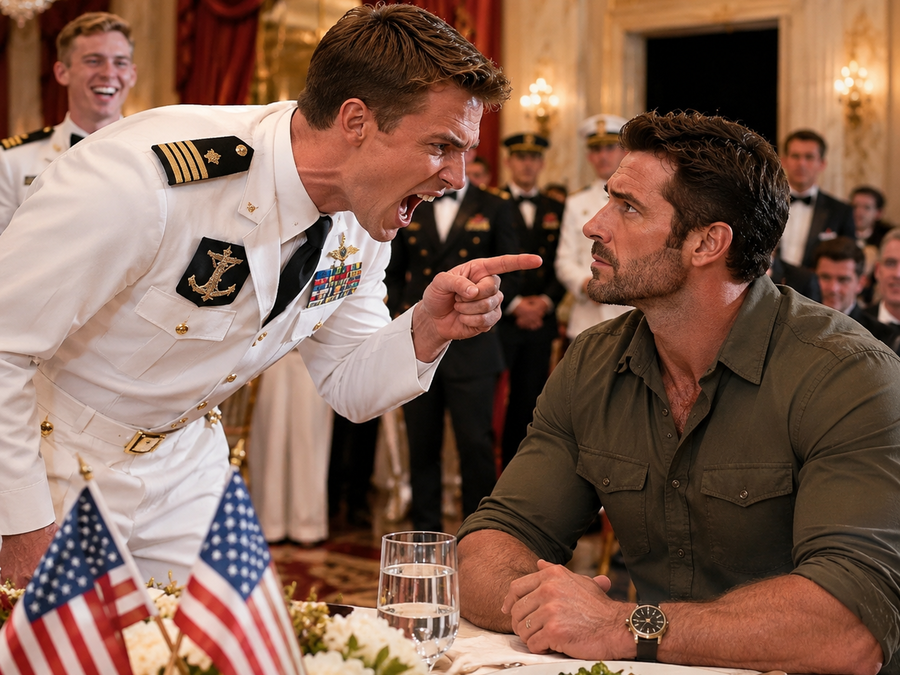
Lieutenant Cole Rourke grabbed the man by the arm, right there in front of everyone.
Sir, I’m going to need you to step away from that display.
The man in the plain dark suit didn’t flinch, didn’t raise his voice, didn’t even blink.
He just looked down at Cole’s hand on his arm and then slowly looked back up.
And something in that silence made the entire room go cold. Cole had humiliated generals in training, broken butter such records, and earned his trident through hell and salt water.
He had never once back down from any man alive, but this quiet stranger in a suit, he would cost Cole everything he thought he’d built.
The hangar smelled like salt air and jet fuel, the kind of smell that gets into your bones if you’ve spent enough years serving near the water.
On any other night, that building stored aircraft. Tonight, it held power.
The Joint Forces Readiness Summit drew the kind of crowd that made civilian security personnel nervous. Senior officers from every branch of the military moved through the converted hangar like chess pieces, each one reading the room the way combat soldiers read terrain, calculating exits, measuring threats, identifying allies, gold braid, silver eagles, full bird colonels with chests full of ribbons that told 20 year stories without a single word.
Catering tables ran along the far wall. A temporary stage had been erected near the bay facing windows where the evenings formal rocks would would happen in about an hour.
Between now and then, the summit operated the way every military social function operated through the invisible architecture of rank.
Who approached whom first?
Who held the door?
Who laughed loudest when the general told a joke? Daniel Mercer understood all of it.
He’d lived inside that architecture for the part of two decades.
He just wasn’ performing it tonight.
He stood near one of the restricted strategy displays a detailed mounted briefing board showing operational readiness assessments across three Pacific theater commands and he was reading it the way a man reads a newspaper, quietly, without urgency, like someone who had been inside a hundred rooms exactly like this one and had long since stopped being impressed by the furniture. He was 41 years old, but he carried his age the way certain men do not his weight.
But as something settled, something finished being built. His dark suit was clean but unremarkable.
No medals, no ribbons, no rank insignia of any kind.
The kind of outfit a man wears when he’s been invited somewhere and doesn’t particularly care about being noticed.
He was holding a glass of water he hadn’t touched.
That was when Cole Rourke walked over. Cole was 30 years old and he moved through rooms the way young lions move through territory with the easy, unhurried confidence of an animal that has once considered the possibility of losing.
His dress whites were immaculate. The gold trident pinned above his left breast pocket caught the hangar lighting.
Every time he shifted his weight, and he shifted his weight often enough that you got the impression it wasn’t entirely unconscious.
He had good reason to carry himself that way.
18 months earlier, his team had completed a direct action operation in a denied access environment that had earned him a commendation most operators only read about in classified briefings. He was 30 years old and already being mentioned in conversations two pay grades above his own.
His commanding officer had told him privately that his career ceiling was somewhere most people couldn’t see from the ground.
Cole had heard that.
He’d filed it and he’d walked a little differently ever since.
He noticed Daniel the way a hawk notices something that doesn’t belong.
A man in a plain standing at a restricted display board.
No uniform, no visible credentials. No one standing next to him who might explain his presence through social proximity.
Cole glanced at two of his teammates nearby, petty officer Ryan Beck and a quiet, square-jawed operator named Torres, then started walking toward the stranger.
He wasn’t angry yet.
He was curious, the way a cat is curious before it decides whether something is prey. Hey, Cole said, stepping up beside Daniel and dropping his voice just enough to keep it between them for the moment.
You’re military?
Daniel didn’t look up from the display board immediately.
He finished reading whatever sentence he was on, then turned. I was, Cole let a beat pass.
His eyes moved down Daniel’s suit, up again.
No rank, no branch, nothing to read.
What rank? Senior chief.
The two words landed in the air between them and Cole processed them the same way a man processes an answer that is technically sufficient and somehow completely unsatisfying at the same time. Senior chief.
E8. Non-commissioned officer.
Career enlisted. Solid.
Respectable. Not a rank that got you into rooms like this one on its own merit.
Cole’s mouth pulled to one side.
It wasn’t quite a smile.
That’s it?
The question had an edge to it, not a sharp one yet, but the kind of edge you could feel if you pressed. Daniel looked at him, just looked at him.
The way a man looks at weather, observing it without being particularly bothered by it.
That’s it.
Cole exhaled through his nose.
He glanced back at Beck and Torres.
Beck had already gone still in the particular way that meant I see where this is going and I don’t love it.
Torres was studying the floor.
Cole turned back to Daniel and let the smile finish forming.
Listen, man, this summit, it’s not really a general public kind of situation.
These are tier one people, special operations, flag officers, people who’ve operated at the I know what is, Daniel said.
His voice was even, not cold, not warm.
The temperature of a room that hasn’t decided yet.
Cole felt something flicker in his chest.
Not anger, not quite.
Something closer to the feeling of pushing against a door that should have opened and didn’t.
Yeah? Who invited you?
Some people. What people?
Daniel turned back to the display board.
People who haven’t arrived yet.
Cole stared at the side of his face for a long moment. The profile of a man completely unbothered.
It was somehow more aggravating than anything Daniel could have said. Cole had built his entire career on the principle that excellence earned attention and attention commanded respect.
He had operated in environments where the wrong posture could get you killed.
Where confidence wasn’t arrogance, it was survival.
He had been tested in ways that most of the men in this room had only read about. And this man in a plain suit was standing at a restricted display board, reading it like a commuter, reading a transit schedule.
Cole stepped closer. Not threatening, but closer.
Look, I don’t say this to be a jerk, all right?
But we’ve got generals coming in tonight.
Admirals.
So calm leadership.
This is a serious professional environment, and I don’t know who told you this was open admission.
But Lieutenant. Cole stopped.
Daniel’s voice hadn’t risen, hadn’t sharpened.
He’d simply said the word like a period at the end of a sentence that had been running too long.
He turned and looked at Cole fully now.
You should be careful, Daniel said, about deciding what a man has done based on what he chooses to wear.
The words were quiet, measured.
The kind of quiet that isn’t the absence of force, but the complete control of it.
Cole opened his mouth, closed it.
Around them, two Marine colonels had gone still. A Navy captain near the catering table was watching without appearing to watch.
Beck had taken a slow step backward, which was the physical equivalent of yourself from the blast radius.
Cole found his voice.
I didn’t say anything about what you’ve done.
You’re about to.
Another beat of silence.
Cole felt the room in a way he didn’t usually feel rooms the attention on him, on this exchange, on the gap between what he intended and how it was landing.
He pivoted, deployed the version of his voice he used when he wanted to sound reasonable while staying in control.
I’m not attacking you, man.
I’m just saying this summit has a restricted guest list.
If you’re on it, great.
No issue.
But I don’t recognize you.
And that concerns me.
And you don’t have to recognize me, Daniel said.
He picked up his glass of water finally and took a drink.
I wasn’t asking to be recognized.
He said it simply, not as a rebuttal, just as a fact, the same way you’d state that the sky outside was dark.
And for the first time in the conversation, Cole had no immediate response. Beck appeared at his shoulder two minutes later after Daniel had drifted to the far side of the display area.
Hey, Beck said quietly.
I know, Cole said. Drop it.
I’m not Cole.
Beck’s voice carried the specific weight of a man who had been in enough bad situations with someone to recognize the early signs of another one approaching.
Drop it.
Cole watched Daniel across the room. The man had stopped near a window and was looking out at the bay, one hand in his pocket, the same water glass in the other.
Completely still, he had the body language of someone waiting for a delayed flight, patient, unhurried, faintly elsewhere.
He’s standing at a restricted display, Cole said.
Half the people in this room don’t have clearance to read that board and they’re standing in front of it anyway.
That’s not why you’re bothered.
Cole didn’t answer.
You’re bothered because he’s not impressed, Beck said, and you can’t figure out why.
Cole turned and looked at his teammate.
Beck was a few years older, one of those quiet operators who had run more missions than he talked about, who wore his competence like an old coat comfortable, unshowy, never in doubt.
He was smiling a little now, but it was the kind of smile that meant he was worried.
I’ve got a right to question someone who doesn’t belong in a secured environment, Cole said.
Sure, that’s not arrogance.
I know.
I’m just doing my job.
Cole.
What?
Beck looked at him steadily.
What’s his name?
Cole said nothing.
You talked to the man for 5 minutes and you don’t know his name, Beck said.
You spent the whole time telling him what he doesn’t have.
You never once asked what he does have. Cole started to say something, stopped.
Drop it, Beck said again and walked away.
Cole didn’t drop it.
He told himself later, when he had time to be honest, that he didn’t know why he kept going.
Some part of him would try to frame it as professional obligation, as diligence, as the kind of situational awareness that had been drilled into him since Bud Nesh.
But that wasn’t true, and some part of him knew it in the moment.
The same way a man can know he’s making a mistake and make it anyway because stopping would require admitting something he’s not ready to admit.
He approached Daniel again 20 minutes later, now with three other operators nearby who’d drifted into conversational range.
There was an audience, even if nobody was calling it that. Help me understand something, Cole said.
He’d adjusted his approach.
Conversational now, reasonable, the voice of a man asking honest questions. You were in what branch?
Navy. How long?
22 years.
Cole nodded slowly, theatrically. And you mustered out as a senior chief.
That’s right.
No officer candidate school? No commission?
22 years and you stayed enlisted?
Daniel looked at him.
That ‘s right.
Cole spread his hands slightly, not aggressive, expository, making a point to the room around them more than to Daniel directly.
I ask because, and I’m genuinely asking, what brings a retired EA to a restricted leadership summit with Socom, joint chief staff and flag officers?
Like, what’s the function?
What’s the role?
Daniel was quiet for a moment, not because he was searching for an answer, more the way a man is quiet when he’s deciding whether the question deserves the answer it’s asking for.
I was invited, Daniel said. By who?
People. People, Cole repeated.
He let the words sit there to let the room hear how thin it sounded.
That’s the answer?
People?
That’s the answer.
One of the operators near Cole, a young guy, a seal candidate still in his assessment phase named Howell, made a sound that was almost a laugh.
Small, involuntary, the kind of laugh that gets pulled out of you before you can decide whether you should let it go.
Daniel heard it.
He looked at Howell, just looked at him.
Howell looked down. Cole pressed forward.
Listen, I’ve got nothing against enlisted.
I came up through Bud SH with some of the finest men I’ve ever known.
Senior chiefs are the backbone of the fleet.
I mean that.
He paused.
But this summit has a specific attendance list and part of my responsibility tonight as an officer is to your responsibility tonight, Daniel said, is to be in this room.
That’s what you were assigned.
Cole stopped. You were assigned to attend a reception, Daniel continued.
His voice was still level, still quiet, that same unhurried temperature.
Not to audit it, the room or the part of it paying attention had gone quiet in a way that was no longer coincidental. Cole felt heat move up through his jaw.
I’m not auditing anyone.
I’m asking reasonable questions about access to a restricted.
You’ve asked me my rank three different ways in 20 minutes, Daniel said.
You’re not asking about access.
You’re asking why I’m not smaller than you.
The silence after that sentence was the loudest silence Cole had experienced in a long time that didn’t involve incoming fire.
Howell had gone completely still.
The two colonels who had been watching without watching were now just watching.
Beck was somewhere behind Cole and not intervening, which meant Beck had decided whatever happened next was Cole’s consequence to carry.
Cole straightened. He was taller than Daniel by about 2 in and he was aware of it in the moment in the specific way that tall men become aware of their height when they feel it should be doing more work.
That’s a significant assumption.
Is it wrong?
A long beat.
Yeah, Cole said.
It’s wrong.
Daniel nodded once, like a man noting a data point. Okay, he said and turned back to the window.
He was done with the conversation, not angrily, not dismissively.
The way a man ends something he’s decided isn’t worth more of his time, not because the other person is beneath him, but because continuing serves neither of them.
That somehow was the worst part.
Cole stood there for a full 4 seconds, then walked away.
Outside on the hangar’s bay-facing balcony, a Marine colonel named Thomas Reed was leaning against the railing with a cup of coffee and the expression of a man who had witnessed approximately everything at least once.
Reed was 58 years old, three tours in Fallujah, two in Helmand, and he had spent the last eight years running leadership development curricula for the Marine Corps. He had seen more young officers make more expensive mistakes than he could conveniently number.
He recognized Daniel the moment Daniel stepped through the balcony door. Senior chief, Reed said.
He raised his coffee cup fractionally.
You look like you could use some air. Daniel leaned on the railing next to him.
Younger crowd than I expected.
Reed made a sound that might have been a laugh.
That young SEAL working you over in there?
He’s ambitious.
He’s a damn fool, Reed said observationally.
Daniel shook his head.
He’s 29 or 30.
He’s still writing the story he thinks he’s supposed to write.
Reed turned and looked at him.
Most men your age would have stopped that performance a lot earlier.
How? By telling him who you are.
Daniel looked out at the water.
The bay at night had a particular quality, the lights of the ships out there moving slowly, steadily, the way serious things move when they’re not trying to announce themselves.
He didn’t ask who I was.
He asked what rank I was.
Those are two very different questions.
Reed absorbed that.
And the medal?
Daniel was quiet a moment.
He’d reluctantly pinned it, just the ribbon, the small blue strip that represented the full thing inside his jacket lapel earlier that evening at the specific request of one of the generals who’d said something about the formality of the event requiring it.
He’d argued.
He’d lost.
He’d compromised on inside the lapel rather than visible.
It’s in the jacket.
He’ll see it eventually.
Maybe.
What are you going to do when he does?
Daniel looked at Reed. The colonel was watching him with the specific attention of a man who had learned that the most useful thing you can do in almost any situation is watch carefully before you speak.
Nothing, Daniel said. Reed nodded slowly.
That’ll bother him more than anything you could say.
Yeah, Daniel said.
I know. They stood in silence for a while, the kind of silence that has history in it.
Reed had known Daniel Mercer for 17 years, had been a major during the year Operation Iron Harbor happened, had been one of the officers in the command center the night Daniel went back in three times.
He’d stood in rooms where generals talked about that night in the specific way that military men talk about things that reset their understanding of what a human being can do.
He’d watched Daniel receive the Medal of Honor from the president in a ceremony that Daniel had reportedly tried to gate out of attending.
How’s your daughter?
Reed asked.
Daniel’s expression shifted, the easiest shift Reed had seen from him all night.
She’s good.
She’s great actually.
She’s 16.
She’s smarter than I am.
She’d have to work at it.
No, Daniel said.
She really wouldn’t.
Reed smiled into his coffee.
You come a long way for a reception. They asked me to be here.
The four of them?
Daniel nodded.
You could have said no. I could have said no to the generals, too, Daniel said.
But here I am.
Reed laughed. A real one, short and genuine.
Here you are.
Behind them, through the glass of the balcony door, the hanger was visible. The crowd had grown.
PART 2
The formal portion of the evening would begin soon, and Cole Rourke was visible through the glass, standing with a group of operators, talking, animated, still working the room the way he’d been working it all night.
Reed watched him for a moment.
You know what’s going to happen when those doors open?
I know.
And you’re not going to say a word.
Daniel picked up his water glass from the railing where he’d set it.
I’m going to return their salutes, he said.
That’s it.
Reed shook his head slowly, not in disagreement, more in the quiet admiration of a man who recognizes something he doesn’t fully possess.
20 years I’ve been doing this job, senior chief, trying to teach young officers the difference between rank and character, the difference between what you’ve earned and who you are.
He paused.
I’ve never once taught it as well as you’re about to in the next 20 minutes without saying a single word.
Daniel looked at him.
The corner of his mouth moved, not quite a smile, but in the direction of one.
You’re being kind.
I’m being accurate, Reed said.
There’s a difference.
They stood there a moment longer.
Then Daniel pushed off the railing.
I should go back inside, he said.
Probably.
Before he comes out here looking for me again.
Reed raised an eyebrow.
He won’t let it go, Daniel said.
Not bitterly, just accurately.
He’s not made that way yet.
He’s still running towards something.
He hasn’t figured out you can stop running once you’ve already arrived.
He set down his glass on the railing. Then he opened the balcony door and went back inside.
Cole had found a new audience and a second wind. He was standing near the catering table with four junior officers, two army lieutenants, a marine captain, and Howell and the story he was telling.
Ostensibly about a mission he couldn’t fully detail had expanded in the way stories do when they’ve been told a few times, and each time the crowd was good.
He was good at this. He knew he was good at this.
There was a version of Cole Rourke who was genuinely compelling.
The stories were real. The capability behind them was real.
And when he wasn’t performing for status, he was by all honest accounts exactly the kind of officer that the Naval Special Warfare community produced at its best.
But tonight he was performing. He noticed Daniel re-enter from the balcony, watched him for a moment, turned back to his group.
The thing about experience, Cole was saying, is that it’s earned, you know?
It’s not given.
It’s not grandfathered in.
It’s not a courtesy extended because someone showed up long enough.
You earn it through selection, through deployment, through having your He caught himself.
Through being tested, real tested, not supervised testing, combat tested.
He left that land.
That’s the difference between rank and between rank and what, said a voice.
Not Daniel’s.
A marine captain, early 40s, high and tight, the eyes of a man who had seen significantly more than his rank suggested had turned toward Cole. Sorry, between rank and what?
The captain repeated.
He wasn’t aggressive.
He was asking.
But he was asking the way experienced people ask questions they already know the answers to. You were about to say something.
Earn it through being combat tested, Cole said.
That’s the difference between rank that means something and rank that’s just seniority, the captain said.
Yeah, seniority.
You think that man over there, the captain said, and he didn’t look in Daniel’s direction, but somehow everyone understood who he meant.
You think he only has seniority?
Cole paused. I think a senior chief is a senior chief.
With respect, they’re the backbone of the fleet.
But this room, this room is full of people you don’t know yet, the captain said.
He said it evenly.
The way you say a fact, not an accusation, a fact, that’s fine.
We all walk in rooms where we don’t know people yet.
The question is what you do with that. He picked up a small plate from the catering table.
Good evening, lieutenant. He walked away.
Cole stood there. Howell was looking at the floor.
The two army lieutenants had found somewhere else to be.
Cole turned to Beck, who had materialized from wherever he’d been standing.
Say it, Cole said.
I wasn’t going to say anything, Beck said.
You were going to say something.
Beck looked at him for a long moment.
Then he said, sacrifice isn’t something you wear so everyone can see it.
Cole blinked. What?
The man in the suit.
That’s what he said to you about 40 minutes ago.
Cole remembered.
The sentence had landed differently in the moment than it was landing now. He was deflecting, was he?
He was being evasive about his credentials.
Cole, Beck’s voice was low, patient, the voice of a man choosing his words because he’d decided they mattered.
I’ve been watching you work this room for two hours.
I’ve watched you introduce yourself to every flag officer, shake every senior hand, position yourself in every photograph, and I’ve watched you spend more time on one quiet man in a dark suit than on anyone else in here.
He paused. Why?
Cole said nothing.
Why does that man bother you? Beck said.
Not what he did, not what he said.
Why does the fact that he’s standing there, not impressed by you, not asking about your trident, not wanting something from you, why does that bother you?
The question sat there.
Cole was saved from having to answer it by the sound of the main hangar doors. They opened with the specific weight of something that had been decided in advance, something with security detail and protocol attached to it.
And the murmur that moved through the room was the murmur of a crowd recognizing something important was about to happen.
Cole straightened automatically, fixed his collar, squared his medals, and waited for the kind of introduction he had been dreaming about since before he’d ever pinned a trident.
He had no idea what was actually walking through those doors. The security detail came through first, two men in dark suits, earpieces in, moving to with the practiced economy of people whose job was to make sure nothing surprising happened.
They split at the entrance, one right, and the crowd responded the way military crowds always respond to that kind of entrance.
Without being told to, people stepped back. Conversations stopped mid-sentence.
Glasses paused halfway to mouths.
Cole was already standing straight.
He’d done it before he consciously decided to.
22 months of SEAL training and three deployments had certain responses so deep into his nervous system that they happened before his brain signed off on them. Posture, attention, eyes forward.
He was good at this moment.
He’d been good at moments like this his whole career.
The arrival of senior leadership, the electric current that moved through a room when serious rank entered it, Cole had always felt it as confirmation. This is where you belong.
These are your people.
This is what you worked for.
He touched the trident on his chest without thinking about it.
Just a small thing, a reflex. The first figure came through the doors.
General Raymond Strauss, Army, four stars.
Cole recognized him immediately from congressional testimony he’d watched online, from photographs in briefings, from the way the room around him reorganized itself in real time, the way a magnetic field reorganizes iron filings.
Strauss was 61 years old with the posture of a man who had never once allowed himself to slouch, and the face of someone who had made enough hard decisions that they’d settled permanently into his features.
Behind him came Lieutenant General Patricia Okafor, Air Force, three stars.
Then Marine General Victor Delgado, four stars. So calm and last, moving with the unhurried authority of a man who had stopped needing to rush anywhere a long time ago.
Admiral James Whitfield, four stars.
The kind of career that got written about in places most people never read. Four of them walking together in a room full of the finest military minds in the Pacific theater.
Cole straightened further, if that was possible.
He thought about the handshakes he would get tonight, the introductions.
He was 30 years old.
He was a commended SEAL lieutenant who had operated in denied access environments that most of these generals had only seen on classified maps. He was exactly the kind of young officer that senior leadership looked for at events like this.
One proof that the pipeline was working, that the future had faces worth trusting.
He’d spent two hours working this room precisely so that when this moment arrived, he’d be positioned for it.
He prepared his greeting, and then General Strauss walked past him.
Cole tracked him, adjusted.
Strauss was moving toward the left side of the room, toward the strategy display area, toward the window, toward Daniel Mercer.
Cole’s mind processed this as coincidence for approximately three seconds.
Then General Okafor changed direction as well.
Then Delgado.
Then Whitfield, who had paused briefly near Cole, near enough that Cole had actually started extend his hand and then kept walking smoothly, without acknowledgment, without acknowledgment.
Cole stood there with his hand moving and then not moving, and then resting against his side in a way that he hoped looked intentional.
Beck was behind him.
Cole could feel it.
He didn’t turn around.
He watched the four generals cross the room, and then he saw it, the thing that he would later described to exactly no one as the moment his entire evening collapsed into a single point of absolute silence.
General Strauss stopped in front of Daniel Mercer, the man in the plain dark suit who had stood at this reception for 2 hours without a single visible credential, without a rank on his collar, without a medal on his chest, without anything that the room could read or respect or defer to, who had been questioned and challenged and effectively told he didn’t belong here by a decorated Navy SEAL lieutenant.
That man looked up from his water glass, and General Strauss came to attention. Not a nod, not a handshake, not the warm greeting of a senior officer glad to see someone they knew.
He came to attention, heels together, back straight, chin level. He saluted Daniel Mercer.
The room noticed before Cole did. He could tell because the sound dropped out not all at once, but in a wave, conversation dying from the center outward like a stone dropped in still water, the silence spreading until the hanger was holding its breath.
General Okafor came to attention, saluted. General Delgado, saluted.
Admiral Whitfield, saluted.
Four of the most senior military officers in the United States of America, standing in a room full of their own subordinates, rendering honors to a man who hadn’t worn a uniform in 5 years.
Daniel Mercer stood there.
He looked at each of them in turn.
Then he straightened, not the way a man straightens when he’s trying to look important, but the way a man straightens when he is stepping back into something that fits him.
And he returned every salute one after the other with the quiet precisions of someone who had done it 10,000 times and found no theater in it.
The room was completely silent.
Cole realized his mouth was open.
He closed it. For a long moment, no one in the hanger moved.
Then General Strauss smiled a real one, the kind that changes the whole face, and extended his hand. Daniel took it.
Strauss pulled him in and said something Cole couldn’t hear from across the room.
Whatever it was, Delgado laughed.
Whitfield put a hand on Daniel’s shoulder, and then Strauss turned to the room.
He didn’t raise his voice much.
He didn’t need to.
The room was built for this kind of silence.
Senior Chief Mercer, he said, and his voice carried the particular weight of a man stating something for the record.
It has been too long.
No one breathed.
Strauss looked at the younger officers near him, the lieutenants, the captains, the operators.
Cole and his eyes moved over them without hurrying.
Young men, he said, if you’re wondering why four generals are saluting a retired senior chief, he paused, just a beat, you should probably spend some time learning your own military history.
He turned back to Daniel, and the conversation continued. And the room around it slowly, awkwardly, began to breathe again.
Cole didn’t move for a long time.
He was aware of Beck beside him.
He was aware of Howell somewhere to his left.
So still he might have been furniture.
He was aware of the marine captain he’d sparred with at the catering table, watching him from across the room with an expression that wasn’t satisfaction, wasn’t contempt, was something worse than either of those, something that felt specifically like
witnessing the moment a man understood something he should have understood an hour ago.
Cole’s eyes moved to Daniel’s jacket, and there it was, small, tucked inside the lapel rather than on the chest, a small blue ribbon, the kind of ribbon that stands for something so significant that the military created a whole separate category of response to it, the kind of ribbon that by regulation renders all other decorations secondary.
The Medal of Honor. Cole had studied it.
Every SEAL candidate studied it. You learn the history, the recipients, the criteria, acts of valor above and beyond the call of a duty at the risk of life in actual conflict with enemy of the United States.
You learned the numbers because the numbers made it real.
You knew how many had been awarded in the history of the American military. You knew how many recipients were still living.
The percentage was small enough that knowing it always did something to your chest.
Some involuntary recalibration of what you thought you knew about bravery. And you learned the missions.
Cole had learned the missions.
He had learned them because they were part of the curriculum. Because they were the case studies that SEAL instructors walked you through in classrooms at Coronado.
The case studies you returned to in advanced training. The examples that showed up in leadership doctrine and tactical development courses and after action analysis frameworks.
He had learned Operation Iron Harbor.
He had read the account of what happened when the extraction zone went hot and communications collapsed and three separate combat elements were trapped.
And the man who went back in three times wasn’t an officer, wasn’t a designated combat rescue specialist, wasn’t acting on any order anyone could later document because there was no one left who could issue a coherent order.
He had read that account.
He had discussed it in a classroom. He had used it in an argument.
He had in fact used it tonight.
45 minutes ago, standing near the catering table, he had said something about combat tested experienced and battlefield leadership to a group of junior officers.
And he had been in his peripheral awareness, thinking partly about Operation Iron Harbor when he said it.
About what that kind of experience looked like. About the difference between men who had truly been tested and men who had only been trained.
Cole looked at Daniel Mercer standing 20 ft away, talking to four generals who had saluted him and understood the man he had spent 2 hours dismissing was the man at the center of the case study, the rescue, the burning extraction zone, the 17 men who came home, the mission that Cole had cited in a classroom as an example of the thing Cole claimed to understand better than a retired senior chief who’d shown up without a uniform.
Cole felt something moved through him that he did not have an adequate word for.
It wasn’t shame exactly, or not only shame.
It was something larger and more structural than that, the feeling of a building whose foundation has just been identified as wrong. Everything built on top of it suddenly sitting differently.
Every wall slightly out of true.
He became aware that his hands were cold.
Beck was beside him, still hadn’t said a word.
Cole finally turned and looked at him.
Beck was watching him with an expression Cole had never quite seen on his face before.
Not pity, not satisfaction, something closer to the look of a man who genuinely hopes the person he’s watching will choose well.
And who knows that hoping is all he can do. Beck, Cole said.
His voice came out different than he expected.
Quieter, like something had been turned down.
Yeah, Beck said. Operation Iron Harbor.
Yeah, 1B 2.
That’s him, Cole said.
Yeah, Beck said.
That’s him.
Cole turned back.
Daniel had said something that made Whitfield laugh again, a short, real sound that broke across the hangar like a reminder that there was audio in the room. The cluster of generals around Daniel had a quality that Cole recognized from the best moments in his career, the moments with his own team after something hard, a specific gravitational comfort.
The way men stand near each other when they have been through something together that they will not fully explain to anyone who wasn’t there.
How many of those generals, Cole said, were on that mission?
Two of them, Beck said. Okafor was an Air Force combat rescue officer.
Whitfield was a junior intelligence commander attached to the task force. Both of them were trapped in the extraction zone.
He paused. Daniel Mercer went back in and got them out.
Cole closed his eyes for 3 seconds.
He had shaken Whitfield’s hand this evening.
Before everything, in the first few minutes of the reception, working the room the way he’d planned, he had found the admiral and introduced himself smoothly and confidently, and Whitfield had been gracious, had said something complimentary about the naval special warfare community, and Cole had walked away feeling like the evening was going well.
Whitfield had been inside a burning extraction zone, and Daniel Mercer, the man in the dark suit, the retired senior chief, the man Cole had told didn’t belong in a room like this, had carried him out.
Cole opened his eyes.
Across the room, General Strauss was saying something to the crowd that had gathered near them, the inevitable gravitational pull of four generals in a tight conversation.
Cole couldn’t make out all of it.
He caught fragments, words that landed in pieces, the kind of man who could have told the story himself and chose not to leadership curriculum at three war colleges, what this summit is supposed to be about.
Cole heard that last one clearly, what this summit is supposed to be about.
PART 3
He thought about the two hours he had just spent in this room, the hands he’d shaken, the stories he’d told, the way he’d positioned himself near the restricted display, and then decided the presence of a quiet man in a
dark suit was an irregularity worth investigating, the way he’d pushed and pushed and pushed against someone who hadn’t once pushed back, and called that diligence, called that professionalism, called that the legitimate exercise of an officer’s judgment.
He felt sick, not dramatically, not in the way of a man performing regret for an audience, just the specific private nausea of understanding that you have been wrong, specifically, concretely, demonstrably wrong in a way that other people witnessed and that you cannot take back.
A hand appeared at his shoulder. He turned.
It was the Marine captain, the one from the catering table.
His expression was the same as before, not contempt, not satisfaction, something more like sober witness. First times the hardest, the captain said.
Cole looked at him. What?
The first time you find out you’ve been the fool in the room, the captain said, it gets easier to handle.
Never easy, but easier.
He removed his hand from Cole’s shoulder.
What you do in the next hour matters more than what you did in the last two.
Remember that.
He walked away.
Cole stood there.
The evening wasn’t over.
The formal remarks hadn’t happened yet.
The room was still full.
Daniel Mercer was still 20 ft away, surrounded by men who loved him for reasons Cole was only beginning to understand.
And Cole Rourke decorated Seal, commended operator, the young officer whose career ceiling had been described to him as somewhere most people couldn’t see from the ground was standing in the middle of it all, cold-handed, trying to find the floor.
He found it finally when he made himself stop looking at Daniel and start looking at nothing in particular, just a fixed point on the far wall, the kind of nothing you look at when you need to think without anyone watching, you think. He stood there for a long time and then he started putting it together.
Not the facts, the facts had assembled themselves quickly enough. The facts were brutal and simple and required no great effort of reasoning.
The hard thing, the thing that actually cost him something was the layer underneath the facts, the thing Beck had been trying to say for 2 hours. Why did that man bother you?
Because Daniel Mercer’s care had been unbothered.
That was it. The whole thing distilled down.
Cole had approached him because he was in a restricted area. Yes, that was the surface, but he had stayed, had kept pressing, had escalated, had told stories to junior officers and positioned himself as the authority on experience and sacrifice and what it meant to truly earn your place because Daniel had looked at all of it and fundamentally unimpressed.
Not dismissive, not hostile, not competing, just not impressed.
Cole had spent his entire adult life making sure that never happened.
Every selection, every deployment, every commendation, every story told well at the right moment to the right people. He had been building something.
He understood that now, standing here against his will, he had been building a fortress out of other people’s recognition.
And every time someone looked at him and registered nothing, he experienced it as an attack on the walls.
Daniel hadn’t attacked him.
Daniel had simply declined to be the wall.
And Cole had treated that as a threat. He was still working through what that meant when he heard his name.
His commanding officer, Lieutenant Commander Victor Hayes, 43 years old, 12 combat deployments, the kind of quiet authority that didn’t need a room to notice it.
Hayes was standing at Cole’s elbow with an expression Cole had never wanted to see directed at him.
Cole, Hayes said, with me.
It wasn’t a question.
They moved to a corner of the hangar near the back wall, away from the remaining crowd.
Hayes stood with his back to the room and looked at Cole directly.
He didn’t raise his voice.
He didn’t need to.
There were certain tones that military men developed after enough years that carried more force in a whisper than most people managed in a shout. Hayes had that tone.
Walk me through the last two hours, Hayes said. Sir?
Not a suggestion, Cole.
Cole walked him through it, the approach, the questions about access, the challenge about rank, the conversation at the catering table, the junior officers. Hayes listened to all of it without moving his face.
When Cole finished, Hayes was quiet for a moment.
Medal of Honor, Hayes said.
Operation Iron Harbor. 17 men recovered.
Three trips into a compromised extraction zone.
He paused.
You learned this when? Bud, Cole said.
Advanced Leadership Curriculum.
Right, Hayes said.
And tonight you told him he didn’t belong in this room.
I didn’t know.
You didn’t ask.
Hayes’s voice dropped half a notch and somehow got heavier.
You didn’t ask his name.
You didn’t ask his background.
You asked his rank and when it didn’t satisfy you, you made a decision about who he was and then you performed that decision in front of junior officers.
He let that sentence sit between them.
That’s the conduct I’m reviewing.
Cole’s jaw was tight.
Understood, sir.
I don’t think you do, Hayes said.
Not yet, but you will. He straightened.
You’re done working the room tonight.
Find a wall and stay near it.
When the remarks are over, we’re going to have a longer conversation.
Yes, sir.
Hayes studied him for one more beat. His expression was not angry.
It was something Cole found harder to carry, genuinely disappointed. And underneath that, the ghost of something that might have been concerned.
Cole, Hayes said, you’re a good operator.
I’ve told you that and I mean it.
But in the last two hours you proved something that good operators can’t afford to prove.
What’s that?
Hayes looked at him.
That you can be rattled by a man who doesn’t need you, he said.
That’s a vulnerability.
In the field, vulnerabilities get people killed. He walked away.
Cole turned back to the room. Across the hanger near the window, Daniel Mercer was saying something to Admiral Whitfield.
Whitfield was nodding slowly, the way older men nod when someone says something that lands exactly right.
Daniel’s hand was in his pocket.
He still had the water glass.
He still hadn’t finished it.
He looked from across the room exactly like he had when Cole first saw him, unhurried, unbothered, finished becoming whatever he had become.
Cole watched him for a long moment.
He thought about what Beck had said.
About the first time you find out you’re the fool in the room.
About what the next hour was worth compared to the last two.
He thought about Howell, the young candidate, standing somewhere behind him, filing everything he’d seen tonight into the part of his memory that would inform the kind of officer he decided to become.
He thought about the 17 men, and then he stopped thinking and just stood there in the quiet and the consequence of the evening, the specific shape of a lesson that no training evolution had ever taught him and no combat deployment had ever required. The shape of being wrong
completely, specifically, expensively wrong and the particular silence that follows when there is nothing left to do but stand inside it.
The formal remarks started at 8:15. General Strauss took the podium first and the room arranged itself the way rooms do when the most senior person in them speaks, not because anyone was told to pay attention, but because attention became the only natural response.
Strauss didn’t speak long.
He never did.
Cole had read enough about the man to know that he considered brevity a form of respect for the audience, for the subject, for the weight of whatever was being said.
Every sentence earned its place or it didn’t get spoken.
He talked about readiness, about the gap between training and character, about the kind of leadership that holds when systems fail and communication collapses, and the only thing standing between disaster and survival is the decision one person makes in a moment nobody planned for.
He
didn’t mention Daniel by name.
He didn’t have to.
15 ft from the podium, Cole stood against the back wall exactly where Hayes had told him to stay and listened to a speech about everything he thought he understood and was no longer sure he did.
Admiral Whitfield spoke second.
Shorter still, he said one thing that Cole heard and would not forget.
The men I respect most in this uniform are the ones who could have demanded recognition and chose instead to do the work.
Those men are When you find one, pay attention.
You won’t always know you’re in the presence of greatness.
That’s the point.
He stepped back from the podium, and for just a moment, less than a second, his eyes moved across the room and landed on Daniel Mercer.
Daniel, standing near the window, gave the admiral the smallest nod in the history of military acknowledgment.
Whitfield returned it, and the moment passed.
Cole felt it pass through him like a current.
The reception broke into smaller conversations after that. Groups formed and reformed.
Junior officers migrated towards senior ones with the careful intentionality of people who understood this was their one chance to make an impression. Catering staff moved through the gaps.
The sound level climbed back toward what it had been before the generals arrived.
Cole didn’t move from his wall for 11 minutes.
He counted, not because he was tracking time, because counting gave his mind something small to do while the larger part of it was occupied with a reckoning he hadn’t finished and couldn’t rush.
On the 12th minute, Beck appeared beside him.
Beck handed him a cup of coffee without a word. Cole took it.
They stood there together, not talking, in the specific silence of two men who have known each other long enough that silence between them has texture.
This one was the texture of aftermath, the kind of quiet that follows not combat but consequence. Is it bad?
Cole said finally. Conduct review, Beck said.
Hayes will run it.
Probably takes two weeks.
And after? Depends on the review.
Beck paused.
And on you? On me how?
Beck turned and looked at him directly. On whether you understand what actually happened tonight or whether you decide you were treated unfairly.
Cole held the coffee without drinking it.
I wasn’t treated unfairly.
No, I was wrong.
Yes, I was specifically, completely, and very publicly wrong. In front of junior officers, Beck said, not twisting the knife, just completing the inventory, the way you complete any accurate accounting.
Cole exhaled in front of junior officers. Across the room, Daniel had separated from the generals and was standing alone near the balcony door.
Not isolated, just apart, the way certain people are apart in groups.
Slightly outside the gravitational pull of the main crowd, self-contained.
He was talking to no one.
He had finally, at some point in the last 30 minutes, finished his water.
Cole watched him.
What do you know about him?
Cole asked after the service.
Beck was quiet for a moment.
His wife died of cancer, I think, maybe six years ago. He had a teenage daughter.
He left active duty to raise her alone. A beat.
Turned down a commission three times before that.
Apparently, they really wanted him to officer up. He kept saying no.
Why?
I don’t know.
I heard he said something once about how the best leadership he ever saw came from enlisted men, and he didn’t want to leave that.
Cole absorbed this, turned it over.
A man who could have had more rank, who had been offered more rank, who had said no to it repeatedly and gone back to his team, gone back to the work, gone back to being exactly what he was and had at no point in this building tonight attempted to leverage any of it to make Cole feel small, even when Cole had given him every reason to. He never told me, Cole said.
No, not once. He had it right there.
The mission, the medal, the whole thing he could have said at any time in the last two hours and ended it. Yeah, Beck said.
Why didn’t he?
Beck looked at him. I think you already know.
Cole did know.
He’d known for a while.
He just hadn’t said it out loud yet.
Saying it out loud made it real in a different way.
Because he didn’t need to, Cole said.
Because he didn’t need to, Beck confirmed.
You were trying to shrink him with your rank.
He didn’t need his rank to make you smaller.
You were doing that entirely on your own.
The sentence landed with the specific precision of something true, not cruel, not delivered to wound, but landing exactly where it needed to land and doing the damage that accurate things do.
Cole drank the coffee.
It had gone slightly cold.
He drank it anyway.
I need to talk to him, Cole said.
Tonight? Yes.
Beck shook his head slowly.
Cole, I’m not asking permission, Cole said.
And then, catching himself the edge in his own voice, I’m not.
I just need to.
I owe him that.
You owe him an apology, yeah.
But tonight, in this room, in front of these people, not in front of anyone, Cole said. Private.
He set the coffee cup down on the small ledge behind him, straightened.
I’m going to ask if he has a minute.
Beck studied him.
Whatever he saw in Cole’s face, whatever quality of intention had replaced the performance that had been there 2 hours ago seemed to satisfy something in his assessment.
All right, he said.
If Hayes asks, I’ll tell him you went to the head, Beck said.
Go.
Cole crossed the room.
He moved differently than he’d moved all evening.
No one watching would have been able to articulate exactly what was different.
He was the same height, same build, same dress whites, same trident, but something in the way he moved had changed. The performance had come down.
What was left underneath was a 30-year-old man walking towards something he was afraid of in the specific way that honest people are afraid of honest moments.
Daniel saw him coming.
Cole watched the recognition pass across Daniel’s face, first identification, then a kind of neutral readiness, the expression of a man who was not afraid but was also not naive.
He didn’t step back.
He didn’t set his jaw.
He just watched Cole approach with the same unhurried assessment he’d been applying to everything all evening.
Cole stopped 2 feet from him. Senior Chief Mercer, Cole said.
I’d like a minute of your time.
Private.
If you’re willing.
A beat.
Daniel looked at him. The assessment went deeper this time, past the surface.
Cole felt it the way you feel doctor pressing to locate something specific, not painful, but purposeful.
All right, Daniel said.
They moved to the balcony, the same balcony where Daniel had stood earlier with Reed, looking at the bay.
Reed was gone now.
The balcony was empty.
The city spread out to one side, the water to the other.
The sounds of the reception muffled behind the glass.
Cole stood with his back to the railing. Daniel leaned against the wall, arms loose, posture easy.
For a long moment, neither of them spoke. Cole had planned what he was going to say.
He’d organized it during the walk across the room.
A clear, direct, accountable apology, the kind he’d been trained to deliver after mission failures.
The kind that didn’t hedge or qualify or redirect blame.
Own the mistake.
State what you understand about it.
Commit to the change. He opened his mouth and said none of it.
What came out instead was Operation Iron Harbor. Daniel went still.
Not frozen, not surprised, just still.
The way a deep lake goes still when the wind stops.
I studied that mission, Cole said.
Bud S advanced leadership curriculum.
I’ve used it in arguments.
I used it tonight. He stopped.
Forced himself not to look away.
I used it tonight to make a point about what real combat experience looks like.
I didn’t know.
He let that sit for 1 second.
That’s not an excuse.
I’m just I need you to know that I understand what I did, not just that I did it.
Daniel watched him.
I spent 2 hours telling you that you didn’t belong in a room that you were invited to by four generals who saluted you, Cole said.
2 hours questioning your credentials while you were standing there with credentials that I literally studied in a classroom.
His voice was steady.
He was proud of that in a small and private way because he hadn’t been certain it would be.
I was wrong, specifically, concretely wrong. And I was wrong in front of people who are going to remember it.
I’m telling you I understand that and I’m sorry for it.
Silence.
The bay moved below them.
The lights of the ships out there.
Slow, steady, serious.
Daniel said, how long have you been a SEAL? Cole blinked.
18 months.
Commissioned at I’m not asking for your resume.
Not harsh. Clarifying.
I’m asking 18 months before that.
Bud SASS training pipeline.
How many years? 7 years total to get to this deployment.
7 years, Daniel said.
And you’re 30.
Yes, sir. Daniel was quiet for a moment.
He looked at the water. When he looked back, something in his expression had shifted, not softened exactly, but opened like a door that had been closed the whole evening, choosing at this specific moment to come off the latch.
I’m going to tell you something, Daniel said, and I want you to hear it clearly because I’m only going to say it once.
Cole nodded.
I’m not angry at you, Daniel said.
Cole had been prepared for many things.
That was not one of them. Sir, let me finish.
Daniel’s voice wasn’t sharp.
It was the voice of a man who had decided to give something he didn’t have to give.
I’m not angry at you.
I recognize you.
I’ve been you.
He let that land. Not at your age exactly, not in the same way, but I have been the man in the room who needed the room to know his name, who measured every person by what they could do for his next mission, his next evaluation, his next step up, who read the rank before he read the person.
He looked at Cole steadily.
That man does a lot of damage, usually to himself, sometimes to other people, sometimes to both.
Cole said nothing.
PART 4
The difference between you and that version of me, Daniel continued, is that I didn’t have someone call it out when it was happening.
I had to learn it the hard way over years through losing things.
He paused.
You’re learning it tonight in 2 hours in front of people who will mostly forget it by next month if you give them something better to remember.
He tilted his head slightly.
That’s not a punishment, Lieutenant.
That’s a gift.
Cole felt the thing behind his sternum that he’d been holding together all evening start to loosen in a way hadn’t he hadn’t given it permission to.
He kept his face steady.
He was a SEAL.
He had been through Hell Week, through combat operations, through things that broke other men into pieces.
He was not going to come apart on a balcony because someone was being decent to him. He managed it.
Barely.
The review is going to cost me, Cole said.
His voice came out slightly rougher than he intended. I know.
Hayes pulled me from the room.
There’s going to be a formal.
I know, Daniel said again. There should be.
Cole looked at him. There should be consequences, Daniel said plainly.
Not because you’re a bad officer, because consequences are how the system tells you that what you did matters.
If nothing happens, you’ll file it as a bad evening and move on.
If something happens, something real, something that cost you, you’ll carry it.
And carrying it is how it actually changes something. He paused.
Does that make sense? Yes, sir.
Don’t call me sir.
I’m enlisted.
Was enlisted, Senior Chief.
Better. Another silence.
This one different from the others.
Quieter in a different way. The quality of two people who have moved past the point of posturing and are standing in the same actual room now rather than the performance of a room.
Cole said, can I ask you something?
Go ahead.
The medal.
Cole looked at the lapel, the small blue ribbon barely visible inside the jacket. You almost hid it.
I did hide it.
Why?
Daniel looked down at the ribbon.
For a moment his expression did something private, just briefly, just the passage of something internal that Cole couldn’t read but could register the existence.
Because the night I earned it, Daniel said, was the worst night of my career. Men died.
Not all of them, not most of them, but some.
And I went back in three times and the men I brought out are alive, and that’s the part everyone talks about.
He paused.
The part no one talks about is the ones I didn’t get to in time, the ones who were already gone when I reached them.
I carry those names.
He looked up.
So no, I don’t put the ribbon on the chest and let it do work in rooms.
It doesn’t feel right.
Cole was quiet for a long time.
Operation Iron Harbor, he said finally.
The way it’s taught, the way I learned it, it’s framed as a leadership success, a rescue operation that exceeded all expectations.
That’s how the instructors present it.
I know, Daniel said.
I’ve heard that’s not how you carry it.
No, Daniel said.
I carry it as the night I found out what I could do.
And as the night I found out, it wasn’t enough to save everyone.
He looked at Cole directly. Both things are true at the same time.
That’s the part they can’t teach in a classroom.
Something settled in Cole’s chest, not comfort, something more like the feeling of seeing a thing clearly for the first time, not pretty, not simple, but real, the difference between a map of a place and the actual ground.
He straightened against the railing. What do I do with the review?
You take it, Daniel said.
You don’t bargain, don’t minimize, don’t let anyone advocate on your behalf in ways that reduce the outcome.
You take what comes and you let it be what it is.
And after you become useful somewhere that doesn’t advance your career, Daniel said.
Find people who can’t do anything for you and lead them well.
That’s where the real evaluation happens.
Cole thought about that. That sounds like something Colonel Reed would say.
Tom Reed is a smart man.
He was on the balcony earlier. With you he was, Daniel said.
A small shift in his expression, something warm, not quite a smile, but the precondition of one.
He’s been saying the same things to young officers since Fallujah.
Most of them don’t hear it until something forces the frequency to change.
Cole looked at him.
Is this the frequency change? Daniel looked back.
Son, he said, and the word came out without calculation, without condescension, just the way certain older men say it to younger ones when something real has passed between them. This is the frequency change.
They stood there a moment longer.
The reception behind the glass was winding toward its end.
Figures were beginning to move toward exits.
Hayes was somewhere inside, and the review was coming, and the career cost was real and wasn’t going to reduce itself.
Cole said, I want to ask you one more thing.
All right.
The sentence you said earlier tonight, when I kept pushing, he made himself hold eye contact.
Sacrifice isn’t something you wear so everyone can see it.
He paused.
Is that something you figured out or something someone told you?
Daniel’s expression did the thing again, that brief private passage of something interior.
My wife said it, he said, before she died. She was talking about something else entirely.
He paused.
But it’s the kind of sentence that turns out to apply to everything.
The words landed in the space between them.
Cole didn’t fill the silence this time.
He’d been filling silences all evening with noise, with rank, with performance, with everything except the willingness to sit inside a moment and let it be what it was.
He sat inside this one. After a while, Daniel pushed off the wall.
I’m going back in, he said.
There are people I haven’t talked to yet, senior chief.
Cole’s voice stopped him.
Daniel turned. Thank you for coming out here, for saying what you said.
He held the man’s gaze.
You didn’t have to.
Daniel studied him for one long beat.
That’s the thing about what you do when you don’t have to, he said.
It’s the only time it actually counts.
He opened the door and went back inside.
Cole stood on the balcony alone.
He could see Daniel through the glass, moving back into the crowd, already absorbed into a conversation with Okafor, easy and unhurried, as if the last 20 minutes hadn’t cost him a thing.
Maybe they hadn’t.
Maybe a man who had already given everything on a burning extraction zone found conversations like this one honest, uncomfortable, human, simply part of the ordinary weight of being who he was.
Cole thought about the men whose names Daniel carried, thought about 17 people who went home because of this quiet man in a dark suit, thought about the classroom at Coronado where he’d sat and learned about a mission and understood its surface and thought he understood its core.
He hadn’t understood anything.
He understood more now.
Not enough he knew that. The real understanding, the kind Daniel was talking about, the kind that changes the frequency was ahead of him, not behind.
It would come through years and losses and choices made in moments when no one was watching.
It would come through leading people who didn’t advance his career and staying in rooms where no one knew his trident.
It would be slow and it would cost him things and it would arrive quietly, the way all the things worth having arrived quietly, if you paid attention.
He looked at the bay one more time.
Then he went back inside. Hayes was waiting near the door.
Cole walked toward him without slowing down, without adjusting his posture in ways designed to project confidence, without any of the small performances he’d been running all evening, just walking, just a man toward a consequence he had chosen.
Lieutenant, Hayes said.
Commander, Cole said. Hayes studied his face.
Whatever the appraisal found seemed to register some slight shift in his expression, not warmth but the absence of something harder than what had been there before. You talked to him, Hayes said.
It wasn’t a question.
Yes, sir, Cole said. I told you to stay near the wall.
Yes, sir.
Hayes held his gaze for a moment, 3 seconds, 5 and and I needed to apologize to him directly, Cole said.
In private. That was more important than the wall.
Another beat. Was it a good conversation?
Hayes said. Cole considered the question seriously, the way it deserved to be considered.
It was the right one.
He said. Hayes nodded once.
The nod of a man who was updating his evaluation and was not yet finished, but had revised one of his earlier inputs.
Go get your cover, he said.
We’ll talk outside.
Cole got his cover and on his way to the exit, he passed Howell, the young candidate who had laughed slightly, involuntarily, at Daniel’s expense two hours ago when Cole was still performing, when Cole was still the man he’d been at the beginning of the evening.
Howell was standing near the wall where Cole had been standing, not because Hayes had told him to, because he had put himself there, because somewhere in the last two hours she had watched a decorated SEAL lieutenant get dismantled by a quiet man in a dark suit and had decided in whatever part of a 23-year-old decides things that last, that he was going to learn from it.
Cole stopped in front of him.
Howell straightened. Sir, drop it.
Cole said.
Not the way he’d been saying things all evening.
The other way.
The way Beck said it.
The way a real man says it when he wants you to relax and hear him.
Howell. Yeah, what you saw tonight, Cole said.
Don’t let it be a story you tell about me.
Let it be something you carry about yourself. He paused.
The man in the suit, before you know anyone’s rank, before you know anyone’s record, ask their name.
That’s where you start.
Howell looked at him. Cole saw it then.
Whatever it was that Beck must have seen on the balcony earlier, the quality that meant a man was actually receiving something rather than just standing in its vicinity.
Howell was 23 years old and he was receiving it. Yes, sir.
Howell said. Cole nodded once and went to find Hayes.
Behind him, the hanger continued its wind down. Conversations finished.
Coats were retrieved. Senior officers moved toward their vehicles with the quiet efficiency of people who had long since stopped saying goodbye.
At length, the display that Daniel had been reading, the restricted board that had started everything, stood undisturbed against its mounting.
The reception was ending, and somewhere near the window, holding the empty water glass he’d never put down, Daniel Mercer said good night to General Delgado and smiled at something the general said and looked from a distance like a man who had attended a pleasant professional event and was glad it was nearly finished.
The plainest man in the room and the only one who would still be talked about in the morning.
Hayes didn’t make Cole wait.
That was the thing about Victor Hayes that Cole had always respected.
Even when Hayes was the one delivering information Cole didn’t want to receive.
He didn’t let things sit in the uncertain space between happening and being addressed.
He believed that uncertainty was its own punishment and that a man who had made a mistake deserved to know exactly what he was facing clearly and quickly, so he could begin the work of facing it. They stood outside the hangar, the bay behind them, the night air off the water carrying the particular chill of a San Diego evening that civilians always underestimated.
Hayes spoke for 11 minutes.
Cole counted again, not because he was tracking time, but because counting gave him something precise to hold on to while everything else was shifting. The formal conduct review would begin Monday morning, two weeks minimum.
The deployment he had been scheduled for the one he had spent eight months preparing for, the one that was supposed to be the operational capstone of his first SEAL tour.
The one that people in his community had told him was career-defining was being held pending the review’s outcome, not canceled, held.
The distinction mattered, Hayes said, and also mattered less than Cole probably hoped it did. His commanding officer at the squadron level had already been notified.
The review board would consist of three senior officers, none of them from his direct chain of command, which was procedure.
And also, Hayes said, a courtesy the kind of process protection that was better than Cole deserved, given that what he had done hadn’t merely been a lapse in judgment, but a sustained public, multi-hour demonstration of the precise kind of leadership failure that the Naval Special Warfare community spent enormous resources trying to prevent.
Hayes said all of this without raising his voice. When he finished, he looked at Cole and waited.
Understood, Cole said.
That’s it?
What else would you like me to say, sir? Hayes studied him.
The appraisal again, the one Cole had been under all evening, from different eyes, finding different things at different moments. What Hayes seemed to find now was something that moved his expression slightly from the severity it had been carrying.
I’d like you to tell me what you actually understand, he said.
Not the official version, the real one.
Cole thought about it.
He thought about the balcony and Daniel’s voice saying the word son without any condescension in it.
He thought about the names Daniel carried from a mission everyone else called a success.
He thought about Howell standing near the wall, deciding what kind of officer to become based on what he’d seen tonight.
I walked into that room tonight performing, Cole said.
I’d been performing so long I thought it was just who I was.
I’d built an identity out of what other people were willing to confirm about me.
My rank, my trident, my deployments, my reputation. He paused.
And when I ran into someone who wasn’t confirming any of it, who wasn’t even looking at it, I didn’t know what to do except push.
Make him acknowledge it somehow.
Make the room acknowledge it through him.
He looked at Hayes.
That’s not leadership.
That’s insecurity with good physical fitness.
The corner of Hayes’s mouth moved, the smallest possible movement.
Where’d you get that last part?
I just thought of it.
Sir, don’t lose it.
Hayes was quiet for a moment.
The review board is going to ask you similar questions.
I’m advising you now as your commanding officer to answer them the same way you just answered me.
Not because honesty will reduce the outcome, it probably won’t, but because the people on that board have been doing this a long time and they will know the difference between a man performing contrition and a man actually understanding what he did.
The former makes the outcome worse.
The latter doesn’t guarantee anything, but it’s the only version of this that leads somewhere worth going.
Cole nodded.
Go home, Lieutenant, Hayes said.
Get some sleep. Be at my office Monday at 0700.
Yes, sir.
Hayes started to turn, Commander. Hayes stopped.
Cole said, I talked to him on the balcony. Senior Chief Mercer.
I know. He said the review should happen, that I should take what comes and not minimize it.
Hayes was quiet for a beat.
Smart man. Yes, sir, Cole said, he is.
Hayes looked at him one more time, the full final version of the look, the one that filed its conclusion and closed the folder.
Then he walked back inside. Cole stood there alone for a moment.
The bay behind him, the lights of the city doing what city lights do over water at night. He thought about his daughter.
He thought about the fact that he didn’t have one.
He thought about the fact that Daniel Mercer had won. And that Daniel had left a career and a uniform and all of it, the trident, the missions, the rooms full of generals to go home and raise her alone.
Had turned down a commission three times.
Had built his life around something that didn’t advance his rank or decorate his resume or guarantee that anyone in any room would know his name.
And had managed in one quiet evening in a converted naval hangar to be the most significant person there. Cole went home.
He didn’t sleep well.
Not because of the review exactly.
Though the review was a real weight in his chest he carried horizontally across his mattress until about three in the morning.
It was something else.
It was the specific wakefulness of a man who has been handed a mirror and keeps seeing something in it he isn’t finished examining.
At 3:15 he got up and sat at his kitchen table with a glass of water.
He thought about his father.
He hadn’t thought about his father in a purposeful way in a long time, not in the way of deliberately drawing him out of storage and examining what was there.
His father had left when Cole was 11, clean as a surgery.
There one Tuesday, gone by Friday.
The specifics of the departure hand by his mother in ways that shielded Cole from the worst of the paperwork while doing nothing to shield him from the worst of the reality.
His father had been a contractor, not military, a good enough man until he wasn’t.
The way some men are good enough right up until the moment a better option appears and couldn’t down to have been convenience all along.
Cole had spent exactly zero hours of his adult life consciously attributing anything about himself to that departure. He had a therapist, the navy provided them, and Hayes had recommended Cole actually use his who had pointed at the departure a few times with questions.
Cole has had always answered with something technically true and emotionally sideways.
He sat with it now at 3:15 in the morning with his glass of water and asked the question honestly for the first time. What had he been trying to prove exactly and to whom?
To every senior officer who ever looked at him and found him worth the attention he’d worked to earn.
To every qualification board that had to decide whether he was good enough.
To every room he’d walked into since he was a 30-lb kid watching his father’s truck back out of the driveway and not stop.
PART 5
To his father who would never see it, who had never asked, who had not in 30 years once made a phone call that indicated the answer mattered to him. Cole sat with this for a long time.
He did cry. He was not built for that particular expression.
At least not alone at a kitchen table at 3:15 in the morning, but something in his chest did something that wasn’t crying and also wasn’t the absence of it.
Something moved and settled and left a different kind of space than what had been there before.
At 4 in the morning, he picked up his phone. He thought about calling Beck.
Didn’t.
Beck had given him everything he needed tonight in the form of questions.
The answers were Cole’s work to do.
He thought about calling his mother.
It was too late or too early and also the conversations would be real in a way he couldn’t manage tonight without more distance than he currently had from the evening.
He put the phone down.
He pulled out a notebook, actual paper, the kind he used for tactical planning and after action notes, and he wrote two things.
The first was a list of names, junior sailors from his current command, men and women he had led, technically led in the sense that they reported to him, and he signed things that governed their professional lives but had never actually seen, had never eaten with or learned the story behind or asked a single question that had nothing to do with their operational function.
He filled almost half a page before he ran out of names he knew.
The names he didn’t know, there were more of those he left as blanks.
The blanks bothered him more than the names.
The second thing he wrote was a sentence.
He wrote it at the top of the next page and stared at it for a while. Your trident proves you survived the training.
It doesn’t prove you’ve finished becoming a man.
He didn’t know yet what he was going to do with it.
He just knew it was true and that true things needed to be written down before they got sorted into the part of the brain that softens edges over time and turns sharp things into manageable shapes. He kept it sharp.
Then he closed the notebook and went back to bed and slept 4 hours and got up and made coffee and sat with the morning the way a man sits with a morning that is the first day of something he didn’t plan to begin.
The two weeks of the conduct review were the strangest professional experience of Cole’s career and Cole’s career had included things that most men’s careers didn’t have room for.
The strangeness wasn’t the board itself.
The board was formal and fair and exactly what Hayes had described three senior officers.
No one from his chain questions that were clear and specific and expected direct answers. Cole gave them direct answers.
Everyone he said what he had done, why he understood it was wrong, and what he understood about the gap between who he had been in that room and who he needed to become.
He did not minimize, he did not redirect, he did not perform contrition in the theatrical way that people perform it when they want a result. The strangeness was everything around the board.
He was still in his command, still showing up every day, still technically the officer in charge of his element while the operation sat on the deployment.
His team knew Beck had been there and the community was not large and these things traveled and the knowing created a particular quality in the space between Cole and his people that he had never experienced before.
It wasn’t contempt, it wasn’t overt, it was something subtler, a small recalibration, the specific adjustment that happens in any group when the person at the top has been seen at human scale and everyone is deciding simultaneously what that means and how to file it.
Cole noticed it and didn’t address it.
That was the first thing he did differently. In the past he would have addressed it, would have made a point in some practiced casual way of reasserting himself, told a good story in the right moment, let the trident do some work, reminded the room through the performance of confidence that the man they were dealing with was the same who had always been there.
Instead he just kept showing up.
Same time, same standard, same work, not performing steadiness, actually steady or working toward it or at minimum unwilling to fake what he didn’t currently possess.
It was harder than Bud’s sand.
Budge had been hard in ways that were designed, which meant it was also at some level manageable.
You knew the shape of it. You knew that the evolution ended, that the instructors were testing you, that the cold and the sand and the sleep deprivation were a designed system aimed at producing a specific result.
You could hold on to that architecture when your body was failing. This had no architecture, just the formless weight of consequence and the daily work showing up inside it without anything to hold on to except the decision to keep being honest.
On the fifth day of the review period, Cole did something that he told no one about.
He went to the enlisted mess at 6:30 and had breakfast with his junior sailors, not with his element leadership, not with the senior enlisted men who formed the practical backbone of his operational authority. He sat with the E 3s and E 4s, the 20 year olds, the kids who had arrived at the six man six ago and were still figuring out where everything was.
He got a tray, found a table with four of them, sat down and said, I don’t think I know all your names.
I’m going to fix that.
They stared at him.
One of them, a 21 year old from Arkansas named Pitts.
Cole would learn who had enlisted because it was the first thing anyone in his family had ever done that required them to leave the county said, Sir, what’s your name?
Pitts, sir.
Aviation Ordnanceman third class.
Where are you from, Pitts? Pitts blinked, clearly running a quick internal assessment of whether this was a test of some kind.
Batesville, Arkansas, sir.
You got family there?
Another blink, the assessment running again. Then, apparently deciding that the question was genuine.
Yes, sir.
Mom and two sisters.
Dad passed when I was twelve.
I’m sorry, Cole said.
And he meant it in the immediate and uncomplicated way he hadn’t meant things in a long time.
Pitts looked at him.
Something in the young man’s posture shifted not the formal straightening of someone addressing a superior officer, but the different and more significant shift of someone who had been seen.
Thank you, sir, Pitts said. They had breakfast, all five of them.
Cole asked questions and answered ones when they were asked, which they tentatively began to do around the 20-minute mark, when whatever they’d been waiting for the catch, the real purpose, the evaluation hidden inside the casual conversation hadn’t appeared.
He learned that one of them was saving money to take care of a parent with a chronic illness. One was the first person in her family to serve in the United States military and was sending half her paycheck to her mother in the in the Philippines.
One had almost washed out of his training pipeline and was quietly terrified that it would happen again and no one would tell him why. Cole talked to that one for a long time.
He told him specifically what he’d seen in his work that was strong and specifically what he needed to develop in the straightforward language of someone who was paying actual attention rather than an assessment from a distance.
The young man, Martinez, 22, from Fresno, listened with the focused attention of someone who had been waiting for that exact information and hadn’t known how to ask for it.
You’re going to be fine, Cole said, but you need to stop waiting for someone to tell you whether you’re fine.
Do the work and track what improves.
That’s how you know.
Yes, sir, and come find me if you get stuck. He paused.
I mean that, not as a performance.
Come find me. Martinez nodded and looked for the first time since Cole had sat down like a 22-year-old who believed that the person across the table was telling him the truth.
Cole went back to work.
He did it again the next day and the day after that.
By the end of the first week, he knew 18 names he hadn’t known before.
By the end of the second week, 31. He learned about Batesville, Arkansas, and the Philippines, and Fresno, and a small town in Georgia, whose name he had to ask twice to get the pronunciation right.
He learned about fathers who had died, and mothers who were sick, and siblings who were proud, and siblings who were difficult, and all the ordinary, extraordinary weight that young people carry into service, and then learned to carry silently, because the culture doesn’t always make room for it.
He started making room. Not perfectly, not without mistakes.
There were moments when the old habits fired, and the performance took over, and he would catch himself halfway through a sentence that was more about his image than the person in front of him, and he would stop, back up, start again in a different voice. The starting again was the harder skill.
He was developing it.
The review board delivered its findings on a Thursday.
Cole read the document in Hayes’s office, with Hayes sitting across from him, silent, letting Cole take it at his own pace.
The deployment was off. The specific operational assignment he had spent eight months preparing for would be filled by another officer.
The commendation attached to his previous deployment remained on record. The board had found no basis to retroactively alter his performance record, which Cole had not expected them to, and would not have argued if they had.
What was added was a formal notation in his file, a leadership conduct finding. The language was precise and cold and accurate.
Cole read it twice.
Then he set the document on Hayes’s desk.
Okay, he said. Hayes watched him.
Okay, I’m not going to appeal.
I know.
And the deployment he stopped, let himself feel the weight of it for one honest second.
Eight months, the planning, the preparation, the conversations with his team about what this one would mean.
He felt the weight, then set it down on the same internal surface where he’d been setting things all week.
Someone else should run it.
Someone who’s ready in ways I wasn’t.
Hayes said nothing for a long moment. When he spoke, his voice had something in it that had not been there during the 11 minutes outside the hangar.
What are you going to do?
Cole thought about the notebook on his kitchen table.
The names, the blank spaces, the sentence he’d written at the top of the page.
I’m going to do the work, he said.
Here, with the people who are here.
Until I’ve done it well enough that it’s not something I’m doing because someone told me to do it.
And after that? Ask me then, Cole said.
I’m not planning that far ahead anymore.
Hayes looked at him for a long moment.
The full appraisal one more time.
Then he picked up the document and set it in the folder on his desk and said, dismissed lieutenant.
Cole stood. He was at the door when Hayes said, Cole.
He turned. Hayes was looking down at his desk, not at Cole.
Looking at the folder or at the surface beside it or at something in the middle distance that had nothing to do with the room. When he spoke, his voice was quieter than Cole had ever heard it, not soft, exactly, but private in a way that meant what he was saying was leaving the official register entirely.
The review found what it found, Hayes said.
That’s on the record.
What I’m telling you now is not on the record.
He paused.
In 17 years of command, I have sat across from officers after conduct reviews more times than I want to count.
Most of them come in performing acceptance, managing the moment, calculating what they need to say and how they need to appear to get the best result.
He looked up.
You came in and said the real thing every time they asked.
And this week in this command, I’ve had three enlisted sailors tell me independently that something has changed in your section.
He paused.
That’s not the finding.
That’s just what I know.
Cole held his gaze. Thank you, sir, he said.
He left.
In the corridor outside Hayes’s office, he stood for a moment with his back against the wall and his eyes on the ceiling and breathed the specific breath of of of of a man who has come through something and is not entirely sure yet
what he’s come through into.
He pulled out his phone. He opened his contacts and scrolled until he found the name he was looking for, Colonel Thomas Reed.
He’d gotten the contact information through the summit’s administrative follow-up email, which had gone to all registered attendees with a standard networking attachment.
He stared at Reed’s name for a moment.
Then he put the phone away, not because he wasn’t going to call.
He was going to call.
He wanted to ask Reed something, something specific about the leadership curriculum, about the gap between what got taught and what got learned, about whether there was a way to close that gap that Cole could be part of. He had real questions.
He was going to ask them, but not today.
Today he was going to go back to his section and find Martinez and check in on how the week had gone.
He was going to find out how Pitts’s mother was doing because Pitts had mentioned last Tuesday that she’d had a procedure and was recovering and Cole had filed it and hadn’t asked yet and he was going to ask.
He was going to do the small, invisible, uncredentialed work of actually leading the people in front of him because Daniel Mercer had told him something on a balcony that Cole had written in a notebook and read every morning since.
How you treat someone who can do nothing for you is the clearest report on your character, not a line from a leadership manual, not a curriculum point, the sentence of a man who had learned it the hard way through years and loss and the particular education that comes from discovering who you are when the uniform
comes off and the medals go in a drawer and what’s left is just you and whoever is in the room with you and what you’re willing to give them when there’s nothing in it for you.
Cole was starting to learn He was going to get there.
He had enough time, he hoped.
And as he walked back down the corridor toward his section, toward Martinez and Pitts and the 31 names he now knew and the blank spaces he hadn’t filled yet, he felt something that he didn’t immediately have a word for.
It wasn’t pride he had too much recent inventory of what pride at the wrong moments cost him.
It wasn’t peace exactly because the file was in Hayes’s drawer and the deployment was someone else’s and the cost was real and ongoing.
It was something closer to direction, the feeling of a man who has been moving fast in the wrong lane and has finally, expensively, found the right one.
He was still going to move fast, just differently now, just toward something real.
Eight months is not a long time.
In the military, eight months is one deployment cycle, one rotation, one long stretch of days that bleeds into itself until the calendar becomes less a measurement of time and more a measurement of endurance.
Eight months is long enough to develop a skill and short enough to feel like you haven’t finished learning it, long enough to change a habit, not always long enough to know whether the change is real.
Cole Rourke had been aboard the
USS Macon Island for seven of those eight months, assigned to a role that his peers in the special warfare community described charitably as a stepping back and less charitably as the kind of assignment you got when someone upstairs had decided you needed to remember where you came from. He was the officer in charge of a joint coordination element supporting amphibious operations planning.
It was real work, consequential work in the abstract sense that all military logistic work was consequentially the kind of work that kept things moving that needed to move and prevented disasters that that never got named because they were prevented. But it was not the work Cole had spent seven years training for.
It was not direct action.
It was not denied access operations.
It was not the sharp end of anything.
It was meetings, coordination calls, cross-functional planning sessions with people from naval engineering, aviation maintenance, medical supply, and the ship’s company, the vast invisible infrastructure of human beings who made an amphibious assault ship function at sea, most of whom had never once been in a room where four generals walked in and saluted someone.
Cole had spent the first three weeks of the assignment doing the work correctly and nothing else.
Professional, competent, technically precise in all the ways his training had made him.
He gave nothing extra. He took nothing personal.
He moved through the assignment the way a man moves through a space he is temporarily occupying and does not intend to decorate. Then something happened.
It happened on a Tuesday in the second week of October, in the middle of a planning session about maintenance scheduling, the ship’s Cole was running the meeting.
Around the table were two aviation technicians, a boatswain’s mate chief, three junior sailors from the deck department, and a petty officer second class from engineering named Carla Dominguez, who had the look of someone who had been in too many planning sessions where her input was collected and then arranged in the order else had already decided.
Cole
was halfway through an agenda item when he noticed the Dominguez had stopped writing, not because she was done, because she’d written something, because she’d and then looked up and was waiting with the specific patience of someone who has learned that waiting is more efficient than speaking for the moment when someone would ask what she’d been about to say.
No one was asking.
PART 6
Cole stopped mid-sentence, not a natural pause, a stop.
Everyone at the table looked at him.
Petty officer Dominguez, Cole said, you wrote something down and stopped. What was it?
Dominguez blinked. She looked at her notepad, then at Cole.
The look of a woman running a quick calculation about whether the question was genuine.
Sir, it’s probably not the right time in the agenda.
The agenda works for us, Cole said.
Not the other way around.
What did you write?
Another beat.
Then she said, the maintenance window, your scheduling conflicts with a crew rest requirement that’s already been flagged three times this quarter.
If we run it on Thursday, we’re going to have a third consecutive overtime stretch for 14 people who’ve been running underrested for six weeks.
She paused.
That’s a safety issue.
It’s not in the planning documents because it shows up in HR data, not operational data, and usually no one connects them.
The table was quiet. Cole looked at the agenda.
Then at Dominguez, can you pull that data? I already have it, sir.
I brought it because I thought someone might ask. Cole looked at her for a moment.
Send it to me this afternoon.
We’re moving the window.
He moved on. The meeting continued.
Nothing dramatic happened. No one applauded.
Dominguez wrote something in her notepad, and this time didn’t stop, but something had shifted in the room.
Cole could feel it.
The specific shift that happens when people who have been in a lot of meetings where their data doesn’t connect to the decision I find themselves in one where it does.
The room got slightly more alert, slightly more present.
The junior sailors who had been contributing at the minimum required level started contributing at something closer to the level they were actually capable of. The meeting ran 12 minutes over schedule.
It was the most productive planning session Cole had run since coming aboard. He sat in his office afterward and thought about Dominguez writing something and stopping.
Thought about how many times she’d done that in other rooms with other officers, thought about all the safety issues that were sitting in HR data, that no one was connecting to operational data because the people who held one kind of information and the people who made with another kind were not in the habit of treating each other as sources of something worth knowing.
He called Dominguez to his office that afternoon. She came in with the data already printed.
She had brought three copies.
She had been ready for this conversation for a long time.
He understood, had been preparing for the version of it that finally happened, running drills in her own head for the meeting where someone asked the right question at the right moment, and she was ready with the right answer. How long have you been tracking this?
Cole asked. 14 months, sir.
14 months?
Yes, sir.
And in 14 months no one asked. She was quiet for a moment.
People asked, sir.
They just asked in ways that made it clear they wanted confirmation, not information. Cole looked at her.
There’s a difference.
Yes, sir.
There’s a significant difference.
He leaned back in his chair. Walk me through the full data set.
She walked him through it for an hour and 15 minutes.
It was the most cogent operational analysis he had received since coming aboard, thorough, honest, already anticipating the counterarguments built by someone who had learned to make her case airtight before she made it because the alternative was being dismissed before she finished. When she was done, Cole sat with it for a moment.
Then he said, I’m going to present this to the XO with your name on it.
Dominguez went still. Sir?
Your analysis, your recommendation. He looked at her.
You did the work. You carry the credit.
Officers don’t usually I know what officers usually do, Cole said.
I’m telling you what I’m going to do.
She looked at him with an expression he’d seen before on Martinez, on Pitts, on the young sailor from the Philippines who’d been sending half her paycheck home.
The look of someone who has been seen and is still adjusting to what that feels like. Thank you, sir, she said.
Don’t thank me, Cole said.
Just keep doing the work.
And next time you write something down in a meeting, say it before you stop. She smiled.
Quick, small, real.
Yes, you’re left.
Cole sat alone.
He thought about a balcony over a bay eight months ago and a man who had said, learn to lead people who cannot advance your career.
He thought about how he’d heard that sentence and understood it intellectually the moment Daniel said it, the moment and hadn’t fully understood it, the marrow of it, the daily practice of it until this afternoon, watching Carla Dominguez pull
out three copied of data she’d been carrying for 14 months because she’d believed against all available evidence that someone would eventually ask.
She had been right. It had just taken the right person in the right room at the right moment, which was the whole problem with relying on eventually.
Cole was going to try to be the person who asked sooner. The months continued.
The ship moved. The work continued.
Cole ate in the enlisted mess twice a week, not announced, not performative.
He just showed up with a tray and sat where there was space and asked the people around him what they were working on.
Sometimes they told him, sometimes they were too surprised to do much more than answer in the short, careful sentences that junior enlisted excuse, they haven’t decided to trust yet.
He didn’t push.
He kept showing up. After about six weeks, the short, careful sentences started getting longer.
He learned things he hadn’t known, he didn’t know.
He learned that a significant portion of the ship’s maintenance delays were downstream of a parts ordering system that everyone knew was broken and no one above a certain grade had ever bothered to look at because the people it affected most were the people least positioned to escalate the complaint.
He learned that three sailors in the deck department were in the middle of serious family crises, divorce, illness, a child with a developmental need, and were performing at a level that looked like to their immediate supervisors, but was actually the performance of people holding themselves together with with their fingernails.
While dealing with things that had nothing to do with the ship, he talked to their supervisors, not about the personal details, those stayed where they were given, but about the performance narrative, about what it looked like versus what it was, about the difference between a sailor who didn’t care and a sailor who was fighting a battle nobody in the chain could see.
One of those supervisors, a chief boatswain’s mate named Garrett, 20 years in, the kind of enlisted leader who had seen everything at least twice, listened to Cole and then said something that stopped him cold.
Lieutenant Garrett said, In 20 years, I have had three officers talk to me like this. Cole waited.
Two of them made admiral, Garrett said.
The third one died in Helmand, and there were 400 sailors at his memorial who all said he was the best officer they ever served with.
He paused.
I don’t know which one of those you’re going to be, but you’re in the right category now.
Cole didn’t know what to do with that, so he said thank you and moved on.
But he wrote it in the notebook that night, not because he wanted to remember the compliment, because he wanted to remember Garrett’s face when he said it, the face of a man who had been leading people well for 20 years in rooms where no one was writing anything down and who had almost stopped expecting anyone above his pay grade to notice.
Cole was going to notice.
That was the decision. That was the whole of it, distilled to its simplest form.
He was going to notice the people in front of him. He was going to ask the questions that assumed they had something worth hearing.
He was going to put their names on their work and show up at their tables and find out about their mothers and their children and the towns they came from and the fears they carried and the things they were building even while everything else was uncertain.
He was going to do it not because it advanced anything, not because it would end up on his record or in his evaluation or visible to anyone who controlled the next step of his career. He was going to do it because it was the work, the actual work, the thing underneath all the other things.
Because a man in a dark suit had stood on a balcony and said something true to him when he didn’t have to say anything at all.
The letter arrived on a Wednesday in March, not an email, actual paper.
Cole’s name and the ship’s address in handwriting that was precise and slightly old-fashioned, the kind that people who grew up writing before screens developed and never lost.
He opened it at his desk.
It wasn’t from Daniel.
It was from a name he recognized but didn’t immediately place.
Staff Sergeant retired Aaron Mills. He had to read the first paragraph before it clicked.
Mills had been one of the 17 Operation Iron Harbor.
One of the men Daniel had pulled out of the burning extraction zone. He had read about the summit, he wrote.
A former colleague had been there, had told him what happened, and he had heard through channels that a young SEAL officer had gone Daniel afterward on the balcony and that the conversation had been real. Mills had been looking for a way to write this letter for a long time, he said.
He’d wanted to write it to Daniel, but Daniel would deflect it, had always deflected anything that sounded like hero worship, had told Mills more than once that the men who came home were their own miracle and he just helped with the logistics.
So Mills was writing it to Cole instead. Cole read it twice.
Mills wrote about the night, not the parts that were in the curriculum, the rescue, the numbers, the tactical breakdown, the other parts, the part where the smoke was so thick you couldn’t tell what was fire and what was shadow, the part where Mills had a fractured leg and had dragged himself to a position he thought might be defensible and had stopped moving because moving was no longer something he could organize.
The part where a figure appeared through the smoke, not an officer, not a specialist, not anyone Mills had specifically expected to be saved by, said in a voice that was almost conversational in its steadiness, I’ve got you.
Stay on my left. The part where Daniel Mercer had come back for him specifically, not because of rank or because of orders or because the math of the situation suggested it was the correct tactical choice.
Because was there. Because leaving him, there was not a thing Daniel was willing to do.
Because for Daniel Mercer, the decision had already been made somewhere prior to that night in the formation of whatever kind of person he had become, and the decision was simply not while I can move. Mills had thought about that decision for 17 years.
He’d built a life around it, had a family, two kids, a small landscaping business in Georgia, had spent a lot of years trying to understand what you do with the knowledge that you’re alive because of a specific choice, a specific person made at a specific moment when they didn’t have to make it.
He’d concluded, he wrote, that you pay it forward in whatever form your particular life allows.
You decide that someone’s decision to come back for you means you owe the world your fullest presence.
You show up for the people in your life the way someone once showed up for you not because they’ll ever know it connect back, but because it does.
He’d heard that Cole was changing, was paying attention differently, was learning something the hard way that some men never learned at all.
He wanted Cole to know why that mattered. He wanted Cole to know that what Daniel Mercer did on a burning extraction zone and what Daniel Mercer did in a room full of generals and what Daniel Mercer had apparently done on a balcony with a young seal.
Lieutenant who had a lot to learn were all the same thing. He kept showing up.
He kept coming back.
He did it when it wasn’t required and when no one was watching and when the cost was real, that was it.
That was the whole of what the man was made of.
Cole finished reading the letter and sat still at his desk for a long time.
He thought about calling Beck.
He thought about calling his mother.
He thought about the notebook and the names and the blank spaces he was still filling.
He picked up a pen. He wrote back to Aaron Mills.
He didn’t know what he was going to say until he was saying it, which was the most honest writing he’d done since 3:15 in the morning, the night after the summit, when he’d sat at his kitchen table with a glass of water and let himself think about his father for the first time in years.
He told Mills that the letter had arrived at the right time, which was to say it had arrived after eight months of work that Cole was not yet sure was complete and was becoming less sure needed to be complete in any defined sense.
He told Mills that he understood something now that he hadn’t understood when the evening started, that the men who shaped other men in the real sense, the lasting sense, were not always the ones with the most stars on their collar.
Sometimes they were the ones who I showed up and came back and did not leave people in the smoke even when leaving was the rational choice. He told Mills that he was grateful, not for the letter, exactly, though the letter mattered, for the reminder that what he was building slowly, imperfectly, one name and one question and one conversation at a time was connected to something real, was part of a longer chain than his own career or his own choices or his own reckoning with a father who left on a Friday and never called.
He signed it,
Lieutenant Cole Rourke, US Navy.
Then looked at the signature, crossed out the rank and title, wrote just Cole Rourke.
He put the letter in an envelope and addressed it and set it on the corner of his desk. Then he did something he had been putting off for three weeks.
He picked up his phone and found Colonel Thomas Reed’s number.
Reed answered on the third Reed, Colonel, this is Cole Rork.
I was at the Joint Forces Summit in San Diego. I know who you are, Lieutenant Reed said.
Not unkindly, I wondered when you’d call.
Cole paused. You expected me to call?
Daniel said you might. A pause.
Eventually, Cole absorbed this, the idea that Daniel had talked to Reed about him, the idea that Daniel had said anything to anyone.
What did he say? He said you were worth the conversation.
Another pause, and Cole could hear in it the quality of a man who was smiling and deciding whether to let the smile into his voice.
Coming from him, that’s not a small thing.
No, Cole said.
I imagine it’s not.
They talked for 40 minutes. Reed talked about his curriculum, about the gap between what leadership looked like in doctrine and what it required in practice, about the specific challenge of teaching something that was fundamentally experiential to people who had not yet had the experiences.
He
talked about the sessions he ran with senior enlisted personnel, ones who had never been asked to teach and had been doing it for 20 years anyway, informally, in the spaces between official instruction.
Cole asked if he could sit in on one.
Reed went quiet for a moment. In what capacity?
I don’t know yet, Cole said.
Student, maybe, or just to see what it looks like when it ‘s done right.
Reed was quiet a moment longer. When does your current assignment end?
Four months. And after?
I don’t know yet, Cole said.
I stopped planning that far ahead.
Reed made the sound of a man who recognized something in that answer. Call me in four months, he said.
We’ll talk about what’s next.
Yes.
Sir, Cole, sir.
For what it’s worth, Reed said, I’ve known Daniel Mercer for 17 years.
He doesn’t give the benefit of the doubt to many people.
He gave it to you in about 20 minutes on a balcony. You should know what that means.
Cole sat with that for a moment.
What does it It means he saw something in you that was worth the trouble of telling the truth to, Reed said.
Not everyone gets that. Most people, he just lets them go on being what they are.
A pause.
You got the real thing.
Don’t waste it.
No, sir, Cole said.
I don’t intend to.
He hung up. He sat at his desk for a while with the phone in his hand and the letter to Mills in the corner and the notebook beside it with the names and the sentences and the blank spaces that were slowly being filled.
4 months later, Cole Rourke walked off the Macon Island with a service record that was officially complicated and unofficially in the ways that matter significantly stronger than when he’d walked on.
Garrett shook his hand at the gangway.
So did Dominguez, whose safety analysis had been presented to the XO with her name on it, had been implemented shipwide and had prevented what the engineering department estimated would have been at least two serious incidents in the following quarter. Martinez had finished his probationary period and was tracking for promotion.
The sailor from the Philippines had received family support assistance that Cole had helped her navigate, and her mother’s medical situation had stabilized.
27 names. Cole knew all of them.
And the Joint Forces Readiness Summit came around again. San Diego, same converted hangar, same bay, different season, different crowd, same architecture of rank and recognition operating in all the invisible ways it always operated.
Cole walked in with Hayes, who had been invited in his capacity as a senior special warfare commander.
The conduct notation was still in Cole’s file.
The deployment he’d lost was still gone.
PART 7
The career cost was real and permanent in the ways that the review board had determined it should be. He had not bargained with any of it.
He had taken it and worked through it and arrived at this evening carrying it the way you carry something that is part of you now rather than something that happened to you.
He moved through the room differently.
He talked to junior officers, to senior enlisted, to the catering staff briefly, because one of them looked exactly like Martinez young and slightly terrified and doing with the focused determination of them, someone who was not going to let the terror show.
And Cole stopped for 30 seconds and said something that had nothing to do with the catering and everything to do with the young man’s actual human presence in the room.
He did not work toward the generals. He did not position himself.
He did not prepare remarks about his trident. He had coffee with Beck, who was there with a different element.
And they stood near the back wall, the same wall where Cole had stood eight months ago, cold handed and unraveling and talked about Beck’s kids and Cole’s assignment and the letter from Aaron Mills, which Cole had told Beck about on the phone two weeks after he received it.
Mills wrote to you, Beck said.
He wrote to me, Cole confirmed. Why you?
Why not Daniel? He said Daniel would deflect it.
Beck nodded, the specific nod of someone who knew Daniel well enough to know that was exactly right.
Smart man, he is.
Then Cole saw him near the window where he’d been the year before.
The same posture, the same dark suit, different suit, same quality of unremarkableness, the same glass of water he probably wouldn’t finish.
Talking to a young marine captain who had the body language of someone who had been hoping for exactly this conversation.
Daniel Mercer, unhurried, unbothered, finished.
Cole watched him for a moment.
Beck said, you going to go over in a minute?
Cole said. He waited until the marine captain had moved on, waited until Daniel was briefly alone, looking out at the bay with the water glass and the patient stillness of a man who required nothing from the room and was giving it back everything it had.
Then Cole crossed the floor. Daniel heard him coming the way experienced people hear things without obviously turning, without any dramatic display of awareness, just a slight adjustment of his posture that acknowledged the approach and left room for it.
Cole stopped beside him.
Senior Chief Mercer, he said.
Daniel turned. He looked at Cole, the assessment again, the full, careful, unprejudiced version.
What he found in it this time was clearly different from what he’d found a year ago because what passed across his face was different, not surprise, not the neutral readiness of a man prepared for anything, something warmer, something that recognized something.
Lieutenant Rourke, Daniel said.
Good to see you, Senior Chief.
Daniel extended his hand.
Cole took it.
They shook hands the way men shake hands when the handshake means something specific and not the professional greeting of two people who are supposed to know each other, but the acknowledgment of two people who went through something and came out different on the other side.
How’s the assignment?
Daniel asked.
It’s done, Cole said.
I finished last month. And what did you learn?
Cole thought about Dominguez and her three printed copies, about Garrett and his 20 years and his two admirals and his one dead officer with 400 sailors at the memorial, about Martinez and the Philippine sailor and the deck department men carrying invisible weight, about Mills and the smoke and the voice I’ve got you.
Stay on my left.
About the notebook and the names and the 31 that became 43, that became 61, that eventually became a number.
Cole stopped counting because counting had started to feel like the wrong way to measure what was happening. I learned to ask the question before someone stops writing, Cole said.
Daniel looked at him, a long beat, then he nodded once, the nod of a man receiving exactly the right answer. Good, he said.
They stood together at the window for a moment, the baby on the glass, the city of San Diego, doing what it always did at this hour, steady, certain, larger than any individual story playing out inside it. Somewhere behind them, a young operator 24 maybe First Summit, new Trident moving through the room with the particular energy of someone who was still writing the story he thought he was supposed to write, stopped and looked at the two men by the window.
He leaned toward his teammate.
Who’s that talking to the senior chief?
His teammate squinted.
That’s Lieutenant Rorke, SEAL.
He had some kind of thing last year, conduct review, I heard.
But they say his last assignment was something.
People who served with him talk about him differently than you’d expect.
What do you mean?
I mean the teammate paused, tried to find the right word.
I mean they talk about him like he saw them, you know?
Like they weren’t just bodies filling billets, like he actually He stopped again.
I don’t know.
They just talk about him different.
The young operator watched Cole for another moment.
What does he do now? he asked.
His teammate shook his head.
I don’t know exactly.
I heard he’s working with Reed on a leadership curriculum.
Something about the gap between doctrine and practice.
A pause.
Something about what you can’t teach in a classroom.
The young operator nodded slowly. He filed it.
And across the room, Daniel Mercer said something to Cole that made Cole smile, a real one, the kind that starts in the eyes.
And Cole said something back.
And the conversation between them had the quality of two people who had already done the hard part and were now simply in the easy geography of what came after.
Daniel eventually moved on.
He always moved on.
He was the kind of man who moved through rooms without making them about himself, who gave what he had to give and then made space for the next person who needed it.
He would end the evening the way he’d ended the last one, slipping out before the formal close.
No announcement, no ceremony, the door swinging shut behind him on a room that would talk about him for years without being entirely sure what it was they were describing.
Cole watched him go.
Then he turned back to the room, to Beck, still by the wall, to the young operator across the floor who was watching and filing and deciding, to the junior sailors near the catering table who were working their first summit and trying to figure out the invisible architecture of the place, to all of it, the whole complicated, hierarchical, proud, flawed, still trying to get right machinery of men and women who had signed something and meant it and were figuring out, some of them slowly and some of them never and some
of them some of them at exactly the right moment in exactly the right room, what that signature actually asked of them.
He thought about what Reed had said, about what the next step was, about the curriculum and the gap and the thing you couldn’t teach in a classroom.
He thought about Daniel Mercer’s voice on a balcony.
How you treat someone who can do nothing for you is the clearest report on your character.
He thought about the notebook on his desk at home, almost full now, and the new one he’d bought last week.
And then Cole Rourke stopped thinking and started doing what he had come to understand was the actual work.
He walked toward a young petty officer standing alone near the catering table, looking at the room with the expression of someone who hasn’t been introduced to anyone yet and is beginning to wonder if they will be.
Cole extended his hand.
Hey, he said, I don’t think we’ve met.
I’m Cole.
What’s your name?
The petty officer blinked, extended his own hand. Torres, sir.
Manuel are you from?
Manuel and Torres told him.
And Cole listened because that was the thing Daniel Mercer had taught him not in any classroom, not in any curriculum, not in any leadership doctrine written by anyone who ever got paid to write it down.
He’d taught it on a balcony in the dark over a glass of water he never finished, to a man who’d spent the whole evening trying to be the most important person in the room and had finally, expensively, learned that the most important person in any room is the one who makes everyone else feel like they belong in it.
That was the rank that mattered.
That was the only trident worth earning.
And some men spent their whole lives chasing the wrong one building walls out of recognition, measuring worth in other people’s attention, demanding that every room confirm what they needed to be told and never once understood what they were missing.
While quiet men in dark suits stood at windows and held water glasses they never finished and carried names no one asked them to carry and went back into the smoke one more time.
Not because they had to, not because anyone was watching, but because the decision had already been made long before the burning started in the formation of the kind of person they had chosen, slowly and honestly and at real cost to become.
That was the whole story and it started the way all the real ones do, not with a rank or a title or a medal or a trident or any of the things that rooms full of important people spend their whole careers arranging themselves around. It started with a man who showed up and stayed and came back every single time.