Cop Shot a Black Man on Sight — Then Discovered He Was an FBI Agent!
Cop Shot a Black Man on Sight — Then Discovered He Was an FBI Agent!
Sirens remained silent while blue and red lights sliced through the dense Louisiana fog, illuminating a desolate stretch of Highway 49.
A badge usually signifies safety, but on this humid November night, it represented a license for execution.
Two rogue deputies cornered a man they assumed was just another powerless target they could bury under a fabricated police report.
They never realized the man in their crosshairs was a seasoned federal agent, and their reckless trigger pull would unleash the full devastating wrath of the United States government. Oakhaven Parish was the kind of place time deliberately ignored.
Spanish moss hung from the ancient live oaks like tattered burial shrouds, and the air was perpetually thick with the smell of stagnant water and decaying pine.
In this isolated pocket of the deep South, the law wasn’t defined by the Constitution.
It was defined by Sheriff Boyd Taggart and his handpicked deputies. For decades, they had operated a brutal fiefdom, preying on marginalized locals, skimming from civil asset forfeitures and burying their mistakes deep in the bayou.
But Oakhaven’s rampant corruption had finally tripped a silent wire in Washington, D.
C.
Special Agent David Hayes of the Federal Bureau of Investigation had been in the parish for 3 weeks.
Operating undercover, Hayes had been meticulously building a racketeering and civil rights case against the department.
At 42, Hayes was a decorated veteran of the Bureau’s Violent Crimes Task Force.
He was methodical, calm, and intimately familiar with the dangers of working without a net.
He was also a black man navigating a jurisdiction where the local deputies still used racial profiling as their primary investigative tool.
It was 2:14 a.m.on a Tuesday.
Hayes was driving a nondescript gray sedan back to his motel after meeting a confidential informant at a dilapidated diner just across the county line.
The encrypted files on his hidden laptop contained enough evidence to send half the Oak Haven Sheriff’s Office to federal prison for the rest of their natural lives.
In the rearview mirror, a pair of headlights suddenly crested the hill, closing the distance with predatory speed.
A moment later, the blinding flash of police light bars flooded Hayes’s cabin.
Hayes sighed, easing his foot off the accelerator. He knew his vehicle registration was clean, his speed was exactly at the limit, and his taillights were perfectly functional.
This wasn’t a traffic stop.
It was a hunting expedition. He pulled over onto the crumbling gravel shoulder, shifting the car into park.
Following standard protocol, he rolled down his window, turned on the dome light, and placed both hands flat on the steering wheel. Two deputies stepped out of the cruiser.
In the glare of the spotlight, Hayes recognized them from his case files.
The one approaching the driver’s side was Deputy Travis Cobb, a man with a documented history of excessive force complaints that Sheriff Taggart had conveniently made vanish.
Flanking the passenger side was Deputy Wyatt Langdon, a younger, nervous recruit who followed Cobb like a shadow. Cobb swaggered up to the window, resting his hand heavily on the butt of his holstered sidearm.
His eyes swept over Hayes, lingering on his skin color before settling on his face with a look of aggressive contempt.
You’re a long way from the city, boy, Cobb drawled, leaning in close enough for Hayes to smell stale coffee and chewing tobacco on his breath.
License and registration, now. Good evening, deputy, Hayes said, his voice level and devoid of intimidation.
My wallet is in my inner left jacket pocket.
I’m going to reach for it slowly.
I didn’t ask for a damn speech, Cobb snapped, shining his heavy tactical flashlight directly into Hayes’s eyes.
Move too fast and I’ll drop you right here.
Let’s go.
Hayes slowly retrieved his wallet and handed over his undercover driver’s license.
Cobb squinted at it, then tapped the edge of the card against the car door. David, you got any weapons in the vehicle, David?
Any drugs? Because you look like the type who might be running weight down my highway.
There is nothing illegal in this vehicle, Hayes replied calmly.
I’m just heading back to my motel.
Get out of the car, Cobb ordered, stepping back and unsnapping the retention strap on his holster.
Deputy, there’s no probable cause to ask me to step out of the vehicle for a routine I said get out of the damn car, Cobb roared, drawing his weapon and pointing it squarely at Hayes’s chest.
On the other side of the car, Langdon drew his weapon as well, his hands visibly shaking.
Hayes’s tactical training immediately took over.
The situation was escalating violently and logic was no longer a factor.
Cobb wasn’t looking for an arrest.
He was looking for an excuse. Hayes slowly unbuckled his seat belt and opened the door, stepping out into the damp, freezing air with his hands raised.
Turn around and put your hands on the roof, Cobb barked.
As Hayes complied, Cobb moved in close, kicking Hayes’s legs apart so violently that Hayes almost lost his balance.
Cobb began an aggressive illegal pat down, his hands moving roughly over Hayes’s sides.
That was when Cobb felt the rigid shape of the FBI-issued Glock 19 holstered at Hayes’s hip, concealed beneath his jacket.
Gun!
Cobb yelled, jumping back.
He’s got a gun!
Deputy, listen to me very carefully, Hayes said, keeping his hands firmly planted on the roof of the car, not moving a muscle.
I am a sworn federal agent with the FBI.
My credentials are in my right breast pocket. Do not escalate this.
SHUT YOUR MOUTH! Cobb screamed, his finger tight on the trigger.
The adrenaline and deep-seated prejudice had completely hijacked his brain.
He couldn’t comprehend that the black man he had pulled over for a routine shakedown was a federal agent.
In Cobb’s twisted mind, Hayes was a liar, a thug trying to pull a fast one.
I’m going to reach for my badge.
Hayes stated loudly, ensuring Langdon could hear him too.
I am Special Agent David Hayes.
I am not a threat to you.
Don’t you move a muscle.
Langdon shouted from the other side.
Hayes turned his head slightly to look at Cobb.
Check the right pocket, Cobb. Just look at the ID.
The use of his last name broke Cobb’s fragile ego.
Enraged, Cobb lunged forward to grab Hayes by the collar to throw him to the asphalt.
As Cobb yanked him backward, Hayes instinctively shifted his weight to maintain his balance. To a corrupt cop looking for a reason to shoot a man trying not to fall over is a man resisting arrest.
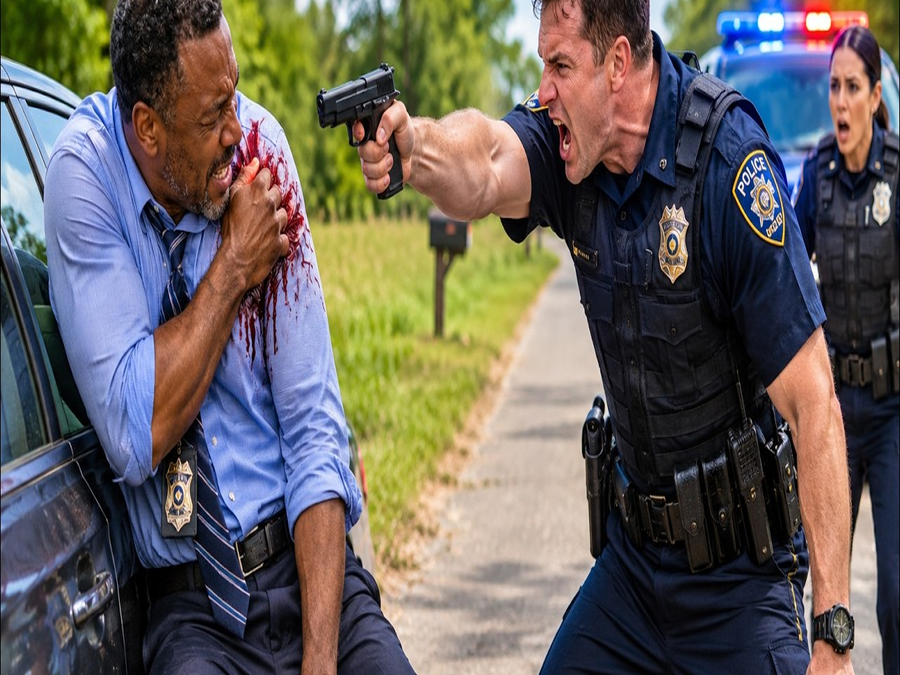
Cobb fired.
The gunshot deafened the quiet swamp.
The 9 mm round tore through Hayes’s left shoulder, missing his body armor by a fraction of an inch.
The kinetic impact spun Hayes around, throwing him against the side of his sedan.
Blood instantly soaked his jacket.
Langdon screamed, holding his gun with both hands, but freezing, unable to pull his own trigger. Hayes fell to the gravel, the burning agony in his shoulder threatening to blackout his vision.
But survival instinct honed over two decades in law enforcement overrode the pain. Cobb was raising his gun for a fatal headshot, intending to silence the situation forever.
Hayes didn’t reach for his gun.
Doing so would mean certain death against an drawn weapon.
Instead, he kicked outward with devastating force, his heavy boot catching Cobb squarely in the knee cap. A sickening crack echoed in the night.
Cobb howled in pain, his leg buckling, sending his second shot wild into the trees.
Using the split second of chaos, Hayes scrambled around the back of his sedan. Officer down!
Officer down! Langdon was screaming into his radio, completely losing his composure.
Hayes knew he couldn’t stay by the car.
They would flank him and finish the job.
Clutching his bleeding shoulder, the FBI agent bolted into the dense black tree line of the swamp just as Cobb regained his footing and fired blindly into the darkness.
The branches tore at Hayes’s face as he plunged waist deep into the freezing muddy water of the bayou.
He pushed through the pain, finding refuge behind the massive twisted roots of a fallen cypress tree.
Gasping for breath, he reached into his belt and activated his encrypted federal emergency beacon, a silent alarm that broadcast an immediate distress signal and GPS coordinates directly to the FBI operations center in New Orleans. The trap had been sprung, but the prey was a predator in his own right.
The clock was now ticking. Back on the asphalt, panic had set in.
Cobb limped toward the edge of the woods, his gun raised, staring into the pitch black swamp.
The silence of the night was broken only by the chirping of crickets and Langdon’s hyperventilating.
Did you get him? Langdon asked, his voice cracking.
I hit him.
Cobb spat, clutching his knee. I know I hit him.
Get the spotlight on these trees.
Langdon scrambled to the cruiser, turning the high-powered spotlight toward the woods.
It illuminated nothing but impenetrable brush and Spanish moss. What do we do, Travis?
Langdon asked, his panic boiling over.
He said he was federal.
What if he was telling the truth? Shut up, Wyatt.
Cobb snapped, turning his rage on his partner.
Look at this car. Look at the plates.
Does this look like a federal vehicle?
He’s a gangbanger, a drug runner playing games.
He went for my gun, you understand? He fought me.
He reached for my weapon, and I fired to save my life.
That’s what happened.
Langdon swallowed hard, nodding rapidly.
Okay.
Okay. Yeah.
He reached for the gun. Cobb limped back to his cruiser and grabbed his radio.
Dispatch, this is Unit Four.
Shots fired.
Shots fired. Suspect is a black male, armed and dangerous, fled into the bayou on foot.
We have an officer injured.
Get the sheriff down here right now. 15 minutes later, Sheriff Boyd Taggart arrived on the scene in a massive black SUV.
Taggart was a heavy-set man with a thick silver mustache and cold, calculating eyes.
He didn’t survive 20 years in Oak Haven by panicking.
He surveyed the scene, the abandoned sedan, the blood on the gravel, Cobb’s injured knee, and Langdon’s pale face.
Talk to me. Taggart commanded.
Cobb recounted his fabricated story.
Taggart listened in silence, chewing on a matchstick.
When Cobb finished, Taggart walked over to Hayes’s gray sedan.
He peered inside, noting the distinct lack of drug paraphernalia or contraband.
He opened the glove box. Empty.
He checked the visor.
Nothing. Then Taggart reached into the blood-stained jacket that Hayes had managed to shrug off as he fled into the woods.
pulled out a leather wallet. He flipped it open.
The gold FBI shield glinted under the harsh light of the police cruiser. Next to it was an identification card bearing the seal of the Department of Justice.
Taggart stopped chewing his matchstick.
The blood drained from his face.
Sheriff?
Cobb asked, hobbling over. What is it?
Taggart turned slowly, holding the badge up.
His voice was a deadly, terrifying whisper.
You stupid, arrogant son of a Do you know what you just did? Cobb stared at the federal badge, his tough-guy facade shattering instantly.
I I thought it was fake. I swear to God, Boyd, he reached for my gun.
Save it for the grand jury.
Taggart roared, throwing the badge onto the hood of the car. You shot an FBI agent.
You just brought the entire federal government down on my parish. Taggart rubbed his face, his mind racing.
Damage control.
They needed damage control immediately. If this agent died in the swamp, it was murder.
If he lived, it was attempted murder of a federal officer.
Listen to me, Taggart barked, grabbing Cobb by the collar.
We find him first.
We find him, and we say he succumbed to his wounds before we could render aid. We drop a clean piece near his body.
He was a rogue agent acting erratically high on narcotics.
You understand me?
We control the narrative before Washington even knows he’s missing.
Get the dogs, Taggart yelled to the arriving deputies. Seal off a 5-mile radius.
Nobody gets in or out of this highway. But Taggart was already too late.
Deep in the swamp, Hayes had managed tear off his shirt and fashion a crude tourniquet around his shoulder. He was shivering violently from blood loss and the freezing water.
But he could hear the rhythmic electronic beep of his emergency beacon.
It was a beautiful sound. Suddenly, the low thumping sound of heavy rotor blades echoed through the night sky.
Back on the highway, Taggart and his men looked up in confusion.
It wasn’t the state police chopper.
The sound was too heavy, too deep.
A massive matte black UH-60 Black Hawk helicopter descended from the clouds, its searchlights cutting through the fog like the wrath of God.
The downdraft whipped the trees into a frenzy, blowing off the deputies’ hats and forcing them to shield their eyes.
Before the helicopter even touched the asphalt, the side doors slid open.
A dozen heavily armored operators from the FBI’s hostage rescue team, HRT, poured out.
Their assault rifles raised laser sights, painting the chests of Sheriff Taggart and his deputies. Drop your weapons.
Do it now. A federal tactical commander screamed through a megaphone.
The local cops were completely paralyzed.
This wasn’t a jurisdiction dispute.
This was an invasion. Langdon immediately dropped his shotgun and fell to his knees, raising his hands.
Cobb backed away, trembling, holding his hands in the air. Taggart slowly unbuckled his gun belt and let it fall to the ground.
Where is he?
The HRT commander demanded, grabbing Taggart by the vest and shoving him against the cruiser.
Where is Agent Hayes?
He ran into the swamp.
Taggart stammered.
All his bravado stripped away in seconds. We were just looking for him to render medical aid.
The commander snarled.
He tapped his earpiece. Eagle One, we have his beacon ping.
300 yards north northeast. Move.
Move.
Half the tactical team vanished into the tree line with night vision goggles.
10 minutes later, they emerged, carrying Hayes on a rigid stretcher. The agent was pale, covered in mud and blood, but he was conscious.
As they loaded Hayes into the Black Hawk, Hayes weakly turned his head.
His eyes met Cobb’s.
Despite the agonizing pain, Hayes’s expression was one of cold, absolute finality.
The helicopter lifted off, roaring into the night sky, rushing Hayes to a level one trauma center in New Orleans. Left behind on the highway, surrounded by heavily armed federal operators securing the scene, Cobb, Langdon, and Taggert realized their reign of terror was over.
The nightmare for them was just beginning. The surgical lights were blinding.
It took 3 hours for the trauma surgeons to extract the 9 mm hollow point from Hayes’s shoulder, repair the torn musculature, and stabilize his blood volume.
When Hayes finally drifted back into consciousness, the steady beep of the heart monitor was the first thing he registered.
The second thing was the towering figure standing at the foot of his bed. Special agent in charge Arthur Pendleton was a man who looked like he had been carved out of granite.
As the head of the FBI’s New Orleans field office, Pendleton commanded fear and respect in equal measure.
Next to him stood agent Jessica Collins, Hayes’s handler and point person for the Oak Haven racketeering investigation.
Welcome back, David, Pendleton said, his voice a low, gravelly rumble.
How’s the shoulder?
Feels like I got kicked by a mule, sir, Hayes rasped, reaching for the cup of ice chips on the tray next to him.
Collins gently handed it to You’re lucky, Collins said, her jaw tight with suppressed rage.
An inch to the right, and that round would have shattered your collarbone and nicked the subclavian artery. have bled out in the mud before HRT even touched down.
shot me, Hayes said, his mind clearing instantly.
The mission protocols snapped back into place.
It wasn’t a mistake.
It wasn’t friendly fire.
He found my badge.
He knew what I was, and he tried to execute me to cover his tracks.
Pendleton’s eyes darkened.
Sheriff Taggart is already holding a press conference.
They’re circling the wagons.
Taggart claims you were driving erratically, refused to comply, and reached for a weapon.
He’s claiming his deputies acted in self-defense, and he’s threatening to sue the federal government for unlawful military intervention in his parish.
Hayes let out a weak, agonizing chuckle.
Let him talk.
Why?
Collins asked, leaning in.
Because Taggart is a dinosaur, and he doesn’t understand modern tech, Hayes replied, wincing as he shifted in the bed.
My undercover vehicle, the grey sedan, did HRT secure it? Yes, Pendleton said.
It’s sitting in the heavily guarded bay of our evidence facility right now.
Taggart’s men tried to wipe the onboard dash cam hard drive before we got there.
They smashed the physical unit with a baton. I figured they would.
Hayes smiled, a predatory gleam returning to his eyes. But that vehicle was outfitted by the tech division last month.
The local hard drive is a dummy unit. The real recording system, audio and video from both the cabin and the dashboard, was continuously uploading to a secure cloud server at Quantico via a hidden satellite uplink in the roof antenna.
Pendleton and Collins exchanged a look.
You have everything, Pendleton a slow smile spreading across his face.
Every word, every threat, every gunshot, Hayes confirmed.
Cobb calling me boy, me identifying myself twice, the illegal search, the unprovoked shooting, it’s all backed up on a federal server.
Pendleton pulled out his phone.
Rest up, David.
You did your job perfectly.
Now the bureau is going to do its job.
We’re going to tear Oak Haven down to the studs.
By noon the next day, the karma that Sheriff Taggart and his deputies had outrun for decades finally caught up with them. And it arrived with the subtlety of a freight train.
Sheriff Taggart was sitting in his plush office, smoking a cigar and watching the local news broadcast of his press conference.
He was feeling confident.
He had local judges in his pocket.
The district attorney was his cousin, and the physical dash cam was destroyed.
He thought it would be his word against the FBI’s, a jurisdictional war he had won a dozen times before.
The heavy wooden doors of the sheriff’s office suddenly blew open with a deafening crash.
Dozens of FBI agents wearing navy blue windbreakers with bold yellow lettering flooded into the precinct.
They weren’t there for a friendly chat.
This was a synchronized, overwhelming raid.
Nobody touch a keyboard.
Step away from your desks, Agent Jessica Collins commanded, holding up a stack of federal warrants signed by a federal judge just 30 minutes prior.
PART 2
Deputies scrambled, some reaching for their holsters purely out of shock, but the sheer number of armed federal agents flooding the room forced them to freeze.
Behind Collins walked Richard Beaumont, a shark-like federal prosecutor from the Department of Justice’s Civil Rights Division.
Taggart stormed out of his office, his face purple with rage.
What the hell is this?
You can’t just storm into my department.
This is my jurisdiction.
Beaumont stepped forward, unphased by the yelling sheriff.
Boyd Taggert, as of this moment, you don’t have a jurisdiction.
The Department of Justice is seizing control of this facility, its servers, its evidence room, and all personnel records under the authority of the Racketeer Influenced and Corrupt Organizations Act, as well as multiple violations of Title 18 US Code Section
242, deprivation of rights under color of law.
You have nothing.
Taggert spat.
Your agent went rogue.
Collins stepped around the prosecutor.
In her hand, she held a portable tablet. She tapped the screen, turning the volume up to maximum.
The crisp, unmistakable audio filled the stunned precinct.
I am a sworn federal agent with the FBI. My credentials are in my right breast pocket.
Do not escalate this.
Hayes’s voice echoed clearly.
Then came Cobb’s panicked, enraged response, followed immediately by the deafening crack of the gunshot.
The color drained from Taggert’s face.
The cigar slipped from his fingers, falling onto the polished linoleum floor. Across the room, Deputy Wyatt Langdon began to weep openly, dropping into a chair and burying his face in his hands.
Where is Deputy Travis Cobb? Collins demanded, her voice echoing in the dead silence of the room.
Before anyone could answer, the back door of the precinct opened.
Cobb hobbled in on crutches, his leg in a brace from where Hayes had shattered his knee.
He stopped dead in his tracks, staring at the sea of FBI jackets.
Collins didn’t hesitate.
She marched directly up to Cobb.
She didn’t read him his rights immediately.
She wanted him to feel the exact weight of what he had done. Deputy Travis Cobb, Collins said, her voice dripping with ice, turn around and place your hands behind your back.
You are under federal arrest for the attempted assassination of a federal agent, conspiracy to commit murder, and civil rights violations.
Wait, wait, please!
Cobb begged, his tough-guy facade completely evaporating. He looked at Taggart for help, but the sheriff was staring blankly at the floor, realizing his entire empire had just turned to ash.
I didn’t know.
I didn’t know he was really FBI.
You’re going to have 50 years in a federal penitentiary to think about that, Collins replied, grabbing his arms and violently ratcheting the stainless steel handcuffs tightly around Cobb’s wrists.
She grabbed the tin star pinned to his chest and ripped it off his uniform, tossing it onto the floor. The blue wall of silence had shattered.
The hunters had become the hunted, and the United States government was showing absolutely no mercy.
By sunset on Wednesday, the Oakhaven Parish Sheriff’s Office had been entirely dismantled, transformed from a bastion of backwards tyranny into a sterile, floodlit federal crime scene.
Tactical agents guarded the perimeter with M4 carbines, turning away baffled local reporters and furious parish commissioners. Inside the precinct was a hive of forensic activity.
Agents from the FBI’s Evidence Response Team were systematically tearing through 20 years of Boyd Taggart ‘s filthy empire.
Agent Jessica Collins stood in the cavernous, damp basement that served as Oakhaven’s evidence room.
The stench of mildew, stale marijuana, and rust was overpowering.
To a trained federal investigator, the room wasn’t just poorly maintained, it was a graveyard of civil rights violations.
Look at this, an evidence technician said, handing Collins a rusted, unlabeled revolver wrapped in a plastic grocery bag.
We found a dozen of these in a locked duffel bag under the floorboards of Cobb’s locker.
Serial numbers filed off.
Drop guns, Collins muttered, her jaw tightening. They kept a stash of untraceable weapons to plant on unarmed suspects.
Tag them all.
I want ballistics run on every single one.
If Cobb or Taggart use these to justify past shootings, we’re going to reopen every closed casket in this parish.
While the physical evidence piled up, the psychological dismantling of Taggart men was taking place an hour away, deep inside the heavily fortified FBI field office in New Orleans.
Deputy Wyatt Langdon sat in interrogation room B, shaking uncontrollably.
He hadn’t slept, hadn’t eaten, and the stark fluorescent lighting made his pale skin look translucent.
Across the steel table sat federal prosecutor Richard Beaumont and special agent in charge Arthur Pendleton.
They hadn’t said a word for 20 minutes, letting the terrifying silence of the federal government break the young deputy’s remaining resolve.
Finally, Beaumont opened a manila folder. He slid an 8 by 10 glossy photograph across the table.
It was a high-resolution still from Hayes’s hidden dash cam, capturing the exact moment Travis Cobb fired his weapon.
Langdon was visible in the background, his gun drawn, a look of sheer terror on his face.
Attempted murder of a federal agent, deprivation of rights under color of law, aggravated assault with a deadly weapon, obstruction of justice, conspiracy. Beaumont recited his voice, a smooth, lethal baritone.
In the federal system, Deputy Langdon, there is no parole. You are 24 years old.
You will die in a concrete box in Florence, Colorado, having never seen the sun without a wire mesh over your head.
Langdon covered his face, sobbing into his hands.
I didn’t shoot.
I didn’t pull my trigger.
I swear to God. Cobb went crazy.
He just snapped.
We know you didn’t shoot, Pendleton said, leaning forward.
But you drew your weapon on an FBI agent, and you conspired to cover it up.
That makes you an accessory to an assassination attempt, unless you give us a reason to view you differently.
Langdon looked up, his eyes bloodshot and pleading. What do you want?
Everything, Beaumont said flatly.
I want the history of the drop guns.
I want the names of every deputy who participated in the highway shakedowns.
I want the ledgers showing where the civil asset forfeiture money went.
I want you to hand me Sheriff Boyd Taggart’s head on a silver platter under oath in front of a federal grand jury.
Langdon swallowed hard.
If I talk, Taggart will have me killed.
He has connections with the Gulf Coast boys.
He’s not just a sheriff.
He runs the whole highway corridor.
Beaumont and Pendleton exchanged a swift, calculating glance. The investigation had just cracked wide open.
They thought they were dealing with racist, small-town thugs. Langdon had just handed them a golden thread connected to organized crime.
You’re in federal custody now, Wyatt, Pendleton said softly.
Taggart can’t touch you.
But if you walk back out that door without a deal, you belong to him.
Make your choice.
I’ll talk, Langdon whispered, his shoulders slumping in total defeat.
I’ll tell you everything.
Meanwhile, Boyd Taggart was discovering the isolating reality of federal heat.
He had been allowed a single phone call from his holding cell at the US Marshals lockup. He dialed the private cell phone of state senator Warren Reynolds, a man Taggart had funneled hundreds of thousands of dollars in illicit campaign contributions to over the years.
Warren, it’s Boyd.
Taggart barked into the receiver the moment it connected. I need you to call the governor.
Get the state police down here to assert jurisdiction. The feds are staging a coup.
I need a judge to issue a restraining order against the DOJ.
Boyd, Senator Reynolds interrupted, his voice trembling with panic.
Do not ever call this number again.
What? Warren, you listen to me.
I know where the bodies are buried. You shot a black FBI agent, Boyd.
Reynolds hissed.
The attorney general of the United States just gave a live press conference about you on CNN. The DOJ Civil Rights Division is out for blood.
You are radioactive. If you mention my name, I will personally see to it that you never make it out of pretrial detention.
Lose this number. The line went dead.
Taggart stared at the receiver, the dial tone buzzing in his ear like a hornet. For the first time in his life, the undisputed king of Oakhaven parish felt entirely helplessly powerless.
Three weeks later, David Hayes pushed himself through the agonizing pain of physical therapy.
The FBI gym in New Orleans was quiet, save for the rhythmic squeak of the pulley machine as Hayes worked his left shoulder.
The 9 mm round had severely damaged his deltoid muscle, but sheer willpower and world-class federal surgeons were knitting him back together.
Agent Collins walked into the gym holding a thick leather-bound dossier.
You’re pushing too hard, David.
The doctors said you need six weeks before bearing weight.
The grand jury convenes in four days, Jess.
Hayes grunted, completing another repetition.
Sweat beaded on his forehead.
I’m not walking into that courtroom looking like a victim.
I’m walking in looking like the agent who took them down.
Well, you might want to sit down for this.
Collins said, tapping the dossier.
Langdon’s confession was the domino we needed.
The tech division finally cracked the encrypted hard drive we pulled from a hidden floor safe in Taggart’s hunting cabin.
Hayes racked the weights and grabbed a towel.
His interest peaked.
Tell me Taggart wasn’t just shaking down minorities on Highway 49 for sport or petty cash.
Collins explained, her eyes wide with the magnitude of the discovery. He was running a toll booth for the Gulf Coast Syndicate.
The deputies were profiling and pulling over rival drug runners, seizing their cash and narcotics under the guise of legitimate police work.
They’d log a fraction of it into evidence to look good for the state and funnel the rest directly to the Syndicate.
In exchange, the Syndicate paid Taggart a massive monthly retainer to ensure their own trucks traveled through Oakhaven Parish completely unmolested. Hayes let out a low whistle.
He weaponized civil asset forfeiture to act as a cartel enforcer.
Exactly.
Collins smiled. And thanks to Langdon testimony and the decrypted ledgers, Beaumont is upgrading the charges.
We aren’t just hitting them with civil rights violations anymore.
Beaumont is dropping the hammer. Title 18 USC Section 1962, the Racketeer Influenced and Corrupt Organizations Act, RICO.
By the time the federal grand jury convened, Taggart had retained Thomas Abernathy, one of the most expensive and ruthless criminal defense attorneys in the South. Abernathy was famous for muddying the waters, attacking the character of victims and exploiting procedural loopholes.
During the closed-door bail hearing, Abernathy stood before federal magistrate judge Harrison Bennett, oozing false confidence.
Your Honor, Sheriff Taggart is a decorated public servant with 20 years of service.
Abernathy boomed, hooking his thumbs into his suspenders. This entire federal circus is an overreaction to a tragic misunderstanding on a dark highway.
My client is a pillar of his community.
He is not a flight risk. We request bail be set at a reasonable amount so he can assist in his own defense.
Prosecutor Richard Beaumont didn’t even stand up from his desk.
He simply slid a single piece of paper toward the judge’s clerk.
Your Honor, Beaumont said calmly, the government has frozen 14 offshore bank accounts in the Cayman Islands tied to Mr.Taggart, totaling roughly $6. 2 million in laundered cartel money.
Furthermore, we have intercepted jailhouse communications where Mr.Taggart attempted to arrange a fatal accident for our cooperating witness, Deputy Langdon.
Abernathy’s face fell.
Taggart whipped his head around to stare at his lawyer, his eyes wide with panic.
They hadn’t known the feds were monitoring the jailhouse payphones.
Judge Bennett looked at the document, his expression turning to stone. He looked down at Taggart with absolute disgust.
Mr.Abernathy, your client isn’t a pillar of the community.
He is a highly motivated, well-funded apex predator, the judge declared, banging his gavel. Bail is categorically denied.
The defendant is remanded to the custody of the United States Marshals and will be held in solitary confinement for the duration of these proceedings to prevent further witness tampering.
As the marshals clamped the heavy shackles around Taggart’s ankles and dragged him out of the courtroom.
The disgraced sheriff caught a glimpse of David Hayes sitting in the back row of the gallery.
Hayes wasn’t scowling.
He wasn’t glaring.
He simply sat there, impeccably dressed in a tailored suit, his FBI credentials pinned to his lapel, watching Taggart’s empire burn with cold, calculated satisfaction.
The trap Hayes had sprung in the swamp had not only caught a corrupt cop, it had inadvertently triggered the collapse of a multi-million dollar criminal enterprise.
Down in the medical wing of the federal detention center, Travis Cobb was faring even worse. His shattered knee had been surgically reconstructed with titanium pins, but he would walk with a severe limp for the rest of his life.
Confined to a wheelchair in a sterile, windowless cell, Cobb spent his days staring at the wall, terrified.
He was a racist thug who had relied on a badge to protect him from the consequences of his brutality.
Now the badge was gone, the protection was gone, and he was surrounded by federal inmates, many of whom were only there because Cobb had planted evidence on them years prior.
Without Taggart’s protection, Cobb was nothing but a frightened, broken man waiting for the slaughter.
Eight months later, the skies over New Orleans were bruised with dark, heavy thunderclouds, matching the atmosphere inside the United States District Court for the Eastern District of Louisiana. The trial of the United States versus Boyd Taggart and Travis Cobb had become a national spectacle.
The courtroom was packed with journalists, civil rights leaders, and a heavy presence of armed federal marshals.
The DOJ had refused to sever the trials, forcing Taggart and Cobb to sit at the same defense table.
The paranoia between the two men was palpable. They refused to look at each other, both knowing the other would happily trade their life for a reduced sentence.
Prosecutor Richard Beaumont was a maestro of destruction. Over the course of two weeks, he meticulously presented the mountain of evidence the FBI had gathered.
He brought forensic accountants to the stand to trace the cartel money. He brought the ER doctors to testify about the trajectory of the bullet that nearly killed Hayes.
He brought former victims of O’Haven’s corrupt deputies to testify about the planted drop guns.
But the fatal blow came on day 12.
Wyatt Langdon took the witness stand.
Dressed in a drab prison jumpsuit, looking aged beyond his years, Langdon avoided looking at Taggert as he spoke into the microphone.
Deputy Langdon, Beaumont asked, pacing slowly in front of the jury box. On the night of November 14th, what was your objective on Highway 49?
We were hunting, Langdon said, his voice echoing in the dead silent courtroom. Hunting for what?
Out of state plates, specifically minority drivers, Langdon confessed, gripping the edges of the witness stand.
Sheriff Taggert had a quota.
He told us if we didn’t bring in at least $10,000 in civil asset seizures a week, we’d be fired.
Travis, Deputy Cobb, he liked targeting black men. He said they were easier to intimidate into signing over their cash.
Amnesia and excuses were Thomas Abernathy’s only defense.
When it was his turn to cross-examine, the defense attorney tried to corner Langdon, suggesting he was lying to save himself.
But Beaumont was ready.
The prosecution calls Special Agent David Hayes, Beaumont announced. The courtroom doors opened, and Hayes walked down the center aisle.
He moved with a quiet, lethal grace, his shoulders broad in his dark suit.
He took the oath, sat in the witness chair and looked directly at the jury.
For three hours, Hayes recounted the night on the highway.
His tone was clinical, precise, and devoid of the angry emotional outbursts Abernathy tried to provoke out of him. Hayes was the perfect federal witness, bulletproof in his credibility.
Agent Hayes, Abernathy sneered during cross-examination.
Is it not true that you physically assaulted Deputy Cobb unprovoked, resulting in a shattered patella?
Isn’t it possible my client fired his weapon in fear for his life from a violent resisting suspect?
Hayes leaned forward into the microphone.
Mr.Abernathy, my FBI credentials were in my right pocket. I verbally identified myself as a federal agent three separate times.
Your client did not fire his weapon out of fear. He fired his weapon because his authority was challenged by a black man he believed he could murder with absolute impunity.
I broke his knee to prevent him from putting a second bullet into the back of my head.
Abernathy opened his mouth to object, but before he could, Beaumont stood up.
Your Honor, if it pleases the court, I would like to play prosecution exhibit 14, the unedited, decrypted audio and video from Agent Hayes’s vehicle.
Judge Leonard Holden nodded.
Proceed. The large flat screens facing the jury flickered to life.
The dash cam footage showed the dark highway, but it was the audio that sucked the air out of the room.
The jury listened in horror to Cobb’s racist sneers, Hayes’s calm compliance, the sudden escalation of violence, and the terrifying, deafening crack of the gunshot.
When the tape ended, the silence in the courtroom was suffocating. Several jurors were openly glaring at Cobb.
Abernathy sat down heavily at the defense table, dropping his pen.
He knew it was over. The jury deliberated for a mere four hours before returning with a verdict.
On the charges of attempted murder of a federal officer, deprivation of rights under color of law, and conspiracy, we find the defendant Travis Cobb guilty on all counts. Cobb collapsed back into his wheelchair, his chest heaving as he sobbed loudly, burying his face in his hands.
On the charges of racketeering, money laundering, conspiracy to commit murder, and deprivation of rights, we find the defendant Boyd Taggert guilty on all counts.
Taggert didn’t cry.
He simply stared blankly ahead, a broken emperor realizing his kingdom was gone forever.
Judge Leonard Holden did not wait for a separate sentencing hearing.
He looked down from the bench, his eyes filled with righteous fury.
Travis Cobb, you are a disgrace to the badge you wore.
Judge Holden boomed. You used the authority granted to you by the state to operate as a racist predator.
The court sentences you to life in federal prison without the possibility of parole.
Holden turned his gaze to the former sheriff. Boyd Taggert, you corrupted an entire parish.
You sold out your oath to drug cartels, and you fostered a culture of hatred and violence that culminated in the attempted assassination of a United States federal agent. This court sentences you to life in federal prison plus an additional 30 consecutive years.
You will breathe your last breath behind federal steel.
PART 3
The gavel slammed down with the finality of a coffin lid. Armed marshals converged on the defense table.
They hauled Cobb out of his wheelchair unceremoniously, dragging him toward the holding cells, as he wailed for mercy that would never come.
Two other marshals yanked Taggart to his feet. As Taggart was led away in heavy chains, he looked back over his shoulder one last time.
He saw David Hayes standing at the prosecutor’s table, shaking hands with Richard Beaumont.
Hayes didn’t gloat.
He didn’t smile.
He merely gave Taggart a brief, chilling nod of acknowledgment.
The predator had been hunted, caught, and erased.
The sentencing of Sheriff Boyd Taggart and Deputy Travis Cobb was only the opening salvo of the federal government’s wrath.
Taggart’s imprisonment severed the head of the snake, but the Department of Justice was determined to burn out the venom that had infected Oak Haven Parish for over two decades.
48 hours after the trial concluded, the United States Attorney General held a press conference in Washington, D. C.
, announcing a sweeping federal consent decree against the Oak Haven Parish Sheriff’s Office.
It was a measure rarely deployed with such absolute severity.
The DOJ Civil Rights Division stripped the local government of its autonomy, installing a team of independent federal monitors to oversee every hire, every traffic stop, and every dollar spent by the department.
The purge was ruthless and systematic.
Based on the decrypted ledgers and Wyatt Langdon’s explosive grand jury testimony, the FBI returned to Oak Haven with a stack of federal indictments that looked like a telephone book.
Over the next three weeks, 27 more deputies were arrested in pre-dawn raids.
Some were pulled directly from their patrol cruisers. Others were dragged out of their suburban homes in handcuffs while their neighbors watched in stunned silence.
The charges ranged from perjury and evidence tampering to extortion and wire fraud. The blue wall of silence that had protected these men for so long dissolved into a panicked race to secure plea deals.
But prosecutor Richard Beaumont was not offering leniency.
The federal government seized the corrupt deputies’ pensions, drained their bank accounts, and auctioned off their homes to fund a massive victim restitution program.
For the first time in a generation, the marginalized citizens of Oak Haven Parish experienced actual justice.
Hundreds of civil lawsuits were filed by the black and Hispanic motorists who had been targeted, terrorized, and robbed on Highway 49. The millions of dollars in cartel hush money that Taggart had hoarded in offshore accounts were repatriated and distributed to the very people his deputies had preyed upon.
The ripple effects of the Oak Haven sting extended far beyond the Louisiana swamps.
The intelligence gathered from Taggart’s hidden floor safe provided the FBI’s organized crime task force with a detailed road map of the Gulf Coast syndicate’s logistics.
Deprived of their protected transit corridor, the syndicate’s supply lines bottlenecked.
Within 6 months, the DEA and FBI executed synchronized raids across four states, seizing over 3 tons of narcotics, $60 million in illicit cash, and arresting three high-ranking cartel lieutenants. The criminal empire that Taggart had sold his soul to protect was decimated.
As for Deputy Wyatt Langdon, his cooperation spared him the fate of dying in Florence, ADX, but the federal government did not forgive his complicity. He pleaded guilty to federal civil rights violations and was sentenced to 12 years in a specialized protective custody unit for former law enforcement He would spend his thirties locked in a heavily guarded cell, constantly looking over his shoulder, a pariah to both the criminals he once protected and the badge he had disgraced.
Fourteen months after the near fatal night on Highway 49, the oppressive heat of the Louisiana summer had finally given way to a crisp, cool autumn.
Inside the heavily fortified walls of the FBI Academy in Quantico, Virginia, hundreds of agents in dress blues stood at attention in the main auditorium.
The ceremony was closed to the public and off limits to the press.
Special Agent David Hayes stood on the brightly lit stage. The nine millimeter hollow point that Cobb had fired had caused permanent nerve damage in his left shoulder, leaving him with a faint, almost imperceptible stiffness in his posture.
But he had fought his way through grueling rehabilitation to pass his physical fitness tests. He was fully cleared for active duty.
FBI Director Thomas Sterling approached Hayes holding a small velvet box.
Inside rested the FBI star, a medal awarded exclusively to agents who suffer severe injuries in the direct line of duty.
Agent Hayes, the director said, his voice echoing through the silent auditorium.
You ventured into the darkest corners of this country, facing men who wielded the law as a weapon of hatred.
You did not flinch. You did not break.
When confronted with lethal prejudice, you upheld the highest ideals of this bureau, bringing a corrupt empire to its knees. For your immense courage and unbreakable resolve, the United States thanks you.
The director pinned the heavy silver star to Hayes’s lapel.
The auditorium erupted in a deafening standing ovation.
In the front row, Special Agent in charge Arthur Pendleton and agent Jessica Collins clapped the loudest, immense pride beaming from their faces.
Hayes looked out at the sea of federal agents.
He nodded respectfully, shaking the director’s hand.
But despite the applause and the accolades, Hayes was not a man who craved the spotlight.
The medal was an honor, but it wasn’t the mission.
Two days later, Hayes was back in New Orleans. The sun was just beginning to set over the Mississippi River, casting long golden shadows across the pavement of the field office parking lot.
Agent Collins walked out of the building holding two steaming cups of black coffee. She handed one to Hayes, who was leaning against the hood of a brand new non-descript black SUV.
Pendleton just got off the secure line with Washington, Collins said, taking a sip of her coffee.
They want us to take a look at a precinct up in the panhandle.
We’re getting reports of a sheriff operating a kickback scheme with a private prison contractor, judges getting paid to maximize sentences for minor infractions.
Hayes took a slow sip of his coffee.
The stiffness in his shoulder twinged, a permanent phantom reminder of Travis Cobb’s hatred.
He reached up, rubbing the scar hidden beneath his tailored jacket, and then his eyes hardened with that familiar predatory focus.
The corrupt men of the world always thought they were untouchable. They hid behind badges, gavels, and elected offices, believing the darkness would shield their sins forever.
They never expected the darkness to bite back.
Give me the file, Jess, Hayes said quietly, tossing his empty coffee cup into a nearby trash can.
He opened the driver’s side door of the SUV.
Let’s go hunting.
The terrifying reality of this story proves that the most dangerous criminals don’ always wear masks.
Sometimes they hide behind a badge. But it also proves that ultimate accountability still exists.
And when the hammer of federal justice falls, it shatters corruption overnight.