Rancher Married a Heavyset Black Woman as a Joke — She Turned His Dying Ranch Into a $40M Empire
THE BRIDE WHO SAVED THE RANCH
The first thing Cody Ransom did when he introduced me as his bride was insult his mother’s taste in women.
The second thing he did was make me the most unpopular woman in three counties.
And the third thing, though neither of us knew it yet, was give me the chance to save the only home I had ever felt was worth fighting for.
I was standing beside an old oak tree in the Ransom ranch yard, holding a glass of lemonade and trying not to draw attention to myself. That was usually the safest way to behave at family gatherings. I had spent enough years working in hospitals to know that people often became more difficult when they had an audience.
Unfortunately, the Ransom family had an audience.
There were more than a hundred guests gathered beneath white tents. A string quartet played near the porch. Waiters carried trays of champagne, and a florist had covered the entrance to the main house with enough roses to supply a small town.
The occasion was supposed to be a celebration of the future union between Cody Ransom and Kinley Halden.
Kinley was the daughter of Tripp Halden, a wealthy cattleman whose family owned several ranches across the county. She was beautiful, polished, and dressed in a cream-colored gown that probably cost more than my car. Her father had been negotiating the marriage with Cody’s mother, Darlene, for months.
The plan was simple. Cody would marry Kinley, the Haldens would clear the Ransom family’s outstanding bank debt, and the two ranching families would join their businesses.
There was only one problem.
Cody didn’t want to marry Kinley.
And apparently, he had decided that the best way to announce that was to make me part of the discussion.
“Five generations of ransom brides,” Darlene announced, raising her glass. “Every woman who has joined this family has understood what it means to carry the Ransom name. Not one of them has ever forgotten the responsibility that comes with it.”
She looked directly at me.
I knew that look. I had seen it before whenever she passed me in the hallway or caught me helping her mother-in-law with breakfast.
It was the look of someone who had already decided what I was worth.
“Look at her,” Darlene continued, lowering her voice just enough to make sure everyone could hear. “She can’t even fit through my front door. Don’t you dare turn marriage into a joke in my yard, Cody.”
The conversation around us stopped.
Cody stood beside Kinley, his hands in his pockets. He was thirty-four, broad-shouldered, with dark hair that never seemed to stay neatly in place. His usual expression carried the confidence of someone who had inherited a large piece of land without ever being entirely certain what to do with it.
He looked at his mother.
“A joke?”
“Don’t start.”
“You sold me to the Halders to pay the bank, Ma. You made my marriage a joke before I ever opened my mouth.”
Darlene’s face tightened.
“Watch how you speak to me.”
“So I picked my own bride.”
He turned toward me.
I nearly dropped my glass.
“She’s not the bride you wanted, Mom,” Cody said. “But she’ll care for this family.”
Kinley gave a short, disbelieving laugh.
“You cannot be serious.”
“I’m serious.”
“She’s the hired nurse,” Kinley said. “She can’t even fit into our family photograph.”
A few people laughed.
I felt my cheeks burn, but I kept my eyes on Cody. I had learned a long time ago that answering every insult only gave the person who delivered it another opportunity.
Cody’s grandmother, Winona Ransom, sat near the porch in her wheelchair. At eighty-eight, she was small and thin, with silver hair carefully pinned behind her head. Her eyesight had weakened, but her mind remained sharp.
She had been watching everything.
“Daddy,” Kinley said, turning toward Tripp, “tell him he’s joking.”
Tripp Halden lifted his glass.
“Let’s not turn a family celebration into a circus.”
Cody looked at me again.
I wanted to ask him what on earth he thought he was doing, but the old woman beside the porch spoke before I could.
“Steady as a clock, Miss Wynonna,” Winona said to me. “You’ll outlive us all.”
I walked over to her.
“Are you comfortable, Mrs. Ransom?”
“Not particularly. Come sit with me.”
I pulled a chair close to her wheelchair.
She studied me for several seconds.
Then she said, “I need to ask you something.”
“Of course.”
“Marry my grandson.”
I thought I had misunderstood.
“Mrs. Ransom?”
“He said it in front of everyone. That should count for something.”
“Cody doesn’t love me.”
“I didn’t ask whether he did.”
I glanced toward him. He had stepped away from Kinley, and Darlene was speaking to him through clenched teeth.
“Then why are you asking me?”
“Because I have a reason that has nothing to do with that foolish little performance.”
She nodded toward the sprawling ranch beyond the house.
“The Ransom family trust is written in a way that allows the land to be managed by a direct family member or by someone who joins the family through marriage. Darlene has been running the business for years. She’s running it into the ground. Cody knows something is wrong, but he won’t stand up to her.”
“Then why not replace her?”
“Because she has spent a long time making sure nobody believes I can make my own decisions.”
Her fingers tightened around the blanket on her lap.
“You grew up on your grandfather’s farm in Georgia. You know what dirt means. You know the difference between a field that’s resting and one that’s dying. You understand what happens when somebody treats land as if it belongs to them simply because their name is on a mailbox.”
I looked toward the pasture.
“I know dirt,” I said. “I don’t know your family.”
“Nobody knows this family. Not even this family.”
That was the first time I had seen her smile that evening.
“Your daughter-in-law will make my life miserable,” I said.
“She makes everyone’s life miserable. You’ll simply be the person who stays.”
“Why me?”
“Because I’ve watched you for a year.”
I looked at her, surprised.
“You’ve watched me?”
“I may be old, dear. I’m not blind.”
She leaned closer.
“You never make me feel like a burden. You tell me the truth even when you know I won’t like it. And when Darlene speaks to you as if you’re furniture, you don’t take your anger out on me afterward.”
I looked down at my hands.
“I don’t know what to say.”
“Say yes.”
I was quiet for a long time.
Then I gave her my condition.
“If I agree, you stay in this house. No nursing home. No matter what your daughter-in-law says.”
Winona’s eyes sharpened.
“That’s your only condition?”
“Yes.”
“Then we have a deal.”
She held out her hand.
I took it.
“Congratulations, Mrs. Ransom.”
“Not yet. We still have to get the boy to behave.”
Cody arrived a few minutes later. He looked as though his mother had just threatened to disinherit him, which was probably exactly what had happened.
“Grandma, what did you say to her?”
“I asked her to marry you.”
He stared at me.
“You said yes?”
“I did.”
Cody let out a breath.
“Then we’d better make this official before Mom arranges another wedding.”
Darlene approached, her expression cold.
“This is not happening.”
Cody reached into his jacket and removed a folded document.
“The courthouse has the original. This is your copy.”
He handed it to his mother.
She looked at the page, then at me.
“You actually married her?”
“Yes.”
“You married a nurse?”
“Her name is Ayana.”
“I know what her name is.”
“Then use it.”
Darlene’s eyes narrowed.
“Do you understand what you have done?”
“For once, I think I do.”
She looked at me with open contempt.
“This family has standards, Cody.”
“Standards? You traded Grandma’s room to pay a debt.”
“I traded nothing.”
“You made a deal involving my wedding and her home.”
Tripp Halden stepped forward.
“Let’s be reasonable. The bank is owed money. A wedding doesn’t change that.”
Cody turned to him.
“That was the copy, Mr. Halden. The courthouse keeps the original.”
Tripp’s smile disappeared.
“Excuse me?”
“She’s my wife. Whether you like it or not.”
Darlene looked as if she might strike him.
Kinley walked away first. Her father followed, muttering something about wasted time and foolish decisions.
The guests slowly drifted toward the parking area.
I stood in the yard wearing a borrowed blue dress, with a paper marriage certificate in my handbag and a husband I barely knew.
Cody came to stand beside me.
“Sorry about the dress.”
I looked down at it.
“It belongs to the church.”
“I’ll pay for it.”
“With what?”
He gave me a faint smile.
“You’ve been married to me for less than an hour, and you’re already questioning my finances.”
“Someone should.”
His smile disappeared.
“One hundred and sixty thousand dollars.”
I waited.
“That’s what the bank says we owe.”
“And how much money do you have?”
“Not enough.”
“Then I suppose I should know what I married into.”
He looked toward the darkening pastures.
“There’s not much left.”
“That’s not an answer.”
“No,” he said. “It isn’t.”
He was right.
But by the end of that evening, I had discovered that the Ransom ranch had much bigger problems than a bank loan.
And I had agreed to help solve them.
I had been working at the Ransom house for eleven months before the wedding.
I was hired through a home-care agency after Winona suffered a fall and spent several days in the hospital. Her doctor recommended that she have someone with her during the day, especially because she had begun forgetting her medication.
The agency sent me for what they called a temporary assignment.
Temporary assignments had a way of becoming permanent when the patient was kind and the family was difficult.
Winona had been both my patient and, in some ways, my friend.
I had grown up in rural Georgia. My grandfather owned a small farm, and I had spent much of my childhood following him from the chicken coop to the fields, carrying tools that were too heavy for my hands.
He taught me how to read soil, how to recognize a sick cow, and how to mend a fence without wasting an entire afternoon.
When I was twenty-two, the bank took his farm.
My grandfather had worked the land for forty years. One bad season, followed by another, had left him behind on his payments. By the time we understood what was happening, the bank had already decided to sell.
I still remembered the morning we stood outside the farmhouse and watched a man put a notice on the front door.
My grandfather never recovered from losing the place.
He died two years later, and I left Georgia.
I became a nurse because I wanted a profession that could not be repossessed. I worked night shifts at a county hospital for twelve years, moving between emergency rooms, surgical floors, and long-term care units. I paid rent, saved what I could, and learned to live without expecting much.
The Ransom house had been the first place in a long time where I felt useful beyond my job description.
Winona asked me about my grandfather. She wanted to know what he grew, how he cared for his cattle, and why I thought some families seemed to understand land while others only understood its price.
I told her stories during breakfast.
Sometimes she asked me to read the newspaper.
Sometimes she wanted to play checkers.
And sometimes she simply wanted someone to sit beside her while she watched the rain.
Darlene regarded my presence as an inconvenience.
She had never liked the fact that her mother-in-law preferred me to the people she hired to entertain her. She liked it even less when I refused to leave Winona alone whenever the old woman felt unwell.
Cody was another matter.
I saw him occasionally around the property, usually in the barn or beside the cattle pens. He was not cruel, exactly. He was simply absent in the way people became absent when they had spent their entire lives being told that somebody else was responsible.
He let Darlene make decisions.
He let her speak for the family.
He let her tell him the ranch was doing fine.
He never seemed to question why there were fewer cattle every time I walked past the west pasture.
On the day of the wedding, I had finally understood what Winona had been trying to tell me.
The family needed someone who would look at the numbers instead of the family name.
And apparently, I was the person she had chosen.
The morning after the wedding, I found Cody in the kitchen staring at a cup of coffee.
He looked as if he had slept about an hour.
“Morning,” I said.
He glanced up.
“Morning.”
“Where’s Grandma?”
“Still asleep.”
“Good. She was awake half the night.”
He rubbed his face.
“Look, Ayana, I want to make something clear.”
I sat down across from him.
“Go ahead.”
“Yesterday was a way to stop my mother. I didn’t expect you to agree to it.”
“I know.”
“That doesn’t mean I think you should suddenly start pretending we’re some kind of happy couple.”
“I wasn’t planning to.”
“Good.”
“Did you think I married you because I wanted your last name?”
He looked uncomfortable.
“No. I just don’t want you to misunderstand.”
“I don’t misunderstand, Cody. You married me to make a point. I’m marrying you to keep a promise.”
He frowned.
“What promise?”
“Not yours to know yet.”
He leaned back.
“You have secrets already?”
“I have two conditions.”
“Of course you do.”
“First, your grandmother stays in this house. She doesn’t go to Pine Ridge or anywhere else.”
“Done.”
“Second, I run the ranch for six months.”
He stared at me.
“Run it?”
“All of it. The cattle, the books, the workers, the fields, the business. I want access to everything.”
“Ayana, the ranch is going under. There’s nothing to run.”
“Then I won’t have much to do.”
He almost smiled.
“You’re serious.”
“Completely.”
He stood and walked to the window.
“Mom handles the books.”
“That is precisely why I want to see them.”
He turned.
“What’s that supposed to mean?”
“It means I want to know how much money comes in, where it goes, what we own, what we owe, and why your family has thirty cattle on two hundred acres of grass.”
“Thirty head is enough to keep the place running.”
“Thirty head is enough to make us look like we’re waiting for the bank to take everything.”
He stared at me.
I continued.
“I want the keys to the office. I want the last three years of bank statements. And I want to see the property records.”
“My mother won’t give you those.”
“Then you can get them.”
He shook his head.
“She’s going to hate this.”
“She already hates me.”
For the first time, Cody laughed.
It was brief, but it was real.
“Six months,” he said.
“Six months.”
He held out his hand.
I shook it.
And that was how my marriage began: with a contract, a promise, and a husband who still had no idea how much trouble he was in.
The first thing I did was open the kitchen drawer.
I wasn’t looking for anything unusual. I wanted a pen to make notes while I went through the household expenses.
Instead, I found a stack of envelopes beneath several takeout menus.
They were addressed to banks, insurance companies, feed suppliers, and equipment lenders.
Some were overdue.
Others had final notices stamped across the front.
I carried them into the dining room and spread them across the table.
Cody came in a few minutes later.
“What’s all this?”
“Your family’s finances.”
He picked up an envelope.
“Where did you get that?”
“Kitchen drawer.”
“Why would Mom keep bank notices in here?”
“Because she didn’t want anyone finding them.”
He opened one and read the first page.
His face changed.
“That’s impossible.”
“What’s impossible?”
“She told me we were fine.”
I handed him another notice.
Then another.
By the time he had read them all, he had stopped speaking.
The ranch owed money on its operating account, two pieces of equipment, and a livestock loan. Several payments had been missed. The feed supplier had reduced the family’s credit, and the bank had placed restrictions on further borrowing.
The biggest problem was the one-hundred-and-sixty-thousand-dollar balance.
The bank had given the Ransoms six months to settle the outstanding amount or risk foreclosure proceedings.
Cody sat down.
“How did it get this bad?”
“That’s what we’re going to find out.”
He looked at the papers.
“Mom said the cattle were covering expenses.”
“Maybe once.”
I opened the ranch ledger.
The numbers were worse than I expected.
The herd had been reduced over several years, but the family had continued spending as though nothing had changed. Feed costs were high because the cattle were kept in one pasture for too long. Several fields had been overgrazed, leaving the soil weak and the grass unable to recover.
There were maintenance bills for equipment that had not been used in months.
And there were regular withdrawals that didn’t appear to have anything to do with the ranch.
I marked each one.
“What are those?” Cody asked.
“That’s your mother.”
“How do you know?”
“Because your mother has been paying for a townhouse, a private club membership, and a car lease from the ranch account.”
He stared at the figures.
“She told me those were family expenses.”
“Maybe she considers them family expenses.”
“She’s my mother.”
“I know.”
“You’re saying she stole from us?”
“I’m saying we need to understand every withdrawal before we make accusations.”
He looked at me for a long moment.
Then he nodded.
It was the first time he had trusted me with something important.
The next morning, I walked the property with the ranch foreman, a quiet man named Ellis who had worked for the Ransoms for twenty-seven years.
He knew the land better than anyone.
When I asked why the cattle were confined to the same pasture, he shrugged.
“That’s how Mrs. Ransom wanted it.”
“Why?”
“She said moving them around was too much work.”
I pointed toward the far fence.
“When was that pasture last used?”
“About two years ago.”
“Is the grass still good?”
“Some of it.”
“What if we divide the grazing areas and move the cattle every three days?”
Ellis studied me.
“Rotational grazing?”
“Yes.”
He scratched his jaw.
“Your grandfather teach you that?”
I smiled.
“He did.”
“Your grandfather must’ve been a smart man.”
“He was.”
We spent the next hour walking the fields.
There were two hundred acres of pasture, much of it underused. The cattle had stripped the main grazing area, but other sections could recover with time and proper rotation. There was enough land to support a larger herd if we managed it correctly.
When we returned to the barn, Cody was waiting.
“Well?”
“We have more land than we’re using and fewer cattle than we should.”
“Can you fix it?”
“Not overnight.”
“How long?”
“Six months.”
He looked at Ellis.
“She’s serious.”
Ellis gave him a small smile.
“Looks that way.”
We started with what we had.
The first week was spent repairing fences, checking water troughs, and moving the cattle away from the exhausted pasture. We made a schedule for grazing rotation and arranged for veterinary inspections. I called several feed suppliers and negotiated smaller purchases instead of allowing the ranch to take on more credit.
I sold my car.
Cody found me signing the paperwork at the kitchen table.
“Why are you doing that?”
“Because we need money to repair the north fence.”
“We can find another way.”
“We have a deadline.”
“You don’t have to sacrifice everything.”
I put the pen down.
“I spent twelve years working night shifts. I’ve bought very few things that mattered to me. That car was one of them, but it isn’t worth losing this property.”
He stared at me.
“Why would you bet everything on us?”
I looked at him.
“Because your grandmother asked me to. And because nobody ever bet on me.”
He didn’t answer.
Instead, he sat down beside me and helped me complete the paperwork.
That evening, we ate dinner together.
It was the first time we had done so without Winona at the table.
Cody seemed uncertain about what to say.
I was just as uncertain.
After a while, he asked, “What happened to your grandfather’s farm?”
I told him.
I told him about the debt, the bad harvest, the bank, and the morning the notice appeared on the door.
I told him how my grandfather had continued waking at five every morning for months after the farm was gone, as if his body couldn’t accept that he no longer had fields to walk.
Cody listened without interrupting.
When I finished, he looked toward the window.
“Maybe that’s why Grandma chose you.”
“Maybe.”
“She knew what it meant to lose land.”
I nodded.
“And she didn’t want it to happen here.”
The ranch had a long history of hosting gatherings, but Darlene had stopped allowing them years earlier.
She said strangers were a nuisance. She said the barn was too old, the kitchen too small, and the house too valuable to let people wander around.
Winona remembered something different.
“My mother used to fill this place with people,” she told me one afternoon. “Neighbors, cousins, workers, travelers. If someone came through the gate hungry, she put a plate in front of them.”
“Did she cook?”
“Better than anyone in the county.”
Winona’s eyes drifted toward a cabinet in the dining room.
“There are recipes in there.”
I opened it.
Inside were several old notebooks, their covers faded and their pages yellowed with age.
“They’re my mother’s,” Winona said. “Nobody has opened them in forty years.”
I carefully lifted the top notebook.
The first few pages held handwritten recipes for cornbread, smoked chicken, beans, and pies. Near the middle was a recipe for brisket.
Coffee rub. Molasses. Garlic. Black pepper. Mustard seed. Twelve hours at low heat.
At the bottom of the page, someone had written a note.
Don’t rush good meat. Patience is the secret.
I smiled.
“Your mother knew what she was doing.”
“She did.”
“What if we bring Sunday supper back?”
Winona looked at me.
“Here?”
“In the barn.”
“Nobody will come.”
“People drive two hours for good barbecue.”
“Not to this place.”
“They might.”
She considered it.
“Your grandfather would have liked that idea.”
The next day, I began planning.
We cleaned the barn, repaired the old tables, and borrowed chairs from the church. I contacted the county’s food-safety office to make sure the kitchen met the requirements. We hired two local cooks and asked several workers’ families if they wanted extra shifts.
Cody initially thought I had lost my mind.
“You’re going to feed strangers in the barn?”
“Yes.”
“With what money?”
“We start small.”
“How small?”
“Sixty guests.”
He looked at me.
“Sixty?”
“That’s small.”
“To whom?”
“To people who want to run a restaurant.”
“This isn’t a restaurant.”
“Then we’ll call it Sunday supper.”
He shook his head.
“You’ve been here three weeks.”
“And we’ve been losing money for years. Maybe a little change won’t hurt.”
Our first Sunday supper took place under a cloudy sky.
We prepared brisket, smoked chicken, corn bread, beans, potatoes, greens, and peach cobbler. We set long tables across the barn and placed simple paper plates beside the silverware.
The food smelled better than anything I had eaten in months.
I worried that nobody would show up.
Then the first truck arrived.
A retired teacher from the next county brought her husband. A family of five came from a town nearly forty miles away. Two farmers walked in wearing muddy boots. By six o’clock, every seat was full.
People went back for seconds.
One man told me he hadn’t tasted brisket like that since his mother died.
An older woman asked for the recipe.
Cody stood behind the serving table, watching people eat.
He looked almost bewildered.
“Sixty guests,” he whispered.
“Sixty.”
“There’s a line outside.”
“Forty more people asked whether they could come next week.”
He stared at me.
“How did you do that?”
“Good food, long tables, and nobody being told to leave.”
Winona laughed so hard she had to wipe her eyes.
For the first time in years, the Ransom barn sounded like a home.
The following Sunday, we served ninety people.
The week after that, we had a waiting list.
A local newspaper published a photograph of the old barn beneath the headline Ransom Ranch Brings Back Sunday Supper.
People began calling.
Some wanted reservations. Others wanted to know whether we sold the brisket separately.
I told them we were working on it.
Cody began spending more time in the kitchen than in his office.
He learned to prepare the coffee rub and how to judge the temperature of the smoker. He made mistakes, but he stopped pretending he already knew everything.
One evening, I found him standing over a tray of burned cornbread.
“Don’t say it,” he warned.
I examined the tray.
“I wasn’t going to.”
“You’re smiling.”
“I’m allowed to smile.”
“The oven is defective.”
“The oven is fine.”
“Then the recipe is wrong.”
“Your great-grandmother would disagree.”
He groaned.
I laughed.
For the first time, being married to Cody felt less like a business arrangement and more like being part of something we were building together.
That frightened me more than I expected.
Our success made Darlene angrier.
She came into the barn one Sunday carrying a folded napkin and looking at the tables as if they offended her.
“You’re feeding strangers off my mother’s china?”
I looked down at the stack of paper plates.
“Off paper plates, ma’am. You took the china.”
“It was put away for a reason.”
“Then it’s fortunate we don’t need it.”
She looked at the customers.
“You think a few suppers make you a Ransom?”
“No, ma’am. The courthouse did.”
Cody, who was carrying a tray of food, stopped beside me.
“Mom, we have customers.”
“Customers? These people are eating in a barn.”
“Yes.”
“Do you think this is what your father wanted for this family?”
Cody set the tray down.
“I think Grandpa wanted the ranch to survive.”
Darlene glanced at him, then at me.
“You should remember where you came from, Ayana.”
“I do.”
“Then perhaps you should remember that this family has standards.”
I looked around the barn.
A retired couple was sharing a plate of brisket. A mother was helping her little boy cut cornbread. One of the ranch hands was laughing with a farmer he had known for twenty years.
“I think your family could use a few more people who know how to sit at the same table,” I said.
Darlene turned away.
She was not the only person who disliked what we were doing.
Kinley appeared one afternoon in a white truck with a driver. She stepped out wearing designer boots that looked entirely unsuited to the muddy yard.
“Well, Cody. I see you’ve become a restaurant manager.”
He was repairing a fence.
“Hello, Kinley.”
She looked at the tools in his hands.
“Are you planning to stay out here all day?”
“That’s generally how work goes.”
She laughed.
“Daddy says the offer is still open.”
Cody continued fastening the wire.
“What offer?”
“You know. You leave the nurse, we arrange the marriage, and the Haldens take care of the debt.”
“Tell your father to keep his money.”
“You’re going to regret this.”
“Maybe.”
She turned toward me.
“Do you really think you can keep this place going with Sunday dinners?”
“I think we’re doing better than we were.”
“You’re still a nurse.”
“Yes.”
“Nothing wrong with that profession. But it’s not exactly what people expect from a Ransom wife.”
Cody straightened.
“That’s enough.”
Kinley tilted her head.
“You’re defending her now?”
“She’s my wife.”
“You say that as if repeating it makes it true.”
He wiped his hands on a cloth.
“It was true at the courthouse.”
Kinley looked at me one last time.
“You’ll come crawling back when the bank shows up.”
I met her eyes.
“The bank has already been here, Kinley. We’re paying it.”
She opened her mouth, then closed it.
When her truck disappeared down the drive, Cody came back to the fence.
“You didn’t have to say that,” I told him.
“Yeah, I did.”
“Why?”
“Because she called you a nurse like it was a bad word.”
I looked at him.
“It’s the best word I know.”
He nodded.
“I’m starting to see that.”
The turning point came when I took our brisket to the county market.
We had been selling plates at the Sunday suppers, and several customers had asked whether they could take food home. I wanted to see whether a local shop would stock packaged portions.
The first three stores declined.
The fourth agreed to sample it.
I was standing behind our table on a cold Saturday morning when a woman in a gray coat stopped.
She tried a small piece of brisket.
Then she tried another.
“Who makes this?”
“I do, with help from the kitchen crew.”
“How long is it cooked?”
“Twelve hours.”
She nodded.
“Coffee rub?”
“Coffee, molasses, garlic, and a few things I won’t advertise.”
She smiled.
“I’m with Lone Pine Markets. We operate two hundred stores across the state. I’m looking for regional products, and this is exactly what I want.”
I thought she was joking.
“Two hundred stores?”
“That’s what I said.”
She took another bite.
“I’d like to discuss a supply agreement. We’d begin with a regional launch next quarter. We’ll also advance sixty thousand dollars to help you scale production.”
My hands went cold.
“Sixty thousand?”
“Against future deliveries. You’ll need proper packaging, production schedules, and a reliable supply of beef. Can you do that?”
I looked at the small sign beside our table.
Ransom Ranch — Grass-Fed Beef and Sunday Supper.
“We can,” I said.
She handed me her card.
“Good. Have your business documents ready. I don’t like waiting.”
I took the card carefully.
The woman left.
I stared at it for several seconds before calling Cody.
He answered from the barn.
“Everything okay?”
“I think you should come to the market.”
“Why?”
“Bring your jacket.”
“Ayana, what’s happening?”
“We may have just found a way to keep the ranch.”
He arrived twenty minutes later and read the card.
Then he looked at me.
“Two hundred stores.”
“Yes.”
“Sixty thousand dollars.”
“Yes.”
“You’re not joking?”
“Not today.”
He laughed, then pulled me into a hug.
It was quick and awkward. Neither of us had expected it.
But I didn’t step away.
We worked for weeks to make the agreement possible.
We had to improve the processing area, obtain new equipment, establish delivery schedules, and meet the market’s food-safety requirements.
My experience as a nurse turned out to be useful.
Cleanliness, recordkeeping, and careful handling were habits I had developed over years of hospital work. I wrote procedures, trained staff, and made sure every product could be traced from processing to delivery.
The Lone Pine representative inspected our operation twice.
On the second visit, she brought a contract.
I read every page.
She noticed.
“You read contracts carefully.”
“Every line.”
“Why?”
“Learned that the hard way.”
She smiled.
“Good. So did I.”
We signed.
The advance arrived three days later.
We used part of it to purchase feed, repair the north fence, and hire two more workers. The rest went toward the bank balance and operating expenses.
For the first time, our numbers began moving in the right direction.
But success had a way of attracting people who wanted a piece of it.
And Darlene had already chosen who she wanted to take the ranch from us.
The first warning came from Winona.
I was helping her prepare for bed when she asked me to close the curtains.
“Has Cody been sleeping?”
“More than he used to.”
“Good. He looks less like a man waiting for bad news.”
I smiled.
“He’s working hard.”
“Hard work never hurt anyone. But he used to think somebody else would always fix things for him.”
“He’s learning.”
Winona adjusted the blanket over her knees.
“Keep an eye on Darlene.”
I stopped.
“What do you mean?”
“She’s been making calls.”
“About the ranch?”
“About selling it.”
I sat beside her.
“To whom?”
“Tripp Halden, I expect.”
I frowned.
“She can’t sell it.”
“She has power of attorney.”
“That gives her authority to manage your affairs. It doesn’t make her the owner.”
“Exactly.”
I looked at her.
“Do you think she’s trying to sell the property without your permission?”
Winona stared at the window.
“I think she’s been planning it for a long time.”
I wanted to tell Cody immediately, but Winona asked me not to.
“Not until we know what she’s done,” she said.
That evening, I began checking her records more carefully.
For a year, I had kept daily notes about her health. I recorded her meals, medication, blood pressure, sleep, memory, and mood. I also wrote down the dates of her doctor’s visits.
At the time, I had considered it ordinary care.
Now I understood why she had insisted that I keep every notebook.
The next morning, a man arrived at the house with a leather folder.
Darlene introduced him as her attorney.
He asked to speak with Winona privately.
I told him I would remain nearby.
“That’s not necessary,” he said.
“It is for me.”
Darlene folded her arms.
“She doesn’t need you hovering over her.”
Winona looked at the man.
“Let her stay.”
He opened his folder.
“Mrs. Ransom, we need to discuss the property’s sale to Mr. Halden.”
Winona did not look at the papers.
“What sale?”
Darlene stepped forward.
“Mother, we discussed this. You agreed.”
“When?”
“Last week.”
“Funny. I don’t remember.”
The attorney glanced toward Darlene.
She gave him a small nod.
He placed a document on the table.
“Your signature is here.”
Winona examined it.
For several seconds, she said nothing.
Then she looked up.
“That’s not my handwriting.”
Darlene sighed.
“Mother, please.”
“I cross my W’s. I always have.”
The attorney shifted his weight.
“Perhaps the signature was made under different circumstances.”
“Perhaps you should get a better look.”
Winona pushed the document toward me.
I studied it.
The signature looked convincing at first glance. But the final stroke of the W was wrong. Winona’s handwriting always ended with a small upward hook.
This one didn’t.
I looked at Darlene.
“Who witnessed this?”
“That is none of your concern.”
“It concerns the woman whose signature is on the page.”
Darlene snatched the document away.
“You’re a nurse. Stay in your lane.”
Winona’s expression changed.
“I think we’ve heard enough.”
The attorney closed his folder.
“We’ll return when Mrs. Ransom is more comfortable.”
“She is perfectly comfortable,” I said.
Darlene gave me a look that promised trouble.
After they left, I turned to Winona.
“What is happening?”
She wheeled herself toward the desk and opened a locked drawer.
Inside was an old envelope bearing the name of a woman in the city.
“Ingrid Paley,” she said. “She has been our family attorney for more than twenty years.”
“Why haven’t I heard of her?”
“Because I didn’t want anyone to know she was holding something.”
She removed a document.
Thirty years earlier, Winona had placed the ranch into a family trust. She retained a fifty-one percent controlling interest, while the remaining ownership was divided among other family beneficiaries.
Her controlling share was protected by the trust agreement.
No sale of the main ranch could proceed without her genuine written authorization.
Darlene’s power of attorney allowed her to manage certain affairs, but it did not permit her to sell the trust’s controlling property interest or transfer ownership of the land.
“Why didn’t you tell Cody?” I asked.
“Because he never asked.”
“That’s not fair.”
“Maybe not. But it’s true.”
She looked at the document.
“I wanted to know whether anyone in this family understood the difference between inheriting something and deserving to keep it.”
I was silent.
“All these years, Darlene has told people I’m slipping. She says I forget names, lose track of dates, and can’t understand the business. Now she’s trying to create a medical record that proves it.”
“Who is the doctor?”
“A man who likes his golf membership more than his patients.”
I shook my head.
“That’s serious.”
“Yes.”
She reached for my hand.
“I need your notebooks.”
“All of them?”
“Every one.”
I understood.
For twelve months, I had recorded her daily care. I had dates, medication schedules, examination notes, and observations of her memory.
I also had a record of every time she played checkers, completed crosswords, discussed the news, and remembered details that Darlene claimed she could no longer recall.
“Will it be enough?”
“Enough to make them look very foolish.”
She smiled.
“Bring Cody into this. He deserves to know.”
Cody was furious when he saw the forged sale document.
He slammed it onto the office desk.
“She was going to sell the ranch behind our backs?”
“That’s what it looks like,” I said.
“To Tripp Halden?”
“Yes.”
“Why?”
Winona answered from the doorway.
“Because he offered her a townhouse.”
Cody turned.
“Grandma?”
She rolled into the office.
“Your mother has been planning this for months.”
“Why didn’t you tell me?”
“Because you weren’t listening.”
He looked down.
She continued.
“She offered him the ranch, herself, and anything else she could find that wasn’t nailed to the floor. In exchange, she would get a place in the city and enough money to live comfortably.”
Cody stared at her.
“And where would you go?”
“Pine Ridge, according to the papers.”
He looked as if someone had struck him.
“She promised to send you to a nursing home?”
“She said it was the best care money could buy.”
I stepped closer to him.
“We have the original trust documents. Ingrid can confirm the ownership.”
“Then why hasn’t she stopped this?”
“Because we need evidence that your mother is trying to transfer property using false documents.”
Winona nodded.
“Bring Ingrid here. And bring the care logs.”
Cody looked between us.
“You knew this was going to happen?”
“I suspected it.”
“Grandma, why didn’t you stop her years ago?”
Winona’s voice softened.
“Because she has spent thirty years telling everyone I cannot make decisions. I needed to prove I can.”
She looked toward me.
“And I needed someone I trusted to run the ranch.”
Cody lowered his head.
“You picked her from the start.”
“The night she wheeled me out to that party, before you opened your mouth.”
He looked at me.
I felt suddenly uncomfortable.
I had never thought of myself as someone who deserved to control a property that large. I had agreed because I wanted to keep an old woman in her home and protect a piece of land that reminded me of my grandfather.
Now I understood that Winona had been measuring me for much longer than I had realized.
“Grandma,” Cody said quietly, “what do we do?”
Winona’s eyes hardened.
“We pay the bank. We protect the house. And then we make sure your mother cannot do this again.”
The bank payment became our first priority.
The Lone Pine advance had helped, but we still had outstanding expenses. I renegotiated several supplier accounts, reduced unnecessary costs, and arranged a payment schedule based on the grocery contract.
The bank manager was not easily convinced.
He had heard promises before.
I went to his office with Cody, carrying the financial records, the supply agreement, and a detailed forecast of our expected revenue.
He examined the documents.
“You’re telling me the ranch can generate enough money to cover this debt?”
“Yes.”
“Based on what?”
“Actual sales, confirmed future orders, current herd value, and the grazing plan.”
He looked at Cody.
“Did you prepare these projections?”
“No. My wife did.”
The manager looked up.
“Your wife?”
“Yes.”
He returned to the paperwork.
“Well, Mrs. Ransom, you’ve done more financial preparation than we’ve seen from this ranch in years.”
“Then let’s make use of it.”
He asked several questions. I answered each one.
At the end of the meeting, he agreed to accept the scheduled payments as long as we stayed current and did not take on additional debt without approval.
It wasn’t a victory, but it was a way forward.
Back at the ranch, Cody found me in the barn checking the feed orders.
“That went well.”
“It went adequately.”
“That’s your way of celebrating?”
“I’ll celebrate when the balance says zero.”
He leaned against the post.
“Do you ever stop thinking about money?”
“Do you?”
He smiled.
“Not anymore.”
He took a folded paper from his pocket.
I recognized the bank statement.
“What is it?”
“The balance.”
I looked.
A payment had been recorded.
Then another.
Then another.
I went to the office and checked the online account.
We had cleared the full one-hundred-and-sixty-thousand-dollar debt eight days before the bank’s final deadline.
For several seconds, I couldn’t speak.
Cody stood behind me.
“Read it again.”
I did.
The balance was zero.
He let out a breath.
“You’re sure?”
“Yes.”
He laughed.
I turned toward him.
“We did it.”
He wrapped his arms around me, lifting me slightly off the floor.
“We did it.”
I felt his face against my hair.
For the first time since the wedding, I didn’t think about the marriage certificate in my handbag or the agreement that had brought us together.
I thought about the ranch.
About the old woman in the wheelchair.
About my grandfather.
And about the man holding me as if he had finally found something worth protecting.
The next morning, Darlene arrived at the house with Tripp Halden.
They came through the front entrance as if the entire property belonged to them.
Darlene was wearing a pale suit and carrying a leather handbag. Tripp wore a dark jacket and an expression of comfortable certainty.
Cody met them in the hallway.
“What are you doing here?”
Darlene smiled.
“Family business.”
“Then you should have called.”
“I don’t need permission to visit my own home.”
Winona sat in the sitting room.
“You’re welcome to visit, Darlene. Whether you’ll enjoy the conversation is another matter.”
Tripp cleared his throat.
“We’ve come to finalize the sale.”
Cody stared at him.
“What sale?”
Darlene removed a folder.
“Mother signed the agreement on Tuesday. The property will transfer to Mr. Halden, subject to the final documents.”
I stepped forward.
“She didn’t sign it.”
Darlene looked at me.
“I wasn’t speaking to you.”
“You brought a document with her name on it. That makes it my concern.”
“This is family business.”
“She’s family.”
Cody’s voice was steady.
“And she’s my wife.”
Darlene looked between us.
“Don’t make this more difficult than it needs to be. The bank debt is gone, but that doesn’t mean the ranch is secure. Tripp has offered to take the property and assume the remaining expenses. You’ll receive a comfortable arrangement.”
“Where?” Cody asked.
“On one of his smaller properties.”
“Like a guest house?”
“Exactly.”
“And Grandma?”
“Pine Ridge has excellent facilities.”
Winona laughed.
“I’m sitting right here, Darlene.”
Tripp opened his folder.
“The paperwork is already prepared. We should keep this professional.”
I looked at the top page.
The signature was the same one I had seen before.
A forgery.
“Who witnessed this?”
Darlene’s face tightened.
“The sale is being handled by the attorneys.”
“Then perhaps you should let them explain it.”
“There’s nothing to explain.”
She looked at Tripp.
“Mother isn’t well. Her doctor agrees.”
I stepped forward and placed a notebook on the table.
“Which doctor?”
“Dr. Haskins.”
“Did he examine her on the day this letter was written?”
“Of course.”
“Then his records should show the visit.”
Darlene looked at me.
“Are you questioning a medical professional?”
“I’m questioning a letter that says Mrs. Ransom is incapable of managing her affairs.”
I opened the notebook.
“These are her care records for the last twelve months. Every medication, every meal, every blood pressure reading, and every observation.”
Darlene folded her arms.
“You’re a nurse. You don’t determine legal capacity.”
“No. But I can tell you that on the date of this supposed examination, Mrs. Ransom completed three crossword puzzles, played two games of checkers, and correctly identified the market price of cattle from the newspaper.”
Winona smiled.
“I won both games.”
I continued.
“Your mother said she was confused. She remembered the date, the names of every person in the room, and the anniversary of the earrings she gave you in 1998.”
Darlene touched her ears before she could stop herself.
I had noticed those earrings earlier.
It was a small detail, but it mattered.
Winona remembered.
She remembered everything.
Then I looked toward the door.
“Ingrid should be here shortly.”
Darlene’s expression changed.
“What does Ingrid have to do with this?”
“She’s the family attorney.”
“She hasn’t handled the ranch in years.”
“She handles the trust.”
Tripp glanced at Darlene.
“What trust?”
Winona answered.
“The Ransom family trust.”
The room fell silent.
Darlene looked at her mother.
“That’s not relevant.”
“It is now.”
Winona held out her hand.
I gave her the original trust document.
She placed it on the table.
“Thirty years ago, I placed this ranch in a trust. I retained fifty-one percent of the controlling interest. No sale is valid without my genuine signature.”
Tripp’s expression hardened.
“That cannot be right.”
“It is.”
Darlene shook her head.
“Mother, you don’t understand what you’re doing.”
Winona looked at her.
“I understand perfectly.”
The front door opened.
Ingrid Paley entered carrying a briefcase.
She was a tall woman in her sixties, with short silver hair and the kind of calm expression that made people choose their words carefully.
She greeted Winona first.
“Good morning.”
“Good morning, Ingrid.”
Then she looked at the papers on the table.
“I see we’ve reached the part where everyone pretends this is a misunderstanding.”
Darlene straightened.
“Ingrid, this is a family matter.”
“Mrs. Ransom asked me to attend. That makes it a legal matter.”
Ingrid opened her briefcase.
She reviewed the sale document, the medical letter, and the trust agreement.
Then she looked at Darlene.
“Did you submit this document as an authorization from your mother?”
“Yes.”
“Did you receive her signature in person?”
“Yes.”
Ingrid glanced at Winona.
“Is that true?”
“No.”
“Did you sign this sale?”
“No.”
“Did you authorize Darlene to sell the trust’s controlling interest?”
“No.”
Ingrid nodded.
“Then the proposed transfer is invalid.”
Tripp stepped forward.
“Hold on. I paid a deposit.”
Ingrid turned toward him.
“How much?”
“One hundred thousand dollars.”
“To whom?”
Tripp looked at Darlene.
“To the family.”
Ingrid looked at the transfer record.
“The payment went directly to Darlene Ransom.”
Darlene’s face went pale.
“It was an advance against the transaction.”
“Then you will need to explain why you accepted money for a transfer you had no authority to make.”
Tripp’s jaw tightened.
“I was told the sale was legal.”
Ingrid placed the document beside the trust papers.
“Then I suggest you speak with your attorneys. The signature is not genuine, and the trust agreement clearly states that no sale can proceed without the trustee’s authorization.”
She turned to Winona.
“Would you like me to notify the district attorney?”
Winona nodded.
“Today.”
Darlene stared at her.
“Mother, you wouldn’t.”
“I would.”
“You can’t destroy your own daughter over a business disagreement.”
Winona’s face remained calm.
“You forged my name, tried to sell my home, and arranged to send me away. You were prepared to leave your own son with nothing.”
“I was trying to save this family!”
“You were trying to save yourself.”
Darlene turned to Cody.
“Say something.”
He looked at her.
“About what?”
“I’m your mother.”
“I know.”
“I raised you here.”
“You did.”
“I kept the lights on. I kept this family together.”
Cody lowered his eyes briefly.
Then he looked up.
“With money you were taking from the ranch account.”
Darlene recoiled.
“That is not true.”
“Ingrid showed me the records. The townhouse, the club membership, the car lease, the withdrawals. You were using money that should have gone to the bank.”
“Don’t speak to me like that.”
“Then stop treating me like someone who can’t read a statement.”
The room was silent.
Winona looked at Ingrid.
“Revoke the power of attorney.”
Ingrid opened another document.
“Mrs. Ransom, you have the authority to revoke it. I can prepare the notice immediately.”
“Do it.”
Darlene’s hands began to tremble.
“You’re throwing me out?”
Winona looked at her.
“You have until Sunday to leave the main house.”
“Where am I supposed to go?”
“That townhouse you bought with ranch money seems suitable.”
Darlene turned toward Cody.
He didn’t move.
“You’re really going to let this happen?”
He answered quietly.
“You tried to sell Grandma’s home with her name on a forged contract.”
“I was saving this family.”
“You were saving your townhouse.”
Darlene looked at me.
“This is your doing.”
I met her eyes.
“No. It’s the result of your choices.”
She took a step toward me, but Cody moved between us.
“Don’t.”
Darlene stared at him.
For a moment, she looked like she might say something that could never be taken back.
Instead, she picked up her handbag.
“Enjoy this while it lasts, Ayana. People like you never keep land for long.”
I looked around the room.
“People like me know how to take care of it.”
She walked out.
Tripp followed, already speaking into his phone.
When the door closed, Winona leaned back in her wheelchair.
“Well,” she said, “that was unpleasant.”
Cody laughed once.
I looked at Ingrid.
“Is it over?”
“Not entirely,” she said. “There will be an investigation, and the forged documents will have to be handled properly. But the attempted sale is void. Winona’s controlling interest remains protected.”
Winona nodded.
“Good.”
She looked at me.
“Now write it down, Ingrid.”
“What would you like recorded?”
“Ayana Ransom is managing trustee. She runs this ranch, every acre of it, subject to the trust.”
I looked at her.
“Mrs. Ransom, are you sure?”
“I’ve never been more certain.”
Cody came to stand beside me.
“Congratulations, Mrs. Trustee.”
I shook my head.
“Don’t start.”
He smiled.
“Yes, ma’am.”
The following months were busy.
The Lone Pine contract expanded from one region to three. We added a second smoker, improved the packaging area, and hired more workers. The cattle herd began growing again as we improved the grazing system.
Our Sunday suppers became a local tradition.
Some nights we served a hundred people. On special weekends, we had to set up tables outside beneath the old trees.
Winona insisted on attending whenever she felt well enough.
She sat near the kitchen entrance, watching people come and go.
Sometimes she told them stories about her mother.
Sometimes she corrected Cody’s cooking.
And sometimes she simply watched the barn fill with conversation.
One night, after the last guests had left, I found her looking at a photograph.
It showed a younger Winona standing beside her husband in front of the ranch house. Cody’s grandfather, Thomas, had one arm around her shoulders and a smile that made him look ten years younger.
“Did you love him?” I asked.
She smiled.
“Very much.”
“What was he like?”
“Stubborn. Proud. Terrible at remembering birthdays.”
“Sounds familiar.”
She laughed.
“He was also the first man who ever listened when I spoke about the land.”
She looked at me.
“That’s why I knew you would understand.”
I sat beside her.
“Sometimes I think you chose me because you needed a caretaker.”
“I did need a caretaker.”
“Mrs. Ransom.”
“And a manager. And somebody who could keep my grandson from making a fool of himself.”
I laughed.
“But I chose you because you know the difference between looking after something and owning it.”
I looked at the photograph.
“Your family doesn’t make things easy.”
“No. We never did.”
She rested her hand on mine.
“Don’t let them make you forget why you’re here.”
I nodded.
“I won’t.”
Darlene left the main house on Sunday.
She moved into the townhouse in the city with several boxes, two suitcases, and a collection of expensive furniture that had been bought with money she was now being asked to repay.
The legal proceedings continued.
Tripp Halden argued that he had acted in good faith, but the investigation uncovered the payment he had made to Darlene and the document he had used to justify it. His attorneys began distancing him from the transaction.
Darlene eventually accepted responsibility for the forged sale paperwork.
She repaid part of the money she had taken from the ranch, surrendered several financial privileges, and was removed from her position in the trust.
She did not apologize.
Not then.
For a while, Cody barely spoke about her.
I never asked him to.
He had spent most of his life trying to earn his mother’s approval. Losing it, even after everything she had done, was not something he could recover from in a few weeks.
We learned to live with the silence.
The ranch was finally making money, but I wanted to do more than simply survive.
A neighboring property came up for auction.
It consisted of two hundred acres of creek-fronting land, including several fields that connected to the Ransom grazing system. The creek provided a reliable water source, and the property would allow us to expand the herd without overworking the existing pasture.
The land had once belonged to a small family operation. Its owner had fallen behind on loans and lost the property.
The auction attracted several bidders, including Tripp Halden.
He stood near the front in an expensive jacket, speaking with his attorney.
When he saw me, he gave a thin smile.
“Mrs. Ransom.”
“Mr. Halden.”
“I see you’ve decided to expand.”
“We’re looking at the possibilities.”
He laughed.
“Two hundred acres is a serious purchase. Do you have the money?”
“We do.”
“An operation like yours can change quickly.”
“So can a man’s opinion when he loses a deposit.”
His smile disappeared.
The auction began.
The first bids came slowly.
One million dollars.
One point one.
One point fifteen.
Tripp raised his card.
I waited.
The auctioneer called out another figure.
I raised mine.
Tripp raised his.
Cody sat beside me, watching the board.
“Are you sure?” he whispered.
“Yes.”
The bidding continued.
Eventually the price reached one point two million.
The auctioneer looked across the room.
“One point two million. Do I hear one point two five?”
Tripp lifted his card.
I waited until the auctioneer turned toward him.
Then I raised mine.
The room went quiet.
Tripp looked at me.
He considered another bid, then lowered his hand.
The auctioneer counted.
“Going once. Going twice.”
I held my breath.
“SOLD to Ransom Table.”
I sat back.
Cody turned toward me.
“Ransom Table?”
“It’s the name I chose for the business.”
He laughed.
“You didn’t tell me.”
“I wanted to surprise you.”
He shook his head.
“You’re full of surprises.”
We shook hands with the auction agent, completed the paperwork, and walked outside.
Tripp was waiting near his vehicle.
“You think you’ve won something?”
I looked back toward the land.
“No, sir. I think the creek is going back to the people who need it.”
He frowned.
“What are you going to do with two hundred more acres?”
“Hire more people.”
“More people?”
“Forty, to start.”
He laughed.
“You’re going to hire forty people?”
“Starting with the workers whose families you couldn’t pay when your own operation got into trouble.”
His expression changed.
“You’d hire my people?”
“They didn’t forge anything. They just worked.”
I looked at the distant creek.
“That’s still worth something.”
The first person came to the kitchen three weeks later.
I was checking a delivery order when the receptionist knocked on the door.
“Mrs. Ransom? There’s a woman at the back entrance.”
“What does she need?”
“She says she’s asking about a job.”
“Send her in.”
A moment later, Darlene stepped into the kitchen.
She was wearing an old cardigan and carrying a small handbag. Her hair was not styled as carefully as it used to be, and she looked tired.
For a moment, neither of us spoke.
Then she said, “They told me you’re hiring dishwashers.”
I set down my clipboard.
“We are.”
“I heard there might be a position.”
I looked at her.
“Would you like to apply?”
Her gaze dropped to the floor.
“Nobody else in town will hire me.”
I waited.
She glanced around the kitchen.
“I’ve lost most of the money. Tripp’s payments went to his lawyers, and what was left went toward the repayment. The townhouse isn’t mine anymore.”
I didn’t say anything.
She looked at me.
“You know what happened.”
“I do.”
“Would you really let me work here after everything?”
The question was difficult to hear.
Not because I wanted to punish her.
Because I remembered how she had spoken to me in the yard. I remembered how she had tried to send Winona away. I remembered the forged signature and the room at Pine Ridge.
But I also remembered what my grandfather used to say.
A person’s worst decision should not become the only thing anyone ever remembers about them.
I opened the drawer and took out an employment form.
“We have a position in the kitchen. It pays the standard rate. The schedule is six days a week, and everyone follows the same rules.”
She looked at the paper.
“You’re serious?”
“Yes.”
“Why?”
“Because there is work to do.”
She stared at me for several seconds.
Then her eyes filled.
“Thank you.”
I slid the form toward her.
“The sinks are on the left. Start with the pots when you’re finished signing.”
She nodded.
“Does Cody know I’m here?”
“He knows.”
“Did he agree?”
I looked toward the kitchen door.
“He said it’s my kitchen.”
She lowered her head.
“And Winona?”
“She said she’d been expecting you.”
Darlene gave a small, shaky laugh.
“She always did have a way of knowing things.”
“She also said there would be a chair for you whenever you were ready to sit at her table.”
Darlene looked down at the form.
“I don’t know whether she’ll ever forgive me.”
“That’s something you have to work out with her.”
I returned to my clipboard.
She picked up the pen.
For the first time since I had met her, Darlene did not try to tell me what to do.
That evening, Cody found me in the barn.
He had been repairing a gate on the new land, and his sleeves were rolled up.
“Mom came today.”
“I know.”
“You hired her.”
“I did.”
He leaned against the wooden post.
“Why?”
“Because we needed another pair of hands.”
“You could have hired somebody else.”
“Yes.”
He looked at me.
“After everything she did?”
“She has to live with what she did. But I don’t want the ranch to become a place where people are punished forever.”
Cody was quiet.
Then he nodded.
“I don’t know whether I can forgive her.”
“You don’t have to decide today.”
He looked toward the house.
“Grandma wants her to come for supper.”
“I know.”
“She’s going to sit with everyone?”
“If she wants to.”
He rubbed the back of his neck.
“You’re more patient than I am.”
“I’m a nurse. Patience is part of the job.”
He smiled.
“You’re not on a night shift anymore.”
“No. Now I have a husband to keep out of trouble.”
He laughed.
Then he stepped closer.
“Do you remember the first day we met?”
“Of course.”
“You were in the kitchen, arguing with Mom about Grandma’s medication.”
“I wasn’t arguing.”
“You told her she was wrong.”
“She was.”
He smiled.
“I thought you were going to get fired.”
“I thought you were going to be useless.”
“That seems fair.”
I looked at him.
“What?”
“I don’t know. I keep thinking about how much has changed.”
“The ranch is different.”
“So am I.”
He reached for my hand.
“When you first agreed to marry me, I thought you were doing it because of Grandma.”
“I was.”
“Then I thought you were doing it because you wanted to save the ranch.”
“I did.”
“Now I think I know why.”
I waited.
He took a breath.
“I feel like I spent most of my life being told what the Ransom name meant. What I was supposed to inherit, who I was supposed to marry, where I was supposed to live. I never stopped to ask what I wanted.”
“And what do you want?”
He looked at me.
“You.”
My throat tightened.
“Cody…”
“I know we started this strangely. I know I put you in a terrible position at that party. And I know I made a joke out of something that should have mattered.”
He paused.
“But you never treated our marriage like a joke. You gave Grandma a home. You brought this place back to life. You taught me how to work for something instead of expecting it to be handed to me.”
I looked down at our hands.
“I didn’t do it alone.”
“I know. That’s why I’m asking.”
He reached into his pocket.
There was a small ring box.
I stared at it.
He opened it.
The ring inside was simple, with a small diamond set in a plain gold band.
“I bought it with my own money,” he said. “Not the ranch account. Not the business account. Mine.”
I smiled despite myself.
“That’s a good start.”
He laughed nervously.
“Three years ago, I married you to make a point. Then you saved my ranch, my grandmother, and me. You fed strangers in this barn until they weren’t strangers anymore. You paid a bank I was too afraid to look in the eye.”
He took my other hand.
“So I’m asking again. Not on paper. Not to stop my mother. Not because someone told me I should.
“Will you marry me, Ayana?”
I looked at the ring.
Then I looked at him.
“Is the joke over, Cody?”
He shook his head.
“It was never funny.”
I felt tears gathering in my eyes.
“Then yes.”
He blinked.
“Yes?”
“Yes, Cody.”
He slid the ring onto my finger.
I laughed as he pulled me into his arms.
“This time,” I said, “I’ll wear my own dress.”
“Whatever dress you choose.”
“And no family announcements without telling me first.”
“Agreed.”
“And no selling the ranch.”
“Absolutely.”
“And no leaving Grandma alone with your mother.”
He grinned.
“That one might be difficult.”
I laughed.
Then he kissed me.
Not for the benefit of the guests. Not to prove a point. Not because a contract required it.
Just because he wanted to.
We held the second wedding in the barn.
There were no white tents, no elaborate flower arrangements, and no expensive string quartet. We placed long tables beneath the rafters and decorated them with wildflowers from the property.
The kitchen prepared the same brisket that had brought the first customers to our Sunday suppers. The Lone Pine representative attended, along with Ellis, the ranch workers, the neighbors, and the people who had stood in line outside the barn when we first reopened it.
Winona sat in the front row.
She wore the earrings she had given Darlene years earlier. Darlene herself sat a few seats behind her, still quiet and uncertain about her place in the family.
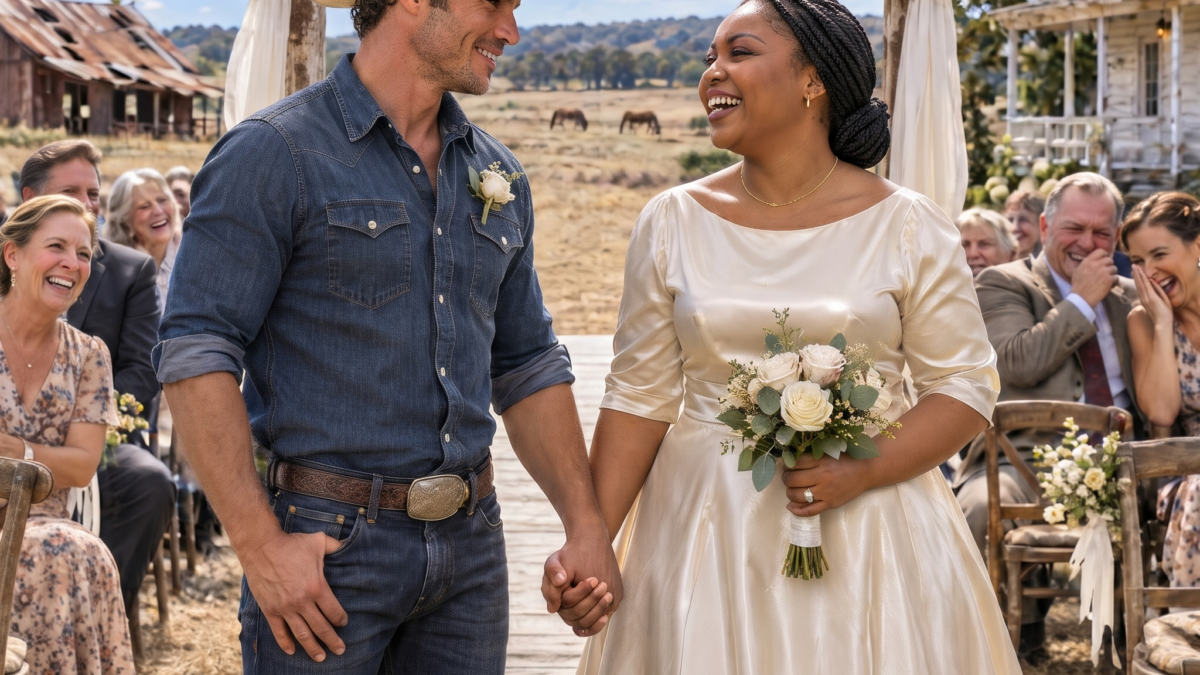
When I walked toward Cody, I wore a simple ivory dress that I had chosen myself.
He stood waiting beneath the old wooden beams.
His eyes brightened when he saw me.
“Beautiful,” he whispered.
“You’re not allowed to change your mind.”
“Not a chance.”
The ceremony was short.
We made our promises without mentioning debts, property, or family arrangements.
I promised to stand beside him when life became difficult.
He promised to listen before making decisions.
We promised to protect the home we were building and never confuse the family name with the people who carried it.
When the minister pronounced us husband and wife, the barn erupted in applause.
Cody kissed me.
Then Winona called out from the front row.
“About time, boy!”
Everyone laughed.
After the ceremony, Darlene approached me near the serving table.
She looked at my dress.
“It’s lovely.”
“Thank you.”
She hesitated.
“I owe you an apology.”
I waited.
“I was wrong about you. I was wrong about what a nurse could do, and I was wrong about what it meant to be part of this family.”
Her voice shook.
“I don’t expect you to forgive me.”
“I appreciate you saying it.”
She looked toward Winona.
“She saved me a seat.”
“She did.”
Darlene nodded.
Then she walked toward the table.
It wasn’t a perfect reconciliation.
It wasn’t a magical moment when every hurt disappeared.
But it was a beginning.
And sometimes, a beginning was enough.
Later that evening, when the music had slowed and most of the guests had gone home, Cody and I stepped outside.
The ranch lay beneath a clear night sky.
The pastures stretched into the distance, and the creek reflected the moonlight. In the barn behind us, people were laughing as they cleaned the tables.
Cody slipped his arm around my waist.
“Do you ever think about leaving?”
I looked at him.
“Where would I go?”
“Somewhere warm. Somewhere without cattle.”
“I grew up around cattle.”
“Somewhere without my mother.”
“That sounds tempting.”
He laughed.
Then his expression softened.
“Thank you.”
“For what?”
“For choosing us.”
I looked across the property.
I thought about my grandfather’s farm, the bank notice on the door, and the years I had spent believing that some people were born to lose everything while others were born to own it.
I thought about Winona’s hands resting on the old photograph.
I thought about the first Sunday supper and the people who had arrived hungry.
And I thought about the woman who had entered our kitchen asking for a job.
“I didn’t choose the Ransom name,” I said. “I chose the people who needed a place to belong.”
Cody squeezed my hand.
“That’s a better reason.”
We stood together for a while.
The ranch wasn’t perfect. There were still fences to repair, cattle to move, contracts to fulfill, and difficult conversations waiting for us.
But the bank no longer owned our future.
The land was producing again.
The house was still Winona’s home.
And the barn was full of people who knew they could come through the gate and find a meal.
I had once lost a farm because nobody could afford to keep it.
Now I was helping build something that could outlast the people who worked it.
The Ransom family had spent five generations choosing brides according to money, reputation, and the convenience of keeping land in the family.
They had mistaken a marriage for a transaction.
They had mistaken wealth for worth.
And they had nearly lost everything because no one remembered what a family was supposed to protect.
I had arrived at the ranch as a nurse with a borrowed dress and a promise to an old woman.
I had stayed because the land deserved another chance.
And when Cody asked me to marry him again, I finally understood something.
I hadn’t been chosen because I looked like a Ransom bride.
I had been chosen because I knew how to build a home.
This time, I wore my own dress.
And this time, I knew exactly where I belonged.