Navy SEAL Helped a Little Girl Buy Her Mom a Cake—Then He Recognized the Name on Her Necklace
103 LETTERS HOME
The first time I saw my daughter, she was two dollars and fifteen cents short of buying her mother’s birthday cake.
I was standing near the back of Merritt’s Bakery, waiting for a cup of coffee, when I heard a small voice at the counter.
“One strawberry cake, please. It’s for my mom’s birthday.”
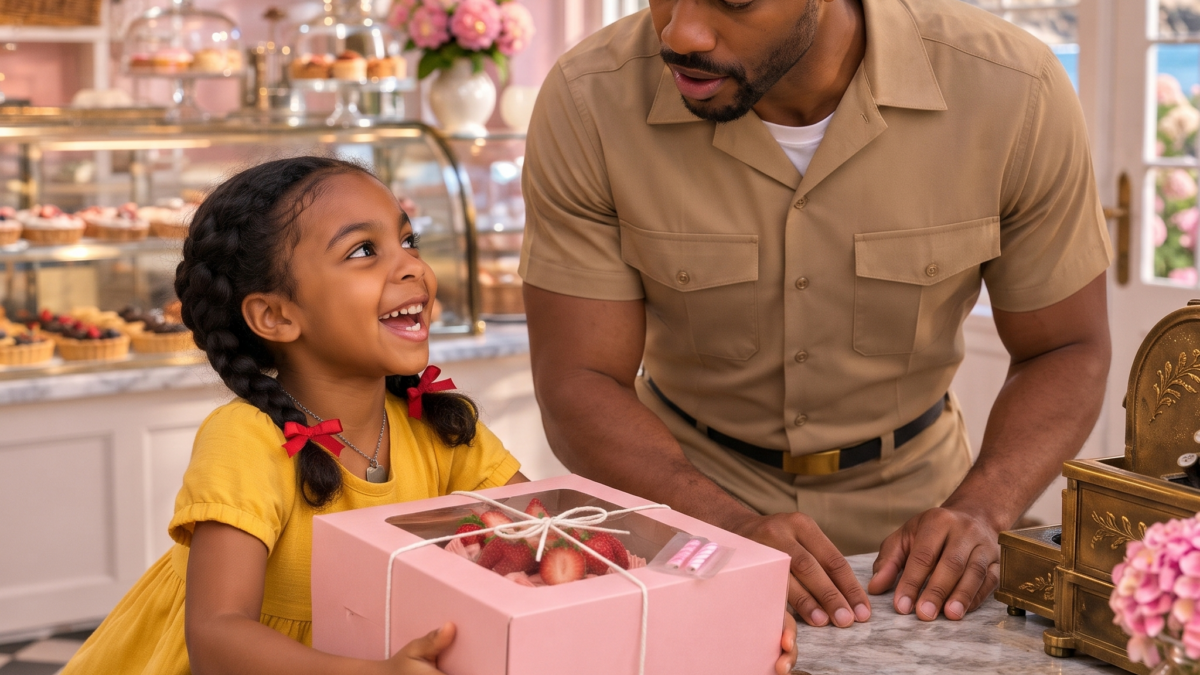
The girl stood on tiptoe, trying to see over the glass display. She was perhaps seven, with dark curls tied into two uneven ponytails and a yellow sweater that looked a little too big for her. A canvas backpack hung from one shoulder. She had arranged a collection of coins and crumpled bills on the counter, carefully separating them into little piles.
The woman behind the register smiled.
“That’s a lovely choice. Strawberry is one of our favorites. That’ll be twenty-four dollars and eighty-five cents.”
The girl counted her money.
Once.
Then again.
She moved a quarter from one pile to another, looked at the total, and began counting her pennies.
“Twenty-one dollars…”
She stopped.
“Twenty-two dollars and seventy cents.”
The girl looked up.
“Oh.”
The disappointment on her face was so immediate that I almost turned away. I had seen grown men try harder than that to hide disappointment. She simply stood there, considering what to do next.
“Maybe I can get a smaller one,” she said.
The cashier glanced at the cakes.
“We don’t have a smaller strawberry one today, sweetheart.”
The girl looked down at the money.
“I can come back.”
I stepped forward and placed a couple of bills on the counter.
“That’s fine. I’ll cover the rest.”
The girl turned.
The cashier looked at me.
“Sir, you don’t have to—”
“I know.”
I pushed the money across.
“Keep the change. Get her the candles, too.”
The girl stared at me.
“Really?”
“Really.”
She looked at the cake, then at me.
“Thank you, sir.”
“You’re welcome.”
She gathered her coins and carefully put them back into her little purse.
Then she picked up the cake box.
It was too big for her. The bottom tilted, and she struggled to balance it.
“Would you like a hand with that?”
She nodded.
“Yes, please.”
I took the box.
As I did, something hanging around her neck slipped out from beneath her sweater.
A military identification tag.
I glanced at it automatically.
Then I stopped breathing.
The metal was scratched and worn, but the lettering was unmistakable.
SOWANDE.
I knew that name.
I had worn one just like it for years.
I leaned closer.
“Sweetheart, may I take a look at that?”
She touched the tag.
“This?”
“Yes.”
“Sure. Be careful. It’s special.”
I lifted it gently.
The chain was old. The metal carried a small scratch near the lower edge, and one corner was slightly bent.
I knew that mark.
I knew the way the letters had been stamped.
I knew the tiny indentation beside the second O.
It was my tag.
Not a copy.
Not something similar.
Mine.
My hands began to shake.
“Where did you get this?”
The girl looked at me as though the answer were obvious.
“It’s my dad’s. Mom says he’s a hero.”
I swallowed.
“What’s your name?”
“Zora.”
“Zora…”
She nodded.
“My dad’s name is Cyrus Sowande. Do you know him?”
I looked at the little girl standing in front of me.
Eight years earlier, I had left a woman I loved behind to serve my country. I had spent those years believing she had married someone else, moved away, and chosen a life without me.
Now a little girl was standing in a bakery, wearing my identification tag.
“Does your mother know you have this?”
“She gave it to me on my first day of school.”
“Did she say anything else about your father?”
“She says he’s far away, keeping people safe.”
The words seemed to pass through me rather than reach my ears.
“That’s what she says?”
Zora nodded.
“She also says he wrote the best letters.”
I looked at the tag again.
“Letters?”
“Yes. But they all got lost. I think the mailman was really bad at his job.”
I couldn’t speak.
The cashier was watching us.
“Sir? Is everything all right?”
I lowered my hand.
“Yes.”
But nothing was all right.
Not anymore.
Zora shifted the cake box in my arms.
“Are you okay?”
I forced myself to smile.
“Yes, sweetheart.”
She studied me.
“Do you keep people safe, too?”
“I try my best.”
“Every single day?”
“Every single day.”
She nodded, satisfied with the answer.
Then she looked down at the floor.
“You walk like you’re counting your steps.”
I stared at her.
“What?”
She demonstrated, moving one foot carefully in front of the other.
“Like this. One, two, three…”
I couldn’t help smiling.
“Old habit.”
“Me, too. I count everything.”
“Everything?”
“Shirt buttons, my last task, steps. There are ninety-two steps from the bakery to our gate.”
She looked toward the door.
“Ninety-one if I run.”
I laughed.
For the first time that afternoon, I felt something other than shock.
“Then we’d better not run with your cake.”
She nodded seriously.
“You’re right. It’s very important.”
The walk to her home took less than ten minutes.
Zora talked almost the entire way.
She told me about her school, her favorite teacher, a classmate who had lost a tooth during lunch, and a dog that sometimes followed her to the bus stop.
I listened.
Every now and then, I asked another question.
I was afraid that if I spoke too much, my voice would give me away.
“Mom loves strawberries,” she said as we crossed the street. “More than chocolate.”
“That’s unusual.”
“I know. Most people like chocolate better.”
“Your mother always liked strawberries.”
Zora looked at me.
“You know my mom?”
I stopped.
She looked up at my face, waiting.
I had to choose my words carefully.
“I knew someone who liked strawberries a long time ago.”
“Was she pretty?”
I smiled faintly.
“Very.”
“Did she sing?”
I looked at her.
“Yes.”
Zora’s expression brightened.
“Then you might know my mom! She sings at the Blue Gala on Friday nights. Everybody claps.”
I felt the old memories stirring.
The Blue Gala was a small music room near the harbor. Tamar used to sing there before she started working at Merritt’s Bakery. She loved old soul songs, especially the ones her mother had played when we were young.
“She still sings?”
“Every Friday.”
I looked away.
“That’s good.”
Zora touched the tag.
“Mom gave me this when I started school. She said Dad went far away to keep people safe.”
I nodded.
“She told you the truth.”
“Do you know him?”
I looked at the girl.
“Almost everybody in the Navy knows everybody,” I said.
She grinned.
“Then maybe you can tell him I have his tag.”
I felt my throat tighten.
“Maybe I can.”
We reached a small apartment building near the end of the street.
Zora pointed toward the entrance.
“That’s our gate.”
I carried the cake up the short path.
A woman was standing near the doorway, holding a dish towel. She had dark hair pulled loosely behind her head and wore a simple blue sweater.
I knew her immediately.
Tamar.
Eight years had passed, but I would have recognized her in a crowded station, in a dark street, or through a window covered in rain.
She looked up.
“Zora? Where have you been?”
Then she saw me.
Her face changed.
The dish towel slipped from her hand.
For a moment, she didn’t move.
I held the cake box between us.
“Hello, Tamar.”
Her lips parted.
“Cyrus.”
I heard my name in her voice, and the years between us seemed to disappear.
Then she stepped backward.
“Don’t say my name like that.”
“Tamar—”
“Eight years.”
She looked at the little girl.
“Take the cake inside, sweetheart.”
Zora shifted excitedly.
“Mom, a really nice man helped me buy it. He even carried it all the way home.”
Tamar looked at me again.
“Thank you.”
“You’re welcome.”
Zora picked up the cake.
“Bye, Mr. Sowande.”
She paused.
“Thank you for carrying it.”
I watched her disappear into the kitchen.
Tamar remained at the door.
Her eyes were wet.
“Eight years, Cyrus. You never came back. Not once.”
I stared at her.
“I did come back.”
She shook her head.
“Please don’t.”
“I came back to town on leave. Eight months after I shipped out. I went straight to Merritt’s Bakery because I couldn’t reach you. Your number was disconnected. Vera told me you had married someone and moved away.”
Tamar stared.
“Married?”
“That’s what she said.”
She took a slow breath.
“I was eight months pregnant, Cyrus. Vera fired me that same month.”
The world seemed to tilt.
“Pregnant?”
She looked at me with an expression I couldn’t understand.
“Yes.”
I struggled to speak.
“With…”
She looked toward the kitchen.
“Zora.”
I closed my eyes.
My daughter.
The little girl who had counted coins in front of me.
The child who wore my military tag.
She was my daughter.
I had missed her birth.
Her first steps.
Her first words.
Her first day at school.
I had missed seven years of her life because somebody had told me the woman I loved had moved on.
“Tamar, I didn’t know.”
She laughed bitterly.
“Neither did I.”
“What do you mean?”
“I wrote you every week, Cyrus. Every single week.”
I stared at her.
“I wrote you every week, too.”
She shook her head.
“I never received a single letter.”
“Neither did I.”
We stood there, looking at each other.
Eight years of silence.
Eight years of birthdays, Christmases, and ordinary evenings that had passed without either of us knowing the other was still waiting.
Tamar wiped her eyes.
“Linus found me a rental after Vera fired me. He paid the first year. His family helped me when I had nowhere to go.”
I looked toward the kitchen.
“Linus Merritt?”
“Yes.”
“He’s…”
“My fiancé.”
The words landed harder than I expected.
“You’re marrying him?”
“In three weeks.”
I lowered my eyes.
“I see.”
She folded her arms.
“I have a daughter to raise. I couldn’t wait forever.”
I wanted to tell her that I hadn’t chosen to leave. That I had written every Sunday. That I had returned to find her and had been told she was gone.
But she had spent eight years raising a child without me.
I couldn’t ask her to accept my explanation as though it repaired anything.
“Can I see her again?” I asked.
Tamar looked toward the kitchen.
“I don’t know.”
“Please.”
“I need to think.”
I nodded.
“Of course.”
She looked at me for another moment.
Then she turned and closed the door.
I stood outside for a long time.
Behind the glass, I could hear Zora laughing.
I didn’t sleep that night.
I sat in my rented room with my old Navy identification tag in my palm.
The tag had been lost during my first deployment. I had reported it missing, but I had never believed I would see it again.
Now it was hanging around my daughter’s neck.
I replayed every second of the afternoon.
The coins.
The cake.
The little house.
Her questions.
Her way of counting steps.
It was strange how much of me I could see in someone I’d never met.
At 11:46 p.m., I called Isaiah.
He answered almost immediately.
“Chief Sowande, it’s midnight. Somebody better be on fire.”
Isaiah had served with me for years. He had been my closest friend in the Navy, the man who had helped me through difficult deployments and who had once carried me out of a flooded compartment after a training accident.
He was still serving.
He was also one of the few people I trusted to tell me when I was being an idiot.
“Isaiah.”
He paused.
“That doesn’t sound good.”
“I found someone.”
“Someone?”
“My daughter.”
Silence.
Then he sat up.
“What?”
I told him about the bakery, the tag, and Tamar.
I told him about Vera.
I told him about the pregnancy.
And I told him that Tamar had never received any of my letters.
Isaiah listened without interrupting.
When I finished, he asked, “You mean the letters you sent from the base?”
“All fifty-two.”
“One every week?”
“Yes.”
“I remember. You used to make me sit beside you while you wrote them. You’d check every address twice.”
“She says she wrote me, too.”
“Then where did they go?”
I looked down at the tag.
“Through the mail tray at Merritt’s Bakery.”
Isaiah was silent.
“That’s where she left hers, too.”
“Wait. The bakery?”
“Yes.”
He took a breath.
“Who handled the mail?”
“Linus Merritt. Vera’s son.”
Isaiah swore quietly.
“That’s cold.”
“Vera told me Tamar was married and gone.”
“And Tamar thinks you stopped writing.”
I leaned back.
“Exactly.”
We were silent for a moment.
Then Isaiah asked, “What are you going to do?”
I looked toward the window.
“Find out where the letters went.”
“And after that?”
“Let Tamar decide.”
He hesitated.
“Brother, you’ve spent your entire career looking after people. Don’t forget that the little girl needs a father now, not just a man chasing old mail.”
I smiled faintly.
“I know.”
“And what about your own heart?”
I looked at the tag.
“I’m not sure what to do with that yet.”
Isaiah sighed.
“Well, whatever happens, don’t let anyone tell you that the truth is too old to matter.”
I nodded.
“Thanks.”
“Anytime, Chief.”
The next morning, I returned to Merritt’s Bakery.
The bell above the door rang when I entered.
The place smelled exactly as I remembered: fresh bread, cinnamon, coffee, and warm sugar.
Vera Merritt stood behind the counter.
She was older now, but her sharp eyes were unchanged.
When she saw me, her expression tightened.
I walked to the register.
“Good morning, Mrs. Merritt.”
She looked at me for a long moment.
“Can I help you?”
“Eight years ago, I stood right here.”
She didn’t answer.
“You told me Tamar had married someone and moved away.”
Vera picked up a cloth.
“I don’t remember you.”
“You remembered me yesterday.”
Her expression changed.
“People like you all look the same after a while.”
I leaned closer.
“She was pregnant, and you fired her.”
“I run a bakery, not a charity for women in trouble.”
“And then you lied to me.”
Vera placed the cloth on the counter.
“There’s nothing here for you, sailor.”
“Where are the letters?”
She stared.
“What letters?”
“The ones Tamar sent. The ones I sent. They went through your bakery.”
She looked toward the back room.
Just for a second.
But I saw it.
“You’re wasting your time.”
“Did Linus take the mail to the post office?”
“He helped with deliveries.”
“For how long?”
“That’s none of your business.”
I looked around.
A young woman was arranging cakes near the display.
She had been listening.
Vera noticed.
“Penny! Mind your register.”
The girl lowered her eyes.
“Yes, Mrs. Merritt.”
Vera turned back toward me.
“People like you should keep walking. There never was anything here for you.”
I held her gaze.
“That’s not true.”
I walked out.
On the sidewalk, I stood beneath the bakery sign.
I could hear Vera speaking sharply behind me.
Then another voice called from the doorway.
“Chief Sowande?”
I turned.
The young woman from the counter had stepped outside.
“Can I speak with you?”
Her name was Penny.
She was in her twenties, with an uncertain smile and flour dust on one sleeve.
“I heard what Mrs. Merritt said,” she began. “I’m sorry.”
“Thank you.”
“I shouldn’t have listened, but I couldn’t help it.”
“That’s all right.”
She glanced back at the bakery.
“There’s something you should know.”
I waited.
“Linus Merritt carries the shop’s mail to the post office every morning. He won’t let anyone else touch the tray. Not even me.”
“For how long?”
“Years. I’ve worked here six years. He was doing it before I started.”
I felt my pulse quicken.
“Is there anything else?”
Penny hesitated.
“There’s a blue box in the storeroom behind the old ledgers. It’s taped shut. It says, ‘Linus, do not open.'”
“Have you looked inside?”
“No. But I’ve seen envelopes sticking out of the side.”
I stared at her.
“Thank you.”
She shrugged.
“I don’t know if it’s important.”
“It is.”
She glanced toward the bakery again.
“Mrs. Merritt might fire me if she finds out I told you.”
I considered that.
“Do you need another job?”
Her eyes widened.
“Why?”
“I know people who own restaurants and cafés. I can give you a reference if she lets you go.”
She almost smiled.
“The Navy needs bakers?”
“Everybody needs bakers.”
Penny laughed softly.
“Then go get your family back, Chief.”
I nodded.
“I intend to.”
I contacted Isaiah again that afternoon.
He had already found someone who could verify the original dispatch records from my old unit.
“Chief, I have the dates,” he said. “You mailed fifty-one letters from the base before the last one came back.”
“Fifty-one?”
“Yes. The fifty-second was returned with a stamp saying she’d moved.”
I closed my eyes.
“And Tamar?”
“She says she wrote every week.”
“Fifty-two letters.”
Isaiah exhaled.
“Then that’s 103 letters between you.”
I looked at the bakery across the street.
“All of them missing.”
“Not necessarily.”
I thought of Penny’s blue box.
“There’s a storeroom.”
“Then we need to find out what’s inside.”
I called Tamar.
She answered after several rings.
“Cyrus?”
“I won’t take much of your time.”
“What’s wrong?”
“Penny told me there’s a blue box in the bakery storeroom. She thinks it contains letters.”
Tamar was quiet.
“That’s impossible.”
“Why?”
“Because Linus always offered to take my letters to the post office. Even after Vera fired me, he kept doing it.”
My throat tightened.
“Did any letters ever come back?”
“No.”
“Did you keep copies?”
“No.”
I took a breath.
“Tamar, I think we need to look.”
She was silent.
Then she said, “I have a key.”
Tamar called me the following evening.
“I found them.”
I stood up.
“All of them?”
“Every one.”
Her voice was unsteady.
“Linus brought them home in a grocery bag. He kept them in the storeroom behind the old ledgers.”
I closed my eyes.
“How many?”
“Fifty-two from me. Fifty-one from you.”
I leaned against the wall.
“Then the last one…”
“Was returned to you.”
“Yes.”
She began to cry.
“I never stopped writing, Cyrus.”
“Neither did I.”
“I thought you had given up.”
“I thought you had moved on.”
We were quiet.
Then she said, “I read some of them.”
I looked down.
“What did they say?”
“Everything.”
She laughed through her tears.
“You told me about the sea, the food, the men you worked with, and how much you missed home. You wrote about a little apartment you wanted to rent when you came back.”
I smiled faintly.
“I remember.”
“And I wrote about the baby.”
My eyes filled.
“Zora.”
“Yes.”
I heard her take a shaky breath.
“There’s a letter from the day she was born.”
I closed my eyes.
“Can I read it?”
“Not yet.”
I waited.
“I’m still trying to understand what happened. I need time.”
“Of course.”
She paused.
“Linus knows I found the box.”
I felt my jaw tighten.
“How?”
“Vera knows. So by now, he knows too.”
I looked toward the window.
“Then he’ll know we have the truth.”
The following morning, Tamar came to see me.
She carried a small envelope.
She looked tired.
“What’s that?” I asked.
“The letter I wrote when Zora was born.”
I took it carefully.
The handwriting was hers.
I recognized every curve.
“Dear Cyrus,” it began. “She was born at 6:12 this morning. She has your eyes and your stubborn chin. I named her Zora. I tied your tag to her crib because I wanted her to have something that belonged to you.”
I could no longer read.
I held the paper against my chest.
Tamar watched me.
“I begged you to come home.”
I looked at her.
“I didn’t know.”
“Neither did I.”
She sat beside me.
“Every night, I told Zora stories about you. Even when I was angry. Even when I thought you had abandoned us.”
“Why?”
“Because I didn’t want her to hate her own name.”
I looked at her.
“She’s brilliant, Tamar.”
A small smile appeared.
“She counts everything.”
I laughed softly.
“Yes.”
“She counted your steps from the bakery.”
“She told me.”
Tamar studied my face.
“You noticed?”
“I noticed everything.”
She looked away.
“I don’t know how to feel.”
“Neither do I.”
“Linus has helped us. He paid the rent when I had nowhere to go. He drove me to the hospital. He was there when Zora was sick. He made sure we had somewhere to live.”
I nodded.
“I understand.”
“He’s not a monster every minute of the day.”
“I didn’t say he was.”
She looked toward me.
“But he knew about the letters.”
I said nothing.
“How do you live with that?”
I took a breath.
“You don’t have to decide today.”
She nodded.
“Linus wants to announce the adoption at the engagement party. He’s already made the arrangements.”
“Adoption?”
“He’s planning to adopt Zora after the wedding. He wants her to become Zora Merritt.”
I looked at her.
“Does she want that?”
Tamar shook her head.
“She doesn’t understand what it means. She thinks it means he’ll be her new father.”
I lowered my eyes.
“She already has a father.”
“I know.”
She touched the necklace she was wearing.
“But he was the person who showed up.”
I looked at her.
“I know I wasn’t there.”
She wiped her eyes.
“I need time, Cyrus.”
“Take it.”
I stood.
“I’m not going to force you to choose me. I only want the chance to know my daughter.”
She nodded.
“I’ll think about it.”
That evening, I went back to the bakery.
Penny was arranging trays near the counter.
When she saw me, she gave a small smile.
“Did you find them?”
“Yes.”
She looked relieved.
“Good.”
I glanced toward the storeroom.
“Did Vera know about the box?”
Penny lowered her voice.
“Yes.”
“How do you know?”
“She told Linus to keep it hidden. I heard them arguing once. She said the letters were leverage.”
I stared at her.
“Leverage?”
Penny nodded.
“She said she kept them so Linus would never cross her.”
I felt cold.
“Thank you for telling me.”
Penny looked frightened.
“Chief, I don’t want to cause trouble.”
“You haven’t.”
She hesitated.
“Mrs. Merritt said the engagement party is still happening tomorrow at seven.”
“Is that right?”
“Yes.”
I nodded.
“Then I’ll see you there.”
Vera Merritt had spent years believing she knew exactly what was best for her son.
She had met me only briefly before I deployed. She hadn’t liked that I wore a uniform, hadn’t liked that Tamar was serious about me, and hadn’t liked the idea that her employee might marry someone whose career would keep him away for long periods.
She believed military men never stayed.
She believed women who trusted them were fools.
She believed she had rescued Tamar from a life of disappointment by persuading her that I had moved on.
When I returned on leave and asked where Tamar was, Vera saw an opportunity.
She told me Tamar had married.
She told Tamar I had stopped writing.
Then she took the letters.
At first, she said she was protecting her son.
Then, as the years passed, the letters became something else.
Proof that she controlled a secret powerful enough to keep Linus obedient.
Penny later told me that Vera had once threatened to show the letters to Tamar if Linus ever went against her.
She had never intended to deliver them.
And when Linus finally became engaged to Tamar, he believed the letters were safer hidden than destroyed.
He was wrong.
The engagement party was held at a hotel near the harbor.
It was a large gathering. Friends, bakery employees, business associates, and members of the Merritt family filled the ballroom. A small stage had been arranged near the back, with flowers and a microphone.
I arrived shortly before seven.
I wore a dark suit.
No uniform.
No medals.
I didn’t want to turn the evening into a performance.
I wanted the truth to speak for itself.
Penny was near the entrance. She saw me and gave a small nod.
Tamar was standing beside Linus.
She looked beautiful.
Her hair was swept back, and she wore a simple blue dress. The tag was visible around her neck.
Linus leaned toward her, whispering something.
She didn’t smile.
I found a place near the rear of the room.
Then I waited.
Linus opened the evening with a toast.
“Friends, thank you all for coming.”
He raised his glass.
“Three weeks from now, this beautiful woman becomes my wife. And her daughter becomes part of the Merritt family.”
The guests applauded.
Tamar remained still.
Linus smiled toward the crowd.
“Zora will officially become Zora Merritt. We’re very excited.”
More applause.
He turned toward Tamar.
“She’s had a difficult beginning, but I’ve been fortunate enough to help her build a better life.”
I looked at her.
Her fingers were wrapped around the edge of the table.
Then Linus noticed me.
His smile changed.
“Well.”
He gestured toward the rear.
“It looks as though we have a surprise guest.”
Several people turned.
The room fell quiet.
“The man who walked out on a pregnant woman,” Linus said. “Eight years later, he wants a slice of the cake.”
A few people laughed uncertainly.
I stood.
Linus raised his glass.
“People like him leave. That’s what they do.”
He turned toward the guests.
“They disappear when life gets difficult, then return when they hear someone else has built a comfortable home.”
I looked at Tamar.
She was staring at me.
Then she stepped forward.
“May I say something, Linus?”
He smiled.
“Of course, darling. It’s your party.”
Tamar walked toward the microphone.
She carried a small blue box.
The room became quiet.
“These are letters,” she said.
Linus’s smile faded.
“Fifty-two from me. Fifty-one from Cyrus.”
A murmur spread through the room.
“The fifty-second letter he sent came back to him. It was stamped ‘Moved.'”
She looked at me.
“Not one of them was ever delivered.”
Tamar opened the box.
Inside were envelopes tied together with faded ribbon.
She placed them on the table.
“I found these yesterday in the storeroom behind the old ledgers at Merritt’s Bakery.”
Vera stood.
“That’s absurd. Anybody could have put those there.”
Tamar looked at her.
“These are my letters, Vera.”
“You’re upset. You don’t know what you’re saying.”
“I know exactly what I’m saying.”
She lifted one envelope.
“This one was written when I was eight months pregnant.”
Her voice trembled.
“Dear Cyrus. I don’t know whether you’ll ever receive this, but I’m trying again. I miss you. I want to tell you the baby is moving more every day. I keep wondering whether she’ll have your eyes.”
She swallowed.
“The next one was written the day Zora was born.”
The room was completely silent.
Tamar opened the letter.
“Dear Cyrus, she was born at 6:12 this morning. She has your eyes and your stubborn chin. I named her Zora. I tied your tag to her crib because I wanted her to have something that belonged to you.”
I looked down.
The little girl in the bakery had been wearing that tag.
My tag.
Tamar continued.
“Please come home to us. I don’t know how to raise her without you, but I will. I just want you to know that she is here, she is healthy, and she already has a laugh that sounds like yours.”
Her voice broke.
I lowered my head.
For eight years, that letter had been waiting in a box.
I had never read it.
I had never known it existed.
Tamar looked toward Linus.
“Do you recognize the handwriting?”
He shook his head.
“Those could be anyone’s.”
She lifted another envelope.
“Return to sender. Moved.”
Then she showed the crowd the message written beneath the stamp.
Recipient no longer at this address.
The handwriting was unmistakable.
Linus’s.
Tamar held up a second piece of paper.
“And this is the note he left on Cyrus’s windshield yesterday.”
The room stirred.
“Same handwriting. Same looping R. Same way of crossing the T.”
Linus looked around.
“That’s ridiculous.”
Tamar faced him.
“You brought my letters home in a grocery bag. You hid them behind your mother’s ledgers for eight years.”
Vera stepped forward.
“I kept them because I was protecting my son.”
I turned toward her.
“From what?”
She looked at me.
“From a sailor who was never going to stay.”
I stared.
“I returned to find Tamar.”
“You returned for a few hours. Then you left again.”
“Because you told me she had married.”
Vera lifted her chin.
“She had to move on.”
Tamar’s voice sharpened.
“You fired me while I was pregnant. You told him I had moved away. You told me he had stopped writing. And then you let your son stand beside me and pretend he had rescued me.”
Vera had no answer.
Tamar looked at Linus.
“You told me you were the one who had stayed.”
Linus stepped toward her.
“I did stay. I was here. I helped you.”
“Yes. You helped me when I had nowhere to live.”
“I paid your rent.”
“I know.”
“I took you to appointments.”
“I know.”
“I was there for Zora.”
Tamar’s eyes filled.
“And you made sure her father never had the chance to be there, too.”
Linus’s face twisted.
“You’re being unfair.”
“No. I’m finally being honest.”
He reached for her arm.
She stepped away.
“Don’t.”
He lowered his hand.
“You have no idea what you’re throwing away.”
Tamar looked at the blue box.
“I know exactly what I was given. And I know exactly what you took.”
Vera turned toward the guests.
“Everyone, please. This is a private family matter. We don’t need to humiliate anyone.”
I stepped forward.
“No one needs to be humiliated.”
Linus laughed.
“That’s easy for you to say. You weren’t there.”
I looked at him.
“You’re right.”
He seemed surprised.
“I wasn’t there when she needed a place to live. I wasn’t there when Zora was born. I wasn’t there for her first steps, her first birthday, or the first day of school.”
I took a breath.
“I won’t pretend those years don’t matter.”
The room remained quiet.
“But I didn’t choose to abandon them. I wrote every week. I sent fifty-two letters. Tamar wrote fifty-two letters. None were delivered.”
Linus looked away.
I continued.
“I don’t expect her to forget those years because I’ve walked back into town. I don’t expect Zora to call me Dad tomorrow. I don’t expect Tamar to marry me because I have a uniform or a story.”
I looked at Tamar.
“I only want the chance to be there now.”
Tamar’s eyes filled.
Then she walked toward me.
She took my hand.
“That’s all I wanted.”
I squeezed her fingers.
She turned toward the guests.
“I won’t marry Linus.”
A shocked murmur spread through the room.
“Tomorrow, the postal inspector will receive copies of every letter and the handwriting samples. The authorities can decide what happened to the mail.”
Vera’s face went pale.
Linus looked furious.
“You can’t do this.”
Tamar faced him.
“I can.”
The engagement party ended early.
Guests left in small groups, speaking quietly among themselves.
Vera stayed near the table, staring at the blue box.
Linus disappeared into the hotel corridor.
Penny approached me.
“Chief.”
I turned.
She smiled nervously.
“I thought you should know. Someone from the postal service is on their way to meet with Mrs. Lawson tomorrow.”
“Thank you, Penny.”
She nodded.
Then she looked at the letters.
“I’m glad you found them.”
“So am I.”
She hesitated.
“Mrs. Merritt is going to be furious.”
I smiled.
“She can be.”
Penny laughed softly.
For the first time, I saw her stand a little taller.
“Good luck, Chief.”
I nodded.
“Same to you.”
Tamar and I left the hotel together.
We walked toward the harbor, where the lights reflected across the water.
For a while, neither of us spoke.
Then she said, “I don’t know what to do now.”
I looked at her.
“You don’t have to decide tonight.”
“I’ve been with Linus for years. He helped us. He made sure Zora had somewhere to live.”
“I know.”
“He wasn’t kind to you.”
“No.”
She looked down.
“But he wasn’t always cruel to me.”
I considered that.
“People aren’t always one thing.”
She nodded.
We continued walking.
After a while, she stopped.
“I was so angry with you.”
“I understand.”
“I thought you had forgotten us.”
“I never did.”
“Every Sunday, I waited for the mail.”
I looked at her.
“Every Sunday, I wrote another letter.”
She laughed through her tears.
“That’s ridiculous.”
“It is.”
She touched the tag at her neck.
“I kept this because I wanted Zora to know you existed.”
I smiled.
“She knows.”
“She doesn’t understand what happened.”
“She doesn’t need every detail yet.”
Tamar looked at me.
“Do you want to meet her properly?”
I nodded.
“More than anything.”
“Then tomorrow.”
“Tomorrow?”
“It’s my birthday.”
I smiled.
“I know.”
She raised an eyebrow.
“How?”
“I remembered.”
Her expression softened.
“Then come to the backyard. We’ll have balloons, a cake, and a proper introduction.”
I laughed.
“Another strawberry cake?”
“Of course.”
“You haven’t changed.”
“Neither have you.”
I reached for her hand.
She let me take it.
That night, I called Isaiah.
He answered immediately.
“Chief?”
“It’s done.”
“What happened?”
I told him about the letters and the engagement party.
He listened.
When I finished, he let out a long breath.
“One hundred and three letters.”
“One hundred and three.”
“And you both thought the other one had moved on.”
“Yes.”
“That’s a hell of a thing.”
I looked out at the harbor.
“It is.”
“What happens now?”
“Tomorrow I meet my daughter.”
Isaiah was quiet for a moment.
“How are you feeling?”
“Terrified.”
He laughed.
“Good. Means you understand how important it is.”
“I don’t know what to say to her.”
“Tell her the truth. Then listen.”
I smiled.
“You’re full of wisdom tonight.”
“Don’t get used to it.”
I arrived at Tamar’s apartment shortly before noon.
A small table had been set up in the backyard. Balloons were tied to the fence, and a strawberry cake sat in the middle.
There were thirty-two candles.
I stared at them.
“Thirty-two?”
Tamar smiled.
“I put them in myself. Counted twice.”
I looked at the candles.
“That’s a lot of candles.”
“It’s my birthday. I get to decide.”
Zora ran out of the kitchen.
“Dad!”
She stopped.
For a moment, she looked uncertain.
Then she glanced at my identification tag.
“You’re the man from the bakery.”
I smiled.
“That’s right.”
She looked toward Tamar.
“Mama?”
Tamar knelt beside her.
“Sweetheart, there’s something I want to tell you.”
Zora looked between us.
Tamar took her hand.
“This is Cyrus Sowande.”
The girl tilted her head.
“Like the name on my tag?”
“Yes.”
Tamar looked at me.
“He’s your father.”
Zora’s eyes widened.
Then she smiled.
“I knew it at the bakery.”
I laughed.
“You did?”
“Of course.”
She held up the tag.
“Same name. Same scratch. Same eyebrows.”
I touched my face.
“My eyebrows?”
She nodded.
“And you count things like me.”
Tamar laughed.
“She noticed you counting your steps.”
I crouched in front of Zora.
“You’re a very observant girl.”
“I know.”
She considered me.
“Are you going away again?”
The question hurt.
I looked at her.
“I may have to travel sometimes because of my work. But I will always come back. I’ll call you. I’ll write to you. And I’ll make sure you know where I am.”
She studied me.
“Promise?”
I held out my hand.
“Promise.”
She placed her small hand against mine.
“Okay.”
Then she reached into her backpack.
“I made you something.”
She pulled out a drawing.
It showed three people standing beside a little house. One was wearing a blue uniform, one had long dark hair, and the smallest was holding a huge strawberry cake.
I looked at it.
“Who’s this?”
“That’s me.”
“And this?”
“Mom.”
I smiled.
“And this?”
She pointed to the uniformed figure.
“That’s you.”
I looked up.
“Thank you, Zora.”
She nodded.
“You’re welcome.”
Then I took a small package from my bag.
“I brought you something, too.”
She opened it.
Inside was a new military identification tag, carefully engraved with her name.
ZORA SOWANDE.
She stared at it.
“That’s me.”
“All the way.”
She held it against her chest.
“Can I wear it?”
“Of course.”
She looked at the tag, then at me.
“Can I read all your letters?”
I nodded.
“One a night, starting tonight.”
“How many?”
“Fifty-one are in the box. One was returned to me.”
She counted on her fingers.
“Fifty-two.”
“That’s right.”
She smiled.
“One every week for a whole year.”
I laughed.
“Exactly.”
“And you’ll write me more?”
“Every week.”
She thought about that.
“Then I’ll count every single one.”
I looked at Tamar.
“She’ll find a typo, too.”
Tamar laughed.
“And charge you two dollars and fifteen cents for it.”
Zora clapped.
“That’s how much you paid for my cake!”
We all laughed.
After lunch, I sat with Tamar beneath the backyard tree.
Zora was showing Bruno how to chase a ball. Lucas wasn’t in this story; there was no other man waiting to claim the space beside me. For the first time in years, I didn’t need to compete with the past.
I looked at the letters on the table.
Tamar had arranged them in chronological order.
Fifty-two from her.
Fifty-one from me.
The final letter I had written had been returned, marked MOVED.
One hundred and three letters.
One hundred and three attempts to reach someone who was only a few miles away.
I picked up one of Tamar’s.
“May I?”
She nodded.
I opened it.
Her handwriting was softer than I remembered.
Dear Cyrus,
Today I heard a song on the radio that reminded me of you. I wanted to call, but I don’t know whether the number still works. I hope you’re eating properly. I hope you’re sleeping. I hope you’re safe.
Sometimes I get angry because you’re so far away. Then I remember why you left, and I feel proud of you again.
I miss you.
I set it down.
Tamar watched me.
“I wrote things like that every week.”
“I know.”
“Did you?”
I reached into my jacket and took out the last letter I had kept.
“I wrote this one before I came home on leave.”
She opened it.
Dear Tamar,
The sea has been rough for three days. I keep thinking about the little apartment we talked about. I want a kitchen with a window, somewhere you can put flowers. I want a table big enough for all the people we love.
I want to come home.
She looked up.
“I never saw this.”
“I know.”
She touched my hand.
“I’m sorry.”
I shook my head.
“We didn’t do this to each other.”
She leaned closer.
“Do you think we’ll ever get back what we lost?”
I considered the question.
“No.”
She looked down.
“But we can make something new.”
She smiled faintly.
“That’s not a bad answer.”
The following week, the postal inspector opened an investigation into the missing correspondence.
The records from the bakery, the handwriting on the returned letter, and the envelopes found in the blue box provided a clear trail. Vera and Linus were questioned about the handling of the mail.
Neither offered a convincing explanation.
Penny provided a statement confirming that Linus had insisted on handling the mail for years. The old delivery records showed that he had collected letters from the bakery and taken them away rather than leaving them for the postal service.
Vera initially claimed she had never seen the box.
When investigators showed her the note in her handwriting directing Linus to keep it hidden, she stopped answering questions.
The case took time.
There were statements to collect, records to examine, and legal questions about the mail that had been withheld.
I didn’t expect every lost year to be returned by a courtroom decision.
I only wanted the truth recorded.
Tamar didn’t want revenge.
She wanted the chance to raise Zora without being told who she was allowed to love.
We both agreed that Linus would not be adopting her.
The decision belonged to Tamar and, as Zora grew older, to Zora herself.
Three weeks later, I received orders confirming a shore assignment at the naval station twenty minutes outside town.
I had requested it before the engagement party.
I hadn’t been sure it would be approved.
Now I had a reason to hope.
Tamar read the message over my shoulder.
“Twenty minutes?”
“That’s what it says.”
“That’s close.”
“Very close.”
She looked at me.
“Does that mean you can drive her to school?”
“If you let me.”
She smiled.
“She’ll make you count every step from the car to the classroom.”
“I’ve been warned.”
“And she’ll want to know who you are.”
I laughed.
“Then I’ll tell her.”
Tamar folded the paper.
“She’s already halfway there.”
I reached for her hand.
“How about you?”
“What about me?”
“Are you halfway there?”
She looked at me for a long moment.
Then she smiled.
“Maybe.”
I leaned closer.
“That’s a start.”
The next evening, I took Zora to the bakery.
Merritt’s had closed temporarily after the investigation, and Penny was helping the health department review the records. She had found a new position at a café near the naval station.
When she saw us, she waved.
“Chief!”
Zora ran toward her.
“Hi, Penny!”
Penny smiled.
“Look at you. And who’s this?”
“My dad.”
Penny looked at me.
“Well, I’d say you finally found what you were looking for.”
I nodded.
“Thanks to you.”
She shrugged.
“Sometimes people just need someone to point them toward the right box.”
Zora looked at the counter.
“Can we buy a cake?”
Penny laughed.
“Of course.”
“Strawberry?”
“Naturally.”
I turned toward her.
“Still your favorite?”
She nodded.
“Mom’s favorite.”
I smiled.
“Then let’s get one.”
That night, I tucked Zora into bed.
She had insisted on wearing the new identification tag over her pajamas.
“Is it heavy?” I asked.
“A little.”
“You can take it off when you sleep.”
She considered that.
“Can I keep it beside my pillow?”
“Of course.”
She placed it on the bedside table.
Then she looked at me.
“Are you going away tomorrow?”
“I have to go to work.”
“Will you come back?”
“Yes.”
“What time?”
“After dinner.”
She thought for a moment.
“Can you write me a letter?”
I smiled.
“Even though I’ll see you tomorrow?”
“Yes.”
“Why?”
“So I can count it.”
I laughed softly.
“All right. One letter.”
She nodded.
“Good.”
I bent and kissed her forehead.
“Good night, sweetheart.”
“Good night, Daddy.”
I stood still for a moment.
Then I switched off the light.
The first letter I wrote to Zora was short.
I wrote it at the kitchen table after she had gone to sleep.
Dear Zora,
Today you told me to write you a letter even though I would see you tomorrow. I think that’s a very good idea.
I want you to know that I missed things I can never get back. I missed your first steps, your first words, and the day you started school. I cannot change that.
But I can be here for your next steps. I can listen to your stories, help you with your homework, teach you how to change a tire, and make sure you always know that you are loved.
I will keep writing. You can count every letter.
Love,
Dad.
I folded the paper and placed it inside an envelope.
Then I put it beside her identification tag.
The next morning, she found it before breakfast.
She read it twice.
Then she counted the words.
“There’s no typo.”
I smiled.
“Disappointing, isn’t it?”
She shook her head.
“It’s okay. I’ll find one next time.”
Life didn’t become perfect after that.
There were difficult mornings and long workdays. Tamar and I had to learn how to speak honestly after years of silence. We disagreed about small things. We sometimes misunderstood each other. I had to learn when to give her space, and she had to learn that I wasn’t going to disappear just because we argued.
Zora kept counting.
She counted the steps from the apartment to the gate, the candles on her birthday cake, and the letters I sent each week.
Whenever I had to travel for duty, I wrote before leaving.
Whenever I returned, I brought her a postcard.
She collected every one.
Tamar started singing more often. On Friday nights, I sometimes sat at the back of the Blue Gala and listened while she performed. I always applauded. She always found me in the crowd.
One evening, after a song, she came down from the small stage.
“You know,” she said, “I used to think I would never sing in front of you again.”
I smiled.
“Why?”
“Because I thought you had forgotten.”
I took her hand.
“I never forgot.”
She leaned against me.
“I know.”
One year after I found Zora in Merritt’s Bakery, we celebrated her eighth birthday.
The backyard was full of balloons.
There was a strawberry cake in the center of the table, and this time we had enough candles.
Zora had arranged them herself.
She stood beside the cake, counting.
“One, two, three…”
I watched her.
“How many?”
“Thirty-two.”
Tamar laughed.
“Sweetheart, those aren’t for me.”
Zora looked up.
“I know. I just like counting.”
I smiled.
“That’s my girl.”
She turned toward me.
“Can we read the rest of the letters tonight?”
“Which ones?”
“Daddy’s old letters. The ones in the blue box.”
I nodded.
“One a night.”
“How many are left?”
I looked at Tamar.
She smiled.
“Enough to keep us busy for a while.”
Zora clapped.
“One hundred and three nights!”
I laughed.
“That’s a lot of bedtime stories.”
She looked at me seriously.
“They’re not stories. They’re real.”
I knelt beside her.
“You’re right.”
She picked up the tag and held it against her chest.
“Can I wear this forever?”
“Yes.”
“Even when I get old?”
“Even then.”
She smiled.
“Good.”
After the party, Tamar and I sat on the back steps.
The evening was warm, and the lights from the house spilled across the garden.
I looked at her.
“Do you remember the first time we met?”
“At the bakery?”
“No. Before that.”
She smiled.
“You spilled coffee on my notebook.”
“I was carrying two cups.”
“You were looking at me.”
“I was trying to impress you.”
“You failed.”
I laughed.
“I know.”
She rested her head against my shoulder.
“Eight years, Cyrus.”
“I know.”
“I used to imagine what I’d say if you ever came back.”
“What did you imagine?”
“That I’d tell you how angry I was. That I’d ask why you left. That I’d make you explain every Sunday I spent waiting for the mail.”
“And now?”
She looked toward the house.
“Now I think I’m glad we found the letters.”
I took her hand.
“So am I.”
She smiled.
“Although I still think you owe me eight years of strawberry cake.”
I laughed.
“One cake at a time.”
She leaned closer and kissed me.
For a long moment, we sat quietly beneath the porch light.
Inside, Zora was arranging her colored pencils beside the letters.
She had found a new way to count time.
Not by the days we had lost.
But by the moments we still had.
Sometimes I think about the little girl who stood at the bakery counter with twenty-two dollars and seventy cents.
She didn’t know that a stranger was about to recognize the name on her necklace.
She didn’t know that her parents had written one hundred and three letters that never reached each other.
She only wanted a strawberry cake for her mother’s birthday.
And I had thought I was simply helping a child buy something sweet.
I couldn’t have known that the smallest act of kindness would lead me back to my family.
I couldn’t have known that a piece of old metal would become the thread that connected eight lost years.
But I know something now.
People can be separated by distance, by fear, and sometimes by the lies of those who claim to know what’s best for them.
Yet love can survive in the things people keep.
A letter.
A photograph.
A worn identification tag.
A little girl’s drawing.
And sometimes, all it takes to bring a family home is one person willing to stop, listen, and help carry a cake.
The following Sunday, Zora and I walked from the bakery to our gate.
She held my hand.
“Ninety-two steps,” she announced.
I looked down at her.
“Are you sure?”
“Absolutely.”
“Let’s count.”
We took the first step.
“One.”
Then the second.
“Two.”
At the gate, she looked up at me.
“Ninety-two.”
I smiled.
“Well done.”
She squeezed my hand.
“Daddy?”
“Yes, sweetheart?”
“Tomorrow, can you write me another letter?”
I laughed.
“Of course.”
“Good. I’ll count it.”
We walked inside.
Tamar was waiting by the door, holding a strawberry cake.
She smiled when she saw us.
“You’re late.”
Zora held up one finger.
“Ninety-two steps, Mama. We counted every single one.”
I looked at Tamar.
“We didn’t want to miss any.”
She laughed and opened the door.
“Come inside, both of you.”
And for the first time in eight years, I didn’t have to wonder whether I had a home to return to.
I was already there.