She Was Sitting Quietly in First Class—Then the Captain Asked, “Is There a Military Pilot on Board?
THE LAST FLIGHT I WAS AFRAID TO TAKE
The first warning came as a vibration beneath my feet.
It was subtle at first, almost easy to mistake for ordinary turbulence. The aircraft shook once, settled, then shuddered again. A few passengers looked up from their screens. Someone laughed nervously. A child began asking his mother whether the plane was supposed to make that sound.
I knew better.
I had spent years learning to distinguish the ordinary noises of an aircraft from the ones that demanded attention. The low hum of the engines. The slight changes in pressure. The familiar rattles that came and went during a long flight.
This was different.
Then the overhead lights flickered.
A moment later, the cabin announcement system crackled.
“Ladies and gentlemen, may we have your attention, please?”
The captain’s voice was steady, but I heard the effort behind it.
“We’re experiencing a technical problem. Our flight crew is assessing the situation. Please remain seated, keep your seat belts fastened, and follow all instructions from the cabin crew.”
The announcement ended.
People looked around.
A woman across the aisle gripped her husband’s arm. A man near the window lowered his phone. Two rows ahead, a little boy stopped playing with his toy airplane.
Then the intercom sounded again.
“This is the cabin crew. We need to ask whether there is a military pilot or a person with advanced military flight experience on board. If so, please identify yourself to a member of the crew immediately.”
I stared at the seat in front of me.
Eight years.
Eight years since I had last sat in a military cockpit. Eight years since the sound of an alarm had become something I could tolerate without feeling my stomach tighten.
Eight years since James died.
I had promised myself I would never go back up there.
Today, apparently, I didn’t get to make that choice.
I unbuckled my seat belt.
The woman beside me caught my sleeve.
“Are you going somewhere?”
I nodded.
“They asked for a military pilot.”
“Are you one?”
“I used to be.”
She stared at me as I stepped into the aisle.
“Please tell me you’re not going to try to fly the plane.”
I glanced toward the cockpit.
“I’m not.”
That was the first thing I needed to remember.
I was a passenger. The pilots were trained professionals. They had their procedures, their instruments, their responsibilities, and authority over the aircraft.
I could offer experience.
I could not replace the people already doing their jobs.
A flight attendant approached, looking relieved and frightened at the same time.
“Ma’am? Are you the military pilot?”
“I am. Claire Bennett. I flew several types of military aircraft.”
Her shoulders relaxed slightly.
“Thank goodness. The captain asked us to find anyone with advanced flight experience.”
“Before we go anywhere, I need to understand what’s happening.”
“Of course. Come with me.”
As I followed her toward the galley, the aircraft shuddered again.
And suddenly, I was no longer a woman sitting on a commercial flight.
I was back in the sky eight years ago, hearing my brother’s voice in my headset and wondering which decision would keep him alive.
I stopped walking.
The flight attendant turned.
“Ma’am?”
I took one slow breath.
“I’m all right.”
But I wasn’t.
Not yet.
My name was Claire Bennett.
I had flown military aircraft for several years, spending most of my career in fighter aviation. I had been stationed in different places, worked with pilots from different units, and learned to live with the strange mixture of discipline and uncertainty that came with flying.
I loved it.
When I was young, I thought flying was about speed. About climbing above the clouds, feeling the aircraft respond to every movement, and watching the world become small beneath you.
My brother James had been the one who taught me otherwise.
He was three years younger than me, though he had always acted as if he were the older sibling. He was stubborn, quick to laugh, and completely incapable of admitting when he was frightened.
We had trained together for a while before our careers took different paths. We were eventually assigned to separate units, but we stayed close. We spoke whenever schedules allowed. He used to call me after difficult missions, usually to complain about the food or tell me an exaggerated story about something that had happened during training.
He was a good pilot.
Not because he never made mistakes, but because he listened. He respected his aircraft, respected the people around him, and understood that courage had little to do with showing off.
Then came the mission that ended everything.
His aircraft was damaged during an operation. The situation changed quickly, and the information available to us was incomplete. I made a decision based on what I believed was the safest course.
The investigation later concluded that several factors had been beyond my control.
James never came home.
The official report cleared me of wrongdoing.
My commanding officer told me I had made the best decision I could with the information available at the time.
I hated him for saying it.
Because if I had made the best decision, then I had to accept that doing everything right could still leave someone dead.
And that was something I couldn’t bear.
I returned to flying for a while, but every cockpit reminded me of my brother. Every warning light made me remember that day. Every decision brought back the question I had spent years trying to silence.
What if I had chosen differently?
Eight years ago, I left the military.
I told my family I needed a fresh start. I told myself I was tired. I told everyone that I had done enough.
But the truth was less respectable.
I was afraid.
I had started to believe that the safest thing I could do was never make another decision that could affect someone else’s life.
So I left the sky.
And I stayed away.
“Miss Bennett?”
The flight attendant’s voice brought me back.
We were standing near the forward galley.
“My name is Emily,” she said. “I need to ask a few questions before I contact the cockpit.”
“Go ahead.”
“What aircraft did you fly?”
“Several types of fighter aircraft. Mostly in operational units, with some advanced training assignments.”
“When was your last operational flight?”
“Eight years ago.”
Emily paused.
“Eight years?”
“Yes.”
She looked uncertain.
“The captain sounded extremely worried.”
“How long has the shaking been going on?”
“About ten minutes. The turbulence started first. Then we heard a strange noise from the rear.”
“Was there a sharp change in the aircraft’s direction?”
“I don’t know. The captain hasn’t said anything about that.”
“Have the crew been told there is a navigation problem?”
Emily nodded.
“They’ve mentioned unreliable flight information.”
I looked toward the cockpit.
“Please tell the captain I have military flight experience. I want to understand the situation, but I won’t interfere with the crew.”
Emily picked up the intercom telephone.
“Understood.”
She spoke briefly with the cockpit, then covered the receiver.
“The captain wants to speak with you.”
She handed me the telephone.
A man’s voice came through.
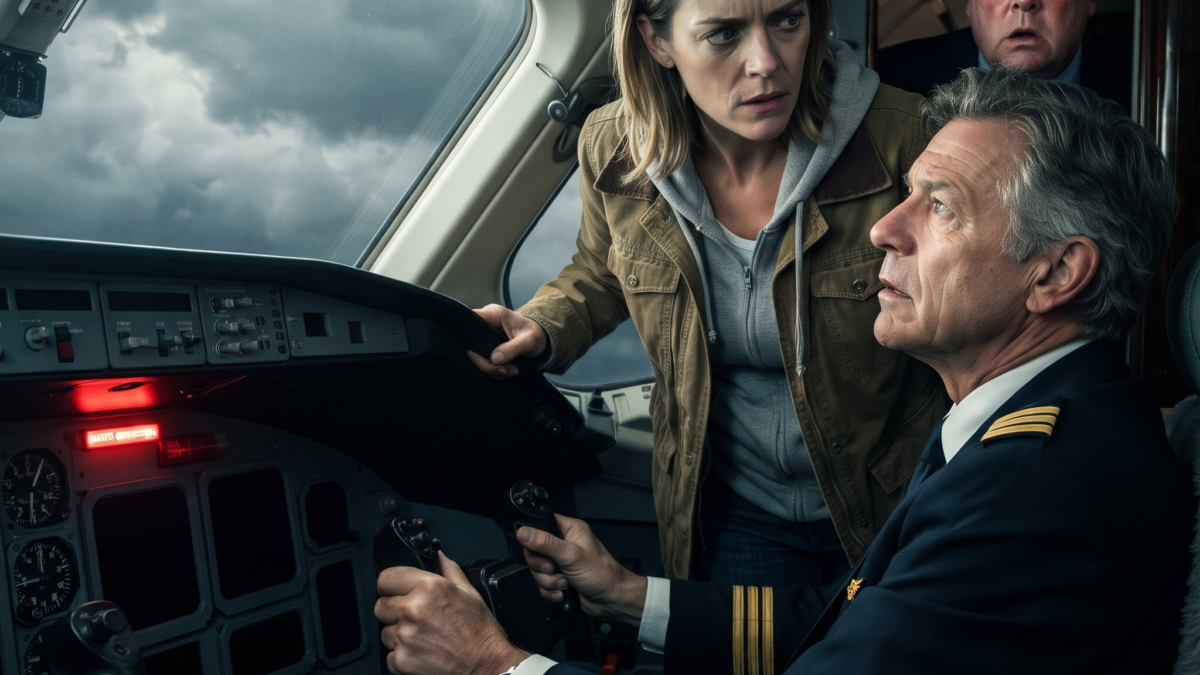
“This is Captain Reed.”
“Claire Bennett, sir. Former military fighter pilot.”
“How much experience?”
“Several years in operational and training environments. I’ve been out of active flying for eight years.”
“I understand you’re a passenger. I need to make that very clear. My first officer and I remain responsible for this aircraft. You will not operate the controls.”
“Of course, Captain. I’m not asking to take your place. I only want to know whether my experience can be useful.”
There was a brief pause.
“We’ve lost reliable navigation information. Several flight indications are affected. We’re following our procedures, but the situation is deteriorating.”
“Are your primary flight controls still responding normally?”
“At the moment, yes. The aircraft is responding. We have conflicting indications from several systems, and we’re trying to establish which information we can trust.”
“Understood.”
I rested my free hand against the galley counter.
“Don’t let conflicting information pressure you into rushed decisions. Confirm every critical indication through your approved procedures. Separate what you know from what you’re still trying to establish.”
The captain was quiet for a moment.
“That’s what we’re doing.”
“Good.”
“Stay nearby, Ms. Bennett. Emily will bring you forward if we need another discussion.”
“Understood.”
I returned the telephone.
Emily studied me.
“You sound like you’ve done this before.”
“I have.”
“Then why did you stop flying?”
I looked toward the narrow window beside the galley.
“Sometimes surviving a flight is harder than surviving the crash.”
She didn’t ask what I meant.
I was grateful.
The first person to challenge me was seated in row fourteen.
He was in his late fifties or early sixties, with silver hair, an expensive watch, and a suit that looked as though it had never encountered a wrinkle.
A laptop was open on his tray table.
He had been speaking loudly into his phone until Emily reminded him that electronic devices needed to be switched off during the affected portion of the flight. He had responded by complaining about the airline’s Wi-Fi and demanding that someone contact his legal department.
His daughter sat beside him.
She looked around thirty, with dark hair and a tired expression.
“Father, you could try being nice to people once in a while.”
“I am nice. I pay people very well to do their jobs.”
The man noticed me standing in the aisle.
“What’s going on? Are you part of the crew?”
“No.”
“Then why are you wandering around?”
“They asked for someone with military flight experience.”
He stared at me.
“You’re the pilot?”
“I was.”
His expression changed.
“You’re claiming to be a military pilot?”
“I don’t recall making a claim. I told the crew what I did.”
He laughed.
“You expect us to believe someone who hasn’t flown in years can save this plane?”
“Nobody has asked me to save it.”
“Then what are you doing?”
“Offering what experience I can.”
He shook his head.
“I hope the captain doesn’t take advice from passengers. I have a meeting tomorrow morning. I’d prefer to arrive alive.”
His daughter lowered her voice.
“Dad, please. People are listening.”
“I’m asking a reasonable question.”
I looked at him.
“It’s a fair question. The captain will decide whether my experience is useful.”
“That’s not reassuring.”
I shrugged.
“Then perhaps you should listen to the captain instead of me.”
The daughter looked as though she wanted to smile.
The man closed his laptop with an irritated snap.
“Wonderful. A stranger with a military story and no qualifications for this aircraft. That’s exactly what I wanted tonight.”
His daughter sighed.
“I’m sorry.”
“You don’t need to apologize for him.”
She glanced toward the cockpit.
“Are you really worried?”
“Of course.”
“Then why do you look so calm?”
I looked at her.
“Because panic doesn’t improve anything.”
The girl seated across the aisle leaned forward.
She was perhaps ten years old, with a bright pink jacket and a small book resting on her lap.
“Excuse me, ma’am?”
I turned.
“Yes?”
“Were you really a fighter pilot?”
“Yes.”
“Did you fly faster than the speed of sound?”
“A few times.”
“Was it scary?”
I smiled.
“When you’re young, it feels incredible. Later, you learn the important part is knowing when to slow down.”
She considered that.
“My dad used to fly helicopters.”
I sat on the empty seat beside her.
“He did?”
“Yes. He died when I was twelve. Mom says he loved being up there.”
I listened.
“Do you remember him?”
“Some things.”
She looked at the window.
“He used to tell me stories about flying. I wish I could remember all of them.”
I smiled gently.
“Maybe he loved what flying made him feel. Freedom. Purpose. A chance to matter.”
The girl nodded.
“I don’t think my dad would have wanted you to stop doing something you loved.”
Her words struck me harder than I expected.
“He would have hated that,” she added.
I looked down at my hands.
For a moment, I saw James’s face.
Then I heard the captain’s voice over the intercom.
“Ladies and gentlemen, please remain seated and keep your seat belts fastened. We are preparing to divert to the nearest suitable airport.”
The girl looked frightened.
I leaned closer.
“Stay with your mother. Listen to the crew, all right?”
She nodded.
I stood.
The flight attendant signaled me from the front.
“Claire? The captain would like to speak with you again.”
I looked back at the girl.
“What’s your name?”
“Olivia.”
“Olivia, remember what I said. Being brave doesn’t mean you aren’t afraid.”
She nodded.
I returned to the galley.
Captain Reed was waiting near the forward service area.
He was a tall man in his early fifties, with short brown hair and the tired, concentrated expression of someone who had spent too long staring at uncertain information.
His first officer, Daniel Price, stood nearby.
“Ms. Bennett,” Reed said. “Thank you for coming forward.”
“Of course.”
“Before we go further, I want to be clear. You are not to operate the aircraft, and you are not to interfere with our flight procedures.”
“I understand completely.”
He nodded.
“We’re experiencing unreliable information across several systems. The aircraft is responding, but some of the indications disagree. We’re following the emergency guidance and coordinating with air traffic control.”
“Understood.”
“We’re considering diversion options. The nearest suitable airport has worsening weather. Another option is farther away, but the conditions appear more favorable.”
I listened carefully.
“Are you working with the controller to confirm the available conditions?”
“Yes.”
“Then compare the full picture before committing. Don’t let the cabin pressure you into choosing the nearest option simply because it sounds reassuring.”
Price nodded.
“That’s what we’re trying to do.”
Reed looked at me.
“Have you dealt with unreliable flight information during an emergency?”
“Yes. Different aircraft, different systems, but the principle is similar. You separate what you know from what you suspect. You confirm information through independent sources wherever possible. And you avoid turning uncertainty into panic.”
“You’re sounding like a flight instructor.”
“I’ve been accused of that.”
He smiled faintly.
Then his expression grew serious again.
“My biggest concern is making the right decision with incomplete information while keeping three hundred people safe.”
I looked at him.
“Then don’t carry the whole burden alone. You have your first officer, your cabin crew, air traffic control, and procedures built for situations like this.”
He nodded.
“Thank you.”
A warning sounded from somewhere inside the cockpit.
Reed glanced toward the door.
“I need to return to the flight deck.”
“Of course.”
He paused.
“Stay nearby. We may need your perspective again.”
I nodded.
Price followed him.
Emily stood beside me.
“You helped.”
“I hope so.”
She smiled.
“You did.”
I looked down the aisle.
People were frightened, but they were listening. Some were holding hands. Others had their eyes closed. A man who had been complaining earlier was now quietly helping an elderly passenger fasten her seat belt.
Fear had changed the cabin.
It had also reminded everyone that they were sitting in the same aircraft, dependent on the same crew, with the same destination in mind.
For once, nobody was asking who had paid more for their seat.
The aircraft shook again.
A child cried out.
The cabin crew moved through the rows, making sure passengers remained seated. Emily spoke to people in a low, reassuring voice. She didn’t promise that everything would be fine. She told them what they needed to do.
That mattered.
I watched her for a while.
“How are people holding up?”
“Some are frightened. A few are angry. Most are trying hard to stay calm.”
“You’re doing important work.”
She looked surprised.
“We’re just serving drinks and keeping people seated.”
“No. You’re helping hundreds of people manage fear while the pilots solve the problem. That’s not a small thing.”
She smiled.
“Thank you.”
I leaned against the galley counter.
“Do you have family waiting at home?”
“My mother. She worries about every flight I work.”
“Then you understand how much this matters.”
“I do.”
She looked toward the cockpit door.
“Do you think we’ll be all right?”
I considered my answer.
“I think the pilots are doing what they should be doing. They’re working the problem, checking their information, and coordinating with the controller.”
“That’s not quite an answer.”
“It’s the honest one.”
She nodded.
“Sometimes that’s all people need.”
The captain called me forward again.
The cabin had grown quieter, though the aircraft was still shaking occasionally.
Reed was speaking with the controller when I entered the forward area.
“Conditions at the nearest airport have deteriorated,” he said after finishing the call. “The alternative gives us more time, provided the aircraft remains stable.”
“Have you confirmed the information through the available sources?”
“Yes. We’re cross-checking.”
“Good.”
Price looked at me.
“Do you think that’s the better option?”
I considered the question.
“I don’t know your aircraft’s full status. I don’t have access to all the information you’re using. You’re the ones who have to make that decision.”
Reed nodded.
“That’s exactly why I asked you here. I wanted an outside perspective, not someone telling us what to do.”
I looked at both pilots.
“You know your aircraft. Trust your training. Keep communicating. Don’t let the noise in the cabin become noise in your decision-making.”
Reed smiled.
“That’s good advice.”
He turned toward Price.
“Let’s complete the review.”
The first officer opened the relevant information.
They worked through the options, comparing the reports and discussing the available diversion airports. I remained nearby, listening and answering questions when they asked.
I did not touch any controls.
I did not tell them how to fly their aircraft.
I didn’t need to.
The most useful thing I could do was remind them that they were allowed to think carefully.
A pilot under pressure could start to believe that every second demanded an immediate answer.
Sometimes the greatest skill was knowing when not to rush.
During a quieter moment, Captain Reed looked at me.
“Can I ask you something personal?”
“Go ahead.”
“Why did you leave the military?”
I looked toward the cockpit window.
“Because I lost someone.”
“Someone close?”
“My brother. James.”
Reed’s expression softened.
“I’m sorry.”
“He was a pilot, too. Three years younger than me. We trained together for a while and ended up assigned to different units.”
“What happened?”
I took a breath.
“His aircraft was damaged during an operation. I was involved in the decisions surrounding his situation. The information was incomplete, and I made a call I believed was safest.”
I paused.
“He didn’t come home.”
Reed didn’t interrupt.
“The investigation found that several factors had been beyond my control. My commanding officer told me I had done what I could with what I knew.”
“That sounds reasonable.”
“It did to everyone except me.”
I looked at my hands.
“Every time I entered a cockpit afterward, I heard the last conversation we had. Every time I made a decision, I wondered whether I was about to make the same mistake again.”
“So you left.”
“Yes.”
Reed watched me.
“That must have been difficult.”
“It was.”
He glanced toward the instruments.
“I’ve been flying for twenty-seven years. I’ve made decisions I still think about at night. Some were right. Some were wrong. But I’ve learned that regret can teach you something. It cannot fly the aircraft.”
I looked at him.
“You sound like my old commanding officer.”
“Was he a good man?”
“Yes.”
“Then perhaps you should have listened.”
I laughed softly.
“Perhaps.”
The warning tone sounded again.
Reed straightened.
“I need to get back.”
“Of course.”
He paused at the door.
“Thank you, Claire.”
“You’re welcome, Captain.”
He returned to the cockpit.
I stood for a moment, thinking about James.
For eight years, I had believed that leaving the military would help me forget.
It hadn’t.
It had only given the memory more room.
When I returned to the cabin, the wealthy man in row fourteen was watching me.
He looked irritated.
“Well?”
I glanced at him.
“Well, what?”
“Are you going to save us?”
I remained standing.
“The pilots are assessing the situation.”
“That’s all you can say?”
“That’s the honest answer.”
He scoffed.
“I’ve flown more than a hundred times. I’ve never seen anything like this.”
“Neither have I on this aircraft.”
“Then how useful are you?”
His daughter closed her eyes.
“Dad, stop.”
“I’m trying to protect you, Olivia.”
She turned toward him.
“No. You’re trying to control something you can’t control. And it’s frightening everyone around you.”
He stared at her.
“That’s a ridiculous thing to say.”
“Then stop acting like the cabin is your office.”
A few passengers turned.
He lowered his voice.
“Watch your tone.”
Olivia looked away.
I sat beside her.
She gave me a small, apologetic smile.
“I’m sorry.”
“You don’t have to apologize.”
“My father gets difficult when he’s frightened.”
I glanced at him.
“Does he?”
She looked down.
“He thinks money can solve almost everything.”
“Money can solve some problems.”
“That’s what I keep telling him.”
I watched the man.
He was staring at the cabin ceiling, his jaw tight. He had not opened his laptop again.
“What does he do?” I asked.
“He’s a businessman. He built a company from nothing. He’s very good at making decisions when he knows what the numbers are.”
“And when he doesn’t?”
“He tries to make everyone else follow him anyway.”
I smiled.
“That sounds exhausting.”
“It is.”
She paused.
“Can I ask you something?”
“Of course.”
“Are you scared?”
I looked at her.
“Yes.”
She seemed surprised.
“But you don’t look scared.”
“I’ve had eight years to practice hiding it.”
She smiled faintly.
“Then perhaps you’re better at it than my dad.”
I laughed.
“Perhaps.”
A little while later, Olivia approached me near the galley.
“Claire?”
“Yes?”
“I wanted to apologize for my father.”
“There’s no need.”
“I know, but I should have challenged him a long time ago.”
I leaned against the counter.
“You can’t change every silence. You can decide what you do the next time someone needs you to speak.”
She looked toward her father.
“He wasn’t always like that.”
“People change.”
“My mother died when I was younger. After that, he worked constantly. He says he did it for me.”
“Maybe he did.”
“He never talked about being afraid. He just bought things. Better houses, better schools, bigger vacations. Sometimes I think he believes that if he gives me enough, I won’t notice he’s never really there.”
I nodded.
“That can happen.”
She looked at me.
“Do you have a family?”
I thought of James.
Then of my mother.
“Yes. My family is waiting for me at home.”
“Your brother?”
I looked away.
“He isn’t anymore.”
“I’m sorry.”
“Thank you.”
She studied me.
“Can I ask what happened?”
I considered refusing.
Then I remembered the little girl on the flight who had told me her father would have wanted me to keep flying.
“His name was James,” I said. “He was my younger brother. We trained together. He wanted to fly before he understood what it cost.”
She smiled sadly.
“Was he a pilot like you?”
“Yes.”
“What happened?”
I told her.
Not every detail, but enough.
I explained the damaged aircraft, the incomplete information, and the decision that had changed my life. I told her about the investigation and how I had spent years believing that a different choice could have saved him.
Olivia listened.
“Did your commanding officer blame you?”
“No.”
“Then why did you blame yourself?”
I stared at the floor.
“Because if it was my fault, then there was something I could have done. Something I could have changed. Accepting that I might have done everything right and still lost him was harder.”
She nodded slowly.
“That’s a terrible thing to have to accept.”
“It is.”
“But maybe your brother wouldn’t want you to keep punishing yourself.”
I looked at her.
“You sound like you knew him.”
“No. But I think I know what it feels like when someone you love leaves too much unsaid.”
I smiled.
“That’s a wise thing to understand.”
She touched the small photograph attached to her phone case.
“That’s my dad and me. The last picture before he went on a rescue mission. I want to be like him someday.”
I studied the photograph.
A younger man stood beside a helicopter. He was smiling broadly, with one arm around a little girl.
“He looks proud.”
“He was.”
I handed the photograph back.
“Then be kind when it’s difficult. Honest when it’s uncomfortable. And brave enough to ask for help.”
She smiled.
“You sound just like my mom.”
“She must be a wise woman.”
“She is.”
For a moment, we simply listened to the aircraft.
Then Olivia looked at me.
“I hope you fly again someday.”
I didn’t answer.
But I didn’t dismiss the possibility either.
The captain called me forward once more.
The situation had stabilized enough for the crew to coordinate a diversion. The nearest airport remained unsuitable because of worsening weather, while another had better conditions and emergency support available.
The aircraft was still operating, but the information problems required careful monitoring.
Reed looked exhausted.
“We’re continuing with the diversion plan. Air traffic control has confirmed the available conditions.”
“Good.”
“How do you feel about the approach?”
I took a breath.
“Captain, I want to be careful here. I don’t have your aircraft data, and I don’t know every condition you’re seeing. I can tell you that your approach has been disciplined. Keep following the approved guidance and keep checking your assumptions.”
He nodded.
“I appreciate that.”
Price looked toward the cabin.
“We’re getting more questions from passengers.”
“Then I’ll speak to them,” Emily said.
Reed glanced at me.
“Would you be willing to help the crew keep people calm?”
I nodded.
“Of course.”
He looked relieved.
“Thank you.”
I paused.
“Captain, may I ask something?”
“Yes.”
“Are you confident in the plan?”
He considered it.
“I’m confident we’ve made the best decision available based on the information we have. I’m not going to promise something I can’t guarantee.”
I smiled.
“That’s exactly the right answer.”
He held out his hand.
I shook it.
Then I stepped back into the cabin.
The announcement came a few minutes later.
“Ladies and gentlemen, we are preparing to divert to an airport where emergency services are standing by. Please remain seated, keep your seat belts fastened, and follow all instructions from our cabin crew.”
A low murmur spread through the rows.
Emily moved along the aisle.
“Everything is going according to the captain’s instructions. Please stay seated.”
I stood near the front.
A few passengers looked at me.
One woman asked whether we would be landing soon.
“I don’t know the exact timing,” I said. “The pilots are coordinating with the controller.”
Another man asked whether the aircraft was safe.
“The crew is following the procedures and monitoring the situation. The best thing you can do is stay seated and listen to them.”
The wealthy man in row fourteen watched me.
He seemed ready to challenge me again, but his daughter placed her hand on his arm.
“Please, Dad.”
He said nothing.
I walked toward them.
“How are you feeling, Olivia?”
“I’m all right.”
Her father looked at me.
“Are you sure?”
She nodded.
He took a slow breath.
“All right.”
I was surprised by the change.
He looked uncomfortable, but at least he was listening.
“Miss Bennett,” he said.
“Yes?”
“I want to ask you something. If you were in my position, what would you do?”
I looked at him.
“I’d follow the crew’s instructions.”
“That’s all?”
“That’s enough. You don’t have access to the information the captain has. You don’t know what the aircraft is doing or what the controllers are seeing. You have no reason to interfere.”
He nodded.
“Understood.”
Then, after a pause, he added, “I hope they know what they’re doing.”
“So do I.”
For the first time since the announcement, he smiled faintly.
The approach took longer than the passengers expected.
There were moments when the cabin grew quiet enough for me to hear people breathing. The aircraft changed direction, and a few passengers gripped the armrests.
I sat near the forward galley, speaking with Emily.
“You’re doing well,” I told her.
She smiled nervously.
“I’m trying.”
“That’s all anyone can ask.”
She looked toward the windows.
“Do you ever get used to this?”
“To what?”
“Not knowing whether everything will be all right.”
I thought about James.
“No.”
She waited.
“But you learn not to let uncertainty make every decision for you.”
She nodded.
I glanced toward the cockpit.
“Your pilots are doing the work. Your job is to help everyone else get through the next few minutes.”
She straightened.
“Then that’s what I’ll do.”
I smiled.
“Exactly.”
The announcement system crackled.
“This is the captain. We have received confirmation from air traffic control. We are continuing with the diversion and preparing for our arrival. Please remain seated.”
A few people began whispering.
Olivia reached for her father’s hand.
He took it.
Then he looked toward me.
“Thank you.”
I nodded.
“You’re welcome.”
The landing was uneventful.
The aircraft touched down, rolled along the runway, and slowed before coming to a stop.
There was a moment of silence.
Then applause broke out.
Some people laughed. Others began crying. A child shouted that we were on the ground.
I remained seated.
I had not flown the aircraft. I had not operated a single control. I had not saved anyone by making a dramatic decision.
The pilots had done their jobs.
The cabin crew had done theirs.
The passengers had listened.
And somehow, that felt more meaningful than I expected.
Emily approached.
“We made it.”
I smiled.
“The crew made it happen.”
She shook her head.
“And you helped.”
“I only offered what I could.”
“You kept people together.”
I looked around.
The cabin was full of tired, relieved faces.
“Then I’m glad.”
Captain Reed appeared near the cockpit door.
He looked toward me.
“Ms. Bennett.”
I stood.
“Captain.”
He extended his hand.
“Thank you. Truly.”
I shook it.
“You did the hard part.”
“We did it together.”
I smiled.
“That’s what a crew is supposed to do.”
He nodded.
Then he turned toward the passengers.
“On behalf of the entire crew, thank you for your patience. We are grateful to have you with us.”
The cabin applauded again.
I looked out the window.
The airport lights reflected across the wing.
For the first time in eight years, I was not looking at an aircraft as something I had lost.
I was looking at it as something I might someday return to.
The passengers disembarked slowly.
Some were met by family members. Others were guided toward the terminal.
Olivia approached me with her father.
“Claire, I wanted to thank you.”
“You’ve already done that.”
“I know. But I wanted to say it properly.”
Her father stepped forward.
“Ms. Bennett, I owe you an apology.”
I looked at him.
“I’m listening.”
He took a breath.
“I judged you before I knew anything about you. I assumed your clothes, your seat, and your quiet manner told me everything I needed to know.”
I smiled slightly.
“A lot of people make that mistake.”
“That doesn’t make it acceptable. I spend my life evaluating people. Today, I realized how often I confuse confidence with competence and wealth with worth.”
Olivia looked at him.
“I’m proud of you for saying that, Dad.”
He nodded.
“Don’t make me regret it.”
She laughed.
“I’ll try.”
He turned back to me.
“Thank you for looking after my daughter.”
“She’s a remarkable young woman.”
He looked at her.
“She is.”
Then he held out his hand.
I shook it.
For a moment, I wondered whether he was thinking about the time he had spent controlling her. Perhaps the emergency had reminded him how little control any of us truly had.
“I hope you get to fly again,” he said.
“Thank you.”
He glanced at Olivia.
“And I hope you’ll forgive me for being difficult.”
She smiled.
“Tomorrow, maybe.”
He laughed.
“Fair enough.”
Olivia lingered near the terminal entrance.
“Claire?”
I turned.
“Yes?”
“I’ve been thinking about what you said.”
“Which part?”
“About being brave enough to ask for help.”
She looked down at the photograph on her phone.
“I think I’ve spent a lot of time waiting for my father to be someone else. Someone who doesn’t work all the time. Someone who knows how to listen. Someone who isn’t afraid to show he cares.”
I nodded.
“People don’t always know how to change.”
“I know.”
She looked up.
“But I can tell him what I need.”
I smiled.
“That’s a good place to start.”
She hesitated.
“Do you think your brother would be proud of you?”
The question caught me off guard.
I thought about James.
His laugh.
His stubbornness.
The way he always knew when I was making excuses.
I smiled.
“I think he would have been.”
Olivia hugged me.
“Then I hope you remember that.”
She walked away with her father.
I watched them disappear into the terminal.
For eight years, I had thought about James only through the final mission. The damaged aircraft. The radio calls. The decision. The investigation.
I had forgotten the rest.
He had been more than the man I lost.
He had been my brother.
And there had been a whole life before that day.
I was sitting near the airport café when someone called my name.
“Claire Bennett?”
I turned.
A tall older man stood a few feet away. He had gray hair, broad shoulders, and the unmistakable posture of someone who had spent a lifetime in uniform.
For a second, I couldn’t place him.
Then I stood.
“General Mitchell?”
He smiled.
“Retired general these days. Robert will do.”
I shook his hand.
“What are you doing here?”
“I was meeting a colleague. Then I heard about the emergency. Someone mentioned a former military pilot named Claire Bennett.”
I gave a small laugh.
“That was me.”
“I know.”
He looked toward the terminal.
“They said you helped the crew.”
“I didn’t do much.”
Mitchell shook his head.
“That’s not what I heard. You helped frightened people think clearly. You reminded the cabin crew that what they were doing mattered. And you reminded the pilots not to let pressure replace judgment.”
I lowered my eyes.
“They did the flying.”
“Of course they did.”
He looked at me.
“But you did something else.”
“What?”
“You stopped running from the person you used to be.”
I didn’t answer.
General Mitchell had been my commanding officer eight years earlier. He was the one who told me that the investigation had found no evidence of wrongdoing on my part. He was the one who said I should not confuse grief with responsibility.
I hadn’t believed him.
I looked at him now.
“I thought you blamed me for James.”
His expression softened.
“I never blamed you.”
“I know you said that.”
“And?”
“I couldn’t believe it.”
He sighed.
“Claire, grief can convince people of things that aren’t true. It can make you believe that suffering is a debt you owe to someone who is gone.”
I looked away.
“Maybe I deserved it.”
“No.”
He said it firmly.
“You lost your brother. That was a tragedy. But you did not lose the right to live because he died.”
I swallowed.
“I don’t know how to let it go.”
“You don’t have to let go of James. You have to stop punishing yourself forever.”
I thought about the flight.
The pilots working through the problem.
Emily keeping the passengers calm.
Olivia holding her father’s hand.
For the first time in years, I had been around people who were frightened and uncertain, yet still willing to do what needed to be done.
I had helped in the only way I could.
And the world had not ended.
“Do you think I could ever fly again?” I asked.
Mitchell considered his answer.
“Honestly?”
“Please.”
“I think you should explore that with people qualified to assess you. There may be medical and practical steps. You’d need to establish what kind of flying is appropriate and whether you’re ready for it.”
I nodded.
“But you don’t have to decide everything today,” he continued. “You don’t need to go from avoiding aircraft to returning to the cockpit overnight.”
I smiled.
“That’s probably wise.”
“And what if you’re still afraid?”
“Then I suppose I’ll have to face it.”
He nodded.
“That’s a start.”
I looked toward the departure windows.
“I spent eight years believing the worst moment of my life defined me.”
“It never did, Claire.”
He rested a hand on my shoulder.
“You were a sister before you were a pilot. A daughter before you wore a uniform. A person long before that impossible decision.”
I closed my eyes.
“James loved you,” he said. “He would never have wanted your life to stop because his did.”
I felt tears gather.
“I miss him every day.”
“Of course you do. Love doesn’t disappear. It changes shape over time.”
I nodded.
For once, I didn’t argue.
My phone rang as Mitchell was leaving.
The screen showed my mother’s name.
I answered.
“Hi, Mom.”
“Claire!”
Her voice was full of worry.
“I’ve been trying to reach you all afternoon. I heard about the emergency on the news. Are you safe?”
“I’m safe.”
“Thank goodness. I was terrified.”
“I’m sorry I didn’t call sooner.”
“You don’t have to apologize. I just needed to know you’re all right.”
I sat down.
“I’m more than all right, Mom.”
She was quiet.
“What happened up there?”
I looked toward the terminal windows.
“Something reminded me of James.”
“Oh, sweetheart.”
“But this time, I remembered more than how we lost him.”
I paused.
“I remembered who he was. I remembered who I was before grief took over.”
My mother began to cry quietly.
“That’s good, Claire.”
“I think I want to look into flying again.”
She took a breath.
“Are you sure?”
“No. Not completely.”
“Then don’t rush.”
I smiled.
“I won’t.”
“Your brother would be proud of you.”
I looked at my reflection in the glass.
For eight years, I had carried the same memory like a sentence. I had believed that if I stopped flying, I could somehow keep the past from repeating itself.
But James had never asked me to stop living.
He had wanted me to fly.
He had wanted me to laugh, to travel, to argue with him about music, and to call him when I reached home.
I had mistaken missing him for honoring him.
Perhaps I could finally do both.
“Mom?”
“Yes, sweetheart?”
“I’m going to be okay.”
She laughed through her tears.
“I know you are.”
I stayed at the airport until evening.
The aircraft that had carried us had been taken out of service for inspection. The crew was preparing reports, and the passengers were being assisted with onward travel.
I saw Captain Reed near the operations desk.
He was speaking with an airline manager when he noticed me.
“Claire.”
I approached.
“Captain.”
He smiled.
“How are you doing?”
“Better than when I boarded.”
He laughed.
“That’s good.”
He paused.
“I wanted to thank you again. I know I said it already, but I meant it.”
“You were responsible for three hundred people. You didn’t need another voice in your ear.”
“Maybe not. But you helped us remember something.”
“What’s that?”
“That a cockpit isn’t a place for one person to carry everything alone.”
I nodded.
“That’s true.”
He glanced toward the gate.
“Would you consider speaking to our training department sometime? Not about operating the aircraft. About decision-making under pressure. Communication. The human side of emergencies.”
I smiled.
“I’d consider it.”
He handed me a card.
“Call me when you’re ready.”
I took it.
“Thank you.”
He held out his hand.
“Good flight, Claire.”
I shook it.
“Good flight, Captain.”
That night, I returned to my apartment.
My mother called again, but I was too tired to answer. I sent her a message telling her I would call in the morning.
Then I opened the drawer beside my bed.
Inside was a small photograph of James.
He was standing in front of an aircraft with his helmet tucked beneath one arm. His face was sunburned, his hair was a mess, and he was grinning like he had just gotten away with something.
I sat on the edge of the bed.
“Hey, idiot,” I whispered.
For years, I had avoided speaking to the photograph. It felt foolish, and I hated the way it made me cry.
Tonight, I didn’t mind.
“You’d have hated what I did today.”
I smiled.
“I got on a plane, heard a warning, and almost turned around.”
I touched the frame.
“But I stayed.”
The room was quiet.
“I didn’t fly it. I didn’t pretend to know everything. I just helped where I could.”
I paused.
“And I think I finally understand what you meant.”
I placed the photograph back on the table.
The next morning, I called the aviation medical office.
I didn’t tell them I was returning to the cockpit.
I simply asked what steps would be necessary for a former military pilot with an eight-year break from flying to begin an assessment.
The woman on the phone explained that the process would involve medical review, updated training, and an evaluation of my current qualifications.
I wrote everything down.
When the call ended, I stared at the list.
It looked intimidating.
There were forms, appointments, refresher requirements, and several things I would need to learn again.
I almost laughed.
Eight years ago, that list would have frightened me more than the flight itself.
Now it looked like a beginning.
I picked up General Mitchell’s card and called him.
He answered after two rings.
“Claire?”
“I made the call.”
“Good.”
“I’m not promising anything yet.”
“Nobody asked you to.”
“I want to see whether I can do it.”
He smiled through the telephone.
“Then that’s exactly what you should do.”
I glanced toward the photograph of James.
“I think I’m ready to stop hiding.”
Mitchell was quiet for a moment.
“Your brother would be proud.”
I smiled.
“I hope so.”
A few weeks later, I met Emily for coffee.
She had contacted me after the flight and asked whether I would be willing to share my experience with the airline’s cabin crew training team.
I agreed.
We sat near the airport windows, watching the aircraft taxi between gates.
Emily stirred her coffee.
“I keep thinking about that flight.”
“So do I.”
“Do you think the passengers will remember it?”
“Some will. Some won’t.”
“What about the crew?”
“Your crew will remember.”
She smiled.
“I think you’re right.”
She looked out at the runway.
“I’ve worked on hundreds of flights. Most of the time, people barely notice us. They complain about drinks, luggage, delays, seats, and anything else they can think of.”
I laughed.
“That’s part of the job.”
“That night reminded me why I do it.”
“Why?”
“Because when people are scared, they look for someone who can help them feel less alone.”
I nodded.
“You gave them that.”
She smiled.
“Your words helped.”
I looked at the aircraft beyond the glass.
“Then perhaps we both learned something.”
Emily leaned closer.
“Can I ask whether you’re thinking about flying again?”
“Yes.”
Her eyes brightened.
“Really?”
“I’m going through the process. I have no idea where it will lead.”
“That’s wonderful.”
I smiled.
“One step at a time.”
She raised her cup.
“To second chances.”
I touched mine against it.
“To second chances.”
A month after the emergency, I visited the military base where James and I had trained.
The hangars had changed. Some of the aircraft were newer, the markings had been updated, and the old briefing room had been renovated.
But the smell was the same.
Oil, metal, aviation fuel, and coffee.
It brought back memories so quickly that I had to stop near the entrance.
A young pilot passed me.
“Ma’am, are you all right?”
I smiled.
“Yes. Just remembering.”
He nodded and continued walking.
I went to the memorial wall.
James’s name was there.
I stood in front of it for a long time.
Then I placed a small set of wings beneath the plaque.
Not the ones I’d given Emily.
A new pair.
I had bought them the day before.
“I haven’t forgotten you,” I whispered.
I looked at his name.
“But I’m not going to spend the rest of my life trying to change the day you died.”
I took a breath.
“You were a good pilot. A good brother. And you were right about one thing.”
I smiled faintly.
“Being brave doesn’t mean you aren’t scared.”
The wind moved through the trees beyond the memorial.
I stood there until I felt ready to leave.
The following spring, I completed my first refresher assessment.
It was not a flight.
Not yet.
It was a medical review, an interview, and a series of evaluations intended to establish whether I could safely begin further training.
I passed the first stage.
Then the second.
I still had more to do, and I knew the process might reveal things I didn’t want to hear. I accepted that.
For the first time in eight years, I wasn’t trying to force an outcome.
I was allowing myself to find out.
General Mitchell called me that evening.
“How did it go?”
“I passed the initial review.”
He laughed.
“Congratulations.”
“Don’t celebrate too early. There’s more to do.”
“That’s fine. You’ve got time.”
I looked out the window.
“That’s what I’ve been afraid of.”
“Of having time?”
“Of using it.”
He was quiet.
Then he said, “Claire, you can’t go back and give James more time. But you can stop refusing the time you still have.”
I smiled.
“You’re getting good at this.”
“I’ve had practice.”
We said goodbye.
I sat for a while.
Then I opened the photograph of James on my phone.
He was still smiling.
I smiled back.
I never returned to the exact life I had before.
I didn’t want to.
I eventually began working with a flight training organization, helping evaluate decision-making, communication, and emergency management. I continued with the medical process and returned to flying gradually, under proper supervision and within the limits of my qualifications.
Some days were difficult.
There were moments when an unexpected sound brought back the memory of that mission. There were mornings when I woke up thinking I heard James’s voice in my headset.
But I no longer treated those moments as proof that I should stop.
I treated them as reminders that I was human.
I began calling my mother every Sunday.
I visited the memorial more often.
And when people asked why I had left military aviation, I stopped giving them the simple answer.
I told them about James.
I told them about grief.
I told them that sometimes the hardest part of surviving is learning that you are allowed to keep living.
One afternoon, I received a message from Olivia.
She had started volunteering with an organization that supported children of military families. She sent a photograph of herself standing beside her father at a small aviation museum.
Underneath it, she had written:
He finally told me more stories about his helicopter days. We talked for three hours. Thank you for telling me to ask.
I smiled.
Then another message appeared.
I hope you’re flying again, Claire.
I typed back.
One step at a time. Tell your dad I hope he’s being nicer to people.
She replied with a laughing face.
A few seconds later, another message arrived.
He says he’s trying.
I put my phone away.
The sky outside was clear.
A commercial aircraft passed overhead, leaving a white line across the blue.
I watched it until it disappeared.
On the anniversary of James’s death, I returned to the memorial.
My mother came with me.
We stood together in front of his name.
She placed a small flower beneath the plaque.
“He would be proud of you,” she said.
I nodded.
“I think so.”
She touched my arm.
“Are you happy now?”
I thought about the question.
Happiness wasn’t a permanent state. Neither was grief. Some days were good; others were difficult. But I no longer felt as though I was standing at the edge of a ruined life, waiting for someone to tell me it was safe to move.
“I think I’m getting there.”
She smiled.
“That’s enough.”
I looked at the name on the wall.
“James would have hated that I stopped flying.”
My mother laughed softly.
“He would have hated that you stopped living.”
I turned toward her.
“You’re both starting to sound alike.”
“Maybe you should listen to us more often.”
I laughed.
Then I looked back at the memorial.
For eight years, I had believed that the worst moment of my life was the only moment that mattered.
Now I knew better.
James had been more than the mission. More than the investigation. More than the last radio call.
He had been my brother.
He had made me laugh.
He had challenged me.
He had believed in me when I didn’t believe in myself.
I had spent years remembering how I lost him.
It was time to remember how I loved him.
Several months later, Captain Reed invited me to speak to his flight crew.
I stood in front of a room filled with pilots and cabin staff. Emily sat in the front row. Reed was beside her.
I looked around.
“I want to make one thing clear,” I began. “The day we flew together, I did not save your aircraft. I didn’t operate the controls, I didn’t make the diversion decision, and I didn’t replace the professionals responsible for the flight.”
Captain Reed smiled.
I continued.
“You saved your passengers by doing your jobs. You listened to each other. You checked the information available to you. You didn’t let pressure or fear force you into shortcuts.”
I looked toward Emily.
“And the cabin crew helped hundreds of people remain calm while the pilots worked. They did something just as important.”
Emily smiled.
I paused.
“People often think courage is a dramatic moment. Someone running toward danger, making a heroic speech, or doing something extraordinary. But courage is often quieter than that.”
I looked around the room.
“Sometimes courage is admitting that you don’t know the answer. Sometimes it’s asking for help. Sometimes it’s staying with someone who is frightened. And sometimes it’s accepting that you cannot change what happened, while still choosing what happens next.”
No one spoke.
I smiled.
“That’s what courage means to me now.”
The room applauded.
Captain Reed approached afterward.
“Well said.”
“Thank you.”
He extended his hand.
“Keep flying, Claire.”
I shook it.
“I’m trying.”
That evening, I went home and placed my old military wings beside James’s photograph.
My mother called to ask whether I wanted to come over for dinner on Sunday.
I said yes.
Then I checked the calendar.
The next morning, I had another training appointment.
I set my alarm and prepared my notes.
Before going to bed, I looked once more at James’s photograph.
He was smiling.
I smiled back.
“I think I’m ready, brother.”
I switched off the light.
For the first time in eight years, I wasn’t afraid of tomorrow.
I was still afraid of flying sometimes. I suspected I always would be.
But fear no longer had the authority to decide the rest of my life.
I couldn’t change what happened.
I couldn’t bring James home.
I couldn’t undo the choices made on that mission.
But I could stop leaving myself behind.
And perhaps that was the most important lesson he had ever taught me.
Being brave doesn’t mean you stop being afraid.
It means you refuse to let fear decide who you become.