Part 1| Single Dad Saved a CEO From Six Hijackers—They Had No Idea He Was a Former Navy SEAL!
Part 1| Single Dad Saved a CEO From Six Hijackers—They Had No Idea He Was a Former Navy SEAL!
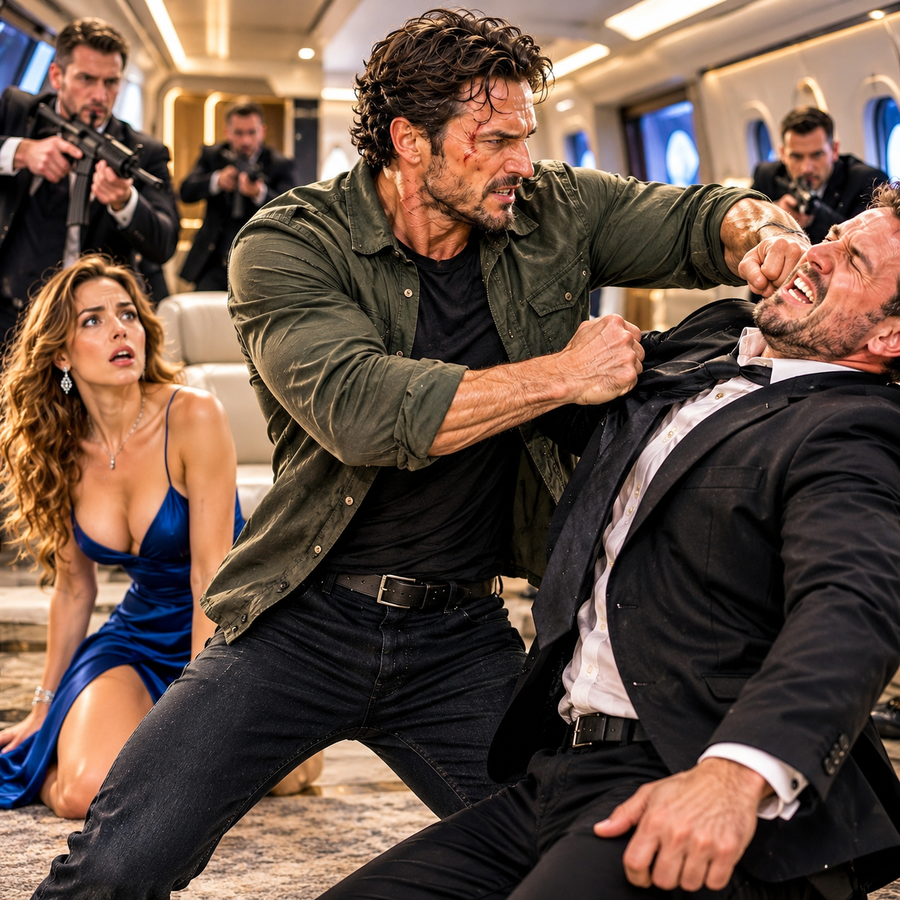
The man standing on that dark runway was not supposed to be there.
He wore a gray mechanic’s uniform.
He carried a dented toolbox. His name was not in any file the hijackers had studied, any briefing their inside source had leaked, or any list of threats they had thought to prepare for.
He was nobody, a ghost in a jumpsuit.
But when he stepped out of the darkness and the first armed man laughed, thinking this was a lost maintenance worker who had taken a wrong turn, that laughter lasted exactly 4 seconds. Then the screaming started, and it did not stop until Nathan Brooks decided it should.
If a story like this is what you live for, hit subscribe right now and join our channel family. We bring you new cinematic stories every single week, and you do not want to miss what comes next.
Hit the like button if you are already hooked, and tell me in the comments which city and country you are watching from.
I want to see how far this story travels.
Let’s go back to the beginning.
Let’s talk about the man nobody saw.
The airport at night had a particular kind of quiet that Nathan Brooks had come to appreciate. The low hum of the ventilation, the crackle of radio traffic from the tower, the far-off whine of a commercial jet climbing into the dark.
It was a quiet that asked nothing of you.
You could exist inside it, and nobody needed to know who you used to be. Nathan preferred it that way.
He was on his third inspection of the evening when Frank Dunmore, the overnight supervisor, called over from the equipment bay. The Hail Bird lands at 9:40.
They want a full pre-flight by 10:30. Nathan looked up from the hydraulic log pen cap between his teeth.
Which aircraft?
Falcon 8X, tail number N41K.
He wrote it at the top of a fresh form. That was what he liked about this work.
There was a process for everything, and the process made sense.
Every line of every checklist had been paid for by someone’s last mistake.
Nathan respected that.
He wheeled his cart toward hangar 4 and passed Tyler, a 22-year-old line tech who still believed moving fast was the same as being good.
Hail’s jet.
Nathan, you know who that right?
Victoria Hale, CEO of Aurelis Dynamics. $12 billion last I read.
I know who she is, Nathan said, and kept walking. He did not say it to be rude.
He just had nothing to add.
$12 billion did not change how a fuel line was routed.
The aircraft did not know who owned it.
His job was to know the aircraft. The Falcon rolled into the hangar at 9:53.
The crew who climbed out were polished and politely distracted.
People who worked for people with money and had learned to project competence at all times.
Nathan took the logbooks and began his walk around. He went slow.
He always went slow. The fuselage was clean.
The nav lights checked out. Both engines had been serviced within 40 hours.
Swept the leading edges, the control surfaces, then crouched at the belly with his flashlight.
That was where he found it. It was small, fixed to the secondary access panel of the avionics bay, kind of place a standard preflight would skip.
Nathan tilted the beam and looked without touching, a wireless transmitter. Amateur work but functional.
The kind of thing that could ride the aircraft’s communication systems and do far more than listen.
He straightened up slowly.
He picked up his radio.
Frank, who’s the pilot in command on the Hale flight?
A pause.
Captain Whiteacre, I need him.
Captain Ron Whiteacre was in his mid 50s with a gray mustache and the calm of 28 years in the air.
He met Nathan at the nose with the face of a man who had learned to wait before reacting. Then showed him the panel and explained.
Whiteacre stared at the device for a long moment.
You’re telling me someone tampered with the avionics bay?
I’m telling you there’s a device on that panel that isn’t in the maintenance records.
I don’t know who placed it or when.
That panel was checked in Phoenix this morning.
Know what the log says?
Could be a tracker. Her security team adds their own hardware sometimes.
Trackers don’t go on avionics housings, Nathan said.
This is positioned to talk to the communication architecture. Silence settled between them.
Then recognized it.
It was the silence of a man weighing a mechanic’s word against paperwork that said everything was fine.
I’ll mention it to the security detail when they arrive, Whitaker said at last.
Thank you for flagging it.
He walked away. Nathan had seen that walk before.
The walk of a man letting someone else’s problem stay someone else’s problem.
He could not entirely blame him.
Whitaker had a schedule, a client, and a career that depended on avoiding friction. Nathan finished the job.
He ran the avionics diagnostic. Everything else was clean.
He wrote the device into his report under non-maintenance observations and initialed the form. He had done what he could do.
At 10:47, three black SUVs rolled into the hangar.
Six men in dark suits stepped out, moving with the slightly too controlled ease of people trained to look relaxed.
Two swept the perimeter. The others formed a loose triangle around the third vehicle.
The door opened and Victoria Hale stepped out.
Nathan was 40 ft away torquing a panel fastener. He glanced over once the way anyone would.
What he noticed was not the expensive suit.
It was how she moved. Quickly like a woman perpetually 5 minutes behind her own decisions, phone already in her hand, eyes already reading before her feet were under her.
She was not performing power. She was just busy.
Captain Whitaker, her voice carried without being raised. Are we on schedule?
11:15 wheels up, Mimas Hale.
A slight delay with the preflight, but we’re on track.
Slight delay, routine inspection matter, all cleared. And turned back to his work.
The head of her security detail, a thick-necked man named Bryce Kessler, crossed to the nose and spoke with Whitaker. Nathan watched Whitaker gesture toward the avionics bay.
He watched Kessler glance at the panel, glance at Nathan, and say something that made Whitaker nod.
Kessler walked over.
You’re Brooks?
That’s right.
The captain says you flagged the device on the secondary access panel.
Kessler studied him like a man who assessed threats for a living and had filed Nathan somewhere in the lower columns. Our techs cleared this aircraft in Phoenix, then it went on after Phoenix.
That’s a serious claim.
I know what I found. Kessler held his gaze a moment longer.
We’ll have our own people look before departure.
If there’s something there, we pull the flight.
That’s the right call, Nathan said.
Kessler nodded and walked back, already lifting his phone.
Nathan let out a slow breath.
Good. If their team knew what they were looking at, the flight would be grounded, and whatever had been planned for 38,000 ft would have to be replanned.
He cleaned his tools and sat at the small break table by the window overlooking the tarmac.
He poured coffee from a thermos that had belonged to his wife, Anna. The paint was nearly worn away.
The seal on the cap leaked if you did not tighten it just right.
He had never replaced it.
Some things you kept not because they were useful, but because letting them go felt like losing her twice. He thought about Lily.
She was 7 years old with her mother’s eyes and his stubbornness, a combination he considered dangerous.
She was asleep in the back office right now.
She came on late shifts when he could not find a sitter, curled on the cot beside the filing cabinet with her headphones on and her stuffed rabbit biscuit tucked under one arm. She slept deep and hard, the way children do when they still trust the world to hold itself together while they are unconscious.
Then envied her that he drank his coffee. At 11:08 the Falcon rolled out and taxied toward the runway.
Its lights blinked steadily against the dark.
Kessler’s vehicles took position at the edge of the ramp, and Kessler himself stood with a phone to his ear.
Nathan tried to read the conversation from 40 yd away.
Was this a man who had found a device and canceled the flight or a man who had looked at a device and decided it was not worth the disruption?
The aircraft did not stop.
It reached the threshold, paused for clearance, and then the engines opened up with that low ground-shaking thunder.
The Falcons accelerated and lifted into the night as though it had every right to be there. Nathan set his cup down.
He did not panic.
He simply sat and watched the red and white lights bank west. Felt something move through him that he had not felt in years.
Not fear, something colder.
The deep recognition of a man who had spent years trusting his instincts were ignoring them cost lives. Something was wrong.
He had known it the moment he found the device.
He had hoped Kessler’s team would catch it.
He had done everything he was supposed to do. He pulled out his phone and opened the flight tracking app, a habit from nights when he liked to confirm wheels up on the jets he serviced.
showed on the screen, transponder active, climbing through 14,000 ft west-northwest on the filed plan.
He watched for 8 minutes. Then the heading changed, not the gentle arc of a reroute, but an abrupt turn 30° south of the corridor.
The climb stopped.
The data tag flickered, hesitated, and returned with a small discrepancy in speed. Nathan stared at the screen.
Someone else had the aircraft.
The crew.
He looked toward the back office where Lily slept. He looked at his hands.
They were perfectly still. That was the thing about the training.
It taught your body a readiness that did not announce itself with adrenaline. When a real moment came, his hands went quiet and his thinking went clear, and everything that was not the problem fell away.
He had built a life out of not being that man anymore. He had promised Lily the way you promised things to a 7-year-old that end up binding you tighter than any signature, that he was just her dad now.
Kanak, a man with a thermos, a toolbox, and Saturday pancakes. He had meant it.
He still meant it.
He walked to the locker at the back of the maintenance bay, the one he had carried from his old apartment and never opened at work. He keyed the combination, a number he had never written down because it was not a number you forgot, and pulled the door open.
The canvas bag inside was military-grade, compressed tight. He had not touched it in 4 years.
He opened it now.
He went to find Frank.
I need you to watch Lily until I get back.
Don’t tell her anything.
If she wakes up, tell her I’m finishing an inspection.
Frank looked at him for a long moment. He was 53 and had seen a lot of airports and a lot of men.
He knew the difference between a simple favor and something else entirely.
Whatever he saw in Nathan’s face, it was enough.
You good, Nate? Not really, Nathan said, but but He walked out of the hangar and into the dark.
38,000 feet, Victoria Hale finally closed her laptop. She had meant to rest.
When the wheels left the runway and the city lights fell away, she had promised herself 30 quiet minutes.
No calls, just the black sky and the oval window and the low vibration of the engines. The stillness had lasted 11.
Her chief of staff, Peter Lang, had sent 17 messages since takeoff. Legal had flagged a new filing in the shareholder dispute.
Gordon Pierce, her VP product development, a man she had grown uneasy about over six weeks, had forwarded a draft press release about Project Aegis that contained three details which should never have existed in any outside document.
She had read it three times under the single reading light, the cabin dark around her.
Each time the knot behind her sternum pulled tighter.
Aegis was not public. It was not even fully known inside Aurelis.
It had its own servers, its own clearance tiers, its own walls. Victoria had built those walls herself because she knew what the technology was worth in the wrong hands.
Gordon should not have had that information, which meant someone had given it to him or he had taken it.
She pressed the heels of her hands against her eyes, 31 years old, and she was tired in a way she imagined people only got in their 5ties. Not in the body, but somewhere structural, like metal stressed too many times in the same place, beginning to show hairline cracks.
She had built Aurelis from two people in a rented Austin office into a $12 billion company in eight years.
She had done it by being smarter, faster, and harder working than everyone who called her too young.
She had not flinched at the cost. The cost had been considerable.
She had not had a real conversation with her mother in 14 months. She could not remember her last meal that was not delivered or eaten at a conference table.
She had hundreds of thousands of followers and no one to call at 2:00 in the morning if something went wrong.
By every measure, she was enormously successful. In the honesty that only comes at altitude in the middle of the night, she was lonely in a way she not know how to fix.
She reached for her water bottle. That was when the cockpit door opened.
Was not Captain Whitaker.
The man who stepped out wore the same navy uniform with four gold stripes, but he was wrong and the way you know something is wrong before you can name it.
Too young for the rank, his posture was off and his eyes finding her in the dim cabin held none of a pilot’s professional neutrality.
They were calculating.
Victorious hands stopped on the bottle. Three more men came through the cockpit door behind him.
Then two more stepped out from behind the rear galley partition. Men who had not been on the manifest, men who had somehow made themselves invisible during boarding.
They did not need to brandish the weapons. In a sealed aluminum tube at 38,000 ft, their existence was aggressive enough.
Six men in total.
Victoria counted them without moving her head.
The man in the pilot’s uniform said his accent was faint, Eastern European maybe, softened by years of practice.
His tone was business like, which was somehow worse than a threat. Please put the laptop away.
Keep your hands on the table where I can see them.
Where is Captain Whitaker? Captain Whitaker and his crew are secure.
They will not be harmed if you cooperate. That is not an answer.
He looked at her a moment.
Something shifted in his face.
Not respect, but something standing next to it. They are restrained in the galley.
The aircraft is under our control. We are diverting to a private airfield.
When we land, you will give us what we came for. Two rows back, Megan made a small sound that was not quite a word.
One of the armed men stepped beside her chair without being told. These people had done this before.
They knew where the pressure points were.
What do you want?
Victoria asked.
Project Aegis access architecture, the authentication keys for the distributed server network, the deployment framework documentation.
The knot behind her sternum went cold. I do not carry that on my person.
You carry everything on your person.
That is what makes you exceptional.
A biometric token on a device in your bag linked to a secure server holding the complete Aegis package.
He paused.
We know because someone who spent a long time inside your organization explained it in detail.
Someone inside, someone close to the core.
She thought of Gordon Pearce’s message.
She thought of the press release containing information that should not have existed.
She thought of six weeks of unease, small things filed away under paranoia. A meeting moved at the last minute.
A document opened outside normal hours.
A conversation she had walked into the edge of and watched stop too quickly.
She had not been paranoid enough. What is your name?
she asked. He almost smiled.
Victor, Victor. Did you put the device on the avionics panel?
The pause was fractional, but she caught it. You should be focused on.
I am asking because someone found it. Maintenance technician, he flagged it to the crew before we left.
Victor was quiet, then he said it does not matter. The aircraft is in the air.
His opinion is no longer relevant.
She held his gaze long enough that the man behind his left shoulder shifted his weight, a small tell.
Someone less comfortable with stillness than his leader.
She turned to the window, to the black sky and the faint suggestion of land far below. The technician, she had barely noticed him during preflight.
She had been moving fast, half her mind on her phone, already running the agenda for Los Angeles.
Man in a gray uniform near the nose, she had not looked at his face. She wished now that she had.
Victor gave instructions in the measured voice of a man working through a checklist.
Megan was moved to the rear and secured to a fixed seat.
The weapons Victoria could see were mid-sized and suppressed, built for people who meant to be contained and precise. They had planned for the acoustics of a cabin.
They had planned for a great many things. Victoria sat very still and began to think.
She was not someone who panicked. She had held investor rooms for 40 minutes while millions hung on her voice.
She had sat through board votes that stayed uncertain until the last second.
She had fought legal battles against opponents with more lawyers and more time.
Over the years, she had learned to take panic when it arrived and push it down to a place she could reach later, where it would not interfere with the thinking. Right now, she needed to think.
Project Tjes was not merely valuable.
It could re rewrite how the world secured its communication.
Financial systems, medical records, government data, in an ethical company’s hands, it could improve billions of lives.
In the hands of someone who sold access to the highest bidder or watched people at a scale never before possible, it was catastrophic.
She would not give it to them.
That was the easiest decision she had made in 10 minutes. The harder question was what she could actually do unarmed at 38,000 ft with six armed men on an aircraft she could not fly.
The token Victor described did exist. He was wrong about one detail.
The token alone granted nothing. It needed a second factor that lived on no device and sat in no file Gordon Pierce or anyone near him should have been able to find that bought her time, much but some.
She needed someone to know.
The seatback screen still showed the flight path, a small airplane icon crawling along a heading that now clearly departed from the filed route. She understood enough about private jets to know the communications had been compromised.
That was what the device had been for. Whoever coordinated this from the ground did not want an emergency squawk or a call on the guard frequency, but a Falcon 8X with an altered course and a regular transponder and a silent radio would be noticed.
The question was
whether noticed would turn into something useful fast enough to matter.
Back at the private terminal, Nathan Brooks was already moving. He had sat in his car for 11 minutes before calling anyone.
He drove southwest along the peripheral road that skirted the airport fence, following the only logic he had.
A diverted aircraft needed a runway long enough for a Falcon 8X, isolation enough for a crime, and no commercial traffic to complicate it. He had worked maintenance in this region for 4 years.
He knew the geography.
He pulled onto a service road and opened the tracking app. The last position before the transponder went ragged was 30 miles southwest of the city, heading toward a scatter of private and agricultural strips in the flatlands before the state line.
Three could take the jet. One had made regional aviation news eight months ago for a change in ownership.
Nobody in the local pilot community could trace to a real operator. Nathan stared at the map and he called the number he had spent four years not calling.
Rang twice. A voice answered, gravel and patience without any greeting.
Brooks, Hank, I need something.
A pause, not the pause of a man deciding whether to answer, but of a man recalibrating. Hank Tolliver had commanded Nathan for six years.
He knew that when Nathan dialed a number he had not used since leaving the service, the problem was not hypothetical.
Talk. Talked.
Tail number N 3 1 K, last known position, the transponder behavior.
His read on the three strips, he kept it short and Hank did not interrupt.
You are driving toward it right now.
Yes. There is a response protocol for a hijacking.
Five B I, you should let it run.
It takes time and I found the device they used on the avionics. Whoever runs this has inside information and a specific technical goal.
This is not about cash or a statement.
They want something inside the company.
That is a lot of conclusions from a box on a panel.
I have been wrong before. I am not wrong about this.
Silent.
Hank said, Harlan County private strip, it fits your criteria and the ownership change matches a shell company pattern I have seen in three other operations.
We’ll make calls and get eyes on it in 40 minutes.
Bodies, not fast. You have a seven year old.
I know, Hank. The three words carried everything, why he was going, why it changed nothing.
He had left Lily with Frank.
He had looked at her through the office window before he walked out. The rabbit tucked under her arm, the soft rise and fall of her breathing in the cool air from the vent.
A child untouched by the knowledge that the world had edges and that men on the other side of them did things to people without asking. He had looked at her.
Then he had walked to the parking lot and gotten into his car.
Call me when you are in position, Hank said, and do nothing until I have eyes on it.
Nathan said he would not.
He meant to keep that promise. He drove 22 minutes on roads that narrowed and decayed the farther he went from the city.
Headlights swept flat farmland, a water tower, a grain elevator rising from the dark.
The tracking app glowed on the seat beside him, the jet’s last position blinking in the southwest.
He did not think about Victoria Hale, not specifically.
He thought about the device, its design, its placement, the neatness of it.
Whoever installed it knew the aircraft’s architecture.
That was no random criminal skill that meant maintenance documentation or real training.
And then another thought arrived, quiet and cold, the way true thoughts did. Kessler.
The security chief had barely glanced at the device.
He had listened to Nathan with his eyes on his watch and said the flight would not be delayed.
At the time it had looked like arrogance, man protecting a schedule. Now Nathan replayed it, the speed of the dismissal.
The way Kessler had not asked a single question, a careful man, a man paid to be suspicious, who had not been suspicious at all.
It was not laxness, it was a decision. His phone buzzed.
Frank.
Frank’s voice was low and tight.
Two black SUVs just pulled in front of the terminal.
Kessler’s men, they are walking the hangars asking for the overnight mechanic.
Said he saw something he should not have.
Nathan’s grip closed on the wheel.
Where is Lily? Still asleep in the back office.
I locked the door and put a filing cabinet against it.
I told them you went home sick. They did not like that, Frank.
I am an old man with a bad knee, Nate.
I have been stubborn for 53 years.
Go do what you are going to do. Nobody gets through me.
Call Hank if it turns. He has the number.
Go. The line went dead.
Nathan sat for one breath, jaw tight, the road empty in front of him. Every instinct told him to turn the car around.
Every instinct was right and every instinct was incomplete.
Kessler’s men were hunting him because the people on that jet needed him quiet.
If he turned back, the hunters would find a locked door and a sleeping girl.
If he went forward and ended this at the source, there was nothing left for them to hunt for. It was the worst arithmetic he had ever done.
He did it anyway. He turned off the main road onto a county track and killed the headlights.
The land opened flat and black ahead, and perhaps 3 mi out he saw a thin line of runway lights, not a full array, a miniscule string, the kind used by people who wanted to land without announcing themselves.
He stopped the car and pulled the canvas bag from the back seat. He opened it on the passenger seat and worked by feel, the way he had learned in places where light was a liability.
Everything he needed was there. Not everything he would have wanted, but enough.
He had kept the bag not because he planned to use it, but because throwing it away had always felt like a decision he was not ready to make, sitting in a dark car on a dirt road with a stolen jet 3 mi ahead and a woman inside who did not know anyone was coming.
He was grateful for the man who had kept things just in case.
He checked everything once, slowly, without hurry, then he stepped out and walked into the dark.
6 minutes in his phone buzzed again. Hank Harlan County confirmed.
BI notified 55 to 70 minutes to the site.
Do not engage.
He read it and pocketed the phone.
55 to 70 minutes.
He looked at the lights in the distance and thought of the man in the pilot’s uniform, the small recalibration at the mention of a technician, panic.
Not even concerned, just a man who had met a minor variable and decided it did not matter. The kind of man who removed people who had seen too much, not out of cruelty, but out of efficiency.
Then kept walking.
The ground was dry and uneven and old field graded once and mostly forgotten.
He moved low where the terrain allowed, watching the tree line on his left and the open approach on his right.
As he drew closer the airstrip resolved out of the dark. One runway running north and south, a small operations building at the north end.
Three vehicles clustered near the south threshold. The Falcon sat on the tarmac, engines spooled down, cabin lights glowing through the oval windows.
He stopped at the edge of the cleared perimeter and crouched. Two men near the vehicles, a third walking a loose patrol along the western edge.
At least three more inside, they were not panicking.
They were holding, waiting. Waiting for what?
If they had the jet and the target, why not move? Either the extraction was taking longer than planned or a second party was on its way.
A vehicle, more people.
Someone who would receive whatever they pulled from Victoria before anyone could trace where it went. He studied the vehicles, two large subs and a panel van.
He studied the access road that ran along the east side of the tarmac, unpaved, barely visible. Nobody on it yet.
The window was still open.
Sent Hank one line. Three outside, at least three inside, waiting for secondary contact.
Move fast. Then he settled his weight and began working around the perimeter toward the operations building slowly without sound.
With the patience of a man who understood that the difference between walking into a situation and walking through it was preparation, position, and the willingness to wait when waiting was right. Inside the jet, Victoria had been stalling for 40 minutes.
She had done it the only way she could, not with open resistance, but with careful, plausible confusion.
She made the authentication process sound more complicated than it was. She invented small procedural steps that did not exist and delivered them with a straight face.
She asked questions and when Victor answered, she asked more, never challenging him, only making him explain so the minutes slid by without alarming him. It was a technique she had built in investor meetings when a conversation raced toward a conclusion she was not ready for.
She did not know if anyone knew what had happened to the flight.
She did not know if the technician had done anything with what he found or if Kessler had waved it away. She did not know if it even mattered anymore.
She was alone at an airstrip she did not recognize and the man across the table was running out of patience. His hail.
Victor’s voice was still even, but something under it had pulled tight.
I have given you considerable time. I will not give you more.
Keys. She thought of Lily Brooks, though she did not know name, only the idea of a child somewhere, a daughter she had never had, a life she had never built, the thing she had promised herself when the company was stable.
When the next quarter closed, when she could finally stop moving for 5 minutes, she thought of the man in the gray uniform who had seen something wrong and told the people who were supposed to listen and been ignored.
She thought of Aegis in the wrong hands, watching and controlling people who had no idea they were exposed, ordinary people who had done nothing to deserve it, Victoria said.
Victor looked at her.
I am not giving you the keys.
Whatever you plan to do next, do it, but I am not giving you the keys.
The cabin went very quiet.
Out in the dark beyond the runway, something moved along the western perimeter. The man walking the loose patrol stopped, turned toward it, and started walking in that direction.
His name was Mills, or at least that was what the others called him, and it was the only name Nathan needed. Mills was experienced enough to move quietly and inexperienced enough to stop when he heard something he could not explain.
That pause, that 3 seconds of stillness where the brain asked questions the body had not caught up to yet, was the window Nathan had been counting on. He came in low from the left using the shadow of a corrugated equipment shed at the edge of the graded perimeter.
The ground was dry and packed.
It cooperated.
He closed the distance in under 4 seconds, and when he got there, he was precise about it, the way a man is precise after a decade of training, then 4 years of none, and the quiet discovery that the body remembers what the mind tried to set aside.
Mills went down without a sound.
Nathan caught him, lowered him to the dirt, and checked that he was breathing.
He was.
Nathan moved on. At the edge of the shed, he stopped and counted two men near the vehicles, low voices, the easy talk of people who were waiting and did not expect anything to interrupt the waiting.
One of them had a cigarette going, a small orange point in the dark. That was useful.
It told Nathan exactly where the man’s eyes were, down on his own hands.
Needed the operations building.
It sat at the north end of the runway, squat and rectangular, flat roof, two dark windows.
If these people had a ground relay for their exit, it would be in there. So would the timeline.
He worked along the fence line, keeping the bulk of a panel van between himself and the two men.
He crossed 10 ft of open ground then pressed flat against the east wall.
He listened.
Nothing.
The door was held by a plain padlock that told him something.