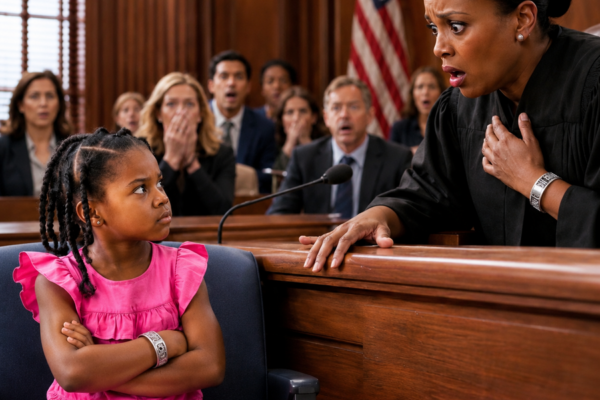
Black Girl Stares at the Judge and Whispers “You’re My Mom” — The Entire Courtroom Gasps
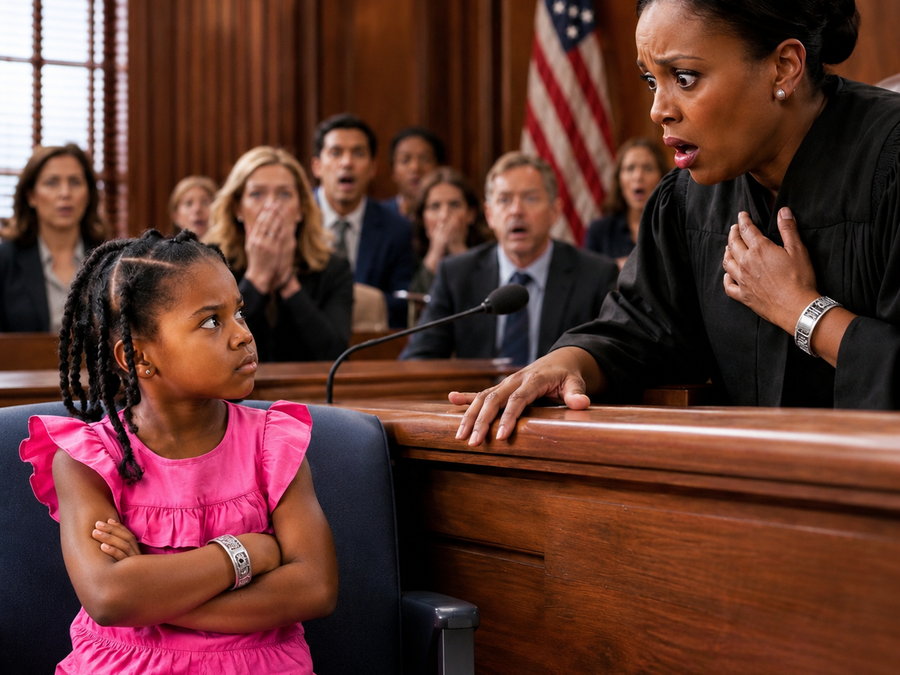
Black Girl Stares at the Judge and Whispers “You’re My Mom” — The Entire Courtroom Gasps
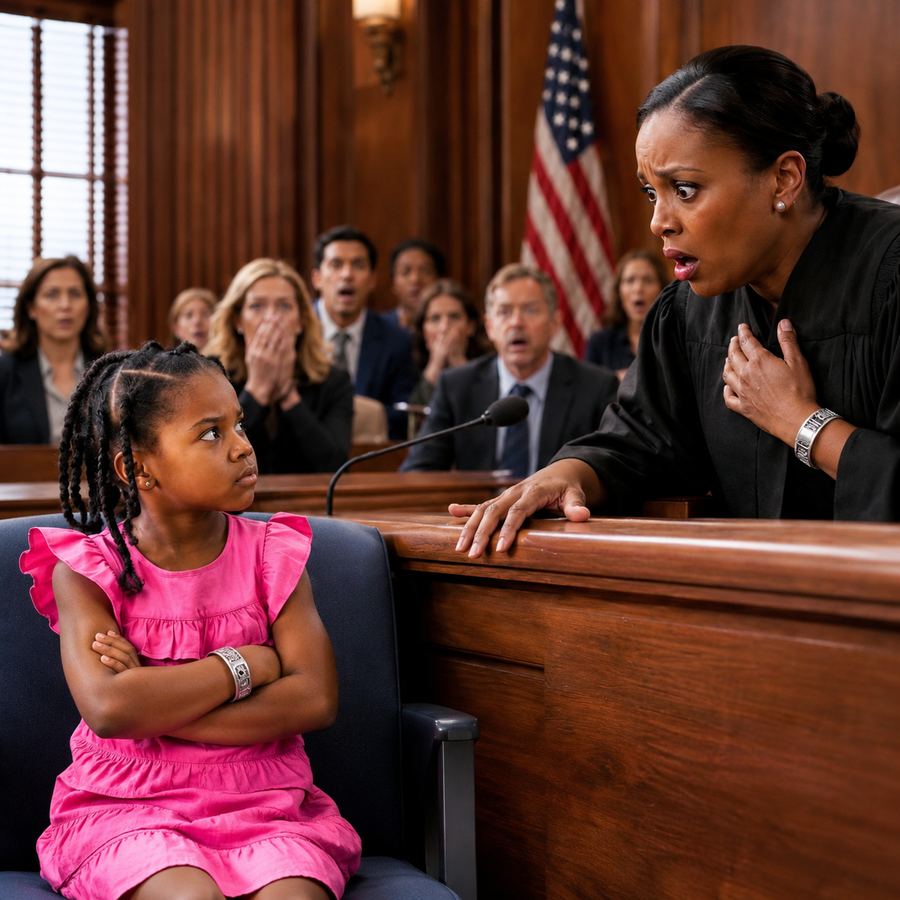
You’re my mom.
That’s impossible.
Then why do we have the same bracelet? The bracelet was too big for her small wrist, and she wore it anyway. Seven-year-old Zara had learned early how to make herself invisible.
Six foster homes in seven years had taught her that.
Don’t speak unless spoken to.
Don’t ask questions.
Don’t let anyone see what you’re holding on to.
But she couldn’t let go of the bracelet.
Couldn’t forget the woman with the kind eyes who’d pressed it into her palm and whispered, “Keep this safe.
Your real mama gave it to me for you.”
Couldn’t stop the dreams about a voice low and warm singing something she didn’t have words for, but somehow knew by heart.
Judge Vivian Monroe had spent 11 years on the family court bench building a reputation out of stone. Unshakable.
Precise. Untouchable.
What her colleagues didn’t know, what nobody knew, was that 11 years of precision had been carefully constructed over a single wound.
A hospital room.
A nurse’s quiet voice.
An empty bassinet she’d bought herself still sitting in a closet she hadn’t opened since.
For 7 years, she had buried that grief under black robes and legal language. For 7 years, she had told herself the death certificate was real until today. Until this small girl with six families behind her and silence in front of her looked up from the front row not with desperation, not with fear, but with the steady certain gaze of someone who had been searching for a long time and had finally found what she was looking for.
Until Zara lifted her eyes to the bench and the room went still and four words crossed the air between them like something that had been traveling for 7 years just to arrive here.
You’re my mom.
Nobody moved. Nobody spoke.
Vivian Monroe, the judge who never flinched, went completely pale. And the reason why is something no one in that courtroom was prepared to hear.
Courtroom nine of the Harmon County Family Court had a particular kind of quiet on Tuesday mornings. Not peaceful. Not calm.
The kind of quiet that accumulates in a room where difficult things have been decided for a long time. Where the air itself seems to carry the weight of every child who has sat in those chairs, every parent who has stood before that bench, every life that has been redirected by a few words from a judge who may or may not have slept well the night before.
Judge Vivian Monroe had sat behind that bench for 11 years. She arrived every morning at 7:45, 20 minutes before her clerk.
She made her own coffee, black, no sugar, reviewed the day’s docket alone, and was already composed by the time anyone else entered the room.
Her colleagues described her as precise. Her opponents described her as immovable. The court reporter, a woman named Gloria who had worked there for 19 years, once said that in all her time at Harmon County, she had never seen Vivian Monroe visibly rattled.
That was version of Vivian the world knew. The other version lived in a two-bedroom house on Callaway Street where the second bedroom door stayed closed. Always.
The room had been painted a soft yellow 7 years ago. The crib was still in there assembled and waiting. Vivian had not been able to take it apart.
She had not been able to give it away. She had simply closed the door and decided that the most efficient way to survive was to make the rest of her life so structured, so purposeful, so full of forward motion that there was no space left for the grief to find a foothold.
For 7 years, that strategy had worked. She was 41 years old.
She had graduated top of her class at Howard Law. She had been the first black woman appointed to the family court bench in Harmon County, a fact that local newspapers had mentioned in headlines and that she herself never mentioned at all.
She wore her hair natural, pinned back on court days. She owned 12 identical black blazers.
She answered every email within 4 hours. She had not cried since the hospital.
This is the woman who opened the Zara Daniels file at 7:51 on a Tuesday morning and felt for just a fraction of a second something she could not name move through her chest. She set it aside, picked up her coffee, moved on.
Keisha Watkins had been a social worker for 9 years and she carried the evidence of it in the way she walked quickly, head slightly forward like someone who had learned that hesitation cost children something they could never get back. She was 34, black with reading glasses pushed up on her forehead that she never remembered to actually use.
She had been assigned to Zara Daniel’s case for the past 14 months, the longest stretch of continuity the child had experienced with any single adult in the system.
She laid the file on the table in front of her and tried not to let her expression say what she was thinking. Six placements in seven years.
The first, the Holloways, had returned Zara after 11 months. The official reason was inability to form attachment.
The actual reason, which Keesha had pieced together from case notes and one ungarded comment from a former colleague, was that the Holloways had expected a different kind of child. A quieter one.
A more grateful one.
One who didn’t watch them with those steady unblinking eyes as if she was recording everything.
After the Holloways came the Praters, who kept Zara for eight months before a school counselor flagged concerns. The investigation was inconclusive. The case notes used the phrase unsubstantiated.
Keesha had read that word and felt sick. Then the Garfields, who had a lifestyle account with 40,000 followers and a particular fondness for photographing their foster children at holiday dinners. Then the Washingtons, who were genuinely kind but genuinely overwhelmed.
Then the Merritts, who lasted four months and described Zara as emotionally unavailable. And now the Ashfords.
Keesha watched Zara from across the waiting area and thought, not for the first time, that this child was not emotionally unavailable. This child was the opposite. She felt everything so deeply that she had learned through years of necessary self-protection to show none of it.
Zara sat with her back straight and her hands folded in her lap. She was small for seven, fine-boned, with her hair in two braids that Keysha had done herself that morning because there was no one else to do them. She wore a dark green dress that was slightly too large.
On her left wrist, sliding loosely against her skin, was a silver bracelet. Simple, old, engraved with letters too small to read from a distance. She was not looking at the floor the way children in her situation usually did.
She was looking at the door to the courtroom with an expression of absolute focus, as if she had been waiting for something on the other side of it for a very long time. Vivian entered the courtroom at 8:59, 1 minute before proceedings were scheduled to begin, and took her seat without looking at anyone in particular. She adjusted her robe.
She opened the file. She looked up. Her eyes moved across the room in the methodical way they always did, the Ashfords with their lawyer, Keysha Watkins, the court-appointed child representative, and then came to rest on the small girl in the front row, and stopped.
The bracelet on the child’s wrist caught the light.
Silver, simple, engraved. Vivian could not read the inscription from the bench.
She did not need to because she had an identical bracelet in a small wooden box in the bottom drawer of her dresser at home. A matching pair made by her mother. One engraved VM forever.
The other engraved ZM forever. A name she had chosen before the birth.
A name she had never gotten to use. The second bracelet had been in the box when she came home from the hospital.
She had checked every day for a year, then stopped checking, then stopped opening the drawer entirely.
Now it was on this child’s wrist.
Vivian sat down her pen. She folded her hands on the bench in front of her. From the outside she looked exactly as she always did.
Inside something that had been sealed for 7 years cracked open along a line she hadn’t known was there.
We are here today. She said her voice steady. In the matter of Zara Daniels.
Brandon Ashford spoke first. He always did. He was the kind of man who had learned very early that a certain tone of voice measured reasonable faintly regretful could make almost any position sound like the only sensible one.
He sat with his ankles crossed and his hands loosely folded the posture of a man who had nothing to hide because he had never once considered that hiding might be necessary. Your honor. He began.
Patricia and I came into this with the best intentions.
We’ve been foster parents for 6 years.
We have two other children in our home right now who are thriving. What we experienced with Zara was something different. He paused tilting his head slightly.
Something we weren’t equipped to manage.
Vivian looked at him. Can you be specific Mr.Ashford?
It wasn’t a question.
He recognized that and shifted slightly in his chair. Cheryl Ashford took over. She was better at this smoother with a practiced warmth that could be adjusted up or down depending on the room.
Today she had it turned to low conveying reluctant honesty rather than enthusiasm.
She doesn’t speak at meals.
Cheryl said. Not a word.
We tried everything, family dinners, one-on-one time, a therapist every Thursday. She sits at the table and watches us.
Just watches. She let that land.
She has night terrors sometimes, three or four times a week. Our other children have been affected.
Our youngest started having nightmares herself. A carefully placed pause.
We have to think about the whole household. And the bracelet, Brandon added.
Vivian’s pen stopped moving.
I’m sorry, she said.
She won’t take it off.
We offered to buy her a new one, nicer actually. Something age-appropriate, and she became very distressed. Screaming.
We were concerned.
He glanced at the bracelet on Zara’s wrist with an expression of mild bewilderment, as if the attachment itself were the symptom.
Honestly, your honor, some children come from certain backgrounds that make them harder to reach.
We’ve seen it before.
The room was quiet. Keisha Watkins looked at her notepad.
The child representative looked at the ceiling. Vivian looked at Brandon Ashford for a long moment without expression. Which backgrounds are you referring to, Mr.Ashford?
She said. He blinked. I only meant children who have experienced instability.
Who haven’t had to because I want to be precise, Vivian said, about what you mean.
He smiled the smile of a man choosing retreat over honesty. Of course. I only meant her history.
The number of placements. Vivian made a note.
Said nothing. Let the silence do what silence does. Keisha Watkins had rehearsed her presentation on the drive over.
But sitting in this courtroom watching the Ashfords perform their particular version of reasonable disappointment, she felt something cut through her professional composure.
She had written and rewritten Zara’s file summaries nine times in 14 months, always choosing careful language, always aware that the wrong framing could close a door for a child who had already had too many doors closed.
Today she decided to be plain.
“Iquo Zara Daniels entered the foster care system at 4 days old,” she said.
“Her intake documentation lists her as a voluntary surrender from an unnamed mother through the Bright Path Adoption Services.
There is no original birth certificate on file.
There is no newborn medical history on file.”
She paused to let that register.
“What we have is six placements, seven years, and a pattern of removal documentation that consistently describes the child as the source of the problem.
” She looked at the Ashfords briefly, then back at Vivian.
“The Holloways described her as unable to form attachment.
She was 11 months old.”
A beat.
“The Praters described her as difficult and watchful.
She was two.”
Another beat.
“The Garfields described her as uncooperative with family activities.
She was four.
” Kisha set down her pen.
“In 14 months working with Zara, I have found a child who is observant, careful, and in possession of a memory that is unusual for her age.
I do not find a child who is disordered. I find a child who has been passed between families that expected something from her she was not able to give, which was in most cases gratitude for being chosen.
Brendan Ashford’s lawyer began to speak.
Vivian held up one hand. Ms.Watkins, she said, you mentioned Bright Path Adoption Services.
Yes, your honor. They closed approximately 4 years ago.
Correct. Following a financial audit that identified irregularities, the full records were never made public.
Vivian wrote something on her notepad, underlined it twice, and looked up.
What do we know about Zara’s biological origin prior to Bright Path?
Nothing, Keisha said. The file begins with intake.
Everything before that is blank. Zara had not moved during any of this. She sat in the front row with the stillness that had been misread by six families and a dozen caseworkers as absence, as emptiness, as proof of damage.
But Vivian, watching her from the bench with eyes that were now paying a different kind of attention, saw something else entirely. She saw a child who was not absent, but present, fully, carefully, almost painfully present, tracking every word in that room and filing it somewhere precise. And she was looking at Vivian, not at Keisha, not at the Ashfords, not at the ceiling or the floor or the middle distance where frightened children so often fixed their gaze.
She was looking directly at the bench at Vivian with an expression that contained no fear and no performance and no request. Just recognition. Vivian felt the back of her neck go cold.
I know you, that gaze said, without saying anything.
The Ashfords’ lawyer was midway through a sentence about disruption to the household when Zara stood up quietly without asking permission.
The child representative reached out a hand.
Zara didn’t look at her.
She took one step forward. And the room, all of it, the lawyer mid-sentence, Keisha mid-breath, Brandon Ashford mid-expression, simply stopped.
Four words. That was all.
Four words in a voice that should not have been able to carry across a courtroom, a child’s voice barely above a whisper, the kind of voice that gets overlooked in crowded hallways and busy kitchens and every place where adults are talking and children are expected to wait.
But courtroom nine was not crowded in that moment. It was absolutely still. And in that stillness, four words crossed the air with the clarity of something that had been waiting seven years for the right silence to land in.
“You’re my mom.”
Nobody moved. Nobody corrected her.
The Ashfords’ lawyer stopped speaking mid-word, his mouth still slightly open.
Keisha Watkins looked up from her notepad and went still.
The court reporter’s fingers lifted from her keyboard.
Gloria, who had seen 19 years of difficult things in this room, later told her daughter that she had never heard silence fall that fast. Vivian Monroe did not move, either. She sat behind the bench with her hands flat on the surface in front of her and looked at this child, this 7-year-old girl in a too-large green dress with a silver bracelet sliding on her wrist, and felt something happen inside her chest that she did not have professional language for.
Not shock, exactly. Not disbelief.
Something older and more physical than either of those things. The sensation of a lock recognizing a key.
Court is in recess, she said. Her voice was level. Her face was level.
Everything visible about her was exactly as it always was. She stood.
She gathered her papers. She walked through the door behind the bench with the same measured pace she always used. The door closed.
And then she stopped walking. Her chambers were a precise room.
Every surface had a function. Books arranged by subject. Files in color-coded folders.
A single photograph on the desk her mother taken at Easter 12 years ago laughing at something off camera. Nothing else personal.
Nothing that could be read as vulnerability by anyone who walked in uninvited. Vivian sat down in her chair and put both hands on the desk and looked at the wall.
Seven years ago, she had been 24 weeks pregnant when the complications began. 34 weeks when they rushed her into the operating room.
She remembered the anesthesiologist’s voice counting backward.
She remembered thinking in the last seconds before she went under that she had not yet finished painting the second coat on the nursery walls. She had wanted to finish before the baby came.
She woke up in a recovery room. A nurse was sitting nearby.
Not a doctor, they sent a nurse. Vivian had noticed that even through the medication had filed it away with the part of her mind that was always observing, always recording. They sent a nurse because what was coming was soft news, not medical news.
The kind that requires a gentle voice and a hand near yours without quite touching.
I’m so sorry, Ms.Monroe.
Your daughter was born still. It was very fast. There was nothing anyone could have done.
She had asked to see the body. The nurse said it would make the grief worse. She had asked again.
They gave her something for the pain, and by the time it wore off, she had been moved to a different room, and the moment had closed over like water. She named her anyway.
In her own mind, in the dark of the nights that followed. Zara.
It had been her grandmother’s name.
She had ordered the second bracelet, already matching pair, a surprise for the birth. And when she came home from the hospital, the box was on the kitchen counter, and she had put it in the dresser drawer and not touched it since. One bracelet for herself, one for the daughter she did not get to bury because there was no body, they said.
A cremation, they said. Private.
Standard procedure. She had believed them.
She had rebuilt everything around that belief. A knock at the chamber door. Keisha Watkins, not waiting for permission.
Your Honor? She stepped inside, closed the door behind her. Her voice was careful.
She’s asking for you.
She’ll stay in the waiting area with the child representative.
Yes. Keisha paused.
But she won’t sit down.
She’s just standing there looking at the door.
Vivian said nothing. Judge Monroe.
Keisha moved closer. She had nine years of professional distance, and she set all of it aside. The bracelet.
You saw it. Ms.Watkins.
I’ve had her file for 14 months.
I never found a source for that bracelet. No foster parent gave it to her. No intake record mentions it.
I asked her once where it came from.
Kesha’s voice dropped.
So, she said a woman with kind eyes gave it to her when she was very small at a place that smelled like hospitals. The room held that for a moment.
She said the woman told her to keep it no matter what. That her real mother had given it to her to hold until they found each other. Kesha looked directly at the judge.
Zara has kept that bracelet through six placements. The Praters tried to take it during her second month there. She bit the hand that reached for it.
That’s in the file under aggressive behavior.
Vivian stood up. She walked to the window. Delridge spread out below ordinary Tuesday morning traffic moving people walking the world entirely unaware.
She pressed one hand flat against the glass. Get me Victor Hayes.
She said quietly.
He’s in my contacts under VH.
Tell him I need him today.
Tell him it’s about Mercy Cross Hospital 7 years ago.
Kesha didn’t ask questions.
She turned for the door. And Ms.Watkins. She stopped.
Bring Zara to me. Not the waiting room. Here.
Shut the The door opened. The door closed. Vivian stood at the window and watched the street below and allowed herself for 30 seconds exactly to feel the full weight of what was moving toward her.
Then she turned around, straightened her robe, and waited. The knock came 2 minutes later.
Small. Precise. Three times.
Vivian said, “Come in.”
And the door opened. The door opened slowly, the way doors open when the person on the other side is not entirely certain they are permitted through. Zara stepped inside, stopped just past the threshold, and looked at Vivian Monroe exactly as she had looked at her from the courtroom floor.
Not with the searching uncertainty of a child in a strange room, with the steady focus of someone who has finally arrived somewhere they have been trying to reach for a very long time. Keisha Watkins followed her in, closed the door quietly, and positioned herself near it without speaking. She understood in the way experienced social workers develop instinct for such things that this moment did not need management.
“Sit down, Zara.”
Vivian said. The girl crossed to the chair across from the desk and sat. Her feet did not reach the floor.
She placed both hands in her lap. The silver bracelet shifted down her wrist and caught the light from the window behind the desk.
In 11 years on the bench, Vivian had never allowed herself to be distracted during a proceeding. Now, she could not stop looking at three engraved letters on a piece of metal the size of her thumbnail. She had removed her robe and was in her blazer black like all the others.
And for the first time in years, she felt something other than professional when she considered how she appeared.
She wondered if her face looked the way her mother’s had.
Whether certain things carried in the bone.
“I’d like to ask you about your bracelet.”
Vivian said. Zara looked down at her wrist.
She touched it with two fingers, the way you touch something you have reached for so many times the motion has become unconscious. Then she looked up.
“A lady gave it to me.
She said, a long time ago when I was very little. Do you remember what she looked like?
She had kind eyes and she always smelled like peppermint. Zara paused careful with her words in the way that children who have been misunderstood learn to be.
She used to hold me when I cried. She was the one who told me about you.
Vivian kept her voice completely level. What did she tell you?
That my real mama didn’t know I was alive.
That they took me before she could see me. Zara looked directly at her.
She said my mama cried for a long time after. That she was very brave and very smart and that someday I would find her.
A short pause. She said the bracelet was yours. That she was keeping it for you.
Until I found you. Vivian pressed her hands flat on the surface of the desk.
She told me there was a song, too. Zara continued without being prompted. She said my mama sang it when I was still inside her.
She taught it to me so I wouldn’t forget.
The girl looked at Vivian steadily. Do you want to hear it? Vivian said nothing.
She nodded once. Zara hummed three notes. Low, unhurried, in a key that belonged somewhere between a lullaby and a prayer.
Vivian Monroe stopped breathing.
It was her mother’s song.
Her grandmother’s song before that.
A Creole melody with no title passed through generations of women in her family without ever being written down or recorded or taught to anyone outside it.
She had hummed it in the last months of her pregnancy at the kitchen sink in the car, sitting at her desk at 10:00 in the evening when she should have been reviewing briefs, but couldn’t stop pressing one hand against her stomach to feel the movement inside.
She had hummed it driving to the hospital the morning everything went wrong. There was no world in which Zara Daniels should have known those three notes. There was no explanation that did not require Vivian to reconsider the last 7 years of her life from the very beginning.
She stood up, walked to the window, stood with her back to the room long enough that Keisha took one careful step forward. Then Vivian turned around.
Her face was composed. Her voice when she spoke next was composed. Only her hands pressed together in front of her betrayed anything at all.
“The woman who gave you the bracelet,” she said, “do you remember anything else?
A name?”
Zara thought, not performing thought, but actually retrieving something specific. Her eyes moving slightly left the way they did when she was reaching for something precise.
“She said her name was Darlene.”
“She told me never to say that name to the people at the agency.”
A pause.
“I never did.”
Vivian looked at Keisha.
“Step outside.
5 minutes.
Close the door.”
Keisha left without question. The room became very quiet. Vivian sat back down across from Zara.
She looked at this child, at the shape of her face, the set of her jaw, the particular way she held stillness not as emptiness but as concentrated attention, and felt something move through her chest that was not grief, though it contained grief, and not hope, though it contained that too. Something older and more physical than either. Something she recognized the way you recognize a song you have not heard in years, but your body remembered without asking permission.
“In the courtroom,” Vivian said quietly.
“You said you knew.”
“You said you knew I was your mom.”
She leaned forward slightly.
“How?”
Zara met her eyes without hesitation.
“Because of the song,” she said.
“And because when you walked into the room, something stopped feeling wrong.”
She said it without drama, as if she were reporting an observable fact. Vivian held that for a long moment. Then she reached for her phone.
Victor Hayes answered on the second ring.
“Uh Victor,” she said.
“I need you today, not tomorrow.”
A pause.
“Mercy Cross Hospital, 7 years ago.
Every stillbirth in the maternity ward, and a nurse named Darlene Hughes.
Find her tonight.”
She listened, said, “Yes, that is exactly what I’m saying.”
Then ended the call. Zara had not moved, was watching her with an expression of total patience.
“Are you hungry?”