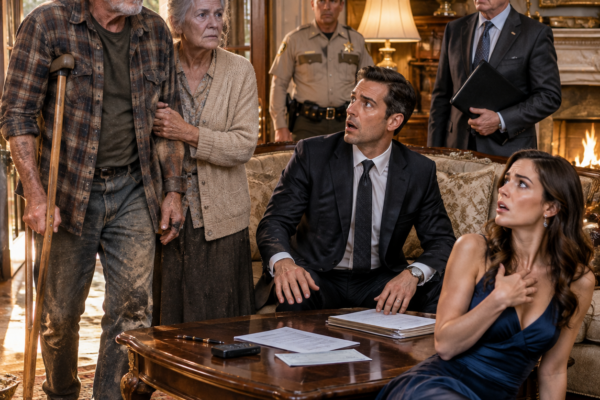
Black Girl Stares at the Judge and Whispers “You’re My Mom” — The Entire Courtroom Gasps – PART 2

PART 2
Vivian asked. Zara nodded once.
“Then let’s find you something to eat while we wait.”
It was the most ordinary sentence in the world. That was exactly right.
Victor Hayes arrived at 9:47 that evening, carrying a canvas bag that looked like it belonged to a graduate student, and contained things that belonged to nobody’s graduate education.
He had spent the last 11 hours making calls, pulling threads, and visiting two people who were very unhappy to see him.
He set the bag on Vivian’s dining room table without ceremony and began removing folders.
Chee Darlene Hughes, he said. 53 years old former labor and delivery nurse at Mercy Cross Hospital terminated 6 years ago. Currently living in Clarksville, Tennessee under her married name Darlene Okafor.
She has a landline. He placed a single sheet of paper on the table.
She picked up on the first ring. She said, and I am quoting directly tell whoever is asking that I have been waiting 6 years for this call and I have a box under my bed they are not going to believe. Vivian sat down.
Kesha, who had stayed without being asked, pulled her chair closer to the table. Victor opened the second folder.
Mercy Cross Hospital maternity ward, the 4-year window you requested. 28 cases classified as stillbirth. Of those 11 have no postmortem documentation on file.
No autopsy. No independent examination. The death certificates were signed by a single physician.
He placed a photograph on the table, a hospital ID badge, a man in his 50s with silver hair and an expression of complete authority. Dr.Philip Stroud head of obstetrics at Mercy Cross for 14 years retired abruptly 5 years ago.
Currently residing in Coral Gables, Florida. And Bright Path, Vivian asked. Shakti Cottrell said registered as a nonprofit adoption facilitation service operated for 9 years before closing.
The financial irregularities the state auditor flagged were significant shell accounts payments to individuals with no documented role at the agency wire transfers to three LLCs that dissolved within months of receiving the money. Victor spread more papers across the table. The payments to Dr.Stroud alone totaled just over 1.
2 million dollars across a 4-year period. The payments to a Mercy Cross administrator named Gerald Foss totaled 640,000. Keisha made a sound that was not quite a word.
Every each transaction corresponds to a date. Victor continued.
I cross-referenced them with the 11 undocumented stillbirth cases. Every single payment was made within 72 hours of a case being closed. He looked at Vivian.
They were running a system. Stroud identified candidates in the maternity ward mothers who were single educated without close family nearby, unlikely to have someone demanding independent review. He induced complications during delivery, performed emergency cesareans, kept the mothers under anesthesia longer than medically indicated.
By the time anyone woke up, the baby was already in transit. The room held that for a moment.
Transit to where? Keisha asked.
Bright Path had a network of what they called placement partners. Couples who had already been vetted and approved, wealthy, discreet, with connections to sympathetic legal officials who could expedite paperwork without scrutiny. Victor placed a final photograph on the table, an older man in judicial robes at a public ceremony.
Judge Carlton Briggs, family court, 22 years on the bench. He fast-tracked 23 adoption filings in 9 years, all connected to Bright Path, all processed in under 2 weeks. Standard procedure takes 4 to 6 months.
Vivian recognized the name. She had appeared in proceedings in his courtroom.
She thought about that and said nothing.
“The Holloways,” she said, “two paid $310,000, wired through one of the shell LLCs.
They received Zara 4 days after her birth and returned her 11 months later because she cried too much.”
Victor’s voice remained professional.
The return was handled through a secondary channel. Bright Path accepted children back, placed them into the foster system, and continued collecting monthly support payments.
Secondary revenue stream. Vivian looked at the photograph of Stroud. She looked at it for a long time.
“There’s one more thing,” Victor said.
He reached into the bag and placed a sealed envelope on the table.
“The preliminary DNA results from the lab I contacted this afternoon.
I asked them to flag it urgent.
” He looked at her.
“It’s your call whether you open it tonight.”
Vivian took the envelope, did not open it immediately, placed it flat on the table in front of her, and looked at it the way you look at something when you already know what it contains, but need another moment before that knowledge becomes irreversible. Then she opened it.
The paper inside was one page. She read it once, set it down.
“99.
97% probability of maternal relationship confirmed.”
Keisha reached across the table and put her hand over Vivian’s.
Neither of them spoke. The clock on the kitchen wall moved. Outside a car passed on the street.
Ordinary sounds. The world entirely unchanged. After a long moment, Vivian folded the paper, placed it back in the envelope, and stood up.
She walked down the short hallway to the guest room where Zara had been sleeping for the past 3 hours. She pushed the door open quietly. The girl was on her back, one arm curled above her head, the silver bracelet still on her wrist, catching the faint light from the hallway.
Vivian stood in the doorway and looked at her daughter for the first time, knowing that she was her daughter. She did not go in.
She just stood there. The moment did not need anything added to it.
She was still standing there when her phone buzzed in her pocket. A text from Victor sent from the dining room 20 ft away. One more thing.
Just checked his travel records. Stroud has a flight booked out of Miami, departing 6:15 a.m.tomorrow.
One way. Vivian looked at her daughter sleeping. Then she turned and walked back down the hallway.
She made the call at 4:00 in the morning.
Special Agent Dana Ross had worked organized crime and human trafficking for the FBI’s Atlanta Field Office for 16 years, and she had a particular talent for receiving calls at abnormal hours without sounding like someone who had been asleep.
Vivian had known her for 9 years, since a case that had required a federal referral, and ended with Dana testifying in her courtroom with the precision of someone who understood that every word said under oath had to carry its full weight.
I have evidence of a 7-year child trafficking operation,” Vivian said.
“Originating at Mercy Cross Hospital in Delridge.
I have financial records cross-referenced transaction data, 11 undocumented stillbirth cases, and a whistleblower with physical documentation going back to the start.”
She paused.
“I also have a subject who is currently booked on a one-way flight departing Miami International at 6:15 this morning.
” Dana said, “I need you to send me everything in the next 30 minutes.”
“It’s already in your inbox,” Vivian said.
“Victor Hayes compiled it.”
A short silence.
“You called Victor Hayes?”
“Yes.”
“Then it’s solid.”
Dana’s voice shifted into the register it used when she was already moving.
“I’ll have agents at the gate in 90 minutes.
Don’t call the subject.
Don’t call anyone connected to the hospital.
Let us work.”
Vivian said, “There are other children.
At least 28 undocumented cases, potentially more.
Some of them may still be in the foster system.”
“I understand,” Dana said.
“One thing at a time.”
The call ended. Vivian sat at her kitchen table in the pre-dawn dark and waited the way she had learned to wait in courtrooms, completely still, completely present, not borrowing trouble from the minutes ahead. At 6:08, Dr.Philip Stroud was detained at Gate 31 of Miami International Airport, 7 minutes before his flight began boarding.
He was carrying a leather briefcase, a carry-on bag, and a second passport in a name that was not his own. He did not resist.
According to the agent who processed the arrest, he said nothing at all. Just sat down in the plastic chair they indicated and stared at a fixed point on the floor with the expression of a man who had always known somewhere beneath the certainty that this morning would eventually come. By 9:00 a.m.federal
agents had executed simultaneous search warrants at Mercy Cross Hospital, at two storage facilities registered to the dissolved Bright Path LLCs, and at the private residence of Judge Carlton Briggs.
The Briggs arrest happened in the corridor outside his own courtroom at 9:22 in front of four attorneys, two bailiffs, and a court reporter named Angela, who later said she had suspected something for years, but never had language for what it was. Vivian watched the early coverage from the living room, Zara beside her on the couch with a bowl of cereal going untouched in her lap.
The news ran the airport footage first, Stroud in his gray blazer, head down, agents on both sides. Then a shot of the Mercy Cross main entrance with crime scene tape crossing the automatic doors. Zara set her bowl on the coffee table.
She was looking at the television with the careful attention she brought to everything.
“I know him,” she said.
Vivian looked at her.
“The man they arrested.”
“He used to come to the Holloways’ house sometimes.”
Zara’s voice was factual, unhurried.
“At night, he always wore a white coat, even when he wasn’t at a hospital.
He used to look at me for a long time without saying anything.”
A pause.
“I didn’t like the way he looked at me.
Like I was something he owned.”
The room felt very quiet.
“He came to another house, too.
Zara continued. The Protters.
He came twice. After the second time is when they said I had to leave. She looked at Vivian.
I think he was checking on us. The ones he took.
Vivian reached over and placed her hand on Zara’s.
The girl turned her palm upward and held it. At 11:15, Keisha called. Her voice had the careful control of someone managing something large.
The Holloways were arrested this morning in Buckhead.
They’re cooperating.
A pause. The Ashfords, the Voss couple, have been taken in for questioning.
They’re claiming they didn’t know the full extent of the operation, but the FBI found communication records.
Another pause. Vivian.
When they pulled Stroud’s encrypted hard drive, they found a database organized dated every transaction, every placement, every child.
Vivian waited. 34 cases, Keisha said.
34 children taken from their mothers at Mercy Cross and two affiliated hospitals over a 9-year period. Her voice dropped. 16 of them are still in the foster care system right now.
Being moved between placements.
Some of them have case notes that look exactly like Zara’s.
Vivian closed her eyes briefly.
I’ve flagged all 16 files, Keisha continued.
The FBI is cross-referencing with the biological mother database tonight.
They’re asking if you’d be willing to consult given your knowledge of the operation and the legal landscape.
Yes. Vivian said immediately.
And there’s a woman in Cincinnati.
Keisha said. She saw the news coverage an hour ago and called the tip line.
She lost a baby girl 7 years ago at a hospital that had a financial relationship with Brightpath. She has the original medical paperwork. She never stopped asking questions.
A short pause. She asked if there was someone she could talk to who would actually listen. Vivian looked at Zara who was watching her from the couch with those steady patient eyes.
Tell her yes, Vivian said. Tell her someone is listening now. The custody hearing lasted 43 minutes.
That was how long it took for a system that had failed Zara Daniels for 7 years to formally, legally, and on the record correct itself.
Judge Patricia Hale brought in from an adjacent county so that Vivian’s personal stake could not be questioned, reviewed the DNA confirmation, the FBI findings, Darlene Hughes’ documented evidence, and Kesha Watkins’ 14 months of case notes with the focused efficiency of someone who understood exactly what she was looking at.
She asked three questions. She made two notes in the margin.
Then she set her pen down and looked up at the room. The court finds clear and convincing evidence that Zara Daniels is the biological child of Vivian Monroe and that her removal from her mother at birth was the direct result of criminal fraud, deliberate falsification of medical records, and the coordinated corruption of multiple institutional actors.
She paused and her voice carried no ceremony, only the weight of the words themselves. Her subsequent 7 years in the foster care system constitute not a series of unfortunate placements, but a systemic failure of the institutions entrusted with her protection.
She signed the bottom of the order without looking away from the room. Custody is transferred effective immediately, permanently, and without conditions. This is not a foster arrangement.
This is not a provisional finding. This is a legal recognition of a family that should never have been separated.
She looked at Vivian over the rim of her glasses. Take your daughter home.
Dr.Philip Stroud began cooperating the afternoon of his arrest. His attorney had reviewed the evidence for 3 hours and returned with a single recommendation talk. And so he talked with the meticulous detail of a man who had kept his own records because he had always believed that documentation was a form of protection and who was now discovering that it was also a form of confession available to the other side.
He named Dr.Gerald Foss, the Mercy Cross administrator, who had coordinated internal logistics. He named four nurses who had received payment for silence including a woman who had been present at the delivery of nine of the 34 documented cases. He named two affiliated hospitals, one in Georgia, one in South Carolina, where the same operational model had been replicated.
He provided encryption keys for the digital database and access credentials for three financial accounts.
He identified the families who had paid above the standard amount, which in the network’s internal records were flagged with a small asterisk, a notation whose blandness Vivian found more disturbing than anything theatrical could have been.
He also confirmed in the flat language of a man who had ceased performing remorse what Victor Hayes had already reconstructed from the records that the selection of mothers had been deliberate and systematic. Single women.
Black women. Educated and professional without extended family networks in the immediate area.
Women who when told their baby had not survived would be statistically more likely to face that grief without someone in the room demanding an independent review. Women for whom the institutions involved could predict a particular kind of silence. Agent Dana Ross used the phrase systematically targeted in her summary to federal prosecutors.
The phrase appeared in the indictment 19 times. Judge Carlton Briggs was arraigned on a Thursday morning. He arrived in his own car with his own attorney wearing a suit his wife had pressed the night before out of some reflexive routine whose dignity the circumstances had long since abandoned.
He was 64 years old.
He had presided over this county’s family court for 22 years.
His name was on a scholarship fund at the county law school, a plaque outside courtroom four, and a letter of commendation from the State Bar Association. He pleaded not guilty. The evidence made this a procedural position rather than a factual one.
And everyone in the room understood that. Vivian did not attend. She did not need to.
Darlene Hughes arrived at the house at 4:00 that afternoon in a rental car she had driven from the airport herself, declining Victor’s offer of an arranged pickup.
She was a tall woman, silver-haired with hands that moved expressively when she spoke, and the specific kind of composure that belongs to people who have carried fear for a long time and recently set it down. She had driven across three states with a box of documents in her backseat.
And she had not once considered that the moment she had been waiting six years for might feel like anything other than it felt now. Which was relief so large it had nowhere to go except outward through the eyes without permission. She walked through the front door and stopped.
Zara was standing in the hallway. She had been told Darlene was coming.
She had been quiet all morning in the particular way she got quiet when something large was approaching, processing it ahead of time so that the actual moment could be met with stillness rather than overwhelm. Neither of them moved for a count of three.
Then Zara said quietly, “Miss Darlene.”
Darlene crossed the distance in four steps and went to her knees on the hallway floor and held this child, this girl she had last seen as a frightened four-year-old being transferred to a third placement, clutching a bracelet Darlene had just pressed into her hand with a whispered instruction the child had honored for three years without a single slip. She held her and said nothing because there was nothing to say that the moment did not already contain in full.
After a long moment, Darlene pulled back and looked at the bracelet.
“You kept it.”
she said.
“I always kept it.”
Zara said.
That evening, Vivian sat at the kitchen table long after Zara had gone to sleep, reading through Victor’s latest update on the 34 cases, and found herself stopping at the same line three times without absorbing it.
Not because it was difficult, because the rest of the house was so quiet. Because her daughter was sleeping down the hallway in a room with a closed door that Vivian could now for the first time open without grief waiting on the other side. She closed the laptop, sat in the quiet for a while, let it be what it was.
The sentences came in over three months, staggered the way federal proceedings move methodically, without the dramatic speed that justice seems to require in imagination, but rarely produces in practice. Each one was reported by the local news, then the national news, then picked up again as the scale of the operation continued to unfold.
Dr.Philip Stroud, 28 years in federal prison. The sentencing judge noted that the crimes were not impulsive or situational, but premeditated, systematic, and sustained across 9 years, and that the harm caused to mothers, to children, to the foundational integrity of institutions designed to protect both, was of a nature that resisted easy quantification. Stroud said nothing during sentencing.
He had said everything that was going to benefit him, and understood that the time for that had passed. Judge Carlton Briggs, 22 years.
He wept during sentencing, which the court reporter recorded with the same neutral precision she applied to everything else. The lead prosecutor noted without editorial comment that none of his victims had been given a courtroom in which to weep.
The Holloways, 16 years, reduced from 22 in exchange for full cooperation. They had provided transaction records, communication logs, and identified three additional families in the network who had not yet been reached. The Voss couple, who had introduced themselves to Courtroom 9 as Brandon and Cheryl Ashford, received 18 years.
Federal investigators had found hidden surveillance equipment in three rooms of their home. A folder on a password-protected drive contained behavioral profiles of each child they had managed over 7 years, annotated in the efficient shorthand of people who had been doing this for a long time, and expected to keep doing it. Gerald Foss, the Mercy Cross administrator, received 14 years.
11 others received sentences between 4 and 11 years. The hospital reached a civil settlement of $68 million with the families of confirmed victims. The settlement contained no admission of liability, which was the institutional equivalent of closing a window rather than a door.
The families took the money because some acknowledgement is better than none. And because fighting longer costs things that cannot be recovered.
The FBI’s Operation Return established a national tip line in its second week and received over a thousand calls in the first month.
The forensic team worked through the Brightpath database cross-referencing records against biological family DNA submissions confirming 19 matches in the first year. 19 children located. 19 mothers who had spent years believing something that was not true.
Keisha Watkins was promoted to director of child welfare reform for Harmon County. Her first major policy initiative required independent review of any stillbirth case in the county involving a mother without family present at delivery.
She named it the Simmons protocol. Darlene, when told, said that was unnecessary.
Then she went quiet for a moment and said thank you in a voice that meant it completely. Zara said mom for the first time on an ordinary Wednesday.
Vivian was at the kitchen counter with her back to the room making coffee when Zara came in from the backyard with grass clippings on her shoes and said without looking up, “Mom, can I have orange juice?”
in the same tone she might use to ask what time dinner was. Automatic. Casual.
As if the word had always lived there and was simply being used. Vivian turned around.
Zara had already opened the refrigerator and was standing on her toes, reaching for the carton entirely unconcerned, having no idea what she had just handed over. Vivian turned back to the counter, finished the coffee, stood there with both hands wrapped around the mug, looking out the window at a Tuesday morning that looked the same as every other Tuesday morning, and was not. Then she let herself cry the fast involuntary kind that is over before you have decided to begin.
Gone in 40 seconds.
“She wiped her face with the back of her hand.
Glasses are above the sink,” she said.
In the evenings that October, when the light came low and golden through the backyard trees, they developed the habit of sitting on the porch after dinner.
Zara brought a book she wasn’t reading.
Vivian brought her laptop and case files from Operation Returned, which she was also not reading. Mostly they sat.
One evening, Zara set her book down and looked at the yard and said without preamble, “Were you sad when they said I was gone?”
Vivian looked at her.
“Every single day.”
Zara nodded slowly.
“Me, too,” she said.
“I didn’t know what I was missing for a long time.
I just always felt like something wasn’t right.”
She touched the bracelet.
“But I kept it because she said as long as I kept it, you were still looking.”
“I was always looking,” Vivian said.
“I just didn’t know where to look.”
Zara picked her book back up, turned a page without reading it.
After a moment, she said, “I’m glad I stood up in the courtroom.”
“You were scared.”
“Yes.”
She considered.
“But I was more scared of leaving without saying it.”
Vivian looked at her daughter, at this child who had carried a silver bracelet and three musical notes through six households over seven years, and had never once let either go and thought about all the forms that courage takes.
The loud public kind that gets documented and the quiet daily kind that sustains itself in a child’s pocket invisible to everyone, waiting for the right room and the right silence and the right pair of eyes to say the true thing into.
I’m glad, too.
Vivian said.
Zara leaned her head against her mother’s arm.
They sat until the light was gone. One year after the custody order was signed, Vivian Monroe stood at a podium in the main hall of the National Family Justice Reform Conference in Washington, D.
C. and for the first time in her professional life, she was not standing there as a judge.
She was standing there as a mother. The hall held 400 people. Reunited families sat beside advocacy attorneys and federal investigators and researchers in child welfare policy and two senators who had co-sponsored the legislation that had emerged directly from the Mercy Cross investigation.
There were people in that room who had driven 12 hours. There were people who had flown in from states where similar operations were now under federal scrutiny. There were mothers who had gotten their children back.
There were mothers who were still waiting, who had come because waiting is easier when you are not doing it alone. Zara sat in the front row. She was eight now, and the distance between seven and eight was greater than the number suggested.
She sat with the same straight spine she had always had, but the quality of the stillness had changed. It was no longer the stillness of a child making herself small in a room that did not belong to her.
It was the stillness of someone who had learned, gradually and with difficulty, and then all at once, that she was allowed to take up space. She wore a yellow dress she had chosen herself from a store where Vivian had told her to take as long as she needed.
On her left wrist, side by side, were both bracelets, hers and her mother’s.
Together now, the way they had always been meant to be. She was watching the podium with an expression of uncomplicated total pride. One year ago, Vivian began, a 7-year-old girl stood up in a courtroom where she had no power in front of adults who had every institutional reason to dismiss what she was about to say, and she said something true.
The hall was quiet. Zara kept you.
She had been described in her file as difficult, emotionally unavailable, unable to form attachment. Every adult charged with her protection had used those words as justification for passing her forward, for closing one door and opening the next one, and recording the failure as hers. She paused.
What she actually was was a child who refused to forget the truth, who carried it for 7 years through six households without anyone asking what she was carrying or why. Who held onto it the way you hold something that belongs to someone else carefully because it is not yours to lose. She looked down at the front row.
Zara looked back.
“She was not broken,” Vivian said.
She was waiting. The Zara Act had been signed into federal law 11 months earlier. It required independent third-party review of all stillbirth cases in hospitals receiving federal funding, mandatory biological family notification in cases where nobody had been released for burial, and a national DNA cross-referencing registry connecting adoption records with biological family submissions on request.
The legislation had taken 14 months, two congressional hearings, and the combined testimony of 31 affected families. Vivian had testified twice. Zara had sat in the gallery both times and watched the proceedings with the focused attention of someone who understood at 8 years old that what happened in rooms like this had consequences in rooms like the ones she had lived in.
Operation Returned had confirmed 34 matches in its first year. The database remained active.
The calls kept coming. The formal remarks ended. The applause moved through the hall in the full sustained way that applause does when it is not polite but genuine.
Darlene Hughes, sitting in the third row with her hands folded, looked at the ceiling briefly with the expression of a woman who had imagined a version of this moment for 6 years and was now discovering that the real version was larger than the imagined one. Vivian was midway through acknowledging her when she heard it. Three notes, low, unhurried, in a key that existed somewhere between a lullaby and a prayer.
She stopped speaking. The hall, which had been shifting and rustling in the comfortable way of large rooms between significant moments, went completely and immediately still.
Not gradually. All at once, the way silence falls when something true enters a space and the room recognizes it before the people in it do. Zara had not stood, had not raised her hand or called out.
She was sitting exactly where she had been, hands folded in her lap, simply humming three opening notes of a song that had no written version, no recorded version, no version that existed anywhere outside the memory of the women in one family who had passed it forward without knowing what they were passing.
A song
that had traveled from a hospital room through six households in seven years and arrived now in this hall, offered freely into 400 people’s silence.
Vivian stood at the podium and could not speak. She pressed one hand flat against her chest, exhaled, and then she smiled, not the composed professional expression she had spent 15 years perfecting, but the real one, the one that reached everything. She leaned toward the microphone.
“That,” she said quietly, “is the song.”
They flew home late, and Zara fell asleep on the plane, and Vivian carried her inside from the car, heavier than last year, solid in the way of children who have learned that the ground holds, and laid her down in the yellow bedroom without waking her. She sat on the edge of the bed in the dark.
The two bracelets on Zara’s wrist caught no light.
The room was quiet in the way that the second bedroom of a house on Callaway Street had not been quiet for seven years, not with the hollow sealed quiet of a room that cannot be entered, but with the warm inhabited quiet of a room where someone is sleeping. Vivian began to hum, three notes, then the rest of the melody. The full arc of the thing her mother had given her without knowing she was giving it, the thing that had survived everything traveling forward through time in the body of a child who had been told to forget and had simply refused.
Zara’s hand resting on the blanket moved slowly until it found her mother’s and held it.
Vivian sat in the yellow room with her daughter’s hand in hers and hummed their song through to the end.
No tears this time, only this. Only here. Only now.
Which was as it turned out everything. Some children are not broken. They are just waiting.
Waiting for one person with enough courage to stop, listen, and believe that the truth a child carries is worth more than the paperwork built around it. Zara kept a bracelet. Vivian kept a door unlocked in her heart.
Between the two of them, they found what the system tried to bury. Love does not require permission to survive.
THE END.