Part 4: I Brought My Rideshare Driver Coffee Every Night — One Night He Said, “Don’t Go Home.”
The prosecutor guided me gently through my life before November. I spoke about Margaret, about 42 years of marriage, about the accident on the 2110 freeway, about grief that hollowed out every room in my house.
I described Lillian visiting more frequently after the funeral, the questions about my will, my retirement accounts, beneficiaries. At the time, did you find her questions suspicious?
The prosecutor asked. No, I said.
I thought she was worried about me.
And now I looked at my daughter across the courtroom. Her hair was pulled back.
Her face thinner than I remembered.
Eyes rimmed red. Now I understand she was positioning herself, I said quietly.
I described Dr.Lawsons office, the clock drawing, the memory tests, the prescription for Donna Pezle. Did you believe you had dementia?
the prosecutor asked. At first, yes, I admitted.
Then Darius told me someone might want me to think I was sick, so I would surrender control. And was he right?
Yes. The prosecutor paused before the final question.
Do you believe your daughter intended for you to be killed? The courtroom held its breath.
I considered my answer carefully.
No, I said at last.
I dont believe Lillian wanted me dead. But I believe she wanted my money badly enough that she stopped asking what Tristan was willing to do.
I looked at her. I dont think she wanted to know.
The defenses week followed. Lillian took the stand in a simple blue dress.
She looked fragile, smaller than I remembered.
Her attorney asked her to explain. I made terrible decisions, she said, voice trembling.
I was in debt, gambling, loans.
I owed over $200,000.
The people I owed were threatening me.
She wiped her eyes. Tristan said he had a solution.
Power of attorney, assisted living, sell the house, pay everything off.
He said it would be controlled, legal, that my dad would be safe.
Did you know he hired men to harm your father? her lawyer asked.
Lillian shook her head violently. No, I didnt know.
I swear I didnt know.
Her voice cracked.
I thought hed just be moved somewhere nice.
I didnt know about the men. I didnt know he planned to hurt him.
She turned toward me. Im sorry, Dad.
She whispered.
I never wanted you dead.
Her sobs filled the room.
I did not respond. The jury deliberated for two full days.
When they returned, the courtroom filled again. Tristan Maddox was found guilty on all counts, including conspiracy to commit murder.
Dr.Lawson was convicted of medical fraud, conspiracy, and falsification of records.
The two hired men were convicted of conspiracy to commit assault and attempted extortion. Lillian was found guilty of financial exploitation of an elder and conspiracy to commit fraud, but not guilty of attempted murder.
The sentences followed weeks later.
Tristan received a lengthy prison term, effectively decades behind bars.
Dr.Lawson lost his medical license and received a substantial sentence.
The hired men were sentenced to years in state prison.
Lillian received a reduced sentence several years with eligibility for parole based on cooperation and lack of direct involvement in the violence.
When the judge read the verdicts, I felt no triumph, no relief, only a quiet, aching finality.
After the proceedings ended, Darius stood beside me outside the courthouse.
You did the right thing, he said. I nodded slowly.
It doesnt feel like it, I admitted. He understood.
6 months earlier, I had nearly lost my life.
Now I had lost something else.
But standing there beside the man who refused to look away. And knowing his daughter was already filling out scholarship applications to study aerospace engineering, I realized something.
Justice doesnt erase betrayal.
It simply prevents it from continuing.
And sometimes survival is the only victory youre going to get. When the jury returned to the courtroom, silence fell like a heavy curtain over every person in the room.
I sat in the front row, Darius beside me, his hand steady on my shoulder. After three weeks of testimony, four audio recordings played repeatedly in open court emails documenting a $10,000 bribe falsified medical records for over a dozen elderly patients and tearful confessions from my daughter Lillian.
The 12 jurors filed into the jury box without expression.
Their faces were blank, unreadable, as if they had seen something that had drained them of emotion. Judge Anderson, a gay-haired man in his 60s with deep lines around his eyes, looked out over the packed courtroom.
Reporters filled the back rows, their pens poised. Family members of other victims sat to my left.
Dariuss daughter, Kesha, now 17 and preparing for her freshman year at Caltech, sat beside her father. She had become like family to me over the past six months.
The judge asked the four person, a middle-aged woman in a blue sweater, to read the verdicts.
In the matter of the state of California versus Tristanley James Maddox, she began her voice flat and careful. On the charge of conspiracy to commit elder abuse and fraud, we find the defendant guilty.
On the charge of conspiracy to cause serious bodily harm with intent to defraud, we find the defendant guilty. Tristan, seated at the defense table in an orange Los Angeles County jail jumpsuit, showed no emotion.
His attorney, a young man in an expensive suit, placed a hand on his arm, but Tristan simply stared straight ahead, his jaw clenched.
I saw no remorse, no fear, only a cold calculation that this day had always been a possibility.
In the matter of the state of California versus Lillian Lynn Mercer Maddox, the fourperson continued, On the charge of financial exploitation of an elder, we find the defendant guilty.
On the charge of conspiracy to commit fraud, we find the defendant guilty.
Lillian gasped, a sharp intake of breath that carried across the silent room. She turned toward me, tears streaming down her face, but I looked away.
I could not meet her eyes.
Not yet.
In the matter of the state of California versus doctor Richard Lawson, the four person said, On the charge of medical fraud, we find the defendant guilty. On the charge of conspiracy to commit elder abuse, we find the defendant guilty.
On the charge of falsifying medical records, we find the defendant guilty. Dr.Lawson, a man in his late 50s with thinning hair and wire- rimmed glasses, dropped his head into his hands.
His attorney leaned in and whispered urgently, but the doctor did not respond.
He simply sat there, shoulders shaking.
In the matter of the state of California versus Harold Eugene Martinez and Tyrell James Collins, the four person concluded, referring to the two hired men who had waited outside my house that Wednesday night with a handgun, zip ties, and duct tape on the charges of conspiracy to commit assault and attempted extortion. We find both defendants guilty.
The courtroom erupted in murmurss. Several reporters stood to leave.
Judge Anderson struck his gavel three times.
The sharp crack echoing through the room.
Order. This court will reconvene in two weeks for sentencing.
All defendants are remanded into custody.
Baleiff, please escort the defendants. Two weeks later, I returned to the same courtroom for sentencing.
The gallery was just as full, perhaps more so. Darius sat beside me again.
Kesha had an exam at school, but she had sent me a text that morning.
Youve got this, Mr.Mercer. Youre braver than you think.
Judge Anderson addressed each defendant in turn, starting with Tristan Maddox.
Mr.Maddox, the judge said his voice stern. You orchestrated a scheme designed to strip an elderly man of his autonomy, his assets, and quite possibly his life.
You paid $10,000 to a corrupt physician to falsify a diagnosis.
You hired two men with criminal records to wait outside Mr.Mercers home with weapons and restraints.
You did all of this while your wife, the victims own daughter, manipulated and gaslighted him.
The prosecution has argued for the maximum sentence.
And after reviewing the evidence, I agree. You are sentenced to 25 years to life in state prison.
Tristans face remained blank. His attorney whispered something, but Tristan simply nodded once.
Next, the judge turned to Lillian.
Ms.Mercer Maddox.
Judge Anderson said his tone softer, but still firm.
The court acknowledges that you were under significant financial pressure. A $220,000 gambling debt, a history of job loss due to embezzlement and manipulation by your husband are all mitigating factors.
However, you actively participated in this conspiracy. You gaslighted your own father, made him doubt his memory, scheduled a fraudulent medical appointment, and attempted to secure power of attorney under false pretenses.
You betrayed your own father for money.
That is a wound that may never heal.
You are sentenced to 12 years in state prison.
Lillians attorney stood and began to argue for a reduced sentence, but the judge raised his hand. The sentence stands, he said.
Dr.Lawson was next. Doctor Lawson.
Judge Anderson said his voice filled with disgust. You exploited the trust society places in physicians.
Over a period of at least 5 years, you falsified diagnosis for a minimum of 12 elderly patients, accepting payments ranging from 5,000 to $15,000.
You destroyed lives for profit. You are a danger to the vulnerable.
You are sentenced to 8 years in state prison and your medical license is permanently revoked. Dr.Lawson did not look up.
Finally, the judge addressed Harold Martinez and Tyrell Collins. Mr.Martinez and Mr.Collins, he said.
You were hired to commit violence against an elderly man for $5,000 each. You both have prior felony records.
You waited outside his home with weapons and restraints. The only reason you did not succeed was that Mr.Mercer never entered his home that night.
You are each sentenced to 15 years in state prison. Before the hearing concluded, Judge Anderson looked at me.
Mr.Mercer, he said, the court recognizes your courage in coming forward.
You have the opportunity to make a victim impact statement if you wish. I stood my legs trembling.
I turned to face Lillian, who sat at the defense table in a gray jumpsuit, her hands cuffed in front of her.
Lillian, I began my voice breaking.
You were my only daughter.
I held you the day you were born at Huntington Memorial Hospital. I taught you to ride a bike on Cedar Street.
I sat in the audience at your high school graduation. I walked you down the aisle on your wedding day.
When your mother Margaret died 8 months ago in a highway accident, you were the first person I called.
You came to the funeral. You hugged me.
You promised you would always be there for me. Lillian sobbed, her shoulders shaking violently, but you chose something else.
I continued tears streaming down my face. You chose debt over family.
You chose lies over love.
You brought me to a fraudulent doctor who diagnosed me with a disease I did not have so you and your husband could take my home, my savings, and my f vonom.
You scheduled a fake appointment for a Monday, knowing that two days later on Wednesday night, men with weapons would be waiting outside my house to force me to sign away everything or worse.
I paused trying to steady my voice. If my ride share driver, Darius Vaughn, had not been paying attention.
If he had not recognized your husband Tristan from previous rides, if he had not recorded Tristans drunken confessions, if he had not driven past my house that Wednesday night instead of stopping, I would have walked through my front door and into a trap. I would not be standing here today.
Lillian looked up her face red and swollen with tears. Dad, Im so sorry.
I never wanted you to get hurt. I just I will always love you, Lillian, I said quietly, my voice barely above a whisper.
But I will never trust you again. The courtroom was silent.
Even the reporters had stopped writing. As the baleiff stepped forward to lead Lillian away, she turned back one last time, her voice choked with sobs.
I love you, Dad. I nodded, but I felt nothing inside.
No peace, no satisfaction, only a deep, bottomless emptiness that seemed to expand with every breath. Darius placed his hand on my shoulder.
Lets go home, he said softly.
We walked out of the Pasadena courthouse into the bright California sunlight.
The trial was over.
Justice had been served.
But as I climbed into Dariuss car and watched the courthouse disappear in the side mirror, I realized something. The wound Lillian had left would take years to heal, if it ever did.
Two years have passed since the night Darius drove past my house instead of stopping. I am 70 years old now.
I still live in the same craftsmanstyle house on Cedar Street in Pasadena. The house Margaret and I bought decades ago for a little under $400,000.
The house that is now worth over 2 million.
The house my daughter Lillian and her husband Tristan Maddox tried to steal from me.
But I am no longer alone.
6 months after the trial, Darius and his daughter Kesha moved in with me. Darius no longer drives for Uber.
Technically, I hired him as my personal assistant, helping me manage my finances, coordinate my volunteer work at the VA medical center, and maintain the house. But that is just a formality.
In reality, we treat each other like family.
Kesha is 18 now. Last fall, she was accepted into the California Institute of Technology, known to everyone in Pasadena simply as Caltech, with a major in aerospace engineering.
When the acceptance letter arrived, she ran through the house screaming, waving the envelope in the air.
Darius cried. I cried, too, remembering the first night I met her.
A quiet 16-year-old girl with a poster of the Hubble Space Telescope on her bedroom wall and a half-built model of the Saturn Fuve rocket on her desk. I cover all of Keshas tuition, housing, and living expenses.
It is not charity.
It is an investment in a brilliant young mind and more than that it is what family does.
In return, Kesha lets me be her informal adviser.
Every evening when she comes home from campus, we sit together in my old study, the one with the framed photos of the Voyager spacecraft and the Mars rovers on the walls. And I teach her about orbital mechanics thermal systems and the real stories behind the missions that made history at the Jet Propulsion Laboratory.
Watching her eyes light up when she finally understands a concept. Seeing her sketch out a trajectory calculation on the whiteboard I installed last year.
Hearing her ask the kinds of questions I used to ask my own mentors 40 years ago at JPL fills me with a kind of joy I thought I had lost forever.
Every month I receive a letter from Lillian. She writes from the California Institution for Women in Corona where she is serving her 12-year sentence.
The letters arrive in plain white envelopes with the prisons return address stamped in the corner. Lillian writes about her regret, about the gambling addiction treatment program she has enrolled in, about the therapy sessions she attends twice a week.
She writes that she understands why I have not responded, that she does not expect forgiveness, but that she wants me to know she is trying to become a better person.
I keep the letters in a shoe box in the back of my closet.
I have not read most of them.
Perhaps one day I will. Perhaps one day I will write back, but not today.
The wound is still too deep.
This morning I woke up at 6:30 the way I have every morning for the past 50 years.
I walked downstairs in my slippers and made a pot of coffee the same dark roast Darius and I buy from the grocery store on South Lake Avenue. Darius came down a few minutes later, already dressed in jeans and a Caltech t-shirt Kesha gave him for Fathers Day.
I poured him a cup without asking, added no sugar, no cream, exactly the way he likes it. Kesha ran downstairs at 7, her backpack slung over one shoulder, her hair pulled back in a ponytail, and asked if I could help her with an orbital mechanics problem she was stuck on.
We sat together at the kitchen table, the three of us working through the math while the morning sunlight poured through the window. It felt natural.
It felt like home.
I think about Margaret often.
I think about the 42 years we spent together, the vacations to Yoseite, the quiet Sunday mornings reading the newspaper together, the way she used to hum while she cooked dinner.
Losing her in that highway accident was the worst pain I have ever known.
It was a pain born of love, of loss, of the natural cruelty of the world. Losing Lillian was different.
I lost her not to death, but to betrayal to Jievon, to a choice she made to value money over her own father. That is a pain I am not sure I will ever fully understand or accept.
But I have gained something I never expected.
I have a family again. Not the family I was born into.
Not the family I raised, but a family I chose and who chose me in return.
This is my true story, and it happened right here in Pasadena, California.
If my ride share driver had not driven past my house that Wednesday night, if Darius Vaughn had not been paying attention, if he had not recognized the danger and acted, I would be dead. That is not an exaggeration.
That is a fact confirmed by the Pasadena Police Department, by Detective Sullivan, by the weapons and restraints found on the two men waiting outside my home. So, I want to leave you with this.
Pay attention to the people around you.
Notice when something feels wrong.
Kindness is not weakness. Listening can save a life.
And sometimes a stranger will care about you more than your own family ever did.
I am 70 years old. I still volunteer at the VA Medical Center every Tuesday, Thursday, and Saturday night, teaching veterans technical skills and listening to their stories.
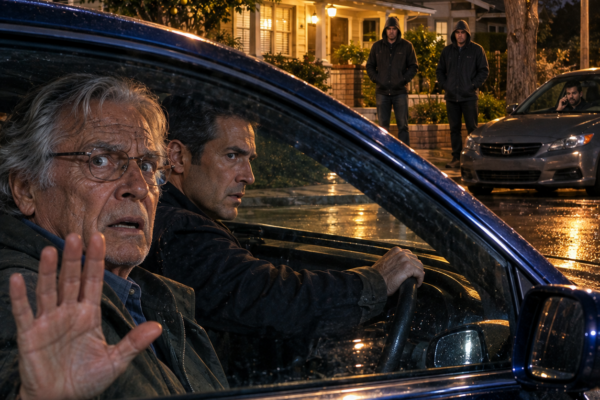
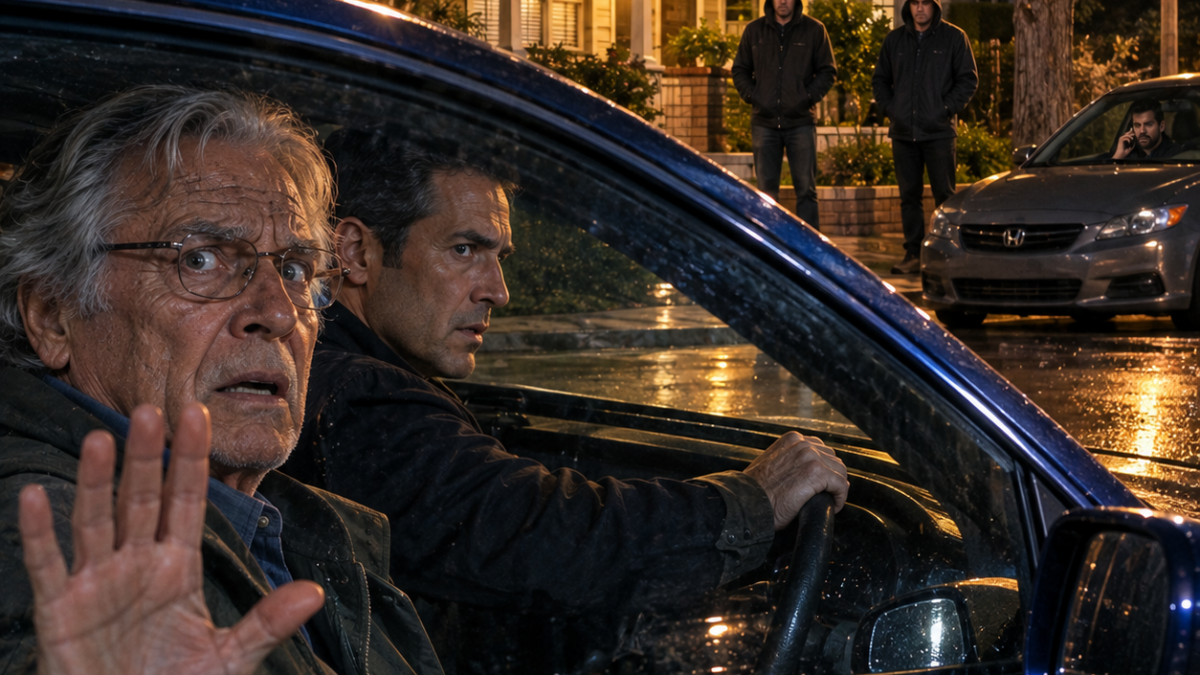
I still live in the house on Cedar Street, I have a family once again, and every morning when I wake up, I am grateful for the night Darius Vaughn drove past my driveway instead of stopping. The night he looked in his rear view mirror and saw two men in dark hoodies standing where no one should have been standing.
the night he made a choice that saved my life.
That is the end of my story.
And to you listening to this story, remember this blindness does not begin with evil.
It begins with comfort. I trusted blood over behavior.
I ignored red flags because I wanted to believe my daughter could never be part of something like family betrayal. I was wrong.
This is my family story and I share it so you do not repeat my mistakes. I used to think family meant automatic loyalty.
I believed love was permanent simply because it was shared by blood. But family betrayal does not arrive wearing a villains face.
It arrives gently questions about your finances. Sudden concern about your memory offers to help manage your affairs.
Small lies grow quietly until they become something deadly.