Part 4: I Received a $5.3M Check — I Came Home Early and Froze When I Heard My Wife Talking
I did not pay it.
Cameron dropped the paper. His hands were shaking.
And since you are the legal guardians, I said, since you signed that order accepting full liability for the estate, you owe the bank $500,000 today.
I smiled.
If you do not pay it, they will foreclose next week, and you will still owe the balance.
The crowd erupted. They laughed.
They cheered. They saw the trap snap shut.
Natasha fell to her knees. She screamed.
It was a sound of pure agony. Not for me, for the money.
She had lost the 5 million. She had lost the house.
She had inherited a debt that would bury her. Cameron looked at the lone sharks.
They were walking toward him.
They did not look happy. They knew he had no house to sell.
They knew he had no money coming.
He looked at me.
His eyes were begging. Pops, he whispered.
Please. I turned off the microphone.
I dropped it on the table. Do not call me pops, I said.
I turned my back on them.
I walked toward the Rolls-Royce. James opened the door.
I did not look back at the ruin of my family. I did not look back at the house I had built.
It was just wood and brick.
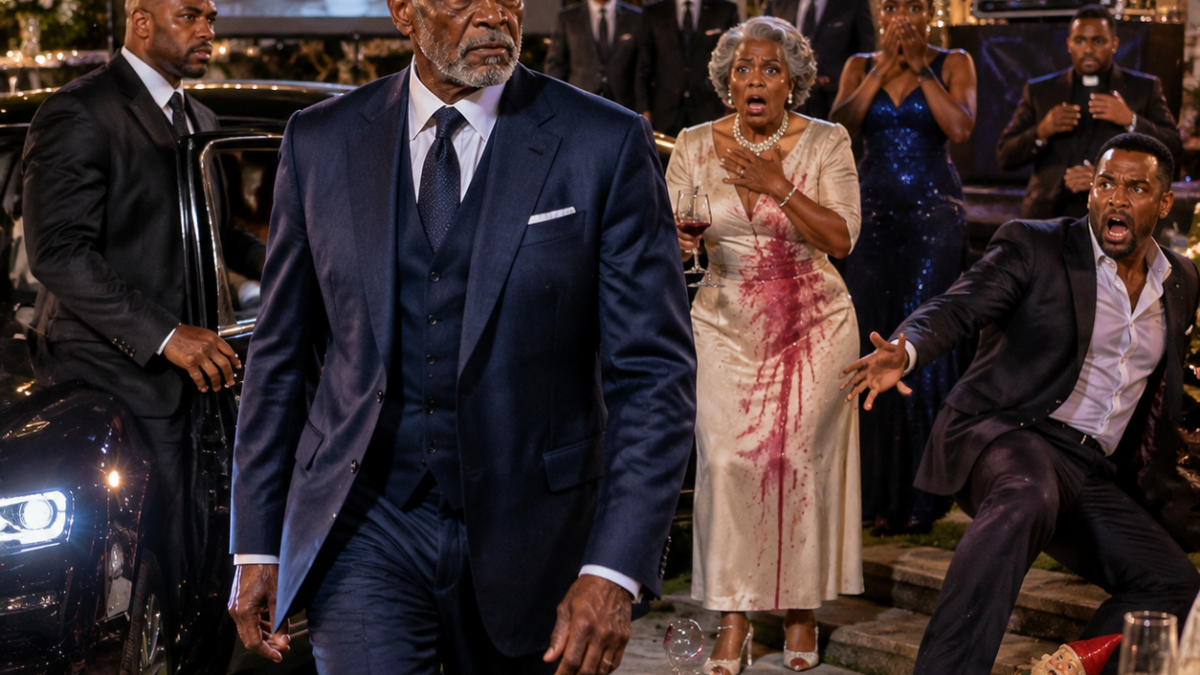
It belonged to them now, and they were welcome to it. The sirens cut through the night air like a knife.
They were loud and close.
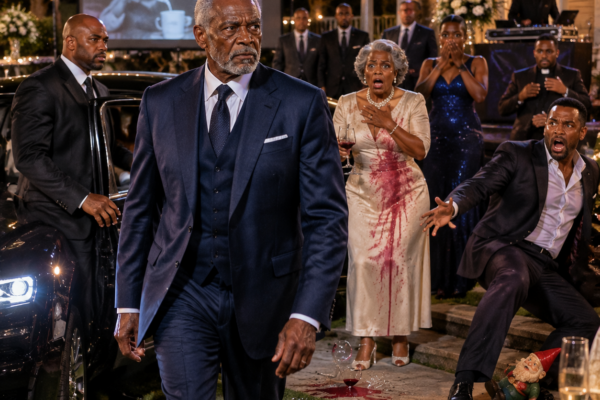
The guests covered their ears. The blue and red lights washed over the front yard, turning the white tablecloths into strobe lights.
It was not one car, it was a fleet. Oilia had timed this perfectly.
She had given the police the evidence of the kidnapping and the poisoning an hour ago.
She had waited for me to finish my performance.
She had waited for me to destroy them in front of their friends.
Now it was time for the law to finish the job.
She told them exactly where to find the perpetrators. They swarmed the driveway.
Officers and tactical vests poured out of the vehicles. They moved with precision.
They ignored the lone shark standing in the shadows. They ignored the shocked neighbors.
They went straight for the woman in the white dress and the man trying to hide behind the oak tree.
Dr.Hill had been lurking near the side gate, hoping to slip away during the confusion. Two officers tackled him before he could take three steps.
I saw his face pressed into the dirt of my flower bed, the dirt I had tilled every spring.
He was shouting about his medical license. He was shouting that he was a victim of circumstance.
An officer pulled his arms back and clicked the handcuffs into place. The sound was crisp.
It cut through the wailing of the sirens.
You are under arrest for conspiracy to commit murder, kidnapping, and medical malpractice, the officer recited. Dr.Hill spat dirt.
He looked at me.
I did not look away. I watched him being dragged toward a squad car.
He was no longer a doctor. He was just a criminal in a dirty suit.
Natasha stood on the porch.
She was frozen.
An officer walked up the steps. He was young, but his face was hard.
He held up a warrant.
Natasha Thornton.
He said, You are under arrest for attempted murder and unlawful imprisonment. Natasha looked at the handcuffs.
She looked at the guests. She saw the judgment in their eyes.
She saw her reputation crumbling into dust.
She panicked.
The mask of the grieving wife fell away completely. The mask of the dignified matriarch shattered.
She pointed a trembling finger at Cameron, who was cowering near the garage. It was him, she screamed.
Her voice was shrill and ugly.
It was all his idea. He forced me to do it.
He said he would kill me if I did not help him. He owes money to bad people.
I am a victim here.
I The crowd gasped. The betrayal was absolute.
The alliance of greed had dissolved the moment the steel bracelets came out.
Natasha was throwing her partner to the wolves to save her own skin.
Cameron looked at her with wide eyes. You lying witch!
he shouted.
You mixed the poison. You stole the keys.
You wanted the house just as much as I did. The officer did not care about their arguments.
He spun Natasha around.
He cuffed her hands behind her back. She struggled.
She kicked.
She screamed that she was an old woman.
She screamed that she was frail.
But the video on the screen behind her was still frozen on the image of her pouring powder into my milk. The evidence was staring down at her.
She was dragged down the steps she had once swept with pride.
She was shoved into the back of a police cruiser. She looked at me through the window.
She mouthed the word, Please. I turned my back on her.
I had spent 40 years pleasing her. I was done.
Cameron saw Natasha go down. He saw the police focused on securing the doctor and his mother-in-law.
He saw an opening.
He thought he could run.
He sprinted toward the back gate that led to the alley. It was a desperate move.
He was fast, but he was panicked.
He scrambled over the rose bushes, tearing his expensive suit.
He made it to the gate. He fumbled with the latch.
He pushed it open. He did not get far.
The alley was not empty. The men in the ill-fitting suits were waiting.
They had anticipated his move.
They knew rats always run for the darkest hole. I watched from the porch.
The police saw him run. They started to move toward him, but the captain held up a hand.
He paused. He adjusted his belt.
He looked at his watch.
He gave the universe 10 seconds of blind justice.
Cameron ran straight into the chest of the largest lone shark.
The man did not move.
He grabbed Cameron by the lapels. He lifted him off the ground.
Cameron kicked and flailed. He screamed for the police.
Help me!
he shrieked. Arest me!
Please arrest me!
The shark did not speak.
He threw Cameron against the brick wall of the garage. The sound of the impact was sickening.
It was a wet thud.
Cameron slid down the wall.
He tried to crawl away.
The man stepped forward. He lifted his heavy boot.
He did not aim for the head.
He aimed for the leg. He stomped down hard on Camerons shin.
The snap was loud. It sounded like a dry branch breaking in a winter forest.
Cameron howled. It was a high-pitched sound of pure agony.
He curled into a ball clutching his leg. He rolled in the dirt.
He was crying.
He was begging.
The lone shark leaned down. He whispered something in Camerons ear.
I did not hear it, but I knew what it was. It was a promise.
It was a reminder that a broken leg was just a down payment. The debt was still owed.
And now Cameron had no house to sell, no inheritance to claim. The police captain lowered his hand.
Okay, he said.
Go get him.
The officers jogged over to the alley. The lone shark stepped back.
They raised their hands. They looked innocent.
They We were just performing a citizens arrest officer.
One of them said, He tried to flee. He fell.
The police did not argue.
They picked Cameron up. He screamed in pain as they moved his broken leg.
They did not handle him gently. They dragged him to the waiting ambulance.
He was sobbing.
He was broken in body and spirit.
He looked at me as they loaded him onto the stretcher.
His eyes were glazed with pain. He looked like a child who had touched a hot stove after being told not to.
I felt nothing.
No joy, no sorrow, just the cold satisfaction of a balanced equation. He had tried to break my mind.
Now his leg was broken.
It was fair. The yard was clearing out.
The guests were fleeing the scene of the disaster. They did not want to be associated with a criminal family.
They drove away in their luxury cars, leaving tire marks on the lawn. The police cars drove off with lights flashing, carrying my past away.
I stood alone on the porch. The party decorations were still up.
The cake was uncut. The music had stopped.
I felt a tug on my sleeve. I looked down.
Kenya was kneeling on the grass at my feet.
Her dress was ruined.
Her makeup was stre with tears.
She looked small.
She looked like the little girl who used to wait for me to come home from the shop.
But her eyes were not innocent. They were terrified.
I, Daddy, she sobbed. Oh, Daddy, I am so sorry.
I did not know.
I swear I did not know they were going to hurt you. I looked at her.
I looked at the daughter I had starved for. I looked at the woman who had laughed at me while I wore a bib.
You knew Kenya, I said. My voice was tired.
You knew everything.
I saw the video.
I heard you say you hoped I would die soon.
She grabbed my hand.
She tried to kiss it.
I pulled it away.
I was confused. She cried.
Cameron told me it was for the best.
He said you were suffering. He manipulated me.
Daddy, I am a victim, too.
He ruined our credit.
He spent all our money.
I have nothing.
They are going to take my car. They are going to take my clothes.
I have nowhere to go.
She looked up at me. Her eyes were pleading.
Help me, Daddy, she begged. Please.
You have the money now. You have millions.
You can fix this. You can pay off Camerons debts.
You can buy us a new house. We can start over.
Just you and me.
I will take care of you.
I promise.
I looked at the house behind me.
It was dark now. The lights had been turned off.
It was just a shell. You want me to save you?
I asked.
Yes. She nodded eagerly.
Yes, Daddy.
Save me.
I reached into my pocket.
I pulled out a $20 bill. It was crumpled.
It was greasy. It was the only cash I had carried before I got the check.
I dropped the bill on the grass in front of her.
Here, I said. She looked at the money.
She looked at me. She looked confused.
What is this?
she asked.
It is cab fair, I said.
Or maybe it is lunch.
It is all you are getting from me.
Daddy, you cannot be serious, she wailed.
I am your daughter.
No, I said.
My daughter was a kind girl who loved her father. My daughter would never have let her husband mock me.
My daughter died a long time ago.
Kenya, you are just a stranger who shares her face.
I stepped around her. I walked down the steps.
But but where will I go?
She screamed. What will I do?
I stopped.
I turned back one last time.
You will do what I did, I said. You will get a job.
You will work.
You will struggle.
And maybe if you were lucky, you will learn what it feels like to earn your own way.
I have rescued you a thousand times, Kenya. I paid for your mistakes.
I paid for your vanity.
I shielded you from the world.
And in return, you tried to bury me.
I took a deep breath. The night air filled my lungs.
And this time, you have to save yourself, I said, by learning how to be a human being.
I turned away. I walked toward the Rolls-Royce.
James held the door open.
I slid into the leather seat. I did not look back at the woman kneeling in the dirt.
I did not look back at the flashing lights in the distance. Drive, James, I said.
Where too, sir? We asked.
Forward, I said. Just drive forward.
The car pulled away. I watched the house disappear in the rear view mirror.
It grew smaller and smaller until it was just a speck of light in the darkness.
Then we turned a corner and it was gone. I sat in the silence of the car.
I touched the gold watch on my wrist.
It ticked steadily.
Time was moving.
My life was starting over. I was 70 years old.
I was alone, but I was free.
And for the first time in a long time, I was at peace.
It has been 30 days since the red and blue lights faded from my street.
30 days since the silence returned, but it is a different kind of silence now.
It is the silence of a ledger being balanced. I drove past the county jail yesterday.
It is a gray concrete building surrounded by razor wire.
Natasha is inside.
Shes wearing an orange jumpsuit that clashes with her complexion.
She sleeps on a steel cot with a thin mattress. There are no silk sheets.
There is no wine. There is only the cold, hard reality of a cell.
Her lawyer says she cries every day.
She claims she was coerced. She claims she is a victim, but the judge watched the video.
The judge saw her pour the powder.
She was denied bail. She sits there and she waits for a trial that will send her away for 20 years.
She wanted to live in a place where someone else made her meals and did her laundry.
She got her wish. Cameron is not in jail yet.
He is in a cheap motel on the outskirts of town.
He paid cash for a week.
He cannot walk.
His leg is in a cast that goes up to his hip. He sits in a dark room with the curtains drawn.
He jumps every time a car door slams outside. He knows the men in the ill-fitting suits are still out there.
They know where he is.
They are just letting him heal a little. They want him to be able to work so he can pay them back.
He will spend the rest of his life looking over his shoulder. He will never wear a suit again.
He will never drive a Porsche.
He is a ghost haunting his own life. and Kenya, my daughter.
I went to a diner downtown last Tuesday. It was late.
I sat in the back.
I saw a waitress moving between the tables.
She looked tired.
Her feet dragged. She was wearing a uniform that was too big for her.
She spilled coffee on a customer. The man yelled at her.
He called her clumsy.
She did not argue.
She did not roll her eyes. She apologized.
She wiped the table. She looked like she was about to cry.
It was Kenya.
She works the graveyard shift. She lives in a studio apartment above a laundromat.
She takes the bus.
She is learning what it means to stand on her own feet. I watched her for an hour.
I did not say hello.
I did not leave a tip.
I paid my bill and I walked away.
She needs this.
She needs to feel the weight of the tray.
She needs to know that money is heavy.
It is the only way she will ever become a person worth knowing. The house on Maple Street is gone.
Not physically. The structure is still there, but it is dead.
The bank foreclosed on it 3 days after the party. The lean I placed on it swallowed every cent of equity.
Natasha and Cameron defaulted immediately. The bank sent a crew to board up the windows.
They put a padlock on the door.
They put a sign on the lawn.
Foreclosure auction.
The neighbors walk by and shake their heads.
They talk about the tragedy. They do not know it was a liberation.
I do not miss it. I do not miss the crown molding or the oak floors.
It was a museum of lies. I let the bank take it.
It was the price of my freedom. I erased the chalkboard.
I washed it clean.
I did not buy a mansion. I did not buy a yacht.
I did not move to an island.
I stayed right here in the city that made me. I took a drive down to the industrial district.
It is a place of brick factories and smoke stacks. It is a place most people avoid.
I found a building.
It was an old textile mill. It had been abandoned for 10 years.
The windows were broken. The roof leaked.
The floor was covered in debris. But the bones were good.
The steel beams were straight.
It had soul. I bought it.
I paid cash. I hired a crew.
But I did not hire Camerons friends.
I hired men from the neighborhood. Men who needed a second chance.
We worked side by side. I put on my coveralls.
I picked up a hammer. I sweated.
I bled. We replaced the roof.
We poured new concrete. We installed lights that turned the night into day.
I filled the space with machines. I bought lathes.
I bought milling machines.
I bought the most advanced diagnostic computers money could buy. I bought engines, V8s, diesels, electric motors.
I lined them up like soldiers on parade.
I put a sign over the door.
It is simple metal letters welded to an iron arch.
The Thornton Institute of Mechanics.
It is not a business.
It is a school.
I went to the high schools in the poorest districts. I talked to the counselors.
I asked for the kids who were failing, the kids who sat in the back of the class drawing in notebooks, the kids who had grease under their fingernails and anger in their eyes. I asked for the ones the system had thrown away.
The ones they called obsolete. I found them.
There are 50 of them now.
Boys and girls, black and white and brown.
They come here after school. They come here on weekends.
I teach them.
I do not teach them how to pass a test. I teach them how to feel the vibration of an engine.
I teach them how to listen to the rhythm of a piston.
I teach them that a machine does not lie.
If you treat it right, it runs.
If you neglect it, it breaks.
There is no politics in an engine block. There is only truth.
I watch them. I see a boy named Marcus holding a torque wrench for the first time.
He treats it like a holy relic. I see a girl named Sarah welding a seam with a steady hand.
I see the pride in their eyes when an engine roars to life for the first time.
It is a sound better than any symphony.
I pay them.
I give them a stipen so they do not have to sell drugs on the corner. I give them a meal so they do not have to go home hungry.
I give them a future.
They look at me with respect, not because I have $5 million. They do not know about the money.
They respect me because I can take a transmission apart and put it back together blindfolded.
They respect me because I have dirt on my hands. They respect me because I am one of them.
I am building an army of mechanics, an army of creators. They will go out into the world and they will fix things.
They will build things. They will know that their worth is not in what they own, but in what they can do.
I sat in my office.
It is a glass box suspended above the workshop floor. I can see everything from here.
I can see the sparks flying from the welding stations. I can hear the wine of the drills.
I can smell the oil and the hot metal.
It is the perfume of industry.
I sip my black coffee. It was strong and bitter, just the way I like it.
There was a knock on the door.
I turned. Oilia Price stood there.
She was wearing a red suit today. She looked like Victory.
She was holding a manila envelope. Hello, Caleb, she said.
She walked in and sat down. She looked out at the workshop.
She watched the kids working below. This is impressive, she said.
You did good.
I am just getting started, I said.
She placed the envelope on my desk. She slid it toward me.
It is done, she said.
The divorce is final. The judge granted everything.
Natasha contested it from jail, but she had no ground to stand on.
The fraud invalidated the prenup. The attempted murder invalidated her claim to marital assets.
You are a single man, Caleb.
I looked at the envelope.
Inside was a piece of paper that severed 40 years of my life. It cut the cord to the woman who tried to kill me.
It cut the cord to the lies.
Thank you, Oilia.
I said, I mean it. You saved my life.
You saved your own life, Caleb.
she said. I just filed the paperwork.
She stood up. She walked to the door.
She paused. What are you going to do now?
She asked.
You have the money.
You have the freedom.
You could go anywhere.
I looked down at the workshop. I saw Marcus high-fiving Sarah because they fixed a carburetor.
I saw the future. I am exactly where I want to be, I said.
Oilia smiled.
She closed the door. I opened the envelope.
I took out the decree.
I picked up a pen.
It was a heavy silver pen.
I signed my name on the line, Caleb Thornon.
The ink was black and permanent. I put the pen down.
I leaned back in my chair. I thought about Natasha and her cell.
I thought about Cameron in his motel. I thought about Kenya in the diner.
I did not feel hate. I did not feel pity.
I felt nothing.
They were just broken parts that I had discarded. I had replaced them with something that worked.
I looked at my hands. They were still rough.
They were still stained with oil. They were the hands of a mechanic.
I had $5 million in the bank. I had a legacy growing on the floor below me.
I had my life back. I stood up.
I walked out of the office.
I walked down the metal stairs to the workshop floor. Marcus looked up.
Hey, Mr.Thornton, he shouted over the noise of a drill. This engine is humming.
Come listen. I walked over to him.
I leaned in. I listened to the steady rhythmic beat of the pistons.
It was a strong sound.
It was a powerful sound. It sounds perfect, Marcus, I said.
Good job, he beamed. I picked up a wrench.
I tightened a bolt. I felt the metal bite.
I was home. And to you listening to this story, remember this.
When family betrayal comes from your own blood, it cuts deeper than any stranger ever could.