Part 2: Alone on a Freezing Farm With Nothing Left. Then She Opened the Grain Bin Floor
She took off the glasses and set them down and looked out the fogged window at the street for a while.
You have to understand what that winter was out here, she said. You wouldnt know.
You werent born. Grain prices went through the floor and the banks called in the loans, one farm after another, all across this county.
Men whod farmed the same ground their whole lives lost it at the courthouse steps in an afternoon.
People didnt have feed for their stock.
Some of them didnt have food for their kids.
My daddy was one of them.
I was 23, living at home, and I remember my mother sitting at the table with the checkbook, doing the same subtraction over and over, like it might come out different. What happened?
Things started turning up on porches at night.
Nobody ever saw who. A few sacks of corn in your barn in the morning, a ham on the step, a can of kerosene by the door.
Folks called him the hard year man, like he was something out of a story.
Some of them thought it was the church. Some of them thought it was the government, which tells you how desperate folks were.
She laughed a little without much in it. My daddy found 30 bushels of seed corn in his crib the week before Christmas and two hams.
He cried at the kitchen table. Id never seen him cry before and I never saw it again.
She turned the ledger toward Josie and put her finger beside her fathers name.
Beside it, in different ink, someone had written paid back 1991. He never knew who to pay back, so every spring for six years he left a sack of seed in the co-op with a note on it that said for whoever needs it.
And he figured that would get where it was supposed to go. She shook her head slowly.
And all this time it was August Brant, quiet old August, who never said 10 words at a church supper.
It was your grandpa.
Josie could not speak for a moment. Ive been leaving food for that dog two years, Loretta said, and I didnt even know why I was doing it.
I guess I do now. They sat with that.
The cafe door opened and closed and let in cold air and a farmer in a feed cap who nodded to Loretta and sat at the counter.
The waitress refilled their coffee.
Your brother, Loretta said after a while in a different voice, lower.
Dale is it?
Big fella, drives a white truck with his company name on it.
Not anymore. Hes between trucks.
No, hes not between anything.
That truck sold at the sale barn auction here in November.
I saw it on the lot.
Pruitt Construction, right on the doors.
Went for about half what it was worth. Loretta picked up her fork and put it down again.
Man doesnt sell his work truck in November in a small county where everybody will see it unless he needs the money worse than he minds being seen.
Josie thought of the gray sedan, the coffee he had not shared, the gold watch he kept checking as though time were something he owed somebody. He was up here in October too, Loretta said, at the courthouse.
The clerks a talker.
She said he spent an afternoon in the land records. What would he want with land records?
The farms in Moms estate.
He already knows that. Loretta did not answer.
She was looking at Josie with an odd expression, as though a thought had just arrived and she did not like it. Finish your eggs, she said.
I want to check something at the office.
The post office was a narrow brick room that smelled of paper and floor wax with a wall of brass boxes and a counter. Loretta went behind it and opened a drawer and went through a stack of envelopes and cards held with a rubber band, the ones nobody had come for.
She came back with a business card and set it on the counter in front of Josie.
It was a plain white card. Redline Plains Energy, it said.
Land Department, a mans name, a phone number, an office address two counties south. On the back, in blue ink, somebody had written in a quick salesmans hand, seeking Josie Carver, mineral owner of record, Brant section.
Please call at earliest convenience.
He left that in November, Loretta said.
Asked if I delivered to anybody by that name. I said not on my route.
He said to hold it in case.
Josie read it twice.
She turned it over and read the front again and then the back.
Mineral owner, she said slowly.
Owner of what? The lawyers office was a single room up a flight of stairs above the hardware store, and Nolan Price had been practicing law in it for 41 years.
He was a small, neat man of 71 in a brown corduroy suit with rimless glasses and a fountain pen in his breast pocket. And when Loretta brought Josie through his door at 8:00 on Tuesday morning, he took one look at her and stood up.
Miss Carver, he said, I wondered if youd ever come.
He did not have to look anything up. He opened the second drawer of his desk and took out a thin folder with her name on the tab, and he laid a photocopy on the blotter in front of her and turned it so she could read it.
Mineral deed, it said across the top.
August Brant, grantor.
Josie Carver, grantee.
All oil, gas, and other minerals in and under 320 acres.
Signed, notarized, and recorded at the county courthouse nine years ago this past September. You were 10, Nolan said.
He came in that fall and sat in that chair youre sitting in and told me exactly what he wanted. Ill say it the plain way because hed want it plain.
The ground and whats under the ground can be owned separately. Your grandfather split them.
He left the surface, the house, and the dirt to your mother, and its in her estate now. But everything under it he deeded to you, straight, no strings.
Youve been of age for a year.
Nobody can lease it, sell it, or sign it away but you.
Josie looked at the paper for a long time. Whats it worth?
Until last year, not much.
Then the drilling moved into this county. He took out a second letter.
Red Line Plains Energy wants to lease it.
$900 an acre paid upfront plus 3/16 of whatever they produce. On 320 acres, the bonus alone comes to $288,000.
Loretta, standing by the radiator, let out a breath.
I wrote to you in October, Nolan said, at your mothers address. It was the only one I had.
I never heard back. My mothers house has been dales to empty since May, Josie said.
Hes the executor. Hes had every piece of her mail.
She said it slowly, and then she kept going because the pieces were falling into place faster than she could stop them, and saying them out loud was the only way to hold them still.
Hes broke.
He sold his truck here in November.
He went through the land records in August, the same month your letter came. So he knew.
He knew the minerals were mine, and he knew what they were worth.
She put her finger on the deed.
He cant sign this, only I can. So he takes my phone so I cant call anyone.
He takes the car so I cant leave.
He takes my money so Im scared, and he leaves me out there where he thinks theres nothing in January, and he waits. A couple of weeks, he said, long enough for me to sign anything he puts in front of me to get back to a warm room.
Nobody said anything.
The radiator hissed.
Thats about the size of it, Nolan said quietly.
If youll allow an old man an opinion, dont sign anything today.
Not for them and not for him.
My grandfather painted something on a beam, Josie said.
Save back seed for the hard year.
I dont know yet what that means for this, but Im not signing anything until I do. Loretta drove her home in the early dark.
When the headlights swept the yard, Josie saw them before Loretta did.
Fresh tire tracks, the narrow tread of a small car curving up to the porch and back out again.
And on the kitchen door, folded and pinned under the latch, a sheet of paper from a pocket notebook. Came by to check on you.
Where are you? Back Saturday at noon with the estate papers.
Need your signature so we can close everything out.
D, a couple of weeks, he had said.
It had been five days. Loretta read it over her shoulder and did not say anything for a moment.
Then she said, you want me to stay? No.
I want to find a key.
She stood in the yard after Lorettas tail lights had gone, with Scout pressing against her legs and the note in her hand. And she looked at the front porch, buried to the rail in a long drift from the storm.
Five wooden steps under there.
She thought of the smell of cut hay again, and the secret that had been all hers.
And this time, standing in the cold with the porch in front of her, it came. She had been seven.
The third step had a loose board, and she had discovered that if you pried up the end with a butter knife, there was a hollow underneath. She had hidden a bandage tin there with her treasures in it, and she had made her grandfather promise never to look, and he had crossed his heart.
She dug.
It took her half an hour with the scoop shovel to clear the steps, and her arms were burning when she got the hatchet blade under the end of the third board.
It came up easier than it should have, as if someone had loosened the nails not long ago. The bandage tin was there, rusted at the corners.
She opened it with shaking fingers. A green glass marble, a blue jay feather gone thin, a photograph of a small girl in a red shirt sitting on the shoulders of a tall man in a seed cap, in a field of wheat higher than his waist.
And tied to the lid with a length of red yarn, a thing she had never put there, a small brass key.
He had crossed his heart, and then, one day long after, he had looked after all, because he knew it was the one place in the world she would remember. Before she turns that key, tell me something in the comments.
What did someone in your family leave you that was worth more than money? Then stay with Josie, because the key tied with red yarn was about to open the one thing her brother never knew existed.
She went down the ladder with the lamp in her teeth and the key in her fist. She knelt at the bottom shelf.
The key went into the brass lock as if it had never been anywhere else and turned, and the lid came up. The first thing she saw was the original, not a photocopy.
The mineral deed itself, the real one, on heavy paper with a raised notary seal and a county recorders stamp in purple ink across the top corner.
Her name, typed. His signature below it, big and careful, August Brant.
The way a man signs something he means. Under the deed were three letters, each on company letterhead, each from a different year.
The first was from a land company six years ago, offering to lease the minerals under the Brant section at a modest price per acre. The second, four years ago, offered more.
The third was from Red Line Plains Energy, dated the spring before he died, and the number in it made her set it down on the concrete for a moment and breathe. Across the top of each one, in the same square pencil capitals as the beam, her grandfather had written a single word, No.
And under that, smaller, Not mine to sign. Under the letters was a sheet of lined paper folded once.
She opened it.
Josie, if youve got this far, youve got the deed in your hand and you know what it is, or Nolan told you. Its yours.
I put it in your name when you were 10 because you were the only one of them who ever asked me what the ground was for instead of what it was worth.
You asked me that on the porch with a peach in your hand.
Ive been thinking about the answer ever since. These men will keep coming.
The money will get bigger.
You can lease it or leave it.
Thats your choice and nobody elses.
I dont want you living your life to please a dead man. I only want you to decide it yourself, with your eyes open, standing on your own feet, not scared, not cold, not with somebodys hand on your shoulder telling you its the responsible thing.
She stopped reading.
She looked at those last three words for a long time. The responsible thing.
He could not have known Dale would say it, but he had known Dale and he had known the voice. She read on.
The letter went onto the back of the sheet and there his writing grew smaller, as if he had been running out of room and did not want to start a second page.
Youve probably found the ledger by now.
Im not proud of much, but Im proud of that winter.
I had a good crop in 84 and a bad feeling about 85, so I saved back more than I needed.
And when the banks started in, I had it to give. I did it at night because I didnt want thanks, and I didnt want anybody feeling they owed me.
People out here would rather go hungry than owe. I understand that.
Im the same. Your mother was 11 that winter.
She rode along some nights in the truck with a blanket over her legs and a thermos, and she never told a soul.
She was the best of us, Josie.
Whatever happened after, she was the best of us, and she made you, and you were the best of her. Dont let anybody tell you different, and dont you ever hate her for that last summer.
She was trying to keep peace in a family that didnt know how to have any.
Thats a hard job.
It wore her out.
Josie had to put the letter down on her knee. She had not known that.
She had not known her mother had ridden through the dark at 11 years old with a thermos, carrying food to people who were losing everything.
Her mother, who kept a tin of recipe cards with notes in the margins for whoever came after.
She thought she could see it now, the line that ran from that truck to that tin.
And she thought that whatever else her mother had done, she had not been lying about everything.
Only about one thing, once, in a car on a hot day, because she was tired and her son was angry, and she did not know how to hold them all.
That was harder to carry than hating her would have been. It was also truer.
Josie was beginning to understand that the true things usually were. At the very bottom of the box was the something harder she had felt shifting on Saturday.
It was a squat glass jar with a zinc lid, full to the brim with seed corn, fat golden kernels dried hard as pebbles. A strip of masking tape on the side read in pencil, 1985, seed from the hard year, plant it when you need to.
She held the jar up to the lamp and the kernels shone like old coins. She thought about 30 bushels of seedcorn in Ed Pikes crib the week before Christmas and a man who cried at his kitchen table and 63 names in a ledger and she understood that this was the last of it.
The seed he had saved back from the seed he gave away. She did not know how long she knelt there.
Scout came down the ladder at some point badly and lay on the concrete beside her with his chin on her boot.
Above them the night had gone still and hard. She could hear the bins steel walls ticking as they cooled and far off, very faint, the windmill turning in a wind too light to feel.
She got up once to fill the heater from the red can, the way he had told her on the tape, to the line and not past, and she cracked the hatch its inch and she sat back down with her back against the shelves. 4 days until Saturday.
4 days until the little gray car came back up the lane with a folder on the seat and her brothers patient voice inside it.
She had the deed now.
She had the letters with no written across them. She had a lawyer who knew her name and a mail carrier who knew her dog.
5 days ago she had had 18 matches and nothing else. It was strange how much a person could be given in 5 days when the people who were supposed to give it had taken everything first.
When she finally went to put the jar back, she saw there was one more thing at the bottom of the box, flat against the metal where the jar had been sitting on it. A small envelope sealed with a single line on the front in his hand.
Play the last tape before your brother comes back, then open this. She turned and looked at the shelf, at the eight cassette cases lined up where she had left them.
At the one on the end, she had not been able to make herself play.
Josie, seventeen.
She played it that night, sitting on the wool blankets with the lamp turned low and the envelope on her knee, because he had asked her to and because she had run out of reasons not to. The voice on the seventeenth tape was not the same voice.
It was slower.
There were pauses in it that had nothing to do with choosing words, pauses where she could hear him breathing carefully, the way a man breathes when every breath has become a small piece of work.
Youd be seventeen, August Brant said.
Its April. The meadowlarks are back.
I heard the first one this morning from the porch, and I thought, well, theres one more spring anyhow. A long pause.
The doctor in town says my hearts tired.
I told him I know the feeling.
I dont think Ill be making another one of these, Josie, so Im going to say it all and Im going to say it plain, and then Im going to rest. She pulled her knees up and wrapped her arms around them.
That last summer, the day your mother came and took you home, your brother was twenty-five and hed started a company and he wanted to buy two big machines he couldnt afford. The bank wanted something behind the loan.
He asked me to sign the minerals under this ground over to him so he could put them up as collateral.
He said they werent doing anybody any good just sitting there.
He said Id never know the difference.
The tape hissed. I told him no, not because I didnt love him, because Id watched what happened in eighty-five to men who borrowed against their ground and I wasnt going to hand my grandson the rope.
He didnt see it that way. He told your mother Id pick the dirt over my own family.
Your mother loved him and she believed him and that was the end of the summers.
Another pause, long enough that Josie thought the tape had ended.
That fall I went to Nolan and put the minerals in your name. I want you to know why.
It wasnt to punish Dale.
It was because a 10-year-old girl sat on my porch with peach juice running down her wrist and asked me what the ground was for.
Not what it was worth, what it was for. Nobody had asked me that in 40 years.
I figured somebody who asks that question is somebody who ought to have the answering of it.
His breath caught.
He waited it out. The men from the company started coming a few years later.
I said no every time. It wasnt mine to say yes.
Id already given it away. I just held the door until you got here.
He coughed and it went on a while. Im sorry I wont be the one to open it for you.
I hope somebody does. And Josie, the envelope, that one isnt for you.
Youll see. Youll know what to do with it.
You always did know more than they gave you credit for.
The last thing on the tape was the sound of a screen door and a bird somewhere far off and his voice very quietly as if he had forgotten the machine was still running.
There, thats the meadowlark. Click.
She did not cry this time.
She sat for a long while with her hand on Scouts side, feeling it rise and fall, and then she opened the envelope. Inside was a second envelope, smaller, sealed with a strip of tape and on it in the same square capitals one word, Dale.
A folded slip of paper was tucked behind it. Josie, give him this if hes earned the reading.
Youll know if he has.
If he hasnt, burn it and dont feel bad. Ive said worse to him to his face.
She turned the sealed envelope over in her hands.
It was thin, one sheet, maybe two. She did not open it.
She set it on the shelf beside the tapes where she could see it and she lay down on the blankets and slept without dreaming.
Loretta came up the lane on Wednesday afternoon, at the end of her route, with two grocery sacks and a 40-pound bag of dog food in the back seat.
Before you say anything, she said, setting them on the kitchen table, this isnt a favor. My daddy owed your grandpa 30 bushels of seed corn and two hams, and he died never knowing who to give it back to.
I know now, so Im paying on his account. You dont get a say in it.
Josie did not argue. She had learned the difference that week between being given something and being taken from, and she found she did not want to argue with the first kind.
Loretta had brought more than groceries. She had brought a message from Nolan Price, written on the back of a post office form in her quick, square hand, and she read it aloud at the table because she said her writing was only legible to God and the postmaster.
Nolan had called Redline Plains Energy on Tuesday afternoon.
The land department had been happy to talk to the lawyer for the mineral owner of record.
According to their notes, a man named Dale Pruitt had called them the third week of October. He had said he represented the family.
He had said his sister was young and did not understand business, and that he would have her sign a mineral deed over to him so that he could handle the lease himself, and that they should expect to have everything signed by the 1st of February. He had asked whether the company could advance any part of the bonus once the deed was recorded.
They had told him no. 1st of February, Josie said.
Thats what he told them.
Its January 15th. I know it.
Josie looked out the kitchen window at the long white lane running out to the county road.
Two weeks.
That was what Dale had given her at the most.
Two weeks of cold and hunger and fear before the folder came out.
Hes going to bring a mineral deed on Saturday, she said. Not a state papers.
Hell call it estate papers. Itll be a deed with his name where grandpas used to be.
Nolan says thats likely.
He says if you sign it, its done.
Theres no taking it back. Loretta folded the form in half.
He says hell come up Saturday if you want him.
Ill drive him. Josie thought about it.
She thought about the car backing around in the yard and the red taillights and Travis walking out without a word.
Come at 12:30, she said.
Not before.
I want to hear him say it first.
One more thing, Loretta said at the door, pulling on her gloves. The radios calling for another storm Saturday, worse than last week.
Supposed to come in sometime in the afternoon. She looked down the lane.
If your brothers got any sense, he wont come. Hell come, Josie said.
Hes only got until the 1st of February. The next two days she worked.
There was no other way she knew to wait. She got the kitchen warm and kept it warm.
She scrubbed nine years of dust off the oak table and found under the grime at one end a set of small initials cut into the wood with a pocket knife, JC, in letters that wobbled.
And she remembered her grandfather pretending to be angry about it and then showing her how to hold the knife so she would not cut her thumb. She hauled water.
She got the windmill off its brake with a pipe wrench from the machine shed and Lorettas instructions over coffee.
And on Friday morning it turned and the pump coughed and water came up into the stock tank for the first time in 22 months. She stood and watched it run in the cold sunlight with her hands on her hips like a farmer and Scout barked at it and she laughed.
On Friday night she took the blue plate with the chipped rim down from the cupboard.
She had found it on Tuesday night at the front of the shelf as though it had been set there to be found.
She washed it and dried it and set it at her place at the oak table and she ate her supper off it. Beans and cornbread Loretta had taught her to make in the cast iron skillet.
She did not know if that was a sad thing to do or a good one.
She decided it could be both.
Saturday came up gray and still and 12° and low in the northwest, along the far edge of the world, a long bank of cloud the color of slate had begun to build. She was ready.
She had made coffee. She had put on the one clean shirt she had left and braided her hair.
The original deed was down in the green box with the three letters where it had been safe for nine years, and she had brought up only one thing, the sealed envelope with Dales name on it, which she had tucked inside her jacket without being entirely sure why. At 11:52 by the kitchen clock, which she had wound on Wednesday and set by Lorettas watch, the little gray sedan turned in off the county road.
She watched it come the whole mile and a half.
It came slowly.
When it was halfway up the lane, she saw it slow even more, and she understood that Dale was seeing what she had done.
The smoke going straight up out of the chimney, the trench dug to the door, the windmill turning, the dog. The car stopped by the porch.
Dale got out first in his tan coat and pressed plaid shirt with a leather folder under his arm. Travis got out the other side and stood by the fender with his hands in his pockets and his green cap pulled low.
He looked at the windmill for a long time. Scout did not bark.
He stood at the top of the porch steps beside Josie with his torn ear forward and his amber eyes on Dale, and a sound came out of his chest so low it was almost not a sound.
Well, look at this, Dale said.
He smiled up at her, the patient smile, and she saw his eyes go past her to the kitchen door and back.
Youve been busy.
Whered the dog come from?
He was here, Josie said.
Hes been here the whole time.
Nobody bothered to look.
Dale let that go past him, the way he let everything go past him. came up the steps.
sound got a little louder, and Dale stopped on the second step, and after a moment he went around. In the kitchen he set the folder on the oak table and did not take off his coat.
He looked around at the scrubbed table and the warm stove and the pot of coffee, and something moved in his face and was gone. I came by Tuesday, he said.
You werent here.
I was worried sick.
I was in town.
I got a ride.
From who? A friend of Grandpas.
He looked at her a moment longer than he needed to. Then he opened the folder.
He did it the way he did everything, with care, squaring the papers against the tables edge. All right?
Ill make this quick because I know its been hard out here, and Im sorry for that, Joe. I am, but its nearly done.
He turned the papers to face her.
Estate forms.
Moms estate has to close, and the farm has to be sold, and the buyer wants it clean.
Theres a few signatures, here and here, and the last ones just housekeeping. A quick claim, so the titles in one name and the sale can go through.
Thats all it is. He took a pen from his coat and set it on the papers.
Sign these and Ill drive you back to town today. Your phones in the car, sos your envelope, sos Moms tin.
Its all right there.
He smiled. You can sleep in a warm bed tonight.
Josie looked at the pen. She looked at the stack of papers.
She looked at Travis, who had come in behind Dale and was standing by the door with his back almost against it, looking at the floor, the way he had looked at the floor nine days ago while their mothers handwriting went out under their brothers arm. Read me the top line of the last one, she said.
Dales smile did not move. Its legal language, Joe.
Itd just confuse you.
Then it wont take long.
For the first time she could remember, her brother did not have anything ready to say. He looked at her.
She looked back. Behind him, Travis had lifted his head.
Mineral deed, Josie said quietly. She did not look at the paper.
She did not have to. Grantor, Josie Carver.
Grantee, Dale Pruitt.
All oil, gas, and other minerals under 320 acres.
Thats the top line, isnt it, Dale?
The kitchen was very quiet. The stove ticked.
Out in the yard, the windmill turned and the pump coughed and the water ran. Dale put both hands flat on the table.
Where did you hear that word? He said.
It was not a question.
And his voice for the first time since the funeral was not patient at all. Josie got up from the table.
She crossed the kitchen and opened the back door and went out across the snow to the old grain bin, and she did not hurry.
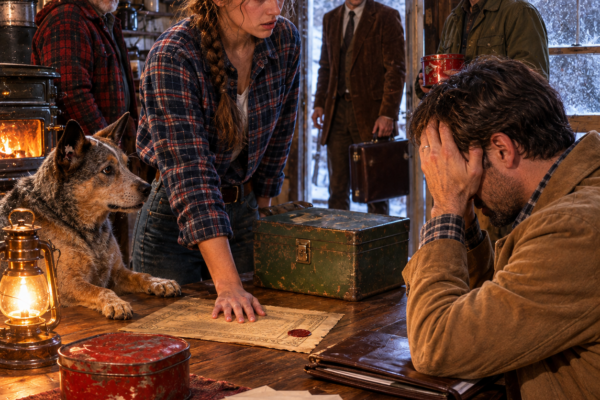
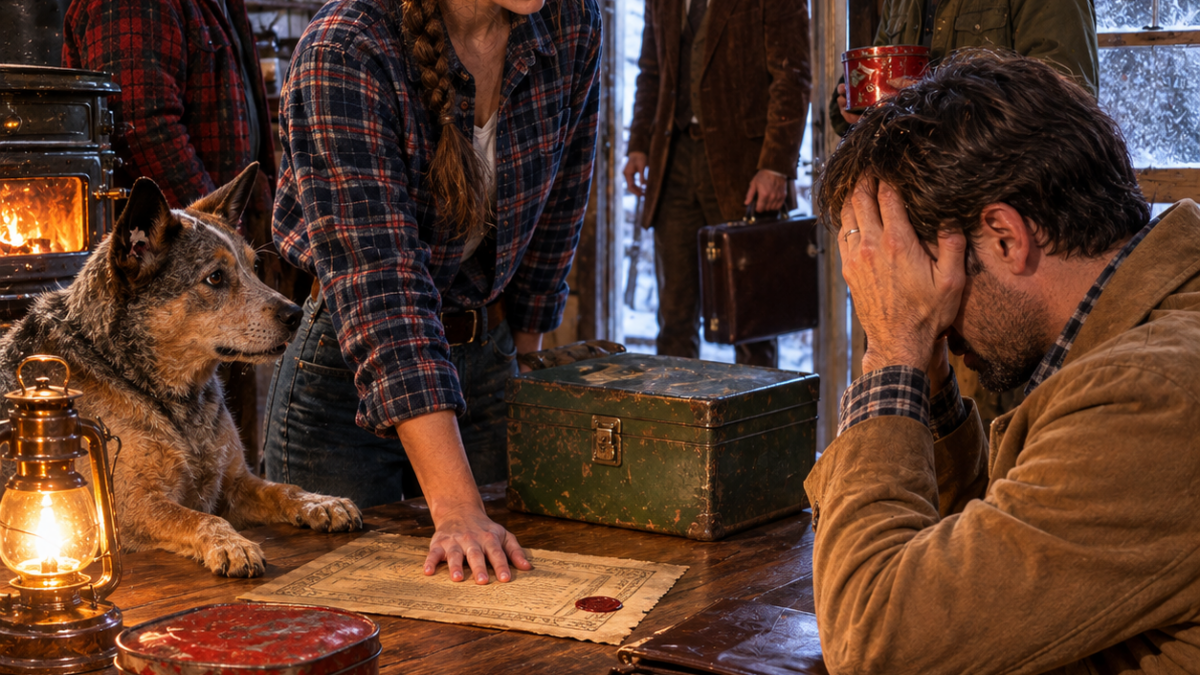
When she came back, she was carrying a dented green metal box, and she set it on the oak table on top of his papers, and she turned the brass key.
She took out the original deed with its raised seal and its purple stamp and laid it in front of him.
Then the three letters, one on top of the other, each with a single word written across the top in her grandfathers square pencil hand.
No. No.
No.
Read me this one first, Dale, she said. Dale did not read it.
He did not have to.
He looked at the deed for a long time, at the raised seal and the purple stamp and the big careful signature, and then at the three letters with no written across them.
And his face did something Josie had never seen it do. It went still, not calm.
Still, the way a pond goes still when the wind drops and you can suddenly see how deep is.
He showed you, Dale said finally.
He left it for me. He left all of it under the old bin.
Theres nothing under the old bin. Theres a room, Josie said.
Theres been a room since 1985.
Youd know that if youd ever asked him what the ground was for.
Out in the yard, an engine.
Scout lifted his head.
Through the kitchen window, Josie saw the small white mail car turn in off the county road, and she looked at the clock on the wall.
12:28.
Nolan Price came in first in his brown corduroy suit and an overcoat that was too thin for the plains, with his briefcase held against his chest.
Loretta came behind him in her red plaid jacket and stood by the stove as though she had been standing by that stove all her life. Nolan looked at the papers on the table, the folder and the deed and the letters, and he did not need anyone to explain it.
Mr.Pruitt, he said, Im Nolan Price. I represent your sister.
Dale did not answer.
Ill keep it short, Nolan said.
The minerals under this farm were deeded to Josie nine years ago and recorded at the courthouse.
They are hers completely, and they were never part of your mothers estate. Nobody else can sign them over, and nothing you draw up changes that.
He set his briefcase on the table. The surface is a separate matter.
That is in the estate, and it goes to the three of you in equal shares, and well settle it properly and in the open.
But the minerals are finished, Mr.Pruitt.
They were finished before you got in the car.
Dale sat down.
He did it slowly as though his legs had made the decision without him. He put his elbows on the table and his face in his hands, and for a long moment, the only sounds in the kitchen were the stove and the windmill.
Then he talked. Dad left when I was 14, he said into his hands.
You dont remember. You werent born.
Mom worked two jobs and I worked after school.
And when I was 18, I was the one who paid the light bill. Ive been the one holding it up ever since.
The company, the house, two little girls, a wife who thinks were fine.
Were not fine.
I owe $140,000 to people who dont wait and the bank is calling the note on the house in March. He lifted his head.
His eyes were red. When that land man told me what was under this ground and whose name was on it, I thought shes 19.
She doesnt even know its there.
I told myself youd never miss what you never knew you had.
I told myself a lot of things. Josie waited until she was sure he was finished.
You left me out here in January with 18 matches, she said.
She did not raise her voice.
You took my money and my phone and moms handwriting so Id be small enough to sign anything you put in front of me.
Thats what you did. I heard why.
I understand why.
It doesnt change what you did. She put her hand flat on the deed.
Im not signing.
Not today and not ever.
Grandpa built this place for hard years.
Im going to use it for that.
Nobody spoke.
Then Travis moved. He had been standing against the door the whole time and now he turned and went out and Josie heard the car door open and shut and for one cold second she thought he was leaving the way he had left nine days ago without a word.
 [Tap here for the Next Part ]