Alone at a Frozen Motel, She Found Something Behind the Closet Wall
Alone at a Frozen Motel, She Found Something Behind the Closet Wall
At 63, Lorna Beckett had learned to be grateful quietly before anyone had to ask.
So when her sons wife drove her up Tamarak Pass on the coldest Friday in January and called the shutdown motel at the top, a little place of your own, Lorna said, Thank you.
Then Shelby kept the car keys, the phone, the checkbook, the toolbox Lornas husband had carried for 40 years, and the shoe box of his letters.
She had already kept the $186,000 from Lornas house.
The nearest town was 23 miles of snow away.
On the second night, warm air that smelled of cedar began breathing out of the back of a closet, and behind it, Lorna found a hidden room inside the motel her sons wife had spent 14 months calling a condemned ruin.
It all began the afternoon they drove her up the mountain. Lorna rode in the backseat of the car that had been hers until October, her one suitcase against her knees.
Travis drove.
Every few miles he took one hand off the wheel to rub the back of his neck the way he had done since he was a boy waiting on a report card.
He did not turn on the radio. Shelby sat beside him with her leather folder on her knees and she talked for both of them.
Your place now, Shelby said and turned and smiled over the seat. It was a good smile.
She had a whole shop full of things that looked like that smile.
Soft linen and candles in glass jars and painted signs that said kind things about home. I know we told you it was a mess.
It is a mess, but its yours and that has to count for something.
14 months ago, when word came that Winnie had died at 91 in the care home down in Cold Water Bend, Lorna had been sick with pneumonia and Shelby had taken over the mail.
Shelby said the will left Lorna the motel and the motel was condemned with back taxes and a lean and the kindest thing was to let the county have it.
Lorna had believed her.
She had not seen Whipperwill Court since she was 15 years old. Past the second switchback, Shelbys phone buzzed.
Her face did a small thing, a tightening that came and went, and she said, Pull over a second, babe.
She got out and walked 20 ft up the road and took the call with her back to the car, one arm wrapped across her middle against the cold. When she got back in, she said, Work!
and put the phone face down on the folder.
That was the third call Lorna had watched Shelby step outside to take that week. It was the first time she let herself count them.
There had been other small things.
The new camel coat returned with the tags still on. The handlettered sign in the window of Shelbys shop, everything must go, which Shelby had called a winter promotion.
Lorna had thought nothing of any of it.
That was the trouble with being grateful. It kept your eyes down.
The motel came up out of the trees a little before 3:00. It was smaller than she remembered, the way places are.
A low white L of cinder block with eight turquoise doors, the paint gone to chalk and peeling in long curls, the flat roof carrying 2 feet of snow like a loaf of bread. Above it, on a rusted steel pole, stood the sign, A tall neon bird perched on a branch, its glass tubes dark and cracked, its wings spread over panels that had not lit in 22 years.
Lorna remembered that bird glowing pink and blue on summer nights. She remembered lying awake in room six and watching its light come soft through the curtain.
Travis stopped under the sign and left the engine running.
Well, Shelby said brightly, here we are.
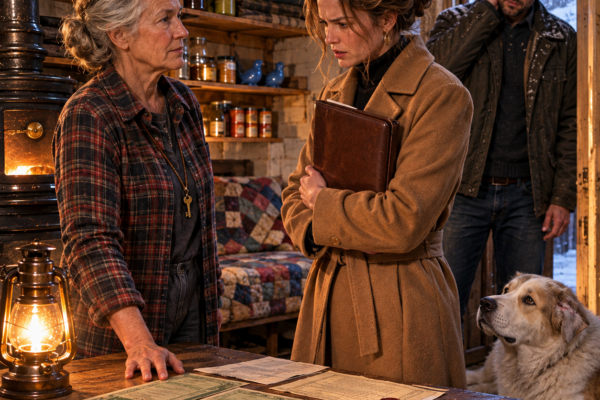
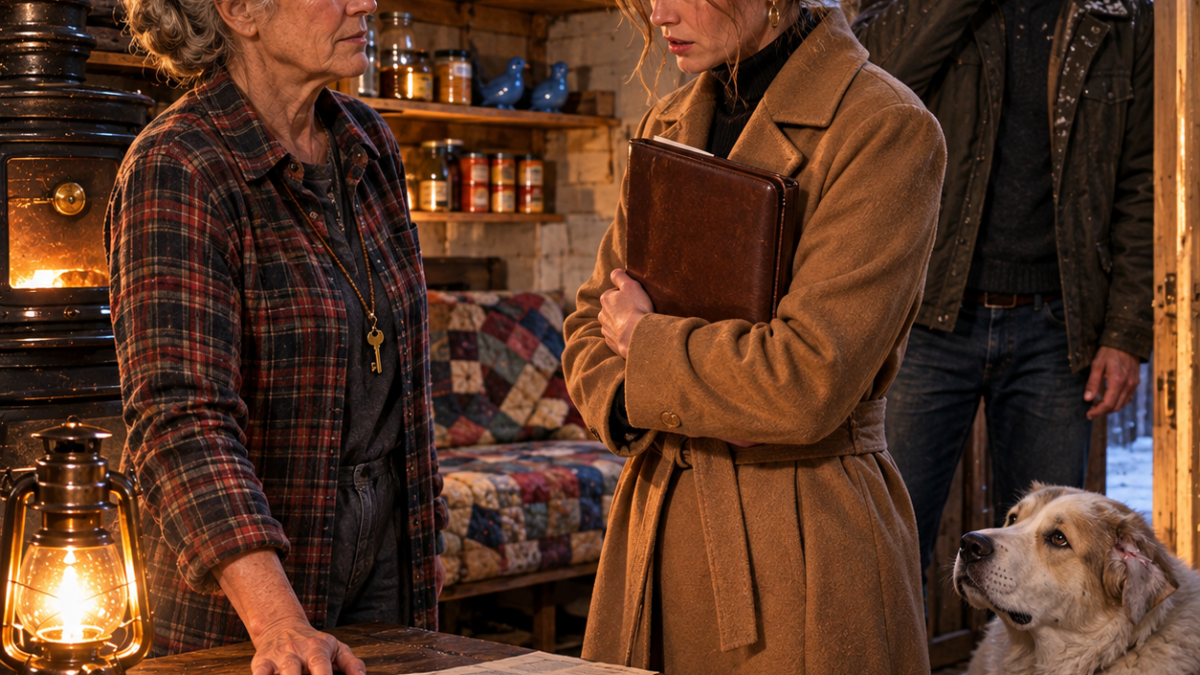
Travis worked the office key in the frozen lock until it turned. Inside there was a long oak counter, a board of brass hooks with keys still hanging from some of them, a faded armchair with roses on it, and a squat iron stove in the corner with its pipe going up into the wall.
A clock above the counter said 20 4 and had said it for a long time.
Theres a stove, Travis said.
His voice came out rough.
And wood out back.
Youll be fine, Shelby said. Youre the most capable woman I know.
Then she held out her hand, palm up, steady, waiting.
The phone, Shelby said gently.
Its on the family plan, and theres no signal up here anyway.
It would just die in the cold. Well keep it charged for you.
And the checkbook.
I know, I know. But you remember that man who called about your Medicare, and you very nearly read him your numbers.
Its only paperwork, Lorna.
Its there to protect you. Travis and I will handle the accounts until youre settled, and then well all sit down and sort everything out properly.
That was the voice. It was the voice of someone being kind to you while she took something out of your hands, so that if you held on, you were the one being difficult.
It never made demands. It only made reasonable suggestions one after another until there was nothing left in your hands to make suggestions about.
Lorna gave her the phone.
She gave her the checkbook.
Then she looked at her son.
Travis was looking at the stopped clock.
My things.
Lorna said Deans toolbox.
The box with his letters. Theres no room for all that in here.
Itll get damp. Shelby said, Well hold on to it at the house.
She glanced at her husband. Wont we?
Travis rubbed the back of his neck. He opened his mouth and Lorna waited, and the cold came in through the open door and touched her ankles, and he closed his mouth and went back out to the car.
Her son said nothing. It was his silence she would keep coming back to.
Not the phone or the checkbook or the $186,000 from the little house on Larks Street, which had gone into Shelbys shop 18 months ago as a family loan nobody had written down.
Her son had stood in that doorway with his mothers whole life in the trunk of his car, and he had said nothing at all. The box she wanted most was the shoe box.
On top of Deans letters, wrapped in a dish towel, sat a small blue ceramic bird, a salt shaker the size of a hens egg with a chipped beak and three tiny holes in its head.
Winnie had given her one of the pair the last summer Lorna spent here when she was 15. The other had stayed behind.
Lorna had kept hers on the window sill of every kitchen she had ever cooked in.
Two weeks ago, it had gone into a carton Shelby marked for the yard sale, and Lorna had taken it out again, and somehow it had found its way back in.
Well come up in a couple of weeks, Shelby called from the passenger side.
Stay warm.
The car turned under the dark neon bird. Lorna stood on the step with her coat buttoned to the throat and watched the tail lights go red and small down the white road between the spruce.
The tail lights never slowed. Nobody in the car turned around.
It was 4° above zero and the light was already going blue at the edges of the snow. She went inside and let herself have one minute standing in the middle of the office with her hands in her pockets.
Then she took her hands out and went to see about the stove.
For 34 years she had run a school kitchen. She knew how to start from nothing.
The wood pile behind the office was not much. A few dozen split lengths gone gray under a lean-to roof.
A splitting maul leaned in the corner, its cracked handle wrapped in tape, and on a nail hung a coffee can. Inside were matches, a stub of candle, and a square of newspaper.
Somebody had left them there on purpose. She laid the fire the way her father had taught her, newspaper first, then the thinnest splinters she could shave with Deans old pocketk knife.
The first match broke, the second caught and died.
The third caught, and she cuped it in both hands, and fed it the paper slowly, and the paper took, and the splinters took, and a thin blue flame climbed into the dry wood, and turned yellow.
She sat back on her heels on the rag rug, and let out the breath she had been holding since the car door slammed.
Under the counter, she found a kerosene lamp with an inch of oil in its base.
Out by the leanto stood a 50-gallon water barrel with a skin of ice 2 in thick and she broke it with the back of the mall.
Three hard blows that rang off the spruce and filled the coffee can and set it on the stove.
She ate half of the egg salad sandwich she had made that morning in Shelbys kitchen and wrapped the other half for tomorrow. Then she dragged the armchair to the stove and sat with her coat on and the lamp turned low.
It was a little after 8 when she heard the scratching at the door.
It was a slow sound, patient.
Three strokes and a pause, and three more. There was nobody for 23 miles.
The scratching came again, and with it a low sound, half a wine and half a sigh, the sound of something too tired to bark.
She opened the door a hands width.
A dog stood on the step.
She was enormous, or had been, a big white dog with a heavy coat gone dull and matted.
Burrs knotted in the long fur of her chest, a pale cream patch across her back, like a saddle someone had laid there and forgotten.
One ear stood up and one folded over.
Her ribs showed when she breathed.
Around her neck was a worn red leather collar with a small brass tag. She did not push in.
She looked up at Lorna with dark brown eyes and waited to be told. Well, Lorna said, look at you.
Youd better come in before we both freeze. The dog came in carefully, the way a guest steps into a house where she is not sure of her welcome, and went straight to the stove and lay down in front of it with a long groan, as if she had done it a thousand times.
Lorna knelt and unwrapped the other half of the sandwich, the half she had saved for morning, and held it out on her flat palm. The dog took it so gently Lorna barely felt her teeth.
That was breakfast, Lorna told her. Yours and mine.
The dog laid her heavy head on Lornas knee, and the cold office felt less like a place she had been left.
She called the dog snow because there was snow on her and snow everywhere and she was too tired to think of anything better. Twice in the night Lorna woke to feed the stove and both times the dog lifted her head to watch her do it and laid it back down.
Morning came gray and bitterly still with frost ferns on the inside of the windows.
Lorna did the arithmetic of the wood pile and did not like it.
wood for two more days if she was careful. No food, water as long as she could break the ice.
She spent the morning finding things, a ring of keys with paper tags in a faded hand she recognized, three cans of peaches behind the counter, the tins still sound. She ate half of one and gave the dog the rest, syrup and all.
She pried boards off the leanto for kindling, and the dog followed her everywhere.
And when Lorna stopped to catch her breath, the dog leaned against her legs.
By 3:00, the light was going again. Her back would not take another night in the armchair.
She needed blankets, and she remembered that Winnie kept two spares in every closet. She took the ring of keys and waited through snow to her knees, and she knew which door she was going to before she reached it.
Number six.
The first room passed the office, sharing its back wall with the office chimney.
The key turned as if somebody had oiled it.
Naughty pine walls, the white iron bed with its faded chenille spread, a window etched with frost, a cedar lined closet with a sliding door. The room had the bitter settled cold of a place shut up for 22 years, and her breath hung in front of her face.
She slid the closet open. There were the blankets on the shelf, two gray wool ones folded square.
She reached up for them and stopped with her arms in the air. There was warm air on her wrists.
Not hot, it was the faint warmth of a kitchen an hour after the oven has been turned off in a room where her breath was smoking, and it smelled of cedar, and under the cedar of lamp oil and something sweeter, like old soap. She held her bare hand flat near the back of the closet, and felt the warmth move across her palm, steady as a draft from an open window, only the wrong way round.
It was coming out of the seams between the cedar boards.
The dog pushed in beside her.
Her nose went down along the closet floor, working, working, and a low sound started in her chest, and she scratched once at the bottom board with one big white paw, and looked up at Lorna and waited. I feel it, too, Lorna said quietly.
A chimney warms a wall. It does not breathe through a closet.
She knocked on the side of the closet.
Solid cinder block, dull and dead. She knocked on the back.
It answered hollow, and somewhere behind it the knock went on a little way and came back the way a voice comes back in an empty hole.
She ran her fingers along the edges of the cedar boards. Along the bottom, nothing.
Along the sides, nothing. Up at the top, hidden under the lip of the blanket shelf, where no one would ever look, her fingertips found a notch cut into the wood, just big enough for two fingers.
Lorna stood a long moment with her fingers in that notch and her heart going hard.
Then she pulled. The whole back of the closet swung inward on hinges that made no sound at all, and warm, still air rolled over her face, the breath of a room that had been holding it for a very long time.
The dog was through the gap before she could stop her.
Lorna lifted the lamp into the dark, and the light slid across a whitewashed wall and a row of shelves lined with glass jars and the end of a narrow cot.
On the cot, propped against a folded pillow as if someone had said it there that morning, was an envelope, and on the envelope, in a slanting hand she had not seen in 48 years, was her own name.
Snow, Lorna said.
But the dog was already sitting beside the cot as if she had sat there a hundred times before, and she did not turn around. Lorna stepped through the closet after her.
The room was perhaps 7 ft wide and 12 ft long, tucked between the office and room 6, where no one standing outside would ever have guessed there was space for it. The walls were whitewashed cinder block, clean and bare.
Along one side ran the old block chimney, and Lorna laid her palm against it, and felt the heat of her own fire, the office stove she had fed all night and all day, coming through the blocks into this hidden place, and filling it the way warm water fills a cup.
That was the breath in the closet.
22 years of cold, and the first fire anyone had lit in the office had woken this room up. There was a second stove, a small black box stove on a square of slate.
its pipe running into the same chimney. Raw cedar shelves climbed the far wall from floor to ceiling, and on them in rows as neat as a school pantry, sat cans of beans and corn and peaches and condensed milk, jars of honey, a tin of coffee, a sack of oats hung from a nail, three kerosene lamps with full bases, a gallon can of lamp oil, and folded wool blankets, gray and red and green, stacked to the top.
split wood stacked chest high against the end wall, a canvas caught with a pillow and a patchwork quilt. Lorna turned slowly with the lamp.
She had fed people for 34 years.
She knew a pantry stocked by someone who meant it.
Somebody had stalked this room the way you stalk a lifeboat.
On the shelf nearest the cot, beside the first lamp, sat a small blue ceramic bird.
She knew it before she reached it. the size of a hens egg, three tiny holes in its head.
The beak on this one was whole.
She picked it up and held it in her palm, and it weighed exactly what hers weighed, and she stood there in her coat in the lamplight, and could not for a long moment do anything at all.
48 years, one bird in every kitchen she ever had, and one bird here in the dark, waiting, and hers was in the trunk of a car going down the mountain.
She set it back exactly where it had been and sat on the edge of the cot and opened the envelope.
It was three pages of lined paper written in pencil in the slanting hand Lorna remembered from grocery lists taped to the office counter. Winnie had always written as if she were in a hurry to get the words down before somebody needed a room.
Lorna, the letter began. If you are reading this, then somebody finally brought you up the pass or you came on your own.
And either way, the office stove is lit because that is the only way this room breathes.
I built it like that on purpose. Only somebody who comes in out of the cold and makes a fire will ever feel this closet warm.
I am writing this in the fall of the year I turned 89 at the counter with my good glasses on.
The doctor says the home in Cold Water Bend by spring. So I will say it now plain while my hand is steady.
Room six was always yours. I never rented it again after the summer you left.
Not one night in 26 years. Not even to a honeymoon couple who offered me double.
I told them it was being kept.
It was. Your mother and I said hard things the night your father left.
I asked her to let you stay up here with me. I said things about her pride I should not have said.
And she said things about my motel and my strangers she should not have said.
And in the end, she made me promise to stay out of your life and let her raise you her own way. I kept that promise.
It is the only promise I ever kept that I am sorry for.
Whatever she told you about why I never came, I expect it was easier to hear than the truth.
The truth is I wanted you everyday and was not allowed to say so.
You were never the girl nobody wanted. You were the girl I was not allowed to keep.
Everything up here is yours now. The motel, the land, the sign, this room, and what is behind the back panel.
Do not open that panel until you have talked to Priscilla Vin in Cold Water Bend.
She has the papers and you will want a clear head and a good lawyer before you see what is back there. The key is somewhere you will not think to look because I know my family and I know they would look everywhere I would think of.
Love always Winnie.
Folded inside the letter was a smaller card and on it in the same pencil a list. The box stove damper is the brass knob.
Half a turn and no more, or she will smoke you out.
Prime the office pump with a kettle of hot water down the top.
Then pump slow. The cans with blue tape on them are good.
Burn the spruce first and save the tamarak for the hard nights.
A man named Odell Fisk comes up on Thursdays. You can trust him with anything except a secret about pie.
Lorna read the letter twice, and then she folded it and put it inside her sweater against her chest.
Then she did what the card said, because there was nothing in her life she trusted more than a list written by a woman who had run a kitchen.
She laid a fire in the box stove with spruce from the end of the stack.
She turned the brass knob half a turn, and no more. She struck a match, and it caught on the first try, and the little stove drew clean and quiet into the old chimney, as though it had been waiting all those years for exactly this match.
Some people leave behind money, and some leave behind a room with your name on it.
When the stove was going, she lifted the lamp to look for a hook to hang it on, and the light slid up the wall above the cot and caught on a piece of painted tin.
It was a small sign no bigger than a license plate cut from the side of a large pale and nailed to the block. Someone had painted it white, and on the white, in red letters that had faded to the color of a rose petal, someone had lettered six words, and then smaller three more.
Leave the light on.
Somebodys still on the road. Lorna knew that voice.
She had heard it every night of one summer in July and August of the year she was 15. That was the summer her father left.
He packed a suitcase on the first Saturday in June and drove away. And her mother stopped eating and started sleeping in the afternoons.
And by the end of the month, somebody decided Lorna would be better off out of the house. So she spent July and August at Whipperwill Court with her mothers younger sister, a small quick woman with auburn hair pinned up with a pencil through the bun who wore mens denim shirts with the sleeves rolled and carried the room keys on a ring at her hip.
Lorna wheeled blankets down the row in a laundry cart.
She learned to make a bed with corners you could bounce a quarter on. She learned to fold towels in thirds.
She learned that people who stop at a motel on a mountain pass at 11:00 at night are mostly tired and frightened and grateful, and that it costs nothing to be kind to them first, and ask their names second. And every evening at dusk, Winnie went out to the base of the sign with Lorna behind her, and opened a gray metal box on the pole, and threw a heavy switch.
The neon bird would buzz and stutter and then bloom pink and blue against the dark spruce.
And Winnie would stand there a moment with her hands still on the switch and say it the same words every night the way some people say grace.
Leave the light on. Somebodys still on the road.
On the last morning of August, her mother drove up to take her home.
Lorna remembered the voices through the office door. Not the words, only the sound of two sisters saying the kind of things that cannot be taken back and the long silence after.
Then Winnie came out alone with her eyes red and pressed a small blue bird into Lornas hand. One goes with you, she said.
One stays here.
That way the pairs never really split up. In the car going down the pass, her mother said only one thing.
Your aunt has her motel and her strangers.
She doesnt need us.
The next spring, her mother told her Winnie had sold the place and moved out west somewhere.
Arizona, she thought. Lorna wrote one letter to the motel anyway at 16, and nothing ever came back.
And her mother said that was all the answer anybody needed. Lorna sat on the cot in the warm hidden room and looked at the faded red letters on the tin.
And for the first time in 48 years, she wondered whether that letter had ever left her mothers house.
Winnie had not sold anything. She had not moved anywhere.
She had stayed right here and kept a room empty for 26 years and turned the light on every night for a girl who had been told she was not coming. Lorna slept that night on the canvas cot under the patchwork quilt with the box stove ticking and the dog stretched along the floor beside her, and it was the first warm night she had spent since Friday.
The next four days had a shape, and she was grateful for the shape.
On Sunday morning, she carried a kettle of hot water to the office and poured it down the top of the frozen hand pump the way the card said, and pumped slow. And on the 40th stroke, the pump coughed and spat rust and then ran clear and cold into the tin sink.
She laughed out loud. The dog barked at the sound once and looked embarrassed.
She ate beans with blue tape on the can and oats with honey, and on Monday a can of peaches she let herself have all to herself.
She fed the dog first every time. She found a steel comb on the shelves and spent an hour each evening working the burrs out of the long white coat, one knot at a time, while the dog lay with her eyes half shut and groaned whenever Lorna stopped.
Under the burrs, the coat was thick and soft. Under the coat, the ribs were already a little less sharp.
Every evening at dusk, Lorna filled a lamp from the gallon can and set it in the office window facing the road. She did not tell herself why.
She only knew it felt wrong not to. And every day, sooner or later, she found herself standing in front of the back wall of the hidden room.
It was a panel of painted plywood 4 ft wide and taller than she was, screwed into a frame of 2x4s set into the block.
On its right edge was a steel hasp, and through the hasp hung a brass padlock the size of her palm, the kind you buy for a barn and not for a closet. She put her ear to the plywood and heard nothing.
She held the lamp close to the seams and felt the faintest dry stir of air, cooler than the room, smelling of cedar and old dust.
She looked for the key. She looked on every shelf and under every can.
She looked under the cot and inside the quilt and behind the stove.
She went through every drawer in the office and every hook on the keyboard, and she tried every key on the paper tagged ring.
All eight rooms and the office and the shed, and not one of them came close to fitting. She thought of Winnies line.
The key is somewhere you will not think to look. On Wednesday night, she stood in front of the panel with the lamp in her hand and said out loud, Well, where did you put it?
The dog thumped her tail against the floor, and that was the only answer she got.
Thursday morning came in clear and cold, the 15th of January, the seventh day since the car went down the pass. Lorna was in the office feeding the stove when the dog came to her feet in one motion and went to the front window and stood there with her nose against the frost, every muscle in her big body gone still.
Then Lorna heard it too.
Far down the pass below the switchbacks, an engine laboring up the grade, and with it a long grinding scrape, steel on frozen gravel, like a plow blade pushing snow.
The dogs tail began to swing slow and then fast.
She threw back her head and barked again and again, and it was not a warning.
It was the bark of a dog who knows exactly who is coming up the road. Lorna put on her coat and went out onto the step.
A red pickup came around the last switchback with a yellow plow blade bolted to its front, throwing a long white curl of snow off to the side, and it pulled into the lot under the dark neon bird, and stopped. The engine died.
The door opened, and a big man climbed down slowly, the way big men climb down when their knees have opinions. He was past 70, broad through the chest, with a wide red face, a thick white mustache that hid his whole upper lip, and a red wool watch cap pulled down to his eyebrows.
Under his open coat, he wore a white cooks apron over a green flannel shirt.
The dog went off the step like a shot. She hit him at the knees and he staggered and caught himself on the fender and went down onto one knee in the snow anyway and took her big white head in both of his hands.
Pilot, he said. You old fool.
Pilot!
Pilot!
I know. I know it.
Then he looked up and saw the smoke coming out of the office chimney and the woman standing on the step under it.
and he stayed exactly where he was on one knee for a long moment with his hands still in the dogs fur. Well, he said finally, youd be Lorna.
I would.
Odell Fisk.
He got up, one hand on the fender.
Winnie talked about you so much.
I feel like I ought to apologize for knowing what you looked like at 15.
He came up the step and shook her hand. His hand was the size of a skillet and just as warm.
And he looked past her into the office at the lit stove and the lamp on the counter and the swept floor and something in his face settled. How long?
He said since Friday they brought me up Friday afternoon.
Who did?
My son and his wife. He did not say anything to that.
He only looked down the empty road for a while, and his jaw moved under the white mustache, and then he turned and went back to the truck and hauled a 50-lb sack of dog food out of the bed and set it on his shoulder.
Pilot, Lorna said when they were inside by the stove. Ive been calling her Snow.
Shell answer to Snow. Shell answer to supper if you say it right.
Odell poured food into a steel pan from the leanto, and the dog ate with her whole face in it.
Winnie named her. Got her as a pup six years ago this spring from a sheep outfit over in the next valley that had one too many.
Big white dogs like that are bred to stand out in the weather and watch over things.
Thats all they want to do.
Winnie said shed walk out to the road in a storm and stand under the sign and bark until whoever was crawling up the pass found the lot. Said she brought them in the way a pilot boat brings a ship to the harbor.
So pilot he sat down in the rose armchair which groaned under him. When Winnie went down to the home going on 3 years ago now, I took the dog had a good yard for her fenced.
Pilot went over that fence the second night and turned up here eight days later. 23 mi up the pass.
Sitting on that step, I brought her down again. She came back again.
Third time, I quit fighting her. I figured if she wanted to keep the place, Id keep her.
I come up every Thursday with a pan of food and a bucket of water, and she licks it clean by Saturday and waits the rest of the week.
Youve been driving 46 miles every Thursday for a dog. Going on 3 years, he shrugged.
Winnie fed half this county on a tab she never collected. Im only paying down the interest.
Lorna thought of the coffee can on the nail in the leanto with its matches and its candle and its square of newspaper, and she understood who had left them there on purpose.
Theres a room behind the closet in six, she said. Odell nodded slowly.
I wondered when somebodyd feel that closet warm. She had me haul cans up every fall.
Blue tape on the new ones.
She told me where to set them and what to throw out. She never told me whats behind that plywood at the back.
And I never asked. Some things you dont ask Winnie Haskell.
He looked at her. She wrote you a letter.
She did.
Then you know more than I do. He drove her down the mountain at a little 11.
Pilot rode between them on the bench seat with her chin on the dashboard, and Lorna sat with her hands in her lap and watched the spruce go by. The same spruce she had watched the other way 6 days before and told him the whole of it, the phone, the checkbook, the toolbox, and the shoe box, and the $186,000.
The word condemned, she told it plainly without dressing it up, the way she would have reported a broken freezer to a school board.
Odell drove and did not interrupt. Twice his hands tightened on the wheel.
Once he said very quietly, a word she did not quite hear and did not ask him to repeat.
Cold Water Bend was one main street along a frozen river with a feed store, a hardware store, a white church, a bank with a clock in the window, and at the near end, under a snowbank higher than its windows, a low diner with steam on the glass.
Inside it was warm and loud and smelled of coffee and onions and pie crust. There were red stools along a steel counter and a checkered floor, and four or five men in feed caps at the counter turned on their stools when the bell over the door rang.
Odell walked Lorna to a booth by the window, put a cup of coffee in front of her without asking, and went back behind the counter and tied his apron tighter.
Everybody, he said to the room, this is Winnies niece. That was all he said.
It was enough. The man nearest the door, a thin old fellow with a truckers cap and hands spotted brown, got down off his stool and came over and stood by her booth with his cap in his hands.
Maam, he said, February of 79, I was hauling feed over the pass, and the snow came down so hard I couldnt see my own hood. Then I saw that bird, pink and blue, plain as day, up the hill in front of me.
Id have gone off the edge at the next turn.
Your aunt put me in room three and fed me ham and eggs at 2:00 in the morning and would not take $1.
Shed say, You can pay me by stopping for the next fellow. He put his cap back on.
Ive stopped for a lot of fellows.
He went back to his stool.
 [Tap here for the Next Part ]