Part 2: Alone at a Frozen Motel, She Found Something Behind the Closet Wall
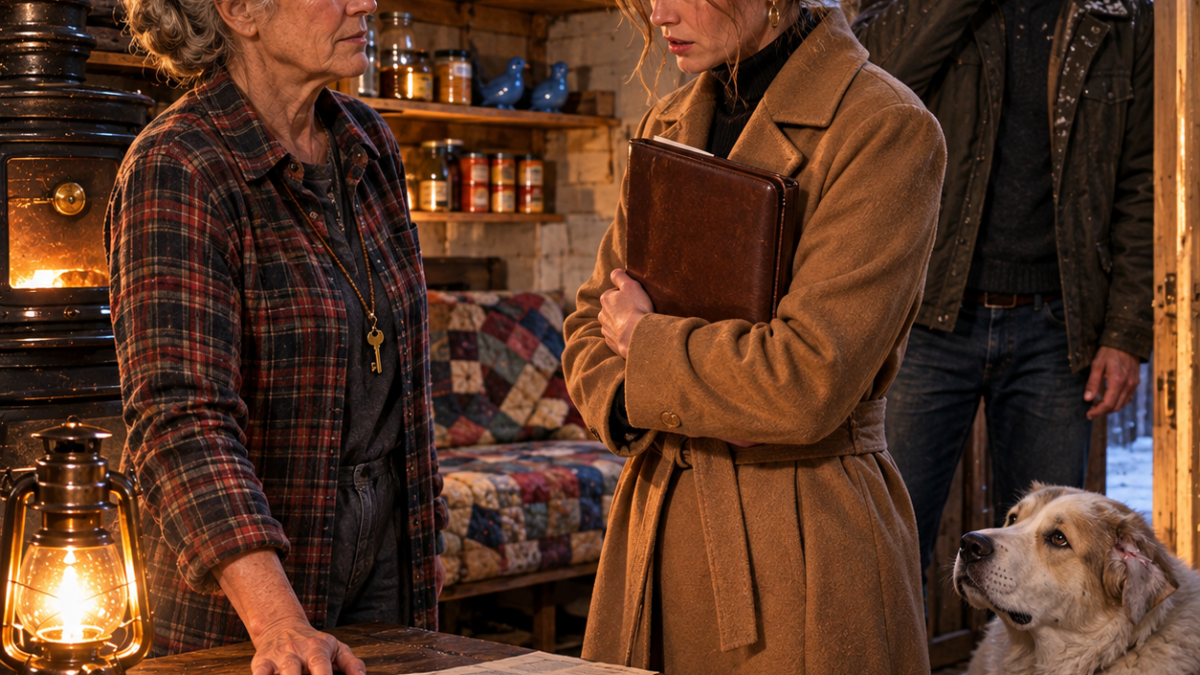
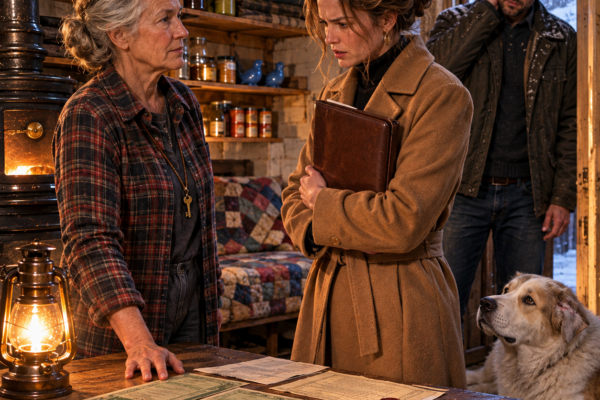
Odell set a plate in front of Lorna, chicken and dumplings and a square of cornbread with a pad of butter going soft on top, and she ate the whole of it while the room went back to its own noise around her, and nobody watched her eat, which was its own kindness.
When the lunch crowd thinned, Odell came and sat across from her with a cup of his own. Thats the story youll hear in this town if you stay long enough.
He said 43 winters Winnie ran that motel and every one of them she kept the sign lit all night long. Every night snow or no snow electric bill near broke her some years.
Storm nights she never charged a soul.
She kept a book of them names and dates who came in off the pass and what they needed.
Folks around here called it the light at the top. If you broke down up there, you didnt pray for a tow truck.
You prayed you could make it to the bird. He turned his cup on the table.
Every night at dusk, shed walk out and throw that switch.
And shed say the same thing, like Grace, leave the light on. Somebodys still on the road.
I know, Lorna said.
I used to stand behind her when she said it. Odell looked at her across the table for a long time.
She knew youd remember, he said.
Then his face changed and he set the cup down and he looked out the window at the main street.
I ought to tell you something, he said.
And I dont like telling it because its not my business. There was a man in here twice in December.
Good coat, city haircut. Said he was with a company called Tamarak Ridge Resort Partners.
Asked a lot of questions about the motel and the land around it. snow load road access how far to the ridge line second time he got friendly said the family had promised him a signed deed by the 1st of March and he didnt plan to wait a day past it Lorna sat very still u she said I havent been asked she counted it the way she used to count trays the 1st of March was 45 days away Odell said I didnt think you had.
She looked down at her hands on the table. Things she had seen and not let herself see came up one at a time, the way stones come up in a field after a hard frost.
Three phone calls taken out of earshot in a single week.
A camel coat going back to the store with the tags still on. a sign in the shop window, everything must go, that Shelby had called a promotion, and something she had forgotten until this moment, a pink notice on Shelbys kitchen counter one morning in December, half under the fruit bowl, from the company that held the note on Shelbys car with two words stamped across the top in red ink.
Past due. Shelby had swept it into a drawer when she saw Lorna looking and smiled and said the bank had made a mistake.
Lorna had believed her.
She had believed all of it. Youre welcome to my spare room, Odell said.
Its got a real bed and a real furnace and nobody in it.
Thank you, Lorna said.
I have a room. Its been kept for me.
Odell looked at her and then he laughed, a short surprised laugh, and shook his head. Lord, he said, you are her niece.
He would not let her pay for lunch.
And when she said she could not keep taking things, he said he was not giving her anything.
He was keeping Winnies books balanced. And he wrote her name at the top of a fresh page in a green ledger under the register in large careful capitals and drew one line under it.
Then he filled two grocery sacks off his own shelves, flour and eggs, and bacon and coffee and a bag of oranges, and put them in the truck, and drove her back up the pass in the blue afternoon light, with pilot asleep across both their laps.
At the top he carried the sacks into the office, and stacked another armload of split tamarak beside the stove.
He stood a moment on the step under the dark sign, putting his gloves back on.
One more thing, he said. Winnies lawyer, Priscilla Vin, office over the hardware store.
Shes been in court over at the county seat all week, but shes back Monday. Ill come for you at 9:00.
Winnies letter told me to see her. Then youll want to hear this before you do.
Odell pulled the second glove on and flexed his fingers. Priscilla sat at my counter not two weeks ago and told me shes been mailing you letters for over a year.
certified every one of them with the keys to this place and a copy of the will. Everyone came back with a signature on the little green card that says it was delivered.
Lorna stood very still on the step. I never got any letters, she said.
No, Odell said. Priscilla figured you didnt because the signature on those green cards wasnt yours.
He climbed into the truck and backed it around under the bird, and the plow blades scraped and lifted, and the red tail lights went slowly down the pass. Lorna stood on the step until they were gone.
Then she went inside and filled a lamp and set it in the office window, facing the road, and stood there in the warm room with the dog against her legs, and thought about a round, careful handwriting she had seen on a thousand grocery lists and birthday cards and notes left on a kitchen counter. She did not need Monday to tell her whose name was on those green cards.
She needed Monday to tell her why. Odell came for her at 9:00 on Monday morning, the 19th of January, and by 10 she was sitting in a worn leather chair above the hardware store, with a radiator hissing under the window.
Priscilla Vin was a small upright woman with a steel gray bob and half moon reading glasses with a file on her roll top desk 3 in thick.
Your aunts will was admitted to probate 14 months ago, she said. It left the motel, the land, and everything on it to you and to no one else.
The executives deed, putting it in your name, was recorded last April. The property taxes have been paid every year from an account your aunt set aside for that purpose.
There is no lean.
There is no back tax. It has never been condemned by anyone.
Priscilla laid three small green cards on the desk side by side. Each was a certified mail receipt signed in a round careful hand with little closed loops.
S Beckett, I mailed you the keys, a copy of the will, and the deed, Priscilla said. Three times someone signed for all of it at your sons address.
Lorna asked about the money, and Priscilla explained it plainly.
When you add a person to your bank account as a joint owner, the law treats every dollar in it as hers as much as yours, which is how your daughter-in-law could write those checks.
A deed is different.
Your name is the only name on that motel, and no one can sell it, lease it, or sign away one inch of it without your own signature.
Well move your pension deposits to an account in your name alone starting this month, Priscilla said that we can do today.
Do it, Lorna said. Priscilla took one more paper from the file.
It was a letter on Heavy Cream Stationery from a law firm in the city on behalf of Tamarak Ridge Resort Partners. It asked her to confirm clear title on the motel because their client held a signed option to purchase it for $1,200,000 and had already paid a deposit of $40,000 toward it.
The option was signed in November and it promised a deed by the 1st of March. The signature on the option was the same round careful hand.
She had no right to sign that.
Priscilla said, It doesnt bind you and it doesnt bind the motel.
Ill be writing them this afternoon to say so. Lorna sat back in the leather chair and began to talk slowly putting each piece in its place.
Her shop is failing, Lorna said. Thats the sign in the window.
Thats the coat that went back and the car notice in the drawer and the phone calls she takes outside.
She took the $40,000 in December and spent it. And now she owes it to people who expect a deed by March.
She cant sell the motel because its mine. So, she needs me to sign it to her.
She looked at the green cards. She signed for my letters so Id never know what I had.
She told me it was condemned so Id never ask. And then she took my phone and my checkbook and left me up there in January with no way to call anyone because she thought that after a few weeks of cold I would sign anything she put in front of me just to come down off that mountain.
Priscilla did not answer.
She did not have to. I asked your aunt once where she kept the key to the back room.
She said after a while she laughed and said the key will find Lorna.
It always comes home. That evening she sat on the floor of the hidden room with the box stove ticking and the dog stretched across her lap, and she worked the steel comb through the long white fur of Pilots neck where the burrs were worst close under the red leather collar.
She worked at it for a quarter of an hour while the dog groaned and leaned into her hands. The knot came free.
The brass tag on the collar swung loose and caught the lamplight.
She had taken it for a name tag. It was not a tag.
It was a key. A small brass key with a stout square shank hanging from the collar ring by a loop of wire.
And on its round bow, someone had stamped the tiny shape of a bird on a branch.
She held it in her fingers and did not breathe. The key is somewhere you will not think to look because I know my family and I know they would look everywhere I would think of.
Winnie had not hidden it in the motel at all. She had hung it on the one thing in the world that would always find its way back to this place, on a dog nobody in Lornas family would ever look at twice.
Lorna put her face down into the warm white fur and held on. And for a long while neither of them moved.
Let me ask you something before that padlock opens.
Who in your life kept a door open for you when your own family had closed one?
Tell me in the comments and then stay with Lorna because behind that plywood was the reason Winnie never sold. Lorna slipped the wire loop off the collar ring and stood up.
The padlock was cold in her hand. The key went into it stiff and slow, and she had to work it back and forth twice, and then the shackle gave with a dry little click that sounded much too small for the size of the moment.
She lifted the lock out of the hasp and set it on the shelf beside the blue bird. She pulled the plywood panel toward her.
It came heavily on hinges that had not moved in years, and a breath of cold, dry air came out from behind it, smelling of cedar and dust and something sharper, like tarpentine left a long time in a closed tin. Behind the panel was a corridor.
It ran away from her into the dark, narrow as a hallway in a railroad car along the back of the motel behind the rooms where the old water pipes had once run between the cinder block and the hillside.
A battery lantern hung from a nail just inside.
Lorna switched it on, and it flickered and held, and the light went down the corridor, and she saw that both walls were lined with tall wooden racks, floor to ceiling, like the racks in a lumber yard. And standing upright in the racks, side by side, each one wrapped in pale canvas sheeting and tied with twine, were flat rectangular shapes, dozens of them.
She walked down the corridor slowly with the lantern, touching each one with her fingertips as she passed and counting under her breath the way she used to count trays in a school kitchen.
Some were small, no bigger than a cookie sheet. Some were taller than she was.
When she reached the end of the corridor, where it turned at the corner of room 8, she had counted 38. She came back to the first one, the one nearest the light, a little bigger than a window pane, and untied the twine with fingers that would not quite work, and folded back the canvas.
It was a painting, oil on canvas, thick and alive.
It showed a motel at night in a snowstorm, a low white L of cinder block with eight turquoise doors, and above it on a tall pole, a neon bird blazing pink and blue through the falling snow, throwing its light out across the drifts toward a dark road, where a single pair of headlights was just coming around the bend.
The snow in it seemed to move.
The light in it seemed to be warm. In the bottom corner, in small dark letters, were a first initial and a last name.
E Strand. Lorna did not know the name.
She did not know anything about paintings. She only knew that she was looking at the sign over her own head, painted by someone who had stood in this lot on a night like the one in the picture, and understood exactly what that light had meant.
She wrapped the canvas again carefully, the way you would cover a sleeping child, and tied the twine. She did not unwrap another.
Winnie had set a clear head and a good lawyer, and Lorna had seen the lawyer, and her head was anything but clear.
On a low shelf at the end of the rack sat a gray tin document box with a hinged lid. She looked at it for a long time.
Then she switched off the lantern and closed the plywood panel and slept on the cot with the brass key on a string around her neck.
The next evening, Tuesday, she heard the car. It came up the pass in the last of the light, the same car she had ridden up in 11 days before, the car that had been hers until October.
It pulled into the lot under the dark bird, and stopped, and both front doors opened at once.
Lorna was standing in the office doorway with the lamp behind her when Shelby came up the step. Shelbys camel wrap coat was buttoned to the chin and her face was pale and bright at the same time and she was holding the leather folder against her chest like a shield.
Oh, thank goodness.
Shelby said, Lorna, weve been sick. Absolutely sick.
She came in past her without being asked and stopped in the middle of the warm office and looked around at the lit stove and the swept floor and the grocery sacks on the counter and the brightness in her face slipped for half a second and came back.
Somebodys been up here.
A neighbor?
Lorna said, We got a call yesterday.
Shelby set the folder on the counter from people weve been working with about your property. Lorna, someone has been talking to you.
A lawyer filling your head, moving your money around.
Do you understand how vulnerable that makes you?
People pray on women your age.
You hear about it every day.
Travis had come in behind her and stopped just inside the door.
He looked at his mother and then at the dog who had come to stand at Lornas side and was watching him without moving.
He rubbed the back of his neck.
Whose dog is that? he said.
Winnies, Lorna said.
Shelby opened the folder.
Inside was a single document with yellow sticky flags along its edge where the signatures went. This is just so we can protect you, Shelby said, and her voice was warm and patient and reasonable, the voice Lorna had never had a name for until now.
Its for Medicaid planning.
It puts the motel in our names, so if you ever need care, nobody can take it from you.
Its what responsible families do. Traviss own father would have wanted it.
Lorna looked at the paper. She did not pick up the pen.
Leave it, she said. Ill read it.
Shelbys smile held. Of course, take your time.
Read every word. She closed the folder and left it on the counter.
Well come back Friday with a notary and well get it all taken care of properly and then you can come home where its warm. Home where its warm.
Lorna looked at the stove she had lit with her third match.
Friday, she said.
They went out to the car.
Travis stopped on the step and turned back and for a moment Lorna thought he would say something. He looked past her into the office at the lamp she had set in the window facing the road and his mouth opened.
Then Shelby called his name from the car and he closed his mouth and went down the step.
The car turned under the bird. The tail lights went red and small down the pass.
Lorna stood a long time at the window. Then she went back through the closet into the hidden room and opened the plywood panel and switched on the battery lantern and knelt on the cold floor at the end of the corridor in front of the gray tin box.
The lid was not locked.
She lifted it. On top of a thick bundle of envelopes tied with ribbon, lay a single newspaper clipping, cut neatly with scissors and yellow at the edges, a photograph of a painting of a snowy road, and under it a short article about an auction in the city two years ago.
A single canvas by the late painter Emil Strand, it said, had sold that afternoon to a private collector. Lorna read the price twice.
Then she looked back down the dark corridor at the 38 pale shapes standing in their racks, and the lantern shook a little in her hand. She did not sleep much that night.
Sometime after midnight she gave up trying, lit the lamp, and sat on the cot with the gray tin box on her knees, and untied the ribbon.
The envelopes were letters, 40 or 50 of them, all in the same hand, a tall, leaning, impatient script in black ink. They were addressed to Mrs.Wifred Haskell at Whipperwill Court, and the postmarks ran from the spring of 1966 to the spring of 1988.
The first one was the shortest.
Dear Mrs.Haskell, it said, I am the fool who came up your pass in a city coat on the night of February 11th, and would have died in my car if your sign had not been lit.
You put me in room four and fed me and would not take my money.
I have no money anyway.
What I have is the enclosed. It is a small painting of your sign as I saw it through my windshield.
I hope you will accept it as the first payment on a debt I do not expect ever to finish paying.
Emile Strand Lorna read on into the small hours. He had come back the next winter and the winter after that and every winter for 22 years.
He stayed in room 4 from December to March and painted all day in the empty units.
And Winnie fed him and never sent a bill. And every spring when he left, he wrapped what he had painted that winter in canvas and stacked it behind the motel and wrote her a letter.
The letters grew longer as he grew older. He wrote about light on snow, about the color of the neon through falling flakes, about a gallery in the city that had started selling his small pictures and then his large ones.
In one letter, he told her a museum had bought a painting and that she should not let it change anything. In another, he begged her to sell one of the canvases in the corridor and fix the roof.
She evidently did not because the next letter scolded her for it. The last letter was dated April of 1988.
It was one page and the hand was shakier. Winnie, the 38 canvases in the corridor are yours.
I give them to you freely and for good with no strings and no conditions. Keep them, sell them, or burn them in the stove on a cold night.
They are the only rent I ever paid that was worth anything for the light you never once turned off.
your friend Emil. Under the letters at the bottom of the box was a ledger bound in black cloth.
Lorna opened it and found what Odell had told her about.
Names and dates page after page in Winnies slanting pencil going back to the winter of 1961.
Who came in off the pass?
What night? What they needed?
A trucker.
Room three.
A young couple with a broken axle.
Room seven. a school teacher and her mother.
Room two, three nights.
Next to every name in the margin, the same two words, no charge. Lorna counted the storm knights the way she had counted the canvases.
212 of them.
The fourth name in the book was Emil Strand, February 11th, 1966, room 4.
Odell came up at noon on Wednesday as he had promised on the drive home Monday and found her at the office counter with the letters spread out in front of her and the clipping on top.
He read the clipping.
He read the last letter.
He set them both down very gently and took off his red watch cap and held it in his hands.
Amil, he said, tall fellow paint on his trousers all winter. He used to sit at my counter and draw on the napkins.
He shook his head slowly.
40 years.
She never said one word. He took photographs of three of the paintings with his phone, holding it out at arms length like a man who did not trust it, and of the last letter and the first page of the black ledger.
Then he drove Lorna down to Priscilla Vins office.
And Priscilla looked at the photographs for a long minute without speaking and picked up her telephone and called a woman she had gone to college with, who was now a curator at the state art museum. The curators name was Harriet Lindquist, and she drove up the pass the next morning in a museum station wagon with Odells truck leading the way and Priscilla riding beside her.
She was a brisk gray-haired woman in rubber boots, and she walked the corridor behind the motel with a flashlight and a pair of white cotton gloves for almost 2 hours, unwrapping a corner here and a corner there, saying almost nothing. Halfway down the corridor, she stopped with a tall canvas half unwrapped, a field of snow with one lit window in it, and Lorna saw her gloved hands begin to shake, and she had to lean it back against the rack and stand a moment with her back to them before she could go on.
She compared the signatures against something on her own phone.
She read the last letter twice. She turned the pages of the black ledger slowly and stopped at February 11th, 1966 and put her gloved finger on the line.
When she came out into the office, she sat down in the rose armchair without being asked, which Lorna would learn was a thing people did in that chair.
Mrs.Beckett, she said, I want to be careful because Ive only had 2 hours.
But Ive spent my whole career on painters of this region, and Emil Strand is the best of them, and nobody in my field has known where his winter paintings went. We have three in the museum.
There are perhaps a dozen more in private hands. Behind your motel, there are 38.
She took off her glasses and rubbed her eyes.
If they are all what the first six are, and I believe they are, then a conservative estimate for the collection would be somewhere between 4 and $6 million, possibly more, and that is before anyone understands what the letters and that ledger add to the story.
Lorna did not say anything. The dog came and leaned against her legs.
Priscilla explained the rest in three plain sentences, the way she had explained the deed.
A gift is complete when a person gives a thing freely and lets the other person keep it.
And Emils letters and 22 years of canvases stacked on Winnies property prove both. That made the paintings Winnies.
Winnies will left Lorna the motel and all its contents, which made them Lornas, and no one in the world needed to approve that or sign anything for it to be true. Then Priscilla opened her briefcase on the counter.
Theres something else you should see, she said. I went looking after you left Monday.
These are public records.
She laid out two papers. The first was a notice from the court in the valley filed in December.
Shelbys landlord was suing to evict her shop for 5 months of unpaid rent. The second was the resorts option again with a line Lorna had not noticed before near the bottom.
The purchase was to include the land, the buildings, and all fixtures and contents.
All contents. Priscilla said, If you had signed that paper Shelby left on your counter, and she had passed the motel onto the resort, those 38 paintings would have gone with it, for the price of a lot on a mountain pass.
She didnt know they were there.
Im quite sure of that.
She wanted the land.
Shed have thrown away more than she ever dreamed of to get it. Lorna looked at the round, careful signature at the bottom of the option.
Is Traviss name on any of this? She said.
Priscilla shook her head. Not one page.
Lorna did not know whether that made it better or worse.
Harriet Linquist left a little before 1:00, sooner than she wanted to.
She stood on the step, zipping her coat and looking west, where a long bank of gray cloud had begun to stand up over the far ridges like a wall going up in a field.
The radio says its the worst one in 10 years, she said. Starting tomorrow afternoon, 20 in wind behind it, 15 below by Saturday morning.
Theyll close the pass by dark.
She looked at Lorna.
Please come down with us. The paintings have been safe back there for 40 years.
Theyll be safe a few more days. It isnt the paintings Im worried about leaving.
Lorna said somebody ought to be up here with the light on.
Odell argued with her for 10 minutes on the step and then he gave up the way he had given up with the dog and spent the next hour carrying split tamarak from the leanto through the office and the closet into the hidden room until it was stacked to the ceiling. He filled every jug and pot she had at the office pump.
He set a battery radio on the shelf beside the blue bird and showed her how to work it. You stay back there once it starts, he said.
Office will go cold fast with that big window. Back room will hold.
Winnie built it to hold.
He stood a moment with his cap in his hands.
And your daughter-in-law said Friday. She did.
Nobodys driving this past tomorrow afternoon. Not with the radio saying what its saying.
Shelby will Lorna said she has a deadline. The first flakes came a little afternoon on Friday the 23rd of January, 2 weeks to the day since the car had gone down the pass.
They came small and dry and slanting, and by 1:00 the far ridges were gone, and the spruce at the edge of the lot were only gray shapes, and the wind had begun to talk in the high branches the way it had not talked all week. At a/4 to 2, headlights came up out of the white.
It was the same car.
It came slowly, sliding a little on the last turn, and pulled into the lot under the bird, and stopped crooked, its nose in a drift. Shelby got out of the passenger side, with the leather folder held against her chest and her head down against the wind.
Travis got out of the drivers side and stood a moment by the open door, looking up at the sky, and Lorna saw the worry on his face from 40 ft away. There was no notary.
Shelby came up the step and into the office, stamping snow off her tall boots, talking before the door was shut.
The notary wouldnt drive up.
Can you believe that?
A little snow. It doesnt matter.
We can do it at the house. Well just take you down with us tonight, and you can sign it in the kitchen where its warm.
She set the folder on the counter beside the one she had left on Tuesday, which Lorna had not touched. She looked at it and then at Lorna.
You didnt read it. I read something else, Lorna said.
She reached under the counter and brought out a plain manila folder that Priscilla Vin had given her, and she opened it and laid its contents out on the oak counter one at a time in a row, the way she used to lay out lunch trays.
Three green certified mail receipts, each signed S. Beckett.
A copy of the executives deed with one name on it.
A copy of an option to purchase for $1,200,000 signed in November in the same round.
Careful hand, a copy of a court notice from the valley about 5 months of unpaid rent.
Shelby looked down at the row of papers.
Lorna watched her face do the small thing it had done in the car on the way up the mountain. The tightening that came and went, only this time it came and did not go.
behind her. Travis had stopped just inside the door with snow on his shoulders.
He was not looking at the papers.
He was looking at his wife.
Where did you get these?
Shelby said it was not a question. Her voice had gone flat and quiet.
Before Lorna could answer, the wind hit the motel. It came down off the ridge all at once like a train, and the whole front window of the office shuttered in its frame, and the lamp flame lay flat and stood up again, and outside the lot simply vanished in a roaring white wall.
Through it, faintly Lorna saw the car.
It was already buried to the door handles, and the drift was still climbing. Travis went to the window and stood there with his hand flat on the cold glass.
Were not going anywhere, he said quietly.
Nobody is. The temperature in the office was already falling.
Lorna could feel it on the backs of her hands. In an hour, the big window would be a sheet of ice.
By midnight, it would be 15 below.
There was one warm room on that whole mountain, and the only person who knew the way into it was the woman Shelby had left up here to freeze.
Priscilla then gave them to me, Lorna said. Winnies lawyer, the one whose letters you signed for.
Shelby opened her mouth, and Lorna heard the voice begin to come back into it. The patient voice, the reasonable one, Lorna, youre upset, and youve been alone up here, and somebody has obviously been filling your head with.
Dont, Lorna said.
She did not raise her voice.
She had run a school kitchen for 34 years, and she had learned that the quietest voice in a loud room is the one people stopped to hear.
I know that voice now, she said.
It took me a long time, but I know it.
Its the voice of somebody being kind to you while she takes the last thing out of your hands.
So, Im going to say this once plainly, and then were going to talk about staying alive tonight.
There is nothing here for me to sign.
Not today, not Friday, not at your kitchen table. The motel is mine.
My pension goes into my own account now. You sold an option on a place that was never yours to sell.
And Priscilla wrote to those people on Monday and told them so.
Whatever you owe them, you owe them yourself.
Shelby stood very still with one hand on the counter. Her face had gone white around the mouth.
She did not answer. The window cracked.
It was not loud, only a sharp tick like a knuckle on glass, but a thin silver line ran down from the top corner of the big pane, and the cold came through it at once.
And the lamp flame bent.
Lorna picked up the lamp. Get your coats buttoned, she said.
Both of you follow me and stay close and dont let go of the wall.
She took them out the office door into the white roar.
The wind took Shelbys breath away and nearly took her feet with it, and Travis caught her by the arm, and the three of them went along the front of the building with their hands on the cinder block.
Pilot pushing ahead through drifts to her chest until Lorna found the turquoise door with the green six on it, and got them inside and shut it. Room six was cold as a cellar.
Shelby stood in the middle of it, shaking, looking at the iron bed and the frosted window.
This is worse, she said. Lorna, this is worse than the office.
Lorna slid the closet door open, put her fingers into the notch under the shelf, and pulled. Warm air rolled out over all of them.
Cedar and lamp oil and the smell of a fire that had been burning since morning.
Pilot went through the gap first, the way she always did. Lorna held the lamp up so they could see, and Travis stepped through after the dog, and then Shelby, and then Lorna came last and pulled the panel shut behind them.
They stood in the hidden room with the box stove ticking, and the shelves going up to the ceiling, the cans and the jars, and the blankets, and the split tamarak stacked by Odells own hands, and the little blue bird on the shelf by the lamp, and the faded red letters on the painted tin above the cot. The wind was a far off sound now, a long dull roar on the other side of the block.
Travis put his hand flat against the warm chimney and left it there. Shelby turned slowly in a full circle and did not say anything at all.
Lorna fed the stove.
She opened a can of beans and fried bacon from Odells grocery sack in the iron skillet on the box stoves lid, and she made coffee, and she handed her son and his wife each a tin plate and a cup, the same way she would have handed them to any two strangers who came in off the pass. They ate sitting on the floor with their backs to the warm wall.
Nobody talked. The radio on the shelf said the pass was closed from the valley to the summit and would stay closed until the plows went through, which would not be before noon tomorrow.
When the plates were scraped, Lorna stood up and took the brass key on its string from around her neck.
 [Tap here for the Next Part ]